EP4425890A1 - Verfahren zur kommunikation zwischen einem peer und einem signalisierungssystem - Google Patents
Verfahren zur kommunikation zwischen einem peer und einem signalisierungssystem Download PDFInfo
- Publication number
- EP4425890A1 EP4425890A1 EP23305276.0A EP23305276A EP4425890A1 EP 4425890 A1 EP4425890 A1 EP 4425890A1 EP 23305276 A EP23305276 A EP 23305276A EP 4425890 A1 EP4425890 A1 EP 4425890A1
- Authority
- EP
- European Patent Office
- Prior art keywords
- signaling
- instance
- peer
- load balancer
- dataset
- Prior art date
- Legal status (The legal status is an assumption and is not a legal conclusion. Google has not performed a legal analysis and makes no representation as to the accuracy of the status listed.)
- Withdrawn
Links
Images

Classifications
-
- H—ELECTRICITY
- H04—ELECTRIC COMMUNICATION TECHNIQUE
- H04L—TRANSMISSION OF DIGITAL INFORMATION, e.g. TELEGRAPHIC COMMUNICATION
- H04L67/00—Network arrangements or protocols for supporting network services or applications
- H04L67/01—Protocols
- H04L67/10—Protocols in which an application is distributed across nodes in the network
- H04L67/104—Peer-to-peer [P2P] networks
-
- H—ELECTRICITY
- H04—ELECTRIC COMMUNICATION TECHNIQUE
- H04W—WIRELESS COMMUNICATION NETWORKS
- H04W28/00—Network traffic management; Network resource management
- H04W28/02—Traffic management, e.g. flow control or congestion control
- H04W28/08—Load balancing or load distribution
-
- H—ELECTRICITY
- H04—ELECTRIC COMMUNICATION TECHNIQUE
- H04L—TRANSMISSION OF DIGITAL INFORMATION, e.g. TELEGRAPHIC COMMUNICATION
- H04L5/00—Arrangements affording multiple use of the transmission path
- H04L5/003—Arrangements for allocating sub-channels of the transmission path
- H04L5/0044—Allocation of payload; Allocation of data channels, e.g. PDSCH or PUSCH
-
- H—ELECTRICITY
- H04—ELECTRIC COMMUNICATION TECHNIQUE
- H04L—TRANSMISSION OF DIGITAL INFORMATION, e.g. TELEGRAPHIC COMMUNICATION
- H04L67/00—Network arrangements or protocols for supporting network services or applications
- H04L67/01—Protocols
- H04L67/10—Protocols in which an application is distributed across nodes in the network
- H04L67/1001—Protocols in which an application is distributed across nodes in the network for accessing one among a plurality of replicated servers
- H04L67/1004—Server selection for load balancing
- H04L67/1006—Server selection for load balancing with static server selection, e.g. the same server being selected for a specific client
-
- H—ELECTRICITY
- H04—ELECTRIC COMMUNICATION TECHNIQUE
- H04L—TRANSMISSION OF DIGITAL INFORMATION, e.g. TELEGRAPHIC COMMUNICATION
- H04L67/00—Network arrangements or protocols for supporting network services or applications
- H04L67/01—Protocols
- H04L67/10—Protocols in which an application is distributed across nodes in the network
- H04L67/1001—Protocols in which an application is distributed across nodes in the network for accessing one among a plurality of replicated servers
- H04L67/1004—Server selection for load balancing
- H04L67/1025—Dynamic adaptation of the criteria on which the server selection is based
Definitions
- the present disclosure deals with a method of communication between a peer and a signaling system.
- a system for relaying messages between peers of a peer-to-peer network comprises several signaling instances, wherein the signaling instances communicate with peers via different communication channels.
- a peer may be assigned to a specific signaling instance.
- Such a system works as follows. A message generated by a source peer and intended for a recipient is received by a first peer of the system, via a first communication channel established between the source peer and the first signaling instance. Then, the message is sent by a second signaling instance of the system to the recipient peer via a second communication channel established between the second signaling instance and the recipient peer.
- a goal of the present disclosure is to overcome the drawback identified above.
- This goal is achieved by the method of claim 1.
- This method comprises steps of:
- each subchannel is a Websocket channel.
- the deterministic function is a rendezvous hashing or a consistent hashing.
- the deterministic function outputs a unique identifier of the selected signaling instance.
- the input data consists of the unique identifier of the recipient peer and of the dataset.
- Another aspect of the present disclosure is a computer program product comprising instructions which, when the program is executed by a computer, cause the computer to carry out the steps of the method described above.
- a further aspect of the present disclosure is a non-transitory computer-readable medium comprising code instructions for causing a computer to perform the method described above.
- a further aspect of the present disclosure is a load balancer configured to perform the method described above.
- Still another aspect of the present disclosure is a system comprising the load balancer and an instance manager configured to add at least two signaling instances in the system, and send the dataset to the load balancer.
- a signaling system 1 according to an embodiment is shown in figure 1 .
- a function played by the signaling system 1 is relaying messages between peers of a peer-to-peer network.
- peers A, B are shown, but the signaling system 1 is of course able to communicate with more peers.
- the signaling system 1 comprises server resources for performing methods that will be described later.
- Said server resources comprise processors and memories.
- the server resources may be of any type.
- the server resources may comprise a plurality of physical servers having the ability to communicate with each other.
- Each physical server comprises a processor, said processor comprising one or many cores.
- Each core can perform tasks, and different cores may perform different tasks in parallel.
- a server resource may comprise physical resources of a single server, such as one or many cores, or physical resources of many physical servers.
- the signaling system 1 comprises an instance manager M.
- the instance manager M comprises a processor configured to execute code instructions of an instance management program, and a memory.
- the memory of the instance manager M may store the load instance management computer program and other data.
- the instance manager M has the ability to add or remove signaling instances in the signaling system 1.
- a “cloud computing instance” is commonly defined in the literature as a server resource configured to perform tasks.
- a “signaling instance” is defined as a server resource of the signaling system 1 configured to execute code instructions of a signaling computer program. When executed by a signaling instance, the signaling computer program causes the signaling instance to perform a signaling method which will be described later.
- the exemplary signaling system 1 shown in figure 1 has three signaling instances S1, S2, S3. However, the number of signaling instances may be different. In addition, the number of signaling instances of the system 1 can vary over time.
- Different signaling instances Si, Sj involve different server resources of the signaling system 1. More particularly, different signaling instances may be run by different physical servers or by different cores of the same server.
- the signaling system 1 further comprises a load balancer L.
- the load balancer L has the ability to establish communication channels between peers and signaling instances, for instance Websocket communication channels.
- the load balancer L acts as a proxy between the signaling instance and peers, for example as a layer 7 proxy in the sense of the OSI model.
- the load balancer L comprises a processor configured to execute code instructions of a load balancing computer program, and a memory.
- the memory of the load balancer may store the load balancing computer program and other data.
- a common feature between the load balancing computer program to be executed by the load balancer L and the signaling computer program to be executed by each signaling instance Si is a predefined deterministic function F.
- This function F is deterministic in sor far asit involves no randomness.
- the deterministic function F computes output data from input data. If the input data does not change, the output data will not change either.
- the deterministic function F is expected to select a signaling instance of the signaling system 1 from a unique identifier of a peer and from a dataset y[] representing a particular context.
- the deterministic function F represents an assignment of the peer to the selected instance in said context.
- a particular property of the deterministic function F is that the output z is always an element of the dataset y[].
- another property of the deterministic function F is a tendency to assign peers to different instances evenly.
- the variable x can have N different values. Now, let us suppose that the function is executed N times. Each execution of the function f takes as input data a different value of x but a constant set Y[] having M elements. The N executions produce N values of z wherein each of the M elements will tend to appear N/M times.
- the "rendezvous hashing" and the “consistent hashing” are two examples of deterministic functions having this interesting property, and which can therefore be included in the function F or used as function F.
- the instance management program When executed by the instance manager M, the instance management program causes the instance manager M to perform a method comprising the following steps.
- the instance manager M detects that at least one first predefined condition is fulfilled.
- a first condition may be an average CPU usage of existing signaling instances exceeding a certain threshold.
- the instance manager M Upon detecting that at least one first predefined condition is fulfilled, the instance manager M adds at least one new signaling instance Si, thereby increasing the number of signaling instances present in the system 1. Adding a new signaling instance comprises finding an unused server resource of the system 1, and configuring this server resource so as to make it perform a signaling method which will be described hereinafter.
- the instance manager For each newly added signaling instance Si, the instance manager obtains an unique identifier IDSi of the new signaling instance Si and adds it in a dataset IDS[], said dataset being stored in a memory of the instance manager M.
- the unique identifier IDSi of signaling instance Si may for example be an address of the signaling instance Si, such as an IP address thereof.
- the instance manager M Whenever detected that at least one second predefined condition is fulfilled, the instance manager M removes at least one signaling instance Si (which has been previously added), thereby decreasing the number of signaling instances present in the system 1. Removing a signaling instance comprises stopping or interrupting the signaling method, and marking the server resource assigned to the signaling instance as free. From this point on, this server resource is no longer used, and can be reused in the future by the instance manager M to add a new signaling instance.
- the instance manager M removes the unique identifier of each freed signaling instance from the dataset IDS[] of instances stored in the memory of the instance manager M.
- the dataset IDS[] is updated so as to reflect the signaling instances present in the signaling system 1 at any time.
- the instance manager M repeatedly sends the dataset IDS[] to each signaling instance and to the load balancer L, preferably periodically, for example every 5 seconds.
- the load balancing computer program When executed by the load balancer L, the load balancing computer program causes the load balancer L to perform a load balancing method.
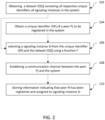
- the load balancing method comprises the following steps.
- step 102 the load balancer L obtains a dataset IDS[] consisting of respective unique identifiers of signaling instances present in the signaling system 1, and sent by the instance manager (since said instances have been added by the instance manager M).
- step 104 the load balancer L obtains a unique identifier IDPj of a peer Pj which needs to be registered in the signaling system 1.
- the load balancer L considers that a peer Pj needs to be registered when the load balancer L receives a registration request sent by the peer Pj (the unique identifier IDPj may be included in the registration request).
- the unique identifier IDPj of a peer Pj may for example be an address of the peer Pj, such as an IP address thereof.
- Steps 102 and 104 may be performed in any order.
- the load balancer L selects a signaling instance Si among signaling instances, by applying the deterministic function F to the unique identifier IDPj of the peer Pj obtained at step 104, and to the dataset IDS[] received at step 102.
- the function F actually outputs the unique identifier IDSi of the signaling instance Si, thereby selecting said instance Si. It can also be considered that F actually "assigns" the peer Pj to the signaling instance Si.
- Step 106 may be triggered in different manners.
- step 106 is performed upon obtaining the unique identifier IDPj, and the dataset IDS[] used in step 106 is the last dataset received by the load balancer. This dataset may have been obtained by the load balancer before obtaining the unique identifier IDPj, and even before receiving a request of registration of peer Pj. In another embodiment, such a registration is received, then the load balancer waits for a new dataset IDS[], then triggers step 106 upon receiving this new dataset IDS[]. This illustrates the fact that steps 102 and steps 104 are prerequisites for conducting step 106, which may occur in any order.
- step 108 the load balancer L establishes a communication channel between the peer Pj and the signaling system 1.
- the communication channel may be bidirectional.
- the main purpose of the communication channel is conveying messages from the signaling system 1 to the peer Pj (considered as a recipient of said messages).
- the communication channel may be also used for conveying messages from the peer Pj (considered as a source of said messages) to the signaling system 1.
- the communication channel actually comprises two subchannels arranged in series: an external subchannel between the peer Pj and the load balancer L, and an internal subchannel between the load balancer L and the signaling instance Si identified by the deterministic function F.
- the subchannel between the load balancer L and signaling instance is called “internal” because the load balancer L and the signaling instance are parts of the signaling system 1.
- the subchannel established between the load balancer L and the peers Pj is called an "external" channel to illustrate the fact that the peer Pj is not part of the signaling system 1.
- the two subchannels may be Websocket channels, especially if the standard web-compliant protocols are used.
- the load balancer L stores in a memory thereof information indicating that the peer Pj has been registered and assigned to the signaling instance Si selected by means of the function F.
- the load balancer L may store the unique identifier IDSj in association with the unique identifier IDPj of peer Pj in its memory. Such an association may for instance be obtained by a hashmap.
- the load balancer L may create as many internal subchannels to a signaling instance Si as there are peers registered to that instance. For instance, if both peers A and B were registered to S1, the load balancer L would have 2 internal subchannels to instance S1 (one for each peer). L choose not to reuse a single internal channel for multiple peers, even if they are registered to the same instance.
- the load balancer L obtains the dataset IDS[] at step 102.
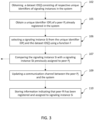
- the load balancer Upon obtaining the dataset IDS[], the load balancer triggers a step 105 wherein the load balancer L obtains the unique identifier IDPj of any peer already registered in the system 1. For that purpose, the load balancer L searches in its memory any information indicating that a peer has been registered and assigned to a signaling instance.
- the load balancer L performs the steps below for each registered peer Pj. From this point on, we assume that a peer Pj has been assigned to signaling instance Sk.
- Step 106 is performed for the peer Pj as explained before, based on the dataset IDS[] obtained at step 102 and based on the unique identifier IDPj found at step 105.
- the function F outputs signaling instance Si, as explained before.
- step 107 the load balancer L compares the signaling instance Si identified using the deterministic function F with the signaling instance Sk which was previously assigned to the peer Pj.
- the load balancer L updates the communication channel between the peer Pj and the signaling system 1 in step 109.
- This update comprises closing the internal subchannel previously added between the load balancer L and the signaling instance Sk, and opening a subchannel between the load balancer L and the signaling instance Si identified by the deterministic function F.
- step 110 i.e. stores in the memory thereof information indicating that the peer Pj has been registered and assigned to the signaling instance Si selected by means of the function F.
- step 109 the update step 109 is bypassed and the method repeats step 106 for any other peer already registered. If there is no registered peer left, the load balancer waits for receiving another dataset IDS[].
- the load balancer L detects that no peer has been registered so far, and detects that two peers A, B are to be registered.
- the unique identifier of peer A is IDPA
- the unique identifier of peer B is IDPB.
- the deterministic function F has assigned peer A to instance S1, and has assigned peer B to instance S2.
- a first communication channel is established between peer A and the signaling instance S1
- a second communication channel is established between peer B and the signaling instance S2 during the first iteration of the load balancing method.
- the instance manager M decides later to add a third signaling instance S3 in the signaling system 1.
- IDS[] [IDS1, IDS2, IDS3]
- the function F has assigned peer A to instance S1, and has assigned peer B to instance S3, which is different from instance S2.
- the first communication channel established between peer A and the signaling instance S1 is left as it is, and the second communication channel established between peer B and the signaling system 1 is updated at the second iteration, by closing the internal subchannel between the load balancer L and the signaling instance S2, and opening an internal subchannel between the load balancer L and the signaling instance S3.
- the signaling system 1 may be used for relaying messages between registered peers.
- any signaling instance Si added in the signaling system 1 is configured to perform a signaling method.
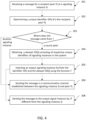
- This signaling method comprises the following steps shown in figure 3 .
- the signaling instance Si receives a message initially generated by a source peer.
- the message is intended for a recipient peer Pj.
- the message may comprise the unique identifier IDPj of the recipient peer Pj.
- the signaling instance Si determines the unique identifier IDPj of the recipient peer Pj based on the message it has received. If the unique identifier IDPj is included in the message, the first signaling instance S1 parses the message to extract it.
- the signaling instance Si obtains the dataset IDS[] indicating the signaling instances added in the signaling system 1, like in the step 102 performed by the load balancer L.
- steps 201, 202, 204 may be performed in any order.
- the signaling instance Si checks where the message comes from.
- the message may either come from a communication channel established between the source peer and the signaling instance Si or from another channel established between the signaling instance Si and another signaling instance of the signaling system 1.
- the signaling instance Si is the very first instance of the system 1 that has received the message. In this case, the signaling method goes to step 204.
- the signaling method goes to step 206.
- the signaling instance Si selects an output signaling instance Sq among the signaling instances of the signaling system 1, by applying the deterministic function F to the unique identifier IDPj of the recipient peer Pj and to the received dataset IDS[].
- the output signaling instance Sq is either the first input signaling instance Si or another signaling instance of the signaling system 1.
- the signaling method goes to step 206. If the output signaling instance Sq is not the signaling instance Si (Sq ⁇ Si), the signaling method goes to step 208.
- step 206 the signaling instance Si directly sends the message in a communication channel previously established between the signaling instance Si and the recipient peer Pj, without involving any further signaling instance of the system 1.
- step 208 the signaling instance Si sends the message to the output signaling instance Sq using internal communication means of the signaling system 1.
- This internal communication means may for instance be a network request using the HTTP protocol.
- the signaling instance Si determines whether the output signaling instance Sq is the first signaling instance or not before executing the function F at step 205.
- This piece of information may be obtained by checking whether the unique identifier of the recipient peer is present in a data structure specific to the first signaling instance, and wherein peers assigned to the signaling instance Si are listed.
- the data structure may be of any type : a list, hashset or hashmap, etc. If the recipient peer is found in the data structure, then the method may directly jump to step 206. If the recipient peer is not found in the data structure, then step 205 is performed.
- the signaling system 1 is used by a peer A trying to communicate with a peer B, for example in order to facilitate establishing a direct communication channel between peer A and B using the WebRTC protocol.
- the first peer A generates a message intended for the second peer B.
- the first peer A can be regarded as a source peer
- the second peer B can be regarded as a recipient peer.
- the message comprises the unique identifier IDB of the recipient peer B.
- the message comprises a request for a WebRTC connection between the peers A, B.
- the source peer A sends the message in the first communication channel established with the signaling system 1. It is further to be noted that the source peer A does not "see" the load balancer L, which acts as a proxy.
- the message is conveyed in the external subchannel of the first communication channel, then is conveyed in the internal subchannel of the first communication channel, and is thereby received by the first signaling instance S1 of the signaling system 1.
- the second signaling instance S2 performs as well the signaling method described above. Instance S2 detects that the message comes from another instance (S1). Thus, unlike S1, the second signaling instance S2 directly sends the message in the second communication channel previously established between S2 and the recipient peer B. Peer B is expected to have already previously registered to instance S2, therefore the second communication channel should already exist. If the second communication channel to peer 2 does not exist for some reason (for instance, a network error caused the communication channel to be closed), S2 will register an error (in the form of a textual error log for example) and drop the message.
- the message is conveyed in the internal subchannel of the second communication channel, then in the external subchannel of the second communication channel, and is thereby received by the recipient peer B.
- the second peer B processes the request contained in the message.
- the second peer B can ignore the request or respond to the request. If the second peer B chooses to respond to the request, the second peer B generates a new message intended for the first peer A, the new message comprising the unique identifier of the first peer A and a response to the request contained in the message received by peer B.
- the second peer B can be regarded as a source peer for the new message and the first peer A as a recipient peer for the new message.
- the second peer B sends the new message in the second communication channel.
- the signaling method described above is carried out by the second signaling instance S2.
- the second signaling instance S2 applies the deterministic function F as described above to the unique identifier IDA of the recipient peer A and the list IDS[], and function F outputs S1 from this input data, based on the assumption that IDS[] has not changed.
- the second signaling instance S2 reaches the conclusion that the first signaling instance S1 is in charge of directly sending the new message in a communication channel established with the recipient peer A.
- the same process as in the previous paragraph when S2 received the message from S1 is carried out as well by the first signaling instance S1 upon receiving the new message sent by the second signaling instance S2.
- the first signaling instance sends the new message in the first communication channel, then the recipient peer A receives the new message.
- the first peer A can then process the response contained in the new message, so as to establish a connection with the second peer B, for instance a WebRTC connection.
- the function F When the function F takes the form of the rendezvous hashing algorithm or the consistent hashing algorithm, the function F will tend to assign peers in an even manner between the instances referred in the dataset IDS[]. When the size of IDS[] increases (after the addition of at least one new instance), only a fraction representing on average 1/k all the peers will be assigned to a different instance (where k is the number of signaling instances).
- step 203 is optional: a given instance may then perform steps 204, 205 wherever the message comes from. As a consequence, an instance may run the deterministic function F even if it has received a message from another instance. This ensures a message will always end up finding a path to its recipient.
- the load balancing method performed by the load balancer is an advantageous addition to the signaling method performed by each signaling instance, whenever the system has a variable number of instances. Indeed, the function F may "decide" to reassign a registered peer to a different instance over time, in reaction to a change caused by the instance manager (addition of a new instance, or deletion of a running instance). In this context, the load balancing method ensures that a message will always find its way up to the recipient peer, while keeping the number of created subchannels reasonable and bounded.
Landscapes
- Engineering & Computer Science (AREA)
- Signal Processing (AREA)
- Computer Networks & Wireless Communication (AREA)
- Computer And Data Communications (AREA)
Priority Applications (2)
| Application Number | Priority Date | Filing Date | Title |
|---|---|---|---|
| EP23305276.0A EP4425890A1 (de) | 2023-03-02 | 2023-03-02 | Verfahren zur kommunikation zwischen einem peer und einem signalisierungssystem |
| US18/506,700 US12621713B2 (en) | 2023-03-02 | 2023-11-10 | Method of communication between a peer and a signaling system |
Applications Claiming Priority (1)
| Application Number | Priority Date | Filing Date | Title |
|---|---|---|---|
| EP23305276.0A EP4425890A1 (de) | 2023-03-02 | 2023-03-02 | Verfahren zur kommunikation zwischen einem peer und einem signalisierungssystem |
Publications (1)
| Publication Number | Publication Date |
|---|---|
| EP4425890A1 true EP4425890A1 (de) | 2024-09-04 |
Family
ID=85727168
Family Applications (1)
| Application Number | Title | Priority Date | Filing Date |
|---|---|---|---|
| EP23305276.0A Withdrawn EP4425890A1 (de) | 2023-03-02 | 2023-03-02 | Verfahren zur kommunikation zwischen einem peer und einem signalisierungssystem |
Country Status (2)
| Country | Link |
|---|---|
| US (1) | US12621713B2 (de) |
| EP (1) | EP4425890A1 (de) |
Citations (3)
| Publication number | Priority date | Publication date | Assignee | Title |
|---|---|---|---|---|
| US20110255675A1 (en) * | 2010-04-16 | 2011-10-20 | John Jasper | Cloud computing call centers |
| US20150006611A1 (en) * | 2013-06-30 | 2015-01-01 | Avaya Inc. | Back-to-back virtual web real-time communications (webrtc) agents, and related methods, systems, and computer-readable media |
| US20180006952A1 (en) * | 2014-12-24 | 2018-01-04 | Ntt Communications Corporation | Load distribution apparatus, load distribution method and program |
Family Cites Families (10)
| Publication number | Priority date | Publication date | Assignee | Title |
|---|---|---|---|---|
| US7613796B2 (en) * | 2002-09-11 | 2009-11-03 | Microsoft Corporation | System and method for creating improved overlay network with an efficient distributed data structure |
| US7627678B2 (en) * | 2003-10-20 | 2009-12-01 | Sony Computer Entertainment America Inc. | Connecting a peer in a peer-to-peer relay network |
| US7761569B2 (en) * | 2004-01-23 | 2010-07-20 | Tiversa, Inc. | Method for monitoring and providing information over a peer to peer network |
| CN101282281B (zh) * | 2007-04-03 | 2011-03-30 | 华为技术有限公司 | 一种媒体分发系统、装置及流媒体播放方法 |
| US9826044B2 (en) * | 2013-10-23 | 2017-11-21 | Qualcomm Incorporated | Peer-to-peer communication for symmetric NAT |
| US9775008B2 (en) * | 2015-01-14 | 2017-09-26 | Kodiak Networks, Inc. | System and method for elastic scaling in a push to talk (PTT) platform using user affinity groups |
| US10652340B2 (en) * | 2016-09-23 | 2020-05-12 | Apple Inc. | Quick relay interface and transport selection |
| US10735268B2 (en) * | 2017-04-21 | 2020-08-04 | System73 Ltd. | Predictive overlay network architecture |
| US10630739B2 (en) * | 2017-06-27 | 2020-04-21 | Atlassian Pty Ltd | Parallel peer to peer connection establishment in WebRTC conferencing |
| US10880342B2 (en) * | 2018-03-15 | 2020-12-29 | Jive Communications, Inc. | Dynamically controlling communication channels during a communication session |
-
2023
- 2023-03-02 EP EP23305276.0A patent/EP4425890A1/de not_active Withdrawn
- 2023-11-10 US US18/506,700 patent/US12621713B2/en active Active
Patent Citations (3)
| Publication number | Priority date | Publication date | Assignee | Title |
|---|---|---|---|---|
| US20110255675A1 (en) * | 2010-04-16 | 2011-10-20 | John Jasper | Cloud computing call centers |
| US20150006611A1 (en) * | 2013-06-30 | 2015-01-01 | Avaya Inc. | Back-to-back virtual web real-time communications (webrtc) agents, and related methods, systems, and computer-readable media |
| US20180006952A1 (en) * | 2014-12-24 | 2018-01-04 | Ntt Communications Corporation | Load distribution apparatus, load distribution method and program |
Also Published As
| Publication number | Publication date |
|---|---|
| US20240298214A1 (en) | 2024-09-05 |
| US12621713B2 (en) | 2026-05-05 |
Similar Documents
| Publication | Publication Date | Title |
|---|---|---|
| US10958519B2 (en) | Dynamic, load-based, auto-scaling network security microservices architecture | |
| US9369435B2 (en) | Method for providing authoritative application-based routing and an improved application firewall | |
| EP3281369B1 (de) | Serverlastausgleich | |
| CN105681217B (zh) | 用于容器集群的动态负载均衡方法及系统 | |
| CN109617996B (zh) | 文件上传及下载方法、服务器及计算机可读存储介质 | |
| US20200007445A1 (en) | Enhanced service function chain | |
| CN109831507B (zh) | 物联网系统、负载均衡方法和存储介质 | |
| EP3148125A1 (de) | Einstellverfahren, servervorrichtung und dienstkettensystem | |
| WO2019100921A1 (zh) | 消息推送方法及装置 | |
| CN109656688B (zh) | 一种实现分布式业务规则的方法、系统和服务器 | |
| CN113010313A (zh) | 一种负载均衡方法、装置、电子设备及计算机存储介质 | |
| CN107463390A (zh) | 一种软件升级方法及升级服务器 | |
| US9491067B2 (en) | Timeout for identifying network device presence | |
| US12621713B2 (en) | Method of communication between a peer and a signaling system | |
| US9154519B1 (en) | System and method for antivirus checking of objects from a plurality of virtual machines | |
| EP4425889A1 (de) | Verfahren zur signalisierung einer nachricht von einem peer zu einem anderen peer | |
| CN107547523A (zh) | 报文处理方法、装置、网络设备及机器可读存储介质 | |
| CN115580497A (zh) | 容器环境下数据传输控制方法、设备及存储介质 | |
| CN110830378B (zh) | 一种地址表项更新方法及交换设备 | |
| US12261760B2 (en) | Self-election processes in managed subnets implementing modified swim protocols | |
| CN111343110B (zh) | 报文处理方法、sdn交换机及计算机可读存储介质 | |
| CN112783673A (zh) | 一种调用链的确定方法、装置、计算机设备及存储介质 | |
| CN108390822B (zh) | 路由发布方法和装置 | |
| WO2017001916A1 (en) | System and method for reacquiring a running service after restarting a configurable platform instance | |
| US11595245B1 (en) | Computer network troubleshooting and diagnostics using metadata |
Legal Events
| Date | Code | Title | Description |
|---|---|---|---|
| PUAI | Public reference made under article 153(3) epc to a published international application that has entered the european phase |
Free format text: ORIGINAL CODE: 0009012 |
|
| STAA | Information on the status of an ep patent application or granted ep patent |
Free format text: STATUS: THE APPLICATION HAS BEEN PUBLISHED |
|
| AK | Designated contracting states |
Kind code of ref document: A1 Designated state(s): AL AT BE BG CH CY CZ DE DK EE ES FI FR GB GR HR HU IE IS IT LI LT LU LV MC ME MK MT NL NO PL PT RO RS SE SI SK SM TR |
|
| STAA | Information on the status of an ep patent application or granted ep patent |
Free format text: STATUS: THE APPLICATION IS DEEMED TO BE WITHDRAWN |
|
| 18D | Application deemed to be withdrawn |
Effective date: 20250305 |