EP4427672A1 - Procédé, dispositif et système de détection d'événements répétitifs distincts à partir de signaux - Google Patents
Procédé, dispositif et système de détection d'événements répétitifs distincts à partir de signaux Download PDFInfo
- Publication number
- EP4427672A1 EP4427672A1 EP23161315.9A EP23161315A EP4427672A1 EP 4427672 A1 EP4427672 A1 EP 4427672A1 EP 23161315 A EP23161315 A EP 23161315A EP 4427672 A1 EP4427672 A1 EP 4427672A1
- Authority
- EP
- European Patent Office
- Prior art keywords
- signal
- candidate
- candidates
- repetitive events
- amplitude
- Prior art date
- Legal status (The legal status is an assumption and is not a legal conclusion. Google has not performed a legal analysis and makes no representation as to the accuracy of the status listed.)
- Pending
Links
Images

Classifications
-
- A—HUMAN NECESSITIES
- A61—MEDICAL OR VETERINARY SCIENCE; HYGIENE
- A61B—DIAGNOSIS; SURGERY; IDENTIFICATION
- A61B5/00—Measuring for diagnostic purposes; Identification of persons
- A61B5/08—Measuring devices for evaluating the respiratory organs
- A61B5/0816—Measuring devices for examining respiratory frequency
-
- A—HUMAN NECESSITIES
- A61—MEDICAL OR VETERINARY SCIENCE; HYGIENE
- A61B—DIAGNOSIS; SURGERY; IDENTIFICATION
- A61B5/00—Measuring for diagnostic purposes; Identification of persons
- A61B5/72—Signal processing specially adapted for physiological signals or for diagnostic purposes
- A61B5/7235—Details of waveform analysis
Definitions
- the invitation relates to the field of determining events in a signal and thus to pattern recognition.
- the present invention relates to a method that detects at least two distinct repetitive events from a signal by comprising a candidate detection that selects respective candidates for the distinct repetitive event from the signal; a feature generation in which candidate features are captured; a state estimation that adjusts at least one internal state based on at least one candidate feature; and a candidate classification that determines the distinct repetitive events from the respective candidates based on at least one candidate feature and at least one internal state.
- the term "signal" refers to a discretely sampled time signal, preferably stored digitally. According to some embodiments of the present invention, this signal is a biomedical signal or a respiratory signal, such as the flow signal of a respiratory mask or a derived respiratory signal from easily measurable signals.
- the term "event” refers to the point in time of an underlying activity or process evident in the present signal, especially a peak or trough.
- the distinct repetitive events are instances of a repetitive cyclic/rhythmic process or activity, such as a respiratory or a cardiac cycle or part thereof.
- the terms cyclic or rhythmic refer to the repeated nature or patterned nature of the event and/or to a sequential property thereof, for example, an expected sequence of phases in a cardiac cycle, an expected sequence of a respiratory cycle, an expected sequence of a circadian cycle, or the like, that commonly form a pattern associated with the activity.
- Such a repeated event can be involuntary, for example, a cardiac cycle or an involuntary respiratory cycle, or at least partially voluntary, such as guided respiration activity.
- candidate refers to a point in time in the present signal that indicates a possible event.
- a candidate may be a possible event of only one of the distinct repetitive events, or from several, or all of them. In any case, there must be candidates for each of the distinct repetitive events.
- the term "feature” refers to an individual measurable property or characteristic of the candidates.
- a feature may be a direct property of the signal (e.g., a maximum or minimum amplitude value) or it may be indirectly derivable from the signal (e.g., properties derived by applying analytical, statistical or model-based methods to the signal).
- the candidate features are informative, discriminative as to whether or not they are true events, and independent of each other.
- an internal state refers to a variable that affects the behavior of the disclosed method but is not apparent from outside of the method.
- a method according to the present invention may implement a parameter-based fitting algorithm for the step of candidate classification.
- the parameters for the fitting algorithms may be preset and defined as an internal state of a method according to the present invention.
- at least one internal state i.e., at least one of the preset parameters, may be adjusted based on at least one candidate feature. Said candidate feature may thus have an actual effect on candidate classification.
- an internal state may also contain information about whether the event type of the last valid candidate was the expected event type.
- an internal state may refer to simple Boolean information or a more complex data structure.
- the distinct repetitive events occur consecutively, for instance as in respiratory peaks and troughs, wherein another respiratory peak may occur only after the occurrence of a respiratory trough.
- this property is used in feature generation or state estimation, for example, by generating a feature or internal state that contains information about whether the event type of the last valid candidate was the expected event type.
- the method continuously detects the distinct repetitive events from a continuously supplied signal, the signal being supplied either in single data points or in streams of multiple data points, possibly of different numbers (data points may be derived from an analog signal).
- this can be accomplished by basing candidate classification on candidate features and internal states at any point in time, which are generated from past and present information and thus do not depend on future signal components, advantageously resulting in online functionality.
- future signal components may also be used for candidate classification on candidate features and internal states, e.g., by applying predictive methods (analytical, statistical or model-based) to further analyze the past and present information of the signal.
- the candidate features are determined from at least one of the amplitude, time, type, and validity of the previous and current candidates.
- the candidate features are determined from all of the amplitude, time, type, and validity of the previous and current candidates.
- amplitude and time refer to the two values which are describing the candidate signal point, alternatively one could call this the "x" and “y” component of the candidates or the "value” and “timing” of the candidates or the like.
- the term "type" refers to the event type of the candidate. For example, for respiratory peaks and troughs, the type would refer to either a peak or a trough. It is also possible for a candidate to have multiple types or for the type to have multiple events as its value.
- validity refers to whether the candidate is a true event or not. In the case that the validity of the candidate has not yet been determined by the candidate classification, the value can also be undefined or a default value. In particular, validity may be represented by an internal state of the method according to the present invention as a Boolean variable.
- the candidate features that are determined from at least one or all of the amplitude, time, type, and validity of the previous and current candidates are thus not based on signal components outside the detected candidates, which means that these signal components or parts thereof can be erased from memory, which can also be referred to as resampling, downsampling or the like, which is advantageous for devices with limited memory.
- the candidate features that are determined from at least one or all of the amplitude, time, type and validity of the previous and current candidates may not be determined from all previous candidates, but rather from the last few candidates, which offers the possibility to remove the other previous candidates further in the past from memory, which is advantageous for devices with limited memory.
- At least one or all of the amplitude, time, type, and validity of a candidate are part of the candidate, so that feature generation is possible from the candidates rather than from the signal, and the signal or parts of it can be removed from memory.
- portions of the signal are erased from memory after candidate detection, while the candidates are retained, which is advantageous for devices with limited memory.
- the beneficial memory reduction can be achieved in the present invention by several means, all of which arise from the advantageous structure of the present method in this respect, and some of which have been previously explained.
- the candidate features comprise at least one or all of the amplitude, peak-to-trough amplitude, and time distance to previous candidates, which can all be generated from at least one or all of the amplitude, time, type, and validity of the previous and current candidates and thus again are not based on signal components outside the detected candidates which means that these signal components or parts thereof can be erased from memory, which is advantageous for devices with limited memory.
- the candidate features amplitude, peak-to-trough amplitude and time distance to previous candidates have a limited amount of complexity and thus in most implementations a small requirement to computational resources but a high content of information and discriminatory power as to whether or not the candidates are true events. The amount of complexity of signal and thus the requirement on memory and computational resources may thus be limited by at least partly reducing the signal to candidate features.
- the term "current candidate” refers to the candidate that is at this stage of the method in processing and coherently the term “previous candidates” refers to the candidates that were at an earlier stage of the method in processing.
- the entire method, and thus the generation of candidate features operates in temporal correspondence with the time signal, so that candidates that were in processing at a previous time are also candidates that have a previous time component.
- the entire method, and thus the feature generation operates in temporal correspondence with the time signal, so that candidates that were in processing at an earlier stage of the method are also candidates that have an earlier time point in the signal.
- peak-to-trough amplitude refers to the amplitude between a peak and a trough, where the current candidate is defined as one of the two and the other is at an earlier time in the signal.
- time distance refers to the distance with regards to the time component of the candidates, which is interchangeable with the expression “temporal distance”, “sample distance”, or “x distance” or the like.
- time distance to previous candidates refers to the amount of time, samples, or the like to one of the previous candidates. This could be the time distance of the current candidate to the last candidate or the second last candidate or to the last valid candidate or to the last candidate of the same type or to the last candidate of another type or to the last valid candidate of the same or another type, or the like or any combination thereof. All of these can be generated from at least one or all of the time, type, and validity of the previous and current candidates.
- the at least one internal state is physiologically interpretable, which is advantageous in terms of comprehensibility and often complexity, and therefore requires a small amount of computing resources in most implementations.
- physiologically interpretable internal states have a low degree of complexity in most cases.
- the at least one internal state comprises noise level and/or signal level, both of which are specifically favorable as they have a limited amount of complexity and thus in most implementations a small requirement to computational resources but a high content of information and discriminatory power as to whether or not the candidates are true events.
- the method is applied recursively to a portion of the signal, advantageously to a portion of the signal in which no event or not all events have been detected for some time.
- This can be particularly useful for highly variable signals where the amplitude or other characteristics change drastically and therefore the detection does not work adequately.
- the amplitude of the signal can change drastically and rapidly due to guided breathing or physical activity.
- Another aspect of the present invention relates to a device for data processing, comprising a signal input for receiving a signal; a memory; and a processor, configured for carrying out the steps of a method according to the present invention.
- signal input refers to an interface which allows the device to receive a signal, especially a biomedical signal.
- the interface can be a structural element (e.g., an electrical port or connection socket) or a virtual instance (e.g., an application programming interface, API, for connecting the device to a signal source component).
- the term "memory” refers to any type of volatile or non-volatile storage for storing information.
- the memory may be a virtual or cloud-based memory. It may be used to at least temporarily store the signal (or at least parts of the signal) and a representation of at least one internal state, a generated feature and/or a candidate classification.
- the memory may store an implementation of a method according to the present invention for being executed on a processor.
- processor particularly refers to an electric microprocessor which may be configured for carrying out the steps of a method according to the present invention.
- a codified representation of the steps of said method may be stored in the memory as machine or program code to be executed by the processor.
- a representation of the steps of said method may also be temporarily or permanently implemented in the processor, e.g., the processor may be a programmed FPGA or the like.
- Another aspect of the present invention discloses a system for detecting at least two distinct repetitive events, especially peaks and troughs, from a signal, comprising a device for data processing according to the present invention.
- the system may further comprise at least one sensors for acquiring a signal, especially a biological signal, and a battery for energy supply.
- the system may further comprise means for communicating with external devices, in particular means for wireless communication.
- Fig. 1 schematically illustrates a flow chart of a method according to the present invention. The steps of the method are shown as candidate detection 201, feature generation 202, state estimation 203 and candidate classification 204.
- a signal 100 such as a respiration signal, is provided to the method, and respiratory peaks and troughs are to be detected and returned as distinct repetitive events 300.
- bandpass filtering which is often a useful addition, but is not necessary for the method to work.
- preferably only causal filtering should be used, otherwise the online functionality of the method may be lost.
- candidates 210 for both respiratory peaks and troughs are detected, e.g., by detecting local extrema or by determining maxima and minima after zero crossings.
- the exact implementation of candidate detection 201 is interchangeable, as the present invention focuses on the evaluation of the detected candidates 210, and equivalent results can be obtained with many different candidate detections 201.
- the candidate detection 201 After the candidate detection 201, according to some embodiments, it is possible to erase portions of the signal 100 from memory, while the candidates 210 are retained. There might be various reasons though not to keep only the data points of the candidates 210, for example, it makes sense to keep a certain amount of signal in memory because of the implementation of online filters, but this amount is relatively small, depending on filter type and parameters. Similarly, the start and end points of breaths and thus between respiratory peaks and troughs and thus definitely outside the data points of the candidates 210 may be of interest. However, depending on the application and implementation, a large reduction in the amount of required memory is possible.
- candidate features 220 are detected within the step of feature generation 202.
- the candidate features 220 are determined from at least one or all of the amplitude, time, type and validity of the previous and current candidates 210.
- the features could comprise at least one or all of the amplitude of the current candidate, the peak-to-valley amplitude, generated from the amplitude of the current candidate and the amplitude of the previous candidate with a different candidate type than the current candidate, and the time distance to the previous candidate, generated from the time of the current candidate and the time of the last previous candidate or the last previous candidate with a different candidate type than the current candidate.
- the step of state estimation 203 follows, in which the internal states 230 are adjusted based on the candidate features 220.
- the internal states 220 may be adjusted in a variety of ways.
- the internal states 220 comprise the noise level and the signal level that attempt to estimate the amplitude level of the noise of the provided signal 100 and the amplitude level of at least one of the distinct repetitive events 300, such as the respiratory peaks. It is also possible to generate a threshold level from these signal and noise levels as a further internal state 220.
- the internal states 220 may be exemplarily adjusted using a leaky update mechanism that, depending on the validity of the previous candidates, either leakily decreases its state or adjusts its value in a weighted manner.
- the distinct repetitive events 300 are determined and returned from the candidates 210 based on the candidate features 220 and the internal states 230. For this purpose, it might be useful to compare some candidate features 220 with some internal states 230 and decide according to this relationship whether the respective candidate 210 is a distinct repetitive event 300 or not.
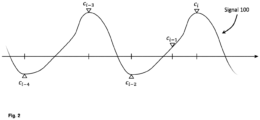
- Fig. 2 schematically illustrates a portion of a signal 100 with some candidates 210 according to some embodiments of the present invention.
- the current candidate in process in the current phase of the procedure is called candidate c i . Consequently, the previous candidates are labeled c i -1 , c i -2 , c i - 3 , and c i -4 .
- validity is undetermined for c i and invalid for c i -1 and valid for c i -2 , c i -3 , and c i -4 , and type being peak for c i , c i -1 , and c i -3 and trough for c i -2 and c i -4 .
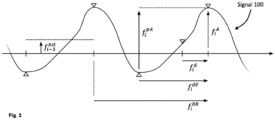
- the generated features comprise amplitude and temporal features.
- the amplitude features comprise for the current candidate c i the candidate's amplitude fi A and peak to trough amplitude f i pA , where the current candidate c i is the peak and the last valid candidate of the opposite type is c i -2 .
- the temporal features comprise the temporal distance to the last candidate f i d and the temporal distance to the last valid candidate f i dV and the temporal distance to the last valid candidate of the same type as the current candidate f i RR . Additionally there is the mean of the amplitudes between two opposite types as local baseline feature f i ⁇ 3 bsl , in this example for the candidate c i -3 .
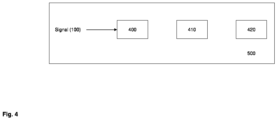
- the device 500 comprises a signal input 400 for receiving a signal 100; a memory 410; and a processor 420, configured for carrying out the steps of the method according to the present invention.
Landscapes
- Health & Medical Sciences (AREA)
- Life Sciences & Earth Sciences (AREA)
- Engineering & Computer Science (AREA)
- Surgery (AREA)
- Animal Behavior & Ethology (AREA)
- Pulmonology (AREA)
- Veterinary Medicine (AREA)
- Physics & Mathematics (AREA)
- Public Health (AREA)
- Biophysics (AREA)
- Pathology (AREA)
- Biomedical Technology (AREA)
- Heart & Thoracic Surgery (AREA)
- Medical Informatics (AREA)
- Molecular Biology (AREA)
- General Health & Medical Sciences (AREA)
- Physiology (AREA)
- Artificial Intelligence (AREA)
- Computer Vision & Pattern Recognition (AREA)
- Signal Processing (AREA)
- Psychiatry (AREA)
- Measurement Of The Respiration, Hearing Ability, Form, And Blood Characteristics Of Living Organisms (AREA)
- Image Analysis (AREA)
Priority Applications (3)
| Application Number | Priority Date | Filing Date | Title |
|---|---|---|---|
| EP23161315.9A EP4427672A1 (fr) | 2023-03-10 | 2023-03-10 | Procédé, dispositif et système de détection d'événements répétitifs distincts à partir de signaux |
| CN202480007013.3A CN120693102A (zh) | 2023-03-10 | 2024-03-07 | 用于从信号中检测不同重复事件的方法、装置和系统 |
| PCT/EP2024/056103 WO2024188827A1 (fr) | 2023-03-10 | 2024-03-07 | Procédé, dispositif et système de détection d'événements répétitifs distincts à partir de signaux |
Applications Claiming Priority (1)
| Application Number | Priority Date | Filing Date | Title |
|---|---|---|---|
| EP23161315.9A EP4427672A1 (fr) | 2023-03-10 | 2023-03-10 | Procédé, dispositif et système de détection d'événements répétitifs distincts à partir de signaux |
Publications (1)
| Publication Number | Publication Date |
|---|---|
| EP4427672A1 true EP4427672A1 (fr) | 2024-09-11 |
Family
ID=85571404
Family Applications (1)
| Application Number | Title | Priority Date | Filing Date |
|---|---|---|---|
| EP23161315.9A Pending EP4427672A1 (fr) | 2023-03-10 | 2023-03-10 | Procédé, dispositif et système de détection d'événements répétitifs distincts à partir de signaux |
Country Status (3)
| Country | Link |
|---|---|
| EP (1) | EP4427672A1 (fr) |
| CN (1) | CN120693102A (fr) |
| WO (1) | WO2024188827A1 (fr) |
Citations (5)
| Publication number | Priority date | Publication date | Assignee | Title |
|---|---|---|---|---|
| WO2000021438A1 (fr) * | 1998-10-15 | 2000-04-20 | University Of Florida Research Foundation | Dispositif de determination du rythme respiratoire a partir d'un plethysmogramme |
| US20120253216A1 (en) * | 2011-03-30 | 2012-10-04 | Yongji Fu | Respiration analysis using acoustic signal trends |
| US20130345585A1 (en) * | 2011-03-11 | 2013-12-26 | Koninklijke Philips N.V. | Monitoring apparatus for monitoring a physiological signal |
| US20190029626A1 (en) * | 2017-07-31 | 2019-01-31 | Shanghai United Imaging Healthcare Co., Ltd. | Systems and methods for motion signal correction |
| CN114938951A (zh) * | 2022-05-31 | 2022-08-26 | 南京佗道医疗科技有限公司 | 一种呼吸数据处理方法 |
-
2023
- 2023-03-10 EP EP23161315.9A patent/EP4427672A1/fr active Pending
-
2024
- 2024-03-07 WO PCT/EP2024/056103 patent/WO2024188827A1/fr not_active Ceased
- 2024-03-07 CN CN202480007013.3A patent/CN120693102A/zh active Pending
Patent Citations (5)
| Publication number | Priority date | Publication date | Assignee | Title |
|---|---|---|---|---|
| WO2000021438A1 (fr) * | 1998-10-15 | 2000-04-20 | University Of Florida Research Foundation | Dispositif de determination du rythme respiratoire a partir d'un plethysmogramme |
| US20130345585A1 (en) * | 2011-03-11 | 2013-12-26 | Koninklijke Philips N.V. | Monitoring apparatus for monitoring a physiological signal |
| US20120253216A1 (en) * | 2011-03-30 | 2012-10-04 | Yongji Fu | Respiration analysis using acoustic signal trends |
| US20190029626A1 (en) * | 2017-07-31 | 2019-01-31 | Shanghai United Imaging Healthcare Co., Ltd. | Systems and methods for motion signal correction |
| CN114938951A (zh) * | 2022-05-31 | 2022-08-26 | 南京佗道医疗科技有限公司 | 一种呼吸数据处理方法 |
Non-Patent Citations (2)
| Title |
|---|
| CHAN ALEXANDER M ET AL: "Ambulatory respiratory rate detection using ECG and a triaxial accelerometer", ENGINEERING IN MEDICINE AND BIOLOGY SOCIETY (EMBC), 2013 34TH ANNUAL INTERNATIONAL CONFERENCE OF THE IEEE, IEEE, 3 July 2013 (2013-07-03), pages 4058 - 4061, XP032489033, ISSN: 1557-170X, [retrieved on 20130925], DOI: 10.1109/EMBC.2013.6610436 * |
| DALUWATTE CHATHURI ET AL: "A robust detection algorithm to identify breathing peaks in respiration signals from spontaneously breathing subjects", COMPUTING IN CARDIOLOGY, N/A, 6 September 2015 (2015-09-06), pages 297 - 300, XP032865145, ISSN: 2325-8861, ISBN: 978-1-4799-0884-4, [retrieved on 20160216], DOI: 10.1109/CIC.2015.7408645 * |
Also Published As
| Publication number | Publication date |
|---|---|
| CN120693102A (zh) | 2025-09-23 |
| WO2024188827A1 (fr) | 2024-09-19 |
Similar Documents
| Publication | Publication Date | Title |
|---|---|---|
| US9659216B2 (en) | Method, computer program, and system for automated real-time signal analysis for detection, quanitification, and prediction of signal changes | |
| EP3822830B1 (fr) | Procédé et dispositif de traitement de caractéristiques d'une trajectoire de mouvement et support d'informations informatique | |
| CN109584266A (zh) | 一种目标检测方法及装置 | |
| CN111150392A (zh) | 一种有向动态脑功能网络多类情绪识别构建方法及其装置 | |
| US20200268270A1 (en) | Apparatus and method for predicting disease | |
| EP3327613A1 (fr) | Procédé, appareil et dispositif terminal d'entrée d'empreintes digitales | |
| CN111671420A (zh) | 一种从静息态脑电数据中提取特征的方法及终端设备 | |
| CN113647959B (zh) | 一种心电波形信号的波形识别方法、装置及设备 | |
| CN110689885A (zh) | 机器合成语音识别方法、装置、存储介质及电子设备 | |
| CN119888788A (zh) | 一种牙齿点云数据的用户身份识别方法和装置 | |
| CN120892917A (zh) | 一种基于多域特征融合的脑电信号eeg分类方法 | |
| CN118902475A (zh) | 一种eeg信号伪迹剔除方法、装置及相关设备 | |
| CN109492602B (zh) | 一种基于人体肢体语言的工序计时方法及系统 | |
| CN114795247A (zh) | 脑电信号分析方法、装置、电子设备和存储介质 | |
| EP4427672A1 (fr) | Procédé, dispositif et système de détection d'événements répétitifs distincts à partir de signaux | |
| Kumar et al. | Improving the performance of speech recognition feature selection using northern goshawk optimization | |
| CN115359066B (zh) | 用于内窥镜的病灶检测方法、装置、电子设备及存储介质 | |
| CN109697447A (zh) | 基于随机森林的分类模型构建装置、方法及电子设备 | |
| CN120493160B (zh) | Ac/dc整流模块的质量智能分析方法及系统 | |
| CN109063652B (zh) | 一种信号处理方法、系统及计算机存储介质 | |
| CN114495292A (zh) | 身份识别方法、装置、设备及可读存储介质 | |
| CN118806298B (zh) | 一种普适环境中脑电信号的自适应去噪方法 | |
| CN118395245B (zh) | 基于黎曼流形的实时脑电信号自适应分类方法及系统 | |
| CN119235325A (zh) | 基于深度学习的多任务心电图分析方法、系统及介质 | |
| CN109840511A (zh) | 一种信号分类方法、终端及存储介质 |
Legal Events
| Date | Code | Title | Description |
|---|---|---|---|
| PUAI | Public reference made under article 153(3) epc to a published international application that has entered the european phase |
Free format text: ORIGINAL CODE: 0009012 |
|
| STAA | Information on the status of an ep patent application or granted ep patent |
Free format text: STATUS: REQUEST FOR EXAMINATION WAS MADE |
|
| 17P | Request for examination filed |
Effective date: 20230929 |
|
| AK | Designated contracting states |
Kind code of ref document: A1 Designated state(s): AL AT BE BG CH CY CZ DE DK EE ES FI FR GB GR HR HU IE IS IT LI LT LU LV MC ME MK MT NL NO PL PT RO RS SE SI SK SM TR |
|
| STAA | Information on the status of an ep patent application or granted ep patent |
Free format text: STATUS: EXAMINATION IS IN PROGRESS |
|
| 17Q | First examination report despatched |
Effective date: 20250813 |