EP4428068A1 - Un appareil et une méthode pour former des groupes de produits - Google Patents
Un appareil et une méthode pour former des groupes de produits Download PDFInfo
- Publication number
- EP4428068A1 EP4428068A1 EP24161078.1A EP24161078A EP4428068A1 EP 4428068 A1 EP4428068 A1 EP 4428068A1 EP 24161078 A EP24161078 A EP 24161078A EP 4428068 A1 EP4428068 A1 EP 4428068A1
- Authority
- EP
- European Patent Office
- Prior art keywords
- products
- grouping
- product
- group
- transport direction
- Prior art date
- Legal status (The legal status is an assumption and is not a legal conclusion. Google has not performed a legal analysis and makes no representation as to the accuracy of the status listed.)
- Pending
Links
- 238000000034 method Methods 0.000 title claims description 9
- 238000011144 upstream manufacturing Methods 0.000 claims description 17
- 230000001133 acceleration Effects 0.000 claims description 4
- 230000005540 biological transmission Effects 0.000 claims description 3
- 238000004806 packaging method and process Methods 0.000 description 9
- 235000013305 food Nutrition 0.000 description 3
- 230000015572 biosynthetic process Effects 0.000 description 2
- 235000015895 biscuits Nutrition 0.000 description 2
- 238000010276 construction Methods 0.000 description 1
- 125000004122 cyclic group Chemical class 0.000 description 1
- 230000000717 retained effect Effects 0.000 description 1
Images



Classifications
-
- B—PERFORMING OPERATIONS; TRANSPORTING
- B65—CONVEYING; PACKING; STORING; HANDLING THIN OR FILAMENTARY MATERIAL
- B65G—TRANSPORT OR STORAGE DEVICES, e.g. CONVEYORS FOR LOADING OR TIPPING, SHOP CONVEYOR SYSTEMS OR PNEUMATIC TUBE CONVEYORS
- B65G47/00—Article or material-handling devices associated with conveyors; Methods employing such devices
- B65G47/02—Devices for feeding articles or materials to conveyors
- B65G47/04—Devices for feeding articles or materials to conveyors for feeding articles
- B65G47/06—Devices for feeding articles or materials to conveyors for feeding articles from a single group of articles arranged in orderly pattern, e.g. workpieces in magazines
- B65G47/08—Devices for feeding articles or materials to conveyors for feeding articles from a single group of articles arranged in orderly pattern, e.g. workpieces in magazines spacing or grouping the articles during feeding
- B65G47/082—Devices for feeding articles or materials to conveyors for feeding articles from a single group of articles arranged in orderly pattern, e.g. workpieces in magazines spacing or grouping the articles during feeding grouping articles in rows
-
- B—PERFORMING OPERATIONS; TRANSPORTING
- B65—CONVEYING; PACKING; STORING; HANDLING THIN OR FILAMENTARY MATERIAL
- B65G—TRANSPORT OR STORAGE DEVICES, e.g. CONVEYORS FOR LOADING OR TIPPING, SHOP CONVEYOR SYSTEMS OR PNEUMATIC TUBE CONVEYORS
- B65G47/00—Article or material-handling devices associated with conveyors; Methods employing such devices
- B65G47/22—Devices influencing the relative position or the attitude of articles during transit by conveyors
- B65G47/26—Devices influencing the relative position or the attitude of articles during transit by conveyors arranging the articles, e.g. varying spacing between individual articles
- B65G47/261—Accumulating articles
-
- B—PERFORMING OPERATIONS; TRANSPORTING
- B65—CONVEYING; PACKING; STORING; HANDLING THIN OR FILAMENTARY MATERIAL
- B65G—TRANSPORT OR STORAGE DEVICES, e.g. CONVEYORS FOR LOADING OR TIPPING, SHOP CONVEYOR SYSTEMS OR PNEUMATIC TUBE CONVEYORS
- B65G47/00—Article or material-handling devices associated with conveyors; Methods employing such devices
- B65G47/22—Devices influencing the relative position or the attitude of articles during transit by conveyors
- B65G47/26—Devices influencing the relative position or the attitude of articles during transit by conveyors arranging the articles, e.g. varying spacing between individual articles
- B65G47/30—Devices influencing the relative position or the attitude of articles during transit by conveyors arranging the articles, e.g. varying spacing between individual articles during transit by a series of conveyors
- B65G47/32—Applications of transfer devices
-
- B—PERFORMING OPERATIONS; TRANSPORTING
- B65—CONVEYING; PACKING; STORING; HANDLING THIN OR FILAMENTARY MATERIAL
- B65G—TRANSPORT OR STORAGE DEVICES, e.g. CONVEYORS FOR LOADING OR TIPPING, SHOP CONVEYOR SYSTEMS OR PNEUMATIC TUBE CONVEYORS
- B65G47/00—Article or material-handling devices associated with conveyors; Methods employing such devices
- B65G47/74—Feeding, transfer, or discharging devices of particular kinds or types
- B65G47/84—Star-shaped wheels or devices having endless travelling belts or chains, the wheels or devices being equipped with article-engaging elements
- B65G47/841—Devices having endless travelling belts or chains equipped with article-engaging elements
-
- B—PERFORMING OPERATIONS; TRANSPORTING
- B65—CONVEYING; PACKING; STORING; HANDLING THIN OR FILAMENTARY MATERIAL
- B65G—TRANSPORT OR STORAGE DEVICES, e.g. CONVEYORS FOR LOADING OR TIPPING, SHOP CONVEYOR SYSTEMS OR PNEUMATIC TUBE CONVEYORS
- B65G47/00—Article or material-handling devices associated with conveyors; Methods employing such devices
- B65G47/22—Devices influencing the relative position or the attitude of articles during transit by conveyors
- B65G47/26—Devices influencing the relative position or the attitude of articles during transit by conveyors arranging the articles, e.g. varying spacing between individual articles
- B65G47/28—Devices influencing the relative position or the attitude of articles during transit by conveyors arranging the articles, e.g. varying spacing between individual articles during transit by a single conveyor
- B65G47/29—Devices influencing the relative position or the attitude of articles during transit by conveyors arranging the articles, e.g. varying spacing between individual articles during transit by a single conveyor by temporarily stopping movement
-
- B—PERFORMING OPERATIONS; TRANSPORTING
- B65—CONVEYING; PACKING; STORING; HANDLING THIN OR FILAMENTARY MATERIAL
- B65G—TRANSPORT OR STORAGE DEVICES, e.g. CONVEYORS FOR LOADING OR TIPPING, SHOP CONVEYOR SYSTEMS OR PNEUMATIC TUBE CONVEYORS
- B65G47/00—Article or material-handling devices associated with conveyors; Methods employing such devices
- B65G47/74—Feeding, transfer, or discharging devices of particular kinds or types
- B65G47/88—Separating or stopping elements, e.g. fingers
- B65G47/8876—Separating or stopping elements, e.g. fingers with at least two stops acting as gates
- B65G47/8892—Stops acting independently of each other
Definitions
- the present invention relates in general to the formation of groups of products.
- the invention was developed particularly with a view to its application to the sector of automatic packaging of products, for example, food products.
- the invention is applicable in particular to the packaging of groups of products in flow-pack packages.
- the products to be packaged are often fed towards a packaging machine via a product conveyor along which the products are aligned with each other in an array.
- the product conveyor has a plurality of pushers moved by a chain, and each product is pushed in the direction of advancement by a respective pusher.
- the individual products may be spaced apart in the direction of advancement.
- EP-A-1136400 by the same applicant describes a method for forming groups of products which envisages in a coordinated way:
- a limitation of this known solution is represented by the high speeds and accelerations which the grouping element must have to move cyclically downstream and upstream of each group of products in very short times.
- the dynamics of the grouping element causes stress both on the actuators that control the movement of the grouping element and on the products.
- the high-speed impact of the grouping element against the products may pose risks of damaging the products, especially in the case of delicate food products such as biscuits, bars or the like.
- the object of the present invention is to provide an apparatus and a method for forming groups of products that overcome the problems of the prior art.
- the object of the invention is to provide an apparatus and a method for forming groups of products which, starting from a single array of products or stacks of products, can form groups of products in contact with each other, avoiding the risk of compromising the integrity of the products.
- this object is achieved by an apparatus and a method for forming groups of products having the characteristics forming the subject of claims 1 and 7.
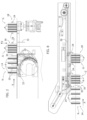
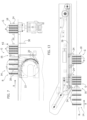
- numeral 10 indicates an apparatus for forming groups of products to be fed to a packaging machine 12, for example, a flow-pack packaging machine, illustrated only schematically in Figure 1 .
- the apparatus 10 comprises a product conveyor 14, a grouping device 16 and a product group conveyor 18.
- the product conveyor 14 is configured to advance an array R of products P along a transport direction X.
- the product conveyor 14 may comprise a plurality of pushers 20 moved by a common transmission member 22, formed for example by a chain. Each of the pushers 20 may advance a respective product P along the transport direction X. In the array R the individual products P may be spaced apart from each other in the transport direction X.
- the grouping device 16 is arranged downstream of the product conveyor 14 and upstream of the group conveyor 18, and is configured to form groups of products G, each of which is made up of a plurality of products P placed in contact with each other in the transport direction X.
- the group conveyor 18 is configured to feed the groups of products G to the packaging machine 12 in a feed direction, which may coincide with the transport direction X.
- the group conveyor 18 may comprise a plurality of pairs of transport elements 24 driven by a common transmission member 26, formed for example by a chain.
- the transport elements 24 of each pair are arranged downstream and upstream of each group of products G, and hold the respective group of products G during movement in the feed direction.
- the grouping device 16 comprises a first and a second grouping element 30, 32, movable cyclically in a mutually coordinated manner between a first operating position in which the first grouping element 30 is located downstream of a group of products G, and the second grouping element 32 is inserted between an upstream product of the same group of products G and a downstream product P of the array R, and a second operating position in which the second grouping element 32 is located downstream of a group of products G, and the first grouping element 30 is inserted between an upstream product of the same group of products G and a downstream product P of the array R.
- the reference to the downstream and upstream positions is relative to the transport direction X.
- the first and second grouping elements 30, 32 cyclically reverse their operating positions. More specifically, in a first step, the first grouping element 30 is in contact with a downstream product of a group of products G and the second grouping element 32 is inserted between an upstream product of the same group of products G and a downstream product of a subsequent group of products G. In an immediately subsequent step, the operating positions of the first and second grouping elements 30, 32 are reversed and the second grouping element 32 is in contact with a downstream product of a group of products G and the first grouping element 30 is inserted between an upstream product of the same group of products G and a downstream product of a subsequent group of products G.
- Each grouping element 30, 32 may have two or more prongs parallel to each other.
- each grouping element 30, 32 has the shape of a fork with two vertical prongs.
- the first and second grouping elements 30, 32 may be movable with variable speeds and accelerations in the transport direction X independently from each other.
- the first and second grouping elements 30, 32 may also be movable in a direction Z orthogonal to the transport direction X independently from each other.
- the transport direction X is horizontal and the direction Z is vertical.
- the directions X and Z could have different orientations from those illustrated in the figures.
- the grouping device 16 may comprise a first, a second, a third and a fourth actuator device 34, 36, 38, 40.
- the first actuator device 34 controls the movement in the transport direction X of the first grouping element 30
- the second actuator device 36 controls the movement in the transport direction X of the second grouping element 32
- the third actuator device 38 controls the movement in the direction Z of the first grouping element 30
- the fourth actuator device 40 controls the movement in the direction Z of the second grouping element 32.
- the first, second, third and fourth actuator devices 34, 36, 38, 40 may be equipped with respective motors independent from each other, so that the movements in the directions X and Z of each of the grouping elements 30, 32 are independent from each other.
- Figures 2 and 8 show the step of the operating cycle of the apparatus 10 in which the composition of a new group of products G begins.
- the groups of products G already previously formed are retained between pairs of transport elements 24 of the group conveyor 18 and are fed in the feed direction towards the packaging machine.
- the first grouping element 30 is inserted downstream of the downstream product P of the array of products R with a movement from bottom to top in the vertical direction Z.
- the first grouping element 30 moves in the transport direction X at a speed lower than the speed at which the products P of the array R advance in the transport direction X. Then, the downstream product of the array of products R contacts the first grouping element 30 and slows to the speed of the first grouping element 30. The subsequent products P come into contact with the previous products and slow down to the advancing speed of the first grouping element 30.
- the pusher elements 20 of the product conveyor 14 disengage from the products P with a movement from top to bottom as the products P come into contact with previous products or with the first grouping element 30.
- the pusher elements 20 may be inclined as illustrated in Figures 2-7 to facilitate disengagement from the products P.
- Figures 3, 9 and 4, 10 show the steps wherein a new group of products G is being formed.
- the second grouping element 32 is located below the support surface of the products P and moves in the opposite direction to the transport direction X of the products P.
- the second grouping element 32 is inserted with a movement from bottom to top in the vertical direction Z between the upstream product of the newly completed group of products G and the downstream product P of the array of products R.
- the second grouping element 32 moves in the transport direction X with a speed greater than that of the first grouping element 30 so as to compact the group of products G just completed between the first and the second grouping element 32 as illustrated in Figures 6 and 12 .
- the downstream product of the newly completed group of products G comes into contact with one of the transport elements 24 of the group conveyor 18 and the first grouping element 30 disengages from the group of products G with a movement from top to bottom and goes below the support surface of the products P.
- the second grouping element 32 slows down and the downstream product of the array R comes into contact with the second grouping element 32 to begin the formation of a new group of products G.
- the first grouping element is located below the support surface of the products P and moves in the opposite direction to the transport direction X of the products.
- the first grouping element 32 is inserted with a movement from bottom to top in the vertical direction Z between the upstream product of the group of products G just completed and the downstream product P of the array of products R to start a new cycle.
- This cyclic inversion of the operating positions of the first and second grouping elements 30, 32 avoids high-speed impacts between the grouping elements 30, 32 and the products P, and avoids risks of damaging the products even when the products advance at very high speeds and in the case of fragile products.
Landscapes
- Engineering & Computer Science (AREA)
- Mechanical Engineering (AREA)
- Attitude Control For Articles On Conveyors (AREA)
Applications Claiming Priority (1)
| Application Number | Priority Date | Filing Date | Title |
|---|---|---|---|
| IT202300004143 | 2023-03-07 |
Publications (1)
| Publication Number | Publication Date |
|---|---|
| EP4428068A1 true EP4428068A1 (fr) | 2024-09-11 |
Family
ID=86468966
Family Applications (1)
| Application Number | Title | Priority Date | Filing Date |
|---|---|---|---|
| EP24161078.1A Pending EP4428068A1 (fr) | 2023-03-07 | 2024-03-04 | Un appareil et une méthode pour former des groupes de produits |
Country Status (1)
| Country | Link |
|---|---|
| EP (1) | EP4428068A1 (fr) |
Cited By (1)
| Publication number | Priority date | Publication date | Assignee | Title |
|---|---|---|---|---|
| CN119348904A (zh) * | 2024-11-15 | 2025-01-24 | 杭州永创智能设备股份有限公司 | 一种产品分组整理方法 |
Citations (6)
| Publication number | Priority date | Publication date | Assignee | Title |
|---|---|---|---|---|
| EP1136400A1 (fr) | 2000-03-13 | 2001-09-26 | CAVANNA S.p.A. | Méthode et dispositif de groupage d'objets sur un convoyeur, en particulier pour une ligne d'emballage automatisée |
| WO2006024460A1 (fr) * | 2004-09-02 | 2006-03-09 | Krones Ag | Dispositif de groupage de marchandises de detail |
| EP2021267A1 (fr) * | 2006-05-26 | 2009-02-11 | A.C.M.I. S.p.A. | Machine servant à regrouper des emballages |
| EP3013717A2 (fr) * | 2013-06-25 | 2016-05-04 | G.D Societa' per Azioni | Procédé et unité de regroupement pour la formation d'une ligne de produits sur une machine d'emballage |
| US20160229643A1 (en) * | 2012-01-18 | 2016-08-11 | Douglas Machine Inc. | Article metering apparatus, system & methods |
| US9580253B2 (en) * | 2015-06-09 | 2017-02-28 | The Procter & Gamble Company | Adjustable carriage for transporting articles of various sizes and a grouping apparatus comprising the same |
-
2024
- 2024-03-04 EP EP24161078.1A patent/EP4428068A1/fr active Pending
Patent Citations (6)
| Publication number | Priority date | Publication date | Assignee | Title |
|---|---|---|---|---|
| EP1136400A1 (fr) | 2000-03-13 | 2001-09-26 | CAVANNA S.p.A. | Méthode et dispositif de groupage d'objets sur un convoyeur, en particulier pour une ligne d'emballage automatisée |
| WO2006024460A1 (fr) * | 2004-09-02 | 2006-03-09 | Krones Ag | Dispositif de groupage de marchandises de detail |
| EP2021267A1 (fr) * | 2006-05-26 | 2009-02-11 | A.C.M.I. S.p.A. | Machine servant à regrouper des emballages |
| US20160229643A1 (en) * | 2012-01-18 | 2016-08-11 | Douglas Machine Inc. | Article metering apparatus, system & methods |
| EP3013717A2 (fr) * | 2013-06-25 | 2016-05-04 | G.D Societa' per Azioni | Procédé et unité de regroupement pour la formation d'une ligne de produits sur une machine d'emballage |
| US9580253B2 (en) * | 2015-06-09 | 2017-02-28 | The Procter & Gamble Company | Adjustable carriage for transporting articles of various sizes and a grouping apparatus comprising the same |
Cited By (1)
| Publication number | Priority date | Publication date | Assignee | Title |
|---|---|---|---|---|
| CN119348904A (zh) * | 2024-11-15 | 2025-01-24 | 杭州永创智能设备股份有限公司 | 一种产品分组整理方法 |
Similar Documents
| Publication | Publication Date | Title |
|---|---|---|
| CN110431095B (zh) | 用于从多个产品生产产品的批次的装置 | |
| EP2746165A1 (fr) | Dispositif pour saisir et transférer des produits individuels | |
| EP2417029B1 (fr) | Dispositif de delivrance en ligne a mouvement continu | |
| CN107249987B (zh) | 包装线速度降低的包装分组单元 | |
| EP4428068A1 (fr) | Un appareil et une méthode pour former des groupes de produits | |
| EP3013717B1 (fr) | Procédé et unité de regroupement pour la formation d'une ligne de produits sur une machine d'emballage | |
| EP2757045B1 (fr) | Dispositif de préhension et de transfert de produits individuels | |
| EP0030304A1 (fr) | Dispositif de rotation pour former des groupes uniformes d'articles, en particulier de carreaux | |
| CN109863089B (zh) | 用于扁平产品的份包装的方法和装置 | |
| EP3699099A1 (fr) | Procédé et système d'emballage de paquets | |
| EP2757044B1 (fr) | Dispositif pour saisir et transférer des produits individuels | |
| EP2199217B1 (fr) | Dispositif sélecteur de groupes d'objets pour alimenter des machines de conditionnement et procédé correspondant | |
| EP1270459B1 (fr) | Unité pour l'alimentation continue de séquences ordonneés de produits à une station de déchargement | |
| US6808062B2 (en) | Plant and method for orderly aligning products in rows along a packaging line | |
| EP2403783B1 (fr) | Installation permettant d'alimenter une machine de conditionnement en groupes de produits | |
| US20120199447A1 (en) | Traction device, particularly for products to be packaged | |
| US20210216947A1 (en) | Production of batches of products for palletizing in layers | |
| EP4421009A1 (fr) | Un appareil et une méthode pour former des groupes de produits | |
| EP1932783A1 (fr) | Groupe de manipulation et procédé pour la répartition et l'agencement d'objets de type et taille variables | |
| EP2403788B1 (fr) | Installation comprenant une navette de transfert destinée à amener des produits à une machine d'emballage | |
| EP1953090B1 (fr) | Dispositif pour former des groupes de produits | |
| US4083165A (en) | Stacking and transferring device for cellowrappers for cigarette packs | |
| EP3064456A1 (fr) | Système de déviation destiné à un appareil de distribution de produit à chemins multiples | |
| EP4124581B1 (fr) | Machine de scellement de coques et procédé d'emballage correspondant | |
| JP2022501289A (ja) | 品物をグループ分けするためのモーションシステム及び方法 |
Legal Events
| Date | Code | Title | Description |
|---|---|---|---|
| PUAI | Public reference made under article 153(3) epc to a published international application that has entered the european phase |
Free format text: ORIGINAL CODE: 0009012 |
|
| STAA | Information on the status of an ep patent application or granted ep patent |
Free format text: STATUS: THE APPLICATION HAS BEEN PUBLISHED |
|
| AK | Designated contracting states |
Kind code of ref document: A1 Designated state(s): AL AT BE BG CH CY CZ DE DK EE ES FI FR GB GR HR HU IE IS IT LI LT LU LV MC ME MK MT NL NO PL PT RO RS SE SI SK SM TR |
|
| STAA | Information on the status of an ep patent application or granted ep patent |
Free format text: STATUS: REQUEST FOR EXAMINATION WAS MADE |
|
| 17P | Request for examination filed |
Effective date: 20250120 |