EP4428073A1 - Procede et appareil pour la mise en oeuvre d'un changement de bobine de bande d'electrode pour la production de cellules electrochimiques - Google Patents
Procede et appareil pour la mise en oeuvre d'un changement de bobine de bande d'electrode pour la production de cellules electrochimiques Download PDFInfo
- Publication number
- EP4428073A1 EP4428073A1 EP23217489.6A EP23217489A EP4428073A1 EP 4428073 A1 EP4428073 A1 EP 4428073A1 EP 23217489 A EP23217489 A EP 23217489A EP 4428073 A1 EP4428073 A1 EP 4428073A1
- Authority
- EP
- European Patent Office
- Prior art keywords
- electrode web
- piece
- cutting
- retaining device
- retaining
- Prior art date
- Legal status (The legal status is an assumption and is not a legal conclusion. Google has not performed a legal analysis and makes no representation as to the accuracy of the status listed.)
- Pending
Links
Images







Classifications
-
- B—PERFORMING OPERATIONS; TRANSPORTING
- B65—CONVEYING; PACKING; STORING; HANDLING THIN OR FILAMENTARY MATERIAL
- B65H—HANDLING THIN OR FILAMENTARY MATERIAL, e.g. SHEETS, WEBS, CABLES
- B65H19/00—Changing the web roll
- B65H19/10—Changing the web roll in unwinding mechanisms or in connection with unwinding operations
- B65H19/18—Attaching, e.g. pasting, the replacement web to the expiring web
- B65H19/1842—Attaching, e.g. pasting, the replacement web to the expiring web standing splicing, i.e. the expiring web being stationary during splicing contact
- B65H19/1852—Attaching, e.g. pasting, the replacement web to the expiring web standing splicing, i.e. the expiring web being stationary during splicing contact taking place at a distance from the replacement roll
-
- B—PERFORMING OPERATIONS; TRANSPORTING
- B65—CONVEYING; PACKING; STORING; HANDLING THIN OR FILAMENTARY MATERIAL
- B65H—HANDLING THIN OR FILAMENTARY MATERIAL, e.g. SHEETS, WEBS, CABLES
- B65H35/00—Delivering articles from cutting or line-perforating machines; Article or web delivery apparatus incorporating cutting or line-perforating devices, e.g. adhesive tape dispensers
- B65H35/0006—Article or web delivery apparatus incorporating cutting or line-perforating devices
- B65H35/0073—Details
- B65H35/008—Arrangements or adaptations of cutting devices
- B65H35/0086—Arrangements or adaptations of cutting devices using movable cutting elements
-
- B—PERFORMING OPERATIONS; TRANSPORTING
- B65—CONVEYING; PACKING; STORING; HANDLING THIN OR FILAMENTARY MATERIAL
- B65H—HANDLING THIN OR FILAMENTARY MATERIAL, e.g. SHEETS, WEBS, CABLES
- B65H2301/00—Handling processes for sheets or webs
- B65H2301/40—Type of handling process
- B65H2301/46—Splicing
- B65H2301/461—Processing webs in splicing process
- B65H2301/4615—Processing webs in splicing process after splicing
- B65H2301/4617—Processing webs in splicing process after splicing cutting webs in splicing process
- B65H2301/46176—Processing webs in splicing process after splicing cutting webs in splicing process cutting both spliced webs simultaneously
-
- B—PERFORMING OPERATIONS; TRANSPORTING
- B65—CONVEYING; PACKING; STORING; HANDLING THIN OR FILAMENTARY MATERIAL
- B65H—HANDLING THIN OR FILAMENTARY MATERIAL, e.g. SHEETS, WEBS, CABLES
- B65H2301/00—Handling processes for sheets or webs
- B65H2301/40—Type of handling process
- B65H2301/46—Splicing
- B65H2301/462—Form of splice
- B65H2301/4622—Abutting article or web portions, i.e. edge to edge
-
- B—PERFORMING OPERATIONS; TRANSPORTING
- B65—CONVEYING; PACKING; STORING; HANDLING THIN OR FILAMENTARY MATERIAL
- B65H—HANDLING THIN OR FILAMENTARY MATERIAL, e.g. SHEETS, WEBS, CABLES
- B65H2301/00—Handling processes for sheets or webs
- B65H2301/40—Type of handling process
- B65H2301/46—Splicing
- B65H2301/463—Splicing splicing means, i.e. means by which a web end is bound to another web end
- B65H2301/4631—Adhesive tape
- B65H2301/46314—Pieces of adhesive tape, e.g. labels
-
- B—PERFORMING OPERATIONS; TRANSPORTING
- B65—CONVEYING; PACKING; STORING; HANDLING THIN OR FILAMENTARY MATERIAL
- B65H—HANDLING THIN OR FILAMENTARY MATERIAL, e.g. SHEETS, WEBS, CABLES
- B65H2301/00—Handling processes for sheets or webs
- B65H2301/40—Type of handling process
- B65H2301/46—Splicing
- B65H2301/464—Splicing effecting splice
- B65H2301/46412—Splicing effecting splice by element moving in a direction perpendicular to the running direction of the web
-
- B—PERFORMING OPERATIONS; TRANSPORTING
- B65—CONVEYING; PACKING; STORING; HANDLING THIN OR FILAMENTARY MATERIAL
- B65H—HANDLING THIN OR FILAMENTARY MATERIAL, e.g. SHEETS, WEBS, CABLES
- B65H2301/00—Handling processes for sheets or webs
- B65H2301/50—Auxiliary process performed during handling process
- B65H2301/51—Modifying a characteristic of handled material
- B65H2301/515—Cutting handled material
- B65H2301/5153—Details of cutting means
- B65H2301/51535—Details of cutting means adhesive tape or tab
-
- B—PERFORMING OPERATIONS; TRANSPORTING
- B65—CONVEYING; PACKING; STORING; HANDLING THIN OR FILAMENTARY MATERIAL
- B65H—HANDLING THIN OR FILAMENTARY MATERIAL, e.g. SHEETS, WEBS, CABLES
- B65H2801/00—Application field
- B65H2801/72—Fuel cell manufacture
-
- Y—GENERAL TAGGING OF NEW TECHNOLOGICAL DEVELOPMENTS; GENERAL TAGGING OF CROSS-SECTIONAL TECHNOLOGIES SPANNING OVER SEVERAL SECTIONS OF THE IPC; TECHNICAL SUBJECTS COVERED BY FORMER USPC CROSS-REFERENCE ART COLLECTIONS [XRACs] AND DIGESTS
- Y02—TECHNOLOGIES OR APPLICATIONS FOR MITIGATION OR ADAPTATION AGAINST CLIMATE CHANGE
- Y02E—REDUCTION OF GREENHOUSE GAS [GHG] EMISSIONS, RELATED TO ENERGY GENERATION, TRANSMISSION OR DISTRIBUTION
- Y02E60/00—Enabling technologies; Technologies with a potential or indirect contribution to GHG emissions mitigation
- Y02E60/10—Energy storage using batteries
-
- Y—GENERAL TAGGING OF NEW TECHNOLOGICAL DEVELOPMENTS; GENERAL TAGGING OF CROSS-SECTIONAL TECHNOLOGIES SPANNING OVER SEVERAL SECTIONS OF THE IPC; TECHNICAL SUBJECTS COVERED BY FORMER USPC CROSS-REFERENCE ART COLLECTIONS [XRACs] AND DIGESTS
- Y02—TECHNOLOGIES OR APPLICATIONS FOR MITIGATION OR ADAPTATION AGAINST CLIMATE CHANGE
- Y02P—CLIMATE CHANGE MITIGATION TECHNOLOGIES IN THE PRODUCTION OR PROCESSING OF GOODS
- Y02P70/00—Climate change mitigation technologies in the production process for final industrial or consumer products
- Y02P70/50—Manufacturing or production processes characterised by the final manufactured product
Definitions
- the present invention refers to a method and an apparatus relating to the production of an electric battery of the type usable in applications in which it is necessary to provide electric energy.
- the present invention relates to a method and apparatus for implementing a change of coil of electrode web for the production of electrochemical cells, in particular of the rechargeable type.
- Electrochemical cells are devices that convert chemical energy into electrical energy with a reversible redox reaction and that convert electrical energy into chemical energy by reversing said redox process.
- a primary or secondary electrical battery comprises one or more electrochemical cells connected to each other in series or in parallel.
- the electrochemical cells comprise a casing containing two electrodes, anode and cathode, separated by one or more electrolytic separators.
- the anode, the cathode and the separators are in the form of thin sheets or overlapping foils forming a multilayer, with the separators alternated to anode and cathode.
- the electrodes are composed of different materials.
- the electrodes comprise a thin metal layer, for example of copper or aluminium, which is coated on one side or both sides with an electrochemically active material.
- the electrodes may be composed of a polymeric binder, a conductive additive, and an electrochemically active material.
- the main function of the polymeric binder is to retain the active material together with the conductive additive.
- the separators instead consist, for example, of an electrically insulating polymeric membrane.
- the multilayer is composed of an anode, a cathode and two separator sheets alternately overlapped, wound in a winding, respectively cylindrical or prismatic, called “jelly roll” or “ Swiss roll”, and inserted into the cavity of a hollow container.
- the cathode is placed in electrical contact with an electrical pole placed on the bottom of the hollow container and electrically isolated from the container itself.
- the anode is placed in electrical contact with a cover which is placed to close the container and which creates a further electrical pole.
- the multilayer is composed of a single separator sheet folded multiple times to form several layers, between which one or more anode sheets and one or more cathode sheets are alternately interposed.
- the multilayer thus obtained is placed in a casing, for example an envelope, or "pouch", from which electrical terminals connected respectively to the anode or cathode sheets emerge.
- Examples of such applications are the lithium-ion rechargeable batteries, nickelcadmium rechargeable batteries and nickel-metal hydride rechargeable batteries.
- the material for the electrodes (anode and/or cathode) is continuously fed to a forming station for the assembly of the electrodes with the separators.
- a coil is used on which an electrode foil is wound, which will be indicated below with electrode web.
- the Applicant has observed that the change of coil of electrode web should be performed in the shortest possible time so that the packaging machine in the forming station can continue to produce while the coil of electrode web in use is stationary.
- the operations to replace a coil of electrode web with a new coil typically require the presence of an operator, for example to mount the new coil, move or remove the spent coil, and/or to facilitate or join the electrode web.
- the environment in which the machines for the production of the electrochemical cells are housed is a dry room (typically with a relative humidity level not above 5%), in which an operator can stay for a limited time and then leave and hydrate him-herself.
- a saving of time for the change of coil of electrode web would allow a reduction in the time spent in the dry room, if the direct supervision of an operator is necessary.
- the Applicant has perceived that the conception of a particular configuration of reciprocal positioning between the end parts of the webs originating from the coil in use and from the new coil can lead to an optimisation of the execution times of the coil change.
- the Applicant has perceived that providing two unwound pieces of electrode web, respectively, from the coil in use and from the new coil, a respective free end being defined on each said two unwound pieces of electrode web, the respective free end being retained in place, would allow the implementation of a joint through a mutual approach between the free ends bringing the two edges into alignment.
- the present invention concerns a method and an apparatus for implementing a change of coil of electrode web for the production of electrochemical cells.
- a method for implementing a change of coil of electrode web for the production of electrochemical cells is provided.
- a first electrode web partially unwound from a first coil of electrode web is provided, the first electrode web comprising a not-wound first piece of electrode web defined by a first portion and by a second portion and arranged along a first advancement path.
- the second portion of the first piece of electrode web is provided with a first free end, wherein the first free end is transverse to the first advancement path.
- the first free end of the second portion of the first piece of electrode web is retained with a first retaining device.
- a second electrode web is provided partially unwound from a second coil of electrode web, wherein the second electrode web comprises a not-wound second piece of electrode web defined by a first portion and by a second portion, the second piece of electrode web being arranged along a second advancement path.
- the first portion of the second piece of electrode web is provided with a second free end transverse with respect to the second advancement path;
- the second free end of the first portion of the second piece of electrode web is retained with a second retaining device.
- the first and second retaining device are moved in mutual approach to bring the first free end of the second portion of the first piece of electrode web and the second free end of the first portion of the second piece of electrode web into mutual alignment by positioning the first free end of the first piece of electrode web at the second free end of the second piece of electrode web.
- the second portion of the first piece of electrode web is joined with the first portion of the second piece of electrode web.
- an apparatus for implementing a change of coil of electrode web for the production of electrochemical cells is provided.
- the apparatus comprises a first retaining device configured to retain a first piece of electrode web of a first electrode web.
- the apparatus comprises a second retaining device configured to retain a second piece of electrode web of a second electrode web.
- the apparatus comprises a cutting mechanism comprising a cutting device.
- the cutting device is configured to cut the first piece of electrode web to define a first free end of a second portion of the first piece of electrode web.
- the cutting device is configured to cut the second piece of electrode web to define a second free end of a first portion of the second piece of electrode web.
- the apparatus comprises at least one first movement device active on at least one of the first retaining device and the second retaining device.
- the at least one first movement device is configured to move the first and second retaining device in mutual approach to bring the first free end of the second portion of the first piece of electrode web and the second free end of the first portion of the second piece of electrode web into mutual alignment by positioning the first free end at the second free end.
- the apparatus comprises a joining device configured to join the first portion of the second piece of electrode web with the second portion of the first piece of electrode web at the first and second free end.
- web is typically meant a body having a length measured along a longitudinal direction, a width measured along a transverse direction orthogonal to the longitudinal direction, and a thickness measured along a direction orthogonal to both the longitudinal direction and the transverse direction, wherein the thickness is at least two orders of magnitude less than the length and at least one order of magnitude less than the width.
- the total length of the electrode web wound on a new coil for anode or cathode of electrochemical cells may be 4-8 orders of magnitude greater than its thickness and 2-4 orders of magnitude greater than its width.
- thicknesses of the electrode webs for the production of anode and/or cathode for electrochemical cells can be comprised from 40 to 220 ⁇ m.
- the electrode webs are moved along the respective advancement paths while being unwound from the respective coils and/or fed to the forming station.
- upstream it is meant, unless otherwise specified, a position which, following the advancement path of the electrode web, is placed towards the respective feeding coil and/or away from the forming station.
- downstream it is meant, unless otherwise specified, a position which, following the advancement path of the electrode web, is placed away from the respective feeding coil and/or towards the forming station.
- each electrode web has longitudinal edges along its length, wherein the longitudinal edges of the electrode web during its unwinding from a coil are aligned with the advancement path of the web itself while the web is being fed.
- free end of an electrode web is meant an end of the unwound portion of the unwound electrode web, the free end being transverse to the longitudinal edges of the web.
- end portion of an electrode web is meant an end portion of the electrode web comprising, at one end thereof, the free end.
- adhesive in particular referred to an adhesive strip, is meant the ability of a body to attach to a surface on which it is applied, for example by means of an adhesive provided on the body.
- in alignment when referred to the mutual positioning between the first free end of the second portion of the first piece of electrode web and the second free end of the first portion of the second piece of electrode web it is meant that the first end portion and the second end portion are arranged along a common lying plane.
- proximity between the two free ends means a mutual positioning at a distance (understood in this context as minimum distance) less than or equal to 10 mm, preferably less than or equal to 5 mm, even more preferably less than or equal to 3 mm.
- the expression “substantially in contact” when referred to the mutual position of the retaining devices it is meant that the first retaining device and the second retaining device are separated by a mutual distance along the lying plane of not more than 5 mm, preferably of not more than 3 mm, for example by a distance comprised between 1 and 2 mm.
- junction with reference in particular to the junction between a first and second electrode web, by “to join” or “junction” in the present description and in the subsequent claims it is meant a stable mechanical union between the respective ends (e.g. the free ends) of the first and second electrode web or between two end portions of the first and second electrode web, the end portions comprising a respective free end.
- the present invention may have, in one or more of its aspects, at least one of the preferred features described below. Such features may be present individually or in combination with each other, except when expressly stated otherwise, in the method and/or in the apparatus for implementing a change of coil of electrode web for the production of electrochemical cells.
- the first coil of electrode web is the coil in use for feeding the electrode web to a forming station.
- the second coil of electrode web is a new coil of electrode web which, once the change of coil of electrode web is performed will replace the first coil of electrode web to feed the electrode web to a forming station.
- the first free end of the first electrode web and the second free end of the second electrode web are arranged in a "head-to-head" alignment.
- the two free ends face each other in a common lying plane.
- the first and second end of the respective electrode web face each other, without physical contact between them.
- the first and second advancement path have the same direction.
- the Applicant has verified that by arranging the first piece of unwound electrode web and the second piece of unwound electrode web side by side to one another, along the respective advancement paths having the same direction, it allows to obtain a high precision in positioning the ends of the electrode webs that must be united.
- the first and second advancement path are arranged side by side to one another.
- the Applicant has verified that by connecting the second portion downstream of the first electrode web with the first portion upstream of the second electrode web along the respective advancement paths each other side by side, it is possible to position the first free end and the second free end along a same line transverse to the advancement paths. In this way, it is possible to provide the first free end and the second free end at a single cutting position for both the first and the second piece of electrode web.
- joining comprises mechanically uniting the first electrode web with the second electrode web by means of one or more connection elements.
- connection elements may comprise:
- the one or more connection elements comprise an adhesive patch, applied at the first and second free end of the electrode webs in alignment and in mutual proximity to each other.
- the adhesive patch may be applied to a respective end portion of the first and second electrode web, the end portions comprising the first and second free end.
- connection element is an adhesive patch applied at the junction between the two free ends of the electrode webs.
- joining comprises applying, by means of an adhesive strip applicator, an adhesive patch at the first and second free end.
- a pair of adhesive patches are applied to both sides of both the first and second electrode web, at the respective first and second free end.
- joining comprises applying, by means of a first adhesive strip applicator, a first adhesive patch and applying, by means of a second adhesive strip applicator, a second adhesive patch, wherein the first and second adhesive patch are applied at the first and second free end and the second adhesive patch is applied on the opposite side with respect to the first adhesive patch, on respective opposite sides of the first and second electrode web.
- the at least one connection element for example an adhesive patch
- the at least one connection element is applied at the first and second free end, which are arranged in a mutual proximity, facing each other, without physical contact between them.
- the direction of the first advancement path is parallel to the direction of the second advancement path.
- the free end of the first and second electrode web is perpendicular to the respective advancement path.
- perpendicular to a direction or an axis is meant in the present context an orthogonality within 5 degrees of tolerance.
- the first portion of the first piece of electrode web is arranged upstream of the second portion of the first piece of electrode web with respect to the first advancement path.
- the first portion of the first piece of electrode web is contiguous with the second portion of the first piece of electrode web.
- the first portion of the second piece of electrode web is arranged upstream of the second portion of the second piece of electrode web with respect to the second advancement path.
- the first portion of the second piece of electrode web is contiguous with the second portion of the second piece of electrode web.
- the first electrode web and the second electrode web have the same electrode thickness, defined in a direction perpendicular to the longitudinal edges of the respective electrode web.
- the second portion of the first piece of electrode web is released from the first retaining device and the first portion of the second piece of electrode web from the second retaining device.
- the first electrode web is fed to a forming station of an electrochemical cell along the first advancement path by rotating the first coil of electrode web.
- the first electrode web comprises the first piece of not-wound electrode web.
- both the first portion and the second portion of the first piece of electrode web are retained, in particular by means the first retaining device.
- feeding the first electrode web to a forming station of an electrochemical cell, stopping the rotation of the first coil of electrode web, and retaining both the first portion and the second portion of the first piece of electrode web are performed prior to providing the first free end of the first piece of electrode web.
- providing the first free end comprises cutting the first piece of electrode web to physically separate the first portion from the second portion of the first piece.
- cutting the first piece of electrode web is implemented while both the first portion and the second portion of the first piece of electrode web are retained.
- cutting the first piece of electrode web comprises moving the first retaining device from a distanced position to a cutting position retaining both the first portion and the second portion of the first piece of electrode web.
- retaining the first free end of the first electrode web is implemented by continuing to retain the second portion of the first piece of electrode web after cutting the first piece of electrode web.
- moving the first retaining device to the cutting position is implemented prior to cutting the second piece of electrode web.
- the cutting position is a position intermediate between the distanced position and an approached position, wherein in the approached position the first retaining device is substantially in contact with the second retaining device and a cutting position.
- the first portion of the first piece of electrode web is released.
- the second electrode web is unwound along the second advancement path by rotating the second coil of electrode web.
- the rotation of the second coil of electrode web is stopped.
- the second electrode web comprises the not-wound second piece of electrode web.
- both the first portion and the second portion of the second piece of electrode web are retained by means of the second retaining device.
- the method comprises unwinding the second electrode web along the second advancement path by rotating the second coil of electrode web.
- a longitudinal end of the second electrode web is constrained downstream of the second piece of electrode web with respect to the second advancement path.
- the longitudinal end is constrained to a winder of second electrode web.
- the second piece of electrode web is stretched along the second unwinding path by winding the second electrode web on said winder of second electrode web.
- providing the second free end comprises cutting the second piece of electrode web to physically separate the first portion from the second portion of the second piece of electrode web.
- cutting the second piece of electrode web comprises moving the second retaining device from a distanced position to a cutting position retaining both the first portion and the second portion of the second piece of electrode web.
- moving the second retaining device to the cutting position is implemented prior to cutting the second piece of electrode web.
- the cutting position of the second piece of electrode web corresponds to a position intermediate between the distanced position and an approached position of the second retaining device, wherein in the approached position the first retaining device is substantially in contact with the second retaining device.
- retaining the second free end of the second electrode web is implemented by continuing to retain the first portion of the second piece of electrode web after cutting the second piece of electrode web.
- the second portion of the second piece of electrode web is released.
- cutting the first piece of electrode web is implemented with the second retaining device in the distanced position.
- cutting the second piece of electrode web is implemented with the first retaining device in the respective distanced position.
- providing the first portion of the second piece of electrode web with a second free end is implemented prior to providing the second portion of the first piece of electrode web with a first free end.
- moving the first and second retaining device in mutual approach comprises moving the first retaining device and the second retaining device into respective approach positions to position the second portion of the first piece of electrode web in alignment with the first free end of the second portion of the first piece of electrode web, wherein the second portion of the first piece of electrode web is positioned downstream of the first portion of the second piece of electrode web with respect to the first advancement path so as to bring the first free end into mutual alignment with the second free end.
- the first retaining device comprises a first retaining element and a second retaining element.
- the second retaining device comprises a first retaining element and a second retaining element.
- the first retaining device is configured to operate in three operating conditions:
- the second retaining device is configured to operate in three operating conditions:
- the first movement device is active on the first retaining device and is movable between a distanced position, in which the first retaining device is distanced from the second retaining device, an approached position, in which the first retaining device is substantially in contact with the second retaining device, and a cutting position, intermediate between the distanced position and the approached position.
- the cutting device is configured to cut the first piece of electrode web at the cutting position.
- the distanced position of the first movement device corresponds to the distanced position of the first retaining device.
- the approached position of the first movement device corresponds to the approached position of the first retaining device.
- the cutting position of the first movement device corresponds to the cutting position of the first retaining device.
- the first movement device is configured to move along a first sliding direction.
- the distanced position and the approached position of the first retaining device lie on a cutting section belonging to a plane on which the cutting direction of the cutting device and the first sliding direction of the first retaining device lie.
- the cutting direction and the first sliding direction are perpendicular to each other.
- the distanced position, the approached position and the cutting position of the first retaining device are arranged along a straight line parallel to or coincident with the sliding direction of the first movement device.
- the straight line comprising the positions of the first retaining device is perpendicular to the direction of the first advancement path, at least at the first retaining device.
- the apparatus comprises a second movement device active on the second retaining device and movable between a distanced position, in which the second retaining device is distanced from the first retaining device, an approached position, in which the second retaining device is substantially in contact with the first retaining device, and a cutting position, intermediate between the distanced position and the approached position.
- the cutting device is configured to cut the second piece of electrode web at the cutting position of the second movement device.
- the distanced position of the second movement device corresponds to the distanced position of the second retaining device.
- the approached position of the second movement device corresponds to the approached position of the second retaining device.
- the cutting position of the second movement device corresponds to the cutting position of the second retaining device.
- the second movement device is configured to move along a second sliding direction.
- the distanced position and the approached position of the second retaining device lie on a cutting section belonging to a plane on which the cutting direction of the cutting device and the sliding direction of the second retaining device lie, wherein preferably the cutting direction and the sliding direction are perpendicular to each other.
- the sliding directions of the first retaining device and of the second retaining device are parallel to each other and the cutting section of the second retaining device corresponds to the aforementioned cutting section of the first retaining device.
- the distanced position, the approached position and the cutting position of the second retaining device are arranged along a straight line parallel to or coincident with the sliding direction of the second retaining device.
- the straight line defined by the positions of the second retaining device is coincident with the aforementioned straight line defined by the respective positions of the first retaining device.
- each retaining device has verified that the positioning configurations of each retaining device can be implemented with movements in only one direction.
- the cutting position of the first retaining device with respect to the first advancement path of electrode web corresponds to the cutting position of the second retaining device with respect to the second advancement path of electrode web.
- the second movement device when the first movement device is in the cutting position, the second movement device is in the distanced position.
- the first movement device is in the distanced position.
- the first retaining device when the first movement device is in the cutting position and the cutting device performs the cutting stroke, the first retaining device is in the first operating condition (i.e., the first and second retaining element are active).
- the cutting device when the first movement device is in the cutting position, the cutting device performs a cutting stroke by moving from a rest position to a plurality of active positions.
- the cutting device also performs a reset stroke by moving between the plurality of active positions and the rest position; during the cutting stroke the cutting device being configured to cut the first piece of electrode web.
- the second retaining device is in the first operating condition.
- the cutting device when the second movement device is in the cutting position, the cutting device performs a cutting stroke by moving from a rest position to a plurality of active positions.
- the cutting device also performs a reset stroke by moving between the plurality of active positions and the rest position; during the cutting stroke the cutting device being configured to cut the second piece of electrode web.
- the first retaining device and the second retaining device are in the respective second operating conditions (only one of the first and the second retaining element is active).
- the second free end is positioned upstream with respect to the first free end (positioned downstream), in relation to the advancement directions of the first and second electrode web.
- the second retaining element of the first retaining device is active to retain the second portion of the first piece of electrode web having the first free end.
- the first retaining element of the second retaining device is active to retain the first portion of the second piece of electrode web having the second free end.
- the first retaining element and the second retaining element of the first retaining device respectively comprise a first suction surface and a second suction surface.
- the first retaining element and the second retaining element of the second retaining device respectively comprise a third suction surface and a fourth suction surface.
- Each suction surface of the respective retaining element is configured to retain an object, such as an electrode web, by suction.
- the first retaining device and the second retaining device are in the first operating condition
- the cutting mechanism comprises the cutting device comprising a blade.
- the cutting mechanism comprises a first counter-blade placed at the first retaining device
- the cutting mechanism comprises a second counter-blade placed at the second retaining device.
- the first counter-blade is placed between the first suction surface and the second suction surface of the first retaining device with respect to said first plane.
- the second counter-blade is placed between the third suction surface and the fourth suction surface of the second retaining device with respect to said second plane.
- the blade slidably engages said first counter-blade.
- said blade slidingly engages said second counter-blade.
- the apparatus further comprises an electrode web deflector movable between a rest position and a first interception position.
- the deflector is movable between the rest position, the first web interception position and a second web interception position.
- the electrode web deflector is configured to engage the first electrode web and bring the first electrode web closer to the first retaining device.
- the electrode web deflector is configured to engage the second electrode web and bring the second electrode web closer to the second retaining device.
- the first movement device comprises a first support carriage movable in at least a first sliding direction, wherein the first retaining device is fixedly mounted on the first support carriage.
- the first sliding direction is perpendicular to the first plane of the first and second suction surface.
- the second movement device comprises a second support carriage movable in at least a second sliding direction, wherein the second retaining device is fixedly mounted on the second support carriage.
- the second sliding direction is perpendicular to said second plane of the third and fourth suction surface.
- a spacer is provided.
- said spacer comprises a pair of opposite first abutment surfaces placed at a first distance and a pair of opposite second abutment surfaces placed at a second distance less than the first distance.
- said spacer is movable, preferably in rotation, between a first abutment position and a second abutment position.
- the first abutment position and the second abutment position are angularly spaced by 90°.
- the first distance between the first abutment surfaces is defined transversely to the first advancement path and to the second advancement path when said spacer is in the first abutment position.
- the second distance between the second abutment surfaces is defined transversely to the first advancement path and to the second advancement path when said spacer is in the second abutment position.
- said spacer has a substantially rectangular shape.
- said rectangular-shaped spacer comprises two short sides on which the first abutment surfaces are defined and two long sides on which the second abutment surfaces are defined.
- a first stopping member is provided.
- the first stopping member is fixed to the first movement device.
- the first stopping member is integral with the first retaining device.
- said spacer is configured to stop in abutment to said first stopping member when the first movement device is in the cutting position.
- said spacer is configured to stop in abutment to said first stopping member when the first movement device is in the approached position.
- the first stopping member comprises a first stopping surface configured to abut against said spacer.
- the first stopping member comprises an adjustment device configured to adjust a position of said first stopping surface with respect to the first retaining device in a direction transverse to the first advancement path.
- said adjustment device comprises a screw and said first stopping surface is defined at one end of said screw.
- said first stopping surface is configured to abut against a first abutment surface of the pair of first abutment surfaces of the spacer when the spacer is in the first abutment position.
- said first stopping surface is configured to abut against a second abutment surface of the pair of second abutment surfaces of the spacer when the spacer is in the second abutment position.
- a second stopping member is provided.
- the second stopping member is fixed to the second movement device.
- the second stopping member is integral with the second retaining device.
- said spacer is configured to stop in abutment to said second stopping member when the second movement device is in the cutting position.
- said spacer is configured to stop in abutment to said second stopping member when the second movement device is in the approached position.
- the second stopping member comprises a second stopping surface configured to abut against said spacer.
- the second stopping member comprises an adjustment device configured to adjust a position of said second stopping surface with respect to the second retaining device in a direction transverse to the second advancement path.
- said adjustment device comprises a screw and said second stopping surface is defined at one end of said screw.
- said second stopping surface is configured to abut against a first abutment surface of the pair of first abutment surfaces of the spacer when the spacer is in the first abutment position.
- said second stopping surface is configured to abut against a second abutment surface of the pair of second abutment surfaces of the spacer when the spacer is in the second abutment position.
- moving the first retaining device from the distanced position to the cutting position comprises stopping the first retaining device in the cutting position bringing the first stopping member in abutment against the spacer arranged in the first abutment position.
- moving the second retaining device from the distanced position to the cutting position comprises stopping the second retaining device in the cutting position bringing the second stopping member in abutment against said spacer arranged in the first abutment position.
- moving the first retaining device and the second retaining device into respective approached positions comprises stopping the first retaining device in the approached position bringing the first stopping member in abutment against said spacer arranged in the second abutment position.
- moving the first retaining device and the second retaining device into respective approached positions comprises stopping the second retaining device in the approached position bringing the second stopping member in abutment against said spacer arranged in said second abutment position.
- moving the first retaining device and the second retaining device into respective approached positions is preceded by moving said spacer from the first abutment position to the second abutment position.
- the second stopping member is not in contact with said spacer.
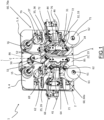
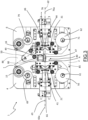
- the apparatus 1 also has the function of joining a first electrode web f1 to a second electrode web f2 to implement a change of coil of electrode web for the production of electrochemical cells.
- the apparatus 1 is adoptable in a rechargeable battery cell production line (not illustrated in the figures), wherein a plurality of electrode webs, such as, for example, an electrode web for the formation of the cathode and an electrode web for the formation of the anode, are unwound from respective coils and fed to a forming station of an electrochemical cell where they are, for example, overlapped on each other, wound together continuously and cut to form a plurality of jelly-rolls.
- a plurality of electrode webs such as, for example, an electrode web for the formation of the cathode and an electrode web for the formation of the anode
- the apparatus 1 can be installed in the production line along the path of an electrode web unwound from a respective coil of electrode web, between two coil supports (illustrated in figures 7-11 ) and the electrochemical cell forming station.
- the two coil supports comprise a first coil support 81 configured to support and unwind a first coil of electrode web 83 and a second coil support 82 configured to support and unwind a second coil of electrode web 84.
- Both the first support 81 and the second support 82 can be used interchangeably to unwind from the respective coil of electrode web 83, 84 the electrode web f1, f2 fed to the forming station (coil in use).
- a new coil of electrode web is mounted on the unused support 81, 82 and is to be fed to the forming station when the coil in use runs out or needs to be replaced.
- the first coil of electrode web 83 mounted on the first support 81 is the coil in use and the second coil of electrode web 84 mounted on the second support 82 is the new coil.
- the first and second coil support 81, 82 are positioned externally to the apparatus 1.
- first coil support 81 there is mounted the coil of electrode web 83 from which a first electrode web f1 fed to the forming station is unwound; on the second coil support 82 it can be mounted a coil 84 of a second virgin electrode web f2 before the coil of electrode web 83 in use runs out, so that the electrode web f2 from the virgin coil 84 can be unwound and fed to the forming station downstream immediately after the coil of electrode web 83 in use runs out.
- the apparatus 1 comprises a fixed support 2.
- the fixed support 2 has an inlet portion 85 and an outlet portion 86, wherein the inlet and outlet portion 85, 86 are positioned on opposite sides of the fixed support 2 and wherein the outlet portion 86 is proximal to the forming station with respect to a generic advancement path of the electrode web to the forming station.
- a first movement device 3 ( figure 4 ) comprises a first support carriage 4 movable in a first sliding direction d1.
- the first support carriage 4 is slidably mounted on the fixed support 2.
- the first movement device 3 comprises one or more movement guides 3a placed between the fixed support 2 and the first support carriage 4 to guide the movement of the first support carriage 4 in the first sliding direction d1 (indicated in figures 3 and 4 ).
- the first movement device 3 further comprises an actuator 3b, preferably a pneumatic cylinder, configured to actuate the movement of the first support carriage 4.
- a second movement device 5 ( figure 4 ) comprises a second support carriage 6 movable in a second sliding direction d2 ( figures 3 and 4 ).
- the second sliding direction d2 is parallel to the first sliding direction d1.
- the second support carriage 6 is slidably mounted on the fixed support 2.
- the first support carriage 4 and the second support carriage 6 are movable towards and away from each other.
- the second movement device 5 comprises one or more movement guides 5a placed between the fixed support 2 and the second support carriage 6 to guide the movement of the second support carriage 6 in the second sliding direction d2.
- the movement guides 5a of the second movement device 5 are parallel to the movement guides 5a of the first movement device 3.
- the second movement device 5 further comprises an actuator 5b, preferably a pneumatic cylinder, configured to actuate the movement of the second support carriage 6.
- the first movement device 3 is configured to move the first support carriage 4 with respect to the fixed support 2 selectively towards the second support carriage 6 and away from the second support carriage 6.
- the second movement device 5 is configured to move the second support carriage 6 with respect to the fixed support 2 selectively towards the first support carriage 4 and away from the first support carriage 4.
- the apparatus 1 is configured to receive a first piece of electrode web s1 of the first electrode web f1 unwound from the first coil of electrode web 83 and a second piece of electrode web s2 of the second electrode web f2 unwound from the second coil of electrode web 84.
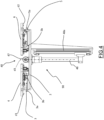
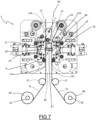
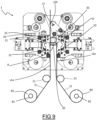
- a first directing roller 11 is positioned between the first coil of electrode web 83 and the apparatus 1, in particular the inlet portion 85 of the apparatus 1 ( figures 7-9 ).
- the first directing roller 11 is configured to deviate the first electrode web f1 and direct the first piece of electrode web s1 along a first advancement path p1.
- the first advancement path p1 passes between the first support carriage 4 and the second support carriage 6.
- the first advancement path p1 is perpendicular to the first sliding direction d1.
- a second directing roller 12 is positioned between the second coil of electrode web 84 and the inlet portion 85 of the apparatus 1.
- the second directing roller 12 is configured to deviate the second electrode web f2 and direct the second piece of electrode web s2 along a second advancement path p2.
- the second advancement path p2 passes between the first support carriage 4 and the second support carriage 6.
- the second advancement path p2 is perpendicular to the second sliding direction d2.
- further directing rollers may be provided externally to the apparatus 1.
- a first directing roller may be mounted on the fixed support 2 or on the first support carriage 4, at the inlet portion 85, and a second directing roller may be mounted on the fixed support 2 or on the second support carriage 6, at the inlet portion 85.
- the apparatus 1 comprises a winder of second electrode web 16.
- the winder of second electrode web 16 is mounted on the second support carriage 6.
- the winder of second electrode web 16 is configured to receive an end of the second piece of electrode web s2 distal from the second coil of electrode web 84.
- the winder of second electrode web 16 is rotatably actuatable to provide the second piece of electrode web s2 along the second advancement path p2, preferably while the first electrode web f1 is fed to the forming station.
- the end of the second piece of electrode web s2 is manually applicable on the winder of second electrode web 16.
- the apparatus 1 may comprise a winder of first electrode web 15 mounted on the first support carriage 4 and configured to receive a longitudinal end of the piece of electrode web unwound from a coil of electrode web 83, 84.
- the winder of first electrode web 15 is rotatably actuatable and arranged distal from the first coil of electrode web 83.
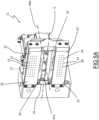
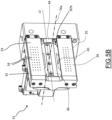
- the apparatus 1 comprises a first retaining device 21, depicted in greater detail in figure 5 , configured to retain the first piece of electrode web s1.
- the first retaining device 21 is movable by the first movement device 3 along the first sliding direction d1.
- the first retaining device 21 faces the first advancement path p1.
- the first retaining device 21 is fixed to the first support carriage 4.
- the first retaining device 21 comprises a first retaining element 22 ( figures 5A , 6 , 8 and 9 ), for example formed by a plate.
- the first retaining element 22 is proximal to the inlet portion 85 of the support 2 and distal to the outlet portion 86 with respect to the first advancement path p1.
- the first retaining element 22 comprises a first suction surface 23 configured to retain an object by suction ( figure 5A ).
- the first suction surface 23 is flat.
- the first suction surface 23 comprises a plurality of suction holes 24 placed in fluid communication with a suction member (not illustrated).
- the first suction surface 23 is parallel to the first advancement path p1.
- the first suction surface 23 is orthogonal to the first sliding direction d1.
- the first retaining device 21 comprises a second retaining element 25, for example formed by a plate.
- the second retaining element 25 is placed downstream of the first retaining element 22 with respect to the first advancement path p1.
- the second retaining element 25 comprises a second suction surface 26.
- the second suction surface 26 is flat.
- the second suction surface 26 comprises a plurality of suction holes 27 placed in fluid communication with a suction member (not illustrated), preferably in common with the first suction surface 23.
- the second suction surface 26 is aligned with the first suction surface 23 with respect to a direction perpendicular to the first advancement path p1.
- the second suction surface 26 is parallel to the first advancement path p1, at least in the portion of the path at the first retaining device.
- the first suction surface 23 is orthogonal to the first sliding direction d1.
- the first and second suction surface 23, 26 of the first retaining device 21 are powered separately such that they can activate or deactivate suction independently of each other.
- the first and second suction surface 23, 26 are connected to a suction member by means of two separate connection ducts on which a respective suction valve is arranged (elements not illustrated in the figures).
- the suction valves are configured to be actuated in a closed or open position independently of each other.
- the first suction surface 23 and the second suction surface 26 are coplanar.
- the suction on the second retaining element 22 is maintained, while on the first retaining element 25 it is deactivated to allow the first electrode web f1 to separate from the working coil 83 (in use).
- first and second retaining element 22, 25 of the first retaining device 21 are distanced from each other along a direction parallel to the first advancement path p1, forming an opening 87a ( figure 5A ) between the retaining surfaces 23, 26 in the plane defined by the retaining surfaces.
- the first retaining device 21 is mounted on the first support carriage 4 at an end portion of the first carriage that intercepts the sliding direction d1.
- the retaining surfaces 23, 26 are placed at an end of the first carriage.
- the retaining surfaces 23, 26 of the first and second retaining element 22, 25 of the first retaining device 21 have the same size and shape.
- the apparatus 1 comprises a second retaining device 31 configured to retain the second piece of electrode web s2 of the second electrode web f2.
- the second retaining device 31 is movable by the second movement device 5 along the second sliding direction d2.
- the second retaining device 31 is fixed to the second support carriage 6.
- the second retaining device 31 faces the second advancement path p2.
- the second retaining device 31 faces the first retaining device 31.
- the second retaining device 31 is mounted on the second support carriage 6 at an end portion of the first carriage that intercepts the sliding direction d2.
- the retaining surfaces 33, 36 are placed at an end of the second carriage.
- the second retaining device 31 comprises a first retaining element 32.
- the first retaining element 32 is proximal to the inlet portion 85 and distal to the outlet portion 86 of the support 2 with respect to the first advancement path p2.
- the first retaining element 32 comprises a first suction surface 33, configured to retain an object by suction ( figure 5B ).
- the first suction surface 33 is flat.
- the first suction surface 33 is parallel to the second advancement path p2, at least in the portion of the path at the second retaining device.
- the first suction surface 33 of the second retaining device 31 is parallel to the first suction surface 23 of the first retaining device 21.
- the first suction surface 33 comprises a plurality of suction holes 34 placed in fluid communication with a suction member (not illustrated). The suction member is external to the apparatus 1.
- the first suction surface 33 is perpendicular to the second sliding direction d2.
- the second retaining device 31 comprises a second retaining element 35.
- the second retaining element 35 is placed downstream of the first retaining element 32 with respect to the second advancement path p2.
- the second retaining element 35 of the second retaining device 31 faces the second retaining element 25 of the first retaining device 21.
- the second retaining element 35 comprises a second suction surface 36.
- the second suction surface 36 is flat.
- the second suction surface 36 of the second retaining device 31 is parallel to the second suction surface 26 of the first retaining device 21.
- the second suction surface 36 comprises a plurality of suction holes 37.
- the holes of the second suction surface 36 are placed in fluid communication with a suction member (not illustrated), which can also be connected with the suction holes 34 of the first suction surface 33.
- the second suction surface 36 is aligned with the first suction surface 33 along a direction perpendicular to the second advancement path p2.
- the second suction surface 36 is parallel to the second advancement path p2, at least in the portion of the path at the second retaining device.
- the second suction surface 36 is orthogonal to the second sliding direction d2.
- the first suction surface 33 and the second suction surface 36 are coplanar.
- the first and second suction surfaces 33, 36 of the second retaining device 31 are powered separately such that they can activate or deactivate suction independently of each other.
- the first and second suction surfaces 33, 36 are connected to a suction member by means of two separate connection ducts on which respective valves are arranged (elements not illustrated in the figures).
- the valves are configured to be actuated in a closing or opening position independently of each other.
- the suction member may be common to the first and second retaining device 21, 31, the suction activation and deactivation by the retaining elements 22, 25, 32 and 35 being actuated by controlling the opening and closing state of the respective valves.
- the retaining surfaces 33, 36 of the first and second retaining element 32, 35 of the second retaining device 31 have the same size and shape.
- first and second retaining elements 32, 35 of the second retaining device 31 are distanced from each other along a direction parallel to the second advancement path p2, forming an opening 87b ( figure 5B ) between the retaining surfaces 33, 36 in the plane defined by the retaining surfaces.
- the areas of the suction surfaces 23, 26 of the first and second elements 22, 25 of the first retaining device 21 are preferably the same.
- the areas of the suction surfaces 33, 36 of the first and second element 32, 35 of the second retaining device 31 are preferably the same.
- the first movement device 3 and the second movement device 5 are both movable between a distanced position and an approached position.
- the first retaining device 21 and the second retaining device 31 are positioned with respect to each other to bring the first piece of web into alignment with the second piece of web, on a common lying plane g.
- the lying plane g is parallel to the planes defining the suction surfaces of the first and second retaining device (typically parallel to the advancement paths p1 and p2, at least in the part of the path at the retaining devices).
- the first and second retaining device are substantially in contact with each other, e.g. they are separated at most by a distance from 1 to 4 mm, e.g. 2 mm.
- the first retaining device 21 and the second retaining device 31 are spaced apart from each other.
- spaced apart from each other it is meant that the first retaining device 21 and the second retaining device 31 are separated by a distance of not less than 50 mm.
- the apparatus 1 further comprises a cutting mechanism 40.
- the cutting mechanism 40 comprises a first rotating body 41 ( figure 5A ).
- the first rotating body 41 is rotatably mounted on the first retaining device 21 around a rotation axis r1.
- the rotation axis r1 is perpendicular to the first sliding direction d1.
- the rotation axis r1 is also perpendicular to the first advancement path p1.
- the first rotating body 41 is rotatable about the rotation axis r1 between a cutting abutment position and a non-operating position, described in detail below.
- the cutting abutment position and the non-operating position are angularly distanced by 90°.
- the first rotating body 41 also has a passage opening 42, extended radially with respect to the rotation axis r1.
- the passage opening 42 has a rectangular section in a plane parallel to the rotation axis r1. In the non-operating position the passage opening 42 is oriented parallel to the sliding direction d1 of the first support carriage 4. In the non-operating position the passage opening 42 is open at the first retaining device 21.
- the cutting mechanism 40 comprises a first counter-blade 43 ( figures 5A , 6 and 7 ).
- the first counter-blade 43 has a development direction perpendicular to the first advancement path p1.
- the first counter-blade 43 is movable along the first sliding direction d1 together with the first retaining device 21.
- FIG 5A the first rotating body 41 is illustrated in the cutting abutment position, in which the first counter-blade 43 faces outwards with respect to the opening 87a.
- the first counter-blade 43 is mounted on the first rotating body 41.
- the first counter-blade 43 is oriented parallel to the rotation axis r1.
- the first counter-blade 43 is fixed to the first rotating body 41 and is movable integrally therewith about the rotation axis r1.
- the first counter-blade 43 In the cutting abutment position of the first rotating body 41, the first counter-blade 43 is placed at the first retaining device 21. In the cutting abutment position, the first counter-blade 43 is placed between the first retaining element 22 and the second retaining element 25.
- the first counter-blade 43 is parallel to the first suction surface 23 and to the second suction surface 26, preferably coplanar therewith.
- the first counter-blade 43 In the non-operating position of the first rotating body 41, the first counter-blade 43 is spaced apart from the first retaining element 22 and from the second retaining element 25 and does not engage the passage opening 42. In particular, in said position, the first counter-blade 43 is not coplanar to the first suction surface 23 and to the second suction surface 26.
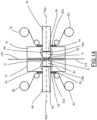
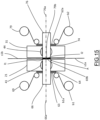
- the cutting mechanism 40 comprises a second rotating body 44 ( figures 1 , 5B , 12-15 ).
- the second rotating body 44 is rotatably mounted on the second retaining device 31 about a rotation axis r2.
- the rotation axis r2 is perpendicular to the second sliding direction d2 of the second carriage 6.
- the rotation axis r2 is also perpendicular to the second advancement path p2.
- the second rotating body 44 is rotatable about the rotation axis r2 between a cutting abutment position and a non-operating position, described in detail below.
- the cutting abutment position and the non-operating position are angularly distanced by 90°.
- the second rotating body 44 also has a passage opening 45, extended radially with respect to the rotation axis r2.
- the passage opening 45 has a rectangular section in a plane parallel to the rotation axis r2. In the non-operating position the passage opening 45 is oriented parallel to the sliding direction d2. In the non-operating position the passage opening 45 is open at the second retaining device 31.
- the second rotating body 44 is illustrated in the cutting abutment position, in which the second counter-blade 46 faces outwards.
- the cutting mechanism 40 comprises a second counter-blade 46 ( Fig. 5B ).
- the second counter-blade 46 is movable along the second sliding direction d2 together with the second retaining device 31.
- the second counter-blade 46 has a development direction perpendicular to the first advancement path p1.
- the second counter-blade 46 is mounted on the second rotating body 44.
- the second counter-blade 46 is oriented parallel to the rotation axis r2.
- the second counter-blade 46 is fixed to the second rotating body 44 and is movable integrally therewith about the rotation axis r1.
- the second counter-blade 46 is placed at the second retaining device 31.
- the second counter-blade 46 is placed between the first retaining element 32 and the second retaining element 35.
- the second counter-blade 46 is parallel to the first suction surface 33 and to the second suction surface 36, preferably coplanar therewith.
- the second counter-blade 46 is spaced apart from the first retaining element 32 and from the second retaining element 35 and is not coplanar with the first suction surface 33 and with the second suction surface 36.
- FIG 5B the first rotating body 44 is illustrated in the cutting abutment position, in which the second counter-blade 46 is turned outwards with respect to the opening 87b.
- the cutting mechanism 40 comprises a cutting device 90 configured to selectively cut the first piece of electrode web s1 retained by the first retaining device 21 and the second piece of electrode web s2 retained by the second retaining device 31.
- the cutting device 90 comprises a blade 47 ( figures 2 , 4 , 7-10 ).
- the blade 47 has a circular shape.
- the cutting device 90 comprises an actuation arm 48 operatively connected to the blade 47 and configured to move the blade 47 along a cutting direction d3 ( figure 4 ).
- the actuation arm 48 is slidably mounted on the fixed support 2 between the first movement device 3 and the second movement device 5.
- An actuator 48a is configured to move the arm 48 with respect to the fixed support 2 ( figure 4 ) along the cutting direction d3.
- the blade 47 is rotatable about an axis parallel to the first advancement path p1 and the second advancement path p2.
- the cutting direction d3 is perpendicular to the first sliding direction d1 and to the second sliding direction d2.
- the cutting direction d3 is perpendicular to the first advancement path p1 and to the second advancement path p2.
- the cutting direction d3 is parallel to the first counter-blade 43 and to the second counter-blade 46.
- the cutting direction d3 is parallel to the rotation axes r1, r2 of the first rotating body 41 and of the second rotating body 44.
- the blade 47 is rotatable about an axis perpendicular to the cutting direction d3.
- the cutting device 90 comprises an actuation roller 49 concentric to the blade 47 ( figures 2 and 4 ).
- the blade 47 is mounted rotationally fixed with the actuation roller 49.
- the blade 47 and the actuation roller 49 are mounted idly on the arm 48.
- the actuation roller 49 is configured to roll against the first counter-blade 43 when the first retaining device 21, which retains the first piece s1, is arranged in the cutting position. In particular, the actuation roller 49 slides grazing the first counter-blade 43 bringing into rotation the blade 47 that performs the cutting of the piece s1. Similarly, when the second retaining device 31 is arranged in the cutting position, which preferably coincides with the cutting position of the first retaining device 21, the actuation roller 49 slides grazing the second counter-blade 46 causing the blade 47 to rotate.
- actuation roller 49 is motorized to impart rotation to the blade 27.
- the cutting device 90 is positionable in a rest position in which the blade 47 is not placed between the first retaining device 21 and the second retaining device 31.
- the cutting device 90 is configured to perform a cutting stroke between the rest position and a plurality of active positions. During the cutting stroke the blade 47 is moved along the cutting direction d3 by the actuation arm 48 ( figure 4 ). In the plurality of active positions the blade 47 is interposed between the first retaining device 21 and the second retaining device 31.
- the cutting device 90 is further configured to perform a reset stroke in which the blade 47 returns to the rest position, in which the reset stroke is opposite to the cutting direction.
- the first movement device 3 is configured to arrange the first retaining device 21 in a cutting position intermediate between the distanced position and the approached position.
- the blade 47 of the cutting device 90 In the cutting position of the first retaining device 21 the blade 47 of the cutting device 90, during the cutting stroke, is configured to cut the first piece of electrode web s1 retained by the first retaining device 21 by sliding against the first counter-blade 43.
- the cut first piece of electrode web s1 is divided into a first portion s1a, in continuity with the first coil of electrode web 83, and a second portion s1b, separated from the first coil of electrode web 83.
- the first retaining element 22 of the first retaining device 21 is configured to retain the first portion s1a.
- the second retaining element 25 of the first retaining device 21 is configured to retain the second portion s1b.
- a first free end 11, transverse and preferably perpendicular to the first advancement path p1, is defined on the second portion s1b.
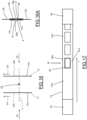
- a first surface portion t1a is defined on the second portion s1b of the first piece s1, adjacent to the first free end 11, and extends transversely between the longitudinal edges in the first electrode web f1 ( figure 16A ).
- a second surface portion t1b is defined on the second portion s1b, adjacent to the first free end 11, and extends transversely between the longitudinal edges in the first electrode web f1 on the opposite side to the first surface portion t1a. Both the first surface portion t1a and the second surface portion t1b extend longitudinally and transversely on the first electrode web f1.
- the second movement device 5 is configured to arrange the second retaining device 31 in a cutting position intermediate between the distanced position and the approached position.
- the cutting position of the second retaining device 31 is alternative to the cutting position of the first retaining device 21.
- the blade 47 In the cutting position of the second retaining device 31 the blade 47, during the cutting stroke, is configured to cut the second piece of electrode web s2 retained by the second retaining device 31 by sliding against the second counter-blade 46.
- the cut second piece of electrode web s2 is divided into a first portion s2a, in continuity with the second coil of electrode web 84, and a second portion s2b, separated from the second coil of electrode web 84.
- the first retaining element 32 of the second retaining device 31 is configured to retain the first portion s2a.
- the second retaining element 35 of the second retaining device 31 is configured to retain the second portion s2b.
- a second free end l2, transverse and preferably perpendicular to the second advancement path p2, is defined on
- a first surface portion t2a is defined on the first portion s2a, adjacent to the second free end l2, and extends transversely between the longitudinal edges in the second electrode web f2.
- a second surface portion t2b is defined on the first portion s2a, adjacent to the second free end l2, and extends transversely between the longitudinal edges in the second electrode web f2 on the opposite side to the first surface portion t2a. Both the first surface portion t2a and the second surface portion t2b extend longitudinally and transversely on the first electrode web f2.
- the apparatus 1 comprises an electrode web deflector 50.
- the deflector 50 is mounted on the fixed support 2.
- the deflector 50 is mounted at the outlet portion 86 of the fixed support 2, in an area thereof that does not engage the first and second support carriage 4, 6 in any of the positions used by the movement devices 3, 5.
- the deflector 50 comprises a fork 51 having an axis of symmetry t (indicated in figure 1 ).
- the deflector 50 comprises a pair of deflector rollers 52 mounted parallel to each other on the fork 51, at respective ends thereof opposite with respect to the axis of symmetry.
- the deflector 50 is movable between a rest position, a first web interception position and a second web interception position.
- the fork 51 In the rest position the fork 51 is arranged with the respective axis of symmetry t parallel to the first advancement path p1 and to the second advancement path p2.
- the deflector rollers 52 engage neither the first piece of electrode web s1 nor the second piece of electrode web s2.
- the deflector 50 is configured to engage the first piece of electrode web s1 and bring it closer to the first retaining device 21.
- the fork 51 is rotated with respect to the rest position and is arranged with the respective axis of symmetry t inclined with respect to the first advancement path p1 and to the second advancement path p2 (indicated in figure 7 ).
- one of the deflector rollers 52 is configured to press the first piece of electrode web s1 against the first retaining device 21. In this way, the cutting device 90 can cut the second piece of electrode web s2 without risking engaging the first piece of electrode web s1.
- the deflector 50 is configured to engage the second piece of electrode web s2 and bring it closer to the second retaining device 23.
- the fork 51 is rotated with respect to the rest position and is arranged with the respective axis of symmetry t inclined with respect to the first advancement path p1 and to the second advancement path p2 on the opposite side with respect to the first interception position.
- the other of the deflector rollers 52 is configured to press the second piece of electrode web s2 against the second retaining device 31. In this way, the cutting device 40 can cut the first piece of electrode web s1 without risking engaging the second piece of electrode web s2.
- the apparatus 1 further comprises a joining device 60, configured to join the first free end l1 to the second free end l2. In this way, the first portion s1a of the first piece of electrode web s1 is joined to the second portion s2b of the second piece of electrode web s2.
- the joining device 60 is active on a junction area A ( figures 1 , 4 and 7 ).
- the first retaining device 21 is configured to retain the first free end l1 at the junction area A during junction.
- the second retaining device is configured to retain the second free end l2 at the junction area A, the second free end being positioned at the first free end l1, during junction.
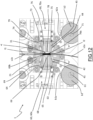
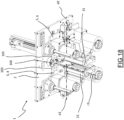
- the joining device 60 comprises a first applicator 60a (indicated in figures 1 and 12 ).
- the first applicator 60a is mounted on the first support carriage 4.
- the first applicator 60a is configured to cooperate with the first retaining device 21.
- the first applicator 60a is configured to apply a first connection element 60b at the first free end l1 and the second free end l2, and in particular on the first surface portion t1a of the second portion s1b of the first piece of electrode web s1 and on the first surface portion t2a of the first portion s2a of the second piece of electrode web s2.
- the first connection element 60b is an adhesive element and, in particular, a first adhesive patch 69b.
- the first applicator 60a comprises a first adhesive strip coil support 61 configured to support a first adhesive strip feeding coil b1 and unwind a first adhesive strip n1 from the first feeding coil b1 to provide an unwound first piece of adhesive strip b1a.
- the first adhesive strip coil support 61 is mounted on the first support carriage 4, preferably rotatably.
- the first applicator 60a comprises first guide rollers 62 (indicated in figures 1 , 6 and 13 ) configured to guide the unwinding of the first piece of adhesive strip b1a from the first feeding coil b1 along a first web unwinding path 63 ( figures 12-15 ).
- the first web unwinding path 63 has a section parallel to the first advancement path p1 of the first piece of electrode web s1.
- the first unwinding path 63 is opposite to the first advancement path p1 with respect to the first retaining device 21.
- the first piece of adhesive strip b1a has an adhesive side facing the first retaining device 21.
- the first applicator 60a comprises a first punching base 64.
- the first punching base 64 has a punching surface parallel to the first web unwinding path 63.
- the first punching base 64 is fixed to the first support carriage 4.
- the first punching base 64 has a punching opening 65. In the non-operating position of the first rotating body 41, the passage opening 42 of the first rotating body 41 is aligned with the punching opening 65 and is accessible from the punching opening 65 ( figure 6 ).
- the punching opening 65 has substantially the same shape and sectional dimensions with respect to the passage opening 42 of the first rotating body 41.
- the first applicator 60a comprises a first punch 66.
- the first punch 66 is movably mounted on the first support carriage 4.
- the first punch 66 is movable along a first punching direction 66a transverse to the first unwinding path 63.
- the first punching direction 66a is perpendicular to the first advancement path p1.
- the first punching direction 66a is parallel to the first sliding direction d1 of the first support carriage 4.
- the first punch 66 comprises a perimeter cutting edge 67.
- the cutting perimeter edge 67 is rectangular.
- the perimeter cutting edge 67 is substantially counter-shaped to the punching opening 65 so as to be able to cross it flush, for example with a margin not higher than 0.04 mm with respect to the sides of the punching opening 65.
- the first punch 66 is also substantially counter-shaped to the passage opening 42 so as to be able to cross it flush.
- the first punch 66 is configured to cut the first piece of adhesive strip b1a between the cutting perimeter edge 67 and an edge of the punching opening 65.
- the first punch 66 comprises a suction surface 68 (indicated in figures 6 , 12 and 14 ) configured to vacuum suck a first adhesive patch 69b cut away from the first piece of adhesive strip b1a to retain it.
- the suction surface 68 of the first punch 66 comprises a plurality of suction holes in fluid communication with a suction member (not shown).
- the suction surface 68 of the first punch 66 is circumscribed by the perimeter cutting edge 67.
- the first punch 66 is movable between a rest configuration and an application configuration.
- the first punch 66 is configured to apply the first cut adhesive patch 69b to the first free end l1 and to the second free end l2, retained by the first retaining device 21 and by the second retaining device 31, placed in the approached position, at the junction area A.
- the first punch 66 is movable into a punching position in which, preferably without stopping, the first punch 66 engages the first unwinding path 63 to cut away an inner portion from the unwound first piece of adhesive strip b1a, thereby separating the inner portion from a residual edge portion 69a extending along the first web unwinding path 63.
- the first punch 66 is configured to cut the first piece of adhesive strip b1a while maintaining a first part n1a of the first adhesive strip n1 upstream in connection with a second part n1b of the first adhesive strip n1 downstream. In other words, the first punch 66 is configured to cut away the inner portion without completely cutting off the first piece of adhesive strip b1a.
- the first punch 66 has a width measured transversely to the first unwinding path 63 smaller than the width of the first piece of adhesive strip b1a. The inner portion cut away by the first punch 66 forms the first adhesive patch 69b ( figures 12 , 14 , 15 ).
- the first punch 66 is movable between the rest configuration and the application configuration through the punching opening 65 and the passage opening 42 of the first rotating body 41 in the non-operating position.
- the first punch 66 is configured to retain the first adhesive patch 69b between the punching position and the application configuration.
- the first applicator 60a comprises a first winder 69.
- the first winder 69 is rotatably mounted on the first support carriage 4.
- the first winder 69 is configured to wind the residual edge portion 69a of the first adhesive strip n1 downstream of the first unwinding path 63.
- the first winder 69 is configured to tension the first piece of adhesive strip b1a between the first feeding coil b1 and the first winder 69 so as to stretch it on the first punching base 64 during punching.
- the residual portion 69a that is wound on the first winder 69 consists at least in part of punching scraps of the first piece of adhesive strip b1a, i.e. the residual edge portions 69a of the first adhesive strip n1.
- FIG 17 it is schematically represented the path of the first adhesive strip n1, but it can be the representation of the path of the second adhesive strip n2.
- the first piece of adhesive strip b1a is unwound from the first feeding coil b1 and is intercepted by the first punch 66 (position P) that cuts away the first adhesive patch 69b leaving a residual portion 69a in the shape of a frame that allows a continuity in unwinding the web between before and after punching.
- the web formed by the residual edge portions 69a is wound to the first winder 69.
- the joining device 60 comprises a second applicator 70a.
- the second applicator 70a is mounted on the second support carriage 6.
- the second applicator 70a is configured to cooperate with the second retaining device 31.
- the second applicator 70a is configured to apply a second connection element 70b at the first free end l1 and the second free end l2, and in particular on the second surface portion t1b of the second portion s1b of the first piece of electrode web s1 and on the second surface portion t2b of the first portion s2a of the second piece of electrode web s2.
- the second connection element 70b is an adhesive element and, in particular, the second adhesive patch 79b.
- the second applicator 70a comprises a second adhesive strip coil support 71 configured to support a second adhesive strip feeding coil b2 and unwind a second adhesive strip n2 from the second feeding coil b2 to provide an unwound second piece of adhesive strip b2a.
- the second adhesive strip coil support 71 is mounted on the second support carriage 6, preferably rotatably.
- the second applicator 70a comprises second guide rollers 72 configured to guide the unwinding of the second piece of adhesive strip b2a from the second feeding coil b2 along a second web unwinding path 73.
- the second web unwinding path 73 has a section parallel to the second advancement path p2 of the second piece of electrode web s2.
- the second web unwinding path 73 is opposite to the second advancement path p2 with respect to the second retaining device 31.
- the second piece of adhesive strip b2a has an adhesive side facing the second retaining device 31.
- the second applicator 70a comprises a second punching base 74.
- the second punching base 74 has a punching surface parallel to the second web unwinding path 73.
- the second punching base 74 is fixed to the second support carriage 6.
- the second punching base 74 has a punching opening 75. In the non-operating position of the second rotating body 44, the passage opening 45 of the second rotating body 44 is aligned with the punching opening 75 and is accessible from the punching opening 75.
- the punching opening 75 has substantially the same shape and sectional dimensions with respect to the passage opening 45 of the first rotating body 44.
- the second applicator 70a comprises a second punch 76.
- the second punch 76 is movably mounted on the second support carriage 6.
- the second punch 76 is movable along a second punching direction 76a transverse and preferably perpendicular to the second web unwinding path 73.
- the second punching direction 76a is perpendicular to the second advancement path p2.
- the second punching direction 76a is parallel to the second sliding direction d2 of the second support carriage 6.
- the second punch 76 comprises a perimeter cutting edge 77.
- the cutting perimeter edge 77 is rectangular.
- the perimeter cutting edge 77 is substantially counter-shaped to the punching opening 75 so as to be able to cross it flush.
- the second punch 76 is also substantially counter-shaped to the passage opening 45 so as to be able to cross it flush.
- the second punch 76 is configured to cut the second piece of adhesive strip b2a between the cutting perimeter edge 77 and an edge of the punching opening 75.
- the second punch 76 comprises a suction surface 78 configured to vacuum suck a second adhesive patch 79b cut away from the second piece of adhesive strip b2a to retain it.
- the suction surface 78 of the second punch 76 comprises a plurality of suction holes in fluid communication with a suction member (not shown).
- the suction surface 78 of the second punch 76 is circumscribed by the perimeter cutting edge 77.
- the second punch 76 is movable between a rest configuration and an application configuration.
- the second punch 76 is arranged, preferably without stopping, in a punching position in which the second punch 76 engages the second web unwinding path 73 to cut away an inner portion of adhesive strip from the unwound second piece of adhesive strip b2a, thereby separating the inner portion from a residual edge portion (not illustrated), which extends along the second web unwinding path 73.
- the residual edge portion of the second adhesive strip n2 is similar to the residual edge portion 69a of the first adhesive strip n1.
- the second punch 76 is configured to cut the second piece of adhesive strip b2a while maintaining a first part n2a of the second adhesive strip n2 upstream in connection with a second portion n2b of the second adhesive strip n2 downstream. In other words, the second punch 76 is configured to cut away the inner portion without completely cutting off the second piece of adhesive strip b2a.
- the second punch 76 has a width measured transversely to the second web unwinding path 73 smaller than the width of the second piece of adhesive strip b2a. The inner portion cut away by the second punch 76 forms the second adhesive patch 79b ( figures 12 , 14 , 15 ).
- the second punch 76 is configured to apply the second cut adhesive patch 79b to the first free end l1 and to the free end l2, retained by the first retaining device 21 and by the second retaining device 31, placed in the approached position, at a junction area A.
- the second punch 76 is configured to apply the second adhesive patch 79b simultaneously with the application of the first adhesive patch 69b by means of the first punch 66, at opposite sides of the first piece of electrode web s1 and of the second piece of electrode web s2.
- the second punch 76 is movable between the punching position and the joining configuration through the punching opening 75 and the passage opening 45 of the second rotating body 44 in the non-operating position.
- the second punch 76 is configured to retain the second adhesive patch 79b between the punching position and the application configuration.
- the second applicator 70a comprises a second winder 79.
- the second winder 79 is rotatably mounted on the second support carriage 6.
- the second winder 79 is configured to wind the residual edge portion of the second adhesive strip n2 downstream of the second web unwinding path 73.
- the second winder 79 is configured to tension the second adhesive strip n2 between the second feeding coil b2 and the second winder 79 so as to stretch it on the second punching base 74 during punching.
- the residual portion that is wound on the second winder 79 consists at least in part of punching scraps of the second piece of adhesive strip b2a.
- Figures 18 to 21 refer to a further embodiment of an apparatus for implementing a change of coil of electrode web for the production of electrochemical cells in accordance with the present invention.
- the apparatus 1 of figures 18-21 is analogous to the apparatus described above and additionally has a spacer 100 mounted on the fixed support 2.
- the spacer 100 is rotatably mounted about a spacer rotation axis r3 ( figure 18 ).
- the spacer rotation axis r3 is perpendicular to the first sliding direction d1 and the second sliding direction d2.
- the spacer 100 is shaped, in plane in a view orthogonal to the spacer rotation axis r3, substantially rectangular and comprises two short sides 100a parallel to each other and two long sides 100b parallel to each other and perpendicular to the short sides 100a.
- the spacer 100 is rotatable about the spacer rotation axis r3 between a first abutment position, illustrated in figure 20 , and a second abutment position, illustrated in figures 19 and 21 .
- the spacer 100 comprises two first adjustment screws 101.
- the first adjustment screws 101 are screwable and unscrewable perpendicularly to the spacer rotation axis r3. Each first adjustment screw 101 is placed at a respective short side 100a.
- a first abutment surface 101a is defined on each first adjustment screw 101.
- the two first abutment surfaces 101a are parallel to each other.
- the two first abutment surfaces 101a are placed at a first mutual distance 101d, illustrated in figure 19 .
- the first distance 101d is adjustable by screwing or unscrewing one or both of the first adjustment screws 101.
- the spacer 100 comprises two second adjustment screws 102.
- the second adjustment screws 102 are screwable and unscrewable perpendicularly to the spacer rotation axis r3.
- the second adjustment screws 102 are screwable and unscrewable in a direction perpendicular to the screwing and unscrewing direction of the first adjustment screws 101.
- Each second adjustment screw 102 is placed at a respective long side 100b.
- a second abutment surface 102a is defined on each second adjustment screw 102.
- the two second abutment surfaces 102a are parallel to each other.
- the two second abutment surfaces 102a are perpendicular to the first abutment surfaces 101a.
- the two second abutment surfaces 102a are placed at a second mutual distance 102d.
- the second distance 102d is adjustable by screwing or unscrewing one or both of the second adjustment screws 102.
- the second distance 102d is perpendicular to the first distance 101d.
- the second distance 102d among the second abutment surfaces 102a is smaller than the first distance 102d among the first abutment surfaces 101a, regardless of the adjustment of the first adjustment screws 101 and of the second adjustment screws 102.
- the first distance 101d among the first abutment surfaces 101a is oriented parallel to the first sliding direction d1 and to the second sliding direction d2.
- the second distance 102d among the second abutment surfaces 102a is oriented perpendicular to the first sliding direction d1 and to the second sliding direction d2.
- the second distance 102d among the second abutment surfaces 102a is oriented parallel to the first sliding direction d1 and to the second sliding direction d2.
- the first distance 101d among the second abutment surfaces 101a is oriented perpendicular to the first sliding direction d1 and to the second sliding direction d2.
- the first abutment position and the second abutment position are angularly distanced by 90°.
- a first stopping member 103 is fixed to the first movement device 3, in particular to the first support carriage 4, so as to move integrally with the first retaining device 21 along the first sliding direction d1.
- the first stopping member 103 comprises a block 103a fixed to the first support carriage 4 and an adjustment device 103b movable with respect to the block 103a parallel to the first sliding direction d1.
- the adjustment device 103b is a screw in threaded engagement with a hole obtained in the block 103a.
- the first stopping member 103 comprises a first stopping surface 104, defined at one end of the adjustment device 103b.
- the first stopping surface 104 is orthogonal to the first sliding direction d1.
- the adjustment device 103b allows to adjust the position of the first stopping surface 104 along the first sliding direction d1, in particular by screwing or unscrewing the screw in the respective hole.
- the first stopping surface 104 is configured to abut against one of the first abutment surfaces 101 when the spacer 100 is in the first abutment position to stop the first movement device 3 in the cutting position.
- the position of the first stopping surface 104 and of the respective first abutment surface 101a it is possible to precisely adjust the position of the first retaining device 21 in the cutting position with respect to the cutting device 90.
- the first stopping surface 104 is configured to abut against one of the second abutment surfaces 102a when the spacer 100 is in the second abutment position to stop the first movement device 3 in the approached position.
- a second stopping member 105 is fixed to the second movement device 5, in particular to the second support carriage 6, so as to move integrally with the second retaining device 31 along the second sliding direction d2.
- the second stopping member 105 is analogous to the first stopping member 103.
- the second stopping member 105 comprises a block 105a fixed to the second support carriage 6 and an adjustment device 105b movable with respect to the block 105a parallel to the second sliding direction d2.
- the adjustment device 105b is a screw in threaded engagement with a hole obtained in the block 105a.
- the second stopping member 105 comprises a second stopping surface 106, defined at one end of the adjustment device 105b.
- the second stopping surface 106 is orthogonal to the second sliding direction d2.
- the adjustment device 105b allows to adjust the position of the second stopping surface 106 along the second sliding direction d2, in particular by screwing or unscrewing the screw in the respective hole.
- the second stopping surface 106 is configured to abut against one of the first abutment surfaces 101a when the spacer 100 is in the first abutment position to stop the second movement device 5 in the cutting position.
- the second stopping surface 106 is configured to abut against one of the second abutment surfaces 102a when the spacer 100 is in the second abutment position to stop the second movement device 5 in the approached position.
- the position of the second stopping surface 106 and of the respective second abutment surface 102a it is possible to precisely adjust the position of the second retaining device 31 in the approached position. It is thus possible to adjust the distance between the first retaining device 21 and the second retaining device 31 in the respective approached positions.
- the first electrode web f1 is provided partially unwound from the first electrode web coil 83.
- the first electrode web f1 comprises the first piece of electrode web s1 of not-wound web.
- the first piece of electrode web s1 is defined by the first portion s1a and by the second portion s1b and arranged along the first advancement path p1 ( figure 7 ).
- the first electrode web f1 is fed to the forming station of an electrochemical cell (downstream of the apparatus 1 and not shown) along the first advancement path p1 by rotating the first coil of electrode web 83.
- the second electrode web f2 is provided partially unwound from a second coil of electrode web 84, preferably a new coil.
- the second electrode web f2 comprises the not-wound second piece of electrode web s2 defined by the first portion s2a and by the second portion s2b.
- the second piece of electrode web s2 is arranged along the second advancement path p2.
- this is unwound along the second advancement path p2 by rotating the second coil of electrode web 84.
- a longitudinal end of the second electrode web f2 unwound from the second coil of electrode web 84 positioned upstream of the second piece of electrode web s2 is constrained to the winder of second electrode web 16. This operation can be done manually by an operator. By winding the second end to the winder of second electrode web 16, a predetermined traction is exerted on the second piece of electrode web s2 to tension it along the second advancement path p2.
- the unwinding of the second coil of electrode web 84 is stopped.
- the second electrode web f2 comprises the second piece of electrode web s2 of not-wound web ( figure 7 ).
- Figure 16 is a conceptual representation of the operational step illustrated in figure 7 , to highlight some geometric relationships between the main elements of the method, in accordance with preferred embodiments.
- the first piece of electrode web s1 is arranged along the first advancement path p1 and the second piece of electrode web s2 is arranged along the second advancement path p2, the advancement paths p1, p2 being arranged side by side.
- the advancement paths p1, p2 are arranged in parallel, at least at the first and second retaining device which retain the first and second piece of electrode web s1, s2.
- the cutting direction d3 lies on a plane section, indicated with v in figure 16 , whose plane comprises the direction d3 and is perpendicular to the advancement paths p1, p2.
- the positions of the retaining devices i.e. distanced, approached and cutting positions) belong to said plane section.
- the first portion s2a of the second piece of electrode web s2 is provided with a second free end l2 ( figure 8 ).
- the second free end l2 is transverse and preferably perpendicular with respect to the second advancement path p2.
- the second piece of electrode web s2 is retained by means of the second retaining device 31. Both the first portion s2a and the second portion s2b of the second piece of electrode web s2 are retained.
- first portion s2a is retained by means of the first retaining element 32 and the second portion s2b is retained by means of the second retaining element 35. While the first portion s2a and the second portion s2b of the second piece of electrode web s2 are retained, the second piece of electrode web s2 is cut to physically separate the first portion s2a from the second portion s2b of the second piece of electrode web s2.
- the second retaining device 31 is moved from the distanced position to the cutting position. This is done by continuing to retain both the first portion s2a and the second portion s2b of the second piece of electrode web s2.
- the spacer 100 before moving the second retaining device 31 from the distanced position to the cutting position, the spacer 100 is provided in the first abutment position.
- the second retaining device 31, by moving from the distanced position to the cutting position, is stopped in the cutting position when the second stopping member 105 abuts against the spacer 100, in particular when the second stopping surface 106 abuts against the respective first abutment surface 101a.
- the first retaining device 21 While the second piece of electrode web s2 is cut, the first retaining device 21 is kept in the distanced position.
- a cutting stroke of the cutting device 90 is implemented.
- the blade 47 is made to slide against the second counter-blade 46 between the plurality of active positions.
- the cutting position of the second retaining device corresponds to the position of the blade 47 which, in the active positions of the cutting device 90, slides along the direction d3 perpendicular to the sliding directions d1, d2 of the retaining devices ( figures 4 and 16 ).
- the second rotating body 44 is arranged in the cutting abutment position in which the second counter-blade 46 is placed between the first and the second retaining element 33, 35.
- the first portion s2a of the second piece of electrode web s2 is provided with the second free end l2 before the second portion s1b of the first piece of electrode web s1 is provided with the first free end l1.
- the second portion s1b of the first piece of electrode web s1 is provided with a first free end l1.
- the first free end l1 is transverse and preferably perpendicular to the first advancement path p1.
- the unwinding of the first coil of electrode web 83 is stopped.
- the first electrode web f1 comprises the first piece of electrode web s1 of not-wound web.
- both the first portion s1a and the second portion s1b of the first piece of electrode web s1 are retained by means of the first retaining device 21.
- the first portion s1a is retained by means of the first retaining element 22 and the second portion s1b is retained by means of the second retaining element 25.
- first piece of electrode web s1 is cut to physically separate the first portion s1a from the second portion s1b of the first piece of electrode web s1.
- the first free end of the second portion s1b of the first piece of electrode web s1 is formed.
- first portion s2a of the second electrode web f2 is positioned upstream of the second portion s1b of the first electrode web f1, with respect to the advancement paths of the respective webs.
- the first retaining device 21 is moved from the distanced position to the cutting position. This is done by continuing to retain both the first portion s1a and the second portion s1b of the first piece of electrode web s1.
- the second retaining device 31 While the first piece of electrode web s1 is cut, the second retaining device 31 is kept in the distanced position.
- a cutting stroke of the cutting device 90 is implemented.
- the blade 47 is made to slide against the first counter-blade 43 between the plurality of active positions.
- the deflector 50 presses the second piece of electrode web s2 against the second retaining device 31 to keep it spaced apart from the blade 47.
- the first rotating body 41 is arranged in the cutting abutment position, in which the first counter-blade 43 is placed between the first and the second retaining element 22, 25.
- the first free end l1 of the second portion s1b of the first piece of electrode web s1 is retained with the first retaining device 21, in particular with the second retaining element 25.
- the first portion s1a of the first piece of electrode web s1 is removed so as to disengage the first retaining element 22 ( figure 10 ).
- the second free end l2 is provided at the first free end l1.
- the free ends face each other in a head-to-head alignment.
- the first and second free end are arranged at a mutual distance of less than or equal to 10 mm, preferably less than or equal to 6 mm, even more preferably less than or equal to 3 mm.
- the first free end and the second free end have a mutual distance of not less than 1 mm, for example a mutual distance comprised between 1 and 2 mm.
- a small distance between the free ends l1, l2 of the webs and therefore between the respective retaining devices on the lying plane g can avoid any collisions between the parts.
- the present invention may however comprise embodiments in which the first free end l1 and the second free end l2 are in direct contact with each other.
- the first retaining device 21 and the second retaining device 31 are moved into mutual approach to bring the first free end l1 of the second portion s1b of the first piece s1 in mutual approach with the second free end l2 of the first portion s2a of the second piece of electrode web s2.
- the first retaining device 21 and the second retaining device 31 are brought to the respective approached positions to position the second portion s1b of the first piece of electrode web s1 at the first portion s2a of the second piece of electrode web s2.
- the spacer 100 before moving the first retaining device 21 and the second retaining device 31 into the respective approached positions, the spacer 100 is provided in the second abutment position by rotating the spacer 100 by 90°.
- the first retaining device 21 and the second retaining device 31 are stopped in the approached position when the first stopping member 103 and the second stopping member 105 abut against the spacer 100, in particular when the first stopping surface 104 stops against the respective second abutment surface 102a and the second stopping surface 106 stops against the other abutment surface 102a.
- the first free end l1 and the second free end l2 are brought into mutual approach without overlaps of the first piece s1 with the second piece of electrode web s2 or vice versa so as to have a head-to-head alignment between the first and second electrode web f1, f2.
- the first portion s1a of the first piece of electrode web s1 is joined with the second portion s2a of the second piece of electrode web s2.
- at least the first adhesive patch 69b is applied at the first free end l1 and the second free end l2.
- the first adhesive patch 69b is applied by means of the first applicator 60a and the second adhesive patch 79b is applied by means of the second applicator 70a.
- the first adhesive strip n1 is unwound from the first feeding coil b1 along the first unwinding path 63.
- the first adhesive strip n1 comprises the unwound first piece of adhesive strip b1a which is positioned between the first part n1a of the first adhesive strip n1 upstream and the second part n1b of the first adhesive strip n1 downstream along the first unwinding path 63.
- the first piece of adhesive strip b1a is arranged between the first punch 66 and the first punching base 64.
- an inner portion of adhesive strip is cut away from the first piece of adhesive strip b1a.
- the inner portion is thus separated from a residual edge portion 69a extending along the first unwinding path 63.
- the residual edge portion 69a thus keeps the first part n1a of the first adhesive strip n1 in connection with the second part n1b of the first adhesive strip n1.
- the inner portion forms the first adhesive patch 69b.
- the first adhesive strip n1 While the inner portion is cut away from the first piece of adhesive strip b1a, the first adhesive strip n1 is tensioned between the first winder 69 and the first feeding coil b1. To tension the first adhesive strip n1, a traction is exerted on its residual edge portion 69a.
- the first rotating body 41 After cutting the first piece of electrode web s1 of the first electrode web f1 and the second piece of electrode web s2 of the second electrode web f2, and before cutting away from the first piece of adhesive strip b1a the inner portion, the first rotating body 41 is switched from the cutting abutment position to the non-operating position.
- the first piece of adhesive strip b1a is punched by means of the first punch 66.
- the first adhesive patch 69b is applied at both the first free end l1 and the second free end l2.
- the first adhesive patch 69b is retained on the suction surface 68 of the first punch 66 by a suction action exerted on the first adhesive patch 69b through the suction surface 68. While the first adhesive patch 69b is retained, the first punch 66 is moved along the first punching direction 66a up to the first free end l1 and the second free end l2.
- the first adhesive patch 69b is cut away and applied in a single uninterrupted straight movement of the first punch 66 towards the first piece of adhesive strip b1a, along the first punching direction 66a and up to the first free end l1 and the second free end l2.
- the first punch 66 is inserted into the punching opening 65 of the first punching base 64 and into the passage opening 42 of the first rotating body 41 in the non-operating position.
- the first adhesive patch 69b is finished being retained to the first punch 66 and the first punch 66 is retracted into the rest configuration.
- the residual edge portion 69a of the first adhesive strip n1 is wound on the first winder 69.
- the second adhesive strip n2 is unwound from the second feeding coil b2 along the second web unwinding path 73.
- the second adhesive strip n2 comprises the unwound second piece of adhesive strip b2a which is positioned between the first part n2a of the second adhesive strip n2 upstream and the second part n2b of the second adhesive strip n2 downstream along the second web unwinding path 73.
- the second piece of adhesive strip b2a is arranged between the second punch 76 and the second punching base 74.
- an inner portion of the adhesive strip is cut away from the second piece of adhesive strip b2a.
- the inner portion is thus separated from a residual edge portion extending along the second web unwinding path 73.
- the residual edge portion thus keeps the first part n2a of the second adhesive strip n2 in connection with the second part n2b of the second adhesive strip n2.
- the inner portion forms the second adhesive patch 79b.
- the second adhesive strip n2 While the inner portion is cut away from the second piece of adhesive strip b2a, the second adhesive strip n2 is tensioned between the second winder 79 and the second feeding coil b2. To tension the second adhesive strip n2, a traction is exerted on its residual edge portion.
- the second rotating body 44 After cutting the first piece of electrode web s1 of the first electrode web f1 and the second piece of electrode web s2 of the second electrode web f2, and before cutting away from the first piece of adhesive strip b1a the inner portion, the second rotating body 44 is switched from the cutting abutment position to the non-operating position.
- the second piece of adhesive strip b2a is punched by means of the second punch 76.
- the second adhesive patch 79b is applied at both the first free end l1 and the second free end l2.
- the second adhesive patch 79b is retained on the suction surface 78 of the second punch 76 by a suction action exerted on the second adhesive patch 79b through the suction surface 78. While the second adhesive patch 79b is retained, the second punch 76 is moved along the second punching direction 76a up to the first free end l1 and the second free end l2. Preferably the second adhesive patch 79b is cut away and applied in a single uninterrupted straight movement of the first punch 76 towards the second piece of adhesive strip b2a, along the second punching direction 76a and up to the first free end l1 and the second free end l2.
- the second punch 76 is inserted into the punching opening 75 of the second punching base 74 and into the passage opening 45 of the second rotating body 44 in the non-operating position.
- the second adhesive patch 79b is finished being retained to the second punch 76 and the second punch 76 is retracted into the rest configuration.
- the second portion s1a of the first piece of electrode web s1 is released from the first retaining device 21 and the first portion s2a of the second piece of electrode web s2 from the second retaining device 31.
- the second adhesive patch 79b is applied simultaneously to the first adhesive patch 69b, on the opposite side to the first free end I1 and to the second free end I2 with respect to the first adhesive patch 69b.
- the first and second adhesive patch 69b, 79b are retained by the respective suction surfaces of the first and second punch 66, 76, and the first and second punch apply the respective adhesive patch 69b, 79b to the respective opposite sides of the second portion s1b of the first piece of electrode web s1 with the first portion s2a of the second piece of electrode web s2 simultaneously.
- the first punch 66 and the second punch 76 perform an uninterrupted rectilinear movement along the first punching direction 66a and the second punching direction 76a simultaneously.
- the first punching direction 66a is aligned with the second punching direction 76a, and has opposite direction.
- the first punch 66 acts as an abutment element for the second punch 76 and vice versa.
- the electrodes tend to be very dusty and sometimes even greasy. So at the rollers the webs tend to detach from the adhesive. An application of adhesive strip on both sides of the end parts of the electrode webs improves the seal of the junction.
Landscapes
- Secondary Cells (AREA)
- Replacement Of Web Rolls (AREA)
- Battery Electrode And Active Subsutance (AREA)
Applications Claiming Priority (3)
| Application Number | Priority Date | Filing Date | Title |
|---|---|---|---|
| IT102023000004026A IT202300004026A1 (it) | 2023-03-06 | 2023-03-06 | Metodo e apparato per realizzare un cambio di bobina di nastro di elettrodo per la produzione di celle elettrochimiche |
| IT102023000004050A IT202300004050A1 (it) | 2023-03-06 | 2023-03-06 | Metodo e apparato per realizzare un cambio di bobina di nastro di elettrodo per la produzione di celle elettrochimiche |
| IT102023000004032A IT202300004032A1 (it) | 2023-03-06 | 2023-03-06 | Metodo e apparato per realizzare un cambio di bobina di nastro di elettrodo per la produzione di celle elettrochimiche |
Publications (1)
| Publication Number | Publication Date |
|---|---|
| EP4428073A1 true EP4428073A1 (fr) | 2024-09-11 |
Family
ID=89164449
Family Applications (3)
| Application Number | Title | Priority Date | Filing Date |
|---|---|---|---|
| EP23217489.6A Pending EP4428073A1 (fr) | 2023-03-06 | 2023-12-18 | Procede et appareil pour la mise en oeuvre d'un changement de bobine de bande d'electrode pour la production de cellules electrochimiques |
| EP23217508.3A Pending EP4428075A1 (fr) | 2023-03-06 | 2023-12-18 | Procede et appareil pour la mise en oeuvre d'un changement de bobine de bande d'electrode pour la production de cellules electrochimiques |
| EP23217500.0A Active EP4428074B1 (fr) | 2023-03-06 | 2023-12-18 | Procede et appareil pour la mise en oeuvre d'un changement de bobine de bande d'electrode pour la production de cellules electrochimiques |
Family Applications After (2)
| Application Number | Title | Priority Date | Filing Date |
|---|---|---|---|
| EP23217508.3A Pending EP4428075A1 (fr) | 2023-03-06 | 2023-12-18 | Procede et appareil pour la mise en oeuvre d'un changement de bobine de bande d'electrode pour la production de cellules electrochimiques |
| EP23217500.0A Active EP4428074B1 (fr) | 2023-03-06 | 2023-12-18 | Procede et appareil pour la mise en oeuvre d'un changement de bobine de bande d'electrode pour la production de cellules electrochimiques |
Country Status (6)
| Country | Link |
|---|---|
| EP (3) | EP4428073A1 (fr) |
| KR (3) | KR20250153846A (fr) |
| CN (3) | CN120858066A (fr) |
| ES (1) | ES3051405T3 (fr) |
| PL (1) | PL4428074T3 (fr) |
| WO (3) | WO2024184709A1 (fr) |
Citations (7)
| Publication number | Priority date | Publication date | Assignee | Title |
|---|---|---|---|---|
| EP1127821A2 (fr) * | 2000-02-23 | 2001-08-29 | Shikoku Kakoki Co., Ltd. | Dispositif et méthode pour le raccordement de rouleaux de film |
| WO2011070820A1 (fr) * | 2009-12-09 | 2011-06-16 | 住友化学株式会社 | Système de fabrication d'un dispositif d'affichage optique et procédé de fabrication du dispositif d'affichage optique |
| JP2012101866A (ja) * | 2010-11-08 | 2012-05-31 | Jtekt Corp | スプライス装置 |
| KR101857396B1 (ko) * | 2017-09-29 | 2018-05-11 | 정연길 | 2차 전지용 전극 생산 시스템 |
| EP4024545A1 (fr) * | 2019-11-13 | 2022-07-06 | Lg Energy Solution, Ltd. | Appareil d'alimentation d'électrode automatique pour la fabrication d'une batterie secondaire et procédé d'alimentation d'électrode automatique correspondant |
| EP4049955A1 (fr) * | 2021-02-26 | 2022-08-31 | SK On Co., Ltd. | Appareil et procédé de remplacement automatique pour matériau d'alimentation |
| KR102477823B1 (ko) * | 2022-01-10 | 2022-12-15 | (주)대코 | 전극판 소재를 공급하는 릴의 자동 교체 장치 및 이를 이용한 전극판 소재 자동 교체 방법 |
Family Cites Families (6)
| Publication number | Priority date | Publication date | Assignee | Title |
|---|---|---|---|---|
| JPS63165258A (ja) * | 1986-12-25 | 1988-07-08 | Tokyo Jido Kikai Seisakusho:Kk | 帯状材の自動接続装置 |
| JPH03283171A (ja) * | 1990-03-30 | 1991-12-13 | Sony Magnescale Inc | テープ接合装置の接着テープ送り出し機構 |
| FR2750968B1 (fr) * | 1996-07-12 | 1999-02-26 | Alaimo Andre | Dispositif de collage de bandes en continu |
| NL2008497C2 (en) * | 2012-03-16 | 2013-09-18 | Fuji Seal Europe Bv | Device and method for connecting two ends of foil. |
| KR101695650B1 (ko) * | 2015-05-12 | 2017-01-12 | 주식회사 디에이테크놀로지 | 전극 필름 자동 교체 장치 |
| KR102269811B1 (ko) * | 2019-09-06 | 2021-06-28 | 엘지전자 주식회사 | 이차 전지용 필름형 자재 자동 연결 장치 |
-
2023
- 2023-12-18 EP EP23217489.6A patent/EP4428073A1/fr active Pending
- 2023-12-18 EP EP23217508.3A patent/EP4428075A1/fr active Pending
- 2023-12-18 ES ES23217500T patent/ES3051405T3/es active Active
- 2023-12-18 PL PL23217500.0T patent/PL4428074T3/pl unknown
- 2023-12-18 EP EP23217500.0A patent/EP4428074B1/fr active Active
-
2024
- 2024-02-09 KR KR1020257032216A patent/KR20250153846A/ko active Pending
- 2024-02-09 CN CN202480016623.XA patent/CN120858066A/zh active Pending
- 2024-02-09 WO PCT/IB2024/051210 patent/WO2024184709A1/fr not_active Ceased
- 2024-02-28 WO PCT/IB2024/051898 patent/WO2024184732A1/fr not_active Ceased
- 2024-02-28 WO PCT/IB2024/051900 patent/WO2024184733A1/fr not_active Ceased
- 2024-02-28 KR KR1020257032923A patent/KR20250172571A/ko active Pending
- 2024-02-28 KR KR1020257032215A patent/KR20250154477A/ko active Pending
- 2024-02-28 CN CN202480016621.0A patent/CN120826363A/zh active Pending
- 2024-02-28 CN CN202480016607.0A patent/CN120826362A/zh active Pending
Patent Citations (7)
| Publication number | Priority date | Publication date | Assignee | Title |
|---|---|---|---|---|
| EP1127821A2 (fr) * | 2000-02-23 | 2001-08-29 | Shikoku Kakoki Co., Ltd. | Dispositif et méthode pour le raccordement de rouleaux de film |
| WO2011070820A1 (fr) * | 2009-12-09 | 2011-06-16 | 住友化学株式会社 | Système de fabrication d'un dispositif d'affichage optique et procédé de fabrication du dispositif d'affichage optique |
| JP2012101866A (ja) * | 2010-11-08 | 2012-05-31 | Jtekt Corp | スプライス装置 |
| KR101857396B1 (ko) * | 2017-09-29 | 2018-05-11 | 정연길 | 2차 전지용 전극 생산 시스템 |
| EP4024545A1 (fr) * | 2019-11-13 | 2022-07-06 | Lg Energy Solution, Ltd. | Appareil d'alimentation d'électrode automatique pour la fabrication d'une batterie secondaire et procédé d'alimentation d'électrode automatique correspondant |
| EP4049955A1 (fr) * | 2021-02-26 | 2022-08-31 | SK On Co., Ltd. | Appareil et procédé de remplacement automatique pour matériau d'alimentation |
| KR102477823B1 (ko) * | 2022-01-10 | 2022-12-15 | (주)대코 | 전극판 소재를 공급하는 릴의 자동 교체 장치 및 이를 이용한 전극판 소재 자동 교체 방법 |
Also Published As
| Publication number | Publication date |
|---|---|
| EP4428074C0 (fr) | 2025-09-03 |
| CN120858066A (zh) | 2025-10-28 |
| WO2024184732A1 (fr) | 2024-09-12 |
| EP4428074A1 (fr) | 2024-09-11 |
| CN120826363A (zh) | 2025-10-21 |
| EP4428075A1 (fr) | 2024-09-11 |
| KR20250153846A (ko) | 2025-10-27 |
| EP4428074B1 (fr) | 2025-09-03 |
| ES3051405T3 (en) | 2025-12-29 |
| WO2024184733A1 (fr) | 2024-09-12 |
| PL4428074T3 (pl) | 2026-02-09 |
| KR20250172571A (ko) | 2025-12-09 |
| KR20250154477A (ko) | 2025-10-28 |
| CN120826362A (zh) | 2025-10-21 |
| WO2024184709A1 (fr) | 2024-09-12 |
Similar Documents
| Publication | Publication Date | Title |
|---|---|---|
| EP3813172B1 (fr) | Dispositif de remplacement automatique de matériau d'une batterie secondaire | |
| EP4091762B1 (fr) | Appareil de changement de rouleau et équipement de soudage à onglet | |
| CN103579660B (zh) | 卷绕装置 | |
| CN207954082U (zh) | 极片模切设备 | |
| CN112467229A (zh) | 电芯卷绕装置及方法 | |
| CN111958123A (zh) | 一种极耳成型及分切设备 | |
| CN216583209U (zh) | 一种自动换卷的贴胶装置及极片卷绕设备 | |
| CN215248597U (zh) | 一种分切机 | |
| KR101930071B1 (ko) | 이차전지 전극 노칭 장치 | |
| CN109759845B (zh) | 一种全自动锂电池极耳裁切超声波焊接设备 | |
| EP4428073A1 (fr) | Procede et appareil pour la mise en oeuvre d'un changement de bobine de bande d'electrode pour la production de cellules electrochimiques | |
| IT202300004032A1 (it) | Metodo e apparato per realizzare un cambio di bobina di nastro di elettrodo per la produzione di celle elettrochimiche | |
| IT202300004050A1 (it) | Metodo e apparato per realizzare un cambio di bobina di nastro di elettrodo per la produzione di celle elettrochimiche | |
| US11581552B2 (en) | Sheet attaching apparatus and method | |
| US20250229518A1 (en) | Press bonding apparatus for electrode foil of a lithium metal secondary battery | |
| EP4506120A1 (fr) | Bande composite intermittente et procédé de préparation, bande de transfert, dispositif et procédé de préparation | |
| IT202300004026A1 (it) | Metodo e apparato per realizzare un cambio di bobina di nastro di elettrodo per la produzione di celle elettrochimiche | |
| CN220742417U (zh) | 间歇式复合带制备装置 | |
| KR20220112893A (ko) | 라미네이팅 장치 및 라미네이팅 방법 | |
| CN216698432U (zh) | 极片入料装置 | |
| CN210504959U (zh) | 极片贴胶机 | |
| CN219566988U (zh) | 具有自动换卷功能的收卷装置及涂布机 | |
| CN220553475U (zh) | 切割机构及电芯卷绕设备 | |
| CN119852476B (zh) | 卷绕设备、卷绕方法及电池制造设备 | |
| CN221070382U (zh) | 一种卷式麦拉膜和麦拉膜上料装置 |
Legal Events
| Date | Code | Title | Description |
|---|---|---|---|
| PUAI | Public reference made under article 153(3) epc to a published international application that has entered the european phase |
Free format text: ORIGINAL CODE: 0009012 |
|
| STAA | Information on the status of an ep patent application or granted ep patent |
Free format text: STATUS: THE APPLICATION HAS BEEN PUBLISHED |
|
| AK | Designated contracting states |
Kind code of ref document: A1 Designated state(s): AL AT BE BG CH CY CZ DE DK EE ES FI FR GB GR HR HU IE IS IT LI LT LU LV MC ME MK MT NL NO PL PT RO RS SE SI SK SM TR |
|
| STAA | Information on the status of an ep patent application or granted ep patent |
Free format text: STATUS: REQUEST FOR EXAMINATION WAS MADE |
|
| 17P | Request for examination filed |
Effective date: 20250310 |