EP4428219A2 - Stoffmischung zur geruchsverbesserung - Google Patents
Stoffmischung zur geruchsverbesserung Download PDFInfo
- Publication number
- EP4428219A2 EP4428219A2 EP24183017.3A EP24183017A EP4428219A2 EP 4428219 A2 EP4428219 A2 EP 4428219A2 EP 24183017 A EP24183017 A EP 24183017A EP 4428219 A2 EP4428219 A2 EP 4428219A2
- Authority
- EP
- European Patent Office
- Prior art keywords
- acetate
- methyl
- oil
- mixture
- group
- Prior art date
- Legal status (The legal status is an assumption and is not a legal conclusion. Google has not performed a legal analysis and makes no representation as to the accuracy of the status listed.)
- Pending
Links
Classifications
-
- C—CHEMISTRY; METALLURGY
- C11—ANIMAL OR VEGETABLE OILS, FATS, FATTY SUBSTANCES OR WAXES; FATTY ACIDS THEREFROM; DETERGENTS; CANDLES
- C11B—PRODUCING, e.g. BY PRESSING RAW MATERIALS OR BY EXTRACTION FROM WASTE MATERIALS, REFINING OR PRESERVING FATS, FATTY SUBSTANCES, e.g. LANOLIN, FATTY OILS OR WAXES; ESSENTIAL OILS; PERFUMES
- C11B9/00—Essential oils; Perfumes
- C11B9/0007—Aliphatic compounds
- C11B9/0015—Aliphatic compounds containing oxygen as the only heteroatom
-
- A—HUMAN NECESSITIES
- A61—MEDICAL OR VETERINARY SCIENCE; HYGIENE
- A61K—PREPARATIONS FOR MEDICAL, DENTAL OR TOILETRY PURPOSES
- A61K8/00—Cosmetics or similar toiletry preparations
- A61K8/18—Cosmetics or similar toiletry preparations characterised by the composition
- A61K8/30—Cosmetics or similar toiletry preparations characterised by the composition containing organic compounds
- A61K8/33—Cosmetics or similar toiletry preparations characterised by the composition containing organic compounds containing oxygen
-
- A—HUMAN NECESSITIES
- A61—MEDICAL OR VETERINARY SCIENCE; HYGIENE
- A61K—PREPARATIONS FOR MEDICAL, DENTAL OR TOILETRY PURPOSES
- A61K8/00—Cosmetics or similar toiletry preparations
- A61K8/18—Cosmetics or similar toiletry preparations characterised by the composition
- A61K8/30—Cosmetics or similar toiletry preparations characterised by the composition containing organic compounds
- A61K8/33—Cosmetics or similar toiletry preparations characterised by the composition containing organic compounds containing oxygen
- A61K8/34—Alcohols
-
- A—HUMAN NECESSITIES
- A61—MEDICAL OR VETERINARY SCIENCE; HYGIENE
- A61K—PREPARATIONS FOR MEDICAL, DENTAL OR TOILETRY PURPOSES
- A61K8/00—Cosmetics or similar toiletry preparations
- A61K8/18—Cosmetics or similar toiletry preparations characterised by the composition
- A61K8/30—Cosmetics or similar toiletry preparations characterised by the composition containing organic compounds
- A61K8/33—Cosmetics or similar toiletry preparations characterised by the composition containing organic compounds containing oxygen
- A61K8/34—Alcohols
- A61K8/342—Alcohols having more than seven atoms in an unbroken chain
-
- A—HUMAN NECESSITIES
- A61—MEDICAL OR VETERINARY SCIENCE; HYGIENE
- A61K—PREPARATIONS FOR MEDICAL, DENTAL OR TOILETRY PURPOSES
- A61K8/00—Cosmetics or similar toiletry preparations
- A61K8/18—Cosmetics or similar toiletry preparations characterised by the composition
- A61K8/30—Cosmetics or similar toiletry preparations characterised by the composition containing organic compounds
- A61K8/33—Cosmetics or similar toiletry preparations characterised by the composition containing organic compounds containing oxygen
- A61K8/35—Ketones, e.g. benzophenone
-
- A—HUMAN NECESSITIES
- A61—MEDICAL OR VETERINARY SCIENCE; HYGIENE
- A61K—PREPARATIONS FOR MEDICAL, DENTAL OR TOILETRY PURPOSES
- A61K8/00—Cosmetics or similar toiletry preparations
- A61K8/18—Cosmetics or similar toiletry preparations characterised by the composition
- A61K8/30—Cosmetics or similar toiletry preparations characterised by the composition containing organic compounds
- A61K8/33—Cosmetics or similar toiletry preparations characterised by the composition containing organic compounds containing oxygen
- A61K8/36—Carboxylic acids; Salts or anhydrides thereof
- A61K8/361—Carboxylic acids having more than seven carbon atoms in an unbroken chain; Salts or anhydrides thereof
-
- A—HUMAN NECESSITIES
- A61—MEDICAL OR VETERINARY SCIENCE; HYGIENE
- A61K—PREPARATIONS FOR MEDICAL, DENTAL OR TOILETRY PURPOSES
- A61K8/00—Cosmetics or similar toiletry preparations
- A61K8/18—Cosmetics or similar toiletry preparations characterised by the composition
- A61K8/30—Cosmetics or similar toiletry preparations characterised by the composition containing organic compounds
- A61K8/33—Cosmetics or similar toiletry preparations characterised by the composition containing organic compounds containing oxygen
- A61K8/37—Esters of carboxylic acids
-
- A—HUMAN NECESSITIES
- A61—MEDICAL OR VETERINARY SCIENCE; HYGIENE
- A61K—PREPARATIONS FOR MEDICAL, DENTAL OR TOILETRY PURPOSES
- A61K8/00—Cosmetics or similar toiletry preparations
- A61K8/18—Cosmetics or similar toiletry preparations characterised by the composition
- A61K8/30—Cosmetics or similar toiletry preparations characterised by the composition containing organic compounds
- A61K8/49—Cosmetics or similar toiletry preparations characterised by the composition containing organic compounds containing heterocyclic compounds
- A61K8/4973—Cosmetics or similar toiletry preparations characterised by the composition containing organic compounds containing heterocyclic compounds with oxygen as the only hetero atom
-
- A—HUMAN NECESSITIES
- A61—MEDICAL OR VETERINARY SCIENCE; HYGIENE
- A61K—PREPARATIONS FOR MEDICAL, DENTAL OR TOILETRY PURPOSES
- A61K8/00—Cosmetics or similar toiletry preparations
- A61K8/18—Cosmetics or similar toiletry preparations characterised by the composition
- A61K8/30—Cosmetics or similar toiletry preparations characterised by the composition containing organic compounds
- A61K8/49—Cosmetics or similar toiletry preparations characterised by the composition containing organic compounds containing heterocyclic compounds
- A61K8/4973—Cosmetics or similar toiletry preparations characterised by the composition containing organic compounds containing heterocyclic compounds with oxygen as the only hetero atom
- A61K8/498—Cosmetics or similar toiletry preparations characterised by the composition containing organic compounds containing heterocyclic compounds with oxygen as the only hetero atom having 6-membered rings or their condensed derivatives, e.g. coumarin
-
- A—HUMAN NECESSITIES
- A61—MEDICAL OR VETERINARY SCIENCE; HYGIENE
- A61Q—SPECIFIC USE OF COSMETICS OR SIMILAR TOILETRY PREPARATIONS
- A61Q1/00—Make-up preparations; Body powders; Preparations for removing make-up
- A61Q1/14—Preparations for removing make-up
-
- A—HUMAN NECESSITIES
- A61—MEDICAL OR VETERINARY SCIENCE; HYGIENE
- A61Q—SPECIFIC USE OF COSMETICS OR SIMILAR TOILETRY PREPARATIONS
- A61Q11/00—Preparations for care of the teeth, of the oral cavity or of dentures; Dentifrices, e.g. toothpastes; Mouth rinses
-
- A—HUMAN NECESSITIES
- A61—MEDICAL OR VETERINARY SCIENCE; HYGIENE
- A61Q—SPECIFIC USE OF COSMETICS OR SIMILAR TOILETRY PREPARATIONS
- A61Q13/00—Formulations or additives for perfume preparations
-
- A—HUMAN NECESSITIES
- A61—MEDICAL OR VETERINARY SCIENCE; HYGIENE
- A61Q—SPECIFIC USE OF COSMETICS OR SIMILAR TOILETRY PREPARATIONS
- A61Q19/00—Preparations for care of the skin
-
- A—HUMAN NECESSITIES
- A61—MEDICAL OR VETERINARY SCIENCE; HYGIENE
- A61Q—SPECIFIC USE OF COSMETICS OR SIMILAR TOILETRY PREPARATIONS
- A61Q19/00—Preparations for care of the skin
- A61Q19/001—Preparations for care of the lips
-
- A—HUMAN NECESSITIES
- A61—MEDICAL OR VETERINARY SCIENCE; HYGIENE
- A61Q—SPECIFIC USE OF COSMETICS OR SIMILAR TOILETRY PREPARATIONS
- A61Q19/00—Preparations for care of the skin
- A61Q19/10—Washing or bathing preparations
-
- A—HUMAN NECESSITIES
- A61—MEDICAL OR VETERINARY SCIENCE; HYGIENE
- A61Q—SPECIFIC USE OF COSMETICS OR SIMILAR TOILETRY PREPARATIONS
- A61Q5/00—Preparations for care of the hair
- A61Q5/02—Preparations for cleaning the hair
-
- A—HUMAN NECESSITIES
- A61—MEDICAL OR VETERINARY SCIENCE; HYGIENE
- A61Q—SPECIFIC USE OF COSMETICS OR SIMILAR TOILETRY PREPARATIONS
- A61Q5/00—Preparations for care of the hair
- A61Q5/12—Preparations containing hair conditioners
-
- C—CHEMISTRY; METALLURGY
- C11—ANIMAL OR VEGETABLE OILS, FATS, FATTY SUBSTANCES OR WAXES; FATTY ACIDS THEREFROM; DETERGENTS; CANDLES
- C11B—PRODUCING, e.g. BY PRESSING RAW MATERIALS OR BY EXTRACTION FROM WASTE MATERIALS, REFINING OR PRESERVING FATS, FATTY SUBSTANCES, e.g. LANOLIN, FATTY OILS OR WAXES; ESSENTIAL OILS; PERFUMES
- C11B9/00—Essential oils; Perfumes
- C11B9/0007—Aliphatic compounds
- C11B9/0015—Aliphatic compounds containing oxygen as the only heteroatom
- C11B9/0019—Aliphatic compounds containing oxygen as the only heteroatom carbocylic acids; Salts or esters thereof
-
- C—CHEMISTRY; METALLURGY
- C11—ANIMAL OR VEGETABLE OILS, FATS, FATTY SUBSTANCES OR WAXES; FATTY ACIDS THEREFROM; DETERGENTS; CANDLES
- C11B—PRODUCING, e.g. BY PRESSING RAW MATERIALS OR BY EXTRACTION FROM WASTE MATERIALS, REFINING OR PRESERVING FATS, FATTY SUBSTANCES, e.g. LANOLIN, FATTY OILS OR WAXES; ESSENTIAL OILS; PERFUMES
- C11B9/00—Essential oils; Perfumes
- C11B9/0069—Heterocyclic compounds
- C11B9/0073—Heterocyclic compounds containing only O or S as heteroatoms
- C11B9/0076—Heterocyclic compounds containing only O or S as heteroatoms the hetero rings containing less than six atoms
-
- C—CHEMISTRY; METALLURGY
- C11—ANIMAL OR VEGETABLE OILS, FATS, FATTY SUBSTANCES OR WAXES; FATTY ACIDS THEREFROM; DETERGENTS; CANDLES
- C11D—DETERGENT COMPOSITIONS; USE OF SINGLE SUBSTANCES AS DETERGENTS; SOAP OR SOAP-MAKING; RESIN SOAPS; RECOVERY OF GLYCEROL
- C11D3/00—Other compounding ingredients of detergent compositions covered in group C11D1/00
- C11D3/0005—Other compounding ingredients characterised by their effect
- C11D3/001—Softening compositions
-
- C—CHEMISTRY; METALLURGY
- C11—ANIMAL OR VEGETABLE OILS, FATS, FATTY SUBSTANCES OR WAXES; FATTY ACIDS THEREFROM; DETERGENTS; CANDLES
- C11D—DETERGENT COMPOSITIONS; USE OF SINGLE SUBSTANCES AS DETERGENTS; SOAP OR SOAP-MAKING; RESIN SOAPS; RECOVERY OF GLYCEROL
- C11D3/00—Other compounding ingredients of detergent compositions covered in group C11D1/00
- C11D3/0005—Other compounding ingredients characterised by their effect
- C11D3/0068—Deodorant compositions
-
- C—CHEMISTRY; METALLURGY
- C11—ANIMAL OR VEGETABLE OILS, FATS, FATTY SUBSTANCES OR WAXES; FATTY ACIDS THEREFROM; DETERGENTS; CANDLES
- C11D—DETERGENT COMPOSITIONS; USE OF SINGLE SUBSTANCES AS DETERGENTS; SOAP OR SOAP-MAKING; RESIN SOAPS; RECOVERY OF GLYCEROL
- C11D3/00—Other compounding ingredients of detergent compositions covered in group C11D1/00
- C11D3/50—Perfumes
Definitions
- the invention is in the field of oleochemical products and relates to mixtures of substances which reduce or prevent the sensory perception of substances formed by oleochemical preparations and which cause undesirable off-notes, as well as a process for their preparation and their use.
- Oleochemical products and preparations from the areas of cosmetics, household, oral care products, and fine fragrance contain fats, fatty acids, fatty acid esters, fatty acid salts, or fat or fatty acid-based ingredients. What all of these substances have in common is that they have a typical greasy smell, which develops other unpleasant notes when stored for a long time. The reason for this is not only short-chain free fatty acids, which are released by saponification of the triglycerides, but also aldehydes and other substances that are formed by oxidation.
- EP 2 865 739 A1 discloses the use of mixtures with lactones of formula (Ia) or (Ib) where R1 is a linear or branched, saturated or unsaturated, optionally hydroxy-substituted hydrocarbon radical having 2 to 22 carbon atoms and 0 or 1 to 3 double bonds and n is the number 1 or 2, for masking off-odor notes in oleochemical preparations.
- compositions for counteracting and/or masking malodor that develops during soaking and/or hand washing of laundry.
- the disclosed compositions comprise one or more malodor suppressing substances selected from the group consisting of: compounds of formula (I), aldehyde C-11 (undecanal), aldehyde C-11 inter, aldehyde C-12 lauric acid, ethyl rosate, galbanum oil, hivertal, p-methyl cresol, methyl acetophenone, patchouli oil, undecavertol, aldehyde C-11 lenic, allyl cyclohexyl propinate, ambrettolide, amyl salicylate, damascone delta, dihydromyrcenol, ethyl vanillin, florazon, iris nitrile, methyl ionone gamma, nonalactone gamma, pandanol, rose oxide L and tridecen-2
- fragrance mixture that is optimized to mask bad smells caused by nitrogenous substances, such as ammonia and substituted amines, but which can also be used for other types of bad smells such as sweat, body odor, bathroom odors, kitchen odors, etc.
- fragrance mixtures are disclosed that show the combinations of gamma-undecalactone, gamma-decalactone and diethyl phthalate (DEP) as well as the combination of gamma-undecalactone, geraniol, linalool and diethyl phthalate (DEP).
- fragrance mixtures are hair dyes, although they can also be used for products ranging from household cleaners to cosmetics, including antiperspirants, deodorants, self-tanners, shampoos, conditioners, hand lotions, body lotions and perms.
- fragrance components prevent the production of odorous steroids produced by microorganisms present on the surface of the skin.
- the compositions are described as antimalodor active ingredients as well as deodorant active ingredients for cosmetics or perfumes, antiperspirants and deodorants.
- the combination of gamma-octalactone, gamma-nonalactone, geraniol, dihydrolinalool and tetrahydrogeraniol is disclosed.
- the object of the present invention was therefore to provide new, highly active substance mixtures which, even in very low concentrations, are capable of counteracting, reducing or masking the unpleasant odor or aroma off-notes occurring in oleochemical raw materials and in the end products manufactured therewith, preferably off-notes which are perceived by consumers as pungent, scratchy, oxidized, acrid, rancid, fatty, animalistic, goat, fermented, musty, herbaceous and vomit.
- a second object of the present invention was therefore to provide new highly active substance mixtures which are able to counteract, reduce or mask the above-mentioned undesirable off-notes, both during use and after rinsing off the oleochemical preparations or end products, in particular from the skin surface, which comprise these highly active substance mixtures.
- the preparation according to the invention is an oleochemical preparation.
- the preparation according to the invention contains at least two, three or four substances of group (a).
- component (a1) is selected from the group consisting of linalool, geraniol, freesiol and nerolidol as well as their enantiomers, diastereomers, racemates, solvates and physiologically acceptable salts.
- the bicyclic epoxy monoterpenes are epoxy-p-menthane derivatives, particularly preferred are the compounds 1,4-cineole and 1,8-cineole.
- the preparation according to the invention contains at least two lactones - optionally three or four - selected from the group consisting of gamma-dodecalactone, gamma-decalactone, gamma-undecalactone, delta-decalactone, delta-dodecalactone, 4-methyl-gamma-nonalactone, 3-methyl-gamma-decalactone, gamma-nonalactone, delta-nonalactone, gamma-octalactone, delta-octalactone, gamma-heptalactone, delta-heptalactone, gamma-hexalactone and delta-hexalactone, preferably gamma-dodecalactone, gamma-decalactone, delta-decalactone and delta-dodecalactone.
- the aldehydes of the formula (III) are selected from the group consisting of hexanal, heptanal, octanal, nonanal, decanal, hexenal, heptenal, octenal, nonenal, decenal, undecenal, dodecenal, hexadienal, heptadienal, octadienal, nonadienal, decadienal, undecandienal, dodecandienal, octatrienal, nonatrienal, decatrienal, undecatrienal, dodecatrienal, particularly preferably hexanal, octanal, nonanal, hexenal, heptenal, octenal, heptadienal octadienal, decadienal and decatrienal.
- the free fatty acids of the formula (IV) are selected from the group consisting of butanoic acid, pentanoic acid, isovaleric acid, hexanoic acid, heptanoic acid, octanoic acid, nonanoic acid, decanoic acid, undecanoic acid and dodecanoic acid, particularly preferably hexanoic acid, octanoic acid and decanoic acid.
- the aldehydes of the formula (III) are selected from the group consisting of hexanal, heptanal, octanal, nonanal, decanal, hexenal, heptenal, octenal, nonenal, decenal, undecenal, dodecenal, hexadienal, heptadienal, octadienal, nonadienal, decadienal, undecandienal, dodecandienal, octatrienal, nonatrienal, decatrienal, undecatrienal, dodecatrienal, particularly preferably hexanal, octanal, nonanal, hexenal, heptenal, octenal, heptadienal, octadienal, decadienal and decatrienal, and the free fatty acids of the formula (IV) are selected from the group consisting of buta
- component (c) of the preparation according to the invention is one, two or more solvents selected from the group consisting of ethanol, water, dipropylene glycol (DPG), diethyl phthalate (DEP), propylene glycol (PG), isopropyl myristate (IPM), isopropyl palmitate (IPP), triethyl citrate (TEC), triacetin (TRI), 1,2-propanediol, 1,3-propanediol, propanetriol, pentanediol, hexanediol, octanediol, decanediol (SymClariol ® ), dodecanol, 4-hydroxyacetophenone (SymSave ® H) and benzyl benzoate (BB).
- DPG dipropylene glycol
- DEP diethyl phthalate
- PG propylene glycol
- IPM isopropyl myristate
- IPP is
- the preparation according to the invention contains one or more flavorings or fragrances of group (d), which is/are selected from the group of 3-phenylbutanal (trifernal), acetylmethylcarbinol, 2-methyldecanal, 2-benzyl-2-methylbut-3-ene nitrile (Citrowanil ® B), 3-hexenyl acetate, styralyl acetate, rhubafuran, anther, prenyl acetate, styralyl propionate, isoamyl phenyl acetate, beta-damascone, isoamyl acetate, citronellol and cyclohexyl acetate.
- group (d) which is/are selected from the group of 3-phenylbutanal (trifernal), acetylmethylcarbinol, 2-methyldecanal, 2-benzyl-2-methylbut-3-ene nitrile (Citrowanil ® B), 3-
- the preparation according to the invention can be combined with additional fragrances or flavorings.
- It is therefore a further object of the present invention to provide a fragrance or aroma composition comprising the preparation according to the invention in combination with additional fragrances or aromas of group (e), which can be incorporated into oleochemical preparations or end products.
- Fragrances or flavorings of group (e) within the meaning of the invention are substances which are defined by, for example, European or American case law, e.g. Regulation (EC) No. 2232/96 of the European Parliament and of the Council and the positive list according to Commission Implementing Regulation (EU) No. 872/2012, and the substances listed in “ Riechstoffe " by Steffen Arctander, in “ Perfume and Flavor Chemicals “ by Eigenverlag, Montclair, NJ 1969 and in “ Common Fragrance and Flavor Materials " by H. Surburg, J. Panten, 5th Edition, Wiley-VCH, Weinheim 2006.
- EC European or American case law
- EU Commission Implementing Regulation
- the fragrance or aroma composition is a liquid or solid aroma composition.
- Another object of the present invention is the use of the preparation according to the invention as a fine fragrance or perfume.
- the substance mixture according to the invention in very low concentrations is able to reduce or mask the perceived intensity of unpleasant and undesirable off-notes in a variety of oleochemical formulations, in particular odor or aroma off-notes which are perceived by the test subjects as pungent, scratchy, oxidized, acrid, rancid, fatty, animalistic, goat, fermented, musty, herbaceous and vomit, as demonstrated by the experimental data in Table 2 of Example 1.
- the substance mixture according to the invention continues to exert its effect during the phases of use, even after rinsing off the substance mixture according to the invention or the preparation containing the substance mixture according to the invention, as demonstrated by the experimental data in Tables 3 and 4 of Example 1. It was thus surprisingly found that preparations containing the substance mixture according to the invention also mask the undesirable off-notes during use, i.e. when washing hands or hair and after rinsing, in contrast to normal perfumes or aromatizations at this dosage.
- the mixture of substances according to the invention or the combination of components (a), (b) and (c) and optionally component (d) has a synergistic effect. It has therefore been found that the combination according to the invention masks the undesirable off-notes significantly better than the substances of group (a), (b) and (c), and optionally group (d) alone (synergistic effect) and masks the off-notes caused by the aldehydes of formula (III) or by aldehydes of formula (III) and fatty acids of formula (IV) in combination better than the groups alone, as demonstrated by the experimental data in Table 2 of Example 1.
- a further object of the present invention is the use of the substance mixture according to the invention for reducing and/or masking undesirable odor or aroma off-notes in oleochemical preparations.
- a further object of the present invention is the use of the substance mixture according to the invention for reducing and/or masking undesirable odor or aroma off-notes in oleochemical preparations, in particular undesirable off-notes caused by aldehydes of the formula (III) and/or free fatty acids of the formula (IV) as defined above.
- the substance mixture according to the invention contains at least two, three or four substances of group (a).
- component (a1) the compounds linalool, geraniol, freesiol and nerolidol as well as their enantiomers, diastereomers, racemates, solvates and physiologically acceptable salts are particularly suitable for masking the undesirable off-notes of the aldehydes of the formula (III) and/or the free fatty acids of the formula (IV), in particular the undesirable off-notes caused by the above-mentioned specific aldehydes of the formula (III) and/or the specific free fatty acids of the formula (IV).
- the bicyclic epoxy monoterpenes are epoxy-p-menthane derivatives. It has also been found that the compounds 1,4-cineole and 1,8-cineole are particularly suitable as component (a2) for masking the undesirable off-notes of the aldehydes of the formula (III) and/or the free fatty acids of the formula (IV), in particular the undesirable off-notes of the above-mentioned specific aldehydes of the formula (III) and/or the specific free fatty acids of the formula (IV).
- the substance mixture according to the invention contains at least one compound of group (a1) and at least one compound of group (a2), wherein the compounds of group (a1) are selected from the group consisting of linalool, geraniol, freesiol and nerolidol and their enantiomers, diastereomers, racemates, solvates and physiologically acceptable salts and the compounds of group (a2) are selected from the group consisting of compounds 1,4-cineole and 1,8-cineole.
- components (a1) and (a2) are in a weight ratio of about 100:1 to about 1:100, preferably about 50:1 to about 1:50 and particularly preferably about 20:1 to about 1:20.
- the mixture of substances according to the invention contains at least two, optionally three or four lactones of the formula (II).
- the substance mixture according to the invention contains at least two lactones - optionally three or four - selected from the group consisting of gamma-dodecalactone, gamma-decalactone, gamma-undecalactone, delta-decalactone, delta-dodecalactone, 4-methyl-gamma-nonalactone, 3-methyl-gamma-decalactone, gamma-nonalactone, delta-nonalactone, gamma-octalactone, delta-octalactone, gamma-heptalactone, delta-heptalactone, gamma-hexalactone and delta-hexalactone, preferably gamma-dodecalactone, gamma-decalactone, delta-decalactone and delta-dodecalactone.
- gamma-decalactone, delta-decalactone, gamma-dodecalactone and delta-dodecalactone are particularly suitable for masking the undesirable off-notes of the aldehydes of the formula (III) and/or the free fatty acids of the formula (IV), in particular the undesirable off-notes caused by the above-mentioned specific aldehydes of the formula (III) and/or the specific free fatty acids of the formula (IV).
- component (c) it has been found that the combination of ethanol with one, two or more solvents selected from the group consisting of dipropylene glycol (DPG), diethyl phthalate (DEP), propylene glycol (PG), isopropyl myristate (IPM), isopropyl palmitate (IPP), triethyl citrate (TEC), triacetin (TRI), 1,2-propanediol, 1,3-propanediol, propanetriol, pentanediol, hexanediol, octanediol, decanediol (SymClariol ® ), dodecanol, 4-hydroxy-acetophenone (SymSave ® H), butylene glycol, pentylene glycol, hexylene glycol, decylene glycol, propylene carbonate, butylene carbonate, glycerin carbonate, 2-benzylheptanol,
- the combination of at least two, preferably at least three or four of the flavorings or fragrances of group (d) is advantageous for specific applications, particularly with regard to the further processing of the substance mixture according to the invention in some end products.
- the substance mixture according to the invention can contain at least two, three or four of the flavorings or fragrances of group (d).
- the substance mixture according to the invention contains one or more flavorings or fragrances from group (d), which is/are selected from the group consisting of 3-phenylbutanal (trifernal), acetylmethylcarbinol, 2-methyldecanal, 2-benzyl-2-methylbut-3-ene nitrile (Citrowanil ® B), 3-hexenyl acetate, styralyl acetate, rhubafuran, anther, prenyl acetate, styralyl propionate, isoamyl phenyl acetate, beta-damascone, isoamyl acetate, citronellol and cyclohexyl acetate.
- group (d) which is/are selected from the group consisting of 3-phenylbutanal (trifernal), acetylmethylcarbinol, 2-methyldecanal, 2-benzyl-2-methylbut-3-ene nitrile (Citrowanil
- the amount of ethanol in a further embodiment of the substance mixture according to the invention is ⁇ 30 wt.%, more preferably ⁇ 20 wt.%, preferably ⁇ 15 wt.%, particularly preferably ⁇ 10 wt.%, based on the total weight of the substance mixture.
- components (a) and (b) are in a weight ratio of about 100:1 to about 1:100, preferably about 50:1 to about 1:50 and particularly preferably from about 1:20 to about 20:1.
- a further embodiment of the substance mixture according to the invention contains components (a+b) and (c) in a weight ratio of about 100:1 to 1:100, particularly preferably about 50:1 to 1:50 and especially preferably about 30:1 to 1:30.
- the substance mixture according to the invention is present as a liquid mixture.
- this can be converted into a solid preparation, e.g. by spray drying.
- the substance mixture according to the invention can be combined with additional fragrances or flavorings.
- It is therefore a further object of the present invention to provide a fragrance or aroma composition comprising the substance mixture according to the invention in combination with additional fragrances or aromas of group (e), which can be incorporated into oleochemical preparations or end products.
- the fragrance or aroma composition is a liquid or solid aroma composition.
- a further object of the present invention is the use of the fragrance or aroma composition described above for reducing and/or masking undesirable off-notes in oleochemical preparations, in particular undesirable off-notes caused by aldehydes of the formula (III) and/or free fatty acids of the formula (IV) as defined above.
- the substance mixture according to the invention can be used in any product in which it is necessary to mask unpleasant odor or aroma notes, which are caused primarily by aldehydes of the formula (III) and/or the free fatty acids of the formula (IV), or to replace them with aroma or fragrance notes that are perceived as pleasant notes.
- product groups in which the substance mixture according to the invention can be used are, for example, soap bases, washing, dishwashing and cleaning agents and cosmetic preparations.
- the substance mixture according to the invention is preferably used in amounts of 0.0001 to 3% by weight, preferably 0.001 to 1.5% by weight, particularly preferably 0.01 to 1.2% by weight, especially preferably 0.01 to 1% by weight, based on the preparation or end product.
- preparations in particular oleochemical preparations, or end products which contain the substance mixture according to the invention or the above-mentioned fragrance or aroma composition containing the substance mixture according to the invention and additional fragrances or aromas of group (e) are a further subject of the present invention.
- the preparations are oleochemical preparations.
- the oleochemical preparations or end products are selected from the group consisting of cleaning agents, detergents, air fresheners, candles, dishwashing liquids, fabric softeners, skin creams, lip care, make-up removers, hair conditioners, lotions, shampoos, shower gels and soaps and their solid and liquid embodiments, particularly preferably shampoo, shower gels, soaps and their solid and liquid embodiments.
- a further subject matter of the present invention is the use of the substance mixture according to the invention or the fragrance or aroma composition described above containing the substance mixture according to the invention and additional fragrances or aromas from group (d) for reducing and/or masking undesirable odor or aroma off-notes in oleochemical preparations, in particular undesirable off-notes caused by aldehydes of the formula (III) and/or free fatty acids of the formula (IV) as defined above, wherein the oleochemical preparations are selected from the group consisting of cleaning agents, detergents, air fresheners, candles, dishwashing detergents, fabric softeners, skin creams, lip care products, make-up removers, hair conditioners, lotions, shampoos, shower gels and soaps and their solid and liquid embodiments.
- the invention further relates to preparations containing the above-mentioned mixtures of substances according to the invention or fragrance or aroma compositions and aldehydes of the formula (III) and/or free fatty acids of the formula (IV).
- the preparations can be added to the end products in amounts of 0.0001 to 3 wt.%, preferably 0.001 to 1.5 wt.%, particularly preferably 0.01 to 1.2 wt.%, especially preferably 0.01 to 1 wt.%, based on the end product.
- the preparations contain components (a) and (b), or (a) and (c) or (a) and (c+b) in a weight ratio of 1:0.00001 to 1:120, preferably 1:0.001 to 1:100, in particular 1:0.01 to 1:50.
- the preparations are used in end products selected from the group consisting of cleaning agents, detergents, air fresheners, candles, dishwashing liquids, fabric softeners, skin creams, lip care, make-up removers, hair conditioners, lotions, shampoos, shower gels and soaps and their solid and liquid embodiments, preferably soaps and their solid and liquid embodiments, shampoos and shower gels, and particularly preferably soaps and their solid and liquid embodiments.
- Another object of the present invention is the use of the substance mixture according to the invention or the fragrance or aroma composition described above as a fine fragrance or perfume.
- mixtures of substances, fragrance or aroma compositions and preparations can be produced which can be used to reduce and/or mask undesirable off-notes in preparations, in particular in oleochemical preparations.
- Another object of the invention relates to the use of the above-mentioned mixtures of substances, aroma compositions and preparations for the production of intermediate products and end products selected from the group consisting of perfume, cleaning agents, detergents, air fresheners, candles, dishwashing liquids, fabric softeners, skin creams, lip care, make-up removers, hair conditioners, lotions, shampoos, shower gels and soaps and their solid and liquid embodiments, preferably soaps and their solid and liquid embodiments, shampoos and shower gels, and particularly preferably soaps and their solid and liquid embodiments.
- Table 1 Composition of the soap bar ingredient INCI Soap 1 wt.% Soap 2 wt.% Soap 3 wt.% Soap 4 wt.% Soap 5 wt.% Soap 6 wt.% Soap 7 wt.% Phase A Basic soap Sodium tallowate, sodium cocoate, sodium palm kernel fatty acid salt 97.5 97.5 97.5 97.5 97.5 97.5 Water Water 0.5000 0.5000 0.5000 0.5000 0.5000 0.5000 0.5000 0.5000 0.5000 0.5000 0.5000 0.5000 Titanium dioxide Titanium dioxide 1,0000 1,0000 1,0000 1,0000 1,0000 1,0000 1,0000 1,0000 1,0000 Phase B DPG Dipropylene glycol 1,0000 0.9750 0.9975 0.9960 0.9685 0.9500 0.9935 gamma-dodecalactone - 0.0150 - - 0.0150 0.0150 - gamma-decalactone - 0.0100 - - 0.0100 - Ethanol - - 0.0025 - 0.00
- phase B which corresponds to the substance mixture 1 according to the invention, is premixed.
- the components of phase A and the premixed phase B are mixed in a kneader.
- the resulting mass is formed into pieces using an extruder. The pieces were then conditioned for 7 days at room temperature.
- Phases B of soap bars 1-4 and 6-7 are not in accordance with the invention because they do not contain all of the necessary components (a) to (c) according to the present invention.
- phase B of soap bar 1 only contains component (c)
- phase B of soap bar 2 contains components (b) and (c)
- phase B of soap bar 3 contains component (c)
- phase B of soap bar 4 contains components (a) and (c)
- phase B of soap bar 6 contains components (b) and (e)
- soap bar 7 contains components (a) and (c).
- Phase B of the soap bar 5 is a mixture of substances according to the invention which comprises the necessary components (a) to (c).
- the conditioned bars were coded and sensorially evaluated by an expert panel of 15 people.
- the perceived overall intensity and the perceived intensity of the undesirable off-notes as well as a description of the odor impression were measured.
- the measured values were compared with the values of the soap sample 1 and the percentage of off-note intensity, related to the soap bar 1, was calculated.
- the odor impressions of the different soap bars 1 to 7 were measured during the phases of use. To do this, one hand was washed with soap bar 1 and the other hand with a different soap bar. The expert panel then evaluated the hand lathered with the soap and then the wet hand rinsed with water, again determining the perceived overall intensity, the intensity of the off-notes and a description.
- Table 17 Liquid soap ingredient INCI % by weight Phase A Water Water 77.4360 Rantacare PS 10 Sodium Laureth sulfate, Lauryl Glucoside 20,0000 Preservative 0.5000 Sodium chloride Sodium Chloride 1,4000 Citric acid monohydrate Citric Acid 0.1640 Phase B DPG Dipropylene glycol 0.4253 gamma-dodecalactone 0.0122 gamma-decalactone 0.0090 Ethanol 0.0500 Geraniol 0.0025 Linalool 0.0010 sum 100,0000
- phase A To prepare phase A, all of the ingredients listed are combined in the order of this list, one after the other, at room temperature and with stirring.
- Phase B which corresponds to the inventive mixture 1, is premixed and added to the finished phase A. If necessary, the pH can be adjusted to 6.0 with citric acid or sodium hydroxide.
- Table 18 Shampoo ingredient INCI % by weight Water Water 71,3000 Citric acid monohydrate Citric acid 0.1000 Euperlan PK 771 Glycol Distearate, Sodium Laureth Sulfate, Cocamide MEA, Laureth-10 6,0000 Sodium chloride Sodium Chloride 1,4000 Rantacare PS 10 Sodium Laureth Sulfate, Lauryl Glucoside 20,0000 Preservative 0.5000
- the pH can be adjusted to 6.0 with citric acid or sodium hydroxide.
- Table 19 Laundry soap ingredient INCI % by weight Britesil H 20 Sodium Silicate 14,6500 Dolomites Sudesan 25,0000 Basic Soap HTS Sodium Tallow ate, Sodium Cocoate, sodium Palm Kernelate 45,0000 Marlon ARL C-10-13, ABS-Na, powder 6,7000 Texapon Z HK Powder Sodium fatty alcohols C12-C18 6,6000 Titanium dioxide Titanium dioxide 1,0000 Cosmetic Acid Blue 7, C.I.42080 Powder 0.2000 Example Mix 4 Perfume 0.8500 sum 100,0000
- the ingredients are mixed in a kneader and formed into a bar of soap using an extruder.
- the production takes place in a Becomix.
- phase A To prepare phase A, the glycerine and Surfhope ® C1216 are added to the Becomix and stirred at -0.5 bar at 0.3 m/s, then homogenized using a Turrax at 3 m/s for 4 minutes. When the Surfhope ® C1216 is completely dissolved, the Surfhope ® C1616 is added, continuing stirring at 0.3 m/s.
- This mixture is heated to 80 °C while stirring at 0.3 m/s, then brought to 50 °C and homogenized again using a Turrax at 3 m/s for 2 minutes. The temperature is then increased to 80 °C and a pressure of -0.6 bar is set.
- Phase B is produced at 80 °C.
- the components of phase B are mixed very slowly one after the other and then stirred at 0.5 m/s and homogenized using a Turrax at 3 m/s for 2 minutes.
- a homogenization step is carried out using a Turrax at 5 m/s for 4 minutes.
- a homogenization step follows using a Turrax at 5 m/s for 4 minutes and an increase in the stirring speed to 1 m/s. Then the remaining amount of oil is added and stirred at 1.2 m/s.
- phase C After adding phase C, the pressure is increased to -0.8 bar and homogenized using a Turrax at 5 m/s for 4 minutes.
- Phase D is then added at 40 °C.
- the final preparation has a viscosity of 69280 cP.
- Table 21 Detergent ingredient INCI % by weight Water, de-mineralized Water 41,8000 Glucopon 650 EC Coco-Glucoside 4,0000 Zetesol NL-2 Sodium Laureth Sulfate 45,0000 Dehyton AB 30 Coco-Betaine 8,0000 ethanol 96% Ethanol 1,0000 Parmatol MBX Benisothiazolinone, Methylisothiazolinone, Laurylarrine, Dpropylenediarrine 0.1000 Example Mix 4 Perfume 0.1000 sum 100,0000
- Table 22 Hair conditioner ingredient INCI % by weight Phase A Hostaphat Kw 340 D Tritetraeth-4 Phosphates 10,0000 Medium Mineral Oil Paraffinum Liquidum 6,0000 Lunacera M Ozocerite 5,0000 Isopropyltriristate Isopropyl yristate 5,0000 Xiameter ® PMX-200 Silicone Fluid Dimethicone 0.5000 Lanolin Alcohol Lanolin Alcohol 0.5000 Phase B Water Water (Aqua) 29,1000 Preservative 0.8000 Glycerin, 99.5 P Glycerine 12,0000 Citric acid 20% aqueous solution Citric acid 1,3000 Phase C Water Water (Aqua) 28,9000 Carbopol ® Ultrez-10 Caromer 0.2000 Triethanolamine 99% Triethanolamine 0.3000 Phase D Example Mix 5 Perfume 0.4000 sum 100,0000
- phase A All ingredients of phase A are mixed and heated to 75 °C.
- phase B the water is first heated to 80 °C and then the remaining components of phase B are mixed in and homogenized. Phase A is then added to phase B while stirring.
- phase C the Ultrez-10 is allowed to swell in water with vigorous stirring, then the triethanolamine is added to obtain a clear gel preparation, which is then heated to 45 °C.
- the mixture of phases A and B is added to phase C at 45 °C and homogenized at room temperature.
- phase D is added to example mixture 5.
- Table 23 Liquid detergent ingredient INCI % by weight 1 Water, demineralized Water 39,7000 2 Tinopal CBS-X Disodium Distyrylbiphenyl Disulfonate 0.1000 3 Edenor K12-18 Cocos fatty acids 7,5000 4 Potassium Hydroxide 50% Solution Potassium Hydroxide 4,3000 5 Propylene glycol 1.2 Propane-1,2-diol 5,0000 6 Hoesch T 9 90% Trideceth-9 12,0000 7 Parmatol A 26 Mixture of 5-Chloro-2-methyl-2H-isothiazol-3-one and 2-Methyl-2H-isothiazol-3-one 0.2000 8 Hoesch NAS 60 Sulfonic acid, C 13-17-sec-alkyl, sodium salt 17,0000 9 Triethanolamine pure C Triethanolamine 2,0000 10 Trisodium citrate dihydrate Tri-sodium citrate dihydrate 5,0000 11 Hoesch Phos DET 32 D Diethylenetriamine Pentamethylene Phosphonic acid Sodium salt 3,0000 12
- Table 25 Fabric softener ingredient INCI % by weight 1 Water, de-mineralized Water 93,1000 2 Parmetol K 40 N, S-heterocycles 0.1000 3 Xiameter AFE-1520 Simethicone 0.3000 4 Rew oquat WE 18 Di-(tallow carboxyethyl) hydroxyethyl methyl ammonium methosulfate 5,5000 5 Example Mix 5 Perfume 1,0000 sum 100,0000
- Table 27 Night cream ingredient INCI % by weight Phase A Dragosan W/O P Sorbitan Isostearate, Hydrogenated Castor oil, Beewax (Cera Alba) 5,0000 Dragoxat ® 89 Ethylhexyl Isononanoate 5,0000 Medium Mineral Oil Paraffinum Liquidum 15,1000 Tece Ozokerite N 325/II Ozokerite 2,3000 vaseline Petrolatum 4,5000 Phase B Water Water (Aqua) 64,0970 Glycerin, 99.5 P Glycerine 3,0000 Magnesium sulfate heptahydrate Magnesium Sulfate 0.7000 Preservative Complex (ND Liquid) Triethylene Glycol, Imidazolidinyl Urea, Methylparaben, 0.3000 Phase C Example Mix 2 Perfume 0.0030 sum 100,0000
- phase A and B are heated individually to approx. 80 °C.
- Phase B is then added to phase A using an Ultra-Turrax and emulsified.
- This mixture is cooled while stirring with a paddle stirrer and then emulsified again at approx. 60 °C.
- phase C is added.
- Table 28 Body lotion ingredient INCI % by weight Phase A Covabsorb Ethylhexyl Methoxycinnamate, Butyl 0.4000 Dragoxat ® 89 Ethylhexyl Isononanoate 3,7500 Emulium 22 Tribehenin PEG-20 Ester 4,0000 Lantte ® O Cetearyl Alcohol 1,0000 PCL Liquid Cetearyl Ethylhexanoate, Isopropyl Myristate 2,2500 Xiameter ® PMX-0245 Cyclopentasiloxane 3,7500 Phase B Water Water 78.8500 Sodium benzoate Sodium Benzoate 0.1000 Phase C Glycerin 99.5P Perfume 5,0000 Preservative Complex (ND Liquid) Triethylene Glygol, Imidazolidinyl Urea, Methylparaben, 0.9000 Phase D Sodium hydroxide 30% solution Sodium Hydroxide 0.1300 Phase E Example Mix 2 Perfume 0.0
- phase B the sodium benzoate is added to the water and mixed until completely dissolved. Then the premixed phase C is added to phase B and heated to 75 °C while stirring using a magnetic stirrer.
- Phase D is then added to adjust the pH to 6.0.
- phase E the perfume, is added.
- Table 29 Washing powder ingredient INCI % by weight Sodium metasilicate pentahydrate Sodium metasilicate pentahydrate 48,0000 Sodium hydrogen carbonate Sodium hydrogen carbonate 15,0000 Sodium percarbonate Sodium carbonate peroxyhydrate 15,0000 Peractive AC Blue TAED / Na-carboxymethylcellulose 5,0000 Genapol OA-080 Oxoalcohol C14-15, 8EO 3,0000 Texapon K12 powder Sodium Lauryl Sulphate C12 7,0000 Tinopal CBS-X 0.5000 Savinase 6.0 T, Type W Protease 0.4000 Termamyl 120 T Alpha-amylase 0.3000 Sodium sulfate Sodium Sulphate 5,5000 Example Mix 9 Perfume 0.3000 sum 100,0000
- Table 30 All-purpose cleaners ingredient INCI % by weight Deionized water Water 59,6000 Mergal K9N 5-Chloro-2-methyl-3-(2H)-isothiazolone and 2-methyl-3-(2H)-isothiazolone 0.1000 Trisodium citrate dihydrate Trisodium citrate dihydrate 3,0000 Zetesol NL-2 Fatty alcohol C12-14-sulfate, sodium 30,0000 Imbentin C/125/055 Fatty alcohol C12-15, 8EO 5,0000 ethanol 96% Ethanol 2,0000 Example Mix 10 Perfume 0.3000 sum 100,0000
- Table 31 Shampoo ingredient INCI % by weight Deionized water Water 71,5000 Plantacare PS 10 Sodium Laureth Sulfate, Lauryl Glucoside 20,0000 Euperlan PK 771 Glycol Distearate, Sodium Lauryl Sulfate, 6,0000 Dragocid Liquid Phenoxyethanol, methylparaben, ethylparaben, 0.5000 Sodium chloride Sodium Chloride 1,4000 Citric acid monohydrate crystalline Citric Acid 0.1000
- Table 32 shower gel ingredient INCI % by weight Deionized water Water 76,3000 Plantacare PS 10 Sodium Laureth Sulfate, Lauryl Glucoside 20,0000 Dragocid Liquid Phenoxyethanol, methylparaben, ethylparaben, 0.5000 Sodium chloride Sodium Chloride 1,4000 Citric acid monohydrate crystalline Citric Acid 1,3000 Example Mix 11 Perfume 0.5000 sum 100,0000
- Transparent deodorant stick (formulation A) or cream deodorant cream stick (formulation B)
- Table 33 Transparent deodorant sticks ingredient A wt.% B wt.% Deionized water 36,5500 54,8500 Aluminum Zirconium Tetrachlorohydrate - Glycine Complex 25,0000 25,0000 Dimethicone (10 Cst) - 5,0000 Cyclopentasiloxane - 1,0000 Petrolatum 5,0000 5,0000 Ozokerite 1,0000 - Stearyl alcohol 12,0000 - 2-Butyloctanoic acid 0.5000 0.5000 wax - 1,2500 PPG-14 Butyl ether 9,0000 - Hydrogenated rapeseed oil - 5,0000 Silicon dioxide - 1,0000 Farnesol 0.2500 0.2500 Paraffin oil 0.5000 - Hydrogenated castor oil (castor wax) 3,5000 - Talk 4,0000 - Behenyl alcohol 0.2000 - d-Panthenyl triacetate 1,0000 - Example Mix 13 1,5000 1,1500 sum 100,0000 100,0000
- Table 34 Roll-on antiperspirant ingredient % by weight Deionized water 72.9000 Caprylyl Trimethicone (SilCare TM Silicone 31 M 50) 0.3000 Steareth-20 (GENAPOL TM HS 200) 3,0000 Steareth-2 (GENAPOL TM HS 020) 1,5000 Dicaprylyl Ether (Cetiol TM OE) 2,0000 Coco Caprylate/Caprate (Cetiol TM LC) 2,0000 Glycerine 2,0000 Glyceryl Stearate (Cutina TM GMS) 2,0000 Octyldodecanol (Eutanol TM G) 1,0000 Stearyl alcohol 2,5000 Aluminium chlorohydrate according to Example 1 of EP1321431 10,0000 Avocado Extract Persea Gratissima 0.3000 Example Mix 12 0.5000 sum 100,0000
- Aerosol spray ingredient % by weight Ethanol 96,2000 Octyldodecanol 0.5000 1,2-pentanediol 1,0000 1,2-Hexanediol 0.2500 1,2-octanediol 0.2500 Farnesol 0.5000 Ethylhexylglycerin (octoxyglycerin) 0.5000
- Example Mix 5 0.4000
- Example Mix 11 0.4000 sum 100,0000
- Table 36 Hair conditioners with UV protection ingredient INCI % by weight Deionized water Water 83,2000 Benzophenone-4 Benzophenone-4 0.5000 Dow Corning 5200 Laurylmethicone Copolyol 0.5000 Dow Corning 949 Cationic Emulsion Amodimethicone, Cetrimonium Chloride, Trideceth- 2,0000 Dragocide Liquid Phenoxyethanol (and) Methylparaben (and) 0.8000 Dragoxat 89 Ethylhexyl Isononanoate 4,0000 Edeta BD Disodium EDTA 0.0500 Emulsiphos Potassium Cetyl Phosphate, Hydrogenated Palm 0.5000 L-Arginine Arginine 1,2000 Lanette O Cetearyl Alcohol 4,0000 Natrosol 250 HR Hydroxyethylcellulose 0.2500 Neo Heliopan AP Disodium Phenyl Dibenzimidazole Tetrasulfonate 0.5000 Neo Heliopan Hydro Phenyl
- Table 37 Sunscreen spray ingredient INCI % by weight Phase A Water, demineralized Water (Aqua) 68,9000 Glycerine Glycerine 4,0000 1,3 Butylene glycol Butylene Glycol 5,0000 D-Panthenol Panthenol 0.5000 LaraCare A-200 Galactoarabinan 0.2500 Phase B Baysilone oil M 10 Dimethicone 1,0000 Edeta BD Disodium EDTA 0.1000 Copherol 1250 Tocopheryl Acetate 0.5000 Cetiol OE Dicaprylyl ether 3,0000 Neo Heliopan ® HMS Homosalates 5,0000 Neo Heliopan ® AV Ethylhexyl Methoxycinnamate 6,0000 Neo Heliopan ® 357 Butyl Methoxydibenzoylmethane 1,0000 Corapan TQ Diethylhexylnaphthalate 2,0000 Alpha Bisabolol Bisabolol 0.1000 Pemulen TR-2 Acrylates/C10
- phase B All raw materials of phase B were weighed without Pemulen and the crystalline substances were dissolved by heating. After dissolving, the Pemulen was dispersed. The mixture of phase B was then added to the mixture of phase A and homogenized for 1 minute. Finally, the premixed phases CE were added and homogenized again for 1-2 minutes with the Ultra Turrax.
- Table 38 Sunscreen with sun protection factor 40 ingredient INCI % by weight Phase A Dehymuls PGPH Ethylhexyl Methoxycinnamate, Butyl 5,0000 Copherol 1250 Ethylhexyl Isononanoate 0.5000 Permulgin 3220 Tribehenin PEG-20 Ester 0.5000 Zinc stearate Cetearyl Alcohol 0.5000 Tegosoft TN Cetearyl Ethylhexanoate, Isopropyl Myristate 10,0000 Neo Heliopan ® E1000 2,0000 NeoHeliopan® 303 5,0000 Neo Heliopan ® MBC 3,0000 Zinc oxide neutral Cyclopentasiloxane 5,0000 Phase B Water Water 62,6000 Glycerine Glycerine 0.1000 Phenoxyethanol Phenoxyethanol 4,0000 Solbrol M Methylparaben 0.7000 Solbrol P Propylparaben 0.2000 Magnesium sulfate Magnesium Sulfate 0.1000
- Phase A All components of Phase A were mixed and heated to approximately 85 °C. Then the components of
- Phase B was mixed with each other, with the exception of the zinc oxide, which was dispersed using the Ultra Turrax.
- the mixture of the components of phase B was heated to approx. 85 °C.
- the mixture of phase B was then added to the mixture of phase A and cooled while stirring.
- Phase C was then added and homogenized.
- Table 39 Sunscreen lotion ingredient INCI % by weight Phase A Dehymuls PGPH Polyglyceryl-2 Dipolyhydroxystearate 3,0000 Beeswax 8100 Beesw ax 1,0000 Monomuls 90-0-18 Glyceryl Oleate 1,0000 Zinc stearate Zinc stearate 1,0000 Cetiol SN Cetearyl Isononanoate 5,0000 Cetiol OE Dicaprylyl ether 5,0000 Tegosoft TN C12-15 Alkyl Benzoates 4,0000 Vitamin E Tocopherol 0.5000 Solbrol P Propylparaben 0.1000 Neo Heliopan ® OS Ethylhexyl Salicylate 5,0000 Neo Heliopan ® AV Ethylhexyl Methoxycinnamate 7,5000 Uvinula T150 Ethylhexyl Triazone 1,5000 Phase B Water Water 43,5500 Trilon BD Disodium EDTA 0.1000 Glycerine Glycerine 5,0000 Solbro
- Table 40 Transparent gel toothpaste ingredient % by weight Sorbitol 70% 63,1750 Deionized water 11,3100 Sodium carboxymethylcellulose 0.6000 Sodium lauryl sulfate 1,5000 Sodium monofluorophosphate 1,1400 PEG1500 (PEG32) 5,0000 Pellitorin solution (containing 10% pellitorin) 0.0250 Saccharin 0.2000 Sident 22 S (Thickening Silica) 8,0000 Sident 9 (Abrasive Silica) 8,0000 Solbrol 0.1500 Trisodium phosphate 0.1000 Example Mix 7 0.8000 sum 100,0000
- Table 41 Phosphate-based toothpaste ingredient % by weight Deionized water 36,3900 Aerosil ® 200 (silica) 3,0000 Dicalcium phosphate dihydrate 36,0000 Glycerine 20,0000 Sodium carboxymethylcellulose 1,2000 Natriurriauryl sulfate (Texapon) 1,3000 Sodium monofluorophosphate 0.7600 Saccharin 0.2000 Solbrol M (sodium salt) 0.1500
- Table 42 Toothpaste with zinc ingredient % by weight Deionized water 21,2000 1,2-propylene glycol 5,0000 Abrasive Silica 20,0000 Dye (1% in water) 0.5000 Glycerine 5,0000 Na-gluconate 1,5000 Na-Saccharin 0.5000 Sodium fluoride NaF 0.5000 Sodium hydroxide 0.1000 Sodium lauryl sulfate 2,0000 Polyethylene glycol 1,0000 Sorbitol, 70 % in water 36,0000 Tetrasodium pyrophosphate 2,5000 Zinc carbonate ZnCO3 1,0000 Zinc Lactate 2,0000 Example Mix 7 1,2000 sum 100,0000
- Table 43 Mouthwash ingredient % by weight Deionized water 79.5800 1,2-propylene glycol 2,0000 Benzoic acid 0.1200 Cremophor CO 40 1,0000 Ethyl alcohol 96% 5,0000 Glycerine 8,0000 L-Blue 5000 (1% in water) 0.1000 Sodium saccharin 450 0.0500 Sorbitol 70% 1,0000 Hydrogen peroxide (35% H2O2 in water) 3,0000 Example Mix 6 0.1500 sum 100,0000
- Chewing gum (with sugar and sugar-free)
- Table 45 Chewing gum (with sugar and sugar-free) ingredient A wt.% B wt.% Icing sugar 61,7500 - Sorbitol (in powder form) - 38,6000 Acesulfame K - 0.1000 Aspartam - 0.1000 EmulgumTM (emulsifier) - 0.3000 Glucose syrup 16,5000 - Glycerine 0.5000 1,0000 Gum Base (chewing gum base) 21,0000 30,0000 Mannitol - 3,0000 Palatinite - 9,5000 Sorbitol 70%, in water - 14,0000 Xylitol - 2,0000
- Example Mix 7 0.2500 1,4000 sum 100,0000 100,0000
Landscapes
- Health & Medical Sciences (AREA)
- Life Sciences & Earth Sciences (AREA)
- Animal Behavior & Ethology (AREA)
- Veterinary Medicine (AREA)
- Public Health (AREA)
- General Health & Medical Sciences (AREA)
- Chemical & Material Sciences (AREA)
- Epidemiology (AREA)
- Birds (AREA)
- Emergency Medicine (AREA)
- Organic Chemistry (AREA)
- Wood Science & Technology (AREA)
- Oil, Petroleum & Natural Gas (AREA)
- Chemical Kinetics & Catalysis (AREA)
- Engineering & Computer Science (AREA)
- Dermatology (AREA)
- Oral & Maxillofacial Surgery (AREA)
- Cosmetics (AREA)
- Fats And Perfumes (AREA)
- Disinfection, Sterilisation Or Deodorisation Of Air (AREA)
- Organic Low-Molecular-Weight Compounds And Preparation Thereof (AREA)
Abstract
(i) eine Stoffmischung, enthaltend
(a) ein, zwei oder mehrere Verbindungen ausgewählt aus der Gruppe bestehend aus
(a1) Alkohol-Monoterpene der Formel (I)

R1 für H oder Methyl, R2 für H oder C2-Alkenyl, und R3 für einen linearen oder verzweigten, gesättigten oder ungesättigten Kohlenwasserstoffrest mit 4 bis 10 Kohlenstoffatomen steht, sowie deren Enantiomere, Diastereomere, Razemate, Solvate und physiologisch verträglichen Salze,
und/oder
(a2) Bicyclische Epoxy-Monoterpene,
(b) mindestens zwei Lactone der Formel (II)
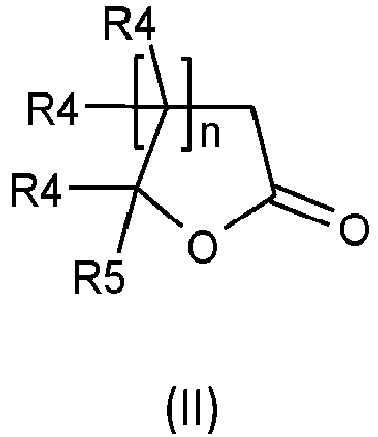
R4 für H oder Methyl, R5 für einen linearen oder verzweigten, gesättigten oder ungesättigten Kohlenwasserstoffrest mit 2 bis 10 Kohlenstoffatomen und n für die Zahlen 1 oder 2 steht, sowie deren Enantiomere, Diastereomere und Razemate, und
(c) ein, zwei oder mehrere Lösungsmittel ausgewählt aus der Gruppe bestehend aus Ethanol, Wasser, Dipropylenglykol (DPG), Diethylphtalat (DEP), Propylenglykol (PG), Isopropylmyristat (IPM), Isopropylpalmitat (IPP), Triethylcitrat (TEC), Triacetin (TRI), 1,2-Propandiol, 1,3-Propandiol, Propantriol, Pentandiol, Hexandiol, Octandiol, Decandiol , Dodecanol, 4-Hydroxy-Acetophenon , Butylenglykol, Pentylenglykol, Hexylenglykol, Decylenglykol, Propylencarbonat, Butylencarbonat, Glycerincarbonat, 2-Benzylheptanol, Trimethyl-Hydroxypentyl-Isobutyrat, Glycerylcaprylat, Ethylhexylglycerin, Benzylbenzoat (BB),
und gegebenenfalls
(d) weitere Aroma- bzw. Duftstoffe ausgewählt aus der Gruppe bestehend aus 3-Phenylbutanal, Acetylmethylcarbinol, Anethol, Anisylacetat, Dihydroeugenol, Linalylformiat, 2-Methyldecanal, 2-Benzyl-2-methylbut-3-ene nitrile, 3-Hexenylacetat, Styralylacetat, Citronellal, Cinnamylacetat, Rhubafuran, betalonon, Anther, Prenylacetat, 2-Phenylpropanal, 4-(4-Hydroxyphenyl)butan-2-on, Ethylphenoxyacetat, Isoraldein, gamma-Terpinen, Limonen, Neocyclocitral, Methyllavenderketon, Styralylpropionat, Phenylethylpropionat, Limonenal, 4-Isopentylcyclohexanol, 4-methyl-2-phenyl-3,6-dihydro-2H-pyran/4-methylen-2-phenyl-tetrahydropyran, Hydrocitronitril, Phenoxanol, Isoamylphenylacetat, Damascon, Silvial, Nectaryl, Ambroxid, Acetylpyrazin, Trimethylpyrazin, Isoamylacetat, Cresylmethylether para, Filbertone, Cyclohexylacetat, Heliotropin, Acetophenon, Anisaldehyd, Methylacetophenon para, Veratraldehyd, Methylanisat und Vertoprenal,
und
(ii) Aldehyde der Formel (III)

und/oder
(iii) freie Fettsäuren der Formel (IV).
Description
- Die Erfindung befindet sich auf dem Gebiet der oleochemischen Produkte und betrifft Stoffmischungen, die die sensorische Wahrnehmung der durch oleochemische Zubereitungen gebildeten und unerwünschten Fehlnoten verursachenden Stoffe reduziert oder verhindert, sowie ein Verfahren zu deren Herstellung sowie deren Verwendung.
- Oleochemische Produkte und Zubereitungen aus den Bereichen der Kosmetik, Haushalt, Mundpflegemitteln, Fine Fragrance enthalten Fette, Fettsäuren, Fettsäureester, Fettsäuresalze oder Fett- bzw. Fettsäure-basierte Inhaltsstoffe. Gemeinsam ist allen diesen Stoffen, dass sie einen typischen fettigen Geruch besitzen, der bei längerer Lagerung zudem weitere unangenehme Noten entwickelt. Ursache hierfür sind neben kurzkettigen freien Fettsäuren, die durch Verseifung der Triglyceride freigesetzt werden, insbesondere Aldehyde und andere Stoffe, die durch Oxidation entstehen.
- Diese unerwünschten Fehlnoten wirken sich negativ auf den Geruch oder das Aroma des Produktes oder Zubereitung und dessen Qualität aus. Gängige verwendete Parfümierungen oder Düfte bzw. Aromen können diese Fehlnote nur bedingt verdecken und müssen ggf. in erhöhter Konzentration eingesetzt werden, was wiederum erhöhte Kosten zur Folge hat.
- Eine Methode, dieses Problem zu lösen, besteht darin, geruchlich nicht einwandfreie Chargen einer Nachbehandlung, der so genannten Desodorierung, zu unterwerfen. Dabei werden die Rohstoffe mit heißem Wasserdampf behandelt, wobei die Geruchsträger zu einem großen Teil abdestilliert werden. Das Verfahren ist jedoch mit hohem Energieeintrag verbunden. Insbesondere dann, wenn es darum geht, möglichst preiswerte Fette und Öle zu verarbeiten, die naturgemäß den höchsten Anteil an den genannten unerwünschten Geruchsträgern aufweisen, ist diese Maßnahme ökonomisch gesehen natürlich konterproduktiv.
- In manchen Fällen ist es auch möglich, den unangenehmen Geruch durch Zugabe eines Verkapselungsmittels einzuschließen, wie dies beispielsweise in
WO 2009 131748 A1 beschrieben wird. Allerdings ist auch diese Maßnahme aus ökonomischer Sicht kaum zu realisieren. Bei dieser Lösung besteht die Möglichkeit, das Riechstoffe oder Aromastoffe der zugesetzten Aromatisierung oder Parfümierung durch das Verkapselungsmittel ebenfalls gebunden werden könnten und sich dadurch negativ auf den gewünschten Duft oder Geschmack auswirken kann. - Die gängigste Alternative besteht bislang darin, den olfaktorisch nicht einwandfreien Rohstoffen - oder den damit konfektionierten Endprodukten - Duftstoffe beizufügen, die den unangenehmen Geruch oder Aroma überdecken (maskieren) oder sich mit diesem in einer Art und Weise kombinieren, dass ein neuer Geruch oder Aroma entsteht, der weniger unangenehm ist. Auch dieses Verfahren ist aufwendig und teuer, da bislang stets erhebliche Mengen an solchen Maskierungsstoffen erforderlich gewesen sind.
- Das Dokument
EP 2 865 739 A1 offenbart die Verwendung von Mischungen mit Lactonen der Formel (Ia) oder (Ib)
- Das Dokument
WO 03/070871 A1 
- Das Dokument
US 2006/0207037 A1 offenbart ein Parfüm oder Riechstoffmischung, die optimiert ist auf die Überdeckung von stickstoffhaltigen Stoffe bedingte Schlechtgerüche, wie Ammoniak und substituierte Amine, die aber auch für andere Arten von Schlechtgerüchen wie Schweiß, Körpergeruch, Badzimmergerüche, Küchengerüche, etc angewendet werden kann. Weiterhin werden Duftstoffmischungen offenbart, die die Kombinationen von gamma-Undecalacton, gamma-Decalacton und Diethylphtalat (DEP) sowie die Kombination von gamma-Undecalacton, Geraniol, Linalool und Diethylphtalat (DEP) zeigen. Hauptverwendung dieser Riechstoffmischungen sind Haarfärbemittel, wobei sie auch für Produkte vom Haushaltsreiniger bis hin zu Kosmetika, umfassend Antiperspirationen, Deodorants, Selbstbräuner, Shampoos, Conditioner, Handlotion, Bodylotion und Dauerwelle verwendet werden können. - Im Dokument
WO 2004/009750 A1 sind Duftstoffkomponenten, Gemische davon und Parfum-Zusammensetzungen zur Reduzierung oder Verhinderung von Körpergeruch beschrieben. Die identifizierten Duftstoffkomponenten verhindern die Herstellung riechender Steroiden, die von auf der Hautoberfläche vorhandenen Mikroorganismen hergestellt werden. Die Zusammensetzungen werden als Antimalodor-Wirkstoff als auch als Deo-Wirkstoff für Kosmetik bzw. Parfüm, Antiperspirantien und Deodorants beschrieben. Es wird die Kombination von gamma-Octalacton, gamma-Nonalacton, Geraniol, Dihydrolinalool und Tetrahydrogeraniol offenbart. - Das Dokument
WO 96/04940 - a) etwa 0,01 bis etwa 1% Parfüm, bezogen auf das Gewicht der Zusammensetzung;
- b) gegebenenfalls, jedoch vorzugsweise, etwa 0,1 bis etwa 5% eines wasserlöslichen Cyclodextrins, bezogen auf das Gewicht der Zusammensetzung; c) gegebenenfalls, jedoch vorzugsweise, etwa 0,1 bis etwa 10% eines wasserlöslichen Metallsalzes, bezogen auf das Gewicht der Zusammensetzung; d) gegebenenfalls, jedoch vorzugsweise, etwa 0 bis etwa 3% eines Solubilisierungs-Hilfsmittels, bezogen auf das Gewicht der Zusammensetzung; und e) einen wässrigen Träger. Gamma-Decalacton und gamma-Dodecalacton befinden sich unter den verschiedenen Duftstoffen, die die Komponente a) enthalten kann. Die Zusammensetzung werden vorzugweise auf Textilien, insbesondere Kleider, aufgesprüht, ohne sie zu waschen oder trockenzureinigen.
- Trotz der oben genannten Alternativen, die aus dem Stand der Technik bekannt sind, besteht weiterhin im Gebiet der oleochemischen Produkte ein starkes Bedürfnis nach neuen Stoffmischungen, die die oben genannten Nachteile überwinden, und die die Herstellung von qualitativ-hochwertigen Produkten und Zubereitungen ohne unerwünschten Geruchs- oder Aroma-Fehlnoten ermöglichen.
- Weiterhin wirken sich diese unerwünschten Fehlnoten auch auf die Benutzung der Produkte oder Zubereitungen aus, denn beim Waschen, sprühen oder eincremen, versagen die gängigen Parfümierungen oder Aromatisierungen und die unerwünschten Fehlnoten treten besonders stark hervor.
- Die Aufgabe der vorliegenden Erfindung hat somit darin bestanden, neue hochaktive Stoffmischungen zur Verfügung zu stellen, die schon in sehr geringen Konzentrationen in der Lage sind, die in oleochemischen Rohstoffen und in den damit hergestellten Endprodukten auftretenden unangenehmen Geruchs- oder Aroma-Fehlnoten, vorzugsweise Fehlnoten, die als stechend, kratzig, oxidiert, beißend, ranzig, fettig, animalisch, Ziege, vergoren, muffig, krautig und Erbrochenes von den Verbrauchern wahrgenommen werden, entgegenzuwirken, zu reduzieren oder zu maskieren.
- Eine zweite Aufgabe der vorliegenden Erfindung hat somit darin bestanden, neue hochaktive Stoffmischungen zur Verfügung zu stellen, die in der Lage sind, den oben genannten unerwünschten Fehlnoten entgegenzuwirken, zu reduzieren oder zu maskieren, sowohl während der Benutzung als auch nach dem Abspülen der oleochemischen Zubereitungen bzw. Endprodukten, vor allem von der Hautoberfläche, die diese hochaktiven Stoffmischungen umfassen.
- Ein erster Gegenstand der vorliegenden Erfindung betrifft Zubereitungen enthaltend
- (i) eine Stoffmischung, enthaltend
- (a) ein, zwei oder mehrere Verbindungen ausgewählt aus der Gruppe bestehend aus
- (a1) Alkohol-Monoterpene der Formel (I)

R1 für H oder Methyl, R2 für H oder C2-Alkenyl, und R3 für einen linearen oder verzweigten, gesättigten oder ungesättigten Kohlenwasserstoffrest mit 4 bis 10 Kohlenstoffatomen steht, sowie deren Enantiomere, Diastereomere, Razemate, Solvate und physiologisch verträglichen Salze,
und/oder - (a2) Bicyclische Epoxy-Monoterpene,
- (a1) Alkohol-Monoterpene der Formel (I)
- (b) mindestens zwei Lactone der Formel (II)

R4 für H oder Methyl, R5 für einen linearen oder verzweigten, gesättigten oder ungesättigten Kohlenwasserstoffrest mit 2 bis 10 Kohlenstoffatomen und n für die Zahlen 1 oder 2 steht, sowie deren Enantiomere, Diastereomere und Razemate, und - (c) ein, zwei oder mehrere Lösungsmittel ausgewählt aus der Gruppe bestehend aus Ethanol, Wasser, Dipropylenglykol (DPG), Diethylphtalat (DEP), Propylenglykol (PG), Isopropylmyristat (IPM), Isopropylpalmitat (IPP), Triethylcitrat (TEC), Triacetin (TRI), 1,2-Propandiol, 1,3-Propandiol, Propantriol, Pentandiol, Hexandiol, Octandiol, Decandiol (SymClariol®), Dodecanol4-Hydroxy-Acetophenon (SymSave® H), Butylenglykol, Pentylenglykol, Hexylenglykol, Decylenglykol, Propylencarbonat, Butylencarbonat, Glycerincarbonat, 2-Benzylheptanol, Trimethyl-Hydroxypentyl-Isobutyrat, Glycerylcaprylat, Ethylhexylglycerin, Benzylbenzoat (BB),
und gegebenenfalls - (d) weitere Aroma- bzw. Duftstoffe ausgewählt aus der Gruppe bestehend aus 3-Phenylbutanal (Trifernal), Acetylmethylcarbinol, Anethol, Anisylacetat, Dihydroeugenol, Linalylformiat, 2-Methyldecanal, 2-Benzyl-2-methylbut-3-ene nitrile (Citrowanil®B), 3-Hexenylacetat, Styralylacetat, Citronellal, Cinnamylacetat, Rhubafuran, beta-Ionon, Anther, Prenylacetat, 2-Phenylpropanal, 4-(4-Hydroxyphenyl)butan-2-on (Frambinon®), Ethylphenoxyacetat, Isoraldein, gamma-Terpinen, Limonen, Neocyclocitral, Methyllavenderketon, Styralylpropionat, Phenylethylpropionat, Limonenal, 4-Isopentylcyclohexanol (Symrose®), 4-methyl-2-phenyl-3,6-dihydro-2H-pyran/4-methylen-2-phenyl-tetrahydropyran (Rosyrane super), Hydrocitronitril, Phenoxanol, Isoamylphenylacetat, Damascon, Silvial, Nectaryl, Ambroxid, Acetylpyrazin, Trimethylpyrazin, Isoamylacetat, Cresylmethylether para, Filbertone, Cyclohexylacetat, Heliotropin, Acetophenon, Anisaldehyd, Methylacetophenon para, Veratraldehyd, Methylanisat und Vertoprenal,
- (a) ein, zwei oder mehrere Verbindungen ausgewählt aus der Gruppe bestehend aus
- (ii) Aldehyde der Formel (III)

und/oder - (iii) freie Fettsäuren der Formel (IV).

- In einer bevorzugten Ausführungsform ist die erfindungsgemäße Zubereitung eine oleochemische Zubereitung.
- In einer bevorzugten Ausführungsform enthält die erfindungsgemäße Zubereitung mindestens zwei, drei oder vier Stoffe der Gruppe (a).
- In einerweiteren bevorzugten Ausführungsform ist die Komponente (a1) ausgewählt aus der Gruppe bestehend aus Linalool, Geraniol, Freesiol und Nerolidol sowie deren Enantiomere, Diastereomere, Razemate, Solvate und physiologisch verträglichen Salze.
- In einer weiteren bevorzugten Ausführungsform sind die bicyclische Epoxy-Monoterpene (Komponente (a2)) Epoxy-p-Menthan-Derivate, insbesondere bevorzugt sind die Verbindungen 1,4-Cineol und 1,8-Cineol.
- In einer bevorzugten Ausführungsform enthält die erfindungsgemäße Zubereitung mindestens zwei Lactone - gegebenenfalls drei oder vier - ausgewählt aus der Gruppe bestehend aus der Lactone der Formel (II) sowie deren Enantiomere, Diastereomere und Razemate, wobei R4 für H, R5 für lineare und gesättigte Kohlenstoffreste mit 2 bis 10 Kohlenstoffatomen n für die Zahlen 1 oder 2 steht, besonders bevorzugt mit R4 = H und R5 = lineare und gesättigte Kohlenstoffreste mit 2 bis 8 Kohlenstoffatomen und n = 1 oder 2.
- In einer weiteren bevorzugten Ausführungsform enthält die erfindungsgemäße Zubereitung mindestens zwei Lactone - gegebenenfalls drei oder vier - ausgewählt aus der Gruppe bestehend aus gamma-Dodecalacton, gamma-Decalacton, gamma-Undecalacton, delta- Decalacton, delta- Dodecalacton, 4-Methyl-gamma-Nonalacton, 3-Methyl-gamma-Decalacton, gamma-Nonalacton, delta-Nonalacton, gamma-Octalacton, delta-Octalacton, gamma-Heptalacton, delta-Heptalacton, gamma-Hexalacton und delta-Hexalacton, bevorzugt gamma-Dodecalacton, gamma-Decalacton, delta-Decalacton und delta-Dodecalacton.
- In einer bevorzugten Ausführungsform sind die Aldehyde der Formel (III) aus der Gruppe bestehend aus Hexanal, Heptanal, Octanal, Nonanal, Decanal, Hexenal, Heptenal, Octenal, Nonenal, Decenal, Undecenal, Dodecenal, Hexadienal, Heptadienal, Octadienal, Nonadienal, Decadienal, Undecandienal, Dodecandienal, Octatrienal, Nonatrienal, Decatrienal, Undecatrienal, Dodecatrienal, insbesondere bevorzugt Hexanal, Octanal, Nonanal, Hexenal, Heptenal, Octenal, Heptadienal Octadienal, Decadienal und Decatrienal ausgewählt.
- In einer weiteren bevorzugten Ausführungsform sind die freie Fettsäuren der Formel (IV) aus der Gruppe bestehend aus Butansäure, Pentansäure, Isovaleriansäure, Hexansäure, Heptansäure, Octansäure, Nonansäure, Decansäure, Undecansäure und Dodecansäure, insbesondere bevorzugt Hexansäure, Octansäure und Decansäure ausgewählt.
- In einer anderen bevorzugten Ausführungsform sind die Aldehyde der Formel (III) aus der Gruppe bestehend aus Hexanal, Heptanal, Octanal, Nonanal, Decanal, Hexenal, Heptenal, Octenal, Nonenal, Decenal, Undecenal, Dodecenal, Hexadienal, Heptadienal, Octadienal, Nonadienal, Decadienal, Undecandienal, Dodecandienal, Octatrienal, Nonatrienal, Decatrienal, Undecatrienal, Dodecatrienal, insbesondere bevorzugt Hexanal, Octanal, Nonanal, Hexenal, Heptenal, Octenal, Heptadienal, Octadienal, Decadienal und Decatrienal, und
die freie Fettsäuren der Formel (IV) aus der Gruppe bestehend aus Butansäure, Pentansäure, Isovaleriansäure, Hexansäure, Heptansäure, Octansäure, Nonansäure, Decansäure, Undecansäure und Dodecansäure, insbesondere bevorzugt Hexansäure, Octansäure und Decansäure ausgewählt. - In einer bevorzugten Ausführungsform ist die Komponente (c) der erfindungsgemäßen Zubereitung ein, zwei oder mehrere Lösungsmittel ausgewählt aus der Gruppe bestehend aus Ethanol, Wasser, Dipropylenglykol (DPG), Diethylphtalat (DEP), Propylenglykol (PG), Isopropylmyristat (IPM), Isopropylpalmitat (IPP), Triethylcitrat (TEC), Triacetin (TRI), 1,2-Propandiol, 1,3-Propandiol, Propantriol, Pentandiol, Hexandiol, Octandiol, Decandiol (SymClariol®), Dodecanol, 4-Hydroxy-Acetophenon (SymSave® H) und Benzylbenzoat (BB).
- In einer weiteren bevorzugten Ausführungsform enthält die erfindungsgemäße Zubereitung einen oder mehrere Aroma- bzw. Duftstoffe der Gruppe (d), wobei diese aus der Gruppe aus 3-Phenylbutanal (Trifernal), Acetylmethylcarbinol, 2-Methyldecanal, 2-Benzyl-2-methylbut-3-ene nitrile (Citrowanil®B), 3-Hexenylacetat, Styralylacetat, Rhubafuran, Anther, Prenylacetat, Styralylpropionat, Isoamylphenylacetat, beta-Damascon, Isoamylacetat, Citronellol und Cyclohexylacetat ausgewählt ist/sind.
- Im Sinne der vorliegenden Erfindung kann die erfindungsgemäße Zubereitung mit zusätzlichen Duft- oder Aromastoffe kombiniert werden.
- Es ist daher ein weiterer Gegenstand der vorliegenden Erfindung eine Duft- oder Aromazusammensetzung, enthaltend die erfindungsgemäße Zubereitung in Kombination mit zusätzlichen Duft- oder Aromastoffe der Gruppe (e), die in oleochemischen Zubereitungen oder Endprodukten eingearbeitet werden kann.
- Duft- bzw. Aromastoffe der Gruppe (e) im Sinne der Erfindung sind Stoffe, die durch z.B. europäische oder amerikanische Rechtsprechung, z.B. die Verordnung (EG) Nr. 2232/96 des Europäischen Parlaments und des Rates und der Positivliste gemäß der Durchführungsverordnung (EU) Nr. 872/2012 der Kommission, definiert sind, und die Stoffe, die in "Riechstoffe" von Steffen Arctander, in "Perfume and Flavor Chemicals" vom Eigenverlag, Montclair, N. J. 1969 sowie in "Common Fragrance and Flavor Materials" von H. Surburg, J. Panten, 5th Edition, Wiley-VCH, Weinheim 2006 aufgeführt sind.
- Beispiele für Duft-und Aromastoffe der Gruppe (e) im Sinne der Erfindung sind
- Extrakte aus natürlichen Rohstoffen wie Etherische Öle, Concretes, Absolues, Resine, Resinoi-de, Balsame, Tinkturen wie z. B. Ambratinktur; Amyrisöl; Angelicasamenöl; Angelicawurzelöl; Anisöl; Baldrianöl; Basilikumöl; Baummoos-Absolue; Bayöl; Beifußöl; Benzoeresin; Bergamotteöl; Bienenwachs-Absolue; Birkenteeröl; Bittermandelöl; Bohnenkrautöl; Buccoblätteröl; Cabreuvaöl; Cadeöl; Calmusöl; Campheröl; Canangaöl; Cardamomenöl; Cascarillaöl; Cassiaöl; Cassie-Absolue; Castoreum-absolue; Cedernblätteröl; Cedernholzöl; Cistusöl; Citronellöl; Citronenöl; Copaivabalsam; Copaivabalsamöl; Corianderöl; Costuswurzelöl; Cuminöl; Cypressenöl; Davanaöl; Dillkrautöl; Dillsamenöl; Eau de brouts-Absolue; Eichenmoos-Absolue; Elemiöl; Estragonöl; Eucalyptus-citriodora-Öl; Eucalyptusöl; Fenchelöl; Fichtennadelöl; Galbanumöl; Galbanumresin; Geraniu-möl; Grapefruitöl; Guajakholzöl; Gurjunbalsam; Gurjunbalsamöl; Helichrysum-Absolue; He-lichrysumöl; Ingweröl; Iriswurzel-Absolue; Iriswurzelöl; Jasmin-Absolue; Kalmusöl; Kamillenöl blau; Kamillenöl römisch; Karottensamenöl; Kaskarillaöl; Kiefernadelöl; Krauseminzöl; Kümmel-öl; Labdanumöl; Labdanum-Absolue; Labdanumresin; Lavandin-Absolue; Lavandinöl; Lavendel-Absolue; Lavendelöl; Lemongrasöl; Liebstocköl; Limetteöl destilliert; Limetteöl gepreßt; Linaloeöl; Litsea-cubeba-Öl; Lorbeerblätteröl; Macisöl; Majoranöl; Mandarinenöl; Massoirindenöl; Mimosa-Absolue; Moschuskörneröl; Moschustinktur; Muskateller-Salbei-Öl; Muskatnußöl; Myrrhen-Absolue; Myrrhenöl; Myrtenöl; Nelkenblätteröl; Nelkenblütenöl; Neroliöl; Olibanum-Absolue; Olibanumöl; Opopanaxöl; Orangenblüten-Absolue; Orangenöl; Origanumöl; Palmarosaöl; Patchouliöl; Perillaöl; Perubalsamöl; Petersilienblätteröl; Petersiliensamenöl; Petitgrainöl; Pfefferminzöl; Pfefferöl; Pimentöl; Pineöl; Poleyöl; Rosen-Absolue; Rosenholzöl; Rosenöl; Rosmarinöl; Salbeiöl dalmatinisch; Salbeiöl spanisch; Sandelholzöl; Selleriesamenöl; Spiklavendelöl; Sternanisöl; Styraxöl; Tagetesöl; Tannennadelöl; Tea-tree-Öl; Terpentinöl; Thymianöl; Tolubalsam; Tonka-Absolue; Tuberosen-Absolue; Vanilleextrakt; Veilchenblätter-Absolue; Verbenaöl; Vetiveröl; Wacholderbeeröl; Weinhefenöl; Wermutöl; Wintergrünöl; Ylangöl; Ysopöl; Zibet-Absolue; Zimtblätteröl; Zimtrindenöl, sowie Fraktionen davon, bzw. daraus isolierten Inhaltsstoffen
- Ester wie z.B. Ethylbutyrat, Allylcapronat, Benzylacetat, Methylsalicylat, Nerylacetat, Geranylacetat, Allylcapronat, Anisylformiat, Butylbutyrat, Butylcapronat, Butylidenphthalid, Benzylbenzoat, Citronellylacetat, Dimethylanthranilat, Dimethylanthranilat, Ethoxyethylacetat, Ethylbutyrat, Ethylcaprinat, Ethylcapronat, Ethylcrotonat, Ethyl-isobutyrat, Ethylisovalerianat, Ethyllactat, Ethylmethylbutyrat, Ethylpropionat, Ethylheptylat, Methyldihydrojasmonat (z.B. Hedion®), cis-2-Hexenylacetat, cis-3-Hexenylcapronat, trans-2-Hexenylcapronat, cis-3-Hexenylformiat, cis-2-Hexylacetat, cis-3-Hexylacetat, trans-2-Hexylacetat, cis-3-Hexylformiat, Isoamylisovalerianat, Isobutylbutyrat, Linalylacetat, Methylanthranilat, 2-Methylbutylacetat, Methylcapronat, Methylcinnamat, Methyljasmonat, 2-Methylmethylbutyrat, Methylthiobutyrat, 3-Methylthiohexylacetat, Nerylacetat, 1-Octylacetat, 3-Octylacetat, Phenylethylacetat, Phenylethylisovalerianat, Propylbutyrat, Ethylvanillinisobutyrat, Essigsäureisoamylester, Buttersäureethylester, Buttersäure-n-butylester, Buttersäureisoamylester, 3-Methyl-buttersäureethylester, n-Hexansäureethylester, n-Hexansäureallylester, n-Hexansäure-n-butylester, n-Octansäureethylester, Ethyl-3-methyl-3-phenylglycidat, Ethyl-2-trans-4-cis-decadienoat, Methylsalicylat, Methylsorbat;
- Alkohole wie z.B. Octenol, cis-3-Hexanol, Benzylalkohol, Phenylethylalkohol, Eugenol, cis-3-Hexenol, Isoamylalkohol, Methylbutanol, 3,1-Methylthiohexanol, 2,4-Nonadienol, 2,6-Nonadienol, 2,4-Nonadienol, 2-Octanol, 3-Octanol, 1,3-Octenol, Phenylethylalkohol, Phenylethylalkohol, Zimtalkohol;
- Aldehyde wie z.B. Acetaldehyd, Isobutyraldehyd, Nonadienal, 3-Phenylacetaldehyd, Benzaldehyd, Grapefruitaldehyd, Isobutyraldehyd, 5-Methylfurfural, Paraldehyd, Piperonal, Propionaldehyd, Vanillin, Ethylvanillin, Divanillin, Phenylacetaldehyd, Methional, Zimtaldehyd;
- Ketone wie z.B. Menthon, alpha-lonon, beta-lonon, 4-(p-Hydroxyphenyl)-2-butanon, 2-Heptanon, 3-Heptanon, 4-Heptanon, para-Hydroxybenzylaceton, 3,2,2-Methylcyclopentenolon, 6,5,2-Methylheptenon, Nootkaton, Pentandion, 4-(p-Hydroxyphenyl)-2-butanon;
- Ether wie z.B. 4-Hydroxy-5-methylfuranon, 3-Hydroxy- 4,5-dimethyl-2-(5H)-furanon, 2,5-Dimethyl-3-hydroxy-2(3H)-furanon, 2(5)-Ethyl-4- hydroxy-5(2)-methyl-3(2H)-furanon, p-Methoxybenzaldehyd, Guajacol, Methoxyvinylphenol, Ethylfuraneol, Ethylguajakol, Isoeugenolmethylether, Menthofuran, 2,5-Dimethyl-4-hydroxy-3(2H)-furanon, Homo-furaneol (= 2-Ethyl-4-hydroxy-5-methyl-3(2H)-furanon), Homofuronol (= 2-Ethyl-5-methyl-4-hydroxy-3(2H)-furanon und 5-Ethyl-2-methyl-4-hydroxy-3(2H)-furanon, 1,1-Dimethoxy-2,2,5-trimethyl-4-hexan;
- Acetale wie z.B. Acetaldehyddiethylacetal; Heliotropindiethylacetal;
- Lactone wie z.B. Ethylenbrassylat, Globalide®, Ambrettolid, Massoilacton, Tuberolacton, 4-Octanolid; 3-Methyl-1,4-octanolid; 1,4-Nonanolid; 1,4-Decanolid; 8-Decen-1,4-olid; 1,4-Undecanolid; 1,4-Dodecanolid; 1,5-Decanolid; 1,5-Dodecanolid; 1,15-Pentadecanolid; cis- und trans-11-Pentadecen-1,15-olid; cis- und trans-12-Pentadecen-1,15-olid; 1,16-Hexadecanolid; 9-Hexadecen-1,16-olid; 10-Oxa-1,16-hexadecanolid; 11-Oxa-1,16-hexadecanolid; 12-Oxa-1,16-hexadecanolid; Ethylen-1,12-dodecandioat; Ethylen-1,13-tridecandioat; Cumarin; 2,3-Dihydrocumarin; Octahydrocumarin;
- Terpene wie z.B. Citronellol; Nerol; Lavadulol; Farnesol; Tetrahydrolinalool; Tetrahydrogeraniol; 2,6-Dimethyl-7-octen-2-ol; 2,6-Dimethyloctan-2-ol; 2-Methyl-6-methylen-7-octen-2-ol; 2,6-Dimethyl-5,7-octadien-2-ol; 2,6-Dimethyl-3,5-octadien-2-ol; 3,7-Dimethyl-4,6-octadien-3-ol; 3,7-Dimethyl-1,5,7-octatrien-3-ol 2,6-Dimethyl-2,5,7-octatrien-1-ol; sowie deren Formiate, Acetate, Propionate, Isobutyrate, Butyrate, Isovalerianate, Pentanoate, Hexanoate, Crotonate, Tiglinate, 3-Methyl-2-butenoate;
- Terpenaldehyde wie z.B. Geranial; Neral; Citronellal; 7-Hydroxy-3,7-dimethyloctanal; 7-Methoxy-3,7-dimethyloctanal; 2,6,10-Trimethyl-9-undecenal; Geranylaceton sowie die Dimethyl- und Diethylacetale von Geranial, Neral, 7-Hydroxy-3,7-dimethyloctanal; Menthol; Isopulegol; alpha-Terpineol; Terpinenol-4; Menthan-8-ol; Menthan-1-ol; Menthan-7-ol; Borneol; Isoborneol; Linalooloxid; Nopol; Cedrol; Ambrinol; Vetiverol; Guajol; sowie deren Formiate, Acetate, Propionate, Isobutyrate, Butyrate, Isovalerianate, Pentanoate, Hexanoate, Crotonate, Tiglinate, 3-Methyl-2-butenoate;
- cyclischen Terpenalkohole wie z.B. Menthol; Isopulegol; alpha-Terpineol; Terpinenol-4; Menthan-8-ol; Menthan-1-ol; Menthan-7-ol; Borneol; Isoborneol; Linalooloxid; Nopol; Cedrol; Ambrinol; Vetiverol; Guajol; sowie deren Formiate, Acetate, Propionate, Isobutyrate, Butyrate, Isovalerianate, Pentanoate, Hexanoate, Crotonate, Tiglinate, 3-Methyl-2-butenoate;
- Sulfide und Disulfide wie z.B. Dimethylsulfid, Difurfuryldisulfid, Methylthiopropanal;
- Thiole wie z.B. Methylfuranthiol, Benzothiazol, Isopropylmethylthiazol, Sulfurol, 8,3-Thiomenthanon, 4,4,2-Thiomethylpentanon, 2,4,5-Trimethylthiazol, 2-Acetylthiazol, 2,4-Dimethyl-5-ethylthiazol;
- Pyrazine und Pyrroline wie z.B. Methylpyrazin, Acetylpyrazin, 2-Propionylpyrrolin, 2-Acetylpyrrolin, 2-Acetyl-1-pyrrolin, 2-Methyl-3-ethylpyrazin, 2-Ethyl-3,5-dimethylpyrazin, 2-Ethyl-3,6-dimethylpyrazin, 2,3-Diethyl-5-methylpyrazin, 3-Isopropyl-2-methoxypyrazin, 3-Isobutyl-2-methoxypyrazin, 2-Pentylpyridin
- cycloaliphatischen Alkohole wie z.B. alpha,3,3-Trimethylcyclohexylmethanol; 2-Methyl-4-(2,2,3-trimethyl-3-cyclopent-1-yl)butanol; 2-Methyl-4-(2,2,3-trimethyl-3-cyclopent-1-yl)-2-buten-1-ol; 2-Ethyl-4-(2,2,3-trimethyl-3-cyclopent-1-yl)-2-buten-1-ol; 3-Methyl-5-(2,2,3-trimethyl-3-cyclopent-1-yl)-pentan-2-ol; 3-Methyl-5-(2,2,3-trimethyl-3-cyclopent-1-yl)-4-penten-2-ol; 3,3-Dimethyl-5-(2,2,3-trimethyl-3-cyclopent-1-yl)-4-penten-2-ol; 1-(2,2,6-Trimethylcyclohexyl)pentan-3-ol; 1-(2,2,6-Trimethylcyclohexyl)hexan-3-ol;
- cyclischen und cycloaliphatischen Ether wie z.B. Cedrylmethylether; Cyclododecyl-methylether; (Ethoxymethoxy)cyclododecan; alpha-Cedrenepoxid; 3a,6,6,9a-Tetramethyldodecahydronaphtho[2,1-b]furan; 3a-Ethyl-6,6,9a-trimethyldodecahydronaphtho[2,1-b]furan; 1,5,9-Trimethyl-13-oxabicyclo[10.1.0]trideca-4,8-dien; Rosenoxid; 2-(2,4-Dimethyl-3-cyclohexen-1-yl)-5-methyl-5-(1-methylpropyl)-1,3-dioxan;
- cyclischen und makrocyclischen Ketone wie z.B. 4-tert.-Butylcyclohexanon; 2,2,5-Trimethyl-5-pentylcyclopentanon; 2-Heptylcyclopentanon; 2-Pentylcyclopentanon; 2-Hydroxy-3-methyl-2-cyclopenten-1-on; 3-Methyl-cis-2-penten-1-yl-2-cyclopenten-1-on; 3-Methyl-2-pentyl-2-cyclopenten-1-on; 3-Methyl-4-cyclopentadecenon; 3-Methyl-5-cyclopentadecenon; 3-Methylcyclopentadecanon; 4-(1-Ethoxyvinyl)-3,3,5,5-tetramethylcyclohexanon; 4-tert.-Pentylcyclohexanon; 5-Cyclohexadecen-1-on; 6,7-Dihydro-1,1,2,3,3-pentamethyl-4(5H)-indanon; 7-Cyclohexadecen-1-on; 8-Cyclohexadecen-1-on; 9-Cycloheptadecen-1-on; Cyclo-pentadecanon; Cyclohexadecanon;
- cycloaliphatischen Aldehyde wie z.B. 2,4-Dimethyl-3-cyclohexencarbaldehyd; 2-Methyl-4-(2,2,6-trimethyl-cyclohexen-1-yl)-2-butenal; 4-(4-Hydroxy-4-methylpentyl)-3-cyclohexencarbaldehyd; 4-(4-Methyl-3-penten-1-yl)-3-cyclohexencarbaldehyd;
- cycloaliphatischen Ketone wie z.B. 1-(3,3-Dimethylcyclohexyl)-4-penten-1-on; 1-(5,5-Dimethyl-1-cyclohexen-1-yl)-4-penten-1-on; 2,3,8,8-Tetramethyl-1,2,3,4,5,6,7,8-octahydro-2-naphtalenylmethylketon; Methyl-2,6,10-trimethyl-2,5,9-cyclododecatrienylketon; tert.-Butyl-(2,4-dimethyl-3-cyclohexen-1-yl)keton;
- Ester cyclischer Alkohole wie z.B. 2-tert-Butylcyclohexylacetat; 4-tert-Butylcyclohexylacetat; 2-tert-Pentylcyclohexylacetat; 4-tert-Pentylcyclohexylacetat; Decahydro-2-naphthylacetat; 3-Pentyltetrahydro-2H-pyran-4-ylacetat; Decahydro-2,5,5,8a-tetramethyl-2-naphthylacetat; 4,7-Methano-3a,4,5,6,7,7a-hexahydro-5, bzw. 6-indenylacetat; 4,7-Methano-3a,4,5,6,7,7a-hexahydro-5, bzw. 6-indenylpropionat; 4,7-Methano-3a,4,5,6,7,7a-hexahydro-5, bzw. 6-indenylisobutyrat; 4,7-Methanooctahydro-5, bzw. 6-indenylacetat;
- Ester cycloaliphatischer Carbonsäuren wie z.B. Allyl-3-cyclohexylpropionat; Allylcyclohexyloxyacetat; cis- und trans-Methyldihydrojasmonat; cis- und trans-Methyljasmonat; Methyl-2-hexyl-3-oxocyclopentancarboxylat; Ethyl-2-ethyl-6,6-dimethyl-2-cyclohexencarboxylat; Ethyl-2,3,6,6-tetramethyl-2-cyclohexencarboxylat; Ethyl-2-methyl-1,3-dioxolan-2-acetat;
- araliphatischen Alkohole wie z.B. Benzylalkohol; 1-Phenylethylalkohol; 2-Phenylethylalkohol; 3-Phenylpropanol; 2-Phenylpropanol; 2-Phenoxyethanol; 2,2-Dimethyl-3-phenylpropanol; 2,2-Dimethyl-3-(3-methylphenyl)propanol; 1,1-Dimethyl-2-phenylethylalkohol; 1,1-Dimethyl-3-phenylpropanol; 1-Ethyl-1-methyl-3-phenylpropanol; 2-Methyl-5-phenylpentanol; 3-Methyl-5-phenylpentanol; 3-Phenyl-2-propen-1-ol; 4-Methoxybenzylalkohol; 1-(4-Isopropylphenyl)ethanol;
- araliphatischen Ether wie z.B. 2-Phenylethylmethylether; 2-Phenylethylisoamylether; 2-Phenylethyl-1-ethoxyethylether; Phenylacetaldehyddimethylacetal; Phenylacetaldehyddiethyl-acetal; Hydratropaaldehyddimethylacetal; Phenylacetaldehydglycerinacetal; 2,4,6-Trimethyl-4-phenyl-1,3-dioxane; 4,4a,5,9b-Tetrahydroindeno[1,2-d]-m-dioxin; 4,4a,5,9b-Tetrahydro-2,4-dimethylindeno[1,2-d]-m-dioxin;
- aromatischen und araliphatischen Aldehyde wie z.B. Benzaldehyd; Phenylacetaldehyd; 3-Phenylpropanal; Hydratropaaldehyd; 4-Methylbenzaldehyd; 4-Methylphenylacetaldehyd; 3-(4-Ethylphenyl)-2,2-dimethylpropanal; 2-Methyl-3-(4-isopropylphenyl)propanal; 2-Methyl-3-(4-tert.-butylphenyl)propanal; 3-(4-tert.-Butylphenyl)propanal; Zimtaldehyd; alpha-Butylzimtaldehyd; alpha-Amylzimtaldehyd; alpha-Hexylzimtaldehyd; 3-Methyl-5-phenylpentanal; 4-Methoxybenzaldehyd; 4-Hydroxy-3-methoxybenzaldehyd; 4-Hydroxy-3-ethoxybenzaldehyd; 3,4-Methylendioxybenzaldehyd; 3,4-Dimethoxybenzaldehyd; 2-Methyl-3-(4-methoxyphenyl)propanal; 2-Methyl-3-(4-methylendioxyphenyl)propanal;
- aromatischen und araliphatischen Ketone wie z.B. 4-Methoxyacetophenon; 4-tert.-Butyl-2,6-dimethylacetophenon; 4-Phenyl-2-butanon; 4-(4-Hydroxyphenyl)-2-butanon; 1-(2-Naphthalenyl)ethanon; Benzophenon; 1,1,2,3,3,6-Hexamethyl-5-indanylmethylketon; 6-tert.-Butyl-1,1-dimethyl-4-indanylmethylketon; 1-[2,3-dihydro-1,1,2,6-tetramethyl-3-(1-methylethyl)-1H-5-indenyl]ethanon; 5',6',7',8'-Tetrahydro-3',5',5',6',8',8'-hexamethyl-2-acetonaphthon;
- aromatischen und araliphatischen Carbonsäuren und deren Ester wie z.B. Benzoesäure; Phenylessigsäure; Methylbenzoat; Ethylbenzoat; Hexylbenzoat; Benzyl-benzoat; Methylphe-nylacetat; Ethylphenylacetat; Geranylphenylacetat; Phenylethyl-phenylacetat; Methylcinnmat; Ethylcinnamat; Benzylcinnamat; Phenylethylcinnamat; Cinnamylcinnamat; Allylphenoxyacetat; Methylsalicylat; Isoamylsalicylat; Hexylsalicylat; Cyclohexylsalicylat; Cis-3-Hexenylsalicylat; Benzylsalicylat; Phenylethylsalicylat; Methyl-2,4-dihydroxy-3,6-dimethylbenzoat; Ethyl-3-phenylglycidat; Ethyl-3-methyl-3-phenylglycidat;
- stickstoffhaltigen aromatischen Verbindungen wie z.B. 2,4,6-Trinitro-1,3-dimethyl-5-tert.-butylbenzol; 3,5-Dinitro-2,6-dimethyl-4-tert.-butylacetophenon; Zimtsäurenitril; 5-Phenyl-3-methyl-2-pentensäurenitril; 5-Phenyl-3-methylpentansäurenitril; Methylanthranilat; Methy-N-methylanthranilat; Schiff'sche Basen von Methylanthranilat mit 7-Hydroxy-3,7-dimethyloctanal, 2-Methyl-3-(4-tert.-butylphenyl)propanal oder 2,4-Dimethyl-3-cyclohexencarbaldehyd; 6-lsopropylchinolin; 6-lsobutylchinolin; 6-sec.-Butylchinolin; Indol; Skatol; 2-Methoxy-3-isopropylpyrazin; 2-Isobutyl-3-methoxypyrazin;
- Phenole, Phenylether und Phenylester wie z.B. Estragol; Eugenol; Eugenylmethylether; Isoeugenol; Isoeugenylmethylether; Thymol; Carvacrol; Diphenylether; beta-Naphthylmethylether; beta-Naphthylethylether; beta-Naphthylisobutylether; 1,4-Dimethoxybenzol; Eugenylacetat; 2-Methoxy-4-methylphenol; 2-Ethoxy-5-(1-propenyl)phenol; p-Kresylphenylacetat;
- heterocyclischen Verbindungen wie z.B. 2,5-Dimethyl-4-hydroxy-2H-furan-3-on; 2-Ethyl-4-hydroxy-5-methyl-2H-furan-3-on; 3-Hydroxy-2-methyl-4H-pyran-4-on; 2-Ethyl-3-hydroxy-4H-pyran-4-on;
- In einer bevorzugten Ausführungsform ist die Duft- oder die Aromazusammensetzung eine flüssige oder feste Aromazusammensetzung.
- Es ist ebenso ein weiterer Gegenstand der vorliegenden Erfindung die Verwendung der erfindungsgemäßen Zubereitung als Fine Fragrance oder Parfüm.
- Ein weiterer Gegenstand der vorliegenden Erfindung ist eine Stoffmischung, enthaltend
- (a) ein, zwei oder mehrere Verbindungen ausgewählt aus der Gruppe bestehend aus
- (a1) Alkohol-Monoterpene der Formel (I)

R1 für H oder Methyl, R2 für H oder C2-Alkenyl, und R3 für einen linearen oder verzweigten, gesättigten oder ungesättigten Kohlenwasserstoffrest mit 4 bis 10 Kohlenstoffatomen steht, sowie deren Enantiomere, Diastereomere, Razemate, Solvate und physiologisch verträglichen Salze,
und/oder - (a2) Bicyclische Epoxy-Monoterpene,
- (a1) Alkohol-Monoterpene der Formel (I)
- (b) mindestens zwei Lactone der Formel (II)

R4 für H oder Methyl, R5 für einen linearen oder verzweigten, gesättigten oder ungesättigten Kohlenwasserstoffrest mit 2 bis 10 Kohlenstoffatomen und n für die Zahlen 1 oder 2 steht, sowie deren Enantiomere, Diastereomere und Razemate, - (c) ein, zwei oder mehrere Lösungsmittel ausgewählt aus der Gruppe bestehend aus
- (c1) Ethanol und/oder
- (c2) ein, zwei oder mehrere Lösungsmittel ausgewählt aus der Gruppe bestehend aus Wasser, Dipropylenglykol (DPG), Diethylphtalat (DEP), Propylenglykol (PG), Isopropylmyristat (IPM), Isopropylpalmitat (IPP), Triethylcitrat (TEC), Triacetin (TRI), 1,2-Propandiol, 1,3-Propandiol, Propantriol, Pentandiol, Hexandiol, Octandiol, Decandiol (SymClariol®), Dodecanol, 4-Hydroxy-Acetophenon (SymSave® H), Butylenglykol, Pentylenglykol, Hexylenglykol, Decylenglykol, Propylencarbonat, Butylencarbonat, Glycerincarbonat, 2-Benzylheptanol, Trimethyl-Hydroxypentyl-Isobutyrat, Glycerylcaprylat, Ethylhexylglycerin, Benzylbenzoat (BB),
- (d) weitere Aroma- bzw. Duftstoffe ausgewählt aus der Gruppe bestehend aus 3-Phenylbutanal (Trifernal), Acetylmethylcarbinol, Anethol, Anisylacetat, Dihydroeugenol, Linalylformiat, 2-Methyldecanal, 2-Benzyl-2-methylbut-3-ene nitrile (Citrowanil®B), 3-Hexenylacetat, Styralylacetat, Citronellal, Cinnamylacetat, Rhubafuran, beta-Ionon, Anther, Prenylacetat, 2-Phenylpropanal, 4-(4-Hydroxyphenyl)butan-2-on (Frambinon®), Ethylphenoxyacetat, Isoraldein, gamma-Terpinen, Limonen, Neocyclocitral, Methyllavenderketon, Styralylpropionat, Phenylethylpropionat, Limonenal, 4-Isopentylcyclohexanol (Symrose®), 4-methyl-2-phenyl-3,6-dihydro-2H-pyran/4-methylen-2-phenyl-tetrahydropyran (Rosyrane super), Hydrocitronitril, Phenoxanol, Isoamylphenylacetat, Damascon, Silvial, Nectaryl, Ambroxid, Acetylpyrazin, Trimethylpyrazin, Isoamylacetat, Cresylmethylether para, Filbertone, Cyclohexylacetat, Heliotropin, Acetophenon, Anisaldehyd, Methylacetophenon para, Veratraldehyd, Methylanisat und Vertoprenal.
- Überraschenderweise wurde gefunden, dass die erfindungsgemäße Stoffmischung in sehr geringen Konzentrationen in der Lage ist, die wahrgenommene Intensität von unangenehme und unerwünschte Fehlnoten in einer Vielzahl von oleochemischen Formulierungen zu verringern bzw. zu maskieren, insbesondere Geruchs- oder Aroma-Fehlnoten, die als stechend, kratzig, oxidiert, beißend, ranzig, fettig, animalisch, Ziege, vergoren, muffig, krautig und Erbrochenes von den Testpersonen wahrgenommen werden, wie die experimentellen Daten der Tabelle 2 des Beispiels 1 belegen.
- Darüber hinaus wurde überraschenderweise gefunden, dass die erfindungsgemäße Stoffmischung ihre Wirkung auch während der Phasen der Benutzung weiter entfaltet, sogar nach Abspülung der erfindungsgemäßen Stoffmischung bzw. der Zubereitung enthaltend die erfindungsgemäße Stoffmischung, wie die experimentelle Daten der Tabellen 3 und 4 des Beispiels 1 belegen. So wurde überraschenderweise gefunden, dass Zubereitungen enthaltend die erfindungsgemäße Stoffmischung die Überdeckung der unerwünschten Fehlnoten auch während der Anwendung, also beim Hände bzw. Haare waschen und nach dem Abspülen, bewirken, im Gegensatz zu normalen Parfümierungen bzw. Aromatisierungen bei dieser Dosierung.
- Es hat sich herausgestellt, dass die erfindungsgemäße Stoffmischung besonders geeignet ist, um unerwünschten Fehlnoten zu maskieren, überdecken oder zu vermindert, die durch Aldehyde der Formel (III)

- wobei R6 für einen gesättigten oder ungesättigten, linearen Kohlenwasserstoffrest steht, bevorzugt mit einer Kettenlänge von 3 bis 10 Kohlenstoffatomen,
- und/oder freie Fettsäuren der Formel (IV)

- wobei R7 für einen linearen oder verzweigten, gesättigten Kohlenwasserstoffrest steht, bevorzugt eine Kettenlänge von 3 bis 12 Kohlenstoffatomen
hervorgerufen werden. - So wurde überraschenderweise gefunden, dass die erfindungsgemäße Stoffmischung bzw. die Kombination der Komponente (a), (b) und (c) und gegebenenfalls die Komponente (d) eine synergistische Wirkung aufweist. Es hat sich also herausgestellt, dass die erfindungsgemäße Kombination deutlich besser die unerwünschten Fehlnoten überdeckt als die Stoffe der Gruppe (a), (b) und (c), und optional der Gruppe (d) allein (synergistische Wirkung) und die von den Aldehyden der Formel (III) bzw. von Aldehyden der Formel (III) und Fettsäuren der Formel (IV) verursachten Fehlnoten in Kombination besser überdecken als die Gruppen für sich allein, wie die experimentelle Daten der Tabelle 2 des Beispiels 1 belegen.
- Die von Aldehyden der Formel (III) und Fettsäuren der Formel (IV) verursachten Fehlnoten werden als stechend, kratzig, oxidiert, beißend, ranzig, fettig, animalisch, Ziege, vergoren, muffig, krautig und Erbrochenes von den Testpersonen beschrieben bzw. wahrgenommen.
- Es hat sich herausgestellt, dass die erfindungsgemäße Stoffmischung besonders geeignet ist, um unerwünschten Fehlnoten zu maskieren, überdecken oder zu vermindert, die durch Aldehyde der Formel (III) und/oder freie Fettsäuren der Formel (IV),
- wobei die Aldehyde der Formel (III) aus der Gruppe bestehend aus Hexanal, Heptanal, Octanal, Nonanal, Decanal, Hexenal, Heptenal, Octenal, Nonenal, Decenal, Undecenal, Dodecenal, Hexadienal, Heptadienal, Octadienal, Nonadienal, Decadienal, Undecandienal, Dodecandienal, Octatrienal, Nonatrienal, Decatrienal, Undecatrienal, Dodecatrienal insbesondere bevorzugt Hexanal, Octanal, Nonanal, Hexenal, Heptenal, Octenal, Heptadienal Octadienal, Decadienal und Decatrienal ausgewählt sind,
und - die freie Fettsäuren der Formel (IV) aus der Gruppe bestehend aus Butansäure, Pentansäure, Isovaleriansäure, Hexansäure, Heptansäure, Octansäure, Nonansäure, Decansäure, Undecansäure und Dodecansäure, insbesondere bevorzugt Hexansäure, Octansäure und Decansäure ausgewählt sind.
- Daher ist ein weiterer Gegenstand der vorliegenden Erfindung, die Verwendung der erfindungsgemäßen Stoffmischung zur Reduzierung und/oder Maskierung von unerwünschten Geruchs- oder Aroma-Fehlnoten in oleochemischen Zubereitungen.
- Daher ist ein weiterer Gegenstand der vorliegenden Erfindung die Verwendung der erfindungsgemäße Stoffmischung zur Reduzierung und/oder Maskierung von unerwünschten Geruchs- oder Aroma-Fehlnoten in oleochemischen Zubereitungen, insbesondere von unerwünschten Fehlnoten, die durch Aldehyde der Formel (III) und/oder freie Fettsäuren der Formel (IV) wie oben definiert, hervorgerufen werden.
- In einer bevorzugten Ausführungsform enthält die erfindungsgemäße Stoffmischung mindestens zwei, drei oder vier Stoffe der Gruppe (a).
- Es hat sich herausgestellt, dass als Komponente (a1) die Verbindungen Linalool, Geraniol, Freesiol und Nerolidol sowie deren Enantiomere, Diastereomere, Razemate, Solvate und physiologisch verträglichen Salze besonders geeignet sind, um die unerwünschten Fehlnoten der Aldehyde der Formel (III) und/oder der freien Fettsäuren der Formel (IV) zu maskieren, insbesondere die von der oben genannten konkreten Aldehyde der Formel (III) und/oder der konkreten freien Fettsäuren der Formel (IV) unerwünschten Fehlnoten.
- In einer bevorzugten Ausführungsform sind die bicyclische Epoxy-Monoterpene (Komponente (a2)) Epoxy-p-Menthan-Derivate. Ebenso hat es sich herausgestellt, dass als Komponente (a2) die Verbindungen 1,4-Cineol und 1,8-Cineol besonders geeignet sind, um die unerwünschten Fehlnoten der Aldehyde der Formel (III) und/oder der freien Fettsäuren der Formel (IV) zu maskieren, insbesondere die von der oben genannten konkreten Aldehyde der Formel (III) und/oder der konkreten freien Fettsäuren der Formel (IV) unerwünschten Fehlnoten.
- In einer bevorzugten Ausführungsform enthält die erfindungsgemäße Stoffmischung mindestens eine Verbindung der Gruppe (a1) und mindestens eine Verbindung der Gruppe (a2), wobei die Verbindungen der Gruppe (a1) ausgewählt aus der Gruppe bestehend aus Linalool, Geraniol, Freesiol und Nerolidol sowie deren Enantiomere, Diastereomere, Razemate, Solvate und physiologisch verträglichen Salze und die Verbindungen der Gruppe (a2) ausgewählt aus der Gruppe bestehend aus Verbindungen 1,4-Cineol und 1,8-Cineol sind.
- In einer weiteren bevorzugten Ausführungsform der erfindungsgemäße Stoffmischung liegen die Komponenten (a1) und (a2) in einem Gewichtsverhältnis von etwa 100:1 bis etwa 1:100, vorzugsweise etwa 50:1 bis etwa 1:50 und insbesondere bevorzugt von etwa 20:1 bis etwa 1:20.
- Bezüglich der Komponente (b) enthält die erfindungsgemäße Stoffmischung mindestens zwei, gegebenenfalls drei oder vier Lactone der Formel (II).
- In einer bevorzugten Ausführungsform enthält die erfindungsgemäße Stoffmischung mindestens zwei Lactone - gegebenenfalls drei oder vier - ausgewählt aus der Gruppe bestehend aus der Lactone der Formel (II) sowie deren Enantiomere, Diastereomere und Razemate, wobei R4 für H, R5 für lineare und gesättigte Kohlenstoffreste mit 2 bis 10 Kohlenstoffatomen n für die Zahlen 1 oder 2 steht, besonders bevorzugt mit R4 = H und R5 = lineare und gesättigte Kohlenstoffreste mit 2 bis 8 Kohlenstoffatomen und n = 1 oder 2.
- In einer weiteren bevorzugten Ausführungsform enthält die erfindungsgemäße Stoffmischung mindestens zwei Lactone - gegebenenfalls drei oder vier - ausgewählt aus der Gruppe bestehend aus gamma-Dodecalacton, gamma-Decalacton, gamma-Undecalacton, delta- Decalacton, delta- Dodecalacton, 4-Methyl-gamma-Nonalacton, 3-Methyl-gamma-Decalacton, gamma-Nonalacton, delta-Nonalacton, gamma-Octalacton, delta-Octalacton, gamma-Heptalacton, delta-Heptalacton, gamma-Hexalacton und delta-Hexalacton, bevorzugt gamma-Dodecalacton, gamma-Decalacton, delta-Decalacton und delta-Dodecalacton.
- Es hat sich herausgestellt, dass als Komponente (b) gamma-Decalacton, delta-Decalacton, gamma-Dodecalacton und delta- Dodecalacton besonders geeignet sind, um die unerwünschten Fehlnoten der Aldehyde der Formel (III) und/oder der freien Fettsäuren der Formel (IV) zu maskieren, insbesondere die von der oben genannten konkreten Aldehyde der Formel (III) und/oder der konkreten freien Fettsäuren der Formel (IV) unerwünschten Fehlnoten.
- Bezüglich der Komponente (c) hat es sich herausgestellt, dass die Kombination von Ethanol mit einem, zwei oder mehreren Lösungsmitteln ausgewählt aus der Gruppe bestehend aus Dipropylenglykol (DPG), Diethylphtalat (DEP), Propylenglykol (PG), Isopropylmyristat (IPM), Isopropylpalmitat (IPP) Triethylcitrat (TEC), Triacetin (TRI), 1,2-Propandiol, 1,3-Propandiol, Propantriol, Pentandiol, Hexandiol, Octandiol, Decandiol (SymClariol®), Dodecanol, 4-Hydroxy-Acetophenon (SymSave® H), Butylenglykol, Pentylenglykol, Hexylenglykol, Decylenglykol, Propylencarbonat, Butylencarbonat, Glycerincarbonat, 2-Benzylheptanol, Trimethyl-Hydroxypentyl-Isobutyrat, Glycerylcaprylat, Ethylhexylglycerin, Benzylbenzoat (BB) und insbesondere ausgewählt aus der Gruppe bestehend aus Dipropylenglykol (DPG), Diethylphtalat (DEP), Propylenglykol (PG), Isopropylmyristat (IPM), Isopropylpalmitat (IPP), Triethylcitrat (TEC), Triacetin (TRI), 1,2-Propandiol, 1,3-Propandiol, Propantriol, Pentandiol, Hexandiol, Octandiol, Decandiol (SymClariol®), Dodecanol, 4-Hydroxy-Acetophenon (SymSave® H), Benzylbenzoat (BB) für konkrete Anwendungen vorteilhaft ist, besonders im Hinblick auf die weiter Verarbeitung der erfindungsgemäßen Stoffmischung in einigen Endprodukten. Dementsprechend kann die erfindungsgemäße Stoffmischung mindestens zwei, drei oder vier der oben genannten Lösungsmittel enthalten.
- Bezüglich der optionalen Komponente (d) hat es sich herausgestellt, dass die Kombination von mindestens zwei, vorzugsweise mindestens drei oder vier der Aroma- bzw. Duftstoffe der Gruppe (d) für konkrete Anwendungen vorteilhaft ist, besonders im Hinblick auf die weitere Verarbeitung der erfindungsgemäßen Stoffmischung in einigen Endprodukten. Dementsprechend kann die erfindungsgemäße Stoffmischung mindestens zwei, drei oder vier der der Aroma- bzw. Duftstoffe der Gruppe (d) enthalten.
- In einer weiteren bevorzugten Ausführungsform enthält die erfindungsgemäße Stoffmischung einen oder mehrere Aroma- bzw. Duftstoffe der Gruppe (d), wobei diese aus der Gruppe aus 3-Phenylbutanal (Trifernal), Acetylmethylcarbinol, 2-Methyldecanal, 2-Benzyl-2-methylbut-3-ene nitrile (Citrowanil®B), 3-Hexenylacetat, Styralylacetat, Rhubafuran, Anther, Prenylacetat, Styralylpropionat, Isoamylphenylacetat, beta-Damascon, Isoamylacetat, Citronellol und Cyclohexylacetat ausgewählt ist/sind.
- In einer weiteren bevorzugten Ausführungsform ist die erfindungsgemäße Stoffmischung dadurch gekennzeichnet, dass sie
- (i) 0,0000001 bis 80 Gew.-% Komponente (a),
- (ii) 0,0000001 bis 80 Gew.-% Komponente (b),
- (iii) 0,0000001 bis 98 Gew.-% Komponente (c), bevorzugt 0,0000001 bis 80 Gew.-%, besonders bevorzugt 0,0000001 bis 75 Gew.-%, und insbesondere bevorzugt 0,0000001 bis 65 Gew.-%,
- (iv) 0 bis 80 Gew.-% Komponente (d),
- In einer weiteren bevorzugten Ausführungsform ist die erfindungsgemäße Stoffmischung dadurch gekennzeichnet, dass sie
- (i) 0,00001 bis 50 Gew.-% Komponente (a),
- (ii) 0,00001 bis 80 Gew.-% Komponente (b),
- (iii) 0,001 bis 95 Gew.-% Komponente (c), bevorzugt 0,001 bis 80 Gew.-%, besonders bevorzugt 0,001 bis 75 Gew.-%, und insbesondere bevorzugt 0,001 bis 65 Gew.-%,
- (iv) 0 bis 70 Gew.-% Komponente (d),
- In einer weiteren bevorzugten Ausführungsform ist die erfindungsgemäße Stoffmischung dadurch gekennzeichnet, dass sie
- (i) 0,001 bis 40 Gew.-% Komponente (a),
- (ii) 0,001 bis 80 Gew.-% Komponente (b),
- (iii) 0,01 bis 95 Gew.-% Komponente (c), bevorzugt 0,01 bis 80 Gew.-%, besonders bevorzugt 0,01 bis 75 Gew.-%, und insbesondere bevorzugt 0,01 bis 65 Gew.-%,
- (iv) 0 bis 60 Gew.-% Komponente (d),
- In einer weiteren bevorzugten Ausführungsform ist die erfindungsgemäße Stoffmischung dadurch gekennzeichnet, dass sie
- (i) 0,1 bis 40 Gew.-% Komponente (a),
- (ii) 0,1 bis 80 Gew.-% Komponente (b),
- (iii) 0,1 bis 90 Gew.-% Komponente (c), bevorzugt 0,1 bis 80 Gew.-%, besonders bevorzugt 0,1 bis 75 Gew.-%, und insbesondere bevorzugt 0,1 bis 65 Gew.-%,
- (iv) 0 bis 50 Gew.-% Komponente (d),
- Es hat sich herausgestellt, dass Ethanol einen positiven Einfluss nicht nur auf die erwünschte maskierende Wirkung hat, sondern auch auf die weitere Verarbeitung der erfindungsgemäße Stoffmischung in Endprodukten hat.
- In diesem Sinne liegt die Menge an Ethanol in einer weiteren Ausführungsform der erfindungsgemäßen Stoffmischung ≤ 30 Gew.-%, weiter bevorzugt ≤ 20 Gew.-%, bevorzugt ≤ 15 Gew.-%, besonders bevorzugt ≤ 10 Gew.-%, bezogen auf das Gesamtgewicht der Stoffmischung.
- In einer weiteren bevorzugten Ausführungsform ist die erfindungsgemäße Stoffmischung dadurch gekennzeichnet, dass sie
- (i) 0,0000001 bis 80 Gew.-% Komponente (a),
- (ii) 0,0000001 bis 80 Gew.-% Komponente (b),
- (iii) 0,0000001 bis 98 Gew.-% Komponente (c), bevorzugt 0,0000001 bis 80 Gew.-%, besonders bevorzugt 0,0000001 bis 75 Gew.-%, und insbesondere bevorzugt 0,0000001 bis 65 Gew.-%,
- (iv) 0 bis 80 Gew.-% Komponente (d),
- die Menge an Ethanol (Komponent c1)) ≤ 30 Gew.-% ist, weiter bevorzugt ≤ 20 Gew.-%, bevorzugt ≤ 15 Gew.-%, besonders bevorzugt ≤ 10 Gew.-%, bezogen auf das Gesamtgewicht der Stoffmischung,
und - sich die Mengenangaben mit gegebenenfalls weiteren Inhaltsstoffen zu 100 Gew.-% addieren, bezogen auf das Gesamtgewicht der Stoffmischung.
- In einer weiteren bevorzugten Ausführungsform ist die erfindungsgemäße Stoffmischung dadurch gekennzeichnet, dass sie
- (i) 0,00001 bis 50 Gew.-% Komponente (a),
- (ii) 0,00001 bis 80 Gew.-% Komponente (b),
- (iii) 0,001 bis 95 Gew.-% Komponente (c), bevorzugt 0,001 bis 80 Gew.-%, besonders bevorzugt 0,001 bis 75 Gew.-%, und insbesondere bevorzugt 0,001 bis 65 Gew.-%,
- (iv) 0 bis 70 Gew.-% Komponente (d),
- die Menge an Ethanol (Komponent c1)) ≤ 30 Gew.-% ist, weiter bevorzugt ≤ 20 Gew.-%, bevorzugt ≤ 15 Gew.-%, besonders bevorzugt ≤ 10 Gew.-%, bezogen auf das Gesamtgewicht der Stoffmischung,
und - sich die Mengenangaben mit gegebenenfalls weiteren Inhaltstoffen zu 100 Gew.-% addieren, bezogen auf das Gesamtgewicht der Stoffmischung.
- In einer weiteren bevorzugten Ausführungsform ist die erfindungsgemäße Stoffmischung dadurch gekennzeichnet, dass sie
- (i) 0,001 bis 40 Gew.-% Komponente (a),
- (ii) 0,001 bis 80 Gew.-% Komponente (b),
- (iii) 0,01 bis 95 Gew.-% Komponente (c), bevorzugt 0,01 bis 80 Gew.-%, besonders bevorzugt 0,01 bis 75 Gew.-%, und insbesondere bevorzugt 0,01 bis 65 Gew.-%,
- (iv) 0 bis 60 Gew.-% Komponente (d),
- die Menge an Ethanol (Komponent c1)) ≤ 30 Gew.-% ist, weiter bevorzugt ≤ 20 Gew.-%, bevorzugt ≤ 15 Gew.-%, besonders bevorzugt ≤ 10 Gew.-%, bezogen auf das Gesamtgewicht der Stoffmischung,
und - sich die Mengenangaben mit gegebenenfalls weiteren Inhaltstoffen zu 100 Gew.-% addieren, bezogen auf das Gesamtgewicht der Stoffmischung.
- In einer weiteren bevorzugten Ausführungsform ist die erfindungsgemäße Stoffmischung dadurch gekennzeichnet, dass sie
- (i) 0,1 bis 40 Gew.-% Komponente (a),
- (ii) 0,1 bis 80 Gew.-% Komponente (b),
- (iii) 0,1 bis 90 Gew.-% Komponente (c), bevorzugt 0,1 bis 80 Gew.-%, besonders bevorzugt 0,1 bis 75 Gew.-%, und insbesondere bevorzugt 0,1 bis 65 Gew.-%,
- (iv) 0 bis 50 Gew.-% Komponente (d),
- die Menge an Ethanol (Komponent c1)) ≤ 30 Gew.-% ist, weiter bevorzugt ≤ 20 Gew.-%, bevorzugt ≤ 15 Gew.-%, besonders bevorzugt ≤ 10 Gew.-%, bezogen auf das Gesamtgewicht der Stoffmischung,
und - sich die Mengenangaben mit gegebenenfalls weiteren Inhaltstoffen zu 100 Gew.-% addieren, bezogen auf das Gesamtgewicht der Stoffmischung.
- In einer weiteren bevorzugten Ausführungsform der erfindungsgemäße Stoffmischung liegen die Komponenten (a) und (b) in einem Gewichtsverhältnis von etwa 100:1 bis etwa 1:100, vorzugsweise etwa 50:1 bis etwa 1:50 und insbesondere bevorzugt von etwa 1:20 bis etwa 20:1.
- Eine weitere Ausführungsform der erfindungsgemäßen Stoffmischung enthält die Komponente (a+b) und (c) im Gewichtsverhältnis etwa 100:1 bis 1:100, besonders bevorzugt etwa 50:1 bis 1:50 und insbesondere bevorzugt etwa 30:1 bis 1:30.
- In einer bevorzugten Ausführungsform liegt die erfindungsgemäße Stoffmischung als flüssige Mischung vor. Jedoch kann diese in eine feste Zubereitung überführt werden, z.B. durch Sprühtrocknung.
- Es ist daher ein weiterer Gegenstand der vorliegenden Erfindung ein Verfahren zur Herstellung der oben ausgeführte erfindungsgemäße Stoffmischung, umfassend die Schritte:
- i) Vermischung der (a), (b), (c) und gegebenenfalls (d), wobei die Komponente (a) bis (d) in Form von Feststoffen, Lösungen, Extrakten, wässrigen Auszügen und angereichter Zubereitungen oder Konzentraten, beispielweise durch Destillation, Chromatographie oder nach dem in
EP 2 075321 B1 beschrieben Verfahren, vorliegen können,
und gegebenenfalls - ii) die so erhaltene Stoffmischung anschließend einer Sprühtrocknung unterwirft.
- Im Sinne der vorliegenden Erfindung kann die erfindungsgemäße Stoffmischung mit zusätzlichen Duft- oder Aromastoffe kombiniert werden.
- Es ist daher ein weiterer Gegenstand der vorliegenden Erfindung eine Duft- oder Aromazusammensetzung, enthaltend die erfindungsgemäße Stoffmischung in Kombination mit zusätzlichen Duft- oder Aromastoffe der Gruppe (e), die in oleochemischen Zubereitungen oder Endprodukten eingearbeitet werden kann.
- Bezüglich der zusätzlichen Duft- oder Aromastoffe der Gruppe (e) gelten die obenstehenden Ausführungen.
- In einer bevorzugten Ausführungsform ist die Duft- oder die Aromazusammensetzung eine flüssige oder feste Aromazusammensetzung.
- Es ist daher ein weiterer Gegenstand der vorliegenden Erfindung ein Verfahren zur Herstellung der oben ausgeführten Duft oder Aromazusammensetzung, umfassend die Schritte:
- i) Vermischung der (a), (b), (c) und gegebenenfalls (d), wobei die Komponente (a) bis (d) in Form von Feststoffen, Lösungen, Extrakten, wässrigen Auszügen und angereichter Zubereitungen oder Konzentraten, beispielweise durch Destillation, Chromatographie oder nach dem in
EP 2 075321 B1 beschrieben Verfahren vorliegen können,
und gegebenenfalls - ii) die so erhaltene Mischung anschließend einer Sprühtrocknung unterwirft.
- Daher ist ein weiterer Gegenstand der vorliegenden Erfindung die Verwendung der der oben ausgeführte Duft- oder Aromazusammensetzung zur Reduzierung und/oder Maskierung von unerwünschten Fehlnoten in oleochemischen Zubereitungen, insbesondere von unerwünschten Fehlnoten, die durch Aldehyde der Formel (III) und/oder freie Fettsäuren der Formel (IV) wie oben definiert, hervorgerufen werden.
- Im Sinne der vorliegenden Erfindung lässt sich die erfindungsgemäße Stoffmischung in beliebige Produkte einsetzen, in denen es gilt, unangenehme Geruchs- oder Aromanoten, die vor allem durch Aldehyde der Formel (III) und/oder der freien Fettsäuren der Formel (IV) hervorgerufen werden, zu maskieren bzw. durch Aroma- oder Duftnoten zu ersetzen, die als angenehme Noten wahrgenommen werden. Typische Beispiele für Produktgruppen, in denen die erfindungsgemäße Stoffmischung eingesetzt werden kann, sind beispielsweise Seifenbasen, Wasch-, Spül- und Reinigungsmittel sowie kosmetische Zubereitungen. Vorzugsweise wird die erfindungsgemäße Stoffmischung in Mengen von 0,0001 bis 3 Gew.-%, bevorzugt 0,001 bis 1,5 Gew.-%, besonders bevorzugt 0,01 bis 1,2 Gew.-%, insbesondere bevorzugt 0,01 bis 1 Gew.-%, bezogen auf die Zubereitung oder Endprodukt, eingesetzt.
- Daher sind Zubereitungen, insbesondere oleochemischen Zubereitungen, oder Endprodukte ein weiterer Gegenstand der vorliegenden Erfindung, die die erfindungsgemäße Stoffmischung bzw. die oben ausgeführte Duft- oder Aromazusammensetzung enthaltend die erfindungsgemäße Stoffmischung und zusätzlichen Duft- oder Aromastoffe der Gruppe (e) enthalten.
- Demzufolge ist ein weiterer Gegenstand der vorliegenden Erfindung Zubereitungen enthaltend
- (i) die oben ausgeführten erfindungsgemäßen Stoffmischungen ,
und - (ii) Aldehyde der Formel (III)
und/oder - (iii) freie Fettsäuren der Formel (IV).
- In einer bevorzugten Ausführungsform sind die Zubereitungen oleochemischen Zubereitungen.
- In einer bevorzugten Ausführungsform sind die oleochemischen Zubereitungen oder Endprodukte ausgewählt aus der Gruppe bestehend aus Reinigungsmittel, Waschmittel, Lufterfrischer, Kerzen, Spülmittel, Weichspüler, Hautcreme, Lippenpflege, Make-up Entferner, Haarconditioner, Lotion, Shampoo, Duschgel und Seife und deren feste und flüssige Ausführungsformen ausgewählt, besonders bevorzugt Shampoo, Duschgel, Seife und deren feste und flüssige Ausführungsformen.
- Daher ist ein weiterer Gegenstand der vorliegenden Erfindung die Verwendung der erfindungsgemäßen Stoffmischung bzw. die oben ausgeführte Duft- oder Aromazusammensetzung enthaltend die erfindungsgemäße Stoffmischung und zusätzlichen Duft- oder Aromastoffe der Gruppe (d) zur Reduzierung und / oder Maskierung von unerwünschten Geruchs- oder Aroma-Fehlnoten in oleochemischen Zubereitungen, insbesondere von unerwünschten Fehlnoten, die durch Aldehyde der Formel (III) und/oder freie Fettsäuren der Formel (IV) wie oben definiert, hervorgerufen werden, wobei die oleochemischen Zubereitungen aus der Gruppe bestehend aus Reinigungsmittel, Waschmittel, Lufterfrischer, Kerzen, Spülmittel, Weichspüler, Hautcreme, Lippenpflege, Make-up Entferner, Haarconditioner, Lotion, Shampoo, Duschgel und Seife und deren feste und flüssige Ausführungsformen ausgewählt sind.
- Ein weiterer Gegenstand der Erfindung betrifft Zubereitungen, enthaltend die oben ausgeführten erfindungsgemäßen Stoffmischungen oder Duft-bzw. Aromazusammensetzungen und Aldehyde der Formel (III) und/oder freie Fettsäuren der Formel (IV).
- Die Zubereitungen können den Endprodukten in Mengen von 0,0001 bis 3 Gew.-%, bevorzugt 0,001 bis 1,5 Gew.-%, besonders bevorzugt 0,01 bis 1,2 Gew.-%, insbesondere bevorzugt 0,01 bis 1 Gew.-%, bezogen auf das Endprodukt.
- In einer weiteren Ausführungsform enthalten die Zubereitungen die Komponente (a) und (b), bzw. (a) und (c) oder (a) und (c+b) im Gewichtsverhältnis von 1:0,00001 bis 1:120, vorzugsweise 1:0,001 bis 1:100, insbesondere 1:0,01 bis 1:50.
- Die Zubereitungen werden in Endprodukten eingesetzt, ausgewählt aus der Gruppe bestehend aus Reinigungsmittel, Waschmittel, Lufterfrischer, Kerzen, Spülmittel, Weichspüler, Hautcreme, Lippenpflege, Make-up Entferner, Haarconditioner, Lotion, Shampoo, Duschgel und Seife und deren feste und flüssige Ausführungsformen ausgewählt sind, vorzugsweise Seife und deren feste und flüssige Ausführungsformen, Shampoo und Duschgel, und besonders bevorzugt Seife und deren feste und flüssige Ausführungsformen.
- Es ist ebenso ein weiterer Gegenstand der vorliegenden Erfindung die Verwendung der erfindungsgemäßen Stoffmischung oder der oben ausgeführte Duft- oder Aromazusammensetzung als Fine Fragrance oder Parfüm.
- Gemäß der vorliegenden Erfindung können Stoffmischungen, Duft- bzw. Aromazusammensetzungen und Zubereitungen hergestellt werden, die zur Reduzierung und/oder Maskierung von unerwünschten Fehlnoten in Zubereitungen, insbesondere in oleochemischen Zubereitungen, verwendet werden können.
- Ein weiterer Gegenstand der Erfindung betrifft die Verwendung der oben genannten Stoffmischungen, Aromazusammensetzungen und Zubereitungen zur Herstellung von Zwischenprodukten und Endprodukten, ausgewählt aus der Gruppe bestehend aus Parfüm, Reinigungsmittel, Waschmittel, Lufterfrischer, Kerzen, Spülmittel, Weichspüler, Hautcreme, Lippenpflege, Make-up Entferner, Haarconditioner, Lotion, Shampoo, Duschgel und Seife und deren feste und flüssige Ausführungsformen ausgewählt sind, vorzugsweise Seife und deren feste und flüssige Ausführungsformen, Shampoo und Duschgel, und besonders bevorzugt Seife und deren feste und flüssige Ausführungsformen.
- Die vorliegende Erfindung wird unter Bezugnahme auf die nachstehenden Beispiele leichter zu verstehen sein. Jedoch dienen diese Beispiele lediglich zur Veranschaulichung der Erfindung und können nicht als einschränkend in Bezug auf den Schutzbereich der Erfindung ausgelegt werden.
- Sofern nicht anders angegeben, beziehen sich alle Angaben auf das Gewicht.
-
Tabelle 1: Zusammensetzung der Seifenstück Bestandteil INCI Seife 1 Gew.-% Seife 2 Gew.-% Seife 3 Gew.-% Seife 4 Gew.-% Seife 5 Gew.-% Seife 6 Gew.-% Seife 7 Gew.-% Phase A Grundseife Natriumtallowat, Natrium- cocoat, Natrium-Palmkern - fettsäuresalz 97,5 97,5 97,5 97,5 97,5 97,5 97,5 Wasser Wasser 0,5000 0,5000 0,5000 0,5000 0,5000 0,5000 0,5000 Titandioxid Titandioxid 1,0000 1,0000 1,0000 1,0000 1,0000 1,0000 1,0000 Phase B DPG Dipropylenglykol 1,0000 0,9750 0,9975 0,9960 0,9685 0,9500 0,9935 gamma-Dodecalacton - 0,0150 - - 0,0150 0,0150 - gamma-Decalacton - 0,0100 - - 0,0100 0,0100 - Ethanol - - 0,0025 - 0,0025 0,0025 0,0025 Geraniol - - - 0,0040 0,0040 - 0,0040 Limonen - - - - - 0,0225 - Summe 100,0000 100,0000 100,0000 100,0000 100,0000 100,0000 100,0000 - Zur Herstellung der Seifenprobe 1 bis 7 wird die Phase B, die der erfindungsgemäßen Stoffmischung 1 entspricht, vorgemischt. Die Bestandteile der Phase A und die vorgemischte Phase B werden in einem Kneter vermischt. Die erhaltene Masse wird mittels eines Extruders in Stücke geformt. Anschließend wurden die Stücke für 7 Tage bei Raumtemperatur konditioniert.
- Die Phasen B der Seifenstücke 1-4 und 6-7 sind nicht erfindungsgemäß, da sie die nicht alle notwendigen Komponenten (a) bis (c) gemäß der vorliegenden Erfindung enthalten. So enthält die Phase B des Seifenstückes 1 nur die Komponente (c), die Phase B des Seifenstückes 2 die Komponenten (b) und (c), die Phase B des Seifenstückes 3 die Komponente (c), die Phase B des Seifenstückes 4 die Komponente (a) und (c), die Phase B des Seifenstückes 6 die Komponente (b), (c) und (e) und das Seifenstück 7 die Komponente (a) und (c).
- Die Phase B des Seifenstückes 5 ist eine erfindungsgemäße Stoffmischung, die die notwendige Komponente (a) bis (c) aufweist.
- Die konditionierten Stücke wurden kodiert und sensorisch bewertet durch ein Expertenpanel von 15 Personen. Dabei wurden die wahrgenommene Gesamtintensität und die wahrgenommene Intensität der unerwünschten Fehlnoten als auch eine Beschreibung des Geruchseindrucks gemessen. Die gemessenen Werte wurden mit den Werten des Seifenmusters 1 vergleichen und die Prozent-Anteile der Fehlnoten-Intensität, auf das Seifenstück 1 bezogen, berechnet.
- Die sensorischen Messungen der Seifenstücke 1 bis 7 sind in der Tabelle 2 zusammengefasst:
Tabelle 2: Ergebnisse der sensorischen Messungen der Seifenstück 1 bis 7 Seife 1 Seife 2 Seife 3 Seife 4 Seife 5 Seife 6 Seife 7 Gesamtintensiät 4,3 4,1 4,3 4,1 5,1 4,3 4,1 Fehlnoten-Intensität 4,3 3,0 4,2 3,3 0,9 3,3 3,3 Reduktion der Fehlnoten-Intensität [%] im Vergleich zu Seife 1 30 2 23 79 23 23 Beschreibung fettig, oxidiert, ranzig, stechend, kratzig fettig, cremig, leicht oxidiert, stechend fettig, oxidiert, ranzig, stechend, kratzig fettig, ranzig, leicht oxidiert, blumig, kratzig frisch, blumig, weich, cremig fettig, cremig, oxidiert, stechend, kratzig fettig, ranzig, leicht oxidiert, blumig, kratzig - Weiterhin wurden die Geruchseindrücke der unterschiedlichen Seifenstück 1 bis 7 während der Phasen der Benutzung gemessen. Dazu wurden eine Hand mit dem Seifenstück 1 und die andere Hand mit einem anderen Seifenstück gewaschen. Das Expertenpanel hat dann jeweils die mit der Seife eingeschäumte Hand und dann die mit Wasser abgespülte, feuchte Hand bewertet, wobei wieder die wahrgenommene Gesamtintensität, die Fehlnoten-Intensität als auch eine Beschreibung ermittelt worden sind. Die sensorische Auswertung ist in den Tabellen 3 und 4 zusammengefasst:
Tabelle 3: Ergebnisse der sensorischen Messungen der geschäumten Hände der Seifenstücke 1 bis 7 Seife 1 Seife 2 Seife 3 Seife 4 Seife 5 Seife 6 Seife 7 Gesamtintensiät 3,5 3,8 3,6 3,9 4,3 3,6 3,9 Fehlnoten-Intensität 3,1 2,4 3,0 2,5 1,1 2,5 2,5 Reduktion der Fehlnoten-Intensität [%] im Vergleich zu Seife 1 23 3 19 65 19 19 Beschreibung kratzig, fettig, oxidiert cremig, fettig, stechend fettig, oxidiert, kratzig, stechend fettig, blumig, kratzig, leicht oxidiert, frisch, blumig, weich, cremig fettig, cremig, oxidiert, kratzig, stechend fettig, blumig, kratzig, leicht oxidiert, Tabelle 4: Ergebnisse der sensorischen Messungen der abgespülten, feuchten Hände der Seifenstücke 1 bis 7 Seife 1 Seife 2 Seife 3 Seife 4 Seife 5 Seife 6 Seife 7 Gesamtintensiät 2,4 2,8 2,4 2,7 3,9 2,7 2,7 Fehlnoten-Intensität 2,1 1,6 2,0 1,7 0,8 1,6 1,6 Reduktion der Fehlnoten-Intensität [%] im Vergleich zu Seife 1 24 5 19 62 24 24 Beschreibung kratzig, muffig, oxidiert, vergoren cremig, leicht oxidiert oxidiert, kratzig, vergoren, leicht muffig blumig, kratzig, leicht oxidiert weich, neutral, blumig, cremig kratzig, cremig, leicht oxidiert blumig, leicht oxidiert - Die Ergebnisse zeigen, dass die Kombination aus Geraniol (Komponente (a)), Lactonen (Komponente (b)), und den Lösungsmitteln EtOH und DPG (Komponente (c)) im erfindungsgemäßen Seifenstück 5 deutlich niedrigere Werte bei der wahrgenommen Fehlnoten-Intensität aufweist als diese Stoffe allein. Dieser synergistische Effekt wurde bei allen Phasen der Benutzung gefunden und zeigt, dass die Stoffe länger als andere Stoffe aktiv sind. Weiterhin trifft dieser Effekt schon bei niedrigen Konzentrationen bzw. Dosierungen auf.
- Weitere Beispiele der erfindungsgemäßen Stoffmischung sind in den Tabellen 5 bis 6 zusammengefasst:
Tabelle 5: Beispiel-Stoffmischung 2 Stoff Gew-% Dodecalacton-gamma 30,0 Decalacton-gamma 20,0 Decalacton-delta 20,0 Ethanol 6,0 1,8-Cineol 8,0 1,4-Cineol 1,0 Freesiol 15,0 Summe 100,0 Tabelle 6: Beispiel-Stoffmischung 3 Stoff Gew-% Dodecalacton-gamma 20,0 Decalacton-gamma 20,0 Decalacton-delta 20,0 Undecalacton-gamma 20,0 Ethanol 4,0 Geraniol 8,0 Linalool 8,0 Summe 100,0 - Beispiele für Mischungen (M1) in Kombination mit weiteren Aroma- bzw. Duftstoffen als Fragrance/Parfüm oder Aroma/Flavour werden in den Tabellen 7 bis 12 zusammengefasst:
Tabelle 7: Beispiel-Λ/ischung 4 Stoff Gew-% 1,4-Cineol 0,115 2-Methyldecanal 0,022 2-Phenylacetat 0,041 3-Hexenylacetat 0,021 3-Methyldecalacton-gamma 0,102 Acetonphenon 0,002 Agrumex HC 3,874 Anisaldeyhd 0,325 Citronellal 0,004 Citronellol 0,574 Citrow anil®B 0,223 Cyclohexylaceat 0,119 Damascon 0,088 Decalacton-delta 0,314 Decalacton-gamma 0,455 Dihydromyrcenol 5,987 Dodecalacton-delta 0,054 Dodecalacton-gamma 1,187 DPG 58,503 Ethanol 1,215 Ethylphenoxyacetat 0,002 Ethylvanillin 0,0001 Filberton 0,0001 Freesiol 0,341 Geraniol 5,100 Globalide® 0,145 Heliotropin 0,771 Heptalacton-gamma 0,013 Herbylforrriat 3,111 Ionon-beta 3,312 Isoamylacetate 0,071 Isoamylphenylacetat 0,208 Limonenal 0,021 Linalool 1,210 Linalylacetat 2,978 Linanylformiat 0,232 Methylacetophenon-para 0,002 Methylanisat 0,0330 Methyllavenderketon 0,038 Nectaryl 0,018 Neocyclocitral 0,011 Nerolidol 0,097 Nonalacton-gamma 0,045 Octalacton-gamma 0,025 Orangenöl/Limonen 6,510 Phenoxanol 0,014 Phenylethylalkohol 0,748 Phenylethylpropionat 0,101 Rhubafuran 0,004 Stryralylpropionat 0,021 Styralylacetat 0,190 Terpinen-gamma 1,071 Undecalacton-gamma 0,321 Vanillin 0,0001 Veratraldehyd 0,003 Vertoprenal 0,008 Summe 100,0000 Tabelle 8: Beispiel-Mischung 5 Stoff Gew-% 1,4-Cineol 0,011 1,8-Cineol 0,312 2-Phenylpropanal 0,024 3-Methyldecalacton-gamma 0,113 Acetylmethylcarbinol 0,001 Agrumex HC 2,300 Amboxid 0,001 Amylsalicylat 1,000 Anethol 0,059 Anisaldeyhd 0,578 Anisylacetat 0,012 Anther 0,112 Belanis 0,026 Benzylacetat 9,000 Benzylsalicylat 3,000 Cinnamylacetat 0,167 Citronellol 1,000 Citrow anil®B 0,258 Cresylmethylether-para 0,257 Damascon 0,005 Decalacton-delta 0,010 Decalacton-gamma 0,553 Dihydroeugenol 0,089 Dihydromyrcenol 4,000 Dodecalacton-delta 0,100 Limonenal 0,100 Dodecalacton-gamma 0,352 DPG 45,212 Ethanol 5,000 Frambinon® 0,010 Geraniol 3,200 Heliotropin 0,080 Heptalacton-gamma 0,014 Herbylpropionat 4,700 Hydrocitronitril 0,014 lonon-beta 4,600 Iso E Super 1,000 Isoraldein 1,030 Linalool 1,780 Linalylacetat 4,780 Linanylformiat 3,140 Octalacton-gamma 0,081 Orangenöl/Limonen 1,287 Rosyrane super 0,015 Silvial 0,170 Styralylacetat 0,198 Symrose® 0,020 Terpinen-gamma 0,114 Trifernal 0,010 Trimethylpyrazin 0,0001 Undecalacton-gamma 0,105 Vanillin 0,0001 Summe 100,0000 Tabelle 9: Beispiel-Mischung 6 Stoff Gew-% Dodecalacton-gamma 2,0 Decalacton-delta 1,0 Ethanol 5,0 1,8-Cineol 24,0 1,4-Cineol 5,0 I-Menthol 35,0 Anethol 28,0 Summe 100,0 Tabelle 10: Beispiel-Stoffmischung 7 Stoff Gew-% Dodecalacton-gamma 1,5 Decalacton-gamma 1,5 Anethol 7,0 Pfefferminzöl Mentha piperita Typ Willametta 18,0 Pfefferminzöl Mentha arvensis, rektifiziert 18,0 Ethanol 1,0 1,8-Cineol 5,0 1,4-Cineol 2,0 L-Menthol 45,0 Linalool 1,0 Summe 100,0 Tabelle 11: Beispiel-Stoffmischung 8 Stoff Gew-% Dodecalacton-gamma 5,0 Decalacton-delta 5,0 Ethanol 2,5 1,4-Cineol 1,0 Geraniol 0,5 Linalool 1,0 Vanillin 10% in DPG 3,0 Orangenöl brasilianisch 65,0 Glycerin 5,0 Citronenöl Terpen 12,0 Summe 100,0 Tabelle 12: Beispiel-Λ/ischung 9 Stoff Gew-% 1,4-CINEOL 0,0200 DECALACTON-DELTA 0,0030 DECALACTON-GAMMA 0,0030 DODECALACTON-DELTA 0,0100 DODECANLACTON-GAMMA 0,0100 ETHANOL 1,7500 FREESIOL 0,2000 GERANIOL 0,0040 ROSMARINÖL 0,5000 DIHYDROMYRCENOL 11,0000 HERBAFLORAT (ESSIGSAEURETRlCYCLO[5.2.1.0]-4-DECEN-8-YLESTER) 5,0000 HEXYLZIMTALDEHYD ALPHA 10,0000 CUMARIN 1,0000 DIPHENYLOXID 5,0000 LILIAL® (PROPANAL, 2-METHYL-3-(4-TERT.-BUTYLPHENYL)-) 4,0000 GALAXOLID® 50% in DEP (1,1,2,3,3,8-Hexamethyl-1,2,3,5,7,8-hexahydro-6-oxa-cyclopenta[b]naphthalen) 12,0000 ISORALDEIN® 70 ((E)-3-Methyl-4-(2,6,6-trimethyl-cyclohex-2-enyl)-but-3-en-2-on) 3,0000 ALLYLAMYLGLYCOLAT 0,7000 ISO E SUPER® (BICYCLO[4.4.0]DECEN, 3-ACETYL-3,4,10,10-TETRAMETHYL-1(6)-) 8,0000 ROSEN BASE 8,0000 GALBANUM BASE 8,0000 APFEL BASE 2,5000 OZONIL 10% in DPG (DODECENYLCYANID, 1Z-) 1,5000 MELONAL® 10% in DPG (HEPTENAL, 2,6-DIMETHYL-5-) 0,3000 METHYLOCTINCARBONAT 10% in DPG 0,5000 DAMASCON DELTA 10% in DPG (1-(2,6,6-Trimethyl-cyclohex-3-enyl)-but-2-en-1-one) 0,7000 SANDRANOL® (BUTENOL, 2-ETHYL-4-(2,2,3-TRlMETHYL-3-CYCLOPENTENYL)-2E-) 2,0000 VERTOCITRAL (CYCLOHEXEN, TRANS-2,4-DIMETHYL-1-FORMYL-3-) 0,3000 AGRUMEX (ESSIGSAEURE-2-TERT.-BUTYLCYCLOHDCYLESTER) 8,0000 BENZYLACETON 1,0000 ALDEHYDC12 MNA (Methylnonylacetaldehyd) 0,5000 PROJASMON P (CYCLOPENTANON, 2-HEPTYL-) 1,0000 NEROLIN YARA YARA 1,5000 INTRELEVENALDEHYD (10-Undecenal) 10% in DPG 0,5000 PATCHOULIÖL 1,5000 Summe 100,0000 Tabelle 13: Beispiel-Λ/ischung 10 Stoff Gew-% 1,4-CINEOL 0,3000 DECA LA CTON-DELTA 0,0100 DODECANLACTON-GAMMA 0,4000 ETHANOL 5,0000 GERANIOL 0,2000 DPG 32,2800 CEDERNHOLZÖL 0,8000 AMBROCENIDE® 10% in DPG 0,1000 ROSMARINÖL 0,8000 DIHYDROMYRCENOL 8,0000 ISOBUTYLCHINOLIN 0,0500 AMBROXAN 0,1000 LIGUSTRAL (CYCLOHEXEN, TRANS-2,4-DIMETHYL-1-FORMYL-3-) 0,2000 AMYLSALICYLAT N/ISO 2,4000 CITRONELLOL 0,8000 VERTOFIX (1-(3,6,8,8-Tetramethyl-2,3,4,7,8,8a-hexahydro-1H-3a,7-methano-azulen-5-yl)-ethanone) 3,0000 HEXYLZIMTALDEHYD ALPHA 5,0000 CUMARIN 0,4000 COUMARONE (BENZOFURAN, 2-ACETYL-) 0,0600 ISOBORNYLACETAT 3,0000 KAMPFER 0,8000 LILIAL® (PROPANAL, 2-METHYL-3-(4-TERT.-BUTYLPHENYL)-) 3,0000 LINALOOL 4,0000 LINALYLACETAT 4,0000 TERPINEOL 10,0000 GALAXOLID® 50% in DEP (1,1,2,3,3,8-Hexamethyl-1,2,3,5,7,8-hexahydro-6-oxa-cyclopenta[b]naphthalin) 2,4000 GLOBALIDE® (PENTADECEN-1,15-OLID, 11E/Z) 0,5000 ETHYLENBRASSYLAT (BRASSYLSÄUREETHANDIOLESTER) 2,4000 AGRUNITRIL (HEPTENYLCYANID, 2,6-DIMETHYL-5-) 1,6000 ISORALDEIN® 70 (E)-3-Methyl-4-(2,6,6-trimethyl-cyclohex-2-enyl)-but-3-en-2-on) 2,0000 ALLYLAMYLGLYCOLAT (ESSIGSÄUREALLYLESTER, 2-METHYLBUTOXY-) 1,5000 DAMASCONE DELTA ((1-(2,6,6-Trimethyl-cyclohex-3-enyl)-but-2-en-1-on) 0,2000 TIMBEROL® (CYCLOHEXAN, 2,2,6-TRIMETHYL-1-(3-HYDROXYHEXYL)-) 0,2000 CITRONENÖL TERPENE 2,0000 CALONE® 1951 10% in DPG (BENZODIOXEPINON, 7-METHYL-3,4-DIHYDRO-3-) 0,4000 EUGENOL 0,1500 FARENAL® (UNDECENAL, 2,6,10-TRIMETHYL-9-) 0,0500 LIMETTENÖL 1,2000 ANETHOL 0,4000 METHYLNAPHTHYLKETON BETA 0,3000 Summe 100,0000 Tabelle 14: Beispiel-Λ/ischung 11 Stoff Gew-% 1,4-CINEOL 0,3000 HEPTALACTON-GAMMA 0,0020 OCTALACTON-GAMMA 0,0020 NONALACTON-GAMMA 0,0020 UNDECALACTON-GAMMA 0,0020 DECALACTON-DELTA 0,0020 DODECANLACTON-GAMMA 0,4000 ETHANOL 2,0000 FREESIOL 1,5000 DPG 2,6400 JASMOL 0,5000 TOCOPHEROL 0,0500 CASSIS BASE 1,0000 NELKENBLÜTENÖL 0,5000 PATCHOULIÖL 0,5000 DIHYDROMYRCENOL 6,0000 HEXYLSALICYLAT 2,0000 HEDION® (METHYL-CIS/TRANS-DIHYDROJASMONAT) 21,0000 ORANGENÖL 2,5000 GLOBALIDE® (PENTADECEN-1,15-OLID, 11E/Z) 2,0000 CYCLOPENTENYL)-4-) 0,5000 LAVANDINÖL GROSSO 2,0000 YSAMBER® K (ISOLONGIFOLANONETHANDIOLKETAL) 2,0000 HEXYLZIMTALDEHYD ALPHA 8,0000 LILIAL® (PROPANAL, 2-METHYL-3-(4-TERT.-BUTYLPHENYL)-) 1,0000 LINALOOL 6,0000 LINALYLACETAT 5,0000 TERPINEOL 1,8000 ETHYLENBRASSYLAT (BRASSYLSÄUREETHANDIOLESTER) 2,0000 ALLYLAMYLGLYCOLAT (ESSIGSÄUREALLYLESTER, 2-METHYLBUTOXY-) 1,0000 ISO E SUPER® (BICYCLO[4.4.0]DECEN, 3-ACETYL-3,4,10,10-TETRAMETHYL-1(6)-) 4,5000 KEPHALIS (CYCLOHEXANON, 3,3,5,5-TETRAMETHYL-4-(1-ETHOXYVINYL)-) 4,5000 BERGAMOTTE BASE 8,0000 FLORALOZONE (PROPANAL, 2-METHYL-2-(4-ETHYLBENZYL)- 1,0000 MANDARINENALDEHYD 10% in TEC (DODECENAL, 2E-) 0,5000 LIGUSTRAL® 10% in DPG (CYCLOHEXEN, TRANS-2,4-DIMETHYL-1-FORMYL-3-) 0,8000 DAMASCON ALPHA 1% in DPG ((E/Z)-1-(2,6,6-Trimethyl-cyclohex-2-enyl)-but-2-en-1-on) 2,0000 FARENAL® 1% in DPG (UNDECENAL, 2,6,10-TRIMETHYL-9-) 1,5000 LEAFOVERT® 10% in DPG (KOHLENSAEURE-3Z-HEXENYLMETHYLESTER) 2,0000 CALONE® 1951 10% in DPG (BENZODIOXEPINON, 7-METHYL-3,4-DIHYDRO-3-) 3,0000 Summe 100,0000 Tabelle 15: Beispiel-Λ/ischung 12 Stoff Gew-% 1,4-CINEOL 0,3000 HEPTALACTON-GAMMA 0,0020 OCTALACTON-GAMMA 0,0020 NONALACTON-GAMMA 0,0020 UNDECALACTON-GAMMA 0,0020 DECALACTON-DELTA 0,0020 DODECANLACTON-GAMMA 0,4000 ETHANOL 2,0000 FREESIOL 1,5000 DPG 1,7400 TOCOPHEROL 0,0500 NELKENBLÜTENÖL 1,0000 PATCHOULIÖL 5,0000 DIHYDROMYRCENOL 6,0000 ISORALDEIN® ((E)-3-Methyl-4-(2,6,6-trimethyl-cyclohex-2-enyl)-but-3-en-2-on) 2,0000 EBANOL (PENTEN-2-ON, 3-METHYL-5-(2,2,3-TRIMETHYL-3-CYCLOPENTENYL)-4E/Z-) 1,5000 GLOBALIDE® (PENTADECEN-1,15-OLID, 11E/Z) 6,0000 HEXYLZIMTALDEHYD ALPHA 4,0000 CUMARIN 2,0000 LILIAL® (PROPANAL, 2-METHYL-3-(4-TERT.-BUTYLPHENYL)-) 3,0000 LINALOOL 2,0000 LINALYLACETAT 3,0000 VANILLIN 2,0000 LYRAL® (CYCLOHEXEN, 4-FORMYL-2-(4-HYDROXY-4-METHYL-PENTYL)-) 4,0000 HEDION® (METHYL-CIS/TRANS-DIHYDROJASMONAT) 3,0000 EVERNYL® (BENZOESAEUREMETHYLESTER, 2,4-DIHYDROXY-3,6-DIMETHYL-) 0,5000 CEDRAMBER (CEDRYLMETHYLETHER) 2,0000 ISO E SUPER® (BICYCLO[4.4.0]DECEN, 3-ACETYL-3,4,10,10-TETRAMETHYL-1(6)-) 15,0000 GERANIUM BASE 2,0000 BERGAMOTTE BASE 7,0000 BEFUSSÖL 1,0000 GALBANUMÖL 10% in DPG 1,5000 AMBROCENIDE® 0,1% in DPG 2,0000 CYCLOGALBANAT® 10% in DPG (CYCLOHEXYLOXYESSIGSÄUREALLYLESTER) 0,5000 CISTUSÖL 10% in DPG 1,0000 KRAUSEMINZÖL (SPEARMINT) 10% in DPG 1,0000 AURELIONE (CYCLOHEXADECENON, 7/8E/Z-) 12,0000 AMBROXID 0,5000 MANDARINENÖL 0,5000 LAVANDINÖL GROSSO 3,0000 Summe 100,0000 Tabelle 16: Beispiel-Mschung 13 Stoff Gew-% DECA LA CTON-DELTA 0,0020 DODECANLACTON-GAMMA 0,4000 ETHANOL 2,0000 GERANIOL 1,5000 DPG 2,8480 TOCOPHEROL 0,0500 AGRUMEX LC 0,5000 ALDEHYDE C14 SOGENANNT 0,2000 AMAROCIT® 0,2000 AMBERWOOD® F 1,0000 BENZOIN SIAM RESIN 50% IN BB 0,3000 BERGAMOT SYNTHESSENCE AFRIKANISCH 4,0000 ZEDERNHOLZÖL VIRGINIA 3,0000 CEDRAMBER 1,5000 COUMARIN 0,3000 DIETHYLMA LONAT 0,8000 DIHYDROMYRCENOL 0,8000 ETW LDECA DIENOAT TRANS CIS-2,4 10% in IPM 1,0000 ETHYL VANILLIN 0,4000 ETHYLENBRASSYLAT 12,0000 FLOROSA 3,0000 GERANYL ACETAT 0,5000 INGWERÖL CHINESISCH 0,2000 GIVESCONE 10% in DPG 0,6000 HEDIONE 6,5000 HELIONAL 3,0000 HEXENYLACETAT CIS-3 10% in DPG 2,0000 HEXYL SALICYLAT 6,5000 INDOLE 10% in DPG 0,3000 ISO E SUPER 22,5000 LINALOOL 3,0000 LINALYLACETAT 4,0000 METHYLANTHRANILAT 0,2000 METHYL NAPHTYL KETON BETA KRIST. 0,3000 NEROLIDOL 0,5000 ORANGENÖL BRASILIANISCH 6,0000 PRENYLACETAT 10% in DPG 1,0000 SANDRANOL® 1,0000 STYRALLYLACETAT 10% in DPG 0,8000 SYMROXANE® 0,3000 TETRAHYDROLINA LOOL 5,0000 Summe 100,0000 - Im Folgenden wird die vorliegende Erfindung anhand ausgewählter, konkreter Anwendungsbeispiele näher beschrieben. Wie bereits hingewiesen, dienen diese Beispiele nur zur Verdeutlichung der Erfindung, ohne diese einzuschränken bzw. darauf zu beschränken.
-
Tabelle 17: Flüssigseife Bestandteil INCI Gew.-% Phase A Wasser Water 77,4360 Rantacare PS 10 Sodium Laureth sulfate, Lauryl Glucoside 20,0000 Preservative 0,5000 Natrium Chlorid Sodium Chlorid 1,4000 Citronensäure Monohydrat Citric Acid 0,1640 Phase B DPG Dipropylenglykol 0,4253 gamma-Dodecalacton 0,0122 gamma-Decalacton 0,0090 Ethanol 0,0500 Geraniol 0,0025 Linalool 0,0010 Summe 100,0000 - Zur Herstellung der Phase A werden alle aufgeführten Bestandteile gemäß der Reihenfolge dieser Liste, nacheinander, bei Raumtemperatur und unter Rühren zusammengefügt. Die Phase B, die der erfindungsgemäßen Stoffmischung 1 entspricht, wird vorgemischt und zur fertigen Phase A hinzugefügt. Falls erforderlich, kann der pH-Wert mit Citronensäure oder Natriumhydroxid auf 6,0 eingestellt werden.
-
Tabelle 18: Shampoo Bestandteil INCI Gew.-% Wasser Water 71,3000 Citronensäure Monohydrat Citric acid 0,1000 Euperlan PK 771 Glycol Distearate, Sodium Laureth Sulfate, Cocamide MEA, Laureth-10 6,0000 Natrium Chlorid Sodium Chlorid 1,4000 Rantacare PS 10 Sodium Laureth Sulfate, Lauryl Glucoside 20,0000 Preservativ 0,5000 Beispiel-Mischung 4 Parfum 0,7000 Summe 100,0000 - Zur Herstellung werden alle aufgeführten Bestandteile gemäß der Reihenfolge dieser Liste, nacheinander, bei Raumtemperatur und unter Rühren zusammengefügt. Falls erforderlich, kann der pH-Wert mit Citronensäure oder Natriumhydroxid auf 6,0 eingestellt werden.
-
Tabelle 19: Waschseife Bestandteil INCI Gew.-% Britesil H 20 Sodium Silicate 14,6500 Dolomite Sudesan 25,0000 Grundseife HTS Sodium Tallow ate, Sodium Cocoate, sodium Palm Kernelate 45,0000 Marlon ARL C-10-13, ABS-Na, Pulver 6,7000 Texapon Z HK Pulver Sodium fatty alcohol C12-C18 6,6000 Titanium Dioxid Titanium Dioxide 1,0000 Kosmfst. Säureblau 7, C.I.42080 Pulver 0,2000 Beispiel-Mischung 4 Parfum 0,8500 Summe 100,0000 - Die Bestandteile werden in einem Kneter vermischt und mittels eines Extruders in ein Seifenstück geformt.
- Die Herstellung erfolgt in einem Becomix.
- Zur Herstellung der Phase A wird das Glycerin und das Surfhope® C1216 in den Becomix gegeben und bei -0,5 bar mit 0,3 m/s gerührt, danach mittels Turrax bei 3 m/s für 4 Minuten homogenisiert. Wenn das Surfhope® C1216 vollständig gelöst ist, wird das Surfhope® C1616 hinzugefügt, wobei das Rühren bei 0,3m/s fortgesetzt wird.
- Die anschließende Homogenisierung erfolgt bei 3m/s für 4 Minuten mittels Turrax. Danach wird das Wasser hinzugefügt und erneut homogenisiert mittels Turrax mit 3m/s für 6 Minuten.
- Dieses Gemisch wird unter Rühren bei 0,3m/s auf 80 °C erhitzt, dann auf 50 °C gebracht und wiederum homogenisiert mittels Turrax mit 3m/s für 2 Minuten. Anschließend wird die Temperatur auf 80 °C erhöht und ein Druck von -0,6 bar eingestellt.
Tabelle 20: Make-up Entferner Bestandteil INCI Gew.-% Phase A Glycerin Glycerin 10,0000 Surfhope® C-1216 Sucrose Laurate 3,0000 Surfhope® C-1616 Sucrose Palmitate 3,0000 Wasser Water (Aqua) 5,0000 Phase B Neutral oil Caprylic/Capric Triglyceride 47,7100 Dragoxat® 89 Ethylhexyl Isononanoate 30,0000 Ionol CP BHT 0,0500 Phase C Symdiol® 68 1,2-Hexanediol, Caprylyl Glycol 0,8000 Phase D Beispiel-Mischung 2 Parfum 0,1500 Colour I Colour 0,1500 Colour II Colour 0,1400 Summe 100,0000 - Die Herstellung der Phase B erfolgt bei 80 °C. Bei einer Temperatur von 80 °C werden die Bestandteile der Phase B sehr langsam nacheinander und sehr langsam vermischt und dann bei 0,5 m/s gerührt sowie mittel Turrax bei 3m/s für 2 Minuten homogenisiert. Wenn ein Viertel des Öls in den Kessel gegeben worden sind, erfolgt ein Homogenisierungsschritt mittels Turrax mit 5 m/s für 4 Minuten.
- Nachdem die Hälfte der Mange an Öl hinzugefügt worden sind, wird erneut homogenisiert mittels Turrax mit 5 m/s für 4 Minuten sowie die Rührgeschwindigkeit auf 0,8 m/s erhöht.
- Wenn drei Viertel des Öls hinzugefügt wurden, schließt sich ein Homogenisierungsschritt mittels Turrax mit 5 m/s für 4 Minuten und eine Erhöhung der Rührgeschwindigkeit auf 1 m/s. Dann wird die restliche Menge des Öls hinzugegeben und mit 1,2 m/s gerührt.
- Nach dem Hinzufügen der Phase C, wird der Druck auf -0,8 bar erhöht und mittels Turrax bei 5 m/s für 4 Minuten homogenisiert.
- Die Zubereitung wird unter Rühren mit 0,5 m/s auf 25 °C abgekühlt, wobei die Rührgeschwindigkeit dabei reduziert. Dann wird die Phase D bei 40 °C hinzugegeben.
- Colour I: 0,1 %ige Lösung in Isopropylpalmitat von D&C Red N °17 C.I. 26100 Colour II: 0,1 %ige Lösung in Isopropylpalmitat von Phat Brown DC 8206: C.I. 47000, C.I. 26100, C.I. 60725
- Die finale Zubereitung hat eine Viskosität von 69280 cP.
-
Tabelle 21: Spülmittel Bestandteil INCI Gew.-% Wasser, derrineralisiert Water 41,8000 Glucopon 650 EC Coco Glucoside 4,0000 Zetesol NL-2 Sodium Laureth Sulfate 45,0000 Dehyton AB 30 Coco-Betaine 8,0000 Ethanol 96% Ethanol 1,0000 Parmatol MBX Benisothiazolinone, Methylisothiazolinone, Laurylarrine, Dpropylenediarrine 0,1000 Beispiel-Mischung 4 Parfum 0,1000 Summe 100,0000 - Zur Herstellung werden alle Bestandteile in der Reihenfolge der Liste hinzugefügt, wobei zu beachten ist, dass jeder Bestandteil vollständig gelöst ist, bevor der nächste Bestandteil hinzugegeben wird. Der pH-Wert wird mittels Citronensäure auf pH = 7 eingestellt.
-
Tabelle 22: Haarconditioner Bestandteil INCI Gew.-% Phase A Hostaphat Kw 340 D Trieteareth-4 Phospate 10,0000 Medium Mineral Oil Paraffinium Liquidum 6,0000 Lunacera M Ozocerite 5,0000 Isopropylrryristat Isopropyl yristate 5,0000 Xiameter® PMX-200 Silicone Fluid Dimethicone 0,5000 Lanolin Alcohol Lanolin Alcohol 0,5000 Phase B Wasser Water (Aqua) 29,1000 Preservative 0,8000 Glycerin, 99,5 P. Glycerin 12,0000 Citronensäure 20% wässrige Lösung Citric acid 1,3000 Phase C Wasser Water (Aqua) 28,9000 Carbopol® Ultrez-10 Caromer 0,2000 Triethanolarrin 99% Triethanolamine 0,3000 Phase D Beispiel-Mischung 5 Parfum 0,4000 Summe 100,0000 - Zur Herstellung des Haarconditioners werden alle Bestandteile der Phase A vermischt und auf 75 °C erwärmt.
- Zur Herstellung der Phase B wird zunächst das Wasser auf 80 °C erwärmt und dann die restlichen Bestandteile der Phase B hinzugemischt und homogenisiert. Dann wird die Phase A der Phase B unter Rühren hinzugefügt.
- Zur Herstellung der Phase C wird das Ultrez-10 im Wasser unter starkem Rühren quellen gelassen, dann das Triethanolamin hinzugeben, um eine klare Gelzubereitung zu erhalten, die dann auf 45 °C erwärmt wird. Zu der 45 °C warmen Phase C werden das Gemisch aus Phase A und B hinzugefügt und bei Raumtemperatur homogenisiert.
- Dann wird die Phase D die Beispiel-Mischung 5 ergänzt.
- Falls erforderlich, sollte der pH-Wert mittels Citronensäure oder Natriumhydroxid auf pH = 4 eingestellt werden.
-
Tabelle 23: Flüssigvollwaschmittel Bestandteil INCI Gew.-% 1 Wasser, demineralisiert Water 39,7000 2 Tinopal CBS-X Disodium Distyrylbiphenyl Disulfonate 0,1000 3 Edenor K 12-18 Cocos fatty acids 7,5000 4 Kalium Hydroxid 50% Lösung Potassium Hydroxide 4,3000 5 Propylenglykol 1,2 Propan-1,2-diol 5,0000 6 Hoesch T 9 90% Trideceth-9 12,0000 7 Parmatol A 26 Mixture of 5-Chloro-2-methyl-2H-isothiazol-3-one and 2-Methyl-2H-isothiazol-3-one 0,2000 8 Hoesch NAS 60 Sulfonic acid, C 13-17-sec-Alkyl-, Sodium salt 17,0000 9 Triethanolamin pure C Triethanolamine 2,0000 10 Trinatriumcitrat Dihydrat Tri-sodiumcitrate-dihydrate 5,0000 11 Hoesch Phos DET 32 D Diethylenetriamine Pentamethylene Phosphonic acid Sodium salt 3,0000 12 Ethanol 96% Ethanol 3,0000 13 Alcalase 2,5 L Protease 0,4000 14 Termamyl 300L Alpha-Amylase 0,3000 15 Beispiel-Mischung 5 Parfum 0,5000 Summe 100,0000 - Zur Herstellung werden die Bestandteile 1 und 2 vermischt und auf 50 °C erwärmt. Dann werden die Bestandteile 3 und 4 dazugegeben und gerührt bis sich Seife gebildet hat. Nach dem die Bestandteile 5 bis 10 in der Reihenfolge der Liste hinzugefügt und auf 30 °C abgekühlt wurde, werden die Bestandteile 11 bis 14 in der Reihenfolge der Liste hinzugegeben. Falls es erforderlich ist, wird der pH-Wert auf 8,5 eingestellt.
- Zur Herstellung wird in einem Gefäß das Wasser vorgelegt und unter Rühren auf 70 °C erwärmt. Dann werden die Bestandteile 2 und 3 in dieser Reihenfolge hinzugefügt und für 30 Minuten ohne weiteres Erwärmen gerührt. Dann werden alle Bestandteile in der Reihenfolge der Liste hinzugefügt, wobei zu beachten ist, dass jeder Bestandteil vollständig gelöst ist, bevor der nächste Bestandteil hinzugegeben wird. Der pH-Wert wird mittels Citronensäure auf pH = 9 eingestellt.
Tabelle 24: Flüssigwaschmittel Bestandteil INCI Gew.-% 1 Wasser, demineralisiert Water 48,3000 2 Edenor K 12-18 Cocos fatty acids 3,0000 3 Natrium Hydroxid 50% Lösung Sodium Hydroxide 2,5000 4 Novethix L-10 Polymer NRC Nordmann, Rassmann 2,5000 5 Zetesol NL-2 Sodium Laureth Sulfate 30,0000 6 Hoesch AE50 sodium Dodecylbenzenesulfonate 3,0000 7 Dehydol LT 7 3,0000 8 Hoesch Phos DET 32 D Diethylenetriamine Pentamethylene Phosphonic acid Sodium salt 1,0000 9 Ethanol 96% Ethanol 2,0000 10 Propylenglykol 1,2 Propan-1,2-diol 2,0000 11 Trinatriumcitrat Dihydrat Tri-sodiumcitrate-dihydrate 2,0000 12 Beispiel-Mischung 5 Parfum 0,5000 13 Parmatol A 26 Mxture of 5-Chloro-2-methyl-2H-isothiazol-3-one and 2-Methyl-2H-isothiazol-3-one 0,2000 Summe 100,0000 -
Tabelle 25: Weichspüler Bestandteil INCI Gew.-% 1 Wasser, derrineralisiert Water 93,1000 2 Parmetol K 40 N, S-Heterocyclen 0,1000 3 Xiameter AFE-1520 Simethicone 0,3000 4 Rew oquat WE 18 Di-(Talg Carboxyethyl) Hydroxyethyl methylammoniummethosulfat 5,5000 5 Beispiel-Mischung 5 Parfum 1,0000 Summe 100,0000 - Zur Herstellung wird in einem Gefäß das Wasser vorgelegt und auf 45 °C erwärmt. Dann wird unter starkem Rühren der Bestandteil 2 hinzugefügt und kontinuierlich bis auf 50 °C erwärmt bis der Bestandteil 2 vollständig gelöst ist. Dann werden nacheinander separat die Bestandteile 3 und 4 in der Reihenfolge der Liste hinzugefügt. Nach dem Abkühlen auf 25 °C wird der Bestandteil 5 ergänzt und dann für 30 Minuten stark gerührt. Zum Schluss wird der pH-Wert mit Citronensäure oder Natriumhydroxid auf pH = 3 eingestellt.
- Zur Herstellung werden alle Bestandteile in der Reihenfolge der Liste ohne da Parfüm geschmolzen und während des Erwärmens auf 70 °C homogenisiert. Bei einer Temperatur von 50 °C wird das Parfüm hinzugefügt und homogenisiert.
Tabelle 26: Lippenpflegestift Bestandteil INCI Gew.-% Cetiol 868 Ethylhexyl Stearate 5,0000 Cutina® FS 45 Stearic acid, Palmitic acid 1,5000 Elfacos E 200 Methoxy PEG-22 and Dodecyl Glycol Copolymer 4,0000 Ivarlan 3360 Glyceryl Lanolate 3,0000 Jojoba oil 1,0000 Medium mineral oil Paraffinium Liquidum 25,9950 Neutral oil Caprylic/Capric Triglyceride 10,0000 Paraffin 52-54 Paraffin 12,0000 Permulgin 3220 Ozokerite 20,0000 Permulgin 3430 Copernicia Cerifera (Carnauba) Wax 2,0000 Prisorine Sqs 3758 Hydrogenated Polyisobutene 5,0000 Softisan 100 Hydrogenated Cocoglycerides 5,0000 Super Hartolan Lanolin Alcohol 1,4000 Titaniumdioxid Titanium Dioxide 0,1000 Xiameter® PMX-0245 Cyclosiloxane Cyclopentasiloxane 4,0000 Beispiel-Mischung 3 Parfum 0,0050 Summe 100,000 -
Tabelle 27: Nachtcreme Bestandteil INCI Gew.-% Phase A Dragosan W/O P Sorbitan Isostearate, Hydrogenated Castor oil, Beewax (Cera Alba) 5,0000 Dragoxat® 89 Ethylhexyl Isononanoate 5,0000 Medium Mineral Oil Paraffinium Liquidum 15,1000 Tece Ozokerit N 325/II Ozokerite 2,3000 Vaseline Petrolatum 4,5000 Phase B Wasser Water (Aqua) 64,0970 Glycerin, 99,5 P. Glycerin 3,0000 Magnesiumsulfat-Heptahydrat Magnesium Sulfate 0,7000 Preservative Complex (ND Liquid) Triethylene Glycol, Imidazolidinyl Urea, Methylparaben, 0,3000 Phase C Beispiel-Mischung 2 Parfum 0,0030 Summe 100,0000 - Zur Herstellung werden jeweils die Phase A und B einzeln auf ca. 80 °C erwärmt. Dann wird die Phase B der Phase A hinzugefügt unter Verwendung eines Ultra-Turrax und emulgiert. Unter Rühren mit einem Schaufelrührer wird dieses Gemisch abgekühlt und dann erneut bei ca. 60 °C emulgiert. Wenn die Mischung eine Temperatur von ca. 35 °C erreicht hat, wird die Phase C hinzugefügt.
-
Tabelle 28: Bodylotion Bestandteil INCI Gew.-% Phase A Covabsorb Ethylhexyl Methoxycinnamate, Butyl 0,4000 Dragoxat® 89 Ethylhexyl Isononanoate 3,7500 Emulium 22 Tribehenin PEG-20 Ester 4,0000 Lantte® O Cetearyl Alcohol 1,0000 PCL-Liquid Cetearyl Ethylhexanoate, Isopropyl Myristate 2,2500 Xiameter® PMX-0245 Cyclopentasiloxane 3,7500 Phase B Wasser Water 78,8500 Natriumbenzoat Sodium Benzoate 0,1000 Phase C Glycerin 99,5 P. Parfum 5,0000 Preservative Complex (ND Liquid) Triethylene Glygol, Imidazolidinyl Urea, Methylparaben, 0,9000 Phase D Natriumhydroxid 30% Lösung Sodium Hydroxide 0,1300 Phase E Beispiel-Mischung 2 Parfum 0,0100 Summe 100,0000 - Zur Herstellung der Phase B wird das Natriumbenzoat zu dem Wasser dazu gegeben und vermischt bis es vollständig gelöst ist. Dann wird die vorgemischte Phase C zu der Phase B gegeben und unter Rühren mittels eines Magnetrührers auf 75 °C erwärmt.
- Die Bestandteile der Phase A werden separat vermischt und dann in einem Wasserbad erwärmt und homogenisiert. Unter Rühren (Rayneri = deflocculator oder mindestens eine Helix) wird die Phase A zu dem Gemisch aus Phase B und C gegeben. Danach wird dieses Gemisch unter Rühren (Helix) auf 30 °C abgekühlt.
- Anschließend wird die Phase D hinzugefügt, um den pH-Wert auf 6,0 einzustellen. Danach wird die Phase E, das Parfüm hinzugefügt.
-
Tabelle 29: Waschpulver Bestandteil INCI Gew.-% Natrium Metasilicat Pentahydrat Sodium Metasilicate Pentahydrate 48,0000 Natriumhydrogen- carbonat Sodium hydrogen carbonate 15,0000 Natriumpercarbonat Sodium carbonate peroxyhydrate 15,0000 Peractive AC Blue TAED / Na-Carboxymethylcellulose 5,0000 Genapol OA-080 Oxoalkohol C14-15, 8EO 3,0000 Texapon K12 Pulver Sodium Lauryl Sulphate C12 7,0000 Tinopal CBS-X 0,5000 Savinase 6.0 T, Type W Protease 0,4000 Termamyl 120 T Alpha-Amylase 0,3000 Natriumsulfat Sodium Sulphate 5,5000 Beispiel-Mischung 9 Parfum 0,3000 Summe 100,0000 -
Tabelle 30: Allzweckreiniger Bestandteil INCI Gew.-% Entionisiertes Wasser Water 59,6000 Mergal K9N 5-Chloro-2-methyl-3-(2H)-isothiazolone und 2-methyl-3-(2H)-isothiazolone 0,1000 Trinatriurrcitrat Dihydrat Trisodium citrate dihydrate 3,0000 Zetesol NL-2 Fatty alcohol C12-14-sulfate, Sodium 30,0000 Imbentin C/125/055 Fatty alcohol C12-15, 8EO 5,0000 Ethanol 96% Ethanol 2,0000 Beispiel-Mischung 10 Parfum 0,3000 Summe 100,0000 -
Tabelle 31: Shampoo Bestandteil INCI Gew.-% Entionisiertes Wasser Water 71,5000 Plantacare PS 10 Sodium Laureth Sulfate, Lauryl Glucoside 20,0000 Euperlan PK 771 Glycol Distearate, Sodium Lauryl Sulfate, 6,0000 Dragocid Liquid Phenoxyethanol, Methylparaben, Ethylparaben, 0,5000 Natriumchlorid Sodium Chloride 1,4000 Citronensäure Monohydrat kristallin Citric Acid 0,1000 Beispiel-Mischung 12 Parfum 0,5000 Summe 100,0000 -
Tabelle 32: Duschgel Bestandteil INCI Gew.-% Entionisiertes Wasser Water 76,3000 Plantacare PS 10 Sodium Laureth Sulfate, Lauryl Glucoside 20,0000 Dragocid Liquid Phenoxyethanol, Methylparaben, Ethylparaben, 0,5000 Natriumchlorid Sodium Chloride 1,4000 Citronensäure Monohydrat kristallin Citric Acid 1,3000 Beispiel-Mischung 11 Parfum 0,5000 Summe 100,0000 -
Tabelle 33: Transparente Deo-Sticks Bestandteil A Gew.-% B Gew.-% Entionisiertes Wasser 36,5500 54,8500 Aluminium Zirconium Tetrachlorohydrat - Glycin Komplex 25,0000 25,0000 Dimethicon (10 Cst) - 5,0000 Cyclopentasiloxan - 1,0000 Petrolatum 5,0000 5,0000 Ozokerit 1,0000 - Stearylalkohol 12,0000 - 2-Butyloctansäure 0,5000 0,5000 Wachs - 1,2500 PPG-14 Butylether 9,0000 - Gehärtetes Rapsöl - 5,0000 Siliciumdioxid - 1,0000 Farnesol 0,2500 0,2500 Paraffinöl 0,5000 - Hydriertes Rizinusöl (castor wax) 3,5000 - Talk 4,0000 - Behenylalkohol 0,2000 - d-Panthenyltriacetat 1,0000 - Beispiel-Mischung 13 1,5000 1,1500 Summe 100,0000 100,0000 -
Tabelle 34: Roll-on Antiperspirant Bestandteil Gew.-% Entionisiertes Wasser 72,9000 Caprylyl Trimethicon (SilCare TM Silicone 31 M 50) 0,3000 Steareth-20 (GENAPOL TM HS 200) 3,0000 Steareth-2 (GENAPOL TM HS 020) 1,5000 Dicaprylyl Ether (Cetiol TM OE) 2,0000 Coco Caprylat/Caprat (Cetiol TM LC) 2,0000 Glycerin 2,0000 Glyceryl Stearat (Cutina TM GMS) 2,0000 Octyldodecanol (Eutanol TM G) 1,0000 Stearyl alkohol 2,5000 Aluminiumchlorohydrat gemäß Beispiel 1 der EP 1321431 10,0000 Avocado Extract Persea Gratissima 0,3000 Beispiel-Mischung 12 0,5000 Summe 100,0000 -
Tabelle 35: Aerosolspray Bestandteil Gew.-% Ethanol 96,2000 Octyldodecanol 0,5000 1,2-Pentandiol 1,0000 1,2-Hexandiol 0,2500 1,2-Octandiol 0,2500 Farnesol 0,5000 Ethylhexylglycerin (Octoxyglycerin) 0,5000 Beispiel-Mischung 5 0,4000 Beispiel-Mischung 11 0,4000 Summe 100,0000 -
Tabelle 36: Haarkonditioner mit UV-Schutz Bestandteil INCI Gew.-% Entionisiertes Wasser Water 83,2000 Benzophenon-4 Benzophenone-4 0,5000 Dow Corning 5200 Laurylmethicone Copolyol 0,5000 Dow Corning 949 Cationic Emulsion Amodimethicone, Cetrimonium Chloride, Trideceth- 2,0000 Dragocide Liquid Phenoxyethanol (and) Methylparaben (and) 0,8000 Dragoxat 89 Ethylhexyl Isononanoate 4,0000 Edeta BD Disodium EDTA 0,0500 Emulsiphos Potassium Cetyl Phosphate, Hydrogenated Palm 0,5000 L- Arginin Arginine 1,2000 Lanette O Cetearyl Alcohol 4,0000 Natrosol 250 HR Hydroxyethylcellulose 0,2500 Neo Heliopan AP Disodium Phenyl Dibenzimidazole Tetrasulfonate 0,5000 Neo Heliopan Hydro Phenylbenzimidazole Sulfonic Acid 2,0000 Beispiel-Mischung 5 Parfum 0,2500 Beispiel-Mischung 12 Parfum 0,2500 Summe 100,0000 -
Tabelle 37: Sonnenschutzspray Bestandteil INCI Gew.-% Phase A Wasser, demineralisiert Water (Aqua) 68,9000 Glycerin Glycerin 4,0000 1,3 Butylenglykol Butylene Glycol 5,0000 D-Panthenol Panthenol 0,5000 Lara Care A-200 Galactoarabinan 0,2500 Phase B Baysiloneöl M 10 Dimethicone 1,0000 Edeta BD Disodium EDTA 0,1000 Copherol 1250 Tocopheryl Acetate 0,5000 Cetiol OE Dicaprylyl Ether 3,0000 Neo Heliopan® HMS Homosalate 5,0000 Neo Heliopan® AV Ethylhexyl Methoxycinnamate 6,0000 Neo Heliopan® 357 Butyl Methoxydibenzoylmethane 1,0000 Corapan TQ Diethylhexylnaphthalate 2,0000 Alpha Bisabolol Bisabolol 0,1000 Pemulen TR-2 Acrylates/C10-30 Alkyl Acrylate Crosspolymer 0,2500 Phase C Phenoxyethanol Phenoxyethanol 0,7000 Solbrol M Methylparaben 0,2000 Solbrol P Propylparaben 0,1000 Phase D NaOH, 10 %ig Sodium Hydroxide 0,6000 Phase E 0,5000 Beispiel-Mischung 13 Parfum 0,2000 Beispiel-Mischung 5 Parfum 0,1000 Summe 100,0000 - Zunächst wurde das Lara Care A-200 unter Rühren in den anderen Bestandteilen von Phase A gelöst.
- Dann wurden alle Rohstoffe der Phase B ohne Pemulen eingewogen und die kristallinen Substanzen unter Erwärmen gelöst. Nach dem Lösen wurde das Pemulen eindispergiert. Danach wurde die Mischung der Phase B zu zur Mischung der Phase A gegeben und 1 Minute homogenisiert. Zum Schluss wurden die vorgemischten Phasen C-E hinzugefügt und nochmals für 1-2 Minuten mit dem Ultra Turrax homogenisiert.
-
Tabelle 38: Sonnencreme mit Lichtschutzfaktor 40 Bestandteil INCI Gew.-% Phase A Dehymuls PGPH Ethylhexyl Methoxycinnamate, Butyl 5,0000 Copherol 1250 Ethylhexyl Isononanoate 0,5000 Permulgin 3220 Tribehenin PEG-20 Ester 0,5000 Zinkstearat Cetearyl Alcohol 0,5000 Tegosoft TN Cetearyl Ethylhexanoate, Isopropyl Myristate 10,0000 Neo Heliopan® E1000 2,0000 Neo Heliopan® 303 5,0000 Neo Heliopan® MBC 3,0000 Zinkoxid neutral Cyclopentasiloxane 5,0000 Phase B Wasser Water 62,6000 Glycerin Glycerin 0,1000 Phenoxyethanol Phenoxyethanol 4,0000 Solbrol M Methylparaben 0,7000 Solbrol P Propylparaben 0,2000 Magnesiumsulfat Magnesium Sulfate 0,1000 Phase C 0,5000 Beispiel-Mischung 13 Parfum 0,2000 Beispiel-Mischung 4 Parfum 0,1000 Summe 100,0000 - Alle Bestandteile von Phase A wurden vermischt und auf ca. 85 °C erhitzt. Dann wurden die Bestandteile von
- Phase B mit einander vermischt, mit Ausnahme des Zinkoxids, welches mit dem Ultra Turrax eindispergieren wird. Die Mischung der Bestandteile der Phase B wurde auf ca. 85 °C erhitzt. Danach wurde die Mischung der Phase B zur der Mischung der Phase A hinzugegeben und unter Rühren abgekühlt. Anschließend wurde Phase C hinzugefügt und homogenisiert.
-
Tabelle 39: Sonnenschutzmilch Bestandteil INCI Gew.-% Phase A Dehymuls PGPH Polyglyceryl-2 Dipolyhydroxystearate 3,0000 Bienenwachs 8100 Beesw ax 1,0000 Monomuls 90-0-18 Glyceryl Oleate 1,0000 Zinkstearat Zinc stearate 1,0000 Cetiol SN Cetearyl Isononanoate 5,0000 Cetiol OE Dicaprylyl Ether 5,0000 Tegosoft TN C12-15 Alkyl Benzoate 4,0000 Vitamin E Tocopherol 0,5000 Solbrol P Propylparaben 0,1000 Neo Heliopan® OS Ethylhexyl Salicylate 5,0000 Neo Heliopan® AV Ethylhexyl Methoxycinnamate 7,5000 Uvinulâ T150 Ethylhexyl Triazone 1,5000 Phase B Wasser Water 43,5500 Trilon BD Disodium EDTA 0,1000 Glycerin Glycerin 5,0000 Solbrol M Methylparaben 0,2000 Phenoxyethanol Phenoxyethanol 0,7000 Neo Heliopan® AP 10%ige Lösung, Disodium Phenyl Dibenzirridazole Tetrasulfonate 15,0000 Phase C 0,5000 Alpha Bisabolol Bisabolol 0,1000 Beispiel-Mischung 12 Parfum 0,2500 Summe 100,0000 -
Tabelle 40: Transparente Gel-Zahnpasta Bestandteil Gew.-% Sorbitol 70% 63,1750 Entionisiertes Wasser 11,3100 Natriumcarboxymethylcellulose 0,6000 Natriumlaurylsulfat 1,5000 Natriummonofluorphosphat 1,1400 PEG 1500 ( PEG 32 ) 5,0000 Pellitorin-Lösung (enthaltend 10% Pellitorin) 0,0250 Saccharin 0,2000 Sident 22 S (Verdickende Silica) 8,0000 Sident 9 (Abrasive Silica) 8,0000 Solbrol 0,1500 Trinatriumphosphat 0,1000 Beispiel-Mischung 7 0,8000 Summe 100,0000 -
Tabelle 41: Zahnpasta auf Phosphatbasis Bestandteil Gew.-% Entionisiertes Wasser 36,3900 Aerosil® 200 (Silica) 3,0000 Dicalciurrphosphat-Dihydrat 36,0000 Glycerin 20,0000 Natriumcarboxymethylcellulose 1,2000 Natriurriaurylsulfat (Texapon) 1,3000 Natriummonofluorphosphat 0,7600 Saccharin 0,2000 Solbrol M (Natriumsalz) 0,1500 Beispiel-Mischung 7 1,0000 Summe 100,0000 -
Tabelle 42: Zahnpasta mit Zink Bestandteil Gew.-% Entionisiertes Wasser 21,2000 1,2-Propylenglycol 5,0000 Abrasiv-Silica 20,0000 Farbstoff (1 %ig in Wasser) 0,5000 Glycerin 5,0000 Na-gluconat 1,5000 Na-Saccharin 0,5000 Natriumfluorid NaF 0,5000 Natriumhydroxid 0,1000 Natriurriaurylsulfat 2,0000 Polyethylenglycol 1,0000 Sorbitol, 70 %ig in Wasser 36,0000 Tetranatriumpyrophosphat 2,5000 Zinkcarbonat ZnCO3 1,0000 Zinklactat 2,0000 Beispiel-Mischung 7 1,2000 Summe 100,0000 -
Tabelle 43 : Mundwasser Bestandteil Gew.-% Entionisiertes Wasser 79,5800 1,2-Propylenglycol 2,0000 Benzoesäure 0,1200 Cremophor CO 40 1,0000 Ethylalkohol 96% 5,0000 Glycerin 8,0000 L-Blue 5000 (1% in Wasser) 0,1000 Natriumsaccharin 450 0,0500 Sorbitol 70% 1,0000 Wasserstoffperoxid (35% H2O2 in Wasser) 3,0000 Beispiel-Mischung 6 0,1500 Summe 100,0000 -
Tabelle 44: Mundwasserkonzentrat Bestandteil Gew.-% Entionisiertes Wasser 49,6700 Allantoin 0,2000 Colour L-Blue 5000 (1% in Wasser) 0,0300 Cremophor CO 40 5,0000 Ethylalkohol 96% 42,0000 Natriumsaccharin 450 0,1000 Beispiel-Mischung 6 3,0000 Summe 100,0000 -
Tabelle 45: Kaugummis (mit Zucker und Zuckerfrei) Bestandteil A Gew.-% B Gew.-% Puderzucker 61,7500 - Sorbitol (in Pulverform) - 38,6000 Acesulfam K - 0,1000 Aspartam - 0,1000 EmulgumTM (Emulgator) - 0,3000 Glucosesirup 16,5000 - Glycerin 0,5000 1,0000 Gum Base (Kaugumrribase) 21,0000 30,0000 Mannitol - 3,0000 Palatinit - 9,5000 Sorbitol 70%, in Wasser - 14,0000 Xylitol - 2,0000 Beispiel-Mischung 7 0,2500 1,4000 Summe 100,0000 100,0000 -
Tabelle 46: Bonbon Bestandteil Gew.-% Wasser 2,7500 Zucker 60,1000 Glukosesirup 36,9000 Beispiel-Mischung 8 0,2500 Summe 100,0000 -
Tabelle 47: Fine Fragrance 1 Stoff Gew-% 1,4-Cineol 0,011 4-Hydroxy-Acetonphenon 5 Ambrarome 10% in IPM 2 Benzoin Siam Resin 50% in BB 2,5 Bouleau Abs. 10% in IPM 0,7 Cedren 1,5 Cistus Labdanum ABS. 10% in PG 2,5 Coumarin 6 Damascon beta 10% in TRI 1 Dodecalacton-delta 0,100 Dodecalacton-gamma 0,352 DPG 41,337 Ethanol 5,000 Eugenol 0,2 Geraniol 3,2 Ionon beta 1,5 Iso E Super 10 Jasmol 3 Leder Base (SUEDERAL LT) 0,3 Linalool 1,5 Linaly lacetat 2 Methyl Cyclopentenolon-3,2,2, natürlich, 10% in DPG 0,3 Olibanum coeur 50% in TEC 3 Oponax Öl 10% in DPG 1 Sandalore 1 Tolu Resin 50% in DPG 1,5 Vanillin 2 Vetiver Öl Java 10% in DPG 1,5 Summe 100,0000 Tabelle 48: Fine Fragrance 2 Stoff Gew-% 4-HYDROXY-ACETOPHENON 0,6590 AGRUNITRIL 0,3405 ALDEHYD C12 MNA 1% DPG 0,4393 ALKOHOL C10 0,0013 ALLYLAMYLGLYCOLAT 1,2630 AMBERWOOD® F 0,2526 AMBROCENIDE® 10 DPG 0,2087 AMBROXIDE 10% IPM 0,3295 AMYLSALICYLAT 1,5485 BAYOEL 0,0008 BENZYLACETAT 1,1312 BENZYLBENZOAT M 0,0006 BENZYLSALICYLAT 5,7878 BORNEOL L/ISOBORNEOL 65/35 0,0162 BORNYLACETAT L KRIST. 0,0005 BUTYLENCARBONAT 0,2197 CALONE 10% DPG 0,1428 CAMPHEN L SUPRA 0,1428 CANTHOXAL 0,1098 CARDAMOMENOEL 0,0011 CARYOPHYLLEN NAT. REKT. 0,0079 CASSIS ABS. BOURGEONS 0,0003 CEDERNBLAETTEROEL 0,2636 CEDERNHOLZOEL CHIN. 0,0005 CEDRAMBER 2,8335 CINNAMON LEAF OIL DISCOL. 0,1647 CISTUS LABDANUM ABS. SIS 10% DPG 0,1098 CITRAL MELANGE 0,0008 CITRONELLOL 950 0,0280 CITRONELLY LFORMIAT 0,0099 CITRONELLY LTIGLINAT 0,0049 CITRONENSAEURE MONOHYDRAT MSF 10% DPG 0,9225 COPAIVABALSAMOEL ED 0,0022 COUMARONE 0,1318 CUMARIN 0,4064 CUMINALDEHYD 0,0549 CUMINALKOHOL 0,0988 CYMOLPARA SUPRA 0,0003 DAMASCONE DELTA 0,0879 DECALACTON-GAMMA 0,2197 DEP 0,5491 DIHYDROEUGENOL 0,0988 DIHYDROMYRCENOL 33,8484 DIMETHYL SULFIDE / 10% IN TEC 0,0003 DODECA LACTON-GA MMA 0,4393 DYNASCONE 0,0001 ETHANOL 4,1930 ETHYLHEXYLGLYCERIN 0,1098 EUCALYPTOL NAT. 0,0154 80/85% 0,8913 EUGENOL NAT. 0,1192 EVERNYL 0,4173 FARENAL® 10% DPG 0,0988 FENCHOND 10% DPG 0,1098 FLORAZON 0,0439 FLORHYDRAL 10% DPG 0,0549 FLOROSA BM / PYRANOL 0,9775 FRAMBINON® 10% DPG 0,5821 GALAXOLID PURE 3,8439 GALBANOLEN SUPER 0,0879 GERANIOL SUPRA 0,0428 GERANYLACETAT 60 0,0028 GERANYLFORMIAT SUPRA 0,0198 GLOBALIDE® 0,5491 GURJUNBALSAMOEL 0,0071 HEDION 0,4064 HELIOTROPIN/PIPERONAL 0,2306 HERCOLYND-E 0,0037 HEXALACTON GAMMA 10% DPG 0,2306 HEXANDIOL 0,2197 CIS,TRANS-3 0,0002 HEXENOL CIS-3 0,1107 HEXENYLACETAT CIS,TRANS-3 10% DPG 0,1647 HEXYLSALICYLAT 2,0208 HEXYLZIMTALDEHYDALPHA 4,3381 ISO E SUPER 14,1017 ISOAMYLALKOHOL 0,0002 ISOBORNYLACETAT 0,9225 ISOBORNYLCYCLOHEXANOL 1,4277 ISOBUTYLCHINOLIN DL 100% 0,0439 ISOEUGENOLMETHYLETHER 0,0004 ISOMENTHON 0,0148 KAMPFER DL 0,4064 LAVANDINOEL GROSSO NAT. CENSO 0,0830 LIGUSTRAL 0,0010 LIMONEN D REIN 0,0785 LINALOOL 0,2166 LINALOOL BM 2,5260 LINALOOLOXID 0,0008 LINALYLACETAT 0,1206 MACISOEL ND 0,0879 MAJANTOL® 0,3624 MAJORANOEL AEGYPT. 0,0004 MALTOL 0,0004 MANDARINEALDEHYD 10% IN TEC 10% BB 0,0879 MANZANATE 10% DPG 0,2636 MENTHANYLACETAT 1,1532 MINTONAT 0,4393 MYRCEN 0,0015 NEROL 900 0,0016 NEROLIDOL 0,0033 OCIMEN 0,0022 OCTANDIOL 0,2197 OCTANON-3 0,0012 OCTENOL-1,3 0,0014 ORANGENOEL 5X 0,0001 ORIGANUMOEL 0,0549 OXANTHIA 50% IN TEC 0,0011 PATCHOULIOEL ENTF. 1,6254 PELARGONSAEURE 0,0002 PENTANDIOL 0,2197 PENTYLFORMIAT 0,0003 PFEFFEROEL SCHWARZ 10% BB 0,2855 EUCALYPTUSOEL 0,0038 PHENYLETHYLA LKOHOL 0,0033 PHENYLETHYLA LKOHOL 0,1208 PIMENTOEL REF. A 0,0002 PINENALPHA LAEVO NAT. 0,2855 PINENBETA NAT. 0,0878 PINOACETALDEHYD 0,0329 PRECYCLEMONE B 0,1318 PROPANDIOL 0,8786 RHUBOFIX 0,0011 ROSENOXID 0,0016 ROSENOXID HIGH CIS 0,0001 ROSMARINOEL BM 0,2636 SANDRANOL® 0,6590 STERNANISOEL ROH 10% TEC 0,0002 TERPINEN GAMMA 0,0002 TERPINENOL-4 NAT. 0,0020 TERPINEOL ALPHA 0,0030 TERPINEOL REIN 0,1195 TERPINOLEN DEXTRO 0,0003 TETRAHYDROGERANIOL 0,0000 TONALID 2,7457 TRIETHYLCITRAT 0,0584 VELOUTONE 0,0011 VERTOCITRAL 0,1647 Summe 100,0000 -
Tabelle 49: Bonbon Bestandteil Gew.-% Isomalt 95,0225 Wasser 2,2400 Xylitol 2,4000 Sucralose 0,0300 Acesulfam K 0,0500 Citronensäure 0,0500 Pellitorin-Lösung (enthaltend 10% Pellitorin) 0,0075 Beispiel-Mischung 8 0,2000 Summe 100,0000
Claims (13)
- Zubereitungen enthaltend(i) eine Stoffmischung, enthaltend(a) ein, zwei oder mehrere Verbindungen ausgewählt aus der Gruppe bestehend aus(a1) Alkohol-Monoterpene der Formel (I)

R1 für H oder Methyl, R2 für H oder C2-Alkenyl, und R3 für einen linearen oder verzweigten, gesättigten oder ungesättigten Kohlenwasserstoffrest mit 4 bis 10 Kohlenstoffatomen steht, sowie deren Enantiomere, Diastereomere, Razemate, Solvate und physiologisch verträglichen Salze,
und/oder(a2) Bicyclische Epoxy-Monoterpene,(b) mindestens zwei Lactone der Formel (II)
R4 für H oder Methyl, R5 für einen linearen oder verzweigten, gesättigten oder ungesättigten Kohlenwasserstoffrest mit 2 bis 10 Kohlenstoffatomen und n für die Zahlen 1 oder 2 steht, sowie deren Enantiomere, Diastereomere und Razemate, und(c) ein, zwei oder mehrere Lösungsmittel ausgewählt aus der Gruppe bestehend aus Ethanol, Wasser, Dipropylenglykol (DPG), Diethylphtalat (DEP), Propylenglykol (PG), Isopropylmyristat (IPM), Isopropylpalmitat (IPP), Triethylcitrat (TEC), Triacetin (TRI), 1,2-Propandiol, 1,3-Propandiol, Propantriol, Pentandiol, Hexandiol, Octandiol, Decandiol, Dodecanol, 4-Hydroxy-Acetophenon, Butylenglykol, Pentylenglykol, Hexylenglykol, Decylenglykol, Propylencarbonat, Butylencarbonat, Glycerincarbonat, 2-Benzylheptanol, Trimethyl-Hydroxypentyl-Isobutyrat, Glycerylcaprylat, Ethylhexylglycerin, Benzylbenzoat (BB),
und gegebenenfalls(d) weitere Aroma- bzw. Duftstoffe ausgewählt aus der Gruppe bestehend aus 3-Phenylbutanal, Acetylmethylcarbinol, Anethol, Anisylacetat, Dihydroeugenol, Linalylformiat, 2-Methyldecanal, 2-Benzyl-2-methylbut-3-ene nitrile, 3-Hexenylacetat, Styralylacetat, Citronellal, Cinnamylacetat, Rhubafuran, beta-Ionon, Anther, Prenylacetat, 2-Phenylpropanal, 4-(4-Hydroxyphenyl)butan-2-on, Ethylphenoxyacetat, Isoraldein, gamma-Terpinen, Limonen, Neocyclocitral, Methyllavenderketon, Styralylpropionat, Phenylethylpropionat, Limonenal, 4-Isopentylcyclohexanol, 4-methyl-2-phenyl-3,6-dihydro-2H-pyran/4-methylen-2-phenyl-tetrahydropyran, Hydrocitronitril, Phenoxanol, Isoamylphenylacetat, Damascon, Silvial, Nectaryl, Ambroxid, Acetylpyrazin, Trimethylpyrazin, Isoamylacetat, Cresylmethylether para, Filbertone, Cyclohexylacetat, Heliotropin, Acetophenon, Anisaldehyd, Methylacetophenon para, Veratraldehyd, Methylanisat und Vertoprenal,und(ii) Aldehyde der Formel (III)
und/oder(iii) freie Fettsäuren der Formel (IV).
- Stoffmischung, enthaltend(a) ein, zwei oder mehrere Verbindungen ausgewählt aus der Gruppe bestehend aus(a1) Alkohol-Monoterpene der Formel (I)

R1 für H oder Methyl, R2 für H oder C2-Alkenyl, und R3 für einen linearen oder verzweigten, gesättigten oder ungesättigten Kohlenwasserstoffrest mit 4 bis 10 Kohlenstoffatomen steht, sowie deren Enantiomere, Diastereomere, Razemate, Solvate und physiologisch verträglichen Salze,
und/oder(a2) Bicyclische Epoxy-Monoterpene,(b) mindestens zwei Lactone der Formel (II)
R4 für H oder Methyl, R5 für einen linearen oder verzweigten, gesättigten oder ungesättigten Kohlenwasserstoffrest mit 2 bis 10 Kohlenstoffatomen und n für die Zahlen 1 oder 2 steht, sowie deren Enantiomere, Diastereomere und Razemate, und(c) ein, zwei oder mehrere Lösungsmittel ausgewählt aus der Gruppe bestehend aus(c1) Ethanol und/oder(c2) ein, zwei oder mehrere Lösungsmittel ausgewählt aus der Gruppe bestehend aus, Wasser, Dipropylenglykol (DPG), Diethylphtalat (DEP), Propylenglykol (PG), Isopropylmyristat (IPM), Isopropylpalmitat (IPP), Triethylcitrat (TEC), Triacetin (TRI), 1,2-Propandiol, 1,3-Propandiol, Propantriol, Pentandiol, Hexandiol, Octandiol, Decandiol, Dodecanol, 4-Hydroxy-Acetophenon, Butylenglykol, Pentylenglykol, Hexylenglykol, Decylenglykol, Propylencarbonat, Butylencarbonat, Glycerincarbonat, 2-Benzylheptanol, Trimethyl-Hydroxypentyl-Isobutyrat, Glycerylcaprylat, Ethylhexylglycerin, Benzylbenzoat (BB),und gegebenenfalls(d) weitere Aroma- bzw. Duftstoffe ausgewählt aus der Gruppe bestehend aus 3-Phenylbutanal, Acetylmethylcarbinol, Anethol, Anisylacetat, Dihydroeugenol, Linalylformiat, 2-Methyldecanal, 2-Benzyl-2-methylbut-3-ene nitrile, 3-Hexenylacetat, Styralylacetat, Citronellal, Cinnamylacetat, Rhubafuran, betalonon, Anther, Prenylacetat, 2-Phenylpropanal, 4-(4-Hydroxyphenyl)butan-2-on, Ethylphenoxyacetat, Isoraldein, gamma-Terpinen, Limonen, Neocyclocitral, Methyllavenderketon, Styralylpropionat, Phenylethylpropionat, Limonenal, 4-Isopentylcyclohexanol, 4-methyl-2-phenyl-3,6-dihydro-2H-pyran/4-methylen-2-phenyl-tetrahydropyran, Hydrocitronitril, Phenoxanol, Isoamylphenylacetat, Damascon, Silvial, Nectaryl, Ambroxid, Acetylpyrazin, Trimethylpyrazin, Isoamylacetat, Cresylmethylether para, Filbertone, Cyclohexylacetat, Heliotropin, Acetophenon, Anisaldehyd, Methylacetophenon para, Veratraldehyd, Methylanisat und Vertoprenal. - Stoffmischung nach Anspruch 2, wobei die Komponente (a1) aus der Gruppe bestehend aus Linalool, Geraniol, Freesiol und Nerolidol ausgewählt ist.
- Stoffmischung nach mindestens einem der Ansprüche 2 und/oder 3, wobei die Komponente (a2) aus der Gruppe bestehend aus 1,4-Cineol und 1,8-Cineol ausgewählt ist.
- Stoffmischung nach mindestens einem der Ansprüche 2 bis 4, wobei die Komponente (b) aus der Gruppe der Lactone der Formel (II) sowie deren Enantiomere, Diastereomere und Razemate ausgewählt ist,
wobei R4 für H, R5 für lineare und gesättigte Kohlenstoffreste mit 2 bis 8 Kohlenstoffatomen n für die Zahlen 1 oder 2 steht. - Stoffmischung nach mindestens einem der Ansprüche 2 bis 5, wobei die Komponente (c) eine Mischung aus Ethanol (Komponente c1) und/oder ein, zwei oder mehrere Lösungsmittel (Komponente c2) ausgewählt aus der Gruppe bestehend aus Dipropylenglykol (DPG), Diethylphtalat (DEP), Propylenglykol (PG), Isopropylmyristat (IPM), Isopropylpalmitat (IPP), Triethylcitrat (TEC), Triacetin (TRI), 1,2-Propandiol, 1,3-Propandiol, Propantriol, Pentandiol, Hexandiol, Octandiol, Decandiol, Dodecanol, 4-Hydroxy-Acetophenon, Benzylbenzoat (BB) ist.
- Stoffmischung nach mindestens einem der Ansprüche 2 bis 6, wobei die Komponente (d) aus der Gruppe bestehend aus 3-Phenylbutanal, Acetylmethylcarbinol, 2-Methyldecanal, 2-Benzyl-2-methylbut-3-ene nitrile, 3-Hexenylacetat, Styralylacetat, Rhubafuran, Anther, Prenylacetat, Styralylpropionat, Isoamylphenylacetat, beta-Damascon, Isoamylacetat, Citronellol und Cyclohexylacetat ausgewählt ist/sind.
- Stoffmischung nach mindestens einem der Ansprüche 2 bis 7, dadurch gekennzeichnet, dass sie(i) 0,0000001 bis 80 Gew.-% Komponente (a),(ii) 0,0000001 bis 80 Gew.-% Komponente (b),(iii) 0,0000001 bis 98 Gew.-% Komponente (c),(iv) 0 bis 80 Gew.-% Komponente (d),mit der Maßgabe enthält, dass sich die Mengenangaben mit gegebenenfalls weiteren Inhaltstoffen zu 100 Gew.-% addieren, bezogen auf das Gesamtgewicht der Stoffmischung.
- Stoffmischung nach mindestens einem der Ansprüche 2 bis 8, dadurch gekennzeichnet, dass die Menge an Ethanol der Komponente (c1) kleiner als 30 Gew.-% ist, bezogen auf das Gesamtgewicht der Stoffmischung.
- Verfahren zur Herstellung der Stoffmischung nach mindestens einem der Ansprüche 2 bis 9, umfassend die Schritte:i) Vermischung der (a), (b) (c) und gegebenenfalls (d), wobei die Komponente (a) bis (d) in Form von Feststoffen, Lösungen, Extrakten, wässrigen Auszügen und angereichter Zubereitungen oder Konzentraten vorliegen können,
und gegebenenfallsii) die so erhaltene Stoffmischung anschließend einer Sprühtrocknung unterwirft. - Duft- oder Aromazusammensetzung enthaltend die Stoffmischung nach mindestens einem der Ansprüche 2 bis 9 oder die Zubereitung nach Anspruch 1 im Kombination mit zusätzlichen Duft- oder Aromastoffe, wobei die Aromazusammensetzung in flüssiger oder fester Form vorliegt.
- Verwendung der Zubereitung nach Anspruch 1 oder der Stoffmischung nach mindestens einem der Ansprüche 2 bis 9 oder der Duft- oder Aromazusammensetzung nach Anspruch 11 als Fragrance oder Parfüm.
- Endprodukte enthaltend die Zubereitung nach Anspruch 1 oder die Stoffmischung nach mindestens einem der Ansprüche 2 bis 9 oder der Duft- oder Aromazusammensetzung nach Anspruch 11, wobei die Endprodukte ausgewählt sind aus der Gruppe bestehend aus Parfüm, Reinigungsmittel, Waschmittel, Lufterfrischer, Kerzen, Spülmittel, Weichspüler, Hautcreme, Lippenpflege, Make-up Entferner, Haarconditioner, Lotion, Shampoo, Duschgel und Seife und deren feste und flüssige Ausführungsformen.
Priority Applications (1)
| Application Number | Priority Date | Filing Date | Title |
|---|---|---|---|
| EP24183017.3A EP4428219A3 (de) | 2017-05-05 | 2017-05-05 | Stoffmischung zur geruchsverbesserung |
Applications Claiming Priority (3)
| Application Number | Priority Date | Filing Date | Title |
|---|---|---|---|
| EP17721673.6A EP3618798B1 (de) | 2017-05-05 | 2017-05-05 | Stoffmischung zur geruchsverbesserung |
| EP24183017.3A EP4428219A3 (de) | 2017-05-05 | 2017-05-05 | Stoffmischung zur geruchsverbesserung |
| PCT/EP2017/060745 WO2018202311A1 (de) | 2017-05-05 | 2017-05-05 | Stoffmischung zur geruchsverbesserung |
Related Parent Applications (2)
| Application Number | Title | Priority Date | Filing Date |
|---|---|---|---|
| EP17721673.6A Division EP3618798B1 (de) | 2017-05-05 | 2017-05-05 | Stoffmischung zur geruchsverbesserung |
| EP17721673.6A Division-Into EP3618798B1 (de) | 2017-05-05 | 2017-05-05 | Stoffmischung zur geruchsverbesserung |
Publications (2)
| Publication Number | Publication Date |
|---|---|
| EP4428219A2 true EP4428219A2 (de) | 2024-09-11 |
| EP4428219A3 EP4428219A3 (de) | 2025-06-18 |
Family
ID=58671673
Family Applications (2)
| Application Number | Title | Priority Date | Filing Date |
|---|---|---|---|
| EP24183017.3A Pending EP4428219A3 (de) | 2017-05-05 | 2017-05-05 | Stoffmischung zur geruchsverbesserung |
| EP17721673.6A Active EP3618798B1 (de) | 2017-05-05 | 2017-05-05 | Stoffmischung zur geruchsverbesserung |
Family Applications After (1)
| Application Number | Title | Priority Date | Filing Date |
|---|---|---|---|
| EP17721673.6A Active EP3618798B1 (de) | 2017-05-05 | 2017-05-05 | Stoffmischung zur geruchsverbesserung |
Country Status (8)
| Country | Link |
|---|---|
| US (1) | US11332692B2 (de) |
| EP (2) | EP4428219A3 (de) |
| JP (1) | JP7091365B2 (de) |
| CN (1) | CN110769804B (de) |
| BR (1) | BR112019021821B1 (de) |
| CA (1) | CA3061539A1 (de) |
| MX (1) | MX382477B (de) |
| WO (1) | WO2018202311A1 (de) |
Families Citing this family (19)
| Publication number | Priority date | Publication date | Assignee | Title |
|---|---|---|---|---|
| CN111374899B (zh) * | 2018-12-29 | 2023-02-03 | 上海浩泰生物科技有限公司 | 一种组合物及其制备方法和应用 |
| JP7658911B2 (ja) | 2019-11-01 | 2025-04-08 | 高砂香料工業株式会社 | 悪臭抑制素材のスクリーニング方法 |
| EP4061915A1 (de) * | 2019-11-19 | 2022-09-28 | Symrise AG | Heimpflegeprodukt oder -formulierung |
| WO2022005757A1 (en) | 2020-06-29 | 2022-01-06 | The Procter & Gamble Company | Hair conditioning composition free of fatty alcohol |
| US20220031901A1 (en) * | 2020-07-28 | 2022-02-03 | Takasago International Corporation | Fragrance composition |
| GB202014639D0 (en) | 2020-09-17 | 2020-11-04 | Givaudan Sa | Improvements in or relating to organic compounds |
| CN112745984B (zh) * | 2020-12-15 | 2021-10-22 | 广州芬豪香精有限公司 | 持久留香型香精 |
| CN114711454B (zh) * | 2021-01-05 | 2023-11-10 | 深圳市康诚一品科技有限公司 | 一种天然组分的气溶胶形成基质以及气溶胶生成系统 |
| GB202104969D0 (en) * | 2021-04-08 | 2021-05-26 | Givaudan Sa | Fragrance composition |
| WO2022214180A1 (en) | 2021-04-08 | 2022-10-13 | Symrise Ag | Sustainable process for the preparation of 5-methylhept-2-en-4-one |
| CN117642147A (zh) * | 2021-06-04 | 2024-03-01 | 联合利华知识产权控股有限公司 | 向身体的局部表面提供高spf的方法 |
| WO2022270560A1 (ja) * | 2021-06-22 | 2022-12-29 | 不二製油グループ本社株式会社 | マスキング用風味材 |
| JP2023031914A (ja) * | 2021-08-26 | 2023-03-09 | ライオン株式会社 | 香料組成物、及び皮膚洗浄剤組成物 |
| FR3128374B1 (fr) * | 2021-10-22 | 2024-10-04 | Expressions Parfumees | complexe parfumant, composition parfumante et composition aqueuse parfumée d'origine naturelle |
| JP2024546894A (ja) * | 2021-12-17 | 2024-12-26 | ビーエーエスエフ ソシエタス・ヨーロピア | 抗菌剤の活性を増強するためのラクトン |
| WO2023147874A1 (en) * | 2022-02-04 | 2023-08-10 | Symrise Ag | A fragrance mixture |
| WO2023224604A1 (en) * | 2022-05-17 | 2023-11-23 | Symrise Ag | Fragrance compositions and products conveying a positive mood |
| US20260071137A1 (en) * | 2022-06-01 | 2026-03-12 | Symrise Ag | 5,5-disubstitued tetrahydrofuran-2-one as fragrance compounds |
| CN119998432A (zh) * | 2022-10-25 | 2025-05-13 | 西姆莱斯股份公司 | 用于恶臭减少和香味增强的洗涤剂和/或清洁组合物 |
Citations (7)
| Publication number | Priority date | Publication date | Assignee | Title |
|---|---|---|---|---|
| WO1996004940A1 (en) | 1994-08-12 | 1996-02-22 | The Procter & Gamble Company | Composition for reducing malodor impression on inanimate surfaces |
| WO2003070871A1 (en) | 2002-02-23 | 2003-08-28 | Symrise Gmbh & Co. Kg | Malodor counteracting composition |
| WO2004009750A1 (en) | 2002-07-18 | 2004-01-29 | Quest International Services B.V. | Improvements in or relating to perfume compositions |
| US20060207037A1 (en) | 2005-02-17 | 2006-09-21 | Addi Fadel | Malodor covering perfumery |
| WO2009131748A1 (en) | 2008-04-25 | 2009-10-29 | Belle-Aire Fragrances, Inc. | Multiple component compound and method for neutralizing offensive odors |
| EP2075321B1 (de) | 2007-12-17 | 2011-08-03 | Symrise AG | Verfahren zur Herstellung eines Aromakonzentrates sowie ein Aromakonzentrat |
| EP2865739A1 (de) | 2013-10-28 | 2015-04-29 | Symrise AG | Verwendung von Lactonen |
Family Cites Families (12)
| Publication number | Priority date | Publication date | Assignee | Title |
|---|---|---|---|---|
| JPS5859908A (ja) * | 1981-10-06 | 1983-04-09 | Soda Koryo Kk | 不飽和脂肪酸を含有する香料組成物 |
| DE69024650T3 (de) * | 1990-08-07 | 2004-03-04 | Quest International B.V. | Aroma-Zusammensetzung enthaltende Gamma-Jasmolactone, die Verwendung solch einer Aromazusammensetzung oder Gamma-lactone für die Aromatisierung von Nahrungsmitteln, und die aromatisierte Nahrungsmitteln |
| DE19532314A1 (de) * | 1995-09-01 | 1997-03-06 | Haarmann & Reimer Gmbh | Verwendung substituierter Lactone als Riechstoffe |
| DE19961030A1 (de) * | 1999-12-16 | 2001-06-21 | Haarmann & Reimer Gmbh | Aromen und Aromakompositionen enthaltend 4,8-Dimethyl-3,7-nonadien-2-on und ein Verfahren zu dessen Herstellung |
| DE102004029809A1 (de) * | 2004-06-19 | 2006-06-08 | Symrise Gmbh & Co. Kg | Verwendung eines Gemisches von cis- und trans-3-Methyl-gamma-decalacton sowie Riechstoffkompositionen und parfümierte Artikel umfassend ein solches Gemisch |
| JP2008056641A (ja) * | 2006-09-04 | 2008-03-13 | Kao Corp | 皮膚外用剤 |
| EP2022780A2 (de) | 2007-06-19 | 2009-02-11 | Givaudan SA | Cysteinderivate zur Neutralisierung des unangenehmen Geruches |
| US8389466B2 (en) | 2008-04-07 | 2013-03-05 | Symrise Ag | Use of carboxylic acid esters as a fragrance substance |
| WO2010114908A1 (en) | 2009-03-31 | 2010-10-07 | Smg Brands, Inc. | Compositions for the masking of malodor in agricultural compositions and methods of making and using thereof |
| CN103320228A (zh) * | 2013-06-03 | 2013-09-25 | 吴江市利达上光制品有限公司 | 一种红茶香精 |
| CA2959691A1 (en) * | 2014-09-26 | 2016-03-31 | The Procter & Gamble Company | Products comprising malodor reduction materials |
| DE102015217867A1 (de) * | 2015-09-17 | 2017-03-23 | Henkel Ag & Co. Kgaa | Parfümzusammensetzung mit Geruchsmodulatorverbindungen zur Steigerung der Duftintensität |
-
2017
- 2017-05-05 BR BR112019021821-1A patent/BR112019021821B1/pt not_active IP Right Cessation
- 2017-05-05 MX MX2019013063A patent/MX382477B/es unknown
- 2017-05-05 EP EP24183017.3A patent/EP4428219A3/de active Pending
- 2017-05-05 US US16/609,992 patent/US11332692B2/en active Active
- 2017-05-05 CN CN201780090278.4A patent/CN110769804B/zh active Active
- 2017-05-05 JP JP2019560082A patent/JP7091365B2/ja active Active
- 2017-05-05 CA CA3061539A patent/CA3061539A1/en active Pending
- 2017-05-05 EP EP17721673.6A patent/EP3618798B1/de active Active
- 2017-05-05 WO PCT/EP2017/060745 patent/WO2018202311A1/de not_active Ceased
Patent Citations (7)
| Publication number | Priority date | Publication date | Assignee | Title |
|---|---|---|---|---|
| WO1996004940A1 (en) | 1994-08-12 | 1996-02-22 | The Procter & Gamble Company | Composition for reducing malodor impression on inanimate surfaces |
| WO2003070871A1 (en) | 2002-02-23 | 2003-08-28 | Symrise Gmbh & Co. Kg | Malodor counteracting composition |
| WO2004009750A1 (en) | 2002-07-18 | 2004-01-29 | Quest International Services B.V. | Improvements in or relating to perfume compositions |
| US20060207037A1 (en) | 2005-02-17 | 2006-09-21 | Addi Fadel | Malodor covering perfumery |
| EP2075321B1 (de) | 2007-12-17 | 2011-08-03 | Symrise AG | Verfahren zur Herstellung eines Aromakonzentrates sowie ein Aromakonzentrat |
| WO2009131748A1 (en) | 2008-04-25 | 2009-10-29 | Belle-Aire Fragrances, Inc. | Multiple component compound and method for neutralizing offensive odors |
| EP2865739A1 (de) | 2013-10-28 | 2015-04-29 | Symrise AG | Verwendung von Lactonen |
Non-Patent Citations (2)
| Title |
|---|
| H. SURBURGJ. PANTEN: "Common Fragrance and Flavor Materials", 2006, WILEY-VCH |
| STEFFEN ARCTANDER: "Perfume and Flavor Chemicals", 1969, EIGENVERLAG, article "Riechstoffe" |
Also Published As
| Publication number | Publication date |
|---|---|
| CA3061539A1 (en) | 2018-11-08 |
| CN110769804A (zh) | 2020-02-07 |
| MX382477B (es) | 2025-03-13 |
| BR112019021821B1 (pt) | 2022-01-18 |
| EP3618798B1 (de) | 2024-08-21 |
| MX2019013063A (es) | 2020-02-05 |
| EP3618798A1 (de) | 2020-03-11 |
| US11332692B2 (en) | 2022-05-17 |
| BR112019021821A2 (pt) | 2020-05-05 |
| EP3618798C0 (de) | 2024-08-21 |
| EP4428219A3 (de) | 2025-06-18 |
| JP2020519577A (ja) | 2020-07-02 |
| US20200056118A1 (en) | 2020-02-20 |
| CN110769804B (zh) | 2024-01-05 |
| WO2018202311A1 (de) | 2018-11-08 |
| JP7091365B2 (ja) | 2022-06-27 |
Similar Documents
| Publication | Publication Date | Title |
|---|---|---|
| EP3618798B1 (de) | Stoffmischung zur geruchsverbesserung | |
| EP2578671B1 (de) | Riechstoffe mit Maiglöckchennote | |
| EP3206756B1 (de) | Verwendung von hexadeca-8,15-dienal als aromachemikalie | |
| EP2133102B1 (de) | Geruchsreduzierende Stoffe | |
| EP2100589B1 (de) | 4-Alkylsubstituierte Pyridine als Riechstoffe | |
| DE102006043587A1 (de) | 2-Methyl-2-alkenyl-substituierte 1,3-Dioxane als Riechstoffe | |
| EP2524959A1 (de) | Riech- und/oder Aromastoffkompositionen enthaltend Dioxolane | |
| EP3197987A1 (de) | Verwendung von isomerenreinem oder hoch isomerenangereichertem cis- oder trans-(2-isobutyl-4-methyl-tetrahydropyran-4-yl)acetat | |
| EP1682230A1 (de) | 4,8-dimethyl-7-nonen-2-on und 4,8-dimethylnonan-2-on als riechstoffe | |
| EP4006130B1 (de) | Isomerenmischungen von ungesättigten makrocyclischen moschusverbindungen | |
| EP2594626B1 (de) | Verwendung von Oxyacetaldehyden als Maiglöckchen-Riechstoffe | |
| EP1677749B1 (de) | Kurzkettige enolester als riechstoff-prekursoren | |
| US20240240106A1 (en) | 1,4-butanediol mono- or diesters for use as aroma chemicals | |
| EP4045490B1 (de) | Neue aromatische monothioketale als riechstoffe | |
| EP1797025B1 (de) | 4-isoamylcyclohexanol als riechstoff | |
| WO2021008696A1 (de) | Riechstoffmischung enthaltend 1,3-propandiol | |
| EP3853199B1 (de) | 2-(5-isopropyl-2-methyl-cyclohex-2-en-1-yl-) acetaldehyd und 2-(6-isopropyl-3-methyl-cyclohex-2-en-1-yl-) acetaldehyd als neue riechstoffe | |
| WO2019037862A1 (de) | Organoschwefelverbindungen als riech- und geschmackstoffe | |
| JP2025539409A (ja) | 香料化学物質の香りを強化又は改質するための酢酸 | |
| US20240343992A1 (en) | Use of substituted cyclopentenones and cyclopentanones as aroma ingredients | |
| EP3112448A1 (de) | Derivate des 1-(4-methylcyclohexyl)-ethanols | |
| BR112023006254B1 (pt) | Usos de pelo menos um composto e de uma mistura, método para conferir uma impressão de aroma a uma composição, composição, composto, e, mistura |
Legal Events
| Date | Code | Title | Description |
|---|---|---|---|
| PUAI | Public reference made under article 153(3) epc to a published international application that has entered the european phase |
Free format text: ORIGINAL CODE: 0009012 |
|
| STAA | Information on the status of an ep patent application or granted ep patent |
Free format text: STATUS: THE APPLICATION HAS BEEN PUBLISHED |
|
| AC | Divisional application: reference to earlier application |
Ref document number: 3618798 Country of ref document: EP Kind code of ref document: P |
|
| AK | Designated contracting states |
Kind code of ref document: A2 Designated state(s): AL AT BE BG CH CY CZ DE DK EE ES FI FR GB GR HR HU IE IS IT LI LT LU LV MC MK MT NL NO PL PT RO RS SE SI SK SM TR |
|
| REG | Reference to a national code |
Ref country code: DE Ref legal event code: R079 Free format text: PREVIOUS MAIN CLASS: C11D0017000000 Ipc: A61K0008330000 |
|
| RIC1 | Information provided on ipc code assigned before grant |
Ipc: C11D 17/00 20060101ALI20250218BHEP Ipc: C11D 9/22 20060101ALI20250218BHEP Ipc: C11D 3/16 20060101ALI20250218BHEP Ipc: A61Q 19/10 20060101ALI20250218BHEP Ipc: A61Q 19/00 20060101ALI20250218BHEP Ipc: A61Q 13/00 20060101ALI20250218BHEP Ipc: A61Q 11/00 20060101ALI20250218BHEP Ipc: A61Q 5/12 20060101ALI20250218BHEP Ipc: A61Q 5/02 20060101ALI20250218BHEP Ipc: A61Q 1/14 20060101ALI20250218BHEP Ipc: A61K 8/49 20060101ALI20250218BHEP Ipc: A61K 8/37 20060101ALI20250218BHEP Ipc: A61K 8/35 20060101ALI20250218BHEP Ipc: A61K 8/34 20060101ALI20250218BHEP Ipc: A61K 8/33 20060101AFI20250218BHEP |
|
| PUAL | Search report despatched |
Free format text: ORIGINAL CODE: 0009013 |
|
| AK | Designated contracting states |
Kind code of ref document: A3 Designated state(s): AL AT BE BG CH CY CZ DE DK EE ES FI FR GB GR HR HU IE IS IT LI LT LU LV MC MK MT NL NO PL PT RO RS SE SI SK SM TR |
|
| RIC1 | Information provided on ipc code assigned before grant |
Ipc: C11D 17/00 20060101ALI20250509BHEP Ipc: C11D 9/22 20060101ALI20250509BHEP Ipc: C11D 3/16 20060101ALI20250509BHEP Ipc: A61Q 19/10 20060101ALI20250509BHEP Ipc: A61Q 19/00 20060101ALI20250509BHEP Ipc: A61Q 13/00 20060101ALI20250509BHEP Ipc: A61Q 11/00 20060101ALI20250509BHEP Ipc: A61Q 5/12 20060101ALI20250509BHEP Ipc: A61Q 5/02 20060101ALI20250509BHEP Ipc: A61Q 1/14 20060101ALI20250509BHEP Ipc: A61K 8/49 20060101ALI20250509BHEP Ipc: A61K 8/37 20060101ALI20250509BHEP Ipc: A61K 8/35 20060101ALI20250509BHEP Ipc: A61K 8/34 20060101ALI20250509BHEP Ipc: A61K 8/33 20060101AFI20250509BHEP |
|
| STAA | Information on the status of an ep patent application or granted ep patent |
Free format text: STATUS: REQUEST FOR EXAMINATION WAS MADE |
|
| 17P | Request for examination filed |
Effective date: 20251217 |