EP4428519A1 - Dispositif et procédé d'enrichissement variable dépendant de la pression et détermination spectroscopique d'un analyte dans un échantillon gazeux ou vaporeux - Google Patents
Dispositif et procédé d'enrichissement variable dépendant de la pression et détermination spectroscopique d'un analyte dans un échantillon gazeux ou vaporeux Download PDFInfo
- Publication number
- EP4428519A1 EP4428519A1 EP23020113.9A EP23020113A EP4428519A1 EP 4428519 A1 EP4428519 A1 EP 4428519A1 EP 23020113 A EP23020113 A EP 23020113A EP 4428519 A1 EP4428519 A1 EP 4428519A1
- Authority
- EP
- European Patent Office
- Prior art keywords
- sample
- analyte
- measuring
- gaseous
- pressure
- Prior art date
- Legal status (The legal status is an assumption and is not a legal conclusion. Google has not performed a legal analysis and makes no representation as to the accuracy of the status listed.)
- Granted
Links
Images

Classifications
-
- G—PHYSICS
- G01—MEASURING; TESTING
- G01N—INVESTIGATING OR ANALYSING MATERIALS BY DETERMINING THEIR CHEMICAL OR PHYSICAL PROPERTIES
- G01N21/00—Investigating or analysing materials by the use of optical means, i.e. using sub-millimetre waves, infrared, visible or ultraviolet light
- G01N21/01—Arrangements or apparatus for facilitating the optical investigation
- G01N21/03—Cuvette constructions
- G01N21/0317—High pressure cuvettes
-
- G—PHYSICS
- G01—MEASURING; TESTING
- G01N—INVESTIGATING OR ANALYSING MATERIALS BY DETERMINING THEIR CHEMICAL OR PHYSICAL PROPERTIES
- G01N21/00—Investigating or analysing materials by the use of optical means, i.e. using sub-millimetre waves, infrared, visible or ultraviolet light
- G01N21/17—Systems in which incident light is modified in accordance with the properties of the material investigated
- G01N21/25—Colour; Spectral properties, i.e. comparison of effect of material on the light at two or more different wavelengths or wavelength bands
- G01N21/27—Colour; Spectral properties, i.e. comparison of effect of material on the light at two or more different wavelengths or wavelength bands using photo-electric detection ; circuits for computing concentration
- G01N21/274—Calibration, base line adjustment, drift correction
-
- G—PHYSICS
- G01—MEASURING; TESTING
- G01N—INVESTIGATING OR ANALYSING MATERIALS BY DETERMINING THEIR CHEMICAL OR PHYSICAL PROPERTIES
- G01N21/00—Investigating or analysing materials by the use of optical means, i.e. using sub-millimetre waves, infrared, visible or ultraviolet light
- G01N21/62—Systems in which the material investigated is excited whereby it emits light or causes a change in wavelength of the incident light
- G01N21/63—Systems in which the material investigated is excited whereby it emits light or causes a change in wavelength of the incident light optically excited
- G01N21/64—Fluorescence; Phosphorescence
- G01N2021/6417—Spectrofluorimetric devices
-
- G—PHYSICS
- G01—MEASURING; TESTING
- G01N—INVESTIGATING OR ANALYSING MATERIALS BY DETERMINING THEIR CHEMICAL OR PHYSICAL PROPERTIES
- G01N21/00—Investigating or analysing materials by the use of optical means, i.e. using sub-millimetre waves, infrared, visible or ultraviolet light
- G01N21/17—Systems in which incident light is modified in accordance with the properties of the material investigated
- G01N21/25—Colour; Spectral properties, i.e. comparison of effect of material on the light at two or more different wavelengths or wavelength bands
- G01N21/31—Investigating relative effect of material at wavelengths characteristic of specific elements or molecules, e.g. atomic absorption spectrometry
-
- G—PHYSICS
- G01—MEASURING; TESTING
- G01N—INVESTIGATING OR ANALYSING MATERIALS BY DETERMINING THEIR CHEMICAL OR PHYSICAL PROPERTIES
- G01N21/00—Investigating or analysing materials by the use of optical means, i.e. using sub-millimetre waves, infrared, visible or ultraviolet light
- G01N21/62—Systems in which the material investigated is excited whereby it emits light or causes a change in wavelength of the incident light
- G01N21/63—Systems in which the material investigated is excited whereby it emits light or causes a change in wavelength of the incident light optically excited
- G01N21/64—Fluorescence; Phosphorescence
- G01N21/645—Specially adapted constructive features of fluorimeters
-
- G—PHYSICS
- G01—MEASURING; TESTING
- G01N—INVESTIGATING OR ANALYSING MATERIALS BY DETERMINING THEIR CHEMICAL OR PHYSICAL PROPERTIES
- G01N21/00—Investigating or analysing materials by the use of optical means, i.e. using sub-millimetre waves, infrared, visible or ultraviolet light
- G01N21/62—Systems in which the material investigated is excited whereby it emits light or causes a change in wavelength of the incident light
- G01N21/63—Systems in which the material investigated is excited whereby it emits light or causes a change in wavelength of the incident light optically excited
- G01N21/65—Raman scattering
-
- G—PHYSICS
- G01—MEASURING; TESTING
- G01N—INVESTIGATING OR ANALYSING MATERIALS BY DETERMINING THEIR CHEMICAL OR PHYSICAL PROPERTIES
- G01N2201/00—Features of devices classified in G01N21/00
- G01N2201/12—Circuits of general importance; Signal processing
- G01N2201/121—Correction signals
- G01N2201/1218—Correction signals for pressure variations
-
- G—PHYSICS
- G01—MEASURING; TESTING
- G01N—INVESTIGATING OR ANALYSING MATERIALS BY DETERMINING THEIR CHEMICAL OR PHYSICAL PROPERTIES
- G01N2201/00—Features of devices classified in G01N21/00
- G01N2201/12—Circuits of general importance; Signal processing
- G01N2201/124—Sensitivity
Definitions
- the invention relates to a device and a method for the spectroscopic measurement of analytes in a gaseous or vaporous sample.
- the invention further relates to a device and a method for the qualitative and quantitative spectroscopic determination of substances present in a gaseous or vaporous phase, for example pollutants, which often occur in very small quantities and therefore place high demands on the sensitivity of the optical measuring devices.
- the invention relates in particular to a corresponding device and a method with which the measurement-specific sensitivity of the device can be made variable by defined, predetermined pressure-dependent enrichment of an analyte in a gaseous or vaporous sample and can thus be adapted to the properties of the analyte to be measured. This also enables analyses of, for example, hydrogen, CO 2 (containing 14 C) or explosives and warfare agents.
- Spectroscopy is a proven and rapid method for the qualitative and quantitative analysis of many elements and compounds in aqueous, gaseous or solid phases. It is usually based on the attenuation of radiation through interaction with atoms and/or molecules.
- Optical analysis methods are increasingly replacing the conventional chemical analysis of gases. They use the effect that atoms and molecules absorb light at specific wavelengths and have the advantage that the results are available quickly. The detection of gases and the determination of their concentrations are possible in situ without having to take samples. Such methods are therefore generally well suited to transient chemical processes or fast-flowing gases.
- the measuring instruments used for this purpose essentially consist of a light source, an open or closed cuvette through which the fluid to be measured flows, a system consisting of an analyzer and detector for the spectral analysis of the incident light, and a device for data acquisition and transmission.
- the WO 2001/27596 A1 describes a carbon monoxide sensor for the spectroscopic determination of carbon monoxide/carbon dioxide as a component of reformed gases in a measuring cell by applying and varying the pressure of the gas in a measuring cell. With the system described, the gases can be determined qualitatively and quantitatively with great accuracy.
- the US 2003/0098419 A1 describes a device and a method for the qualitative and quantitative spectroscopic determination of halogen gases. It is found that by varying the pressure of the gas sample in the measuring cell or by changing the optical path length of the measuring cell, a high accuracy and sensitivity of the measurement can be achieved.
- the US 2003/0015019 A1 discloses, among other things, a spectroscopic method for analyzing gases, in particular using "pneumatic focusing". This means that the gas sample is compressed into a smaller volume in the measuring cell before the measurement in order to achieve an amplified signal and greater sensitivity.
- Broadband emitters for measuring molecules or line emitters with a narrowband emission line resonant to the analyte are often used as light sources.
- the absorption of light when shining through a sample depends mainly on the composition/structure of the sample and the frequency of the light (wavelength).
- the extinction coefficient ⁇ is a natural material constant, the numerical value of which can vary over many orders of magnitude depending on the material.
- concentration c to be measured depends on the current analytical question and can also vary over many orders of magnitude. In the ideal case, ⁇ is therefore only dependent on the type of absorbing substance and the wavelength ⁇ under controlled measuring conditions (e.g. temperature, solvent, pH).
- the unknown concentration c of a substance can be determined by measuring the extinction E at a specific wavelength.
- the sensitivity of the measurement for a specific detector system ideally depends exclusively on the optical path length of the irradiated sample, usually the optical path thickness (OPL) of the measuring cuvette.
- OPL optical path thickness
- cuvette end pieces in the form of standard ground cores are equipped with integrated input and output optics and fiber optic connections or light sources and detectors, so that the cuvette length can be easily adapted to the measuring system or the analyte to be measured ( DE 20 2012 003 739 U1 ).
- the object of the present invention to provide a spectroscopic device and a spectroscopic method for the quantitative and/or qualitative measurement of analytes in a gaseous or vaporous sample using a device which not only works with a defined cuvette length in a
- the aim is not only to determine whether the sensitivity or extinction of a given optical measuring system is increased and therefore the detection limit is reduced, for example by higher pressure or a reduction in volume in a measuring cell caused by pressure, but also to propose measures that go beyond the known physical relationships of the parameters concerned and lead to a further increase in sensitivity or a reduction in the detection limit or quantification limit of the measuring system.
- the sensitivity of the spectroscopic measurement and the detection/determination limit of an analyte in a gaseous or vaporous process environment can be increased if the analyte to be determined is first compressed from the process that produces it by a compressor device and thereby enriched or its concentration greatly increased before it is transferred to the measuring cell, and then or during this time is transferred to the measuring cell at a pressure that can be regulated via the compressor device and there it is analyzed spectroscopically qualitatively and quantitatively.
- the pressure increase of the sample quantity to be examined does not take place in or immediately before it is introduced into the measuring cuvette, but in a separate device using a compressor at any time before it is transferred to the actual sample measuring chamber.
- This not only produces a pressure-compressed sample, which, as described in the prior art, initiates a lower detection limit and thus higher sensitivity for physical reasons (Lambert-Beer), but also a significant, technically very well controllable and adjustable enrichment of the quantity or concentration increase of the gaseous sample to be determined and thus of the analyte, which can then be controllably transferred from the separate compressor device into the sample measuring chamber in a more concentrated form than before. This significantly lowers the detection and determination limit for the analyte without the spectroscopic measuring method having to be optimized or changed.
- the compressor device comprises at least one collection or storage container which, on the input side, receives and temporarily stores a gaseous or vaporous sample containing the analyte to be determined directly from the process environment generating it via at least one first adjustable feed, and on the output side, feeds the compressor device with the temporarily stored sample containing the analyte via at least one second adjustable feed.
- the pressurized gaseous or vaporous sample with the simultaneously enriched analyte can now be transferred in a targeted and controllable manner through mechanical or electronic valves into the sample measuring chamber and analyzed spectroscopically.
- the working range of the analyte to be determined in relation to the selected measuring system and the existing measuring conditions can be determined in a simple manner by targeted pressure change.
- the subject matter of the invention is therefore not only the device described above and in the claims, but in particular also a method for the spectroscopic qualitative and/or quantitative determination of an analyte in a gaseous or vaporous sample for a defined spectroscopic measuring system with the aid of this device, whereby the concentration of the enriched sample and thus of the enriched analyte in the sample measuring chamber is changed by a targeted pressure change via the compressor device until the detection or determination limit of the analyte is reached and the analyte can thus be determined.
- the working range of the spectroscopic measurement for this analyte can be determined for the selected measuring system and under the selected measuring conditions by simply changing the pressure above or through the compressor device.
- the spectroscopic determination of an analyte can also be very easily subjected to calibration with respect to a given measuring system.
- the invention therefore also relates to the use of the device according to the invention described here for calibrating a spectroscopic measurement of the concentration of an analyte to be determined in a gaseous or vaporous sample in a selected measuring environment, taking into account in particular pressure, temperature, length of the sample measuring chamber and type of analyte, by determining the possible working range of the measuring system by changes in the concentration of the sample or the analyte in the sample measuring chamber by means of a targeted pressure change by the compressor device.
- analyte is understood to mean a substance to be determined that is present (or possibly not present) in a gaseous or vaporous sample and which is usually present in the sample alongside other substances (matrix) that are not intended for measurement.
- This substance can be an atom, a molecule or a more complex chemical compound in gaseous or particle form.
- the term "limit of determination” means the smallest concentration of an analyte that can be determined quantitatively with a specified precision. Quantitative analysis results are only given above the limit of quantification. The limit of quantification always has a higher precision than the limit of detection.
- the term “detection limit” refers to the extreme value of a measuring method up to which the measured quantity can still be reliably detected.
- working range is understood to mean the range between the lower and upper concentration of a quality assurance analysis in which the measurement error is still within the tolerable range.
- the term "process environment” refers to the conditions under which the sample and the analyte to be determined are or were formed, processed and/or analyzed. These conditions may not only be of a physical nature, but may also include environmental influences (e.g. pollutant loads).
- the device according to the invention offers an elegant and simple way of calibrating a measuring system depending on a multi-dimensional characteristic field, for example, including parameters such as temperature, pressure, length of the sample measuring space and concentration of the analyte.
- a multi-dimensional characteristic field for example, including parameters such as temperature, pressure, length of the sample measuring space and concentration of the analyte.
- knowledge of the variable parameters such as pressure, temperature, concentration is essential for the measurement.
- the ratio of pressure to concentration enrichment plays a special role.
- Solvatochromic effects which result from both the composition of a sample and from simple variables, must also be taken into account. It is known that the pressure within a sample has an influence (e.g. Lorenz broadening) on the spectral absorption and emission behavior of the particles contained in the sample, which normally has to be taken into account when calibrating the measuring device used. Solvatochromic effects have not yet been precisely predicted in science for either the coordinates of compositions or the influence of pressure. In addition, there is the change in concentration due to enrichment. Therefore, the calibration model must be determined completely for each individual application. This invention also allows these effects to be used to change the sensitivity.
- the device according to the invention preferably has a light source with a wavelength range of preferably 180 - 2700 nm.
- the light source can include light guides and corresponding optics.
- the light guide connections can be replaced by suitable integrated light sources or, opposite, by integrated detectors. Absorption or emission spectrometers for visible light, or for IR, UV or X-rays, or even Raman spectrometers can be provided as the detector system.
- Input and/or output coupling optics or other optical or optoelectronic means for optimizing and controlling the light passing through the sample space can be used as optics.
- Such optical means are known in the art.
- the device according to the invention can be used for qualitative and quantitative analyses by means of system calibration, using defined standards (e.g. optical filters or turbidity standards) or by means of reference samples with known properties.
- the measuring fluid is guided through suitable adjustable process connections, which are preferably attached to opposite ends of the pressure-stable measuring chamber.
- a device for the preferably automatic provision of the analyte and/or for increasing the analyte concentration in the sample to be measured is expediently provided.
- the process connections or the device for providing the gaseous analyte are connected according to the invention to a pressure-generating device, for example to a compressor or a pneumatic cylinder that is customary in the prior art.
- the sample measuring chamber of the device according to the invention is preferably a thin tube or a capillary, preferably made of steel or another correspondingly pressure-stable material, usually with any length, for example from 5 - 2000 cm, preferably 10 - 300 cm.
- the tubes, as well as the optical and other connections should be designed in such a way that pressures > 10 bar, preferably > 20 bar, or even > 200 bar are possible.
- Several tubes can also be pressure-tight. can be connected in series in order to be able to solve several measuring tasks simultaneously, for example.
- these end pieces consist of a cone, within which a fiber optic coupling and an input or output coupling optic are installed.
- two of these cones, a first with a fiber optic connection and input coupling optics and a second with a fiber optic connection and output coupling optics can be connected to the front or rear sleeves of a tube with a length suitable for the measuring task.
- Fiber optic connections can then be coupled in a known manner to a light source or, on the opposite side, to a detector (e.g. spectrometer).
- the cones preferably have standard ground core dimensions (e.g. NS 29/32) with corresponding standard ground sleeves, so that several pressure-stable tubes can be plugged one behind the other and clamped together in a pressure-tight manner, thus completing the measuring system.
- FIG.1 shows schematically the structure of an embodiment of the device according to the invention including a compressor device for enriching a gaseous sample or an analyte contained therein and its spectroscopic determination.
- the compressor device comprises the actual compressor and, if necessary, a storage container connected to it.
- a gaseous sample with the analyte (1) is fed from a process environment (e.g. room air, breathing air, industrial gases, exhaust gases, other gases) into a compressor (3) or sucked in by it (arrow b).
- the sample with the analyte to be determined is fed into an upstream storage container (2) and collected there (arrow a) until a sufficient amount is available for compression.
- the sample or analyte enriched in this way is fed from the compressor device via an inlet valve (4) into a tubular sample measuring chamber (5) of defined optical length, preferably made of steel, which is equipped with optical connections (input and output optics 7, 8), a light source (9) and a detector (10).
- the light paths are indicated by narrow arrows.
- a control and evaluation unit (11) is provided, e.g. a computer equipped with control and monitoring software and data lines.
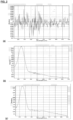
- Fig. 2 (a) shows the absorption of acetone in a gaseous sample under normal pressure in a wavelength range of approximately 250 nm to 600 nm without using the device according to the invention.
- acetone-containing gas is sucked from a storage container and fed into a measuring cell / sample measuring chamber under a pressure of 3 bar (b) and 5 bar (c).
- the spectra (a), (b) and (c) show how the optimum sensitivity range can be set using a suitable pressure setting. It is self-explanatory that the pressure setting must be precise and that a pressure-dependent calibration should preferably be carried out in the defined measuring system.
- acetone shows that a significant increase in sensitivity can be achieved by increasing the pressure including enrichment via a compressor according to the invention.
Landscapes
- Physics & Mathematics (AREA)
- Biochemistry (AREA)
- Analytical Chemistry (AREA)
- Pathology (AREA)
- Immunology (AREA)
- Health & Medical Sciences (AREA)
- Life Sciences & Earth Sciences (AREA)
- Chemical & Material Sciences (AREA)
- General Physics & Mathematics (AREA)
- General Health & Medical Sciences (AREA)
- Engineering & Computer Science (AREA)
- Mathematical Physics (AREA)
- Spectroscopy & Molecular Physics (AREA)
- Theoretical Computer Science (AREA)
- Investigating Or Analysing Materials By Optical Means (AREA)
Priority Applications (2)
| Application Number | Priority Date | Filing Date | Title |
|---|---|---|---|
| ES23020113T ES3060512T3 (en) | 2023-03-09 | 2023-03-09 | Device and method for variable pressure-dependent enrichment and spectroscopic determination of an analyte in a gas- or vaporous sample |
| EP23020113.9A EP4428519B1 (fr) | 2023-03-09 | 2023-03-09 | Dispositif et procédé d'enrichissement variable dépendant de la pression et détermination spectroscopique d'un analyte dans un échantillon gazeux ou vaporeux |
Applications Claiming Priority (1)
| Application Number | Priority Date | Filing Date | Title |
|---|---|---|---|
| EP23020113.9A EP4428519B1 (fr) | 2023-03-09 | 2023-03-09 | Dispositif et procédé d'enrichissement variable dépendant de la pression et détermination spectroscopique d'un analyte dans un échantillon gazeux ou vaporeux |
Publications (3)
| Publication Number | Publication Date |
|---|---|
| EP4428519A1 true EP4428519A1 (fr) | 2024-09-11 |
| EP4428519B1 EP4428519B1 (fr) | 2025-12-17 |
| EP4428519C0 EP4428519C0 (fr) | 2025-12-17 |
Family
ID=85569796
Family Applications (1)
| Application Number | Title | Priority Date | Filing Date |
|---|---|---|---|
| EP23020113.9A Active EP4428519B1 (fr) | 2023-03-09 | 2023-03-09 | Dispositif et procédé d'enrichissement variable dépendant de la pression et détermination spectroscopique d'un analyte dans un échantillon gazeux ou vaporeux |
Country Status (2)
| Country | Link |
|---|---|
| EP (1) | EP4428519B1 (fr) |
| ES (1) | ES3060512T3 (fr) |
Citations (6)
| Publication number | Priority date | Publication date | Assignee | Title |
|---|---|---|---|---|
| WO2001027596A1 (fr) | 1999-10-12 | 2001-04-19 | Nok Corporation | Capteur de co |
| US20030015019A1 (en) | 2000-01-25 | 2003-01-23 | The State Of Oregon Acting By And Through The State Board Of Higher Education On Behalf Of Portl | Method and apparatus for concentrating samples for analysis |
| US20030098419A1 (en) | 2001-10-29 | 2003-05-29 | Bing Ji | On-line UV-Visible light halogen gas analyzer for semiconductor processing effluent monitoring |
| US20110147592A1 (en) * | 2008-08-28 | 2011-06-23 | Martin Hans Goeran Evald | Arrangement adapted for spectral analysis of small concentrations of gas |
| DE202012003739U1 (de) | 2012-04-12 | 2012-06-27 | Christian Buck | Vorrichtung zum Bau von Photometer- und Spektrometersystemen mit Küvetten beliebiger optischer Pfadlänge: Osfia- Köpfe (one size fits it all) |
| DE202022000633U1 (de) * | 2022-03-14 | 2022-04-05 | Christian Buck | Vorrichtung zur spektroskopischen Bestimmung von Analyten mit variabler druckabhängiger Empfindlichkeit |
-
2023
- 2023-03-09 ES ES23020113T patent/ES3060512T3/es active Active
- 2023-03-09 EP EP23020113.9A patent/EP4428519B1/fr active Active
Patent Citations (6)
| Publication number | Priority date | Publication date | Assignee | Title |
|---|---|---|---|---|
| WO2001027596A1 (fr) | 1999-10-12 | 2001-04-19 | Nok Corporation | Capteur de co |
| US20030015019A1 (en) | 2000-01-25 | 2003-01-23 | The State Of Oregon Acting By And Through The State Board Of Higher Education On Behalf Of Portl | Method and apparatus for concentrating samples for analysis |
| US20030098419A1 (en) | 2001-10-29 | 2003-05-29 | Bing Ji | On-line UV-Visible light halogen gas analyzer for semiconductor processing effluent monitoring |
| US20110147592A1 (en) * | 2008-08-28 | 2011-06-23 | Martin Hans Goeran Evald | Arrangement adapted for spectral analysis of small concentrations of gas |
| DE202012003739U1 (de) | 2012-04-12 | 2012-06-27 | Christian Buck | Vorrichtung zum Bau von Photometer- und Spektrometersystemen mit Küvetten beliebiger optischer Pfadlänge: Osfia- Köpfe (one size fits it all) |
| DE202022000633U1 (de) * | 2022-03-14 | 2022-04-05 | Christian Buck | Vorrichtung zur spektroskopischen Bestimmung von Analyten mit variabler druckabhängiger Empfindlichkeit |
Also Published As
| Publication number | Publication date |
|---|---|
| EP4428519B1 (fr) | 2025-12-17 |
| ES3060512T3 (en) | 2026-03-26 |
| EP4428519C0 (fr) | 2025-12-17 |
Similar Documents
| Publication | Publication Date | Title |
|---|---|---|
| DE102012100794B3 (de) | Vorrichtung und Verfahren zum Erfassen von Kontaminationen in einem Hydrauliksystem | |
| EP2003441A1 (fr) | Capteur ATR | |
| DE10392663T5 (de) | Foto-akustisches Erfassungsverfahren zum Messen der Konzentration von Nicht-Kolenwasserstoff-Komponenten einer methanhaltigen Gasmischung | |
| EP3475686B1 (fr) | Méthode et appareil pour surveillance des fluids gazeux | |
| DE2543726A1 (de) | Geraet zur feststellung einer gasfoermigen verunreinigung | |
| DE69023875T2 (de) | Vorrichtung zum Messen der Lichtabsorption oder Fluoreszenz in flüssigen Proben. | |
| DE3938142C2 (fr) | ||
| DE102016108267B4 (de) | Vorrichtung und Verfahren zum Ermitteln einer Konzentration von wenigstens einer Gaskomponente eines Gasgemischs | |
| DE3605518A1 (de) | Messzelle fuer die spektrometrie sowie verfahren zum messen der adsorption oder emission einer probe im rohrinnenraum dieser messzelle | |
| DE19509822A1 (de) | Ölkonzentrations-Meßgerät | |
| DE202022000633U1 (de) | Vorrichtung zur spektroskopischen Bestimmung von Analyten mit variabler druckabhängiger Empfindlichkeit | |
| EP0550542B1 (fr) | Dispositif pour la determination qualitative et/ou quantitative de la composition d'un echantillon a analyser | |
| WO2006002740A1 (fr) | Analyseur de gaz a infrarouge non dispersif | |
| DE19607062C2 (de) | Verfahren zur Bestimmung der Ethanolkonzentration in einer Atemgasprobe | |
| EP4428519B1 (fr) | Dispositif et procédé d'enrichissement variable dépendant de la pression et détermination spectroscopique d'un analyte dans un échantillon gazeux ou vaporeux | |
| DE4240301A1 (fr) | ||
| WO1999009391A2 (fr) | Photometre a spectroscopie d'absorption non dispersive dans l'infrarouge (ndir) pour la mesure de plusieurs constituants | |
| DE4316513B4 (de) | Atomabsorptionsspektrometer | |
| EP3561487B1 (fr) | Dispositif de mesure destiné à l'analyse d'une composition d'un gaz de combustion pourvu d'une chambre filtrante disposée devant un détecteur | |
| DE202012003739U1 (de) | Vorrichtung zum Bau von Photometer- und Spektrometersystemen mit Küvetten beliebiger optischer Pfadlänge: Osfia- Köpfe (one size fits it all) | |
| EP4242634A1 (fr) | Dispositif et procédé de détermination spectroscopique des analytes à sensibilité dépendante de la pression variable | |
| EP3770585B1 (fr) | Dispositif et procédé de mesure d'une concentration d'une substance dans un fluide | |
| EP3538871B1 (fr) | Spectrometre comprenant une lampe a decharge avec plusieurs trajectoires de faiseaux differentes | |
| AT520428B1 (de) | Verfahren und Vorrichtung zur Messung eines in einem Rohgas | |
| AT527236B1 (de) | Verfahren zum Analysieren einer Probe sowie Vorrichtung hierzu |
Legal Events
| Date | Code | Title | Description |
|---|---|---|---|
| PUAI | Public reference made under article 153(3) epc to a published international application that has entered the european phase |
Free format text: ORIGINAL CODE: 0009012 |
|
| STAA | Information on the status of an ep patent application or granted ep patent |
Free format text: STATUS: REQUEST FOR EXAMINATION WAS MADE |
|
| 17P | Request for examination filed |
Effective date: 20231026 |
|
| AK | Designated contracting states |
Kind code of ref document: A1 Designated state(s): AL AT BE BG CH CY CZ DE DK EE ES FI FR GB GR HR HU IE IS IT LI LT LU LV MC ME MK MT NL NO PL PT RO RS SE SI SK SM TR |
|
| STAA | Information on the status of an ep patent application or granted ep patent |
Free format text: STATUS: EXAMINATION IS IN PROGRESS |
|
| 17Q | First examination report despatched |
Effective date: 20250226 |
|
| GRAP | Despatch of communication of intention to grant a patent |
Free format text: ORIGINAL CODE: EPIDOSNIGR1 |
|
| STAA | Information on the status of an ep patent application or granted ep patent |
Free format text: STATUS: GRANT OF PATENT IS INTENDED |
|
| INTG | Intention to grant announced |
Effective date: 20250925 |
|
| GRAS | Grant fee paid |
Free format text: ORIGINAL CODE: EPIDOSNIGR3 |
|
| GRAA | (expected) grant |
Free format text: ORIGINAL CODE: 0009210 |
|
| STAA | Information on the status of an ep patent application or granted ep patent |
Free format text: STATUS: THE PATENT HAS BEEN GRANTED |
|
| AK | Designated contracting states |
Kind code of ref document: B1 Designated state(s): AL AT BE BG CH CY CZ DE DK EE ES FI FR GB GR HR HU IE IS IT LI LT LU LV MC ME MK MT NL NO PL PT RO RS SE SI SK SM TR |
|
| REG | Reference to a national code |
Ref country code: CH Ref legal event code: F10 Free format text: ST27 STATUS EVENT CODE: U-0-0-F10-F00 (AS PROVIDED BY THE NATIONAL OFFICE) Effective date: 20251217 Ref country code: GB Ref legal event code: FG4D Free format text: NOT ENGLISH |
|
| REG | Reference to a national code |
Ref country code: DE Ref legal event code: R096 Ref document number: 502023002460 Country of ref document: DE |
|
| U01 | Request for unitary effect filed |
Effective date: 20251229 |
|
| U07 | Unitary effect registered |
Designated state(s): AT BE BG DE DK EE FI FR IT LT LU LV MT NL PT RO SE SI Effective date: 20260109 |
|
| REG | Reference to a national code |
Ref country code: CH Ref legal event code: R17 Free format text: ST27 STATUS EVENT CODE: U-0-0-R10-R17 (AS PROVIDED BY THE NATIONAL OFFICE) Effective date: 20260213 |
|
| REG | Reference to a national code |
Ref country code: ES Ref legal event code: FG2A Ref document number: 3060512 Country of ref document: ES Kind code of ref document: T3 Effective date: 20260326 |
|
| REG | Reference to a national code |
Ref country code: CH Ref legal event code: U11 Free format text: ST27 STATUS EVENT CODE: U-0-0-U10-U11 (AS PROVIDED BY THE NATIONAL OFFICE) Effective date: 20260401 |
|
| PG25 | Lapsed in a contracting state [announced via postgrant information from national office to epo] |
Ref country code: NO Free format text: LAPSE BECAUSE OF FAILURE TO SUBMIT A TRANSLATION OF THE DESCRIPTION OR TO PAY THE FEE WITHIN THE PRESCRIBED TIME-LIMIT Effective date: 20260317 |
|
| PG25 | Lapsed in a contracting state [announced via postgrant information from national office to epo] |
Ref country code: HR Free format text: LAPSE BECAUSE OF FAILURE TO SUBMIT A TRANSLATION OF THE DESCRIPTION OR TO PAY THE FEE WITHIN THE PRESCRIBED TIME-LIMIT Effective date: 20251217 |
|
| U20 | Renewal fee for the european patent with unitary effect paid |
Year of fee payment: 4 Effective date: 20260312 |
|
| PG25 | Lapsed in a contracting state [announced via postgrant information from national office to epo] |
Ref country code: RS Free format text: LAPSE BECAUSE OF FAILURE TO SUBMIT A TRANSLATION OF THE DESCRIPTION OR TO PAY THE FEE WITHIN THE PRESCRIBED TIME-LIMIT Effective date: 20260317 |