EP4429310A1 - Procédé et dispositif de communication - Google Patents
Procédé et dispositif de communication Download PDFInfo
- Publication number
- EP4429310A1 EP4429310A1 EP22903483.0A EP22903483A EP4429310A1 EP 4429310 A1 EP4429310 A1 EP 4429310A1 EP 22903483 A EP22903483 A EP 22903483A EP 4429310 A1 EP4429310 A1 EP 4429310A1
- Authority
- EP
- European Patent Office
- Prior art keywords
- communication device
- signal
- information
- sensing
- piece
- Prior art date
- Legal status (The legal status is an assumption and is not a legal conclusion. Google has not performed a legal analysis and makes no representation as to the accuracy of the status listed.)
- Pending
Links
Images




Classifications
-
- H—ELECTRICITY
- H04—ELECTRIC COMMUNICATION TECHNIQUE
- H04W—WIRELESS COMMUNICATION NETWORKS
- H04W4/00—Services specially adapted for wireless communication networks; Facilities therefor
- H04W4/30—Services specially adapted for particular environments, situations or purposes
- H04W4/38—Services specially adapted for particular environments, situations or purposes for collecting sensor information
-
- H—ELECTRICITY
- H04—ELECTRIC COMMUNICATION TECHNIQUE
- H04B—TRANSMISSION
- H04B17/00—Monitoring; Testing
- H04B17/30—Monitoring; Testing of propagation channels
- H04B17/309—Measuring or estimating channel quality parameters
-
- H—ELECTRICITY
- H04—ELECTRIC COMMUNICATION TECHNIQUE
- H04W—WIRELESS COMMUNICATION NETWORKS
- H04W24/00—Supervisory, monitoring or testing arrangements
- H04W24/02—Arrangements for optimising operational condition
-
- H—ELECTRICITY
- H04—ELECTRIC COMMUNICATION TECHNIQUE
- H04W—WIRELESS COMMUNICATION NETWORKS
- H04W24/00—Supervisory, monitoring or testing arrangements
- H04W24/08—Testing, supervising or monitoring using real traffic
Definitions
- This application relates to the field of communication technologies, and in particular, to a communication method and a communication device.
- electromagnetic waves generated by a transmit antenna are radiated to a region to be sensed, and a plurality of propagation paths are formed.
- a receive antenna receives an echo signal that is obtained by superimposing signal components on the plurality of paths, and the echo signal reflects a plurality of types of information in signal propagation space.
- the received echo signal is analyzed and processed to obtain characteristics of the signal propagation space, and sensing functions such as target positioning, motion state monitoring, and scene imaging can be implemented.
- a core node device for example, a base station, a terminal device, or a vehicle-mounted device
- a core node device for example, a base station, a terminal device, or a vehicle-mounted device
- a specific wireless sensing capability in addition to a conventional communication function.
- how to improve sensing precision of the node device for a sensing region to improve sensing performance is a problem that needs to be urgently resolved currently.
- This application provides a communication method and a communication device, to improve sensing precision and improve sensing performance of an integrated sensing and communication network.
- a first aspect of this application provides a communication method, including:
- a first communication device receives a first message from a second communication device, where the first message is used to request or configure at least one piece of the following sensing information, and the at least one piece of sensing information includes attitude information, antenna direction information, and motion location information of the first communication device.
- the first communication device transmits a first signal to a target sensing region based on the at least one piece of sensing information.
- the first message is used to request or configure at least one piece of the following sensing information, and the at least one piece of sensing information includes the attitude information, the antenna direction information, and the motion location information of the first communication device.
- the first communication device transmits the first signal to the target sensing region based on the at least one piece of sensing information.
- the at least one piece of sensing information may assist the second communication device in sensing the target sensing region. This helps improve sensing precision of the second communication device in sensing the target sensing region, and improve sensing performance.
- the second communication device uses the first communication device to assist in sensing the target sensing region, and the second communication device may implement sensing of the target sensing region by receiving an echo signal of the first signal. That is, a bistatic (a transmit end and a receive end are disposed at different geographical locations) solution (a transmit end and a receive end are disposed at different geographical locations) is used to expand an aperture of a virtual array and improve sensing precision.
- the method further includes:
- the first communication device sends the at least one piece of sensing information to the second communication device.
- the first communication device may feed back the at least one piece of sensing information to the second communication device. Therefore, the second communication device obtains the at least one piece of sensing information.
- the at least one piece of sensing information may assist the second communication device in sensing the target sensing region. This helps improve the sensing precision of the second communication device in sensing the target sensing region, and improve the sensing performance.
- the first message further includes precision requirement information.
- the precision requirement information indicates a precision requirement for the attitude information and the antenna direction information.
- the attitude information and the antenna direction information that are sent by the first communication device to the second communication device meet the precision requirement.
- the first message further includes the precision requirement information, and the precision requirement information indicates the precision requirement for the attitude information and the antenna direction information.
- the second communication device obtains the sensing information that meets the precision requirement. This helps improve the sensing precision of the second communication device in sensing the target sensing region, and improve the sensing performance.
- the first message is used to request the at least one piece of sensing information, and the method further includes:
- the first communication device determines whether to send the at least one piece of sensing information. If the first communication device determines to send the at least one piece of sensing information, the first communication device performs an action of sending, by the first communication device, the at least one piece of sensing information to the second communication device. In this implementation, the first communication device may determine whether to send the at least one piece of sensing information, and then perform a corresponding sending operation.
- the method further includes:
- the first communication device receives a second message sent by the second communication device, where the second message indicates the first communication device to switch from a first mode to a second mode, a signal in the first mode is a communication signal, and a signal in the second mode is a sensing signal or an integrated sensing and communication signal; and that the first communication device transmits a first signal to a target sensing region based on the at least one piece of sensing information includes: The first communication device transmits the first signal to the target sensing region in the second mode based on the at least one piece of sensing information.
- the first communication device receives the second message, and switches from the first mode to the second mode. Then, the first communication device transmits the first signal to the target sensing region in the second mode based on the at least one piece of sensing information.
- the signal in the second mode is a sensing signal or an integrated sensing and communication signal. This helps improve the sensing precision of the second communication device for the target sensing region.
- the first message is further used to configure a periodicity for transmitting the first signal by the first communication device; and that the first communication device transmits a first signal to a target sensing region based on the at least one piece of sensing information includes: The first communication device transmits the first signal to the target sensing region based on the at least one piece of sensing information by using the periodicity.
- the second communication device may configure the periodicity for transmitting the first signal by the first communication device, so that a product of a movement speed of the first communication device and the periodicity for transmitting the first signal by the first communication device is less than a half wavelength, namely, a half of a wavelength of the first signal transmitted by the first communication device. This ensures the sensing precision.
- the method further includes:
- the first communication device receives a third message from the second communication device, where the third message indicates the first communication device to transmit the first signal to the target sensing region by using a first frequency band; and that the first communication device transmits a first signal to a target sensing region based on the at least one piece of sensing information includes:
- the first communication device transmits the first signal to the target sensing region based on the at least one piece of sensing information by using the first frequency band.
- the first communication device may receive the third message. Then, the first communication device transmits the first signal to the target sensing region based on the at least one piece of sensing information by using the first frequency band. Therefore, the second communication device accurately senses the target sensing region by using the echo signal of the first signal.
- the method further includes:
- the first communication device receives a fifth message from the second communication device, where the fifth message indicates the first communication device to transmit the first signal to the target sensing region in a first polarization direction; and that the first communication device transmits a first signal to a target sensing region based on the at least one piece of sensing information includes:
- the first communication device transmits the first signal to the target sensing region based on the at least one piece of sensing information and the first polarization direction.
- the first communication device may receive the fifth message. Then, the first communication device transmits the first signal to the target sensing region in the first polarization direction based on the at least one piece of sensing information. Therefore, the second communication device accurately senses the target sensing region by using the echo signal of the first signal.
- the first communication device transmits the first signal to the target sensing region for a plurality of times during movement, to form a first virtual transmit array.
- the first communication device transmits the first signal for a plurality of times during movement, to form the virtual transmit array similar to a synthetic aperture array.
- An aperture of the virtual transmit array is increased. This helps improve the sensing precision of the second communication device for the target sensing region. A quantity of required real-aperture array elements is reduced, and hardware costs are reduced.
- the second communication device forms a first virtual receive array in a process of receiving a first echo signal for a plurality of times during movement.
- the second communication device receives the first echo signal for a plurality of times during movement, to form the virtual receive array similar to a synthetic aperture array.
- a quantity of virtual array elements of a receive antenna is effectively increased, and an aperture of the virtual receive array is increased. This helps improve the sensing precision of the second communication device for the target sensing region.
- the quantity of required real-aperture array elements is reduced, and the hardware costs are reduced.
- the first communication device is a terminal device
- the second communication device is a network device.
- the network device may obtain the at least one piece of sensing information from the terminal device by using specific signaling, to make full use of a communication capability between the terminal device and the network device.
- the network device may select the terminal device to assist in sensing the target sensing region. Therefore, the technical solutions of this application can implement sensing in different scenarios, sensing in a large scenario range, and sensing in a plurality of scenario directions. This improves flexibility of a scenario to which the solutions are applicable, implements evolution of the integrated sensing and communication network, and effectively reflects integration of a communication technology and a sensing technology.
- a second aspect of this application provides a communication method.
- the method includes:
- a second communication device sends a first message to a first communication device, where the first message is used to request or configure at least one piece of the following sensing information, and the at least one piece of sensing information includes attitude information, antenna direction information, and motion location information of the first communication device; the second communication device receives a first echo signal from a target sensing region, where the first echo signal is obtained by reflecting, by the target sensing region, a first signal that is transmitted by the first communication device to the target sensing region based on the at least one piece of sensing information; and the second communication device senses the target sensing region based on the at least one piece of sensing information and the first echo signal.
- the second communication device senses the target sensing region based on the at least one piece of sensing information and the first echo signal.
- the second communication device selects the first communication device to assist the second communication device in sensing the target sensing region.
- the second communication device may implement sensing of the target sensing region by receiving the first echo signal. That is, a bistatic (a transmit end and a receive end are disposed at different geographical locations) solution is used to expand an aperture of a virtual array and improve sensing precision.
- the at least one piece of sensing information includes the attitude information, the antenna direction information, and the motion location information of the first communication device.
- the second communication device may sense the target sensing region by using the at least one piece of sensing information and an echo signal of the first signal. This helps improve sensing precision of the second communication device in sensing the target sensing region, and improve sensing performance.
- the method further includes: The second communication device receives the at least one piece of sensing information from the first communication device.
- the first communication device may feed back the at least one piece of sensing information to the second communication device. Therefore, the second communication device obtains the at least one piece of sensing information.
- the at least one piece of sensing information may assist the second communication device in sensing the target sensing region. This helps improve the sensing precision of the second communication device in sensing the target sensing region, and improve the sensing performance.
- the first message further includes precision requirement information.
- the precision requirement information indicates a precision requirement for the attitude information and the antenna direction information.
- the attitude information and the antenna direction information that are sent by the first communication device to the second communication device meet the precision requirement.
- the first message further includes the precision requirement information, and the precision requirement information indicates the precision requirement for the attitude information and the antenna direction information.
- the second communication device obtains the sensing information that meets the precision requirement. This helps improve the sensing precision of the second communication device in sensing the target sensing region, and improve the sensing performance.
- the method further includes: The second communication device sends a second message to the first communication device, where the second message indicates the first communication device to switch from a first mode to a second mode, a signal in the first mode is a communication signal, and a signal in the second mode is a sensing signal or an integrated sensing and communication signal.
- the second communication device sends the second message to the first communication device, to indicate the first communication device to switch from the first mode to the second mode.
- the signal in the second mode is a sensing signal or an integrated sensing and communication signal. This helps improve the sensing precision of the second communication device for the target sensing region.
- the first message is further used to configure a periodicity for transmitting the first signal by the first communication device.
- the second communication device may configure the periodicity for transmitting the first signal by the first communication device, so that a product of a movement speed of the first communication device and the periodicity for transmitting the first signal by the first communication device is less than a half wavelength, namely, a half of a wavelength of the first signal transmitted by the first communication device. This ensures the sensing precision.
- the method further includes:
- the second communication device sends a third message to the first communication device, where the third message indicates the first communication device to transmit the first signal to the target sensing region by using a first frequency band; the second communication device sends a fourth message to a third communication device, where the fourth message indicates the third communication device to transmit a second signal to the target sensing region by using a second frequency band; and the second communication device receives a second echo signal from the target sensing region, where the second echo signal is obtained by reflecting, by the target sensing region, the second signal that is transmitted by the third communication device to the target sensing region by using the second frequency band; and that the second communication device senses the target sensing region based on the at least one piece of sensing information and the first echo signal includes: The second communication device senses the target sensing region based on the at least one piece of sensing information, the first echo signal, and the second echo signal.
- the second communication device may configure different communication devices to transmit signals to the target sensing region in different polarization directions, so that the second communication device receives echo signals of the signals that are transmitted by the different communication devices in the different polarization directions.
- the second communication device may sense the target sensing region by using these echo signals. This improves the sensing precision and the sensing performance.
- the method further includes:
- the second communication device sends a fifth message to the first communication device, where the fifth message indicates the first communication device to transmit the first signal to the target sensing region in a first polarization direction; the second communication device sends a sixth message to a third communication device, where the sixth message indicates the third communication device to transmit a third signal to the target sensing region in a second polarization direction; and the second communication device receives a third echo signal from the target sensing region, where the third echo signal is obtained by reflecting, by the target sensing region, the third signal that is transmitted by the third communication device to the target sensing region in the second polarization direction; and that the second communication device senses the target sensing region based on the at least one piece of sensing information and the first echo signal includes: The second communication device senses the target sensing region based on the at least one piece of sensing information, the first echo signal, and the third echo signal.
- the second communication device may configure different communication devices to transmit signals to the target sensing region in different polarization directions.
- An independent bistatic system is formed between the second communication device and any communication device.
- a multi-static system in which information from a plurality of frequency bands is synthesized may be formed between the second communication device and the plurality of communication devices.
- the second communication device may sense the target sensing region by using echo signals of the signals that are transmitted by the different communication devices. This improves the sensing precision for the target sensing region.
- the first communication device transmits the first signal to the target sensing region for a plurality of times during movement, to form a first virtual transmit array.
- the first communication device transmits the first signal for a plurality of times during movement, to form the virtual transmit array similar to a synthetic aperture array.
- An aperture of the virtual transmit array is increased. This helps improve the sensing precision of the second communication device for the target sensing region. A quantity of required real-aperture array elements is reduced, and hardware costs are reduced.
- the second communication device forms a first virtual receive array in a process of receiving the first echo signal for a plurality of times during movement.
- the second communication device receives the first echo signal for a plurality of times during movement, to form the virtual receive array similar to a synthetic aperture array.
- a quantity of virtual array elements of a receive antenna is effectively increased, and an aperture of the virtual receive array is increased. This helps improve the sensing precision of the second communication device for the target sensing region.
- the quantity of required real-aperture array elements is reduced, and the hardware costs are reduced.
- the first communication device is a terminal device
- the second communication device is a network device.
- the network device may obtain the at least one piece of sensing information from the terminal device by using specific signaling, to make full use of a communication capability between the terminal device and the network device.
- the network device may select the terminal device to assist in sensing the target sensing region. Therefore, the technical solutions of this application can implement sensing in different scenarios, sensing in a large scenario range, and sensing in a plurality of scenario directions. This improves flexibility of a scenario to which the solutions are applicable, implements evolution of the integrated sensing and communication network, and effectively reflects integration of a communication technology and a sensing technology.
- a third aspect of this application provides a first communication device, including: a transceiver module, configured to: receive a first message from a second communication device, where the first message is used to request or configure at least one piece of the following sensing information, and the at least one piece of sensing information includes attitude information, antenna direction information, and motion location information of the first communication device; and transmit a first signal to a target sensing region based on the at least one piece of sensing information.
- a transceiver module configured to: receive a first message from a second communication device, where the first message is used to request or configure at least one piece of the following sensing information, and the at least one piece of sensing information includes attitude information, antenna direction information, and motion location information of the first communication device; and transmit a first signal to a target sensing region based on the at least one piece of sensing information.
- the transceiver module is further configured to: send the at least one piece of sensing information to the second communication device.
- the first message further includes precision requirement information.
- the precision requirement information indicates a precision requirement for the attitude information and the antenna direction information.
- the attitude information and the antenna direction information that are sent by the first communication device to the second communication device meet the precision requirement.
- the first message is used to request the at least one piece of sensing information; and the first communication device further includes a processing module, where the processing module is configured to: determine whether to send the at least one piece of sensing information. If the processing module determines to send the at least one piece of sensing information, an action of sending, by the first communication device, the at least one piece of sensing information to the second communication device is performed.
- the transceiver module is further configured to:
- the first message is further used to configure a periodicity for transmitting the first signal by the first communication device.
- the transceiver module is further configured to:
- the transceiver module is further configured to:
- the first communication device transmits the first signal to the target sensing region for a plurality of times during movement, to form a first virtual transmit array.
- the first communication device is a terminal device
- the second communication device is a network device.
- a fourth aspect of this application provides a second communication device, including:
- the transceiver module is further configured to: receive the at least one piece of sensing information from the first communication device.
- the first message further includes precision requirement information.
- the precision requirement information indicates a precision requirement for the attitude information and the antenna direction information.
- the attitude information and the antenna direction information that are sent by the first communication device to the second communication device meet the precision requirement.
- the transceiver module is further configured to:
- the first message is further used to configure a periodicity for transmitting the first signal by the first communication device.
- the transceiver module is further configured to:
- the transceiver module is further configured to:
- the first communication device transmits the first signal to the target sensing region for a plurality of times during movement, to form a first virtual transmit array.
- the second communication device forms a first virtual receive array in a process of receiving the first echo signal for a plurality of times during movement.
- the first communication device is a terminal device
- the second communication device is a network device.
- a fifth aspect of an embodiment of this application provides a first communication device.
- the first communication device includes a processor and a memory.
- the memory stores a computer program.
- the processor is configured to invoke and run the computer program stored in the memory, to enable the processor to implement any implementation of the first aspect.
- the first communication device further includes a transceiver.
- the processor is further configured to control the transceiver to receive and send a signal.
- a sixth aspect of an embodiment of this application provides a second communication device.
- the second communication device includes a processor and a memory.
- the memory stores a computer program.
- the processor is configured to invoke and run the computer program stored in the memory, to enable the processor to implement any implementation of the second aspect.
- the second communication device further includes a transceiver.
- the processor is further configured to control the transceiver to receive and send a signal.
- a seventh aspect of this application provides a first communication device.
- the first communication device includes a processor.
- the processor is configured to invoke a computer program or computer instructions in a memory, to enable the processor to implement any implementation of the first aspect.
- the communication apparatus further includes a transceiver.
- the processor is configured to control the transceiver to receive and send a signal.
- An eighth aspect of this application provides a second communication device.
- the second communication device includes a processor.
- the processor is configured to invoke a computer program or computer instructions in a memory, to enable the processor to implement any implementation of the first aspect.
- the communication apparatus further includes a transceiver.
- the processor is configured to control the transceiver to receive and send a signal.
- a ninth aspect of this application provides a first communication device.
- the first communication device includes a processor, and the processor is configured to perform any implementation of the first aspect.
- Atenth aspect of this application provides a second communication device.
- the second communication device includes a processor, and the processor is configured to perform any implementation of the second aspect.
- An eleventh aspect of an embodiment of this application provides a first communication device.
- the first communication device includes a logic circuit and an input/output interface.
- the logic circuit is configured to perform a processing operation in any implementation of the first aspect
- the input/output interface is configured to perform receiving and sending operations in any implementation of the first aspect.
- a twelfth aspect of an embodiment of this application provides a second communication device.
- the second communication device includes a logic circuit and an input/output interface.
- the logic circuit is configured to perform a processing operation in any implementation of the second aspect
- the input/output interface is configured to perform receiving and sending operations in any implementation of the second aspect.
- a thirteenth aspect of an embodiment of this application provides a computer program product including instructions.
- the computer program product When the computer program product is run on a computer, the computer is enabled to perform any implementation of the first aspect and the second aspect.
- a fourteenth aspect of an embodiment of this application provides a computer-readable storage medium, including computer instructions.
- the computer instructions When the computer instructions are run on a computer, the computer is enabled to perform any implementation of the first aspect and the second aspect.
- a fifteenth aspect of an embodiment of this application provides a chip apparatus, including a processor.
- the processor is configured to: connect to a memory, and invoke a program stored in the memory, to enable the processor to perform any implementation of the first aspect and the second aspect.
- a sixteenth aspect of an embodiment of this application provides a communication system.
- the communication system includes the first communication device according to the third aspect and the second communication device according to the fourth aspect.
- a first communication device receives a first message from a second communication device, where the first message is used to request or configure at least one piece of the following sensing information, and the at least one piece of sensing information includes attitude information, antenna direction information, and motion location information of the first communication device; and the first communication device transmits a first signal to a target sensing region based on the at least one piece of sensing information. It may be learned that the first communication device is used to assist in sensing the target sensing region in the foregoing technical solutions, and the second communication device may implement sensing of the target sensing region by receiving an echo signal of the first signal.
- a bistatic (a transmit end and a receive end are disposed at different geographical locations) solution is used to expand an aperture of a virtual array and improve sensing precision.
- the first message is used to request or configure the at least one piece of the following sensing information, where the at least one piece of sensing information includes the attitude information, the antenna direction information, and the motion location information of the first communication device.
- the first communication device transmits the first signal to the target sensing region based on the at least one piece of sensing information.
- the second communication device may sense the target sensing region based on the at least one piece of sensing information of the first communication device and the echo signal of the first signal. This helps improve sensing precision of the second communication device in sensing the target sensing region, and improve sensing performance.
- This application provides a communication method and a communication device, to improve sensing precision and improve sensing performance of an integrated sensing and communication network.
- At least one means one or more, and "a plurality of" means two or more.
- the term “and/or” describes an association relationship between associated objects and indicates that three relationships may exist. For example, A and/or B may indicate the following three cases: Only A exists, both A and B exist, and only B exists, where A and B may be singular or plural. "At least one of the following items (pieces)” or a similar expression thereof means any combination of these items, including a singular item (piece) or any combination of plural items (pieces).
- At least one item (piece) of a, b, or c may represent a, b, c, a-b, a-c, b-c, or a-b-c, where a, b, and c each may be singular or plural.
- a communication system to which the technical solutions provided in this application are applicable includes but is not limited to a 4th generation (4th generation, 4G) communication system, a worldwide interoperability for microwave access (worldwide interoperability for microwave access, WiMAX) communication system, a 5th generation (5th generation, 5G) communication system, a communication system after a 5G communication system (for example, a 6G communication system), an internet of vehicles communication system, or a device to device (device to device, D2D) communication system.
- the 4G communication system may be a long-term evolution (long-term evolution, LTE) system
- the 5G communication system may be a new radio (new radio, NR) system.
- the communication system to which this application is applicable includes a first communication device and a second communication device.
- the first communication device is a device having a communication capability.
- the first communication device further has a sensing capability.
- the second communication device is a device having both a communication capability and a sensing capability.
- the first communication device may perform communication and transmission with the second communication device.
- the first communication device transmits a signal to a target sensing region by using a transmit antenna
- the second communication device may receive an echo signal of the signal by using a receive antenna, to implement sensing of the target sensing region.
- both the first communication device and the second communication device are terminal devices.
- the first communication device is a terminal device
- the second communication device is a network device.
- the first communication device may be a device in a movement state, or may be a device that is about to move.
- a motion state of the first communication device may be predicted.
- the first communication apparatus is in a temporarily parked vehicle that is about to move.
- the second communication device may be a device in a movement state, or may be a device that is about to move, or may be a device in a static state.
- the terminal device may be referred to as user equipment (user equipment, UE), an access terminal, a subscriber unit, a subscriber station, a mobile station (mobile station, MS), a remote terminal, a mobile device, a user terminal, a terminal, a wireless communication device, a user apparatus, a vehicle, or the like.
- user equipment user equipment
- UE user equipment
- access terminal a subscriber unit, a subscriber station, a mobile station (mobile station, MS), a remote terminal, a mobile device, a user terminal, a terminal, a wireless communication device, a user apparatus, a vehicle, or the like.
- the terminal device may be a cellular phone (cellular phone), a smartphone (smartphone), a wireless data card, a personal digital assistant (personal digital assistant, PDA for short) computer, a tablet computer, a wireless modem (modem), a laptop computer (laptop computer), a machine-type communication (machine-type communication, MTC) terminal, various handheld devices (handset), computer devices, vehicle-mounted devices, wearable devices, or computing devices that have a wireless communication function, or other processing devices connected to a wireless modem, a terminal device in a 5G communication system, a terminal device in an NR system, or a terminal device in a communication system after a 5G network, for example, a terminal device in a future evolved public land mobile network (public land mobile network, PLMN).
- PLMN public land mobile network
- the network device is an apparatus that is deployed in a radio access network to provide a wireless communication function for the terminal device.
- the network device may be a base station, and the base station includes a macro base station, a micro base station, a relay station, and an access network point in various forms.
- the base station in embodiments of this application may be a base station, a transmission reception point (transmission reception point, TRP), or a transmission point (transmission point, TP) in new radio (new radio, NR), or a next generation NodeB (next generation NodeB, ngNB), or may be an evolved NodeB (evolved NodeB, eNB or eNodeB) in a long-term evolution (long-term evolution, LTE) system.
- a conventional communication network is evolved to an integrated sensing and communication network.
- the integrated sensing and communication network also has a specific wireless sensing capability.
- electromagnetic waves generated by a transmit antenna are radiated to a region to be sensed, and a plurality of propagation paths are formed.
- a receive antenna receives an echo signal that is obtained by superimposing signal components on the plurality of paths, and the echo signal reflects a plurality of types of information in signal propagation space.
- the received echo signal is analyzed and processed to obtain characteristics of the signal propagation space, and sensing functions such as target positioning, motion state monitoring, and scene imaging can be implemented.
- a larger antenna aperture of an antenna array indicates a smaller 3 dB beamwidth of the antenna array, better directivity and beam convergence of beams, and a stronger capability of distinguishing between two adjacent targets at a same range. Therefore, performance of the wireless sensing technology is directly related to an aperture of an antenna array of a device.
- a single base station or terminal device is constrained by a hardware condition, and an aperture size of an antenna array is limited. In some cases, high-precision sensing of a sensing scenario cannot be met by using only an antenna array on a single base station side, and a sensing performance requirement cannot be met.
- coordination between a plurality of devices in the integrated sensing and communication network is used to separately dispose the transmit antenna and the receive antenna in different places, and a solution of signaling exchange and joint sensing between the plurality of devices is designed.
- a virtual array aperture of the transmit antenna and/or a virtual array aperture of the receive antenna are/is expanded, a problem of an excessively small size of a real aperture of a single base station is resolved, and sensing performance is improved.
- FIG. 2 is a schematic of a scenario of a communication method according to an embodiment of this application. Refer to FIG. 2 .
- the technical solutions of this application may be used in a networking scenario of a network device and a terminal device in an integrated sensing and communication network.
- the integrated sensing and communication network has a capability of providing both a communication service and a sensing service.
- the network device has a communication capability and a sensing capability
- the terminal device has a communication capability.
- the terminal device further has a sensing capability.
- a corresponding sensing function can be provided between the network device and the terminal device.
- the terminal device transmits a signal by using the technical solutions of this application.
- the network device may implement, by using a communication signal of the terminal device, a plurality of applications such as imaging of an ambient environment of the network device, extraction of a target feature parameter (for example, positioning, a speed, and an acceleration), and detection of a scenario target parameter trajectory (for example, an azimuth angle, an altitude, and a range), road settlement, and building deformation. That is, the network device is assisted in sensing the ambient environment by using the communication signal of the terminal device.
- a target feature parameter for example, positioning, a speed, and an acceleration
- a scenario target parameter trajectory for example, an azimuth angle, an altitude, and a range
- road settlement for example, an azimuth angle, an altitude, and a range
- the terminal device transmits a signal by using the technical solutions of this application.
- the network device may implement, by using a communication signal of the terminal device, special applications such as sensing and imaging of an ambient environment of the terminal device and detection of an obstacle in the scenario at night or in a condition in which an object is difficult to be identified. That is, the network device is assisted in sensing the ambient environment by using the communication signal of the terminal device.
- the terminal device transmits a signal by using the technical solutions of this application.
- the network device may sense, by using a signal transmitted by the terminal device, information about an ambient environment, to avoid an obstacle, design a communication link, improve communication performance, and the like. That is, the network device senses the ambient environment to help improve the communication performance.
- the terminal device is used as a transmit end
- the network device is used as a receive end
- the terminal device is in a movement state
- a remote bistatic system is formed between the terminal device and the network.
- a remote multi-static system may be further formed between the network device and a plurality of terminal devices.
- FIG. 3 is a schematic of another scenario of a communication method according to an embodiment of this application.
- the technical solutions of this application may be used in a networking scenario of vehicles and a network device (for example, a roadside base station) in the internet of vehicles.
- a network device for example, a roadside base station
- each vehicle may be considered as an integrated sensing and communication apparatus.
- an integrated sensing and communication apparatus responsible for coordinating a roadside base station is installed on a vehicle, a movement speed is even within a specific time, and a movement state is stable.
- a movement trajectory of the integrated sensing and communication apparatus may be pre-determined based on a road condition.
- the roadside base station may sense an ambient environment of the vehicle by using a signal transmitted by the integrated sensing and communication apparatus installed on the vehicle, and monitor road condition information around the vehicle and motion information of surrounding vehicles in real time, to carry out related services such as intelligent driving.
- the integrated sensing and communication apparatus may perform communication exchange with the roadside base station by using a communication function of the integrated sensing and communication apparatus, and the vehicle may obtain, from the base station, ambient environment information that is of the vehicle and that is sensed by the vehicle, to assist the vehicle in maintaining a good driving state.
- the vehicle-mounted device is used as a transmit end
- the network device is used as a receive end
- the vehicle-mounted device is in a movement state
- a remote bistatic system is formed between the vehicle-mounted device and the network.
- a remote multi-static system may be further formed between the network device and a plurality of vehicle-mounted devices.
- FIG. 4 is a schematic of an embodiment of a communication method according to an embodiment of this application. Refer to FIG. 4 . The method includes the following steps.
- a second communication device sends a first message to a first communication device.
- the first message is used to request or configure at least one piece of the following sensing information of the first communication device.
- the first communication device receives the first message from the second communication device.
- the at least one piece of sensing information of the first communication device includes attitude information, antenna direction information, and motion location information of the first communication device.
- the following describes the at least one piece of sensing information of the first communication device.
- the attitude information indicates an attitude of a user holding the first communication device, and a gyroscope in the first communication device is used to detect whether the first communication device is in a horizontal placement state, a vertical placement state, or a placement state at a specific angle with a horizontal plane.
- the attitude information represents a three-dimensional location of the first communication device, determines an array structure and an orientation angle of an antenna array when scanning, and has decisive impact on sensing precision.
- the antenna direction information is orientation information of the first communication device when the user holds the first communication device, or direction information of an antenna of the first communication device.
- an antenna array deployed in the first communication device transmits a narrow beam, and the narrow beam has a determined direction. That is, the antenna array is a non-omnidirectional array.
- the antenna direction information determines a sensing range in a target sensing region radiated by the antenna of the first communication device, and has decisive impact on the sensing range and sensing precision of the target sensing region.
- the antenna array deployed in the first communication device is an omnidirectional array.
- the antenna direction information of the first communication device determines whether an incident direction in which the antenna of the first communication device radiates the target sensing region is blocked by the user, a vehicle, or the like, and has decisive impact on the sensing precision.
- the motion location information of the first communication device includes motion parameter information of the first communication device and/or spatial location information of the first communication device.
- the spatial location information of the first communication device includes absolute location information of the first communication device; and the motion parameter information of the first communication device includes a movement speed, a movement direction, a movement trajectory, or the like of the first communication device.
- a more stable movement trajectory and a longer movement range indicate a larger aperture of a first virtual transmit array formed by transmitting a signal by the first communication device during movement. This helps improve the sensing precision.
- the first virtual transmit array refer to related descriptions below.
- both the first communication device and the second communication device are terminal devices.
- the first communication device is a terminal device
- the second communication device is a network device.
- the second communication device determines the target sensing region.
- the second communication device performs positioning on communication devices around the second communication device, to determine location information of communication devices near the target sensing region.
- the second communication device selects the first communication device based on the location information of the communication devices near the target sensing region, motion states of the communication devices, and the like, to assist the second communication device in sensing the target sensing region.
- a range between the first communication device and the target sensing region should be short, so that power, a signal-to-noise ratio, and the like of a signal that is transmitted by the first communication device and that reaches the target sensing region meet a sensing requirement.
- a location and a motion state (including a speed, a movement trajectory, and the like of the first communication device) of the first communication device determine a structure of a virtual transmit array formed when the first communication device transmits a signal.
- the second communication device receives an echo signal of the signal transmitted by the first communication device, and senses the target sensing region.
- the sensing precision should meet the sensing requirement.
- the second communication device may select a plurality of first communication devices, and the plurality of first communication devices assist the second communication device in sensing the target sensing region.
- This is not specifically limited in this application.
- a sensing process between the second communication device and the first communication device is used as an example for description.
- a sensing process between the second communication device and another first communication device is similar. Details are not described herein.
- the first message is used to request the at least one piece of sensing information of the first communication device.
- step 402a is performed after step 401, and is performed before step 402.
- the first communication device sends the at least one piece of sensing information of the first communication device to the second communication device.
- a base station sends a first message to a terminal device, to request at least one piece of sensing information of the terminal device.
- the terminal device may feed back the at least one piece of sensing information of the terminal device to the base station.
- the first message further includes precision requirement information
- the precision requirement information indicates a precision requirement for the attitude information and the antenna direction information of the first communication device.
- the attitude information and the antenna direction information that are sent by the second communication device to the first communication device meet the precision requirement.
- the attitude of the user holding the terminal device is represented by using an azimuth angle, and precision of the azimuth angle may be in millimeters, centimeters, or the like.
- an operating frequency band used by the second communication device includes a microwave frequency band, a millimeter-wave frequency band, or a terahertz frequency band.
- a higher frequency of the operating frequency band used by the second communication device indicates higher sensing precision (for example, a higher range resolution). Therefore, a higher precision requirement is imposed on the at least one piece of sensing information.
- the second communication device may add a precision requirement that adapts to the operating frequency band of the second communication device.
- the second communication device can obtain the motion location information of the first communication device by using a capability of the second communication device.
- the second communication device may obtain the motion location information of the first communication device by using a positioning technology.
- the attitude information and the antenna direction information of the first communication device are strongly related. That is, the second communication device may indirectly determine the antenna direction information of the first communication device by using the attitude information of the first communication device. Therefore, in this scenario, the second communication device may request only the attitude information of the first communication information from the first communication device.
- the embodiment shown in FIG. 4 further includes step 402b, and step 402b is performed before step 402a.
- the first communication device determines whether to send the at least one piece of sensing information of the first communication device. If the first communication device determines to send the at least one piece of sensing information of the first communication device, step 402a is performed; or if the first communication device determines not to send the at least one piece of sensing information of the first communication device, step 405 is performed.
- the first communication device determines whether to send the at least one piece of sensing information of the first communication device. If the first communication device determines to send the at least one piece of sensing information of the first communication device, step 402a is performed; or if the first communication device determines not to send the at least one piece of sensing information of the first communication device, step 405 is performed.
- the following describes a possible implementation in which the first communication device determines whether to send the at least one piece of sensing information.
- the first communication device is a terminal device.
- the terminal device may provide a pop-up prompt by using a user interface of the terminal device, to prompt the user whether to allow the base station to obtain information about the terminal device.
- the user may perform a first operation on the user interface.
- the first operation indicates that the base station is allowed to obtain the information about the terminal device.
- the terminal device may generate a first instruction based on the first operation.
- the first instruction indicates that the user allows the base station to obtain the information about the terminal device.
- the terminal device may perform an operation in step 402a based on the first instruction.
- the terminal device may generate a second instruction based on the first operation.
- the second instruction indicates that the user does not allow the base station to obtain the information about the terminal device.
- the terminal device may perform an operation in step 405 based on the second instruction.
- step 402b is optional. That is, the first communication device only needs to complete information exchange in a background, and does not need to obtain consent or authorization of the user.
- step 401 the first message is used to configure the at least one piece of sensing information.
- the base station sends the first message to the terminal device.
- the first message is used to configure the at least one piece of sensing information for the terminal device.
- the terminal device may prompt the user with the at least one piece of sensing information by using the user interface. The user may hold the terminal device based on the attitude information and the antenna direction information, and hold the terminal device based on the motion location information to move.
- the first message is further used to configure a periodicity for transmitting a first signal by the first communication device.
- the periodicity for transmitting the first signal by the first communication device may be set with reference to a movement speed and an antenna array structure of the first communication device.
- the periodicity for transmitting the first signal by the first communication device mainly indicates a pulse repetition frequency (which may also be referred to as a pulse repetition periodicity) of the first signal.
- a pulse repetition frequency which may also be referred to as a pulse repetition periodicity
- Each time a pulse signal is transmitted it may be considered that an array (an array having a same specification as a transmit antenna of the first communication device) exists at a transmit location.
- a higher movement speed of the first communication device indicates a larger spacing between two adjacent array elements in the virtual transmit array formed in a process of transmitting the first signal by the first communication device. That is, within a same time, the first communication device with a higher movement speed moves for a longer range.
- a spacing between adjacent array elements of an array cannot be greater than a half wavelength (that is, a half of a wavelength, where the wavelength is a wavelength of the first signal transmitted by the first communication device). Otherwise, in a sensing process, due to impact of a grating lobe, imaging is blurred, and estimation precision of a feature parameter in a feature measurement process is low. Therefore, a product of the movement speed of the first communication device and the periodicity for transmitting the first signal by the first communication device is less than the half wavelength. This ensures the sensing precision.
- the first message may be further used to configure a bandwidth, a sampling rate, a quantity of pulses, a frequency band, and the like for transmitting the first signal by the first communication device. This is not specifically limited in this application.
- the second communication device may configure the at least one piece of sensing information for the first communication device. This helps improve the sensing precision of the second communication device for the target sensing region.
- the first communication device transmits the first signal to the target sensing region based on the at least one piece of sensing information.
- the first communication device transmits the first signal to the target sensing region for a plurality of times during movement, to form the first virtual transmit array. For example, the first communication device periodically transmits the first signal to the target sensing region during movement, to form the first virtual transmit array.
- the user holds the terminal device based on the attitude information and the antenna direction information, and holds the terminal device based on the motion location information to move.
- the terminal device transmits the first signal to the target sensing region during movement.
- each time the terminal device transmits the first signal during movement it may be considered that one or more virtual transmit array elements exist at a location at which the terminal device is located.
- the terminal device transmits the first signal for a plurality of times (for example, periodically) during movement, to form the virtual transmit array similar to a synthetic aperture array.
- a quantity of virtual array elements of the transmit antenna is effectively increased, and an aperture of the virtual transmit array is increased. This helps improve the sensing precision of the second communication device for the target sensing region.
- a quantity of required real-aperture array elements is reduced, and hardware costs are reduced.
- the first communication device may be in a communication state.
- the first message is further used to configure the periodicity for transmitting the first signal by the first communication device.
- Step 402 specifically includes: The first communication device transmits the first signal to the target sensing region based on the at least one piece of sensing information according to the periodicity.
- step 402c the embodiment shown in FIG. 4 further includes step 402c, and step 402c may be performed before step 402.
- the second communication device sends a second message to the first communication device.
- the second message indicates the first communication device to switch from a first mode to a second mode.
- the first communication device receives the second message from the second communication device.
- a signal in the first mode is a communication signal
- a signal in the second mode is a sensing signal or an integrated sensing and communication signal.
- the signal in the second mode is a frequency-modulated continuous wave signal or a monopulse signal.
- the first mode and the second mode include at least one of the following: A bandwidth of a signal used in the first mode is less than a bandwidth of a signal used in the second mode; energy of the signal used in the first mode is less than energy of the signal used in the second mode; and a pulse width of the signal used in the first mode is less than a pulse width used in the second mode.
- the signal in the second mode generally uses a large time-bandwidth product signal, and a large compression ratio, a good speed resolution, and a good range resolution may be obtained in a pulse compression process.
- a larger bandwidth of the signal indicates a better range resolution and a larger time duration (namely, pulse width). This can improve transmit power of the signal. Greater signal energy can ensure a maximum range of the signal. That is, the signal can travel further. This helps improve the sensing precision of the second communication device for the target sensing region.
- the second communication device may alternatively indicate, by using the first message, the first communication device to switch from the first mode to the second mode. That is, the second communication device may request or configure the at least one piece of sensing information for the terminal device and indicate the first communication device to switch from the first mode to the second mode by using a same message and different messages.
- step 402 specifically includes: The first communication device transmits the first signal in the second mode to the target sensing region based on the at least one piece of sensing information.
- the first communication device may switch from the first mode to the second mode, and transmit the first signal in the second mode to the target sensing region based on the at least one piece of sensing information.
- the second communication device receives a first echo signal from the target sensing region.
- the first echo signal is a multipath signal generated by performing a combination of a plurality of physical phenomena such as reflection, refraction, and/or scattering on the first signal by the target sensing region.
- a receive antenna array used by the second communication device to receive the first echo signal includes a phased array and a digital array.
- the second communication device senses the target sensing region based on the at least one piece of sensing information and the first echo signal.
- That the second communication device senses the target sensing region based on the at least one piece of sensing information and the first echo signal includes at least one of the following: feature measurement performed by the second communication device on the target sensing region, and imaging processing performed by the second communication device on the target sensing region.
- the feature measurement includes range finding, speed measurement, location positioning, and the like performed on a target object in the target sensing region.
- the second communication device receives the first echo signal for a plurality of times during movement, to form a first virtual receive array.
- the second communication device periodically receives the first echo signal during movement, to form the first virtual receive array. That is, each time the second communication device receives the first echo signal during movement, it may be considered that one or more virtual receive array elements exist at a location at which the second communication device is located.
- the second communication device receives the first echo signal for a plurality of times during movement, to form the virtual receive array similar to a synthetic aperture array.
- a quantity of virtual array elements of a receive antenna is effectively increased, and an aperture of the virtual receive array is increased. This helps improve the sensing precision of the second communication device for the target sensing region.
- the quantity of required real-aperture array elements is reduced, and the hardware costs are reduced.
- the base station receives the first echo signal.
- the base station senses the target sensing region based on the at least one piece of sensing information and the first echo signal.
- the attitude information and the movement trajectory of the user holding the terminal device determine an arrangement manner of the virtual transmit array formed by the terminal device in a process of transmitting the first signal. For example, when the user holds the terminal device and moves in a horizontal direction to form a virtual transmit array, a resolution capability of the virtual transmit array in an azimuth direction (horizontal direction) is significantly improved. When the user holds the terminal device and moves in a vertical direction to form a virtual transmit array, a resolution capability of the virtual transmit array in an elevation direction (altitude) is significantly improved.
- a more stable movement trajectory and a longer movement range indicate a larger aperture of the formed virtual transmit array and greater improvement of the sensing performance.
- the antenna array deployed in the first communication device is usually an omnidirectional array.
- the second communication device may determine, by using the antenna direction information, the regions that cannot be sensed.
- the base station may determine, based on the at least one piece of sensing information, an arrangement manner, a location, and the like of the virtual transmit array formed by the terminal device. Then, the base station parses the first echo signal with reference to the arrangement manner, the location, and the like of the virtual transmit array, to obtain a characteristic of signal propagation space, and implement sensing of the target sensing region.
- the second communication device senses the target sensing region based on the at least one piece of sensing information and the first echo signal.
- the first communication device is used to assist in sensing the target sensing region, and the second communication device may implement sensing of the target sensing region by receiving the first echo signal. That is, a bistatic (a transmit end and a receive end are disposed at different geographical locations) solution is used to expand an aperture of a virtual array and improve sensing precision.
- the terminal device transmits the first signal for a plurality of times (for example, periodically) during movement, to form the virtual transmit array similar to a synthetic aperture array. A quantity of virtual array elements of the transmit antenna is effectively increased, and an aperture of the virtual transmit array is increased.
- the at least one piece of sensing information includes the attitude information, the antenna direction information, and the motion location information of the first communication device.
- the first communication device transmits the first signal to the target sensing region based on the at least one piece of sensing information.
- the second communication device may sense the target sensing region by using the at least one piece of sensing information and an echo signal of the first signal. This helps improve the sensing precision of the second communication device in sensing the target sensing region, and improve the sensing performance.
- the first communication device may be a terminal device
- the second communication device may be a network device.
- the network device may obtain the at least one piece of sensing information from the terminal device by using specific signaling, to make full use of a communication capability between the terminal device and the network device.
- the network device may select a proper terminal device to assist in sensing the target sensing region. Therefore, the technical solutions of this application can implement sensing in different scenarios, sensing in a large scenario range, and sensing in a plurality of scenario directions. This improves flexibility of a scenario to which the solutions are applicable, implements evolution of the integrated sensing and communication network, and effectively reflects integration of a communication technology and a sensing technology.
- an implementation in which the first message is used to configure the at least one piece of sensing information for the first communication device helps the first communication device transmit the first signal to the target sensing region based on the at least one piece of sensing information.
- the first communication device forms a specific virtual transmit array based on the at least one piece of sensing information configured by the second communication device. This reduces a possibility of occurrence of irregular data, repeated data, and invalid data, improves efficiency of obtaining a valid sensing signal by the second communication device, and improves the sensing performance.
- the second communication device may obtain the at least one piece of sensing information of the first communication device at different moments by performing processes of step 401 and step 402a for a plurality of times.
- the second communication device may receive echo signals of signals that are transmitted by the first communication device at different moments.
- the second communication device may obtain the at least one piece of sensing information that respectively corresponds to a moment T1 and a moment T2 and that is of the first communication device by performing processes of step 401 to step 402a.
- the second communication device may receive echo signals corresponding to the first signals that are respectively transmitted by the first communication device at the moment T1 and the moment T2.
- the second communication device senses the target sensing region based on the at least one piece of sensing information corresponding to the first communication device at the moment T1 and the echo signal received by the second communication device at the moment T1.
- the second communication device senses the target sensing region based on the at least one piece of sensing information corresponding to the first communication device at the moment T2 and the echo signal received by the second communication device at the moment T2.
- a quantity of times the second communication device obtains the at least one piece of sensing information of the first communication device may alternatively be less than a quantity of times the second communication device receives the first echo signal.
- the second communication device obtains the at least one piece of sensing information corresponding to the first communication device respectively at the moment T1 and the moment T2.
- the second communication device may receive echo signals corresponding to the first signals that are transmitted by the first communication device respectively at the moment T1, the moment T2, and a moment T3.
- the second communication device may estimate, based on the at least one piece of sensing information corresponding to the first communication device respectively at the moment T1 and the moment T2, the at least one piece of sensing information corresponding to the first communication device at the moment T3.
- the second communication device senses the target sensing region based on the at least one piece of sensing information corresponding to the first communication device at the moment T1 and the echo signal received by the second communication device at the moment T1.
- the second communication device senses the target sensing region based on the at least one piece of sensing information corresponding to the first communication device at the moment T2 and the echo signal received by the second communication device at the moment T2.
- the second communication device senses the target sensing region based on the estimated at least one piece of sensing information corresponding to the first communication device at the moment T3 and the echo signal received by the second communication device at the moment T3.
- the following describes a process in which the second communication device senses the target sensing region with reference to the at least one piece of sensing information of the first communication device and the first echo signal.
- the user holds the terminal device based on a specific attitude and antenna direction.
- the user holds the terminal device to transmit the first signal to the target sensing region during movement based on a specific movement trajectory, so that a direction of a transmit beam of the terminal device directly faces the target sensing region.
- the user moves for a specific range while keeping the current attitude of holding the terminal device and the antenna direction. That is, the terminal device transmits the first signal to the target sensing region based on the specific attitude, the antenna direction, and the movement trajectory.
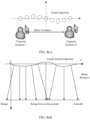
- FIG. 8(a) a schematic of a movement effect is shown in FIG. 8(a) .
- the base station may determine, based on the at least one piece of sensing information, an arrangement manner, a location, and the like of the virtual transmit array formed by the terminal device.
- the base station parses the first echo signal based on the arrangement manner, the location, and the like of the virtual transmit array, to implement sensing of the target sensing region.
- the base station configures the at least one piece of sensing information of the terminal device by using the first message
- the randomness and the uncertainty of the at least one piece of sensing information that is of the first communication device and that is obtained by the second communication device can be avoided. This avoids a repeated operation caused by a fact that the attitude information of the first communication device does not meet a sensing requirement in an implementation process, and improves implementation efficiency of the solutions.
- the user holds the terminal device based on a specific attitude and antenna direction.
- the user holds the terminal device to transmit the first signal to the target sensing region during movement based on a specific movement trajectory.
- the antenna direction of the terminal device does not necessarily directly face the target sensing region during movement.
- an attitude in which the user holds the terminal device inevitably changes.
- the user changes an arm holding the terminal device, tilts the terminal device, or the like, causing the antenna array deployed on the terminal device to tilt or the antenna direction to shift.
- a direction of an antenna deployed on the terminal device is limited to a specific angle tilt range.
- the angle tilt range is from -70° to 70° or from -20° to 20°.
- FIG. 8(b) a schematic of a movement effect is shown in FIG. 8(b) .
- the attitude in which the user holds the terminal device changes during movement.
- the antenna direction of the terminal device does not necessarily directly face the target sensing region. If the base station does not obtain the attitude information and the antenna direction information that are of the terminal device at different moments during movement, and directly senses the target sensing region by using the echo signal, the sensing precision is low, and the sensing performance is poor. Therefore, the base station may obtain the at least one piece of sensing information from the terminal device during movement of the terminal device.
- the base station processes the at least one piece of sensing information to reconstruct a motion trajectory (including a horizontal trajectory, a vertical trajectory, an antenna direction, and the like) of the terminal device, and may also obtain information such as an elevation-dimensional tilt angle, an azimuth-dimensional tilt angle, and the like of the terminal device.
- the base station may correct a phase error and amplitude modulation of the echo signal based on the information, or selectively capture a data segment, to implement accurate sensing of the target sensing region by the base station.
- a location change and an attitude change of the terminal device may occur.
- the attitude change causes a change in the antenna direction, resulting in large modulation on an amplitude of the echo signal.
- the location change causes a location error of an antenna phase center of a virtual array, and affects ranges between spatial scattering points and the antenna phase center of the array. Therefore, phases of scattering point echoes change, and the sensing performance is greatly affected.
- the base station may obtain the at least one piece of sensing information from the terminal device during movement of the terminal device. Then, the base station processes the at least one piece of sensing information to reconstruct a motion trajectory (including a horizontal trajectory, a vertical trajectory, an antenna direction, and the like) of the terminal device, and may also obtain information such as an elevation-dimensional tilt angle, an azimuth-dimensional tilt angle, and the like of the terminal device. In a process in which the base station senses the target sensing region based on the echo signal, the base station may correct a phase error of the echo signal based on the information, to implement accurate sensing of the target sensing region by the base station.
- the antenna direction of the terminal device deviates greatly, and a beam transmitted by the terminal device already cannot scan the target sensing region.
- the echo signal reflected by the first signal that is transmitted by the terminal device based on the attitude information, the antenna direction information, and the motion location information belongs to a data segment that cannot be used by the base station.
- the base station should truncate the data segment of this part. If the base station retains the echo signal and senses by using the echo signal and other echo signals, a sensing effect is poor.
- the antenna deployed on the terminal is an omnidirectional array
- signals transmitted by the terminal device in some directions are blocked by the user.
- the base station needs to obtain the attitude information and the antenna direction information of the terminal device, and sense the target sensing region with reference to the attitude information and the antenna direction information of the terminal device.
- the first communication device sends a first rejection message to the second communication device.
- the first rejection message indicates that the first communication device refuses to feed back the at least one piece of sensing information to the second communication device. Specifically, the first communication device refuses to feed back the at least one piece of sensing information of the first communication device.
- the second communication device may reselect another communication device to assist the second communication device in sensing the target sensing region.
- the first communication device is used to assist in sensing the target sensing region in the foregoing technical solutions
- the second communication device may implement sensing of the target sensing region by receiving the echo signal of the first signal. That is, a bistatic (a transmit end and a receive end are disposed at different geographical locations) solution is used to increase a quantity of transmit array elements. This helps expand an aperture of a virtual array and improve sensing precision.
- the terminal device transmits the first signal for a plurality of times (for example, periodically) during movement, to form the virtual transmit array similar to a synthetic aperture array. An aperture of the virtual transmit array is increased. This helps improve the sensing precision of the second communication device for the target sensing region.
- the quantity of required real-aperture array elements is reduced, and the hardware costs are reduced.
- the first message is used to request or configure the at least one piece of the following sensing information, where the at least one piece of sensing information includes the attitude information, the antenna direction information, and the motion location information of the first communication device.
- the first communication device transmits the first signal to the target sensing region based on the at least one piece of sensing information.
- the second communication device may obtain the at least one piece of sensing information, to assist the second communication device in sensing the target sensing region by using the echo signal of the first signal. That is, the second communication device may obtain the at least one piece of sensing information of the first communication device. This helps improve the sensing precision of the second communication device in sensing the target sensing region, and improve the sensing performance.
- This application further provides another implementation. If the second communication device can obtain the at least one piece of sensing information of the first communication device by using a capability of the second communication device, the second communication device does not need to exchange with the first communication device.
- the first communication device transmits the first signal to the target sensing region based on the at least one piece of sensing information of the first communication device.
- the second communication device receives the first echo signal, and senses the target sensing region based on the at least one piece of sensing information and the first echo signal.
- the second communication device may select a plurality of first communication devices to assist in sensing the target sensing region.
- the plurality of first communication devices transmit first signals at different moments and at different locations.
- the plurality of first communication devices transmit the first signals at different moments and at different locations, to jointly form a virtual transmit array.
- the second communication device senses the target sensing region by receiving echo signals of the first signals that are transmitted by the plurality of first communication devices.
- An aperture of the virtual transmit array is increased. This helps improve the sensing precision of the second communication device for the target sensing region.
- the quantity of required real-aperture array elements is reduced, and the hardware costs are reduced.
- a plurality of second communication devices receive, at different locations, the echo signal of the first signal that is transmitted by the first communication device.
- the plurality of second communication devices receive the echo signal at different locations, to jointly form a virtual receive array.
- one of the plurality of second communication devices may obtain echo signals received by the plurality of second communication devices, and sense the target sensing region based on the echo signals.
- An aperture of the virtual receive array is increased. This helps improve the sensing precision of the second communication device for the target sensing region.
- the quantity of required real-aperture array elements is reduced, and the hardware costs are reduced.
- the second communication device may configure different communication devices to transmit signals to the target sensing region by using different frequency bands, so that the second communication device receives echo signals of the signals that are transmitted by the different communication devices by using the different frequency bands.
- the second communication device may sense the target sensing region by using these echo signals. This improves the sensing precision and the sensing performance. A description is provided below with reference to an embodiment shown in FIG. 9A to FIG. 9C .
- FIG. 9A to FIG. 9C are a schematic of another embodiment of a communication method according to an embodiment of this application. Refer to FIG. 9A to FIG. 9C . The method includes the following steps.
- a second communication device sends a first message to a first communication device, where the first message is used to request or configure at least one piece of the following sensing information of the first communication device.
- Step 901 is similar to step 401 in the embodiment shown in FIG. 4 .
- Step 901 refers to related descriptions of step 401 in the embodiment shown in FIG. 4 .
- step 902a the embodiment shown in FIG. 9A to FIG. 9C further includes step 902a, and step 902a is performed after step 901.
- the first communication device sends the at least one piece of sensing information of the first communication device to the second communication device.
- step 902b the embodiment shown in FIG. 9A to FIG. 9C further includes step 902b, and step 902b may be performed before step 902a.
- the first communication device determines whether to send the at least one piece of sensing information of the first communication device. If the first communication device determines to send the at least one piece of sensing information of the first communication device, step 902a is performed; or if the first communication device determines not to send the at least one piece of sensing information of the first communication device, step 910 is performed.
- Step 902a and step 902b are similar to step 402a and step 402b in the embodiment shown in FIG. 4 .
- Step 902a and step 902b are similar to step 402a and step 402b in the embodiment shown in FIG. 4 .
- Step 902a and step 902b are similar to step 402a and step 402b in the embodiment shown in FIG. 4 .
- Step 902a and step 902b are similar to step 402a and step 402b in the embodiment shown in FIG. 4 .
- Step 902a and step 902b are similar to step 402a and step 402b in the embodiment shown in FIG. 4 .
- the second communication device sends a third message to the first communication device, where the third message indicates the first communication device to transmit a first signal to a target sensing region by using a first frequency band.
- a base station sends the third message to a terminal device A, to indicate the terminal device A to use the first frequency band as a transmit frequency band to transmit the first signal.
- the second communication device sends a seventh message to a third communication device, where the seventh message is used to request or configure at least one piece of the following sensing information of the third communication device.
- Step 903 is similar to step 401 in the embodiment shown in FIG. 4 .
- Step 903 refers to related descriptions of step 401 in the embodiment shown in FIG. 4 .
- step 903a the embodiment shown in FIG. 9A to FIG. 9C further includes step 903a, and step 903a is performed after step 903.
- the second communication device sends the at least one piece of sensing information of the third communication device to the third communication device.
- step 903b the embodiment shown in FIG. 9A to FIG. 9C further includes step 903b, and step 903b may be performed after step 903.
- the third communication device determines whether to send the at least one piece of sensing information of the third communication device. If the third communication device determines to send the at least one piece of sensing information of the third communication device, step 903a is performed; or if the third communication device determines not to send the at least one piece of sensing information of the third communication device, step 911 is performed.
- Step 903a and step 903b are similar to step 402a and step 402b in the embodiment shown in FIG. 4 .
- Step 903a and step 903b are similar to step 402a and step 402b in the embodiment shown in FIG. 4 .
- Step 903a and step 903b are similar to step 402a and step 402b in the embodiment shown in FIG. 4 .
- Step 903a and step 903b are similar to step 402a and step 402b in the embodiment shown in FIG. 4 .
- Step 903a and step 903b are similar to step 402a and step 402b in the embodiment shown in FIG. 4 .
- the second communication device sends a fourth message to the third communication device, where the fourth message indicates the third communication device to transmit a second signal to the target sensing region by using a second frequency band.
- the base station sends the fourth message to a terminal device B, where the fourth message indicates the terminal device B to use the second frequency band as a transmit frequency band to transmit the second signal.
- step 901 to step 902 may be performed before step 903 to step 904; or step 903 to step 904 may be performed before step 901 to step 902; or step 901 to step 902 and step 903 to step 904 may be simultaneously performed based on a situation.
- the first communication device transmits the first signal to the target sensing region based on the at least one piece of sensing information of the first communication device by using the first frequency band.
- a multipath signal generated by performing a combination of a plurality of physical phenomena such as reflection, refraction, and/or scattering on the first signal by the target sensing region is referred to as a first echo signal herein.
- the first communication device transmits the first signal to the target sensing region for a plurality of times by using the first frequency band during movement, to form a first virtual transmit array. For example, the first communication device periodically transmits the first signal to the target sensing region by using the first frequency band during movement, to form the first virtual transmit array.
- the third communication device transmits the second signal to the target sensing region based on the at least one piece of sensing information of the third communication device by using the second frequency band.
- a multipath signal generated by performing a combination of a plurality of physical phenomena such as reflection, refraction, and/or scattering on the second signal by the target sensing region is referred to as a second echo signal herein.
- the third communication device transmits the second signal to the target sensing region for a plurality of times by using the second frequency band during movement, to form a second virtual transmit array. For example, the third communication device periodically transmits the second signal to the target sensing region by using the second frequency band during movement, to form the second virtual transmit array.
- step 905 may be performed before step 906; or step 905 may be performed before step 906; or step 905 and step 906 may be simultaneously performed based on a situation.
- the third communication device receives the first echo signal from the target sensing region.
- the second echo signal is a multipath signal generated by performing a combination of a plurality of physical phenomena such as reflection, refraction, and/or scattering on the first signal by the target sensing region.
- the third communication device receives the second echo signal from the target sensing region.
- the first echo signal is a multipath signal generated by performing a combination of a plurality of physical phenomena such as reflection, refraction, and/or scattering on the second signal by the target sensing region.
- step 907 may be performed before step 907; or step 907 may be performed before step 906; or step 907 and step 908 may be simultaneously performed based on a situation.
- the second communication device senses the target sensing region based on the at least one piece of sensing information of the first communication device, the at least one piece of sensing information of the third communication device, the first echo signal, and the second echo signal.
- the first communication device sends a first rejection message to the second communication device.
- Step 910 is similar to step 405 in the embodiment shown in FIG. 4 .
- Step 910 refers to related descriptions of step 405 in the embodiment shown in FIG. 4 . Details are not described herein again.
- the third communication device sends a second rejection message to the second communication device.
- the second rejection message indicates that the third communication device refuses to feed back the at least one piece of sensing information of the third communication device to the second communication device. Specifically, the third communication device refuses to feed back the at least one piece of sensing information of the first communication device. In this case, the second communication device may reselect another communication device to assist the second communication device in sensing the target sensing region.
- the base station may configure different terminal devices to transmit signals to the target sensing region by using different frequency bands.
- An independent bistatic system is formed between the base station and any terminal device.
- a multi-static system in which information from a plurality of frequency bands is synthesized may be formed between the base station and the plurality of terminal devices.
- the base station may sense the target sensing region by using echo signals of the signals that are transmitted by the different terminal devices. For example, the base station may effectively synthesize echo signals of a plurality of frequency bands, so that a bandwidth of a synthesized signal is much greater than that of an original signal.
- information carried in the original echo signals of the plurality of frequency bands is also included in the new fused signal.
- the second communication device implements an ultra-wideband signal by using a multi-frequency band synthesis technology, and multi-frequency band signals that have undergone fusion processing are spliced in terms of frequency and time.
- the second communication device senses the target sensing region based on the synthesized ultra-wideband signal.
- the bandwidth of the echo signal directly affects range resolution in a sensing process. Therefore, the second communication device can accurately sense the target sensing region.
- the base station may further implement accurate sensing of the target sensing region by parsing reflection characteristics of different frequency bands.
- the base station may configure a plurality of terminal devices to transmit signals to the target sensing region by using a same frequency band, to further improve an aperture of a virtual array, implement sensing from a plurality of angles, and expand a sensing range.
- the second communication device may configure different communication devices to transmit signals to the target sensing region in different polarization directions, so that the second communication device receives echo signals of the signals that are transmitted by the different communication devices in the different polarization directions.
- the second communication device may sense the target sensing region by using these echo signals. This improves the sensing precision and the sensing performance. A description is provided below with reference to an embodiment shown in FIG. 11A to FIG. 11C .
- FIG. 11A to FIG. 11C are a schematic of another embodiment of a communication method according to an embodiment of this application. Refer to FIG. 11A to FIG. 11C . The method includes the following steps.
- a second communication device sends a first message to a first communication device, where the first message is used to request or configure at least one piece of the following sensing information of the first communication device.
- Step 1101 is similar to step 401 in the embodiment shown in FIG. 4 .
- Step 1101 refers to related descriptions of step 401 in the embodiment shown in FIG. 4 .
- the embodiment shown in FIG. 11A to FIG. 11C further includes step 1102a, and step 1102a is performed after step 1101.
- the first communication device sends the at least one piece of sensing information of the first communication device to the second communication device.
- step 902b the embodiment shown in FIG. 11A to FIG. 11C further includes step 902b, and step 902b may be performed before step 902a.
- the first communication device determines whether to send the at least one piece of sensing information of the first communication device. If the first communication device determines to send the at least one piece of sensing information of the first communication device, step 1102a is performed; or if the first communication device determines not to send the at least one piece of sensing information of the first communication device, step 1110 is performed.
- Step 1102a and step 1102b are similar to step 402a and step 402b in the embodiment shown in FIG. 4 .
- Step 1102a and step 1102b are similar to step 402a and step 402b in the embodiment shown in FIG. 4 .
- Step 1102a and step 1102b are similar to step 402a and step 402b in the embodiment shown in FIG. 4 .
- Step 1102a and step 1102b are similar to step 402a and step 402b in the embodiment shown in FIG. 4 .
- Step 1102a and step 1102b are similar to step 402a and step 402b in the embodiment shown in FIG. 4 .
- the second communication device sends a fifth message to the first communication device, where the fifth message indicates the first communication device to transmit a first signal to a target sensing region in a first polarization direction.
- a base station sends the fifth message to a terminal device A, where the fifth message indicates the terminal device A to transmit the first signal in the first polarization direction.
- the second communication device sends a seventh message to a third communication device, where the seventh message is used to request or configure at least one piece of the following sensing information of the third communication device.
- Step 1103 is similar to step 401 in the embodiment shown in FIG. 4 .
- Step 1103 refers to related descriptions of step 401 in the embodiment shown in FIG. 4 .
- the embodiment shown in FIG. 11A to FIG. 11C further includes step 1103a, and step 1103a is performed after step 1103.
- the second communication device sends the at least one piece of sensing information of the third communication device to the third communication device.
- step 1103b the embodiment shown in FIG. 11A to FIG. 11C further includes step 1103b, and step 1103b may be performed after step 1103.
- the third communication device determines whether to send the at least one piece of sensing information of the third communication device. If the third communication device determines to send the at least one piece of sensing information of the third communication device, step 1103a is performed; or if the third communication device determines not to send the at least one piece of sensing information of the third communication device, step 1111 is performed.
- Step 1103a and step 1103b are similar to step 402a and step 402b in the embodiment shown in FIG. 4 .
- Step 1103a and step 1103b are similar to step 402a and step 402b in the embodiment shown in FIG. 4 .
- Step 1103a and step 1103b are similar to step 402a and step 402b in the embodiment shown in FIG. 4 .
- Step 1103a and step 1103b are similar to step 402a and step 402b in the embodiment shown in FIG. 4 .
- Step 1103a and step 1103b are similar to step 402a and step 402b in the embodiment shown in FIG. 4 .
- the second communication device sends a sixth message to the third communication device, where the sixth message indicates the third communication device to transmit a second signal to the target sensing region in a second polarization direction.
- the base station sends the sixth message to a terminal device B, where the sixth message indicates the terminal device B to transmit a third signal in the second polarization direction.
- step 1101 to step 1102 may be performed before step 1103 to step 1104; or step 1103 to step 1104 may be performed before step 1101 to step 1102; or step 1101 to step 1102 and step 1103 to step 1104 may be simultaneously performed based on a situation.
- the first communication device transmits the first signal to the target sensing region in the first polarization direction based on the at least one piece of sensing information of the first communication device.
- the first signal is reflected, refracted, or scattered by the target sensing region, to obtain a first echo signal.
- the first communication device transmits the first signal to the target sensing region for a plurality of times in the first polarization direction during movement, to form a first virtual transmit array.
- the first communication device periodically transmits the first signal to the target sensing region in the first polarization direction during movement, to form the first virtual transmit array.
- the third communication device transmits the third signal to the target sensing region in the second polarization direction based on the at least one piece of sensing information of the third communication device.
- the third signal is reflected, refracted, or scattered by the target sensing region, to obtain a third echo signal.
- the third communication device transmits the third signal to the target sensing region for a plurality of times in the second polarization direction during movement, to form a third virtual transmit array.
- the third communication device periodically transmits the third signal to the target sensing region in the second polarization direction during movement, to form the third virtual transmit array.
- the third communication device receives the first echo signal from the target sensing region.
- the second echo signal is a multipath signal generated by performing a combination of a plurality of physical phenomena such as reflection, refraction, and/or scattering on the first signal by the target sensing region.
- the third communication device receives the second echo signal from the target sensing region.
- the first echo signal is a multipath signal generated by performing a combination of a plurality of physical phenomena such as reflection, refraction, and/or scattering on the second signal by the target sensing region.
- step 1107 may be performed before step 1108; or step 1108 may be performed before step 1107; or step 1107 and step 1108 may be simultaneously performed based on a situation.
- the second communication device senses the target sensing region based on the at least one piece of sensing information of the first communication device, the at least one piece of sensing information of the third communication device, the first echo signal, and the third echo signal.
- the base station may configure different terminal devices to transmit signals to the target sensing region in different polarization directions.
- An independent bistatic system is formed between the base station and any terminal device.
- a multi-static system in which information from a plurality of frequency bands is synthesized may be formed between the base station and the plurality of terminal devices.
- the base station may sense the target sensing region by using echo signals of the signals that are transmitted by the different terminal devices.
- the first communication device sends a first rejection message to the second communication device.
- Step 1110 is similar to step 405 in the embodiment shown in FIG. 4 .
- Step 1110 refers to related descriptions of step 405 in the embodiment shown in FIG. 4 . Details are not described herein again.
- the third communication device sends a second rejection message to the second communication device.
- Step 1111 is similar to step 911 in the embodiment shown in FIG. 9A to FIG. 9C .
- Step 1111 refers to related descriptions of step 911 in the embodiment shown in FIG. 9A to FIG. 9C . Details are not described herein again.
- FIG. 13 is a schematic of a structure of a first communication device according to an embodiment of this application.
- the first communication device may be configured to perform the steps performed by the first communication device in embodiments shown in FIG. 4 , FIG. 9A to FIG. 9C , and FIG. 11A to FIG. 11C .
- FIG. 4 the first communication device
- FIG. 9A to FIG. 9C the first communication device
- FIG. 11A to FIG. 11C For details, refer to related descriptions in the foregoing method embodiments.
- the first communication device includes a transceiver module 1301.
- the first communication device further includes a processing module 1302.
- the transceiver module 1301 is configured to: receive a first message from a second communication device, where the first message is used to request or configure at least one piece of the following sensing information, and the at least one piece of sensing information includes attitude information, antenna direction information, and motion location information of the first communication device; and transmit a first signal to a target sensing region based on the at least one piece of sensing information.
- the transceiver module 1301 is further configured to: send the at least one piece of sensing information to the second communication device.
- the first message further includes precision requirement information.
- the precision requirement information indicates a precision requirement for the attitude information and the antenna direction information.
- the attitude information and the antenna direction information that are sent by the first communication device to the second communication device meet the precision requirement.
- the first message is used to request the at least one piece of sensing information; and the first communication device further includes the processing module 1302.
- the processing module 1302 is configured to: determine whether to send the at least one piece of sensing information. If the processing module 1302 determines to send the at least one piece of sensing information, an action of sending, by the first communication device, the at least one piece of sensing information to the second communication device is performed.
- the transceiver module 1301 is further configured to:
- the first message is further used to configure a periodicity for transmitting the first signal by the first communication device.
- the transceiver module 1301 is further configured to:
- the transceiver module 1301 is further configured to:
- the first communication device transmits the first signal to the target sensing region for a plurality of times during movement, to form a first virtual transmit array.
- the first communication device is a terminal device
- the second communication device is a network device.
- the transceiver module 1301 is configured to: receive the first message from the second communication device, where the first message is used to request or configure the at least one piece of the following sensing information, and the at least one piece of sensing information includes the attitude information, the antenna direction information, and the motion location information of the first communication device; and transmit the first signal to the target sensing region based on the at least one piece of sensing information.
- the second communication device uses the first communication device to assist in sensing the target sensing region, and the second communication device may implement sensing of the target sensing region by receiving an echo signal of the first signal.
- a bistatic (a transmit end and a receive end are disposed at different geographical locations) solution is used to expand an aperture of a virtual array and improve sensing precision.
- the at least one piece of sensing information may assist the second communication device in sensing the target sensing region. This helps improve sensing precision of the second communication device in sensing the target sensing region, and improve sensing performance.
- FIG. 14 is a schematic of a structure of a second communication device according to an embodiment of this application.
- the second communication device may be configured to perform the steps performed by the second communication device in embodiments shown in FIG. 4 , FIG. 9A to FIG. 9C , and FIG. 11A to FIG. 11C .
- FIG. 4 is a schematic of a structure of a second communication device according to an embodiment of this application.
- the second communication device may be configured to perform the steps performed by the second communication device in embodiments shown in FIG. 4 , FIG. 9A to FIG. 9C , and FIG. 11A to FIG. 11C .
- FIG. 14 is a schematic of a structure of a second communication device according to an embodiment of this application.
- the second communication device may be configured to perform the steps performed by the second communication device in embodiments shown in FIG. 4 , FIG. 9A to FIG. 9C , and FIG. 11A to FIG. 11C .
- FIG. 11A to FIG. 11C refer to related descriptions in the fore
- the second communication device includes a transceiver module 1401 and a processing module 1402.
- the transceiver module 1401 is configured to: send a first message to a first communication device, where the first message is used to request or configure at least one piece of the following sensing information, and the at least one piece of sensing information includes attitude information, antenna direction information, and motion location information of the first communication device; and receive a first echo signal from a target sensing region, where the first echo signal is obtained by reflecting, by the target sensing region, a first signal that is transmitted by the first communication device to the target sensing region based on the at least one piece of sensing information.
- the processing module 1402 is configured to sense the target sensing region based on the at least one piece of sensing information and the first echo signal.
- the transceiver module 1401 is further configured to: receive the at least one piece of sensing information from the first communication device.
- the first message further includes precision requirement information.
- the precision requirement information indicates a precision requirement for the attitude information and the antenna direction information.
- the attitude information and the antenna direction information that are sent by the first communication device to the second communication device meet the precision requirement.
- the transceiver module 1401 is further configured to:
- the first message is further used to configure a periodicity for transmitting the first signal by the first communication device.
- the transceiver module 1401 is further configured to:
- the transceiver module 1401 is further configured to:
- the first communication device transmits the first signal to the target sensing region for a plurality of times during movement, to form a first virtual transmit array.
- the second communication device forms a first virtual receive array in a process of receiving the first echo signal for a plurality of times during movement.
- the first communication device is a terminal device
- the second communication device is a network device.
- the transceiver module 1401 is configured to: send the first message to the first communication device, where the first message is used to request or configure the at least one piece of the following sensing information, and the at least one piece of sensing information includes the attitude information, the antenna direction information, and the motion location information of the first communication device; and receive the first echo signal from the target sensing region, where the first echo signal is obtained by reflecting, by the target sensing region, the first signal that is transmitted by the first communication device to the target sensing region based on the at least one piece of sensing information.
- the processing module 1402 is configured to sense the target sensing region based on at least one piece of sensing information and the first echo signal. In this way, the second communication device accurately senses the target sensing region, and sensing performance is improved.
- FIG. 15 is a schematic of another structure of a first communication device according to an embodiment of this application.
- the first communication device includes an input/output interface 1501.
- the first communication device further includes a logic circuit 1502.
- the first communication device shown in FIG. 15 may be configured to perform the steps performed by the first communication device in embodiments shown in FIG. 4 , FIG. 9A to FIG. 9C , and FIG. 11A to FIG. 11C .
- the logic circuit 1502 may have a function of the processing module 1302 in the embodiment shown in FIG. 13 .
- the input/output interface 1501 may have a function of the transceiver module 1301 in the embodiment shown in FIG. 13 .
- the first communication device shown in FIG. 15 may perform the technical solutions shown in the foregoing method embodiments. Implementation principles and beneficial effects thereof are similar to those of the foregoing method embodiments. Details are not described herein again.
- FIG. 16 is a schematic of another structure of a second communication device according to an embodiment of this application.
- the second communication device includes an input/output interface 1601 and a logic circuit 1602.
- the second communication device shown in FIG. 16 may be configured to perform the steps performed by the second communication device in embodiments shown in FIG. 4 , FIG. 9A to FIG. 9C , and FIG. 11A to FIG. 11C .
- the logic circuit 1602 may have a function of the processing module 1402 in the embodiment shown in FIG. 14 .
- the input/output interface 1602 may have a function of the transceiver module 1401 in the embodiment shown in FIG. 14 .
- the second communication device shown in FIG. 16 may perform the technical solutions shown in the foregoing method embodiments. Implementation principles and beneficial effects thereof are similar to those of the foregoing method embodiments. Details are not described herein again.
- the following shows a schematic of a possible structure in which a first communication device is a terminal device with reference to FIG. 17 .
- FIG. 17 is a simplified schematic of a structure of a terminal device.
- the terminal device includes a processor, a memory, a radio frequency circuit, an antenna, and an input/output apparatus.
- the processor is mainly configured to process a communication protocol and communication data, control the terminal device, execute a software program, process data of the software program, and the like.
- the memory is mainly configured to store a software program and data.
- the radio frequency circuit is mainly configured to perform conversion between a baseband signal and a radio frequency signal, and process the radio frequency signal.
- the antenna is mainly configured to receive and send a radio frequency signal in a form of an electromagnetic wave.
- the input/output apparatus such as a touchscreen, a display, or a keyboard, is mainly configured to: receive data input by a user and output data to the user. It should be noted that terminal devices of some types may have no input/output apparatus.
- the processor When data needs to be sent, the processor performs baseband processing on the to-be-sent data, and then outputs a baseband signal to the radio frequency circuit. After performing radio frequency processing on the baseband signal, the radio frequency circuit sends a radio frequency signal in a form of an electromagnetic wave to the outside through the antenna.
- the radio frequency circuit receives the radio frequency signal through the antenna, converts the radio frequency signal into a baseband signal, and outputs the baseband signal to the processor.
- the processor converts the baseband signal into data, and processes the data.
- FIG. 17 shows only one memory and one processor.
- the memory may also be referred to as a storage medium, a storage device, or the like.
- the memory may be deployed independent of the processor, or may be integrated with the processor. This is not limited in embodiments of this application.
- the antenna and the radio frequency circuit that have sending and receiving functions may be considered as a transceiver unit of the terminal device, and the processor that has a processing function may be considered as a processing unit of the terminal device.
- the terminal device includes a transceiver unit 1710 and a processing unit 1720.
- the transceiver unit may also be referred to as a transceiver, a transceiver machine, a transceiver apparatus, or the like.
- the processing unit may also be referred to as a processor, a processing board, a processing module, a processing apparatus, or the like.
- a device that is in the transceiver unit 1710 and that is configured to implement a receiving function may be considered as a receiving unit
- a device that is in the transceiver unit 1710 and that is configured to implement a sending function may be considered as a sending unit.
- the transceiver unit 1710 includes the receiving unit and the sending unit.
- the transceiver unit sometimes may also be referred to as a transceiver machine, a transceiver, a transceiver circuit, or the like.
- the receiving unit sometimes may also be referred to as a receiver machine, a receiver, a receiver circuit, or the like.
- the sending unit sometimes may also be referred to as a transmitter machine, a transmitter, a transmitter circuit, or the like.
- transceiver unit 1710 is configured to perform a sending operation and a receiving operation of the first communication device in the foregoing method embodiments
- processing unit 1720 is configured to perform an operation other than the receiving/sending operation of the first communication device in the foregoing method embodiments.
- the chip When the terminal device is a chip, the chip includes a transceiver unit and a processing unit.
- the transceiver unit may be an input/output circuit or a communication interface.
- the processing unit is a processor, a microprocessor, an integrated circuit, or a logic circuit integrated on the chip.
- FIG. 18 is a schematic of another structure of a second communication device according to an embodiment of this application.
- the second communication device may be configured to perform the steps performed by the second communication device in embodiments shown in FIG. 4 , FIG. 9A to FIG. 9C , and FIG. 11A to FIG. 11C .
- FIG. 4 the second communication device
- FIG. 9A to FIG. 9C the second communication device
- FIG. 11A to FIG. 11C the steps performed by the second communication device in embodiments shown in FIG. 4 , FIG. 9A to FIG. 9C , and FIG. 11A to FIG. 11C .
- the second communication device includes a processor 1801.
- the second communication device further includes a memory 1802 and a transceiver 1803.
- the processor 1801, the memory 1802, and the transceiver 1803 are connected through a bus, and the memory stores computer instructions.
- the processing module 1402 in the foregoing embodiments may be specifically the processor 1801 in this embodiment. Therefore, specific implementation of the processor 1801 is not described again.
- the transceiver module 1401 in the foregoing embodiments may be specifically the transceiver 1803 in this embodiment. Therefore, specific implementation of the transceiver 1803 is not described again.
- An embodiment of this application further provides a communication system.
- the communication system includes the first communication device shown in FIG. 13 and the second communication device shown in FIG. 14 .
- the first communication device shown in FIG. 13 may be configured to perform all or some of the steps performed by the first communication device in embodiments shown in FIG. 4 , FIG. 9A to FIG. 9C , and FIG. 11A to FIG. 11C .
- the second communication device shown in FIG. 14 may be configured to perform all or some of the steps performed by the second communication device in embodiments shown in FIG. 4 , FIG. 9A to FIG. 9C , and FIG. 11A to FIG. 11C .
- An embodiment of this application further provides a computer program product including instructions.
- the computer program product When the computer program product is run on a computer, the computer is enabled to perform the communication methods in embodiments shown in FIG. 4 , FIG. 9A to FIG. 9C , and FIG. 11A to FIG. 11C .
- An embodiment of this application further provides a computer-readable storage medium, including computer instructions.
- the computer instructions When the computer instructions are run on a computer, the computer is enabled to perform the communication methods in embodiments shown in FIG. 4 , FIG. 9A to FIG. 9C , and FIG. 11A to FIG. 11C .
- An embodiment of this application further provides a chip apparatus, including a processor.
- the processor is configured to: connect to a memory, and invoke a program stored in the memory, to enable the processor to perform the communication methods in embodiments shown in FIG. 4 , FIG. 9A to FIG. 9C , and FIG. 11A to FIG. 11C .
- the processor mentioned above may be a general-purpose central processing unit, a microprocessor, an application-specific integrated circuit (application-specific integrated circuit, ASIC), or one or more integrated circuits for controlling program execution of the communication methods in embodiments shown in FIG. 4 , FIG. 9A to FIG. 9C , and FIG. 11A to FIG. 11C .
- the memory mentioned above may be a read-only memory (read-only memory, ROM), another type of static storage device capable of storing static information and instructions, a random access memory (random access memory, RAM), or the like.
- the disclosed systems, apparatuses, and methods may be implemented in other manners.
- the described apparatus embodiments are merely examples.
- division into the units is merely logical function division and may be other division in actual implementation.
- a plurality of units or components may be combined or integrated into another system, or some features may be ignored or not performed.
- the displayed or discussed mutual couplings or direct couplings or communication connections may be implemented through some interfaces.
- the indirect couplings or communication connections between the apparatuses or units may be implemented in electronic, mechanical, or other forms.
- the units described as separate parts may or may not be physically separate, and parts displayed as units may or may not be physical units, may be located in one position, or may be distributed on a plurality of network units. Some or all of the units may be selected based on actual requirements to achieve the objectives of the solutions of embodiments.
- functional units in embodiments of this application may be integrated into one processing unit, each of the units may exist alone physically, or two or more units are integrated into one unit.
- the integrated unit may be implemented in a form of hardware, or may be implemented in a form of a software functional unit.
- the integrated unit When the integrated unit is implemented in the form of the software functional unit and sold or used as an independent product, the integrated unit may be stored in a computer-readable storage medium. Based on such an understanding, the technical solutions of this application essentially, or the part contributing to a conventional technology, or all or some of the technical solutions may be implemented in the form of a software product.
- the computer software product is stored in a storage medium and includes several instructions for instructing a computer device (which may be a personal computer, a server, a network device, or the like) to perform all or some of the steps of the methods described in embodiments of this application.
- the foregoing storage medium includes any medium that can store program code, for example, a USB flash drive, a removable hard disk, a read-only memory (read-only memory, ROM), a random access memory (random access memory, RAM), a magnetic disk, or an optical disc.
- a USB flash drive for example, a USB flash drive, a removable hard disk, a read-only memory (read-only memory, ROM), a random access memory (random access memory, RAM), a magnetic disk, or an optical disc.
Landscapes
- Engineering & Computer Science (AREA)
- Computer Networks & Wireless Communication (AREA)
- Signal Processing (AREA)
- Quality & Reliability (AREA)
- Physics & Mathematics (AREA)
- Electromagnetism (AREA)
- Mobile Radio Communication Systems (AREA)
Applications Claiming Priority (2)
| Application Number | Priority Date | Filing Date | Title |
|---|---|---|---|
| CN202111486867.9A CN116249132A (zh) | 2021-12-07 | 2021-12-07 | 通信方法以及通信设备 |
| PCT/CN2022/137090 WO2023104061A1 (fr) | 2021-12-07 | 2022-12-07 | Procédé et dispositif de communication |
Publications (2)
| Publication Number | Publication Date |
|---|---|
| EP4429310A1 true EP4429310A1 (fr) | 2024-09-11 |
| EP4429310A4 EP4429310A4 (fr) | 2024-10-02 |
Family
ID=86624636
Family Applications (1)
| Application Number | Title | Priority Date | Filing Date |
|---|---|---|---|
| EP22903483.0A Pending EP4429310A4 (fr) | 2021-12-07 | 2022-12-07 | Procédé et dispositif de communication |
Country Status (3)
| Country | Link |
|---|---|
| EP (1) | EP4429310A4 (fr) |
| CN (1) | CN116249132A (fr) |
| WO (1) | WO2023104061A1 (fr) |
Families Citing this family (13)
| Publication number | Priority date | Publication date | Assignee | Title |
|---|---|---|---|---|
| CN119653511B (zh) * | 2023-09-18 | 2026-02-10 | 中信科移动通信技术股份有限公司 | 感知方法、通信设备和存储介质 |
| CN119697596A (zh) * | 2023-09-25 | 2025-03-25 | 维沃移动通信有限公司 | 误差地图辅助的感知处理方法、装置、终端及网络侧设备 |
| CN119934952A (zh) * | 2023-11-02 | 2025-05-06 | 华为技术有限公司 | 形变感知方法和通信装置 |
| CN119967607A (zh) * | 2023-11-07 | 2025-05-09 | 华为技术有限公司 | 通信方法和通信装置 |
| CN120370306A (zh) * | 2024-01-25 | 2025-07-25 | 华为技术有限公司 | 感知方法及装置 |
| CN117687013B (zh) * | 2024-02-04 | 2024-05-17 | 中亿(深圳)信息科技有限公司 | 基于5g的安防高精度定位方法 |
| CN120445020A (zh) * | 2024-02-07 | 2025-08-08 | 华为技术有限公司 | 形变感知方法及相关产品 |
| CN120710541A (zh) * | 2024-03-26 | 2025-09-26 | 华为技术有限公司 | 感知方法及相关产品 |
| CN120881530A (zh) * | 2024-04-29 | 2025-10-31 | 大唐移动通信设备有限公司 | 信号处理方法、装置及设备 |
| CN121013042A (zh) * | 2024-05-22 | 2025-11-25 | 华为技术有限公司 | 一种通信方法以及相关装置 |
| CN120786423A (zh) * | 2024-06-27 | 2025-10-14 | 中兴通讯股份有限公司 | 通信感知方法、电子设备、存储介质及程序产品 |
| CN121603912A (zh) * | 2024-08-19 | 2026-03-03 | 华为技术有限公司 | 一种感知方法及相应装置 |
| CN121603904A (zh) * | 2024-08-23 | 2026-03-03 | 华为技术有限公司 | 感知方法、感知装置、存储介质和程序产品 |
Family Cites Families (6)
| Publication number | Priority date | Publication date | Assignee | Title |
|---|---|---|---|---|
| US9107040B2 (en) * | 2010-09-29 | 2015-08-11 | Apple Inc. | Systems, methods, and computer readable media for sharing awareness information |
| CN109451430B (zh) * | 2017-08-25 | 2021-09-14 | 华为技术有限公司 | 环境感知方法和通信设备 |
| CN109714647B (zh) * | 2018-12-30 | 2023-01-17 | 联想(北京)有限公司 | 信息处理方法及装置 |
| CN112748425B (zh) * | 2019-10-31 | 2026-01-23 | 华为技术有限公司 | 感知方法及装置 |
| CN113225814B (zh) * | 2020-02-04 | 2022-11-01 | 上海朗帛通信技术有限公司 | 一种被用于无线通信的节点中的方法和装置 |
| CN112986903B (zh) * | 2021-04-29 | 2021-10-15 | 香港中文大学(深圳) | 一种智能反射平面辅助的无线感知方法及装置 |
-
2021
- 2021-12-07 CN CN202111486867.9A patent/CN116249132A/zh active Pending
-
2022
- 2022-12-07 EP EP22903483.0A patent/EP4429310A4/fr active Pending
- 2022-12-07 WO PCT/CN2022/137090 patent/WO2023104061A1/fr not_active Ceased
Also Published As
| Publication number | Publication date |
|---|---|
| WO2023104061A1 (fr) | 2023-06-15 |
| CN116249132A (zh) | 2023-06-09 |
| EP4429310A4 (fr) | 2024-10-02 |
Similar Documents
| Publication | Publication Date | Title |
|---|---|---|
| EP4429310A1 (fr) | Procédé et dispositif de communication | |
| US20230333242A1 (en) | Collaborative environment sensing in wireless networks | |
| US10928479B2 (en) | Apparatus and method for determining a distance to an object | |
| US12372634B2 (en) | Signal sending method, signal processing method, and radar apparatus | |
| CN115209383A (zh) | 协作感知的方法、电子设备和可读存储介质 | |
| US20250038817A1 (en) | Sensing processing method and apparatus, network-side device, and terminal | |
| Yang et al. | Multi-domain cooperative SLAM: The enabler for integrated sensing and communications | |
| US20250097754A1 (en) | Sensing manner switching method and apparatus, communication device, and storage medium | |
| EP3855211B1 (fr) | Radar multistatique utilisant les signaux 5g | |
| US12210113B2 (en) | Radio signal sending method and apparatus | |
| EP4216462A1 (fr) | Procédé et appareil de communication | |
| US20250097735A1 (en) | Information transmission method and apparatus | |
| US20240088947A1 (en) | Method for identifying intelligent surface device, communication device, and intelligent surface device | |
| WO2024012237A1 (fr) | Procédé et appareil de traitement de détection, terminal et dispositif | |
| CN118488485A (zh) | 通信方法、电子设备以及计算机存储介质 | |
| WO2025156783A1 (fr) | Procédé et appareil de détection | |
| WO2025054003A1 (fr) | Opération radar de décalage de faisceau à dispositif de surface intelligent reconfigurable | |
| WO2025092042A1 (fr) | Procédé de détection et appareil | |
| JP2004085545A (ja) | 無線通信システム、無線通信装置及び無線通信方法,並びにコンピュータ・プログラム | |
| CN117687013B (zh) | 基于5g的安防高精度定位方法 | |
| CN120128887B (zh) | 感测方法和通信装置 | |
| WO2025241324A1 (fr) | Procédé, appareil et système d'indication de point de référence dans des réseaux de détection et de communication intégrés | |
| Cosmas et al. | Towards joint communication and sensing | |
| CN121968036A (zh) | 一种通信感知方法、装置和系统 | |
| WO2025036724A1 (fr) | Communication radar conjointe |
Legal Events
| Date | Code | Title | Description |
|---|---|---|---|
| STAA | Information on the status of an ep patent application or granted ep patent |
Free format text: STATUS: THE INTERNATIONAL PUBLICATION HAS BEEN MADE |
|
| PUAI | Public reference made under article 153(3) epc to a published international application that has entered the european phase |
Free format text: ORIGINAL CODE: 0009012 |
|
| STAA | Information on the status of an ep patent application or granted ep patent |
Free format text: STATUS: REQUEST FOR EXAMINATION WAS MADE |
|
| 17P | Request for examination filed |
Effective date: 20240606 |
|
| AK | Designated contracting states |
Kind code of ref document: A1 Designated state(s): AL AT BE BG CH CY CZ DE DK EE ES FI FR GB GR HR HU IE IS IT LI LT LU LV MC ME MK MT NL NO PL PT RO RS SE SI SK SM TR |
|
| A4 | Supplementary search report drawn up and despatched |
Effective date: 20240904 |
|
| RIC1 | Information provided on ipc code assigned before grant |
Ipc: H04W 24/08 20090101ALI20240829BHEP Ipc: H04B 17/309 20150101ALI20240829BHEP Ipc: H04W 4/38 20180101ALI20240829BHEP Ipc: H04W 24/02 20090101AFI20240829BHEP |
|
| DAV | Request for validation of the european patent (deleted) | ||
| DAX | Request for extension of the european patent (deleted) | ||
| STAA | Information on the status of an ep patent application or granted ep patent |
Free format text: STATUS: EXAMINATION IS IN PROGRESS |
|
| 17Q | First examination report despatched |
Effective date: 20250917 |