EP4431417A1 - Flexibler schüttgutbehälter zum transport und zur lagerung von schüttgütern - Google Patents
Flexibler schüttgutbehälter zum transport und zur lagerung von schüttgütern Download PDFInfo
- Publication number
- EP4431417A1 EP4431417A1 EP23162474.3A EP23162474A EP4431417A1 EP 4431417 A1 EP4431417 A1 EP 4431417A1 EP 23162474 A EP23162474 A EP 23162474A EP 4431417 A1 EP4431417 A1 EP 4431417A1
- Authority
- EP
- European Patent Office
- Prior art keywords
- bulk container
- flexible intermediate
- intermediate bulk
- sidewall
- coating
- Prior art date
- Legal status (The legal status is an assumption and is not a legal conclusion. Google has not performed a legal analysis and makes no representation as to the accuracy of the status listed.)
- Withdrawn
Links
Images

Classifications
-
- B—PERFORMING OPERATIONS; TRANSPORTING
- B65—CONVEYING; PACKING; STORING; HANDLING THIN OR FILAMENTARY MATERIAL
- B65D—CONTAINERS FOR STORAGE OR TRANSPORT OF ARTICLES OR MATERIALS, e.g. BAGS, BARRELS, BOTTLES, BOXES, CANS, CARTONS, CRATES, DRUMS, JARS, TANKS, HOPPERS, FORWARDING CONTAINERS; ACCESSORIES, CLOSURES, OR FITTINGS THEREFOR; PACKAGING ELEMENTS; PACKAGES
- B65D88/00—Large containers
- B65D88/16—Large containers flexible
- B65D88/1612—Flexible intermediate bulk containers [FIBC]
- B65D88/1675—Lifting fittings
- B65D88/1681—Flexible, e.g. loops, or reinforcements therefor
- B65D88/1687—Flexible, e.g. loops, or reinforcements therefor specially adapted for the forks of a forklift
-
- B—PERFORMING OPERATIONS; TRANSPORTING
- B65—CONVEYING; PACKING; STORING; HANDLING THIN OR FILAMENTARY MATERIAL
- B65D—CONTAINERS FOR STORAGE OR TRANSPORT OF ARTICLES OR MATERIALS, e.g. BAGS, BARRELS, BOTTLES, BOXES, CANS, CARTONS, CRATES, DRUMS, JARS, TANKS, HOPPERS, FORWARDING CONTAINERS; ACCESSORIES, CLOSURES, OR FITTINGS THEREFOR; PACKAGING ELEMENTS; PACKAGES
- B65D88/00—Large containers
- B65D88/16—Large containers flexible
- B65D88/1612—Flexible intermediate bulk containers [FIBC]
- B65D88/1618—Flexible intermediate bulk containers [FIBC] double-walled or with linings
Definitions
- the present invention generally relates to a flexible intermediate bulk container, or "FIBC", for the transport and storage of bulk goods.
- FIBC flexible intermediate bulk container
- Flexible intermediate bulk containers are conventionally made of pieces of flexible fabric material consisting of one or multiple layers of a woven fabric comprising woven strands produced out of polypropylene (PP).
- PP polypropylene
- a solution that has been contemplated in the art is to put in place a fully circular approach, creating a circular economy in which FIBCs are produced, used and recycled in a closed-loop system to produce new FIBCs.
- One such approach is disclosed in Issue No. 252 of Dry Cargo International (https://www.drycargomag.com/), November 2021, "Closed-loop technology for FIBCs: Starlinger's green solution", pp. 113-117 .
- a fundamental requirement for this approach to be applicable in practice hinges on the recycling of the FIBCs which must be designed to facilitate recycling in the first place.
- the real challenge is however to ensure complete traceability of the FIBCs throughout the lifecycle to create a uniform material stream to ensure the required quality of the material to be recycled.
- the aforementioned approach thus contemplates an important and essential step, namely, the generation of a material passport for each FIBC in which the entire lifecycle of the FIBC is documented, from the materials used for its production, up to the last filling operation and the nature of the filled products. While traceability can thereby be ensured, this inevitably generates and imposes additional logistical and practical constraints that can hardly be maintained in practice. This furthermore requires all stakeholders to commit to ensuring that absolute traceability is guaranteed throughout the FIBC lifecycle. It is only at this cost that one can guarantee that the FIBCs that are being recycled are similar in composition and show the lowest possible degrees of contamination.
- Used FIBCs can be collected and prepared for recycling by being scrupulously sorted and cleaned, before the relevant constituents thereof can be segregated, if necessary, into different types of plastic materials that may potentially require different recycling steps.
- Polypropylene (PP) material which is predominantly used in the industry to produce FIBCs, can suitably be recycled by shredding the relevant PP constituents, after cleaning and sorting, before being compounded using e.g. an extruder which melts down the shredded particles and creates recycled plastic pellets, or granulate, namely, recycled polypropylene (rPP) - also referred to as polypropylene regranulate - that can be used again to produce new products.
- rPP recycled polypropylene
- New FIBCs may be produced using recycled polypropylene (rPP) but - unless a fully circular, closed-loop approach is applied as previously discussed - one cannot ensure in practice that the rPP material being used suitably meets customer and/or regulatory demands, be it from an aesthetic perspective and/or functional perspective. Care should furthermore be taken that the rPP material being used does not negatively impact structural requirements that could be detrimental to the robustness and life expectancy of the FIBCs.
- rPP material may come in varying colour grades and qualities.
- a large number of FIBCs are typically provided with prints and like coloured markings, resulting in black or dark-coloured rPP material, which forms the largest source of rPP material on the market.
- a general aim of the invention is to provide a flexible intermediate bulk container for the transport and storage of bulk goods that obviates the problems and limitations of known flexible intermediate bulk containers.
- an aim of the invention is to provide such a flexible intermediate bulk container that can be produced at least partly out of recycled polypropylene (rPP) material without compromising practical usability thereof.
- rPP recycled polypropylene
- a further aim of the invention is to provide such a flexible intermediate bulk container that can suitably meet customer demands and/or regulatory requirements, despite the use of recycled polypropylene (rPP) material.
- rPP recycled polypropylene
- Yet another aim of the invention is to provide such a flexible intermediate bulk container whose construction does not negatively impact its ability to be recycled into recycled polypropylene (rPP), especially into polypropylene regranulate.
- rPP recycled polypropylene
- a flexible intermediate bulk container for the transport and storage of bulk goods the features of which are recited in claim 1, namely, such a flexible intermediate bulk container comprising at least a bottom part and a sidewall made of pieces of flexible fabric material.
- the sidewall includes a woven fabric comprising woven strands produced out of recycled polypropylene (rPP).
- rPP recycled polypropylene
- an exterior side of the sidewall comprises a coloured polypropylene (PP) coating that is extruded onto an outer side of the woven fabric.
- the coloured PP coating is preferably substantially opaque, thereby efficiently covering and masking the underlying fabric material and imparting a defined visual appearance irrespective of the underlying woven fabric which is partly made of recycled polypropylene (rPP) and may come up in varying colour grades.
- rPP recycled polypropylene
- the coloured PP coating acts as a printable layer that may be provided, if desired, with printed motifs.
- the bottom part may likewise include a woven fabric comprising woven strands produced out of recycled polypropylene (rPP).
- rPP recycled polypropylene
- an interior side of the sidewall and an interior side of the bottom part each preferably comprise a further PP coating that is extruded onto an inner side of the woven fabric.
- a flexible intermediate bulk container for the transport and storage of bulk goods the features of which are recited in independent claim 6, namely, such a flexible intermediate bulk container comprising at least a bottom part and a sidewall made of pieces of flexible fabric material.
- the bottom part and sidewall each include a woven fabric comprising woven strands produced out of recycled polypropylene (rPP).
- rPP polypropylene
- an interior side of the relevant bottom part and/or sidewall comprises a polypropylene (PP) coating that is extruded onto an inner side of the woven fabric.
- the PP coating that is extruded on the inner side of the woven fabric may in particular be a food-grade coating.
- Each PP coating may advantageously be applied with a weight per unit area of approximately 10 to 30 g/m 2 , preferably of the order of 15 g/m 2 .
- the woven fabric is made at more than 30% in weight of woven strands produced out of recycled polypropylene (rPP) and/or the woven fabric comprises less than 70% in weight of woven strands produced out of pure, non-recycled polypropylene (PP).
- rPP recycled polypropylene
- PP polypropylene
- the recycled polypropylene (rPP) may in particular be non-white, non-food grade recycled polypropylene (rPP).
- the flexible intermediate bulk container of the invention may especially be constructed such that an entirety thereof is recyclable into polypropylene regranulate.
- the sidewall includes four side panels connected in pairs (for instance by sewing, glueing and/or welding) along adjacent edges to form vertical ridges at four corners of the flexible intermediate bulk container.
- the flexible intermediate bulk container may furthermore comprise one or more lifting straps each secured to the sidewall so as to rise above a top surface of the flexible intermediate bulk container and/or project outwards from the sidewall, each lifting strap being preferably made of reinforced woven bands produced out of pure, non-recycled polypropylene (PP).
- the flexible intermediate bulk container may especially include at least one set of four lifting straps that are interconnected in pairs by two sleeves to form tubings or ducts extending longitudinally along the top surface of the flexible intermediate bulk container or along a top portion of the sidewall to allow lifting of the flexible intermediate bulk container by means of a forklift.
- the two sleeves are preferentially made of flexible fabric material including a woven fabric comprising woven strands produced out of polypropylene (PP), preferably woven strands produced out of recycled polypropylene (rPP).
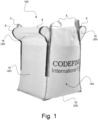
- FIG 1 is a photographic illustration of a flexible intermediate bulk container - or FIBC - that is generally designated by reference numeral 100.
- FIBC 100 exhibits one possible, illustrative configuration that could be contemplated in accordance with the invention, which configuration in essence matches that shown e.g. in Figure 6 of International ( PCT) Publication No. WO 98/54070 A1 .
- FIBC 100 illustrated in Figure 1 comprises a bottom part 10 and a sidewall 15 made of pieces of flexible fabric material, the precise nature of which will be described hereafter.
- sidewall 15 includes four side panels connected in pairs along adjacent edges to form vertical ridges at four corners of the flexible intermediate bulk container 100. The side panels may be connected together by any appropriate means, including sewing, glueing, welding, or any combination thereof.
- FIBC 100 further comprises two sets of four lifting straps 5, 6 (only part of which are visible in Figure 1 ) that are positioned in an upper portion of the FIBC 100 and adequately secured to the sidewall 15.
- a first set of four lifting straps 5 is provided that are secured in such a way as to rise above a top surface of the FIBC 100.
- Such lifting straps 5 are typically used for lifting of the FIBC 100 by means of a four-point lifting device.
- a second set of four lifting straps 6 is provided that are secured to the sidewall 15 is such a way as to project outwards from the sidewall 15, here along two opposite side panels.
- the lifting straps 6 are interconnected in pairs, as shown, by two sleeves 16 to form tubings or ducts extending longitudinally or along a top portion of the sidewall 15 to allow lifting of the FIBC 100 by means of a forklift (see e.g. Figure 4 of International ( PCT) Publication No. WO 98/54070 A1 ).
- the sleeves 16 may each be formed of a part of the relevant side panel which is looped back on and secured to itself, in which case the sleeves 16 will be understood to be made of the same flexible fabric material as the relevant side panels.
- the sleeves 16 may alternatively be made of entirely separate pieces of fabric material that may then be secured or otherwise attached to the sidewall 15.
- Another illustrative FIBC configuration is disclosed in that regard in International ( PCT) Publication No. WO 2022/123445 A1 in the name of the present Applicant, which is likewise incorporated by reference in its entirety. Such other FIBC configuration could perfectly be adopted in the context of the present invention, it being noted that the sleeves would extend in this case along the top surface of the FIBC 100, rather than along two opposite sides of the FIBC 100.
- the lifting straps 5, 6 are preferably made of reinforced woven bands produced out of polypropylene (PP) but other materials could potentially be contemplated.
- the use of polypropylene (PP) to produce the lifting straps 5, 6 is however favoured in that the lifting straps 5, 6 may adequately be recycled into polypropylene regranulate, along with other parts of the FIBC 100 made of polypropylene (PP).
- the lifting straps 5, 6 are made exclusively of pure, non-recycled polypropylene (PP) to ensure that these lifting straps 5, 6 meet desired structural specifications, especially in terms of strength and resistance.
- the upper portion of the FIBC 100 may be open or closed by a top part (not shown) provided with a suitable filling spout (as shown e.g. in Figure 6 of International ( PCT) Publication No. WO 98/54070 A1 ).
- the top part may advantageously be designed in accordance with substantially the same principles as discussed below with regard to the sidewall 15 and bottom part 10.
- Figure 2 schematically shows a partial, cross-sectional view of a piece of flexible fabric material as used to produce the sidewall 15.
- the bottom part 10 is likewise produced, in comparable fashion, of a similar piece of flexible fabric material as explained hereafter.
- the piece of flexible fabric material depicted in Figure 2 includes a woven fabric 20 comprising woven strands produced out of recycled polypropylene (rPP).
- the woven fabric 20 is made at more than 30% in weight of woven strands produced out of recycled polypropylene (rPP) and/or comprises less than 70% in weight of woven strands produced out of pure, non-recycled polypropylene (PP).
- an exterior side 15A of the sidewall 15 comprises a polypropylene (PP) coating, as designated in Figure 2 by reference numeral 21, that is extruded onto the woven fabric 20, namely, on its outer side.
- PP polypropylene
- This PP coating 21 is preferably substantially opaque and may further advantageously act as a printable layer that can at least partly be provided with printed motifs, if so desired.
- a substantially opaque PP coating 21 on the exterior side 15A of the sidewall 15 is particularly advantageous in that this obviates the potentially negative visual appearance of the underlying woven fabric 20 which is partly made of recycled polypropylene (rPP) and may come up in varying colour grades. Any desired visual appearance can therefore be guaranteed and imparted to the FIBC 100 thanks to the provision of a substantially opaque, coloured PP coating 21, irrespective of the actual nature and visual appearance of the underlying woven fabric 20.
- the use of a PP coating 21 applied by extrusion coating is furthermore particularly advantageous in that this does not negatively impact the ability for the FIBC 100 to be recycled into polypropylene regranulate. Recycling may not therefore require separation of the PP coating 21 which could be shredded along with the woven fabric 20.
- an interior side 15B of the sidewall 15 is likewise provided with a further PP coating, as designated by reference numeral 25, that is extruded onto the woven fabric 20, namely, on its inner side.
- a further PP coating as designated by reference numeral 25, that is extruded onto the woven fabric 20, namely, on its inner side.
- the PP coating 25 is applied directly onto the inner side of the woven fabric 20 by extrusion coating in a manner known as such in the art. While the extrusion of a substantially opaque PP coating 25 is not excluded, such opacification of the PP coating 25 is not absolutely necessary. It is however particularly advantageous that the PP coating 25 be a food-grade coating in that this will ensure meeting regulatory requirements for storage of any food or agricultural product within the storage volume of the FIBC 100.
- such bottom part 10 may likewise advantageously include a woven fabric comprising woven strands produced out of recycled polypropylene (rPP), like the woven fabric 20 shown in Figure 2 .
- rPP recycled polypropylene
- at least the interior side, designated 10A, of the bottom part 10 may likewise be provided with the PP coating 25, namely, that PP coating that is extruded onto the inner side of the woven fabric 20, similarly to the sidewall 15.
- an exterior side thereof does not need to be provided with any PP coating, such as the coloured PP coating 21 depicted in Figure 2 , which may be omitted in such case.
- a coloured PP coating 21 may nevertheless be provided, if required or desired, to ensure a substantially uniform visual appearance, including on the underside of the FIBC 100.
- Each of the PP coatings 21, 25 is preferably applied by extrusion coating with a weight per unit area of approximately 15 g/m 2 . Grammage may however vary, especially from 10 to 30 g/m 2 .
- the recycled polypropylene (rPP) material used to form part of the sidewall 15 and/or bottom part 10 may especially be a non-white, non-food grade recycled polypropylene (rPP) material, it being understood that the provision of the first and/or second PP coatings 21, 25 obviates the negative impact that the use of such recycled polypropylene (rPP) material might have on the visual appearance of the FIBC 100 and/or on its ability to be used for storage and transport of food and agricultural products, especially.
- FIBC 100 may advantageously be constructed in such a way that an entirety thereof can be recycled into polypropylene regranulate, which greatly simplifies recycling operations.
- the bag is shown as being of generally cubic form, the bag could exhibit a more elongated shape in one direction, for instance be taller or wider, depending on the relevant application.
- the sidewall could furthermore exhibit a substantially cylindrical form in other embodiments.
- any suitable number of lifting straps or like lifting points could be contemplated to provide for the ability for the flexible intermediate bulk container to be lifted by adequate lifting means.
- each of the sidewall and the bottom part of the flexible intermediate bulk container of the invention do not necessarily both have to be made of the same fabric material or include the same proportion of rPP strands, if any.
- the bottom part 10 could perfectly be made of a piece of woven fabric produced exclusively out of pure, non-recycled polypropylene (PP), while the sidewall 15 is made in accordance with the invention, including a woven fabric comprising a certain proportion by weight of woven strands produced out of recycled polypropylene (rPP) that is sufficient to meet regulatory demands.
- rPP recycled polypropylene
- the invention provides for the ability to reach an optimal compromise between regulatory requirements regarding the use of a minimum amount of recycled materials - in this case recycled polypropylene (rPP) - and customer demands, as well as functional, structural and/or aesthetic requirements.
- the woven fabric may in effect be made of a combination of strands produced out of pure, non-recycled polypropylene (PP) and strands produced out of recycled polypropylene (rPP) or be made exclusively of strands produced out of recycled polypropylene (rPP).
Landscapes
- Engineering & Computer Science (AREA)
- Mechanical Engineering (AREA)
- Containers Having Bodies Formed In One Piece (AREA)
- Laminated Bodies (AREA)
Priority Applications (2)
| Application Number | Priority Date | Filing Date | Title |
|---|---|---|---|
| EP23162474.3A EP4431417A1 (de) | 2023-03-16 | 2023-03-16 | Flexibler schüttgutbehälter zum transport und zur lagerung von schüttgütern |
| PCT/IB2024/052348 WO2024189523A1 (en) | 2023-03-16 | 2024-03-11 | Flexible intermediate bulk container for the transport and storage of bulk goods |
Applications Claiming Priority (1)
| Application Number | Priority Date | Filing Date | Title |
|---|---|---|---|
| EP23162474.3A EP4431417A1 (de) | 2023-03-16 | 2023-03-16 | Flexibler schüttgutbehälter zum transport und zur lagerung von schüttgütern |
Publications (1)
| Publication Number | Publication Date |
|---|---|
| EP4431417A1 true EP4431417A1 (de) | 2024-09-18 |
Family
ID=85703610
Family Applications (1)
| Application Number | Title | Priority Date | Filing Date |
|---|---|---|---|
| EP23162474.3A Withdrawn EP4431417A1 (de) | 2023-03-16 | 2023-03-16 | Flexibler schüttgutbehälter zum transport und zur lagerung von schüttgütern |
Country Status (2)
| Country | Link |
|---|---|
| EP (1) | EP4431417A1 (de) |
| WO (1) | WO2024189523A1 (de) |
Citations (7)
| Publication number | Priority date | Publication date | Assignee | Title |
|---|---|---|---|---|
| US5071699A (en) * | 1991-02-07 | 1991-12-10 | Exxon Chemical Patents Inc. | Antistatic woven coated polypropylene fabric |
| WO1998054070A1 (fr) | 1997-05-28 | 1998-12-03 | Codefine S.A. | Sac pour le transport et l'entreposage de marchandises en vrac |
| DE29818049U1 (de) * | 1998-11-13 | 1999-05-12 | Eurea Verpackungsgesellschaft mbH & Co KG, 48432 Rheine | Flexibler Transportbehälter |
| JP2013049444A (ja) * | 2011-08-30 | 2013-03-14 | Diatex Co Ltd | フレキシブルコンテナ |
| WO2015121042A1 (en) | 2014-02-13 | 2015-08-20 | Saudi Basic Industries Corporation | Flexible intermediate bulk container (fibc) |
| CN106480527A (zh) * | 2015-08-25 | 2017-03-08 | 昆明仙织塑业有限公司 | 一种环保型集装袋扁丝生产方法 |
| EP4008651A1 (de) * | 2020-12-07 | 2022-06-08 | Codefine International SA | Beutel zum transport und zur lagerung von schüttgütern und verfahren zur herstellung eines derartigen beutels |
-
2023
- 2023-03-16 EP EP23162474.3A patent/EP4431417A1/de not_active Withdrawn
-
2024
- 2024-03-11 WO PCT/IB2024/052348 patent/WO2024189523A1/en not_active Ceased
Patent Citations (9)
| Publication number | Priority date | Publication date | Assignee | Title |
|---|---|---|---|---|
| US5071699A (en) * | 1991-02-07 | 1991-12-10 | Exxon Chemical Patents Inc. | Antistatic woven coated polypropylene fabric |
| WO1998054070A1 (fr) | 1997-05-28 | 1998-12-03 | Codefine S.A. | Sac pour le transport et l'entreposage de marchandises en vrac |
| DE29818049U1 (de) * | 1998-11-13 | 1999-05-12 | Eurea Verpackungsgesellschaft mbH & Co KG, 48432 Rheine | Flexibler Transportbehälter |
| JP2013049444A (ja) * | 2011-08-30 | 2013-03-14 | Diatex Co Ltd | フレキシブルコンテナ |
| WO2015121042A1 (en) | 2014-02-13 | 2015-08-20 | Saudi Basic Industries Corporation | Flexible intermediate bulk container (fibc) |
| US10112769B2 (en) | 2014-02-13 | 2018-10-30 | Sabic Global Technologies B.V. | Flexible intermediate bulk container (FIBC) |
| CN106480527A (zh) * | 2015-08-25 | 2017-03-08 | 昆明仙织塑业有限公司 | 一种环保型集装袋扁丝生产方法 |
| EP4008651A1 (de) * | 2020-12-07 | 2022-06-08 | Codefine International SA | Beutel zum transport und zur lagerung von schüttgütern und verfahren zur herstellung eines derartigen beutels |
| WO2022123445A1 (en) | 2020-12-07 | 2022-06-16 | Codefine International Sa | Bag for the transport and storage of bulk goods and method of producing such a bag |
Non-Patent Citations (1)
| Title |
|---|
| DRY CARGO INTERNATIONAL, CLOSED-LOOP TECHNOLOGY FOR FIBCS: STARLINGER'S GREEN SOLUTION, November 2021 (2021-11-01), pages 113 - 117, Retrieved from the Internet <URL:https://www.drycarqoma.com/> |
Also Published As
| Publication number | Publication date |
|---|---|
| WO2024189523A1 (en) | 2024-09-19 |
Similar Documents
| Publication | Publication Date | Title |
|---|---|---|
| EP0703162B1 (de) | Recyclebarer, flexibler Schüttgutbehälter | |
| US20070082158A1 (en) | Composite film bag for packaging bulk products | |
| US20110007986A1 (en) | Multi Compartment Trash and Recycling Bag and Method of Manufacturing the Same | |
| US20050100252A1 (en) | Heat-sealed multi-wall flexible container | |
| WO2008104749A1 (en) | Improvements to packaging | |
| EP4431417A1 (de) | Flexibler schüttgutbehälter zum transport und zur lagerung von schüttgütern | |
| GB2455599A (en) | A compostable/biodegradable plastic and paper laminate packaging bag | |
| EP4357270A1 (de) | Flexibler schüttgutbehälter zum transport und zur lagerung von schüttgütern | |
| WO2024084411A1 (en) | Flexible intermediate bulk container for the transport and storage of bulk goods | |
| US20130114916A1 (en) | Visually distinct sorting assembly with separable means | |
| GB2125769A (en) | Bottom panel construction for receptacle | |
| SA516371623B1 (ar) | حاوية مرنة متوسطة الحجم | |
| US20150030262A1 (en) | Bag with pre-applied strap handle | |
| CN110436040A (zh) | 一种用于包装的多层纸塑复合包装袋 | |
| GB2462335A (en) | Retroreflective flexible intermediate bulk container | |
| EP3492405B1 (de) | Behälter für die lagerung und den transport von schüttgüter, abfüllanlage und verfahren | |
| EP4232373B1 (de) | Sack für versand- oder packmaterial und herstellungsverfahren | |
| CN205802046U (zh) | 防冻聚酯纤维编织吨袋 | |
| JP3249669U (ja) | 廃プラスチック製容器 | |
| ES3025476T3 (en) | A web of bags with guide and bags of different materials | |
| CA2128261C (en) | Multiwall bag | |
| JP2505671B2 (ja) | 廃品リサイクル用バッグ | |
| KR200314092Y1 (ko) | 합성수지 포대 | |
| KR20040079112A (ko) | 합성수지 포대 및 그 제조방법 | |
| KR200446508Y1 (ko) | 재활용품 분리수거용 배출통 |
Legal Events
| Date | Code | Title | Description |
|---|---|---|---|
| PUAI | Public reference made under article 153(3) epc to a published international application that has entered the european phase |
Free format text: ORIGINAL CODE: 0009012 |
|
| STAA | Information on the status of an ep patent application or granted ep patent |
Free format text: STATUS: THE APPLICATION HAS BEEN PUBLISHED |
|
| AK | Designated contracting states |
Kind code of ref document: A1 Designated state(s): AL AT BE BG CH CY CZ DE DK EE ES FI FR GB GR HR HU IE IS IT LI LT LU LV MC ME MK MT NL NO PL PT RO RS SE SI SK SM TR |
|
| STAA | Information on the status of an ep patent application or granted ep patent |
Free format text: STATUS: THE APPLICATION IS DEEMED TO BE WITHDRAWN |
|
| 18D | Application deemed to be withdrawn |
Effective date: 20250319 |