EP4431459A1 - Oxidionenleitender festelektrolyt - Google Patents
Oxidionenleitender festelektrolyt Download PDFInfo
- Publication number
- EP4431459A1 EP4431459A1 EP22889716.1A EP22889716A EP4431459A1 EP 4431459 A1 EP4431459 A1 EP 4431459A1 EP 22889716 A EP22889716 A EP 22889716A EP 4431459 A1 EP4431459 A1 EP 4431459A1
- Authority
- EP
- European Patent Office
- Prior art keywords
- solid electrolyte
- oxide ion
- oxide
- mayenite
- conducting solid
- Prior art date
- Legal status (The legal status is an assumption and is not a legal conclusion. Google has not performed a legal analysis and makes no representation as to the accuracy of the status listed.)
- Pending
Links
Images


Classifications
-
- H—ELECTRICITY
- H01—ELECTRIC ELEMENTS
- H01B—CABLES; CONDUCTORS; INSULATORS; SELECTION OF MATERIALS FOR THEIR CONDUCTIVE, INSULATING OR DIELECTRIC PROPERTIES
- H01B1/00—Conductors or conductive bodies characterised by the conductive materials; Selection of materials as conductors
- H01B1/06—Conductors or conductive bodies characterised by the conductive materials; Selection of materials as conductors mainly consisting of other non-metallic substances
- H01B1/08—Conductors or conductive bodies characterised by the conductive materials; Selection of materials as conductors mainly consisting of other non-metallic substances oxides
-
- C—CHEMISTRY; METALLURGY
- C01—INORGANIC CHEMISTRY
- C01F—COMPOUNDS OF THE METALS BERYLLIUM, MAGNESIUM, ALUMINIUM, CALCIUM, STRONTIUM, BARIUM, RADIUM, THORIUM, OR OF THE RARE-EARTH METALS
- C01F7/00—Compounds of aluminium
- C01F7/02—Aluminium oxide; Aluminium hydroxide; Aluminates
- C01F7/16—Preparation of alkaline-earth metal aluminates or magnesium aluminates; Aluminium oxide or hydroxide therefrom
- C01F7/164—Calcium aluminates
-
- C—CHEMISTRY; METALLURGY
- C04—CEMENTS; CONCRETE; ARTIFICIAL STONE; CERAMICS; REFRACTORIES
- C04B—LIME, MAGNESIA; SLAG; CEMENTS; COMPOSITIONS THEREOF, e.g. MORTARS, CONCRETE OR LIKE BUILDING MATERIALS; ARTIFICIAL STONE; CERAMICS; REFRACTORIES; TREATMENT OF NATURAL STONE
- C04B35/00—Shaped ceramic products characterised by their composition; Ceramics compositions; Processing powders of inorganic compounds preparatory to the manufacturing of ceramic products
- C04B35/01—Shaped ceramic products characterised by their composition; Ceramics compositions; Processing powders of inorganic compounds preparatory to the manufacturing of ceramic products based on oxide ceramics
- C04B35/44—Shaped ceramic products characterised by their composition; Ceramics compositions; Processing powders of inorganic compounds preparatory to the manufacturing of ceramic products based on oxide ceramics based on aluminates
-
- C—CHEMISTRY; METALLURGY
- C04—CEMENTS; CONCRETE; ARTIFICIAL STONE; CERAMICS; REFRACTORIES
- C04B—LIME, MAGNESIA; SLAG; CEMENTS; COMPOSITIONS THEREOF, e.g. MORTARS, CONCRETE OR LIKE BUILDING MATERIALS; ARTIFICIAL STONE; CERAMICS; REFRACTORIES; TREATMENT OF NATURAL STONE
- C04B35/00—Shaped ceramic products characterised by their composition; Ceramics compositions; Processing powders of inorganic compounds preparatory to the manufacturing of ceramic products
- C04B35/622—Forming processes; Processing powders of inorganic compounds preparatory to the manufacturing of ceramic products
- C04B35/626—Preparing or treating the powders individually or as batches ; preparing or treating macroscopic reinforcing agents for ceramic products, e.g. fibres; mechanical aspects section B
- C04B35/62605—Treating the starting powders individually or as mixtures
- C04B35/62625—Wet mixtures
- C04B35/62635—Mixing details
-
- C—CHEMISTRY; METALLURGY
- C04—CEMENTS; CONCRETE; ARTIFICIAL STONE; CERAMICS; REFRACTORIES
- C04B—LIME, MAGNESIA; SLAG; CEMENTS; COMPOSITIONS THEREOF, e.g. MORTARS, CONCRETE OR LIKE BUILDING MATERIALS; ARTIFICIAL STONE; CERAMICS; REFRACTORIES; TREATMENT OF NATURAL STONE
- C04B35/00—Shaped ceramic products characterised by their composition; Ceramics compositions; Processing powders of inorganic compounds preparatory to the manufacturing of ceramic products
- C04B35/622—Forming processes; Processing powders of inorganic compounds preparatory to the manufacturing of ceramic products
- C04B35/626—Preparing or treating the powders individually or as batches ; preparing or treating macroscopic reinforcing agents for ceramic products, e.g. fibres; mechanical aspects section B
- C04B35/62605—Treating the starting powders individually or as mixtures
- C04B35/62645—Thermal treatment of powders or mixtures thereof other than sintering
- C04B35/6265—Thermal treatment of powders or mixtures thereof other than sintering involving reduction or oxidation
-
- H—ELECTRICITY
- H01—ELECTRIC ELEMENTS
- H01M—PROCESSES OR MEANS, e.g. BATTERIES, FOR THE DIRECT CONVERSION OF CHEMICAL ENERGY INTO ELECTRICAL ENERGY
- H01M8/00—Fuel cells; Manufacture thereof
- H01M8/10—Fuel cells with solid electrolytes
- H01M8/12—Fuel cells with solid electrolytes operating at high temperature, e.g. with stabilised ZrO2 electrolyte
- H01M8/124—Fuel cells with solid electrolytes operating at high temperature, e.g. with stabilised ZrO2 electrolyte characterised by the process of manufacturing or by the material of the electrolyte
- H01M8/1246—Fuel cells with solid electrolytes operating at high temperature, e.g. with stabilised ZrO2 electrolyte characterised by the process of manufacturing or by the material of the electrolyte the electrolyte consisting of oxides
-
- C—CHEMISTRY; METALLURGY
- C01—INORGANIC CHEMISTRY
- C01P—INDEXING SCHEME RELATING TO STRUCTURAL AND PHYSICAL ASPECTS OF SOLID INORGANIC COMPOUNDS
- C01P2002/00—Crystal-structural characteristics
- C01P2002/50—Solid solutions
- C01P2002/52—Solid solutions containing elements as dopants
-
- C—CHEMISTRY; METALLURGY
- C01—INORGANIC CHEMISTRY
- C01P—INDEXING SCHEME RELATING TO STRUCTURAL AND PHYSICAL ASPECTS OF SOLID INORGANIC COMPOUNDS
- C01P2002/00—Crystal-structural characteristics
- C01P2002/50—Solid solutions
- C01P2002/52—Solid solutions containing elements as dopants
- C01P2002/54—Solid solutions containing elements as dopants one element only
-
- C—CHEMISTRY; METALLURGY
- C01—INORGANIC CHEMISTRY
- C01P—INDEXING SCHEME RELATING TO STRUCTURAL AND PHYSICAL ASPECTS OF SOLID INORGANIC COMPOUNDS
- C01P2004/00—Particle morphology
- C01P2004/60—Particles characterised by their size
- C01P2004/61—Micrometer sized, i.e. from 1-100 micrometer
-
- C—CHEMISTRY; METALLURGY
- C01—INORGANIC CHEMISTRY
- C01P—INDEXING SCHEME RELATING TO STRUCTURAL AND PHYSICAL ASPECTS OF SOLID INORGANIC COMPOUNDS
- C01P2004/00—Particle morphology
- C01P2004/60—Particles characterised by their size
- C01P2004/62—Submicrometer sized, i.e. from 0.1-1 micrometer
-
- C—CHEMISTRY; METALLURGY
- C01—INORGANIC CHEMISTRY
- C01P—INDEXING SCHEME RELATING TO STRUCTURAL AND PHYSICAL ASPECTS OF SOLID INORGANIC COMPOUNDS
- C01P2006/00—Physical properties of inorganic compounds
- C01P2006/40—Electric properties
-
- C—CHEMISTRY; METALLURGY
- C04—CEMENTS; CONCRETE; ARTIFICIAL STONE; CERAMICS; REFRACTORIES
- C04B—LIME, MAGNESIA; SLAG; CEMENTS; COMPOSITIONS THEREOF, e.g. MORTARS, CONCRETE OR LIKE BUILDING MATERIALS; ARTIFICIAL STONE; CERAMICS; REFRACTORIES; TREATMENT OF NATURAL STONE
- C04B2235/00—Aspects relating to ceramic starting mixtures or sintered ceramic products
- C04B2235/02—Composition of constituents of the starting material or of secondary phases of the final product
- C04B2235/30—Constituents and secondary phases not being of a fibrous nature
- C04B2235/32—Metal oxides, mixed metal oxides, or oxide-forming salts thereof, e.g. carbonates, nitrates, (oxy)hydroxides, chlorides
-
- C—CHEMISTRY; METALLURGY
- C04—CEMENTS; CONCRETE; ARTIFICIAL STONE; CERAMICS; REFRACTORIES
- C04B—LIME, MAGNESIA; SLAG; CEMENTS; COMPOSITIONS THEREOF, e.g. MORTARS, CONCRETE OR LIKE BUILDING MATERIALS; ARTIFICIAL STONE; CERAMICS; REFRACTORIES; TREATMENT OF NATURAL STONE
- C04B2235/00—Aspects relating to ceramic starting mixtures or sintered ceramic products
- C04B2235/02—Composition of constituents of the starting material or of secondary phases of the final product
- C04B2235/30—Constituents and secondary phases not being of a fibrous nature
- C04B2235/32—Metal oxides, mixed metal oxides, or oxide-forming salts thereof, e.g. carbonates, nitrates, (oxy)hydroxides, chlorides
- C04B2235/3205—Alkaline earth oxides or oxide forming salts thereof, e.g. beryllium oxide
- C04B2235/3208—Calcium oxide or oxide-forming salts thereof, e.g. lime
-
- C—CHEMISTRY; METALLURGY
- C04—CEMENTS; CONCRETE; ARTIFICIAL STONE; CERAMICS; REFRACTORIES
- C04B—LIME, MAGNESIA; SLAG; CEMENTS; COMPOSITIONS THEREOF, e.g. MORTARS, CONCRETE OR LIKE BUILDING MATERIALS; ARTIFICIAL STONE; CERAMICS; REFRACTORIES; TREATMENT OF NATURAL STONE
- C04B2235/00—Aspects relating to ceramic starting mixtures or sintered ceramic products
- C04B2235/02—Composition of constituents of the starting material or of secondary phases of the final product
- C04B2235/30—Constituents and secondary phases not being of a fibrous nature
- C04B2235/32—Metal oxides, mixed metal oxides, or oxide-forming salts thereof, e.g. carbonates, nitrates, (oxy)hydroxides, chlorides
- C04B2235/3205—Alkaline earth oxides or oxide forming salts thereof, e.g. beryllium oxide
- C04B2235/3215—Barium oxides or oxide-forming salts thereof
-
- C—CHEMISTRY; METALLURGY
- C04—CEMENTS; CONCRETE; ARTIFICIAL STONE; CERAMICS; REFRACTORIES
- C04B—LIME, MAGNESIA; SLAG; CEMENTS; COMPOSITIONS THEREOF, e.g. MORTARS, CONCRETE OR LIKE BUILDING MATERIALS; ARTIFICIAL STONE; CERAMICS; REFRACTORIES; TREATMENT OF NATURAL STONE
- C04B2235/00—Aspects relating to ceramic starting mixtures or sintered ceramic products
- C04B2235/02—Composition of constituents of the starting material or of secondary phases of the final product
- C04B2235/30—Constituents and secondary phases not being of a fibrous nature
- C04B2235/32—Metal oxides, mixed metal oxides, or oxide-forming salts thereof, e.g. carbonates, nitrates, (oxy)hydroxides, chlorides
- C04B2235/3231—Refractory metal oxides, their mixed metal oxides, or oxide-forming salts thereof
- C04B2235/3232—Titanium oxides or titanates, e.g. rutile or anatase
-
- C—CHEMISTRY; METALLURGY
- C04—CEMENTS; CONCRETE; ARTIFICIAL STONE; CERAMICS; REFRACTORIES
- C04B—LIME, MAGNESIA; SLAG; CEMENTS; COMPOSITIONS THEREOF, e.g. MORTARS, CONCRETE OR LIKE BUILDING MATERIALS; ARTIFICIAL STONE; CERAMICS; REFRACTORIES; TREATMENT OF NATURAL STONE
- C04B2235/00—Aspects relating to ceramic starting mixtures or sintered ceramic products
- C04B2235/60—Aspects relating to the preparation, properties or mechanical treatment of green bodies or pre-forms
- C04B2235/604—Pressing at temperatures other than sintering temperatures
-
- C—CHEMISTRY; METALLURGY
- C04—CEMENTS; CONCRETE; ARTIFICIAL STONE; CERAMICS; REFRACTORIES
- C04B—LIME, MAGNESIA; SLAG; CEMENTS; COMPOSITIONS THEREOF, e.g. MORTARS, CONCRETE OR LIKE BUILDING MATERIALS; ARTIFICIAL STONE; CERAMICS; REFRACTORIES; TREATMENT OF NATURAL STONE
- C04B2235/00—Aspects relating to ceramic starting mixtures or sintered ceramic products
- C04B2235/70—Aspects relating to sintered or melt-casted ceramic products
- C04B2235/74—Physical characteristics
- C04B2235/76—Crystal structural characteristics, e.g. symmetry
-
- H—ELECTRICITY
- H01—ELECTRIC ELEMENTS
- H01M—PROCESSES OR MEANS, e.g. BATTERIES, FOR THE DIRECT CONVERSION OF CHEMICAL ENERGY INTO ELECTRICAL ENERGY
- H01M2300/00—Electrolytes
- H01M2300/0017—Non-aqueous electrolytes
- H01M2300/0065—Solid electrolytes
- H01M2300/0068—Solid electrolytes inorganic
- H01M2300/0071—Oxides
- H01M2300/0074—Ion conductive at high temperature
-
- Y—GENERAL TAGGING OF NEW TECHNOLOGICAL DEVELOPMENTS; GENERAL TAGGING OF CROSS-SECTIONAL TECHNOLOGIES SPANNING OVER SEVERAL SECTIONS OF THE IPC; TECHNICAL SUBJECTS COVERED BY FORMER USPC CROSS-REFERENCE ART COLLECTIONS [XRACs] AND DIGESTS
- Y02—TECHNOLOGIES OR APPLICATIONS FOR MITIGATION OR ADAPTATION AGAINST CLIMATE CHANGE
- Y02E—REDUCTION OF GREENHOUSE GAS [GHG] EMISSIONS, RELATED TO ENERGY GENERATION, TRANSMISSION OR DISTRIBUTION
- Y02E60/00—Enabling technologies; Technologies with a potential or indirect contribution to GHG emissions mitigation
- Y02E60/30—Hydrogen technology
- Y02E60/50—Fuel cells
Definitions
- the present invention relates to an oxide ion-conducting solid electrolyte.
- Oxide ion-conducting solid electrolytes can be used as various electrical devices such as solid oxide fuel cells (SOFC), solid oxide electrolyzer cells (SOEC), oxygen sensors, oxygen pumps, and the like.
- SOFC solid oxide fuel cells
- SOEC solid oxide electrolyzer cells
- oxygen sensors oxygen pumps, and the like.
- SOFC and SOEC are electrochemical cells that operate at high temperatures.
- the former can handle various fuels such as hydrogen, carbon monoxide, methane, and the like, while the latter can electrolyze water and carbon dioxide produced by the operation of the SOFC and convert them back into hydrogen and carbon monoxide.
- Each of SOFC and SOEC has a solid electrolyte provided between two electrodes and operates by conducting oxide ions through the solid electrolyte.
- Patent Document 1 International Publication No. 2019/189701
- YSZ yttria-stabilized zirconia
- ScSZ scandia-stabilized zirconia
- a mayenite-type compound exhibits oxide ion conductivity (non-patent document 1).
- the mayenite-type compound has a crystal structure containing free oxide ions in a cage. Therefore, it is possible that the free oxide ions can contribute to ion conduction.
- the ion conductivity of the conventional mayenite-type compound is not very high (for example, about 1/10 of YSZ).
- an object of the present invention is to provide a solid electrolyte having a mayenite-type compound structure and having significantly high oxide ion conductivity.
- an oxide ion-conducting solid electrolyte includes a mayenite-type compound having a representative composition represented by Ca 12 Al 14 O 33 , wherein the oxide ion-conducting solid electrolyte contains 1.5 mol% to 7 mol% of barium (Ba) in terms of oxide.
- an oxide ion-conducting solid electrolyte includes a mayenite-type compound having a representative composition represented by Ca 12 Al 14 O 33 , wherein the oxide ion-conducting solid electrolyte contains 1.5 mol% to 7 mol% of barium (Ba) in terms of oxide.
- first solid electrolyte The oxide ion-conducting solid electrolyte (hereinafter referred to as "first solid electrolyte”) according to an embodiment of the present invention includes a mayenite-type compound of a C12A7 structure.
- the mayenite-type compound has a representative composition represented by 12CaO ⁇ 7Al 2 O 3 and has a characteristic crystal structure with three-dimensionally connected voids (cages) of about 0.4 nm in diameter.
- the framework of the cages is positively charged and forms 12 cages per unit cell. 1/6 of the cages are occupied by oxide ions to satisfy the electroneutrality condition of the crystal.
- the oxide ions in the cages have chemically different properties from the other oxygen ions that constitute the framework, and therefore the oxide ions in the cages are specifically called free oxide ions.
- the mayenite-type compound is also represented by the composition formula: [Ca 24 Al 28 O 64 ] 4+ (O 2- ) 2 (Non-Patent Document 2).
- the mayenite-type compound may function as an oxide ion conductor because the mayenite-type compound contains free oxide ions in the cage (Non-Patent Document 1).
- the ionic conductivity of the general mayenite-type compound having the above composition formula is not very high (for example, about 1/10 of YSZ).
- the inventors of the present invention have been conducting intensive research and development on measures to enhance the oxide ion conductivity of the mayenite-type compound.
- the present inventors found that when barium (Ba) is contained in the mayenite-type compound, the ionic conductivity of the mayenite-type compound can be significantly enhanced.
- the first solid electrolyte contains barium (Ba).
- Ba is contained in the first solid electrolyte in the range of 1.5 mol% to 7 mol% in terms of oxide.
- the content of Ba is preferably in the range of 2 mol% to 6 mol% in terms of oxide, and more preferably in the range of 3 mol% to 6 mol%.
- the molar ratio (Ba+Ca)/Al may be 0.875 or less.
- the first solid electrolyte contains Ba and has a significantly high ionic conductivity.
- the reason for obtaining a high ionic conductivity in one embodiment of the present invention can be considered as follows.
- the Ba atom When Ba is added to a mayenite-type compound, it is considered that the Ba atom is preferentially replaced by the site of the Ca atom.
- the Ba atom has a larger ionic radius than the Ca atom.
- the site of the Ca atom is replaced by a Ba atom, the distance between the Ba atom and the oxide ion increases.
- the electrostatic attraction between the Ba atom and the oxide ion is weakened, and the free oxide ion in the cage is likely to move easily, thereby improving the ionic conductivity.
- the mechanism of the improvement of the ionic conductivity is based on the present experimental consideration, and the ionic conductivity of the first solid electrolyte may be improved by another mechanism.
- the first solid electrolyte may further contain titanium (Ti).
- Ti may be contained in the range of 0.1 mol% to 30 mol%, in terms of TiO 2 , to the whole of the first solid electrolyte.
- the content of Ti is preferably 8.1 mol% or more, in terms of TiO 2 .
- Ti may be replaced with a site of an aluminum (Al) atom of a mayenite-type compound.
- the molar ratio Ti/Al of Ti atoms to Al atoms may be 0.015 ⁇ Ti/Al ⁇ 0.50.
- the molar ratio (Ba+Ca)/(Al+Ti) may be 0.875 or less.
- the ionic conductivity is further improved. This is expected to be due to the following reasons.
- Ti When Ti is added to a mayenite-type compound, Ti atoms are assumed to be preferentially substituted at sites of Al atoms. However, Al atoms are trivalent, while Ti atoms are tetravalent. Therefore, when Al atoms are replaced with Ti atoms, the concentration of oxide ions increases to maintain electroneutrality. In addition, the concentration of free oxide ions in the cage also increases, which may improve the ionic conductivity.
- the first solid electrolyte has significantly higher ionic conductivity than conventional mayenite-type compounds. Therefore, the first solid electrolyte can be expected to be used as a solid electrolyte in electrochemical devices such as SOFCs and SOECs.
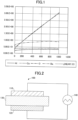
- the code used for the calculation is LAMMPS.
- the values reported by Pedone et al. were used for the input parameters, which are the pair potentials of the constituent elements of each material.
- FIG. 1 illustrates the results of the simulation.
- the horizontal axis is the elapsed time
- the vertical axis is the MSD of each element.
- FIG. 2 schematically illustrates a configuration example of an SOFC cell.
- the first solid electrolyte can be applied as the solid electrolyte 130.
- the solid electrolyte 130 has a significantly high oxide ion conductivity, it is possible to obtain a significantly high power generation efficiency.
- an SOEC cell 200 has an oxygen electrode 210, a fuel electrode 220, and a solid electrolyte 230 between the electrodes.
- the oxide ions generated at the fuel electrode 220 pass through the solid electrolyte 230 and reach the opposite oxygen electrode 210. Therefore, when the SOEC cell 200 is connected to an external power supply 240, the reactions of formulas (3) and (4) continue.
- the first solid electrolyte can be applied as the solid electrolyte 230.
- the solid electrolyte 230 has a significantly high oxide ion conductivity, a significantly high electrolytic efficiency can be obtained.
- the oxide ion-conducting solid electrolyte according to one embodiment of the present invention can be used in such an electrochemical cell as an "electrolyte layer" placed between two electrodes and also as an “electrolyte component” included in the electrodes.
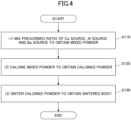
- FIG. 4 schematically illustrates an example of a flow of a method of producing an oxide ion-conducting solid electrolyte (hereinafter referred to as "first manufacturing method") according to one embodiment of the present invention.
- the first manufacturing method includes:
- a mixed powder is prepared.
- a Ca source, an Al source, and a Ba source are mixed in a prescribed ratio.
- the Ca source may be selected from, for example, calcium metal, calcium carbonate, calcium oxide, calcium hydroxide, calcium nitrate, calcium acetate, and the like.
- the Al source may be selected from, for example, metallic aluminum, ⁇ -alumina, ⁇ -alumina, aluminum hydroxide, aluminum nitrate, aluminum sulfate, and the like.
- the Ba source may be selected from, for example, barium carbonate and the like.
- Each raw material is weighed and mixed to obtain a mayenite-type compound having a desired composition.
- the method of mixing is not particularly limited as long as a uniform mixed powder is obtained.
- the mixed powder is calcined.
- the calcination step is carried out in order to remove compounds such as carbonic acid and nitric acid contained in the mixed powder, and to facilitate the formation of the desired mayenite-type compound in the next sintering step.
- the calcination temperature is preferably 1000°C or higher in order to obtain the desired mixed oxide. However, if the calcination temperature is too high, excessive crystallization proceeds in the mixed powder. Therefore, the calcination temperature is preferably 1300°C or lower.
- the calcination time is, for example, about 5 to 24 hours. However, the calcination time also varies depending on the calcination temperature, and the higher the calcination temperature, the shorter the calcination time.
- the calcined powder may be pulverized if necessary.
- the average particle size after pulverizing may be in the range of 0.1 um to 100 ⁇ m, for example.
- the sintering step is performed to obtain a dense sintered body having the desired crystalline phase.
- the calcined powder may be molded prior to the sintering step, and a sintering step may be carried out using the molded body.
- the molding conditions are not particularly limited, and a general molding method such as a uniaxial molding method or a hydrostatic molding method may be employed.
- the sintering method is not particularly limited, and the calcined powder or the molded body may be sintered by a pressureless sintering method under normal pressure, for example.
- the calcined powder may be sintered by a pressure-sintering method such as hot-press sintering or spark plasma sintering.
- a pressure-sintering method such as hot-press sintering or spark plasma sintering.
- molding and sintering may be performed in one step.
- the sintering temperature is not particularly limited as long as a suitable sintered body is obtained, but is preferably in the range of 1200°C to 1400°C. If the sintering temperature is too low, a dense sintered body may not be obtained. If the sintering temperature is too high, melting of the treated body may occur.
- the optimum sintering time varies depending on the sintering temperature.
- the optimum sintering time is, for example, about 5 to 48 hours.
- the optimum sintering time is, for example, about 5 to 60 minutes.
- carbon may adhere to the surface of the sintered body.
- the adhered carbon can be removed by heat treatment at 800°C to 1000°C for about 5 hours under ambient air.
- an oxide ion-conducting solid electrolyte according to an embodiment of the present invention can be produced.
- FIG. 5 schematically illustrates an example of a flow of another method of producing an oxide ion-conducting solid electrolyte according to an embodiment of the present invention (hereinafter referred to as "second manufacturing method").
- the second manufacturing method includes:
- the oxide ion-conducting solid electrolyte is manufactured through two calcination steps (step S220 and step S240) .
- the oxide ion-conducting solid electrolyte with a more homogeneous composition can be manufactured as compared with the case where the mixed powder including the Ca source, Al source, and Ba source is calcined at one time as in the first manufacturing method.
- the highly reactive Ca and Ba may react to form a heterogenous phase.
- step S220 in the first calcination step (step S220), Ca and Al react to form a combined calcined powder. Therefore, in the second calcination step (step S240), Ba can be more reliably introduced into a desired site in the mayenite-type compound.
- the oxide ion-conducting solid electrolyte according to an embodiment of the present invention has been described.
- the above description is only an example, and the oxide ion-conducting solid electrolyte according to one embodiment of the present invention may be produced by another method, such as a hydrothermal method, a sol-gel method, a liquid-phase combustion method, and the like.
- Examples 1 to 8 are Examples, and Examples 21 to 23 are Comparative Examples.
- a sintered body was prepared by the following method.
- Calcium carbonate powder (4.14 g), ⁇ -alumina powder (2.52 g), and barium carbonate powder (0.199 g) were weighed, respectively. These were put into a pot containing zirconia balls of 5 mm ⁇ and 10 cc isopropanol, and pulverized and mixed for 3 hours by a planetary ball milling method. The mixed powder was then dried at 100°C to remove the isopropanol. In addition, the mixed powder was separated from the zirconia balls by sieving.
- the resulting mixed powder was placed in an alumina crucible and calcined at 1200°C for 5 hours in air.
- the resulting sample was pulverized in an agate mortar to produce calcined powder.
- Sample 1 The resulting sintered body is referred to as "Sample 1".
- the content of Ba is 1.5 mol% in terms of oxide.
- Example 2 The resulting sintered body is referred to as "Sample 2".
- the Ba content is 1.6 mol% in terms of oxide and the (Ca+Ba)/Al is 0.879.
- Sintered bodies were prepared by the same method as in Example 1. However, in Examples 3 to 5, mixed powders were prepared by changing the ratio of each raw material in the aforementioned compounding step from that in Example 1. The other steps are the same as those in Example 1.
- Example 3 The resulting sintered bodies are referred to as “Sample 3" to “Sample 5", respectively.
- a sintered body was prepared by the same method as in Example 1. However, in Example 6, in addition to calcium carbonate powder, ⁇ -alumina powder, and barium oxide powder, titanium dioxide powder was added as a raw material in the aforementioned compounding step. The titanium dioxide powder was added so as to be 2.6 mol% based on the total amount. The Ti/Al ratio of the mixed powder was 0.037.
- Example 6 The resulting sintered body is referred to as "Sample 6".
- Sintered bodies were prepared by the same method as in Example 6. However, in Examples 7 to 8, the mixing ratio of each raw material was changed from that in Example 6 to prepare mixed powders. The other steps are the same as those in Example 6. The resulting sintered bodies are referred to as "Sample 7" to “Sample 8", respectively.
- a sintered body was prepared by the same method as in Example 1. However, in Example 21, only calcium carbonate (4.33 g) and ⁇ -alumina (2.57 g) were mixed to prepare a mixed powder in the aforementioned compounding step. That is, the mixed powder was prepared without adding a Ba source.
- Example 21 The resulting sintered body is referred to as "Sample 21".
- Sintered bodies were prepared by the same method as in Example 1. However, in Examples 22 to 23, the mixing ratio of each raw material in the aforementioned compounding step was changed from that in Example 1 to prepare mixed powders.
- Example 22 The resulting sintered bodies are referred to as “Sample 22" to “Sample 23”, respectively.
- Table 1 summarizes the raw materials and firing conditions of each sample.
- a platinum electrode of 6 mm ⁇ and 10 ⁇ m in thickness was placed on the polished surface through a platinum paste.
- the sample was heat-treated at 1000°C for 15 minutes in an atmosphere to solidify the platinum paste.
- the sample was then placed in an electric furnace in an atmosphere.
- the sample was also connected to a potentiogalvanostat (SP-150, manufactured by BioLogic) via a platinum wire coupled to the platinum electrode.
- SP-150 potentiogalvanostat
- the sample was then heated to 850°C and held for 120 minutes to stabilize the temperature of the sample.
- the measurement frequency was 1 MHz to 100 mHz.
- the resistivity was obtained from the intersection with the horizontal axis (real axis).
- resistivity in Table 1 above summarizes the results obtained for each sample.
- resistivity of each sample is indicated as a ratio of the resistivity obtained for Sample 21.
- the resistivity was significantly reduced in samples with 1.5 mol% to 7 mol% Ba added in terms of oxide.
- the solid electrolyte containing Ba in the crystal site of the mayenite-type compound exhibits better ionic conductivity than the conventional mayenite-type compound.
- the present invention may have the following aspects.
Landscapes
- Chemical & Material Sciences (AREA)
- Engineering & Computer Science (AREA)
- Manufacturing & Machinery (AREA)
- Ceramic Engineering (AREA)
- Organic Chemistry (AREA)
- Inorganic Chemistry (AREA)
- Structural Engineering (AREA)
- Materials Engineering (AREA)
- Life Sciences & Earth Sciences (AREA)
- Sustainable Energy (AREA)
- Thermal Sciences (AREA)
- Physics & Mathematics (AREA)
- General Chemical & Material Sciences (AREA)
- Electrochemistry (AREA)
- Chemical Kinetics & Catalysis (AREA)
- Sustainable Development (AREA)
- Geology (AREA)
- Conductive Materials (AREA)
- Fuel Cell (AREA)
Applications Claiming Priority (2)
| Application Number | Priority Date | Filing Date | Title |
|---|---|---|---|
| JP2021182100 | 2021-11-08 | ||
| PCT/JP2022/037226 WO2023079892A1 (ja) | 2021-11-08 | 2022-10-05 | 酸化物イオン伝導性固体電解質 |
Publications (2)
| Publication Number | Publication Date |
|---|---|
| EP4431459A1 true EP4431459A1 (de) | 2024-09-18 |
| EP4431459A4 EP4431459A4 (de) | 2025-12-24 |
Family
ID=86241436
Family Applications (1)
| Application Number | Title | Priority Date | Filing Date |
|---|---|---|---|
| EP22889716.1A Pending EP4431459A4 (de) | 2021-11-08 | 2022-10-05 | Oxidionenleitender festelektrolyt |
Country Status (3)
| Country | Link |
|---|---|
| EP (1) | EP4431459A4 (de) |
| JP (1) | JPWO2023079892A1 (de) |
| WO (1) | WO2023079892A1 (de) |
Family Cites Families (4)
| Publication number | Priority date | Publication date | Assignee | Title |
|---|---|---|---|---|
| KR101245943B1 (ko) * | 2005-05-30 | 2013-03-21 | 도오쿄 인스티튜드 오브 테크놀로지 | 도전성 마이에나이트형 화합물의 제조 방법 |
| JP7138968B2 (ja) | 2018-03-29 | 2022-09-20 | 国立研究開発法人科学技術振興機構 | 電解セル及び電解装置 |
| EP3932547A4 (de) * | 2019-02-26 | 2022-12-07 | Tsubame BHB Co., Ltd. | Keramischer sinterkörper und verfahren zur herstellung des keramischen sinterkörpers |
| JP7248308B2 (ja) | 2020-05-20 | 2023-03-29 | 株式会社EdLog | 採点支援方法 |
-
2022
- 2022-10-05 EP EP22889716.1A patent/EP4431459A4/de active Pending
- 2022-10-05 JP JP2023557906A patent/JPWO2023079892A1/ja active Pending
- 2022-10-05 WO PCT/JP2022/037226 patent/WO2023079892A1/ja not_active Ceased
Also Published As
| Publication number | Publication date |
|---|---|
| EP4431459A4 (de) | 2025-12-24 |
| WO2023079892A1 (ja) | 2023-05-11 |
| JPWO2023079892A1 (de) | 2023-05-11 |
Similar Documents
| Publication | Publication Date | Title |
|---|---|---|
| Lenka et al. | Comparative investigation on the functional properties of alkaline earth metal (Ca, Ba, Sr) doped Nd2NiO4+ δ oxygen electrode material for SOFC applications | |
| KR101808387B1 (ko) | 저온 소결용 세리아 전해질 및 이를 이용한 고체산화물연료전지 | |
| Fu et al. | Fabrication and study of LaNi0. 6Fe0. 4O3-δ and Sm0. 5Sr0. 5CoO3-δ composite cathode for proton-conducting solid oxide fuel cells | |
| Chockalingam et al. | Alumina/cerium oxide nano-composite electrolyte for solid oxide fuel cell applications | |
| Ayhan et al. | Impact of fabrication temperature on the stability of yttria doped bismuth oxide ceramics | |
| Mori et al. | Effect of components in electrodes on sintering characteristics of Ce0. 9Gd0. 1O1. 95 electrolyte in intermediate-temperature solid oxide fuel cells during fabrication | |
| Kiratzis et al. | Preparation and characterization of copper/yttria titania zirconia cermets for use as possible solid oxide fuel cell anodes | |
| Lu et al. | Effect of Sr and Mg Doping on the Property and Performance of the La1− x Sr x Ga1− y Mg y O3− δ Electrolyte | |
| Zhang et al. | Fe-doped SDC solid solution as an electrolyte for low-to-intermediate-temperature solid oxide fuel cells | |
| Bucevac et al. | Effect of preparation route on the microstructure and electrical conductivity of co-doped ceria | |
| US12451505B2 (en) | Oxide ion-conducting solid electrolyte | |
| EP4431459A1 (de) | Oxidionenleitender festelektrolyt | |
| JP7711506B2 (ja) | 酸化物イオン伝導性固体電解質 | |
| JP4589683B2 (ja) | 混合イオン伝導体 | |
| EP4431482A1 (de) | Oxidionenleitender festelektrolyt | |
| JP2003123789A (ja) | 固体電解質材料、その製造方法およびそれを用いた固体電解質型燃料電池 | |
| EP4398268A1 (de) | Oxidionenleitender festelektrolyt | |
| EP4398269A1 (de) | Oxidionen leitender festelektrolyt | |
| KR101806441B1 (ko) | 지르코니아-비스무스 산화물 소결체 및 이의 제조방법 | |
| US20230357045A1 (en) | Perovskite structure, method for producing and application in electrodes and solid oxide cells | |
| Cheng et al. | Preparation and electrical properties of gadolinium-doped strontium tungstate electrolyte for SOFC | |
| Nesaraj et al. | Synthesis and characterization of LaCoO 3 based cathode and its chemical compatibility with CeO 2 based electrolytes for intermediate temperature solid oxide fuel cell(ITSOFC) | |
| WO2023079910A1 (ja) | 酸化物イオン伝導性固体電解質 | |
| JP3598956B2 (ja) | ガレート複合酸化物固体電解質材料とその製造方法 | |
| JP2008077998A (ja) | 固体酸化物形燃料電池 |
Legal Events
| Date | Code | Title | Description |
|---|---|---|---|
| STAA | Information on the status of an ep patent application or granted ep patent |
Free format text: STATUS: THE INTERNATIONAL PUBLICATION HAS BEEN MADE |
|
| PUAI | Public reference made under article 153(3) epc to a published international application that has entered the european phase |
Free format text: ORIGINAL CODE: 0009012 |
|
| STAA | Information on the status of an ep patent application or granted ep patent |
Free format text: STATUS: REQUEST FOR EXAMINATION WAS MADE |
|
| 17P | Request for examination filed |
Effective date: 20240328 |
|
| AK | Designated contracting states |
Kind code of ref document: A1 Designated state(s): AL AT BE BG CH CY CZ DE DK EE ES FI FR GB GR HR HU IE IS IT LI LT LU LV MC ME MK MT NL NO PL PT RO RS SE SI SK SM TR |
|
| DAV | Request for validation of the european patent (deleted) | ||
| DAX | Request for extension of the european patent (deleted) | ||
| A4 | Supplementary search report drawn up and despatched |
Effective date: 20251124 |
|
| RIC1 | Information provided on ipc code assigned before grant |
Ipc: C01G 23/00 20060101AFI20251118BHEP Ipc: H01B 1/08 20060101ALI20251118BHEP Ipc: C04B 35/44 20060101ALI20251118BHEP Ipc: C01F 7/164 20220101ALI20251118BHEP Ipc: H01M 8/1246 20160101ALI20251118BHEP Ipc: C04B 35/626 20060101ALI20251118BHEP |