EP4431475A1 - Feuille de verre chimiquement renforcée et son procédé de fabrication - Google Patents
Feuille de verre chimiquement renforcée et son procédé de fabrication Download PDFInfo
- Publication number
- EP4431475A1 EP4431475A1 EP23162576.5A EP23162576A EP4431475A1 EP 4431475 A1 EP4431475 A1 EP 4431475A1 EP 23162576 A EP23162576 A EP 23162576A EP 4431475 A1 EP4431475 A1 EP 4431475A1
- Authority
- EP
- European Patent Office
- Prior art keywords
- glass sheet
- glass
- ion exchange
- chemically strengthened
- bath
- Prior art date
- Legal status (The legal status is an assumption and is not a legal conclusion. Google has not performed a legal analysis and makes no representation as to the accuracy of the status listed.)
- Pending
Links
Images


Classifications
-
- C—CHEMISTRY; METALLURGY
- C03—GLASS; MINERAL OR SLAG WOOL
- C03C—CHEMICAL COMPOSITION OF GLASSES, GLAZES OR VITREOUS ENAMELS; SURFACE TREATMENT OF GLASS; SURFACE TREATMENT OF FIBRES OR FILAMENTS MADE FROM GLASS, MINERALS OR SLAGS; JOINING GLASS TO GLASS OR OTHER MATERIALS
- C03C3/00—Glass compositions
- C03C3/04—Glass compositions containing silica
- C03C3/076—Glass compositions containing silica with 40% to 90% silica, by weight
- C03C3/11—Glass compositions containing silica with 40% to 90% silica, by weight containing halogen or nitrogen
-
- C—CHEMISTRY; METALLURGY
- C03—GLASS; MINERAL OR SLAG WOOL
- C03C—CHEMICAL COMPOSITION OF GLASSES, GLAZES OR VITREOUS ENAMELS; SURFACE TREATMENT OF GLASS; SURFACE TREATMENT OF FIBRES OR FILAMENTS MADE FROM GLASS, MINERALS OR SLAGS; JOINING GLASS TO GLASS OR OTHER MATERIALS
- C03C3/00—Glass compositions
- C03C3/04—Glass compositions containing silica
- C03C3/076—Glass compositions containing silica with 40% to 90% silica, by weight
- C03C3/097—Glass compositions containing silica with 40% to 90% silica, by weight containing phosphorus, niobium or tantalum
-
- C—CHEMISTRY; METALLURGY
- C03—GLASS; MINERAL OR SLAG WOOL
- C03C—CHEMICAL COMPOSITION OF GLASSES, GLAZES OR VITREOUS ENAMELS; SURFACE TREATMENT OF GLASS; SURFACE TREATMENT OF FIBRES OR FILAMENTS MADE FROM GLASS, MINERALS OR SLAGS; JOINING GLASS TO GLASS OR OTHER MATERIALS
- C03C21/00—Treatment of glass, not in the form of fibres or filaments, by diffusing ions or metals in the surface
- C03C21/001—Treatment of glass, not in the form of fibres or filaments, by diffusing ions or metals in the surface in liquid phase, e.g. molten salts, solutions
- C03C21/002—Treatment of glass, not in the form of fibres or filaments, by diffusing ions or metals in the surface in liquid phase, e.g. molten salts, solutions to perform ion-exchange between alkali ions
-
- C—CHEMISTRY; METALLURGY
- C03—GLASS; MINERAL OR SLAG WOOL
- C03C—CHEMICAL COMPOSITION OF GLASSES, GLAZES OR VITREOUS ENAMELS; SURFACE TREATMENT OF GLASS; SURFACE TREATMENT OF FIBRES OR FILAMENTS MADE FROM GLASS, MINERALS OR SLAGS; JOINING GLASS TO GLASS OR OTHER MATERIALS
- C03C3/00—Glass compositions
- C03C3/04—Glass compositions containing silica
- C03C3/076—Glass compositions containing silica with 40% to 90% silica, by weight
- C03C3/089—Glass compositions containing silica with 40% to 90% silica, by weight containing boron
- C03C3/091—Glass compositions containing silica with 40% to 90% silica, by weight containing boron containing aluminium
Definitions
- the invention generally relates to glass sheets, in particular to chemically strengthened glass sheets, as well as to a method of production for these glass sheets. More particularly, the invention relates to glass sheets comprising a lithium containing aluminosilicate glass.
- Glass sheets are widely used as viewing panels or protective sheets. For example, it is known to use glass sheets as windshields in automotive applications, or as covers in smartphones.
- the glass sheets need to meet several specifications.
- the glass sheets used for protective housings and/or covers for example for portable devices, mobile phones, or for sensor covers, should show a high resistance against mechanical failure such as breakage, especially when the glass surface has been scratched or abraded. Therefore, the glass sheet surfaces should have a high resistance against scratch formation and/or abrasion, Further, a high weathering or corrosion resistance is required.
- Glass sheets comprising or consisting of soda lime glass show neither satisfactory performance in corrosion resistance nor in mechanical strength.
- borosilicate glasses While it is known to use borosilicate glasses instead of soda lime glasses, as borosilicate glasses has superior weathering and/or corrosion resistance as well as a superior resistance to surface defects such as scratches compared to soda lime glasses, their mechanical strength with regard to breakage is still not sufficient.
- glass articles such as glass sheets
- chemical toughening or chemical strengthening it is known to chemically strengthen aluminosilicate glasses (AS glasses) or lithium containing aluminosilicate glasses (so-called LAS glasses).
- AS glasses aluminosilicate glasses
- LAS glasses lithium containing aluminosilicate glasses
- chemically strengthened LAS glasses are known for their high mechanical strength that leads to a high resistance against breakage.
- chemically strengthened LAS glass articles are rather susceptible to scratching and/or abrasion, especially compared to glass articles made of glasses commonly known as "borosilicate glasses", that is, glasses with a rather low content in alkali oxides of less than 10 wt.-% or even less than 5 wt.-% for the total of alkali oxide content and a high content in boron oxide that result in a very abrasion resistant glass network.
- borosilicate glasses that is, glasses with a rather low content in alkali oxides of less than 10 wt.-% or even less than 5 wt.-% for the total of alkali oxide content and a high content in boron oxide that result in a very abrasion resistant glass network.
- Toughened and toughenable glasses and/or glass articles are known, for example, from
- Such highly toughenable glasses have been developed to meet the requirements imposed on protective glasses for mobile devices, for example. These are usually aluminosilicate glasses (for short “AS glasses” in the context of the present disclosure), or so-called lithium aluminosilicate glasses (or LAS glasses for short).
- aluminosilicate glasses for short "AS glasses” in the context of the present disclosure
- lithium aluminosilicate glasses or LAS glasses for short
- aluminosilicate glasses include silicon oxide SiO 2 (or, to be more precise, silicon dioxide) and aluminum oxide Al 2 O 3 as components, and also alkali oxides except for lithium oxide Li 2 O, and lithium aluminosilicate glasses additionally include lithium oxide Li 2 O. Therefore, one difference between the glasses referred to as “aluminosilicate glasses” and as “lithium aluminosilicate glasses” herein is that the lithium aluminosilicate glasses include Li 2 O, but the aluminosilicate glasses do not. In addition to the aforementioned components, the glass usually includes further components.
- a glass capable of being chemically toughened refers to a glass which is accessible to an ion exchange process.
- ions of alkali metals are substituted in a surface layer of a glass article such as a glass sheet. This is done in such a way that a compressive stress zone is established in the surface layer, which is achieved by exchanging ions having smaller radii by ions having larger radii.
- the glass article is immersed in a so-called ion exchange bath, for example a molten salt, and the ion exchange bath includes the ions with the larger ionic radii, in particular potassium and/or sodium ions, so that the latter migrate into the surface layer of the glass article.
- ions with lower ionic radii, in particular lithium and/or sodium ions will migrate from the surface layer of the glass article into the ion exchange bath.
- a compressive stress zone is formed, which can be described by the characteristic parameters of compressive stress, abbreviated CS, and depth of compressive stress, which is often referred to as "Depth of Layer”, or abbreviated DoL, or, more correctly and used throughout the present application, “Depth of Compressive stress Layer” or “DoCL”.
- the compressive stress depth for potassium exchange that is, the exchange of sodium in the glass by potassium ions, if it is specified relative to the respective exchanged components or ions, is also referred to as the so-called “K DoL (exchange depth)". If a pure exchange of potassium for sodium (K ⁇ Na) is occuring, then the "K DoL” is equivalent to the DoCL.
- Stress parameters such as DoCL can be determined by a stress-optical zero-crossing measuring method, for example using measuring equipment with the trade names FSM-6000 or SLP 1000.
- FSM-6000 or SLP 1000 the trade names
- the FSM signal only refers to pure potassium exchange.
- DoCL is measured with the SLP 1000.
- This measuring equipment can also be used to determine the surface compressive stress and the maximum compressive stress CS of a sheet or a sheet-like glass article for aluminosilicate and/or lithium aluminosilicate glasses.
- the object of the present invention is to provide glass articles, in particular glass sheets, that overcome the drawbacks of the glass articles of the state of the art at least partially.
- a further object is to provide a manufacturing process for such glass articles, in particular glass sheets.
- the disclosure therefore relates to a chemically glass sheet comprising SiO 2 , Li 2 O and Al 2 O 3 as glass components and having a thickness between at least 0.3 mm and at most 3 mm, having a stress profile showing a local maximum of compressive stress at a depth within the glass article and, for a thickness of 0.7 mm, exhibiting an integral of compressive stress, of at least 3,500 MPa* ⁇ m, a DoCL of at least 160 ⁇ m,
- An exchange bath is understood to be a salt melt, wherein this salt melt is used in an ion exchange method for a glass or a glass article.
- exchange bath and ion exchange bath are used synonymously.
- salts are used in technical-grade purity for exchange baths.
- the exchange bath is a melt of a salt, for example, of sodium nitrate, or of a mixture of salts, for example, a mixture of a sodium salt and a potassium salt.
- the composition of the exchange bath is indicated in such a way that it refers to the nominal composition of the exchange bath without consideration of possibly present impurities. Therefore, insofar as a 100% sodium nitrate melt is stated in the scope of the present disclosure, this means that only sodium nitrate was used as the raw material.
- the actual content of the exchange bath of sodium nitrate may, however, deviate therefrom and this is also usual, since technical-grade raw materials in particular have a certain percentage of impurities. These are, however, usually less than 5 wt.%, referred to the total weight of the exchange bath, in particular less than 1 wt.%.
- An exchange bath with 90 wt.% KNO 3 and 10 wt.% NaNOsthus may also have some small impurities that are caused, however, by the raw materials, and usually should be less than 5%, referred to the total weight of the exchange bath, in particular, less than 1 wt.%.
- composition of the exchange bath also changes in the course of the ion exchange, in particular, since ions, such as lithium and/or sodium ions, migrate from the glass or the glass article into the exchange bath due to the continued ion exchange.
- ions such as lithium and/or sodium ions
- Such a change in the composition of the exchange bath due to aging is also present, of course, but is not considered, as long as it is not otherwise explicitly stated. Rather, in the scope of the present disclosure, for indicating the composition of an exchange bath, the nominal original composition is put down.
- a stress profile is understood as the application of mechanical stress in a glass article, such as a glass plate, for example, versus the thickness of the glass article considered, given in a diagram.
- a compressive stress profile is indicated, this is understood here as that portion of a stress profile, in which the stress assumes positive values, i.e., is greater than zero.
- Tensile stress in contrast, has a negative sign.
- a glass sheet is a plate-shaped or disc-shaped glass article and such a glass article is understood to be a glass article in which the lateral dimension is smaller in one spatial dimension, at least an order of magnitude smaller, than in the other two spatial directions, whereby these spatial directions are specified relative to a Cartesian coordinate system, in which these spatial directions each time run perpendicular to one another, and in this case, the thickness in the normal direction to the largest or main surface is measured from one main surface to the other main surface.
- a glass is understood to be a material and a glass article, such as a glass sheet is understood to be a product produced from the glass material and/or comprising the glass material, for example by shaping during hot forming.
- a glass article, such as a glass sheet can be composed of glass or predominantly composed of glass; thus the glass material can contain up to at least 90 wt.% glass.
- a glass sheet comprises a glass (or glass material) that comprises components such as SiO 2 , Al 2 O 3 , Li 2 O, alkali and alkaline earth oxides and further compounds that are known as glass components, and this may be expressed as "the glass sheet comprises a certain component" for short.
- a chemical prestressing is understood as a process in which a glass article is immersed in a so-called exchange bath.
- chemical prestressing, chemical toughening, chemical hardening and chemical strengthening are used synonymously, referring to glass articles such as glass sheets prestressed or toughened or hardened or strengthened by an ion exchange process.
- exchange bath there occurs the exchange of ions.
- potassium exchange is understood in that potassium ions migrate from the exchange bath into the glass article or glass sheet, in particular into the surface of the glass article or glass sheet, thus, for example, are incorporated therein, whereby simultaneously small alkali ions, such as sodium, for example, migrate from the glass article or glass sheet into the exchange bath.
- Sodium exchange is understood in a corresponding way, in that sodium ions migrate from the exchange bath into the surface of the glass article or glass sheet, while in contrast, small ions, for example lithium ions migrate from the glass article or glass sheet, in particular from the surface of the glass article, into the exchange bath.
- a compressive stress zone is built up in the surface region of the glass article, for example, the glass sheet.
- maximum tensile stress is the value of the tensile stress in the center of the glass article, thus at a depth of half the thickness of the glass article. Maximum tensile stress may also be called "center tension”.
- the tensile stress is usually provided with a negative sign; in contrast, compressive stresses are given a positive sign, since compression and tension have correspondingly opposite directions.
- compressive stresses are given a positive sign, since compression and tension have correspondingly opposite directions.
- the definition involves here the sign of the stress, as it is usually used by the person skilled in the art, the developer of prestressed protective glasses with respect to the sign of the stress. This directly deviates from the usual designation of compressive stress as negative and tensile stress as positive, as it is usually used in physics, for example.
- the definition of stresses reverts back to how they are usually used in the glass industry.
- network modifier and network former are understood to be according to Zachariasen (cited according to Vogel, H., Springer 1992, Glaschemie, page 52).
- the glass sheet comprises, as components, SiO 2 , Al 2 O 3 , Li 2 O as well as B 2 O 3 and therefore is understood to comprise a LAS-glass, and in particular a LABS glass.
- LAS glasses composite stress profiles that allow for a better performance in strength performance tests such as the aforementioned may readily be obtained by a mixed ion exchange.
- boron oxide is a component known to promote surface scratch resistance of a glass material and the respective glass article, such as a glass sheet, and may therefore promote a good performance in a set drop testing method.
- the glass sheet of the invention has, as indicated by the "local maximum” of the stress profile, a composite stress profile.
- Such stress profiles with a local maximum in a depth of the glass sheet are also known as "buried CS" to the person skilled in the art.
- the stress profile of the glass sheet of the disclosure will also be explained in detail with reference to the enclosed figures further below.
- the glass sheet typically has a thickness between 0.3 mm and 3 mm, wherein a higher thickness usually means a higher strength in conventional glass strength testing methods such as 4-point bending, but a higher overall weight of the glass sheet and thus a device equipped with such a glass sheet, while a lower glass thickness means a lower glass strength as well as a lower height.
- a higher thickness usually means a higher strength in conventional glass strength testing methods such as 4-point bending, but a higher overall weight of the glass sheet and thus a device equipped with such a glass sheet
- a lower glass thickness means a lower glass strength as well as a lower height.
- thicknesses within the indicated range are well suited for targeted applications such as cover glasses for electronic devices such as smartphones or tablet PCs, wherein lower glass thicknesses of 1 mm or less are more preferred than thickness above 1 mm.
- the glass sheet exhibits an integral of compressive stress (I CST in the scope of the disclosure) of at least 3,500 MPa* ⁇ m.
- the integral I CST is, in other words, the area of a right-angled triangle as an approximation of the exact area of the integral in question.
- this approximation is a very good indication of the actual integral, as the stress profile itself is a fit to measured values obtained by stress profilometers as mentioned above.
- the integral I CST is, in the scope of the disclosure, indicated for a thickness of 0.7 mm.
- the stress profile for a given glass sheet may be measured and the compressive stress at a local maximum as well as the DoCL-value may be determined.
- the obtained values need to be normalized to a "standard" thickness (which is set, in the scope of the present disclosure, to 0.7 mm) in order to allow for comparison of glass samples with different thicknesses.
- Inventors therefore developed a calculation model for normalization of measured values as follows: The local compressive stress maximum (CS LM ) and DoCL values for LAS glasses in the range of 0.3 to 1.0 mm run fairly linear against thickness (see fig.4-6 ).
- CS LM local compressive stress maximum
- DoCL graphs in a thickness range of 0.4 mm to 0.7 mm for a given LAS example (glass type A) for a two step ion exchange process creating a local CS LM .
- CS LM , 0.7 CS LM , x : ⁇ 0.0025 * 700 ⁇ x + 1
- the thicknesses are given in ⁇ m.
- the I CST of the normalized local compressive stress maximum and the normalized DoCL are calculated.
- the calculated values for CS LM, 0.7 and DoCL 0.7 can be used, and the calculated values may be used for comparison.
- a high integral of compressive stress is advantageous insofar as a high value means a high strength.
- a maximum value for the integral of compressive stress is set at 11,000 MPa* ⁇ m.
- a further important parameter of the glass sheet of the disclosure is the DoCL.
- the DoCL indicates at which depth the stress within the glass sheet changes its sign. If a scratch or any other surface damage is deeper than the DoCL, breakage takes place. Therefore, a high DoCL is desired. For a glass thickness of 0.7 mm, an upper value for the DoCL is 200 ⁇ m.
- the local maximum is set to be at a depth of at least 25 ⁇ m and at most 60 ⁇ m, and compressive stress of the local maximum is at least 60 MPa and at most 150 MPa, preferably at most 140 MPa and most preferably 130 MPa.
- the overall stored stress within the glass sheet in that way does not exceed a critical value, while, at the same time, optimizing the DoCL, shifting it to higher values. This is due to the fact that while a surface compressive stress as well as a high DoCL are obtained (which would cause a high stored tensile stress within a glass sheet with a stress profile known in the art), the stress profile shows a dip in stress at depths below the buried CS maximum. That is, in the glass sheet of the disclosure, overall stress stored within the glass sheet is kept at acceptable values that do not lead to catastrophic failure upon breakage, while the risk for breakage is still minimized, as high surface compressive values and high DoCL values are nevertheless achieved.
- This dip in compressive strength is designed to be in depth areas/ranges where the contribution to either bending strength or sharp impact strength is small, but the saving of overall stress stored is substantial. Moreover, the saving of overall stress stored in itself shifts the DoCL to higher values.
- the glass sheet of the invention comprises at least 0.4 wt.-% B 2 O 3 (which means that the glass material of the glass sheet is a member of the "LABS" glass group) or if the glass comprises at least 40 wt.-% SiO 2 and at most 24 wt.-% Al 2 O 3 .
- the glass sheet comprises both B 2 O 3 , that is, at least 0.4 wt.-% B 2 O 3 and SiO 2 and Al 2 O 3 in the above indicated amounts.
- the inventors believe this is due to all three of said components being network formers, interacting with each other in a way to provide a glass network that may be easily exchanged while at the same time being rigid enough to store mechanical stresses such that a good performance in mechanical testing arises.
- the glass sheet of the disclosure comprises SiO 2 .
- SiO 2 as the most common glass network former, is the main component of the glass sheet of the disclosure.
- the glass sheet of the disclosure may comprise at least 45 wt.-% SiO 2 .
- content in SiO 2 may be higher, as this provides for a good chemical as well as mechanical stability of the glass sheet.
- the glass sheet comprises at least 60 wt.-%, for example.
- SiO 2 also provides for a high melting temperature and viscosity, the content in SiO 2 may be limited.
- a suitable upper limit for SiO 2 content may be 75 wt.-% or even at most 70 wt.-%.
- the glass sheet of the disclosure comprises a) at least 40 wt.-% SiO 2 and b) at most 24 wt.-% Al 2 O 3 .
- SiO 2 is a network former
- Al 2 O 3 is commonly regarded as an intermediate oxide that, while contributing to the glass network modifies it at the same time, which is also explained in detail further below.
- Al 2 O 3 may provide for a good and rigid network, however, if the content in Al 2 O 3 exceeds a certain level - which has in the glasses of the invention, especially in case they do not comprise B 2 O 3 - the melting temperature gets too high.
- the glass sheets of the disclosure also comprise Al 2 O 3 .
- Al 2 O 3 may either be regarded as a network former or an intermediate oxide and is a known component of glasses that may be chemically strengthened. It has been found that a content of at least 7 wt.-%, preferably at least 10 wt.-%, is advantageous to provide for a good toughenability of the glass sheet. However, the content is limited and should not exceed 24 wt.-% Al 2 O 3 .
- the LAS glass comprised by the glass sheet of the disclosure comprises B 2 O 3 .
- B 2 O 3 is a known glass component and acts as a network former, while at the same time lowering the melting point of a glass melt.
- the addition of B 2 O 3 may also result in an advantageous increase in the scratch resistance of a glass or glass article.
- a high content of B 2 O 3 may have an adverse effect on the toughenability of a glass or glass article.
- the content of B 2 O 3 may therefore be limited according to embodiments of the glass sheet of the disclosure.
- the content in B 2 O 3 is set to be 8 wt.-% at most.
- the B 2 O 3 may even be lower, for instance at most 7 wt.-% or at most 6 wt.-% or even at most 5 wt.-%.
- Li 2 O is a mandatory component of the glass sheet of the disclosure, as it enables sodium exchange. It further provides for a good strength of toughened glasses with respect to sharp impact loads, i.e. impacts on the surface of a glass or a glass article by particles exhibiting an angle of less than 100°.
- the glass sheet therefore may comprise at least 0.1 wt.-% preferably at least 1 wt.-% Li 2 O and more preferably at least 3 wt.-% Li 2 O.
- Li 2 O content should not be too high and is preferably limited, as Li 2 O is known to promote demixing/segregation and crystallization of glasses.
- the glass sheet comprises at most 12 wt.-% Li 2 O, more preferably at most 6 wt.-%.
- the glass sheet comprises Na 2 O.
- Na 2 O as an alkali oxide, lowers the melting point of glass melts and is therefore advantageous.
- Na 2 O is advantageous for glass sheet that show, after ion exchange, good strength in blunt impact tests or a high bending strength that may be determined in static strength tests such as flexural strength according to the four point bending test or strength determined according to a double ring test, as well as against blunt impact loads, as the the ball drop test.
- a too high content in Na 2 O may be detrimental to the chemical resistance of the glass sheet and therefore, Na 2 O content is preferably limited.
- the glass sheet comprises at least 0.2 wt.-% Na 2 O, preferably at least 0.5 wt.-% Na 2 O and more preferably at least 1 wt.-% Na 2 O.
- An upper limit may be 16.5 wt.-% or 15 wt.-% Na 2 O, and the content in Na 2 O may, according to an embodiment, be even much lower, for example at most 4 wt.-%.
- the surface compressive stress is at least 650 MPa and preferably at most 1,100 MPa, preferably for a glass sheet thickness between 0.3 mm to 3 mm, in particular for a glass sheet thickness of 0.7 mm.
- a preferred minimum value of surface compressive stress is 700 MPa.
- the glass sheet comprises the following components, given in wt.-% on an oxide basis: SiO 2 40 to 70, preferably 60 to 70 Al 2 O 3 7 to 24, preferably 10 to 24 Li 2 O 0.1 to 12, preferably 1 to 12, more preferably 1 to 6, wherein in each case, a preferable lower limit may be 3 Na 2 O 0.2 to 16.5, preferably 0.5 to 15, more preferably 0.5 to 4 B 2 O 3 0 to 8, preferably 0 to 5, more preferably 0.4 to 5 ZrO 2 0 to 3 CaO 0 to 6 K 2 O 0 to 1 MgO 0 to 6 CeO 2 0 to 1 ZnO 0 to 1 P 2 O 5 0 to 2 Fe 2 O 3 0 to 0.1 SrO 0 to 1 SnO 2 0 to 1 TiO 2 0 to 2 Nd 2 O 3 0 to 0.5 SO 3 0 to 0.5 Cl 0 to 0.5
- composition of the glass sheet preferably refers to the glass sheet composition prior to chemical toughening.
- this expression is also understood to refer to the composition of the glass material that is comprised by the glass sheet.
- the glass sheet of the disclosure may comprise further components, such as modifiers, fining agents, colorants and/or decolorants, which are well known to the person skilled in the art. These further components may add up to 2 wt.-%.
- the disclosure further relates to a method for producing a chemically strengthened glass sheet, preferably a strengthened glass sheet according to embodiments of the disclosure.
- the method comprises:
- the method of the present disclosure is, in other words, a three-step ion exchange process. While three step ion exchange processes are disadvantageous in terms of manufacturing costs, inventors found that the superior performance of the thus obtained glass sheets compensate for these higher costs.
- Bath compositions and temperatures and the duration of the ion exchange preferably are carefully adjusted in every step of the ion exchange according to embodiments.
- the bath temperature may be set between at least 380°C and at most 450°C, preferably at most 440°C.
- the duration may be between at least 2 hours and at most 15 hours, preferably at most 14 hours.
- the bath may comprise a sodium salt, preferably sodium nitrate, and wherein, preferably, the bath comprises, except for unavoidable trace amounts, only a sodium salt, in particular, only sodium nitrate.
- the first ion exchange step may, in other words, be an almost pure exchange of sodium ions for lithium ions.
- the bath temperature may be between at least 360°C and at most 430°C.
- a preferred lower temperature might be 370°C.
- Preferred upper temperatures might by 410°C or 400°C.
- the duration is between at least 0.5 hours and at most 5 hours, preferably at most 4.5 hours.
- the bath may comprise sodium salt, preferably sodium nitrate, and a lithium salt, preferably lithium nitrate, and wherein the percentage, in weight, of sodium salt is between 60 to 90, and of lithium salt is between 10 and 40.
- ion exchange may be effected in a mixed salt bath, especially a salt bath comprising lithium.
- a mixed salt bath especially a salt bath comprising lithium.
- the purpose in adding Lithium in the indicated amounts is to achieve a "back diffusion" of lithium ions into the glass in the surface near region, to achieve the dip in compressive strength.
- the bath temperature may be between at least 360°C and at most 440°C. According to an embodiment, the bath temperature may also be between 395°C and 425°C.
- the duration may be between at least 0.5 hours and at most 7 hours, preferably at most 6.5 hours.
- the bath may comprise a potassium salt, preferably potassium nitrate, and wherein, preferably, the bath comprises, except for unavoidable trace amounts, only a potassium salt, in particular, only potassium nitrate.
- the third ion exchange is the ion exchange needed for providing the glass sheet with high surface compressive stress values while the first two ion exchange steps are needed to provide the glass with high DoCL values.
- the method of the disclosure therefore is a suitable way to provide the glass sheet with a combined stress profile that is optimized for user applications as may be simulated in performance tests such as the aforementioned set drop test.
- the disclosure therefore also relates to glass sheets that are obtained or obtainable in a three step ion exchange method of the disclosure.
- the disclosure further relates to a use of the chemically strengthened glass sheet, preferably a chemically strengthened glass sheet according to embodiments of the disclosure and/or obtained or at least obtainable in a method according to the disclosure, as a cover glass, such as a cover glass for a smartphone, or tablet PC, or any portable device, or for an optical sensor, such as, for example, a LiDAR sensor.
- a cover glass such as a cover glass for a smartphone, or tablet PC, or any portable device, or for an optical sensor, such as, for example, a LiDAR sensor.
- glass compositions used for glass sheets according to the disclosure may be glasses of the LABS glass material class.
- a preferred compositional range comprises the following components, given in wt.-% on an oxide basis: SiO 2 40 to 70, preferably 60 to 70 Al 2 O 3 7 to 24, preferably 10 to 24 Li 2 O 0.1 to 12, preferably 1 to 12, more preferably 1 to 6, wherein in each case, a preferable lower limit may be 3 Na 2 O 0.2 to 16.5, preferably 0.5 to 15, more preferably 0.5 to 4 B 2 O 3 0 to 8, preferably 0 to 5, more preferably 0.4 to 5 ZrO 2 0 to 3 CaO 0 to 6 K 2 O 0 to 1 MgO 0 to 6 CeO 2 0 to 1 ZnO 0 to 1 P 2 O 5 0 to 2 Fe 2 O 3 0 to 0.1 SrO 0 to 1 SnO 2 0 to 1 TiO 2 0 to 2 Nd 2 O 3 0 to 0.5 SO 3 0 to 0.5 Cl 0 to 0.5
- the glass material and/or the glass sheet may comprise further components, such as modifiers, fining agents, colorants and/or decolorants, which are well known to the person skilled in the art. These further components may add up to 2 wt.-%.
- Table 1 Listed in the following table 1 are three glass types A, B, C that are preferred for the glass sheets according to embodiments of the disclosure.
- the components are given in wt.-% on an oxide basis.
- slight deviations from the composition indicated in table 1 are possible and due to typical slight compositional deviations in raw materials and/or weighing errors.
- Deviation from the 100 wt.-% sum are due to rounding errors.
- Glass sheets comprising glass types A, B, C above were manufactured and underwent several ion exchanges as listed in following table 2.
- IOX is used as an abbreviation for ion exchange.
- any salt may be used, however, preferably LiNOs is used, due its compatibility with the preferably used nitrate of sodium and potassium that are frequently employed in ion exchange processes.
- CS 0 denotes the surface compressice stress, that is, the compressive stress at depth 0, while CS 50 refers to the compressive stress value at a depth of 50 ⁇ m.
- D LM , CS LM refer to the depth and the compressive stress of the local maximum. Values obtained in a set drop testing have been indicated. For the set drop test, sandpaper with #60 was preferably used.
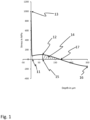
- Fig. 1 is a depiction of a schematic stress profile of a glass sheet according to the disclosure, having a thickness of 0.7 mm.
- Center tension (or CT for short) 16 is determined at the center of the glass sheet, here at a depth of 351-355 ⁇ m.
- Surface compressive stress 13 is between 650 MPa and MPa, here, approximately 1000 MPa.
- Reference numeral 12 depicts the stress value of the local compressive stress maximum at thickness 15 of the local compressive stress maximum.
- the integral of compressive stress (I CST ) 14 is the hatched area and has a value of at least 3,500 MPa* ⁇ m.
- I CST CS LM ⁇ DoCL ⁇ D LM 2
- CS LM is the compressive stress value at the local maximum, and is given in MPa
- DoCL is the depth of the compressive stress layer, and is given in ⁇ m
- D LM is the depth of the local stress maximum.
- the hypothetical DoL or K-DoL is indicated to be about 11, whereas the DoCL is indicated by reference numeral 17.
- fig. 2 is a schematic and not drawn to scale depiction of glass sheet 1 according to embodiments of the disclosure, having thickness t as well as two side faces 2, 3.
- Figs. 3 to 7 illustrate the thickness dependence of certain characteristics of stress profiles of glass sheets according to embodiments.
- Fig. 3 depicts the depth of the local maximum in compressive stress for samples that have been ion exchanged in a two step ion exchange. While for the final product, three ion exchange steps during production might be most preferred, the local maximum is already obtained in a two step ion exchange process and the stress profiles in fig, 3 are therefore quite representative. As can be seen from the depiction in fig. 3 , while the compressive stress at the local maximum, CS LM , is thickness dependent as well as the DoCL, the depth of the local maximum is not. This is apparent from the depiction in fig. 3 as well as from the depiction in fig. 7 , wherein the D LM has been plotted as a function of the thickness.
- Fig. 4 to 6 may be used to normalize stress profile values obtained for thicknesses other than 0.7 ⁇ m, as has been explained in detail further above.
- Fig. 8 is a depiction of the strength in set drop testing ("SD strength") vs the area T, that is, the I CST , the integral of compressive stress. As can been seen, a higher integral correlates with a higher set drop height. For the test, #60 sandpaper was used.
Landscapes
- Chemical & Material Sciences (AREA)
- Life Sciences & Earth Sciences (AREA)
- Engineering & Computer Science (AREA)
- Chemical Kinetics & Catalysis (AREA)
- General Chemical & Material Sciences (AREA)
- Geochemistry & Mineralogy (AREA)
- Materials Engineering (AREA)
- Organic Chemistry (AREA)
- Ceramic Engineering (AREA)
- Surface Treatment Of Glass (AREA)
- Glass Compositions (AREA)
Priority Applications (4)
| Application Number | Priority Date | Filing Date | Title |
|---|---|---|---|
| EP23162576.5A EP4431475A1 (fr) | 2023-03-17 | 2023-03-17 | Feuille de verre chimiquement renforcée et son procédé de fabrication |
| KR1020240011501A KR20240140793A (ko) | 2023-03-17 | 2024-01-25 | 화학적으로 강화된 유리 시트 및 그의 제조를 위한 방법 |
| US18/606,087 US20240308901A1 (en) | 2023-03-17 | 2024-03-15 | Chemically strengthened glass sheet and method for its production |
| CN202410307285.7A CN118666492A (zh) | 2023-03-17 | 2024-03-18 | 化学钢化的玻璃板及其生产方法 |
Applications Claiming Priority (1)
| Application Number | Priority Date | Filing Date | Title |
|---|---|---|---|
| EP23162576.5A EP4431475A1 (fr) | 2023-03-17 | 2023-03-17 | Feuille de verre chimiquement renforcée et son procédé de fabrication |
Publications (1)
| Publication Number | Publication Date |
|---|---|
| EP4431475A1 true EP4431475A1 (fr) | 2024-09-18 |
Family
ID=85703511
Family Applications (1)
| Application Number | Title | Priority Date | Filing Date |
|---|---|---|---|
| EP23162576.5A Pending EP4431475A1 (fr) | 2023-03-17 | 2023-03-17 | Feuille de verre chimiquement renforcée et son procédé de fabrication |
Country Status (4)
| Country | Link |
|---|---|
| US (1) | US20240308901A1 (fr) |
| EP (1) | EP4431475A1 (fr) |
| KR (1) | KR20240140793A (fr) |
| CN (1) | CN118666492A (fr) |
Cited By (1)
| Publication number | Priority date | Publication date | Assignee | Title |
|---|---|---|---|---|
| CN117964236A (zh) * | 2023-12-26 | 2024-05-03 | 江苏锡沂高新材料产业技术研究院有限公司 | 一种防弹面罩用高面形精度强化玻璃及其制备方法 |
Families Citing this family (1)
| Publication number | Priority date | Publication date | Assignee | Title |
|---|---|---|---|---|
| CN120152944A (zh) * | 2022-11-01 | 2025-06-13 | 康宁股份有限公司 | 可折叠基板、可折叠设备及制造方法 |
Citations (16)
| Publication number | Priority date | Publication date | Assignee | Title |
|---|---|---|---|---|
| US201416A (en) | 1878-03-19 | Improvement in saw-sharpening machines | ||
| US4055703A (en) | 1975-08-15 | 1977-10-25 | Ppg Industries, Inc. | Ion exchange strengthened glass containing P2 O5 |
| US8075999B2 (en) | 2008-08-08 | 2011-12-13 | Corning Incorporated | Strengthened glass articles and methods of making |
| CN102690059A (zh) | 2011-03-23 | 2012-09-26 | 肖特玻璃科技(苏州)有限公司 | 用于化学钢化的铝硅酸盐玻璃和玻璃陶瓷 |
| US8759238B2 (en) | 2010-05-27 | 2014-06-24 | Corning Incorporated | Ion exchangeable glasses |
| US20140345325A1 (en) | 2013-05-24 | 2014-11-27 | Corning Incorporated | Double ion exchange process |
| DE102010009584B4 (de) | 2010-02-26 | 2015-01-08 | Schott Ag | Chemisch vorgespanntes Glas, Verfahren zu seiner Herstellung sowie Verwendung desselben |
| US20150239775A1 (en) | 2014-02-24 | 2015-08-27 | Corning Incorporated | Strengthened glass with deep depth of compression |
| US9540278B2 (en) | 2010-05-27 | 2017-01-10 | Corning Incorporated | Ion exchangeable glasses |
| US9593042B2 (en) | 2014-10-08 | 2017-03-14 | Corning Incorporated | Glasses and glass ceramics including a metal oxide concentration gradient |
| US20170166478A1 (en) | 2015-12-11 | 2017-06-15 | Corning Incorporated | Fusion-formable glass-based articles including a metal oxide concentration gradient |
| US20210179488A1 (en) * | 2019-12-17 | 2021-06-17 | Samsung Display Co., Ltd. | Glass article and method for manufacturing the same |
| EP3636609B1 (fr) | 2018-10-08 | 2021-06-23 | Schott Ag | Verre à contrainte de traction élevée pouvant être mémorisée, article en verre chimiquement précontraint à contrainte de traction élevée pouvant être mémorisée, son procédé de fabrication ainsi que son utilisation |
| US20210387904A1 (en) * | 2018-10-09 | 2021-12-16 | Nippon Electric Glass Co., Ltd. | Reinforced glass and method for producing reinforced glass |
| US20220098091A1 (en) * | 2020-09-25 | 2022-03-31 | Corning Incorporated | Stress profiles of glass-based articles having improved drop performance |
| US20220289625A1 (en) * | 2020-01-14 | 2022-09-15 | AGC Inc. | Chemically strengthened glass article and manufacturing method thereof |
-
2023
- 2023-03-17 EP EP23162576.5A patent/EP4431475A1/fr active Pending
-
2024
- 2024-01-25 KR KR1020240011501A patent/KR20240140793A/ko active Pending
- 2024-03-15 US US18/606,087 patent/US20240308901A1/en active Pending
- 2024-03-18 CN CN202410307285.7A patent/CN118666492A/zh active Pending
Patent Citations (24)
| Publication number | Priority date | Publication date | Assignee | Title |
|---|---|---|---|---|
| US201416A (en) | 1878-03-19 | Improvement in saw-sharpening machines | ||
| US4055703A (en) | 1975-08-15 | 1977-10-25 | Ppg Industries, Inc. | Ion exchange strengthened glass containing P2 O5 |
| US8075999B2 (en) | 2008-08-08 | 2011-12-13 | Corning Incorporated | Strengthened glass articles and methods of making |
| DE102010009584B4 (de) | 2010-02-26 | 2015-01-08 | Schott Ag | Chemisch vorgespanntes Glas, Verfahren zu seiner Herstellung sowie Verwendung desselben |
| US9540278B2 (en) | 2010-05-27 | 2017-01-10 | Corning Incorporated | Ion exchangeable glasses |
| US8759238B2 (en) | 2010-05-27 | 2014-06-24 | Corning Incorporated | Ion exchangeable glasses |
| CN102690059A (zh) | 2011-03-23 | 2012-09-26 | 肖特玻璃科技(苏州)有限公司 | 用于化学钢化的铝硅酸盐玻璃和玻璃陶瓷 |
| WO2012126394A1 (fr) | 2011-03-23 | 2012-09-27 | Schott Glass Technologies (Suzhou) Co. Ltd. | Verre d'aluminosilicate contenant li2o et p2o5 utilisé pour une trempe chimique |
| US20140345325A1 (en) | 2013-05-24 | 2014-11-27 | Corning Incorporated | Double ion exchange process |
| US9567254B2 (en) | 2014-02-24 | 2017-02-14 | Corning Incorporated | Strengthened glass with deep depth of compression |
| US9902648B2 (en) | 2014-02-24 | 2018-02-27 | Corning Incorporated | Strengthened glass with deep depth of compression |
| US9487434B2 (en) | 2014-02-24 | 2016-11-08 | Corning Incorporated | Strengthened glass with deep depth of compression |
| US20150239775A1 (en) | 2014-02-24 | 2015-08-27 | Corning Incorporated | Strengthened glass with deep depth of compression |
| US20170129803A1 (en) | 2014-02-24 | 2017-05-11 | Corning Incorporated | Strengthened glass with deep depth of compression |
| US9676663B2 (en) | 2014-02-24 | 2017-06-13 | Corning Incorporated | Strengthened glass with deep depth of compression |
| US9517968B2 (en) | 2014-02-24 | 2016-12-13 | Corning Incorporated | Strengthened glass with deep depth of compression |
| US9593042B2 (en) | 2014-10-08 | 2017-03-14 | Corning Incorporated | Glasses and glass ceramics including a metal oxide concentration gradient |
| US20180002223A1 (en) | 2014-10-08 | 2018-01-04 | Corning Incorporated | Glasses and glass ceramics including a metal oxide concentration gradient |
| US20170166478A1 (en) | 2015-12-11 | 2017-06-15 | Corning Incorporated | Fusion-formable glass-based articles including a metal oxide concentration gradient |
| EP3636609B1 (fr) | 2018-10-08 | 2021-06-23 | Schott Ag | Verre à contrainte de traction élevée pouvant être mémorisée, article en verre chimiquement précontraint à contrainte de traction élevée pouvant être mémorisée, son procédé de fabrication ainsi que son utilisation |
| US20210387904A1 (en) * | 2018-10-09 | 2021-12-16 | Nippon Electric Glass Co., Ltd. | Reinforced glass and method for producing reinforced glass |
| US20210179488A1 (en) * | 2019-12-17 | 2021-06-17 | Samsung Display Co., Ltd. | Glass article and method for manufacturing the same |
| US20220289625A1 (en) * | 2020-01-14 | 2022-09-15 | AGC Inc. | Chemically strengthened glass article and manufacturing method thereof |
| US20220098091A1 (en) * | 2020-09-25 | 2022-03-31 | Corning Incorporated | Stress profiles of glass-based articles having improved drop performance |
Cited By (1)
| Publication number | Priority date | Publication date | Assignee | Title |
|---|---|---|---|---|
| CN117964236A (zh) * | 2023-12-26 | 2024-05-03 | 江苏锡沂高新材料产业技术研究院有限公司 | 一种防弹面罩用高面形精度强化玻璃及其制备方法 |
Also Published As
| Publication number | Publication date |
|---|---|
| KR20240140793A (ko) | 2024-09-24 |
| CN118666492A (zh) | 2024-09-20 |
| US20240308901A1 (en) | 2024-09-19 |
Similar Documents
| Publication | Publication Date | Title |
|---|---|---|
| US11820701B2 (en) | Method for achieving a stress profile in a glass | |
| US11535548B2 (en) | Glass for chemical strengthening, chemically strengthened glass and method for manufacturing chemically strengthened glass | |
| KR102732612B1 (ko) | 강화 유리 및 강화 유리의 제조 방법 | |
| KR102711362B1 (ko) | 개선된 낙하 성능을 갖는 유리 | |
| US10000409B2 (en) | Alkali-doped and alkali-free boroaluminosilicate glass | |
| EP3071526B1 (fr) | Verres échangeurs d'ions et à résistance élevée à l'endommagement | |
| KR102322091B1 (ko) | 내-스크래치성 보로알루미노실리케이트 유리 | |
| US9505653B2 (en) | Acid strengthening of glass | |
| CN104955779B (zh) | 化学强化用玻璃和化学强化玻璃以及化学强化玻璃的制造方法 | |
| US12577151B2 (en) | Safety strengthened glass with tensile stress area with low variation amplitude, and preparation method and application thereof | |
| US10968136B2 (en) | Tempered glass | |
| US20240308901A1 (en) | Chemically strengthened glass sheet and method for its production | |
| KR102735309B1 (ko) | 바람직하게 증가된 저장가능한 인장 응력을 갖는 유리, 바람직하게 증가된 저장가능한 인장 응력을 갖는 화학적 강화 유리 물품, 이러한 유리의 제조 방법, 및 이의 용도 | |
| WO2017126607A1 (fr) | Verre chimiquement renforcé, et verre destiné à un renforcement chimique | |
| KR20140092301A (ko) | 화학 강화용 유리 및 화학 강화 유리 | |
| KR20090124973A (ko) | 디스플레이 장치용 유리판 | |
| KR20120120449A (ko) | 강화유리 기판 및 그 제조 방법 | |
| JP2011088763A (ja) | ディスプレイ装置用ガラス板、ディスプレイ装置用板ガラスおよびその製造方法 | |
| US20230071964A1 (en) | Chemically strengthened glass sheet and method for its production | |
| CN112399964B (zh) | 化学强化玻璃及其制造方法 | |
| KR20200019984A (ko) | 화학적으로 강화된 방현 유리 및 방현 처리용 유리 | |
| KR20220063191A (ko) | 내파단성 유리-계 물품 | |
| EP4148025A1 (fr) | Feuille de verre chimiquement renforcée et son procédé de production | |
| WO2014097986A1 (fr) | Plaque de verre brut, procédé de fabrication de plaque de verre brut, et procédé de production de verre chimiquement renforcé | |
| CN116715449A (zh) | 化学强化玻璃及其制造方法 |
Legal Events
| Date | Code | Title | Description |
|---|---|---|---|
| STAA | Information on the status of an ep patent application or granted ep patent |
Free format text: STATUS: EXAMINATION IS IN PROGRESS |
|
| PUAI | Public reference made under article 153(3) epc to a published international application that has entered the european phase |
Free format text: ORIGINAL CODE: 0009012 |
|
| 17P | Request for examination filed |
Effective date: 20230317 |
|
| AK | Designated contracting states |
Kind code of ref document: A1 Designated state(s): AL AT BE BG CH CY CZ DE DK EE ES FI FR GB GR HR HU IE IS IT LI LT LU LV MC ME MK MT NL NO PL PT RO RS SE SI SK SM TR |
|
| P01 | Opt-out of the competence of the unified patent court (upc) registered |
Free format text: CASE NUMBER: APP_56267/2024 Effective date: 20241015 |