EP4432054A1 - Dispositif d'entrée - Google Patents
Dispositif d'entrée Download PDFInfo
- Publication number
- EP4432054A1 EP4432054A1 EP22892553.3A EP22892553A EP4432054A1 EP 4432054 A1 EP4432054 A1 EP 4432054A1 EP 22892553 A EP22892553 A EP 22892553A EP 4432054 A1 EP4432054 A1 EP 4432054A1
- Authority
- EP
- European Patent Office
- Prior art keywords
- control button
- button
- control
- type
- buttons
- Prior art date
- Legal status (The legal status is an assumption and is not a legal conclusion. Google has not performed a legal analysis and makes no representation as to the accuracy of the status listed.)
- Pending
Links
Images











Classifications
-
- A—HUMAN NECESSITIES
- A63—SPORTS; GAMES; AMUSEMENTS
- A63F—CARD, BOARD, OR ROULETTE GAMES; INDOOR GAMES USING SMALL MOVING PLAYING BODIES; VIDEO GAMES; GAMES NOT OTHERWISE PROVIDED FOR
- A63F13/00—Video games, i.e. games using an electronically generated display having two or more dimensions
- A63F13/20—Input arrangements for video game devices
- A63F13/24—Constructional details thereof, e.g. game controllers with detachable joystick handles
-
- A—HUMAN NECESSITIES
- A63—SPORTS; GAMES; AMUSEMENTS
- A63F—CARD, BOARD, OR ROULETTE GAMES; INDOOR GAMES USING SMALL MOVING PLAYING BODIES; VIDEO GAMES; GAMES NOT OTHERWISE PROVIDED FOR
- A63F13/00—Video games, i.e. games using an electronically generated display having two or more dimensions
- A63F13/40—Processing input control signals of video game devices, e.g. signals generated by the player or derived from the environment
-
- G—PHYSICS
- G05—CONTROLLING; REGULATING
- G05G—CONTROL DEVICES OR SYSTEMS INSOFAR AS CHARACTERISED BY MECHANICAL FEATURES ONLY
- G05G1/00—Controlling members, e.g. knobs or handles; Assemblies or arrangements thereof; Indicating position of controlling members
- G05G1/02—Controlling members for hand actuation by linear movement, e.g. push buttons
-
- G—PHYSICS
- G06—COMPUTING OR CALCULATING; COUNTING
- G06F—ELECTRIC DIGITAL DATA PROCESSING
- G06F3/00—Input arrangements for transferring data to be processed into a form capable of being handled by the computer; Output arrangements for transferring data from processing unit to output unit, e.g. interface arrangements
- G06F3/01—Input arrangements or combined input and output arrangements for interaction between user and computer
- G06F3/02—Input arrangements using manually operated switches, e.g. using keyboards or dials
- G06F3/0202—Constructional details or processes of manufacture of the input device
-
- G—PHYSICS
- G06—COMPUTING OR CALCULATING; COUNTING
- G06F—ELECTRIC DIGITAL DATA PROCESSING
- G06F3/00—Input arrangements for transferring data to be processed into a form capable of being handled by the computer; Output arrangements for transferring data from processing unit to output unit, e.g. interface arrangements
- G06F3/01—Input arrangements or combined input and output arrangements for interaction between user and computer
- G06F3/02—Input arrangements using manually operated switches, e.g. using keyboards or dials
- G06F3/0202—Constructional details or processes of manufacture of the input device
- G06F3/0219—Special purpose keyboards
-
- A—HUMAN NECESSITIES
- A63—SPORTS; GAMES; AMUSEMENTS
- A63F—CARD, BOARD, OR ROULETTE GAMES; INDOOR GAMES USING SMALL MOVING PLAYING BODIES; VIDEO GAMES; GAMES NOT OTHERWISE PROVIDED FOR
- A63F13/00—Video games, i.e. games using an electronically generated display having two or more dimensions
- A63F13/20—Input arrangements for video game devices
- A63F13/22—Setup operations, e.g. calibration, key configuration or button assignment
-
- A—HUMAN NECESSITIES
- A63—SPORTS; GAMES; AMUSEMENTS
- A63F—CARD, BOARD, OR ROULETTE GAMES; INDOOR GAMES USING SMALL MOVING PLAYING BODIES; VIDEO GAMES; GAMES NOT OTHERWISE PROVIDED FOR
- A63F13/00—Video games, i.e. games using an electronically generated display having two or more dimensions
- A63F13/20—Input arrangements for video game devices
- A63F13/24—Constructional details thereof, e.g. game controllers with detachable joystick handles
- A63F13/245—Constructional details thereof, e.g. game controllers with detachable joystick handles specially adapted to a particular type of game, e.g. steering wheels
-
- A—HUMAN NECESSITIES
- A63—SPORTS; GAMES; AMUSEMENTS
- A63F—CARD, BOARD, OR ROULETTE GAMES; INDOOR GAMES USING SMALL MOVING PLAYING BODIES; VIDEO GAMES; GAMES NOT OTHERWISE PROVIDED FOR
- A63F13/00—Video games, i.e. games using an electronically generated display having two or more dimensions
- A63F13/90—Constructional details or arrangements of video game devices not provided for in groups A63F13/20 or A63F13/25, e.g. housing, wiring, connections or cabinets
- A63F13/98—Accessories, i.e. detachable arrangements optional for the use of the video game device, e.g. grip supports of game controllers
-
- G—PHYSICS
- G05—CONTROLLING; REGULATING
- G05G—CONTROL DEVICES OR SYSTEMS INSOFAR AS CHARACTERISED BY MECHANICAL FEATURES ONLY
- G05G1/00—Controlling members, e.g. knobs or handles; Assemblies or arrangements thereof; Indicating position of controlling members
- G05G1/01—Arrangements of two or more controlling members with respect to one another
Definitions
- the present disclosure relates to an input device.
- PTL 1 described below discloses an input device used for control of a game console.
- Input devices used for applications such as games are used by users to input control signals to the applications.
- An object of the present disclosure is to provide a new input device that can make control comfortable for users who have difficulty in feeling comfortable controlling existing input devices.
- An input device includes a body, a first control button having a top surface portion for placing a hand and attached to the body, and a plurality of second control buttons arranged along an outer edge of the first control button and attached to the body. Outer circumferential portions of the plurality of second control buttons extend outward beyond an outer circumferential edge of the body. This can make control of the input device comfortable for users who have difficulty in feeling comfortable controlling existing input devices.
- the present disclosure typically relates to a computer eco-system including an aspect of consumer electronics (CE) device networks not limited to computer game networks.
- the system in the present specification can include server and client components that are connected via a network such that data is exchanged between the client and server components.
- the client components can include one or more pieces of computing equipment such as game consoles such as Sony PlayStation (registered trademark), game consoles of Microsoft (registered trademark), Nintendo (registered trademark), or the like; virtual reality (VR) headsets, augmented reality (AR) headsets, portable televisions (smart televisions, Internet-enabled televisions, etc.), or portable computers (mobile equipment such as laptop personal computers or tablet terminals, additional equipment mentioned later such as smartphones).
- game consoles such as Sony PlayStation (registered trademark), game consoles of Microsoft (registered trademark), Nintendo (registered trademark), or the like
- VR virtual reality
- AR augmented reality
- portable televisions smartt televisions, Internet-enabled televisions, etc.
- portable computers mobile equipment such as laptop
- Linux (registered trademark) or Unix (registered trademark) operating systems or operating systems manufactured by Microsoft (registered trademark), Apple (registered trademark), or Google (registered trademark) can be adopted.
- These operating environments can be used for executing one or more browsing programs such as browsers provided by Microsoft (registered trademark), Google (registered trademark), or Mozilla (registered trademark) that make it possible to access Web sites hosted by Internet servers mentioned later.
- an operating environment according to the present principles can be used for executing one or more computer game programs.
- Servers and/or gateways can include one or more processors (those that are configured to allow the servers to receive and transmit data on networks such as the Internet).
- clients and servers can also be connected by a local intranet or a virtual private network.
- Servers and controllers can be embodied by game consoles such as Sony PlayStation (registered trademark), personal computers, or the like.
- servers and clients can include network infrastructures for reliability and security such as firewalls, load balancers, transitory storage devises, or proxies.
- One or more servers can form an apparatus that implements a method of providing safe communities like online social websites to network members.
- Processors include single-chip or multi-chip processors that can execute logic by various types of line such as address lines, data lines, or control lines, registers, and shift registers.
- a first illustrative apparatus included in the system 10 is a consumer electronics (CE) device such as an audio video device (AVD) 12 not limited to an Internet-enabled television with a television tuner (equivalently, a set top box that controls a television).
- CE consumer electronics
- the AVD 12 may be a computerized Internet-enabled device such as a smartphone, a tablet computer, a laptop computer, a head mounted display (HMD), a wearable computerized apparatus, a music player, a headphone, or a device that can be transplanted onto skin.
- HMD head mounted display
- the AVD 12 is configured to be compliant with the principles of this document (e.g. communicate with another CE devise in order to be compliant with the principles of this document, execute logic described in this document, and execute any other functions and/or operations described in this document).
- the AVD 12 can be established with some or all of constituent elements depicted in FIG. 1 .
- the AVD 12 can include one or more displays 14.
- the displays 14 may be implemented by high-definition or ultra-high-definition flat screens with definition equal to or higher than "4K," and may support touch control for receiving user input signals via touch control on the displays.
- the AVD 12 can include one or more speakers 16 for outputting sound, and at least one additional input devise 18.
- the input devise 18 is a sound receiver, a microphone, or the like for inputting audible commands to the AVD 12 for controlling the AVD 12.
- the illustrative AVD 12 can also include one or more network interfaces 20.
- the network interfaces 20 Under the control of one or more processors 24, the network interfaces 20 perform communication via at least one network 22 such as the Internet, a wide area network (WAN), or a local area network (LAN). Accordingly, although this is not the sole example, the interface 20 may be a Wi-Fi transceiver which is an example of a wireless computer network interface, and, for example, may be a mesh network transceiver. It will be understood that the processors 24 controls the AVD 12, e.g. controls the displays 14 to present images thereon, and receives inputs from the displays 14, in order to be compliant with the principles of this document including other elements of the AVD 12 described in the present specification. Furthermore, it should be noted that the network interfaces 20 may be other appropriate interfaces such as a wired or wireless modem or router, a wireless telephone transceiver, or a Wi-Fi transceiver mentioned above.
- the AVD 12 can also include one or more input/output ports 26 such as a high-definition multi-media interface (HDMI (registered trademark)) port or a universal serial bus (USB) port for physical connection with other CE devises, and/or a headphone port for connecting a headphone to the AVD 12, and presenting sound from the AVD 12 to a user via the headphone.
- the input/output ports 26 may be connected to an audio video content cable or satellite source 26a by wired or wirelessly.
- the source 26a may be a separate or integrated set top box or a satellite receiver.
- the source 26a may be a game console or a disc player on which content is stored.
- the source 26a in a case where it is implemented as a game console can include some or all of constituent elements mentioned later in relation to a CE devise 48.
- the AVD 12 may further include one or more computer memories 28 such as a non-transitory signal disc-based or solid state storage.
- the AVD 12 may be included in the chassis of the AVD as a standalone device, or may be embodied as a personal video recording device (PVR) or a video disc player inside or outside the chassis of the AVD for reproducing AV programs or as a removable memory medium or a server mentioned later.
- PVR personal video recording device
- a video disc player inside or outside the chassis of the AVD for reproducing AV programs or as a removable memory medium or a server mentioned later.
- the AVD 12 can receive geographical positional information from a satellite or a mobile phone base station, and provide the information to the processors 24, and/or the AVD 12 can include a mobile phone receiver, a GPS receiver, and/or a position or position receiver such as an altimeter 30 that are arranged in relation to the processors 24, and configured to decide altitudes, but this is not the sole example.
- the components 30 can also decide the three-dimensional position and orientation of the AVD 12 by an inertial measurement unit (IMU) typically including a combination of an accelerometer, a gyroscope, and a magnetometer, or can also be implemented by an event-based sensor.
- IMU inertial measurement unit
- the AVD 12 can include one or more cameras 32.
- the cameras 32 are a digital camera such as an infrared camera or a web camera, an event-based sensor, and/or a camera that can be integrated into the AVD 12, and controlled by the processors 24, and collects photographs/images, and/or videos according to the principles of this document.
- the AVD 12 may include each of a Bluetooth transceiver 34 and another NFC element 36 for communication with another apparatus that uses the Bluetooth (registered trademark) and/or near field communication (NFC) technologies. Examples of the NFC element include a radio frequency identification (RFID) element.
- RFID radio frequency identification
- the AVD 12 can include one or more auxiliary sensors 38 that provide inputs to the processors 24 (e.g. a motion sensor such as an accelerometer, a gyroscope, a cyclometer, or a magnetic sensor, an infrared (IR) sensor, an optical sensor, a speed and/or cadence sensor, an event-based sensor, a gesture sensor (e.g. for sensing gesture commands)).
- the AVD 12 may include an over-the-air (OTA) television broadcast port 40 for receiving OTA television broadcasts to provide inputs to the processors 24.
- OTA over-the-air
- the AVD 12 can include also an infrared (IR) transmitter, an IR receiver, and/or an IR transceiver 42 such as an IR data association (IRDA) device.
- IR infrared
- a battery (not depicted) may be provided for supplying electric power to the AVD 12, and similarly may be a mobile environment power generating apparatus that can convert kinetic energy into electric power for charging a battery and/or supplying electric power to the AVD 12.
- a graphics processing unit (GPU) 44 and a field programmable gate array (FPGA) 46 may be included.
- One or more tactile sense generators 47 may be provided for generating tactile signals that can be sensed by a human holding or touching a device.
- the system 10 may include one or more other types of CE devise.
- a first CE devise 48 may be a computer game console that can be used to send sounds and videos of a computer game to the AVD 12 via a command directly sent to the AVD 12 and/or via a server mentioned later
- a second CE devise 50 may include components similar to those of the first CE devise 48.
- the second CE devise 50 may be configured as a computer game controller to be controlled by a player, or may be configured as an HMD to be worn by a player.
- At least one server 52 mentioned before includes at least one server processor 54, at least one tangible computer-readable storage medium 56 such as a disc-based or solid state storage, and at least one network interface 58 that enables communication with another apparatus in FIG. 1 via the network 22 under the control of the server processor 54, and can make easier communication between the server and a client apparatus according to the principles of this document actually.
- the network interface 58 may be, for example, a wired or wireless modem or router, a Wi-Fi transceiver, or another appropriate interface like a wireless telephone transceiver, for example.
- the server 52 may be an Internet server or an entire server "firm,” and can include and execute "cloud” functions such that devices of the system 10 can access a "cloud" environment via the server 52 in an illustrative embodiment for a network game application, for example.
- the server 52 may be realized by one or more game consoles or another computer in the same room as another apparatus depicted in FIG. 1 or near the room.
- Constituent elements depicted in the following figures include some or all of constituent elements depicted in FIG. 1 , in some cases.
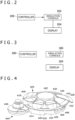
- FIG. 2 depicts that a controller 200 according to the principles of this document can be used for inputting control signals to a computer simulation console 202 in order to control display on a display 204 of a computer simulation executed on the console 202.
- the display 204 may be a television, an HMD (Head Mounted Display), or another display.
- FIG. 3 is a diagram depicting that the controller 200 according to the present principles inputs a control signal to a computer simulation server 300 that can be implemented by the server 52 in FIG. 2 , for example, and a computer simulation is executed on the server 300, and is streamed to the display 204.
- the simulation may be directly streamed to the display 204 by the server 300, or may be streamed via the simulation console 202 depicted in FIG. 2 .
- controller 200 depicted in FIG. 2 and FIG. 3 is explained with reference to FIG. 4 to FIG. 10 .
- Individual constituent elements of the controller 200 mentioned later may be formed of injection-molded plastics, inkjet-printed plastics including ones that can be manufactured by a manufacturer or an end user, composite materials, metals, plastics which are combinations of them, or the like.
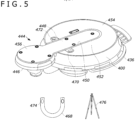
- a base portion 400 having a circular peripheral portion supports, at its top portion, a plurality of control buttons including a central control (CC) button 402.
- the CC button 402 can operate to send signals to a computerized apparatus such as the server 300 in FIG. 3 or the simulation console 202 in FIG. 2 when the apparatus is communicating with the controller through a wire and/or wirelessly.
- the CC button 402 in the non-limiting example depicted in the figure may have a circular, and gently projection top surface portion.
- the shape of the CC button 402 may be another shape.
- the CC button 402 has two functions as a normal control button, and an armrest or a palm rest. Note that in a case where the CC button 402 is used as an armrest or a palm rest, the CC button 402 may have a lock mechanism for stopping upward/downward movement.
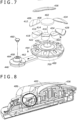
- a circular light-emitting section 403 (see FIG. 7 ) is arranged around the central button, and is devised such that the light-emitting section can be seen from any direction.
- One or more light emitting diodes (LEDs) or other light sources may be arranged under the transparent or semi-transparent portion 403, and light to be propagated through the portion 403 may be provided.
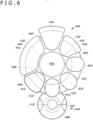
- a plurality of peripheral control (PC) buttons 404 surround the circular light-emitting section 403, and accordingly surround the CC button 402 as depicted in the figure.
- the PC buttons 404 completely surround the CC button 402 leaving only small spaces between the adjacent PC buttons 404.
- the PC buttons 404 may have mutually different shapes, sizes, colors, and textures. Some of the PC buttons 404 may have identical colors and textures, when desired.
- Each PC button can operate to transmit signals to a computerized apparatus when the computerized apparatus is communicating with the apparatus.
- one or more of the PC buttons 404 may have outer edge portions overhanging the base portion 400 (extending radially outward beyond the peripheral portion) in order to make it easier to replace the buttons with one finger or an elbow. Accordingly, end portions of the tops of the PC buttons may have shapes protruding from an end portion of the controller base portion 400.
- a first PC button 406 in a top view includes, when seen from above, a curved inner circumferential portion 408 closest to the CC button 402, and side surfaces 410 that spread outward, and are curved slightly or straight toward an outer circumferential portion 412.
- the outer circumferential portion 412 is larger (longer) than the inner circumferential portion 408.
- the first PC button 406 has a flat top surface portion or a gently projection top surface portion, and may incline from the middle of the top surface portion in dimensions in both the radial direction (the dimension from the middle of the controller toward the outer edge of the controller) and the orientation direction.
- the second and third PC buttons 414 and 416 have upwardly-inclined outside regions 418 and 420, respectively.
- the inner circumferences and the outer circumferences of the second and third PC buttons 414 and 416 have substantially the same lengths.
- Side surfaces 422 of the second and third PC buttons 414 and 416 may be straight, and form race-track-like circumferential edges of the respective PC buttons together with the inner circumferences and the outer circumferences.
- the side surfaces 422 may be gently projection, and form egg-shaped outer circumferences of the respective PC buttons together with the inner circumferences and the outer circumferences.
- the second and third PC buttons 414 and 416 have the upwardly-inclined outside regions 418 and 420, respectively, and these essentially represent discontinuity of the inclinations at ends of downwardly-inclined inside regions.
- a fourth PC button 424 is positioned next to the third PC button 416, and may have the same configuration as the second and third buttons 414 and 416 in terms of the same top surface portion shape, and upwardly-inclined outside region 426.
- a fifth PC button 428 is positioned next to the fourth PC button 424, and may have a contour that is flat or gently and continuously downwardly-inclined from a projection inner circumferential surface 430 of the fifth PC button 428 closest to the CC button to a projection outer circumferential surface 432.
- a sixth PC button 434 is positioned next to the fifth PC button 428, and may be configured with an identical shape as the fifth PC button 428, but may have a size larger than the fifth PC button 428.
- a seventh PC button 436 may be positioned between the sixth PC button 434 and the first PC button 406 as depicted in the figure, and may be larger than other PC buttons.
- the seventh PC button 436 has a recess inner circumferential surface 438 in contrast to other PC buttons that may have projection inner circumferential surfaces, and the seventh PC button 436 may have straight side surfaces 440 that spread outward extending from the inner circumferential surface 438 to a projection outer circumferential surface 442.
- buttons 404 may be freely removably engaged with the base portion 400.
- each PC button 404 can removably engage with each pad 700 on the base portion 400.
- the removable engagement may be friction or snap-fits between the PC buttons 404 and the respective pads 700, or the engagement may be magnetic engagement as depicted in FIG. 9 and FIG. 10 .
- each of the buttons 402 and 404 may be coupled to a ferromagnetic plate 900 (steel, etc.) such that the button engages with a magnet 902 in each pad 700 magnetically. It is understood that the magnets are positioned on the buttons, and the ferromagnetic plates are positioned on the pads of the base portion, in some cases.
- button covers can be moved to different basic controls on the base portion 400.
- functions of the controls themselves also can be defined by a user.
- buttons 402 and 404 may have a unique color different from other buttons.
- some buttons, the buttons 402 and 404 may have a first color, and one or more other buttons may have colors different from the first color.
- all the second to fourth buttons 414, 416, and 424 may have the same color, and the color may be different from the colors of the other buttons.
- One or more buttons may have braille patterns formed thereon projecting on top portions of the buttons by embossing or another method in order to help visually impaired people identify the buttons.
- buttons 402 and 404 to be touched by a user may have a unique texture different from other buttons.
- some buttons, the buttons 402 and 404 may have a first texture, and one or more other buttons may have textures different from the first texture.
- all the second to fourth buttons 414, 416, and 424 may have the same texture, and the texture may be different from the textures of the other buttons.
- the first texture may be a smooth texture
- the second texture may be a coarse texture, a lined texture, a dimpled texture, or another tactilely distinguishable texture.
- buttons shapes other than those described above also can be used.
- a plurality of buttons different from those described above also can be used. This recognition is part of the invention principles of this document, and does not constitute part of the technologies in the past.
- the control portion 446 may be a joystick-type input devise.
- the "north" of the control portion 446 may be defined at the factory, or may be defined by a user. For example, the "north" may be defined such that a user's need is met most by using a user interface that permits the user to define which radial direction of the ASU 444 should be defined as the "north.”
- An additional control key 447 may be provided next to the control portion 446 in the ASU 444 as depicted in the figure for control for generating additional control signals for game play.
- the ASU 444 includes a flat-plate-like platform including a slide 448.
- the slide 448 faces a parallel side surface 450 of the base portion 400, and slidably engages with a receiving portion 452 of the base portion 400 (e.g. slidably engages with a flat-plate-like base-portion plate 454).
- the receiving portion 452 is on the bottom surface of the base portion 400, and the control buttons 402 and 404 are at the top portion of the base portion.
- the flat platform may include, at one end of the slide 448, a disc-like support portion 456 to which the control portion 446 is attached rotatably.
- both the support portion 456 and the control portion 446 are circular, and have substantially the same diameter.
- the support portion 456 and the slide 448 may be formed of an integrated material such as a plastic.
- a separate structure combining an anti-slip rubber part and a plastic part can also be adopted.
- the control portion 446 can be controlled to generate signals to a computerized apparatus.
- the control portion 446 can include a point-and-click apparatus which is, in the example depicted in the figure, a button 458 and a button cover 460 to be pressed down to generate signals.
- the button 458 is attached on a rotatable ball 462 in a round socket 464 that protrudes upward at the center of the control portion 446.
- the button cover 460 has a relatively large size, and may have a strap hole for receiving a fastening strap or a carrying strap formed at its top portion.
- all connectors 466 (see FIG. 4 ) not limited to a USB connector may be arranged on a side opposite to the analog stick unit in order to avoid interference of a cable in control of the analog stick by a user. Since a USB cable is the thickest in cables that are expected to be connected to the equipment and may influence the posture at the time of use, the USB connector may be arranged on a side 180 degrees opposite to the analog stick.
- a flexible buckle attachment 468 (see FIG. 5 ) formed of a soft material such as silicon, rubber, or an elastic member can be attached to the rear surface of the base portion 400. Since, due to its flexibility, the buckle attachment deforms along an attached portion such as a user's foot or arm, or an arm of a wheelchair, stable attachment is possible.
- two screw holes 470 may be formed through the bottom surface or another surface of the base portion 400.
- Each connector 472 may pass through a hole 474 of the attachment 468, engage with a hole 470 of the base portion 400, and hold the base portion and the attachment together.
- Another attachment like a tripod 476 also can be engaged with the base portion 400 similarly.
- FIG. 11 depicts an alternative button layout in which eight peripheral buttons 1100 surround a round center button 1102.
- the peripheral buttons 1100 may have identical shapes and sizes, and, in the example depicted in the figure, may have the shape of the first PC button 406 depicted in FIG. 4 .
- buttons may be arranged left-right symmetrically along a circumferential edge portion of the base portion.
- FIG. 12 depicts an alternative button layout in which peripheral buttons 1200 surround a round center button 1202.
- Some or all of the peripheral buttons 1200 may have identical shapes such as circular shapes and identical sizes.
- four of the peripheral buttons 1200 are round, one of the round peripheral buttons is smaller than the other three peripheral buttons, and one (denoted with 1204) of the peripheral buttons is oval, and curved in the azimuth direction as depicted in the figure.
- Two (denoted with 1206) of the peripheral buttons may be small, flat, and straight buttons.
- FIG. 13 is a view depicting the controller 200 according to the principles of this document engaged with an attachment 1302.
- the attachment 1302 has flexibility and is a leg band or a strap that can fix the controller 200 to a leg or another portion of a user 1304.
- attachment can be performed effectively by using fixing members and screw holes at the base portion of the controller as mentioned above such that the controller 200, when attached to a thigh of the user, faces only one or two directions.
- two controllers are provided, one may be configured for optimal control by one hand of a user, and the other may be configured for optimal control by the other hand of the user.
- FIG. 14 is a perspective view of a controller 2000
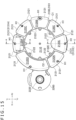
- FIG. 15 is a plan view of the controller 2000.
- the controller 2000 depicted in FIG. 14 and FIG. 15 also can be used for inputting control signals to the console 202 or the server 300 similarly to the controller 200 mentioned above.
- Individual constituent elements of the controller 2000 mentioned later also may be formed of resin such as plastic, metal, a composite material of them, or the like.
- the X1 direction and the X2 direction along the X axis (the direction in which a body 2100 and a stick unit 2200 mentioned later are arrayed) depicted in FIG. 14 and the like are treated as the right direction and the left direction, respectively.
- the Y1 direction and the Y2 direction along the Y axis perpendicular to the X axis are treated as the forward direction and the backward direction, respectively.
- the Z1 direction and the Z2 direction along the Z axis (the direction of extension of a control stick 2220 mentioned later) perpendicular to the X axis and the Y axis depicted in FIG. 3 and the like are treated as the upward direction and the downward direction, respectively.
- these directions and arrangement positions are specified for explaining the shapes and relative positional relations of elements (parts, members, and portions) of the controller 2000, and are not for limiting the posture of the controller 2000.
- the controller 2000 has the body 2100 (base portion) which is the body of the controller 2000, and on which a plurality of control buttons are arranged, and a stick unit 2200 (analog stick unit) connected to the body 2100.
- the stick unit 2200 is arranged next to the body 2100.
- the body 2100 and the stick unit 2200 may be arranged on a predetermined horizontal surface such as a floor, a desk, or a thigh of a user.
- the stick unit 2200 has a slide portion 2210 that extends in the leftward/rightward direction (the direction perpendicular to the upward/downward direction), and is connected to the body 2100.
- the stick unit 2200 has a dome-like shape that bulges upward as a whole, and has the control stick 2220 at a top portion positioned at its central portion.
- the body 2100 has, at its bottom portion, a housing recess portion (not depicted) that houses the slide portion 2210, and the slide portion 2210 can move in its direction of extension relative to the housing recess portion. Thereby, the stick unit 2200 can move in the direction of extension of the slide portion 2210 relative to the body 2100.
- the stick unit 2200 includes a circuit board (not depicted) for detecting motions of the control stick 2220, and the body 2100 includes a first circuit board 2190 (see FIG. 23 ) and a plurality of second circuit boards 2380 (see FIG. 22B and FIG. 23 ) for detecting press-control of a plurality of control buttons attached to the body 2100.
- the first circuit board 2190 and the plurality of second circuit boards 2380 are electrically connected by wires which are not depicted.
- the body 2100 of the controller 2000 has thereon a first control button (central control button) 2110 which serves as a control portion to be controlled by a user, and a plurality of second control buttons 2120 (peripheral control buttons) (type-A to type-E second control buttons 2120A to 2120E mentioned later) that serve as control portions to be controlled by the user.
- the body 2100 is circular in a plan view, and the first control button 2110 and the plurality of second control buttons 2120 are attached onto the body 2100.
- the first control button 2110 also is circular in a plan view.
- the first control button 2110 is provided at a central portion of the body 2100. As depicted in FIG.
- the first control button 2110 has a top surface portion larger than the plurality of second control buttons 2120, and a central portion of the top surface portion is formed in a dome-like shape that bulges upward gently. With such a size and a shape of the first control button 2110, it is easier for a user to place her/his hand on the first control button 2110.
- the first control button 2110 can contribute as a button for placing a hand of a user.
- the plurality of second control buttons 2120 are arranged along the outer circumferential edge C2 of the first control button 2110.
- the plurality of second control buttons 2120 are arrayed in an arc-like shape along the outer circumferential edge C2 of the first control button 2110 in state where the plurality of second control buttons 2120 are attached to the body 2100.
- Each second control button 2120 has an arc-like outer circumferential edge 2121 and inner circumferential edge 2122.
- the outer circumferential edges 2121 of the second control buttons 2120 are arranged outside the body 2100 beyond an outer circumferential edge C1 of the body 2100 in a state where the second control buttons 2120 are attached to the body 2100.
- the inner circumferential edges 2122 of the second control buttons 2120 are arranged on the inner side of the outer circumferential edge C1 of the body 2100 in a state where the second control buttons 2120 are attached to the body 2100.
- the plurality of second control buttons 2120 are formed in such tapered shapes that the lengths of the outer circumferential edges 2121 of the plurality of second control buttons 2120 are greater than the lengths of the inner circumferential edges 2122, and the widths of the plurality of second control buttons 2120 in the circumferential direction of the body 2100 gradually decrease from the outer circumferential edges 2121 toward the inner circumferential edges 2122.
- the side edges of the second control buttons 2120 extend toward the middle of the body 2100 along the radial direction of the body 2100. With such shapes of the plurality of second control buttons 2120, clearances between pairs of adjacent second control buttons 2120 can be made uniform in a state where the plurality of second control buttons 2120 are attached to the body 2100.
- each outer circumferential edge 2121 of the plurality of second control buttons 2120 is arranged outside the outer circumferential edge C1 of the body 2100, and forms an arc-like outer edge along the outer circumferential edge C1.
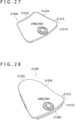
- Top surface portions of the plurality of second control buttons 2120 have openings H1 that are formed therethrough, and mark members 2400 (see FIG. 26A and FIG. 26B ) mentioned later are attached to the openings H1.
- the opening H1 is formed at a position closer to the outer circumferential edge 2121 of the second control button 2120 than to a central portion of the second control button 2120.
- the openings H1 are formed at the central positions of the second control buttons in the widthwise direction (the circumferential direction of the body 2100). Portions of the openings H1 are formed through outer circumferential portions 2131 of the second control buttons 2120.
- the inner circumferential edges 2122 of the type-A to type-D second control buttons 2120A to 2120D in the plurality of second control buttons 2120 are recess in arc-like shapes along the outer circumferential edge C2 of the first control button 2110.
- the inner circumferential edges 2122 of the type-A to type-D second control buttons 2120A to 2120D are arranged outside the outer circumferential edge C2 of the first control button 2110, and form an arc-like inner edge along the outer circumferential edge C2.
- the plurality of second control buttons 2120A have the outer circumferential portions 2131 including the outer circumferential edges 2121.
- the outer circumferential portions 2131 extend outward beyond the outer circumferential edge C1 of the body 2100 in a state where the second control buttons 2120 are attached to the body 2100.
- the top surface portion which is a control surface of the second control button 2120A can be formed large. For example, in a case where control buttons are small and their surfaces are small as on existing input devices, it is difficult for users to control the control buttons, in some cases.
- the top surface portion of the second control button 2120A by forming the top surface portion of the second control button 2120A large, it becomes easier to press-control the button, and control of the controller 2000 including the second control button 2120A can be made comfortable for users who have difficulty in feeling comfortable controlling existing input devices.
- bottom surface portions e.g. a bottom surface portion 2124A in FIG. 17A mentioned later
- a user can hook the bottom-surface-portion sides of the outer circumferential portions 2131 of the second control buttons 2120 with a hand, part of her/his body, a tool or the like, and move up the second control buttons 2120 from the body 2100.
- the plurality of second control buttons 2120 can be removed from the body 2100 by moving up the plurality of second control buttons 2120 as mentioned later.
- an inner circumferential edge 2122E of the type-E second control button 2120E extends toward the inside of the body 2100 beyond the outer circumferential edge C2 of the first control button 2110.
- the type-E second control button 2120E has, at a top surface portion 2123E (second top-surface portion) of the type-E second control button 2120E, an overhanging portion 2132E that covers a portion of the top surface portion (first top surface portion) of the first control button 2110.
- the type-A to type-D second control buttons 2120A to 2120D do not overlap the first control button 2110, and, at the overhanging portion 2132E, the type-E second control button 2120E overlaps the first control button 2110.
- the top surface portion 2123E of the type-E second control button 2120E has a large size extending in a direction toward the central portion of the body 2100.
- the distance from the type-E second control button 2120E to a second control button 2120 arranged on the opposite side with the first control button 2110 interposed therebetween decreases, and it becomes easier for a user to control the second control button 2120E, and control the second control button 2120 positioned on the opposite side, in a state where she/he is placing a hand on the first control button 2110.
- the arrangement position of the top surface portion 2123E of the type-E second control button 2120 e.g. the size of the overhanging portion 2132E
- the top surface portion of the first control button 2110 can be set as appropriate according to the ease of use for a user.
- buttons of the plurality of second control buttons 2120 attached to the body 2100 are type-E second control buttons 2120E.
- Overhanging portions 2132E overlapping the first control button 2110 in a plan view are not drawn for the type-A to type-D second control buttons 2120A to 2120D. Because of this, it is possible to ensure that there is an exposed region of the top surface portion of the first control button 2110 inside the plurality of second control buttons 2120.
- FIG. 16 is an exploded perspective view depicting a state where the plurality of second control buttons 2120 and the control stick 2200 are disassembled from the controller 2000.
- any of the plurality of second control buttons 2120 can be removed from the body 2100.
- the control stick 2220 also can be removed from the stick unit 2200.
- a control stick having a hole provided at an end portion thereof can be attached to the stick unit 2200.
- the body 2100 has a plurality of button receiving portions 2301 (pads) outside the first control button 2110. All the plurality of button receiving portions 2301 have identical shapes, and the plurality of second control buttons 2120 can be attached to the plurality of button receiving portions 2301, respectively.
- the plurality of button receiving portions 2301 surround the first control button 2110 in a plan view. All the plurality of button receiving portions 2301 are arranged between the outer circumferential edge C1 of the body 2100 and the outer circumferential edge C2 of the first control button 2110.
- the top surface portion of the body 2100 and the plurality of button receiving portions 2301 are inclined outward from the central portion of the body 2100 along the top surface portion (see FIG. 23 ) of the dome-like first control button 2110.
- the plurality of button receiving portions 2301 may be arranged evenly in the circumferential direction along the outer circumferential edge C1 of the first control button 2110 in a plan view.
- each of the type-A to type-E second control buttons 2120A to 2120E has a shape corresponding to a button receiving portion 2301 at its bottom portion.
- a user of the controller 2000 can select and attach a desired second control button 2120 from the multiple types of the type-A to type-E second control buttons 2120A to 2120E to a portion of the body 2100 where a button receiving portion 2301 is provided.
- the user can change the arrangement of the second control buttons 2120A to 2120E on the body 2100.
- the number of button receiving portions 2301 provided to the body 2100 is not limited to this.
- the maximum number of second control buttons 2120 that a user of the controller 2000 can attach to the body 2100 is the number of the button receiving portions 2301 provided to the body 2100.
- the identification information is not limited to Arabic numerals, but may be Roman numerals, or may be another type of character or symbol.
- the identification information may be formed as braille patterns or by embossing so as to allow a user to identify the identification information by touching it.
- the button receiving portions 2301 are provided with switches as mentioned later.
- an application e.g. a game application
- the switches of button receiving portions 2301 corresponding to functions of the application can be set, and assignment of switches corresponding to the functions can be changed.
- a user can change assignment of a predetermined function of the application assigned to the switch of a button receiving portion 2301 arranged at a position corresponding to the identification information "1" in FIG.
- FIG. 17A is a side view of the type-A second control button 2120A
- FIG. 17B is a perspective view depicting the lower side of the type-A second control button 2120A
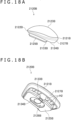
- FIG. 18A is a side view of the type-B second control button 2120B
- FIG. 18B is a perspective view depicting the lower side of the type-B second control button 2120B
- FIG. 19A is a side view of the type-C second control button 2120C
- FIG. 19B is a perspective view depicting the lower side of the type-C second control button 2120C
- FIG. 20 is a perspective view depicting the lower side of the type-D second control button 2120D.
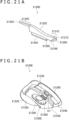
- FIG. 21A is a side view of the type-E second control button 2120E
- FIG. 21B is a perspective view depicting the lower side of the type-E second control button 2120E
- FIG. 21C is an exploded perspective view of the type-E second control button 2120E, and depicts the lower side of the type-E second control button 2120E.
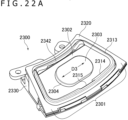
- FIG. 22A is a perspective view of a switch unit 2300 that is arranged around the first control button 2110 on the body 2100, and is provided with a button receiving portion 2301.
- FIG. 22B is an exploded perspective view depicting constituent elements of the switch unit 2300.
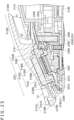
- FIG. 23 is a cross-sectional view taken along a line A-A in FIG. 15
- FIG. 24 is a cross-sectional view taken along a line B-B in FIG. 15 .
- FIG. 23 and FIG. 24 depict states where the type-A second control button 2120A is attached to the button receiving portion 2301.
- FIG. 25 is a cross-sectional view taken along a line C-C in FIG. 15 , and depicts a state where the type-E second control button 2120E is attached to the button receiving portion 2301.
- a top surface portion 2123A of the type-A second control button 2120A includes an outer circumferential edge 2121A and an inner circumferential edge 2122A of the second control button 2120A, and faces upward and a diagonal direction relative to the radial direction of the body 2100 (a direction from the inner circumferential edge 2122A toward the outer circumferential edge 2121A).
- the top surface portion 2123A of the type-A second control button 2120A is slightly curved in the upward/downward direction.
- the bottom surface portion 2124A of the type-A second control button 2120A includes the outer circumferential edge 2121A and the inner circumferential edge 2122A similarly to the top surface portion 2023A.
- the bottom surface portion 2124A of the type-A second control button 2120A faces downward and a diagonal direction relative to the radial direction of the body 2100 (a direction from the outer circumferential edge 2121A toward the inner circumferential edge 2122A).
- the thickness of the outer circumferential edge 2121A is greater than the thickness of the inner circumferential edge 2122A.
- the type-A second control button 2120A has an inclined surface 2127A on the outer circumferential edge 2121A.
- the inclined surface 2127A is the bottom surface of the outer circumferential portion 2131 of the second control button 2120A, and is inclined downward and inward.
- the type-A second control button 2120A has a fitting projection portion 2125A at the bottom surface portion 2124A.
- the fitting projection portion 2125A has a shape corresponding to the plurality of button receiving portions 2301 (see FIG. 16 ) provided at the top surface portion 2101 of the body 2100.
- the fitting projection portion 2125A can be attached to any of the plurality of button receiving portions 2301.
- the fitting projection portion 2125A protrudes downward from the bottom surface portion 2124A.
- the plurality of button receiving portions 2301 are recess downward from the top surface portion 2101 of the body 2100, and have fitting recess portions 2302 (see FIG. 22A ) that receive the fitting projection portion 2125A of the second control button 2120A.
- a relation between the recess and projection of the fitting projection portion 2125A and the button receiving portions 2301 may be opposite.
- the fitting projection portion 2125A of the second control button 2120A has, at its central portion, a first fitting portion 2126A (see FIG. 17B ), and a button receiving portion 2301 has, at its central portion (a central portion of the fitting recess portion 2302), a second fitting portion 2303 (see FIG. 22A ).
- the second fitting portion 2303 of the button receiving portion 2301 fits inside the first fitting portion 2126A of the second control button 2125A.
- first fitting portions 2126B to 2126E to which the second fitting portions 2303 of the button receiving portions 2301 fit are formed also at central portions of fitting projection portions 2125B to 2125E of the type-B to type-E second control buttons 2120B to 2120E mentioned later.
- first fitting portion 2126A is a recess portion which is recess in a direction away from the button receiving portion 2301
- second fitting portion 2303 is a projection portion protruding toward the second control button 2120A in FIG. 17B and FIG. 22A
- the relation between the recess and projection of the first fitting portion 2126A and the second fitting portion 2303 may be opposite.
- first fitting portion 2126A may be a projection portion protruding toward the button receiving portion 2301
- second fitting portion 2303 may be a recess portion which is recess in a direction away from the second control button 2120A
- first fitting portion 2126A and the second fitting portion 2303 have oblong shapes having corner portions that are rounded in a plan view
- the shapes of the first fitting portion 2126A and the second fitting portion 2303 are not limited to these.
- a top surface portion 2123B and a bottom surface portion 2124B of the type-B second control button 2120B include an outer circumferential edge 2121B and an inner circumferential edge 2122B.
- the type-B second control button 2120B has an inclined surface 2127B on the outer circumferential edge 2121B.
- the inclined surface 2127B is the bottom surface of the outer circumferential portion 2131 of the second control button 2120B, and is inclined downward and inward.
- the top surface portion 2123B of the type-B second control button 2120B bulges upward at its central portion unlike the top surface portion 2123A of the type-A second control button 2120A.
- the top surface portion 2123B of the type-B second control button 2120B has a bulging shape, it is easier for some users to control the type-B second control button 2120B as compared with the type-A second control button 2120A, in some cases.
- the user controls the second control button 2120B by sliding the hand along the top surface portion of the dome-like first control button 2110, in some cases. Since the hand of the user interferes with the top surface portion 2123B of the second control button 2120B in that process, press-control of the type-B second control button 2120B becomes easier as compared to control of the type-A second control button 2120A in some cases.
- the fitting projection portion 2125B similar to the fitting projection portion 2125A of the type-A second control button 2120A is formed also at the bottom surface portion 2124B of the type-B second control button 2120B.
- the type-B second control button 2120B also can be attached, at the fitting projection portion 2125B, to any of the plurality of button receiving portions 2301.
- a plurality of holes H2 are formed through the bottom surface portion 2124B of the type-B second control button 2120B, and it is attempted thereby to reduce the weight of the type-B second control button 2120B.
- a top surface portion 2123C and a bottom surface portion 2124C of the type-C second control button 2120C include an outer circumferential edge 2121C and an inner circumferential edge 2122C.
- the type-C second control button 2120C has an inclined surface 2127C on the outer circumferential edge 2121C.
- the inclined surface 2127C is the bottom surface of the outer circumferential portion 2131 of the second control button 2120C, and is inclined downward and inward.
- the top surface portion 2123C of the type-C second control button 2120C faces upward and a diagonal direction relative to the radial direction of the body 2100 (a direction from the outer circumferential edge 2121C toward the inner circumferential edge 2122C), unlike the top surface portion 2123A of the type-A second control button 2120A.
- the top surface portion 2123C of the type-C second control button 2120C is slightly curved in the upward/downward direction.
- the bottom surface portion 2124C of the type-C second control button 2120A faces downward and a diagonal direction relative to a direction from the outer circumferential edge 2121C toward the inner circumferential edge 2122C, similarly to the bottom surface portion 2124A of the type-A second control button 2120A.
- the thickness of the type-C second control button 2120A in the upward/downward direction increases gradually from the inner circumferential edge 2122 toward the outer circumferential edge 2121.
- the position of the outer circumferential edge 2121C of the type-C second control button is the highest.
- the hand of the user interferes with the outer circumferential portion 2121C of the second control button 2120C.
- press-control of the type-C second control button 2120C is easier as compared to control of other second control buttons 2120 (e.g. the type-A second control button 2120A), in some cases.
- a fitting projection portion 2125C similar to the fitting projection portion 2125A of the type-A second control button 2120A is formed also at the bottom surface portion 2124C of the type-C second control button 2120C.
- the type-C second control button 2120C also can be attached, at the fitting projection portion 2125B, to any of the plurality of button receiving portions 2301.
- a plurality of holes H3 are formed through the bottom surface portion 2124C of the type-C second control button 2120C. Thereby, it is attempted to reduce the weight of the type-C second control button 2120C similarly to the type-B second control button 2120B.
- the type-D second control button 2120D is explained. As depicted in FIG. 14 and FIG. 20 , similarly to the type-A second control button 2120A, the type-D second control button 2120D has a top surface portion that faces upward and a diagonal direction relative to the radial direction of the body 2100 (a direction from an inner circumferential edge 2122D toward an outer circumferential edge 2121D), and is slightly curved in the upward/downward direction.
- the type-D second control button 2120D has an inclined surface 2127D on the outer circumferential edge 2121D.
- the inclined surface 2127D is the bottom surface of the outer circumferential portion 2131 of the second control button 2120D, and is inclined downward and inward.
- the type-D second control button 2120D is different from the type-A second control button 2120A in that the type-D second control button 2120D is wider than the type-A second control button 2120A in the circumferential direction of the body 2100 to which the plurality of second control buttons 2120 are attached.
- the type-D second control button 2120D becomes easier to press than the type-A second control button 2120A is, in some cases. In addition, it becomes easier to perform control of pressing adjacent buttons simultaneously, in some cases.
- the widths of the outer circumferential edges 2121A to 2121C in the circumferential direction are the same or approximately the same, and the width of the outer circumferential edge 2121D is or approximately is twice as large as the width of the outer circumferential edge 2121A.
- the widths of the inner circumferential edges 2122A to 2122C in the circumferential direction are the same or approximately the same, and the width of the inner circumferential edge 2122D is or approximately is twice as large as the width of the inner circumferential edge 2122A.
- two fitting projection portions 2125D similar to the fitting projection portion 2125A of the type-A second control button 2120A are formed also at the bottom surface portion 2124D of the type-D second control button 2120D.
- the type-D second control button 2120D is different from the type-A second control button 2120A also in that the number of the fitting projection portions 2125D is two.
- the two fitting projection portions 2125D are separate from each other in the circumferential direction of the body 2100 at the bottom surface portion 2124D of the type-D second control button 2120D.
- the type-D second control button 2120D is attached to the body 2100 by attaching the two fitting projection portions 2125D to two adjacent button receiving portions 2301 (see FIG. 16 ). By pressing the type-D second control button 2120D, a user can press one or both of switch elements 2381 (see FIG. 22B ) provided to the two adjacent button receiving portions 2301.
- the type-E second control button 2120E is explained. As depicted in FIG. 21A , similarly to the type-A second control button 2120A, the type-E second control button 2120E has the top surface portion 2123E that faces upward and a diagonal direction relative to the radial direction of the body 2100 (a direction from the inner circumferential edge 2122E toward an outer circumferential edge 2121E), and is slightly curved in the upward/downward direction. As depicted in FIG. 15 , the inner circumferential edge 2122E included in the top surface portion 2123E of the type-E second control button 2120E protrudes toward the central portion of the body 2100 more significantly than the inner circumferential edges 2122 of the other second control buttons 2120 do.
- the overhanging portion 2132E including the inner circumferential edge 2122E is formed at the top surface portion 2123E of the type-E second control button 2120E.
- the overhanging portion 2132E of the second control button 2120E covers a portion of the top surface portion of the first control button 2110.
- a fitting projection portion 2125E is formed also at a bottom surface portion 2124E of the type-E second control button 2120E.
- the fitting projection portions 2125A and 2125E of the second control buttons 2120A and 2120E have, on the sides of the inner circumferential edges 2122A and 2122E, engagement portions 2151 (second engagement portions) that engage with button receiving portions 2301.
- engagement portions 2151 that engage with button receiving portions 2301 are formed also at the fitting projection portions 2125B to 2125C of the type-B to type-D second control buttons 2120B to 2120C.
- the fitting projection portion 2125E of the type-E second control button 2120E has, also on the side of the outer circumferential edge 2121E, an engagement portion 2128E (first engagement portion) that engages with the button receiving portion 2301.
- the outer circumferential edge 2121E of the type-E second control button 2120E is provided with a movable portion 2129E that protrudes outward from the second control button 2120E, and can be pressed in the direction toward the inner circumferential edge 2122E.
- the engagement portion 2128E moves in the direction toward the inner circumferential edge 2122E according to press-control of the movable portion 2129E.
- the engagement portion 2128E and the movable portion 2129E are provided only to the type-E second control button 2120E.
- engagement portions to be caught by button receiving portions 2301 are not formed on the outer-circumferential-edge-2121 sides of the fitting projection portions 2125A to 2125D.
- the type-A to type-D second control buttons 2120A to 2120D are not provided with movable portions that can be pressed in the directions toward the inner circumferential edges 2122.
- the type-E second control button 2120E has an upper member 2140E on which the outer circumferential edge 2121E, the inner circumferential edge 2122E, the top surface portion 2123E (see FIG. 21A ), and the bottom surface portion 2124E of the type-E second control button 2120E are formed, and a lower member 2150E on which the fitting projection portion 2125E is formed.
- the type-E second control button 2120E is formed by combining the upper member 2140E and the lower member 2150E in the upward/downward direction.
- each of the type-A to type-D second control buttons 2120A to 2120D also may be formed by combining an upper member (e.g. an upper member 2140A depicted in FIG. 23 ), and a lower member (e.g. a lower member 2150A depicted in FIG. 23 ).
- a side surface 2141E closer to the inner circumferential edge 2122E of the upper member 2140E of the type-E second control button 2120E is recess in an arc-like shape along the outer circumferential edge C2 of the first control button 2110.
- the type-E second control button 2120E has an engagement member 2160E on which the engagement portion 2128E and the movable portion 2129E are formed.
- the engagement member 2160E is arranged between the upper member 2140E and the lower member 2150E.
- a housing recess portion 2142E which is recess upward relative to the bottom surface portion 2124E is formed on the upper member 2140E, and the engagement member 2160E is housed inside the housing recess portion 2142E.
- the type-A to type-D second control buttons 2120A to 2120D do not have members equivalent to the engagement member 2160E.
- the engagement member 2160E has a base portion 2161E on which the engagement portion 2128E and the movable portion 2129E are formed, a fixation portion 2162E that is separate from the base portion 2161E in the direction toward the inner circumferential edge 2122E, a spring portion 2163E that extends curvedly from the base portion 2161E, and is continuous to the fixation portion 2162E, and a stopper portion 2164E extending from the base portion 2161E in the direction toward the inner circumferential edge 2122E.
- the engagement portion 2128E is a claw portion extending downward from the base portion 2161E, and having a lower end protruding in the direction toward the movable portion 2129E.
- the fixation portion 2162E of the engagement member 2160E is fixed to the housing recess portion 2142E of the upper member 2140E. Thereby, the fixation portion 2162E is fixed at a position relative to the upper member 2140E and the lower member 2150E.
- the fixation portion 2162E is fixed at a position relative to the upper member 2140E and the lower member 2150E.
- the base portion 2161E and the engagement portion 2128E formed on the base portion 2161E move in a direction to approach the fixation portion 2162E due to elastic warping of the spring portion 2163E.
- the stopper portion 2164E restricts excessive pressing of the movable portion 2129E.
- the base portion 2161E and the engagement portion 2128E move in a direction away from the fixation portion 2162E, and returns to the initial position since the shape of the spring portion 2163E returns to the initial state.
- the movable portion 2129E and the engagement portion 2128E can move relative to a member 2131E and the lower member 2150E.
- buttons 2120A to 2120E can be attached on the body 2100.
- the body 2100 is provided with the plurality of button receiving portions 2301.
- Each button receiving portion 2301 is provided to a switch unit 2300 depicted in FIG. 22A and FIG. 22B .
- the plurality of button receiving portions 2301 and the plurality of switch units 2300 surround the first control button 2110.
- each switch unit 2300 has a base member 2310, a cover member 2320 that covers a portion of the base member 2310, a first support member 2330 that supports the base member 2310 from below, a shaft member 2340, a flat-plate-like magnet 2350, a magnetic material 2360 that covers the lower side of the magnet 2350, a second support member 2370 that supports the magnet 2350 and the magnetic material 2360 from below, and a second circuit board 2380 having a top surface portion on which a switch element 2381 is implemented.
- the cover member 2320 is formed in a frame-like shape and has an opening H4 at its central portion. A button receiving portion 2301 is exposed through the opening H4 of the cover member 2320.
- An engagement portion 2321 to be caught by the first support member 2330 is formed at the lower end of the cover member 2320.
- the base member 2310 and the shaft member 2340 are arranged between the cover member 2320 and the first support member 2330.
- the base member 2310 there is a recess portion on a side (lower side) opposite to the second fitting portion 2303 which is a projection top surface portion, and the magnet 2350 and the magnetic material 2360 are housed inside the recess portion.
- a wall portion 2313 surrounding the second fitting portion 2303 is formed at the top surface portion of the base member 2310.
- a projection portion 2316 protruding to the outer-circumferential-edge-C1 side of the body 2100 is formed outside the wall portion 2313.
- the projection portion 2316 of the base member 2310 is sandwiched between the cover member 2320 and the first support member 2330 in the upward/downward direction. Thereby, it is possible to prevent the base member 2310 from being detached on the outer-circumferential-edge-C1 side of the body 2100.
- the shaft member 2340 is provided to the base member 2310.
- the shaft member 2340 is attached to the base member 2310 and can rotate about an axis Ax1 relative to the base member 2310.
- the shaft member 2340 has a shaft portion 2341 extending along the axis Ax1, and an engagement portion 2342 positioned above the axis Ax1.
- the engagement portion 2342 is a claw portion extending upward from the shaft portion 2341, and having an upper end portion protruding in the direction toward the outer circumferential edge C1 of the body 2100.
- the engagement portion 2342 extends along the axis Ax1. As depicted in FIG.
- the engagement portion 2342 surrounds the fitting recess portion 2302, and the second fitting portion 2303 provided to the fitting recess portion 2302.
- the engagement portion 2342 may be a recess portion to be caught by the engagement portion 2151 of the second control button 2120.
- the second circuit board 2380 of the switch unit 2300 depicted in FIG. 22B is fixed to the first support member 2330 by a fixing member 2390 such as a screw.
- An opening H5 is formed through a central portion of the first support member 2330, and the switch element 2381 is exposed through the opening H5.
- the second support member 2370, the magnetic material 2360, the magnet 2350, the base member 2310, and the cover member 2320 are arranged above the switch element 2381 in this order from below.
- the second support member 2370 moves downward via the base member 2310 and the magnet 2350.
- the switch element 2381 senses that the second control button 2120 is pressed by the user.
- the type-A second control button 2120A is formed by combining, in the upward/downward direction, the upper member 2140A on which the outer circumferential edge 2121A, the top surface portion 2123A, and the like are formed, and the lower member 2150A on which the fitting projection portion 2125A is formed.
- the top surface portion 2123A of the type-A second control button 2120A is arranged above an extended line L1 along the top surface portion of the first control button 2110.
- the top surface portions 2123B to 2123E of the type-B to type-E second control buttons 2120B to 2120E also are arranged above the extended line along the top surface portion of the first control button 2110.
- the controller 2000 has a first magnetic structure and a second magnetic structure.
- the first magnetic structure includes at least two magnetic poles that are separated in the circumferential direction of the body 2100 (first direction).
- the second magnetic structure includes a magnetic material or a magnet facing the at least two magnetic poles of the first magnetic structure.
- magnetic poles mean end surfaces such as end portions of a magnet or end portions of a magnetic material where magnetic fluxes exit and enter.
- the first magnetic structure is provided to one of the base member 2310 included in a button receiving portion 2301 and a second control button 2120, and the second magnetic structure is provided to the other one of the base member 2310 and the second control button 2120.
- the second control button 2120 is attracted to the button receiving portion 2301 by magnetic force.
- the posture of the second control button 2120 can be corrected by the magnetic force.
- a user only has to arrange the second control button 2120 at an approximate position when attaching the second control button 2120 to the button receiving portion 2301, and attachment work of the second control button 2120 can be performed easily. For example, it becomes possible for a user to attach the second control button 2120 to the button receiving portion 2301 by causing the second control button 2120 to slide along the top surface portion of the dome-like first control button 2110, and moving the second control button 2120.
- the base member 2310 has the one magnet 2350
- the second control button 2120 has one magnetic material 2152.
- the magnet 2350 has a magnetic pole (e.g. N pole) N1 on the upper side, and has a magnetic pole (a magnetic pole opposite to the magnetic pole N1, for example S pole) S1 on the lower side.
- the magnetic pole N1 and the magnetic pole S1 of the magnet 2350 are separated in the upward/downward direction (the press-down direction of the second control button 2120, and a third direction crossing the first direction and a second direction mentioned later).
- the magnetic material 2152 is a sheet metal, is fixed to the lower member 2150A, and is exposed downward through the first fitting portion 2126A ( FIG. 17B ) which is a recess portion or the like.
- the type-B to type-E second control buttons 2120B to 2120E also have magnetic materials 2152 fixed to the lower members.
- the magnetic material 2152 faces the magnet 2350 provided on the lower side of the button receiving portion 2301, and is attracted to the button receiving portion 2301 by magnetic force of the magnet 2350.
- the base member 2310 may have a magnetic material
- the second control button 2120 may have a magnet.
- the second control button 2120 may have a magnet instead of having the magnetic material 2152.
- the first magnetic structure includes the U-shaped magnetic material 2360.
- the magnet 2350 is arranged in a recess portion of the U-shaped magnetic material 2360.
- the magnetic material 2360 functions as a generally-called magnetization yoke that enhances the force of the magnet 2350 to the attract magnetic material 2152.
- magnetic force of magnetic poles e.g. S poles
- S2 and S3 opposite to a magnetic pole (e.g. N pole) N1 on the upper side of the magnet 2350 is generated by the magnet 2350.
- N pole e.g. N pole
- a relation between the N pole and the S pole of the magnet 2350 and the magnetic material 2360 may be opposite.
- the three magnetic poles S2, N1, and S3 including the magnetic pole N1 of the magnet 2350 are arrayed in the button receiving portion 2301 in this order along the circumferential direction of the body 2100 (a direction represented by an arrow D3 in FIG. 22A and FIG. 24 ).
- the length of the button receiving portion 2301 in the circumferential direction of the body 2100 is greater than the length of the button receiving portion 2301 in the radial direction of the body 2100.
- the magnetic poles S2, N1, and S3 included in the first magnetic structure are arrayed along the longitudinal direction of the button receiving portion 2301.
- the posture of the second control button 2120 relative to the button receiving portion 2301 can be corrected by magnetic force. Thereby, the work to attach the second control button 2120 to the button receiving portion 2301 becomes easier.
- the number of magnets 2350 arranged in the button receiving portion 2301 can be reduced.
- the first magnetic structure may have a plurality of magnets.
- the plurality of magnets are separated in the circumferential direction of the body 2100 (first direction).
- magnetic poles of two adjacent magnets in the plurality of magnets are preferably opposite magnetic poles.
- the magnetic pole on the upper side of one magnet is the N pole
- the magnetic pole on the upper side of a magnet adjacent thereto is preferably the S pole.
- the first magnetic structure may have a plurality of U-shaped magnetic materials.
- magnets in the plurality of magnets may be arranged respective recess portions of the plurality of U-shaped magnetic materials.
- the button receiving portion 2301 of the body 2100 includes the base member 2310, and the shaft member 2340 attached to the base member 2310, and the shaft member 2340 extends along the axis Ax1, and has the shaft portion 2341 including the axis Ax1, and the engagement portion 2342 extending upward from the shaft portion 2341.
- the engagement portion 2342 of the shaft member 2340 is arranged between the first control button 2110 and the second control button 2120A, and is in contact with the second control button 2120A.
- the fitting projection portion 2125A of the second control button 2120A has the engagement portion 2151 at a position on the inner-circumferential-edge-2122 side.
- the engagement portion 2151 of the second control button 2120A is in contact with the engagement portion 2342 of the shaft member 2340, and is engaged with the engagement portion 2342.
- the engagement portion 2151 which is a claw portion, is caught by the engagement portion 2342, which is a claw portion as well.
- One of the engagement portion 2151 and the engagement portion 2342 may be a claw portion, and the other may be a recess portion to be caught by the claw.
- engagement portions to engage with engagement portions 2342 of shaft members 2340 are formed also at the fitting projection portions 2125B to 2125D of the type-B to type-D second control buttons 2120B to 2120D.
- the engagement portion 2151 of the second control button 2120A is positioned in a direction (the second direction, a direction crossing the first direction in which the at least two magnetic poles are separated) toward the central portion of the body 2100 relative to the at least two magnetic poles included in the first magnetic structure (e.g. the three magnetic poles formed by the magnet 2350 and the U-shaped magnetic material 2360).
- the second control button 2120A can be pressed down in the third direction crossing the first direction and the second direction.
- the engagement portion 2151 of the second control button 2120A is separated in the second direction (a direction crossing the first direction in which the at least two magnetic poles are separated, and the third direction which is the press-down direction of the second control button 2120A) relative to the magnetic poles of the first magnetic structure, it is possible to prevent the second control button from being detached from the body 2100 when a side opposite to the side where the engagement portion 2151 is provided to the second control button 2120A is pressed down.
- the second control button 2120A extends beyond the outer circumferential edge of the button receiving portion 2301 in a direction (a direction toward the outer circumferential edge C1 of the body 2100) opposite to the direction in which the engagement portion 2151 is positioned relative to the at least two magnetic poles included in the first magnetic structure.
- the second control button 2120A covers the entire button receiving portion 2301.
- the second control button 2120A has a first portion A1 and a second portion A2.
- the first portion A1 is positioned on a side where the engagement portion 2151 is provided, relative to the at least two magnetic poles of the first magnetic mechanism.
- the second portion A2 is a portion on a side opposite to the first portion A1, relative to the at least two magnetic poles of the first magnetic mechanism.
- the width of the second portion A2 in the radial direction of the body 2100 (second direction) is greater than the width of the first portion A1.
- the second portion A2 is larger than the first portion A1. Because of this, it is easier for a user to press the second portion A2 than the first portion A1.
- a clearance D1 is formed between the outer circumferential portion C1 of the body 2100 and the second control button 2120A. Because of this, in a case where a user presses down a position (e.g. the second portion A2) closer to the outer circumferential edge 2121A of the second control button 2120A, a portion (e.g. the first portion A1) closer to the inner circumferential edge 2122A of the second control button 2120A is urged upward. Here, at the portion closer to the inner circumferential edge 2122A of the second control button 2120A, the engagement portion 2151 is caught by the engagement portion 2342 of the button receiving portion 2301.
- the widths, in the radial direction of the body 2100, of second portions which are on sides opposite to first portions on the sides where the engagement portions 2151 are provided are greater than the widths of the first portions.
- the engagement portion 2342 of the shaft member 2340 is urged to a position depicted in FIG. 23 (hereinafter, referred to as a lock position) by an elastic member (not depicted) such as a spring.
- an elastic member such as a spring.
- the engagement portion 2342 is arranged at the lock position, and is engaged with the engagement portion 2151 of the second control button 2120A.
- the engagement portion 2342 of the shaft member 2340 is pressed by the second control button 2120A, and the entire shaft member 2340 rotates about the axis Ax1.
- the engagement portion 2342 of the shaft member 2340 moves from the lock position, which is the initial position depicted in FIG. 23 , to an unlock position (a position closer to the first control button 2110 than the lock position is).
- an unlock position a position closer to the first control button 2110 than the lock position is.
- the inclined surface 2127A extending downward and in the direction toward the central portion of the body 2100 from the outer edge of the outer circumferential edge 2121A of the type-A second control button 2120A is formed at the outer circumferential edge 2121A.
- the button receiving portion 2301 including the base member 2310 and the shaft member 2340 is urged upward by the switch of the switch element 2381.
- An outer edge portion of the button receiving portion 2301 abuts on the frame-like cover member 2320 where the opening H4 (see FIG. 22B ) is formed.
- the projection portion 2316 (see FIG.
- the base member 2310 is arranged on one side (an end portion closer to the edge portion C1 of the body 2100) of the outer edge portion of the button receiving portion 2301, and a projection portion 2343 protruding in a direction toward the central portion of the body 2100 (a direction crossing the upward/downward direction and the axis Ax1) from the shaft portion 2341 of the shaft member 2340 is arranged on the other side (an end portion closer to the central portion of the body 2100) of the outer edge portion.
- the projection portion 2316 of the base member 2310 and the projection portion 2343 of the shaft member 2340 abut on the cover member 2320 fixed to the body 2100.
- the button receiving portion 2301 can move downward with a side opposite to the pressed side as a fulcrum. Thereby, it becomes possible to control the switch of the switch element 2381 by pressing either of both the one side and the other side of the outer edge portion of the button receiving portion 2301.
- the type-E second control button 2120E is formed by combining the upper member 2140E and the lower member 2150E in the upward/downward direction, and the engagement member 2160E is arranged between the upper member 2140E and the lower member 2150E.
- the type-E second control button 2120E also has the magnetic material 2152 such as a sheet metal on the lower member 2150E. Thereby, the magnetic material 2152 is attracted to the button receiving portion 2301 by magnetic force of the magnet 2350 provided to the button receiving portion 2301, and it is possible to make it easier to attach the type-E second control button 2120E to the button receiving portion 2301.
- the posture of the type-E second control button 2120E can be corrected when the type-E second control button 2120E is attached to the button receiving portion 2301.
- the overhanging portion 2132E including the inner circumferential edge 2122E of the type-E second control button 2120E covers a portion including the outer circumferential edge C2 of the top surface portion of the first control button 2110. It is ensured that a clearance D2 is formed in the upward/downward direction between the overhanging portion 2132E and the top surface portion of the first control button 2110.
- the clearance D2 is larger than the movable range of the second control button 2120E (i.e. the movable range of the button receiving portion 2301). Thereby, the overhanging portion 2132E is prevented from interfering with the first control button 2110 when the type-E second control button 2120E is pressed down.
- the type-E second control button 2120E includes the outer circumferential portion 2131E extending outward beyond the outer circumferential edge C1 of the body 2100.
- the type-A to type-D second control buttons 2120A to 2120D also include the outer circumferential portions 2131 (e.g. the outer circumferential portion 2313A of the type-A second control button 2120A depicted in FIG. 23 ) extending outward beyond the outer circumferential edge C1.
- the width of the overhanging portion 2132E is narrower than the width of the outer circumferential portion 2131E.
- the layout of a plurality of control buttons including the type-E second control button 2120E on the body 2100 becomes easier.
- the fitting projection portion 2125E of the type-E second control button 2120E similarly to the type-A second control button 2120A, has the engagement portion 2151 (second engagement portion) at a position closer to the inner circumferential edge 2122E of the fitting projection portion 2125E (a position closer to the overhanging portion 2132E).
- the engagement portion 2151 is engaged with the engagement portion 2342 of the shaft member 2340.
- the type-E second control button 2120E has the engagement portion 2128E (first engagement portion) at a position closer to the outer circumferential edge 2121E of the type-E second control button 2120E.
- the engagement portion 2128E is provided at a position closer to a side opposite to the overhanging portion 2132E.
- the base member 2310 included in the button receiving portion 2301 has an engagement portion 2315.
- the engagement portion 2315 of the button receiving portion 2301 is formed under the wall portion 2313 (see FIG. 22B ). In a state where the second control button 2120E is attached to the button receiving portion 2301, the engagement portion 2128E of the second control button 2120E is caught by the engagement portion 2315 of the base member 2310.
- the engagement portion 2128E is caught by the button receiving portion 2301 at a position closer to the outer circumferential portion 2131E. Because of this, it is possible to effectively prevent the type-E second control button 2120E from being detached from the button receiving portion 2301 even in a case where a user presses downward the overhanging portion 2132E protruding significantly from the first control button 2110, and the outer circumferential portion 2131E on the opposite side is urged upward.
- the outer circumferential portion 2131E of the second control button 2120E is provided with the movable portion 2129E.
- the engagement portion 2128E of the second control button 2120E moves from a lock position, which is the initial position depicted in FIG. 25 , to an unlock position (a position closer to the inner circumferential edge 2122 than the lock position is).
- the user can disengage the engagement portion 2128E of the second control button 2120E and the engagement portion 2315 of the base member 2310 by pressing the movable portion 2129E.
- an inclined surface 2135E extending downward and in the direction toward the central portion of the body 2100 from the outer edge of the outer surface of the movable portion 2129E provided to the outer circumferential edge 2121A of the type-E second control button 2120A is formed on the outer surface.
- the second control button 2120E moves upward and in a diagonal direction toward the middle portion of the body 2100. Due to the movement of the second control button 2120E toward the middle portion of the body 2100, the second control button 2120E can press the engagement portion 2342 of the shaft member 2340, and it becomes possible to remove the second control button 2120E from the button receiving portion 2301.
- the type-A second control button 2120A is not provided with an engagement portion to engage with the engagement portion 2315 of the base member 2310.
- a guided slope 2133A to be guided by the wall portion 2313 (see FIG. 22A and FIG. 22B ) of the base member 2310 is formed on the outer circumferential surface of a fitting projection portion 2125.
- the guided slope 2133A is inclined from an outer edge (an outer edge closer to the outer circumferential edge 2121A) of the fitting projection portion 2125A downward and in a direction toward the inner circumferential edge 2122A.
- a guide slope 2314 extending downward and in a direction toward the second fitting portion 2303 is formed inside the wall portion 2313 surrounding the second fitting portion 2303 at the top surface portion of the base member 2310. Since the guided slope 2133A formed at the fitting projection portion 2125A of the second control button 2120A abuts on the guide slope 2314, and slides along the guide slope 2314, the fitting projection portion 2125A can be guided to the inside of the wall portion 2313. Thereby, it is possible to make it easier to attach the type-A second control button 2120A to the button receiving portion 2301.
- guided slopes 2133B to 2133E are formed also at the fitting projection portions 2125B to 2125E of the type-B to type-E second control buttons 2120B to 2120E. Thereby, it is possible to make it easier to attach the type-B to type-E second control buttons 2120A also to the button receiving portions 2301.
- the first fitting portion 2126A is formed at the central portion of the fitting projection portion 2125A.
- a wall surface 2134A is formed at the first fitting portion 2126A.
- the wall surface 2134A of the first fitting portion 2126A is a surface perpendicular to the bottom surface of the fitting projection portion 2125A.
- the wall surface 2134A of the first fitting portion 2126A may be a surface closer to a plane perpendicular to the bottom surface of the fitting projection portion 2125A than the guided slope 2133A is.
- the second fitting portion 2303 (second fitting portion) protruding upward is formed at the central portion of the button receiving portion 2301.
- a wall surface 2304 is formed also at the second fitting portion 2303.
- the wall surface 2304 of the second fitting portion 2303 is a surface perpendicular to the bottom surface of the button receiving portion 2301 (the bottom surface of the fitting recess portion 2302).
- the wall surface 2304 of the second fitting portion 2303 may be a surface closer to a plane perpendicular to the bottom surface of the button receiving portion 2301 than the guide slope 2314 is.
- the wall surface 2134A of the first fitting portion 2126A abuts on the wall surface 2304 of the second fitting portion 2303. Thereby, it is possible to prevent the second control button 2120A from moving along the bottom surface of the button receiving portion 2301 (the bottom surface of the fitting recess portion 2302).
- wall surfaces 2134B to 2134E are formed also at the recess portions 2126B to 2126E of the fitting projection portions 2125B to 2125E of the type-B to type-E second control buttons 2120B to 2120E. Thereby, it is possible to prevent also the type-B to type-E second control buttons 2120B to 2120E from moving along the bottom surfaces of the button receiving portions 2301.
- FIG. 26A is a perspective view of a mark member 2400 attached to a second control button 2120.
- FIG. 26B is a side view of the mark member 2400.
- the mark member 2400 may be manufactured by using, as a material, a resin, a rubber material, or the like.
- the openings H1 are formed through the top surface portions of the plurality of second control buttons 2120 (e.g. the top surface portion 2123A of the type-A second button 2120A).
- the mark member 2400 can be attached to and removed from the opening H1 of a second control button 2120.
- the mark member 2400 has a top portion 2401 representing a mark which is characters, numerals, symbols, or a string which is a combination of these.
- the mark member 2400 has a fitting projection portion 2403 that protrudes downward from the top portion 2401, and engages with the opening H1 of the second control button 2120.
- the top portion 2401 has a circular shape in the example depicted in FIG. 26A
- the shape of the top portion 2401 may be a rectangular shape such as a square shape, or may be another shape.
- a symbol "circle" is provided as identification information on the top portion 2401.
- the mark member 2400 can be attached to the inside of the opening H1 of the second control button 2120, and can be removed from the opening H1.
- the fitting projection portion 2403 of the mark member 2400 has a first extending portion 2403a and a second extending portion 2403b that extend downward with the same length, and have lower ends which are formed as flanges, and the clearance D2 in the widthwise direction of the mark member 2400 is formed between the first extending portion 2403a and the second extending portion 2403b. Due to warping of the first extending portion 2403a and the second extending portion 2403b in directions toward the clearance D2, the overall width of the fitting projection portion 2403 narrows. Thereby, a user can put in the fitting projection portion 2403 inside the opening H1 formed through the top surface portion of the second control button 2120, and can pull out the fitting projection portion 2403 from the opening H1.
- FIG. 27 is a perspective view depicting the type-A second control button 2120A having a mark member 2400 is attached thereto.
- FIG. 28 is a perspective view depicting the type-E second control button 2120E having a mark member 2400 attached thereto.
- the opening H1 is formed at a position closer to an edge portion of the top surface portion of the second control button 2120 than to the central portion of the top surface portion. Because of this, as depicted in FIG. 27 and FIG. 28 , a mark member 2400 can be attached to and detached from a position closer to the edge portion of the top surface portion of the second control button 2120 than to the central portion of the top surface portion. With this configuration, it becomes easier to press the central portion of the top surface portion of the second control button 2120.
- the second control button 2120 has an outer circumferential portion 2121 extending outward beyond the outer circumferential edge C1 of the body 2100. As depicted in FIG. 27 and FIG. 28 , at least a portion of the top portion 2401 of a mark member 2400 overlaps a portion of the outer circumferential portion 2121 of a second control button 2120.
- a user can sense that she/he is touching a portion near the outer circumferential edge 2121E of a second control button, she/he is touching the central portion of the second control button 2120 in the widthwise direction, and so on, by touching the mark member 2400 during control of the second control button 2120. Thereby, it becomes easier for the user to check that a finger or the like is placed at a certain home position.
- the top portion 2401 of a mark member 2400 is circular, and a portion of the outer circumferential edge of the top portion 2401 overlaps a portion of the outer circumferential edge 2121 of a second control button 2120.
- the top portion 2401 of the mark member 2400 may have a portion extending outward from the second control button 2120 beyond the outer circumferential edge 2121 of the second control button 2120.
- the outer edge of the top portion 2401 of the mark member 2400 may have a portion overlapping the inner circumferential edge 2122 of the second control button 2120. With this configuration also, it is possible to make it easier to remove the mark member 2400.
- the top portion 2401 of a mark member 2400 has a bottom surface portion 2402 facing the top surface portion of a second control button 2120 in a state where the mark member 2400 is attached to the second control button 2120.
- the top surface portion 2123A of the type-A second button 2120A depicted in FIG. 27 is slightly curved in the upward/downward direction.
- the top surface portion 2123E of the type-E second button 2120E depicted in FIG. 28 also is slightly curved in the upward/downward direction.
- the bottom surface portion 2402 of the mark member 2400 is flat in the upward/downward direction.
- the mark member 2400 depicted in FIG. 28 is different from the mark member 2400 depicted in FIG. 27 in which the symbol "circle” is provided at the top portion 2401, in that a symbol “square” is provided at the top portion 2401 of the mark member 2400 depicted in FIG. 28 .
- a user can attach mark members 2400 provided with desired identification information to the plurality of second control buttons 2120.
- the user can attach, to the second control buttons 2120, mark members 2400 provided with marks corresponding to functions set in an application (e.g. a game application) executed by an information processing apparatus such as a console or a server.
- an application e.g. a game application
- the user changes the arrangement of the plurality of second control buttons 2120, and changes assignment of the switches of button receiving portions 2301 corresponding to functions in an application, in some cases.
- the user changes the arrangement of the plurality of second control buttons 2120, and changes assignment of the switches of button receiving portions 2301 corresponding to functions in an application, in some cases.
- by changing mark members 2400 attached to the second control buttons 2120 it is possible to prevent differences from being generated between functions set in an application and functions represented by the marks of the mark members 2400.
Landscapes
- Engineering & Computer Science (AREA)
- Multimedia (AREA)
- Human Computer Interaction (AREA)
- General Engineering & Computer Science (AREA)
- Theoretical Computer Science (AREA)
- Physics & Mathematics (AREA)
- General Physics & Mathematics (AREA)
- Automation & Control Theory (AREA)
- Position Input By Displaying (AREA)
- User Interface Of Digital Computer (AREA)
- Input From Keyboards Or The Like (AREA)
Applications Claiming Priority (2)
| Application Number | Priority Date | Filing Date | Title |
|---|---|---|---|
| US17/522,539 US12109486B2 (en) | 2021-11-09 | 2021-11-09 | Computer simulation controller |
| PCT/JP2022/039392 WO2023085053A1 (fr) | 2021-11-09 | 2022-10-21 | Dispositif d'entrée |
Publications (2)
| Publication Number | Publication Date |
|---|---|
| EP4432054A1 true EP4432054A1 (fr) | 2024-09-18 |
| EP4432054A4 EP4432054A4 (fr) | 2025-11-12 |
Family
ID=86228625
Family Applications (2)
| Application Number | Title | Priority Date | Filing Date |
|---|---|---|---|
| EP22892553.3A Pending EP4432054A4 (fr) | 2021-11-09 | 2022-10-21 | Dispositif d'entrée |
| EP22893759.5A Pending EP4430459A4 (fr) | 2021-11-09 | 2022-10-29 | Contrôleur de simulation informatique |
Family Applications After (1)
| Application Number | Title | Priority Date | Filing Date |
|---|---|---|---|
| EP22893759.5A Pending EP4430459A4 (fr) | 2021-11-09 | 2022-10-29 | Contrôleur de simulation informatique |
Country Status (7)
| Country | Link |
|---|---|
| US (3) | US12109486B2 (fr) |
| EP (2) | EP4432054A4 (fr) |
| JP (3) | JP7738670B2 (fr) |
| KR (1) | KR20240093993A (fr) |
| CN (2) | CN118140199A (fr) |
| AU (1) | AU2022388137B2 (fr) |
| WO (2) | WO2023085053A1 (fr) |
Families Citing this family (7)
| Publication number | Priority date | Publication date | Assignee | Title |
|---|---|---|---|---|
| JP1754184S (ja) * | 2022-12-16 | 2023-09-29 | 電子機器用コントローラの操作ボタン | |
| JP1754183S (ja) * | 2022-12-16 | 2023-09-29 | 電子機器用コントローラの操作ボタン | |
| JP1754181S (ja) * | 2022-12-16 | 2023-09-29 | 電子機器用コントローラの操作ボタン | |
| JP1751700S (ja) * | 2022-12-16 | 2023-08-28 | 電子機器用コントローラ | |
| JP1751702S (ja) * | 2022-12-16 | 2023-08-28 | 電子機器用コントローラの操作スティック | |
| WO2025041683A1 (fr) | 2023-08-23 | 2025-02-27 | 株式会社ソニー・インタラクティブエンタテインメント | Dispositif d'entrée |
| USD1089154S1 (en) * | 2024-08-13 | 2025-08-19 | Hefei Tuwa Technology Co., Ltd. | Controller for content editing |
Family Cites Families (59)
| Publication number | Priority date | Publication date | Assignee | Title |
|---|---|---|---|---|
| US4509383A (en) | 1982-12-01 | 1985-04-09 | Championship Electronics (Usa) Inc. | Joystick controller |
| US4491325A (en) | 1983-01-26 | 1985-01-01 | Thomas Bersheim | Game control apparatus |
| US4560844A (en) * | 1983-07-11 | 1985-12-24 | Brother Kogyo Kabushiki Kaisha | Key-holding structure of a keyboard with curved operating surface of keys |
| JPS6017819A (ja) * | 1983-07-11 | 1985-01-29 | ブラザー工業株式会社 | キ−ボ−ド |
| US4518164A (en) | 1983-11-10 | 1985-05-21 | Hayford Jr Robert L | Video game control console |
| US5045842A (en) * | 1989-10-23 | 1991-09-03 | Galvin James J | Computer input device |
| US5894302A (en) * | 1995-08-28 | 1999-04-13 | Contour Design, Inc. | Ergonomic housing for a computer mouse |
| US7113171B2 (en) | 1997-06-10 | 2006-09-26 | Mark Vayda | Universal input device |
| JP3594429B2 (ja) * | 1996-12-25 | 2004-12-02 | 沖電気工業株式会社 | キースイッチ及びこれを用いたキーボード装置 |
| US5874906A (en) * | 1997-09-22 | 1999-02-23 | Wilnel, Inc. | Data entry system |
| US5982356A (en) | 1997-10-15 | 1999-11-09 | Akiyama; Robert | Ergonomic computer cursor control apparatus and mount |
| US20040090423A1 (en) | 1998-02-27 | 2004-05-13 | Logitech Europe S.A. | Remote controlled video display GUI using 2-directional pointing |
| JP3310625B2 (ja) * | 1999-03-18 | 2002-08-05 | 株式会社ソニー・コンピュータエンタテインメント | 携帯用電子機器、同機器の操作パネル及び同機器の操作方法 |
| US8487872B2 (en) | 2000-11-14 | 2013-07-16 | Blue Orb, Inc. | Apparatus and method for generating data signals |
| US7335105B2 (en) | 2001-08-20 | 2008-02-26 | Ssd Company Limited | Soccer game apparatus |
| US20040180719A1 (en) | 2002-12-04 | 2004-09-16 | Philip Feldman | Game controller support structure and isometric exercise system and method of facilitating user exercise during game interaction |
| US7699755B2 (en) | 2002-12-04 | 2010-04-20 | Ialabs-Ca, Llc | Isometric exercise system and method of facilitating user exercise during video game play |
| USD508052S1 (en) | 2003-10-17 | 2005-08-02 | Vtech Electronics Ltd. | Joy stick with rotational element |
| CA2460893C (fr) * | 2003-10-17 | 2006-05-23 | Vtech Electronics Ltd. | Dispositif d'entree utilisateur multifonction adaptable pour utilisation par des gauchers et par des droitiers |
| EP1524592A3 (fr) * | 2003-10-17 | 2011-06-29 | VTech Electronics Limited | Dispositif multifonctions d'entrée de données par un utilisateur adaptable pour utilisateurs gauchiers et droitiers |
| US7510477B2 (en) | 2003-12-11 | 2009-03-31 | Argentar Eric J | Control apparatus for use with a computer or video game system |
| US20050174337A1 (en) | 2004-02-11 | 2005-08-11 | Nielsen Paul S. | Electronic handheld drawing and gaming system using television monitor |
| US7407439B1 (en) | 2004-12-29 | 2008-08-05 | Ochoa Justin J | Apparatus and system for reconfigurable two-hand game controllers |
| US7432461B2 (en) | 2005-05-18 | 2008-10-07 | Vtech Electronics | Repositionable user input device |
| US20070060392A1 (en) * | 2005-08-11 | 2007-03-15 | Sullivan Paul J | Game controller |
| JP4805633B2 (ja) * | 2005-08-22 | 2011-11-02 | 任天堂株式会社 | ゲーム用操作装置 |
| US8493325B2 (en) | 2005-10-21 | 2013-07-23 | Stephine Mak Pui See | Reconfigurable user input device for both left and right handed users |
| US20070178966A1 (en) | 2005-11-03 | 2007-08-02 | Kip Pohlman | Video game controller with expansion panel |
| CN101361034A (zh) | 2006-01-16 | 2009-02-04 | 诺基亚公司 | 充电支架 |
| JPWO2008139552A1 (ja) * | 2007-05-01 | 2010-07-29 | 株式会社ソニー・コンピュータエンタテインメント | コントローラ及び操作対象装置 |
| US20090054146A1 (en) | 2007-08-23 | 2009-02-26 | Michael Epstein | Configurable single handed video game controller |
| US8156323B1 (en) | 2008-12-29 | 2012-04-10 | Bank Of America Corporation | Secured online financial transaction voice chat |
| JP5550433B2 (ja) | 2010-04-22 | 2014-07-16 | 任天堂株式会社 | 操作装置および情報処理システム |
| JP2012029845A (ja) * | 2010-07-30 | 2012-02-16 | Panasonic Corp | コントローラと、これを用いた生体情報システム |
| EP2696950A2 (fr) | 2011-04-12 | 2014-02-19 | Pena, Luis | Contrôleur de jeu adapté à une utilisation par des personnes à mobilité réduite |
| JPWO2013157052A1 (ja) | 2012-04-20 | 2015-12-21 | 任天堂株式会社 | ゲームコントローラ |
| US9713768B2 (en) | 2012-09-26 | 2017-07-25 | Razer (Asia-Pacific) Pte. Ltd. | Game controller |
| BR112015002839B1 (pt) | 2012-10-15 | 2021-11-30 | Sony Computer Entertainment Inc | Dispositivo operacional |
| CN105492090B (zh) | 2013-05-22 | 2019-07-09 | 铁堡发明有限公司 | 游戏机控制器 |
| JP6990962B2 (ja) | 2014-06-09 | 2022-01-12 | 雅人 桑原 | 情報処理装置 |
| EP3277393B1 (fr) * | 2015-03-30 | 2021-12-15 | Moveaim AB | Dispositif de commande de jeu |
| US9842577B2 (en) | 2015-05-19 | 2017-12-12 | Harmonix Music Systems, Inc. | Improvised guitar simulation |
| US10137364B2 (en) * | 2015-06-09 | 2018-11-27 | Microsoft Technology Licensing, Llc | Game controller with removable magnetic button |
| US9764230B2 (en) | 2015-06-09 | 2017-09-19 | Microsoft Technology Licensing, Llc | Game controller with user-replaceable thumbstick top |
| US10630773B2 (en) | 2015-11-12 | 2020-04-21 | Nvidia Corporation | System and method for network coupled cloud gaming |
| US10688387B2 (en) | 2016-02-25 | 2020-06-23 | Box Dark Industries Pty. Ltd. | Articulated gaming controller |
| EP3496831B1 (fr) | 2016-08-11 | 2022-09-28 | Ironburg Inventions Limited | Appareil d'entrée pour un ordinateur |
| US10454295B2 (en) | 2016-09-12 | 2019-10-22 | Microsoft Technology Licensing, Llc | Dual-orientation stand |
| US10328351B2 (en) | 2017-05-04 | 2019-06-25 | Praveen James | Videogame controller adapter |
| CN107648849A (zh) | 2017-10-12 | 2018-02-02 | 灵百科技(北京)有限责任公司 | 一种游戏手柄 |
| US10137366B1 (en) | 2017-12-01 | 2018-11-27 | Dan Quesnel | Dual joystick controller |
| JP6587711B1 (ja) | 2018-04-24 | 2019-10-09 | レノボ・シンガポール・プライベート・リミテッド | キーキャップ、キーボード及び電子機器 |
| IL259059A (en) | 2018-04-30 | 2018-06-28 | Arcana Instr Ltd | A musical instrument with a joystick with variable voltage and a variable range of motion and a method of using it |
| TWM568168U (zh) | 2018-05-10 | 2018-10-11 | 正崴精密工業股份有限公司 | 遊戲控制器的附加控制件 |
| TWM567655U (zh) | 2018-06-01 | 2018-10-01 | 正崴精密工業股份有限公司 | 馬達模組與具有馬達模組之控制器 |
| TWM569644U (zh) | 2018-07-30 | 2018-11-11 | 正崴精密工業股份有限公司 | 遊戲控制器 |
| JP6666504B1 (ja) | 2019-06-20 | 2020-03-13 | 任天堂株式会社 | 装置、システム、ゲームシステム、および、装置セット |
| US10940385B2 (en) * | 2019-07-30 | 2021-03-09 | Sony Interactive Entertainment Inc. | Controller add-on device with customizable presets |
| US11179629B1 (en) | 2020-07-13 | 2021-11-23 | Timothy Frank Bernasch | Steering wheel control device with integral legs |
-
2021
- 2021-11-09 US US17/522,539 patent/US12109486B2/en active Active
-
2022
- 2022-10-21 US US18/708,326 patent/US20250010179A1/en active Pending
- 2022-10-21 WO PCT/JP2022/039392 patent/WO2023085053A1/fr not_active Ceased
- 2022-10-21 EP EP22892553.3A patent/EP4432054A4/fr active Pending
- 2022-10-21 JP JP2023559536A patent/JP7738670B2/ja active Active
- 2022-10-21 CN CN202280071161.2A patent/CN118140199A/zh active Pending
- 2022-10-21 AU AU2022388137A patent/AU2022388137B2/en active Active
- 2022-10-21 KR KR1020247018046A patent/KR20240093993A/ko active Pending
- 2022-10-29 CN CN202280074116.2A patent/CN118215528A/zh active Pending
- 2022-10-29 EP EP22893759.5A patent/EP4430459A4/fr active Pending
- 2022-10-29 WO PCT/US2022/078946 patent/WO2023086739A1/fr not_active Ceased
- 2022-10-29 JP JP2024527366A patent/JP7791324B2/ja active Active
-
2024
- 2024-10-04 US US18/907,024 patent/US20250269270A1/en active Pending
-
2025
- 2025-12-11 JP JP2025245073A patent/JP2026041983A/ja active Pending
Also Published As
| Publication number | Publication date |
|---|---|
| US20250010179A1 (en) | 2025-01-09 |
| AU2022388137A1 (en) | 2024-06-13 |
| CN118140199A (zh) | 2024-06-04 |
| WO2023086739A1 (fr) | 2023-05-19 |
| AU2022388137B2 (en) | 2026-04-23 |
| US20250269270A1 (en) | 2025-08-28 |
| EP4430459A1 (fr) | 2024-09-18 |
| EP4430459A4 (fr) | 2025-10-29 |
| CN118215528A (zh) | 2024-06-18 |
| EP4432054A4 (fr) | 2025-11-12 |
| US20230147235A1 (en) | 2023-05-11 |
| US12109486B2 (en) | 2024-10-08 |
| JP2024544517A (ja) | 2024-12-03 |
| WO2023085053A1 (fr) | 2023-05-19 |
| KR20240093993A (ko) | 2024-06-24 |
| JP7738670B2 (ja) | 2025-09-12 |
| JPWO2023085053A1 (fr) | 2023-05-19 |
| JP7791324B2 (ja) | 2025-12-23 |
| JP2026041983A (ja) | 2026-03-10 |
Similar Documents
| Publication | Publication Date | Title |
|---|---|---|
| EP4432054A1 (fr) | Dispositif d'entrée | |
| JP7427762B2 (ja) | ゲームコントローラ | |
| US20240066391A1 (en) | Controller button labeling | |
| US8994659B2 (en) | Methods for shape detection correlated with position detection and systems for processing the same | |
| CN107533369B (zh) | 带有外围装置的手套指尖的磁性跟踪 | |
| US11826636B2 (en) | Depth sensing module and mobile device including the same | |
| US20160246369A1 (en) | Magnetic tracking of glove fingertips | |
| US9870118B2 (en) | Non-transitory storage medium encoded with computer readable information processing program, information processing apparatus, method of controlling information processing apparatus, and information processing system, capable of controlling virtual camera while grasping overall condition of virtual camera arranged in virtual space | |
| CN109416825A (zh) | 用于设备的双重存在的现实到虚拟现实门户 | |
| US20230149805A1 (en) | Depth sensing module and mobile device including the same | |
| JP2024546016A (ja) | アタッチメント付きコンピュータシミュレーションコントローラ | |
| JP7743627B2 (ja) | アナログスティックデバイス付きコンピュータシミュレーションコントローラ | |
| CN119440281A (zh) | 手持式输入设备 | |
| US20200166990A1 (en) | Device and methodology for the interaction through gestures and movements of human limbs and fingers | |
| Caruso et al. | Interactive augmented reality system for product design review | |
| CN119563150A (zh) | 具有手持式控制器的计算机系统 |
Legal Events
| Date | Code | Title | Description |
|---|---|---|---|
| STAA | Information on the status of an ep patent application or granted ep patent |
Free format text: STATUS: THE INTERNATIONAL PUBLICATION HAS BEEN MADE |
|
| PUAI | Public reference made under article 153(3) epc to a published international application that has entered the european phase |
Free format text: ORIGINAL CODE: 0009012 |
|
| STAA | Information on the status of an ep patent application or granted ep patent |
Free format text: STATUS: REQUEST FOR EXAMINATION WAS MADE |
|
| 17P | Request for examination filed |
Effective date: 20240515 |
|
| AK | Designated contracting states |
Kind code of ref document: A1 Designated state(s): AL AT BE BG CH CY CZ DE DK EE ES FI FR GB GR HR HU IE IS IT LI LT LU LV MC ME MK MT NL NO PL PT RO RS SE SI SK SM TR |
|
| DAV | Request for validation of the european patent (deleted) | ||
| DAX | Request for extension of the european patent (deleted) | ||
| REG | Reference to a national code |
Ref country code: DE Ref legal event code: R079 Free format text: PREVIOUS MAIN CLASS: G06F0003020000 Ipc: A63F0013240000 |
|
| A4 | Supplementary search report drawn up and despatched |
Effective date: 20251010 |
|
| RIC1 | Information provided on ipc code assigned before grant |
Ipc: A63F 13/24 20140101AFI20251006BHEP Ipc: G06F 3/02 20060101ALI20251006BHEP Ipc: G06F 3/023 20060101ALI20251006BHEP Ipc: G06F 3/033 20130101ALI20251006BHEP Ipc: G05G 1/02 20060101ALI20251006BHEP Ipc: H01H 13/70 20060101ALI20251006BHEP |