EP4432132A1 - Procédé, dispositif et support d'invite de recherche - Google Patents
Procédé, dispositif et support d'invite de recherche Download PDFInfo
- Publication number
- EP4432132A1 EP4432132A1 EP24163720.6A EP24163720A EP4432132A1 EP 4432132 A1 EP4432132 A1 EP 4432132A1 EP 24163720 A EP24163720 A EP 24163720A EP 4432132 A1 EP4432132 A1 EP 4432132A1
- Authority
- EP
- European Patent Office
- Prior art keywords
- search
- language
- keywords
- search keywords
- information
- Prior art date
- Legal status (The legal status is an assumption and is not a legal conclusion. Google has not performed a legal analysis and makes no representation as to the accuracy of the status listed.)
- Pending
Links
Images


Classifications
-
- G—PHYSICS
- G06—COMPUTING OR CALCULATING; COUNTING
- G06F—ELECTRIC DIGITAL DATA PROCESSING
- G06F16/00—Information retrieval; Database structures therefor; File system structures therefor
- G06F16/90—Details of database functions independent of the retrieved data types
- G06F16/95—Retrieval from the web
- G06F16/953—Querying, e.g. by the use of web search engines
- G06F16/9532—Query formulation
-
- G—PHYSICS
- G06—COMPUTING OR CALCULATING; COUNTING
- G06F—ELECTRIC DIGITAL DATA PROCESSING
- G06F16/00—Information retrieval; Database structures therefor; File system structures therefor
- G06F16/30—Information retrieval; Database structures therefor; File system structures therefor of unstructured textual data
- G06F16/33—Querying
- G06F16/3331—Query processing
- G06F16/3332—Query translation
- G06F16/3337—Translation of the query language, e.g. Chinese to English
-
- G—PHYSICS
- G06—COMPUTING OR CALCULATING; COUNTING
- G06F—ELECTRIC DIGITAL DATA PROCESSING
- G06F16/00—Information retrieval; Database structures therefor; File system structures therefor
- G06F16/90—Details of database functions independent of the retrieved data types
- G06F16/95—Retrieval from the web
- G06F16/953—Querying, e.g. by the use of web search engines
-
- G—PHYSICS
- G06—COMPUTING OR CALCULATING; COUNTING
- G06F—ELECTRIC DIGITAL DATA PROCESSING
- G06F40/00—Handling natural language data
- G06F40/20—Natural language analysis
- G06F40/263—Language identification
-
- G—PHYSICS
- G06—COMPUTING OR CALCULATING; COUNTING
- G06F—ELECTRIC DIGITAL DATA PROCESSING
- G06F40/00—Handling natural language data
- G06F40/20—Natural language analysis
- G06F40/274—Converting codes to words; Guess-ahead of partial word inputs
-
- G—PHYSICS
- G06—COMPUTING OR CALCULATING; COUNTING
- G06F—ELECTRIC DIGITAL DATA PROCESSING
- G06F40/00—Handling natural language data
- G06F40/40—Processing or translation of natural language
Definitions
- the present application relates to the field of computer technology, and in particular to a search prompt method, an electronic device, and a storage medium.
- Cross-border e-commerce websites provide cross-border e-commerce services, and users may purchase commodity objects from different countries on cross-border e-commerce websites. Since cross-border e-commerce websites support the sale of commodity objects between different countries, they also support languages of different countries.
- a page When a user searches on a website, a page may usually perform prediction based on the user's input, thereby providing keywords for the user to choose, so that a search can be conducted in a faster and more accurate manner.
- a search can be conducted in a faster and more accurate manner.
- this website since this website supports multiple languages, and user behavior is sparse under some languages, it is difficult to match keywords, which renders prompted keywords inaccurate, and will even affect the accuracy and efficiency of subsequent searches.
- An embodiment of the present application provides a search prompt method to improve the accuracy of search keywords.
- embodiments of the present application further provide a search prompt method, an electronic device, and a storage medium to ensure implementation and application of the above system.
- a search prompt method comprising:
- the performing matching based on the search information in the first language, determining a plurality of search keywords in the first language comprises:
- the method further comprises: matching the search keywords in the first language corresponding to the search information in other ways, on condition that the number of the search keywords in the first language is less than a set threshold.
- the matching the search keywords in the first language corresponding to the search information in other ways comprises at least one of the following:
- the determining the plurality of search keywords in the target language respectively corresponding to the plurality of search keywords in the first language comprises:
- the performing sorting based on the plurality of search keywords in the target language comprises:
- the inputting the plurality of search keywords in the target language into a sorting module, determining a sorting score corresponding to each search keyword comprises:
- An embodiment of the present application further discloses a search prompt method, comprising:
- An embodiment of the present application further discloses a search prompt method, comprising:
- An embodiment of the present application further discloses an electronic device, comprising: a processor; and a memory with executable codes stored therein, wherein the executable codes, when executed by the processor, execute the method described in the embodiments of the present application.
- An embodiment of the present application further discloses one or more machine-readable media with executable codes stored therein, wherein the executable codes, when executed by a processor, execute the method described in the embodiments of the present application.
- search information in a first language is received and matched, a plurality of search keywords in the first language are determined, then a search keyword in a target language corresponding to each of the search keywords in the first language is determined, sorting is performed based on a plurality of search keywords in the target language, the search keywords in the target language are screened.
- Other target languages may be introduced to sort the keywords in the first language to improve the accuracy of sorting.
- Search keywords in the first language corresponding to the search keywords in the target language that are screened out are determined and used as predictive search keywords, and feedback on the predictive search keywords is provided to perform search prompt in a search box, such that search keywords can be matched and accurately sorted even for a language with scarce behavior, the accuracy of the keywords is improved, and the efficiency of user search and input is improved.
- Embodiments of the present application may be applied to search scenarios, such as cross-border e-commerce search scenarios.
- search keywords that the user may need may be predicted based on the already input content, thereby providing the keywords for the user to select, which, in one aspect, can improve the input efficiency of search information, and in another aspect, can provide more accurate keywords to improve the efficiency of subsequent searches.
- An embodiment of the present application provides a search prompt method that can match search keywords in the same language based on search information already input by a user, and then combine with other target languages to perform keyword sorting and scoring.
- the target languages may be a language with more search relevant data such as behavior data and commodity object data, which can provide a richer data foundation and improve the accuracy of sorting. Then, a search keyword may be screened out for providing a prompt.
- FIG. 1 there is shown a flow chart of steps of an embodiment of a search prompt method in the present application.
- Step 102 receiving search information in a first language.
- a user who desires to search for a commodity object on a page of a cross-border e-commerce website may input search information in a search box.
- the search information already input by the user may be acquired and uploaded to a server side.
- a language used by the user to input the search information serves as a first language, such as Chinese, English, Japanese, French, Spanish, Arabic, or the like.
- the search information in the first language may be directly uploaded.
- Step 104 performing matching based on the search information in the first language, determining a plurality of search keywords in the first language.
- searching may be performed to determine search keywords that can be predicted.
- This search information may be employed to match database tables, index information, or the like to determine a plurality of search keywords in the first language.
- a search related index table may be created in advance.
- Various search keywords and their relevant information may be acquired, and classified by language, so as to determine search keywords corresponding to each language.
- the relevant information of a search keyword is information related to the search keyword, such as a display location of the search keyword, the number of searches for the search keyword, and the number of clicks, etc.
- a corresponding key score may be determined based on the relevant information, and corresponding index information may be built based on the language type and key score of the search keyword.
- the index information comprises first index information and second index information.
- the first index information is prefix index information, which refers to index information built with a prefix as an index.
- the second index information is segmented word index information, which refers to index information built with a segmented word as an index.
- the prefix refers to a constituent part in the front of a word, for example, prefixes of "word” including "w”, “wo”, and “wor”, while the segmented word refers to a word, a phrase, and other parts obtained by semantic segmentation. These may be used as an index to create corresponding index information.
- the index information may be arranged invertedly according to key scores, with a threshold of the keywords as a filtering field.
- a plurality of search keywords in the first language may be determined based on this index information.
- the search information in the first language may be employed to search in the index information, and a plurality of search keywords in the first language may be determined.
- Prefix recall may be executed.
- the performing matching based on the search information in the first language, determining a plurality of search keywords in the first language comprises: querying first index information by using the search information in the first language as a prefix, determining at least one search keyword in the first language, wherein the first index information is created by using prefixes as indexes; matching, based on the search information in the first language, historical search data, determining at least one search keyword in the first language.
- search information in the first language is queried in the first index information, and then screening is performed using the first language as a filtering field to determine at least one search keyword in the first language.
- the search information in the first language may be employed to match historical search data of this user to determine at least one search keyword in the first language.
- the user may log into the webpage to identify the user, thereby acquiring historical search data or the like of this user.
- search data in some languages is less, and the search keywords in the first language matched through the prefix may be also fewer, such that other recall ways are needed for matching.
- An embodiment of the present application may preset a condition. If the number of matched search keywords in the first language does not meet the condition, it will continue to employ other ways for matching. If the number of matched search keywords in the first language meets the condition, matching may also be continued. On condition that the number of search keywords in the first language is less than a set threshold, search keywords in the first language corresponding to the search information are matched in other ways.
- an extension threshold may not be set. Instead, matching is performed directly by other recall ways, followed by screening and then sorting.
- the embodiments of the present application make no limitation in this regard. That is, after a plurality of search keywords in the first language are determined based on the first index information and the historical search data, search keywords in the first language corresponding to the search information are matched through other ways.
- the search keywords in the first language corresponding to the search information are matched in other ways, which comprises at least one of the following.
- Segmented word recall segmenting the search information, employing a corresponding segmentation result to match second index information, determining at least one search keyword in the first language, wherein the second index information is created by using segmented words as indexes.
- the search information may be analyzed according to semantics, and then based on a semantic analysis, a plurality of segmented fragments may be determined as segmentation results, of which each segmented fragment may be a character, a word, a phrase or the like. Then, each segmented fragment is employed to match the second index information to determine at least one piece of search information; and then screening is performed using the first language as a filtering field to determine at least one search keyword in the first language.
- Stem matching extracting a stem of text in the search information, matching the first index information and/or the second index information based on the stem, determining at least one search keyword in the first language.
- Analysis is performed for the search information to extract a stem of words in the search information, wherein the stem refers to a concept relative to a suffix, which is a structural morpheme, and a part of one word that is left after the suffix is removed is the stem. For example, for a word in plural from, a part that is left after the plural suffix is removed is the stem. For example, the stem of "words" is "word”, and the stem of "dresses" is "dress”. Then, based on this stem, at least one of the first index information and the second index information is matched to obtain a corresponding search keyword, and then screening is performed using the first language as a filtering field to determine at least one search keyword in the first language.
- Error correction recall performing error correction detection for the search information, revising search information with an error, employing the revised search information to perform matching, determining at least one search keyword in the first language. Difficulties for some search information in matching search keywords may be caused by a spelling error. Therefore, error correction detection is performed for the search information. If an error is detected, the error location may be determined, and revision may be performed to obtain revised search information. Then, the revised search information is employed to match at least one of the first index information and the second index information to obtain a corresponding search keyword, and then screening is performed using the first language as a filtering field to determine at least one search keyword in the first language.
- Semantic recall performing semantic analysis for the search information, determining at least one search keyword in the first language which is semantically matched. Semantic analysis may also be performed for the search information to determine corresponding semantic information, and then at least one corresponding search keyword in the first language may be determined according to the semantic information.
- an order of the above recall ways is not limited and may be determined based on demands.
- Multiple keyword recall ways may be combined to expand the coverage of associative words of input from a user.
- the prefix recall, segmented word recall, stem matching, error correction recall, semantic recall, and other ways are used according to the richness of keywords to ensure efficiency while improving the coverage of a long tail input.
- the long tail input refers to an input that is more qualitative, niche, personalized, and individualized. For example, a minority language input is more niche and personalized.
- Step 106 determining a plurality of search keywords in a target language respectively corresponding to the plurality of search keywords in the first language, performing sorting based on the plurality of search keywords in the target language, and screening the plurality of search keywords in the target language.
- the embodiments of the present application may choose a language with a better data foundation in search data, click data, or the like as a target language, and perform screening on the basis of the target language.
- English has a wide range of applications, and there are more search information and click data related to it on websites, which can provide a richer and more accurate data foundation. Therefore, English may be used as the target language.
- Chinese or the like is used as the target language. Therefore, on condition that the first language is the target language, conversion is not needed. On condition that the first language is not the target language, it may be converted to the target language.
- the determining the plurality of search keywords in the target language respectively corresponding to the plurality of search keywords in the first language comprises: determining whether the first language is the target language; on condition that the first language is the target language, using the search keywords in the first language as the search keywords in the target language; on condition that the first language is not the target language, querying the search keywords in the target language corresponding to the search keywords in the first language.
- a sorting module can be constructed on the basis of the target language to sort and score the respective search keywords.
- a correspondence between keywords in other languages and keywords in the target language may be predetermined, a keyword conversion table is generated based on the correspondence, and the conversion table may be directly queried subsequently.
- a Chinese word “ " corresponds to an English word “dress”; or an Azerbaijani word “paltar” corresponds to the English word “dress”; or a Wegn word “haljina” corresponds to the English word "dress”.
- the search keywords in the target language corresponding to the search keywords in the first language may be determined.
- the embodiments of the present application may use Chinese, English, or others as the target language in advance, to determine training data and train the sorting module, thereby facilitating subsequent sorting of search keywords based on use of this sorting model.
- the training data includes: the search keywords in the target language, historical search keyword sequences, user features, keyword features and deviation parameters or the like.
- the deviation parameters refer to related parameters of a deviation caused by display of a search keyword in a search result, including a display location of a search keyword, the number of times of displaying the search keyword, the number of clicks on the search keyword, or the like. These deviation parameters are used to input into the sorting model to reduce (or even eliminate) an impact of the deviation caused by the search result.
- a target keyword and historical search keyword sequence may be analyzed first based on an attention mechanism to determine the user's score for the target keyword, which is used as a first output result. Processing is performed for the deviation parameter by employing Deep Neural Network (DNN), and the impact caused by the deviation is eliminated through a deviation network to obtain a corresponding second output result. Then, processing is performed based on the first output result, the second output result, the user features, and the keyword features to obtain a sorting score of this target keyword. Then, a loss function may be calculated based on this sorting score, and this sorting model may be adjusted based on the loss function until a sorting model that meets demands is determined, which is used in keyword sorting.
- DNN Deep Neural Network
- performing sorting based on the plurality of search keywords in the target language comprises: inputting the plurality of search keywords in the target language into a sorting module, determining a sorting score corresponding to each search keyword; and sorting the search keywords in the target language according to the sorting scores.
- the plurality of search keywords in the target language may be input into the sorting module for processing, and the sorting score corresponding to each of the search keywords may be output respectively.
- the search keywords in the target language may be sorted according to the sorting scores, which, for example, are sorted in a descending order, and the top N search keywords are screened out, where N is a positive integer, and a value of the N may be determined based on demands, which is, for example, 3, 5, 10, 12, 13, or the like.
- the inputting the plurality of search keywords in the target language into a sorting module, determining a sorting score corresponding to each search keyword comprises: acquiring a historical search keyword sequence and feature parameters of a user, wherein the feature parameters include: user features, keyword features and deviation parameters; inputting the plurality of search keywords in the target language, the historical search keyword sequence and the feature parameters into the sorting module for processing; and outputting the sorting score corresponding to each search keyword.
- the sorting module may first analyze a search keyword in the target language and the historical search keyword sequence based on an attention mechanism to determine a first output result, process the deviation parameters based on Deep Neural Network (DNN), and eliminate an impact of a deviation through a deviation network to obtain a corresponding second output result. Then, processing is performed based on the first output result, the second output result, the user features, and the keyword features to obtain a sorting score of this target keyword.
- DNN Deep Neural Network
- processing is performed based on the first output result, the second output result, the user features, and the keyword features to obtain a sorting score of this target keyword.
- the sorting score of each target keyword can be determined, and sorting can be performed based on the sorting scores.
- the search keywords in the target language may also be screened to screen out a specified number of search keywords in the target language. Some search keywords may be screened out from those obtained in various recall ways, and search keywords may also be screened based on value scores. For example, 10 search keywords are screened out from a plurality of search keywords in the first language as matched based on historical search data, and 40 search keywords in the first language are screened out according to key scores from a plurality of search keywords in the first language as determined through other recall ways, thereby obtaining 50 search keywords in the first language, which are converted to search keywords in the target language for sorting.
- Step 108 determining search keywords, as predictive search keywords, in the first language corresponding to search keywords in the target language that have been screened out.
- top N search keywords in the target language may be screened out, then N search keywords in the first language corresponding to these N search keywords in the target language are determined, which, for example, are queried and determined based on the keyword conversion table, and they are used as predictive search keywords.
- Step 110 feeding back the predictive search keywords to perform search prompt in a search box.
- the respective predictive search keywords are employed to generate prediction results, and these prediction results are fed back to a client side to give a prompt when the user inputs the search information.
- the user may directly select a needed search keyword, or based on the input, in response to the user's input, the above process may be executed to continue to prompt the user with predictive search keywords.
- search information in a first language is received and matched, a plurality of search keywords in the first language are determined, then a search keyword in a target language corresponding to each of the search keywords in the first language is determined, sorting is performed based on a plurality of search keywords in the target language, the search keywords in the target language are screened.
- Other target languages may be introduced to sort the keywords in the first language to improve the accuracy of sorting.
- Search keywords in the first language corresponding to the search keywords in the target language that are screened out are determined and used as predictive search keywords, and feedback on the predictive search keywords is provided to perform search prompt in a search box, such that search keywords can be matched and accurately sorted even for a language with scarce behavior, the accuracy of the keywords is improved, and the efficiency of user search and input is improved.
- search and input efficiency is improved, the accuracy of keyword matching is improved, correspondingly, the efficiency of subsequent searches can also be improved, and more accurate search results can be provided to users.
- an embodiment of the present application further provides a search prompt method that can determine search keywords in a first language based on multiple recall ways, then combine with a sorting model of a target language with rich data foundations, convert the search keywords in the first language to search keywords in the target language, and then input them into the sorting model to improve the accuracy of sorting.
- FIG. 2 there is shown a flow chart of steps of another embodiment of the search prompt method in the present application.
- Step 202 receiving search information in a first language.
- Step 204 querying first index information by using the search information in the first language as a prefix, determining at least one search keyword in the first language.
- Step 206 matching, based on the search information in the first language, historical search data, determining at least one search keyword in the first language.
- Step 208 determining whether the number of search keywords in the first language is less than a set threshold.
- Step 210 is executed; if not, Step 220 is executed.
- Step 210 segmenting the search information, employing a corresponding segmentation result to match second index information, determining at least one search keyword in the first language.
- Step 212 extracting a stem of text in the search information, matching the first index information and/or the second index information based on the stem, determining at least one search keyword in the first language.
- Step 214 performing error correction detection for the search information, revising search information with an error, employing the revised search information to perform matching, determining at least one search keyword in the first language.
- Step 216 performing semantic analysis for the search information, determining at least one search keyword in the first language which is semantically matched.
- Step 210 to 216 may be adjusted, or the determination at Step 208 may be executed after each step to determine whether subsequent recall processing needs to be executed.
- the embodiment of the present application makes no limitation in this regard.
- Step 218 determining whether the first language is the target language.
- Step 222 is executed. If not, Step 220 is executed.
- Step 220 querying search keywords in the target language corresponding to the search keywords in the first language.
- Step 222 acquiring a historical search keyword sequence and feature parameters of a user.
- Step 224 inputting the plurality of search keywords in the target language, the historical search keyword sequence and the feature parameters into a sorting module for processing.
- Step 226 outputting a sorting score corresponding to each search keyword.
- Step 2208 sorting the search keywords in the target language according to the sorting scores, and screening the search keywords in the target language. For example, the search keywords in the target language are sorted according to the sorting scores, and N search keywords in the target language are screened out.
- Step 230 determining search keywords, as predictive search keywords, in the first language corresponding to search keywords in the target language that have been screened out.
- Step 232 feeding back the predictive search keywords to perform search prompt in a search box.
- the embodiments of the present application may be applied to mixture matching and recalling of multilingual search keywords.
- a mixed index is constructed based on the corpus of multilingual search keywords, and language filtering is performed in a process of matching with search information input by a user to guarantee that the keywords recalled by an algorithm are related to user input and consistent with the language used by the user.
- all languages can be covered by maintaining only one index, which is simpler and more efficient than the way of building indexes for different languages, and is also more suitable in a case of scarce multilingual data.
- an embodiment of the present application further provides a search prompt method, in which a user accesses a website through an application (APP), a browser in a terminal device or other client sides, and a server side provides transaction services on cross-border commodity objects.
- APP application
- a browser in a terminal device or other client sides
- server side provides transaction services on cross-border commodity objects.
- FIG. 3 there is shown an interactive schematic diagram of an example of a search prompt method in an embodiment of the present application.
- Step 302 providing, by a server side, a search page.
- This search page is various pages that provide search services, such as a homepage of an e-commerce website, a commodity object details page, or the like.
- the search page comprises search controls such as a search box, which can provide search services.
- Step 304 in response to triggering the search control, receiving, by a client side, a character input by a user, and adding the character into search information in a first language, wherein the search information in the first language comprises at least one character.
- the user may trigger the search control and input characters in the search control. Every time one character is input, it is added to the search information, and the search information is sent. Until the user determines a search keyword to search, search information is sent every time one character is input. Since the user inputs characters one by one in an inputting process, the way of sending and predicting the character after each input can prompt the user by predicting search keywords after each input. If there is any search keyword needed by the user among predictive search keywords, the user may directly select this search keyword to search and quickly acquire needed commodity objects or other information.
- the first language is Wegn
- the user inputs "h”, in response to triggering the search control, corresponding search information in the first language is acquired, i.e., "h”.
- the user continues to input "a”, in response to triggering the search control, corresponding search information in the first language is acquired, i.e., "ha”.
- Step 306 sending, by the client side, the search information in the first language to the server side.
- Step 308 performing matching, by the server side, based on the search information in the first language, determining a plurality of search keywords in the first language.
- the performing matching based on the search information in the first language, determining a plurality of search keywords in the first language comprises: querying first index information by using the search information in the first language as a prefix, determining at least one search keyword in the first language, wherein the first index information is created by using prefixes as indexes; matching, based on the search information in the first language, historical search data, determining at least one search keyword in the first language.
- the search keywords in the first language corresponding to the search information are matched in other ways.
- the search keywords in the first language corresponding to the search information are matched in other ways, which comprises at least one of the following: segmenting the search information, employing a corresponding segmentation result to match second index information, determining at least one search keyword in the first language, wherein the second index information is created by using segmented words as indexes; extracting a stem of text in the search information, matching the first index information and/or the second index information based on the stem, determining at least one search keyword in the first language; performing error correction detection for the search information, revising search information with an error, employing the revised search information to perform matching, determining at least one search keyword in the first language; and performing semantic analysis for the search information, determining at least one search keyword in the first language which is semantically matched.
- search keywords such as "Haljina”, “Haljina Ijeto”, and “Haljina pamuk” in Wegn may be retrieved.
- Step 310 determining, by the server side, a plurality of search keywords in a target language respectively corresponding to the plurality of search keywords in the first language, performing sorting based on the plurality of search keywords in the target language, and screening the plurality of search keywords in the target language.
- the determining the plurality of search keywords in the target language respectively corresponding to the plurality of search keywords in the first language comprises: determining whether the first language is the target language; on condition that the first language is the target language, using the search keywords in the first language as the search keywords in the target language; on condition that the first language is not the target language, querying the search keywords in the target language corresponding to the search keywords in the first language.
- the Croatian search keywords "Haljina”, “Haljina Ijeto” and "Haljina pamuk” in the above example may correspond to the English search keywords "dress", "dress summer” and "dress cotton” respectively.
- the performing sorting based on the plurality of search keywords in the target language comprises: inputting the plurality of search keywords in the target language into a sorting module, determining a sorting score corresponding to each search keyword; and sorting the search keywords in the target language according to the sorting scores.
- the inputting the plurality of search keywords in the target language into a sorting module, determining a sorting score corresponding to each search keyword comprises: acquiring a historical search keyword sequence and feature parameters of a user, wherein the feature parameters include: user features, keyword features and deviation parameters; inputting the plurality of search keywords in the target language, the historical search keyword sequence and the feature parameters into the sorting module for processing; and outputting the sorting score corresponding to each search keyword.
- Step 312 determining, by the server side, search keywords in the first language corresponding to the search keywords in the target language that are screened out, and using the determined search keyword in the first language as predictive search keywords.
- Step 314 generating, by the server side, prediction results based on the predictive search keywords, and feeding back the prediction results to the client side.
- the search keywords "dress”, “dress cotton” and “dress summer” in the target language may be screened out through sorting, which correspond to the Wegn search keywords "Haljina”, “Haljina pamuk” and “Haljina Ijeto”, and prediction results are generated and fed back to the client side, which are displayed as the page on the right side in FIG. 4 .
- Step 316 displaying, by the client side, the prediction results.
- predictive information may be matched and displayed based on an input of the user, thereby giving a prompt to the user.
- the user may select a needed keyword. If there is no needed keyword, input may also continue for matching and predicting again.
- an embodiment of the present application further provides a search prompt method.
- FIG. 5 there is shown a flow chart of steps of an embodiment of a search prompt method at a client side in the present application.
- Step 502 displaying a search page, wherein the search page comprises a search control.
- Step 504 receiving, in response to triggering the search control, a character input by a user, and adding the character into search information in a first language, wherein the search information in the first language comprises at least one character.
- Step 506 sending the search information in the first language.
- Matching is performed at a server side based on the search information in the first language, a plurality of search keywords in the first language are determined, a plurality of search keywords in a target language respectively corresponding to the plurality of the search keywords in the first language are determined, sorting is performed based on the plurality of search keywords in the target language, the search keywords in the target language are screened. Search keywords in the first language corresponding to the search keywords in the target language that are screened out are determined and used as predictive search keywords, and prediction results are generated.
- Step 508 receiving and displaying the prediction results to prompt the user with the predictive search keywords corresponding to the search information.
- search information that the user needs may not be included in the prediction results. Therefore, the user may trigger Step 504 based on input characters, so as to add the characters as received into the search information in the first language and send the same, and perform matching for search information composed of the characters input this time and the characters input previously to determine predictive search keywords.
- the method further comprises: determining, in response to a selection instruction, a selected search keyword; and generating a search request based on the search keyword, and sending the search request to perform search prompt.
- the user may select a needed keyword, and a search request is generated based on the selected search keyword and sent to the server side.
- the server side may query based on the search keyword in the search request and provide feedback on a corresponding search result.
- FIG. 6 there is shown a flow chart of steps of an embodiment of a search prompt method at a server side in the present application.
- Step 602 providing a search page, wherein the search page comprises a search control.
- Step 604 receiving search information in a first language, wherein the search information in the first language is determined by a character as received, the character is received in response to triggering the search control, and the search information in the first language comprises at least one character.
- Step 606 performing matching based on the search information in the first language, determining a plurality of search keywords in the first language.
- the performing matching based on the search information in the first language, determining a plurality of search keywords in the first language comprises: querying first index information by using the search information in the first language as a prefix, determining at least one search keyword in the first language, wherein the first index information is created by using prefixes as indexes; matching, based on the search information in the first language, historical search data, determining at least one search keyword in the first language.
- the method further comprises: matching the search keywords in the first language corresponding to the search information in other ways on condition othat the number of search keywords in the first language is less than a set threshold.
- the matching the search keywords in the first language corresponding to the search information in other ways comprises at least one of the following: segmenting the search information, employing a corresponding segmentation result to match second index information, determining at least one search keyword in the first language, wherein the second index information is created by using segmented words as indexes; extracting a stem of text in the search information, matching the first index information and/or the second index information based on the stem, determining at least one search keyword in the first language; performing error correction detection for the search information, revising search information with an error, employing the revised search information to perform matching, determining at least one search keyword in the first language; and performing semantic analysis for the search information, determining at least one search keyword in the first language which is semantically matched.
- Step 608 determining a plurality of search keywords in a target language respectively corresponding to the plurality of search keywords in the first language, performing sorting based on the plurality of search keywords in the target language, and screening the plurality of search keywords in the target language.
- the determining the plurality of search keywords in the target language respectively corresponding to the plurality of search keywords in the first language comprises: determining whether the first language is the target language; on condition that the first language is the target language, using the search keywords in the first language as the search keywords in the target language; on condition that the first language is not the target language, querying the search keywords in the target language corresponding to the search keywords in the first language.
- the performing sorting based on the plurality of search keywords in the target language comprises: inputting the plurality of search keywords in the target language into a sorting module, determining a sorting score corresponding to each search keyword; and sorting the search keywords in the target language according to the sorting scores.
- the inputting the plurality of search keywords in the target language into a sorting module, determining a sorting score corresponding to each search keyword comprises: acquiring a historical search keyword sequence and feature parameters of a user, wherein the feature parameters include: user features, keyword features and deviation parameters; inputting the plurality of search keywords in the target language, the historical search keyword sequence and the feature parameters into the sorting module for processing; and outputting the sorting score corresponding to each search keyword.
- Step 610 determining search keywords, as predictive search keywords, in the first language corresponding to search keywords in the target language that have been screened out.
- Step 612 generating prediction results based on the predictive search keywords, and feeding back the prediction results to a client side to prompt a user with the predictive search keywords corresponding to the search information.
- the embodiments of the present application employ a mixed index constructed with multilingual search keywords.
- filtering is performed according to languages, guaranteeing that the matched search keywords are related to the search information and belong to the same language.
- the mixed index covering various languages needs to be maintained, which is simpler and more efficient, and is also more suitable in a case of scarce multilingual data.
- the embodiments of the present application combine multiple keyword recalling ways, such as prefix recall, segmented word recall, stem matching, error correction recall and semantic recall, to expand the coverage of long-tail input while ensuring efficiency.
- keyword recalling ways such as prefix recall, segmented word recall, stem matching, error correction recall and semantic recall
- the embodiments of the present application can support prediction and recommendation on the user's personalized keywords.
- recall and rough sorting stages of a search the search keywords that the user has searched in the past may be recalled separately and prioritized for fine sorting, that is, being preferentially input into the sorting model for processing.
- analysis may be performed based on user historical search data and keywords and based on an attention mechanism, making learning more sufficient and results more accurate, and recommending keywords in conformity with the user's interests.
- the embodiments of the present application may involve usage of user data.
- particular personal data of a user may be used in the solutions described herein to the extent permitted by applicable laws and regulations of the country involved, provided that the requirements of the applicable laws and regulations are met (e.g., the user has given an explicit consent, the user has been duly notified, etc.).
- an embodiment of the present application further provides a search prompt apparatus, applied in a server-side device or other electronic devices, and comprising:
- search information in a first language is received and matched, a plurality of search keywords in the first language are determined, then a plurality of search keywords in a target language respectively corresponding to the plurality of the search keywords in the first language are determined, sorting is performed based on the plurality of search keywords in the target language, the search keywords in the target language are screened.
- Other target languages may be introduced to sort the keywords in the first language to improve the accuracy of sorting.
- Search keywords in the first language corresponding to the search keywords in the target language that are screened out are determined and used as predictive search keywords, and feedback on the predictive search keywords is provided to perform search prompt in a search box, such that search keywords can be matched and accurately sorted even for a language with scarce behavior, the accuracy of the keywords is improved, and the efficiency of user search and input is improved.
- the search module comprises: a prefix matching unit, a history matching unit, a segmented word matching unit, a stem matching unit, an error correction matching unit and a semantic matching unit.
- the prefix matching unit is used for querying first index information by using the search information in the first language as a prefix, determining at least one search keyword in the first language, wherein the first index information is created by using prefixes as indexes.
- the history matching unit is used for matching, based on the search information in the first language, historical search data, determining at least one search keyword in the first language.
- the search module is further used for matching the search keywords in the first language corresponding to the search information in other ways on condition that the number of search keywords in the first language is less than a set threshold.
- the segmented word matching unit is used for segmenting the search information, employing a corresponding segmentation result to match second index information, determining at least one search keyword in the first language, wherein the second index information is created by using segmented words as indexes.
- the stem matching unit is used for extracting a stem of text in the search information, matching the first index information and/or the second index information based on the stem, determining at least one search keyword in the first language.
- the error correction matching unit is used for performing error correction detection for the search information, revising search information with an error, employing the revised search information to perform matching, determining at least one search keyword in the first language.
- the semantic matching unit is used for performing semantic analysis for the search information, determining at least one search keyword in the first language which is semantically matched.
- the sorting module comprises: a language conversion unit and a sorting scoring unit.
- the language conversion unit is used for determining whether the first language is the target language; on condition that the first language is the target language, using the search keywords in the first language as the search keywords in the target language; on condition that the first language is not the target language, querying the search keywords in the target language corresponding to the search keywords in the first language.
- the sorting scoring unit is used for inputting the plurality of search keywords in the target language into a sorting module, determining a sorting score corresponding to each search keyword; and sorting the search keywords in the target language according to the sorting scores.
- the sorting scoring unit is used for acquiring a historical search keyword sequence and feature parameters of a user, wherein the feature parameters include: user features, keyword features and deviation parameters; inputting the plurality of search keywords in the target language, the historical search keyword sequence and the feature parameters into the sorting module for processing; and outputting the sorting score corresponding to each search keyword.
- an embodiment of the present application further provides a search prompt apparatus, applied in a client side device or other electronic devices, and comprising:
- a server-side search prompt apparatus comprises:
- the embodiments of the present application employ a mixed index constructed with multilingual search keywords.
- filtering is performed according to languages, guaranteeing that the matched search keywords are related to the search information and belong to the same language.
- the mixed index covering various languages needs to be maintained, which is simpler and more efficient, and is also more suitable in a case of scarce multilingual data.
- the embodiments of the present application combine multiple keyword recalling ways, such as prefix recall, segmented word recall, stem matching, error correction recall and semantic recall, to expand the coverage of long-tail input while ensuring efficiency.
- keyword recalling ways such as prefix recall, segmented word recall, stem matching, error correction recall and semantic recall
- the embodiments of the present application can support prediction and recommendation on the user's personalized keywords.
- recall and rough sorting stages of a search the search keywords that the user has searched in the past may be recalled separately and prioritized for fine sorting, that is, being preferentially input into the sorting model for processing.
- analysis can be performed based on user historical search data and keywords and based on an attention mechanism, making learning more sufficient and results more accurate, and recommending keywords in conformity with the user's interests.
- An embodiment of the present application further provides a non-volatile readable storage medium storing one or more programs that, when applied in a device, may cause this device to execute instructions for various method steps in the embodiments of the present application.
- An embodiment of the present application provides one or more machine-readable media with instructions stored therein that, when executed by one or more processors, cause an electronic device to execute the method described in one or more of the above embodiments.
- the electronic device includes a server, a terminal device or other devices.
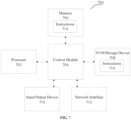
- FIG. 7 schematically illustrates an exemplary apparatus 700 that may be used to implement various embodiments described in the present application.
- FIG. 7 illustrates an exemplary apparatus 700 having one or more processors 702, a control module (a chipset) 704 coupled to at least one of (one or more) processors 702, a memory 706 coupled to control module 704, a non-volatile memory (NVM)/storage device 708 coupled to control module 704, one or more input/output devices 710 coupled to control module 704, and a network interface 712 coupled to control module 704.
- a control module a chipset
- NVM non-volatile memory
- FIG. 7 illustrates an exemplary apparatus 700 having one or more processors 702, a control module (a chipset) 704 coupled to at least one of (one or more) processors 702, a memory 706 coupled to control module 704, a non-volatile memory (NVM)/storage device 708 coupled to control module 704, one or more input/output devices 710 coupled to control module 704, and a network interface 712 coupled to control module 704.
- NVM non-volatile memory
- Processor 702 may comprise one or more single-core or multi-core processors, and processor 702 may comprise any combination of general-purpose processors or dedicated processors (e.g., a graphics processor, an application processor, a baseband processor, etc.). In some embodiments, apparatus 700 can serve as the server side, terminal or other devices described in the embodiments of the present application.
- apparatus 700 may comprise one or more computer-readable media (e.g., memory 706 or NVM/storage device 708) having instructions 714 and one or more processors 702 configured to execute instructions 714 in conjunction with the one or more computer-readable media to implement modules, thereby executing the actions described in the present disclosure.
- computer-readable media e.g., memory 706 or NVM/storage device 708
- processors 702 configured to execute instructions 714 in conjunction with the one or more computer-readable media to implement modules, thereby executing the actions described in the present disclosure.
- control module 704 may comprise any appropriate interface controller to provide any appropriate interface for at least one of (one or more) processors 702 and/or any appropriate device or component in communication with control module 704.
- Control module 704 may comprise a memory controller module to provide an interface for memory 706.
- the memory controller module may be a hardware module, a software module and/or a firmware module.
- Memory 706 may be used, for example, to load and store data and/or instructions 714 for apparatus 700.
- memory 706 may comprise any appropriate volatile memory, such as an appropriate DRAM.
- memory 706 may comprise a double data rate 4 synchronous dynamic random-access memory (DDR4SDRAM).
- DDR4SDRAM double data rate 4 synchronous dynamic random-access memory
- control module 704 may comprise one or more input/output controllers to provide interfaces to NVM/storage device 708 and (one or more) input/output devices 710.
- NVM/storage device 708 may be used to store data and/or instructions 714.
- NVM/storage device 708 may comprise any appropriate non-volatile memory (e.g., flash memory) and/or may comprise any appropriate (one or more) non-volatile storage devices (e.g., one or more hard disk drives (HDD), one or more compact disc (CD) drives and/or one or more digital versatile disc (DVD) drives).
- HDD hard disk drives
- CD compact disc
- DVD digital versatile disc
- NVM/storage device 708 may comprise storage resources as part of a device on which apparatus 700 is installed, or may be accessed by this device without necessarily being part of the device. For example, NVM/storage device 708 may be accessed over the network via (one or more) input/output devices 710.
- One or more input/output devices 710 may provide an interface for apparatus 700 to communicate with any other appropriate device, and may comprise a communication component, an audio component, a sensor component and the like.
- Network interface 712 may provide an interface for apparatus 700 to communicate over one or more networks, and apparatus 700 may wirelessly communicate with one or more components in a wireless network according to any standard and/or protocol of one or more wireless network standards and/or protocols, which, for example, accesses a wireless network based on communication standards, such as Bluetooth, WiFi, 2G, 3G, 4G, 5G, etc., or their combination for wireless communication.
- At least one of (one or more) processors 702 may be packaged together with logics of one or more controllers (e.g., a memory controller module) of control module 704.
- at least one of (one or more) processors 702 may be packaged together with logics of one or more controllers of control module 704 to form a system in package (SiP).
- at least one of (one or more) processors 702 may be integrated on the same model with logics of one or more controllers of control module 704.
- at least one of (one or more) processors 702 may be integrated on the same model with logics of one or more controllers of control module 704 to form a system on chip (SoC).
- SoC system on chip
- apparatus 700 may be, but is not limited to, a terminal device such as a server, a desktop computing device or a mobile computing device (e.g., a laptop computing device, a handheld computing device, a tablet computer, a netbook, etc.).
- apparatus 700 may have more or fewer components and/or a different architecture.
- apparatus 700 comprises one or more cameras, a keyboard, a liquid crystal display (LCD) screen (including a touch screen display), a non-volatile memory port, a plurality of antennas, a graphics chip, an application specific integrated circuit (ASIC) and a speaker.
- LCD liquid crystal display
- ASIC application specific integrated circuit
- a main control chip may be employed as a processor or control module in a detection device, sensor data, location information or the like are stored in the memory or NVM/storage device, a sensor group may be used as an input/output device, and a communication interface may comprise a network interface.
- An embodiment of the present application further provides an electronic device, comprising: a processor; and a memory with executable codes stored therein, the executable codes, when executed by the processor, causing the processor to execute the method described in one or more embodiments of the present application.
- various data may be stored in the memory, such as target files, file and application relevance data or other data, and may further comprise user behavior data, etc., thereby providing a data foundation for various processes.
- An embodiment of the present application further provides one or more machine-readable media with executable codes stored therein, the executable codes, when executed, cause a processor to execute the method described in one or more of the embodiments of the present application.
- These computer program instructions may also be stored in a computer-readable memory that can direct a computer or other programmable data processing terminal device to work in a particular manner, such that the instructions stored in this computer-readable memory produce an article of manufacture comprising an instruction apparatus, and this instruction apparatus implements functions specified in one or more processes in a flow chart and/or in one or more blocks in a block diagram.
- These computer program instructions may also be loaded onto a computer or other programmable data processing terminal device, such that a series of operating steps are performed on the computer or other programmable terminal device to produce computer-implemented processing, thereby making the instructions executed on the computer or other programmable terminal device provide steps for implementing functions specified in one or more processes in a flow chart and/or one or more blocks in a block diagram.
- relational terms herein such as first and second are merely used to distinguish one entity or operation from another entity or operation, and do not definitely require or imply that any such actual relation or order exists between these entities or operations.
- terms “comprise”, “include” or any other variants thereof are intended to cover a non-exclusive inclusion, such that a process, method, article, or terminal device comprising a series of elements not only comprises these elements, but also comprises other elements not expressly listed, or elements inherent to such process, method, article or terminal device.
- an element defined by the statement “comprising a" does not exclude the presence of additional identical elements in a process, method, article or terminal device that comprises the indicated element.
Landscapes
- Engineering & Computer Science (AREA)
- Theoretical Computer Science (AREA)
- Databases & Information Systems (AREA)
- Physics & Mathematics (AREA)
- General Engineering & Computer Science (AREA)
- General Physics & Mathematics (AREA)
- Computational Linguistics (AREA)
- Data Mining & Analysis (AREA)
- General Health & Medical Sciences (AREA)
- Health & Medical Sciences (AREA)
- Audiology, Speech & Language Pathology (AREA)
- Artificial Intelligence (AREA)
- Mathematical Physics (AREA)
- Information Retrieval, Db Structures And Fs Structures Therefor (AREA)
Applications Claiming Priority (1)
| Application Number | Priority Date | Filing Date | Title |
|---|---|---|---|
| CN202310273185.2A CN116467507A (zh) | 2023-03-17 | 2023-03-17 | 一种搜索提示方法、设备和介质 |
Publications (1)
| Publication Number | Publication Date |
|---|---|
| EP4432132A1 true EP4432132A1 (fr) | 2024-09-18 |
Family
ID=87183318
Family Applications (1)
| Application Number | Title | Priority Date | Filing Date |
|---|---|---|---|
| EP24163720.6A Pending EP4432132A1 (fr) | 2023-03-17 | 2024-03-15 | Procédé, dispositif et support d'invite de recherche |
Country Status (3)
| Country | Link |
|---|---|
| US (1) | US20240311408A1 (fr) |
| EP (1) | EP4432132A1 (fr) |
| CN (1) | CN116467507A (fr) |
Families Citing this family (2)
| Publication number | Priority date | Publication date | Assignee | Title |
|---|---|---|---|---|
| CN117112629B (zh) * | 2023-09-14 | 2025-11-04 | 东航技术应用研发中心有限公司 | 一种民航放行信息智能搜索方法、系统及设备 |
| CN117271893A (zh) * | 2023-09-21 | 2023-12-22 | 北京字跳网络技术有限公司 | 一种搜索推荐方法、装置、电子设备及存储介质 |
Citations (2)
| Publication number | Priority date | Publication date | Assignee | Title |
|---|---|---|---|---|
| WO2012037726A1 (fr) * | 2010-09-21 | 2012-03-29 | Google Inc. | Génération de suggestions d'interrogation de recherche |
| US20120330919A1 (en) * | 2011-06-24 | 2012-12-27 | Google Inc. | Determining cross-language query suggestion based on query translations |
Family Cites Families (4)
| Publication number | Priority date | Publication date | Assignee | Title |
|---|---|---|---|---|
| CN1685341B (zh) * | 2002-09-30 | 2014-09-10 | 开拧系统公司 | 跨语言搜索结果的闪烁注释标注加亮 |
| JP6242226B2 (ja) * | 2014-02-04 | 2017-12-06 | 有限会社ティ辞書企画 | 検索装置、検索方法、及びプログラム |
| CN108846037B (zh) * | 2018-05-29 | 2021-12-10 | 天津字节跳动科技有限公司 | 提示搜索词的方法和装置 |
| CN115718821A (zh) * | 2022-11-29 | 2023-02-28 | 达观数据(苏州)有限公司 | 一种搜索排序模型生成方法、排序展示方法、装置及设备 |
-
2023
- 2023-03-17 CN CN202310273185.2A patent/CN116467507A/zh active Pending
-
2024
- 2024-03-15 US US18/606,139 patent/US20240311408A1/en active Pending
- 2024-03-15 EP EP24163720.6A patent/EP4432132A1/fr active Pending
Patent Citations (2)
| Publication number | Priority date | Publication date | Assignee | Title |
|---|---|---|---|---|
| WO2012037726A1 (fr) * | 2010-09-21 | 2012-03-29 | Google Inc. | Génération de suggestions d'interrogation de recherche |
| US20120330919A1 (en) * | 2011-06-24 | 2012-12-27 | Google Inc. | Determining cross-language query suggestion based on query translations |
Also Published As
| Publication number | Publication date |
|---|---|
| CN116467507A (zh) | 2023-07-21 |
| US20240311408A1 (en) | 2024-09-19 |
Similar Documents
| Publication | Publication Date | Title |
|---|---|---|
| US11055374B2 (en) | Method and device for information retrieval, device and computer readable storage medium | |
| US11182445B2 (en) | Method, apparatus, server, and storage medium for recalling for search | |
| US10789309B1 (en) | Associating an entity with a search query | |
| CN109190049B (zh) | 关键词推荐方法、系统、电子设备和计算机可读介质 | |
| US10489399B2 (en) | Query language identification | |
| US20220083874A1 (en) | Method and device for training search model, method for searching for target object, and storage medium | |
| US20140019460A1 (en) | Targeted search suggestions | |
| CN104428769B (zh) | 提供文本阅读器的信息 | |
| US20240311408A1 (en) | Search prompt method, device, and medium | |
| WO2019091026A1 (fr) | Procédé de recherche rapide de document dans une base de connaissances, serveur d'application, et support d'informations lisible par ordinateur | |
| US20150278359A1 (en) | Method and apparatus for generating a recommendation page | |
| CN106649786A (zh) | 基于深度问答的答案检索方法及装置 | |
| CN117112595B (zh) | 一种信息查询方法、装置、电子设备及存储介质 | |
| US11379527B2 (en) | Sibling search queries | |
| WO2014040521A1 (fr) | Procédé de recherche, système et support de stockage | |
| CN114372122A (zh) | 信息的获取方法、计算设备及存储介质 | |
| CN107330057B (zh) | 一种ElasticSearch搜索相关度算法优化方法及系统 | |
| US20240004909A1 (en) | Information processing apparatus, information processing method, and non-transitory computer readable medium | |
| US20250181620A1 (en) | Fine-grained attribution for document question answering | |
| US9152698B1 (en) | Substitute term identification based on over-represented terms identification | |
| US20260093779A1 (en) | Method of retrieving data, method of training deep learning model, electronic device and storage medium | |
| CN117909560A (zh) | 搜索方法、模型的训练方法、装置、设备、介质及程序产品 | |
| CN111723291B (zh) | 选取搜索意图词组的方法和装置 | |
| CN116975083A (zh) | 信息搜索方法、装置、计算机设备和存储介质 | |
| HK40100898A (zh) | 一种搜索提示方法、设备和介质 |
Legal Events
| Date | Code | Title | Description |
|---|---|---|---|
| PUAI | Public reference made under article 153(3) epc to a published international application that has entered the european phase |
Free format text: ORIGINAL CODE: 0009012 |
|
| STAA | Information on the status of an ep patent application or granted ep patent |
Free format text: STATUS: THE APPLICATION HAS BEEN PUBLISHED |
|
| AK | Designated contracting states |
Kind code of ref document: A1 Designated state(s): AL AT BE BG CH CY CZ DE DK EE ES FI FR GB GR HR HU IE IS IT LI LT LU LV MC ME MK MT NL NO PL PT RO RS SE SI SK SM TR |
|
| P01 | Opt-out of the competence of the unified patent court (upc) registered |
Free format text: CASE NUMBER: APP_1421/2025 Effective date: 20250109 |
|
| STAA | Information on the status of an ep patent application or granted ep patent |
Free format text: STATUS: REQUEST FOR EXAMINATION WAS MADE |
|
| 17P | Request for examination filed |
Effective date: 20250305 |