EP4432145A1 - Gesicherter zugriff auf eine vertrauenswürdige umgebung eines computers - Google Patents
Gesicherter zugriff auf eine vertrauenswürdige umgebung eines computers Download PDFInfo
- Publication number
- EP4432145A1 EP4432145A1 EP23305341.2A EP23305341A EP4432145A1 EP 4432145 A1 EP4432145 A1 EP 4432145A1 EP 23305341 A EP23305341 A EP 23305341A EP 4432145 A1 EP4432145 A1 EP 4432145A1
- Authority
- EP
- European Patent Office
- Prior art keywords
- tos
- gpos
- authentication
- certificate
- current application
- Prior art date
- Legal status (The legal status is an assumption and is not a legal conclusion. Google has not performed a legal analysis and makes no representation as to the accuracy of the status listed.)
- Pending
Links
Images


Classifications
-
- G—PHYSICS
- G06—COMPUTING OR CALCULATING; COUNTING
- G06F—ELECTRIC DIGITAL DATA PROCESSING
- G06F21/00—Security arrangements for protecting computers, components thereof, programs or data against unauthorised activity
- G06F21/50—Monitoring users, programs or devices to maintain the integrity of platforms, e.g. of processors, firmware or operating systems
- G06F21/51—Monitoring users, programs or devices to maintain the integrity of platforms, e.g. of processors, firmware or operating systems at application loading time, e.g. accepting, rejecting, starting or inhibiting executable software based on integrity or source reliability
-
- G—PHYSICS
- G06—COMPUTING OR CALCULATING; COUNTING
- G06F—ELECTRIC DIGITAL DATA PROCESSING
- G06F21/00—Security arrangements for protecting computers, components thereof, programs or data against unauthorised activity
- G06F21/50—Monitoring users, programs or devices to maintain the integrity of platforms, e.g. of processors, firmware or operating systems
- G06F21/52—Monitoring users, programs or devices to maintain the integrity of platforms, e.g. of processors, firmware or operating systems during program execution, e.g. stack integrity ; Preventing unwanted data erasure; Buffer overflow
- G06F21/53—Monitoring users, programs or devices to maintain the integrity of platforms, e.g. of processors, firmware or operating systems during program execution, e.g. stack integrity ; Preventing unwanted data erasure; Buffer overflow by executing in a restricted environment, e.g. sandbox or secure virtual machine
-
- G—PHYSICS
- G06—COMPUTING OR CALCULATING; COUNTING
- G06F—ELECTRIC DIGITAL DATA PROCESSING
- G06F21/00—Security arrangements for protecting computers, components thereof, programs or data against unauthorised activity
- G06F21/50—Monitoring users, programs or devices to maintain the integrity of platforms, e.g. of processors, firmware or operating systems
- G06F21/57—Certifying or maintaining trusted computer platforms, e.g. secure boots or power-downs, version controls, system software checks, secure updates or assessing vulnerabilities
Definitions
- the present description relates to secured interactions between processors in computer technique.
- MPU microprocessor unit
- Modern MPU provides several executing cores, each of which reads and executes program instructions, as if the computer had several processors.
- Cores may or may not share caches, and they may implement message passing or shared-memory inter-core communication methods.
- each core has a level L1 cache, but they share level L2 cache.
- Homogeneous multi-core systems include only identical cores; heterogeneous multi-core systems have cores that are not identical.
- a specific Interrupt Controller (called Global Interrupt Controller in ARM ⁇ processors) is required to provides interrupt routing between cores, as well as Inter-processor interrupts.
- RAM Random Access Memory
- device peripherals such as “UART” (for “Universal Asynchronous Receiver Transmitter”), and/or network interface) are shared between the different cores of the Central Processing Unit (CPU). Because of that, some memory or device bottleneck may occur when several cores are accessing the same resource simultaneously.
- TEE Trusted Execution Environment
- ARM processors with TrustZone implement architectural Security Extensions in which each of the physical processor cores provides two virtual cores:
- the world in which the processor is currently running can be determined by the Non-Secure bit available in the Hardware Secure Configuration Register.
- the mechanisms by which the physical processor can enter monitor mode from the Non-Secure World can be triggered by executing a dedicated instruction named "Secure Monitor Call” (SMC) and it could be seen as an exception to the monitor mode software.
- SMC Secure Monitor Call
- main memory is also flagged with the Non-Secure bit, allowing memory isolation between Secure and Non-Secure worlds.
- Intel Software Guard Extensions offers hardware-based memory encryption that isolates specific application code and data in memory.
- SGX allows user-level code to allocate private regions of memory, called enclaves, which are designed to be protected from processes running at higher privilege levels.
- a Trusted Execution Environment is an isolated execution environment that provides security features such as isolated execution, integrity of applications executing within the TEE, along with confidentiality of their assets.
- the TEE offers an execution space that runs in parallel of the normal operating system and provides a higher level of security for trusted applications running on the device.
- the aforesaid "normal" operating system can correspond to a rich operating environment (labelled “REE” hereafter) or to a Generic Purpose Operating System.
- Trusted applications running in a TEE have access to the full power of a device's main processor and memory, whereas hardware isolation protects these components from user installed applications running in the main operating system.
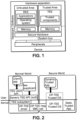
- Software and cryptographic isolations inside the TEE protect the different contained trusted applications from each other. This architecture is shown on figure 1 .
- a TEE kernel driver handles the details needed to communicate with the TEE.
- OP-TEE Open Portable TEE
- SMCCC ARM SMC Calling Convention
- the kernel TEE subsystem deals with:
- TEE applications and components rely on an internal API called TEE Internal Core API whereas the TEE Client API is the API describing how to communicate with a TEE from a Client application running in the REE.
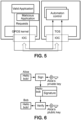
- the API makes usage of a generic TEE API that accesses the kernel driver using standard POSIX communication methods (IEEE 1003) relying on file descriptor and ioctl ("input-output control") as shown in the figure 2 .
- Hybrid software architecture relies on a dual-OS monitor (same role as the hypervisor in software virtualization) designed to concurrently execute a TOS or BareMetal (BM) application, and a GPOS (General-Purpose Operating System) on the same core.
- Hybrid software architecture takes advantage of the ARM TrustZone security extensions to run each OS in a different Security state.
- Hybrid software The main features of Hybrid software are:
- the monitor code is shared by all cores but except during initialization, the execution of the monitor is independent of the core.
- System calls and notifiers are always executed in the same core where they are triggered.
- memory regions and peripherals have access rights so that it is possible to define some private area and peripherals managed exclusively by each OS.
- GPOS non-secured part
- a shared memory is available that can host FIFOs, data structures that are used to implement some communication mechanisms. Some hardware mechanisms such as interrupts can also be used to notify events from one OS to another.
- a first OS running in the non-trusted/non-secured part such as a Rich Execution Environment or Generic Purpose OS
- a second OS running in the Trusted Execution Environment (TEE) such as a TOS.
- TEE Trusted Execution Environment
- the OS running in the trusted part may offer some critical and secure services to the OS running in non-secure part through primitive define over the communication path opened between non-trusted and trusted OSs called hereafter "Inter-OS-Communication” (or “IOC”).
- IOC Inter-OS-Communication
- the trusted OS may provide primitives and services in charge of controlling the state of the running automates (start/stop/pause).
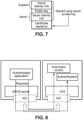
- the non-trusted OS may be corrupted, and one attacker may run some applications that tries to execute malicious requests (see figure 5 ) using critical primitives.
- an attacker may mimic a certified application such as the Guide User Interface (GUI) application in charge of stopping/starting automaton, and send requests with bad parameters, forcing the Trusted OS to execute bad requests as it is illustrated in the figure 5 .
- GUI Guide User Interface
- the application can send requests to the TOS service by using a specific file descriptor associated to IOC device driver.
- the GPOS kernel transfers such requests by using this IOC device driver that is in charge of managing the IOC (software) interface.
- a solution to solve this issue can consist in adding into the GPOS some mechanisms for supporting access control security policies, including mandatory access controls at kernel and user-space level. For instance, SELinux is a set of kernel modifications and user-space tools that have been added to various Linux distributions.
- SELinux can potentially control which activities a system allows each user, process, and daemon, with very precise specifications. It is used to confine daemons such as database engines or web servers that have clearly defined data access and activity rights. This limits potential harm from a confined daemon that becomes compromised.
- SELinux does not protect access to some specific resources when the system is highly compromised, meaning the attacker has acquired the higher level of privileges and may access any file descriptors defined in the GPOS, in particular those used to send requests to the Trusted OS.
- the present description aims to improve the situation.
- the method comprises:
- a computer program of said current application can comprise at least one instruction, the execution of which by the GPOS launches said at least one primitive requesting access to the TOS.
- only authenticated applications can be executed by a computer having such a hybrid architecture secured according to the present description.
- a system call upon request by said at least one primitive to access to the TOS, launches a specific authentication primitive (an "IOC" primitive as detailed below), causing the GPOS to implement the authentication procedure.
- a specific authentication primitive an "IOC” primitive as detailed below
- the GPOS can be programmed to generate such a system call launching the authentication primitive as any primitive requests access to the TOS during the execution of the current application.
- the launching of the aforesaid specific authentication primitive generates a request from the GPOS to access to the TOS with authentication parameters to be validated by the TOS.
- the GPOS when the GPOS requires to the TOS said authentication validation, the GPOS provides to the TOS authentication parameters comprising at least a first set of certificate data, and the authentication procedure comprises a verification performed by the TOS of said first set of certificate data provided by the GPOS against a second set of certificate data previously stored by the TOS.
- the first set of certificate data can comprise data of a customer certificate
- the second set of certificate data can comprise data of a root authority certificate as a trusted certificate, stored in a secured memory accessible only by the TOS. This storing can be performed during an initialization step of configuring the TOS.
- This initialization step can typically correspond to an installation of the TOS, or to an update of a pre-existing TOS with authentication data.
- an application digest is calculated by the GPOS in a preamble step of installation of the current application, and a digital signature of a binary code of the current application is generated using the application digest and a private key associated with a public key the data of which are among said first set of certificate data.
- This application digest (such as a hash for example) and the digital signature are calculated so as to be sure for the TOS that the primitives requesting access are launched from the execution of a correct application. Moreover, these data are to be signed with a correct key, otherwise the TOS refuses the access request.
- the aforesaid specific authentication primitive launches, before the execution of each current instance of the current application, a request to access to the TOS with said generated signature and said first set of certificate data.
- a kernel module of the GPOS processes then the request by:
- the aforesaid kernel module can be seen as a program loaded into the GPOS kernel, acting as a driver to communicate with the TOS.
- the TOS upon reception of the message, the TOS proceeds to an authentication by:
- the GPOS kernel module stores said authentication state in association with the PID of the current application instance, so as to filter requests initiated by one or several primitives of said current application, based on said authentication state.
- each primitive requesting access to the TOS is filtered at one of the IOC interfaces, by the TOS using said PID for each current application instance, so as to avoid possible attacks from the GPOS kernel module.
- IOC Inter-OS-Communication
- the TOS can return a single token per current application instance, as the result of the authentication request, said token having a value defined by said authentication state, so as to avoid a fraudulent reuse of said token for other current application instances.
- the present description aims also at a computer program comprising instructions causing the implementation of the method according to anyone of the precedent claims, when said instructions are executed by a processing unit.
- the computer program can comprise instructions that can be shared between:
- the present description also aims at a current application's computer program, comprising at least one instruction which is executed when said current application's computer program is run, and the execution of which by the GPOS launches at least one primitive requesting access to the TOS, causing thereby the implementation of the authentication procedure of the method presented above.
- this instruction can be executed once the current application is launched (i.e. as soon as its program starts its run).
- the aforesaid current application can correspond to an authenticated application which is therefore entitled to be executed by a computer having the hybrid architecture secured according to the present description.
- the present description aims also at a computer device, comprising a processing unit to implement the method as defined above (and corresponding thereby to the aforesaid computer having the hybrid architecture secured according to the present description).
- the method authenticates applications that can issue requests to the Trusted OS and filters accesses depending on the calling application, the type of requests, and the result of authentication.
- the second embodiment can be considered as an extension of the first embodiment, allowing a stronger security because it relies exclusively on mechanisms running within the Trusted OS perimeter.
- the authentication process makes usage of cryptography mechanisms: digital signage using asymmetric cryptography, chain of public key certificate, Public Key Infrastructure for key distribution/revocation. These principles are applied here to a computer system running over hybrid software architecture. Contrarily to existing solutions, the method does not require any modifications of the GPOS file system. Only the application must be designed specifically to support the proposed authentication mechanisms, and some specific steps are to be implemented when the application is deployed over the running environment.
- a digital signature is a mathematical scheme for verifying the authenticity of digital messages or documents.
- a valid digital signature where the prerequisites are satisfied, gives a recipient very high confidence that the message was created by a known sender (authenticity), and that the message was not altered in transit (integrity).
- the message is digitally signed with Alice's private key, but the message itself is not encrypted.
- Alice signs a message with her private key.
- Bob can verify that Alice sent the message and that the message has not been modified.
- a public key certificate also known as a digital certificate or identity certificate, is an electronic document used to prove the validity of a public key.
- the certificate includes information about the key, information about the identity of its owner (called the "subject"), and the digital signature of an entity that has verified the certificate's contents (called the "issuer"). If the signature is valid, and the software examining the certificate trusts the issuer, then it can use that key to communicate securely with the certificate's subject.
- the signature is generated by hashing the content of the certificate and then the hash is encrypted with the issuer's private key. Hashing and encryption algorithm types are usually indicated within the certificate.
- a certificate issuer is a certificate authority (CA), usually a trusted third-party company that charges customers to issue certificates for them.
- CA certificate authority
- a self-signed certificate is a certificate with a subject that matches its issuer, and a signature that can be verified by its own public key. So, the signature of a self-signed certificate is generated using the private key corresponding to the public key embedded into the certificate.
- Normal primitives can be called without any valid application authentication while secured primitives require a valid authentication. It means that an application, just after opening an IOC session after a start-up, must initiate an authentication procedure.
- This authentication procedure relies on IOC primitives of the normal group. It requires a specific TOS task (in the Trusted part) that is in charge of validating the authentication process as illustrated in figure 8 .
- the application executable binary is signed as described in detail below.
- the authentication procedure implies the signature of an application digest only, that is priorly calculated over the full application binary code. This process allows to reduce the amount of data exchanged over the IOC interface and so improve efficiency.
- This method requires a certificate of a user called hereafter "customer certificate” (of a natural person or a client application) that can be either generated by the customer itself or by a trusted third party called Certificate Authority (CA) when a PKI is used.
- CA Certificate Authority
- the validity checking of this customer certificate must be done by the Trusted OS (TOS).
- This operation uses a Trusted certificate that can be either a self-generated certificate, a CA root or intermediate certificate that are stored securely in a memory accessible only for the Trusted OS in order to not be corrupted (typically in the memory presented in the right part of figure 1 in the Trusted Area).
- a Trusted certificate that can be either a self-generated certificate, a CA root or intermediate certificate that are stored securely in a memory accessible only for the Trusted OS in order to not be corrupted (typically in the memory presented in the right part of figure 1 in the Trusted Area).
- This API uses file descriptor at user-space level and generates a system call ("syscall") to the kernel (such as a Linux kernel for the analogy with POSIX ioctl).
- This API defines IOC primitives to support request execution and also to authenticate the application that is using the API.
- the first embodiment is detailed hereafter.
- the GPOS kernel cannot be corrupted by an attacker. Only the filesystem is fully accessible thanks to high privilege access and consequently the attacker may access the user-space resource (e.g. file descriptor) associated to the IOC interface. Therefore, it can be assumed the kernel-level IOC driver is safe and cannot be corrupted (or at least an attack can be detected). Thus, an attacker cannot inject data/modify code within the code part.
- the kernel-level IOC driver is safe and cannot be corrupted (or at least an attack can be detected).
- the method comprises the following steps when a current application is intended to be executed in the hybrid architecture:
- This step #2 is performed each time the current application starts a session (in practice, at the current application start-up).
- This specific authentication primitive (ICO) generates a request that takes the current application signature and customer certificate as parameters.
- the IOC kernel module is in charge of processing the system call and executes the following operations:
- Step #3 Upon reception of this message, the TOS IOC authentication task will:
- the IOC kernel module stores this returned authentication state in the kernel context associated with the PID of the instance of the current application. Then, it notifies the instance about a success or a failure of the authentication request.
- Step #4 The instance of the current application executes one or more primitives classified as secured.
- the GPOS kernel prior to forwarding the content of a request from a secured primitive to the TOS in step#5, filters this request by checking said authentication state associated with the PID of the current instance.
- Step#5 The GPOS kernel forwards the secured request (when not filtered) to the TOS, to go on with the execution of the current application.
- the method according to a second embodiment remains similar to the first embodiment presented above, except that the GPOS kernel module is not in charge of filtering incoming requests issued by the application, once the authentication state has been determined by the TOS for the current instance of the application (after steps #2 and #3).
- the Trusted OS (TOS) is fully in charge of filtering directly the requests from primitives to access to the TOS.
- the message IOC_IOCTL_CMD_AUTH and the primitive IOC_ CtrlReq_AppAuth return now an authentication token directly to the current instance of the application if the authentication state is "success". If the authentication state is "failure", a "null" token (which is an invalid token) is returned. To that end, the token value associated to the PID of the current application instance is stored in the TOS memory.
- the token value is then used as an additional parameter to every further request of a secured primitive (named IOC_Ctrl_Req_SecXXX ) by the application, in step #4.
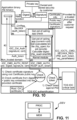
- the kernel module passes this authentication token and also the PID of the current application instance as arguments of any IOC_IOCTL_CMD_SECXXX message over the IOC interface, in step #5. Then, for each request from a secured primitive, the TOS checks the validity of the token before executing the carried request in step #6 shown on figure 10 .
- the TOS can compare the token value stored in its secured memory to the token value presented in the message. The TOS can therefore discard typically a request from a secured primitive presented in a message having an invalid token in its arguments.
- the invalid token can be a "null" token as explained above (because the authentication failed) or any other invalid token, for example a token value previously used (e.g. for a previous instance) so as to avoid a replay attack. Those additional steps require few computing and memory resource on the TOS side but completely secures the filtering step.
- the PID is passed to the TOS by the kernel module so that it prevents from PID hijacking attack.
- a malicious application robs a valid token to an application that succeeds authentication step.
- the PID is determined by the kernel code so it is important the kernel binary code is not altered, or at least any alteration can be detected by the TOS by doing periodic code checking.
- the kernel module in this second embodiment does not store any critical data in the private context associated with the file descriptor passed in the driver calling functions. Therefore, an attacker cannot modify the value of the variable by mapping kernel memory into the user space, and thus allowing the execution of request that requires application authentication.
- the customer can generate by itself a private/public key pair.
- Private key must be stored securely (not on the platform typically) and is used to sign the application runtime binary.
- the public key is embedded into a self-signed certificate. This certificate is stored into the Trusted domain (TOS) and the embedded public key will be used to check signature.
- TOS Trusted domain
- the customer can generate a private/public key pair, but the private key is stored securely by the customer and is used to sign the application runtime binary.
- a Root Certification Authority (CA) certificate is stored securely in the Trusted domain (TOS).
- the aforesaid Certification Authority may be the manufacturer (i.e. the provider of the authentication means) or any trusted third-party company.
- the customer can send the public key to the issuer (CA) that will generate the customer certificate containing:
- some Intermediate certificates can be generated by the CA.
- Signature of the customer certificate can be generated by using the private key associated to one of the Intermediate certificates.
- Intermediate certificates shall be uploaded to the TOS using a specific ICC IOTCL command. After upload, the TOS checks the validity of the provided certificate compared to the stored root CA certificate. Benefit of this method is mainly for the CA avoiding a frequent use of the root CA and limiting thereby its exposition to a potential attacker. It is also more flexible, in particular when some certificates must be revoked.
- a certificate revocation list can be associated to each stored certificate.
- CRL can be stored as a list of digital certificates that have been revoked by the issuing CA before their scheduled expiration date and should no longer be trusted.
- CRL can be stored by TOS and shall be updated using a specific ICC IOTCL command. To avoid an attacker to send the list CRL and induce a deny of service because of fake certificate, primitives related to certificate management must be classified in the Secure group.
- a computer program having an algorithm following the steps of the method presented as possible embodiments above, can be deployed in any type of products using an embedded platform running a main Operating System with a Trusted Execution Environment executing secure operation and requests issued by application running over said main OS.
- the hybrid software architecture consisting of running a Generic Purpose OS as main OS, and a TOS as a Trusted OS is a specific case of this overall architecture.
- the method can therefore be implemented by next-generation devices of Industrial Controllers such as PLC (programmable logic controller) or any IC communication devices. They shall be connected on a single physical bus mixed with other telecommunication devices that may be corrupted and controlled by some attacker.
- PLC programmable logic controller
- the implementation of the method is then very useful since it provides security solutions to protect access to critical functions of IC devices.
- FIG 11 shows schematically a computer device DEV according to an embodiment of the present specification, comprising a processing unit to implement the method described above.
- the processing unit can comprise a processor PROC and a memory MEM storing at least instructions of a computer program according to the present description.
- This computer program can correspond to low-level layer programs of a GPOS and a TOS according to a secured hybrid architecture.
- the processor PROC can cooperate with the memory MEM to read the instructions and implement consequently the method described above, when a current application is launched by the computer device DEV.
Landscapes
- Engineering & Computer Science (AREA)
- Computer Security & Cryptography (AREA)
- Software Systems (AREA)
- Theoretical Computer Science (AREA)
- Computer Hardware Design (AREA)
- General Engineering & Computer Science (AREA)
- Physics & Mathematics (AREA)
- General Physics & Mathematics (AREA)
- Storage Device Security (AREA)
Priority Applications (4)
| Application Number | Priority Date | Filing Date | Title |
|---|---|---|---|
| EP23305341.2A EP4432145A1 (de) | 2023-03-14 | 2023-03-14 | Gesicherter zugriff auf eine vertrauenswürdige umgebung eines computers |
| JP2025545307A JP2025534136A (ja) | 2023-03-14 | 2023-08-22 | コンピューターにおけるデータ処理をセキュアにする方法、コンピュータープログラム及びコンピューターデバイス |
| PCT/JP2023/030839 WO2024189940A1 (en) | 2023-03-14 | 2023-08-22 | Method to secure data processing in computer, computer program and computer device |
| CN202380095657.8A CN120883206A (zh) | 2023-03-14 | 2023-08-22 | 保护计算机中的数据处理的方法、计算机程序和计算机装置 |
Applications Claiming Priority (1)
| Application Number | Priority Date | Filing Date | Title |
|---|---|---|---|
| EP23305341.2A EP4432145A1 (de) | 2023-03-14 | 2023-03-14 | Gesicherter zugriff auf eine vertrauenswürdige umgebung eines computers |
Publications (1)
| Publication Number | Publication Date |
|---|---|
| EP4432145A1 true EP4432145A1 (de) | 2024-09-18 |
Family
ID=86692803
Family Applications (1)
| Application Number | Title | Priority Date | Filing Date |
|---|---|---|---|
| EP23305341.2A Pending EP4432145A1 (de) | 2023-03-14 | 2023-03-14 | Gesicherter zugriff auf eine vertrauenswürdige umgebung eines computers |
Country Status (4)
| Country | Link |
|---|---|
| EP (1) | EP4432145A1 (de) |
| JP (1) | JP2025534136A (de) |
| CN (1) | CN120883206A (de) |
| WO (1) | WO2024189940A1 (de) |
Cited By (1)
| Publication number | Priority date | Publication date | Assignee | Title |
|---|---|---|---|---|
| US20250247247A1 (en) * | 2024-01-31 | 2025-07-31 | Salesforce, Inc. | Securing secrets in software build workflows involving modular build code |
Citations (3)
| Publication number | Priority date | Publication date | Assignee | Title |
|---|---|---|---|---|
| US20200175208A1 (en) * | 2018-11-30 | 2020-06-04 | BicDroid Inc. | Personalized and cryptographically secure access control in operating systems |
| EP3686762A1 (de) * | 2018-05-25 | 2020-07-29 | Huawei Technologies Co. Ltd. | Auf mehreren behältern basiertes vertrauenswürdiges anwendungsverarbeitungsverfahren und zugehörige vorrichtung |
| EP3872634A1 (de) | 2020-02-27 | 2021-09-01 | Mitsubishi Electric R&D Centre Europe B.V. | Mehrkern system on chip architektur |
-
2023
- 2023-03-14 EP EP23305341.2A patent/EP4432145A1/de active Pending
- 2023-08-22 CN CN202380095657.8A patent/CN120883206A/zh active Pending
- 2023-08-22 WO PCT/JP2023/030839 patent/WO2024189940A1/en not_active Ceased
- 2023-08-22 JP JP2025545307A patent/JP2025534136A/ja active Pending
Patent Citations (3)
| Publication number | Priority date | Publication date | Assignee | Title |
|---|---|---|---|---|
| EP3686762A1 (de) * | 2018-05-25 | 2020-07-29 | Huawei Technologies Co. Ltd. | Auf mehreren behältern basiertes vertrauenswürdiges anwendungsverarbeitungsverfahren und zugehörige vorrichtung |
| US20200175208A1 (en) * | 2018-11-30 | 2020-06-04 | BicDroid Inc. | Personalized and cryptographically secure access control in operating systems |
| EP3872634A1 (de) | 2020-02-27 | 2021-09-01 | Mitsubishi Electric R&D Centre Europe B.V. | Mehrkern system on chip architektur |
Non-Patent Citations (1)
| Title |
|---|
| ARFAOUI GHADA ET AL: "Trusted Execution Environments: A Look under the Hood", 2014 2ND IEEE INTERNATIONAL CONFERENCE ON MOBILE CLOUD COMPUTING, SERVICES, AND ENGINEERING, IEEE, 8 April 2014 (2014-04-08), pages 259 - 266, XP032605934, DOI: 10.1109/MOBILECLOUD.2014.47 * |
Cited By (1)
| Publication number | Priority date | Publication date | Assignee | Title |
|---|---|---|---|---|
| US20250247247A1 (en) * | 2024-01-31 | 2025-07-31 | Salesforce, Inc. | Securing secrets in software build workflows involving modular build code |
Also Published As
| Publication number | Publication date |
|---|---|
| WO2024189940A1 (en) | 2024-09-19 |
| CN120883206A (zh) | 2025-10-31 |
| JP2025534136A (ja) | 2025-10-09 |
Similar Documents
| Publication | Publication Date | Title |
|---|---|---|
| US11575672B2 (en) | Secure accelerator device pairing for trusted accelerator-to-accelerator communication | |
| US7739731B2 (en) | Method and apparatus for protection domain based security | |
| US8171295B2 (en) | Information processing apparatus, a server apparatus, a method of an information processing apparatus, a method of a server apparatus, and an apparatus executable process | |
| US9230129B1 (en) | Software trusted computing base | |
| US8826391B2 (en) | Virtualized trusted descriptors | |
| CN101006433B (zh) | 信息通信装置和程序执行环境控制方法 | |
| CN102063592B (zh) | 一种可信平台及其对硬件设备的控制方法 | |
| US12072990B2 (en) | Multiple physical request interfaces for security processors | |
| CN110348204B (zh) | 一种代码保护系统、认证方法、装置、芯片及电子设备 | |
| CN116490868A (zh) | 用于可信执行环境中的安全快速机器学习推理的系统和方法 | |
| KR20090067154A (ko) | 신뢰 상태를 확인하는 데 사용되는 휴대용 장치 | |
| CN114448648B (zh) | 基于rpa的敏感凭据管理方法及系统 | |
| EP2936761B1 (de) | Verfahren zur aktivierung eines clients zwecks bereitstellung einer servereinheit | |
| EP4432145A1 (de) | Gesicherter zugriff auf eine vertrauenswürdige umgebung eines computers | |
| Condé et al. | Using Intel SGX to protect authentication credentials in an untrusted operating system | |
| CN103347073B (zh) | 一种云管理行为安全控制方法和系统 | |
| Wruck et al. | HETCOM: Heterogeneous Container Migration Based on TEE-or TPM-established Trust | |
| EP4506842B1 (de) | Verfahren zur durchführung eines verifizierten starts einer virtuellen maschine | |
| US20250225259A1 (en) | Methods for Executing a Workload (APP) in an Execution Environment and System | |
| Kostiainen et al. | Key attestation from trusted execution environments | |
| CN202177903U (zh) | 一种具有控制功能的可信平台 | |
| Cheng et al. | CrossGuardian: A security domain isolation model for cross-chain gateway | |
| Bruno | Design and Implementation of Trusted Channels in the Keystone Framework | |
| CN120729593A (zh) | 一种软计算环境下的密码资源分发与受控使用系统 | |
| CN121934949A (zh) | 一种基于kvm和qemu的金融终端系统和支付方法 |
Legal Events
| Date | Code | Title | Description |
|---|---|---|---|
| PUAI | Public reference made under article 153(3) epc to a published international application that has entered the european phase |
Free format text: ORIGINAL CODE: 0009012 |
|
| STAA | Information on the status of an ep patent application or granted ep patent |
Free format text: STATUS: THE APPLICATION HAS BEEN PUBLISHED |
|
| AK | Designated contracting states |
Kind code of ref document: A1 Designated state(s): AL AT BE BG CH CY CZ DE DK EE ES FI FR GB GR HR HU IE IS IT LI LT LU LV MC ME MK MT NL NO PL PT RO RS SE SI SK SM TR |
|
| STAA | Information on the status of an ep patent application or granted ep patent |
Free format text: STATUS: REQUEST FOR EXAMINATION WAS MADE |
|
| 17P | Request for examination filed |
Effective date: 20241024 |
|
| RBV | Designated contracting states (corrected) |
Designated state(s): AL AT BE BG CH CY CZ DE DK EE ES FI FR GB GR HR HU IE IS IT LI LT LU LV MC ME MK MT NL NO PL PT RO RS SE SI SK SM TR |