EP4432162A1 - Frühkommende neuronale netze zur radarverarbeitung - Google Patents
Frühkommende neuronale netze zur radarverarbeitung Download PDFInfo
- Publication number
- EP4432162A1 EP4432162A1 EP23161484.3A EP23161484A EP4432162A1 EP 4432162 A1 EP4432162 A1 EP 4432162A1 EP 23161484 A EP23161484 A EP 23161484A EP 4432162 A1 EP4432162 A1 EP 4432162A1
- Authority
- EP
- European Patent Office
- Prior art keywords
- early
- exit
- estimate
- input
- processing
- Prior art date
- Legal status (The legal status is an assumption and is not a legal conclusion. Google has not performed a legal analysis and makes no representation as to the accuracy of the status listed.)
- Pending
Links
Images






Classifications
-
- G—PHYSICS
- G01—MEASURING; TESTING
- G01S—RADIO DIRECTION-FINDING; RADIO NAVIGATION; DETERMINING DISTANCE OR VELOCITY BY USE OF RADIO WAVES; LOCATING OR PRESENCE-DETECTING BY USE OF THE REFLECTION OR RERADIATION OF RADIO WAVES; ANALOGOUS ARRANGEMENTS USING OTHER WAVES
- G01S7/00—Details of systems according to groups G01S13/00, G01S15/00, G01S17/00
- G01S7/02—Details of systems according to groups G01S13/00, G01S15/00, G01S17/00 of systems according to group G01S13/00
- G01S7/41—Details of systems according to groups G01S13/00, G01S15/00, G01S17/00 of systems according to group G01S13/00 using analysis of echo signal for target characterisation; Target signature; Target cross-section
- G01S7/417—Details of systems according to groups G01S13/00, G01S15/00, G01S17/00 of systems according to group G01S13/00 using analysis of echo signal for target characterisation; Target signature; Target cross-section involving the use of neural networks
-
- G—PHYSICS
- G06—COMPUTING OR CALCULATING; COUNTING
- G06N—COMPUTING ARRANGEMENTS BASED ON SPECIFIC COMPUTATIONAL MODELS
- G06N3/00—Computing arrangements based on biological models
- G06N3/02—Neural networks
- G06N3/06—Physical realisation, i.e. hardware implementation of neural networks, neurons or parts of neurons
- G06N3/063—Physical realisation, i.e. hardware implementation of neural networks, neurons or parts of neurons using electronic means
-
- G—PHYSICS
- G01—MEASURING; TESTING
- G01S—RADIO DIRECTION-FINDING; RADIO NAVIGATION; DETERMINING DISTANCE OR VELOCITY BY USE OF RADIO WAVES; LOCATING OR PRESENCE-DETECTING BY USE OF THE REFLECTION OR RERADIATION OF RADIO WAVES; ANALOGOUS ARRANGEMENTS USING OTHER WAVES
- G01S13/00—Systems using the reflection or reradiation of radio waves, e.g. radar systems; Analogous systems using reflection or reradiation of waves whose nature or wavelength is irrelevant or unspecified
- G01S13/02—Systems using reflection of radio waves, e.g. primary radar systems; Analogous systems
- G01S13/50—Systems of measurement based on relative movement of target
- G01S13/58—Velocity or trajectory determination systems; Sense-of-movement determination systems
- G01S13/581—Velocity or trajectory determination systems; Sense-of-movement determination systems using transmission of interrupted pulse modulated waves and based upon the Doppler effect resulting from movement of targets
-
- G—PHYSICS
- G01—MEASURING; TESTING
- G01S—RADIO DIRECTION-FINDING; RADIO NAVIGATION; DETERMINING DISTANCE OR VELOCITY BY USE OF RADIO WAVES; LOCATING OR PRESENCE-DETECTING BY USE OF THE REFLECTION OR RERADIATION OF RADIO WAVES; ANALOGOUS ARRANGEMENTS USING OTHER WAVES
- G01S7/00—Details of systems according to groups G01S13/00, G01S15/00, G01S17/00
- G01S7/02—Details of systems according to groups G01S13/00, G01S15/00, G01S17/00 of systems according to group G01S13/00
- G01S7/41—Details of systems according to groups G01S13/00, G01S15/00, G01S17/00 of systems according to group G01S13/00 using analysis of echo signal for target characterisation; Target signature; Target cross-section
- G01S7/415—Identification of targets based on measurements of movement associated with the target
-
- G—PHYSICS
- G06—COMPUTING OR CALCULATING; COUNTING
- G06F—ELECTRIC DIGITAL DATA PROCESSING
- G06F18/00—Pattern recognition
- G06F18/20—Analysing
- G06F18/21—Design or setup of recognition systems or techniques; Extraction of features in feature space; Blind source separation
- G06F18/214—Generating training patterns; Bootstrap methods, e.g. bagging or boosting
-
- G—PHYSICS
- G06—COMPUTING OR CALCULATING; COUNTING
- G06F—ELECTRIC DIGITAL DATA PROCESSING
- G06F18/00—Pattern recognition
- G06F18/20—Analysing
- G06F18/24—Classification techniques
- G06F18/243—Classification techniques relating to the number of classes
-
- G—PHYSICS
- G06—COMPUTING OR CALCULATING; COUNTING
- G06N—COMPUTING ARRANGEMENTS BASED ON SPECIFIC COMPUTATIONAL MODELS
- G06N3/00—Computing arrangements based on biological models
- G06N3/02—Neural networks
- G06N3/04—Architecture, e.g. interconnection topology
- G06N3/045—Combinations of networks
-
- G—PHYSICS
- G06—COMPUTING OR CALCULATING; COUNTING
- G06N—COMPUTING ARRANGEMENTS BASED ON SPECIFIC COMPUTATIONAL MODELS
- G06N3/00—Computing arrangements based on biological models
- G06N3/02—Neural networks
- G06N3/04—Architecture, e.g. interconnection topology
- G06N3/0464—Convolutional networks [CNN, ConvNet]
-
- G—PHYSICS
- G06—COMPUTING OR CALCULATING; COUNTING
- G06N—COMPUTING ARRANGEMENTS BASED ON SPECIFIC COMPUTATIONAL MODELS
- G06N3/00—Computing arrangements based on biological models
- G06N3/02—Neural networks
- G06N3/08—Learning methods
-
- G—PHYSICS
- G01—MEASURING; TESTING
- G01S—RADIO DIRECTION-FINDING; RADIO NAVIGATION; DETERMINING DISTANCE OR VELOCITY BY USE OF RADIO WAVES; LOCATING OR PRESENCE-DETECTING BY USE OF THE REFLECTION OR RERADIATION OF RADIO WAVES; ANALOGOUS ARRANGEMENTS USING OTHER WAVES
- G01S13/00—Systems using the reflection or reradiation of radio waves, e.g. radar systems; Analogous systems using reflection or reradiation of waves whose nature or wavelength is irrelevant or unspecified
- G01S13/02—Systems using reflection of radio waves, e.g. primary radar systems; Analogous systems
- G01S13/06—Systems determining position data of a target
- G01S13/08—Systems for measuring distance only
- G01S13/10—Systems for measuring distance only using transmission of interrupted, pulse modulated waves
- G01S13/26—Systems for measuring distance only using transmission of interrupted, pulse modulated waves wherein the transmitted pulses use a frequency- or phase-modulated carrier wave
- G01S13/28—Systems for measuring distance only using transmission of interrupted, pulse modulated waves wherein the transmitted pulses use a frequency- or phase-modulated carrier wave with time compression of received pulses
- G01S13/282—Systems for measuring distance only using transmission of interrupted, pulse modulated waves wherein the transmitted pulses use a frequency- or phase-modulated carrier wave with time compression of received pulses using a frequency modulated carrier wave
-
- G—PHYSICS
- G01—MEASURING; TESTING
- G01S—RADIO DIRECTION-FINDING; RADIO NAVIGATION; DETERMINING DISTANCE OR VELOCITY BY USE OF RADIO WAVES; LOCATING OR PRESENCE-DETECTING BY USE OF THE REFLECTION OR RERADIATION OF RADIO WAVES; ANALOGOUS ARRANGEMENTS USING OTHER WAVES
- G01S13/00—Systems using the reflection or reradiation of radio waves, e.g. radar systems; Analogous systems using reflection or reradiation of waves whose nature or wavelength is irrelevant or unspecified
- G01S13/02—Systems using reflection of radio waves, e.g. primary radar systems; Analogous systems
- G01S13/06—Systems determining position data of a target
- G01S13/42—Simultaneous measurement of distance and other co-ordinates
- G01S13/44—Monopulse radar, i.e. simultaneous lobing
-
- G—PHYSICS
- G01—MEASURING; TESTING
- G01S—RADIO DIRECTION-FINDING; RADIO NAVIGATION; DETERMINING DISTANCE OR VELOCITY BY USE OF RADIO WAVES; LOCATING OR PRESENCE-DETECTING BY USE OF THE REFLECTION OR RERADIATION OF RADIO WAVES; ANALOGOUS ARRANGEMENTS USING OTHER WAVES
- G01S13/00—Systems using the reflection or reradiation of radio waves, e.g. radar systems; Analogous systems using reflection or reradiation of waves whose nature or wavelength is irrelevant or unspecified
- G01S13/02—Systems using reflection of radio waves, e.g. primary radar systems; Analogous systems
- G01S13/50—Systems of measurement based on relative movement of target
- G01S13/58—Velocity or trajectory determination systems; Sense-of-movement determination systems
- G01S13/581—Velocity or trajectory determination systems; Sense-of-movement determination systems using transmission of interrupted pulse modulated waves and based upon the Doppler effect resulting from movement of targets
- G01S13/582—Velocity or trajectory determination systems; Sense-of-movement determination systems using transmission of interrupted pulse modulated waves and based upon the Doppler effect resulting from movement of targets adapted for simultaneous range and velocity measurements
-
- G—PHYSICS
- G06—COMPUTING OR CALCULATING; COUNTING
- G06F—ELECTRIC DIGITAL DATA PROCESSING
- G06F2218/00—Aspects of pattern recognition specially adapted for signal processing
- G06F2218/12—Classification; Matching
-
- G—PHYSICS
- G06—COMPUTING OR CALCULATING; COUNTING
- G06N—COMPUTING ARRANGEMENTS BASED ON SPECIFIC COMPUTATIONAL MODELS
- G06N3/00—Computing arrangements based on biological models
- G06N3/02—Neural networks
- G06N3/08—Learning methods
- G06N3/082—Learning methods modifying the architecture, e.g. adding, deleting or silencing nodes or connections
Definitions
- Radar sensors enable various use cases for smart devices, e.g., Internet of Things (IoT) devices and personal computing devices (user equipment, UE).
- IoT Internet of Things
- UE user equipment
- processing radar measurement frames acquired by radar sensors on re-source-constrained UE remains a challenge. This is because processing radar measurement frames according to prior art solutions is often computationally expensive. Possibilities of implementing respective processing algorithms on low-power embedded compute circuitry are limited.
- a computer-implemented method includes obtaining a plurality of radar measurement frames.
- the method also includes processing, in a deep neural network, inputs to the deep neural network.
- the inputs are based on the plurality of radar measurement frames.
- the deep neural network includes a processing pipeline.
- the processing pipeline is formed by a plurality of layers of the deep neural network.
- the processing pipeline provides an estimate of a target observable.
- Two or more layers of the plurality of layers are coupled with a respective early-exit branch of the deep neural network.
- Each early-exit branch provides a respective early-exit estimate of the target observable. This enables selectively aborting further processing of an input of the inputs in the processing pipeline.
- Program code is executable by a processor.
- the processor upon loading and executing the program code, perform such computer-implemented method as disclosed above.
- a processing device includes the processor and the memory.
- the processor is configured to load and execute the program code to perform such computer-implemented method as disclosed above.
- a computer-implemented method includes providing, to a deep neural network, a first input of a sequence of inputs.
- the computer-implemented method also includes processing, in a main processing pipeline of the deep neural network, the first input. Thereby, an estimate of a target observable is obtained.
- the method also includes providing, to the deep neural network, one or more second inputs of the sequence of inputs and monitoring outputs of at least one of one or more early-exit branches of the deep neural network.
- the one or more early-exit branches are coupled to the main processing pipeline. Said monitoring is executed when providing the first input and the one or more second inputs. Then, depending on said monitoring, it is configured whether at least one of the one or more second inputs is processed in the main processing pipeline.
- Program code is executable by a processor.
- the processor upon loading and executing the program code, perform such computer-implemented method as disclosed above.
- a processing device includes the processor and the memory.
- the processor is configured to load and execute the program code to perform such computer-implemented method as disclosed above.
- the deep neural network includes a processing pipeline.
- the processing pipeline has a plurality of layers.
- the processing pipeline provides an estimate of a target observables. Two or more layers of the plurality of layers are coupled with a respective early-exit branch of the deep neural network. Each early-exit branch provides a respective early-exit estimate of the target observable.
- the method includes obtaining a plurality of data sets.
- the method also includes processing, in the deep neural network, a first input that is based on one or more first data sets of the plurality of data sets. A given one of the early-exit branches provides a first early-exit estimate for the first input.
- the method After processing the first input, the method also includes processing, in the deep neural network, a second input that is based on one or more second data sets of the plurality of data sets.
- the second input is different than the first input.
- the given one of the early-exit branches provides a second early-exit estimate for the second input.
- a similarity score is determined between the first early-exit estimate and the second early-exit estimate.
- the method includes selectively processing of the second input in the processing pipeline downstream of the respective one of the plurality of layers to which the given one of the early-exit branches is coupled.
- circuits and other electrical devices generally provide for a plurality of circuits or other electrical devices. All references to the circuits and other electrical devices and the functionality provided by each are not intended to be limited to encompassing only what is illustrated and described herein. While particular labels may be assigned to the various circuits or other electrical devices disclosed, such labels are not intended to limit the scope of operation for the circuits and the other electrical devices. Such circuits and other electrical devices may be combined with each other and/or separated in any manner based on the particular type of electrical implementation that is desired.
- any circuit or other electrical device disclosed herein may include any number of microcontrollers, a graphics processor unit (GPU), integrated circuits, memory devices (e.g., FLASH, random access memory (RAM), read only memory (ROM), electrically programmable read only memory (EPROM), electrically erasable programmable read only memory (EEPROM), or other suitable variants thereof), and software which co-act with one another to perform operation(s) disclosed herein.
- any one or more of the electrical devices may be configured to execute a program code that is embodied in a non-transitory computer readable medium programmed to perform any number of the functions as disclosed.
- the radar measurement frames are acquired by a radar sensor.
- a millimeter-wave radar sensor may be used to perform the radar measurement; the radar sensor operates as a frequency-modulated continuous-wave radar that includes a millimeter-wave radar sensor circuit, one or more transmitters, and one or more receivers.
- a millimeter-wave radar sensor may transmit and receive signals in the 20 GHz to 122 GHz range. Alternatively, frequencies outside of this range, such as frequencies between 1 GHz and 20 GHz, or frequencies between 122 GHz and 300 GHz, may also be used.
- a radar sensor in one mode of operation, transmits a plurality of radar pulses, such as chirps, towards a scene. This refers to a pulsed operation.
- the chirps are linear chirps, i.e., the instantaneous frequency of the chirps varies linearly with time.
- a Doppler frequency shift can be used to determine a velocity of the target.
- Measurement data provided by the radar sensor can thus indicate depth positions of multiple objects of a scene. It would also be possible that velocities are indicated.
- the radar sensor can output measurement frames.
- the measurement frames (sometimes also referred to as data frames or physical frames) include data samples over a certain sampling time for multiple radar pulses, specifically chirps. Slow time is incremented from chirp-to-chirp; fast time is incremented for subsequent samples. A channel dimension may be used that addresses different antennas.
- the radar sensor outputs a time sequence of measurement frames.
- Advanced processing algorithms are disclosed. These processing algorithms are tailored to enable computationally efficient processing, while at the same time accuracy in predicting target observables is maintained.
- a machine-learning algorithm is employed for processing a plurality of radar measurement frames.
- the machine-learning algorithm is implemented by a deep neural network.
- the deep neural network includes a processing pipeline.
- the processing pipeline is configured to obtain an input.
- the processing pipeline is configured to provide an output.
- the processing pipeline includes a sequence of network layers (or simply layers). This includes an input layer, an output layer, and multiple hidden layers in between the input layer and the output layer.
- Each layer of the NN performs a respective compute operation. At least some of the layers are convolutional layers that apply a convolution between input feature maps and respective kernels. Each layer has certain weights that process input activations. the weights are determined in a training process.
- the NN is pre-trained to provide a certain output based on the input.
- the NN can be trained to solve a classification task or a regression task.
- a gesture classification could be implemented, i.e., the target observable that is predicted is the gesture class.
- Obstacle detection could be implemented, i.e., the target observable that is predicted is presence or absence of an obstacle.
- the speed of objects can be detected, i.e., the target observable that is predicted is the speed of a primary object, e.g., in meters per second.
- Further examples include people counting. Here, the number of people in a scene is determined; different candidate classes are associated with different people counts. Another example pertains to motion classification.
- the disclosed techniques can be used to recognize and classify various types of motions. For instance, it would be possible to determine a gesture class of a gesture performed by an object. Different candidate classes pertain to different gestures. Other examples of motion classification would pertain to kick motion classification. Smart Trunk Opener is a concept of opening and closing a trunk or door of a vehicle without using keys, automatic and hands-free. A kick-to-open motion is performed by the user using the foot. Gait classification can be performed.
- the particular task solved by the NN is not germane for the techniques disclosed herein.
- the particular target observable that is predicted by the NN is not germane for the techniques disclosed herein.
- the techniques disclosed herein are widely applicable to different NNs trained to solve different tasks.
- Some example NN that can be used in accordance with the disclosed techniques are disclosed in: US2023068523 A ; US2021325509 A ; US2019302253 A ; US2022404486 A .
- a specifically adapted NN that enables reduced compute complexity as well as reduced power consumption.
- a low-power embedded compute circuitry e.g., a microcontroller, is configured to execute processing a plurality of radar measurement frames.
- a NN is used that includes - in addition to the (main) processing pipeline - one or more early-exit branches. Two or more layers of the plurality of layers of the processing pipeline are coupled with a respective early-exit branch. Each early-exit branch provides a respective early-exit estimate of a target observable to be predicted.
- the NN is implemented using an early-exit architecture.
- An “early-exit NN” is employed for radar processing.
- An early-exit branch maps the latent feature space of the respective layer of the processing pipeline to which it is coupled onto the output space of the NN.
- E.g. early-exit branch can include one or more convolutional layers and, e.g., a fully connected layer.
- the early-exit branch accordingly, typically performs a decoding of the embedded latent feature space of the respective layer of the processing pipeline to which it is coupled (hereinafter referred to as breakout layer).
- breakout layer the processing pipeline as well as each of the early-exit branches provides the estimate of the target observable and the output space, it is possible to rely on either the output of the processing pipeline or the output of any one of the early-exit branches as consolidated estimate of the target observable.
- the early-exit estimate provided by an early-exit branch can have multiple functions. These functions are summarized in TAB. 1 below: TAB. 1: Functions of early-exit estimates. Functions 1 and 2 can also be combined with each other. FUNCTION OF EARLY-EXIT ESTIMATE DESCRIPTION I
- the early-exit estimate is used to determine whether significant changes in the input data are present, so that a fallback to full processing, e.g., along the full main processing pipeline of the NN, is required. I.e., it is possible to monitor the evolution of the early-exit estimate over multiple inputs and, responsive to detecting a significant dynamic, the main processing pipeline of the NN can be (reactivated.
- a similarity measure can be determined between subsequently processed (time-adjacent) early-exit estimates.
- a similarity measure can be alternatively or additionally determined between the early-estimate and a reference early-exit estimate, e.g., determined when first presenting an input associated with the current scene to the NN. Based on said monitoring, it is possible to configure whether subsequent inputs are processed in the main processing pipeline or not. I.e., the processing pipeline can be switched on or off, depending on whether the current input corresponds to a previously seen scene or not. This enables to tailor the budget of computational resources. Use of the processing pipeline can be restricted to inputs that need more accurate prediction of the target observable, e.g., new scenes.
- the early-exit estimate is used to determine the consolidated estimate of the NN.
- the early-exit estimate can also be used to determine the output of the NN.
- An estimate of the target observable provided by the NN can be updated based on the early-exit estimate.
- Various examples disclosed herein provide for logic that selects a given one of the early-exit branches to provide the first and/or second functionality. This logic can operate state specific, i.e., can consider different states of processing inputs in the NN.
- the output of the processing pipeline is used as the consolidated estimate or the output of a given one of the early-exit branches as the consolidated estimate.
- different early-exit branches can be selected to provide the first and/or second functionality.
- Function II is optional: For instance, instead of using the early-exit estimate for current input to determine the consolidated estimate, it would also be possible to store and reuse as the consolidated estimate of the NN an earlier early-exit estimate or earlier consolidated estimate of the NN.
- one of multiple early-exit branches can be selected.
- the early-exit estimates of all early-exit branches can be compared with the primary estimate proved by the main processing pipeline.
- the most upstream early-exit branch that predicts in agreement with the primary estimate can be selected.
- the most upstream early-exit branch in agreement with a majority vote among all estimates can be selected.
- FIG. 1 schematically illustrates a system 65.
- the system 65 includes a radar sensor 70 and a processing device 60.
- the processing device 60 can obtain measurement data 64 from the radar sensor 70.
- the processing device could be an embedded device, a smartphone, a smart watch, etc.
- a processor 62 - e.g., a general-purpose processor (central processing unit, CPU), a field-programmable gated array (FPGA), an application-specific integrated circuit (ASIC) or a low-power embedded compute circuitry - can receive the measurement data 64 via an interface 61 and process the measurement data 64.
- the measurement data 64 could include a time sequence of measurement frames, each measurement frame including samples of an ADC converter.
- the processor 62 may load program code from a memory 63 and execute the program code.
- the processor 62 can then perform techniques as disclosed herein, e.g., processing input data using an ML algorithm, making a classification prediction using the ML algorithm, training the ML algorithm, etc.
- FIG. 2 illustrates aspects with respect to the radar sensor 70.
- the radar sensor 70 includes a processor 72 (labeled digital signal processor, DSP) that is coupled with a memory 73. Based on program code that is stored in the memory 73, the processor 72 can perform various functions with respect to transmitting radar pulses 86 using a transmit antenna 77 and a digital-to-analog converter (DAC) 75.
- DAC digital-to-analog converter
- the processor 72 can process raw data samples obtained from the ADC 76 to some larger or smaller degree.
- radar measurement frames (sometimes also referred to as data frames or physical frames) are determined and output.
- the radar measurement can be implemented as a basic frequency-modulated continuous wave (FMCW) principle.
- a frequency chirp can be used to implement the radar pulse 86.
- a frequency of the chirp can be adjusted between a frequency range of 57 GHz to 64 GHz.
- the transmitted signal is backscattered and with a time delay corresponding to the distance of the reflecting object captured by all three receiving antennas.
- the received signal is then mixed with the transmitted signal and afterwards low pass filtered to obtain the intermediate signal. This signal is of significantly lower frequency than that of the transmitted signal and therefore the sampling rate of the ADC 76 can be reduced accordingly.
- the ADC may work with a sampling frequency of 2 MHz and a 12-bit accuracy.
- a scene 80 includes multiple objects 81-83.
- Each one of these objects 81-83 has a certain distance to the antennas 78-1, 78-2, 78-3 and moves at a certain relative velocity with respect to the sensor 70.
- These physical quantities define range and Doppler frequency of the radar measurement.
- the lateral position with respect to the sensor 70 defines the elevation and azimuthal angle.
- the objects 81-83 could pertain to three persons; for people counting applications, the task would be to determine that the scene includes three people.
- the objects 81, 82 may correspond to background, whereas the object 83 could pertain to a hand of a user - accordingly, the object 83 may be referred to as target or target object.
- gestures performed by the hand can be recognized. This is only one example of a task solved by a respective processing algorithm.
- Various types and kinds of target observables can be predicted.
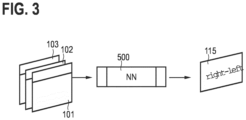
- FIG. 3 schematically illustrates processing of a plurality of radar measurement frames 101-103 using a NN 500.
- Inputs to the NN 500 are based on the plurality of radar measurement frames 101-103. Preprocessing would be possible.
- a consolidated estimate 115 is provided that predicts the target observable.
- a downstream processing associated with a certain use case uses the consolidated estimate 115. For instance, a user interface may be controlled based on the consolidated estimate 115. User interaction may be based on the consolidated estimate 115.
- the NN 500 implements an early-exit architecture. Details are described in connection with FIG. 4A .
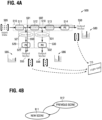
- FIG. 4A illustrates details with respect to the NN 500.
- the NN 500 processes inputs 505, e.g., provided as a multidimensional array. These inputs 505 are based on the plurality of radar measurement frames.
- each of the radar measurement frames of the plurality of radar meant measurement frames is provided, one after another, as an input 505 to the NN 500.
- preprocessing is possible, for example to determine aggregated radar measurement frames based on two or more radar measurement frames.
- the NN 500 includes a processing pipeline 510.
- the processing pipeline is formed by multiple layers 511-514.
- the layers 511-513 are convolutional layers and the layer 514 is a fully-connected layer.
- the processing pipeline 510 provides the estimate 550 of the target observable to be predicted.
- the estimate of the target observable provided by the processing pipeline 510 will be labelled primary estimate 550 hereinafter.
- a certain class is predicted. This is schematically illustrated by the prediction probabilities 580 provided for total of six classes in the inset of FIG. 4A . The particular class having the highest prediction probability in the primary estimate 550 is highlighted.
- the layer 511 and the layer 512 are each coupled with a respective early-exit branch 520, 530. They are, accordingly, early-exit breakout layers.
- Each one of the early-exit branches 520, 530 provides a respective early-exit estimate 555, 556 of the target observable.
- the early-exit branches 520, 530 each include a respective max-pooling layer 521, 531, followed by a respective fully-connected layer 522, 532.
- Illustrated in FIG. 4A are the prediction probabilities 580 for the early-exit estimates 555, 556.
- the early-exit branch 530 provides the early-exit estimate 556 that is in agreement with the primary estimate 550 provided by the processing pipeline 510 (i.e., the same class has the maximum prediction probability in both estimates 550, 556).
- the early-exit branch 520 provides the early-exit estimate 520 that is not in agreement with the primary estimate 550 provided by the processing pipeline 510 (i.e., different classes have the maximum prediction probability in the two estimates 555, 550) .
- the early-exit branches enable selective aborting of further processing of an input 505 in the processing pipeline 510, i.e., downstream of the respective breakout layer 511, 512. Thereby, computational resources for making predictions are reduced. This effect is explained in further detail below.
- such processing of inputs 505 in the processing pipeline 510 downstream of the respective breakout layer 511, 512 to which the respective, relied-upon early-exit branch 520, 530 is coupled can be selectively aborted. This reduces the required computational resources. It reduces the time-to-prediction provided by the NN 500. Processing latency can be reduced.
- the consolidated estimate 115 of the NN 500 is determined based on one or more of the primary estimate 550 and the early-estimates 555, 556.
- the particular calculation of the consolidated estimate 115 depends on a certain state in which the NN 500 operates, as illustrated in FIG. 4B .
- FIG. 4B schematically illustrates states 911, 912 in which the NN 500 can operate. Depending on the state 911, 912 the consolidated estimate 115 is determined differently.
- the state 911 is associated with a new, i.e., previously unseen scene 80; while the state 912 is associated with a scene 80 that has been previously seen by the NN 500.
- the consolidated estimate 115 can be equal to the primary estimate 550 provided by the processing pipeline 510. It would also be possible that the consolidated estimate 115 corresponds to a majority vote amongst all of the estimates 550, 555, 556. An average of all prediction probabilities 580 could be calculated.
- state 912 is a low-power consumption state in which the computational resources required are particularly low, in particular if compared to the state 911. It is not required to continue processing along the entire processing pipeline 510 when operating in the state 912.
- the transitions between the state 911, 912 are regulated based on monitoring an evolution of at least one of the early-exit estimates 555, 556. Cf. TAB. 1: function I.
- it can be tracked over time whether at least one of the early-exit estimates 555, 556 significantly changes from input to input 505 when operating in the state 912. If such a significant change is detected, a transition to the state 911 can be executed.
- a significant change can be indicative of a change of the observed scene 80.
- a given one of the available early-exit branches 520, 530 can be selected as a scene-characteristic early-exit branch. It is then possible to monitor the evolution of the early-exited estimate of that selected early-exit branch 520, 530. Then, the consolidated estimate 115 is based on a respective selected on of all early-exit estimates 555, 556.
- the scene-characteristic early-exit branch can be determined based on a comparison of all early-exit estimates and the primary estimate 550 provided by the processing pipeline 510 when transitioning from the state 911 to the state 912. For instance, a majority vote can be used and the most upstream early-exit branch (i.e., coupled to the most upstream breakout layer) can be used as the scene-characteristic early-exit branch.
- f NN denotes the NN 500, x the input, ⁇ x a change between subsequent inputs, y the respective estimate 550, 555, 556, and ⁇ y is the change of the respective estimate 550, 555, 556.
- the change in the NN's output vector ( o ) determines the similarity between input samples.
- the similarity is, in one example, the Euclidean distance between the current classification output vector ( o t ) and the vector of a previous sample ( o t 0 ) that it is being compared to, see Eq. 2.
- the Euclidean distance metric is only one example. Other distance metrics can be employed.
- function I of TAB. 1 is implemented based on the most upstream early-exit branch.
- Eq. 3 uses the change between t and t 0 (i.e., the earliest early-exit estimate of the present scene; may also be labeled t initial ), it would also be possible to rely on the difference to the preceding earliest early-exit estimate.
- the prediction at each time-step is defined in Eq. 5. If the currently processed input is similar enough to the initial input of the scene (its change is smaller than the threshold), the prediction of the initial input will be reused - this corresponds to state 912. I.e., in this scenario function II of TAB. 1 is not used; the consolidated estimate is kept constant while operating in the state 912. No deeper layers and classifiers than those required to produce the first classification vector will be executed in this case. If it is not similar to the initial sample, it will be labeled by the majority vote of all classifiers and is the first sample of a new scene (i.e., fallback to state 911) .
- output t ⁇ vote t initial , if change t t initial ⁇ threshold vote t , if change t t initial ⁇ threshold
- the threshold can be defined similarly as it would describe the maximum acceptable difference between the two scalar values of the compared time-steps.
- the majority voting eliminates the dependence on unreliable confidence-based metrics. Comparing the currently processed input to the initial input of the scene, rather than the direct predecessor input, prevents mislabeling due to slow drift in the subsequent samples. Additionally, using the early classifier to produce the change metric (see Eq. 3) improves efficiency by allowing operations to be reused. The use of the early-exit estimate creates a simple similarity measure for complex radar data.
- the characteristic early-exit branch can also be used to make the prediction for the subsequent input (cf. TAB. 1: function II).This creates minimal overhead as the output vector is already calculated to determine whether the scene is changed.
- This second example - if compared to the first example - trades improved prediction accuracy for additional computations.
- Scene change detection is now not only based on the distance between the characteristic early-exit branch output vectors compared to the threshold but also on the change of the prediction.This can be described as a patience-based decision mechanism. However, it adds a temporal component by not comparing the output of different early-exit branches for the same sample but the prediction of the same early-exit branch across similar inputs.
- the updated output function at each time-step is described by Eq. 8.
- FIG. 5 is a flowchart of a method according to various examples.
- the method of FIG. 5 may be executed by the processor of a processing device upon loading program code from a memory and upon executing the program code.
- the method of FIG. 5 is executed by the processor 62 upon loading program code that is stored in the memory 63 and upon executing this program code (cf. FIG. 1 ).
- the method of FIG. 5 generally pertains to predicting a target observable.
- the method of FIG. 5 generally corresponds to processing radar measurement frames using a NN, specifically an early-exit NN.
- a NN specifically an early-exit NN.
- the NN 500 as discussed in FIG. 4A can be employed.
- a state-dependent processing as discussed in FIG 4B can be employed.
- a plurality of radar measurement frames are obtained.
- respective radar measurement frames can be obtained via a communication interface (cf. FIG. 1 : communication interface 61). Measurements can be executed.
- the radar measurement frames of the plurality of radar measurement frames can be sequentially obtained.
- the plurality of radar measurement frames can form a time sequence.
- the radar sensor can perform measurements and provide an updated radar measurement frame at a certain refresh rate.
- the pre-processing can enable batch-wise processing in the NN. I.e., it would be possible to form multiple batches, wherein each batch includes two or more radar measurement frames that are sequentially is selected from the time sequence.
- such batches can be formed by buffering radar measurement frames as they sequentially are obtained when forming a batch that is then input to the NN.
- the inputs to the NN that is used for predicting the target observable can then be based on the batches.
- multiple radar measurement frames of a batch can be concatenated to form a respective input to the NN.
- all radar measurement frames of a batch can be concatenated along time dimension (T) in a batch data structure: [T, H, W, C].
- T time dimension
- H denotes the height or slow time
- W the width or fast time
- C is the channel dimension.
- the entries can be re-ordered: to obtain the aggregated radar measurement frames having only three dimensions (rather than four): [H, W, C x T].
- the channel and time dimension illustrates such combination of three radar measurement frames 101, 102, 103 of a time sequence 700 into a single aggregated radar measurement frame 789.
- a prediction of a target observable is made. I.e., a consolidated estimate is obtained from respective processing algorithm implemented by a NN (cf. FIG. 3 and FIG. 4A : consolidated estimate 115 provided by the NN 500).
- the processing power headroom available in the computing device is monitored when executing the processing; if the processing power headroom falls below a certain threshold, then it would be possible to rely on the early-exit estimate of the target observable and abort further processing of an input in the processing pipeline. This limits required compute resources and ensures timely prediction of the target estimate.
- a confidence level for the early-exit estimates provided by the each early-exit branches is monitored and then the most upstream early-exit branch that has a confidence level exceeding a certain threshold is selected.
- a policy NN is used that determines, based on the input, which early-exit branch to use or whether to use the primary estimate.
- a state dependent selection of a scene characteristic early-exit branch is used. This is described in FIG. 4B .
- a GUI may be controlled based on a detected and classified gesture executed by the user. For instance, for a trunk opener, where a kick gesture is detected, the trunk may be opened. For instance, where passengers are detected in a vehicle, air conditioning in the vehicle may be activated. A count of persons may be used in order to trigger a security alert for security applications.
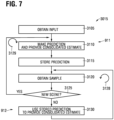
- FIG. 7 is a flowchart of a method according to various examples.
- the method of FIG. 7 pertains to operating in NN to provide a prediction of a target observable.
- the NN provides a consolidated estimate of the target observable.
- the NN can be the NN 500 as previously discussed in connection with FIG. 4A .
- a current input 505 is obtained. Based on this current input 505, a prediction of the target observable is made by the NN 500.
- a respective consolidated estimate 115 is provided. For example, in the first iteration 3129 of box 3110, the consolidated estimate 115 can equate to the primary estimate 550 provided by the processing pipeline 510. Alternatively, it would be possible that the consolidated estimate 115 equates to the majority vote among all early-exit estimates 555, 556 as well as the primary estimate 550.
- the first iteration of box 3110 - i.e., new initialization of the NN 500 -corresponds to state 911 (cf. FIG. 4B ), i.e., new scene.
- the prediction/the consolidated estimate of box 3110 is then stored at box 3115.
- the method commences at box 3130 and the stored prediction of box 3115 is used as consolidated estimate. This corresponds to operating in the state 912 (cf. FIG. 4B ). Then, in an iteration 3128, the next input is obtained at box 3120.
- FIG. 8 schematically illustrates processing multiple subsequent radar measurement frames 711, 712, 721, 722, 723, 731 of a time sequence 700 of radar measurement frames.
- preprocessing does not occur, i.e., batch processing is disabled.
- similar techniques as disclosed in connection with FIG. 8 can be readily applied by batch processing is used.
- FIG. 8 illustrates processing of the radar measurement frames using the NN 500 as discussed in connection with FIG. for a.
- FIG. 8 illustrates the probability distributions 580 for the primary estimate 550 and the probability distributions 580 for the early-exit estimates 555, 556.
- the radar measurement frame 711 is processed.
- the downstream early-exit branch 530 provides the early-exit estimate 556 that is in agreement with the primary estimate 550 provided by the main processing branch 510.
- the upstream early-exit branch 520 provides the early-exit estimate 555 that is not in agreement with the primary estimate 550 and the early-exit estimate 556.
- both the primary estimate 550, as well as the early-exit estimate 556 correspond to the majority vote among all estimates 550, 555, 556.
- the consolidated estimate 115 is determined either as the primary estimate 550 or based on the majority vote (e.g., as an average of the early-exit estimate 556 and the primary estimate 550).
- the early-exit branch 530 is then selected as the scene-characteristic early-exit branch for the current scene 80-1. This is because the early-exit branch 530 is the most upstream early-exit branch that conforms with the majority vote (cf. EXAMPLE B as discussed in connection with FIG. 4B ; cf. Eq. 6.). Alternatively, to selecting the most upstream early-exit branch that conforms with the majority vote, it would be possible to select the most upstream early-exit branch that conforms with the primary estimate 550.
- the radar measurement frame 712 is different than the radar measurement frame 711. It is determined whether the radar measurement frame 711 and the radar measurement frame 712 correspond to the same scene 80-1. Such determination can include determining a similarity score between the early-exit estimate 556 determined for the radar measurement frame 711 and the early-exit estimate 556 determined for the radar measurement frame 712. The similarity score can be a Euclidean distance between these two instances of the early-exit estimate 556. Cf. Eq. 7. This is illustrated in FIG. 9 . Here, the position 811, in the output space 800 of the early-exit estimate 556 determined for the radar measurement frame 711 is illustrated.
- the early-exit estimate 556 determined for the radar measurement frame 712 is located at a position 812 that is closer than a certain threshold 820 from the position 811. Accordingly, the similarity score indicates that the early-exit estimate 556 determined for the radar measurement frame 711 and the early-exit estimate 556 determined for the radar measurement frame 712 are similar to each other. Thus, it can be concluded that the radar measurement frames 711, 712 correspond to the same scene 80-1. Then, it is possible to abort processing of the radar measurement frame 712 in the processing pipeline 510 downstream of the breakout layer 512.
- the similarity score is based on a threshold comparison between a distance in the space of the respective outputs.
- the distance can be compared to a predefined threshold.
- different predefined thresholds can be used for different early-exit branches. It would also be possible to use the same distance for all early-exit branches.
- the radar measurement frame 721 is then processed.
- the radar measurement frame 721 is again different than any one of the radar measurement frames 711, 712. It is determined whether the radar measurement frame 721 and the radar measurement frame 712 correspond to the same scene. Again, a similarity score is determined.
- the position 813 is associated with the early-exit estimate 556 determined by the selected early-exit branch 530.
- the position 813 has a distance to the position 811 that is above the threshold 820; so that, accordingly, it is assumed that the scene has changed, from the scene 80-1 to the scene 80-2 (dashed lines in FIG. 8 ).
- the operation switches back to the state 911 (cf. FIG. 4B ).
- the early-exit estimate 556 determined for the radar measurement frame 721 being dissimilar to the early-exit estimate 556 determined for the radar measurement frame 712 triggers selecting a new scene-characteristic early-exit branch for the new scene 80-2; in this case, this is the early-exit branch 520 providing the early-exit estimate 555. This is because the early-exit branch 520 is the most upstream early-exit branch amongst all early-exit branches 520, 530 that conform with the majority vote and the estimate 555 provided by the processing pipeline 510.
- the subsequent input 505 based on the radar measurement frame 722 is processed.
- the early-exit estimate 555 determined for the radar measurement frame 722 is compared to the early-exit estimate 555 determined for the radar measurement frame 721. They are similar and accordingly the input 505 based on the radar measurement frame 722 is not further processed in the processing pipeline 510 and the early-exit branch 530.
- the consolidated estimate 115 can be determined based on the radar measurement frame 721. This is the radar measurement frame 721 that initialized the current scene 80-2, i.e., corresponding to last operating in the state 911.
- the consolidated estimate 115 provided for the radar measurement frame 722 is the majority vote amongst all estimates 550, 555, 556 determined for the radar measurement frame 721; or could be the primary estimate 550 determined for the radar measurement frame 721. This would correspond to EXAMPLE A discussed in connection with FIG. 4B ; cf. Eq. 5.
- the consolidated estimate 115 can be determined based on the radar measurement frame 722.
- the consolidated estimate can be determined as the early exit estimate 555 determined for the radar measurement frame 722. This would correspond to EXAMPLE B as discussed in connection with FIG. 4B ; cf. Eq. 8.
- the input 505 based on the subsequent radar measurement frame 723 is processed.
- the early-exit estimate 555 determined for the radar measurement frame 723 is compared to the early-exit estimate 555 determined for the radar measurement frame 721. They are similar and accordingly the radar measurement frame 723 is not further processed in the processing pipeline 510 and the early-exit branch 530.
- the consolidated estimate 115 can be determined based on the radar measurement frame 721. This is the radar measurement frame 721 that initialized the current scene 80-2, i.e., corresponding to last operating in the state 911.
- the consolidated estimate 115 provided for the radar measurement frame 723 is the majority vote amongst all estimates 550, 555, 556 determined for the radar measurement frame 721; or could be the primary estimate 550 determined for the radar measurement frame 721. This would correspond to EXAMPLE A discussed in connection with FIG. 4B ; cf. Eq. 5.
- the consolidated estimate 115 can be determined based on the radar measurement frame 723.
- the consolidated estimate can be determined as the early exit estimate 555 determined for the radar measurement frame 722. This would correspond to EXAMPLE B as discussed in connection with FIG. 4B ; cf. Eq. 8.
- the radar measurement frame 731 is continued to be processed in the processing pipeline 510 to obtain the primary estimate 550 and further processed in the early-exit branch 530 to obtain the early-exit estimate 556, as previously explained. Downstream processing of the input 505 associated with the radar measurement frames 731 is executed.
- the consolidated estimate 115 can then be, e.g., the estimate primary estimate 550 determined for the radar measurement frame 731 or the majority vote (cf. Eq. 8, second row; cf. Eq. 5, second row) across all estimates 550, 555, 556 determined for the radar measurement frame 731.
- the respective early-exit estimates 555 determined for the radar measurement frame 723 it is necessary to retain, and a memory, the respective early-exit estimates 555 determined for the radar measurement 721. Similarly, when relying on an early output, the early-exit estimate 555 or the majority vote amongst the early-exit estimates 555, 556 and the primary estimate 550 determined for the radar measurement frame 721 are retained in the memory until re-transitioning back to the state 911 for the radar measurement frame 731.
- FIG. 8 illustrates the logic for selecting the most upstream early-exit branch that conforms with the majority vote (or, alternatively, with the primary estimate 550) as the scene-characteristic early-exit branch. This is only one example. In other scenarios it would be possible to always select the most upstream early-exit branch from all early-exit branches (i.e., the architecture of FIG. 4A , to always use the early-exit branch 520 as the scene-characteristic early-exit branch).
- Subsequent inputs that are similar to the initial input of the scene are then either labeled by the earliest agreeing classifier/early-exit branch; or the majority vote label of the initial input of the scene is re-used, if the change of the earliest classifiers low enough.
- EXAMPLE 2 The computer-implemented method of EXAMPLE 1, further comprising:
- EXAMPLE 3 The computer-implemented method of EXAMPLE 2, further comprising:
- EXAMPLE 4 The computer-implemented method of any one of the preceding EXAMPLEs, further comprising:
- EXAMPLE 6 The computer-implemented method of any one of the preceding EXAMPLEs, further comprising:
- EXAMPLE 9 The computer-implemented method of EXAMPLE 8, further comprising:
- EXAMPLE 10 The computer-implemented method of EXAMPLE 8, further comprising:
- EXAMPLE 11 The computer-implemented method of EXAMPLE 10, wherein the early-exit estimate provided by all early-exit branches (520, 530) coupled to the layers of the subset for the first input (505) is the same as the estimate provided by the processing pipeline (510) for the first input (505) .
- EXAMPLE 12 The computer-implemented method of EXAMPLE 10, wherein the early-exit estimate provided by all early-exit branches (520, 530) coupled to the layers of the subset for the first input (505) is a majority vote among all early-exit estimates (555, 556) provided by all early-exit branches (520, 530) of the deep neural network (500) for the first input (505) and the estimate provided by the processing pipeline (510) for the first input (505).
- EXAMPLE 13 The computer-implemented method of any one of EXAMPLEs 10 to 12, further comprising:
- EXAMPLE 14 The computer-implemented method of any one of EXAMPLEs 8 to 13, wherein the similarity score comprises a Euclidian distance.
- EXAMPLE 15 The computer-implemented method of any one of EXAMPLEs 8 to 14, further comprising:
- EXAMPLE 16 The computer-implemented method of any one of EXAMPLEs 8 to 14, further comprising:
- EXAMPLE 17 The computer-implemented method of any one of EXAMPLEs 8 to 16, further comprising:
- EXAMPLE 18 The computer-implemented method of EXAMPLE 17, further comprising:
- EXAMPLE 19 The computer-implemented method of EXAMPLE 17, further comprising:
- EXAMPLE 20 The computer-implemented method of any one of EXAMPLEs 8 to 19,
- EXAMPLE 21 The computer-implemented method of EXAMPLE 20, wherein one or more further radar measurement frames (722) of the time sequence (700) are arranged in-between the one or more first radar measurement frames (721) and the one or more second radar measurement frames (723) along the time sequence (700).
- EXAMPLE 22 The computer-implemented method of any one of the preceding EXAMPLEs,
- EXAMPLE 23 The computer-implemented method of EXAMPLE 22, further comprising:
- EXAMPLE 24 A computer-implemented method, comprising:
- EXAMPLE 25 The computer-implemented method of EXAMPLE 24, further comprising:
- EXAMPLE 26 The computer-implemented method of EXAMPLE 24 or 25, wherein said monitoring of the outputs of the at least one of the one or more early-exit branches (520, 530) comprises determining a similarity measure between a first output of the at least one of the one or more early-exit branches (520, 530) when providing the first input (505) to the deep neural network and one or more second outputs of the at least one of the one or more early-exit branches (520, 530) when providing the one or more second inputs (505) the neural network.
- EXAMPLE 27 The computer-implemented method of any one of EXAMPLEs 24 to 26, further comprising:
- EXAMPLE 28 The computer-implemented method of any one of EXAMPLEs 24 to 27, further comprising:
- EXAMPLE 30 A low-power embedded compute circuitry (62) configured to execute the method of any one of the preceding EXAMPLES.
Landscapes
- Engineering & Computer Science (AREA)
- Physics & Mathematics (AREA)
- Theoretical Computer Science (AREA)
- General Physics & Mathematics (AREA)
- Evolutionary Computation (AREA)
- Artificial Intelligence (AREA)
- Data Mining & Analysis (AREA)
- Life Sciences & Earth Sciences (AREA)
- Remote Sensing (AREA)
- Radar, Positioning & Navigation (AREA)
- General Engineering & Computer Science (AREA)
- Biomedical Technology (AREA)
- Biophysics (AREA)
- Health & Medical Sciences (AREA)
- Computing Systems (AREA)
- Mathematical Physics (AREA)
- Software Systems (AREA)
- Molecular Biology (AREA)
- General Health & Medical Sciences (AREA)
- Computational Linguistics (AREA)
- Computer Networks & Wireless Communication (AREA)
- Bioinformatics & Cheminformatics (AREA)
- Bioinformatics & Computational Biology (AREA)
- Computer Vision & Pattern Recognition (AREA)
- Evolutionary Biology (AREA)
- Neurology (AREA)
- Radar Systems Or Details Thereof (AREA)
Priority Applications (3)
| Application Number | Priority Date | Filing Date | Title |
|---|---|---|---|
| EP23161484.3A EP4432162A1 (de) | 2023-03-13 | 2023-03-13 | Frühkommende neuronale netze zur radarverarbeitung |
| US18/584,629 US20240310485A1 (en) | 2023-03-13 | 2024-02-22 | Early-exit neural networks for radar processing |
| CN202410273742.5A CN118643879A (zh) | 2023-03-13 | 2024-03-11 | 用于雷达处理的早期退出神经网络 |
Applications Claiming Priority (1)
| Application Number | Priority Date | Filing Date | Title |
|---|---|---|---|
| EP23161484.3A EP4432162A1 (de) | 2023-03-13 | 2023-03-13 | Frühkommende neuronale netze zur radarverarbeitung |
Publications (1)
| Publication Number | Publication Date |
|---|---|
| EP4432162A1 true EP4432162A1 (de) | 2024-09-18 |
Family
ID=85601597
Family Applications (1)
| Application Number | Title | Priority Date | Filing Date |
|---|---|---|---|
| EP23161484.3A Pending EP4432162A1 (de) | 2023-03-13 | 2023-03-13 | Frühkommende neuronale netze zur radarverarbeitung |
Country Status (3)
| Country | Link |
|---|---|
| US (1) | US20240310485A1 (de) |
| EP (1) | EP4432162A1 (de) |
| CN (1) | CN118643879A (de) |
Citations (6)
| Publication number | Priority date | Publication date | Assignee | Title |
|---|---|---|---|---|
| US20190302253A1 (en) | 2018-03-28 | 2019-10-03 | Infineon Technologies Ag | System and Method for Controlling Access to a Trunk of a Vehicle Using a Radar Sensor |
| CN111292366A (zh) * | 2020-02-17 | 2020-06-16 | 华侨大学 | 一种基于深度学习和边缘计算的视觉行车测距算法 |
| CN111638491A (zh) * | 2019-03-01 | 2020-09-08 | 通用汽车环球科技运作有限责任公司 | 使用深层神经网络在感测雷达的波束形成阶段去除假警报 |
| US20210325509A1 (en) | 2020-04-20 | 2021-10-21 | Infineon Technologies Ag | Radar-Based Vital Sign Estimation |
| US20220404486A1 (en) | 2021-06-18 | 2022-12-22 | Infineon Technologies Ag | People Counting Based on Radar Measurement |
| US20230068523A1 (en) | 2021-08-12 | 2023-03-02 | Infineon Technologies Ag | Radar-Based Gesture Classification Using a Variational Auto-Encoder Neural Network |
-
2023
- 2023-03-13 EP EP23161484.3A patent/EP4432162A1/de active Pending
-
2024
- 2024-02-22 US US18/584,629 patent/US20240310485A1/en active Pending
- 2024-03-11 CN CN202410273742.5A patent/CN118643879A/zh active Pending
Patent Citations (6)
| Publication number | Priority date | Publication date | Assignee | Title |
|---|---|---|---|---|
| US20190302253A1 (en) | 2018-03-28 | 2019-10-03 | Infineon Technologies Ag | System and Method for Controlling Access to a Trunk of a Vehicle Using a Radar Sensor |
| CN111638491A (zh) * | 2019-03-01 | 2020-09-08 | 通用汽车环球科技运作有限责任公司 | 使用深层神经网络在感测雷达的波束形成阶段去除假警报 |
| CN111292366A (zh) * | 2020-02-17 | 2020-06-16 | 华侨大学 | 一种基于深度学习和边缘计算的视觉行车测距算法 |
| US20210325509A1 (en) | 2020-04-20 | 2021-10-21 | Infineon Technologies Ag | Radar-Based Vital Sign Estimation |
| US20220404486A1 (en) | 2021-06-18 | 2022-12-22 | Infineon Technologies Ag | People Counting Based on Radar Measurement |
| US20230068523A1 (en) | 2021-08-12 | 2023-03-02 | Infineon Technologies Ag | Radar-Based Gesture Classification Using a Variational Auto-Encoder Neural Network |
Non-Patent Citations (4)
| Title |
|---|
| AMTHOR, MANUELERIK RODNERJOACHIM DENZLER: "Impatient dnns-NNs with dynamic time budgets", ARXIV PREPRINT ARXIV:1610.02850, 2016 |
| FANG, BIYI ET AL.: "2020 IEEE/ACM Symposium on Edge Computing (SEC", 2020, IEEE, article "Flexdnn: Input-adaptive on-device deep learning for efficient mobile vision" |
| HU, HANZHANG ET AL.: "Learning anytime predictions in NNs via adaptive loss balancing", PROCEEDINGS OF THE AAAI CONFERENCE ON ARTIFICIAL INTELLIGENCE, vol. 33, no. 01, 2019 |
| PANDA, PRIYADARSHINI, ABHRONIL SENGUPTA, AND KAUSHIK ROY: "2016 Design, Automation & Test in Europe Conference & Exhibition (DATE", 2016, IEEE, article "Conditional deep learning for energy-efficient and enhanced pattern recognition" |
Also Published As
| Publication number | Publication date |
|---|---|
| US20240310485A1 (en) | 2024-09-19 |
| CN118643879A (zh) | 2024-09-13 |
Similar Documents
| Publication | Publication Date | Title |
|---|---|---|
| EP3929824B1 (de) | Robuste multimodale sensorfusion für autonom fahrende fahrzeuge | |
| US12307821B2 (en) | Radar-based gesture classification using a variational auto-encoder neural network | |
| US11087228B2 (en) | Generic probabilistic approximate computational inference model for streaming data processing | |
| Ahmed et al. | DF-WiSLR: Device-free Wi-Fi-based sign language recognition | |
| Nakamura et al. | Nonparametric density estimation based on self-organizing incremental neural network for large noisy data | |
| Vo et al. | An implementation of the multi-sensor generalized labeled multi-Bernoulli filter via Gibbs sampling | |
| US20240320558A1 (en) | Geolocation-aided unique signal recognition | |
| EP3832550A1 (de) | Vorrichtung und verfahren zum trainieren eines klassifikators | |
| Dubey et al. | Xai-Bayeshar: A novel framework for human activity recognition with integrated uncertainty and shapely values | |
| Ma et al. | Diverse sampling for normalizing flow based trajectory forecasting | |
| Vo et al. | Multi-scan generalized labeled multi-Bernoulli filter | |
| US20240028962A1 (en) | Training of machine-learning algorithm using explainable artificial intelligence | |
| Alizadeh et al. | Characterization and selection of wifi channel state information features for human activity detection in a smart public transportation system | |
| EP4432162A1 (de) | Frühkommende neuronale netze zur radarverarbeitung | |
| JP4166651B2 (ja) | 目標追尾装置 | |
| Zhang et al. | Dynamic gesture recognition based on RF sensor and AE-LSTM neural network | |
| US12366925B2 (en) | Robustifying radar-based gesture recognition solution using contextual information | |
| Janjua et al. | Radar-based gesture recognition using Gaussian mixture variational autoencoder | |
| JP6400251B1 (ja) | 電波探知装置 | |
| WO2024079436A1 (en) | Improved classification using a combined confidence score | |
| CN112816973B (zh) | 一种跟踪信息辅助的目标检测方法 | |
| EP4542341A1 (de) | Gestenklassenvorhersage und erklärbare künstliche intelligenz | |
| Chen et al. | A task-oriented deep learning approach for human localization | |
| Guan et al. | Dual‐labelled multi‐Bernoulli filter based on specific emitter identification | |
| Zaman et al. | Reactive buffering window trajectory segmentation: RBW-TS |
Legal Events
| Date | Code | Title | Description |
|---|---|---|---|
| PUAI | Public reference made under article 153(3) epc to a published international application that has entered the european phase |
Free format text: ORIGINAL CODE: 0009012 |
|
| STAA | Information on the status of an ep patent application or granted ep patent |
Free format text: STATUS: THE APPLICATION HAS BEEN PUBLISHED |
|
| AK | Designated contracting states |
Kind code of ref document: A1 Designated state(s): AL AT BE BG CH CY CZ DE DK EE ES FI FR GB GR HR HU IE IS IT LI LT LU LV MC ME MK MT NL NO PL PT RO RS SE SI SK SM TR |
|
| STAA | Information on the status of an ep patent application or granted ep patent |
Free format text: STATUS: REQUEST FOR EXAMINATION WAS MADE |
|
| 17P | Request for examination filed |
Effective date: 20250318 |