EP4432737A1 - Procédé et appareil de commutation de mode d'accès, dispositif de communication et support de stockage - Google Patents
Procédé et appareil de commutation de mode d'accès, dispositif de communication et support de stockage Download PDFInfo
- Publication number
- EP4432737A1 EP4432737A1 EP21963035.7A EP21963035A EP4432737A1 EP 4432737 A1 EP4432737 A1 EP 4432737A1 EP 21963035 A EP21963035 A EP 21963035A EP 4432737 A1 EP4432737 A1 EP 4432737A1
- Authority
- EP
- European Patent Office
- Prior art keywords
- access mode
- network
- mode switching
- snpn
- switching information
- Prior art date
- Legal status (The legal status is an assumption and is not a legal conclusion. Google has not performed a legal analysis and makes no representation as to the accuracy of the status listed.)
- Pending
Links
- 238000004891 communication Methods 0.000 title claims abstract description 52
- 238000000034 method Methods 0.000 title claims abstract description 44
- 230000004044 response Effects 0.000 claims description 51
- 230000010365 information processing Effects 0.000 claims description 7
- 238000003672 processing method Methods 0.000 claims description 3
- 238000012545 processing Methods 0.000 description 12
- 238000007726 management method Methods 0.000 description 11
- 230000008859 change Effects 0.000 description 10
- 238000010586 diagram Methods 0.000 description 8
- 238000005516 engineering process Methods 0.000 description 7
- 238000012795 verification Methods 0.000 description 6
- 230000006870 function Effects 0.000 description 5
- 230000003287 optical effect Effects 0.000 description 4
- 230000005236 sound signal Effects 0.000 description 4
- 230000009471 action Effects 0.000 description 2
- 230000001413 cellular effect Effects 0.000 description 2
- 230000003993 interaction Effects 0.000 description 2
- 238000010295 mobile communication Methods 0.000 description 2
- 230000001133 acceleration Effects 0.000 description 1
- 230000006978 adaptation Effects 0.000 description 1
- 238000003491 array Methods 0.000 description 1
- 239000003795 chemical substances by application Substances 0.000 description 1
- 230000000295 complement effect Effects 0.000 description 1
- 238000010276 construction Methods 0.000 description 1
- 238000013523 data management Methods 0.000 description 1
- 238000013500 data storage Methods 0.000 description 1
- 238000003384 imaging method Methods 0.000 description 1
- 239000004973 liquid crystal related substance Substances 0.000 description 1
- 230000007774 longterm Effects 0.000 description 1
- 230000007246 mechanism Effects 0.000 description 1
- 229910044991 metal oxide Inorganic materials 0.000 description 1
- 150000004706 metal oxides Chemical class 0.000 description 1
- 238000012986 modification Methods 0.000 description 1
- 230000004048 modification Effects 0.000 description 1
- 230000002093 peripheral effect Effects 0.000 description 1
- 239000004065 semiconductor Substances 0.000 description 1
- 230000011664 signaling Effects 0.000 description 1
- 230000003068 static effect Effects 0.000 description 1
Images


Classifications
-
- H—ELECTRICITY
- H04—ELECTRIC COMMUNICATION TECHNIQUE
- H04W—WIRELESS COMMUNICATION NETWORKS
- H04W36/00—Hand-off or reselection arrangements
- H04W36/0005—Control or signalling for completing the hand-off
- H04W36/0011—Control or signalling for completing the hand-off for data sessions of end-to-end connection
- H04W36/0022—Control or signalling for completing the hand-off for data sessions of end-to-end connection for transferring data sessions between adjacent core network technologies
-
- H—ELECTRICITY
- H04—ELECTRIC COMMUNICATION TECHNIQUE
- H04W—WIRELESS COMMUNICATION NETWORKS
- H04W48/00—Access restriction; Network selection; Access point selection
- H04W48/16—Discovering, processing access restriction or access information
-
- H—ELECTRICITY
- H04—ELECTRIC COMMUNICATION TECHNIQUE
- H04W—WIRELESS COMMUNICATION NETWORKS
- H04W48/00—Access restriction; Network selection; Access point selection
- H04W48/18—Selecting a network or a communication service
-
- H—ELECTRICITY
- H04—ELECTRIC COMMUNICATION TECHNIQUE
- H04W—WIRELESS COMMUNICATION NETWORKS
- H04W84/00—Network topologies
- H04W84/02—Hierarchically pre-organised networks, e.g. paging networks, cellular networks, WLAN [Wireless Local Area Network] or WLL [Wireless Local Loop]
- H04W84/04—Large scale networks; Deep hierarchical networks
- H04W84/042—Public Land Mobile systems, e.g. cellular systems
Definitions
- the disclosure relates to, but is not limited to, a field of wireless communication technology, more particularly, to an access mode switching method, an access mode switching apparatus, a communication device, and a storage medium.
- a public network or a public land mobile network can utilize a characteristic of wide coverage to provide common services such as data, voice and other services, which allows users to choose an appropriate network as needed to obtain corresponding services.
- Embodiments of the disclosure provide an access mode switching method, an access mode switching apparatus, a communication device, and a storage medium.
- an access mode switching method performed by a user equipment (UE). The method includes: in response to obtaining access mode switching information, switching an accessed network between a stand-alone non-public network (SNPN) and a public land mobile network (PLMN).
- SNPN stand-alone non-public network
- PLMN public land mobile network
- an information processing switching method performed by a network element.
- the method includes: sending access mode switching information to a UE, in which the access mode switching information is configured to indicate the UE to switch an accessed network between a SNPN and a PLMN.
- an access mode switching apparatus includes: a switching module, configured to, in response to obtaining access mode switching information, switch an accessed network between a SNPN and a PLMN.
- an information processing apparatus includes: a sending module, configured to send access mode switching information to a UE, in which the access mode switching information is configured to indicate the UE to switch an accessed network between a SNPN and a PLMN.
- a communication device includes a processor, a transceiver, a memory and an executable program stored on the memory and executable by the processor.
- the executable program is executed by the processor, the method of the first aspect or the method of the second aspect is implemented.
- a computer storage medium having an executable program stored thereon is provided.
- the executable program is executed by a processor, the method of the first aspect or the method of the second aspect is implemented.
- the UE obtains the access mode switching information, and the UE automatically switches between the SNPN and the PLMN when the access mode switching information is obtained, rather than being limited to the current accessed mode with which the SNPN or the PLMN is selected to be accessed, reducing a phenomenon of no network signal coverage or poor network signal quality when leaving the corresponding network caused by limiting UE to the current accessed mode with which only the SNPN or the PLMN can be accessed.
- first, second, and third may be used in the embodiments of the disclosure to describe various information, the information should not be limited to these terms. These terms are only used to distinguish the same type of information from each other.
- first information may also be referred to as the second information, and similarly, the second information may also be referred to as the first information.
- second information may also be referred to as the first information.
- the term “if' as used herein can be interpreted as "when", “while” or "in response to determining”.
- FIG. 1 is a schematic diagram of a wireless communication system provided by an embodiment of the disclosure. As illustrated in FIG. 1 , the wireless communication system is a communication system based on cellular mobile communication technology.
- the wireless communication system may include: a plurality of user equipment (UEs) 11 and a plurality of access devices 12.
- UEs user equipment
- the UE 11 may be a device that provides voice and/or data connectivity to a user.
- the UE 11 may communicate with one or more core networks via a Radio Access Network (RAN).
- RAN Radio Access Network
- the UE 11 may be an Internet of Things (IoT) UE, such as a sensor device, a mobile phone (or a "cellular" phone), and a computer with an IoT UE.
- IoT Internet of Things
- the UE 11 may be a stationary, portable, pocket-sized, handheld, computer-built, or vehicle-mounted device, such as, a Station (STA), a subscriber unit, a subscriber station, a mobile station, a mobile, a remote station, an access point, a remote terminal, an access terminal, a user terminal, a user agent, a user device, or a UE.
- the UE 11 may be an unmanned aerial vehicle device.
- the UE 11 may be an in-vehicle device, for example, an electronic control unit (ECU) having a wireless communication function, or a wireless communication device external to the ECU.
- the UE 11 can also be a roadside device, for example, a street light, a signal light, or other roadside devices having the wireless communication function.
- the access device 12 may be a network side device in the wireless communication system.
- the wireless communication system may be the 4th Generation (4G) mobile communication system, also known as a Long Term Evolution (LTE) system.
- the wireless communication system may also be a 5G system, also known as a New Radio (NR) system or a 5G NR system.
- the wireless communication system may be any next generation system of the 5G system.
- the access network in the 5G system may be called a New Generation-RAN (NG-RAN) or a machine type communication (MTC) system.
- NG-RAN New Generation-RAN
- MTC machine type communication
- the access device 12 can be an evolved access device (eNB) employed in a 4G system.
- the access device 12 may be an access device (gNB) with a centralized distributed architecture employed in a 5G system.
- the access device 12 adopts the centralized distributed architecture, it usually includes a Central Unit (CU) and at least two Distributed Units (DUs).
- the CU is equipped with protocol stacks of a Packet Data Convergence Protocol (PDCP) layer, a Radio Link Control (RLC) layer, or a Media Access Control (MAC) layer.
- PDCP Packet Data Convergence Protocol
- RLC Radio Link Control
- MAC Media Access Control
- the DU is equipped with a protocol stack of a physical (PHY) layer, and the specific implementation of the access device 12 is not limited in the embodiments of the disclosure.
- a wireless connection can be established between the access device 12 and the UE 11 via a radio interface.
- the radio interface is a radio interface based on the 4G standard.
- the radio interface is a radio interface based on the 5G standard, such as a NR.
- the radio interface may also be a radio interface based on the standard of a next generation of 5G.
- an End to End (E2E) connection can also be established between the UEs 11 in scenarios, such as, Vehicle to Vehicle (V2V) communication, Vehicle to Infrastructure (V2I) communication, and Vehicle to Pedestrian (V2P) communication in Vehicle to Everything (V2X) communication.
- V2V Vehicle to Vehicle
- V2I Vehicle to Infrastructure
- V2P Vehicle to Pedestrian
- the above wireless communication system may also include a network management device 13.
- the plurality of access devices 12 are connected to the network management device 13 respectively.
- the network management device 13 may be a core network device in the wireless communication system, for example, a Mobility Management Entity (MME) in an Evolved Packet Core (EPC).
- MME Mobility Management Entity
- EPC Evolved Packet Core
- the network management device may be other core network devices, such as a Serving GateWay (SGW), a Public Data Network GateWay (PGW), a Policy and Charging Rules Function (PCRF), or a Home Subscriber Server (HSS), etc.
- SGW Serving GateWay
- PGW Public Data Network GateWay
- PCRF Policy and Charging Rules Function
- HSS Home Subscriber Server
- an embodiment of the disclosure provides an access mode switching method, which is performed by a UE.
- the method includes: S110, in response to obtaining access mode switching information, an accessed network is switched between a stand-alone non-public network (SNPN) and a public land mobile network (PLMN).
- SNPN stand-alone non-public network
- PLMN public land mobile network
- the UE may be any type of UE, for example, a human-carried terminal (e.g., a mobile phone, a tablet computer and a wearable device), a vehicle-mounted terminal, a smart home device, a smart office device, or a smart toy.
- a human-carried terminal e.g., a mobile phone, a tablet computer and a wearable device
- vehicle-mounted terminal e.g., a vehicle-mounted terminal
- smart home device e.g., a smart home device, a smart office device, or a smart toy.
- the access mode switching information may include at least one of:
- the embodiments of the disclosure provide a mechanism that allows the UE to switch freely between the SNPN and the PLMN. In this way, when the UE leaves a coverage of the SNPN, it can switch to access the PLMN by the switching of the access mode. Or, when the UE enters a coverage of the SNPN from that of the PLMN, it can switch to the SNPN that can provide a higher quality of service by the switching of the access mode. Thereby, the communication service quality of the UE is improved, and problems such as poor network signal quality or no network coverage when the UE leaves a specific area can be overcome.
- S110 may include:
- the accessed network is switched from the SNPN to a PLMN when the UE obtains the access mode switching information. If the UE accesses a PLMN currently, the UE switches the accessed network from the PLMN to a SNPN when the UE obtains the access mode switching information.
- the method includes the following steps.
- the access mode switching information may be received by the UE from other devices or automatically generated by the UE, and there are many ways for the UE to obtain the access mode switching information, which are not limited to the above examples.
- S100 includes:
- the access mode switching information may be obtained from the network side or may be automatically generated by the UE. For example, if the network accessed by the UE is a PLMN, the access mode switching information may be from the PLMN. If the network accessed by the UE is a SNPN, the access mode switching information may be from the SNPN. If the network side expects the UE to switch the accessed network, the network side can instruct the UE to switch the current access mode through the access mode switching information. In this way, the UE may switch the accessed network. For example, one or more network elements of a core network on the network side may send the access mode switching information to the UE. For example, the access mode switching information may be sent to the UE by an access management function (AMF), an access function (AF), or a service server of the core network.
- AMF access management function
- AF access function
- service server of the core network a service server of the core network.
- the UE when the UE itself wants to switch the accessed network or detects a need to switch the accessed network, the UE can generate the access mode switching information, to performing the switching of the accessed network.
- S100A includes: receiving a steering of roaming (SoR) message containing the access mode switching information sent by the network accessed by the UE.
- SoR steering of roaming
- the SoR message is originally used to carry a roaming network list of the UE.
- the access mode switching information is sent in the SoR message that sends the roaming network list. In this way, it is equivalent to performing the operation in a scenario where the UE has a relatively high probability of switching the access network.
- the method further includes: receiving network information of a target network to be accessed sent by the network accessed by the UE, in which the target network is the PLMN or the SNPN.
- the received network information may include a network identifier for indicating that a network accessed by the UE after the switching is a PLMN or a SNPN.
- the UE may determine, according to the network information sent by the network side, the network to be accessed after the switching.
- generating the access mode switching information in response to detecting that the UE performs the preset operation or receives the switching instruction, generating the access mode switching information, includes at least one of the following acts:
- the UE receives the switching instruction on the UI.
- the switching instruction may be any instruction input by a user, for example, an instruction that acts on a physical button, a touch instruction that acts on a virtual control displayed on a touch screen, a voice instruction or an air gesture instruction, and the like.
- the UI of the UE can detect any switching instruction input by the user.
- the access mode switching information is generated.
- the access mode switching information can be generated by an application layer of the UE or by a system layer of the UE.
- the access mode switching information may be generated if it is detected that the network accessed by the UE currently is the PLMN.
- the system layer of the UE when the system layer of the UE monitors that there is a start operation, a close operation, or an exit operation of the APP supported by the SNPN at the application layer of the UE, it may determine whether to generate the access mode switching information based on the network currently accessed by the UE in combination with the SNPN that the APP needs to use.
- the method further includes: in response to detecting a change in a network coverage around the UE or detecting a change in a network signal strength around the UE, generating the access mode switching information.
- the UE may generate the access mode switching information, so that the UE may access the SNPN in a timely manner.
- the UE may generate the access mode switching information, so that the UE may switch to the PLMN and can at least obtain wireless communication services.
- the UE when the UE detects a significant decrease in a signal quality of the SNPN which makes a service quality provided by the SNPN to be less than a service quality of the PLMN, the UE can generate the access mode switching information to trigger the UE to switch the accessed network from the SNPN to the PLMN.
- the UE may generate the access mode switching information to trigger the UE to switch the access network from the PLMN to the SNPN.
- the above operations can be used to cause the UE to generate the access mode switching information, thereby controlling the network accessed by the UE to freely switch between the SNPN and the PLMN according to the access mode switching information.
- an embodiment of the disclosure provides an information processing method, which is performed by a network element.
- the method includes: S210, access mode switching information is sent to a UE, in which the access mode switching information is configured to indicate the UE to switch an accessed network between a SNPN and a PLMN.
- the network element includes, but is not limited to, an AMF, an AF, or user data management (UDM).
- the UE may be controlled to perform the switching of the access mode, so that the UE can switch between the SNPN and the PLMN.
- the UE is not limited to the current access mode only, i.e., the access mode is not fixedly or solely accessing to the PLMN or the SNPN.
- S210 may include: sending the access mode switching information to the UE according to contract data of the UE.
- the contract data of the UE may come from the UDM.
- the AMF may send a query request for the contract data to the UDM, receive the contract data a query result returned by the UDM, and send the access mode switching information to the UE.
- S210 includes: sending a SoR message containing the access mode switching information to the UE.
- the access mode switching information is sent to the UE through the SoR message, so that no additional dedicated message is needed to send the access mode switching information to the UE, thereby achieving a characteristic of small message signaling overhead.
- SNPN access mode AM
- Non-SNPN access mode the UE can only select the PLMN and is not allowed to select the SNPN.
- mode switching is performed, to realizing the switching between the PLMN and the SNPN.
- the request or the identifier for triggering the access mode switching is one kind of the aforementioned access mode switching information.
- a network access switching mode based on network control is provided below, which may include followings.
- the UE is set to a SNPN access mode and is successfully registered into the SNPN.
- the UDM of the SNPN determines to update network selection information of the UE.
- the network selection information may include an identifier of switching network selection mode (an access mode switch indication) of the UE and corresponding PLMN information to be selected.
- the UDM of the SNPN sends the access mode switch indication and the network information of the PLMN to the UE through the SoR message.
- the UE When the UE receives the SoR message, it performs security verification and/or integrity verification on the message and updates it to local network selection configuration information after passing the security verification and the integrity verification successfully.
- the UE reselects a network according to the SoR message.
- the SNPN access mode in which the UE is located is switched to a Non-SNPN access mode.
- the UE selects the corresponding PLMN according to the Non-SNPN access mode.
- the UE is set to the Non-SNPN access mode and is successfully registered to the PLMN.
- the UDM of the PLMN determines to update the network selection information of the UE.
- the network selection information includes an identifier of switching network selection mode (an access mode switch indication) of the UE and corresponding SNPN information to be selected.
- the PLMN UDM sends the identifier of switching network selection mode (access mode switch indication) and the SNPN information to the UE side through the SoR message.
- the UE When the UE receives the SoR message, it performs security verification and integrity verification, and updates the local network selection configuration information.
- the UE performs network reselection according to the SoR message, and when the access mode switching information (e.g., the access mode switch indication) is detected, the Non-SNPN AM mode in which the UE is located is switched to the SNPN AM mode.
- the access mode switching information e.g., the access mode switch indication
- the UE selects the corresponding SNPN according to the SNPN access mode.
- the UE is set to the SNPN access mode and is successfully registered to the SNPN.
- the UE receives a mode switching instruction from an application layer. For example, the user triggers mode change manually, or triggers the mode change by selecting an App supported by the SNPN.
- the UE switches from the SNPN access mode to the Non-SNPN access mode according to the mode switching instruction from an upper layer.
- the UE When the UE detects a change in the access mode, it reselects a network according to the new Non-SNPN access mode and selects the corresponding PLMN.
- the UE is set to the Non-SNPN access mode and is successfully registered into the PLMN.
- the UE receives a mode switching instruction from the application layer. For example, the user triggers mode change manually, or triggers the mode change by selecting an App supported by the PLMN.
- the UE switches from Non-SNPN access mode to the SNPN access mode according to the mode switching instruction from the upper layer.
- the UE When the UE detects a change in the access mode, it reselects a network according to the new SNPN access mode and selects the corresponding SNPN.
- an embodiment of the disclosure provides an access mode switching apparatus.
- the apparatus includes: a switching module 110, configured to, in response to obtaining access mode switching information, switch an accessed network between a SNPN and a PLMN.
- the access mode switching apparatus may be included in a UE.
- the switching module 110 may be a program module. After the program module is executed by a processor, it can switch between the SNPN and the PLMN when the access mode switching information is obtained.
- the switching module 110 may be a hardware and software combination module.
- the hardware and software combination module includes but is not limited to a programmable array.
- the programmable array includes but is not limited to a field programmable array or a complex programmable array.
- the switching module 110 may be a pure hardware module.
- the pure hardware module includes but is not limited to a dedicated integrated circuit.
- the switching module 110 is configured to: in response to a network accessed by the UE being the SNPN when the access mode switching information is obtained, switch the network accessed by the UE from the SNPN to the PLMN; or, in response to the network accessed by the UE being the PLMN when the access mode switching information is obtained, switch the network accessed by the UE from the PLMN to the SNPN.
- the apparatus further includes:
- the receiving module is configured to receive a SoR message containing the access mode switching information sent by the network accessed by the UE.
- the receiving module is configured to receive network information of a target network to be accessed sent by the network accessed by the UE, in which the target network is the PLMN or the SNPN.
- the generating module is configured to perform at least one of the following acts:
- an embodiment of the disclosure provides an information processing apparatus.
- the apparatus includes: a sending module 210, configured to send access mode switching information to a UE, in which the accessed mode switching information is configured to indicate the UE to switch an access network between a SNPN and a PLMN.
- the sending module 210 may be a program module. After the program module is executed by a processor, it can send the access mode switching information to the UE.
- the sending module 210 may be a hardware and software combination module.
- the hardware and software combination module includes but is not limited to a programmable array.
- the programmable array includes but is not limited to a field programmable array or a complex programmable array.
- the switching module 110 may be a pure hardware module.
- the pure hardware module includes but is not limited to a dedicated integrated circuit.
- the sending module 210 is further configured to send the access mode switching information to the UE according to contract data of the UE.
- the sending module 210 is further configured to send a SoR message containing the access mode switching information to the UE.
- Embodiments of the disclosure provide a communication device.
- the communication device includes:
- the processor is configured to implement the terminal control method and/or the information processing method provided by any of the above technical solutions.
- the processor may include various types of storage mediums that are non-transitory computer storage mediums capable of continuing to memorize information stored thereon after the communication device is powered down.
- the communication device includes: an access device, a UE, or a core network device.
- the processor may be connected to the memory via a bus to read an executable program stored on the memory, e.g., at least one of the methods shown in FIG. 2, FIG. 3 , FIG. 4A, FIG. 4B, and FIG. 5 .
- FIG. 8 is a block diagram of a UE 800 according to an exemplary embodiment.
- the UE 800 may be a mobile phone, a computer, a digital broadcasting UE, a message transceiver device, a game console, a tablet device, a medical device, a fitness device and a personal digital assistant.
- the UE 800 may include one or more of the following components: a processing component 802, a memory 804, a power component 806, a multimedia component 808, an audio component 810, an input/output (I/O) interface 812, a sensor component 814, and a communication component 816.
- the processing component 802 typically controls overall operations of the UE 800, such as the operations associated with display, telephone calls, data communication, camera operations, and recording operations.
- the processing component 802 may include one or more processors 820 to execute instructions to perform all or part of the steps in the above described methods.
- the processing component 802 may include one or more modules which facilitate the interaction between the processing component 802 and other components.
- the processing component 802 may include a multimedia module to facilitate the interaction between the multimedia component 808 and the processing component 802.
- the memory 804 is configured to store various types of data to support the operation of the UE 800. Examples of such data include instructions for any applications or methods operated on the UE 800, contact data, phonebook data, messages, pictures, videos, etc.
- the memory 804 may be implemented using any type of volatile or non-volatile memory devices, or a combination thereof, such as a Static Random-Access Memory (SRAM), an Electrically-Erasable Programmable Read Only Memory (EEPROM), an Erasable Programmable Read Only Memory (EPROM), a Programmable Read Only Memory (PROM), a Read Only Memory (ROM), a magnetic memory, a flash memory, a magnetic or optical disk.
- SRAM Static Random-Access Memory
- EEPROM Electrically-Erasable Programmable Read Only Memory
- EPROM Erasable Programmable Read Only Memory
- PROM Programmable Read Only Memory
- ROM Read Only Memory
- the power component 806 provides power to various components of the UE 800.
- the power component 806 may include a power management system, one or more power sources, and any other components associated with the generation, management, and distribution of power in the UE 800.
- the multimedia component 808 includes a screen providing an output interface between the UE 800 and the user.
- the screen may include a Liquid Crystal Display (LCD) and a Touch Panel (TP). If the screen includes the touch panel, the screen may be implemented as a touch screen to receive input signals from the user.
- the touch panel includes one or more touch sensors to sense touches, swipes, and gestures on the touch panel. The touch sensor may not only sense a boundary of a touch or swipe action, but also sense a duration and a pressure associated with the touch or swipe action.
- the multimedia component 808 includes a front-facing camera and/or a rear-facing camera.
- the front-facing camera and/or the rear-facing camera can receive external multimedia data.
- Each front-facing camera and rear-facing camera may be a fixed optical lens system or has focal length and optical zoom capability.
- the audio component 810 is configured to output and/or input audio signals.
- the audio component 810 includes a microphone (MIC) configured to receive an external audio signal when the UE 800 is in an operation mode, such as a call mode, a recording mode, and a voice recognition mode.
- the received audio signal may be further stored in the memory 804 or transmitted via the communication component 816.
- the audio component 810 further includes a speaker to output audio signals.
- the I/O interface 812 provides an interface between the processing component 802 and peripheral interface modules, such as a keyboard, a click wheel, buttons, and the like.
- the buttons may include, but are not limited to, a home button, a volume button, a starting button, and a locking button.
- the sensor component 814 includes one or more sensors to provide status assessments of various aspects of the UE 800. For instance, the sensor component 814 may detect an open/closed status of the UE 800, relative positioning of components, e.g., the display and the keypad, of the UE 800, a change in position of the UE 800 or a component of the UE 800, a presence or absence of user contact with the UE 800, an orientation or an acceleration/deceleration of the UE 800, and a change in temperature of the UE 800.
- the sensor component 814 may include a proximity sensor configured to detect the presence of nearby objects without any physical contact.
- the sensor component 814 may also include a light sensor, such as a Complementary Metal Oxide Semiconductor (CMOS) or a Charge-Coupled Device (CCD) image sensor, for use in imaging applications.
- CMOS Complementary Metal Oxide Semiconductor
- CCD Charge-Coupled Device
- the sensor component 814 may also include an accelerometer sensor, a gyroscope sensor, a magnetic sensor, a pressure sensor, or a temperature sensor.
- the communication component 816 is configured to facilitate communication, wired or wirelessly, between the UE 800 and other devices.
- the UE 800 can access a wireless network based on a communication standard, such as Wi-Fi, 2G or 3G, or a combination thereof.
- the communication component 816 receives a broadcast signal from an external broadcast management system or broadcast associated information via a broadcast channel.
- the communication component 816 further includes a Near Field Communication (NFC) module to facilitate short-range communication.
- the NFC module may be implemented based on a Radio Frequency Identification (RFID) technology, an Infrared Data Association (IrDA) technology, an Ultra-Wide Band (UWB) technology, a Blue Tooth (BT) technology, and other technologies.
- RFID Radio Frequency Identification
- IrDA Infrared Data Association
- UWB Ultra-Wide Band
- BT Blue Tooth
- the UE 800 may be implemented with one or more Application Specific Integrated Circuits (ASICs), Digital Signal Processors (DSPs), Digital Signal Processing Devices (DSPDs), Programmable Logic Devices (PLDs), Field Programmable Gate Arrays (FPGAs), controllers, micro-controllers, microprocessors or other electronic components, for performing the above described methods.
- ASICs Application Specific Integrated Circuits
- DSPs Digital Signal Processors
- DSPDs Digital Signal Processing Devices
- PLDs Programmable Logic Devices
- FPGAs Field Programmable Gate Arrays
- controllers micro-controllers, microprocessors or other electronic components, for performing the above described methods.
- non-transitory computer readable storage medium including instructions, such as the memory 804, executable by the processor 820 in the UE 800, for performing the above methods.
- the non-transitory computer-readable storage medium may be a ROM, a Random Access Memory (RAM), a CD-ROM, a magnetic tape, a floppy disc, and an optical data storage device.
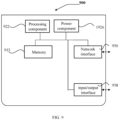
- an embodiment of the disclosure illustrates an architecture of a communication device 900.
- the communication device 900 may be provided as a network side device.
- the communication device may be the network element described above.
- the communication device 900 includes a processing component 922 consisting of one or more processors, and memory resources represented by a memory 932 for storing instructions that may be executed by the processing component 922, such as applications.
- the applications stored in the memory 932 may include one or more modules each corresponding to a set of instructions.
- the processing component 922 is configured to execute the instructions to perform any of the methods described above that are performed by the access device, for example, the methods shown in FIG. 2, FIG. 3 , FIG. 4A, FIG. 4B and FIG. 5 .
- the communication device 900 may also include a power component 926 configured to perform power management of the communication device 900, a wired or wireless network interface 950 configured to connect the communication device 900 to a network, and an input/output (I/O) interface 958.
- the communication device 900 may operate based on an operating system stored in the memory 932, such as Windows Server TM , Mac OS X TM , Unix TM , Linux TM , FreeBSD TM , or the like.
Landscapes
- Engineering & Computer Science (AREA)
- Computer Networks & Wireless Communication (AREA)
- Signal Processing (AREA)
- Computer Security & Cryptography (AREA)
- Mobile Radio Communication Systems (AREA)
Applications Claiming Priority (1)
| Application Number | Priority Date | Filing Date | Title |
|---|---|---|---|
| PCT/CN2021/129396 WO2023077526A1 (fr) | 2021-11-08 | 2021-11-08 | Procédé et appareil de commutation de mode d'accès, dispositif de communication et support de stockage |
Publications (2)
| Publication Number | Publication Date |
|---|---|
| EP4432737A1 true EP4432737A1 (fr) | 2024-09-18 |
| EP4432737A4 EP4432737A4 (fr) | 2025-01-01 |
Family
ID=86240607
Family Applications (1)
| Application Number | Title | Priority Date | Filing Date |
|---|---|---|---|
| EP21963035.7A Pending EP4432737A4 (fr) | 2021-11-08 | 2021-11-08 | Procédé et appareil de commutation de mode d'accès, dispositif de communication et support de stockage |
Country Status (4)
| Country | Link |
|---|---|
| US (1) | US20250008382A1 (fr) |
| EP (1) | EP4432737A4 (fr) |
| CN (1) | CN116420383A (fr) |
| WO (1) | WO2023077526A1 (fr) |
Family Cites Families (9)
| Publication number | Priority date | Publication date | Assignee | Title |
|---|---|---|---|---|
| WO2021026744A1 (fr) * | 2019-08-12 | 2021-02-18 | Oppo广东移动通信有限公司 | Procédé de configuration de stratégie, équipement réseau et équipement terminal |
| CN112822756B (zh) * | 2019-10-30 | 2022-09-06 | 中国电信股份有限公司 | 通信方法、系统以及基站、终端 |
| US11665632B2 (en) * | 2020-01-02 | 2023-05-30 | Apple Inc. | Non-public wireless communication networks |
| US11770751B2 (en) * | 2020-01-31 | 2023-09-26 | Nokia Solutions And Networks Oy | Signaling for target-initiated conditional handover modification via cancellation |
| CN115299104B (zh) * | 2020-03-16 | 2024-07-05 | 鸿颖创新有限公司 | 用于非公共网络控制机制的无线通信方法和用户设备 |
| US11589276B2 (en) * | 2020-04-08 | 2023-02-21 | FG Innovation Company Limited | Method and user equipment for cell (re)selection |
| BR112022020547A2 (pt) * | 2020-04-21 | 2022-12-06 | Qualcomm Inc | Seleção de rede para um equipamento de usuário em roaming |
| CN115777214A (zh) * | 2020-05-21 | 2023-03-10 | Idac控股公司 | 实现独立非公共网与公共陆地移动网之间的服务连续性 |
| JP7776929B2 (ja) * | 2020-05-21 | 2025-11-27 | シャープ株式会社 | UE(User Equipment)及び通信制御方法 |
-
2021
- 2021-11-08 US US18/708,190 patent/US20250008382A1/en active Pending
- 2021-11-08 EP EP21963035.7A patent/EP4432737A4/fr active Pending
- 2021-11-08 CN CN202180003821.9A patent/CN116420383A/zh active Pending
- 2021-11-08 WO PCT/CN2021/129396 patent/WO2023077526A1/fr not_active Ceased
Also Published As
| Publication number | Publication date |
|---|---|
| CN116420383A (zh) | 2023-07-11 |
| WO2023077526A1 (fr) | 2023-05-11 |
| US20250008382A1 (en) | 2025-01-02 |
| EP4432737A4 (fr) | 2025-01-01 |
Similar Documents
| Publication | Publication Date | Title |
|---|---|---|
| US12349104B2 (en) | Paging processing method and apparatus, user equipment, base station, and storage medium | |
| WO2022016431A1 (fr) | Procédé et appareil de transfert de cellule, dispositif de communication et support de stockage | |
| US12309629B2 (en) | Information processing methods, user equipment, and base station | |
| US12245089B2 (en) | Handover processing method and apparatus | |
| US20230007720A1 (en) | Method and apparatus for processing radio link failure, and computer storage medium | |
| US20230094982A1 (en) | Method and device for communication processing | |
| EP4329402A1 (fr) | Procédé et appareil pour rapporter des informations de capacité de terminal, dispositif de communication et support de stockage | |
| CN110431863A (zh) | 跟踪区更新方法及装置、通信设备及存储介质 | |
| CN117858128B (zh) | 提早识别的方法、装置、通信设备及存储介质 | |
| EP4380234A1 (fr) | Procédé et appareil de resélection de cellule, dispositif de communication, et support de stockage | |
| US20240244557A1 (en) | Method and apparatus for transmitting capability indication information, communication device, and storage medium | |
| EP4277333A1 (fr) | Procédé et appareil de balayage de faisceau, dispositif de communication et support de stockage | |
| KR20240007657A (ko) | 네트워크 선택 정보의 전송 방법, 장치, 통신 장치 및 저장 매체 | |
| US20250301389A1 (en) | Mobility event processing method and apparatus, and communication device and storage medium | |
| EP4432737A1 (fr) | Procédé et appareil de commutation de mode d'accès, dispositif de communication et support de stockage | |
| US20250227663A1 (en) | Method for determining paging restriction rule, communication device, and storage medium | |
| EP4447495A1 (fr) | Procédé et appareil de traitement d'informations, dispositif de communication et support de stockage | |
| US20240244582A1 (en) | Method and apparatus for determining paging group, and communication device, and storage medium | |
| US20230199896A1 (en) | Method and apparatus for transferring service, communication device and storage medium | |
| US20250317725A1 (en) | Method for relay communication, and terminal | |
| WO2022110057A1 (fr) | Procédé et appareil de communication sans fil, ainsi que dispositif de communication et support de stockage | |
| EP4561184A1 (fr) | Appareil et procédé de transmission d'informations, dispositif de communication et support de stockage | |
| US20250261009A1 (en) | Measurement method and apparatus, communication device, and storage medium | |
| EP4572455A1 (fr) | Procédé et appareil de positionnement de télémétrie ou de liaison latérale, dispositif de communication et support de stockage | |
| EP4589894A1 (fr) | Procédé et appareil de communication sans fil pour services de proximité (prose), et dispositif de communication et support de stockage |
Legal Events
| Date | Code | Title | Description |
|---|---|---|---|
| STAA | Information on the status of an ep patent application or granted ep patent |
Free format text: STATUS: THE INTERNATIONAL PUBLICATION HAS BEEN MADE |
|
| PUAI | Public reference made under article 153(3) epc to a published international application that has entered the european phase |
Free format text: ORIGINAL CODE: 0009012 |
|
| STAA | Information on the status of an ep patent application or granted ep patent |
Free format text: STATUS: REQUEST FOR EXAMINATION WAS MADE |
|
| 17P | Request for examination filed |
Effective date: 20240605 |
|
| AK | Designated contracting states |
Kind code of ref document: A1 Designated state(s): AL AT BE BG CH CY CZ DE DK EE ES FI FR GB GR HR HU IE IS IT LI LT LU LV MC MK MT NL NO PL PT RO RS SE SI SK SM TR |
|
| A4 | Supplementary search report drawn up and despatched |
Effective date: 20241129 |
|
| RIC1 | Information provided on ipc code assigned before grant |
Ipc: H04W 48/18 20090101ALI20241125BHEP Ipc: H04W 48/16 20090101AFI20241125BHEP |
|
| DAV | Request for validation of the european patent (deleted) | ||
| DAX | Request for extension of the european patent (deleted) |