EP4435376A1 - Procédé et système de mesure de la position d'un code de matrice de données à partir des bords de référence d'une feuille de verre rectangulaire - Google Patents
Procédé et système de mesure de la position d'un code de matrice de données à partir des bords de référence d'une feuille de verre rectangulaire Download PDFInfo
- Publication number
- EP4435376A1 EP4435376A1 EP23163715.8A EP23163715A EP4435376A1 EP 4435376 A1 EP4435376 A1 EP 4435376A1 EP 23163715 A EP23163715 A EP 23163715A EP 4435376 A1 EP4435376 A1 EP 4435376A1
- Authority
- EP
- European Patent Office
- Prior art keywords
- data matrix
- matrix code
- glass
- raster image
- rectangular sheet
- Prior art date
- Legal status (The legal status is an assumption and is not a legal conclusion. Google has not performed a legal analysis and makes no representation as to the accuracy of the status listed.)
- Withdrawn
Links
Images



Classifications
-
- G—PHYSICS
- G01—MEASURING; TESTING
- G01B—MEASURING LENGTH, THICKNESS OR SIMILAR LINEAR DIMENSIONS; MEASURING ANGLES; MEASURING AREAS; MEASURING IRREGULARITIES OF SURFACES OR CONTOURS
- G01B11/00—Measuring arrangements characterised by the use of optical techniques
- G01B11/002—Measuring arrangements characterised by the use of optical techniques for measuring two or more coordinates
-
- G—PHYSICS
- G05—CONTROLLING; REGULATING
- G05B—CONTROL OR REGULATING SYSTEMS IN GENERAL; FUNCTIONAL ELEMENTS OF SUCH SYSTEMS; MONITORING OR TESTING ARRANGEMENTS FOR SUCH SYSTEMS OR ELEMENTS
- G05B19/00—Program-control systems
- G05B19/02—Program-control systems electric
- G05B19/418—Total factory control, i.e. centrally controlling a plurality of machines, e.g. direct or distributed numerical control [DNC], flexible manufacturing systems [FMS], integrated manufacturing systems [IMS] or computer integrated manufacturing [CIM]
- G05B19/4183—Total factory control, i.e. centrally controlling a plurality of machines, e.g. direct or distributed numerical control [DNC], flexible manufacturing systems [FMS], integrated manufacturing systems [IMS] or computer integrated manufacturing [CIM] characterised by data acquisition, e.g. workpiece identification
-
- G—PHYSICS
- G05—CONTROLLING; REGULATING
- G05B—CONTROL OR REGULATING SYSTEMS IN GENERAL; FUNCTIONAL ELEMENTS OF SUCH SYSTEMS; MONITORING OR TESTING ARRANGEMENTS FOR SUCH SYSTEMS OR ELEMENTS
- G05B2219/00—Program-control systems
- G05B2219/30—Nc systems
- G05B2219/45—Nc applications
- G05B2219/45001—Antenna orientation
-
- G—PHYSICS
- G05—CONTROLLING; REGULATING
- G05B—CONTROL OR REGULATING SYSTEMS IN GENERAL; FUNCTIONAL ELEMENTS OF SUCH SYSTEMS; MONITORING OR TESTING ARRANGEMENTS FOR SUCH SYSTEMS OR ELEMENTS
- G05B2219/00—Program-control systems
- G05B2219/30—Nc systems
- G05B2219/45—Nc applications
- G05B2219/45018—Car, auto, vehicle
-
- G—PHYSICS
- G06—COMPUTING OR CALCULATING; COUNTING
- G06K—GRAPHICAL DATA READING; PRESENTATION OF DATA; RECORD CARRIERS; HANDLING RECORD CARRIERS
- G06K7/00—Methods or arrangements for sensing record carriers, e.g. for reading patterns
- G06K7/10—Methods or arrangements for sensing record carriers, e.g. for reading patterns by electromagnetic radiation, e.g. optical sensing; by corpuscular radiation
- G06K7/14—Methods or arrangements for sensing record carriers, e.g. for reading patterns by electromagnetic radiation, e.g. optical sensing; by corpuscular radiation using light without selection of wavelength, e.g. sensing reflected white light
- G06K7/1404—Methods for optical code recognition
- G06K7/1439—Methods for optical code recognition including a method step for retrieval of the optical code
- G06K7/1443—Methods for optical code recognition including a method step for retrieval of the optical code locating of the code in an image
Definitions
- the present invention relates to a method and a system for measuring the position of a data matrix code from the reference edges of a rectangular glass sheet onto which said data matrix code is marked.
- WO 2005/015478 A1 TECHNOLOGY TRANSFER SERVICE CO [JP] 17.02.2005 describes a method for designing a data matrix code on a glass substrate by means of computer-controlled laser.
- WO 2007/033445 A1 LASER ENGINEERING APPLIC S A E [BE] 29.03.2007 describes a method for marking a data matrix code on a glass substrate by using the radiation of a diode-pumped femtosecond laser.
- WO 2018/096258 A1 SAINT GOBAIN [FR] 31.05.2018 of describes a method for marking a data matrix code on the surface a transparent mineral glass sheet by means of a laser radiation.
- Data matrix codes may allow to digitally store, as encoded information, a variety of information related to the properties, the origin, and the final use of the glass sheets and to its manufacturing process. For example, it may store a unique identification number to allow an identification of the sheets within a final glass product, such as insulated glazing, and/or store information related to their manufacturing location, their production date and time or the identity of the customer to which they may be shipped.
- the data matrix codes marked on their surface are generally aimed to be detected, read and decoded several times by different kinds of detecting, reading and decoding processes and devices.
- WO 2020/157260 A1 SAINT GOBAIN [FR] 06.08.2020 describes a method and a device to read data matrix code on a transparent glass sheet with a portable device equipped with an optical imaging system.
- the portable device is placed in front of the code on one side of the glass sheet while said code is illuminated by a light source located at the other side.
- WO 2022/042961 A1 SAINT GOBAIN [FR] 02.03.2022 describes a method for detecting and reading data matrix code in an image of a marked glass substrate through an image processing algorithm based on chained convolutional artificial neural networks.
- WO 2022/195034 A1 SAINT GOBAIN [FR] 22.09.2022 describes a method for reading data matrix code marked on a transparent glass sheet by projecting said code on a projection screen.
- a common requirement to enable its subsequent reading and decoding by any reading / decoding device is that the marking method is capable of marking the codes in the same location on each of the successively processed sheets of glass.
- the data matrix code may be marked along one edge of the sheet of glass or within one of its corners, i.e., within the region where two edges are intersecting.
- the marking process should be able to mark a code on each sheet of glass at the same location, i.e., according to a setpoint for the location that the process should follow.
- the actual location may so depart from the setpoint that the laser may cross over the edge of the sheet of glass and only a portion, if any, of the data matrix code may be marked on the sheet of glass.
- the data matrix code may still be marked on the sheet of glass but at a location so far from the setpoint that, during the further processing of the sheet of glass, the reading / decoding device may be unable to find the code at the expected location.
- the location of the data matric code is too far from the edges of the sheet of glass, the data matrix code may become useless as a support of encoded information for the final product, e.g., an insulated glazing or a windshield.
- a data processing device for carry out a method according to the first aspect of the invention.
- a computer program comprising instructions which, when the program is executed by a computer, cause the computer to carry out a method according to the first aspect of the invention.
- a system for measuring the position of a data matrix code from the reference edges of a rectangular sheet of glass onto which said data matrix code is marked said system comprises a data processing device according to the second aspect of the invention.
- An outstanding advantage of the method according to the invention is to provide an accurate measure of the distances of a data matrix code from the reference edges of a rectangular sheet of glass.
- time-based statistics may be derived from the measured values, and the ability of a marking process to follow a setpoint value within a standard deviation range may be checked.
- a capability index of the process may also be computed or derived thereafter.
- Another advantage of the invention is that it may be implemented on any existing lines with limited time and financial efforts. It may be used to measure the capability of any existing laser marking process provided that images of the marked codes may be acquired by a digital acquisition device and, thereafter, processed with a data processing device comprising means for carrying out the method according to the invention. It may also be used as part of a feedback control loop in the marking process to ensure that the process marks a code on each sheet of glass at the same location, i.e., according to a setpoint for the location that the process should follow.
- a laser engraving process for marking a data matrix code may comprise a laser 1, a beam transportation system 2, and an optical focusing system 3 for the laser beam 4.
- the data matrix code 5 is engraved onto a rectangular sheet 6 of glass.
- the information stored in the data matrix code 5 may then be read by a reading system 7.
- the sheet of glass may be made of mineral or organic glass.
- it is made of mineral glass such as soda-lime silicate glass, borosilicate glass or aluminosilicate glass.
- the expression 'data matrix code' should be interpreted according to its common definition in the field of symbology for encoding information, i.e., as a two-dimensional matrix symbology as defined and described in the ISO standard 16022:2006.
- a data matrix code 2002 is marked on the surface, or just underneath the surface, of the rectangular sheet 2001 of glass.
- the data matrix code 2002 has a width, w, and a length, l.
- the length, l is equal to the width, w.
- the location of the code 2002 from the edges 2001a, 2001b of the rectangular sheet 2001 of glass may be measured through different but equivalent manners.
- the centroid 2002a of the code 2002 the location may be represented by the distance x, y from the edges 2001a, 2001b of the rectangular sheet 2001 of glass.
- one of the corners of the code 2002 it may be represented by the distances of said corner from the edges 2001a, 2001b of the rectangular sheet 2001 of glass.
- the code 2002 may be located at distance D(x), D(y) from the edges 2001a, 2001b of the rectangular sheet 2001 of glass.
- any other reference point which may be representative of the location of the code 2002 from the edges 2001a, 2001b of the rectangular sheet 2001 of glass may be used equivalently.
- an efficient marking method should be able to mark the codes 2002 at the same location on each of the rectangular sheets 2001 of glass that are successively processed.
- the codes 2002 marked by the method should be located at a setpoint location, which is represented by the coordinates (x0, y0) on the Fig. 2 .
- a raster image should be understood according to its common definition in the field of computer graphics, i.e., as a two-dimensional picture, e.g., a rectangular matrix of pixels, each pixel being encoded with a given number of bits.
- Examples of raster images may be 1-bits, 8-bits, 16-bits, 32-bits, or 64-bits images with one or more colour channel.
- a 1-bit or 8-bits image with one channel e.g., a 1-bit black and white image or 8-bits grey scaled image, may be enough for implementing the method of the invention, but an image with a greater bit depth may work as well.
- the reference edges 2001ab 2001b of the rectangular sheet 2002 of glass may be oriented in any direction compared to the directions of the reference frame (O, X, Y) of the said raster image 2003, i.e., compared to the line and column directions of the raster image 2003.
- the reference edges 2001a, 2001b may advantageously be oriented in directions that are substantially parallel to the directions of the reference frame (O, X, Y) of the raster image 2003. Such arrangement may ease the detection 3001 of the two reference edges 2001a, 2001b in the raster image 2003.
- the coordinates of the reference edges 2001a, 2001b in the reference frame (O, X, Y) of the raster image may be expressed in any adapted form.
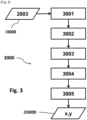
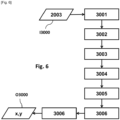
- the step (a) of detecting the reference edges 2001a, 2001b in the raster image 2003 may comprise the following sub-steps:
- a convolution kernel should be interpreted according to its common definition in the field of image processing, i.e., as a filter matrix used in convolution operations that are performed on an image.
- the convolution kernel is an edge detection kernel.
- the convolution kernel is selected among Prewitt operator, Sobel operator, Laplacian operator, or any operator derived thereof.
- the size of the convolution kernel may be adapted according to the properties, e.g., the resolution, the encoding format, the number of channels, of the raster image 2003.
- the reference edges 2001a, 2001b may often appear as very finely contrasted features which are not easy to detect because of the transparent nature of the glass.
- the convolution kernel in step (a1) and the convolution kernel in step (a2) may be Prewitt operators, wherein the convolution kernel in step (a1) may have a size of 3x50 with a [-1;0;1] array as columns, and the convolution kernel in step (a2) may have a size of 50x3 with a [-1;0;1] array as lines.
- the so designed convolution kernels act as discrete operators that locally approximate the gradient of the intensity function within the raster images. Fine features such as the reference edges 2001a, 2001b of the rectangular sheet 2001 of glass are better detected
- the step (c) of detecting the data matrix code 2002 in the raster image 2003 may comprise the following sub-steps:
- the convolution of the raster image 2003 with a low-pass filter kernel allows to blur said raster image to remove noisy pixel and white pixel corresponding to dust particles which may have been present on the sheet 2002 of glass when the raster image 2003 thereof has been acquired.
- the low-pass filter kernel is a gaussian filter kernel.
- the standard deviation of said gaussian filter kernel may be comprised between 3 and 6, preferably fixed to 5.
- the step (c) of detecting the data matrix code 2002 in the raster image 2003 may further comprise, between sub-steps (c2) and (c3), a sub-step (c2a) of performing a morphological opening. This operation may help to remove pixels which may be erroneously depicted as white during the binarization operation of step (c2). The pattern recognition performed at step (c3) may thereafter be more efficient.
- the geometric size, e.g., the width, w, and/or the length, l, of the data matrix code 2002 may potentially vary depending on, for instance, the specifications required by the manufacturer of the sheet 2002 of glass. It then may be advantageous to be able to measure the distances (D(x), D(y)) between the reference edges 2001a, 2001b and the closest corner and/or sides of data matrix code 2002 to said two reference edges 2001a, 2001b without prior knowledge of the geometric size of the data matrix code 2002.
- the method 3000 may further comprise the following steps:
- the calculated Euclidian distances (x, y) between the centroid 2002a of the data matrix code 2002 and the references edges 2001a, 2001b of the rectangular sheet 2001 of glass, or the Euclidian distances (D(x), D(y)) between the closest corner 2002e(1) of the data matrix code 2002 and said reference edges 2001a, 2001b may be expressed in pixels or in units of length.
- a conversion scale may be fixed for converting pixels into units of length and inversely.
- the method according may advantageously comprise a calibration step where raster images of objects with fixed and known geometric dimensions are processed to establish a conversion scale.
- a conversion scale may be provided as an input parameter to the method.
- Another way may be to provide a conversion scale calculated from the processing of raster images when the real geometric dimensions of the data matrix code are previously known.
- the raster image 2003 provided as input data I3000 to the method may be a brightfield or darkfield image.
- the raster image 2003 may be a darkfield image since boundaries, shapes, or edges of transparent or translucent materials may be better revealed.
- Darkfield raster images may then be highly advantageous for measuring the position of a data matrix code on a transparent sheet of glass as they may ease the detection of the reference edges 2001a, 2001b and of the data matrix code 2002.
- the raster may be advantageously submitted to an operation that inverts the colours of the image, in particular when the image is a binarized black and white image, as the boundaries, shapes, or edges of transparent or translucent materials may be better revealed that way.
- the method according to the invention may be adapted to take, as input, a plurality of raster images in order, for instance, to get a dataset of measures of the distances between the data matrix code 2002 and the reference edges 2001a, 2001b of the rectangular sheet 2001 of glass. Statistics may then be built from this dataset in order, for instance, to evaluate the capacity of a marking process to mark a data matrix code 2002 from the reference edges 2001a, 2001b of a rectangular sheet 2001 of glass.
- the method 3000 may take, as input data, a dataset comprising a plurality of raster images 2003 of a portion of a plurality of different rectangular sheets 2001 of glass marked with a data matrix code 2002;
- a dataset of measures of the distances between the data matrix code 2002 and the reference edges 2001a, 2001b of the rectangular sheet 2001 of glass may also be used to build statistic to evaluate the ability of a marking process to follow a setpoint value within a standard deviation range for the location of a data matrix code 2002 to be marked on a rectangular sheet 2001 of glass.
- the method 3000 may further take, as input, a setpoint value for the distances at which a data matrix code is to be marked from the reference edges of a rectangular sheets of glass, and a standard deviation range from said setpoint value; wherein said method further comprises the following steps:
- the standard deviation range may be 1,5 or 3 times the value of the standard deviation.
- the method may provide a percentage of values within the dataset of distances which are inside and/or outside the standard deviation range.
- an alert may be implemented informing a user when the percentage of values which are outside the standard deviation range is above a given threshold.
- the method may also comprise a step of computing at least one process capability index from the dataset of measures and provides its value as output.
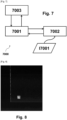
- a data processing system 7000 comprising means for carrying out a method according to any embodiments of the first aspect of the invention.
- a first example of means for carrying out the method may be a device 7001 which can be instructed to carry out sequences of arithmetic or logical operations automatically to perform tasks or actions.
- Such device may comprise one or more Central Processing Unit (CPU) and at least a controller device that are adapted to perform those operations.
- CPU Central Processing Unit
- controller device that are adapted to perform those operations.
- the device may further comprise other electronic components like input/output interfaces 7003, non-volatile or volatile storages devices 7002, and buses that are communication systems for the data transfer between components inside a computer, or between computers.
- One of the input/output devices may be user interface for human-machine interaction, for example graphical user interface to display human understandable information.
- a computer program I7001 comprising instructions which, when the program is executed by a computer, cause the computer to carry out a method according to any embodiments of the first aspect of the invention.
- the computer program can be part of a software solution, i.e., part of a collection of executable instructions, code, scripts or the like and/or databases.
- the computer program may be stored is on a computer-readable non-transitory medium 7002. Accordingly, such computer-readable non-transitory medium 7002 may comprise instructions which, when executed by a computer, cause the computer to carry out the method according to any of the embodiments described herein.
- the computer-readable medium 7002 may be preferably a non-volatile storage or memory, for example a hard disk drive or a flash/non-flash solid-state drive.
- the computer-readable medium can be removable storage media or a non-removable storage media as part of a computer.
- the computer-readable medium 7002 may be a volatile memory inside a removable media. This can ease the deployment of the invention into many production sites.
- a system for measuring the position of a data matrix code 2002 from the reference edges 2001a, 2001b of a rectangular sheet 2001 of glass onto which said data matrix code 2002 is marked comprising:
- raster image of a portion of a rectangular sheet of transparent mineral glass onto which a data matrix code is marked is illustrated on Fig. 8 .
- the raster image is a darkfield image in which the two intersecting reference edges of the sheet of glass and boundaries of the data matric code are better revealed than in a brightfield image.
- the raster image was provided as input data to a method according to the first aspect of the invention.
- the detection of the reference edges was performed according to certain embodiments of the methos, wherein a Prewitt convolution kernel was applied is the lines and columns directions of the raster image.
- the convolution kernel had a size of 3x50 with a [-1;0;1] array as columns, and, in the line direction, the convolution kernel had a size of 50x3 with a [-1;0;1] array as lines. Then, the values of pixels in each column of the convolved image and in each line of the convolved image obtained were summed.
- Fig. 9 The results of the summation are illustrated on Fig. 9 where on the bottom graph is plotted the summation over the columns and on the right graph is plotted the summation over lines.
- the positions, i.e., the coordinates within the reference frame (O, X, Y) of the image, of the reference edges of the rectangular sheet are provided by the maxima of the summed values on each graph.
- Straight solid lines corresponding to the maxima are drawn onto the central image of Fig. 9 which is a reproduction of the raster image of the Fig. 8 .
- the raster image was convolved with a Gaussian filter before to be binarized and subject to an operation of a pattern recognition with a bounding box patter. Finally, the Euclidian distances between the centroid of the data matrix and the reference edges of the rectangular sheet of glass were computed according to invention.
- the method had been carried out on a dataset of raster images of a portion of a plurality of different rectangular sheets of glass marked with a data matrix code.
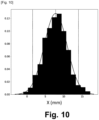
- a statistical distribution of the dataset of computed distances in the X direction was performed and is illustrated on Fig. 10 .
- the distances show a normal distribution spreading over a mean value of 7,5 mm, which is the setpoint value.
- the two dashed lines at 2 mm and 14 mm delimits a standard deviation range. Any values outside the deviation range indicate that the marking process is out of the specifications regarding the location of the data matrix code. When the relative percentage of values which are outside the deviation range compared to those which are inside reach a given threshold, the marking process may be no longer able to mark the data matrix within the specifications and may require maintenance.
- the method may be advantageously implemented to monitor the capability of a marking process to mark data matrix code on a rectangular sheet of glass according to given specifications for the location of the data matrix code on said rectangular sheet.
- a process capability index may be computed from the dataset of measures.
Landscapes
- Engineering & Computer Science (AREA)
- Physics & Mathematics (AREA)
- General Physics & Mathematics (AREA)
- General Engineering & Computer Science (AREA)
- Manufacturing & Machinery (AREA)
- Quality & Reliability (AREA)
- Automation & Control Theory (AREA)
- Image Analysis (AREA)
- Image Processing (AREA)
Priority Applications (3)
| Application Number | Priority Date | Filing Date | Title |
|---|---|---|---|
| EP23163715.8A EP4435376A1 (fr) | 2023-03-23 | 2023-03-23 | Procédé et système de mesure de la position d'un code de matrice de données à partir des bords de référence d'une feuille de verre rectangulaire |
| EP24713963.7A EP4684183A1 (fr) | 2023-03-23 | 2024-03-22 | Procédé et système de mesure de position d'un code matriciel de données à partir des bords de référence d'une feuille de verre rectangulaire |
| PCT/EP2024/057772 WO2024194461A1 (fr) | 2023-03-23 | 2024-03-22 | Procédé et système de mesure de position d'un code matriciel de données à partir des bords de référence d'une feuille de verre rectangulaire |
Applications Claiming Priority (1)
| Application Number | Priority Date | Filing Date | Title |
|---|---|---|---|
| EP23163715.8A EP4435376A1 (fr) | 2023-03-23 | 2023-03-23 | Procédé et système de mesure de la position d'un code de matrice de données à partir des bords de référence d'une feuille de verre rectangulaire |
Publications (1)
| Publication Number | Publication Date |
|---|---|
| EP4435376A1 true EP4435376A1 (fr) | 2024-09-25 |
Family
ID=85726519
Family Applications (2)
| Application Number | Title | Priority Date | Filing Date |
|---|---|---|---|
| EP23163715.8A Withdrawn EP4435376A1 (fr) | 2023-03-23 | 2023-03-23 | Procédé et système de mesure de la position d'un code de matrice de données à partir des bords de référence d'une feuille de verre rectangulaire |
| EP24713963.7A Pending EP4684183A1 (fr) | 2023-03-23 | 2024-03-22 | Procédé et système de mesure de position d'un code matriciel de données à partir des bords de référence d'une feuille de verre rectangulaire |
Family Applications After (1)
| Application Number | Title | Priority Date | Filing Date |
|---|---|---|---|
| EP24713963.7A Pending EP4684183A1 (fr) | 2023-03-23 | 2024-03-22 | Procédé et système de mesure de position d'un code matriciel de données à partir des bords de référence d'une feuille de verre rectangulaire |
Country Status (2)
| Country | Link |
|---|---|
| EP (2) | EP4435376A1 (fr) |
| WO (1) | WO2024194461A1 (fr) |
Citations (10)
| Publication number | Priority date | Publication date | Assignee | Title |
|---|---|---|---|---|
| WO2005015478A1 (fr) | 2003-08-11 | 2005-02-17 | Technology Transfer Service Corp. | Procede et dispositif de formation de code bidimensionnel |
| WO2007033445A1 (fr) | 2005-09-22 | 2007-03-29 | Trackinside, Société Anonyme | Dispositif et procede de marquage interne par laser |
| WO2015121550A1 (fr) | 2014-02-11 | 2015-08-20 | Saint-Gobain Glass France | Dispositif de lecture d'un code d'identification sur une feuille de verre en defilement |
| CN205507818U (zh) * | 2015-12-21 | 2016-08-24 | 洛阳兰迪玻璃机器股份有限公司 | 一种玻璃板 |
| WO2018096258A1 (fr) | 2016-11-24 | 2018-05-31 | Saint-Gobain Glass France | Procede d'obtention de plaques de verre marquees. |
| CN207914781U (zh) * | 2018-02-05 | 2018-09-28 | 洛阳兰迪玻璃机器股份有限公司 | 一种玻璃板激光打码机 |
| WO2020157272A1 (fr) * | 2019-01-31 | 2020-08-06 | Saint-Gobain Glass France | Procédé d'acquisition d'images de codes marqués sur une pluralité de feuilles transparentes et installation correspondante |
| WO2020157260A1 (fr) | 2019-01-31 | 2020-08-06 | Saint-Gobain Glass France | Procede de lecture manuelle d'un code, et dispositif associé |
| WO2022042961A1 (fr) | 2020-08-24 | 2022-03-03 | Saint-Gobain Glass France | Procédé de détection et de lecture d'un code matriciel marqué sur un substrat en verre |
| WO2022195034A1 (fr) | 2021-03-19 | 2022-09-22 | Saint-Gobain Glass France | Procédé d'acquisition d'un code marqué sur une feuille de verre ou de vitrocéramique, et système correspondant |
-
2023
- 2023-03-23 EP EP23163715.8A patent/EP4435376A1/fr not_active Withdrawn
-
2024
- 2024-03-22 WO PCT/EP2024/057772 patent/WO2024194461A1/fr not_active Ceased
- 2024-03-22 EP EP24713963.7A patent/EP4684183A1/fr active Pending
Patent Citations (10)
| Publication number | Priority date | Publication date | Assignee | Title |
|---|---|---|---|---|
| WO2005015478A1 (fr) | 2003-08-11 | 2005-02-17 | Technology Transfer Service Corp. | Procede et dispositif de formation de code bidimensionnel |
| WO2007033445A1 (fr) | 2005-09-22 | 2007-03-29 | Trackinside, Société Anonyme | Dispositif et procede de marquage interne par laser |
| WO2015121550A1 (fr) | 2014-02-11 | 2015-08-20 | Saint-Gobain Glass France | Dispositif de lecture d'un code d'identification sur une feuille de verre en defilement |
| CN205507818U (zh) * | 2015-12-21 | 2016-08-24 | 洛阳兰迪玻璃机器股份有限公司 | 一种玻璃板 |
| WO2018096258A1 (fr) | 2016-11-24 | 2018-05-31 | Saint-Gobain Glass France | Procede d'obtention de plaques de verre marquees. |
| CN207914781U (zh) * | 2018-02-05 | 2018-09-28 | 洛阳兰迪玻璃机器股份有限公司 | 一种玻璃板激光打码机 |
| WO2020157272A1 (fr) * | 2019-01-31 | 2020-08-06 | Saint-Gobain Glass France | Procédé d'acquisition d'images de codes marqués sur une pluralité de feuilles transparentes et installation correspondante |
| WO2020157260A1 (fr) | 2019-01-31 | 2020-08-06 | Saint-Gobain Glass France | Procede de lecture manuelle d'un code, et dispositif associé |
| WO2022042961A1 (fr) | 2020-08-24 | 2022-03-03 | Saint-Gobain Glass France | Procédé de détection et de lecture d'un code matriciel marqué sur un substrat en verre |
| WO2022195034A1 (fr) | 2021-03-19 | 2022-09-22 | Saint-Gobain Glass France | Procédé d'acquisition d'un code marqué sur une feuille de verre ou de vitrocéramique, et système correspondant |
Also Published As
| Publication number | Publication date |
|---|---|
| EP4684183A1 (fr) | 2026-01-28 |
| WO2024194461A1 (fr) | 2024-09-26 |
Similar Documents
| Publication | Publication Date | Title |
|---|---|---|
| CN106960208B (zh) | 一种仪表液晶数字自动切分和识别的方法及系统 | |
| CN105069394B (zh) | 二维码加权平均灰度法解码方法及系统 | |
| US12086681B2 (en) | Method for detecting and reading a matrix code marked on a glass substrate | |
| Shaukat et al. | Visual classification of waste material for nuclear decommissioning | |
| US9286501B2 (en) | Method and device for identifying a two-dimensional barcode | |
| US9652652B2 (en) | Method and device for identifying a two-dimensional barcode | |
| KR101182173B1 (ko) | 차량 번호판 인식 방법 및 시스템 | |
| US20210248428A1 (en) | Automated pixel-wise labeling of rock cuttings based on convolutional neural network-based edge detection | |
| CN115937059A (zh) | 具有生成式训练模型的零件检查系统 | |
| CN115409787A (zh) | 小型可插拔收发光模块底座缺陷的检测方法 | |
| CN113312937A (zh) | 条形码识别方法及装置、存储介质、计算机设备 | |
| CN118520893A (zh) | 一种应用于aoi的条形码标签识别的方法、装置及存储介质 | |
| CN112329496B (zh) | 矩形二维码识别方法、装置及电子设备 | |
| EP4435376A1 (fr) | Procédé et système de mesure de la position d'un code de matrice de données à partir des bords de référence d'une feuille de verre rectangulaire | |
| Peisheng et al. | A stereoscopic warehouse stocktaking method based on machine vision | |
| US20130163871A1 (en) | System and method for segmenting image data to identify a character-of-interest | |
| CN111932469B (zh) | 显著性权重的快速曝光图像融合方法、装置、设备和介质 | |
| WO2013126286A1 (fr) | Système et procédé de segmentation de données image pour identifier un caractère d'intérêt | |
| CN107025669A (zh) | 一种物流分拣中的快递单切单方法 | |
| CN120317267A (zh) | 一种基于飞行时间相机的条形码识别方法和系统 | |
| CN120782868B (zh) | 面向屏幕视觉检测的特征点定位方法、系统及存储介质 | |
| CN116894937B (zh) | 获取车轮定位仪参数的方法、系统及电子设备 | |
| CN117152754A (zh) | 信息码识别方法、装置、设备及存储介质 | |
| Soares | Dynamic and Intelligent Optimization of the Data Matrix Part Reading Process | |
| CN117974578A (zh) | 光伏玻璃丝印边缘缺陷检测方法、装置及电子设备 |
Legal Events
| Date | Code | Title | Description |
|---|---|---|---|
| PUAI | Public reference made under article 153(3) epc to a published international application that has entered the european phase |
Free format text: ORIGINAL CODE: 0009012 |
|
| STAA | Information on the status of an ep patent application or granted ep patent |
Free format text: STATUS: THE APPLICATION HAS BEEN PUBLISHED |
|
| AK | Designated contracting states |
Kind code of ref document: A1 Designated state(s): AL AT BE BG CH CY CZ DE DK EE ES FI FR GB GR HR HU IE IS IT LI LT LU LV MC ME MK MT NL NO PL PT RO RS SE SI SK SM TR |
|
| STAA | Information on the status of an ep patent application or granted ep patent |
Free format text: STATUS: THE APPLICATION IS DEEMED TO BE WITHDRAWN |
|
| 18D | Application deemed to be withdrawn |
Effective date: 20250326 |