EP4435724A2 - Videoerzeugungsverfahren und -vorrichtung - Google Patents
Videoerzeugungsverfahren und -vorrichtung Download PDFInfo
- Publication number
- EP4435724A2 EP4435724A2 EP22912123.1A EP22912123A EP4435724A2 EP 4435724 A2 EP4435724 A2 EP 4435724A2 EP 22912123 A EP22912123 A EP 22912123A EP 4435724 A2 EP4435724 A2 EP 4435724A2
- Authority
- EP
- European Patent Office
- Prior art keywords
- image
- image feature
- feature
- target
- neural network
- Prior art date
- Legal status (The legal status is an assumption and is not a legal conclusion. Google has not performed a legal analysis and makes no representation as to the accuracy of the status listed.)
- Pending
Links
Images

Classifications
-
- G—PHYSICS
- G06—COMPUTING OR CALCULATING; COUNTING
- G06N—COMPUTING ARRANGEMENTS BASED ON SPECIFIC COMPUTATIONAL MODELS
- G06N3/00—Computing arrangements based on biological models
- G06N3/02—Neural networks
- G06N3/08—Learning methods
-
- G—PHYSICS
- G06—COMPUTING OR CALCULATING; COUNTING
- G06T—IMAGE DATA PROCESSING OR GENERATION, IN GENERAL
- G06T3/00—Geometric image transformations in the plane of the image
- G06T3/40—Scaling of whole images or parts thereof, e.g. expanding or contracting
- G06T3/4023—Scaling of whole images or parts thereof, e.g. expanding or contracting based on decimating pixels or lines of pixels; based on inserting pixels or lines of pixels
-
- G—PHYSICS
- G06—COMPUTING OR CALCULATING; COUNTING
- G06V—IMAGE OR VIDEO RECOGNITION OR UNDERSTANDING
- G06V10/00—Arrangements for image or video recognition or understanding
- G06V10/40—Extraction of image or video features
- G06V10/44—Local feature extraction by analysis of parts of the pattern, e.g. by detecting edges, contours, loops, corners, strokes or intersections; Connectivity analysis, e.g. of connected components
-
- G—PHYSICS
- G06—COMPUTING OR CALCULATING; COUNTING
- G06N—COMPUTING ARRANGEMENTS BASED ON SPECIFIC COMPUTATIONAL MODELS
- G06N3/00—Computing arrangements based on biological models
- G06N3/02—Neural networks
- G06N3/04—Architecture, e.g. interconnection topology
- G06N3/045—Combinations of networks
-
- G—PHYSICS
- G06—COMPUTING OR CALCULATING; COUNTING
- G06N—COMPUTING ARRANGEMENTS BASED ON SPECIFIC COMPUTATIONAL MODELS
- G06N3/00—Computing arrangements based on biological models
- G06N3/02—Neural networks
- G06N3/04—Architecture, e.g. interconnection topology
- G06N3/047—Probabilistic or stochastic networks
-
- G—PHYSICS
- G06—COMPUTING OR CALCULATING; COUNTING
- G06N—COMPUTING ARRANGEMENTS BASED ON SPECIFIC COMPUTATIONAL MODELS
- G06N3/00—Computing arrangements based on biological models
- G06N3/02—Neural networks
- G06N3/08—Learning methods
- G06N3/088—Non-supervised learning, e.g. competitive learning
-
- G—PHYSICS
- G06—COMPUTING OR CALCULATING; COUNTING
- G06T—IMAGE DATA PROCESSING OR GENERATION, IN GENERAL
- G06T3/00—Geometric image transformations in the plane of the image
- G06T3/40—Scaling of whole images or parts thereof, e.g. expanding or contracting
- G06T3/4007—Scaling of whole images or parts thereof, e.g. expanding or contracting based on interpolation, e.g. bilinear interpolation
-
- G—PHYSICS
- G06—COMPUTING OR CALCULATING; COUNTING
- G06T—IMAGE DATA PROCESSING OR GENERATION, IN GENERAL
- G06T5/00—Image enhancement or restoration
- G06T5/50—Image enhancement or restoration using two or more images, e.g. averaging or subtraction
-
- G—PHYSICS
- G06—COMPUTING OR CALCULATING; COUNTING
- G06V—IMAGE OR VIDEO RECOGNITION OR UNDERSTANDING
- G06V10/00—Arrangements for image or video recognition or understanding
- G06V10/70—Arrangements for image or video recognition or understanding using pattern recognition or machine learning
- G06V10/74—Image or video pattern matching; Proximity measures in feature spaces
- G06V10/761—Proximity, similarity or dissimilarity measures
-
- G—PHYSICS
- G11—INFORMATION STORAGE
- G11B—INFORMATION STORAGE BASED ON RELATIVE MOVEMENT BETWEEN RECORD CARRIER AND TRANSDUCER
- G11B27/00—Editing; Indexing; Addressing; Timing or synchronising; Monitoring; Measuring tape travel
- G11B27/02—Editing, e.g. varying the order of information signals recorded on, or reproduced from, record carriers
- G11B27/031—Electronic editing of digitised analogue information signals, e.g. audio or video signals
-
- H—ELECTRICITY
- H04—ELECTRIC COMMUNICATION TECHNIQUE
- H04N—PICTORIAL COMMUNICATION, e.g. TELEVISION
- H04N21/00—Selective content distribution, e.g. interactive television or video on demand [VOD]
- H04N21/40—Client devices specifically adapted for the reception of or interaction with content, e.g. set-top-box [STB]; Operations thereof
- H04N21/43—Processing of content or additional data, e.g. demultiplexing additional data from a digital video stream; Elementary client operations, e.g. monitoring of home network or synchronising decoder's clock; Client middleware
- H04N21/44—Processing of video elementary streams, e.g. splicing a video clip retrieved from local storage with an incoming video stream or rendering scenes according to encoded video stream scene graphs
- H04N21/44008—Processing of video elementary streams, e.g. splicing a video clip retrieved from local storage with an incoming video stream or rendering scenes according to encoded video stream scene graphs involving operations for analysing video streams, e.g. detecting features or characteristics in the video stream
-
- H—ELECTRICITY
- H04—ELECTRIC COMMUNICATION TECHNIQUE
- H04N—PICTORIAL COMMUNICATION, e.g. TELEVISION
- H04N5/00—Details of television systems
- H04N5/222—Studio circuitry; Studio devices; Studio equipment
- H04N5/262—Studio circuits, e.g. for mixing, switching-over, change of character of image, other special effects ; Cameras specially adapted for the electronic generation of special effects
- H04N5/2625—Studio circuits, e.g. for mixing, switching-over, change of character of image, other special effects ; Cameras specially adapted for the electronic generation of special effects for obtaining an image which is composed of images from a temporal image sequence, e.g. for a stroboscopic effect
-
- G—PHYSICS
- G06—COMPUTING OR CALCULATING; COUNTING
- G06T—IMAGE DATA PROCESSING OR GENERATION, IN GENERAL
- G06T2207/00—Indexing scheme for image analysis or image enhancement
- G06T2207/10—Image acquisition modality
- G06T2207/10016—Video; Image sequence
-
- G—PHYSICS
- G06—COMPUTING OR CALCULATING; COUNTING
- G06T—IMAGE DATA PROCESSING OR GENERATION, IN GENERAL
- G06T2207/00—Indexing scheme for image analysis or image enhancement
- G06T2207/20—Special algorithmic details
- G06T2207/20081—Training; Learning
-
- G—PHYSICS
- G06—COMPUTING OR CALCULATING; COUNTING
- G06T—IMAGE DATA PROCESSING OR GENERATION, IN GENERAL
- G06T2207/00—Indexing scheme for image analysis or image enhancement
- G06T2207/30—Subject of image; Context of image processing
- G06T2207/30196—Human being; Person
- G06T2207/30201—Face
-
- H—ELECTRICITY
- H04—ELECTRIC COMMUNICATION TECHNIQUE
- H04N—PICTORIAL COMMUNICATION, e.g. TELEVISION
- H04N5/00—Details of television systems
- H04N5/222—Studio circuitry; Studio devices; Studio equipment
- H04N5/262—Studio circuits, e.g. for mixing, switching-over, change of character of image, other special effects ; Cameras specially adapted for the electronic generation of special effects
- H04N5/2621—Cameras specially adapted for the electronic generation of special effects during image pickup, e.g. digital cameras, camcorders, video cameras having integrated special effects capability
Definitions
- Embodiments of the present disclosure relate to the field of computer technologies, in particular to a video generation method and device.
- Embodiments of the present disclosure provide a video generation method and device to solve the problem of improving image quality of intermediate frames in a video generated based on a small number of images.
- an embodiment of the present disclosure provides a video generation method, including:
- an embodiment of the present disclosure provides a model determination method, including:
- an embodiment of the present disclosure provides an electronic device, including: at least one processor and a memory,
- an embodiment of the present disclosure provides a computer readable storage medium, in which the computer readable storage medium stores computer executable instructions, and when the computer executable instructions are executed by a processor, the video generation method as described in the first aspect and various possible designs of the first aspect, or the model determination method as described in the second aspect and various possible designs of the second aspect is implemented.
- a computer program product includes computer executable instructions, and when the computer executable instructions are executed by a processor, the video generation method as described in the first aspect and various possible designs of the first aspect, or the model determination method as described in the second aspect and various possible designs of the second aspect is implemented.
- a computer program is provided, when the computer program is executed by a processor, the video generation method as described in the first aspect and various possible designs of the first aspect, or the model determination method as described in the second aspect and various possible designs of the second aspect is implemented.
- a plurality of intermediate image features are obtained by means of nonlinear interpolation according to a first image feature of a first image and a second image feature of a second image; and image reconstruction is performed by means of an image generation model based on the first image feature, the second image feature, and the plurality of intermediate image features, so as to generate a target video, in which the target video is used for presenting a process of a gradual change from the first image to the second image.
- the quality of the intermediate image features is improved by means of nonlinear interpolation
- the image quality of the intermediate frames of the target video is improved based on ensuring the similarity between the intermediate frames of the target video and the first image as well as the second image, and accordingly the video quality of the target video is improved.
- image features of the two input images are subjected to linear interpolation to obtain intermediate image features, and the intermediate image features are utilized to generate intermediate frames of the video.
- this method can ensure the continuity and similarity of video frames, the intermediate image features obtained after linear interpolation often do not conform to the distribution law (or change law) of the image features of a picture in a real video, which will lead to poor image quality of the intermediate frames and deficiency in aesthetic and reality.
- embodiments of the present disclosure provide a video generation method and device.
- a plurality of intermediate image features are obtained by means of nonlinear interpolation based on a first image feature of a first image and a second image feature of a second image; and image reconstruction is performed by means of an image generation model based on the first image feature, the second image feature, and the plurality of intermediate image features, so as to generate a target video.
- the target video is used for presenting a process of a gradual change from the first image to the second image.
- the change process of a real video picture is a nonlinear change process, therefore, compared to a linear interpolation method, nonlinear interpolation is adopted in the embodiments of the present disclosure, thus improving the quality of the intermediate image features, improving the quality of intermediate frames of the target video, and making video pictures of the target video show a nonlinear change, which is realer and more aesthetic.
- Improving the quality of the intermediate image features includes: improving the reality of the intermediate image features, and improving the similarity between the intermediate images and the first image as well as the second image.
- Improving the quality of intermediate frames of the target video includes: improving the aesthetic and reality of the intermediate frames, and improving the similarity between the intermediate frames and the first image as well as the second image.
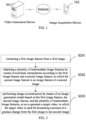
- FIG. 1 is a schematic diagram of an application scenario to which embodiments of the present disclosure are applicable.
- a device involved includes a video generation device 101.
- the video generation device 101 may be a terminal or a server.
- FIG. 1 is an example of the video generation device 101 being a server.
- Two images may be processed on the video generation device 101 to generate a video that is used for presenting a gradual change effect between the two images.
- the device involved in the application scenario further includes an image acquisition device 102.
- the image acquisition device 102 may also be a terminal or a server.
- the terminal acquires an image inputted by a user, or the terminal acquires an image in the current scene via a camera.
- the server acquires an image from a network that is disclosed on the network and allowed to be used by the public.
- FIG. 1 is an example of the image acquisition device 102 being a terminal.
- the image acquisition device 102 sends the acquired image to the video generation device 101.
- the video generation device 101 generates a video that is used for presenting a gradual change from the acquired image to another image (from the image acquisition device 102 or from another device), or a video presenting a gradual change from the other image to the acquired image.
- the video generation device 101 and the image acquisition device 102 may be the same or different devices.
- the video generation device 101 and the image acquisition device 102 may be the same devices, for example, a user uses a cellphone to take a selfie, obtaining a self-portrait image, and selects another image on the cellphone; and the cellphone generates a video based on the user's self-portrait image and the image selected by the user.
- the content of the video shows a process of a gradual change from the user's self-portrait image to the image selected by the user.
- the video generation device 101 and the image acquisition device 102 may be different devices, for example, a user uses a cellphone to take a selfie, obtaining a self-portrait image, and selects another image on the cellphone; and the cellphone sends the self-portrait image and the image selected by the user to a server, and the server generates a video and returns the video to the cellphone.
- the content of the video shows a process of a gradual change from the user's self-portrait image to the image selected by the user.
- the terminal may be a personal digital assistant (PDA) device, a handheld device (e.g., a smartphone, and a tablet computer), a computing device (e.g., a personal computer (PC)), a vehicle-mounted device, a wearable device (e.g., a smartwatch and a smart bracelet), a smart home device (e.g., a smart display device), etc.
- PDA personal digital assistant
- the server may be a distributed server, a centralized server, a cloud server, etc.
- the following provides a plurality of embodiments of the present disclosure.
- the embodiments of the present disclosure may be executed by an electronic device, and the electronic device may be a terminal or a server.
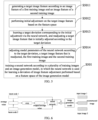
- FIG. 2 is a schematic flowchart I of a video generation method according to an embodiment of the present disclosure.
- the video generation method includes: S201: extracting a first image feature from a first image.
- the first image may be an image inputted by a user, an image from another device, or an image captured by a current execution device.
- the terminal may obtain a first image inputted by the user, or obtain a first image captured by a camera on the terminal.
- the server may receive the first image that is inputted by the user and sent from the terminal.
- the first image feature is an image feature of the first image.
- an encoder is adopted to encode the first image to obtain the first image feature
- the first image feature specifically refers to an image feature obtained by encoding the first image.
- S202 obtaining a plurality of intermediate image features by means of nonlinear interpolation according to the first image feature and a second image feature, in which the second image feature is an image feature of a second image.
- the second image is an image different from the first image.
- the second image feature specifically refers to an image feature obtained by encoding the second image.
- a plurality of images, and image features obtained by encoding the plurality of images may be pre-stored.
- the second image feature is obtained from the stored image features of the plurality of images.
- a second image may be specified by the user among the pre-stored plurality of images, and an image feature of the second image, i.e., the second image feature, may be obtained from the image features of the plurality of images.
- the second image feature may be obtained among the image features of the plurality of images in a preset order (e.g., an order in which the images are stored) or at random.
- a plurality of images for the user to select are displayed on the terminal; the user selects a second image among the plurality of images and inputs a request for generating a video that gradually changes from the first image to the second image on the terminal; and the terminal, in response to the request, obtains an image feature of the second image, i.e., the second image feature, among the image features of the plurality of images that have been pre-stored.
- a second image inputted by the user, sent by another device, or captured by the current execution device may be obtained, and then is encoded to obtain the second image feature.
- the first image feature and the second image feature are taken as two known quantities in a nonlinear interpolation process, and a preset nonlinear interpolation method is adopted to perform nonlinear interpolation to obtain an interpolation function, i.e., to obtain an interpolation curve.
- a preset nonlinear interpolation method is adopted to perform nonlinear interpolation to obtain an interpolation function, i.e., to obtain an interpolation curve.
- sampling is performed between a point corresponding to the first image feature and a point corresponding to the second image feature to obtain a plurality of intermediate image features.
- the intermediate image features are used for generating intermediate frames of the video.
- sampling at equal intervals on the interpolation curve makes the degree of change between neighboring intermediate image features obtained by interpolation similar, thus improving the quality of the video subsequently generated.
- S203 performing image reconstruction by means of an image generation model based on the first image feature, the second image feature, and the plurality of intermediate image features, so as to obtain a target video, in which the target video is used for presenting a process of a gradual change from the first image to the second image.
- the image generation model may be a neural network for image generation or image reconstruction, with its input data being a coded image feature and its output data being a reconstructed image.
- a trained image generation model disclosed on the network may be used, or the neural network may be trained by using training data (including a plurality of training images) to obtain the image generation model, and there is no limitation on the training process of the model.
- the first image feature, the second image feature, and the plurality of intermediate image features may be input into the image generation model to obtain a reconstructed image corresponding to the first image feature, a reconstructed image corresponding to the second image feature, and a reconstructed image corresponding to the respective intermediate image features, respectively.
- the plurality of reconstructed images may be sorted and combined in accordance with a distribution order of the first image feature, the second image feature, and the intermediate image features on the interpolation curve, to obtain the target video.
- the first frame of image is the reconstructed image corresponding to the first image feature
- the last frame of image is the reconstructed image corresponding to the second image feature
- the intermediate frames are reconstructed images corresponding to the intermediate image features.
- a plurality of intermediate image features are obtained by performing nonlinear interpolation based on a first image feature obtained by encoding a first image and a second image feature obtained by encoding a second image; and image reconstruction is performed by means of an image generation model based on the first image feature, the second image feature and the plurality of intermediate image features, and images reconstructed based on the image generation model are output.
- the reality of the intermediate image features obtained by interpolation and the similarity between the intermediate image features and the image features of the two original images are improved, thereby improving the reality and aesthetic of the intermediate frames of the video, improving the similarity between the intermediate frames and the first frame of image as well as the last frame of image, and improving the video quality.
- the image generation model is a Generative Adversarial Network (GAN), and accordingly, by utilizing the advantages of the GAN in terms of image generation, the image reconstruction quality of the image generation model and the quality of image frames of the target video are improved.
- GAN Generative Adversarial Network
- a feature space of the image generation model a neural network may be used to assist the nonlinear interpolation. Subsequently, this auxiliary process is described through embodiments.
- FIG. 3a is a schematic flowchart II of a video generation method according to an embodiment of the present disclosure.
- the video generation method includes: S301: extracting a first image feature from a first image.
- step S301 The implementation principle and technical effects of the step S301 may be referred to the above-mentioned embodiments and will not be repeated.
- S302 generating a third image feature according to the first image feature and the second image feature, in which the second image feature is an image feature of a second image.
- the process of obtaining the second image feature may be referred to the above-mentioned embodiments and will not be repeated.
- an average value of the first image feature and the second image feature is determined, and the average value is the third image feature.
- feature values at corresponding positions of the first image feature and the second image feature may be added and averaged to obtain the average value of the first image feature and the second image feature.
- first image feature and the second image feature are weighted and summed to obtain a third image feature.
- Weights corresponding to the first image feature and the second image feature, respectively, may be set in advance.
- S303 adjusting the third image feature based on a feature space of the image generation model, and a neural network, sequentially, in which the neural network is used for learning a deviation of image feature adjustment performed based on the feature space.
- the feature space of the image generation model may be understood as an input space of the image generation model, and feature samples in this input space conform to a certain probability distribution.
- the feature space of the image generation model is a latent space corresponding to the image generation model
- the image features obtained by encoding the first image and the second image by means of the encoder are latent codes, that is, the first image feature may be referred to as a first latent code, and the second image feature may be referred to as a second latent code.
- the third image feature is readjusted by means of a neural network model, thereby improving the similarity between the third image feature and the first image feature as well as the second image feature.
- the neural network needs to be trained so that the neural network is able to learn the deviation of the image feature adjustment based on the feature space.
- the specific training process is referred to the subsequent embodiments.
- the neural network is a fully-connected neural network.
- the accuracy in adjusting the third image feature is improved by the fully-connected neural network with a larger number of network parameters.
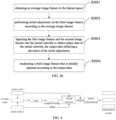
- FIG. 3b is a schematic flowchart of sequentially adjusting a third image feature based on a feature space of an image generation model and a neural network (i.e., S303) according to an embodiment of the present disclosure. As shown in FIG.
- the process i.e., a possible implementation of the step S303 of sequentially adjusting the third image feature based on the feature space of the image generation model and the neural network includes: S3031: obtaining an average image feature in the feature space; S3032: performing initial adjustment on the third image feature according to the average image feature; S3033: inputting the first image feature and the second image feature into the neural network to obtain output data of the neural network, the output data reflecting a deviation of the initial adjustment; and S3034: readjusting a third image feature that is initially adjusted according to the output data.
- the output data of the neural network reflects a feature deviation resulting from an initial adjustment on the third image feature based on the average image feature in the feature space.
- the average image feature in the feature space may be determined based on the probability distribution that the feature space conforms to.
- the probability that the feature space conforms to is, for example, a Gaussian distribution.
- the third image feature is subjected to the initial adjustment by utilizing the average image feature, making the third image feature close to the average image feature and improving the quality of the third image feature.
- the first image feature and the second image feature are then input into the neural network to obtain output data of the neural network.
- the output data of the neural network is also an image feature.
- the third image feature that is initially adjusted is readjusted, making the third image feature close to the first image feature and the second image feature, and improving the similarity between the third image feature and the first image feature as well as the second image feature.
- the step of performing initial adjustment on the third image feature according to the average image feature includes: determining a mean value of the third image feature and the average image feature, and determining the third image that is initially adjusted to be the mean value.
- feature cropping i.e., the initial adjustment
- the third image feature is realized by way of solving for the mean value of the third image feature and the average image feature.
- the step of readjusting the third image feature that is initially adjusted according to the output data includes: adding the output data to the third image feature that is initially adjusted to obtain the third image feature that is readjusted.
- the similarity between the third image feature and the first image feature as well as the second image feature is improved by way of adding the feature deviation obtained in the initial adjustment process and learned by the neural network to the third image feature that is initially adjusted.
- S304 performing nonlinear interpolation according to the first image feature, the second image feature, and a third image feature that is adjusted, to obtain the plurality of intermediate image features.
- the first image feature, the second image feature, and the finally adjusted third image feature are obtained, the first image feature, the second image feature, and the third image feature are taken as three known quantities, an interpolation curve is obtained by means of nonlinear interpolation, and sampling is performed on the interpolation curve to obtain the plurality of intermediate image features.
- the third image feature having a high quality and a high similarity to the first image feature and the second image feature, is utilized in the nonlinear interpolation process, which effectively improves the accuracy of the nonlinear interpolation and improves the quality of the intermediate image features.
- the nonlinear interpolation method adopts cubic spline interpolation.
- the step S304 includes: obtaining an interpolating curve by means of cubic spline interpolation according to the first image feature, the second image feature and the third image feature; and sampling on the interpolating curve to obtain the plurality of intermediate image features.
- the accuracy of the nonlinear interpolation and the quality of the intermediate image features are improved by means of the cubic spline interpolation.
- the third image feature may be input into the cubic spline interpolation together with the first image feature and the second image feature to obtain an interpolation function, i.e., to obtain an interpolation curve. Further, sampling is performed on the interpolation curve to obtain the plurality of intermediate image features.
- S305 performing image reconstruction by means of an image generation model based on the first image feature, the second image feature, and the plurality of intermediate image features, so as to obtain a target video, in which the target video is used for presenting a process of a gradual change from the first image to the second image.
- step S305 may be referred to the above-mentioned embodiments and will not be repeated.
- a plurality of intermediate image features are obtained by using nonlinear interpolation based on a feature space and a neural network, thus effectively improving the accuracy of the nonlinear interpolation, and accordingly improving the quality of the intermediate image features, improving the image quality of the intermediate frames of the video, and improving the video quality.
- FIG. 4 is an example framework diagram of nonlinear interpolation based on a feature space and a neural network according to an embodiment of the present disclosure.
- an average value (equivalent to a third image feature here) of a latent code 1 (equivalent to a first image feature here) and a latent code 2 (equivalent to a second image feature here) is determined first, the average value is cropped based on the feature space to obtain a cropped average value (equivalent to the third image feature that is initially adjusted here); then, the latent code 1 and the latent code 2 are input into the neural network to obtain a feature deviation output by the neural network; and then, the feature deviation is added to the cropped average value (equivalent to obtaining the third image feature that is readjusted).
- the latent code 1, the latent code 2 and the average value are used for spline interpolation to obtain a plurality of interpolation results (i.e
- the above embodiments provide a solution for adjusting the image features in conjunction with the feature space and the neural network, and in a practical application, the image features may also be adjusted based on the feature space alone, that is, the feature deviation resulting from the adjustment of the feature space is ignored.
- the neural network in order to improve the nonlinear interpolation effect, the neural network needs to be trained in advance, so that the neural network is able to learn the deviation of the image feature adjustment based on the feature space of the image generation model.
- the following provides embodiments of training the neural network.
- training process of the neural network and the video generation process in the above-mentioned embodiments may be performed on the same device or on different devices.
- FIG. 5 is a schematic flowchart of a model determination method according to an embodiment of the present disclosure. As shown in FIG. 5 , the model determination method includes:
- S501 training a neural network according to a plurality of training images and an image generation model, in which the neural network is used for learning a deviation of image feature adjustment performed based on a feature space of the image generation model.
- the step S501 includes the following steps.
- S5011 generating a target image feature according to an image feature of a first training image and an image feature of a second training image.
- two training images may be obtained from a plurality of training images during each training process, and the two training images are referred to as a first training image and a second training image, respectively, for ease of differentiation.
- the two training images may be encoded by the encoder to obtain the image feature of the first training image and the image feature of the second training image.
- the image feature of the first training image and the image feature of the second training image are subjected to feature fusion processing to obtain the target image feature.
- the operation of performing the feature fusion processing on the image feature of the first training image and the image feature of the second training image to obtain the target image feature includes: determining an average value of the image feature of the first training image and the image feature of the second training image, in which the average value is the target image feature. Specifically, feature values at corresponding positions of the image feature of the first training image and the image feature of the second training image may be added and averaged to obtain the average value.
- the image feature of the first training image and the image feature of the second training image are weighted and summed to obtain the target image feature.
- Weights corresponding to the image feature of the first training image and the image feature of the second training image, respectively, may be set in advance.
- the average image feature in the feature space may be determined based on a probability distribution that the feature space conforms to.
- the target image feature is subjected to initial adjustment by using the average image feature, making the target image feature close to the average image feature, and improving the quality of the target image feature.
- the step of performing initial adjustment on the target image feature according to the average image feature includes: determining a mean value of the target image feature and the average image feature, and determining the target image feature that is initially adjusted to be the mean value.
- feature cropping i.e., the initial adjustment
- the target image feature is realized by way of solving for the mean value of the target image feature and the average image feature.
- S5013 learning a target deviation corresponding to the initial adjustment via the neural network, and readjusting a target image feature that is initially adjusted according to the target deviation.
- the image feature of the first training image and the image feature of the second training image are input into the neural network to obtain output data of the neural network, i.e., the target deviation, corresponding to the initial adjustment, obtained by learning.
- the target image feature that is initially adjusted is readjusted, so that the target image feature is close to the image feature of the first training image and the image feature of the second training image, that is, the similarity between the target image feature and the image feature of the first training image as well as the image feature of the second training image is improved.
- the step of readjusting the target image feature that is initially adjusted according to the target deviation includes: adding the target deviation to the target image feature that is initially adjusted to obtain the target image feature that is readjusted.
- the similarity between the target image feature and the image feature of the first training image as well as the image feature of the second image is improved by way of adding the feature deviation obtained in the initial adjustment process and learned by the neural network to the target image feature that is initially adjusted.
- S5014 adjusting model parameters of the neural network according to the target deviation, a target image feature that is readjusted, the first training image and the second training image.
- a training error of the neural network may be determined based on the target deviation, the target image feature that is readjusted, the first training image and the second training image, and the model parameters of the neural network are adjusted based on the training error.
- the training error is determined based on a difference between the target image feature that is readjusted and the image feature of the first training image, and/or a difference between the target image feature that is readjusted and the image feature of the second training image.
- the neural network is trained based on a regularized constraint and a similarity constraint
- the regularized constraint is used for minimizing a difference between an image feature, which is adjusted based on the neural network, and an image feature, which is adjusted based on the feature space (i.e., the target image feature that is initially adjusted)
- the similarity constraint is used for minimizing a difference between an image feature, which is adjusted based on the neural network (i.e., the target image feature that is readjusted), and the image feature of the first training image as well as the image feature of the second training image.
- the step S5014 includes: determining a target optimization function of the neural network by means of a regularized constraint and a similarity constraint; and adjusting the model parameters of the neural network based on the target optimization function, the target deviation, the target image feature that is readjusted, the first training image and the second training image.
- the target optimization function of the neural network may be determined in advance according to the regularized constraint and the similarity constraint.
- a function value of the target optimization function i.e., the training error of the neural network
- the model parameters of the neural network are optimized based on the training error.
- the optimization algorithm is, for example, a gradient descent algorithm.
- the image features mentioned in the above-mentioned embodiments are all coded image features.
- the target image feature may be input into the image generation model to obtain an intermediate reconstructed image (i.e., a reconstructed image corresponding to the target image feature); and then, the first training image, the second training image and the intermediate reconstructed image may be subjected feature extraction via a feature extraction network, to obtain the image feature of the first training image, the image feature of the second training image, and the image feature of the intermediate reconstructed image, respectively.
- the first training image, the second training image, and the intermediate reconstruction image are all facial images
- these images may be subjected to feature extraction by using a facial feature extraction network.
- a difference between the image feature of the intermediate reconstructed image and the image feature of the first training image (the features extracted by the feature extraction network), and a difference between the image feature of the intermediate reconstructed image and the image feature of the second training image (the features extracted by the feature extraction network) are determined, and the training error is determined according to the two differences and the output data of the neural network.
- ⁇ ⁇ G f w 1 , w 2 + w 3 ⁇ ⁇ x 1 ⁇ 2 + ⁇ ⁇ G f w 1 , w 2 + w 3 ⁇ ⁇ x 2 ⁇ 2 is the similarity constraint and ⁇ f(w 1 , w 2 )
- FIG. 6 is a schematic diagram of a training framework of a neural network according to an embodiment of the present disclosure.
- a training process includes: first, determining an average value of a latent code 1 (an image feature obtained by encoding an input image 1) and a latent code 2 (an image feature obtained by encoding an input image 2); based on the feature space of the image generation model, performing feature cropping (i.e., performing the initial adjustment) on the average value to obtain a cropped average value; inputting the latent code 1 and latent code 2 into the neural network, and according to a feature deviation output by the neural network, determining the part of the training error subjected to the regularized constraint ; then adding the feature deviation output by the neural network to the cropped average value, and then inputting this average value into the image generation model to obtain a reconstructed image; and finally, determining a feature difference between the reconstructed image and the input image 1, and a feature difference between the
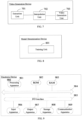
- FIG. 7 is a block diagram of a structure of a video generation device according to an embodiment of the present disclosure. For ease of illustration, only parts related to the embodiments of the present disclosure are shown.
- a video generation device includes an extraction unit 701 and an interpolation unit 702.
- the extraction unit 701 is configured to extract a first image feature from a first image.
- the interpolation unit 702 is configured to obtain a plurality of intermediate image features by means of nonlinear interpolation according to the first image feature and a second image feature, in which the second image feature is an image feature of a second image.
- a video generation unit 703 is configured to perform image reconstruction by means of an image generation model based on the first image feature, the second image feature, and the plurality of intermediate image features, so as to generate a target video, in which the target video is used for presenting a process of a gradual change from the first image to the second image.
- the interpolation unit 702 is further configured to generate a third image feature according to the first image feature and the second image feature; adjust the third image feature based on a feature space of the image generation model, and a neural network, sequentially, in which the neural network is used for learning a deviation of image feature adjustment performed based on the feature space; and perform nonlinear interpolation according to the first image feature, the second image feature, and a third image feature that is adjusted, to obtain the plurality of intermediate image features.
- the interpolation unit 702 is further configured to obtain an average image feature in the feature space; perform initial adjustment on the third image feature according to the average image feature; input the first image feature and the second image feature into the neural network to obtain output data of the neural network, the output data reflecting a deviation of the initial adjustment; and readjust a third image feature that is initially adjusted according to the output data.
- the interpolation unit 702 is further configured to determine a mean value of the third image feature and the average image feature; and determine the third image feature that is initially adjusted to be the mean value.
- the neural network is trained based on a regularized constraint and a similarity constraint
- the regularized constraint is used for minimizing a difference between an image feature, which is adjusted based on the neural network, and an image feature, which is adjusted based on the feature space
- the similarity constraint is used for minimizing a difference between an image feature, which is adjusted based on the neural network, and an image feature of a first training image feature as well as an image feature of a second training image.
- the interpolation unit 702 is further configured to obtain an interpolating curve by means of cubic spline interpolation according to the first image feature, the second image feature and the third image feature; and sample on the interpolating curve to obtain the plurality of intermediate image features.
- the image generation model is a StyleGAN model or a StyleGAN2 model.
- the video generation device provided in the present embodiments may be used for performing the technical solutions of the above-mentioned embodiments related to the video generation method, which have similar implementation principle and similar technical effects. Details are not described again herein in the present embodiment.
- FIG. 8 is a block diagram of a structure of a model determination device according to an embodiment of the present disclosure. For ease of illustration, only parts related to the embodiments of the present disclosure are shown.
- a model determination device includes a training unit 801.
- the training unit 801 is configured to train a neural network according to a plurality of training images and an image generation model, in which the neural network is used for learning a deviation of image feature adjustment based on a feature space of the image generation model.
- a training process of the neural network includes: generating a target image feature according to an image feature of a first training image and an image feature of a second training image; performing initial adjustment on the target image feature based on the feature space; learning a target deviation corresponding to the initial adjustment via the neural network, and readjusting a target image feature that is initially adjusted according to the target deviation; and adjusting model parameters of the neural network according to the target deviation, a target image feature that is readjusted, the first training image and the second training image.
- the training unit 801 is further configured to determine a target optimization function of the neural network by means of a regularized constraint and a similarity constraint; and adjust the model parameters of the neural network based on the target optimization function, the target deviation, the target image feature that is readjusted, the first training image and the second training image.
- the regularized constraint is used for minimizing a difference between the target image feature that is readjusted and the target image feature that is initially adjusted
- the similarity constraint is used for minimizing a difference between the target image feature that is readjusted and the image feature of the first training image, and the image feature of the second training image.
- the model determination device provided by the present embodiment may be used for performing the technical solutions of the above-mentioned embodiments related to the model determination method, which have similar implementation principle and similar technical effects. Details are not described again herein in the present embodiment.
- FIG. 9 illustrates a schematic structural diagram of an electronic device 900 suitable for implementing some embodiments of the present disclosure.
- the electronic device 900 may be a terminal device or a server.
- the terminal device may include but are not limited to mobile terminals such as a mobile phone, a notebook computer, a digital broadcasting receiver, a personal digital assistant (PDA), a portable Android device (PAD), a portable media player (PMP), a vehicle-mounted terminal (e.g., a vehicle-mounted navigation terminal) or the like, and fixed terminals such as a digital TV, a desktop computer, or the like.
- PDA personal digital assistant
- PDA portable Android device
- PMP portable media player
- vehicle-mounted terminal e.g., a vehicle-mounted navigation terminal
- fixed terminals such as a digital TV, a desktop computer, or the like.
- the electronic device illustrated in FIG. 9 is merely an example, and should not pose any limitation to the functions and the range of use of the embodiments of the present disclosure.
- the electronic device 900 may include a processing apparatus 901 (e.g., a central processing unit, a graphics processing unit, etc.), which can perform various suitable actions and processing according to a program stored in a read only memory (ROM) 902 or a program loaded from a storage apparatus 908 into a random access memory (RAM) 903.
- the RAM 903 further stores various programs and data required for operations of the electronic device 900.
- the processing apparatus 901, the ROM 902, and the RAM 903 are interconnected by means of a bus 904.
- An input/output (I/O) interface 905 is also connected to the bus 904.
- the following apparatus may be connected to the I/O interface 905: an input apparatus 906 including, for example, a touch screen, a touch pad, a keyboard, a mouse, a camera, a microphone, an accelerometer, a gyroscope, or the like; an output apparatus 907 including, for example, a liquid crystal display (LCD), a loudspeaker, a vibrator, or the like; a storage apparatus 908 including, for example, a magnetic tape, a hard disk, or the like; and a communication apparatus 909.
- the communication apparatus 909 may allow the electronic device 900 to be in wireless or wired communication with other devices to exchange data. While FIG. 9 illustrates the electronic device 900 having various apparatuses, it should be understood that not all of the illustrated apparatuses are necessarily implemented or included. More or fewer apparatuses may be implemented or included alternatively.
- the processes described above with reference to the flowcharts may be implemented as a computer software program.
- some embodiments of the present disclosure include a computer program product, which includes a computer program carried by a computer-readable medium.
- the computer program includes program codes for performing the methods shown in the flowcharts.
- the computer program may be downloaded online through the communication apparatus 909 and installed, or may be installed from the storage apparatus 908, or may be installed from the ROM 902.
- the processing apparatus 901 the above-mentioned functions defined in the methods of some embodiments of the present disclosure are performed.
- the above-mentioned computer-readable medium in the present disclosure may be a computer-readable signal medium or a computer-readable storage medium or any combination thereof.
- the computer-readable storage medium may be, but not limited to, an electric, magnetic, optical, electromagnetic, infrared, or semiconductor system, apparatus or device, or any combination thereof.
- the computer-readable storage medium may include but not be limited to: an electrical connection with one or more wires, a portable computer disk, a hard disk, a random-access memory (RAM), a read-only memory (ROM), an erasable programmable read-only memory (EPROM or flash memory), an optical fiber, a compact disk read-only memory (CD-ROM), an optical storage device, a magnetic storage device, or any appropriate combination of them.
- the computer-readable storage medium may be any tangible medium containing or storing a program that can be used by or in combination with an instruction execution system, apparatus or device.
- the computer-readable signal medium may include a data signal that propagates in a baseband or as a part of a carrier and carries computer-readable program codes.
- the data signal propagating in such a manner may take a plurality of forms, including but not limited to an electromagnetic signal, an optical signal, or any appropriate combination thereof.
- the computer-readable signal medium may also be any other computer-readable medium than the computer-readable storage medium.
- the computer-readable signal medium may send, propagate or transmit a program used by or in combination with an instruction execution system, apparatus or device.
- the program code contained on the computer-readable medium may be transmitted by using any suitable medium, including but not limited to an electric wire, a fiber-optic cable, radio frequency (RF) and the like, or any appropriate combination of them.
- RF radio frequency
- the above-mentioned computer-readable medium may be included in the above-mentioned electronic device, or may also exist alone without being assembled into the electronic device.
- the above-mentioned computer-readable medium carries one or more programs, and when the one or more programs are executed by the electronic device, the electronic device is caused to implement the method in the above embodiment.
- the computer program codes for performing the operations of the present disclosure may be written in one or more programming languages or a combination thereof.
- the above-mentioned programming languages include object-oriented programming languages such as Java, Smalltalk, C++, and also include conventional procedural programming languages such as the "C" programming language or similar programming languages.
- the program code may be executed entirely on the user's computer, partly on the user's computer, as a stand-alone software package, partly on the user's computer and partly on a remote computer, or entirely on the remote computer or server.
- the remote computer may be connected to the user's computer through any type of network, including a local area network (LAN) or a wide area network (WAN), or the connection may be made to an external computer (for example, through the Internet using an Internet service provider).
- LAN local area network
- WAN wide area network
- each block in the flowcharts or block diagrams may represent a module, a program segment, or a portion of codes, including one or more executable instructions for implementing specified logical functions.
- the functions noted in the blocks may also occur out of the order noted in the accompanying drawings. For example, two blocks shown in succession may, in fact, can be executed substantially concurrently, or the two blocks may sometimes be executed in a reverse order, depending upon the functionality involved.
- each block of the block diagrams and/or flowcharts, and combinations of blocks in the block diagrams and/or flowcharts may be implemented by a dedicated hardware-based system that performs the specified functions or operations, or may also be implemented by a combination of dedicated hardware and computer instructions.
- the units involved in the embodiments of the present disclosure may be implemented in software or hardware.
- the name of the unit does not constitute a limitation of the unit itself under certain circumstances, for example, an acquisition unit may also be described as "the unit that acquires the target audio".
- FPGA field programmable gate array
- ASIC application specific integrated circuit
- ASSP application specific standard product
- SOC system on chip
- CPLD complex programmable logical device
- the machine-readable medium may be a tangible medium that may include or store a program for use by or in combination with an instruction execution system, apparatus or device.
- the machine-readable medium may be a machine-readable signal medium or a machine-readable storage medium.
- the machine-readable medium includes, but is not limited to, an electrical, magnetic, optical, electromagnetic, infrared, or semi-conductive system, apparatus or device, or any suitable combination of the foregoing.
- machine-readable storage medium include electrical connection with one or more wires, portable computer disk, hard disk, random-access memory (RAM), read-only memory (ROM), erasable programmable read-only memory (EPROM or flash memory), optical fiber, portable compact disk read-only memory (CD-ROM), optical storage device, magnetic storage device, or any suitable combination of the foregoing.
- RAM random-access memory
- ROM read-only memory
- EPROM or flash memory erasable programmable read-only memory
- CD-ROM compact disk read-only memory
- magnetic storage device or any suitable combination of the foregoing.
- a video generation method including: extracting a first image feature from a first image; obtaining a plurality of intermediate image features by means of nonlinear interpolation according to the first image feature and a second image feature, in which the second image feature is an image feature of a second image; and performing image reconstruction by means of an image generation model based on the first image feature, the second image feature, and the plurality of intermediate image features, so as to generate a target video, in which the target video is used for presenting a process of a gradual change from the first image to the second image.
- the obtaining the plurality of intermediate image features by means of nonlinear interpolation according to the first image feature and the second image feature includes: generating a third image feature according to the first image feature and the second image feature; adjusting the third image feature based on a feature space of the image generation model, and a neural network, sequentially, in which the neural network is used for learning a deviation of image feature adjustment performed based on the feature space; and performing nonlinear interpolation according to the first image feature, the second image feature, and a third image feature that is adjusted, to obtain the plurality of intermediate image features.
- the adjusting the third image feature based on the feature space of the image generation model, and the neural network sequentially, in which the neural network is used for learning the deviation of image feature adjustment performed based on the feature space, includes: obtaining an average image feature in the feature space; performing initial adjustment on the third image feature according to the average image feature; inputting the first image feature and the second image feature into the neural network to obtain output data of the neural network, the output data reflecting a deviation of the initial adjustment; and readjusting a third image feature that is initially adjusted according to the output data.
- the performing initial adjustment on the third image feature according to the average image feature includes: determining a mean value of the third image feature and the average image feature; and determining the third image feature that is initially adjusted to be the mean value.
- the neural network is trained based on a regularized constraint and a similarity constraint
- the regularized constraint is used for minimizing a difference between an image feature, which is adjusted based on the neural network, and an image feature, which is adjusted based on the feature space
- the similarity constraint is used for minimizing a difference between an image feature, which is adjusted based on the neural network, and an image feature of a first training image as well as an image feature of a second training image.
- the performing nonlinear interpolation based on the first image feature, the second image feature, and the third image feature that is adjusted, to obtain the plurality of intermediate image features includes: obtaining an interpolating curve by means of cubic spline interpolation according to the first image feature, the second image feature and the third image feature; and sampling on the interpolating curve to obtain the plurality of intermediate image features.
- the image generation model is a StyleGAN model or a StyleGAN2 model.
- a model determination method including: training a neural network according to a plurality of training images and an image generation model, in which the neural network is used for learning a deviation of image feature adjustment performed based on a feature space of the image generation model, in which a training process of the neural network includes: generating a target image feature according to an image feature of a first training image and an image feature of a second training image; performing initial adjustment on the target image feature based on the feature space; learning a target deviation corresponding to the initial adjustment via the neural network, and readjusting a target image feature that is initially adjusted according to the target deviation; and adjusting model parameters of the neural network according to the target deviation, a target image feature that is readjusted, the first training image and the second training image.
- the adjusting model parameters of the neural network according to the target deviation, the target image feature that is readjusted, the first training image and the second training image includes:
- a video generation device including: an extraction unit, configured to extract a first image feature from a first image; an interpolation unit, configured to obtain a plurality of intermediate image features by means of nonlinear interpolation according to the first image feature and a second image feature, in which the second image feature is an image feature of a second image; and a video generation unit, configured to perform image reconstruction by means of an image generation model based on the first image feature, the second image feature, and the plurality of intermediate image features, so as to generate a target video, in which the target video is used for presenting a process of a gradual change from the first image to the second image.
- a model determination device including: a training unit, configured to train a neural network according to a plurality of training images and an image generation model, in which the neural network is used for learning a deviation of image feature adjustment performed based on a feature space of the image generation model, in which a training process of the neural network includes: generating a target image feature according to an image feature of a first training image and an image feature of a second training image; performing initial adjustment on the target image feature based on the feature space; learning a target deviation corresponding to the initial adjustment via the neural network, and readjusting a target image feature that is initially adjusted according to the target deviation; and adjusting model parameters of the neural network according to the target deviation, a target image feature that is readjusted, the first training image and the second training image.
- an electronic device including: at least one processor and a memory, in which the memory stores a computer-executable instruction, and the at least one processor executes the computer-executable instruction stored in the memory such that the at least one processor performs the video generation method as described in the first aspect and various possible designs of the first aspect, or, such that the at least one processor performs the model determination method as described in the second aspect and various possible designs of the second aspect.
- a computer-readable storage medium stores computer-executable instructions, in which a processor, and when the computer executable instructions are executed by a processor, the video generation method as described in the first aspect and various possible designs of the first aspect or the model determination method as described in the second aspect and various possible designs of the second aspect is implemented.
- a computer program product includes computer executable instructions, and when the computer executable instructions are executed by a processor, the video generation method as described in the first aspect and various possible designs of the first aspect or the model determination method as described in the second aspect and various possible designs of the second aspect is implemented.
- a computer program is provided, and when the computer program is executed by a processor, the image generation method as described in the first aspect and various possible designs of the first aspect or the model determination method as described in the second aspect and various possible designs of the second aspect is implemented
Landscapes
- Engineering & Computer Science (AREA)
- Theoretical Computer Science (AREA)
- Physics & Mathematics (AREA)
- General Physics & Mathematics (AREA)
- Multimedia (AREA)
- Software Systems (AREA)
- Health & Medical Sciences (AREA)
- Computing Systems (AREA)
- Artificial Intelligence (AREA)
- Evolutionary Computation (AREA)
- General Health & Medical Sciences (AREA)
- Mathematical Physics (AREA)
- Data Mining & Analysis (AREA)
- General Engineering & Computer Science (AREA)
- Life Sciences & Earth Sciences (AREA)
- Biomedical Technology (AREA)
- Biophysics (AREA)
- Computational Linguistics (AREA)
- Molecular Biology (AREA)
- Signal Processing (AREA)
- Computer Vision & Pattern Recognition (AREA)
- Medical Informatics (AREA)
- Databases & Information Systems (AREA)
- Probability & Statistics with Applications (AREA)
- Image Analysis (AREA)
- Image Processing (AREA)
- Television Systems (AREA)
Applications Claiming Priority (2)
| Application Number | Priority Date | Filing Date | Title |
|---|---|---|---|
| CN202111609441.8A CN114255169B (zh) | 2021-12-24 | 2021-12-24 | 视频生成方法及设备 |
| PCT/SG2022/050927 WO2023121571A2 (zh) | 2021-12-24 | 2022-12-22 | 视频生成方法及设备 |
Publications (2)
| Publication Number | Publication Date |
|---|---|
| EP4435724A2 true EP4435724A2 (de) | 2024-09-25 |
| EP4435724A4 EP4435724A4 (de) | 2025-03-26 |
Family
ID=80797847
Family Applications (1)
| Application Number | Title | Priority Date | Filing Date |
|---|---|---|---|
| EP22912123.1A Pending EP4435724A4 (de) | 2021-12-24 | 2022-12-22 | Videoerzeugungsverfahren und -vorrichtung |
Country Status (5)
| Country | Link |
|---|---|
| US (1) | US20250054271A1 (de) |
| EP (1) | EP4435724A4 (de) |
| JP (1) | JP7794530B2 (de) |
| CN (1) | CN114255169B (de) |
| WO (1) | WO2023121571A2 (de) |
Families Citing this family (1)
| Publication number | Priority date | Publication date | Assignee | Title |
|---|---|---|---|---|
| CN117036180A (zh) * | 2022-10-13 | 2023-11-10 | 腾讯科技(深圳)有限公司 | 图像优化方法、装置、电子设备、介质和程序产品 |
Family Cites Families (15)
| Publication number | Priority date | Publication date | Assignee | Title |
|---|---|---|---|---|
| CN106998437B (zh) * | 2017-03-31 | 2020-07-31 | 武汉斗鱼网络科技有限公司 | 一种重建视频图像的方法及装置 |
| CN107341841B (zh) * | 2017-07-26 | 2020-11-27 | 厦门美图之家科技有限公司 | 一种渐变动画的生成方法及计算设备 |
| WO2019136591A1 (zh) * | 2018-01-09 | 2019-07-18 | 深圳大学 | 基于弱监督时空级联神经网络的显著目标检测方法及系统 |
| US10614347B2 (en) * | 2018-01-25 | 2020-04-07 | Adobe Inc. | Identifying parameter image adjustments using image variation and sequential processing |
| CN109905624B (zh) * | 2019-03-01 | 2020-10-16 | 北京大学深圳研究生院 | 一种视频帧插值方法、装置及设备 |
| CN110366029B (zh) * | 2019-07-04 | 2021-08-24 | 中国科学院深圳先进技术研究院 | 一种视频间插入图像帧的方法、系统及电子设备 |
| CN112634429B (zh) * | 2019-10-09 | 2022-12-09 | 四川大学 | 基于混合深度生成模型的岩心三维图像重建方法 |
| CN110830848B (zh) * | 2019-11-04 | 2021-12-07 | 上海眼控科技股份有限公司 | 图像插值方法、装置、计算机设备和存储介质 |
| US11430138B2 (en) * | 2020-03-05 | 2022-08-30 | Huawei Technologies Co., Ltd. | Systems and methods for multi-frame video frame interpolation |
| US11238650B2 (en) * | 2020-03-13 | 2022-02-01 | Nvidia Corporation | Self-supervised single-view 3D reconstruction via semantic consistency |
| CN114846812A (zh) * | 2020-03-16 | 2022-08-02 | 阿里巴巴集团控股有限公司 | 摘要视频的生成方法、装置和服务器 |
| CN111654723B (zh) * | 2020-05-14 | 2022-04-12 | 北京百度网讯科技有限公司 | 视频质量提升方法、装置、电子设备和存储介质 |
| CN111667401B (zh) * | 2020-06-08 | 2022-11-29 | 武汉理工大学 | 多层次渐变图像风格迁移方法及系统 |
| CN112200739B (zh) * | 2020-09-30 | 2024-11-15 | 北京大米科技有限公司 | 一种视频处理的方法、装置、可读存储介质和电子设备 |
| CN113365110B (zh) * | 2021-07-14 | 2023-01-31 | 北京百度网讯科技有限公司 | 模型训练、视频插帧方法,装置,设备以及存储介质 |
-
2021
- 2021-12-24 CN CN202111609441.8A patent/CN114255169B/zh active Active
-
2022
- 2022-12-22 US US18/723,150 patent/US20250054271A1/en active Pending
- 2022-12-22 JP JP2024538088A patent/JP7794530B2/ja active Active
- 2022-12-22 EP EP22912123.1A patent/EP4435724A4/de active Pending
- 2022-12-22 WO PCT/SG2022/050927 patent/WO2023121571A2/zh not_active Ceased
Also Published As
| Publication number | Publication date |
|---|---|
| JP2025500976A (ja) | 2025-01-15 |
| CN114255169B (zh) | 2026-03-06 |
| WO2023121571A3 (zh) | 2023-09-21 |
| US20250054271A1 (en) | 2025-02-13 |
| WO2023121571A2 (zh) | 2023-06-29 |
| EP4435724A4 (de) | 2025-03-26 |
| JP7794530B2 (ja) | 2026-01-06 |
| CN114255169A (zh) | 2022-03-29 |
Similar Documents
| Publication | Publication Date | Title |
|---|---|---|
| EP4354343A1 (de) | Datenverarbeitungsverfahren und -vorrichtung | |
| US20260030809A1 (en) | Image processing method and apparatus, storage medium, and electronic device | |
| US20240289999A1 (en) | Method, apparatus, device and storage medium for image generation | |
| CN110413812B (zh) | 神经网络模型的训练方法、装置、电子设备及存储介质 | |
| CN112785669B (zh) | 一种虚拟形象合成方法、装置、设备及存储介质 | |
| CN110298851B (zh) | 人体分割神经网络的训练方法及设备 | |
| CN112070888B (zh) | 图像生成方法、装置、设备和计算机可读介质 | |
| US20240386640A1 (en) | Method, apparatus, device and storage medium for generating character style profile image | |
| CN114494942B (zh) | 视频分类方法及装置、存储介质及电子设备 | |
| CN117319705A (zh) | 视频生成方法、装置、介质及电子设备 | |
| US20250095112A1 (en) | Image processing method and apparatus, device, and medium | |
| CN111967397A (zh) | 人脸影像处理方法和装置、存储介质和电子设备 | |
| CN112752118A (zh) | 视频生成方法、装置、设备及存储介质 | |
| CN118071428A (zh) | 用于多模态监测数据的智能处理系统及方法 | |
| CN112348910B (zh) | 获取图像的方法、装置、设备和计算机可读介质 | |
| CN111898338A (zh) | 文本生成方法、装置和电子设备 | |
| EP4435724A2 (de) | Videoerzeugungsverfahren und -vorrichtung | |
| US20250005827A1 (en) | Image generation method, apparatus and device, and storage medium | |
| CN111784726A (zh) | 人像抠图方法和装置 | |
| CN117808941A (zh) | 人脸驱动方法、装置和存储介质 | |
| US20250086758A1 (en) | Image processing method and device | |
| US20260030510A1 (en) | Image processing method and apparatus, electronic device and storage medium | |
| US20250299403A1 (en) | Video generation method, readable medium, and electronic device | |
| US20260024255A1 (en) | Effect processing method, electronic device and non-transitory storage medium | |
| CN114283060B (zh) | 视频生成方法、装置、设备及存储介质 |
Legal Events
| Date | Code | Title | Description |
|---|---|---|---|
| STAA | Information on the status of an ep patent application or granted ep patent |
Free format text: STATUS: THE INTERNATIONAL PUBLICATION HAS BEEN MADE |
|
| PUAI | Public reference made under article 153(3) epc to a published international application that has entered the european phase |
Free format text: ORIGINAL CODE: 0009012 |
|
| STAA | Information on the status of an ep patent application or granted ep patent |
Free format text: STATUS: REQUEST FOR EXAMINATION WAS MADE |
|
| 17P | Request for examination filed |
Effective date: 20240620 |
|
| AK | Designated contracting states |
Kind code of ref document: A2 Designated state(s): AL AT BE BG CH CY CZ DE DK EE ES FI FR GB GR HR HU IE IS IT LI LT LU LV MC ME MK MT NL NO PL PT RO RS SE SI SK SM TR |
|
| A4 | Supplementary search report drawn up and despatched |
Effective date: 20250226 |
|
| RIC1 | Information provided on ipc code assigned before grant |
Ipc: G06N 3/088 20230101ALI20250220BHEP Ipc: G11B 27/031 20060101ALI20250220BHEP Ipc: G06N 3/0475 20230101ALI20250220BHEP Ipc: G06N 3/08 20230101ALI20250220BHEP Ipc: G06T 5/50 20060101ALI20250220BHEP Ipc: G06F 17/17 20060101ALI20250220BHEP Ipc: G06T 11/00 20060101AFI20250220BHEP |
|
| DAV | Request for validation of the european patent (deleted) | ||
| DAX | Request for extension of the european patent (deleted) | ||
| STAA | Information on the status of an ep patent application or granted ep patent |
Free format text: STATUS: EXAMINATION IS IN PROGRESS |
|
| 17Q | First examination report despatched |
Effective date: 20251125 |