EP4436016A1 - Machine électrique tournante de type à aimant permanent - Google Patents
Machine électrique tournante de type à aimant permanent Download PDFInfo
- Publication number
- EP4436016A1 EP4436016A1 EP21964736.9A EP21964736A EP4436016A1 EP 4436016 A1 EP4436016 A1 EP 4436016A1 EP 21964736 A EP21964736 A EP 21964736A EP 4436016 A1 EP4436016 A1 EP 4436016A1
- Authority
- EP
- European Patent Office
- Prior art keywords
- stator
- rotor
- magnets
- teeth
- slots
- Prior art date
- Legal status (The legal status is an assumption and is not a legal conclusion. Google has not performed a legal analysis and makes no representation as to the accuracy of the status listed.)
- Pending
Links
Images


Classifications
-
- H—ELECTRICITY
- H02—GENERATION; CONVERSION OR DISTRIBUTION OF ELECTRIC POWER
- H02K—DYNAMO-ELECTRIC MACHINES
- H02K1/00—Details of the magnetic circuit
- H02K1/06—Details of the magnetic circuit characterised by the shape, form or construction
- H02K1/12—Stationary parts of the magnetic circuit
- H02K1/16—Stator cores with slots for windings
- H02K1/165—Shape, form or location of the slots
-
- H—ELECTRICITY
- H02—GENERATION; CONVERSION OR DISTRIBUTION OF ELECTRIC POWER
- H02K—DYNAMO-ELECTRIC MACHINES
- H02K1/00—Details of the magnetic circuit
- H02K1/06—Details of the magnetic circuit characterised by the shape, form or construction
- H02K1/12—Stationary parts of the magnetic circuit
- H02K1/17—Stator cores with permanent magnets
-
- H—ELECTRICITY
- H02—GENERATION; CONVERSION OR DISTRIBUTION OF ELECTRIC POWER
- H02K—DYNAMO-ELECTRIC MACHINES
- H02K1/00—Details of the magnetic circuit
- H02K1/06—Details of the magnetic circuit characterised by the shape, form or construction
- H02K1/22—Rotating parts of the magnetic circuit
- H02K1/27—Rotor cores with permanent magnets
- H02K1/2706—Inner rotors
- H02K1/272—Inner rotors the magnetisation axis of the magnets being perpendicular to the rotor axis
- H02K1/274—Inner rotors the magnetisation axis of the magnets being perpendicular to the rotor axis the rotor consisting of two or more circumferentially positioned magnets
- H02K1/2753—Inner rotors the magnetisation axis of the magnets being perpendicular to the rotor axis the rotor consisting of two or more circumferentially positioned magnets the rotor consisting of magnets or groups of magnets arranged with alternating polarity
- H02K1/276—Magnets embedded in the magnetic core, e.g. interior permanent magnets [IPM]
- H02K1/2766—Magnets embedded in the magnetic core, e.g. interior permanent magnets [IPM] having a flux concentration effect
-
- H—ELECTRICITY
- H02—GENERATION; CONVERSION OR DISTRIBUTION OF ELECTRIC POWER
- H02K—DYNAMO-ELECTRIC MACHINES
- H02K16/00—Machines with more than one rotor or stator
- H02K16/02—Machines with one stator and two or more rotors
-
- H—ELECTRICITY
- H02—GENERATION; CONVERSION OR DISTRIBUTION OF ELECTRIC POWER
- H02K—DYNAMO-ELECTRIC MACHINES
- H02K21/00—Synchronous motors having permanent magnets; Synchronous generators having permanent magnets
- H02K21/12—Synchronous motors having permanent magnets; Synchronous generators having permanent magnets with stationary armatures and rotating magnets
- H02K21/14—Synchronous motors having permanent magnets; Synchronous generators having permanent magnets with stationary armatures and rotating magnets with magnets rotating within the armatures
-
- H—ELECTRICITY
- H02—GENERATION; CONVERSION OR DISTRIBUTION OF ELECTRIC POWER
- H02K—DYNAMO-ELECTRIC MACHINES
- H02K21/00—Synchronous motors having permanent magnets; Synchronous generators having permanent magnets
- H02K21/12—Synchronous motors having permanent magnets; Synchronous generators having permanent magnets with stationary armatures and rotating magnets
- H02K21/14—Synchronous motors having permanent magnets; Synchronous generators having permanent magnets with stationary armatures and rotating magnets with magnets rotating within the armatures
- H02K21/16—Synchronous motors having permanent magnets; Synchronous generators having permanent magnets with stationary armatures and rotating magnets with magnets rotating within the armatures having annular armature cores with salient poles
-
- H—ELECTRICITY
- H02—GENERATION; CONVERSION OR DISTRIBUTION OF ELECTRIC POWER
- H02K—DYNAMO-ELECTRIC MACHINES
- H02K29/00—Motors or generators having non-mechanical commutating devices, e.g. discharge tubes or semiconductor devices
- H02K29/03—Motors or generators having non-mechanical commutating devices, e.g. discharge tubes or semiconductor devices with a magnetic circuit specially adapted for avoiding torque ripples or self-starting problems
-
- H—ELECTRICITY
- H02—GENERATION; CONVERSION OR DISTRIBUTION OF ELECTRIC POWER
- H02K—DYNAMO-ELECTRIC MACHINES
- H02K3/00—Details of windings
- H02K3/46—Fastening of windings on the stator or rotor structure
- H02K3/48—Fastening of windings on the stator or rotor structure in slots
- H02K3/487—Slot-closing devices
- H02K3/493—Slot-closing devices magnetic
-
- H—ELECTRICITY
- H02—GENERATION; CONVERSION OR DISTRIBUTION OF ELECTRIC POWER
- H02K—DYNAMO-ELECTRIC MACHINES
- H02K2213/00—Specific aspects, not otherwise provided for and not covered by codes H02K2201/00 - H02K2211/00
- H02K2213/03—Machines characterised by numerical values, ranges, mathematical expressions or similar information
-
- H—ELECTRICITY
- H02—GENERATION; CONVERSION OR DISTRIBUTION OF ELECTRIC POWER
- H02K—DYNAMO-ELECTRIC MACHINES
- H02K49/00—Dynamo-electric clutches; Dynamo-electric brakes
- H02K49/10—Dynamo-electric clutches; Dynamo-electric brakes of the permanent-magnet type
- H02K49/102—Magnetic gearings, i.e. assembly of gears, linear or rotary, by which motion is magnetically transferred without physical contact
-
- Y—GENERAL TAGGING OF NEW TECHNOLOGICAL DEVELOPMENTS; GENERAL TAGGING OF CROSS-SECTIONAL TECHNOLOGIES SPANNING OVER SEVERAL SECTIONS OF THE IPC; TECHNICAL SUBJECTS COVERED BY FORMER USPC CROSS-REFERENCE ART COLLECTIONS [XRACs] AND DIGESTS
- Y02—TECHNOLOGIES OR APPLICATIONS FOR MITIGATION OR ADAPTATION AGAINST CLIMATE CHANGE
- Y02T—CLIMATE CHANGE MITIGATION TECHNOLOGIES RELATED TO TRANSPORTATION
- Y02T10/00—Road transport of goods or passengers
- Y02T10/60—Other road transportation technologies with climate change mitigation effect
- Y02T10/64—Electric machine technologies in electromobility
Definitions
- the present invention relates to a permanent magnet-type rotary electric machine.
- Patent Document 1 There has been a rotary electric machine that is capable of changing the rotation speed of the rotor with the stator and the rotors being in no contact with each other.
- a rotary electric machine that is a magnetic wave gear machine is disclosed in Patent Document 1.
- the magnetic wave gear machine disclosed in Patent Document 1 includes a stator, a first rotor that rotates at a low speed, and a second rotor that rotates at a high speed depending on a speed change ratio.
- the stator, the first rotor, and the second rotor are disposed about the rotation axis in this order from the outer circumference.
- the stator is provided with stator coils.
- the stator coils are for outputting generated electric power or for controlling generated torque.
- the rotary electric machine disclosed in Patent Document 1 has a plurality of stator slots in the stator, and the stator coils and stator magnets (permanent magnets) are accommodated in the respective stator slots.
- the stator magnets in the respective stator slots are magnetized in the same direction.
- the first rotor having a plurality of pole pieces arranged circumferentially is disposed near the inner circumference of the stator, and the second rotor having permanent magnets is disposed near the inner circumference of the first rotor.
- N S N S + N H .
- the second rotor rotates at a speed N L / N H times the first rotor.
- stator coils are wound on the stator in a distributed winding manner.
- Stator coils wound in a distributed winding manner when the stator diameter is increased with increasing capacity, are reduced in workability. Hence, in a case of the capacity of the rotary electric machine being increased, workability of the stator coils is reduced.
- stator coils of the rotary electric machine are preferably wound in a concentrated winding manner.
- Linkage of magnetic force generated from the permanent magnets of the second rotor increased in speed with the stator coils induces a generated power in the stator coils. That is, increasing the rotation speed of the second rotor or linking more magnetic force of the permanent magnets of the second rotor with the stator coils by narrowing the air gaps from the second rotor to the stator increases induced voltage and results in increase of the generated power.
- Input is generated by rotating the first rotor by an external power: (speed of the first rotor) ⁇ (torque acting on the first rotor). Since the torque is generated in the first rotor by modulation of the magnetic force from the stator magnets and the magnetic force from the permanent magnets of the second rotor by the pole pieces of the first rotor, in order to obtain a necessary output, the torque generated in the first rotor needs to be a predetermined value depending on the rotation speed. That is, by increasing the torque generated in the first rotor, the capacity can be increased.
- induced voltage induced electromotive force
- the machine size or the amount of permanent magnets to be used is affected not by induced electromotive force (hereinafter, referred to as induced voltage) proportional to magnetic flux generated from the second rotor that links with the above-mentioned stator coils and to the rotation speed of the second rotor, but significantly by the magnitude of torque generated in the first rotor.
- induced voltage induced electromotive force
- the induced voltage is increased, reduction of the torque leads to increase of the machine size or the amount of permanent magnets to be used.
- the magnetic geared motor disclosed in Patent Document 2 has the same structure as Patent Document 1, but the two circumferential right and left stator magnets accommodated in each of the stator slots are magnetized in the opposite directions. This allows the number N S of pole pairs formed by the stator magnets in each of the slots to be increased more than in a case of magnetizing in the same direction, and by configuring the first rotor to have an appropriate number of pole pieces, the ratio of speed increase/decrease is increased and the induced voltage is increased when used as a generator.
- the present invention has been made to resolve such the problem described above and is aimed at improving generated torque of a permanent magnet-type rotary electric machine that has stator coils configured in a concentrated winding manner and has stator magnets in the respective slots magnetized in the same direction.
- a permanent magnet-type rotary electric machine disclosed in the present invention comprises: a stator including: a stator core having a plurality of stator teeth formed in a circumferential direction; stator coils arranged on respective bottom sides of a plurality of stator slots formed between the stator teeth and wound on the stator teeth in a concentrated winding manner; and stator magnets having the same polarity in a radial direction and arranged on respective opening sides of the plurality of stator slots, a first rotor having a plurality of pole pieces and disposed coaxially with the stator to face the stator magnets; and a second rotor having a plurality of permanent magnets and disposed coaxially with the first rotor to face the first rotor, wherein the circumferential widths of the stator teeth positioned between the stator magnets arranged in adjacent stator slots among the plurality of stator slots are narrower than circumferential widths of the stator slots.
- the permanent magnet-type rotary electric machine according to the present invention has the stator coils configured in a concentrated winding manner and has stator magnets in the respective slots magnetized in the same direction, thus being able to improve the generated torque.
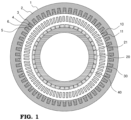
- FIG. 1 is a cross-sectional view showing a basic structure of a permanent magnet-type rotary electric machine disclosed in the present invention. The operation of the permanent magnetic-type rotary electric machine when used as a generator is described first using FIG. 1 . Note that the rotary electric machine is described taking a generator as an example in the present invention, but can also be applied to a case used as an electric motor.
- a stator 1 includes a stator core 2 having a plurality of stator slots 3 formed therein, and stator coils 4 are accommodated in the stator slots 3.
- the stator coils 4 are wound on the stator teeth 5 in a concentrated winding manner.
- Stator magnets 6 that are permanent magnets are accommodated in the stator slots 3, and all stator magnets 6 are magnetized to have the same pole of polarity in the radial direction.
- the stator magnets 6 are N poles
- the stator teeth 5 are S poles; N S pole pairs that are the same as the number of stator slots 3 are formed.
- a first rotor 10 is disposed facing the stator 1 across an air gap and made up of a plurality of pole pieces 11 arranged circumferentially. The number of pole pieces is expressed as N L .
- a second rotor 20 is disposed facing the first rotor 10 across an air gap. The second rotor 20 has second rotor magnets (permanent magnets) 21 and forms N H pole pairs (the number of poles is 2 ⁇ N H ) .
- the permanent magnet-type rotary electric machine disclosed in the present invention is referred to as permanent magnet-type rotary electric machine having a magnetic transmission mechanism.
- the induced voltage generated in the stator coils 4 at no load needs to be increased.
- a method of increasing the amount of linkage of magnetic flux generated from the second rotor magnets 21 with the stator coils 4 and increasing the frequency of the magnetic flux linking with the stator coils 4 are effective.
- the input i.e., the torque generated in the first rotor 10 needs to be increased.
- the torque generated in the first rotor 10 is almost independent of the current through the stator coils 4 but is generated by interaction of the magnetic flux from the stator magnets 6 and the magnetic flux from the second rotor magnets 21 with the pole pieces 11 of the first rotor 10.
- the size of the rotary electric machine or the volume of permanent magnets to be used that is necessary for such the permanent magnet-type rotary electric machine to obtain an output is determined by influence of both the magnitude of induced voltage and the magnitude of torque.
- a rotary electric machine having a smaller size is excellent and a smaller volume of permanent magnets to be used is also excellent from the aspect of global environmental protection.
- the size of the rotary electric machine or the volume of permanent magnets to be used depends more significantly on the magnitude of torque than on the magnitude of induced voltage. That is, by increasing the torque, the size of the rotary electric machine of the present invention is reduced and the volume of permanent magnets to be used can be reduced.
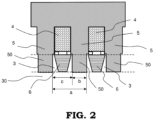
- FIG. 2 is an enlarged conceptual view showing a cross-section near the stator teeth of the permanent magnet-type rotary electric machine according to Embodiment 1.
- FIG. 2 shows a portion including two of the stator slots 3.
- the stator coils 4 are accommodated in the stator slots 3 and wound on the stator teeth 5 in the concentrated winding manner.
- the stator magnets 6 are accommodated in the stator slots 3, and all stator magnets 6 in the respective slots are magnetized to have the same pole of polarity in the radial direction.
- the stator magnets 6 are arranged in the stator slots 3 nearer the first air gap 30 than the stator coils 4.
- stator teeth 50 that are portions of the stator teeth 5 corresponding to portions where the stator magnets 6 are arranged, i.e., positioned between the respective stator magnets 6 accommodated in the adjacent stator slots 3 (positioned between the adjacent stator magnets 6 ) as shown in FIG. 2 .
- the circumferential width of the stator teeth 50 positioned between the adjacent stator magnets 6 is expressed as b , the pitch of the stator teeth 5 at the portion facing the first air gap 30, i.e., at the air gap surface, as a , and the circumferential width of the stator slots 3, as c . It is noted that in Embodiment 1, all of the stator teeth 50 positioned between the adjacent stator magnets 6 have the same circumferential width.
- the b / a ⁇ 100 [%] is set to 50 % or less in Embodiment 1, i.e., the circumferential width of the stator teeth 50 positioned between the adjacent stator magnets 6 is set narrower than the circumferential width c of the stator slots.
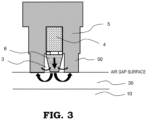
- FIG. 3 is a diagram schematically showing magnetic flux generated from the stator magnets 6 magnetized in the direction of the straight arrow. Magnetic flux generated from the stator magnets 6 that reaches the pole pieces 11 of the first rotor 10 through the first air gap 30 is effective magnetic flux contributing to the torque.
- magnetic flux generated from the stator magnets 6 reaching the stator teeth 5 through the circumferentially neighboring spaces as shown by the thin curved arrows in the figure is leakage magnetic flux not contributing to the torque.
- magnetic flux generated from the stator magnets 6 leaks to the stator teeth 5 as shown by the thick curved arrows before reaches the pole pieces 11 of the rotor 10.
- the first rotor 10 is the structure having the plurality of pole pieces 11, the permeance coefficient of the stator magnets 6 tends to be low compared to a general permanent magnet-type rotary electric machine.
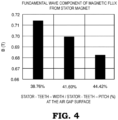
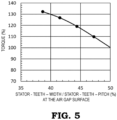
- stator teeth 5 having a narrower width increases effective magnetic flux contributing to the torque.
- FIG. 5 is a line graph showing the analysis results with varying the width of the stator teeth and with the same stator magnets 6 by setting to 100 % the torque in a case of the stator-teeth-width/stator-teeth-pitch being 50 %.
- FIG. 6 is an enlarged conceptual view showing a cross-sectional view near the stator teeth of the permanent magnet-type rotary electric machine according to Embodiment 2.
- the stator coils 4 are accommodated in the stator slots 3 and wound on the stator teeth 5 in the concentrated winding manner.
- the stator magnets 6 are accommodated in the stator slots 3 and all stator magnets 6 in the slots are magnetized to have the same pole of polarity in the radial direction.
- the stator magnets 6 are arranged nearer the first air gap 30 than the stator coils 4.
- Embodiment 1 it was shown that the torque is improved by narrowing the width of the stator teeth more than the width of the stator slots.
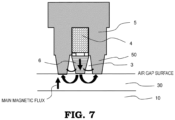
- FIG. 7 magnetic flux generated from the stator magnets that passes in the stator teeth 50 positioned between the adjacent stator magnets 6 is superimposes on the magnetic flux (main magnetic flux) from the second rotor magnets 21.
- stator teeth 50 positioned between the adjacent stator magnets 6 are likely to cause magnetic saturation, thus posing a problem in that the narrower the width of the stator teeth (the wider the width of the stator slots), the more decreases the induced voltage obtained by linkage of the magnetic flux from the second rotor 20 with the stator coils due to the magnetic saturation in the stator teeth 5.
- tapeering in width the stator teeth 50 positioned between the adjacent stator magnets 6 toward the air gap as a configuration for mitigating the magnetic flux saturation in the stator teeth 50 positioned between the adjacent stator magnets 6 and for reducing leakage of the magnetic flux from the stator magnets 6 allows for increasing the cross-sectional area of the stator teeth 5 at the opposite side of the air gaps (near the stator coils), of the stator magnets 6, thereby being able to mitigate the magnetic saturation.
- the leakage magnetic flux can be reduced while mitigating decrease of the induced voltage, whereby the torque can be increased.
- FIG. 8 shows the torque in a case of varying the stator teeth width at the air gap surface, with the width at the position nearest the stator coils 4, of the stator teeth among the width of the stator teeth 50 positioned between the adjacent the stator magnets being fixed to 44.5 % of the stator teeth pitch and with the same stator magnets 6.
- FIG. 8 is shown by setting to 100 % the torque in the case of the width throughout the radial direction of the stator teeth 50 positioned between the adjacent stator magnets being 44.5 % of the stator teeth pitch. It can be seen from the same figure that the torque is improved while mitigating influence of magnetic saturation in the stator teeth as much as possible.
- stator slot width between the stator teeth 50 positioned between the adjacent stator magnets improves the torque, thus being able to reduce the volume of permanent magnets to be used and the machine size.
- the circumferential width at the nearest (the outermost circumference of) the stator coils 4, of the stator teeth 50 positioned between the adjacent stator magnets is preferably, but not limited to, narrower than the circumferential width at the same radial position, of the stator slots, i.e., less than 50 % of the stator teeth pitch.
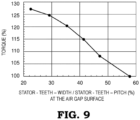
- FIG. 9 in a case of varying the stator teeth width at the air gap surface, with the width at the position nearest the stator coils 4, of the stator teeth among the width of the stator teeth 50 positioned between the adjacent the stator magnets being fixed to 57.7 % of the stator teeth pitch and with the same stator magnets 6.
- FIG. 9 is shown by setting to 100 % the torque in the case of the width throughout the radial direction of the stator teeth 50 positioned between the adjacent stator magnets being 57.7 % of the stator teeth pitch.
- stator-teeth circumferential width at the position nearest the stator coils 4 among the positions between the adjacent stator magnets is 50 % or more of the stator pitch (in other words, although the circumferential width nearest the stator coils 4, of the stator teeth 50 positioned between the stator magnets is wider than the stator-slot circumferential width at the same radial position), the same effect is brought about.
- the stator magnets 6 are formed to have a width so as to be away from the stator teeth toward the air gaps, in other words, the stator magnets 6 are shaped tapered in circumferential width toward the inner circumference, whereby the distance between the stator magnets 6 and the stator teeth 50 positioned between the adjacent stator magnets can be further increased, thus improving the torque.
Landscapes
- Engineering & Computer Science (AREA)
- Power Engineering (AREA)
- Permanent Field Magnets Of Synchronous Machinery (AREA)
- Permanent Magnet Type Synchronous Machine (AREA)
Applications Claiming Priority (1)
| Application Number | Priority Date | Filing Date | Title |
|---|---|---|---|
| PCT/JP2021/042377 WO2023089721A1 (fr) | 2021-11-18 | 2021-11-18 | Machine électrique tournante de type à aimant permanent |
Publications (2)
| Publication Number | Publication Date |
|---|---|
| EP4436016A1 true EP4436016A1 (fr) | 2024-09-25 |
| EP4436016A4 EP4436016A4 (fr) | 2025-01-15 |
Family
ID=82155946
Family Applications (1)
| Application Number | Title | Priority Date | Filing Date |
|---|---|---|---|
| EP21964736.9A Pending EP4436016A4 (fr) | 2021-11-18 | 2021-11-18 | Machine électrique tournante de type à aimant permanent |
Country Status (4)
| Country | Link |
|---|---|
| EP (1) | EP4436016A4 (fr) |
| JP (1) | JP7090828B1 (fr) |
| CN (1) | CN118216076A (fr) |
| WO (1) | WO2023089721A1 (fr) |
Families Citing this family (1)
| Publication number | Priority date | Publication date | Assignee | Title |
|---|---|---|---|---|
| JP7829446B2 (ja) * | 2022-08-19 | 2026-03-13 | 三菱重工業株式会社 | 可変速動力装置及び制御方法 |
Family Cites Families (11)
| Publication number | Priority date | Publication date | Assignee | Title |
|---|---|---|---|---|
| JP6093592B2 (ja) * | 2013-02-22 | 2017-03-08 | 株式会社Ihi | 磁気波動歯車装置 |
| JP6257114B2 (ja) * | 2014-05-20 | 2018-01-10 | 株式会社Ihi | 磁気波動歯車装置 |
| KR101669984B1 (ko) * | 2014-09-03 | 2016-10-27 | 조선대학교산학협력단 | 돌극형 마그네틱 기어 |
| JP6403329B2 (ja) | 2015-01-20 | 2018-10-10 | 株式会社Ihi | 磁気波動歯車装置 |
| JP7361344B2 (ja) | 2019-02-26 | 2023-10-16 | パナソニックIpマネジメント株式会社 | 磁気ギアードモータ |
| DE102019133580A1 (de) * | 2019-12-09 | 2021-06-10 | Bayerische Motoren Werke Aktiengesellschaft | Elektrisch erregte Synchronmaschine mit Schenkelpolrotor und permanentmagnetischer Streuflussreduzierung |
| JP6804699B1 (ja) * | 2020-01-21 | 2020-12-23 | 三菱電機株式会社 | 固定子およびこれを用いた回転電機 |
| JP6804700B1 (ja) * | 2020-01-21 | 2020-12-23 | 三菱電機株式会社 | 固定子およびこれを用いた回転電機 |
| US11996734B2 (en) * | 2020-01-21 | 2024-05-28 | Mitsubishi Electric Corporation | Stator and rotary electric machine using same |
| JP7384678B2 (ja) * | 2020-01-24 | 2023-11-21 | 三菱重工業株式会社 | 磁気ギアード回転電機 |
| JP7542184B2 (ja) * | 2020-03-23 | 2024-08-30 | パナソニックIpマネジメント株式会社 | 回転電機 |
-
2021
- 2021-11-18 EP EP21964736.9A patent/EP4436016A4/fr active Pending
- 2021-11-18 CN CN202180104106.4A patent/CN118216076A/zh not_active Withdrawn
- 2021-11-18 WO PCT/JP2021/042377 patent/WO2023089721A1/fr not_active Ceased
- 2021-11-18 JP JP2022520035A patent/JP7090828B1/ja active Active
Also Published As
| Publication number | Publication date |
|---|---|
| JPWO2023089721A1 (fr) | 2023-05-25 |
| WO2023089721A1 (fr) | 2023-05-25 |
| EP4436016A4 (fr) | 2025-01-15 |
| JP7090828B1 (ja) | 2022-06-24 |
| US20240421643A1 (en) | 2024-12-19 |
| CN118216076A (zh) | 2024-06-18 |
Similar Documents
| Publication | Publication Date | Title |
|---|---|---|
| EP1990895B1 (fr) | Géométrie de rotor à aimants permanents à répartition de contraintes pour machines électriques | |
| JP6992368B2 (ja) | 可変磁束型の永久磁石式回転電機 | |
| US7804216B2 (en) | Permanent-magnet reluctance electrical rotary machine | |
| CN102263468B (zh) | 具有改进磁阻的旋转电机 | |
| US9871420B2 (en) | Rotor for a rotary electric machine and rotary electric machine comprising such a rotor | |
| EP2595281A1 (fr) | Élément rotatif à aimant permanent encastré et machine électrique tournante | |
| KR20140094516A (ko) | 회전 전기 기계의 회전자, 및 회전자를 포함하는 회전 전기 기계 | |
| JPWO2004064225A1 (ja) | 永久磁石型電動機 | |
| EP1598920A2 (fr) | Moteur électrique rotatif à aimants permanents | |
| EP4080743B1 (fr) | Machine électrique rotative à engrenage magnétique | |
| JP6212117B2 (ja) | 同期電動機 | |
| CN103988400A (zh) | 用于旋转电机的转子,以及包括这种类型的转子的旋转电机 | |
| JP6048191B2 (ja) | マルチギャップ型回転電機 | |
| JP2007068357A (ja) | 回転電機の回転子及びそれを用いた回転電機 | |
| JP4580683B2 (ja) | 永久磁石式リラクタンス型回転電機 | |
| KR101473086B1 (ko) | 회전 전기기계 | |
| EP4436016A1 (fr) | Machine électrique tournante de type à aimant permanent | |
| CN113273057A (zh) | 具有磁通分配空隙的内置永磁体电机 | |
| EP4293876A1 (fr) | Machine rotative à engrenage magnétique et système de production d'énergie | |
| US12620846B2 (en) | Permanent magnet-type rotary electric machine | |
| CN117795825A (zh) | 转子及旋转电机 | |
| WO2019102580A1 (fr) | Machine électrique tournante à aimants permanents | |
| US20230223805A1 (en) | Rotor and rotary electric machine | |
| EP4299951A1 (fr) | Machine rotative à engrenage magnétique, système de production d'énergie et rotor de pièce polaire magnétique | |
| JP2023071284A (ja) | 永久磁石電動機 |
Legal Events
| Date | Code | Title | Description |
|---|---|---|---|
| STAA | Information on the status of an ep patent application or granted ep patent |
Free format text: STATUS: THE INTERNATIONAL PUBLICATION HAS BEEN MADE |
|
| PUAI | Public reference made under article 153(3) epc to a published international application that has entered the european phase |
Free format text: ORIGINAL CODE: 0009012 |
|
| STAA | Information on the status of an ep patent application or granted ep patent |
Free format text: STATUS: REQUEST FOR EXAMINATION WAS MADE |
|
| 17P | Request for examination filed |
Effective date: 20240322 |
|
| AK | Designated contracting states |
Kind code of ref document: A1 Designated state(s): AL AT BE BG CH CY CZ DE DK EE ES FI FR GB GR HR HU IE IS IT LI LT LU LV MC MK MT NL NO PL PT RO RS SE SI SK SM TR |
|
| REG | Reference to a national code |
Ref country code: DE Ref legal event code: R079 Free format text: PREVIOUS MAIN CLASS: H02K0016020000 Ipc: H02K0003493000 |
|
| A4 | Supplementary search report drawn up and despatched |
Effective date: 20241218 |
|
| RIC1 | Information provided on ipc code assigned before grant |
Ipc: H02K 49/10 20060101ALN20241212BHEP Ipc: H02K 21/16 20060101ALN20241212BHEP Ipc: H02K 1/276 20220101ALI20241212BHEP Ipc: H02K 29/03 20060101ALI20241212BHEP Ipc: H02K 21/14 20060101ALI20241212BHEP Ipc: H02K 16/02 20060101ALI20241212BHEP Ipc: H02K 3/493 20060101AFI20241212BHEP |
|
| DAV | Request for validation of the european patent (deleted) | ||
| DAX | Request for extension of the european patent (deleted) |