EP4436067A1 - Procédé et appareil d'égalisation dans un pon - Google Patents
Procédé et appareil d'égalisation dans un pon Download PDFInfo
- Publication number
- EP4436067A1 EP4436067A1 EP23163505.3A EP23163505A EP4436067A1 EP 4436067 A1 EP4436067 A1 EP 4436067A1 EP 23163505 A EP23163505 A EP 23163505A EP 4436067 A1 EP4436067 A1 EP 4436067A1
- Authority
- EP
- European Patent Office
- Prior art keywords
- coefficients
- equalizer
- rate
- received signal
- predetermined sets
- Prior art date
- Legal status (The legal status is an assumption and is not a legal conclusion. Google has not performed a legal analysis and makes no representation as to the accuracy of the status listed.)
- Pending
Links
Images


Classifications
-
- H—ELECTRICITY
- H04—ELECTRIC COMMUNICATION TECHNIQUE
- H04B—TRANSMISSION
- H04B10/00—Transmission systems employing electromagnetic waves other than radio-waves, e.g. infrared, visible or ultraviolet light, or employing corpuscular radiation, e.g. quantum communication
- H04B10/60—Receivers
- H04B10/66—Non-coherent receivers, e.g. using direct detection
- H04B10/69—Electrical arrangements in the receiver
- H04B10/697—Arrangements for reducing noise and distortion
- H04B10/6971—Arrangements for reducing noise and distortion using equalisation
-
- H—ELECTRICITY
- H04—ELECTRIC COMMUNICATION TECHNIQUE
- H04Q—SELECTING
- H04Q11/00—Selecting arrangements for multiplex systems
- H04Q11/0001—Selecting arrangements for multiplex systems using optical switching
- H04Q11/0062—Network aspects
- H04Q11/0067—Provisions for optical access or distribution networks, e.g. Gigabit Ethernet Passive Optical Network (GE-PON), ATM-based Passive Optical Network (A-PON), PON-Ring
-
- H—ELECTRICITY
- H04—ELECTRIC COMMUNICATION TECHNIQUE
- H04B—TRANSMISSION
- H04B10/00—Transmission systems employing electromagnetic waves other than radio-waves, e.g. infrared, visible or ultraviolet light, or employing corpuscular radiation, e.g. quantum communication
- H04B10/07—Arrangements for monitoring or testing transmission systems; Arrangements for fault measurement of transmission systems
- H04B10/075—Arrangements for monitoring or testing transmission systems; Arrangements for fault measurement of transmission systems using an in-service signal
- H04B10/079—Arrangements for monitoring or testing transmission systems; Arrangements for fault measurement of transmission systems using an in-service signal using measurements of the data signal
- H04B10/0795—Performance monitoring; Measurement of transmission parameters
-
- H—ELECTRICITY
- H04—ELECTRIC COMMUNICATION TECHNIQUE
- H04B—TRANSMISSION
- H04B10/00—Transmission systems employing electromagnetic waves other than radio-waves, e.g. infrared, visible or ultraviolet light, or employing corpuscular radiation, e.g. quantum communication
- H04B10/27—Arrangements for networking
-
- H—ELECTRICITY
- H04—ELECTRIC COMMUNICATION TECHNIQUE
- H04L—TRANSMISSION OF DIGITAL INFORMATION, e.g. TELEGRAPHIC COMMUNICATION
- H04L25/00—Baseband systems
- H04L25/02—Details ; arrangements for supplying electrical power along data transmission lines
- H04L25/03—Shaping networks in transmitter or receiver, e.g. adaptive shaping networks
- H04L25/03006—Arrangements for removing intersymbol interference
-
- H—ELECTRICITY
- H04—ELECTRIC COMMUNICATION TECHNIQUE
- H04J—MULTIPLEX COMMUNICATION
- H04J14/00—Optical multiplex systems
- H04J14/08—Time-division multiplex systems
-
- H—ELECTRICITY
- H04—ELECTRIC COMMUNICATION TECHNIQUE
- H04Q—SELECTING
- H04Q11/00—Selecting arrangements for multiplex systems
- H04Q11/0001—Selecting arrangements for multiplex systems using optical switching
- H04Q11/0062—Network aspects
- H04Q2011/0079—Operation or maintenance aspects
Definitions
- Various example embodiments relate to optical networks, specifically to equalization in passive optical networks (PON).
- PON passive optical networks
- the Telecommunication Standardization sector of the International Telecommunication Union (ITU-T) standardization body published the G.9804 standard for 50G PON. This standard combines a 50G line rate in downstream (DS), with 12.5G and 25G in upstream (US). In September 2022, also a 50G US line-rate was consented for G.9804.
- ITU-T International Telecommunication Union
- the rate can vary from burst to burst.
- a 50G receiver has a receiver chain (including for example avalanche photo-diode, APD, trans-impedance amplifier, TIA, clock and data recovery, CDR, and equalizer), that have been designed and optimized for 50G reception.
- APD avalanche photo-diode
- TIA trans-impedance amplifier
- CDR clock and data recovery
- equalizer equalizer
- a protection mode is to fall back to a mode that operates at a reduced rate, but offers an improved sensitivity.
- 25G operation is considered.
- DS a mixed modulation scheme that combines 25G with 50G could be used, in which the faulty ONU could use the 25G signal part.
- one solution is to reduce the bandwidth of the analogue components (e.g., the TIA) when a lower-rate burst is received.
- the analogue bandwidth reduction that can be achieved is limited and not sufficient to fully filter out the excess high-frequency noise.
- a prior art solution for using the equalizer in burst-mode reception is to train equalizer coefficients per ONU. This is however not desirable in a multi-rate burst-mode context, as the adaptive equalizer training might take excess time for the 25G and 12.5G rates. Also training a 50G equalizer on a 12.5G and 25G signal will typically lead to a sub-optimal performance (can even lead to a degradation for some types of signals).
- an apparatus comprising means for performing: determining a rate for a received signal in a passive optical network, PON; selecting, based on the determined rate, a set of coefficients for an equalizer from a plurality of predetermined sets of coefficients for the equalizer, wherein, the plurality of predetermined sets respectively corresponds to a plurality of rates; equalizing the received signal with the equalizer based on the selected set of coefficients, obtaining an equalized signal.
- a method comprising: determining a rate for a received signal in a passive optical network, PON; selecting, based on the determined rate, a set of coefficients for an equalizer from a plurality of predetermined sets of coefficients for the equalizer, wherein, the plurality of predetermined sets respectively corresponds to a plurality of rates; equalizing the received signal with the equalizer based on the selected set of coefficients, obtaining an equalized signal.
- a computer program comprising instructions for causing an apparatus to perform at least the following: determining a rate for a received signal in a passive optical network, PON; selecting, based on the determined rate, a set of coefficients for an equalizer from a plurality of predetermined sets of coefficients for the equalizer, wherein, the plurality of predetermined sets respectively corresponds to a plurality of rates; equalizing the received signal with the equalizer based on the selected set of coefficients, obtaining an equalized signal.
- an apparatus comprising at least one processor and at least one memory including computer program code, the at least one memory and the computer program code configured to with the at least one processor, cause the apparatus at least to perform: determining a rate for a received signal in a passive optical network, PON; selecting, based on the determined rate, a set of coefficients for an equalizer from a plurality of predetermined sets of coefficients for the equalizer, wherein, the plurality of predetermined sets respectively corresponds to a plurality of rates; equalizing the received signal with the equalizer based on the selected set of coefficients, obtaining an equalized signal.
- a non-transitory computer readable medium comprising program instructions for causing an apparatus to perform at least the following: determining a rate for a received signal in a passive optical network, PON; selecting, based on the determined rate, a set of coefficients for an equalizer from a plurality of predetermined sets of coefficients for the equalizer, wherein, the plurality of predetermined sets respectively corresponds to a plurality of rates; equalizing the received signal with the equalizer based on the selected set of coefficients, obtaining an equalized signal.
- a computer readable medium comprising program instructions for causing an apparatus to perform at least the following: determining a rate for a received signal in a passive optical network, PON; selecting, based on the determined rate, a set of coefficients for an equalizer from a plurality of predetermined sets of coefficients for the equalizer, wherein, the plurality of predetermined sets respectively corresponds to a plurality of rates; equalizing the received signal with the equalizer based on the selected set of coefficients, obtaining an equalized signal.
- the equalizer coefficients are selected based on the determined rate of the received signal, the same equalizer structure (or part of it) may be kept for different rates of reception.
- a dynamic switch in equalizer coefficients can be realized upon rate switching. While the performance, like Bit Error Rate (BER), and jitter tolerance, etc., of the received signals with different rates can be improved.
- BER Bit Error Rate
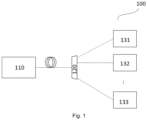
- Figure 1 shows a part of an exemplifying communication network in which examples of disclosed embodiments may be applied.
- an OLT 110 at the network side is used to connect to a plurality of ONUs 131, 132, ..., 133 at the user side by means of an optical distribution network (ODN) or fiber plant 120 that contains optical fibers and splitters, but no active components.
- ODN optical distribution network
- the OLT 110 may be connected to for example up to 64 ONUs.
- TDM time-division multiplexing
- NG-PON2 next-generation NG-PON2
- Example embodiments apply to both TDM and TWDM PON systems.
- Figure 2 shows an example block diagram of an apparatus according to an example embodiment.
- Various embodiments may be implemented at an OLT or an ONU in a PON, for example at the OLT 110, or at any one of the ONUs, for example, ONU 131, 132, ..., 133 in Figure. 1 .
- the apparatus 200 receivers a signal in a PON, for example the PON 100 in Figure 1 .
- the received signal may be an upstream signal transmitted by one or more of the ONUs 131, 132, ..., 133 in burst mode, or a downstream signal transmitted by the OLT 110.
- the received signal may have different rates, selected from a plurality of predetermined operation rates.
- a downstream signal it may be a signal with full rate, for example 50G, or a signal with reduced rate, for example 25G for a fall-back protection mode.
- each burst may come from a respective ONU, which operates at a predetermined rate among a plurality of predetermined operation rates, for example 50G, 25G or 12.5G.
- the upstream signal from certain ONU may also have different rates from burst to burst. As the technique advances, the possible rates of the received signal may be different from the given examples.
- the apparatus 200 determines a rate for the received signal for example based on scheduling information as shown in the example of Figure 2 .
- the scheduling information may be provided by another entity to the apparatus 200.
- the scheduling information maybe preconfigured in the apparatus 200 or determined by the apparatus 200 itself.
- the rate of the received signal may be determined based on a downstream scheduling information.
- the downstream scheduling information may be determined by the OLT for example based on the quality of the downstream channel to the respective ONU.
- the downstream scheduling information may comprise information related to the rate that the OLT has assigned for respective ONU, and/or rates corresponding to respective sections of a frame in which the OLT may transmit data intended for respective ONU.
- the OLT may indicate to the ONUs where the sections of the assigned rate are placed in a frame.
- the OLT may assign to an ONU a certain rate, or a maximal rate, up to which the ONU can decode. Additionally or alternatively, the OLT may assign different rates for different sections of a frame. These assignments may be referred to as a downstream scheduling information.
- the downstream scheduling information may be provided by the OLT to the ONU, for example, in a PLOAM message, transmitted at a lower rate, for example 25G.
- the apparatus 200 being implemented in the ONU 131 may obtain the downstream scheduling information from the OLT 110.
- the downstream scheduling information may also be preconfigured in the apparatus 200 for example when being implemented in the ONU 132.
- the received signal may be a burst from the ONU 131, 132, 133.
- the rate of the received signal maybe determined based on a burst scheduling information.
- the burst scheduling information may be determined by the OLT for example based on the configuration of each ONU, the capability of each ONU, and/or the quality of the upstream channel from each ONU.
- the burst scheduling information may comprise information related to the rate and the ONU Identification corresponding to each expected incoming burst. For example, for typical upstream transmission, each burst is assigned to a respective ONU with a respective rate or, during activation of the ONUs, to a respective group of ONUs with a respective rate. These assignments may be stored at the OLT and used as the burst scheduling information.
- the rate of the received signal during a certain burst may be determined based on the rate assigned to the respective ONU for which the burst is scheduled.
- the rate of the received signal may be determined prior to the signal is received, for example based on scheduling information. In another example, the rate of the received signal maybe determined after the signal is received, for example based on signal characteristics of the received signal.
- the apparatus 200 selects, based on the determined rate, a set of coefficients for an equalizer from a plurality of predetermined sets of coefficients for the equalizer, wherein, the plurality of predetermined sets respectively corresponds to a plurality of rates.
- the plurality of predetermined sets of coefficients for the equalizer may be provided by another entity to the apparatus 200.
- the plurality of predetermined sets of coefficients may be preconfigured in the apparatus 200.
- a respective set of coefficients for the equalizer may be predetermined based on expected channel conditions or calibration measurements in lab conditions of the receiver.
- the plurality of predetermined sets of coefficients comprises at least a first set of coefficients corresponding to a first rate and a second set of coefficients corresponding to a second rate, the first rate being lower than the second rate, and wherein, the first set of coefficients causes the equalizer to perform low-pass filtering, when equalizing the received signal with the equalizer based on the first set of coefficients.
- the first rate may be 25G, while the second rate may be 50G.
- there may be more than two possible rates for the received signal for example 12.5G may be additionally possible.
- a skilled person should understand, for each possible rate there is a corresponding set of predetermined coefficients.
- the first set of coefficients causes the equalizer to perform averaging of the current and the previous sample, for example, to perform the delay-and-add filtering, when equalizing the received signal with the equalizer based on the first set of coefficients.
- the first set of coefficients causes the equalizer to average two or more consecutive samples in the received signal, when equalizing the received signal with the equalizer based on the first set of coefficients.
- a simple way to realize the averaging may be implemented by configuring pairs of equal coefficients for the equalizer, for example a Feed-Forward Equalizer (FFE).
- FFE Feed-Forward Equalizer
- 25G-averaging could be realized by setting the middle two coefficients (for 12.5G the 4 middle coefficients) equal to each other, and the others equal to zero: [... 0 0 1 ⁇ 2 1 ⁇ 2 0 0...].
- the coefficients of the equalizer can be set to perform a low-pass filtering. This can for instance be determined up front, for example during calibration in the lab before deployment in the field.
- Simulation results show that the performance of using the fixed coefficients of equalizer for averaging two or more consecutive samples is very close to the performance of the theoretic optimal 25G equalizer.
- These fixed equalizers are predetermined and can be used without any online training time and thus has minimum complexity.
- the selected set of coefficients is provided to the equalizer.
- the apparatus 200 equalizes the received signal with the equalizer based on the selected set of coefficients, obtaining an equalized signal, to be provided to the output of the apparatus 200.
- the selected set of coefficients may be loaded to the equalizer during a time period determined based on the scheduling information.
- the timing of a switch in the rate of the received signal may be predicted or determined based on the scheduling information, either based on the downstream scheduling information for an implementation in an ONU or based on the burst scheduling information for an implementation in an OLT.
- the timing for switching the coefficients for the equalizer may be determined based on the timing of switch in the rate of the received signal. Accordingly, a pre-emptive switching for the equalizer may be realized.
- the rate of an incoming burst may be determined based on the burst scheduling information.
- the set of coefficients selected based on the determined rate of the coming burst may be loaded during the guard time before the incoming burst.
- the selected set of coefficients may be loaded to the equalizer during a time period prior to the timing of a switch in the rate of the downstream signal is expected.
- the equalizer may be selected from: an FFE, a Decision Feedback Equalizer, DFE, and a Maximum Likelihood Sequence Estimation, MLSE, equalizer.
- the equalizer may also be implemented as a cascade of multiple equalizer structures, for instance multiple FFE equalizers, or a FFE followed by a MLSE.
- the equalizing may be further based on adaptive training.
- the selected set of coefficients may be used as initial value of coefficients for use by the equalizer.
- the coefficients for use by the equalizer may be adjusted based on adaptive training. Approaches for fine-tuning of the coefficients for use by the equalizer are known to a skilled person and will not be elaborated here.
- the second set of coefficients corresponding to the second rate may be selected and provided to the equalizer. Equalization may be performed based on adaptive training using the selected second set of coefficients as initial coefficients.
- the selected set of coefficients maybe updated during operation based on adaptive training.
- the updated set of coefficients may be stored and used later as predetermined set of coefficients corresponding to the determined rate.
- equalizer coefficients are selected based on determined rate of the received signal, the same equalizer structure (or part of it) may be kept for different rates of reception.
- a dynamic switch in equalizer coefficients can be realized upon rate switching. There is no need to wait until the equalizer coefficients are re-trained before valid reception can start. While the performance, like Bit Error Rate (BER), of the received signals with different rates can be improved.
- BER Bit Error Rate
- the first set of coefficients may be optionally predetermined based on the second set of coefficients.
- the second set of coefficients may be optionally predetermined based on the first set of coefficients.
- This relation can for instance be used to calculate first set of coefficients from the second set of coefficients.
- the inverse relation might also be used to do the inverse conversion.
- the calculation of the first set of coefficients from the second set of coefficients can also be realized in different ways. For instance, by taking the spectrum of the 50G equalizer coefficients, and downsampling it and then going back to the time domain.
- Similar methods can be applied in case of a DFE, or even in case of a MLSE which is combined with a channel shortening FFE to calculate branch metrics.
- 25G-averaging could be realized by setting the middle two feed-forward coefficients (for 12.5G the 4 middle coefficients) equal to each other, and the other feed-forward coefficients equal to zero: [... 0 0 1 ⁇ 2 1 ⁇ 2 0 0...], while the feedback coefficients are set to 0.
- the feedback filter is effectively bypassed.
- An alternative 25G DFE implementation could be based on the 50G coefficients.
- the feed-forward coefficients could be determined by averaging every two consecutive coefficients as described above, and the feedback coefficients could similarly be determined by averaging every two consecutive feedback coefficients. This could potentially be combined with changing the amount of delay used in the feedback delay lines.
- Similar techniques could also be applied to switch from a 50G equalizer to an equalizer for a signal with different signal content, i.e., with a different distribution of transitions/bit sequences, for instance a 25G Miller(i.e., delay-encoded) signal.
- the equalizer When the equalizer is used to process the 25G signal, it may still process samples at 50G rate, for instance process 2 samples per 25G symbol. These processed samples should be at some point be downsampled to samples at 25G rate, i.e., to one sample per symbol. This may be in the equalizer itself, or after the equalizer, for instance in the higher layer processing.
- Figure 3 shows a block diagram of a method according to various embodiments.
- the method may be implemented at an OLT or an ONU in a PON, for example at the OLT 110, or at any one of the ONUs, for example, ONU 131, 132, ..., 133 in Figure. 1 .
- the method starts at step S310 with determining a rate for a received signal in a PON.
- the method continues with selecting, based on the determined rate, a set of coefficients for an equalizer from a plurality of predetermined sets of coefficients for the equalizer, wherein, the plurality of predetermined sets respectively corresponds to a plurality of rates.
- the method continues with equalizing the received signal with the equalizer based on the selected set of coefficients, obtaining an equalized signal.
- Figure 4 shows a block diagram of an apparatus according to various embodiments.
- the apparatus 200 operating in accordance with an example embodiment may be implemented at an OLT or an ONU in a PON, for example at the OLT 110, or at any one of the ONUs, for example, ONU 131, 132, ..., 133 in Figure. 1 .
- the apparatus 200 may be implemented as an electronic device such as a chip, chip-set, an electronic device or an access network controller.
- the apparatus 200 includes a processor 410 and a memory 460. In other examples, the apparatus 200 may comprise multiple processors.
- the processor 410 is a control unit operatively connected to read from and write to the memory 460.
- the processor 410 may also be configured to receive control signals received via an input interface and/or the processor 410 may be configured to output control signals via an output interface.
- the processor 410 may be configured to convert the received control signals into appropriate commands for controlling functionalities of the apparatus 200.
- the memory 460 stores computer program instructions 420 which when loaded into the processor 410 control the operation of the apparatus 200 as explained above.
- the apparatus 200 may comprise more than one memory 460 or different kinds of storage devices.
- Computer program instructions 420 for enabling implementations of example embodiments of the invention or a part of such computer program instructions may be loaded onto the apparatus 200 by the manufacturer of the apparatus 200, by a user of the apparatus 200, or by the apparatus 200 itself based on a download program, or the instructions can be pushed to the apparatus 200 by an external device.
- the computer program instructions may arrive at the apparatus 200 via an electromagnetic carrier signal or be copied from a physical entity such as a computer program product, a memory device or a record medium such as a Compact Disc (CD), a Compact Disc Read- Only Memory (CD-ROM), a Digital Versatile Disk (DVD) or a Blu-ray disk.
- the apparatus 200 comprises means, wherein the means comprises at least one processor 410, at least one memory 460 including computer program code 420, the at least one memory 460 and the computer program code 420 configured to, with the at least one processor 410, cause the performance of the apparatus 200.
- Embodiments of the present invention may be implemented in software, hardware, application logic or a combination of software, hardware and application logic.
- the software, application logic and/or hardware may reside on the apparatus, a separate device or a plurality of devices. If desired, part of the software, application logic and/or hardware may reside on the apparatus, part of the software, application logic and/or hardware may reside on a separate device, and part of the software, application logic and/or hardware may reside on a plurality of devices.
- the application logic, software or an instruction set is maintained on any one of various conventional computer-readable media.
- a 'computer- readable medium' may be any media or means that can contain, store, communicate, propagate or transport the instructions for use by or in connection with an instruction execution system, apparatus, or device, such as a computer, with one example of a computer described and depicted in Fig. 4 .
- a computer-readable medium may comprise a computer-readable storage medium that may be any media or means that can contain or store the instructions for use by or in connection with an instruction execution system, apparatus, or device, such as a computer.
- the different functions discussed herein may be performed in a different order and/or concurrently with each other. Furthermore, if desired, one or more of the above-described functions may be optional or may be combined.
Landscapes
- Engineering & Computer Science (AREA)
- Computer Networks & Wireless Communication (AREA)
- Signal Processing (AREA)
- Physics & Mathematics (AREA)
- Electromagnetism (AREA)
- Computing Systems (AREA)
- Power Engineering (AREA)
- Small-Scale Networks (AREA)
- Dc Digital Transmission (AREA)
- Optical Communication System (AREA)
Priority Applications (3)
| Application Number | Priority Date | Filing Date | Title |
|---|---|---|---|
| EP23163505.3A EP4436067A1 (fr) | 2023-03-22 | 2023-03-22 | Procédé et appareil d'égalisation dans un pon |
| US18/610,432 US20240322913A1 (en) | 2023-03-22 | 2024-03-20 | Method and apparatus for equalization in pon |
| CN202410329958.9A CN118695140A (zh) | 2023-03-22 | 2024-03-21 | 用于pon中的均衡的方法和装置 |
Applications Claiming Priority (1)
| Application Number | Priority Date | Filing Date | Title |
|---|---|---|---|
| EP23163505.3A EP4436067A1 (fr) | 2023-03-22 | 2023-03-22 | Procédé et appareil d'égalisation dans un pon |
Publications (1)
| Publication Number | Publication Date |
|---|---|
| EP4436067A1 true EP4436067A1 (fr) | 2024-09-25 |
Family
ID=85726748
Family Applications (1)
| Application Number | Title | Priority Date | Filing Date |
|---|---|---|---|
| EP23163505.3A Pending EP4436067A1 (fr) | 2023-03-22 | 2023-03-22 | Procédé et appareil d'égalisation dans un pon |
Country Status (3)
| Country | Link |
|---|---|
| US (1) | US20240322913A1 (fr) |
| EP (1) | EP4436067A1 (fr) |
| CN (1) | CN118695140A (fr) |
Families Citing this family (1)
| Publication number | Priority date | Publication date | Assignee | Title |
|---|---|---|---|---|
| EP4412110A1 (fr) * | 2023-01-31 | 2024-08-07 | Nokia Solutions and Networks Oy | Procédé et appareil pour augmenter la capacité d'une ligne optique |
Citations (4)
| Publication number | Priority date | Publication date | Assignee | Title |
|---|---|---|---|---|
| US20120134684A1 (en) * | 2010-11-30 | 2012-05-31 | Fujitsu Limited | Adaptive equalizer, optical receiver, and tap coefficient correcting method |
| KR20120078532A (ko) * | 2010-12-31 | 2012-07-10 | 연세대학교 산학협력단 | 적응 가변 전송 방법 및 시스템 |
| US10153844B2 (en) * | 2017-04-03 | 2018-12-11 | Futurewei Technologies, Inc. | Channel recovery in burst-mode, time-division multiplexing (TDM) passive optical networks (PONs) |
| US10404496B1 (en) * | 2018-09-07 | 2019-09-03 | MACOM Technology Solutions Holding, Inc. | Mitigating interaction between adaptive equalization and timing recovery in multi-rate receiver |
Family Cites Families (3)
| Publication number | Priority date | Publication date | Assignee | Title |
|---|---|---|---|---|
| JP5481240B2 (ja) * | 2010-03-12 | 2014-04-23 | 株式会社日立製作所 | マルチレート用バーストモード受信機 |
| JP7338419B2 (ja) * | 2019-11-19 | 2023-09-05 | 富士通株式会社 | 適応等化器、光受信器、及び適応等化方法 |
| US12334986B2 (en) * | 2022-01-26 | 2025-06-17 | Macom Technology Solutions Holdings, Inc. | Methods, systems, and apparatuses for passive optical networks |
-
2023
- 2023-03-22 EP EP23163505.3A patent/EP4436067A1/fr active Pending
-
2024
- 2024-03-20 US US18/610,432 patent/US20240322913A1/en active Pending
- 2024-03-21 CN CN202410329958.9A patent/CN118695140A/zh active Pending
Patent Citations (4)
| Publication number | Priority date | Publication date | Assignee | Title |
|---|---|---|---|---|
| US20120134684A1 (en) * | 2010-11-30 | 2012-05-31 | Fujitsu Limited | Adaptive equalizer, optical receiver, and tap coefficient correcting method |
| KR20120078532A (ko) * | 2010-12-31 | 2012-07-10 | 연세대학교 산학협력단 | 적응 가변 전송 방법 및 시스템 |
| US10153844B2 (en) * | 2017-04-03 | 2018-12-11 | Futurewei Technologies, Inc. | Channel recovery in burst-mode, time-division multiplexing (TDM) passive optical networks (PONs) |
| US10404496B1 (en) * | 2018-09-07 | 2019-09-03 | MACOM Technology Solutions Holding, Inc. | Mitigating interaction between adaptive equalization and timing recovery in multi-rate receiver |
Also Published As
| Publication number | Publication date |
|---|---|
| CN118695140A (zh) | 2024-09-24 |
| US20240322913A1 (en) | 2024-09-26 |
Similar Documents
| Publication | Publication Date | Title |
|---|---|---|
| EP3539228B1 (fr) | Récupération d'horloge et de données (cdr) de niveau supérieur dans les réseaux optiques passifs (pon) | |
| US20190089463A1 (en) | Using multi-level modulated signals in passive optical networks | |
| US9112742B2 (en) | Low-complexity, adaptive, fractionally spaced equalizer with non-integer sampling | |
| EP3836430B1 (fr) | Terminal de ligne optique et procédé associé | |
| WO2019134687A1 (fr) | Traitement adaptatif de signal dans des communications optiques | |
| US9755864B1 (en) | Fractionally spaced adaptive equalizer with non-integer sampling | |
| US11539437B2 (en) | Signal processing apparatus and optical receiving apparatus | |
| US20090225914A1 (en) | Communication terminal apparatus, communication apparatus, and signal receiving method | |
| US20240322913A1 (en) | Method and apparatus for equalization in pon | |
| US12375177B2 (en) | Signal processing method and device, storage medium, and electronic device | |
| US12334986B2 (en) | Methods, systems, and apparatuses for passive optical networks | |
| KR20190039507A (ko) | 광 통신 방법 및 장치 | |
| US7885290B2 (en) | Communication terminal apparatus and signal receiving method | |
| US12088439B1 (en) | Phased burst mode receiver equalization training | |
| US20230361904A1 (en) | High-capacity channel for higher speed passive optical networks | |
| US20250286629A1 (en) | Methods, systems, and apparatuses for passive optical networks | |
| WO2022015305A1 (fr) | Estimation de prise d'égalisation initiale d'unité de réseau optique | |
| WO2020050101A1 (fr) | Dispositif de traitement de signal et récepteur optique | |
| JP2024169412A (ja) | マルチレートのバーストモード受信機 | |
| Feng et al. | Joint transmission of pulse-shaped and spread-spectrum signals for quiet-window reduction in Tactile Passive Optical Network | |
| JP6279500B2 (ja) | 光通信システム及び光通信方法 | |
| Feng et al. | Discarding Quiet-Windows for Latency Optimized Up-Link Transmission in Tactile Passive Optical Network |
Legal Events
| Date | Code | Title | Description |
|---|---|---|---|
| PUAI | Public reference made under article 153(3) epc to a published international application that has entered the european phase |
Free format text: ORIGINAL CODE: 0009012 |
|
| STAA | Information on the status of an ep patent application or granted ep patent |
Free format text: STATUS: THE APPLICATION HAS BEEN PUBLISHED |
|
| AK | Designated contracting states |
Kind code of ref document: A1 Designated state(s): AL AT BE BG CH CY CZ DE DK EE ES FI FR GB GR HR HU IE IS IT LI LT LU LV MC ME MK MT NL NO PL PT RO RS SE SI SK SM TR |
|
| STAA | Information on the status of an ep patent application or granted ep patent |
Free format text: STATUS: REQUEST FOR EXAMINATION WAS MADE |
|
| 17P | Request for examination filed |
Effective date: 20250324 |