EP4438012A2 - Glénoïde intégré/onlay, glénoïde convertible revêtu poreux et têtes humérales avec des sous-faces texturées - Google Patents
Glénoïde intégré/onlay, glénoïde convertible revêtu poreux et têtes humérales avec des sous-faces texturées Download PDFInfo
- Publication number
- EP4438012A2 EP4438012A2 EP24194270.5A EP24194270A EP4438012A2 EP 4438012 A2 EP4438012 A2 EP 4438012A2 EP 24194270 A EP24194270 A EP 24194270A EP 4438012 A2 EP4438012 A2 EP 4438012A2
- Authority
- EP
- European Patent Office
- Prior art keywords
- glenoid
- implant
- fixation
- ring
- peripheral edge
- Prior art date
- Legal status (The legal status is an assumption and is not a legal conclusion. Google has not performed a legal analysis and makes no representation as to the accuracy of the status listed.)
- Pending
Links
Images
















Classifications
-
- A—HUMAN NECESSITIES
- A61—MEDICAL OR VETERINARY SCIENCE; HYGIENE
- A61F—FILTERS IMPLANTABLE INTO BLOOD VESSELS; PROSTHESES; DEVICES PROVIDING PATENCY TO, OR PREVENTING COLLAPSING OF, TUBULAR STRUCTURES OF THE BODY, e.g. STENTS; ORTHOPAEDIC, NURSING OR CONTRACEPTIVE DEVICES; FOMENTATION; TREATMENT OR PROTECTION OF EYES OR EARS; BANDAGES, DRESSINGS OR ABSORBENT PADS; FIRST-AID KITS
- A61F2/00—Filters implantable into blood vessels; Prostheses, i.e. artificial substitutes or replacements for parts of the body; Appliances for connecting them with the body; Devices providing patency to, or preventing collapsing of, tubular structures of the body, e.g. stents
- A61F2/02—Prostheses implantable into the body
- A61F2/30—Joints
- A61F2/40—Joints for shoulders
- A61F2/4081—Glenoid components, e.g. cups
-
- A—HUMAN NECESSITIES
- A61—MEDICAL OR VETERINARY SCIENCE; HYGIENE
- A61F—FILTERS IMPLANTABLE INTO BLOOD VESSELS; PROSTHESES; DEVICES PROVIDING PATENCY TO, OR PREVENTING COLLAPSING OF, TUBULAR STRUCTURES OF THE BODY, e.g. STENTS; ORTHOPAEDIC, NURSING OR CONTRACEPTIVE DEVICES; FOMENTATION; TREATMENT OR PROTECTION OF EYES OR EARS; BANDAGES, DRESSINGS OR ABSORBENT PADS; FIRST-AID KITS
- A61F2/00—Filters implantable into blood vessels; Prostheses, i.e. artificial substitutes or replacements for parts of the body; Appliances for connecting them with the body; Devices providing patency to, or preventing collapsing of, tubular structures of the body, e.g. stents
- A61F2/02—Prostheses implantable into the body
- A61F2/30—Joints
- A61F2/30721—Accessories
- A61F2/30734—Modular inserts, sleeves or augments, e.g. placed on proximal part of stem for fixation purposes or wedges for bridging a bone defect
-
- A—HUMAN NECESSITIES
- A61—MEDICAL OR VETERINARY SCIENCE; HYGIENE
- A61F—FILTERS IMPLANTABLE INTO BLOOD VESSELS; PROSTHESES; DEVICES PROVIDING PATENCY TO, OR PREVENTING COLLAPSING OF, TUBULAR STRUCTURES OF THE BODY, e.g. STENTS; ORTHOPAEDIC, NURSING OR CONTRACEPTIVE DEVICES; FOMENTATION; TREATMENT OR PROTECTION OF EYES OR EARS; BANDAGES, DRESSINGS OR ABSORBENT PADS; FIRST-AID KITS
- A61F2/00—Filters implantable into blood vessels; Prostheses, i.e. artificial substitutes or replacements for parts of the body; Appliances for connecting them with the body; Devices providing patency to, or preventing collapsing of, tubular structures of the body, e.g. stents
- A61F2/02—Prostheses implantable into the body
- A61F2/30—Joints
- A61F2002/30001—Additional features of subject-matter classified in A61F2/28, A61F2/30 and subgroups thereof
- A61F2002/30316—The prosthesis having different structural features at different locations within the same prosthesis; Connections between prosthetic parts; Special structural features of bone or joint prostheses not otherwise provided for
- A61F2002/30329—Connections or couplings between prosthetic parts, e.g. between modular parts; Connecting elements
- A61F2002/30331—Connections or couplings between prosthetic parts, e.g. between modular parts; Connecting elements made by longitudinally pushing a protrusion into a complementarily-shaped recess, e.g. held by friction fit
- A61F2002/30354—Cylindrically-shaped protrusion and recess, e.g. cylinder of circular basis
- A61F2002/30355—Cylinder of elliptical or oval basis
-
- A—HUMAN NECESSITIES
- A61—MEDICAL OR VETERINARY SCIENCE; HYGIENE
- A61F—FILTERS IMPLANTABLE INTO BLOOD VESSELS; PROSTHESES; DEVICES PROVIDING PATENCY TO, OR PREVENTING COLLAPSING OF, TUBULAR STRUCTURES OF THE BODY, e.g. STENTS; ORTHOPAEDIC, NURSING OR CONTRACEPTIVE DEVICES; FOMENTATION; TREATMENT OR PROTECTION OF EYES OR EARS; BANDAGES, DRESSINGS OR ABSORBENT PADS; FIRST-AID KITS
- A61F2/00—Filters implantable into blood vessels; Prostheses, i.e. artificial substitutes or replacements for parts of the body; Appliances for connecting them with the body; Devices providing patency to, or preventing collapsing of, tubular structures of the body, e.g. stents
- A61F2/02—Prostheses implantable into the body
- A61F2/30—Joints
- A61F2002/30001—Additional features of subject-matter classified in A61F2/28, A61F2/30 and subgroups thereof
- A61F2002/30316—The prosthesis having different structural features at different locations within the same prosthesis; Connections between prosthetic parts; Special structural features of bone or joint prostheses not otherwise provided for
- A61F2002/30329—Connections or couplings between prosthetic parts, e.g. between modular parts; Connecting elements
- A61F2002/30405—Connections or couplings between prosthetic parts, e.g. between modular parts; Connecting elements made by screwing complementary threads machined on the parts themselves
-
- A—HUMAN NECESSITIES
- A61—MEDICAL OR VETERINARY SCIENCE; HYGIENE
- A61F—FILTERS IMPLANTABLE INTO BLOOD VESSELS; PROSTHESES; DEVICES PROVIDING PATENCY TO, OR PREVENTING COLLAPSING OF, TUBULAR STRUCTURES OF THE BODY, e.g. STENTS; ORTHOPAEDIC, NURSING OR CONTRACEPTIVE DEVICES; FOMENTATION; TREATMENT OR PROTECTION OF EYES OR EARS; BANDAGES, DRESSINGS OR ABSORBENT PADS; FIRST-AID KITS
- A61F2/00—Filters implantable into blood vessels; Prostheses, i.e. artificial substitutes or replacements for parts of the body; Appliances for connecting them with the body; Devices providing patency to, or preventing collapsing of, tubular structures of the body, e.g. stents
- A61F2/02—Prostheses implantable into the body
- A61F2/30—Joints
- A61F2/30721—Accessories
- A61F2/30734—Modular inserts, sleeves or augments, e.g. placed on proximal part of stem for fixation purposes or wedges for bridging a bone defect
- A61F2002/30738—Sleeves
-
- A—HUMAN NECESSITIES
- A61—MEDICAL OR VETERINARY SCIENCE; HYGIENE
- A61F—FILTERS IMPLANTABLE INTO BLOOD VESSELS; PROSTHESES; DEVICES PROVIDING PATENCY TO, OR PREVENTING COLLAPSING OF, TUBULAR STRUCTURES OF THE BODY, e.g. STENTS; ORTHOPAEDIC, NURSING OR CONTRACEPTIVE DEVICES; FOMENTATION; TREATMENT OR PROTECTION OF EYES OR EARS; BANDAGES, DRESSINGS OR ABSORBENT PADS; FIRST-AID KITS
- A61F2/00—Filters implantable into blood vessels; Prostheses, i.e. artificial substitutes or replacements for parts of the body; Appliances for connecting them with the body; Devices providing patency to, or preventing collapsing of, tubular structures of the body, e.g. stents
- A61F2/02—Prostheses implantable into the body
- A61F2/30—Joints
- A61F2/30767—Special external or bone-contacting surface, e.g. coating for improving bone ingrowth
- A61F2/30771—Special external or bone-contacting surface, e.g. coating for improving bone ingrowth applied in original prostheses, e.g. holes or grooves
- A61F2002/30772—Apertures or holes, e.g. of circular cross section
-
- A—HUMAN NECESSITIES
- A61—MEDICAL OR VETERINARY SCIENCE; HYGIENE
- A61F—FILTERS IMPLANTABLE INTO BLOOD VESSELS; PROSTHESES; DEVICES PROVIDING PATENCY TO, OR PREVENTING COLLAPSING OF, TUBULAR STRUCTURES OF THE BODY, e.g. STENTS; ORTHOPAEDIC, NURSING OR CONTRACEPTIVE DEVICES; FOMENTATION; TREATMENT OR PROTECTION OF EYES OR EARS; BANDAGES, DRESSINGS OR ABSORBENT PADS; FIRST-AID KITS
- A61F2/00—Filters implantable into blood vessels; Prostheses, i.e. artificial substitutes or replacements for parts of the body; Appliances for connecting them with the body; Devices providing patency to, or preventing collapsing of, tubular structures of the body, e.g. stents
- A61F2/02—Prostheses implantable into the body
- A61F2/30—Joints
- A61F2/30767—Special external or bone-contacting surface, e.g. coating for improving bone ingrowth
- A61F2/30771—Special external or bone-contacting surface, e.g. coating for improving bone ingrowth applied in original prostheses, e.g. holes or grooves
- A61F2002/30772—Apertures or holes, e.g. of circular cross section
- A61F2002/30784—Plurality of holes
- A61F2002/30785—Plurality of holes parallel
-
- A—HUMAN NECESSITIES
- A61—MEDICAL OR VETERINARY SCIENCE; HYGIENE
- A61F—FILTERS IMPLANTABLE INTO BLOOD VESSELS; PROSTHESES; DEVICES PROVIDING PATENCY TO, OR PREVENTING COLLAPSING OF, TUBULAR STRUCTURES OF THE BODY, e.g. STENTS; ORTHOPAEDIC, NURSING OR CONTRACEPTIVE DEVICES; FOMENTATION; TREATMENT OR PROTECTION OF EYES OR EARS; BANDAGES, DRESSINGS OR ABSORBENT PADS; FIRST-AID KITS
- A61F2/00—Filters implantable into blood vessels; Prostheses, i.e. artificial substitutes or replacements for parts of the body; Appliances for connecting them with the body; Devices providing patency to, or preventing collapsing of, tubular structures of the body, e.g. stents
- A61F2/02—Prostheses implantable into the body
- A61F2/30—Joints
- A61F2/30767—Special external or bone-contacting surface, e.g. coating for improving bone ingrowth
- A61F2/30771—Special external or bone-contacting surface, e.g. coating for improving bone ingrowth applied in original prostheses, e.g. holes or grooves
- A61F2002/30878—Special external or bone-contacting surface, e.g. coating for improving bone ingrowth applied in original prostheses, e.g. holes or grooves with non-sharp protrusions, for instance contacting the bone for anchoring, e.g. keels, pegs, pins, posts, shanks, stems, struts
-
- A—HUMAN NECESSITIES
- A61—MEDICAL OR VETERINARY SCIENCE; HYGIENE
- A61F—FILTERS IMPLANTABLE INTO BLOOD VESSELS; PROSTHESES; DEVICES PROVIDING PATENCY TO, OR PREVENTING COLLAPSING OF, TUBULAR STRUCTURES OF THE BODY, e.g. STENTS; ORTHOPAEDIC, NURSING OR CONTRACEPTIVE DEVICES; FOMENTATION; TREATMENT OR PROTECTION OF EYES OR EARS; BANDAGES, DRESSINGS OR ABSORBENT PADS; FIRST-AID KITS
- A61F2/00—Filters implantable into blood vessels; Prostheses, i.e. artificial substitutes or replacements for parts of the body; Appliances for connecting them with the body; Devices providing patency to, or preventing collapsing of, tubular structures of the body, e.g. stents
- A61F2/02—Prostheses implantable into the body
- A61F2/30—Joints
- A61F2/30767—Special external or bone-contacting surface, e.g. coating for improving bone ingrowth
- A61F2/30771—Special external or bone-contacting surface, e.g. coating for improving bone ingrowth applied in original prostheses, e.g. holes or grooves
- A61F2002/30878—Special external or bone-contacting surface, e.g. coating for improving bone ingrowth applied in original prostheses, e.g. holes or grooves with non-sharp protrusions, for instance contacting the bone for anchoring, e.g. keels, pegs, pins, posts, shanks, stems, struts
- A61F2002/30879—Ribs
- A61F2002/30881—Circumferential ribs, flanges or fins
-
- A—HUMAN NECESSITIES
- A61—MEDICAL OR VETERINARY SCIENCE; HYGIENE
- A61F—FILTERS IMPLANTABLE INTO BLOOD VESSELS; PROSTHESES; DEVICES PROVIDING PATENCY TO, OR PREVENTING COLLAPSING OF, TUBULAR STRUCTURES OF THE BODY, e.g. STENTS; ORTHOPAEDIC, NURSING OR CONTRACEPTIVE DEVICES; FOMENTATION; TREATMENT OR PROTECTION OF EYES OR EARS; BANDAGES, DRESSINGS OR ABSORBENT PADS; FIRST-AID KITS
- A61F2/00—Filters implantable into blood vessels; Prostheses, i.e. artificial substitutes or replacements for parts of the body; Appliances for connecting them with the body; Devices providing patency to, or preventing collapsing of, tubular structures of the body, e.g. stents
- A61F2/02—Prostheses implantable into the body
- A61F2/30—Joints
- A61F2/30767—Special external or bone-contacting surface, e.g. coating for improving bone ingrowth
- A61F2/30771—Special external or bone-contacting surface, e.g. coating for improving bone ingrowth applied in original prostheses, e.g. holes or grooves
- A61F2002/30878—Special external or bone-contacting surface, e.g. coating for improving bone ingrowth applied in original prostheses, e.g. holes or grooves with non-sharp protrusions, for instance contacting the bone for anchoring, e.g. keels, pegs, pins, posts, shanks, stems, struts
- A61F2002/30891—Plurality of protrusions
-
- A—HUMAN NECESSITIES
- A61—MEDICAL OR VETERINARY SCIENCE; HYGIENE
- A61F—FILTERS IMPLANTABLE INTO BLOOD VESSELS; PROSTHESES; DEVICES PROVIDING PATENCY TO, OR PREVENTING COLLAPSING OF, TUBULAR STRUCTURES OF THE BODY, e.g. STENTS; ORTHOPAEDIC, NURSING OR CONTRACEPTIVE DEVICES; FOMENTATION; TREATMENT OR PROTECTION OF EYES OR EARS; BANDAGES, DRESSINGS OR ABSORBENT PADS; FIRST-AID KITS
- A61F2/00—Filters implantable into blood vessels; Prostheses, i.e. artificial substitutes or replacements for parts of the body; Appliances for connecting them with the body; Devices providing patency to, or preventing collapsing of, tubular structures of the body, e.g. stents
- A61F2/02—Prostheses implantable into the body
- A61F2/30—Joints
- A61F2/30767—Special external or bone-contacting surface, e.g. coating for improving bone ingrowth
- A61F2/30771—Special external or bone-contacting surface, e.g. coating for improving bone ingrowth applied in original prostheses, e.g. holes or grooves
- A61F2002/30878—Special external or bone-contacting surface, e.g. coating for improving bone ingrowth applied in original prostheses, e.g. holes or grooves with non-sharp protrusions, for instance contacting the bone for anchoring, e.g. keels, pegs, pins, posts, shanks, stems, struts
- A61F2002/30891—Plurality of protrusions
- A61F2002/30892—Plurality of protrusions parallel
-
- A—HUMAN NECESSITIES
- A61—MEDICAL OR VETERINARY SCIENCE; HYGIENE
- A61F—FILTERS IMPLANTABLE INTO BLOOD VESSELS; PROSTHESES; DEVICES PROVIDING PATENCY TO, OR PREVENTING COLLAPSING OF, TUBULAR STRUCTURES OF THE BODY, e.g. STENTS; ORTHOPAEDIC, NURSING OR CONTRACEPTIVE DEVICES; FOMENTATION; TREATMENT OR PROTECTION OF EYES OR EARS; BANDAGES, DRESSINGS OR ABSORBENT PADS; FIRST-AID KITS
- A61F2/00—Filters implantable into blood vessels; Prostheses, i.e. artificial substitutes or replacements for parts of the body; Appliances for connecting them with the body; Devices providing patency to, or preventing collapsing of, tubular structures of the body, e.g. stents
- A61F2/02—Prostheses implantable into the body
- A61F2/30—Joints
- A61F2/30767—Special external or bone-contacting surface, e.g. coating for improving bone ingrowth
- A61F2002/3092—Special external or bone-contacting surface, e.g. coating for improving bone ingrowth having an open-celled or open-pored structure
-
- A—HUMAN NECESSITIES
- A61—MEDICAL OR VETERINARY SCIENCE; HYGIENE
- A61F—FILTERS IMPLANTABLE INTO BLOOD VESSELS; PROSTHESES; DEVICES PROVIDING PATENCY TO, OR PREVENTING COLLAPSING OF, TUBULAR STRUCTURES OF THE BODY, e.g. STENTS; ORTHOPAEDIC, NURSING OR CONTRACEPTIVE DEVICES; FOMENTATION; TREATMENT OR PROTECTION OF EYES OR EARS; BANDAGES, DRESSINGS OR ABSORBENT PADS; FIRST-AID KITS
- A61F2/00—Filters implantable into blood vessels; Prostheses, i.e. artificial substitutes or replacements for parts of the body; Appliances for connecting them with the body; Devices providing patency to, or preventing collapsing of, tubular structures of the body, e.g. stents
- A61F2/02—Prostheses implantable into the body
- A61F2/30—Joints
- A61F2/30767—Special external or bone-contacting surface, e.g. coating for improving bone ingrowth
- A61F2002/3093—Special external or bone-contacting surface, e.g. coating for improving bone ingrowth for promoting ingrowth of bone tissue
-
- A—HUMAN NECESSITIES
- A61—MEDICAL OR VETERINARY SCIENCE; HYGIENE
- A61F—FILTERS IMPLANTABLE INTO BLOOD VESSELS; PROSTHESES; DEVICES PROVIDING PATENCY TO, OR PREVENTING COLLAPSING OF, TUBULAR STRUCTURES OF THE BODY, e.g. STENTS; ORTHOPAEDIC, NURSING OR CONTRACEPTIVE DEVICES; FOMENTATION; TREATMENT OR PROTECTION OF EYES OR EARS; BANDAGES, DRESSINGS OR ABSORBENT PADS; FIRST-AID KITS
- A61F2/00—Filters implantable into blood vessels; Prostheses, i.e. artificial substitutes or replacements for parts of the body; Appliances for connecting them with the body; Devices providing patency to, or preventing collapsing of, tubular structures of the body, e.g. stents
- A61F2/02—Prostheses implantable into the body
- A61F2/30—Joints
- A61F2/40—Joints for shoulders
- A61F2/4081—Glenoid components, e.g. cups
- A61F2002/4085—Glenoid components, e.g. cups having a convex shape, e.g. hemispherical heads
Definitions
- Shoulder Replacement is a commonly performed medical procedure for treatment of osteoarthritis, rheumatoid arthritis, as well as for treatment of certain deformities related to oncological indications as well as trauma.
- anatomic the surgeon replaces the articular surfaces with industrial materials such that the articulating surfaces are substantially the same shape as the natural anatomy.
- a stem can be commonly fixed inside the canal of the humerus
- a metallic articular head can be rigidly fixed to the proximal aspect of the same, the articular head having a convex articular surface adapted to articulate with the glenoid implant.
- the glenoid implant can include on its back side (medial side) certain pegs or posts or fins adapted to be rigidly fixed within the glenoid fossa of the scapula and on its front side a concave or flat articular surface adapted to articulate with the humeral head of the humeral implant.
- the articular surface is reversed in that the metallic ball is rigidly fixed to the glenoid fossa of the scapula, and the concave articular surface is rigidly fixed to the humeral bone, thereby reversing the fashion of articulation of the prosthesis.
- the surgeon chooses between the two types of prostheses by assessing a number of conditions of the patient including level of pain, patient activity level, deformity or severity of the boney degradation, the strength of surrounding soft tissues, and present or absence of prior surgery, and particularly the health and strength of the rotator cuff muscle and tendon.
- Disease of the rotator cuff is common among patients with arthritis of the shoulder.
- the absence of insufficiency of the rotator cuff leads to a condition where the anatomic shoulder replacement prosthesis is not sufficiently stabilized by surrounding soft tissue.
- a reverse shoulder replacement prosthesis can be preferred in some cases due to the higher inherent stability of the articulation.
- the reverse prosthesis can advantageously utilize the remaining muscles in a way they can be more effective in the absence of the other soft tissue structures by adjusting the position of the articular surfaces within the joint.
- surgeon selects to use an anatomic prosthesis and is provides effective treatment to the patient though the shoulder replacement operation.
- the patient's rotator cuff complex can become insufficient, tear, or generally be diseased such that it can no longer perform its function associated with normal joint kinematics.
- the surgeon can elect to perform a second operation to remove the anatomic prosthesis, and replace the anatomic prosthesis with a reverse prosthesis.
- a challenge of this particular articulation in some cases is that the glenoid fossa is relatively small, and commonly there is much reduced presence of bone in patients with arthritis.
- the surgeon has limited positioning and bone to work with in order to fit within the patient.
- the surgeon must be careful not to overstuff the joint, meaning implant components that move the new articulating surface far from its original position such that the soft tissues is unnaturally tensioned, which can lead to instability, accelerated where, soft tissue failure, pain, reduced range of motion, or fracture of the prosthesis and surrounding bone. Facing these conditions, the prosthesis typically needs to be designed to remain relatively thin (commonly, 1 piece, where PE glenoid implants typically have a 4mm thick articular surface).
- a method of performing a reversible anatomic shoulder replacement procedure can include any number of: reaming a cavity into the glenoid; and inserting an anatomic glenoid articular implant into the glenoid cavity, the glenoid anatomic articular implant comprising a medial surface configured to mate with the glenoid cavity, a central peg extending medially from the medial surface, a lateral surface configured to articulate with a humeral component; and an intermediate component between the lateral surface and the medial surface, the intermediate component having an outer diameter reversibly attached to a snap ring attached to a fixation ring, the snap ring and the fixation ring at least partially implanted within the glenoid cavity.
- the anatomic glenoid articular implant can be partially or fully inset into the glenoid cavity.
- the cavity could be circular, oval, or another shape.
- the groove can include anti-rotation tabs.
- the peripheral edge of the fixation ring can be configured to facilitate bone ingrowth, e.g., via an osteoinductive or osteoconductive surface.
- the groove can be a circumferential groove.
- the lateral surface can include any appropriate material, such as polyethylene.
- a reverse shoulder replacement kit for an anatomic shoulder replacement system can include any number of: an implant removal tool configured to bore through a medial surface of the anatomic glenoid articular implant sufficient to collapse a snap ring; and remove an anatomic glenoid articular implant while leaving a fixation ring in place within the glenoid cavity; and a reverse shoulder implant configured to be implanted into the glenoid cavity, the reverse shoulder implant comprising a generally cylindrical component comprising a medial surface configured to mate with the glenoid cavity, a central receptacle for housing an articular post therethrough, and a plurality of peripheral screw holes; a lateral surface, and a central post extending away from the lateral surface, wherein the reverse shoulder implant is configured to reversibly mate with the snap ring and fixation ring embedded in the glenoid cavity to anchor the reverse shoulder implant.
- the anatomic glenoid articular implant is partially or fully inset into the glenoid cavity.
- the cavity can be, for example, circular or oval.
- a reversible anatomic shoulder replacement system comprising a fixation ring configured to be positioned within the glenoid cavity, the fixation ring at least partially comprising a porous coating, the fixation ring also comprising a peripheral edge comprising an outer diameter; and an anatomic articular implant comprising a medial surface configured to mate with the glenoid cavity, a central peg extending medially from the medial surface, a lateral surface configured to articulate with a humeral component; a medial peripheral edge; and a lateral peripheral edge, the medial peripheral edge comprising a substantially constant diameter that is less than a substantially constant diameter of the lateral peripheral edge, the fixation ring comprising an inner diameter sized and configured to circumscribe the medial peripheral edge of the implant.
- the fixation ring can be configured to be at least partially implanted within the glenoid cavity.
- the fixation ring can include anti-rotation features on an outer diameter of the fixation ring.
- the peripheral edge of the fixation ring can be configured to facilitate bone ingrowth, e.g., an osteoinductive or osteoconductive surface.
- the inner diameter of the fixation ring can include barbs and/or threads, including self-tapping threads.
- some embodiments of the invention are focused on advantageously exchanging the articular surface of the glenoid from a concave shape to a convex shape, without removing the components or interface having to do with fixation of the implant into the glenoid fossa.
- embodiments of the invention can be used or modified with use with particular advantages of using inset glenoid fixation technology in anatomic shoulder arthroplasty, such as described, for example, in U.S. Pat. Nos. 8,007,538 and/or 8,778,028 to Gunther.
- Some embodiments of the invention can utilize an inset glenoid articulation implant described by Gunther et al. including in U.S. Pat. No. 8,007,538 or 8,778,028 .
- some embodiments of the invention can also utilize onlay glenoid articulation implants.
- the peripheral rim of the implant can in some cases have an important role in the fixation stability of the implant and its resistance to motion relative to the glenoid bone during articulation.
- a known "rule of thumb" in the industry is that the bearing component of the glenoid implant, such as the polyethylene (PE) component, should be at least about 3mm thick at its thinnest position in order to achieve a sufficient material strength to minimize risk of accelerated implant failure.
- PE polyethylene
- the design of the implant (which can be inset in some embodiments) might be improved upon by providing a step in the outer diameter of the inset glenoid implant at its most medial aspect while being able to maintain a minimum PE thickness of about or at least about 2mm, 2.5mm, 3mm, 3.5mm, 4mm, or ranges incorporating any of the aforementioned values.
- annular ring which can be rigidly fixed on the outer diameter of the articular implant such that the outer diameter of the inset glenoid implant remains a contiguous surface, albeit in some embodiments made a plurality of materials: the lateral aspect being part of the PE articulation, the medial aspect being the outer diameter of the annular ring, which can be metallic in some cases.
- the annular ring and the PE articular component can be attached to one another through the use of a snap ring mechanism or other ways, some of which are described elsewhere herein.
- the annular ring can be configured such that its outer diameter presents a surface to the surrounding bone which can be adapted to be biologically attractive for the growth of surrounding bone tissue.
- This technology can be achieved by several means such as, for example, various coatings or secondary manufacturing operations, mechanical modification through machining operations, creation of an adapted surface using 3D printing manufacturing, or other means.
- One advantage of the surface on the outer diameter is such that over the course of the healing process following surgery, bone grows and adapts itself to this annular ring so as to provide rigid attachment of surrounding bone to the annular ring.
- the ring is well fixed to bone, and following removal of the PE articulation component, the ring remains well fixed within the glenoid bone, and can be useful as a support surface in attachment of a new reverse articulating surface to the bone.
- the peripheral edge 104 can include a coating or other surface, e.g., osteoinductive or osteoconductive surface to facilitate bone ingrowth and fixation into the cavity.
- the surface could include, for example, cortical bone, cancellous bone, particulate matter, a powder form, granules, chips, a synthetic bone substitute, growth factors and/or bone growth promoting proteins, or combinations thereof.
- the annular ring 100 can also include a groove or slot 108 that can be oriented along the outer circumference of the central cavity 106 (e.g., inner diameter of the ring) and configured to house a snap ring therein (not shown).
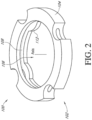
- FIG. 2 illustrates an upper perspective view of an embodiment of a support, e.g., an annular ring 100, showing the indents 102 as previously described. Also shown is the groove or slot 108 configured to house a snap ring as well as radially-inward extending anti-rotation tabs 112.
- the outer diameter of the peripheral edge 104 of the annular ring 100 can match that of a bearing, e.g., polyethylene component in some embodiments.
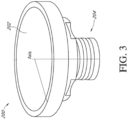
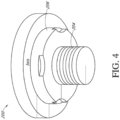
- FIGS. 3 and 4 illustrate an embodiment of an anatomic articular component 200 for a glenoid cavity which can be made of polyethylene or another appropriate material.
- the anatomic articular component 200 can include a concave articulating surface 202 as shown, as well as a central fixation post or peg 204, which can be only a single post or peg in some cases, and be aligned coaxially with the center of the implant.
- the peripheral edge of the implant could have a generally cylindrical shape in some embodiments, and/or have a circular, oval, or other cross-section.
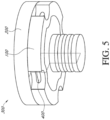
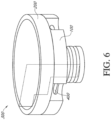
- FIGS. 5 and 6 illustrate different perspective views of an embodiment of a reversible anatomic articular assembly 300 including the anatomic articular component 200, fixation ring 100, and location for placement of a snap ring 400 as previously described and illustrated.
- FIG. 7 illustrates a perspective view of an embodiment of a reverse fixation implant, e.g., disc 700 including a central fixation post 706 that can include a longitudinal axis aligned along the center of the reverse fixation disc as shown.
- the medial surface 702 of the disc can include a central receptacle 708 for an articular post, as well as a plurality, e.g., 2, 3, 4, or more screw holes 704 oriented more peripherally with respect to the peripheral edge 706 of the disc, which can be generally cylindrical as shown, or another suitable geometry.
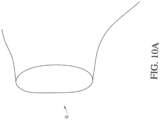
- FIGS. 10A-10C illustrates part of a method of implanting an anatomic prosthesis into a reamed glenoid cavity, according to some embodiments of the invention.
- a pocket P can be prepared, such as by reaming, in the glenoid G (shown in FIG. 10A ), which can be an appropriate shape, such as circular as shown, ovoid, or other geometries, with a central distal extending hole H for a central peg in some embodiments, as shown in FIG. 10C .
- the anatomic implant one embodiment of which is shown in FIG. 10B along with the fixation ring and snap ring, can be implanted into the cavity, shown schematically in FIG.
- the attachment of the ring to the PE implant can be preferably achieved in a reversible fashion using techniques and tools available to a surgeon such that the operation can be performed in situ, or in place within the patient.
- a snap ring mechanism can be utilized such that another component, such as an angular metallic ring is positioned between the bearing component, e.g., PE component and the snap ring and/or metallic ring.
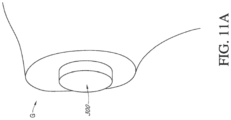
- FIG. 11A schematically illustrates an anatomic articular implant 300 inserted into bone, such as the glenoid cavity.
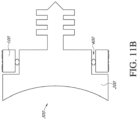
- FIG. 11B schematically illustrates a side view, and FIG. 11C a top view, of an implant that can be as previously described.
- the snap ring 400 shown in phantom in FIG. 11C
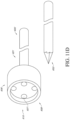
- the snap ring 400 can be collapsed in order to eliminate its interference fit between the annular ring and the PE component. This can be performed through the use of a guide 600 shown in FIG. 11D which can be placed over the surface of the PE component which can be in situ.
- the guide 600 can have an elongate shaft 601 and a distal end 604 including an annular sidewall 606 defining a cavity 608 and an open distal end configured to have an inner diameter that can match, substantially match, or be the same size or larger than the outer diameter of the peripheral edge of the bearing component of the implant, such that the annular sidewall 606 and cavity 608 is placed over the glenoid implant.
- Release pins 602, a drill, or other tool can be axially advanced into apertures 607 of the guide 600 to facilitate release of the snap ring from the glenoid implant.
- the guide 600 provides positioning of a plurality of holes, e.g., about or at least about two, three, four, five, or more holes positioning around the periphery of the PE implanted such that which a drill or pin 602 is mechanically driven into the guide holes 607, they are aligned to force the snap ring 400 in an radially inward fashion to allow for release of the snap ring.
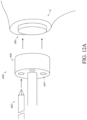
- FIG. 12A schematically illustrates the guide 600 being advanced toward the glenoid implant 300 in situ in the glenoid G, along with pins 602 that can be placed in apertures 607 of the guide 600.
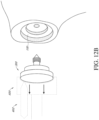
- the snap ring is collapsed, and the PE component and snap ring can be removed from the annular fixation ring as an assembly, as shown in FIG. 12B .
- the fixation ring may not be fully counter-sunk, and be partially rather than fully inset, within the glenoid surface, and/or stand proud of the glenoid surface. With time, the fixation ring can have some bony ingrowth.
- an implant such as a disc, e.g., a metallic disc (e.g., as shown in FIGS. 7-9 for example) can then be placed into the previously implanted fixation ring 100 including a groove 108 configured to fit a new snap ring 400 as previously described.
- the implant 1300 can include a glenosphere 1302 with an offset peg 1303 configured to fit with baseplate 1304 with shaft 1306 (schematically shown in section view), and snap ring 400.
- the baseplate can have a longitudinal axis A2 that is offset from the longitudinal axis of the glenosphere A1 in some embodiments.
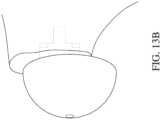
- FIG. 13B illustrates the reverse implant assembled and deployed within the glenoid cavity.
- the surgeon can further prepare the glenoid fossa for the reverse fixation disc by drilling a centrally positioned hole.
- the hole can be adapted to receive a pin, post, screw, or other feature which is integrally attached to the medial aspect of the fixation disc.
- the fixation disc can be positioned within the annular ring, the central fixation protrusion can be positioned within this hole in the glenoid bone such that further fixation rigidity is obtained.
- the surgeon can drill additional holes in the glenoid bone through peripheral holes in the fixation disc, which provides the ability to drive fixation screws through the fixation disc into the glenoid bone, even further improving rigidity, in addition to providing rotational stability. Due to the size constrains of the components, it can be advantageous to design the annular ring in a fashion that provides sufficient clearance through which these fixation screws can pass. To this end, the annular ring can be designed such that at on its periphery are several (four) indents of circular shape that provides clearance for passing of the peripheral screws.
- the spherical articular component is introduced to the fixation disc.
- the articular component can have a cone-shaped protrusion which can be adapted to fit rigidly into a cone shaped hole centrally located within the fixation disc. This can provide a rigid fixation means by which the articular component is fixed to the fixation components using a technique and mechanism well known in the art.
- modular, convertible shoulder system as disclosed for example herein can include several unique advantages not considered elsewhere, including but not limited to one or more of the following:
- an improved glenoid implant can be configured to lie both inset in a subchondral bone pocket in the glenoid, as well as on subchondral bone so that there is additional surface for the humeral head to articulate with in cases of perceived or real joint laxity.
- glenoid implants The most common failure mechanism of glenoid implants is loosening due to a rocking horse motion which can be related to joint laxity. This joint laxity can sometimes allow the humeral head to undesirably articulate at the margins of a glenoid implant. This potential complication can occur with both inset glenoid implants as well as conventional onlay glenoid implants.
- providing additional material for articulation can prevent subluxation while still providing enhanced inset fixation.
- This same fixation argument can be beneficial with respect to onlay glenoids which only provide fixation at small, discrete locations (e.g., peripheral and central pegs or keels).
- any rocking horse motion is advantageously greatly minimized or even eliminated.
- Such embodiments can be used in a large number of total shoulder arthroplasty surgery procedures. Further details of glenoid implants that can be used or modified for use with those as disclosed herein can be found, for example, in U.S. Pat. No. 8,778,028 to Gunther et al. and/or U.S. Pat. App. No. 15/952,063 to Ball .
- an inset glenoid implant configured to reversibly connect with and press-fit into a partial or completely porous ring can be very clinically advantageous.
- FIGS. 14-17 illustrate embodiments of a hybrid inset and onlay glenoid implant.
- FIG. 16 illustrates a side view of an embodiment of a glenoid implant 10 with a backside peg 12.
- the peg could be a single peg 12 situated centrally on the medial (back) side of glenoid implant 10 and in some cases can be a cylindrical peg shape that extends outwardly from glenoid implant 10 away from the back of the implant 16.
- the glenoid implant 10 can also include a lateral articulating surface 20 against which the head of a humerus or humeral component can move.
- Some embodiments include an extended onlay body portion 19 having a width or diameter than is greater than an inset body portion 17 having including the lateral articulating surface 20 and a medial surface 21 on the onlay body portion 19 that is meant to lay on the glenoid surface G.
- the width or diameter is about or at least about 5%, 10%, 15%, 20%, 25%, 30%, 35%, 40%, 45%, 50%, or more greater than the width or diameter of the inset body portion 17, or ranges incorporating any two of the aforementioned values.
- the extended articular surface 20 can lie off axis with the medial surface 16 of the inset body portion 17 as shown in FIG. 16 , or parallel in some embodiments, and be coaxial or non-coaxial.
- a method of treating a patient including identifying a patient having a glenoid surface; reaming a cavity into the glenoid surface; and inserting a glenoid implant having an inset body portion and a peg, the inset body portion having a bearing surface on a peripheral edge thereof into the cavity, such that at least a portion of, or the entire peripheral edge of the inset body portion resides below the adjacent glenoid surface and the portion residing below the adjacent glenoid surface is circumferentially surrounded by cortical bone of the glenoid, while an onlay body portion having a diameter or width greater than the inset body portion has an extended lateral articulating surface for articulation with a humerus or a humeral component, and a medial surface that rests on top of the glenoid surface.
- implants that can use porous coating as a fixation method and optionally allow for conversion to a reverse shoulder arthroplasty during a revision surgery.
- the use of cement during a total shoulder arthroplasty procedure adds additional cost and time to the surgery. Any design that can effectively provide short and long term cementless fixation can advantageously simplify the procedure and reduce overall cost and risk to the patient.
- the porous coating could be, for example, poly-ether-ether-ketone (PEEK), a biostable and biocompatible thermoplastic polymer, hydroxyapatite (or other crystalline phases of HA), metals, or combinations thereof.
- Some embodiments can include HA coated PEEK implants, but can also include any polymer of the poly-aryl-ether-ketone family such as, but not limited to, poly-ether-ketone (PEK) and poly-ether-ketone-ether-ketone-ketone (PEKEKK), or others such as UHMWPE.
- the coating can be applied via a plasma spray process. Prior to coating PEEK (or other similar polymers) with HA (or other crystalline phases of HA), the surface of the PEEK can be textured to provide a more suitable surface for HA deposition.
- Texturing of the surface further enhances the bond strength between the coating and the PEEK and also enhances fixation of the PEEK between the adjacent vertebrae, due to bony ingrowth, upon resorption of the coating.
- the surface of the porous coating may be textured into microstructured, macrostructured, microporous or macroporous morphologies. Texturing can be accomplished, for example, by grit blasting using a suitable media such as alumina, or by machined grooves or threads, or any other method that may allow for texturing of the surface.
- a metal porous coating such as titanium or its alloys, stainless steel alloys, cobalt-chromium (Co-Cr) alloys, tantalum alloys, zirconium alloys, nitinol, or other metals and/or metal alloys can be used.
- a suitable titanium-based material is commercially pure (CP) titanium. Examples of different grades of CP titanium are specified in ASTM F67 as grades 1-4.
- a suitable titanium alloy is a titanium-aluminum-vanadium (Ti-Al-V) alloy.
- the Ti-Al-V alloy is Ti-Al6-V4, or Ti-6-4, which includes 6% aluminum and 4% vanadium and is sometimes referred to as grade 5 titanium alloy.
- the porosity can be between about 20% and about 80%, such as about 20%, 25%, 30%, 35%, 40%, 45%, 50%, 55%, 60%, 65%, 70%, 75%, 80%, or ranges including any two of the aforementioned values.
- individual pore sizes may range from about 100 ⁇ m to about 1000 ⁇ m, and such as from about 200 ⁇ m to about 300 ⁇ m in some cases.
- porous coated elements By adding one or more porous coated elements to the underside of a glenoid implant, short and long term fixation can be created.
- Conventional devices either created a modular implant with a plastic glenoid articular surface implant fitting in to a metal stem and metal underside with porous coating and/or a porous stem compression molded to a plastic glenoid articular surface.
- the use of a modular, metal backed implant can be deficient in multiple areas.
- porous stem compression molded to the articular plastic only provides stem fixation of the implant. Any loading that occurred off the axis of the stem creates a bending moment about the metal/plastic compression molded interface leading to wear debris generation and implant failure.
- Some embodiments include a metal/plastic modular glenoid implant using porous coating fixation.
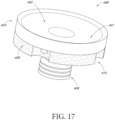
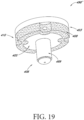
- the porous structure e.g., ring can be attached to the inferior periphery of the plastic glenoid implant as shown in FIGS. 17-20 .
- glenoid implant 498 can include a body 401 that can be made of metal or plastic for example, and include a large diameter lateral portion 403 and a smaller diameter medial portion 405 (shown in FIG. 19 ), lateral articulating surface 402, medial surface 404 (shown in FIG.
- central peg 406, and a porous ring 408 directly adjacent to both the peripheral edge of the medial surface 405 of the metal or plastic component and the medial surface of the large diameter lateral portion 403 of the body 401.
- the ring 408 can include a central aperture circumscribing a portion of the central peg 406 and a peripheral edge that can generally mirror the peripheral edge of the metal or plastic component, and have a maximal outer diameter that is the same as or substantially the same as that of the metal or plastic component.
- the porous ring 408 can include one, two, three, four, five, or more spaced-apart radially inward indentations 410 that can be utilized, for example, for fixation after later optional conversion to a reverse glenoid.
- FIG. 18 is a side view of the implant of FIG. 17 .
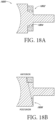
- FIG. 18A schematically shows a side sectional view of a porous coated ring 1802, with a snap ring 1804 that can be present for assembly to the implant 1800.
- the bearing surface of the implant 1800 e.g., polyethylene bearing surface
- the ring 1806 thickness could be asymmetrically reduced in the posterior glenoid relative to the anterior glenoid, as shown in FIG. 18B , wherein the anterior surface of the ring 1806 is angled, e.g., not parallel to the backside of the glenoid.
- the thickness of the ring 1806 in the posterior of the glenoid is about or at least about 5%, 10%, 15%, 20%, 25%, 30%, 35%, 40%, 45%, 50%, 55%, 60%, 65%, 70%, 75%, 80%, 85%, or 90% less than the thickness of the ring 1806 in its anterior portion, or ranges including any two of the aforementioned values.
- FIG. 18C schematically illustrates a cross-section of an embodiment of a glenoid implant 1860 with a porous ring 1862.
- FIG. 18C schematically illustrates anatomic loads AL; outward forces (arrows at 1888) created by in-use loads; cement 1882 and forces 1884 present during cement cure; and an interlocking surface 1886 with can be present at an incline in some cases.
- the outward force can create more intimate contact with bone, potentially improving fixation and the bone response.
- the fixation ring 1890 can be split (e.g., having an incomplete ring defining a channel 1891) in some cases in order to assemble onto the implant, as illustrated in FIG. 18D .
- any off-axis loads can be advantageously readily counter-acted by the large diameter ring fixed into the subchondral bone.
- the ring is in some embodiments only used on the periphery of the plastic, thus keeping the plastic (or plastic plus porous structure) at a minimum thickness of about 3mm which is the normal amount required for successful implant longevity, or at least about 2mm, 2.5mm, 3mm, 3.5mm, 4mm, or more.
- the ring can be attached in multiple ways to the polyethylene including press-fit or compression molded (e.g., without any adhesive or cement) and has the ability to be removed after implantation and reattached to a metal reverse arthroplasty baseplate.
- Some embodiments can include texturing of the underside of a humeral head.
- FIGS. 21 and 22 illustrate embodiments of bottom views of humeral heads 800, 900. This can include both texturing along with the method of implanting a textured humeral head so that it contacts the resected humeral bone.
- the texturing can include a layer of porous material along a flat base head underside. It also, alternatively or in addition, could include creating non-planar surfaces such as concentric annular rings 802 which can have circumferential 804 and/or axially 806 oriented channels therebetween as shown in FIG. 21 , sinusoidal waves, elongated grooves 902 as shown in FIG. 22 , or other desired patterns.
- systems and methods involving a humeral head can advantageously include an underside with an enlarged surface area relative to a flat underside to contact the resected surface of the humeral head thereby distributing loads incurred during gleno-humeral articulation and allowing for bone in-growth into the humeral head underside.
- the enlarged surface area is about or at least about 5%, 10%, 15%, 20%, 25%, 30%, 35%, 40%, 45%, 50%, 55%, 60%, 65%, 70%, 75%, 80%, 85%, 90%, 95%, 100%, or more relative to a flat underside humeral head, or ranges incorporating any two of the aforementioned values.
- Bone resorption tends to occur in the areas surrounding a humeral stem implant. This resorption occurs due to a lack of load transmission from the implant in to the bone. By purposefully engaging contact between a large portion of the humeral head and the resected bone surface, compressive and tensile load transfer can occur, thus eliminating the possibility of bone resorption around the implant.
- Prior devices either ignored the possibility of bone resorption or included a collar of metal at the proximal aspect of the implant to distribute the loads.
- the collars used on other devices is typically either too small or too large.
- the majority of devices using a collar employ a small diameter configuration.
- the small diameter was used to allow for the use of skirts on concentric and eccentric humeral heads.
- the skirt is used to extend the articular surface of the humeral head implant and to provide a more appropriate looking AP x-ray.
- These small collars are not large enough in diameter to appropriately transmit loads into the resected bone.
- the larger diameter collar design is also in use. This collar edge was exposed to the surrounding soft tissues which led to irritation as the tissues rubbed against the edges of the collar.
- the larger diameter collar did not allow for the humeral head articular region to extend below the collar.
- the head By texturing the underside of the humeral implant and forcing contact with the resected bone at implant insertion, the head now can serve as the implant pseudo-collar, and an actual collar is not required. This allows for load transmission at the furthest margins without creating any sharp features. It also allows for the humeral head articular region to extend all the way down to the resected bone surface.
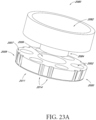
- FIG. 23A illustrates a perspective view of an embodiment of a fixation support, e.g., a fixation ring 2000 that can be fixed at least partially or entirely within a prepared glenoid cavity as previously described.
- the fixation support 2000 can be generally annular and include a plurality of spaced apart indents or slots 2014 along the peripheral side edge 2009 of the support 2000.
- the indents 2014 can be configured to prevent or inhibit rotation of the support 2000 as well as be sized and configured to fit bone fragments or other debris within from the reaming process and during implantation of the support 2000 and assist in preventing fracturing of the reamed glenoid cavity.
- apertures 2002 spaced proximate the peripheral edge 2009 of the support 2000 configured to house screws or other fixation elements.
- the support 2000 can also include one or more apertures, such as central aperture 2006 configured to house a peg or keel of the glenoid implant 2080, such as via press-fit.
- the fixation support 2000 could include upper surface 2007, lower surface 2011, and peripheral side edge 2009 as previously described.
- upper surface 2007 can be a machined surface
- lower surface 2011 and peripheral side edge 2009 could be porous surfaces.
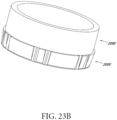
- the glenoid implant 2080 can removably interface with the support 2000 as schematically illustrated in FIG. 23B , and be exchanged for a different implant, such as a reverse implant 2077 as schematically illustrated in FIG. 23C .
- the fixation support does not include a snap ring.
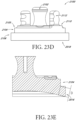
- FIGS. 23D-23F schematically illustrates views of an anatomic glenoid implant 2100 configured to mate with a porous fixation ring (not shown).
- FIG. 23D is a side view
- FIG. 23E is a close-up side view
- FIG. 23F is a perspective view.
- Glenoid implant 2100 can be partially or fully inset within a reamed glenoid cavity in some embodiments as described for example elsewhere herein.
- Glenoid implant 2100 can include a medial surface 2110 including one or more backside pegs, such as central peg 2102.
- Glenoid implant 2100 can also include a plurality of screws 2112 for additional fixation within the cavity.
- Glenoid implant can also include lateral articulating surface 2108, as well as a "two step" stepped thickness including first, lateral peripheral edge 2106 and second, medial peripheral edge 2104 with a surface 2105 that can include features such as barbs and/or threads for example, and be configured to reversibly mate with a fixation ring (not shown).
- Medial peripheral edge 2104 can have a diameter that is less than that of lateral peripheral edge 2106 in some embodiments such that the fixation ring can circumscribe the medial peripheral edge 2104 but not the lateral peripheral edge 2106. In some embodiments, the diameter of the medial peripheral edge 2104 can be between about 1mm and about 2mm less than about, or about 1.5mm less than about the diameter of the lateral peripheral edge 2106.
- the diameters of each of the medial peripheral edge 2104 and the lateral peripheral edge 2106 can be constant or substantially constant (e.g., discrete steps).
- the medial peripheral edge 2104 (and the corresponding fixation ring) can have a thickness/depth of about 3mm, such as between about 2mm and about 4mm, or between about 2.5mm and 3.5mm in some embodiments.
- the outer diameter of the medial peripheral edge 2104 or the lateral peripheral edge 2106 can be from about 20mm to about 30mm, such as about 20, 21, 22, 23, 24, 25, 26, 27, 28, 29, or 30mm, or ranges including any of the foregoing values.
- the thickness of the glenoid implant measured at a corner as shown in FIG.
- glenoid implant 2100 can also include channels or grooves 2120 on the medial surface 2110 configured to house cement for additional fixation if desired.
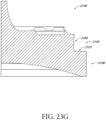
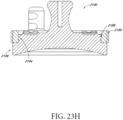
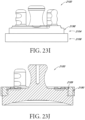
- FIGS. 23G-23H schematically illustrate a glenoid implant 2100 with smaller diameter medial peripheral edge 2104 and larger diameter lateral peripheral edge 2106 that can be as previously described, with a ledge 2121 extending between the medial peripheral edge 2104 and the lateral peripheral edge 2106 and configured to abut a lateral-facing surface of a fixation ring.
- the medial peripheral edge 2104 of the glenoid implant 2100 can include reverse barbs 2185 as illustrated.
- fixation ring 2190 can include barbs 2186 made of oversized metal or other elements and configured to reversibly press into the medial peripheral edge 2104 of the glenoid implant 2100 (either with or without reverse barbs).
- the lateral peripheral edge 2106 of the glenoid implant 2100 can be barb-less as illustrated.
- Fixation ring 2190, or portions thereof can be porous as previously described herein.
- the threads 2199 of the fixation ring 2190 can be self-tapping, in which the medial peripheral edge 2104 of the glenoid implant need not be threaded, as the self-tapping threads 2199 of the fixation ring 2190 can "bite" or otherwise transform the medial peripheral edge 2104 of the glenoid implant 2100.
- the lateral peripheral edge 2106 of the glenoid implant 2100 can be thread-less as illustrated.
- Fixation ring 2190, or portions thereof can be porous as previously described herein.
- some embodiments can include one, two, or more of a hybrid inset-onlay glenoid implant, a porous ring structure, and/or a textured underside humeral implant.
- a hybrid inset-onlay glenoid implant a porous ring structure, and/or a textured underside humeral implant.
- the disclosure herein of any particular feature, aspect, method, property, characteristic, quality, attribute, element, or the like in connection with an embodiment can be used in all other embodiments set forth herein.
- the methods disclosed herein include certain actions taken by a practitioner; however, they can also include any third-party instruction of those actions, either expressly or by implication.
- actions such as “reaming a glenoid implant” includes “instructing the reaming of a glenoid implant.”
- the ranges disclosed herein also encompass any and all overlap, sub-ranges, and combinations thereof. Language such as “up to,” “at least,” “greater than,” “less than,” “between,” and the like includes the number recited.
- the terms “approximately”, “about”, and “substantially” may refer to an amount that is within less than 10% of, within less than 5% of, within less than 1% of, within less than 0.1% of, and within less than 0.01% of the stated amount.
Landscapes
- Health & Medical Sciences (AREA)
- Orthopedic Medicine & Surgery (AREA)
- Cardiology (AREA)
- Oral & Maxillofacial Surgery (AREA)
- Transplantation (AREA)
- Engineering & Computer Science (AREA)
- Biomedical Technology (AREA)
- Heart & Thoracic Surgery (AREA)
- Vascular Medicine (AREA)
- Life Sciences & Earth Sciences (AREA)
- Animal Behavior & Ethology (AREA)
- General Health & Medical Sciences (AREA)
- Public Health (AREA)
- Veterinary Medicine (AREA)
- Prostheses (AREA)
Applications Claiming Priority (3)
| Application Number | Priority Date | Filing Date | Title |
|---|---|---|---|
| US201862664909P | 2018-04-30 | 2018-04-30 | |
| EP19796484.4A EP3787562B8 (fr) | 2018-04-30 | 2019-04-30 | Glénoïde intégré/onlay, glénoïde convertible revêtu poreux, et têtes humérales ayant des sous-côtés texturés |
| PCT/US2019/029905 WO2019213073A1 (fr) | 2018-04-30 | 2019-04-30 | Glénoïde intégré/onlay, glénoïde convertible revêtu poreux, et têtes humérales ayant des sous-côtés texturés |
Related Parent Applications (2)
| Application Number | Title | Priority Date | Filing Date |
|---|---|---|---|
| EP19796484.4A Division EP3787562B8 (fr) | 2018-04-30 | 2019-04-30 | Glénoïde intégré/onlay, glénoïde convertible revêtu poreux, et têtes humérales ayant des sous-côtés texturés |
| EP19796484.4A Division-Into EP3787562B8 (fr) | 2018-04-30 | 2019-04-30 | Glénoïde intégré/onlay, glénoïde convertible revêtu poreux, et têtes humérales ayant des sous-côtés texturés |
Publications (2)
| Publication Number | Publication Date |
|---|---|
| EP4438012A2 true EP4438012A2 (fr) | 2024-10-02 |
| EP4438012A3 EP4438012A3 (fr) | 2024-10-16 |
Family
ID=68386623
Family Applications (2)
| Application Number | Title | Priority Date | Filing Date |
|---|---|---|---|
| EP19796484.4A Active EP3787562B8 (fr) | 2018-04-30 | 2019-04-30 | Glénoïde intégré/onlay, glénoïde convertible revêtu poreux, et têtes humérales ayant des sous-côtés texturés |
| EP24194270.5A Pending EP4438012A3 (fr) | 2018-04-30 | 2019-04-30 | Glénoïde intégré/onlay, glénoïde convertible revêtu poreux et têtes humérales avec des sous-faces texturées |
Family Applications Before (1)
| Application Number | Title | Priority Date | Filing Date |
|---|---|---|---|
| EP19796484.4A Active EP3787562B8 (fr) | 2018-04-30 | 2019-04-30 | Glénoïde intégré/onlay, glénoïde convertible revêtu poreux, et têtes humérales ayant des sous-côtés texturés |
Country Status (4)
| Country | Link |
|---|---|
| US (2) | US12138172B2 (fr) |
| EP (2) | EP3787562B8 (fr) |
| AU (2) | AU2019263063A1 (fr) |
| WO (1) | WO2019213073A1 (fr) |
Families Citing this family (9)
| Publication number | Priority date | Publication date | Assignee | Title |
|---|---|---|---|---|
| US11957595B2 (en) | 2005-02-25 | 2024-04-16 | Shoulder Innovations, Inc. | Methods and devices for less invasive glenoid replacement |
| US8778028B2 (en) | 2005-02-25 | 2014-07-15 | Shoulder Innovations, Inc. | Methods and devices for less invasive glenoid replacement |
| US8007538B2 (en) | 2005-02-25 | 2011-08-30 | Shoulder Innovations, Llc | Shoulder implant for glenoid replacement |
| US10492926B1 (en) | 2014-09-04 | 2019-12-03 | Shoulder Innovations, Inc. | Alignment guide for humeral or femoral stem replacement prostheses |
| EP4520302A3 (fr) | 2017-04-14 | 2025-04-16 | Shoulder Innovations, Inc. | Prothèse totale d'épaule comportant un implant glénoïdien intégré pouvant passer d'une configuration anatomique à une configuration inverse |
| WO2019213073A1 (fr) | 2018-04-30 | 2019-11-07 | Shoulder Innovations, Llc | Glénoïde intégré/onlay, glénoïde convertible revêtu poreux, et têtes humérales ayant des sous-côtés texturés |
| CN113613599A (zh) | 2019-03-11 | 2021-11-05 | 舒尔德创新有限公司 | 全反向肩部系统和方法 |
| USD977643S1 (en) | 2019-03-12 | 2023-02-07 | Shoulder Innovations, Inc. | Humeral stem implant |
| WO2025038862A1 (fr) * | 2023-08-17 | 2025-02-20 | Overture Resurfacing Inc. dba Overture Orthopaedics | Systèmes de resurfaçage d'articulation de genou ciblée/focale |
Citations (2)
| Publication number | Priority date | Publication date | Assignee | Title |
|---|---|---|---|---|
| US8007538B2 (en) | 2005-02-25 | 2011-08-30 | Shoulder Innovations, Llc | Shoulder implant for glenoid replacement |
| US8778028B2 (en) | 2005-02-25 | 2014-07-15 | Shoulder Innovations, Inc. | Methods and devices for less invasive glenoid replacement |
Family Cites Families (224)
| Publication number | Priority date | Publication date | Assignee | Title |
|---|---|---|---|---|
| GB764438A (en) | 1954-01-29 | 1956-12-28 | Chevalier Et Fils E | Improved artificial femoral heads |
| FR2248820A1 (en) | 1973-10-29 | 1975-05-23 | Benoist Girard & Cie | Complete artificial joint between bones - has interlocked rings permanently attached together |
| US4012796A (en) | 1975-09-24 | 1977-03-22 | Howmedica, Inc. | Interpositioning collar for prosthetic bone insert |
| US3979778A (en) | 1976-01-14 | 1976-09-14 | Stroot Jerome H | Shoulder prosthesis |
| US4003095A (en) | 1976-04-29 | 1977-01-18 | Howmedica, Inc. | Trispherical prosthetic shoulder device |
| US4045826A (en) | 1977-02-09 | 1977-09-06 | Stroot Jerome H | Glenoid component for shoulder prosthesis |
| US4206517A (en) | 1977-12-01 | 1980-06-10 | Biomedical Engineering Corp. | Floating center prosthetic joint |
| US4261062A (en) | 1979-03-22 | 1981-04-14 | The Regents Of The University Of California | Natural shoulder joint prosthesis |
| CH642252A5 (de) | 1980-01-14 | 1984-04-13 | Sulzer Ag | Blattartiger schaft fuer die verankerung einer hueftgelenkprothese. |
| DE3216538A1 (de) | 1982-05-03 | 1983-11-03 | Waldemar Link (Gmbh & Co), 2000 Hamburg | Knochenimplantat, insbesondere femorale hueftgelenkprothese |
| US4990161A (en) | 1984-03-16 | 1991-02-05 | Kampner Stanley L | Implant with resorbable stem |
| JPS62500110A (ja) | 1984-06-12 | 1987-01-16 | キエフスキ ポリテヒニチェスキ インスティテュト イメニ 50−レティア ベリコイ オクトヤブルスコイ ソツィアリスティチェスコイ レボリュツィイ | 真空中でフィルムを蒸着させるための蒸発器 |
| FR2567019A1 (fr) | 1984-07-06 | 1986-01-10 | Fournier Gilles | Mode de contention des pieces d'une endoprothese articulaire |
| US4550450A (en) | 1984-07-24 | 1985-11-05 | Kinnett James G | Total shoulder prosthesis system |
| GB8520360D0 (en) | 1985-08-14 | 1985-09-18 | Thackray C F Ltd | Joint prosthesis |
| US5314479A (en) | 1986-08-15 | 1994-05-24 | Depuy Inc. | Modular prosthesis |
| US4827919A (en) | 1986-10-27 | 1989-05-09 | Pfizer Hospital Products Group, Inc. | Femoral spacer |
| DE8708419U1 (de) | 1987-06-15 | 1987-08-06 | Waldemar Link Gmbh & Co, 2000 Hamburg | Endoprothese |
| FR2618065A1 (fr) | 1987-07-15 | 1989-01-20 | Bourgogne Universite | Prothese totale de l'epaule |
| US4865605A (en) | 1988-02-02 | 1989-09-12 | Dines David M | Modular shoulder prosthesis |
| US5080673A (en) | 1988-02-03 | 1992-01-14 | Intermedics Orthopedics, Inc. | Glenoid prosthesis and method of use |
| US4964865A (en) | 1988-02-03 | 1990-10-23 | Intermedics Orthopedics, Inc. | Glenoid prosthesis and method of use |
| DE3813944A1 (de) | 1988-04-26 | 1989-11-09 | S & G Implants Gmbh | Endoprothese fuer ein gelenk |
| DE3816676A1 (de) | 1988-05-17 | 1989-11-23 | S & G Implants Gmbh | Schulterspan |
| US5281226A (en) * | 1989-03-31 | 1994-01-25 | Davydov Anatoly B | Missing portion of a tubular bone |
| US4986833A (en) | 1989-05-05 | 1991-01-22 | Worland Richard L | Glenoid component for an artificial shoulder joint |
| US5370694A (en) | 1989-07-25 | 1994-12-06 | Smith & Nephew Richards, Inc. | Zirconium oxide and nitride coated endoprostheses for tissue protection |
| US5030219A (en) | 1990-01-22 | 1991-07-09 | Boehringer Mannheim Corporation | Glenoid component installation tools |
| US5032132A (en) | 1990-01-22 | 1991-07-16 | Boehringer Mannheim Corporation | Glenoid component |
| US5122133A (en) | 1990-10-26 | 1992-06-16 | Smith & Nephew Richards Inc. | Compression screw for a joint endoprosthesis |
| GB2251795B (en) | 1991-01-17 | 1995-02-08 | Minnesota Mining & Mfg | Orthopaedic implant |
| GR1002517B (el) | 1991-09-30 | 1997-01-23 | Johnson & Johnson Orthopaedics Inc. | Προσθεση ισχιου. |
| JPH05326988A (ja) | 1992-05-19 | 1993-12-10 | Mitsubishi Electric Corp | 赤外線検出器 |
| DE4220217C2 (de) | 1992-06-20 | 1995-02-23 | S & G Implants Gmbh | Endoprothese |
| US5282865A (en) | 1992-06-22 | 1994-02-01 | Osteonics Corp. | Humeral shoulder prosthesis |
| US5344458A (en) | 1992-08-06 | 1994-09-06 | Bonutti Peter M | Arthroplasty component |
| GB9217639D0 (en) | 1992-08-19 | 1992-09-30 | Zimmer Limited | Acetabular prosthetic techniques |
| FR2695313B1 (fr) | 1992-09-08 | 1994-10-28 | Fabrication Etu Realisa Implan | Implant glénoïdien. |
| GB9221257D0 (en) | 1992-10-09 | 1992-11-25 | Minnesota Mining & Mfg | Glenoid alignment guide |
| US5358525A (en) | 1992-12-28 | 1994-10-25 | Fox John E | Bearing surface for prosthesis and replacement of meniscal cartilage |
| US5489309A (en) | 1993-01-06 | 1996-02-06 | Smith & Nephew Richards Inc. | Modular humeral component system |
| US5480450A (en) | 1993-02-11 | 1996-01-02 | The General Hospital Corporation | Method and apparatus for reducing interfacial porosity in a cemented femoral prosthesis |
| JPH06327705A (ja) | 1993-05-26 | 1994-11-29 | Kobe Steel Ltd | 人工関節 |
| US5507817A (en) | 1994-02-22 | 1996-04-16 | Kirschner Medical Corporation | Modular humeral prosthesis for reconstruction of the humerus |
| US5489310A (en) | 1994-06-27 | 1996-02-06 | Mikhail; W. E. Michael | Universal glenoid shoulder prosthesis and method for implanting |
| US6290726B1 (en) | 2000-01-30 | 2001-09-18 | Diamicron, Inc. | Prosthetic hip joint having sintered polycrystalline diamond compact articulation surfaces |
| US5507819A (en) | 1994-11-02 | 1996-04-16 | Wolf; Eugene M. | Apparatus and method for stabilizing a humeral head in a shoulder |
| US5728161A (en) | 1995-06-08 | 1998-03-17 | Depuy Orthopedics, Inc. | Large taper modular shoulder prosthesis |
| ATE217174T1 (de) | 1995-08-25 | 2002-05-15 | Bristol Myers Squibb Co | Prothetisches implantat mit rippen |
| US5593448A (en) | 1995-11-14 | 1997-01-14 | Osteonics Corp. | Glenoid component for shoulder prosthesis and implant method |
| FR2741796B1 (fr) | 1995-11-30 | 1998-03-27 | Tornier Sa | Dispositif pour la fixation d'une prothese et notamment d'une prothese glenoidienne de l'omoplate |
| US5769856A (en) | 1996-06-24 | 1998-06-23 | Osteonics Corp. | Drill guide and implant method |
| DE19633865A1 (de) * | 1996-08-16 | 1998-02-19 | Guenter Prof Dr Med Lob | Endoprothese |
| US5746771A (en) | 1996-09-30 | 1998-05-05 | Wright Medical Technology, Inc. | Calcar collar instrumentation |
| US5800551A (en) | 1997-03-10 | 1998-09-01 | Biomet, Inc. | Apparatus and method for shoulder arthroplasty |
| US6037724A (en) | 1997-05-01 | 2000-03-14 | Osteomed Corporation | Electronic controlled surgical power tool |
| US5928285A (en) | 1997-05-30 | 1999-07-27 | Bristol-Myers Squibb Co. | Orthopaedic implant having an articulating surface with a conforming and translational surface |
| US6379386B1 (en) | 1997-09-09 | 2002-04-30 | Stryker Technologies Corporation | Anatomic glenoid shoulder prosthesis together with methods and tools for implanting same |
| GB9724280D0 (en) | 1997-11-17 | 1998-01-14 | Benoist Girard & Cie | Device to pressurise cement when implanting an acetabular cup |
| CA2263736C (fr) | 1998-02-28 | 2005-01-25 | Kraft Foods, Inc. | Sauces pour produits alimentaires et methodes de production connexes |
| US6228119B1 (en) | 1998-06-09 | 2001-05-08 | Depuy Orthopaedics, Inc. | Modular glenoid assembly |
| US6368353B1 (en) | 1999-02-24 | 2002-04-09 | Michel A. Arcand | Shoulder prosthesis apparatus and methods |
| EP1043001A3 (fr) | 1999-04-07 | 2000-10-18 | Depuy Orthopaedics, Inc. | Prothèse d'arthroplastie sans col pour les épaules |
| FR2794641B1 (fr) | 1999-06-09 | 2001-11-23 | Tornier Sa | Prothese humerale |
| FR2802799B1 (fr) | 1999-12-23 | 2002-08-16 | Depuy France | Ensemble de prothese d'epaule |
| US20040199260A1 (en) | 2000-01-30 | 2004-10-07 | Pope Bill J. | Prosthetic joint component having at least one sintered polycrystalline diamond compact articulation surface and substrate surface topographical features in said polycrystalline diamond compact |
| US6709463B1 (en) | 2000-01-30 | 2004-03-23 | Diamicron, Inc. | Prosthetic joint component having at least one solid polycrystalline diamond component |
| AU2001247476A1 (en) | 2000-03-16 | 2001-09-24 | Eugene M. Wolf M.D. Inc | Facile total shoulder arthroplasty apparatus and method |
| US6911047B2 (en) | 2000-03-17 | 2005-06-28 | Depuy Orthopaedics, Inc. | Apparatus and method for securing a cementless glenoid component to a glenoid surface of a scapula |
| EP2314257B9 (fr) | 2000-05-01 | 2013-02-27 | ArthroSurface, Inc. | Système de réparation de rectification de joint |
| US7618462B2 (en) | 2000-05-01 | 2009-11-17 | Arthrosurface Incorporated | System and method for joint resurface repair |
| US7678151B2 (en) | 2000-05-01 | 2010-03-16 | Ek Steven W | System and method for joint resurface repair |
| US6610067B2 (en) | 2000-05-01 | 2003-08-26 | Arthrosurface, Incorporated | System and method for joint resurface repair |
| US6679917B2 (en) | 2000-05-01 | 2004-01-20 | Arthrosurface, Incorporated | System and method for joint resurface repair |
| US6458136B1 (en) | 2000-05-11 | 2002-10-01 | Zimmer, Inc. | Orthopaedic instrument for sizing implant sites and for pressurizing bone cement and a method for using the same |
| JP2004521666A (ja) | 2000-08-28 | 2004-07-22 | アドバンスト バイオ サーフェイシズ,インコーポレイティド | 哺乳動物の関節を増強する方法およびシステム |
| US20050119531A1 (en) | 2000-09-01 | 2005-06-02 | Minnesota Scientific, Inc. | Method of performing shoulder surgery |
| US20030236572A1 (en) | 2000-10-18 | 2003-12-25 | Morton Bertram | Total joint replacements using magnetism to control instability |
| US20020087213A1 (en) | 2000-10-18 | 2002-07-04 | Morton Bertram | Total joint replacements using magnetism to control instability |
| US6589281B2 (en) | 2001-01-16 | 2003-07-08 | Edward R. Hyde, Jr. | Transosseous core approach and instrumentation for joint replacement and repair |
| US6620197B2 (en) | 2001-01-23 | 2003-09-16 | Depuy Orthopaedics, Inc. | Method and apparatus for performing a shoulder replacement procedure in the treatment of cuff tear arthropathy |
| EP1367966A2 (fr) | 2001-02-21 | 2003-12-10 | New York Society For The Relief Of The Ruptured And Crippled Maintaining The Hospital For Special Surgery | Composant de prosthese glenoide biradial pour arthroplastie totale de l'epaule |
| US7261741B2 (en) | 2001-06-30 | 2007-08-28 | Depuy Products, Inc. | Prosthesis with resorbable collar |
| US6364910B1 (en) | 2001-07-11 | 2002-04-02 | Biomet, Inc. | Method and apparatus for use of a glenoid component |
| US6783549B1 (en) | 2001-07-27 | 2004-08-31 | Biomet, Inc. | Modular humeral head resurfacing system |
| US8317871B2 (en) | 2001-07-27 | 2012-11-27 | Biomet Manufacturing Corp. | Modular humeral head resurfacing system |
| US6712823B2 (en) | 2001-12-14 | 2004-03-30 | Wright Medical Technology Inc. | Humeral head resection guide |
| DE10164328A1 (de) | 2001-12-28 | 2003-07-17 | Claas Hohmann | Subacromiale Prothese |
| US6699289B2 (en) | 2001-12-31 | 2004-03-02 | Depuy Orthopaedics, Inc. | Augmented glenoid component having an interrupted surface and associated method for securing the augmented glenoid component to a glenoid surface of a scapula |
| US6712854B2 (en) | 2002-01-25 | 2004-03-30 | Roger A Rogalski | Acromial-humeral prosthesis and method of implantation |
| US20030163202A1 (en) | 2002-02-06 | 2003-08-28 | Lakin Ryan C. | Modular resurfacing prosthetic |
| FR2836039B1 (fr) | 2002-02-15 | 2004-10-01 | Tornier Sa | Composant glenoidien de prothese d'epaule et prothese totale d'epaule incorporant un tel composant |
| US6679916B1 (en) | 2002-04-29 | 2004-01-20 | Mark A. Frankle | Shoulder prosthesis system |
| US20040002766A1 (en) | 2002-06-27 | 2004-01-01 | Gordon Hunter | Prosthetic devices having diffusion-hardened surfaces and bioceramic coatings |
| FR2841768B1 (fr) | 2002-07-05 | 2005-05-06 | Tornier Sa | Prothese d'epaule ou de hanche facilitant l'abduction |
| US7204854B2 (en) | 2002-08-15 | 2007-04-17 | Arthrex, Inc. | Metal back prosthetic glenoid component with cemented pegs and hollow metal cage screw |
| US6755866B2 (en) | 2002-08-20 | 2004-06-29 | Depuy Products, Inc. | Prosthetic stem with bearings |
| US7329284B2 (en) | 2002-09-27 | 2008-02-12 | Depuy Products, Inc. | Concave resurfacing prosthesis |
| US6863690B2 (en) | 2002-09-27 | 2005-03-08 | Depuy Products, Inc. | Humeral shoulder prosthesis |
| US7011686B2 (en) | 2002-09-30 | 2006-03-14 | Depuy Products, Inc. | Reverse-type humeral prosthesis |
| JP3779674B2 (ja) | 2002-11-18 | 2006-05-31 | 泉工医科工業株式会社 | 人工関節のステム位置決め用遠位チップ |
| US20040122519A1 (en) | 2002-12-20 | 2004-06-24 | Wiley Roy C. | Prosthetic glenoid |
| US20040167629A1 (en) | 2003-02-03 | 2004-08-26 | Geremakis Perry A. | Modular shoulder prosthesis |
| EP1596765A2 (fr) | 2003-02-10 | 2005-11-23 | Smith & Nephew, Inc. | Dispositifs resorbables |
| JP2004243433A (ja) | 2003-02-12 | 2004-09-02 | Shinetsu Quartz Prod Co Ltd | 管状脆性材料の内表面研摩方法および該研摩方法で得られた管状脆性材料 |
| US6916341B2 (en) | 2003-02-20 | 2005-07-12 | Lindsey R. Rolston | Device and method for bicompartmental arthroplasty |
| US20040193276A1 (en) | 2003-03-31 | 2004-09-30 | Maroney Brian J. | Modular articulating surface replacement prosthesis |
| US20040193278A1 (en) | 2003-03-31 | 2004-09-30 | Maroney Brian J. | Articulating surface replacement prosthesis |
| US7517364B2 (en) | 2003-03-31 | 2009-04-14 | Depuy Products, Inc. | Extended articulation orthopaedic implant and associated method |
| US7338498B2 (en) | 2003-03-31 | 2008-03-04 | Depuy Products, Inc. | Prosthetic implant, trial and associated method |
| US8366713B2 (en) | 2003-03-31 | 2013-02-05 | Depuy Products, Inc. | Arthroplasty instruments and associated method |
| ITUD20030092A1 (it) | 2003-04-30 | 2004-11-01 | Lima Lto Spa | Protesi per l'articolazione della spalla. |
| US7186269B2 (en) | 2003-05-16 | 2007-03-06 | Jean-Maxwell Cyprien | Composite shoulder prosthesis |
| WO2005016123A2 (fr) | 2003-08-11 | 2005-02-24 | Chudik Steven C M D | Dispositifs et methodes pour remplacement de l'epaule |
| FR2859099B1 (fr) | 2003-08-25 | 2006-01-06 | Tornier Sa | Composant glenoidien de prothese d'epaule et prothese totale d'epaule incorporant un tel composant |
| GB0320287D0 (en) | 2003-08-29 | 2003-10-01 | Stanmore Implants Worldwide | Shoulder joint prosthetic system |
| US7585327B2 (en) | 2003-09-24 | 2009-09-08 | Biomet Manufacturing Corp. | Extended articular surface resurfacing head |
| US7867234B2 (en) | 2003-10-06 | 2011-01-11 | Howmedica Osteonics Corp. | Reamer bushing |
| US8070820B2 (en) | 2003-10-08 | 2011-12-06 | Biomet Manufacturing Corp. | Shoulder implant assembly |
| US7294149B2 (en) | 2003-12-05 | 2007-11-13 | Howmedica Osteonics Corp. | Orthopedic implant with angled pegs |
| FR2863865B1 (fr) | 2003-12-19 | 2006-10-06 | Tornier Sa | Prothese d'epaule ou de hanche et son procede de montage |
| DE602004022870D1 (fr) | 2004-02-05 | 2009-10-08 | Exactech Inc | |
| ES2364047T3 (es) | 2004-05-19 | 2011-08-23 | Zimmer Gmbh | Anclaje glenoido. |
| US7892290B2 (en) * | 2004-05-28 | 2011-02-22 | Smith & Nephew, Inc. | Fluted sleeve hip prosthesis for modular stem |
| US8303665B2 (en) | 2004-06-15 | 2012-11-06 | Tornier Sas | Glenoidal component, set of such components and shoulder prosthesis incorporating such a glenoidal component |
| US7922769B2 (en) | 2004-09-27 | 2011-04-12 | Depuy Products, Inc. | Modular glenoid prosthesis and associated method |
| US7892287B2 (en) | 2004-09-27 | 2011-02-22 | Depuy Products, Inc. | Glenoid augment and associated method |
| US20060069445A1 (en) | 2004-09-27 | 2006-03-30 | Ondrla Jeffrey M | Extended articulation prosthesis adaptor and associated method |
| US11957595B2 (en) | 2005-02-25 | 2024-04-16 | Shoulder Innovations, Inc. | Methods and devices for less invasive glenoid replacement |
| US7445638B2 (en) | 2005-03-03 | 2008-11-04 | Biomet France | Humeral implant for shoulder prosthesis |
| AU2006201835B2 (en) | 2005-05-09 | 2012-08-30 | Smith & Nephew, Inc. | Orthopaedic implants and methods for making the same |
| JP4864966B2 (ja) | 2005-06-03 | 2012-02-01 | デピュイ・(アイルランド)・リミテッド | 関節置換術に用いるための器具 |
| US20070038302A1 (en) | 2005-08-15 | 2007-02-15 | Biomet Manufacturing Corp. | Method and apparatus for the preparation of an inlaid glenoid |
| US8048167B2 (en) | 2005-08-30 | 2011-11-01 | Depuy Products, Inc. | Orthopaedic implant kit, orthopaedic surgery kit and associated method |
| US20070055380A1 (en) | 2005-09-08 | 2007-03-08 | Biomet Manufacturing Corp | Method and apparatus for a glenoid prosthesis |
| WO2007031575A1 (fr) | 2005-09-16 | 2007-03-22 | Zimmer Gmbh | Plateau et coquille d'un dispositif de reception d'une rotule |
| EP1787603A1 (fr) | 2005-11-18 | 2007-05-23 | Zimmer GmbH | Plate-forme de base pour une articulation artificielle |
| US7766969B2 (en) | 2005-12-05 | 2010-08-03 | Zimmer, Inc. | Modular progressive implant for a joint articulation surface |
| EP2762107B1 (fr) | 2006-01-20 | 2017-11-29 | Zimmer Technology, Inc. | Système d'arthroplastie de l'épaule |
| US7959680B2 (en) | 2006-02-02 | 2011-06-14 | Biomet Manufacturing Corp. | Method and apparatus for performing a shoulder implant procedure |
| US7753959B2 (en) | 2006-03-20 | 2010-07-13 | Biomet Manufacturing Corp. | Modular center pegged glenoid |
| US9474619B2 (en) | 2006-03-21 | 2016-10-25 | Tornier, Inc. | Glenoid component with improved fixation stability |
| EP1996123B1 (fr) | 2006-03-21 | 2019-08-28 | Tornier, Inc. | Surfaces complexes non sphériques d'articulations pour prothèses de l'épaule et de la hanche |
| FR2902993B1 (fr) | 2006-06-28 | 2008-09-05 | Trois S Ortho Sa | Prothese d'epaule et ensemble d'instruments pour l'implantation de cette prothese |
| US20080021564A1 (en) | 2006-07-20 | 2008-01-24 | Gunther Stephen B | Humeral head resurfacing implant and methods of use thereof |
| ITMI20061568A1 (it) | 2006-08-03 | 2008-02-04 | Plustek S R L | Protesi di spalla |
| US8821496B2 (en) | 2006-09-29 | 2014-09-02 | DePuy Synthes Products, LLC | Osteotomy protective cover |
| US7776098B2 (en) | 2006-10-12 | 2010-08-17 | Murphy Stephen B | Modular femoral prosthesis with on-axis junction |
| US20080177327A1 (en) | 2006-10-17 | 2008-07-24 | Hugues Malandain | Central rod connector and T-rod |
| GB2443163C (en) | 2006-10-23 | 2018-10-03 | Innovative Design Orthopaedics Ltd | Shoulder prosthesis |
| FR2911773B1 (fr) | 2007-01-30 | 2009-03-27 | Tornier Sas | Methode et ensemble d'instrumentation chirurgicale pour poser une prothese totale d'epaule inversee,et prothese correspondante |
| US20090287309A1 (en) | 2007-01-30 | 2009-11-19 | Tornier Sas | Intra-articular joint replacement |
| US8715359B2 (en) | 2009-10-30 | 2014-05-06 | Depuy (Ireland) | Prosthesis for cemented fixation and method for making the prosthesis |
| EP2057970B1 (fr) | 2007-11-07 | 2016-01-06 | Arthrex, Inc. | Composant glénoïdien hybride pour arthroplastie de l'épaule |
| GB0724019D0 (en) | 2007-12-08 | 2008-01-16 | Depuy Int Ltd | Implant assembly |
| WO2009108789A1 (fr) | 2008-02-29 | 2009-09-03 | Vot, Llc | Prothèse de tibia |
| US8137359B2 (en) | 2008-04-28 | 2012-03-20 | Depuy (Ireland) | Variable offset reamer assembly for modular humeral component |
| DE102008021110A1 (de) | 2008-04-28 | 2009-10-29 | Smith & Nephew Orthopaedics Ag | Scapulare Komponente einer Schultergelenkprothese |
| US20100114326A1 (en) | 2008-10-30 | 2010-05-06 | Biomet Manufacturing Corp. | Modular implant for joint prosthesis |
| US20100161066A1 (en) | 2008-12-23 | 2010-06-24 | Depuy Products, Inc. | Shoulder Prosthesis having Augmented Metaglene Component for Use in Rotator Cuff Deficient Shoulder |
| US8632597B2 (en) | 2008-12-23 | 2014-01-21 | DePuy Synthes Products, LLC | Rotatable reverse metaglene |
| FR2940607B1 (fr) | 2008-12-29 | 2012-04-06 | Didier Capon | Implant glenoidien comprenant une cupule destinee a cooperer avec une tete humerale prothetique |
| US20100217399A1 (en) | 2009-02-22 | 2010-08-26 | Groh Gordon I | Base plate system for shoulder arthroplasty and method of using the same |
| US9545311B2 (en) | 2009-03-05 | 2017-01-17 | Tornier, Inc. | Glenoid implant anchor post |
| US8231683B2 (en) | 2009-12-08 | 2012-07-31 | Depuy Products, Inc. | Shoulder prosthesis assembly having glenoid rim replacement structure |
| US8882845B2 (en) | 2010-05-05 | 2014-11-11 | DePuy Synthes Products, LLC | Mobile bearing glenoid prosthesis |
| GB2467261B (en) | 2010-05-18 | 2010-12-15 | Corin Ltd | Hip prosthesis system |
| US9381086B2 (en) | 2010-11-30 | 2016-07-05 | Shoulder Innovations, Llc | Stem for use in joint arthroplasty |
| FR2971144A1 (fr) * | 2011-02-08 | 2012-08-10 | Tornier Sa | Implant glenoidien pour prothese d'epaule et kit chirurgical |
| AU2012214581A1 (en) | 2011-02-07 | 2013-08-15 | Exactech, Inc. | Adjustable reverse shoulder prostheses |
| US8551177B2 (en) | 2011-03-18 | 2013-10-08 | DePuy Synthes Products, LLC | Revision glenoid kit |
| EP2502606B1 (fr) | 2011-03-25 | 2014-09-17 | Zimmer GmbH | Prothèse d'épaule |
| US9084680B2 (en) | 2011-10-05 | 2015-07-21 | Biomet Manufacturing, Llc | Multiple bearing humeral prosthesis |
| US8449617B1 (en) | 2011-11-16 | 2013-05-28 | Biomet Manufacturing Corp. | Convertible glenoid implant |
| US9421106B2 (en) | 2011-12-07 | 2016-08-23 | Howmedica Osteonics Corp. | Reverse shoulder baseplate with alignment guide for glenosphere |
| US9439768B2 (en) | 2011-12-08 | 2016-09-13 | Imds Llc | Glenoid vault fixation |
| JP5957914B2 (ja) | 2012-02-01 | 2016-07-27 | セイコーエプソン株式会社 | 液体噴射ヘッドおよび液体噴射装置 |
| US8945229B2 (en) | 2012-03-27 | 2015-02-03 | DePuy Synthes Products, LLC | Reverse shoulder orthopaedic implant having a metaglene component with a screw locking cap |
| US9498334B2 (en) * | 2012-03-27 | 2016-11-22 | DePuy Synthes Products, Inc. | Glenoid defect-filling component |
| US9585769B2 (en) | 2012-03-30 | 2017-03-07 | DePuy Synthes Products, Inc. | Drill guide for use in a surgical procedure to implant a stemless humeral component |
| US20140005789A1 (en) | 2012-06-28 | 2014-01-02 | Depuy Products, Inc. | Modified Glenoid Components and Methods of Installing Same |
| EP2689750B1 (fr) | 2012-07-23 | 2016-08-24 | Tornier Orthopedics Ireland Ltd. | Implant glénoidien pour prothèse d'épaule et kit chirurgical |
| US20150223941A1 (en) | 2012-08-27 | 2015-08-13 | Conformis, Inc. | Methods, Devices and Techniques for Improved Placement and Fixation of Shoulder Implant Components |
| US9398928B2 (en) | 2012-09-28 | 2016-07-26 | DePuy Synthes Products, Inc. | Adjustable height arthroplasty plate |
| JP6800584B2 (ja) | 2012-10-29 | 2020-12-16 | トルニエ オーソペディックス アイルランド エルティーディー.Tornier Orthopedics Ireland Ltd. | 反転型肩関節インプラントのためのシステム及び方法 |
| JP6123992B2 (ja) | 2013-03-05 | 2017-05-10 | セイコーエプソン株式会社 | 液体噴射ヘッド、液体噴射装置、圧電素子及びその製造方法 |
| US9668873B2 (en) | 2013-03-08 | 2017-06-06 | Biomet Manufacturing, Llc | Modular glenoid base plate with augments |
| US9044330B2 (en) | 2013-03-12 | 2015-06-02 | DePuy Synthes Products, Inc. | System and method for implanting a secondary glenoid prosthesis |
| ITUD20130080A1 (it) | 2013-06-06 | 2014-12-07 | Limacorporate Spa | Protesi omerale modulare |
| EP3777777B1 (fr) | 2014-01-03 | 2023-04-05 | Howmedica Osteonics Corp. | Implant glénoïde pour une prothèse d'épaule |
| US20150250472A1 (en) * | 2014-03-07 | 2015-09-10 | Arthrosurface Incorporated | Delivery System for Articular Surface Implant |
| US9615839B2 (en) | 2014-03-18 | 2017-04-11 | Howmedica Osteonics Corp. | Shape-fit glenoid reaming systems and methods |
| US9844440B2 (en) * | 2014-08-14 | 2017-12-19 | Biomet Manufacturing, Llc | Glenoid implant |
| US10492926B1 (en) | 2014-09-04 | 2019-12-03 | Shoulder Innovations, Inc. | Alignment guide for humeral or femoral stem replacement prostheses |
| AU2015330752B2 (en) | 2014-10-10 | 2018-05-10 | Orthopaedic Consultants Of South Florida, Inc. | Shoulder proximal centralizer and method to use the same |
| US20160270922A1 (en) * | 2015-03-19 | 2016-09-22 | Limacorporate S.P.A. | Glenoid Anchor for a Shoulder Joint Prosthesis |
| US10722374B2 (en) | 2015-05-05 | 2020-07-28 | Tornier, Inc. | Convertible glenoid implant |
| CA3083492C (fr) | 2015-07-08 | 2022-08-09 | Zimmer, Inc. | Procede et systeme a base de capteur pour epaule |
| CN108024858A (zh) | 2015-08-27 | 2018-05-11 | 捷迈有限公司 | 方向锁定反转式肩部假体和系统 |
| US10034753B2 (en) | 2015-10-22 | 2018-07-31 | DePuy Synthes Products, Inc. | Customized patient-specific orthopaedic instruments for component placement in a total hip arthroplasty |
| US10172714B2 (en) | 2016-02-28 | 2019-01-08 | Consortium Of Focused Orthopedists, Llc | Shoulder arthroplasty implant system |
| US11013619B2 (en) | 2016-03-22 | 2021-05-25 | Tornier | Instrumentation and method for implanting a glenoidal prosthetic component on a glenoid |
| WO2017184792A1 (fr) | 2016-04-19 | 2017-10-26 | Imascap Sas | Implant huméral planifié avant opération et procédé de planification |
| EP3260087B1 (fr) | 2016-06-24 | 2019-08-07 | Tornier | Ensemble pour un implant glénoïde |
| US11129724B2 (en) | 2016-07-28 | 2021-09-28 | Howmedica Osteonics Corp. | Stemless prosthesis anchor component |
| EP3332750B1 (fr) | 2016-12-09 | 2021-06-30 | Tornier | Implant glénoïde pour une prothèse d'épaule et ensemble permettant l'assemblage d'un tel implant glénoïde |
| EP4282383B1 (fr) | 2017-01-09 | 2026-05-06 | Zimmer, Inc. | Raccordements orthopédiques réglables |
| CN110678151B (zh) | 2017-01-19 | 2022-03-29 | 安可医疗有限公司(以Djo外科名义) | 肩部植入部件 |
| EP3570787B1 (fr) | 2017-01-20 | 2022-05-04 | Biomet Manufacturing, LLC | Composant d'augmentation modulaire |
| EP4520302A3 (fr) | 2017-04-14 | 2025-04-16 | Shoulder Innovations, Inc. | Prothèse totale d'épaule comportant un implant glénoïdien intégré pouvant passer d'une configuration anatomique à une configuration inverse |
| EP3403617B1 (fr) * | 2017-05-19 | 2020-03-18 | Tornier | Insert d'augmentation, prothèse d'épaule et kit comprenant l'insert d'augmentation |
| PL3644906T3 (pl) | 2017-06-29 | 2022-06-13 | Encore Medical, L.P. (D/B/A Djo Surgical) | Panewka sferyczna z wkładkami do wzmocnionego mocowania |
| US11399851B2 (en) | 2017-07-11 | 2022-08-02 | Howmedica Osteonics Corp. | Guides and instruments for improving accuracy of glenoid implant placement |
| WO2019079104A2 (fr) | 2017-10-16 | 2019-04-25 | Imascap Sas | Implants d'épaule et procédés d'utilisation et d'assemblage |
| CA3087066A1 (fr) | 2017-12-29 | 2019-07-04 | Tornier, Inc. | Elements constitutifs d'implant humeral specifiques a un patient |
| US12121450B2 (en) | 2018-01-17 | 2024-10-22 | Knollwood Orthopedic Innovations Llc | Reverse shoulder prosthesis |
| EP3764951A4 (fr) | 2018-03-12 | 2022-03-16 | Shoulder Innovations, Inc. | Prothèse d'épaule totale convertible |
| WO2019213073A1 (fr) | 2018-04-30 | 2019-11-07 | Shoulder Innovations, Llc | Glénoïde intégré/onlay, glénoïde convertible revêtu poreux, et têtes humérales ayant des sous-côtés texturés |
| US10813769B2 (en) | 2018-07-24 | 2020-10-27 | DePuy Synthes Products, Inc. | Baseplate of a modular shoulder joint prosthesis and related methods for implanting the same |
| CN118697517A (zh) | 2018-07-27 | 2024-09-27 | 德普伊爱尔兰无限公司 | 植入物、系统及其使用方法 |
| CN113613599A (zh) | 2019-03-11 | 2021-11-05 | 舒尔德创新有限公司 | 全反向肩部系统和方法 |
| USD977643S1 (en) | 2019-03-12 | 2023-02-07 | Shoulder Innovations, Inc. | Humeral stem implant |
| CN119255769A (zh) | 2022-03-21 | 2025-01-03 | 舒尔德创新有限公司 | 无柄可转换肱骨肩关节假体 |
| US12544083B2 (en) | 2022-07-28 | 2026-02-10 | Shoulder Innovations, Inc. | Reusable, customizable shoulder replacement instrumentation |
-
2019
- 2019-04-30 WO PCT/US2019/029905 patent/WO2019213073A1/fr not_active Ceased
- 2019-04-30 EP EP19796484.4A patent/EP3787562B8/fr active Active
- 2019-04-30 EP EP24194270.5A patent/EP4438012A3/fr active Pending
- 2019-04-30 AU AU2019263063A patent/AU2019263063A1/en not_active Abandoned
- 2019-04-30 US US17/052,126 patent/US12138172B2/en active Active
-
2024
- 2024-07-02 US US18/762,437 patent/US20250177155A1/en active Pending
-
2025
- 2025-03-25 AU AU2025202154A patent/AU2025202154A1/en active Pending
Patent Citations (2)
| Publication number | Priority date | Publication date | Assignee | Title |
|---|---|---|---|---|
| US8007538B2 (en) | 2005-02-25 | 2011-08-30 | Shoulder Innovations, Llc | Shoulder implant for glenoid replacement |
| US8778028B2 (en) | 2005-02-25 | 2014-07-15 | Shoulder Innovations, Inc. | Methods and devices for less invasive glenoid replacement |
Also Published As
| Publication number | Publication date |
|---|---|
| EP4438012A3 (fr) | 2024-10-16 |
| AU2025202154A1 (en) | 2025-04-10 |
| AU2019263063A1 (en) | 2020-12-10 |
| EP3787562B1 (fr) | 2024-08-14 |
| WO2019213073A1 (fr) | 2019-11-07 |
| EP3787562B8 (fr) | 2024-09-25 |
| US12138172B2 (en) | 2024-11-12 |
| US20210137693A1 (en) | 2021-05-13 |
| EP3787562C0 (fr) | 2024-08-14 |
| EP3787562A4 (fr) | 2022-01-19 |
| EP3787562A1 (fr) | 2021-03-10 |
| US20250177155A1 (en) | 2025-06-05 |
Similar Documents
| Publication | Publication Date | Title |
|---|---|---|
| US20250177155A1 (en) | Inset/onlay glenoid, porous coated convertible glenoid, and humeral heads with textured undersides | |
| AU2024201672B2 (en) | Total shoulder prosthesis having inset glenoid implant convertible from anatomic to reverse | |
| US20260041561A1 (en) | Humeral shoulder implant | |
| AU2002318897B2 (en) | Augmented glenoid component having an interrupted surface and associated method for securing the augmented glenoid component to a glenoid surface of a scapula | |
| US8105388B2 (en) | Method and apparatus for wrist arthroplasty | |
| AU2005221715B2 (en) | Universal liner assembly for joint replacement | |
| AU2010239614B2 (en) | Acetabular cup | |
| EP2762107A2 (fr) | Système d'arthroplastie de l'épaule | |
| EP2198809A1 (fr) | Compacteur pour la cavité glénoïde | |
| US20250000662A1 (en) | Stemless, convertible, humeral shoulder prosthesis | |
| WO2016028795A1 (fr) | Implant fémoral variable de resurfaçage de la hanche | |
| EP3718511A1 (fr) | Coupelle acetabulaire de resurfaçage pour hémi-arthroplastie de l'hanche | |
| EP3154479B1 (fr) | Remplacement d'un disque vertébral par une prothèse |
Legal Events
| Date | Code | Title | Description |
|---|---|---|---|
| PUAI | Public reference made under article 153(3) epc to a published international application that has entered the european phase |
Free format text: ORIGINAL CODE: 0009012 |
|
| STAA | Information on the status of an ep patent application or granted ep patent |
Free format text: STATUS: THE APPLICATION HAS BEEN PUBLISHED |
|
| PUAL | Search report despatched |
Free format text: ORIGINAL CODE: 0009013 |
|
| AC | Divisional application: reference to earlier application |
Ref document number: 3787562 Country of ref document: EP Kind code of ref document: P |
|
| AK | Designated contracting states |
Kind code of ref document: A2 Designated state(s): AL AT BE BG CH CY CZ DE DK EE ES FI FR GB GR HR HU IE IS IT LI LT LU LV MC MK MT NL NO PL PT RO RS SE SI SK SM TR |
|
| AK | Designated contracting states |
Kind code of ref document: A3 Designated state(s): AL AT BE BG CH CY CZ DE DK EE ES FI FR GB GR HR HU IE IS IT LI LT LU LV MC MK MT NL NO PL PT RO RS SE SI SK SM TR |
|
| RIC1 | Information provided on ipc code assigned before grant |
Ipc: A61F 2/46 20060101AFI20240909BHEP |
|
| STAA | Information on the status of an ep patent application or granted ep patent |
Free format text: STATUS: REQUEST FOR EXAMINATION WAS MADE |
|
| 17P | Request for examination filed |
Effective date: 20250415 |
|
| STAA | Information on the status of an ep patent application or granted ep patent |
Free format text: STATUS: EXAMINATION IS IN PROGRESS |
|
| 17Q | First examination report despatched |
Effective date: 20251208 |