EP4438773A1 - Revêtement de membranes échangeuses d'anions - Google Patents
Revêtement de membranes échangeuses d'anions Download PDFInfo
- Publication number
- EP4438773A1 EP4438773A1 EP23164605.0A EP23164605A EP4438773A1 EP 4438773 A1 EP4438773 A1 EP 4438773A1 EP 23164605 A EP23164605 A EP 23164605A EP 4438773 A1 EP4438773 A1 EP 4438773A1
- Authority
- EP
- European Patent Office
- Prior art keywords
- composition
- anion exchange
- polymer
- exchange membrane
- swelling agent
- Prior art date
- Legal status (The legal status is an assumption and is not a legal conclusion. Google has not performed a legal analysis and makes no representation as to the accuracy of the status listed.)
- Pending
Links
Images






Classifications
-
- B—PERFORMING OPERATIONS; TRANSPORTING
- B01—PHYSICAL OR CHEMICAL PROCESSES OR APPARATUS IN GENERAL
- B01D—SEPARATION
- B01D67/00—Processes specially adapted for manufacturing semi-permeable membranes for separation processes or apparatus
- B01D67/0081—After-treatment of organic or inorganic membranes
- B01D67/0088—Physical treatment with compounds, e.g. swelling, coating or impregnation
-
- C—CHEMISTRY; METALLURGY
- C08—ORGANIC MACROMOLECULAR COMPOUNDS; THEIR PREPARATION OR CHEMICAL WORKING-UP; COMPOSITIONS BASED THEREON
- C08J—WORKING-UP; GENERAL PROCESSES OF COMPOUNDING; AFTER-TREATMENT NOT COVERED BY SUBCLASSES C08B, C08C, C08F, C08G or C08H
- C08J5/00—Manufacture of articles or shaped materials containing macromolecular substances
- C08J5/20—Manufacture of shaped structures of ion-exchange resins
- C08J5/22—Films, membranes or diaphragms
-
- C—CHEMISTRY; METALLURGY
- C25—ELECTROLYTIC OR ELECTROPHORETIC PROCESSES; APPARATUS THEREFOR
- C25B—ELECTROLYTIC OR ELECTROPHORETIC PROCESSES FOR THE PRODUCTION OF COMPOUNDS OR NON-METALS; APPARATUS THEREFOR
- C25B1/00—Electrolytic production of inorganic compounds or non-metals
- C25B1/01—Products
- C25B1/02—Hydrogen or oxygen
- C25B1/04—Hydrogen or oxygen by electrolysis of water
-
- C—CHEMISTRY; METALLURGY
- C25—ELECTROLYTIC OR ELECTROPHORETIC PROCESSES; APPARATUS THEREFOR
- C25B—ELECTROLYTIC OR ELECTROPHORETIC PROCESSES FOR THE PRODUCTION OF COMPOUNDS OR NON-METALS; APPARATUS THEREFOR
- C25B13/00—Diaphragms; Spacing elements
- C25B13/04—Diaphragms; Spacing elements characterised by the material
- C25B13/08—Diaphragms; Spacing elements characterised by the material based on organic materials
-
- H—ELECTRICITY
- H01—ELECTRIC ELEMENTS
- H01M—PROCESSES OR MEANS, e.g. BATTERIES, FOR THE DIRECT CONVERSION OF CHEMICAL ENERGY INTO ELECTRICAL ENERGY
- H01M8/00—Fuel cells; Manufacture thereof
- H01M8/10—Fuel cells with solid electrolytes
- H01M8/1004—Fuel cells with solid electrolytes characterised by membrane-electrode assemblies [MEA]
-
- H—ELECTRICITY
- H01—ELECTRIC ELEMENTS
- H01M—PROCESSES OR MEANS, e.g. BATTERIES, FOR THE DIRECT CONVERSION OF CHEMICAL ENERGY INTO ELECTRICAL ENERGY
- H01M8/00—Fuel cells; Manufacture thereof
- H01M8/10—Fuel cells with solid electrolytes
- H01M8/1016—Fuel cells with solid electrolytes characterised by the electrolyte material
- H01M8/1018—Polymeric electrolyte materials
- H01M8/102—Polymeric electrolyte materials characterised by the chemical structure of the main chain of the ion-conducting polymer
- H01M8/1023—Polymeric electrolyte materials characterised by the chemical structure of the main chain of the ion-conducting polymer having only carbon, e.g. polyarylenes, polystyrenes or polybutadiene-styrenes
-
- H—ELECTRICITY
- H01—ELECTRIC ELEMENTS
- H01M—PROCESSES OR MEANS, e.g. BATTERIES, FOR THE DIRECT CONVERSION OF CHEMICAL ENERGY INTO ELECTRICAL ENERGY
- H01M8/00—Fuel cells; Manufacture thereof
- H01M8/10—Fuel cells with solid electrolytes
- H01M8/1016—Fuel cells with solid electrolytes characterised by the electrolyte material
- H01M8/1018—Polymeric electrolyte materials
- H01M8/1039—Polymeric electrolyte materials halogenated, e.g. sulfonated polyvinylidene fluorides
-
- B—PERFORMING OPERATIONS; TRANSPORTING
- B01—PHYSICAL OR CHEMICAL PROCESSES OR APPARATUS IN GENERAL
- B01D—SEPARATION
- B01D2323/00—Details relating to membrane preparation
- B01D2323/15—Use of additives
- B01D2323/16—Swelling agents
-
- B—PERFORMING OPERATIONS; TRANSPORTING
- B01—PHYSICAL OR CHEMICAL PROCESSES OR APPARATUS IN GENERAL
- B01D—SEPARATION
- B01D2325/00—Details relating to properties of membranes
- B01D2325/10—Catalysts being present on the surface of the membrane or in the pores
-
- B—PERFORMING OPERATIONS; TRANSPORTING
- B01—PHYSICAL OR CHEMICAL PROCESSES OR APPARATUS IN GENERAL
- B01D—SEPARATION
- B01D2325/00—Details relating to properties of membranes
- B01D2325/42—Ion-exchange membranes
-
- H—ELECTRICITY
- H01—ELECTRIC ELEMENTS
- H01M—PROCESSES OR MEANS, e.g. BATTERIES, FOR THE DIRECT CONVERSION OF CHEMICAL ENERGY INTO ELECTRICAL ENERGY
- H01M8/00—Fuel cells; Manufacture thereof
- H01M8/10—Fuel cells with solid electrolytes
- H01M2008/1095—Fuel cells with polymeric electrolytes
-
- H—ELECTRICITY
- H01—ELECTRIC ELEMENTS
- H01M—PROCESSES OR MEANS, e.g. BATTERIES, FOR THE DIRECT CONVERSION OF CHEMICAL ENERGY INTO ELECTRICAL ENERGY
- H01M2300/00—Electrolytes
- H01M2300/0017—Non-aqueous electrolytes
- H01M2300/0065—Solid electrolytes
- H01M2300/0082—Organic polymers
-
- Y—GENERAL TAGGING OF NEW TECHNOLOGICAL DEVELOPMENTS; GENERAL TAGGING OF CROSS-SECTIONAL TECHNOLOGIES SPANNING OVER SEVERAL SECTIONS OF THE IPC; TECHNICAL SUBJECTS COVERED BY FORMER USPC CROSS-REFERENCE ART COLLECTIONS [XRACs] AND DIGESTS
- Y02—TECHNOLOGIES OR APPLICATIONS FOR MITIGATION OR ADAPTATION AGAINST CLIMATE CHANGE
- Y02E—REDUCTION OF GREENHOUSE GAS [GHG] EMISSIONS, RELATED TO ENERGY GENERATION, TRANSMISSION OR DISTRIBUTION
- Y02E60/00—Enabling technologies; Technologies with a potential or indirect contribution to GHG emissions mitigation
- Y02E60/30—Hydrogen technology
- Y02E60/36—Hydrogen production from non-carbon containing sources, e.g. by water electrolysis
Definitions
- the invention relates to the coating of anion exchange membranes with catalytically active substances.
- the catalytically active coated anion exchange membranes are used in electrochemical cells, in particular for water electrolysis.
- Anion exchange membranes are installed in electrochemical cells. They are generally used to prevent the mixing of substances produced in the cell, such as hydrogen and oxygen, while at the same time enabling ionic charge transport. This makes the electrochemical reactions carried out in the cell more efficient and significantly safer.
- An example of an electrochemical process that is carried out using an anion exchange membrane is the production of hydrogen and oxygen through alkaline water splitting.
- An anion exchange membrane is used as a separator between the electrodes of the cell. This is why the process is also called AEM-based water splitting (AEMWE). Since the reaction takes place in an alkaline environment, AEM-based water splitting is also often called alkaline membrane water electrolysis.
- an electrochemical cell is filled with water or a basic water-based electrolyte and a voltage is applied between the anode and cathode.
- the water H 2 O
- the hydroxide ions H 2
- hydroxide ions OH -
- the anion exchange membrane transports the hydroxide ions to the anode side, where they are oxidized to oxygen (O 2 ) (equation A).
- oxygen is produced on the anode side
- hydrogen is produced on the cathode side.
- the anode side is also called the oxygen side
- the cathode side is also called the hydrogen side.
- the anion exchange membrane between the anode and cathode must conduct the hydroxide ions. At the same time, it must be electrically insulated so that an electrical short circuit does not occur between the anode and cathode. Finally, the anion exchange membrane must be gas-tight if possible so that the resulting gases do not mix back. In addition, the anion exchange membrane must withstand the alkaline conditions that prevail in AEM water splitting. These properties are fulfilled by special anion-conducting polymers (also called anion-conducting ionomers).
- catalytically active substances also called electrocatalysts
- electrocatalysts are installed on both the cathodic and anodic sides. This is done by introducing catalytically active layers into the cell or by applying catalytically active coatings to cell components. These can be located on a substrate material specially introduced into the cell or on a porous transport layer (catalyst-coated substrate, CCS), or the membrane can be directly coated with catalytically active material (catalyst-coated membrane, CCM).
- the membrane usually consists of an ion-conducting special polymer (ionomer) in the form of a film, while metals, metal oxides or organometallic complexes in particulate form are usually used as electrocatalysts.
- ionomer ion-conducting special polymer
- metals, metal oxides or organometallic complexes in particulate form are usually used as electrocatalysts.
- polymeric adhesion promoters are used. which bond the particles to the membrane.
- the adhesion promoters can also be ionomers, made of a material like the anion exchange membrane.
- the catalyst is first mixed with a thermoplastic bonding agent to form a coating compound and this is then applied to a transfer substrate - usually a film made of PTFE (polytetrafluoroethylene).
- a transfer substrate usually a film made of PTFE (polytetrafluoroethylene).
- the coated transfer substrate is then pressed onto the anion exchange membrane and heated.
- the thermoplastic melts and bonds the catalyst particles to the membrane.
- the transfer substrate is then peeled off the membrane like a decal and discarded.
- a coating remains on the membrane, which consists of the bonding agent and the catalyst particles immobilized in it.
- Minkyu Kyeong et al. describe an ionomer with a lower glass transition temperature: Minkyu Kyeong, Ji Eon Chae, So Young Lee, Tae-Hoon Lim, Minsung Kim, Sang-Soo Lee, Kwang Ho Song, Hyoung-Juhn Kim: Development of Poly(Arylene ether Sulfone)-Based blend membranes containing aliphatic moieties for the low-temperature decal transfer method. Journal of Membrane Science, Volume 660, 2022, 120853, ISSN 0376-7388 DOI 10.1016/j.memsci.2022.120853 .
- this ionomer is proton-conducting and therefore cannot be used in an AEM water electrolysis cell.
- Young Jun Yoon et al. describe a decal process that is carried out in the presence of 1-pentanol: Young Jun Yoon, Tae-Ho Kim, Sang Un Kim, Duk Man Yu, Young Taik Hong: Low temperature decal transfer method for hydrocarbon membrane based membrane electrode assemblies in polymer electrolyte membrane fuel cells. Journal of Power Sources, Volume 196, Issue 22, 2011, Pages 9800-9809, ISSN 0378-7753, DOI: 10.1016/j.jpowsour.2011.08.038 .
- the temperature in this process is only 110°C, which does not harm the proton-conducting polymer used. However, a temperature of 110°C is still too high for some anion-conducting polymers. In addition, anion-conducting polymers are known to degrade before reaching their glass transition temperature, meaning that they cannot be transferred.
- the invention is based on the object of specifying a method for coating an anion exchange membrane which can be carried out at lower temperatures and which is particularly applicable for the transfer of such anions of conductive polymers which degrade before reaching their glass transition temperature.
- the advantage of the process according to the invention is that it can be carried out at relatively low temperatures, namely below 100°C.
- Anion-conducting polymers are often temperature-sensitive and should therefore not be processed above 100°C.
- this process can be used to process anion-conducting polymers whose glass transition temperature is higher.
- the swelling agents begin to freeze.
- the temperature during pressing is ideally between -30°C and 80°C or between -15°C and 70°C.
- the swelling agent enables the processing of the anion-conducting polymers at such moderate temperatures.
- the anion-conducting polymers can be contained in the anion exchange membrane and/or in the composition that is applied to the anion exchange membrane.
- the swelling agent is a substance that is at least partially in liquid form and swells the polymer contained in the composition when it comes into contact with the polymer in Contact occurs.
- Swelling means that the swelling agent penetrates the polymer and expands it. The volume of the polymer therefore increases continuously on contact with the swelling agent, while the swelling agent penetrates the polymer. Swelling is therefore a process that takes a certain amount of time.
- Swelling agents also include substances or mixtures of substances that dissolve the polymer. Contact between the polymer and the swelling agent occurs when the swelling agent is applied to the composition or when it is pressed. Swelling can therefore take place at the same time as application and/or pressing, but can also take place earlier or later. The chronology of the sequence of steps is not important.
- swelling does not have to take place separately, it can also take place at the same time as other process steps.
- the process can also contain holding phases in which the swelling agent is given time to swell the polymer.
- a chemical reaction between the swelling agent and the polymer is not necessary during swelling, but is not excluded either.
- the swelling agent dissolves the polymer partially or completely. It is important that the swelling agent is at least partially in liquid form when it comes into contact with the polymer. This promotes swelling.
- the swelling agent can also be partially in the gas phase, but then has less effective contact with the polymer, which means that it swells more slowly. In the interest of high process efficiency, it is therefore best to use a liquid swelling agent.
- the process of the method according to the invention is similar to a decal process.
- the process according to the invention is to be considered wet. Nevertheless, a lengthy and energy-intensive drying step can be dispensed with because the swelling agent is only used in small quantities and evaporates over time under ambient conditions. This applies in particular to swelling agents with a low boiling point, such as ethanol.
- anion exchange membranes are processed in a flat shape.
- Flat means that the height (or thickness) of the anion exchange membrane is much smaller than the length and width.
- the anion exchange membrane therefore has an essentially two-dimensional shape. Any embossing in the surface of the membrane does not change its flat shape. It is therefore a flat membrane.
- the transfer substrate is also flat in an analogous manner.
- the anion exchange membrane is coated with a first composition on at least one side. Since anion exchange membranes are usually used in electrochemical cells that comprise two compartments separated from the membrane, each of which is filled with an electrocatalyst, it makes sense to coat the anion exchange membrane on both sides. More precisely, the anion exchange membrane is coated with the first composition on one side and on the other side with a second composition.
- the first composition then contains, for example, the catalyst for the cathode reaction (K) and the second composition the catalyst for the anode reaction (A). In the process according to the invention, this is possible both simultaneously and serially.
- Such a process therefore aims at coating the anion exchange membrane on both sides: one side is coated with the first composition, the other side is coated with the second composition.
- the first and second compositions preferably have a different recipe; the recipes can differ in particular in the catalyst they contain. However, the two compositions can also be essentially identical.
- the pressing of the first composition with the anion exchange membrane takes place in the presence of the second transfer substrate and the pressing of the second composition with the anion exchange membrane takes place in the presence of the first transfer substrate.
- both compositions are pressed with the membrane simultaneously. This increases the efficiency of the process.
- the pressure during pressing should be between 0.001 MPa and 0.15 MPa.
- pressing is carried out at a pressure of 0.01 MPa to 0.05 MPa.
- Pressure ranges apply both to the pressing of the first composition with the anion exchange membrane and to the pressing of the second composition with the anion exchange membrane. If both compositions are pressed simultaneously in the presence of their respective transfer substrates, the same pressure necessarily acts on the entire laminate. In this context, it should not go unmentioned that conventional decal processes work with pressures of 0.3 MPa to 10 MPa. The process according to the invention therefore uses significantly lower pressures.
- first swelling agent can be applied exclusively to the first composition or exclusively to the anion exchange membrane or to both. If a second swelling agent is used, the same options apply.
- the choice of application location depends on the swelling behavior of the swelling agent in the associated polymer.
- a particular advantage of the method according to the invention is that the transfer substrate can be peeled off the swollen polymer particularly easily.
- the method according to the invention therefore allows the use of a transfer substrate made of a fluorine-free polymer.
- Known decal processes generally use fluoropolymer films, such as PTFE, as the transfer substrate in order to reduce adhesion and thus make removal easier. Since the transfer substrate is generally discarded, the use of fluoropolymers is questionable for environmental reasons.
- a transfer substrate made of a harmless, inexpensive, fluorine-free polymer such as polyethylene (PE) or polypropylene (PP) or polyethylene terephthalate (PET) can be used.
- PE polyethylene
- PP polypropylene
- PET polyethylene terephthalate
- a particular embodiment of the invention is therefore characterized in that at least one transfer substrate consists predominantly of a fluorine-free polymer.
- the first swelling agent therefore corresponds to the second swelling agent.
- “corresponding” means that the first swelling agent and the second swelling agent are the same chemical substance.
- the swelling agents are not used as pure substances, but in technical quality. This means that the swelling agent is used together with impurities or technically necessary accompanying substances, for example 98% ethanol and 2% water, because water cannot be completely removed from the ethanol without reasonable effort.
- the first swelling agent is used in a different technical quality than the second swelling agent, but both cases contain the same substance, the first swelling agent corresponds to the second swelling agent in the sense of the terminology used here. Two batches of swelling agent with different water contents in the ethanol can therefore correspond in the sense of the invention, even though both batches are not exactly identical.
- the decisive factor is that the same substance, for example ethanol, is used.
- the different water content is not important in this example.
- first polymer it is advisable for the first polymer to correspond to the second polymer.
- impurities in the polymer are not important here.
- Polymers can correspond to one another even if they contain the same repeat unit but have different chain lengths.
- the first polymer and the second polymer have the same repeat unit.
- the polymer that is swollen with the swelling agent is preferably an ion-conducting polymer, i.e. an ionomer. Accordingly, the first polymer and/or the second polymer is ion-conducting.
- the use of non-ion-conducting polymers as adhesion promoters to immobilize the catalysts on the membrane is also conceivable; however, this is not recommended in the interests of the efficiency of the cell produced in this way.
- a cationic polymer is preferably used in the process, and this should be as universal as possible.
- the same cationic polymer is used in the first and/or second composition as the first or second polymer for the purpose of immobilizing the catalytically active substance.
- Cationic polymers with the same repeating unit are very particularly preferably used in the compositions and as the membrane material.
- the conductivity of the membrane for anions is made possible intrinsically by the cationic polymer.
- the chain length of the cationic polymers with the same repeating unit can be different.
- this preferred variant of the process is characterized in that the anion exchange membrane contains or consists of a cationic polymer, and that this cationic polymer is identical to the first polymer and/or to the second polymer.
- the fluorine-free cationic polymer can be used both as an ion-conductive material in the anion exchange membrane and for immobilizing the catalysts on the membrane.
- the fluorine-free ionomers with the structures (I), (II) and (III) are suitable both for use in the anion exchange membrane and for immobilizing the catalyst on the membrane.
- these ionomers can be processed excellently using the process according to the invention, especially at low temperatures below 70°C.
- These polymers of the structures (I), (II) and (III) should at least be included in the composition.
- the ionomers are known from the patent applications EP3770201A1 , EP4032934A1 or EP4059988A1 .
- fluorine-free polymer as a transfer substrate is particularly advantageous if the transfer substrate is not reused and is therefore discarded after peeling.
- Fluorine-free transfer substrates made of PP, PE or PET are comparatively easy to dispose of or recycle and do not require any fluorocarbons for their production.
- PP, PE or PET films are less expensive than conventional transfer substrates made of PTFE.
- two or three of the above-mentioned reels are wound or unwound.
- the steps of the process towards the strip materials are carried out sequentially along the feed direction; however, from a global perspective, the steps occur simultaneously because it is a continuous process.
- the process can also be carried out batchwise, with non-band-shaped, stationary materials.
- pressing is advantageously carried out using a stationary pair of rollers, with at least one roller of the pair rolling or rolling on a band-shaped transfer substrate as mentioned above. This allows the pressure required for pressing to be continuously applied to the transfer substrate, thus increasing the manufacturing quality.
- a particular advantage of the process is that it can be carried out at low temperatures compared to conventional decal processes. This means that there is no need for separate heating of the rollers. In conventional decal processes, heated rollers are regularly used to melt the ionomer. This is not necessary here thanks to the swelling. A preferred embodiment of the invention therefore provides that the rollers of the roller pair are unheated.
- peeling is carried out using at least one stationary peeling roller, whereby the peeling roller rolls or rolls on a band-shaped transfer substrate. This makes peeling more consistent, so that productivity and quality increase.
- the anion exchange membrane is coated with at least one composition which contains an electrocatalyst.
- Electrocatalysts are substances which act catalytically in electrochemical reactions or can be activated in such a way that they act catalytically.
- the following elements can be processed in the process in pure form, as oxide, as hydroxide or as oxide hydroxide: iridium (Ir), nickel (Ni), cobalt (Co), chromium (Cr), iron (Fe), ruthenium (Ru), copper (Cu), molybdenum (Mo), zinc (Zn), lead (Pb), manganese (Mn), tungsten (W), platinum (Pt), sulphur (S), tin (Sn), gold (Au), silver (Ag), palladium (Pd), rhenium (Re), rhodium (Rh).
- These elements can be used as electrocatalysts in pure form or as oxide or hydroxide or as oxide hydroxide, individually or in combination.
- NiFe a O b H c nickel-iron (oxide) hydroxide
- the indices a, b and c stand for real numbers in the interval from 0 to 8.
- the indices a, b and c can be the same or different.
- the nickel-iron ratio in the nickel-iron (oxide) hydroxide should be about 3:1.
- the swelling agent used in the process is selected so that it at least swells the polymer or ionomer in the coating composition. Since the ionomers used in water electrolysis must, by design, have a high resistance to water absorption (cf. EP3770201A1 and EP4032934A1 ), aqueous swelling agents are generally not suitable. Organic swelling agents are more suitable. The following swelling agents have proven to be particularly suitable: Methyl-2-pyrrolidone (NMP), N,N-dimethylformamide (DMF), N,N-dimethylacetamide (DMAC), dimethyl sulfoxide (DMSO), isopropanol (IPA), methanol (MeOH), ethanol (EtOH). These swelling agents can be used individually or in combination. Dimethyl sulfoxide (DMSO) and/or ethanol (EtOH) are particularly preferred. The latter swelling agents serve their purpose quite well and are also relatively human-friendly, which makes them easier to handle and process.
- the swelling agent, the amount used and the contact time are selected so that it not only swells the respective polymer but also dissolves it.
- Dissolving means the removal of the intermolecular bonding forces within the polymer. Every dissolution of the polymer is preceded by swelling. It is therefore often a question of the contact time when swelling turns into dissolution of the polymer. Dissolution is defined here as the dissolution of the polymer in a thin boundary layer of contact with the swelling agent. If the polymer is dissolved, the transfer tape can be removed particularly easily.
- a preferred development of the method therefore provides that the first swelling agent at least partially dissolves the first polymer and/or that the second swelling agent at least partially dissolves the second polymer.
- a combination of a cationic polymer and an organic substance as swelling agent namely cationic polymer with structure (I) or (II) or (III) as defined above and dimethyl sulfoxide and/or ethanol as swelling agent.
- the mass ratio q/k between swelling agent and cationic polymer is preferably between 0.01 and 1.5.
- q is the mass of the swelling agent applied to the cationic polymer and k is the mass of the cationic polymer.
- a low specific use of swelling agent enables processing without separate drying.
- the Combination of cationic polymer with structure (I) or (II) or (III) allows the use of small amounts of swelling agent DMSO or EtOH.
- the anion exchange membrane does not necessarily have to be coated directly with the composition. It is also conceivable to use an anion exchange membrane that is already provided with a pre-coating. The composition is then applied to the pre-coating. The pre-coating is then located between the actual anion exchange membrane and the catalytically active coating. The pre-coating can improve the adhesion of the electrocatalyst to the membrane.
- a variant of the method according to the invention therefore provides that the anion exchange membrane is provided with at least one pre-coating, such that the composition is applied to the pre-coating.
- the anion exchange membrane coated according to the invention can be installed in electrochemical cells, in particular as a catalyst coated membrane (CCM).
- the electrochemical cell can be an AEM electrolyzer or an AEM fuel cell.
- the electrolyzer can be used for the electrolysis of water or for the electrolysis of carbon dioxide.
- Figure 1 shows the sequence of a process according to the invention in a schematic representation. The method shown is a roll-to-roll process.
- a flat, ribbon-shaped anion exchange membrane 2 is provided on a first coil 1.
- the anion exchange membrane 2 consists entirely of an anion-conducting, fluorine-free polymer (ionomer).
- the anion exchange membrane 2 is unwound from the first coil 1.
- a first transfer substrate 4 is provided on a second coil 3.
- the first transfer substrate 4 is a flat strip of polyethylene terephthalate (film) which is coated on one side with a first composition 5.
- the first composition 5 comprises the same fluorine-free, ion-conducting polymer (ionomer) as the anion exchange membrane 2 and has a first electrocatalyst dispersed therein.
- the electrocatalyst is a substance which catalyzes the electrolysis of water. More precisely, the electrocatalyst contained in the first composition 5 catalyzes Electrocatalyst the cathode reaction (K) on the hydrogen side of a basic water electrolysis.
- the first transfer substrate 4 is unwound from the second spool 3 and contacted with the anion exchange membrane 2 by means of a first contact roller 6.
- a second transfer substrate 7 is unrolled from a third reel 8 and contacted with the anion exchange membrane 2 by means of a second contact roller 9.
- the second transfer substrate 7 carries a second composition 10 which contains the same ionomer but a different electrocatalyst.
- the other electrocatalyst catalyzes the anode reaction (A) on the oxygen side.
- first transfer substrate 4 is contacted with the top of the anion exchange membrane 2
- second transfer substrate 7 is contacted with the bottom of the anion exchange membrane 2.
- Contact with the two rollers 6, 9 takes place simultaneously at the same point along the path of the anion exchange membrane.
- the two compositions 5, 10 are each sprayed with a swelling agent 11.
- the swelling agent 11 is a liquid organic substance which swells the ionomer.
- the same swelling agent 11 is used for both compositions 5, 10. It is also conceivable to use a different swelling agent for the two compositions, a first swelling agent for the first composition 5 and a second swelling agent for the second composition 10. However, since both compositions contain the same ion-conducting polymer, it also makes sense to use the same swelling agent 11 for both compositions 5, 10.
- the two compositions 5, 10 swell after the liquid swelling agent 11 is sprayed on. More precisely, the ionomer contained in both compositions swells because the swelling agent 11 penetrates into the ionomer.
- the first transfer substrate 4 with the first composition 5 and the second transfer substrate 7 with the second composition 10 are pressed onto the anion exchange membrane 2.
- the two rollers 12, 13 roll on the layer of the two transfer substrates 4, 7 and the anion exchange membrane 2 arranged between them.
- the two rollers 12, 13 press against each other with a force F, which presses the two swollen compositions 5, 10 onto the anion exchange membrane 2.
- the force F acts perpendicular to the plane in which the anion exchange membrane 2 extends.
- the force acts through the two transfer substrates 4, 7
- the two transfer substrates 4, 7 insulate the two rollers of the roller pair 12, 13 from the composition 5, 10 so that they do not become dirty.
- the pressing of the two compositions 5, 10 with the anion exchange membrane 2 takes place at room temperature.
- the rollers of the roller pair 12, 13 are not heated.
- the transition from the first composition 5 into the anion exchange membrane 2 and further into the second composition 10 is smooth:
- the first electrocatalyst is enriched on the upper side of the anion exchange membrane 2
- the second electrocatalyst is enriched on the lower side of the anion exchange membrane 2.
- the ionomer immobilizes the catalyst particles on both sides of the membrane 2 and at the same time creates an anion-conducting connection between the catalyst particles and through the membrane 2.
- the two transfer substrates 4, 7 are no longer required. They are peeled off the sandwich 14 using two peeling rollers 15, 16, leaving behind an anion exchange membrane 17 coated on both sides with electrocatalyst. This is the target product of the process.
- the coated anion exchange membrane 17 is wound onto a fourth spool 18.
- the two peeled transfer substrates 4, 7 are also wound onto a fifth or sixth spool 19, 20.
- the fourth spool 18 with the coated anion exchange membrane 17 is the target product in the container.
- the coated anion exchange membrane 17 can be provided with a protective film when wound onto the fourth spool 18 (not shown).
- the protective film prevents damage to the coating. It is advisable to If one or both of the peeled-off transfer substrates 4, 7 are used as a protective film, material is saved and less waste is generated. For example, if the second peeled-off transfer substrate 7 is to be used as a protective film, it is not wound onto the sixth spool 20 but rather wound onto the fourth spool 18 together with the coated anion exchange membrane 17.
- a fresh first coil 1 with uncoated anion exchange membrane 2 is provided, as well as a fresh second coil 3 with fresh first transfer substrate 4 and fresh first composition 5, and a fresh third coil 8 with fresh second transfer substrate 7 and fresh second composition 10. The process starts again.
- An anion-conducting cationic polymer was prepared according to Example 3 of EP3770201A1 synthesized.
- a screw-top jar was filled up to one third with yttrium-stabilized zirconium oxide grinding balls (diameter 5 mm). Then 28 parts by weight of an ionomer solution (20 wt% of the cationic polymer synthesized in 1. in dimethyl sulfoxide) were placed in the screw-top jar and diluted with 16.7 parts by weight of dimethyl sulfoxide, 13.3 parts by weight of ethanol, 6.7 parts by weight of 2-propanol and finally 20 parts by weight of water. Finally, 13.3 parts by weight of a platinum on carbon catalyst Pt/C ⁇ 1/1 were added under exclusion of oxygen and predispersed using a shaker. The ink was dispersed in the screw-top jar using a shaker mixer (e.g. LAU Disperser) for 4 h.
- a shaker mixer e.g. LAU Disperser
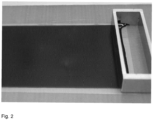
- a box doctor blade with a doctor blade gap of 50 ⁇ m was chosen.
- the resulting layer thickness after drying was between 8 ⁇ m and 15 ⁇ m.
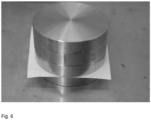
- the contact pressure of 0.04 MPa was achieved by the weight of planar stainless steel disks stacked on the membrane-transfer substrate assembly (photo in Figure 6 ).
- an absorbent fabric (more precisely a cleanroom cloth) was inserted.
- a transfer was achieved within 60 seconds at 20 °C.
- the stainless steel blocks were pre-tempered accordingly before the transfer process.
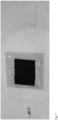
- the PET film was peeled off, leaving the catalyst layer on the membrane.
Landscapes
- Chemical & Material Sciences (AREA)
- Engineering & Computer Science (AREA)
- Chemical Kinetics & Catalysis (AREA)
- Manufacturing & Machinery (AREA)
- Electrochemistry (AREA)
- Organic Chemistry (AREA)
- Materials Engineering (AREA)
- Sustainable Energy (AREA)
- General Chemical & Material Sciences (AREA)
- Life Sciences & Earth Sciences (AREA)
- Sustainable Development (AREA)
- Metallurgy (AREA)
- Inorganic Chemistry (AREA)
- Health & Medical Sciences (AREA)
- Medicinal Chemistry (AREA)
- Polymers & Plastics (AREA)
- Crystallography & Structural Chemistry (AREA)
- Manufacture Of Macromolecular Shaped Articles (AREA)
Priority Applications (5)
| Application Number | Priority Date | Filing Date | Title |
|---|---|---|---|
| EP23164605.0A EP4438773A1 (fr) | 2023-03-28 | 2023-03-28 | Revêtement de membranes échangeuses d'anions |
| PCT/EP2024/057369 WO2024200138A1 (fr) | 2023-03-28 | 2024-03-20 | Revêtement de membranes échangeuses d'anions |
| CN202480022277.6A CN120917184A (zh) | 2023-03-28 | 2024-03-20 | 阴离子交换膜的涂层 |
| AU2024245553A AU2024245553A1 (en) | 2023-03-28 | 2024-03-20 | Coating of anion exchange membranes |
| KR1020257032455A KR20250166936A (ko) | 2023-03-28 | 2024-03-20 | 음이온 교환 막들의 코팅 |
Applications Claiming Priority (1)
| Application Number | Priority Date | Filing Date | Title |
|---|---|---|---|
| EP23164605.0A EP4438773A1 (fr) | 2023-03-28 | 2023-03-28 | Revêtement de membranes échangeuses d'anions |
Publications (1)
| Publication Number | Publication Date |
|---|---|
| EP4438773A1 true EP4438773A1 (fr) | 2024-10-02 |
Family
ID=86095793
Family Applications (1)
| Application Number | Title | Priority Date | Filing Date |
|---|---|---|---|
| EP23164605.0A Pending EP4438773A1 (fr) | 2023-03-28 | 2023-03-28 | Revêtement de membranes échangeuses d'anions |
Country Status (5)
| Country | Link |
|---|---|
| EP (1) | EP4438773A1 (fr) |
| KR (1) | KR20250166936A (fr) |
| CN (1) | CN120917184A (fr) |
| AU (1) | AU2024245553A1 (fr) |
| WO (1) | WO2024200138A1 (fr) |
Citations (8)
| Publication number | Priority date | Publication date | Assignee | Title |
|---|---|---|---|---|
| US20050072514A1 (en) | 2003-10-06 | 2005-04-07 | Yan Susan G. | Method of making membrane electrode assemblies |
| JP2007095582A (ja) | 2005-09-29 | 2007-04-12 | Nissan Motor Co Ltd | 膜電極接合体製造方法 |
| US20110217621A1 (en) * | 2008-12-23 | 2011-09-08 | E. I. Du Pont De Nemours And Company | Process to produce catalyst coated membranes for fuel cell applications |
| EP3770201A1 (fr) | 2019-07-22 | 2021-01-27 | Evonik Operations GmbH | Membranes polymères conductrices d'anions |
| WO2022035792A1 (fr) * | 2020-08-10 | 2022-02-17 | Ecolectro, Inc. | Composites électrolyte-polymère |
| EP4032934A1 (fr) | 2021-01-20 | 2022-07-27 | Evonik Operations GmbH | Composé polymère conducteur d'anions, sa préparation et son utilisation en électrochimie |
| EP4059988A1 (fr) | 2021-03-16 | 2022-09-21 | Evonik Operations GmbH | Composé conducteur d'anions à long terme, sa préparation et son utilisation en électrochimie |
| WO2022241156A1 (fr) * | 2021-05-12 | 2022-11-17 | Giner, Inc. | Ensemble électrode à membrane et son procédé de fabrication |
-
2023
- 2023-03-28 EP EP23164605.0A patent/EP4438773A1/fr active Pending
-
2024
- 2024-03-20 KR KR1020257032455A patent/KR20250166936A/ko active Pending
- 2024-03-20 WO PCT/EP2024/057369 patent/WO2024200138A1/fr not_active Ceased
- 2024-03-20 CN CN202480022277.6A patent/CN120917184A/zh active Pending
- 2024-03-20 AU AU2024245553A patent/AU2024245553A1/en active Pending
Patent Citations (8)
| Publication number | Priority date | Publication date | Assignee | Title |
|---|---|---|---|---|
| US20050072514A1 (en) | 2003-10-06 | 2005-04-07 | Yan Susan G. | Method of making membrane electrode assemblies |
| JP2007095582A (ja) | 2005-09-29 | 2007-04-12 | Nissan Motor Co Ltd | 膜電極接合体製造方法 |
| US20110217621A1 (en) * | 2008-12-23 | 2011-09-08 | E. I. Du Pont De Nemours And Company | Process to produce catalyst coated membranes for fuel cell applications |
| EP3770201A1 (fr) | 2019-07-22 | 2021-01-27 | Evonik Operations GmbH | Membranes polymères conductrices d'anions |
| WO2022035792A1 (fr) * | 2020-08-10 | 2022-02-17 | Ecolectro, Inc. | Composites électrolyte-polymère |
| EP4032934A1 (fr) | 2021-01-20 | 2022-07-27 | Evonik Operations GmbH | Composé polymère conducteur d'anions, sa préparation et son utilisation en électrochimie |
| EP4059988A1 (fr) | 2021-03-16 | 2022-09-21 | Evonik Operations GmbH | Composé conducteur d'anions à long terme, sa préparation et son utilisation en électrochimie |
| WO2022241156A1 (fr) * | 2021-05-12 | 2022-11-17 | Giner, Inc. | Ensemble électrode à membrane et son procédé de fabrication |
Non-Patent Citations (3)
| Title |
|---|
| MILLER, HAMISH ANDREW: "Green hydrogen from anion exchange membrane water electrolysis: a review of recent developments in critical materials and operating conditions", SUSTAINABLE ENERGY FUELS, 21 April 2020 (2020-04-21) |
| MINKYU KYEONG, JI EON CHAE, SO YOUNG LEE, TAE-HOON LIM, MINSUNG KIM, SANG-SOO LEE,KWANG HO SONG, HYOUNG-JUHN KIM: "Development of Poly(Arylene ether Sulfone)-Based blend membranes containing aliphatic moieties for the low-temperature decal transfer method", JOURNAL OF MEMBRANE SCIENCE, vol. 660, 2022, pages 120853, ISBN: 0376-7388 |
| YOUNG JUN YOONTAE-HO KIMSANG UN KIMDUK MAN YUYOUNG TAIK HONG: "Low temperature decaltransfer method for hydrocarbon membrane based membrane electrode assemblies in polymer electrolyte membrane fuel cells", JOURNAL OF POWER SOURCES, vol. 196, 2011, pages 9800 - 9809, XP028283718, ISSN: 0378-7753, DOI: 10.1016/j.jpowsour.2011.08.038 |
Also Published As
| Publication number | Publication date |
|---|---|
| WO2024200138A1 (fr) | 2024-10-03 |
| AU2024245553A1 (en) | 2025-11-13 |
| KR20250166936A (ko) | 2025-11-28 |
| CN120917184A (zh) | 2025-11-07 |
Similar Documents
| Publication | Publication Date | Title |
|---|---|---|
| EP1198021B1 (fr) | Procédé de fabrication d'une unité membrane-électrodes pour piles à combustible | |
| DE102007048872B4 (de) | Additive für Brennstoffzellenschichten | |
| DE112013007069B4 (de) | Verfahren zum Herstellen eines feinen Katalysatorpartikels und Brennstoffzelle umfassend ein durch das Herstellverfahren hergestelltes feines Katalysatorpartikel | |
| DE60305469T2 (de) | Vorrichtung und verfahren zur überführung einer bahn aus einer brennstoffzellenmembran in präzis positionierte abschnitte dieser membran | |
| DE112015001388B4 (de) | Verfahren zur Herstellung einer mit Katalysator beschichteten Membran-Versiegelungs-Anordnung | |
| DE19548422A1 (de) | Materialverbunde und ihre kontinuierliche Herstellung | |
| DE102013205284B4 (de) | Elektrodenanordnung mit integrierter Verstärkungsschicht | |
| DE102005038612A1 (de) | Verfahren zur Herstellung von beidseitig katalysatorbeschichteten Membranen | |
| DE112004001842T5 (de) | Verfahren zum Herstellen von Membranelektrodenanordnungen | |
| DE102019104561A1 (de) | Verfahren zur Herstellung einer Kompositschicht, elektrochemische Einheit und Verwendung der Kompositschicht | |
| DE102018109817A1 (de) | Membran-elektroden-gasdiffusionsschicht-anordnung und verfahren zu deren herstellung | |
| DE112013004009T5 (de) | Verfahren zur Herstellung eines katalytischen Materials | |
| DE102014102409B4 (de) | Verfahren zum gleichzeitigen Aufbringen mehrerer Brennstoffzellkomponentenbeschichtungen auf ein Substrat sowie Verfahren zur Herstellung einer Membranelektrodenanordnung | |
| EP2609233B1 (fr) | Dépôt électrochimique de particules de catalyseur nanométriques | |
| WO2012163383A1 (fr) | Dispositif à membrane électrolytique pour pile à combustible, et son procédé de production | |
| WO2024200138A1 (fr) | Revêtement de membranes échangeuses d'anions | |
| EP4456205A1 (fr) | Revêtement de membranes échangeuses de cations | |
| EP4430231A1 (fr) | Assemblage électrode-membrane et son procédé de fabrication | |
| DE102014102413A1 (de) | Kathodenverbundstruktur und Verfahren davon für verbesserte Brennstoffzellleistung unter hoher Feuchte | |
| DE102020212538A1 (de) | Elektrolytmembran für Brennstoffzellen, die einen Katalysatorverbundstoff mit verbesserter Sauerstoffdurchlässigeit ernthält, und Verfahren zu deren Herstellung | |
| EP4588963A1 (fr) | Préparation d'une membrane échangeuse d'anions revêtue par catalyse | |
| WO2025003245A1 (fr) | Procédé de fabrication d'un assemblage membrane-électrodes à l'aide d'une feuille adhésive pour stabiliser la forme de la membrane polymère | |
| WO2025214812A1 (fr) | Production de corps stratifiés électrocatalytiquement actifs à conductivité anionique | |
| EP4645482A1 (fr) | Revêtement direct de membranes échangeuses d'anions comprenant un matériau catalytiquement actif | |
| DE102025126067A1 (de) | Membran-elektroden-anordnung für die wasserelektrolyse und verfahren zu ihrer herstellung |
Legal Events
| Date | Code | Title | Description |
|---|---|---|---|
| PUAI | Public reference made under article 153(3) epc to a published international application that has entered the european phase |
Free format text: ORIGINAL CODE: 0009012 |
|
| STAA | Information on the status of an ep patent application or granted ep patent |
Free format text: STATUS: THE APPLICATION HAS BEEN PUBLISHED |
|
| AK | Designated contracting states |
Kind code of ref document: A1 Designated state(s): AL AT BE BG CH CY CZ DE DK EE ES FI FR GB GR HR HU IE IS IT LI LT LU LV MC ME MK MT NL NO PL PT RO RS SE SI SK SM TR |
|
| STAA | Information on the status of an ep patent application or granted ep patent |
Free format text: STATUS: REQUEST FOR EXAMINATION WAS MADE |
|
| 17P | Request for examination filed |
Effective date: 20241204 |
|
| RBV | Designated contracting states (corrected) |
Designated state(s): AL AT BE BG CH CY CZ DE DK EE ES FI FR GB GR HR HU IE IS IT LI LT LU LV MC ME MK MT NL NO PL PT RO RS SE SI SK SM TR |
|
| STAA | Information on the status of an ep patent application or granted ep patent |
Free format text: STATUS: EXAMINATION IS IN PROGRESS |
|
| 17Q | First examination report despatched |
Effective date: 20251209 |