EP4440182A1 - Automatisches ersetzen einer fehlfunktionierenden basisstation durch eine autonome mobile 5g-basisstation - Google Patents
Automatisches ersetzen einer fehlfunktionierenden basisstation durch eine autonome mobile 5g-basisstation Download PDFInfo
- Publication number
- EP4440182A1 EP4440182A1 EP23165469.0A EP23165469A EP4440182A1 EP 4440182 A1 EP4440182 A1 EP 4440182A1 EP 23165469 A EP23165469 A EP 23165469A EP 4440182 A1 EP4440182 A1 EP 4440182A1
- Authority
- EP
- European Patent Office
- Prior art keywords
- base station
- instance
- cell
- autonomous mobile
- mobile base
- Prior art date
- Legal status (The legal status is an assumption and is not a legal conclusion. Google has not performed a legal analysis and makes no representation as to the accuracy of the status listed.)
- Pending
Links
- 238000000034 method Methods 0.000 claims abstract description 24
- 230000001413 cellular effect Effects 0.000 claims abstract description 19
- 238000012423 maintenance Methods 0.000 claims abstract description 5
- 238000013473 artificial intelligence Methods 0.000 claims description 29
- 238000004590 computer program Methods 0.000 claims description 7
- 238000005259 measurement Methods 0.000 description 2
- 230000006870 function Effects 0.000 description 1
- 230000003993 interaction Effects 0.000 description 1
- 238000010801 machine learning Methods 0.000 description 1
- 238000010295 mobile communication Methods 0.000 description 1
- 238000011084 recovery Methods 0.000 description 1
Images
Classifications
-
- H—ELECTRICITY
- H04—ELECTRIC COMMUNICATION TECHNIQUE
- H04W—WIRELESS COMMUNICATION NETWORKS
- H04W24/00—Supervisory, monitoring or testing arrangements
- H04W24/04—Arrangements for maintaining operational condition
-
- H—ELECTRICITY
- H04—ELECTRIC COMMUNICATION TECHNIQUE
- H04W—WIRELESS COMMUNICATION NETWORKS
- H04W24/00—Supervisory, monitoring or testing arrangements
- H04W24/02—Arrangements for optimising operational condition
-
- H—ELECTRICITY
- H04—ELECTRIC COMMUNICATION TECHNIQUE
- H04W—WIRELESS COMMUNICATION NETWORKS
- H04W24/00—Supervisory, monitoring or testing arrangements
- H04W24/08—Testing, supervising or monitoring using real traffic
Definitions
- the present invention relates to a computer-implemented method for maintenance of a Cellular Network
- a Cellular Network comprising a First Base Station supporting a First Cell, at least one Further Base Station supporting at least one Further Cell and at least one Malfunctioning Base Station supporting at least one Problematic Cell by discovery of this at least one Problematic Cell by means of Primary Network Statistics comprising network coverage, capacity, availability, accessibility, retainability and mobility and replacing or supporting the at least one Malfunctioning Base Station by at least one Mobile Base Station.
- the present invention further relates to a respective computer program product and a respective computer-implemented device.
- the invention represents on the one hand a contribution to make cellular networks more reliable and to minimize the influence of human-related errors in network problem handling. On the other hand, it can provide a valuable contribution to ensure network stability to peak network traffic situations.
- the cellular network can meet its limits in terms of capacity, coverage or availability.
- MNO mobile network operator
- a limiting factor is that these mobile base stations have to be manually configured and transported by employees, who represent a strongly limited resource the MNO has access to.
- One object of the present invention regards the fact that in the case a Cellular Network comprising a First Base Station supporting a First Cell, at least one Further Base Station supporting at least one Further Cell and at least one Malfunctioning Base Station supporting at least one Problematic Cell has coverage, capacity or availability problems due to an insufficient number of base stations or other technical network problems that can occur during the operation of this Cellular Network, the at least one Problematic Cell has to be discovered and supported or replaced by at least one Mobile Base Station. That problematic cell discovery and recovery or replacement is connected to more or less high workload for the employees of a mobile network operator (MNO) and the MNO himself.
- MNO mobile network operator
- the object of the invention is to significantly reduce or completely overtake this workload.
- a computer-implemented method that comprises the steps of gathering the Primary Network Statistics and generating a dataset of Secondary Network Statistics, by a 5G Autonomous Mobile Base Station, handing over the Secondary Network Statistics to a Selecting Instance, selecting the at least one Problematic Cell by analyzing the Secondary Network Statistics by the Selecting instance, sending an Approval Request to an Approving Instance, in case the Approval Request is approved sending at least one Movement Instruction and Base Station Information to the at least one 5G Autonomous Mobile Base Station and performing at least one Movement Execution of the at least one 5G Autonomous Mobile Base Station that causes a relocation of the at least one 5G Autonomous Mobile Base Station by itself to the at least one Problematic Cell with the Malfunctioning Base Station.
- a cellular network can be any available mobile communication standard like LTE or a 5G network.
- the term Base Station in the field of the present invention means any physical device that supports the cellular network.
- a Base Station is a telecommunication sender unit that enables wireless exchange of digital and analogue data of any content.
- the term Cell means a telecommunication cell. In other words, this is a spatial area in that the signal strength of the Base Station is sufficiently high to enable the wireless data exchange with acceptable speed. The limit of speed that is recognized as acceptable is defined by technical or legal requirements.
- the Cell and the corresponding Base Station are directly connected to each other in the sense of a bijective function.
- a Mobile Base Station is autonomous in the sense of the present invention if it is capable of finding its way to the point of operation that is defined by the MNO.
- this is realized by a 5G Autonomous Mobile Base Station (5GAMB).
- 5GAMB 5G Autonomous Mobile Base Station
- This is a device that on the one hand comprises at least one mobile base station and on the other hand comprises a mechanic driving mechanism, so that the device is capable of autonomously relocating itself to any point of operation.
- a cell is coined as Problematic if it does not meet or does not meet anymore the minimal requirements in terms of signal strength that were discussed before. If a cell is problematic, this has the direct consequence that the corresponding Base Station has to be considered as Malfunctioning. This is because of the bijective nature of the relation between Cell and corresponding Base Station.
- this at least one 5G Autonomous Mobile Base Station that comprises at least one Mobile Base Station and is capable of moving on its own.
- the at least one 5GAMB gathers Primary Network Statistics, e.g. comprising network coverage, capacity or availability, and provides a dataset, called Secondary Network Statistics, to a Selecting Instance that has to identify the at least one Problematic Cell.
- Primary Network Statistics e.g. comprising network coverage, capacity or availability
- Secondary Network Statistics e.g. comprising network coverage, capacity or availability
- this Selecting Instance is the MNO.
- the MNO also acts as Approving Instance: He has to decide if at least one Movement Instruction and Base Station Information has to be sent to the at least one 5GAMB that further executes that Instruction by at least one Movement Execution and relocates to the at least one Problematic Cell to support the at least one Malfunctioning Base Station.
- the Approving Instance sends, in parallel to the at least one Movement Instruction and Base Station Information that is sent to the at least one 5G Autonomous Mobile Base Station, at least one Shut-Down Instruction to the at least one Malfunctioning Base Station.
- This embodiment of the invention contributes to an even better achievement of the previously mentioned object because the at least one Malfunctioning Base Station is completely substituted with the at least one Mobile Base Station of the at least one 5GAMB. In this way, any hidden network problems arising from the at least one Malfunctioning Base Station can be avoided in advance.
- the Selecting Instance is comprised by an Artificial Intelligence Engine.
- the Artificial Intelligence Engine contributes to an even better achievement of the previously mentioned object because the Artificial Intelligence Engine reduces the workload for the MNO to the tasks to be fulfilled by the Approving Instance.
- the Artificial Intelligence Engine comprising the Selecting Instance can hereby be the same Artificial Intelligence Engine as the one comprising the Approving Instance and/or the same Artificial Intelligence Engine as the one configuring the at least one 5GAMB.
- the Selecting Instance that is controlled by the Artificial Intelligence Engine in this embodiment of the invention, prepares at least one Movement Instruction and Base Station Information and optionally the at least one Shut-Down Instruction and sends an Approval Request to the Approving Instance, which is represented by the MNO in this embodiment of the invention - the MNO has just to decide if he approves or denies the Approval Request.
- the Selecting Instance or the Approving Instance or both of them are comprised by an Artificial Intelligence Engine.
- the MNO is completely substituted by the Artificial Intelligence Engine. This leads to an autonomous system, where no human interaction is required anymore and that additionally benefits from the absence of human-related errors compared to the previously described embodiments of the invention.
- the Base Station Information comprised by the at least one Movement Instruction and Base Station Information is used for configuring the at least one 5G Autonomous Mobile Base Station.
- This embodiment of the invention employs the Base Station Information from the Malfunctioning Base Station, that is sent to the 5GMB as a part of the at least one Movement Instruction and Base Station Information, to configure the at least one 5G Autonomous Mobile Base Station in the same way as the Malfunctioning Base Station is configured.
- the at least one 5G Autonomous Mobile Base Station is configured by an Artificial Intelligence Engine.
- the Artificial Intelligence Engine is capable of optimizing physical parameters of the 5G Autonomous Mobile Base Station that have significant influence on the contribution to network coverage, capacity and availability of the at least one 5G Autonomous Mobile Base Station, such as azimuth, latitude, longitude or neighbour cell relations by machine learning algorithms. In this way, the present embodiment of the invention reaches an even better achievement of the previously mentioned object.
- the invention also relates to a computer program product that implements the previously described methods in a system comprising the Cellular Network, the First Base Station supporting the First Cell, the at least one Further Base Station supporting the at least one Further Cell and the at least one Malfunctioning Base Station supporting the at least one Problematic Cell, the at least one 5GAMB, the Selecting Instance and the Approving Instance.
- the invention also relates to a further computer program product for a system additionally comprising the Artificial Intelligence Engine comprising the Selecting Instance. With that, the task of selecting the at least one problematic cell can be handed over to the Artificial Intelligence Engine.
- the invention also relates to a further computer program product for a system that further comprises the Artificial Intelligence Engine additionally comprising the Approving Instance. With that, also the task of approving the replacement of the at least one Malfunctioning Base Station supporting the at least one Problematic Cell by a 5GAMB can be handed over to the Artificial Intelligence Engine.
- the invention also relates to a computer-implemented device that is employed to execute any of the methods described within the previously discussed embodiments of the invention.
- This device implements the previously described methods in hardware, what makes the method independent from any support hardware and therefor allows to execute the methods claimed in one of the method claims in a closed environment.
- the computer-implemented device comprises the Cellular Network, the First Base Station supporting the First Cell, the at least one Further Base Station supporting the at least one Further Cell, the at least one Malfunctioning Base Station supporting the at least one Problematic Cell, the at least one 5G Autonomous Mobile Base Station, the Selecting Instance and the Approving Instance.
- the computer-implemented device described in the last paragraph comprises the Artificial Intelligence Engine that itself comprises the Selecting Instance.
- This embodiment of the invention allows the implementation of method claim 3 in a device. It allows to hand over the Selection Instance task of the MNO to the Artificial Intelligence Engine, what reduces the workload of the MNO.
- the computer-implemented device described three paragraphs ahead comprises the Artificial Intelligence Engine that itself comprises the Approving Instance.
- This embodiment of the invention allows the implementation of method claim 4 in a device. It allows to hand over the Selection Instance task, the Approving Instance Task or both of them from the MNO to the Artificial Intelligence Engine, and allows to substitute the MNO by the Artificial Intelligence Engine.
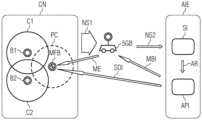
- Fig. 1 shows the principal sketch of the computer system realizing a method for maintenance of a Cellular Network CN.
- the Cellular Network CN comprises a First Base Station B1 that supports a First Cell C1, at least one Further Base Station B2 supporting at least one Further Cell C2 and at least one Malfunctioning Base Station MFB supporting at least one Problematic Cell PC.
- this at least one Problematic Cell PC has first to be discovered.
- a measurement of Primary Network Statistics NS1 comprising network coverage, capacity, availability, accessibility, retainability and mobility is performed.
- those measurements are done by a 5G Autonomous Mobile Base Station 5GB that generates a dataset of Secondary Network Statistics NS2.
- this dataset is handed over to a Selecting Instance SI that identifies the at least one Problematic Cell PC by analyzing the Secondary Network Statistics NS2 in terms of network coverage, capacity, availability, accessibility, retainability and mobility.
- an Approval Request AR is sent to an Approving Instance API.
- the Selecting Instance SI and the Approving Instance API can be comprised by an Artificial Intelligence Engine AIE that fully automatizes this part of maintenance of the Cellular Network CN.
- At least one Movement Instruction and Base Station Information MBI is sent to the at least one 5G Autonomous Mobile Base Station 5GB.
- at least one Shut-Down Instruction SDI is sent to the at least one Malfunctioning Base Station MFB.
- the at least one 5G Autonomous Mobile Base Station 5GB performs at least one Movement Execution ME that causes a relocation of the at least one 5G Autonomous Mobile Base Station 5GB to the at least one Problematic Cell PC with the Malfunctioning Base Station MFB.
- the at least one Malfunctioning Base Station MFB is replaced by at least one Autonomous Mobile Base Station 5GB, that either overtakes the configuration of the at least one Malfunctioning Base Station MFB or is configured by the Artificial Intelligence Engine AIE.
- the Autonomous Mobile Base Station 5GB does not replace the Malfunctioning Base Station MFB but only works in addition to the Malfunctioning Base Station MFB to provide sufficient service for the Problematic Cell PC.
Landscapes
- Engineering & Computer Science (AREA)
- Computer Networks & Wireless Communication (AREA)
- Signal Processing (AREA)
- Mobile Radio Communication Systems (AREA)
Priority Applications (1)
| Application Number | Priority Date | Filing Date | Title |
|---|---|---|---|
| EP23165469.0A EP4440182A1 (de) | 2023-03-30 | 2023-03-30 | Automatisches ersetzen einer fehlfunktionierenden basisstation durch eine autonome mobile 5g-basisstation |
Applications Claiming Priority (1)
| Application Number | Priority Date | Filing Date | Title |
|---|---|---|---|
| EP23165469.0A EP4440182A1 (de) | 2023-03-30 | 2023-03-30 | Automatisches ersetzen einer fehlfunktionierenden basisstation durch eine autonome mobile 5g-basisstation |
Publications (1)
| Publication Number | Publication Date |
|---|---|
| EP4440182A1 true EP4440182A1 (de) | 2024-10-02 |
Family
ID=85792021
Family Applications (1)
| Application Number | Title | Priority Date | Filing Date |
|---|---|---|---|
| EP23165469.0A Pending EP4440182A1 (de) | 2023-03-30 | 2023-03-30 | Automatisches ersetzen einer fehlfunktionierenden basisstation durch eine autonome mobile 5g-basisstation |
Country Status (1)
| Country | Link |
|---|---|
| EP (1) | EP4440182A1 (de) |
Citations (2)
| Publication number | Priority date | Publication date | Assignee | Title |
|---|---|---|---|---|
| WO2018112091A1 (en) * | 2016-12-14 | 2018-06-21 | T-Mobile Usa, Inc. | Uav cellular communication service delivery |
| US20200275291A1 (en) * | 2017-09-01 | 2020-08-27 | Nokia Technologies Oy | Reducing coverage problems via dynamic measurements |
-
2023
- 2023-03-30 EP EP23165469.0A patent/EP4440182A1/de active Pending
Patent Citations (2)
| Publication number | Priority date | Publication date | Assignee | Title |
|---|---|---|---|---|
| WO2018112091A1 (en) * | 2016-12-14 | 2018-06-21 | T-Mobile Usa, Inc. | Uav cellular communication service delivery |
| US20200275291A1 (en) * | 2017-09-01 | 2020-08-27 | Nokia Technologies Oy | Reducing coverage problems via dynamic measurements |
Non-Patent Citations (2)
| Title |
|---|
| KLAINE PAOLO VALENTE: "Self-organization for 5G and beyond mobile networks using reinforcement learning", PHD THESIS, 12 July 2019 (2019-07-12), pages 1 - 199, XP055973422, Retrieved from the Internet <URL:https://core.ac.uk/download/pdf/224753631.pdf> [retrieved on 20221020] * |
| ZTE CORPORATION ET AL: "Supplement for Use case of UBS", vol. SA WG1, no. Tallinn, Estonia; 20190218 - 20190222, 25 February 2019 (2019-02-25), XP051609666, Retrieved from the Internet <URL:http://www.3gpp.org/ftp/tsg%5Fsa/WG1%5FServ/TSGS1%5F85%5FTallin/Docs/S1%2D190473%2Ezip> [retrieved on 20190225] * |
Similar Documents
| Publication | Publication Date | Title |
|---|---|---|
| US11336535B2 (en) | Station movement flow driven automatic RF site grouping | |
| US11689961B2 (en) | Systems and methods for distribution of application logic in digital networks | |
| US11909584B2 (en) | System and method of data communication | |
| US20190223005A1 (en) | Mobility management node selection to support cloud-centric environments | |
| US12124510B2 (en) | Methods and systems for efficient data importation for data visualization | |
| US12273251B2 (en) | Data analysis apparatus management and control method and communication apparatus | |
| US20160286479A1 (en) | Reducing energy consumption of small cell devices | |
| WO2022051226A1 (en) | Method and apparatus for cbrs network planning and operating in an enterprise network | |
| US20210258850A1 (en) | Optimizing private network during offload for user equipment performance parameters | |
| US20260039565A1 (en) | Devices, methods and computer-readable media for activation of artificial intelligence and/or machine learning capabilities | |
| EP4440182A1 (de) | Automatisches ersetzen einer fehlfunktionierenden basisstation durch eine autonome mobile 5g-basisstation | |
| US20250338243A1 (en) | Geographically intelligent network function request routing | |
| Martín et al. | Towards 5G: Techno-economic analysis of suitable use cases | |
| Do et al. | Latency-aware placement for state management functions in service-based 5G mobile core network | |
| US8081607B2 (en) | Method and system for operating a mobile communication network | |
| US7907949B2 (en) | Radio communication system, adjacent station information management method for this system, and management apparatus therefor | |
| US20220360512A1 (en) | System for addition and management of ad-hoc network attached compute (nac) resources | |
| Sánchez et al. | A Trace Data‐Based Approach for an Accurate Estimation of Precise Utilization Maps in LTE | |
| KR20180018459A (ko) | 지능적 진단 데이터 수집을 위한 프레임워크 | |
| US20250358640A1 (en) | Cell cluster interleaving for network service activities | |
| JP2023532889A (ja) | ライブ放送データストリーミング等のための無線通信ネットワークにおける位置報告 | |
| US12323897B2 (en) | Connectionless mobility management for hybrid networks using relativistic routing protocol | |
| US12530815B2 (en) | Method, apparatus and computer program | |
| US20250106911A1 (en) | Handling different management schemes for communication control model | |
| US20240187947A1 (en) | Communication control for dynamically determining ssc mode |
Legal Events
| Date | Code | Title | Description |
|---|---|---|---|
| PUAI | Public reference made under article 153(3) epc to a published international application that has entered the european phase |
Free format text: ORIGINAL CODE: 0009012 |
|
| STAA | Information on the status of an ep patent application or granted ep patent |
Free format text: STATUS: THE APPLICATION HAS BEEN PUBLISHED |
|
| AK | Designated contracting states |
Kind code of ref document: A1 Designated state(s): AL AT BE BG CH CY CZ DE DK EE ES FI FR GB GR HR HU IE IS IT LI LT LU LV MC ME MK MT NL NO PL PT RO RS SE SI SK SM TR |
|
| STAA | Information on the status of an ep patent application or granted ep patent |
Free format text: STATUS: REQUEST FOR EXAMINATION WAS MADE |
|
| 17P | Request for examination filed |
Effective date: 20250220 |