EP4443754A2 - Dreikomponenten-codebuchbasierte csi-meldung - Google Patents
Dreikomponenten-codebuchbasierte csi-meldung Download PDFInfo
- Publication number
- EP4443754A2 EP4443754A2 EP23209152.0A EP23209152A EP4443754A2 EP 4443754 A2 EP4443754 A2 EP 4443754A2 EP 23209152 A EP23209152 A EP 23209152A EP 4443754 A2 EP4443754 A2 EP 4443754A2
- Authority
- EP
- European Patent Office
- Prior art keywords
- csi
- basis
- subgroup
- layers
- csi report
- Prior art date
- Legal status (The legal status is an assumption and is not a legal conclusion. Google has not performed a legal analysis and makes no representation as to the accuracy of the status listed.)
- Pending
Links
Images






Classifications
-
- H—ELECTRICITY
- H04—ELECTRIC COMMUNICATION TECHNIQUE
- H04B—TRANSMISSION
- H04B7/00—Radio transmission systems, i.e. using radiation field
- H04B7/02—Diversity systems; Multi-antenna system, i.e. transmission or reception using multiple antennas
- H04B7/04—Diversity systems; Multi-antenna system, i.e. transmission or reception using multiple antennas using two or more spaced independent antennas
- H04B7/06—Diversity systems; Multi-antenna system, i.e. transmission or reception using multiple antennas using two or more spaced independent antennas at the transmitting station
- H04B7/0613—Diversity systems; Multi-antenna system, i.e. transmission or reception using multiple antennas using two or more spaced independent antennas at the transmitting station using simultaneous transmission
- H04B7/0615—Diversity systems; Multi-antenna system, i.e. transmission or reception using multiple antennas using two or more spaced independent antennas at the transmitting station using simultaneous transmission of weighted versions of same signal
- H04B7/0619—Diversity systems; Multi-antenna system, i.e. transmission or reception using multiple antennas using two or more spaced independent antennas at the transmitting station using simultaneous transmission of weighted versions of same signal using feedback from receiving side
- H04B7/0621—Feedback content
- H04B7/0626—Channel coefficients, e.g. channel state information [CSI]
-
- G—PHYSICS
- G06—COMPUTING OR CALCULATING; COUNTING
- G06T—IMAGE DATA PROCESSING OR GENERATION, IN GENERAL
- G06T7/00—Image analysis
- G06T7/50—Depth or shape recovery
- G06T7/55—Depth or shape recovery from multiple images
-
- G—PHYSICS
- G06—COMPUTING OR CALCULATING; COUNTING
- G06V—IMAGE OR VIDEO RECOGNITION OR UNDERSTANDING
- G06V10/00—Arrangements for image or video recognition or understanding
- G06V10/70—Arrangements for image or video recognition or understanding using pattern recognition or machine learning
- G06V10/74—Image or video pattern matching; Proximity measures in feature spaces
- G06V10/761—Proximity, similarity or dissimilarity measures
-
- H—ELECTRICITY
- H04—ELECTRIC COMMUNICATION TECHNIQUE
- H04B—TRANSMISSION
- H04B7/00—Radio transmission systems, i.e. using radiation field
- H04B7/02—Diversity systems; Multi-antenna system, i.e. transmission or reception using multiple antennas
- H04B7/04—Diversity systems; Multi-antenna system, i.e. transmission or reception using multiple antennas using two or more spaced independent antennas
- H04B7/0413—MIMO systems
- H04B7/0456—Selection of precoding matrices or codebooks, e.g. using matrices antenna weighting
-
- H—ELECTRICITY
- H04—ELECTRIC COMMUNICATION TECHNIQUE
- H04B—TRANSMISSION
- H04B7/00—Radio transmission systems, i.e. using radiation field
- H04B7/02—Diversity systems; Multi-antenna system, i.e. transmission or reception using multiple antennas
- H04B7/04—Diversity systems; Multi-antenna system, i.e. transmission or reception using multiple antennas using two or more spaced independent antennas
- H04B7/0413—MIMO systems
- H04B7/0456—Selection of precoding matrices or codebooks, e.g. using matrices antenna weighting
- H04B7/0478—Special codebook structures directed to feedback optimisation
-
- H—ELECTRICITY
- H04—ELECTRIC COMMUNICATION TECHNIQUE
- H04B—TRANSMISSION
- H04B7/00—Radio transmission systems, i.e. using radiation field
- H04B7/02—Diversity systems; Multi-antenna system, i.e. transmission or reception using multiple antennas
- H04B7/04—Diversity systems; Multi-antenna system, i.e. transmission or reception using multiple antennas using two or more spaced independent antennas
- H04B7/06—Diversity systems; Multi-antenna system, i.e. transmission or reception using multiple antennas using two or more spaced independent antennas at the transmitting station
- H04B7/0613—Diversity systems; Multi-antenna system, i.e. transmission or reception using multiple antennas using two or more spaced independent antennas at the transmitting station using simultaneous transmission
- H04B7/0615—Diversity systems; Multi-antenna system, i.e. transmission or reception using multiple antennas using two or more spaced independent antennas at the transmitting station using simultaneous transmission of weighted versions of same signal
- H04B7/0619—Diversity systems; Multi-antenna system, i.e. transmission or reception using multiple antennas using two or more spaced independent antennas at the transmitting station using simultaneous transmission of weighted versions of same signal using feedback from receiving side
- H04B7/0621—Feedback content
- H04B7/063—Parameters other than those covered in groups H04B7/0623 - H04B7/0634, e.g. channel matrix rank or transmit mode selection
-
- H—ELECTRICITY
- H04—ELECTRIC COMMUNICATION TECHNIQUE
- H04B—TRANSMISSION
- H04B7/00—Radio transmission systems, i.e. using radiation field
- H04B7/02—Diversity systems; Multi-antenna system, i.e. transmission or reception using multiple antennas
- H04B7/04—Diversity systems; Multi-antenna system, i.e. transmission or reception using multiple antennas using two or more spaced independent antennas
- H04B7/06—Diversity systems; Multi-antenna system, i.e. transmission or reception using multiple antennas using two or more spaced independent antennas at the transmitting station
- H04B7/0613—Diversity systems; Multi-antenna system, i.e. transmission or reception using multiple antennas using two or more spaced independent antennas at the transmitting station using simultaneous transmission
- H04B7/0615—Diversity systems; Multi-antenna system, i.e. transmission or reception using multiple antennas using two or more spaced independent antennas at the transmitting station using simultaneous transmission of weighted versions of same signal
- H04B7/0619—Diversity systems; Multi-antenna system, i.e. transmission or reception using multiple antennas using two or more spaced independent antennas at the transmitting station using simultaneous transmission of weighted versions of same signal using feedback from receiving side
- H04B7/0636—Feedback format
- H04B7/0639—Using selective indices, e.g. of a codebook, e.g. pre-distortion matrix index [PMI] or for beam selection
-
- H—ELECTRICITY
- H04—ELECTRIC COMMUNICATION TECHNIQUE
- H04L—TRANSMISSION OF DIGITAL INFORMATION, e.g. TELEGRAPHIC COMMUNICATION
- H04L1/00—Arrangements for detecting or preventing errors in the information received
- H04L1/0001—Systems modifying transmission characteristics according to link quality, e.g. power backoff
- H04L1/0023—Systems modifying transmission characteristics according to link quality, e.g. power backoff characterised by the signalling
- H04L1/0027—Scheduling of signalling, e.g. occurrence thereof
-
- H—ELECTRICITY
- H04—ELECTRIC COMMUNICATION TECHNIQUE
- H04L—TRANSMISSION OF DIGITAL INFORMATION, e.g. TELEGRAPHIC COMMUNICATION
- H04L25/00—Baseband systems
- H04L25/02—Details ; arrangements for supplying electrical power along data transmission lines
- H04L25/0202—Channel estimation
- H04L25/0204—Channel estimation of multiple channels
-
- H—ELECTRICITY
- H04—ELECTRIC COMMUNICATION TECHNIQUE
- H04L—TRANSMISSION OF DIGITAL INFORMATION, e.g. TELEGRAPHIC COMMUNICATION
- H04L25/00—Baseband systems
- H04L25/02—Details ; arrangements for supplying electrical power along data transmission lines
- H04L25/0202—Channel estimation
- H04L25/0224—Channel estimation using sounding signals
-
- H—ELECTRICITY
- H04—ELECTRIC COMMUNICATION TECHNIQUE
- H04L—TRANSMISSION OF DIGITAL INFORMATION, e.g. TELEGRAPHIC COMMUNICATION
- H04L5/00—Arrangements affording multiple use of the transmission path
- H04L5/0001—Arrangements for dividing the transmission path
- H04L5/0014—Three-dimensional division
- H04L5/0023—Time-frequency-space
-
- H—ELECTRICITY
- H04—ELECTRIC COMMUNICATION TECHNIQUE
- H04L—TRANSMISSION OF DIGITAL INFORMATION, e.g. TELEGRAPHIC COMMUNICATION
- H04L5/00—Arrangements affording multiple use of the transmission path
- H04L5/003—Arrangements for allocating sub-channels of the transmission path
- H04L5/0048—Allocation of pilot signals, i.e. of signals known to the receiver
-
- H—ELECTRICITY
- H04—ELECTRIC COMMUNICATION TECHNIQUE
- H04L—TRANSMISSION OF DIGITAL INFORMATION, e.g. TELEGRAPHIC COMMUNICATION
- H04L5/00—Arrangements affording multiple use of the transmission path
- H04L5/0091—Signalling for the administration of the divided path, e.g. signalling of configuration information
-
- H—ELECTRICITY
- H04—ELECTRIC COMMUNICATION TECHNIQUE
- H04N—PICTORIAL COMMUNICATION, e.g. TELEVISION
- H04N13/00—Stereoscopic video systems; Multi-view video systems; Details thereof
- H04N13/10—Processing, recording or transmission of stereoscopic or multi-view image signals
- H04N13/106—Processing image signals
- H04N13/128—Adjusting depth or disparity
-
- H—ELECTRICITY
- H04—ELECTRIC COMMUNICATION TECHNIQUE
- H04N—PICTORIAL COMMUNICATION, e.g. TELEVISION
- H04N23/00—Cameras or camera modules comprising electronic image sensors; Control thereof
- H04N23/60—Control of cameras or camera modules
- H04N23/695—Control of camera direction for changing a field of view, e.g. pan, tilt or based on tracking of objects
-
- G—PHYSICS
- G06—COMPUTING OR CALCULATING; COUNTING
- G06T—IMAGE DATA PROCESSING OR GENERATION, IN GENERAL
- G06T2207/00—Indexing scheme for image analysis or image enhancement
- G06T2207/10—Image acquisition modality
- G06T2207/10028—Range image; Depth image; 3D point clouds
-
- H—ELECTRICITY
- H04—ELECTRIC COMMUNICATION TECHNIQUE
- H04B—TRANSMISSION
- H04B7/00—Radio transmission systems, i.e. using radiation field
- H04B7/02—Diversity systems; Multi-antenna system, i.e. transmission or reception using multiple antennas
- H04B7/10—Polarisation diversity; Directional diversity
-
- H—ELECTRICITY
- H04—ELECTRIC COMMUNICATION TECHNIQUE
- H04W—WIRELESS COMMUNICATION NETWORKS
- H04W72/00—Local resource management
- H04W72/20—Control channels or signalling for resource management
- H04W72/23—Control channels or signalling for resource management in the downlink direction of a wireless link, i.e. towards a terminal
Definitions
- the present invention relates to the field of wireless communications, and in particular to methods, user equipments, network nodes and computer program products for providing channel state information, CSI, feedback from a user equipment in the form of one or more CSI reports in a wireless communication system.
- downlink (DL) and uplink (UL) signals convey data signals, control signals comprising DL control information (DCI) and/or uplink control information (UCI), and a number of reference signals (RSs) used for different purposes.
- DCI DL control information
- UCI uplink control information
- RSs reference signals
- a radio network node or a radio base station or a gNodeB (or gNB or gNB/TRP (Transmit Reception Point)) transmits data and DCI through the so-called physical downlink shared channel (PDSCH) and the physical downlink control channel (PDCCH), respectively.
- PDSCH physical downlink shared channel
- PDCCH physical downlink control channel
- a UE transmits data and UCI through the so-called physical uplink shared channel (PUSCH) and physical uplink control channel (PUCCH), respectively.
- the DL or UL signal(s) of the gNB respectively the user equipment, UE or a radio device may contain one or multiple types of RSs including a channel state information RS (CSI-RS), a demodulation RS (DM-RS), and a sounding RS (SRS).
- CSI-RS channel state information RS
- DM-RS demodulation RS
- SRS sounding RS
- the CSI-RS (SRS) is transmitted over a DL (UL) system bandwidth part and used at the UE (gNB) for CSI acquisition.
- the DM-RS is transmitted only in a bandwidth part of the respective PDSCH/PUSCH and used by the UE/gNB for data demodulation.
- Type-I and Type-II for CSI reporting, where both types rely on a dual-stage, i.e., two components, W 1 W 2 codebook.
- the first component, or the so-called first stage precoder, W 1 is used to select a number of beam vectors and, if configured, the rotation oversampling factors from a Discrete Fourier Transform-based (DFT-based) matrix which is also called the spatial codebook.
- DFT-based Discrete Fourier Transform-based
- the matrix W 1 ⁇ C PN 1 N 2 ⁇ 2 U is the wideband first-stage precoder containing 2U spatial beams for both polarizations, which are identical for all 5 subbands, and F A is a diagonal matrix containing 2U wideband amplitudes associated with the 2U spatial beams, and w 2 r s is the second-stage precoder containing 2 U subband, subband amplitude and phase, complex frequency-domain combining-coefficients associated with the 2 U spatial beams for the s-th subband.
- a subband refers to a group of adjacent physical resource blocks (PRBs).
- PRBs physical resource blocks
- an indicator such as a bitmap is required that indicates which of the 2UD coefficients per layer are selected and reported by the UE.
- the selected non-zero coefficients of the r-th layer are indicated by a bitmap, where each bit in the bitmap is associated with a polarization index (p ⁇ ⁇ 1,2 ⁇ ), an SD basis index (0 ⁇ u ⁇ U - 1) and DD basis index (0 ⁇ d ⁇ D - 1).
- a "1" in the bitmap indicates that the combining coefficient associated with the polarization index p , SD basis index u, and DD basis index d is non-zero, selected and reported by the UE.
- a "0" in the bitmap indicates that the combining coefficient associated with the polarization index p , SD basis index u, and DD basis index d is zero, and hence not reported by the UE.
- the strongest combining coefficient per layer is normalized to 1 and not reported.
- a strongest coefficient indicator (SCI) is reported per layer by the UE.
- the CSI report may contain at least a rank indicator (RI) indicating the selected number of layers of the CSI matrix, the number of selected number of non-zero combining coefficients across all layers, K NZ , and a PMI defining the three components of the CSI matrix, wherein the PMI contains at least the following information [7]:
- the CSI part 2 is composed on 2 N REP + 1 CSI portions.
- 2 N REP CSI portions the so-called subband PMIs, contain the CSI content(s) associated with the even and odd subbands of the N REP CSI report(s).
- each subband PMI is associated with a priority level, starting from index 1 to 2 N REP .
- the first CSI portion which is associated with priority level index 0 contains information for all 2 N REP subband PMIs, i.e., for the entire CSI reporting band. The motivation behind the Rel.
- the 3GPP Rel. 15 UCI omission procedure cannot be reused, since subband-based PMI does not exists and a decomposition of the CSI part 2 into a number of subband PMIs is not possible. Consequently, new UCI omission rules are required.
- the CSI subgroup that contains information associated with all N REP CSI reports may have the highest priority, priority level 0, and the remaining TN REP CSI subgroups may be associated with the lower priority levels 1 to TN REP , and that the last CSI subgroup TN REP is associated with the lowest priority level TNR EP .
- the CSI subgroups may have priorities according as follows: Priority 0: Part 2 joint CSI subgroup for CSI report 1 to N REP Priority 1: Part 2 CSI subgroup 1 for CSI report 1 ... Priority T : Part 2 CSI subgroup T for CSI report 1 Priority T + 1: Part 2 CSI subgroup 1 for CSI report 2 ... Priority 2 T : Part 2 CSI subgroup T for CSI report 2 ... Priority T ( N REP - 1) + 1: Part 2 CSI subgroup 1 for CSI report N REP ... Priority TN REP : Part 2 CSI subgroup T for CSI report N REP .
- the UE may drop the CSI subgroups with lower priority until the payload size of the CSI reports fits with the resource allocation from the gNB.
- the UE may omit all the CSI content at that priority level.
- the parameter T may indicate the number of CSI subgroups per CSI report and may be related to the granularity of the CSI content that is omitted from a CSI report, wherein a high value of T indicates a high granularity and a low value of T indicates a low granularity, and wherein each CSI report is associated only with two CSI subgroups when the parameter T is given by the value of 2.
- the first CSI subgroup is associated with priority level 0 contains CSI information of all N REP CSI reports, and wherein the joint CSI subgroup contains the information of at least one the following parameters:
- the corresponding ordered bitmaps for the RI layers may be grouped together to a bitmap of size 2UD ⁇ RI and segmented into D segments, wherein each segment has a size of 2U ⁇ Rl, wherein the d-th segment is associated with the 2 U SD components of all RI layers.
- bits in a bit-segment associated with the same SD basis index of all layers may be grouped together and sorted with respect to an increasing layer index, and that RI bits associated with a first SD basis index may be grouped together and followed by RI bits associated with a second SD basis index, and so on.
- the first segment of a CSI subgroup with highest priority may be associated with DD basis vector index 0.
- the UE may be configured for a CSI report to perform a cyclic shift operation on the selected combining coefficients and the selected DD basis vectors per layer with respect to the DD basis vector that is associated with the SCI so that the DD basis vector with index 0 is associated with the SCI.
- the CSI subgroup with the highest priority per CSI report may contain information of a first fraction of the amplitude and phase values of the selected non-zero delay-domain combining coefficients, and the remaining T - 1 CSI subgroups with lower priority may contain the remaining fraction of amplitude and phase values of the CSI report.
- each CSI subgroup with the highest priority and associated with a single CSI report may contain at least a fraction of the bitmaps for the RI layers and the phase and amplitude information of a fraction of the K NZ non-zero combining coefficients.
- each CSI subgroup associated with a single CSI report may contain the amplitude and phase information of the combining coefficients associated with a portion of the bitmaps of the RI layers.
- each CSI subgroup with the highest priority associated with a single CSI report may contain at least the fraction of the bitmaps and the information of the combining coefficients associated with the DD basis vector index of the SCI for the RI layers.
- each CSI subgroup that has the highest priority and is associated with a single CSI report may contain at least the bitmaps associated with one or more DD basis vector indices, for the RI layers of the precoding matrix indicated in the CSI report, and the CSI subgroup may contain the corresponding amplitude and/or phase information of the combining coefficients associated with the bitmaps.
- each CSI subgroup that contains information of a fraction of the combining coefficients, may contain phase and amplitude values, associated with a maximum of K NZ x , x > 1 combining coefficients of a CSI report, and that the remaining CSI subgroups with lower priority may contain the remaining phase and amplitude values, of the CSI report.
- the CSI subgroup that has the highest priority per CSI report may contain K NZ / 2 ⁇ ⁇ highest priority amplitude values and K NZ / 2 ⁇ ⁇ highest priority phase values, and that the CSI subgroup that has the lowest priority may contain K NZ / 2 lowest priority amplitude values and K NZ / 2 lowest priority phase values.
- the amplitude and phase information of the combining coefficients in a CSI subgroup may be ordered such that the amplitude information of X combining coefficients ( Xa bits) is followed by the phase information of X combining coefficients ( Xb bits)
- the K NZ 2 ⁇ ⁇ ⁇ a highest priority bits associated with the amplitude values may be followed by the K NZ / 2 ⁇ ⁇ ⁇ b highest priority bits associated with the phase values, and wherein v is the total number of transmission layers.
- the K NZ / 2 ⁇ a highest priority bits associated with the amplitude values are followed by the K NZ / 2 ⁇ b highest priority bits associated with the phase values, and wherein v is the total number of transmission layers.
- the bit-width of the CSI subgroup may be associated with a single CSI report and highest priority may be fixed and given by A + B, where A is the combined bit-width of all components that are contained in the CSI subgroup apart from the number of non-zero combining coefficients, and B is the bit-width associated with the amplitude ( a ) and phase information (b) of a fraction of the combining coefficients K NZ x .
- the present invention also relates to a method performed by a network node, gNB, for receiving channel state information, CSI, feedback in the form of one or more CSI reports in a wireless communication system, the method comprising:
- the invention also relates to a user equipment, UE, comprising a processor and a memory, the memory containing computer program code executable by the processor whereby the UE is operative to perform any one of the subject matter of the inventive method performed by a user equipment.
- UE user equipment
- the invention also relates to a network node comprising a processor and a memory, the memory containing computer program code executable by the processor whereby the network node is operative to perform any one of the subject matter of the inventive method performed by a network node.
- the invention also relates to a computer program product comprising computer program code, which, when executed by a processor, enables the processor to perform any one of the subject matter of inventive method relating to a network node.
- Each CSI report contains the selected precoding matrix in the form of a precoding matrix identifier, PMI, and a rank identifier, RI, indicating the transmission rank for the RI layers of the precoding matrix, and each CSI report comprises two parts: CSI part 1 and CSI part 2, where CSI part 1 has a fixed payload size and comprises information indicating the size of the payload of CSI part 2.
- CSI part 2 comprises at least the amplitude and phase information of the selected non-zero combining coefficients of the CSI report, and a portion, or the entirety, of CSI part 2 is available for omission from the CSI report.
- the CSI part 2 of the N REP CSI reports may be segmented into TN REP CSI subgroups, wherein always T CSI subgroups are associated with a single CSI report. Moreover, each CSI subgroup is associated with a priority level, wherein the first subgroup has the highest priority level 0. The remaining TN REP - 1 CSI subgroups are associated with the lower priority levels 1 to TN REP - 1. The last CSI subgroup TN REP - 1 may be associated with the lowest priority level TN REP - 1.
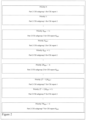
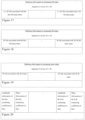
- Figure 2 illustrates a first example of Scheme 1, where always N REP CSI subgroups with priority level (t - 1) N REP to tN REP - 1 (1 ⁇ t ⁇ T) and associated with N REP CSI reports are grouped together.
- Figure 3 illustrates a second example of Scheme 1, where always T CSI subgroups with priority level ( n - 1)T to nT - 1 (1 ⁇ n ⁇ N REP ) and associated with a single CSI report are grouped together
- the parameter T indicates the number of CSI subgroups per CSI report and is related to the granularity of the CSI content that is omitted from a CSI report.
- a high value of T indicates a high granularity and a low value of T indicates a low granularity.
- each CSI report is associated only with two CSI subgroups.
- the parameter T indicating the number of CSI subgroups per CSI report may also depend on the CSI report.
- each subgroup in the proposed decomposition contains the information associated only with a single CSI report.
- the UE drops the CSI subgroups with lower priority until the payload size of the CSI reports fits with the PUSCH resource allocation.
- the UE omits all the CSI content at that priority level.
- the CSI part 2 of the N REP CSI reports may be segmented into TN REP + 1 CSI subgroups, wherein always T CSI subgroups are associated with a CSI report.
- the CSI first subgroup contains information associated with all N REP CSI reports.
- Each CSI subgroup is associated with a priority level, wherein the first subgroup has the highest priority level 0.
- the remaining TN REP CSI subgroups are associated with the lower priority levels 1 to TN REP , where the last CSI subgroup TN REP may be associated with the lowest priority level TN REP .
- the parameter T indicates the number of CSI subgroups per CSI report and is related to the granularity of the CSI content that is omitted from a CSI report.
- a high value of T indicates a high granularity and a low value of T indicates a low granularity.
- each CSI report is associated only with two CSI subgroups.
- the parameter T indicating the number of CSI subgroups per CSI report may also depend on the CSI report.
- the UE drops the CSI subgroups with lower priority until the payload size of the CSI reports fits with the PUSCH resource allocation.
- the UE omits all the CSI content at that priority level.
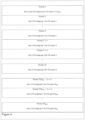
- Figure 4 illustrates a first example of Scheme 2, where always T CSI subgroups with priority level ( n - 1)T + 1 to nT (1 ⁇ n ⁇ N REP ) and associated with a single CSI report are grouped together.
- Figure 5 illustrates a second example of Scheme 2, where always N REP CSI subgroups with priority level ( t - 1) N REP + 1 to tN REP (1 ⁇ t ⁇ T) and associated with N REP CSI reports are grouped together.
- the joint CSI subgroup may contain the information of at least one of the following parameters:
- a first portion of the phase and amplitude values of the selected non-zero delay-domain combining coefficients of the N REP CSI reports is contained in the first joint CSI subgroup that has the highest priority.
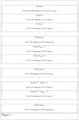
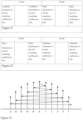
- An example of the CSI content of the first joint CSI subgroup and of the CSI subgroup that has the highest priority and is associated with a single CSI report with respect to the first approach is shown in Figure 6 .
- the first CSI subgroup that has the highest priority does not contain any phase and amplitude values of the selected non-zero delay-domain combining coefficients for the N REP CSI reports, and only the remaining CSI subgroups contain the information of the non-zero combining coefficients.
- An example of the CSI content of the first joint CSI subgroup and of the CSI subgroups associated with a single CSI report with respect to the second approach is shown in Figure 7 .
- T 2, and there are only two groups per CSI report.
- Group 1 the CSI subgroup that has the highest priority per CSI report other than the joint CSI subgroup, includes the K NZ / 2 ⁇ ⁇ highest priority amplitude values and K NZ / 2 ⁇ ⁇ highest priority phase values
- group 2 the CSI subgroup that has the lowest priority per CSI report, contains the K NZ / 2 lowest priority amplitude values and K NZ / 2 lowest priority phase values.
- each CSI subgroup with the highest priority and associated with a single CSI report may contain the following parameters, when not already listed in the first joint CSI subgroup:
- the gNB When UE is configured to decompose the CSI payload of the N REP CSI reports with respect to decomposition scheme 1, and the UE drops up to T -1 CSI subgroups which are associated with a single CSI report, the gNB should still be able to recalculate a part of the CSI matrix for the RI layers based on the remaining non-dropped CSI subgroup(s) associated with that CSI report. In this way, a certain minimum performance may be guaranteed even if a large part of the CSI content of a CSI report is dropped.
- the gNB In order to recalculate a part of the CSI matrix from a CSI report, the gNB needs to know at least some of parameters such as the selected SD and DD basis subset indicator(s), the SCIs, the bitmap(s) and the polarization reference amplitude value(s) for the RI layers, the window parameter M init from the CSI report. This information must be contained for each CSI report in the CSI subgroup that has the highest priority.
- the CSI subgroup with highest priority of a CSI report may contain at least the information of the following parameters:
- the CSI subgroup with highest priority per CSI report does not contain any information of the selected non-zero combining coefficients, and only the remaining T - 1 CSI subgroups with lower priority contain the amplitude and phase values of the selected non-zero combining coefficients of the CSI report.
- the CSI subgroup with highest priority per CSI report may contain information of a first fraction of the amplitude values of the selected non-zero delay-domain combining coefficients, and the remaining T - 1 CSI subgroups with lower priority contain the remaining fraction of amplitude values and all phase values of the CSI report.
- the CSI subgroup with the highest priority per CSI report may contain information of a first fraction of the amplitude and phase values of the selected non-zero delay-domain combining coefficients, and the remaining T - 1 CSI subgroups with lower priority contain the remaining fraction of amplitude and phase values of the CSI report.
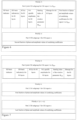
- Figure 8 shows the CSI content of two CSI subgroups associated with a single CSI report and the corresponding CSI content for each CSI subgroup when partitioning the amplitude and phase values with respect to the third method.
- the UE drops firstly the CSI subgroups that contain CSI information related to the non-zero combining coefficients.
- the remaining CSI subgroup(s) still contain the CSI content that can be used to recalculate partly the CSI matrix indicated in a CSI report. Only in the case that the UE drops all T CSI subgroups associated with a CSI report, the full CSI report is dropped.
- the UE drops firstly the CSI subgroups that contain CSI information related to the non-zero delay-domain combining coefficients of the CSI report with lowest priority. In the case that the UE drops all T CSI subgroups associated with the CSI report with lowest priority, the full CSI report is dropped.
- each CSI subgroup that contains information of a fraction of the combining coefficients may contain the amplitude values, or phase and amplitude values associated with a maximum of K NZ x , x > 1 combining coefficients of a CSI report.
- the remaining CSI subgroups with lower priority may contain the remaining amplitude values, or remaining phase and amplitude values of the CSI report.
- group 1 the CSI subgroup that has the highest priority per CSI report other than the joint CSI subgroup, contains the K NZ / 2 ⁇ ⁇ highest priority amplitude values and K NZ / 2 ⁇ ⁇ highest priority phase values
- group 2 the CSI subgroup that has the lower priority per CSI report, contains the K NZ / 2 lowest priority amplitude values and K NZ / 2 lowest priority phase values.
- the phase and amplitude values of the combining coefficients are segmented into two CSI subgroups, where the first CSI subgroup contains the phase and amplitude values associated with K NZ 2 combining coefficients and the second CSI subgroup contains the phase and amplitude associated with the remaining K NZ ⁇ K NZ 2 combining coefficients of a CSI report.
- the payload of the CSI part 2 is mainly determined by the bitmaps and the phase and amplitude information of the non-zero combining coefficients.
- the bitmaps for one or more of the RI layers of a CSI report are contained in the first CSI subgroup with the highest priority. Therefore, the payload size of this CSI subgroup can be higher than the payload size of other CSI subgroups. Due to the higher payload size, the UE may drop in some cases the CSI subgroups containing the bitmaps, and hence the full CSI report(s), when the UCI omission rate is high, i.e., when the UE has to drop a large part of the CSI part 2 content.
- all bitmaps for the RI layers of the N Rep CSI reports may be contained in the first joint CSI subgroup, or they may be contained per CSI report in the first CSI subgroup that has the highest priority.
- the payload size of this/these CSI subgroup(s) can be high, and the UE may drop in some cases the CSI subgroup(s) containing the bitmaps for the RI layers, when the UCI omission rate is high.
- the following embodiments propose different schemes that reduce the payload size of the CSI subgroup(s) containing the bitmaps, and hence the probability of dropping this/these CSI subgroup(s), by partitioning the bitmaps and the phase and amplitude information of the combining coefficients to different CSI subgroups.
- the first segmentation scheme partitions the bitmaps and the combining coefficients with respect to the number of DD basis vector indices of a CSI report.
- the CSI content of the remaining CSI subgroup(s) with higher priority should allow the gNB to partly reconstruct the CSI matrix for the RI layers indicated in the CSI report.
- the gNB requires the knowledge of the SD and DD basis indices associated with the strongest combining coefficient per layer. This information can be obtained from the bitmaps and the SCIs for the RI layers.
- the first joint CSI subgroup or the first CSI subgroup associated with a single CSI report shall contain at least the fraction of the bitmaps and the information of the combining coefficients associated with the DD basis vector index of the SCI for the RI layers.
- each CSI subgroup that has the highest priority and is associated with a single CSI report may contain at least the bitmaps associated with all SD components of one or more DD basis vectors, or one or more DD basis vector indices, for the RI layers of the CSI matrix indicated in the CSI report.
- the CSI subgroup may contain the corresponding amplitude and/or phase information of the combining coefficients for the RI layers of the CSI matrix.
- the bitmaps and the corresponding amplitude and/or phase information of the combining coefficients for the RI layers of the CSI subgroup may be segmented into D' segments, where each segment contains the bitmaps and the corresponding amplitude and/or phase information of the combining coefficients for one or more of the RI layers associated with a single DD basis vector, or a DD basis vector index.
- D' ⁇ D, and D denotes the configured number of DD basis vectors to the UE for each of the RI layers of the CSI matrix.
- the CSI subgroups with lower priority and/or the joint CSI subgroup may contain the remaining segments associated with the remaining DD basis vectors, DD basis vector indices.
- each CSI subgroup that has the highest priority and is associated with a single CSI report may contain the fraction of the bitmaps and the information of the combining coefficients associated with all SD components of the DD basis vector index which is associated with the SCI(s) for the RI layers.
- bitmaps and amplitude and/or phase information contained in a CSI subgroup is segmented in one or more segments, wherein each segment may contain a part of the bitmap, sub-bitmap, for each of the RI layers and the associated amplitude and/or phase information of the combining coefficients associated with the sub-bitmap.
- the CSI content of two CSI subgroups associated with a single CSI report is shown in Figure 9 .
- the sub-bitmap and phase and amplitude information of the combining coefficients associated with all SD components and a DD basis vector index for the RI layers are always packed together into a single segment.
- the last segment of a CSI subgroup may contain only a fraction of a sub-bitmap or a fraction of the amplitude and/or phase information associated with that sub-bitmap.
- the remaining fraction of the sub-bitmap or the remaining fraction of the amplitude and/or phase information associated with that sub-bitmap that is not contained in the CSI subgroup may be contained in a CSI subgroup of the same CSI report with lower priority.
- bitmaps and amplitude and/or phase information contained in a CSI subgroup are segmented in one or more segments, wherein each segment may contain a part of the bitmap, sub-bitmap, for each of the RI layers and the associated amplitude and/or phase information of the combining coefficients associated with the sub-bitmap.
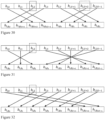
- the k-th segment is further segmented into RI sub-segments, wherein each sub-segment contains the sub-bitmap associated with all SD components and a DD basis vector index of a single layer and the combining coefficients associated with the sub-bitmap, see Figure 10 .
- each sub-segment k r associated with r-th layer may be further segmented into k r, 2 U sub-segments, as shown in Figure 11 .
- Each sub-segment k r,u contains a single-bit from the sub-bitmap and the corresponding amplitude and phase information of the combining coefficient. Note that the bit k r,u is immediately followed by the sub-segment k r,u +1 , when k r,u is '0'. This is due to the absence of the amplitude and phase information associated with bit k r,u .
- the bitmaps and the information of the combining coefficients for the RI layers of a CSI report are segmented into D segments, where each segment contains the bitmap, sub-bitmap, associated with all SD components of a single DD basis index for all RI layers.
- each segment may contain the associated amplitude and/or phase information of the combining coefficients for the RI layers associated with the sub-bitmap.
- the CSI subgroup that has the highest priority and is associated with a single CSI report may contain one or more of the D segments.
- Each CSI subgroup with the highest priority may contain in addition a set of parameters required from the CSI report such that the gNB may be able to recalculate the CSI matrix based on the fraction of the bitmaps for the RI layers and the amplitude and/or phase information of the combining coefficients contained in the CSI subgroup.
- each CSI subgroup with the highest priority may contain in addition at least the following parameters:
- the joint CSI subgroup may contain at least one of the following parameters:
- the remaining CSI subgroups contain at least the CSI content associated with the bitmaps for the RI layers and the phase and amplitude information of the combining coefficients.
- Each CSI subgroup with the highest priority and associated with a single CSI report may contain at least a fraction of the bitmaps for the RI layers and the phase and amplitude information of a fraction of the K NZ combining coefficients.
- group 1 is the CSI subgroup per CSI report that has the highest priority other than the joint CSI subgroup.
- the index i 1,5 denotes the window parameter ( M init ) associated with the DD basis subset indication.
- the indicator i 1,7,l is associated with the bitmap of v layers and the ⁇ 2 LD ⁇ K NZ / 2 highest priority elements of i 1,7,l in group 1 indicates a fraction of the bitmap of v layers in group 1.
- the indicator i 2,4,l is associated with the amplitude information of the K NZ non-zero coefficients and the indicator i 2,4,l in group 1 indicates the amplitude value information of a fraction of the K NZ highest priority non-zero coefficients.
- the indicator i 2,5,l is associated with the phase information of the K NZ non-zero coefficients and the indicator i 2,5,l in group 1 indicates the phase information of a fraction of the K NZ highest priority non-zero coefficients.
- group 2 is the CSI subgroup per CSI report that has the lowest priority.
- the indicator i 1,7,l is associated with the bitmap of v layers and the indicator i 1,7,l in group 2 indicates the remaining fraction of the bitmap of v layers i.e., the K NZ / 2 lowest priority elements of i 1,7,l that is not contained in group1.
- the indicator i 2,4,l is associated with the amplitude information of the K NZ non-zero coefficients and the indicator i 2,4,l in group 2 indicates the amplitude information of K NZ / 2 lowest priority non-zero coefficients.
- the indicator i 2,5,l is associated with the phase information of the K NZ non-zero coefficients and the indicator i 2,5,l in group 2 indicates the phase information of K NZ / 2 lowest priority non-zero coefficients.
- each CSI subgroup with the highest priority associated with a single CSI report may also contain the following parameters, when not already listed in the joint CSI subgroup:
- the first CSI subgroup should contain the fraction of the bitmap and the information of the combining coefficients associated with the DD basis vector index 0.
- the SCI when the SCI is given by a log 2 2 U bit indicator, the SCI may not be indicated in the sub-bitmap associated with DD basis vector index 0, and hence the sub-bitmap per layer may have a size of 2U - 1 ⁇ 1 instead of 2U ⁇ 1.
- the CSI subgroup with the highest priority associated with a CSI report contains the sub-bitmap which is associated with DD basis vector index 0 and the corresponding amplitude and/or phase information of the combining coefficients associated with that sub-bitmap for the RI layers.
- the first segment of a CSI subgroup with highest priority may be associated with DD basis vector index 0.
- the complete bitmap for all selected SD and DD basis vectors per layer may be required by the gNB to identify the SD and DD basis vector indices associated with the strongest combining coefficient. Therefore, the above segmentation of bitmaps and combining coefficients with respect to DD basis vector indices may not be possible.
- the CSI subgroup of the CSI report with highest priority may contain at least the bitmaps for the RI layers and all or a fraction of the phase and/or amplitude information of the combining coefficients of the CSI matrix of the CSI report.
- the remaining CSI subgroups of the CSI report with lower priority may contain the remaining fraction of the phase and/or amplitude information of the combining coefficients of the CSI matrix.
- the joint CSI subgroup may contain the bitmaps for the RI layers of that CSI report.
- the second segmentation scheme partitions for a CSI report the bitmaps and the combining coefficients with respect to the RI layers of the CSI matrix indicated in the CSI report.
- a CSI subgroup that is associated with highest priority of a CSI report may contain at least the bitmap(s) for indicating the non-zero combining coefficients for a first subset of the RI layers, and a first fraction of the amplitude and phase values of the selected non-zero delay-domain combining coefficients associated with the first subset of the RI layers of the CSI matrix indicated in the CSI report.
- the remaining CSI subgroups with lower priority associated with the same CSI report may contain at least the bitmap(s) for the remaining, second subset, of the RI layers and the remaining fraction of amplitude and phase values associated with the second subset of the RI layers of that CSI report.
- the CSI subgroup with highest priority per CSI report may contain in addition the following parameters:
- the CSI subgroup with highest priority per CSI report of a CSI report may also contain in addition the following parameters, when not already listed in the joint CSI subgroup:
- the CSI part 2 decomposition contains in the first CSI portion with priority level 0 the so-called wideband amplitudes of the N REP CSI reports. Based on these wideband amplitudes in the first CSI portion, the gNB can reconstruct per CSI report a wideband CSI matrix for the configured subbands even in the case that the UE has dropped all except the first CSI portion with priority level 0.
- a similar wideband CSI matrix can be defined for the two codebook-based CSI reporting scheme when applying the second CSI decomposition scheme described above.
- the gNB may derive a wideband CSI matrix for a CSI report when it has knowledge on the amplitude information of the combining coefficients and the fraction of the bitmap associated with the "strongest" DD basis vector index for each of the RI layers.
- the "strongest" DD basis vector index for per layer corresponds to the DD basis vector index that is associated with the SCI. Therefore, based on the SCI, the bitmap associated with the DD basis vector index which is associated with the SCI and amplitude information of the combining coefficients, the gNB may reconstruct a wideband CSI matrix as proposed in the following embodiments.
- the joint CSI subgroup may contain the SCI(s) for the RI layers, the fraction of the bitmap and the amplitude and/or phase information of the combining coefficients associated with all SD components of the DD basis vector index which is associated with the SCI(s) for the RI layer(s) of one or more CSI reports, Based on the information contained in the joint CSI subgroup, the gNB is able to recalculate a wideband CSI matrix for each of the one or more CSI reports.
- the DD basis vector index 0 is associated with the SCI.
- the joint CSI subgroup may contain for one or more CSI reports, the SCI(s) for the RI layers, the fraction of the bitmap and the amplitude and/or phase information of the combining coefficients associated with all SD components and DD basis vector index 0 for the RI layers per CSI report.
- the complete bitmap for all selected SD and DD basis vector indices per layer and at least the amplitude and/or phase information of the combining coefficients associated with the DD basis vector index which is associated with the SCI(s) for the RI layer(s) is required to calculate the wideband matrix of that CSI report.
- the joint CSI subgroup may contain the complete bitmap for all selected SD and DD basis vector indices per layer and at least the amplitude and/or phase information of the combining coefficients associated with the DD basis vector index which is associated with the SCI(s) for the RI layer(s) of that CSI report.
- the size of the joint CSI subgroup depends on the number of non-zero combining coefficients associated with the DD basis vector index of the SCI(s) of the one or more CSI reports.
- the gNB may therefore even after decoding CSI part 1 of the CSI payload not know the payload size of the joint CSI subgroup.
- a method that fixes the payload size of the joint CSI subgroup is proposed.
- the joint CSI subgroup contains at least the SCI(s) for the RI layers, the fraction of the bitmap and the amplitude and/or phase information of the combining coefficients associated with all SD components and the DD basis vector index of the SCI for the RI layers, for the N CSI reports that have the highest priority.
- the value for the parameter N may be either higher-layer configured by the gNB, or it is a priori known by the UE, e.g., fixed by specification, or it is determined by the UE.
- the UE may determine the value of the parameter N , i.e., the number of CSI reports that have the highest priority, such that the payload size of the joint CSI subgroup is fixed.
- the CSI subgroup that has the highest priority and is associated with a single CSI report may contain the bitmaps of all RI layers and only a fraction of the phase and/or amplitude information of the combining coefficients.
- the following embodiment presents a decomposition scheme for the phase and/or amplitude information of the combining coefficients with respect to a number of CSI subgroups.
- the decomposition of the phase and/or amplitude information of the combining coefficients may depend on the ordering of the bit-sequences of the associated bitmap for the RI layers of a CSI report.
- the bitmap is segmented into RI segments, each of 2UD bits, in an increasing order with respect to the layer numbers.
- Each segment is associated with all SD and DD basis indices of a layer, see Figure 12 .
- the UE drops first the CSI content associated with one or more of the higher layer(s), and then the CSI content associated with one or more of the lower layer(s).
- the UE may first drop the CSI content associated with layer 3 and 4, CSI subgroup with lower priority, and then drop the CSI content associated with layer 1 and 2, CSI subgroup with high priority, of a CSI report.
- the bit-sequence in each segment may be ordered with respect to one of the following two schemes:
- a first ordering scheme (scheme 1)
- the bits in each segment of size 2UD ⁇ 1 are ordered in a way that the first 2U bits are associated with all 2U SD components of the first DD basis index, followed by 2U bits that are associated with all 2U SD components of the second DD basis index, and so on, see Figure 13 .
- a second ordering scheme (scheme 2)
- the bits in each segment of size 2UD ⁇ 1 are ordered in a way that the first D bits are associated with all D DD basis indices of the first SD basis index, followed by D bits that are associated with all D DD basis indices of the second SD basis index, and so on, see Figure 14 or Figure 15 .
- the fraction of phase and/or amplitude information of the combining coefficients contained in a CSI subgroup is always associated with only a subset of the RI layers of a CSI report.
- Such an ordering/packing may result in a significant performance loss compared to dropping only a part of the phase and/or amplitude information of the combining coefficients of all RI layers.
- the following embodiment presents an alternative ordering/segmentation of the bitmaps and combining coefficients that avoids a dropping of the combining coefficients of one or more layers of a CSI report.
- the bitmap of size 2UD ⁇ RI is segmented into D segments, and each segment has a size of 2U ⁇ RI and is associated with a single DD basis vector index, see Figure 16 .
- the bit-sequence in each segment may be ordered with respect to one of the following two schemes:
- a first ordering scheme (scheme 1), the bits in each segment of size 2U ⁇ RI are ordered in a way that the first RI bits are associated with the first SD basis vector index of all RI layers, followed by the next RI bits associated with the second SD basis index of all RI layers, and so on, see Figure 17 and Figure 18 .
- a second ordering scheme (scheme 2), the bits in each segment of size 2 U ⁇ RI are ordered in a way that the first 2U bits are associated with all 2U SD components of a DD basis index associated with the first layer, followed by the 2U bits associated with all 2U SD components of a DD basis index associated with the second layer, and so on, see Figure 19 .
- a CSI subgroup associated with a CSI report may contain the amplitude and phase information of a fraction of the combining coefficients, where different ordering schemes for the amplitude and phase values may be applied.
- the amplitude and phase information of the combining coefficients in a CSI subgroup may be ordered by one of the following schemes.
- scheme 1 for each combining coefficient in CSI subgroup, the amplitude information, a bits, is followed by the phase information, b bits, see Figure 20 , where X denotes the number of combining coefficients contained in the CSI subgroup.
- scheme 2 the amplitude information of X combining coefficients, Xa bits, is followed by the phase information of X combining coefficients, Xb bits, see Figure 21 .
- the phase information of X combining coefficients, Xb bits is followed by the amplitude information of X combining coefficients, Xa bits, see Figure 22 .
- the K NZ 2 ⁇ ⁇ ⁇ a highest priority bits associated with the amplitude values are followed by the K NZ / 2 ⁇ ⁇ ⁇ b highest priority bits associated with the phase values.
- the K NZ / 2 ⁇ a lowest priority bits associated with the amplitude values are followed by the K NZ / 2 ⁇ b lowest priority bits associated with the phase values.
- the bit-width of the first CSI subgroup associated with a single CSI report and highest priority may be fixed and given by A + B, where A is the combined bit-width of all components that are contained in the first subgroup apart from the number of non-zero combining coefficients, and B is the bit-width associated with the amplitude ( a ) and phase information ( b ) of a fraction of the combining coefficients K NZ x .
- x T.
- the CSI subgroup that has the highest priority and is associated with a single CSI report may contain the bitmap of all RI layers and only a fraction of the CSI content associated with the phase and amplitude information of the combining coefficients.
- different decomposition schemes for the CSI content associated with the combining coefficients of a CSI report with respect to the CSI subgroups are proposed.
- the UE is configured to segment the bitmap of the l- th layer into D bit-sequences with respect to the selected DD basis indices, where each segment has a size of 2U ⁇ 1.
- each DD basis index is associated with a delay vector from the delay codebook.
- the DD basis indices e l,d of the bitmap of the l -th layer and the associated combining coefficients are sorted in ascending order, i.e., e l ,0 ⁇ ⁇ ⁇ e l,d ⁇ ⁇ ⁇ e l,D -1 .
- the selected DD basis indices are given by [0,21,2,25]
- the DD basis index 0 is associated with strongest combining coefficient, and therefore, it carries a significant amount of the power of the combining coefficients of the precoder.
- the power of the selected DD basis indices by the UE is therefore decaying with respect to DD basis index 0. This means a significant amount of the power is associated with DD basis index 0, followed by the adjacent DD basis indices that carry less power.
- the UE shall drop at first the combining coefficients that carry less power which implies that the selected DD basis indices should be ordered with respect to their power in a decreasing order.
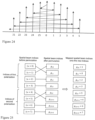
- Figure 23 and Figure 24 show two ordering schemes for the N 3 DD basis indices (0, ..., N 3 - 1), where N 3 denotes the number of DD basis indices of the delay codebook.
- the N 3 DD basis indices are ordered as 0,1, N 3 - 1, 2, N 3 - 2, 3, N 3 - 3, 4, N 3 - 4,5, ...
- the N 3 DD basis indices are ordered as 0, N 3 - 1,1, N 3 - 2,2, N 3 - 3,3, N 3 - 4,4, N 3 - 5,5, ...
- the UE is configured to order the selected DD basis indices per layer according to the first or second scheme as shown in Figure 23 and Figure 24 , respectively.
- the bit-sequences of the bitmap of a layer can be ordered with respect to the first or second scheme.
- the corresponding ordered bitmaps for the RI layers can be grouped together to a bitmap of size 2UD ⁇ RI and segmented into D segments, where each segment has a size of 2U ⁇ RI, see Figure 16 .
- the bitmap can hence be written as B e 1,0 1 , ... , B e l , 0 l , ... , B e RI , 0 RI ... B e 1 , d 1 , ... , B e l , d l , ... , B e RI , d RI ... B e 1 , D ⁇ 1 1 , ... , B e l , D ⁇ 1 l , ... , B e RI , D ⁇ 1 RI
- Each segment A d contains 2U ⁇ RI bits which are associated with the 2 U beams and RI layers.
- b gl,u be the bit associated with the g l,u -th beam index and l -th layer.
- g l,u ( g l,u ⁇ ⁇ 0,..., U - 1 ⁇ , u ⁇ ⁇ 0,..., U - 1 ⁇ ) denotes the g l,u -th beam index of a spatial beam for one polarization of the l -th layer.
- the parameter g l,U + u (g l,U+u ⁇ ⁇ U, ...,2U - 1 ⁇ , u ⁇ ⁇ 0, ..., U - 1 ⁇ ) is used to denote the g l,u -th beam index of the same spatial beam for the other polarization of the l -th layer.
- the bits in segment A d associated with the beam indices of the two polarizations of a spatial beam are grouped together and sorted with respect to an increasing layer index. This means, two bits associated with the two polarizations of the u -th spatial beam, spatial beam indices g l,u and g l,U+u , of the first layer are grouped together and followed by two bits associated with the two polarizations of the same spatial beam, spatial beam indices g l,u and g l,U+u , of the second layer, and so on.
- the segment A d is given by b 1 , g 0 , b 1 , g U , b 2 , g 0 , b 2 , g U , b 3 , g 0 , b 3 , g U , b 4 , g 0 , b 4 , g U , b 1 , g 1 , b 1 , g U + 1 , b 2 , g 1 , b 2 , g U + 1 , b 3 , g 1 , b 3 , g U + 1 ,.. ..
- RI bits associated with the first polarization of a spatial beam index ( g l,u ) are grouped together and followed by RI bits associated with the second polarization of the same spatial beam index ( g l,U+u ).
- the segment A d is given by b 1 , g 0 , b 2 , g 0 , b 3 , g 0 , b 4 , g 0 , b 1 , g U , b 2 , g U , b 3 , g U , b 4 , g U , b 1 , g 1 , b 2 , g 1 , b 3 , g 1 , b 4 , g 1 , b 1 , g U + 1 , b 2 , g U + 1 .. ..
- RI bits associated with a spatial beam index ( g l,u ) are grouped together and followed by RI bits associated with another spatial beam index ( g l,u +1 ).
- the segment A d is given by b 1 , g 0 , b 2 , g 0 , b 3 , g 0 , b 4 , g 0 , ... , b 1 , g U , b 2 , g U , b 3 , g U , b 4 , g U , b 1 , g U + 1 , b 2 , g U + 1 , b 3 , g U + 1 , b 4 , g U + 1 , ... ... , b 1 , g 2 U ⁇ 1 , b 2 , g 2 U ⁇ 1 , b 3 , g 2 U ⁇ 1 , b 4 , g 2 U ⁇ 1
- the bits in segment A d associated with the same layer are grouped together and sorted with respect to an increasing spatial beam index. This means, 2U bits associated with a first layer are grouped together and followed by 2U bits associated with a second layer, and so on.
- the segment A d is given by b 1 , g 0 , ... , b 1 , g U ⁇ 1 , b 1 , g U + 1 , ... , b 1 , g 2 U ⁇ 1 , b 2 , g 0 , ... , b 2 , g U ⁇ 1 , b 2 , g U + 1 , ... , b 2 , g 2 U ⁇ 1 , b 3 , g 0 , ... , b 3 , g U ⁇ 1 , b 3 , g U + 1 , ... , b 3 , g 2 U ⁇ 1 , b 4 , g 0 , ... , b 4 , g U ⁇ 1 , b 4 , g 0 , ... , b 4 , g U ⁇ 1 , b 4 , g U + 1 , ... ,
- the UE is configured to order the bit-sequences of the bitmap and the combining coefficients to one of the first and second ordering schemes combined with one of the third, fourth, fifth and sixth ordering schemes.
- the ordering of the amplitude and phase information of the combining coefficients shall be consistent with the ordering of the bits in the bitmaps.
- Each spatial beam is associated with up to D non-zero combining coefficients.
- the sum power of the combining coefficients of the spatial beam associated with the strongest coefficient may be higher compared to the sum power of the combining coefficients associated with other spatial beams. Therefore, for UCI omission, the bitmap associated with the strongest spatial beam, i.e., the beam associated with the SCI, should have a higher priority than the bitmap associated with the other spatial beams, and hence, it should be ordered first, followed by the bitmaps of the other spatial beams.
- different permutation schemes for the spatial beam indices, indices g l,u and g l,U+u are presented.
- the bits from the bitmap associated with the spatial beam, which is associated with the strongest coefficient, for the l -th layer are mapped to index g l ,0 .
- either a polarization common mapping or polarization specific mapping may be considered.
- the mapping with respect to the two polarizations of a spatial beam is identical, whereas for the polarization-specific mapping, the mapping is done irrespective of the polarization of a spatial beam resulting in different mappings for the two polarizations.
- examples of polarization-common and polarization-specific mapping schemes are explained more in detail.
- mapping of the spatial beam indices with respect to the two polarizations is identical, where the spatial beam indices of the polarization associated with the strongest coefficient are mapped to the indices g l, 0 ... g l,U -1 , and the spatial indices of the other polarization are mapped to the indices g l,U ... g l, 2 U -1 .
- mapping of the spatial beam indices with respect to the two polarizations is identical, where the spatial beam indices of the polarization associated with the strongest coefficient are mapped to the indices g l, 0 ... g l,U- 1 , and the spatial indices of the other polarization are mapped to the indices g l,u ... g l, 2 U -1 .
- the spatial beam index (U + u SCI ) is associated with the strongest coefficient and mapped to the first index g l ,0
- mapping of the spatial beam indices with respect to the two polarizations is identical, where the spatial beam indices of a polarization associated with the strongest coefficient are mapped to the indices g l,u ... g l, 2 U -1 , and the spatial indices of the other polarization are mapped to the indices g l, 0 ... g l,U -1 .
- mapping of the spatial beam indices with respect to the two polarizations is identical, where the spatial beam indices of a polarization associated with the strongest coefficient are mapped to the indices g l,u ... g l, 2 U -1 . and the spatial indices of the other polarization are mapped to the indices g l, 0 ... g l,U -1 .
- the bit associated with the spatial beam associated with the strongest coefficient is shown in a red box with a dashed line.
- the mapping of the spatial beam indices with respect to the two polarizations is not identical. Hence, this mapping can be considered as a polarization-specific mapping.
- the mapping of the spatial beam indices with respect to the two polarizations is not identical.
- the CSI subgroup of a CSI report of highest priority or the joint CSI subgroup contains the bitmap for all RI layers of the CSI report.
- Each segment contains the bitmaps and the combining coefficients associated with 2 U spatial beam indices and RI layers.
- each segment may be further segmented into R' sub-segments, where each sub-segment contains a sub-bitmap of R bits and the combining coefficients associated with the R bits.
- the bits in each sub-bitmap and the combining coefficients of each segment are ordered according to the third, fourth, fifth or sixth ordering scheme.
- the ordering of the bitmaps can be different to the ordering of the combining coefficients.
- the ordering of the bitmaps and combining coefficients shall be a priori known to the gNB.
- the bit-width of the first CSI subgroup associated with a single CSI report and highest priority may be fixed and given by A + B, where A is the combined bit-width of all components that are contained in the first subgroup apart from the number of non-zero combining coefficients, and B is the bit-width associated with the amplitude ( a ) and phase information ( b ) of a fraction of the combining coefficients K NZ x .
- the strongest coefficient, out of the K NZ non-zero combining coefficients, may be indicated by a log 2 K NZ -bit indicator (SCI).
- SCI log 2 K NZ -bit indicator
- the strongest coefficient is indicated using a log 2 2 U -bit indicator (SCI) per layer instead of a log 2 K NZ -bit indicator, due to the cyclic shift operation performed by the UE as described above.
- SCI log 2 K NZ -bit indicator
- 2U codepoints out of K NZ codepoints are used to indicate the strongest coefficient and the remaining K NZ - 2U codepoints are reserved.
- UE 30 comprises a processor 31 or processing circuit or a processing module or a processor or means; a receiver circuit or receiver module 34; a transmitter circuit or transmitter module 35; a memory module 32; a transceiver circuit or transceiver module 33 which may include the transmitter circuit 35 and the receiver circuit 34.
- the UE 30 further comprises an antenna system 36 which includes antenna circuitry for transmitting and receiving signals to/from at least the UE 30.
- the invention also relates to a computer program product 37, which in the figure is stored in the memory module 32, which computer program product 37 comprises computer program code 38, which, when executed by the processor 31, enables the processor 31 to perform any one of the subject matter of the inventive method.
Landscapes
- Engineering & Computer Science (AREA)
- Signal Processing (AREA)
- Computer Networks & Wireless Communication (AREA)
- Physics & Mathematics (AREA)
- Theoretical Computer Science (AREA)
- Multimedia (AREA)
- Computer Vision & Pattern Recognition (AREA)
- Mathematical Physics (AREA)
- General Physics & Mathematics (AREA)
- Power Engineering (AREA)
- Artificial Intelligence (AREA)
- Software Systems (AREA)
- Medical Informatics (AREA)
- General Health & Medical Sciences (AREA)
- Evolutionary Computation (AREA)
- Databases & Information Systems (AREA)
- Computing Systems (AREA)
- Health & Medical Sciences (AREA)
- Quality & Reliability (AREA)
- Mobile Radio Communication Systems (AREA)
- Radio Transmission System (AREA)
Applications Claiming Priority (4)
| Application Number | Priority Date | Filing Date | Title |
|---|---|---|---|
| EP19192000.8A EP3780455A1 (de) | 2019-08-15 | 2019-08-15 | Dreikomponenten-codebuchbasierte csi-berichterstattung |
| EP19199327.8A EP3780456A1 (de) | 2019-08-15 | 2019-09-24 | Dreikomponenten-codebuchbasierte csi-berichterstattung |
| EP20751174.2A EP4018585B1 (de) | 2019-08-15 | 2020-08-11 | Dreikomponenten-codebuchbasierte csi-berichterstattung |
| PCT/EP2020/072472 WO2021028425A1 (en) | 2019-08-15 | 2020-08-11 | Three-component codebook based csi reporting |
Related Parent Applications (1)
| Application Number | Title | Priority Date | Filing Date |
|---|---|---|---|
| EP20751174.2A Division EP4018585B1 (de) | 2019-08-15 | 2020-08-11 | Dreikomponenten-codebuchbasierte csi-berichterstattung |
Publications (2)
| Publication Number | Publication Date |
|---|---|
| EP4443754A2 true EP4443754A2 (de) | 2024-10-09 |
| EP4443754A3 EP4443754A3 (de) | 2024-12-11 |
Family
ID=67659040
Family Applications (6)
| Application Number | Title | Priority Date | Filing Date |
|---|---|---|---|
| EP19192000.8A Withdrawn EP3780455A1 (de) | 2019-08-15 | 2019-08-15 | Dreikomponenten-codebuchbasierte csi-berichterstattung |
| EP19199327.8A Withdrawn EP3780456A1 (de) | 2019-08-15 | 2019-09-24 | Dreikomponenten-codebuchbasierte csi-berichterstattung |
| EP20747437.0A Active EP4014403B1 (de) | 2019-08-15 | 2020-08-05 | Dreikomponenten-codebuchbasierte csi-berichterstattung |
| EP23196548.4A Pending EP4274109A3 (de) | 2019-08-15 | 2020-08-05 | Dreikomponenten-codebuchbasierte csi-meldung |
| EP20751174.2A Active EP4018585B1 (de) | 2019-08-15 | 2020-08-11 | Dreikomponenten-codebuchbasierte csi-berichterstattung |
| EP23209152.0A Pending EP4443754A3 (de) | 2019-08-15 | 2020-08-11 | Dreikomponenten-codebuchbasierte csi-meldung |
Family Applications Before (5)
| Application Number | Title | Priority Date | Filing Date |
|---|---|---|---|
| EP19192000.8A Withdrawn EP3780455A1 (de) | 2019-08-15 | 2019-08-15 | Dreikomponenten-codebuchbasierte csi-berichterstattung |
| EP19199327.8A Withdrawn EP3780456A1 (de) | 2019-08-15 | 2019-09-24 | Dreikomponenten-codebuchbasierte csi-berichterstattung |
| EP20747437.0A Active EP4014403B1 (de) | 2019-08-15 | 2020-08-05 | Dreikomponenten-codebuchbasierte csi-berichterstattung |
| EP23196548.4A Pending EP4274109A3 (de) | 2019-08-15 | 2020-08-05 | Dreikomponenten-codebuchbasierte csi-meldung |
| EP20751174.2A Active EP4018585B1 (de) | 2019-08-15 | 2020-08-11 | Dreikomponenten-codebuchbasierte csi-berichterstattung |
Country Status (7)
| Country | Link |
|---|---|
| US (6) | US11936456B2 (de) |
| EP (6) | EP3780455A1 (de) |
| JP (2) | JP7702386B2 (de) |
| KR (2) | KR102671138B1 (de) |
| CN (4) | CN114223145B (de) |
| ES (2) | ES2960519T3 (de) |
| WO (2) | WO2021028284A1 (de) |
Families Citing this family (47)
| Publication number | Priority date | Publication date | Assignee | Title |
|---|---|---|---|---|
| EP3780455A1 (de) * | 2019-08-15 | 2021-02-17 | Fraunhofer Gesellschaft zur Förderung der angewandten Forschung e.V. | Dreikomponenten-codebuchbasierte csi-berichterstattung |
| US11910430B2 (en) * | 2019-10-07 | 2024-02-20 | Qualcomm Incorporated | Collision resolution for channel state information reporting on a physical uplink control channel |
| US12334999B2 (en) * | 2020-03-06 | 2025-06-17 | Lenovo (Singapore) Pte. Ltd. | Type-II port-selection codebook generation |
| US11750258B2 (en) * | 2020-03-12 | 2023-09-05 | Samsung Electronics Co., Ltd. | Method and apparatus for CSI reporting |
| US11728877B2 (en) * | 2020-10-15 | 2023-08-15 | Qualcomm Incorporated | Polarization and antenna panel configuration and communication diversity configuration |
| US12395217B2 (en) * | 2021-01-15 | 2025-08-19 | Mediatek Inc. | Method for FR1 FDD channel state information |
| US11831376B2 (en) * | 2021-04-05 | 2023-11-28 | Qualcomm Incorporated | Joint channel state information and decoding feedback |
| EP4320743A1 (de) * | 2021-04-07 | 2024-02-14 | Ntt Docomo, Inc. | Verfahren zur csi-meldung für 5g nr ril. codebuch zur auswahl von 17-typ-ii-ports |
| US12267137B2 (en) | 2021-05-11 | 2025-04-01 | Nokia Technologies Oy | Reporting channel state information (CSI) precoding matrix indicator (PMI) |
| US12355528B2 (en) * | 2021-05-17 | 2025-07-08 | Samsung Electronics Co., Ltd. | Method and apparatus for UCI multiplexing |
| WO2022257042A1 (zh) * | 2021-06-09 | 2022-12-15 | Oppo广东移动通信有限公司 | 码本上报的方法、终端设备和网络设备 |
| CN115483950A (zh) * | 2021-06-16 | 2022-12-16 | 华为技术有限公司 | 一种信道状态信息的反馈方法及装置 |
| CN115603872B (zh) * | 2021-06-28 | 2025-11-21 | 维沃移动通信有限公司 | Csi-rs配置方法、csi反馈方法、装置和设备 |
| WO2023277482A1 (ko) * | 2021-07-01 | 2023-01-05 | 엘지전자 주식회사 | 무선 통신 시스템에서 코드북 기반 채널 상태 정보 송수신 방법 및 장치 |
| US11984948B2 (en) * | 2021-08-05 | 2024-05-14 | Apple Inc. | Methods and apparatus for port selection codebook enhancement |
| CN115915249A (zh) * | 2021-08-25 | 2023-04-04 | 北京紫光展锐通信技术有限公司 | 一种csi报告获取方法及通信装置 |
| CN113938922B (zh) * | 2021-09-17 | 2023-06-16 | 中国联合网络通信集团有限公司 | 一种优化小区的确定方法及装置 |
| US20230113496A1 (en) * | 2021-10-11 | 2023-04-13 | Nokia Technologies Oy | Co-polarized transmission and port selection |
| WO2023070497A1 (en) * | 2021-10-29 | 2023-05-04 | Qualcomm Incorporated | Neural network structure for feedback of orthogonal precoding information |
| CN116095742B (zh) * | 2021-11-05 | 2026-04-10 | 维沃移动通信有限公司 | 信道状态信息的传输方法、装置、终端及网络侧设备 |
| US20250373295A1 (en) * | 2021-11-06 | 2025-12-04 | Qualcomm Incorporated | Non-zero coefficient reporting and codebook parameter configuration |
| WO2023108392A1 (en) * | 2021-12-14 | 2023-06-22 | Qualcomm Incorporated | Beam change reporting via prediction based beam management |
| WO2023140581A1 (ko) * | 2022-01-19 | 2023-07-27 | 엘지전자 주식회사 | 무선 통신 시스템에서 채널 상태 정보를 송수신하는 방법 및 장치 |
| US20230246688A1 (en) * | 2022-02-02 | 2023-08-03 | Samsung Electronics Co., Ltd. | Method and apparatus for csi codebook |
| WO2023184147A1 (en) * | 2022-03-29 | 2023-10-05 | Qualcomm Incorporated | Selection and quantization of time domain coefficients through an extended etype-ii codebook |
| EP4515765A4 (de) * | 2022-04-28 | 2025-06-18 | NEC Corporation | Verfahren, vorrichtungen und computerlesbares medium zur kommunikation |
| EP4515928A4 (de) * | 2022-04-29 | 2026-02-11 | Qualcomm Inc | Zerlegung empfohlener vorkodierereigenschaften als rückmeldung von kanalzustandsinformationen in betrieb mit mehreren sendeempfangspunkten |
| US20250300709A1 (en) * | 2022-07-14 | 2025-09-25 | Qualcomm Incorporated | Uplink control information packing and prioritization for channel state information |
| CN119631317A (zh) * | 2022-07-26 | 2025-03-14 | Lg电子株式会社 | 在无线通信系统中发送针对多个时间实例的信道状态信息的方法及其设备 |
| CN117769811A (zh) * | 2022-07-26 | 2024-03-26 | 北京小米移动软件有限公司 | 系数指示方法、装置及存储介质 |
| WO2024026649A1 (en) * | 2022-08-01 | 2024-02-08 | Nec Corporation | Methods, devices, and medium for communication |
| CN117882328A (zh) * | 2022-08-10 | 2024-04-12 | 中兴通讯股份有限公司 | 信道状态信息报告增强 |
| US20240154760A1 (en) * | 2022-10-14 | 2024-05-09 | Samsung Electronics Co., Ltd. | Method and apparatus for multiplexing csi for multi-trp coherent joint transmission |
| JP2025536602A (ja) * | 2022-11-03 | 2025-11-07 | 日本電気株式会社 | 端末装置、ネットワーク装置及び方法 |
| WO2024098272A1 (en) * | 2022-11-09 | 2024-05-16 | Qualcomm Incorporated | Coherent joint transmission channel state information feedback reporting for multiple transmit receive points |
| JP2026504917A (ja) * | 2023-01-20 | 2026-02-10 | 日本電気株式会社 | 端末装置、ネットワーク装置及び方法 |
| CN118749182A (zh) * | 2023-01-20 | 2024-10-08 | 中兴通讯股份有限公司 | 用于信道状态信息报告增强的系统和方法 |
| JP2026508827A (ja) * | 2023-01-20 | 2026-03-13 | 日本電気株式会社 | 通信の方法及びデバイス |
| US12375135B2 (en) * | 2023-01-31 | 2025-07-29 | Qualcomm Incorporated | Codebook selection |
| WO2024159388A1 (en) * | 2023-01-31 | 2024-08-08 | Qualcomm Incorporated | Two-stage non-zero coefficient bitmap for transmission-reception-point-specific coherent joint transmission channel state information reporting |
| KR20250149685A (ko) * | 2023-02-16 | 2025-10-16 | 엘지전자 주식회사 | 무선 통신 시스템에서 신호를 송수신하는 방법 및 장치 |
| EP4662800A1 (de) * | 2023-05-15 | 2025-12-17 | Samsung Electronics Co., Ltd. | Verfahren und vorrichtung zur energieeinsparung in einem drahtlosen kommunikationssystem |
| CN119544160B (zh) * | 2023-08-28 | 2026-04-24 | 中国移动通信有限公司研究院 | 信息传输方法、装置、终端、网络设备及存储介质 |
| US20250132792A1 (en) * | 2023-10-24 | 2025-04-24 | Samsung Electronics Co., Ltd. | Csi reporting |
| CN120110512A (zh) * | 2023-12-05 | 2025-06-06 | 华为技术有限公司 | 信道状态信息反馈方法及通信装置 |
| WO2025156215A1 (en) * | 2024-01-25 | 2025-07-31 | Zte Corporation | High-performance codebook design |
| WO2025231631A1 (en) * | 2024-05-08 | 2025-11-13 | Qualcomm Incorporated | Spatial domain bases report |
Family Cites Families (28)
| Publication number | Priority date | Publication date | Assignee | Title |
|---|---|---|---|---|
| US8687727B2 (en) * | 2010-11-05 | 2014-04-01 | Intel Corporation | Coordinated multi-point transmission using interference feedback |
| KR101632223B1 (ko) * | 2012-11-09 | 2016-06-21 | 엘지전자 주식회사 | 무선 통신 시스템에서 채널 상태 정보를 피드백하는 방법 및 이를 위한 장치 |
| US20160072562A1 (en) * | 2014-09-10 | 2016-03-10 | Samsung Electronics Co., Ltd. | Channel state information reporting with basis expansion for advanced wireless communications systems |
| US9967012B2 (en) * | 2015-05-06 | 2018-05-08 | Samsung Electronics Co., Ltd. | Method and apparatus for channel state information (CSI) reporting |
| US10637546B2 (en) * | 2016-02-23 | 2020-04-28 | Lg Electronics Inc. | Method for transceiving channel state information and apparatus therefor in multiple-antenna wireless communication system |
| US10630365B2 (en) * | 2016-03-07 | 2020-04-21 | Lg Electronics Inc. | Method for transmitting and receiving channel state information between base station and terminal in wireless communication system and apparatus for supporting same |
| CN109565323B (zh) * | 2016-09-26 | 2022-08-02 | Lg 电子株式会社 | 在无线通信系统中发送/接收信道状态信息的方法及其装置 |
| US10396866B2 (en) * | 2016-11-11 | 2019-08-27 | Samsung Electronics Co., Ltd. | Advanced CSI reporting in advanced wireless communication systems |
| US10164699B2 (en) * | 2016-12-28 | 2018-12-25 | Intel IP Corporation | CSI reporting in beamforming systems via time- and frequency-distributed CSI estimation |
| KR102338306B1 (ko) | 2017-03-23 | 2021-12-10 | 엘지전자 주식회사 | 무선 통신 시스템에서 채널 상태 정보 송수신 방법 및 이를 위한 장치 |
| US10536205B2 (en) * | 2017-04-26 | 2020-01-14 | Samsung Electronics Co., Ltd. | Method and apparatus to CSI reporting using multiple antenna panels in advanced wireless communication systems |
| JP6728481B2 (ja) * | 2017-06-14 | 2020-07-22 | エルジー エレクトロニクス インコーポレイティド | 無線通信システムにおけるチャンネル状態情報送受信方法及びそのための装置 |
| AU2018285662B2 (en) * | 2017-06-16 | 2020-11-05 | Telefonaktiebolaget Lm Ericsson (Publ) | Channel state information for reference signals in a wireless communication system |
| CN108880644B (zh) * | 2017-07-26 | 2019-06-11 | 华为技术有限公司 | 用于数据传输的方法、装置和系统 |
| EP3480970B1 (de) * | 2017-09-08 | 2021-05-05 | LG Electronics Inc. | Verfahren zur meldung von kanalstatusinformationen in einem drahtloskommunikationssystem und vorrichtung dafür |
| CN109495149B (zh) * | 2017-09-11 | 2021-10-15 | 华为技术有限公司 | 通信方法、网络设备、终端设备和系统 |
| JP7032433B2 (ja) * | 2017-09-29 | 2022-03-08 | エルジー エレクトロニクス インコーポレイティド | 無線通信システムにおけるチャネル状態情報を報告するための方法及びそのための装置 |
| KR102707864B1 (ko) * | 2018-01-12 | 2024-09-23 | 텔레호낙티에볼라게트 엘엠 에릭슨(피유비엘) | 채널 상태 정보 보고들을 우선순위화하기 위한 시스템 및 방법 |
| EP3750250A4 (de) * | 2018-02-05 | 2021-10-27 | Telefonaktiebolaget LM Ericsson (publ) | Verfahren und vorrichtungen zur schätzung von mimo-kanalzustandsinformationen |
| CN110366247B (zh) * | 2018-03-26 | 2021-07-27 | 上海朗帛通信技术有限公司 | 一种被用于无线通信的用户设备、基站中的方法和装置 |
| EP4224732A1 (de) * | 2018-12-12 | 2023-08-09 | Telefonaktiebolaget LM Ericsson (publ) | Meldung von koeffizienten für kanalzustandsinformationen |
| US11076266B2 (en) * | 2019-01-18 | 2021-07-27 | Kt Corporation | Apparatus and method of performing positioning in new radio |
| US11350418B2 (en) * | 2019-01-24 | 2022-05-31 | Samsung Electronics Co., Ltd. | Method and apparatus for channel measurement and reporting in coreset basis |
| CN113574820B (zh) * | 2019-03-22 | 2024-04-26 | 联想(新加坡)私人有限公司 | 聚合harq反馈 |
| US12368479B2 (en) * | 2019-06-14 | 2025-07-22 | Nec Corporation | Method, device and computer readable medium for uplink control information transmission |
| EP3780455A1 (de) * | 2019-08-15 | 2021-02-17 | Fraunhofer Gesellschaft zur Förderung der angewandten Forschung e.V. | Dreikomponenten-codebuchbasierte csi-berichterstattung |
| US12225398B2 (en) * | 2019-08-15 | 2025-02-11 | Lg Electronics Inc. | Method for reporting channel state information in wireless communication system, and device therefor |
| CN118251848A (zh) * | 2021-08-06 | 2024-06-25 | 瑞典爱立信有限公司 | 等级信息报告 |
-
2019
- 2019-08-15 EP EP19192000.8A patent/EP3780455A1/de not_active Withdrawn
- 2019-09-24 EP EP19199327.8A patent/EP3780456A1/de not_active Withdrawn
-
2020
- 2020-08-05 ES ES20747437T patent/ES2960519T3/es active Active
- 2020-08-05 CN CN202080057782.6A patent/CN114223145B/zh active Active
- 2020-08-05 JP JP2022509079A patent/JP7702386B2/ja active Active
- 2020-08-05 CN CN202410610678.5A patent/CN118646457A/zh active Pending
- 2020-08-05 EP EP20747437.0A patent/EP4014403B1/de active Active
- 2020-08-05 WO PCT/EP2020/071968 patent/WO2021028284A1/en not_active Ceased
- 2020-08-05 KR KR1020227008672A patent/KR102671138B1/ko active Active
- 2020-08-05 EP EP23196548.4A patent/EP4274109A3/de active Pending
- 2020-08-05 US US17/634,371 patent/US11936456B2/en active Active
- 2020-08-11 CN CN202080057721.XA patent/CN114270722B/zh active Active
- 2020-08-11 CN CN202410746486.7A patent/CN118740217A/zh active Pending
- 2020-08-11 US US17/634,354 patent/US11881919B2/en active Active
- 2020-08-11 KR KR1020227008688A patent/KR102787137B1/ko active Active
- 2020-08-11 EP EP20751174.2A patent/EP4018585B1/de active Active
- 2020-08-11 ES ES20751174T patent/ES2968064T3/es active Active
- 2020-08-11 EP EP23209152.0A patent/EP4443754A3/de active Pending
- 2020-08-11 WO PCT/EP2020/072472 patent/WO2021028425A1/en not_active Ceased
- 2020-08-11 JP JP2022509080A patent/JP7631310B2/ja active Active
-
2024
- 2024-01-22 US US18/418,436 patent/US12237898B2/en active Active
- 2024-03-14 US US18/604,689 patent/US12381610B2/en active Active
-
2025
- 2025-02-24 US US19/061,958 patent/US20250192851A1/en active Pending
- 2025-07-31 US US19/286,377 patent/US20250365399A1/en active Pending
Non-Patent Citations (1)
| Title |
|---|
| 3GPP TS 38.214 |
Also Published As
Similar Documents
| Publication | Publication Date | Title |
|---|---|---|
| EP4018585B1 (de) | Dreikomponenten-codebuchbasierte csi-berichterstattung | |
| EP4236103B1 (de) | Verfahren und vorrichtung zur verbesserung auf basis von untergruppenanzeige für auf zwei codebüchern basierende csi-meldung | |
| EP4283882A2 (de) | Verfahren und vorrichtungen zur codebuch-einschränkung für typ-ii-feedback- und higher-layer-konfiguration und -meldung für lineares kombinations-codebuch in einem drahtlosen kommunikationsnetz | |
| US8750404B2 (en) | Codebook subsampling for PUCCH feedback |
Legal Events
| Date | Code | Title | Description |
|---|---|---|---|
| PUAI | Public reference made under article 153(3) epc to a published international application that has entered the european phase |
Free format text: ORIGINAL CODE: 0009012 |
|
| STAA | Information on the status of an ep patent application or granted ep patent |
Free format text: STATUS: THE APPLICATION HAS BEEN PUBLISHED |
|
| AC | Divisional application: reference to earlier application |
Ref document number: 4018585 Country of ref document: EP Kind code of ref document: P |
|
| AK | Designated contracting states |
Kind code of ref document: A2 Designated state(s): AL AT BE BG CH CY CZ DE DK EE ES FI FR GB GR HR HU IE IS IT LI LT LU LV MC MK MT NL NO PL PT RO RS SE SI SK SM TR |
|
| REG | Reference to a national code |
Ref country code: DE Ref legal event code: R079 Free format text: PREVIOUS MAIN CLASS: H04B0007000000 Ipc: H04L0005000000 |
|
| PUAL | Search report despatched |
Free format text: ORIGINAL CODE: 0009013 |
|
| AK | Designated contracting states |
Kind code of ref document: A3 Designated state(s): AL AT BE BG CH CY CZ DE DK EE ES FI FR GB GR HR HU IE IS IT LI LT LU LV MC MK MT NL NO PL PT RO RS SE SI SK SM TR |
|
| RIC1 | Information provided on ipc code assigned before grant |
Ipc: H04B 7/00 20060101ALI20241107BHEP Ipc: H04L 5/00 20060101AFI20241107BHEP |
|
| STAA | Information on the status of an ep patent application or granted ep patent |
Free format text: STATUS: REQUEST FOR EXAMINATION WAS MADE |
|
| 17P | Request for examination filed |
Effective date: 20250602 |