EP4446105A1 - Vorrichtung zum herstellen einer heisssiegelfähigen verpackung - Google Patents
Vorrichtung zum herstellen einer heisssiegelfähigen verpackung Download PDFInfo
- Publication number
- EP4446105A1 EP4446105A1 EP23382337.6A EP23382337A EP4446105A1 EP 4446105 A1 EP4446105 A1 EP 4446105A1 EP 23382337 A EP23382337 A EP 23382337A EP 4446105 A1 EP4446105 A1 EP 4446105A1
- Authority
- EP
- European Patent Office
- Prior art keywords
- die
- loading
- tray
- sheets
- trays
- Prior art date
- Legal status (The legal status is an assumption and is not a legal conclusion. Google has not performed a legal analysis and makes no representation as to the accuracy of the status listed.)
- Pending
Links
Images


Classifications
-
- B—PERFORMING OPERATIONS; TRANSPORTING
- B29—WORKING OF PLASTICS; WORKING OF SUBSTANCES IN A PLASTIC STATE IN GENERAL
- B29C—SHAPING OR JOINING OF PLASTICS; SHAPING OF MATERIAL IN A PLASTIC STATE, NOT OTHERWISE PROVIDED FOR; AFTER-TREATMENT OF THE SHAPED PRODUCTS, e.g. REPAIRING
- B29C51/00—Shaping by thermoforming, i.e. shaping sheets or sheet like preforms after heating, e.g. shaping sheets in matched moulds or by deep-drawing; Apparatus therefor
- B29C51/16—Lining or labelling
- B29C51/162—Lining or labelling of deep containers or boxes
-
- B—PERFORMING OPERATIONS; TRANSPORTING
- B31—MAKING ARTICLES OF PAPER, CARDBOARD OR MATERIAL WORKED IN A MANNER ANALOGOUS TO PAPER; WORKING PAPER, CARDBOARD OR MATERIAL WORKED IN A MANNER ANALOGOUS TO PAPER
- B31B—MAKING CONTAINERS OF PAPER, CARDBOARD OR MATERIAL WORKED IN A MANNER ANALOGOUS TO PAPER
- B31B50/00—Making rigid or semi-rigid containers, e.g. boxes or cartons
- B31B50/02—Feeding or positioning sheets, blanks or webs
- B31B50/04—Feeding sheets or blanks
- B31B50/042—Feeding sheets or blanks using rolls, belts or chains
-
- B—PERFORMING OPERATIONS; TRANSPORTING
- B31—MAKING ARTICLES OF PAPER, CARDBOARD OR MATERIAL WORKED IN A MANNER ANALOGOUS TO PAPER; WORKING PAPER, CARDBOARD OR MATERIAL WORKED IN A MANNER ANALOGOUS TO PAPER
- B31B—MAKING CONTAINERS OF PAPER, CARDBOARD OR MATERIAL WORKED IN A MANNER ANALOGOUS TO PAPER
- B31B50/00—Making rigid or semi-rigid containers, e.g. boxes or cartons
- B31B50/02—Feeding or positioning sheets, blanks or webs
- B31B50/04—Feeding sheets or blanks
- B31B50/06—Feeding sheets or blanks from stacks
- B31B50/062—Feeding sheets or blanks from stacks from the underside of a magazine
-
- B—PERFORMING OPERATIONS; TRANSPORTING
- B31—MAKING ARTICLES OF PAPER, CARDBOARD OR MATERIAL WORKED IN A MANNER ANALOGOUS TO PAPER; WORKING PAPER, CARDBOARD OR MATERIAL WORKED IN A MANNER ANALOGOUS TO PAPER
- B31B—MAKING CONTAINERS OF PAPER, CARDBOARD OR MATERIAL WORKED IN A MANNER ANALOGOUS TO PAPER
- B31B50/00—Making rigid or semi-rigid containers, e.g. boxes or cartons
- B31B50/59—Shaping sheet material under pressure
- B31B50/592—Shaping sheet material under pressure using punches or dies
-
- B—PERFORMING OPERATIONS; TRANSPORTING
- B31—MAKING ARTICLES OF PAPER, CARDBOARD OR MATERIAL WORKED IN A MANNER ANALOGOUS TO PAPER; WORKING PAPER, CARDBOARD OR MATERIAL WORKED IN A MANNER ANALOGOUS TO PAPER
- B31B—MAKING CONTAINERS OF PAPER, CARDBOARD OR MATERIAL WORKED IN A MANNER ANALOGOUS TO PAPER
- B31B50/00—Making rigid or semi-rigid containers, e.g. boxes or cartons
- B31B50/60—Uniting opposed surfaces or edges; Taping
- B31B50/62—Uniting opposed surfaces or edges; Taping by adhesives
- B31B50/624—Applying glue on blanks
-
- B—PERFORMING OPERATIONS; TRANSPORTING
- B31—MAKING ARTICLES OF PAPER, CARDBOARD OR MATERIAL WORKED IN A MANNER ANALOGOUS TO PAPER; WORKING PAPER, CARDBOARD OR MATERIAL WORKED IN A MANNER ANALOGOUS TO PAPER
- B31B—MAKING CONTAINERS OF PAPER, CARDBOARD OR MATERIAL WORKED IN A MANNER ANALOGOUS TO PAPER
- B31B50/00—Making rigid or semi-rigid containers, e.g. boxes or cartons
- B31B50/60—Uniting opposed surfaces or edges; Taping
- B31B50/64—Uniting opposed surfaces or edges; Taping by applying heat or pressure, e.g. by welding
-
- B—PERFORMING OPERATIONS; TRANSPORTING
- B31—MAKING ARTICLES OF PAPER, CARDBOARD OR MATERIAL WORKED IN A MANNER ANALOGOUS TO PAPER; WORKING PAPER, CARDBOARD OR MATERIAL WORKED IN A MANNER ANALOGOUS TO PAPER
- B31B—MAKING CONTAINERS OF PAPER, CARDBOARD OR MATERIAL WORKED IN A MANNER ANALOGOUS TO PAPER
- B31B50/00—Making rigid or semi-rigid containers, e.g. boxes or cartons
- B31B50/74—Auxiliary operations
- B31B50/92—Delivering
- B31B50/98—Delivering in stacks or bundles
-
- B—PERFORMING OPERATIONS; TRANSPORTING
- B31—MAKING ARTICLES OF PAPER, CARDBOARD OR MATERIAL WORKED IN A MANNER ANALOGOUS TO PAPER; WORKING PAPER, CARDBOARD OR MATERIAL WORKED IN A MANNER ANALOGOUS TO PAPER
- B31B—MAKING CONTAINERS OF PAPER, CARDBOARD OR MATERIAL WORKED IN A MANNER ANALOGOUS TO PAPER
- B31B2105/00—Rigid or semi-rigid containers made by assembling separate sheets, blanks or webs
-
- B—PERFORMING OPERATIONS; TRANSPORTING
- B31—MAKING ARTICLES OF PAPER, CARDBOARD OR MATERIAL WORKED IN A MANNER ANALOGOUS TO PAPER; WORKING PAPER, CARDBOARD OR MATERIAL WORKED IN A MANNER ANALOGOUS TO PAPER
- B31B—MAKING CONTAINERS OF PAPER, CARDBOARD OR MATERIAL WORKED IN A MANNER ANALOGOUS TO PAPER
- B31B2105/00—Rigid or semi-rigid containers made by assembling separate sheets, blanks or webs
- B31B2105/002—Making boxes characterised by the shape of the blanks from which they are formed
- B31B2105/0024—Making boxes having all side walls attached to the bottom
-
- B—PERFORMING OPERATIONS; TRANSPORTING
- B31—MAKING ARTICLES OF PAPER, CARDBOARD OR MATERIAL WORKED IN A MANNER ANALOGOUS TO PAPER; WORKING PAPER, CARDBOARD OR MATERIAL WORKED IN A MANNER ANALOGOUS TO PAPER
- B31B—MAKING CONTAINERS OF PAPER, CARDBOARD OR MATERIAL WORKED IN A MANNER ANALOGOUS TO PAPER
- B31B2110/00—Shape of rigid or semi-rigid containers
- B31B2110/10—Shape of rigid or semi-rigid containers having a cross section of varying size or shape, e.g. conical or pyramidal
-
- B—PERFORMING OPERATIONS; TRANSPORTING
- B31—MAKING ARTICLES OF PAPER, CARDBOARD OR MATERIAL WORKED IN A MANNER ANALOGOUS TO PAPER; WORKING PAPER, CARDBOARD OR MATERIAL WORKED IN A MANNER ANALOGOUS TO PAPER
- B31B—MAKING CONTAINERS OF PAPER, CARDBOARD OR MATERIAL WORKED IN A MANNER ANALOGOUS TO PAPER
- B31B2110/00—Shape of rigid or semi-rigid containers
- B31B2110/30—Shape of rigid or semi-rigid containers having a polygonal cross section
-
- B—PERFORMING OPERATIONS; TRANSPORTING
- B31—MAKING ARTICLES OF PAPER, CARDBOARD OR MATERIAL WORKED IN A MANNER ANALOGOUS TO PAPER; WORKING PAPER, CARDBOARD OR MATERIAL WORKED IN A MANNER ANALOGOUS TO PAPER
- B31B—MAKING CONTAINERS OF PAPER, CARDBOARD OR MATERIAL WORKED IN A MANNER ANALOGOUS TO PAPER
- B31B2120/00—Construction of rigid or semi-rigid containers
- B31B2120/40—Construction of rigid or semi-rigid containers lined or internally reinforced
- B31B2120/402—Construction of rigid or semi-rigid containers lined or internally reinforced by applying a liner to already made boxes, e.g. opening or distending of the liner or the box
Definitions
- the present invention falls within the technical field of thermoforming, as well as in the field of the delivery of articles from the machines.
- it concerns a device for forming heat-sealable packaging.
- the European Patent application with publication number EP3988463 describes a heat-sealable packaging and a process for manufacturing such a packaging.
- the packaging comprises an inner container formed from a first flat sheet of cellulose material, an outer shell, linked to an upper end of the container in the vicinity of its upper opening, formed from a second sheet of cellulose material, flat and die-cut, comprising at least one outer perimeter surface giving rise to a flat surface around the upper opening of the container for closing the container by heat-sealing of a plastic sheet, and a plastic coating film covering at least the inner side of the container and the outer perimeter surface of the outer shell.
- the first sheet and the second sheet have different and independent perimeter dimensions and outlines.
- the main feature of this tray is the formation of a smooth, continuous upper lip which ensures a perfect, leak-free seal.
- the subject of the present patent application is a device for forming such a tray.
- document with publication number FR2480708 discloses a device for forming heat-sealable trays, of the type comprising an inner container, an outer casing and a plastic covering film.
- the device comprises an erector with an upper male mould for acting on the sheets; an intermediate frame for supporting the sheet; and a lower female mould for deforming the set of sheets.
- the object of the invention consists of a device for forming heat-sealable trays of the type described in document EP3988463 .
- the tray is formed by joining a first die-cut sheet which forms the inner part of the tray, hereinafter referred to as the "IN” sheet, and a second die-cut sheet which forms the outer shell where the upper lip of the tray is formed, hereinafter referred to as the "OUT" sheet.
- a heat-sealed plastic sheet covers the tray once the "IN” and "OUT" sheets have been joined and formed.
- the forming device basically comprises the following consecutive and interlinked elements:
- the device for forming heat-sealable trays described is designed for forming heat-sealable trays of the type described in document EP3988463 .
- the tray is formed by joining a first die-cut sheet (IN) which forms the inner part of the tray, and a second die-cut sheet (OUT) which forms the outer envelope where the upper lip of the tray is formed.
- a heat-sealed plastic sheet covers the tray once the first (IN) and second (OUT) die-cut sheets have been joined and formed.
- the device is made up of the following consecutive and interlinked elements:
- An external controller not shown in the figures, is linked to all elements of the device and automates and governs their operation.
- the loading table (1) shown in figure 1 , comprises in turn, consecutively, loading and conveying belts, a positioning element (3) and a conveyor element (4).
- the loading belts are the only element of the device where the physical intervention of an operator is necessary.
- An upper belt (5) is loaded with the first die-cut sheets (IN), forming a first stack, and a lower belt (6) is loaded with the second die-cut sheets (OUT), forming a second stack.
- the belts (5,6) automatically advance with their respective sheet stack loads towards the positioning element (3).
- This positioning element (3) also known as a squaring machine, is positioned between the loading belts (5.6) and the conveyor element (4) to straighten the first and second hand-formed stacks.
- FIG. 2 shows the inside of the positioning element (3).
- the stack in question enters through its belt supported against a fixed front wall, which is not shown in the figure so that the interior can be observed.
- two rotating blades (7) act on the stack for longitudinal alignment of the sheets that make up the stack.
- a sliding plate (8) pushes the stack against the aforementioned front wall by means of a linear slide, the stack being perfectly enclosed between the rotating blades (7), the sliding plate (8) and the fixed wall, with all its sheets aligned with each other.
- the rotating blades (7) and the sliding plate (8) are released, and the stack passes to the conveyor element (4) driven by its corresponding belt (5,6).
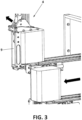
- the conveyor element (4) of the loading table (1) consists of a conveyor robot, controlled by the external controller and equipped with grippers (9) for gripping the stack of sheets from the loading conveyor and its subsequent transport to the assembly machine (2).
- Figure 3 shows a detail of the conveyor element (4) with a stack of sheets.
- the stack of sheets is positioned at the end of the conveyor, where it waits for the robot to perform the approach maneuver, hold the stack with the grippers (9) and transport them.
- the signal to start the loading maneuver is combined.
- the assembly machine (2) sends a signal to the robot, via the external controller, indicating a lack of material in a loader.
- the loading table (1) In order for it to pick up a stack, the loading table (1) must in turn send a signal to the external controller informing it that a stack is present at the end of the conveyor. In this way, operations are coordinated, avoiding bottlenecks and interruptions.
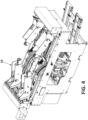
- the assembly machine (2) can assemble two trays per cycle as it has duplicated elements.
- the loaders are open at the top to allow the gripper (9) to enter.
- the robot brings the stack close to the sheets already present in the loader, releases the gripper (9) and moves away.
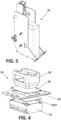
- FIG. 5 shows a view of a loader (10) that is part of the assembly machine (2).
- the detachment of the sheets is done with a piston-actuated suction cup.
- the suction cup comes into contact with the sheet, it adheres to the film due to the Venturi effect.
- the suction cup moves away, it passes between guides that are wide enough for the suction cup to pass through, but narrow enough for the sheet, breaking the vacuum and releasing the sheet.
- the cardboard sheet then moves down the guides to the waiting position.
- the film In the standby position, the film is supported on guides in the longitudinal direction.
- a chain rotating underneath the guides transports the cardboard sheet with a pusher attached to it to the adhesive applicator.
- the first step before the tray is formed is the application of adhesive. It is applied to only one of the sheets.
- a hot melt glue gun system is used for this purpose.
- a sensor detects the presence of the film and sends a signal to the glue gun to apply beads of glue depending on what has been previously programmed in the external controller. Since the glue takes a short time to dry at room temperature, once the adhesive has been applied, the sheets are quickly fed into a forming machine (14) by pressing and moulding.
- This forming machine (14) comprises an upper male mould (11), an intermediate frame (12) and a lower female mould (13), as shown in figure 6 .
- the male mould (11) acts on a first die-cut sheet (IN), which is pressed downwards towards a second die-cut sheet (OUT), located in a lower plane, with the intermediary of the frame (12).
- the forming process of a heat-sealable tray using the device described above has mainly two stages.
- the first stage the lower female mould (13) is closed to trap the second die-cut sheet (OUT).
- the outer lip of the future tray is fixed between the frame (12) and the female mould (13).
- the male mould (13) presses a first die-cut sheet (IN) through the frame (12) from above. In this way, the inner cavity of the tray takes its shape without deforming the lip in the process.
- One advantage of forming the tray with hot glue is that the pressure exerted by the molds (11,13) is not decisive. It has to be just enough to press the two sheets (IN, OUT) together in position, so that the adhesive welds and the tray is assembled. This is an advantage over a process that produces the weld by thermoforming, as a hydraulic system would be needed to apply the required pressure.
- the tray is released from the mould and falls onto a conveyor belt which transports it to the heat sealer.
- the function of the heat sealer is to apply a thin film of plastic over the entire surface of the tray.
- the trays are transported by grippers to a mould. Due to their geometry, the same movement of picking up the trays also causes the trays that have been processed to come out on the conveyor belt. When the trays are in the mould, the lower part rises.
- the already formed trays need to be stacked one on top of the other in order to be packed.
- the automation of this process is done with the charger-counter.
- This element has a sensor at its infeed which allows counting the number of incoming trays. The quantity counted must be the same as the number of trays formed in each cycle of the heat sealer. When this number is reached, a lower flap is released and drops the trays.
- the packer packs the stacks of formed trays into standard packaging for storage and transport. It comprises the following elements:
Landscapes
- Engineering & Computer Science (AREA)
- Mechanical Engineering (AREA)
- Making Paper Articles (AREA)
Priority Applications (1)
| Application Number | Priority Date | Filing Date | Title |
|---|---|---|---|
| EP23382337.6A EP4446105A1 (de) | 2023-04-12 | 2023-04-12 | Vorrichtung zum herstellen einer heisssiegelfähigen verpackung |
Applications Claiming Priority (1)
| Application Number | Priority Date | Filing Date | Title |
|---|---|---|---|
| EP23382337.6A EP4446105A1 (de) | 2023-04-12 | 2023-04-12 | Vorrichtung zum herstellen einer heisssiegelfähigen verpackung |
Publications (1)
| Publication Number | Publication Date |
|---|---|
| EP4446105A1 true EP4446105A1 (de) | 2024-10-16 |
Family
ID=86776096
Family Applications (1)
| Application Number | Title | Priority Date | Filing Date |
|---|---|---|---|
| EP23382337.6A Pending EP4446105A1 (de) | 2023-04-12 | 2023-04-12 | Vorrichtung zum herstellen einer heisssiegelfähigen verpackung |
Country Status (1)
| Country | Link |
|---|---|
| EP (1) | EP4446105A1 (de) |
Citations (9)
| Publication number | Priority date | Publication date | Assignee | Title |
|---|---|---|---|---|
| GB1436205A (en) * | 1972-08-02 | 1976-05-19 | Baudet M | Containers for food products |
| GB2044224A (en) * | 1978-09-30 | 1980-10-15 | Mecdine Ltd | Erecting cartons |
| FR2480708A1 (fr) | 1980-11-07 | 1981-10-23 | Impression Cartonnage Ste Pari | Contenant en carton plie revetu d'une pellicule en matiere synthetique et muni d'un cadre peripherique en une seule piece ainsi que son procede de fabrication |
| US20030005662A1 (en) * | 2001-07-09 | 2003-01-09 | Fuji Photo Film Co., Ltd. | Sheet package producing system, sheet handling device, and fillet folding device |
| US20030120387A1 (en) * | 2001-12-20 | 2003-06-26 | Abb Automation Inc. | End effector for transferring articles |
| EP1880828A1 (de) | 2005-05-10 | 2008-01-23 | Dainippon Ink and Chemicals, Incorporated | Verfahren zum formen einer thermoverformbaren folien- und formmaschine |
| FR2976561A1 (fr) * | 2011-06-15 | 2012-12-21 | Jean Claude Serre | Distributeur de flancs a plat. |
| FR2987772A1 (fr) * | 2012-03-09 | 2013-09-13 | Idi Pharma | Chargeur d'etuis robotise |
| US20220119180A1 (en) * | 2020-10-20 | 2022-04-21 | Solidus Solutions Videcart, S.A. | Heal-sealable packaging and associated manufacturing process |
-
2023
- 2023-04-12 EP EP23382337.6A patent/EP4446105A1/de active Pending
Patent Citations (11)
| Publication number | Priority date | Publication date | Assignee | Title |
|---|---|---|---|---|
| GB1436205A (en) * | 1972-08-02 | 1976-05-19 | Baudet M | Containers for food products |
| GB2044224A (en) * | 1978-09-30 | 1980-10-15 | Mecdine Ltd | Erecting cartons |
| US4533065A (en) * | 1980-07-11 | 1985-08-06 | Societe Parisienne D'impression Et De Cartonnage | Container having one piece peripheral rim, at least two cardboard parts and a synthetic material layer |
| FR2480708A1 (fr) | 1980-11-07 | 1981-10-23 | Impression Cartonnage Ste Pari | Contenant en carton plie revetu d'une pellicule en matiere synthetique et muni d'un cadre peripherique en une seule piece ainsi que son procede de fabrication |
| US20030005662A1 (en) * | 2001-07-09 | 2003-01-09 | Fuji Photo Film Co., Ltd. | Sheet package producing system, sheet handling device, and fillet folding device |
| US20030120387A1 (en) * | 2001-12-20 | 2003-06-26 | Abb Automation Inc. | End effector for transferring articles |
| EP1880828A1 (de) | 2005-05-10 | 2008-01-23 | Dainippon Ink and Chemicals, Incorporated | Verfahren zum formen einer thermoverformbaren folien- und formmaschine |
| FR2976561A1 (fr) * | 2011-06-15 | 2012-12-21 | Jean Claude Serre | Distributeur de flancs a plat. |
| FR2987772A1 (fr) * | 2012-03-09 | 2013-09-13 | Idi Pharma | Chargeur d'etuis robotise |
| US20220119180A1 (en) * | 2020-10-20 | 2022-04-21 | Solidus Solutions Videcart, S.A. | Heal-sealable packaging and associated manufacturing process |
| EP3988463A1 (de) | 2020-10-20 | 2022-04-27 | Solidus Solutions Videcart, S.A. | Heisssiegelbare verpackung und zugehöriges herstellungsverfahren |
Similar Documents
| Publication | Publication Date | Title |
|---|---|---|
| EP1371564B1 (de) | Verfahren und Vorrichtung zum Verpacken eines Produkts unter Verwendung einer flachen rohrförmigen Verpackung | |
| EP0465437B1 (de) | Apparat zum Überführen, Zuführen und Einbringen von Blisterpackungen in einen Karton | |
| MX2007003674A (es) | Aparato y metodo para formar recipientes y preformas de recipientes. | |
| KR20240027833A (ko) | 접착된 코너가 있는 상단 플랜지를 갖는 용기를 형성하는 방법 및 장치 | |
| KR102235381B1 (ko) | 판지 패키징 절단체 상에 보강부를 체결하기 위한 방법과 장치,및 대응 패키징 | |
| EP3639985A1 (de) | Befüllungsanlage und befüllungsverfahren | |
| US10946988B2 (en) | Method and device for forming package bodies which are open on one side using an oscillating gripper | |
| JP2982643B2 (ja) | 袋自動解荷供給方法並びにその装置、及び該装置で使用される袋輸送コンテナ、解束装置、トレー | |
| US12497204B2 (en) | Patch to pouch systems | |
| JP4547595B2 (ja) | 容器製造用のシート材の熱成形システム | |
| IT202200026202A1 (it) | Macchina confezionatrice per confezionare gruppi di prodotti entro scatole di confezionamento formate a partire da fustellati tubolari appiattiti di cartoncino o cartone e destinate ad essere inserite entro una scatola da imballaggio | |
| EP0465438B1 (de) | Vorrichtung zum Überführen von Blisterpackungen von einem Förderband zu einem Magazin und umgekehrt | |
| RU2596036C2 (ru) | Способ упаковывания и машина для изготовления жесткой сигаретной пачки с откидным открыванием | |
| CN111038812B (zh) | 一种电池自动化包装生产线 | |
| EP3639987A1 (de) | Roboterwerkzeug für eine nachschubanlage | |
| KR102172859B1 (ko) | 종이상자 성형기계 | |
| WO2023084407A1 (en) | Apparatus and process for manufacturing a disposable inhaler | |
| CA2593025C (en) | Containers and container blanks, apparatus for and method of forming containers and container blanks | |
| CN212401726U (zh) | 一种下料装置及盒装机 | |
| US12006077B2 (en) | Packaging device, packaging method and package for visual communication boards | |
| CN218055775U (zh) | 一种用于医用试剂板的全自动真空塑封机 | |
| JPH06247403A (ja) | ラップボビン自動包装装置 | |
| JPH048287B2 (de) | ||
| JPH0555363B2 (de) | ||
| JPS6348492Y2 (de) |
Legal Events
| Date | Code | Title | Description |
|---|---|---|---|
| PUAI | Public reference made under article 153(3) epc to a published international application that has entered the european phase |
Free format text: ORIGINAL CODE: 0009012 |
|
| STAA | Information on the status of an ep patent application or granted ep patent |
Free format text: STATUS: THE APPLICATION HAS BEEN PUBLISHED |
|
| AK | Designated contracting states |
Kind code of ref document: A1 Designated state(s): AL AT BE BG CH CY CZ DE DK EE ES FI FR GB GR HR HU IE IS IT LI LT LU LV MC ME MK MT NL NO PL PT RO RS SE SI SK SM TR |
|
| STAA | Information on the status of an ep patent application or granted ep patent |
Free format text: STATUS: REQUEST FOR EXAMINATION WAS MADE |
|
| 17P | Request for examination filed |
Effective date: 20250304 |