EP4447073A1 - Câbles de communication de données ignifuges à faible dégagement de fumée - Google Patents
Câbles de communication de données ignifuges à faible dégagement de fumée Download PDFInfo
- Publication number
- EP4447073A1 EP4447073A1 EP24169488.4A EP24169488A EP4447073A1 EP 4447073 A1 EP4447073 A1 EP 4447073A1 EP 24169488 A EP24169488 A EP 24169488A EP 4447073 A1 EP4447073 A1 EP 4447073A1
- Authority
- EP
- European Patent Office
- Prior art keywords
- data communication
- communication cable
- frpp
- based material
- cable
- Prior art date
- Legal status (The legal status is an assumption and is not a legal conclusion. Google has not performed a legal analysis and makes no representation as to the accuracy of the status listed.)
- Pending
Links
Images

Classifications
-
- H—ELECTRICITY
- H01—ELECTRIC ELEMENTS
- H01B—CABLES; CONDUCTORS; INSULATORS; SELECTION OF MATERIALS FOR THEIR CONDUCTIVE, INSULATING OR DIELECTRIC PROPERTIES
- H01B7/00—Insulated conductors or cables characterised by their form
- H01B7/02—Disposition of insulation
-
- C—CHEMISTRY; METALLURGY
- C08—ORGANIC MACROMOLECULAR COMPOUNDS; THEIR PREPARATION OR CHEMICAL WORKING-UP; COMPOSITIONS BASED THEREON
- C08L—COMPOSITIONS OF MACROMOLECULAR COMPOUNDS
- C08L23/00—Compositions of homopolymers or copolymers of unsaturated aliphatic hydrocarbons having only one carbon-to-carbon double bond; Compositions of derivatives of such polymers
- C08L23/02—Compositions of homopolymers or copolymers of unsaturated aliphatic hydrocarbons having only one carbon-to-carbon double bond; Compositions of derivatives of such polymers not modified by chemical after-treatment
- C08L23/10—Homopolymers or copolymers of propene
- C08L23/12—Polypropene
-
- H—ELECTRICITY
- H01—ELECTRIC ELEMENTS
- H01B—CABLES; CONDUCTORS; INSULATORS; SELECTION OF MATERIALS FOR THEIR CONDUCTIVE, INSULATING OR DIELECTRIC PROPERTIES
- H01B11/00—Communication cables or conductors
- H01B11/02—Cables with twisted pairs or quads
-
- H—ELECTRICITY
- H01—ELECTRIC ELEMENTS
- H01B—CABLES; CONDUCTORS; INSULATORS; SELECTION OF MATERIALS FOR THEIR CONDUCTIVE, INSULATING OR DIELECTRIC PROPERTIES
- H01B11/00—Communication cables or conductors
- H01B11/02—Cables with twisted pairs or quads
- H01B11/06—Cables with twisted pairs or quads with means for reducing effects of electromagnetic or electrostatic disturbances, e.g. screens
- H01B11/10—Screens specially adapted for reducing interference from external sources
- H01B11/1058—Screens specially adapted for reducing interference from external sources using a coating, e.g. a loaded polymer, ink or print
-
- H—ELECTRICITY
- H01—ELECTRIC ELEMENTS
- H01B—CABLES; CONDUCTORS; INSULATORS; SELECTION OF MATERIALS FOR THEIR CONDUCTIVE, INSULATING OR DIELECTRIC PROPERTIES
- H01B3/00—Insulators or insulating bodies characterised by the insulating materials; Selection of materials for their insulating or dielectric properties
- H01B3/18—Insulators or insulating bodies characterised by the insulating materials; Selection of materials for their insulating or dielectric properties mainly consisting of organic substances
- H01B3/30—Insulators or insulating bodies characterised by the insulating materials; Selection of materials for their insulating or dielectric properties mainly consisting of organic substances plastics; resins; waxes
- H01B3/44—Insulators or insulating bodies characterised by the insulating materials; Selection of materials for their insulating or dielectric properties mainly consisting of organic substances plastics; resins; waxes vinyl resins; acrylic resins
- H01B3/441—Insulators or insulating bodies characterised by the insulating materials; Selection of materials for their insulating or dielectric properties mainly consisting of organic substances plastics; resins; waxes vinyl resins; acrylic resins from alkenes
-
- H—ELECTRICITY
- H01—ELECTRIC ELEMENTS
- H01B—CABLES; CONDUCTORS; INSULATORS; SELECTION OF MATERIALS FOR THEIR CONDUCTIVE, INSULATING OR DIELECTRIC PROPERTIES
- H01B3/00—Insulators or insulating bodies characterised by the insulating materials; Selection of materials for their insulating or dielectric properties
- H01B3/18—Insulators or insulating bodies characterised by the insulating materials; Selection of materials for their insulating or dielectric properties mainly consisting of organic substances
- H01B3/30—Insulators or insulating bodies characterised by the insulating materials; Selection of materials for their insulating or dielectric properties mainly consisting of organic substances plastics; resins; waxes
- H01B3/44—Insulators or insulating bodies characterised by the insulating materials; Selection of materials for their insulating or dielectric properties mainly consisting of organic substances plastics; resins; waxes vinyl resins; acrylic resins
- H01B3/448—Insulators or insulating bodies characterised by the insulating materials; Selection of materials for their insulating or dielectric properties mainly consisting of organic substances plastics; resins; waxes vinyl resins; acrylic resins from other vinyl compounds
-
- H—ELECTRICITY
- H01—ELECTRIC ELEMENTS
- H01B—CABLES; CONDUCTORS; INSULATORS; SELECTION OF MATERIALS FOR THEIR CONDUCTIVE, INSULATING OR DIELECTRIC PROPERTIES
- H01B7/00—Insulated conductors or cables characterised by their form
- H01B7/17—Protection against damage caused by external factors, e.g. sheaths or armouring
- H01B7/29—Protection against damage caused by extremes of temperature or by flame
- H01B7/295—Protection against damage caused by extremes of temperature or by flame using material resistant to flame
-
- H—ELECTRICITY
- H01—ELECTRIC ELEMENTS
- H01B—CABLES; CONDUCTORS; INSULATORS; SELECTION OF MATERIALS FOR THEIR CONDUCTIVE, INSULATING OR DIELECTRIC PROPERTIES
- H01B3/00—Insulators or insulating bodies characterised by the insulating materials; Selection of materials for their insulating or dielectric properties
- H01B3/18—Insulators or insulating bodies characterised by the insulating materials; Selection of materials for their insulating or dielectric properties mainly consisting of organic substances
- H01B3/30—Insulators or insulating bodies characterised by the insulating materials; Selection of materials for their insulating or dielectric properties mainly consisting of organic substances plastics; resins; waxes
- H01B3/44—Insulators or insulating bodies characterised by the insulating materials; Selection of materials for their insulating or dielectric properties mainly consisting of organic substances plastics; resins; waxes vinyl resins; acrylic resins
- H01B3/443—Insulators or insulating bodies characterised by the insulating materials; Selection of materials for their insulating or dielectric properties mainly consisting of organic substances plastics; resins; waxes vinyl resins; acrylic resins from vinylhalogenides or other halogenoethylenic compounds
- H01B3/445—Insulators or insulating bodies characterised by the insulating materials; Selection of materials for their insulating or dielectric properties mainly consisting of organic substances plastics; resins; waxes vinyl resins; acrylic resins from vinylhalogenides or other halogenoethylenic compounds from vinylfluorides or other fluoroethylenic compounds
Definitions
- the present application relates to data communication cables. More specifically, the present application relates to data communication cables for use in a plenum, the data communication cables having twisted pairs of insulated conductors with at least one pair of conductors being insulated with a flame retardant polypropylene (“FRPP”)-based material.
- FRPP flame retardant polypropylene
- Data communication cables for use in plenums must meet strict requirements with respect to flame propagation and smoke emission while providing excellent electrical properties.
- the electric insulation for the conductors of many conventional data communication cables is formed from fluoropolymers, but fluoropolymers can tend to be expensive, relative to other materials. Providing less expensive materials for the electric insulation that allow the data communication cable to exhibit desired properties can be challenging.
- FRPP-based materials have been used to provide at least a portion of the electric insulation included in data communication cables, and such usage typically requires a substantial amount of inorganic flame retardant filler in the polypropylene base for the data communication cables to pass flame propagation and smoke emission standards, however, and the inclusion of such substantial amounts of inorganic flame retardant filler may increase the dielectric constant of the FRPP-based materials thus decreasing their performance as electrically insulating materials.
- U.S. Patent No. 5,936,205 describes a communication cable for use in a plenum comprising a plurality of twisted pairs of electrical conductors insulated with fluorinated ethylene propylene (“FEP"), and at least one additional twisted pair of electrical conductors insulated with an olefin-based compound.
- FEP fluorinated ethylene propylene
- the olefin-based material is filled with flame retardants and char enhancers to minimize smoke and flame evolution.
- the insulation material may contain 0-5 parts per hundred (pph) antimony trioxide flame retardant, 0-30 pph halogen flame retardant, up to 120 pph mineral filler, such as magnesium carbonate or magnesium hydroxide, and/or up to 5 pph silicate char enhancers, such as talc.
- pph antimony trioxide flame retardant
- 0-30 pph halogen flame retardant up to 120 pph mineral filler, such as magnesium carbonate or magnesium hydroxide, and/or up to 5 pph silicate char enhancers, such as talc.
- Korean Patent Publication No. 102201364 describes a plenum-grade, unshielded twisted pair ("UTP") cable comprising a flame-retardant polyolefin composition.
- the base resin may include 50 to 90 parts, by weight, of a polyolefin resin, 10 to 50 parts, by weight, of a thermoplastic polyolefin elastomer resin based on a total of 100 parts, by weight, and 2 to 10 parts, by weight, of a reactive polyolefin into which a polar group is introduced.
- the flame-retardant polyolefin composition may include 50 to 100 parts, by weight, of a metal hydroxide flame retardant, such as magnesium hydroxide or aluminum hydroxide, and 5 to 100 parts, by weight, of a flame retardant aid, such as a halogen-based flame retardant or an antimony-based flame retardant.
- a metal hydroxide flame retardant such as magnesium hydroxide or aluminum hydroxide
- a flame retardant aid such as a halogen-based flame retardant or an antimony-based flame retardant.
- a data communication cable comprising a plurality of electric conductors, at least one of which is insulated with a specific flame-retardant polypropylene base material, is suitable for compliance with the stringent standards for use in plenums, while being free from commonly used flame-retardant hydrated mineral filler/s, like magnesium hydroxide or aluminum hydroxide.
- Such specific flame-retardant polypropylene base material provides a layer with suitable electrically insulating properties.
- an exemplary embodiment of the present disclosure provides a data communication cable for use in a plenum having a cable core and jacket layer surrounding the cable core.
- the cable core includes at least one pair of twisted electric conductors electrically insulated with a flame-retardant polypropylene (FRPP)-based material comprising a char enhancer; a halogenated flame retardant; and a flame retardant additive; and wherein the FRPP-based material is free from flame-retardant hydrated mineral filler.
- FRPP flame-retardant polypropylene
- all the pairs of twisted electric conductors are electrically insulated with the FRPP-based material.
- the cable core includes at least one pair of twisted electric conductors electrically insulated with a FRPP-based material and at least one pair of twisted electric conductors electrically insulated with a fluoropolymer material.
- the fluoropolymer material suitable as electric insulation may be selected from FEP, ethylene chlorotrifluoroethylene (“ECTFE”), and a perfluoropolymer, such as methylfluoroalkoxy (“MFA”) or perfluoroalkoxy alkane (“PFA”), among others.
- the fluoropolymer material suitable as electric insulation is FEP.
- the FRPP-based material suitable as electric insulation in the present data communication cable includes at least one polypropylene copolymer amounting to 100 phr (parts per hundred rubber) as polypropylene base.
- a polypropylene copolymer suitable for use in the present data communication cable may be a heterophase polypropylene copolymer.
- heterophase polypropylene copolymers refers to a copolymer formed by a substantially crystalline matrix of polypropylene and an ethylene-propylene rubber phase dispersed therein.
- the FRPP-based material suitable as electric insulation in the present data communication cable is made of a polymer base including at least one polypropylene copolymer and at least one polypropylene homopolymer or copolymer suitably modified with a polar group (hereinafter also referred to as "polar-modified polypropylene homopolymer or copolymer").
- polar-modified polypropylene homopolymer or copolymer hereinafter also referred to as "polar-modified polypropylene homopolymer or copolymer”
- the polypropylene homopolymer or copolymer may be modified by grafting an anhydride or an acrylic group.
- the polymer base may comprise 80-99 phr of a polypropylene copolymer (e.g., a polypropylene heterophase copolymer) and 1-20 phr of a polar-modified polypropylene homopolymer or copolymer.
- a polypropylene copolymer e.g., a polypropylene heterophase copolymer
- polar-modified polypropylene homopolymer or copolymer e.g., a polar-modified polypropylene homopolymer or copolymer.
- the FRPP-based material suitable as electric insulation in the present data communication cable is made of a polymer base including at least one polypropylene copolymer and at least one polypropylene homopolymer.
- the polymer base may include 5-25 phr of a polypropylene homopolymer, with the remaining portion of the polymer base being formed from a polypropylene copolymer (e.g., polypropylene heterophase copolymer).
- the FRPP-based material suitable as electric insulation in the present data communication cable is made of a polymer base including at least one polypropylene copolymer, at least one polar-modified polypropylene homopolymer or copolymer, and at least one polypropylene homopolymer.
- the polymer base may include 5-25 phr of a polypropylene homopolymer, 1-20 phr of a polar-modified polypropylene homopolymer or copolymer, and the remaining portion of the polymer base being formed from a polypropylene copolymer (e.g., polypropylene heterophase copolymer).
- the FRPP-based material insulating at least one electric conductor of the present data communication cable may include a char enhancer.
- a char enhancer suitable for the present data communication cable may include talc, silicone fluids, silica, and/or mica.
- the FRPP-based material may include from 20 to 60 phr of the char enhancer.
- the FRPP-based material insulating at least one electric conductor of the present data communication cable may include a halogenated flame-retardant.
- a halogenated flame retardant suitable for the present data communication cable may include bromine, chlorine, fluorine, or iodine.
- the FRPP-based material may include from 25 to 60 phr of the halogenated flame retardant.
- the FRPP-based material insulating at least one electric conductor of the present data communication cable may include a flame-retardant additive.
- a flame retardant additive suitable for the present data communication cable may include at least one of antimony trioxide, a mixture of antimony trioxide and zinc borate, and a mixture of magnesium oxide and zinc oxide.
- the FRPP-based material may include the flame-retardant additive in an amount that is 25-30% of the amount of the halogenated flame-retardant.
- the FRPP-based material insulating at least one electric conductor of the present data communication cable may be free from flame-retardant hydrated mineral filler, such as magnesium hydroxide (both synthetic and naturally occurring), aluminum hydroxide, magnesium carbonate, mixed magnesium/calcium carbonates and hydroxides, such as naturally occurring mixtures of huntite, boehmite, magnesite, and hydromagnesite.
- flame-retardant hydrated mineral filler such as magnesium hydroxide (both synthetic and naturally occurring), aluminum hydroxide, magnesium carbonate, mixed magnesium/calcium carbonates and hydroxides, such as naturally occurring mixtures of huntite, boehmite, magnesite, and hydromagnesite.
- both the fluoropolymer material and the FRPP-based material in the cable of the present disclosure are solid.
- solid indicates that a material is not foamed or expanded.
- the jacket layer of the cable of the present disclosure may be formed of a polymer material having an oxygen index of at least 40%, and in certain embodiments, of at least 45%, as measured in accordance with American Society for Testing and Materials (“ASTM”) D2863 (2012).
- the cable core further includes a separator.
- the separator may be a tape (i.e., a "flat separator") or an element having a cross-shaped cross-section (i.e., a "cross-web separator”).
- the separator may include a flame-retardant, low-smoke polymer material, such as a low-smoke polyvinylchloride (“PVC”) or a flame-retardant, halogen-free polyolefin of polyethersulfone.
- PVC low-smoke polyvinylchloride
- the present disclosure may also provide a data communication cable for use in plenum having a cable core and jacket layer surrounding the cable core.
- the cable core includes at least one pair of twisted electric conductors electrically insulated with a FRPP-based material having a dielectric constant ( ⁇ ) of less than 2.6 as measured according to ASTM 4566-98.
- Data communication cables for use in plenums may be required to meet several standards.
- such data communication cables may be required to pass testing relating to flame propagation and smoke emission, such as the Underwriter's Laboratory (“UL”) 1581 (2001) VW-1 flame test, UL 444 (2002) plenum testing, and testing according to the National Fire Protection Association (“NFPA”) standards (e.g., NFPA 262, 2011).
- UL Underwriter's Laboratory
- NFPA National Fire Protection Association
- Such data communication cables may be also required to exhibit strong electrical insulating properties, such as a sufficiently low dielectric constant.
- Such data communication cables can further be required meet the standards of ANSI/TIA-568.2-D (2016) of the American National Standards Institute (“ANSI”) and the Telecommunications Industry Association (“TIA”) with respect to, for example, Category 5e, Category 6, and Category 6A cables.
- ANSI American National Standards Institute
- TIA Telecommunications Industry Association
- the data communication cables described herein can pass VW-1 flame testing and testing for UL 444 (2002) and NFPA 262 (2011), meet the standards for a Category 5e, Category 6, and Category 6A cables under ANSI/TIA-568.2-D (2016), exhibit a dielectric constant of less than 2.6 (as measured according to ASTM 4566-98) and suitable mechanical properties, such as tensile strength, elongation at break, and modulus.
- insulation having a sufficiently low dielectric constant can allow for the reduction of insulation wall thickness and diameter, thereby resulting in a lesser volume of combustible material.
- a lower dielectric constant can also allow for faster processing speeds and tighter pair lays with the data communication cable.
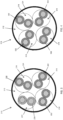
- the data communication cable 10 in FIG. 1 includes a cable core 12 having four pairs (e.g., 14, 16). Each pair comprises two electric conductors 18, each surrounded by an electrically insulating layer (e.g., 20, 22). As shown in FIG. 1 , the insulating layer 20 for three of the pairs 14 (i.e., "first pair/s") is formed from a fluoropolymer material, while the insulating layer 22 for the pair 16 (i.e., "second pair”) is formed from a FRPP-based material comprising a polypropylene base, a char enhancer, a halogenated flame retardant, and a flame retardant additive according to the present disclosure.
- the data communication cable further includes a jacket layer 24 surrounding the cable core 12. As can be appreciated, variations are possible.
- the electric conductors can be solid or stranded and can be formed of any suitable electrically conductive metal including, for example, copper, aluminum, or an alloy thereof.
- the electric conductors can be coated with a corrosion resistant metal, such as tin, to facilitate termination of a communication cable in areas with harsh environmental conditions (e.g., hot or humid areas, etc.).
- the electric conductors can advantageously be formed of copper due to copper's high electrical conductivity relative to volume.
- stranded conductors can be advantageous in certain embodiments due to the mechanical and electrical advantages exhibited by stranded conductors.
- stranded conductors can exhibit increased flexibility and conductivity compared to solid ones of identical gauge.
- the electric conductors can be a stranded copper conductor.
- the insulated electric conductors in a data communication cable can be of any suitable wire gauge.
- the insulated wires can be sized in accordance with American Wire Gauge ("AWG") standards and each wire can have a size between 14 AWG and 40 AWG.
- suitable data communication cables can include a four-pair 23 AWG configuration.
- selection of the wire gauge can vary depending on factors such as the desired cable operating distance, the desired electrical performance, and physical parameters such as the thickness of the data communication cable.
- At least one pair comprises two electric conductors insulated by a fluoropolymer material.
- suitable fluoropolymer materials can include FEP, ECTFE, MFA, and PFA, among others. Relative to other insulation materials, such as polyolefins, for example, fluoropolymers can be advantageous due to the superior electrical properties, especially in terms of the dielectric properties exhibited by such materials.
- at least one pair includes two electric conductors insulated with FEP.
- At least one pair includes two electric conductors insulated with a FRPP-based material comprising a polypropylene base, a char enhancer, a halogenated flame retardant, and a flame retardant additive.
- the FRPP-based material suitable as electric insulation in the present data communication cable may include at least one polypropylene heterophase copolymer.
- the FRPP-based material may include a polypropylene heterophase copolymer as a sole polypropylene base, such that the polypropylene heterophase copolymer may be present in an amount of 100 phr.
- the polypropylene base of the FRPP-based material of the present disclosure may include a minor amount of a polar-modified polypropylene homopolymer or copolymer.
- the polar-modified polypropylene homopolymer or copolymer can be present in the polypropylene base in an amount from 1 phr to 20 phr; in certain embodiments, from 3 phr to 15 phr; and in certain embodiments, from 5 phr to 10 phr.
- Suitable examples of the polar-modified polypropylene homopolymer or copolymer can include maleic anhydride-grafted polypropylene. It will be appreciated that any of a variety of suitable forms of polar-modified polypropylene can be employed in the FRPP-based material.
- the polypropylene base of the FRPP-based material of the present disclosure may include a minor amount of a polypropylene homopolymer.
- the polypropylene homopolymer can be present in the polypropylene base in an amount from about 5 phr to 25 phr; in certain embodiments, from 8 phr to 20 phr; and in certain embodiments, from 10 phr to 15 phr. It will be appreciated that any of a variety of suitable forms of polar-modified polypropylene can be employed in the FRPP-based material.
- the FRPP-based material can include from about 55 phr to about 94 phr, of polypropylene heterophase copolymer, from about 5 phr to about 25 phr, of the polypropylene homopolymer, and from about 1 phr to about 20 phr, of the polar-modified polypropylene homopolymer or copolymer.
- the FRPP-based material can further include a char former.
- Suitable char formers can include talc, silicone, silica, and mica.
- the char former can be talc.
- the FRPP-based material can include, in certain embodiments, about 30 phr or more of the char former.
- the FRPP-based material can further include a halogenated flame retardant.
- Suitable halogenated flame retardant can include brominated phthalimides, such as ethylenebistetrabromophthalimide, decabromodiphenyl ethane ("DBDPE”), decabromodiphenyl oxide (“DBDPO”), and chlorinated products, such as Dechlorane plus ® 25 (marketed by OxyChem, Dallas, TX).
- the FRPP-based material can include, in certain embodiments, about 25 phr, or more of the halogenated flame retardant.
- the FRPP-based material can further include a flame retardant additive.
- Suitable flame retardant additives can include antimony oxides, a mixture of antimony trioxide and zinc borate and/or and a mixture magnesium oxide/zinc oxide.
- the FRPP-based material can include an amount of the flame retardant additive that is, in certain embodiments, about 20% to about 35%; in certain embodiments, about 22% to about 32%; in certain embodiments, about 25% to about 30%; and in certain embodiments, about 27% to about 29% of the amount of the halogenated flame retardant.
- the FRPP-based material can be free of a flame retardant hydrated mineral filler.
- the FRPP-based material can be free of a metal hydroxide and/or metal carbonate, such as magnesium hydroxide (both synthetic and naturally occurring), aluminum hydroxide, hydrated magnesium carbonate, hydrated calcium carbonate, mixed magnesium/calcium carbonates and hydroxides, such as naturally occurring mixtures of huntite, boehmite, magnesite and hydromagnesite.
- the FRPP-based material can further include one or more antioxidants.
- Suitable antioxidants for inclusion in the insulation composition can include, for example, amine-antioxidants, such as 4,4'-dioctyl diphenylamine, N,N'-diphenyl-p-phenylenediamine, and polymers of 2,2,4-trimethyl-1,2-dihydroquinoline; phenolic antioxidants, such as thiodiethylene bis[3-(3,5-di-tert-butyl-4-hydroxyphenyl)-propionate], 4,4'-thiobis(2-tert-butyl-5-methylphenol), 2,2'-thiobis(4-methyl-6-tert-butyl-phenol), benzenepropanoic acid, 3,5-bis(1,1-dimethylethyl)4-hydroxy benzenepropanoic acid, 3,5-bis(1,1-dimethylethyl)-4-hydroxy-C13-15 branched and linear alkyl
- Antioxidants can be included in compositions at concentrations about 5 phr or less of the composition in certain embodiments; from about 0.1 phr to about 4 phr, in certain embodiments; and from about 0.2 phr to about 3 phr, in certain embodiments.
- the insulation composition can comprise pentaerythritol tetrakis[3-(3,5-di-tert.butyl-4-hydroxyphenyl)propionate] and/or 2',3-bis[[3-[3,5-di-tert-butyl-4-hydroxyphenyl]propionyl]]propionohydrazide.
- it can be advantageous in certain embodiments to use a blend of multiple antioxidants.
- the insulation composition can further include one or more metal deactivators.
- Suitable metal deactivator can include, for example, N,N'-bis(3-(3,5-di-t-butyl-4-hydroxyphenyl)propionyl)hydrazine, 3-(N-salicyloyl)amino-1,2,4-triazole, and/or 2,2'-oxamidobis-(ethyl 3-(3,5-di-t-butyl-4-hydroxyphenyl)propionate).
- Metal deactivators can be included in compositions at concentrations about 5 parts, by weight, or less of the composition in certain embodiments; from about 0.1 parts to about 4 parts, by weight, in certain embodiments; and from about 0.2 parts to about 3 parts, by weight, in certain embodiments.
- a processing aid can be included in the FRPP-based material to improve the processability thereof.
- the processing aid can generally be a lubricant, such as ultra-low molecular weight polyethylene (e.g., polyethylene wax), stearic acid, silicones (e.g., polysiloxane dispersed in polypropylene), anti-static amines, organic amides, ethanolamides, mono- and di-glyceride fatty amines, ethoxylated fatty amines, fatty acids, zinc stearate, stearic acids, palmitic acids, calcium stearate, oligomeric olefin oil, or combinations thereof.
- a lubricant such as ultra-low molecular weight polyethylene (e.g., polyethylene wax), stearic acid, silicones (e.g., polysiloxane dispersed in polypropylene), anti-static amines, organic amides, ethanolamides, mono- and di-g
- a lubricant can be included from about 1 part to about 5 parts, by weight; in certain embodiments, from about 2.5 parts to about 4.5 parts, by weight; in certain embodiments, from about 3 parts to about 4 parts, by weight, of the insulation composition.
- the jacket layer 24 surrounds the cable core 12.
- the jacket layer can be formed of a PVC.
- the jacket layer can further include flame retardants, as described herein, and/or smoke suppressants and can be lead-free.
- the jacket layer can also be formed of a fluoropolymer material.
- suitable fluoropolymer materials can include FEP, ECTFE, MFA, PFA, polyvinylidene fluoride ("PVDF”), among others.
- PVDF polyvinylidene fluoride
- a jacket layer can be formed from any of a variety of suitable materials like low-smoke, zero-halogen polyolefins and polyethylene. Examples of suitable jacket layers are disclosed in U.S. Patent. No. 10,246,639 , which is hereby incorporated by reference.
- each of the FRPP-based material and jacket layer material described herein can optionally further include additional components.
- each of the FRPP-based material insulation or jacket layer can further include antioxidants, as described herein; processing aids, as described herein; colorants; and stabilizers in various embodiments.
- any of the additional components can be directly added to compositions forming the respective FRPP-based material insulation or jacket layer described herein or can be introduced using a masterbatch.
- any additional components can be included at about 1% to about 10%, by weight, of the respective insulation composition or jacket layer.
- FIG. 1 depicts a data communication cable 10 including a cable core 12 having a "3x1" configuration-i.e., the insulation 20 for three of the first pairs 14 is formed from a fluoropolymer material and the insulation 22 for the one second pair 16 is formed from the FRPP-based material insulation composition as described herein-other configurations are possible.
- FIG. 2 depicts a data communication cable 110 including a cable core 112 having a "2x2" configuration, where the insulation 120 for two of the first pairs 114 is formed from a fluoropolymer material, while the insulation 122 for two of the second pairs 116 is formed from the FRPP-based material.
- FIG. 1 depicts a data communication cable 10 including a cable core 12 having a "3x1" configuration-i.e., the insulation 20 for three of the first pairs 14 is formed from a fluoropolymer material and the insulation 22 for the one second pair 16 is formed from the FRPP-based material insulation composition as described herein-other configurations are possible
- FIG. 3 depicts a data communication cable 210 including a cable core 212 having a "1x3" configuration, where the insulation 220 for the one first pair 214 is formed from a fluoropolymer material, while the insulation 222 for three of the second pairs 216 is formed from the FRPP-based material.
- FIG. 4 depicts a data communication cable 310 including a cable core 312 having a "0x4" configuration, where the insulation 322 for all of the pairs of the cable are formed from the FRPP-based material according to the present disclosure, i.e., all of the pairs of the cable 310 are second pairs 316.
- the data communication cables can include additional components in certain embodiments.
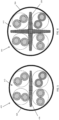
- a cable separator e.g., 426, 526) can be included to further provide mechanical and electrical separation of the pairs.
- the data communication cable 410 can include a flat separator 426 in the cable core 412, while FIG. 6 depicts a similar data communication cable 510 having a cross-web separator 528 in the cable core 512.
- Use of a cable separator can improve the electrical performance characteristics of the data communication cable and can, for example, enable the cable to meet the performance requirements of Category 6 or Category 6A cables.
- suitable cable separators can be formed of a low-smoke polymer, such as PVC; flame-retardant, zero-halogen polyolefins; and polyethersulfone.
- suitable cable separators can be formed of compositions as disclosed in U.S. Patent. No. 10,246,639 . It will be appreciated, however, that a cable separator can be formed from any of a variety of suitable materials in any of a variety of suitable shapes or configurations.
- the cable separator can be made of a foamed or solid material.
- the data communication cables described herein can be constructed in a process similar to known data communication cables.
- the data communication cables can be formed by twisting insulated electric conductors together to form both pairs and a cable core.
- a cable separator can be further included within the cable core.
- a jacket layer can then be extruded around the cable core.
- Table 1 shows FRPP-based material formulations for each of Comparative Examples (“CE”) CE1-CE9 and Inventive Example (“IE”) IE1, where the amount of each component is provided in phr. Table 1.
- FRPP-Based Material Example Formulations Component CE1 CE2 CE3 CE4 CE5 CE6 CE7 CE8 CE9 IE1 Polypropylene Heterophase Copolymer 87 67 67 67 67 67 67 43.5 67 Polypropylene Random Copolymer 20.0 43.5 Polypropylene Homopolymer 20.0 20.0 20.0 20.0 20.0 20.0 20.0 20.0 20.0 20.0 20.0 20.0 20.0 20.0 20.0 20.0 20.0 20.0 20.0 Polyproylene-g-MAH 13.0 13.0 13.0 13.0 13.0 13.0 13.0 13.0 13.0 13.0 Magnesium Hydroxide 78.3 78.3 59 39 39 20 20 20 20 20 Talc 26.1 26.1 20.0 13.0 26.1 26.1 26.1 26.1 26.1 39 N,N
- the polypropylene heterophase copolymer is a copolymer obtained by Catalloy process technology and having a melting enthalpy of about 27 J/g and a melt flow rate of about 0.7 g/10 min.
- the polypropylene random copolymer has a melting enthalpy of about 67 J/g and a melt flow rate of about 1.8 g/10 min.
- the polypropylene homopolymer has a melt flow rate of about 3.5 g/10 min.
- the polypropylene-g-MAH is a polypropylene copolymer grafted with maleic anhydride (polar-modified polypropylene copolymer).
- Magnesium hydroxide is a hydrated mineral flame-retardant.
- Talc acts as a char former.
- N,N-ethylene-bis(tetrabromophthalimide) is a halogenated flame-retardant
- antimony trioxide is a flame-retard
- sample type 1 is a 14 AWG conductor with a 0.25 mm-thick single layer of insulation.
- Sample type 2 is a 1 mm-thick extruded tape of insulating material.
- Sample type 3 refers to a 23 AWG data communication cable.
- the cable is provided in a 3x1 configuration, where the insulation (0.241 mm thick, single layer) for three of the pairs (i.e., first pairs) was formed from FEP material and the insulation for the remaining pair (i.e, second pair) was formed from the respective example FRPP-based material, with a flat separator formed of smoke-suppressant PVC and a low-smoke PVC jacket layer.
- Burn performance is tested in accordance with the National Fire Protection Association (NFPA) standards, specifically NFPA 262 (2011).
- NFPA National Fire Protection Association
- smoke performance is measured by the average optical density and peak optical density of smoke.
- the UL 1581 VW-1 (2001) vertical flame test requires cables to extinguish a flame within 60 seconds after a specified flame is applied to the cable. Additionally, a paper sample located above the cable should not catch on fire. Samples are required to pass at least 3 consecutive samples to pass the respective flame tests. Table 2.
- the material of IE1 allowed the respective sample to pass VW-1 testing and the smoke testing and meet the requisite standards for each of tensile strength, elongation at break, and modulus.
- the dielectric constant of the material of IE1 is lower than 2.6. None of the materials of CE1-CE9 were able to meet all of such standards. For example, only the material of CE7 exhibited a dielectric constant of less than 2.6, but the material of CE7 failed to pass VW-1 flame test.
- IE1 clearly outperformed CE1-CE9 when used as insulation for a twisted wire pair.
- Table 3 shows results relating to testing of each of CE1 and IE1.
- the sample type used for burn performance testing is sample type 3.
- the data communication cables were formed in a 2x2 configuration, where the insulation for two of the pairs (i.e., first pairs) was formed from FEP and the insulation for the remaining two pairs (i.e., second pairs) were formed from the respective example FRPP-based materials.
- each data communication cable also included a flat separator formed of smoke-suppressant PVC and a low-smoke PVC jacket layer.
- the respective example insulation composition was formed on a conductive wire and tested without a separator or jacket layer.
- the insulation formed from IE1 allowed the respective sample to pass burn performance testing two times. While CE1 was also meet the requisite standards, IE 1 outperformed CE1 in each tested category.
- Table 4 shows results relating to testing of each of CE1 and IE1.
- Sample type 3 data communication cables were formed in a 3x1 configuration, where the insulation for three of the pairs was formed from FEP and the insulation for the remaining pair was formed from the respective example insulation composition. The insulation of the two sample was sized in view of the dielectric constant of the insulating material CE1 and IE1.
- Table 4. Measurements of FRPP-Based Material Example Formulations as Insulation for One Twisted Wire Pair in a 3x1 Configuration Test IE1 CE1 Dielectric Constant ⁇ ( ⁇ 2.6 @ 1MHz) 2.57 2.92 Insulation Outer Diameter (mm) 0.96 1.04 Insulation Relative Volume 100% 124% Insulation Thickness (mm) 0.226 0.266
- Table 4 shows measurements for each of CE1 and IE1 insulating layer, relative to the dielectric constant determined in Table 2.
- an insulation layer made of the FRPP-based material according to the present disclosure can be manufactured with a reduced diameter and thickness and, accordingly, less of material than an insulation layer made of a comparative FRPP-based material having a greater dielectric constant because of the presence of a flame-retardant hydrated mineral filler.
Landscapes
- Physics & Mathematics (AREA)
- Spectroscopy & Molecular Physics (AREA)
- Chemical & Material Sciences (AREA)
- Electromagnetism (AREA)
- Health & Medical Sciences (AREA)
- Chemical Kinetics & Catalysis (AREA)
- Medicinal Chemistry (AREA)
- Polymers & Plastics (AREA)
- Organic Chemistry (AREA)
- Insulated Conductors (AREA)
- Organic Insulating Materials (AREA)
- Compositions Of Macromolecular Compounds (AREA)
Applications Claiming Priority (1)
| Application Number | Priority Date | Filing Date | Title |
|---|---|---|---|
| US18/297,990 US12567517B2 (en) | 2023-04-10 | 2023-04-10 | Low-smoke, flame-retardant data communication cables |
Publications (1)
| Publication Number | Publication Date |
|---|---|
| EP4447073A1 true EP4447073A1 (fr) | 2024-10-16 |
Family
ID=90720388
Family Applications (1)
| Application Number | Title | Priority Date | Filing Date |
|---|---|---|---|
| EP24169488.4A Pending EP4447073A1 (fr) | 2023-04-10 | 2024-04-10 | Câbles de communication de données ignifuges à faible dégagement de fumée |
Country Status (4)
| Country | Link |
|---|---|
| US (1) | US12567517B2 (fr) |
| EP (1) | EP4447073A1 (fr) |
| CN (1) | CN118782303A (fr) |
| AU (1) | AU2024202168A1 (fr) |
Citations (6)
| Publication number | Priority date | Publication date | Assignee | Title |
|---|---|---|---|---|
| EP0778589A2 (fr) * | 1995-12-08 | 1997-06-11 | Alcatel | Câble de communication pour plénum |
| US5936205A (en) | 1994-11-10 | 1999-08-10 | Alcatel | Communication cable for use in a plenum |
| US10246639B2 (en) | 2016-05-17 | 2019-04-02 | General Cable Technologies Corporation | Fire retardant compositions and cable separators formed thereof |
| KR102201364B1 (ko) | 2014-05-22 | 2021-01-12 | 엘에스전선 주식회사 | 난연성 폴리올레핀 조성물 및 이로부터 형성된 절연체를 포함하는 cmp 난연등급 utp 케이블 |
| US20210065926A1 (en) * | 2019-09-04 | 2021-03-04 | Yazaki Corporation | Communication cable and wire harness |
| EP3971913A1 (fr) * | 2020-09-16 | 2022-03-23 | Yazaki Corporation | Composition de résine et câble de communication et faisceau de câbles l'utilisant |
Family Cites Families (9)
| Publication number | Priority date | Publication date | Assignee | Title |
|---|---|---|---|---|
| US5493071A (en) * | 1994-11-10 | 1996-02-20 | Berk-Tek, Inc. | Communication cable for use in a plenum |
| US5770820A (en) | 1995-03-15 | 1998-06-23 | Belden Wire & Cable Co | Plenum cable |
| JP2002356591A (ja) * | 2001-05-30 | 2002-12-13 | Yazaki Corp | 電線保護チューブ |
| US7750078B2 (en) * | 2005-12-07 | 2010-07-06 | Exxonmobil Chemical Patents Inc. | Systems and methods used for functionalization of polymeric material and polymeric materials prepared therefrom |
| RU2470946C2 (ru) * | 2008-04-24 | 2012-12-27 | Бореалис Аг | Гетерофазные сополимеры пропилена высокой чистоты |
| KR20100025211A (ko) | 2008-08-27 | 2010-03-09 | 엘에스전선 주식회사 | 기계적 특성이 우수한 폴리프로필렌 기반 난연성 수지 조성물과 이를 이용한 전선 |
| US9424963B1 (en) * | 2012-12-12 | 2016-08-23 | Superior Essex Communications Lp | Moisture mitigation in premise cables |
| JP2015151537A (ja) * | 2014-02-19 | 2015-08-24 | 株式会社オートネットワーク技術研究所 | 電線保護材用組成物、電線保護材及びワイヤーハーネス |
| WO2017199060A1 (fr) * | 2016-05-17 | 2017-11-23 | Prysmian S.P.A. | Câble résistant au feu ayant une couche céramifiable |
-
2023
- 2023-04-10 US US18/297,990 patent/US12567517B2/en active Active
-
2024
- 2024-04-04 AU AU2024202168A patent/AU2024202168A1/en active Pending
- 2024-04-09 CN CN202410419294.5A patent/CN118782303A/zh active Pending
- 2024-04-10 EP EP24169488.4A patent/EP4447073A1/fr active Pending
Patent Citations (6)
| Publication number | Priority date | Publication date | Assignee | Title |
|---|---|---|---|---|
| US5936205A (en) | 1994-11-10 | 1999-08-10 | Alcatel | Communication cable for use in a plenum |
| EP0778589A2 (fr) * | 1995-12-08 | 1997-06-11 | Alcatel | Câble de communication pour plénum |
| KR102201364B1 (ko) | 2014-05-22 | 2021-01-12 | 엘에스전선 주식회사 | 난연성 폴리올레핀 조성물 및 이로부터 형성된 절연체를 포함하는 cmp 난연등급 utp 케이블 |
| US10246639B2 (en) | 2016-05-17 | 2019-04-02 | General Cable Technologies Corporation | Fire retardant compositions and cable separators formed thereof |
| US20210065926A1 (en) * | 2019-09-04 | 2021-03-04 | Yazaki Corporation | Communication cable and wire harness |
| EP3971913A1 (fr) * | 2020-09-16 | 2022-03-23 | Yazaki Corporation | Composition de résine et câble de communication et faisceau de câbles l'utilisant |
Also Published As
| Publication number | Publication date |
|---|---|
| AU2024202168A1 (en) | 2024-10-24 |
| US20240339245A1 (en) | 2024-10-10 |
| US12567517B2 (en) | 2026-03-03 |
| CN118782303A (zh) | 2024-10-15 |
Similar Documents
| Publication | Publication Date | Title |
|---|---|---|
| JP4412407B2 (ja) | 難燃性樹脂組成物並びにそれを用いた絶縁電線、絶縁シールド電線、絶縁ケーブル及び絶縁チューブ | |
| EP3955265B1 (fr) | Câble résistant au feu à agencement à double couche d'isolation | |
| JP3927243B2 (ja) | プレナムケーブル | |
| JP2009051918A (ja) | 難燃性絶縁電線 | |
| US20140166339A1 (en) | Fire and water resistant cable | |
| EP2275477B1 (fr) | Composition de polymère ignifuge comportant un copolymère éthylène avec des unités d'anhydride maléique en tant qu'agent de couplage | |
| KR20150135730A (ko) | 난연성 폴리올레핀 조성물 및 이로부터 형성된 절연체를 포함하는 cmp 난연등급 utp 케이블 | |
| KR20140109558A (ko) | 고내화 전력 케이블 | |
| KR101936806B1 (ko) | 고난연 저발연성의 절연 조성물, 이를 이용한 세퍼레이터 및 상기 세퍼레이터를 구비한 케이블 | |
| KR19980064152A (ko) | 난연성 수지 조성물, 및 이 조성물을 포함하는 절연 전선, 차폐전선 및 절연 튜브 | |
| KR20190121998A (ko) | 내화 케이블 | |
| US12567517B2 (en) | Low-smoke, flame-retardant data communication cables | |
| KR102076454B1 (ko) | 고내화 절연 조성물 | |
| EP2973609B1 (fr) | Câble résistant au feu et imperméable | |
| EP3635072B1 (fr) | Câbles ignifuges formés à partir de compositions exemptes d'halogène et exemptes de métaux lourds | |
| CA2192380C (fr) | Cable de communication a installer en caisson de distribution d'air | |
| US11984242B2 (en) | Flame-retardant electrical cable | |
| JP2015199806A (ja) | 含フッ素エラストマー組成物、並びにこれを用いた絶縁電線及びケーブル | |
| KR20150074557A (ko) | Cmp 난연등급 utp 케이블 | |
| JPH03203123A (ja) | 難燃性電線・ケーブル | |
| US20190080819A1 (en) | Low-smoke, halogen-free flexible cords | |
| KR100737598B1 (ko) | 저발연 고난연성 재료용 조성물과 이를 이용한 절연체 및 전선 | |
| EP1555679B1 (fr) | Câble ignifugé | |
| KR102322295B1 (ko) | Cmp 난연등급 utp 케이블 | |
| JP2010126649A (ja) | 熱可塑性樹脂組成物とそれを用いた成形品 |
Legal Events
| Date | Code | Title | Description |
|---|---|---|---|
| PUAI | Public reference made under article 153(3) epc to a published international application that has entered the european phase |
Free format text: ORIGINAL CODE: 0009012 |
|
| STAA | Information on the status of an ep patent application or granted ep patent |
Free format text: STATUS: THE APPLICATION HAS BEEN PUBLISHED |
|
| AK | Designated contracting states |
Kind code of ref document: A1 Designated state(s): AL AT BE BG CH CY CZ DE DK EE ES FI FR GB GR HR HU IE IS IT LI LT LU LV MC ME MK MT NL NO PL PT RO RS SE SI SK SM TR |
|
| STAA | Information on the status of an ep patent application or granted ep patent |
Free format text: STATUS: REQUEST FOR EXAMINATION WAS MADE |
|
| 17P | Request for examination filed |
Effective date: 20250416 |