EP4447075A1 - Beschichtetes magnetisches material und verfahren zur herstellung eines beschichteten magnetischen materials - Google Patents
Beschichtetes magnetisches material und verfahren zur herstellung eines beschichteten magnetischen materials Download PDFInfo
- Publication number
- EP4447075A1 EP4447075A1 EP24170047.5A EP24170047A EP4447075A1 EP 4447075 A1 EP4447075 A1 EP 4447075A1 EP 24170047 A EP24170047 A EP 24170047A EP 4447075 A1 EP4447075 A1 EP 4447075A1
- Authority
- EP
- European Patent Office
- Prior art keywords
- magnetic material
- rare earth
- coating
- coated magnetic
- aqueous solution
- Prior art date
- Legal status (The legal status is an assumption and is not a legal conclusion. Google has not performed a legal analysis and makes no representation as to the accuracy of the status listed.)
- Pending
Links
Images

Classifications
-
- H—ELECTRICITY
- H01—ELECTRIC ELEMENTS
- H01F—MAGNETS; INDUCTANCES; TRANSFORMERS; SELECTION OF MATERIALS FOR THEIR MAGNETIC PROPERTIES
- H01F41/00—Apparatus or processes specially adapted for manufacturing or assembling magnets, inductances or transformers; Apparatus or processes specially adapted for manufacturing materials characterised by their magnetic properties
- H01F41/02—Apparatus or processes specially adapted for manufacturing or assembling magnets, inductances or transformers; Apparatus or processes specially adapted for manufacturing materials characterised by their magnetic properties for manufacturing cores, coils, or magnets
- H01F41/0206—Manufacturing of magnetic cores by mechanical means
- H01F41/0246—Manufacturing of magnetic circuits by moulding or by pressing powder
-
- C—CHEMISTRY; METALLURGY
- C23—COATING METALLIC MATERIAL; COATING MATERIAL WITH METALLIC MATERIAL; CHEMICAL SURFACE TREATMENT; DIFFUSION TREATMENT OF METALLIC MATERIAL; COATING BY VACUUM EVAPORATION, BY SPUTTERING, BY ION IMPLANTATION OR BY CHEMICAL VAPOUR DEPOSITION, IN GENERAL; INHIBITING CORROSION OF METALLIC MATERIAL OR INCRUSTATION IN GENERAL
- C23C—COATING METALLIC MATERIAL; COATING MATERIAL WITH METALLIC MATERIAL; SURFACE TREATMENT OF METALLIC MATERIAL BY DIFFUSION INTO THE SURFACE, BY CHEMICAL CONVERSION OR SUBSTITUTION; COATING BY VACUUM EVAPORATION, BY SPUTTERING, BY ION IMPLANTATION OR BY CHEMICAL VAPOUR DEPOSITION, IN GENERAL
- C23C22/00—Chemical surface treatment of metallic material by reaction of the surface with a reactive liquid, leaving reaction products of surface material in the coating, e.g. conversion coatings, passivation of metals
- C23C22/05—Chemical surface treatment of metallic material by reaction of the surface with a reactive liquid, leaving reaction products of surface material in the coating, e.g. conversion coatings, passivation of metals using aqueous solutions
- C23C22/06—Chemical surface treatment of metallic material by reaction of the surface with a reactive liquid, leaving reaction products of surface material in the coating, e.g. conversion coatings, passivation of metals using aqueous solutions using aqueous acidic solutions with pH less than 6
- C23C22/07—Chemical surface treatment of metallic material by reaction of the surface with a reactive liquid, leaving reaction products of surface material in the coating, e.g. conversion coatings, passivation of metals using aqueous solutions using aqueous acidic solutions with pH less than 6 containing phosphates
-
- H—ELECTRICITY
- H01—ELECTRIC ELEMENTS
- H01F—MAGNETS; INDUCTANCES; TRANSFORMERS; SELECTION OF MATERIALS FOR THEIR MAGNETIC PROPERTIES
- H01F41/00—Apparatus or processes specially adapted for manufacturing or assembling magnets, inductances or transformers; Apparatus or processes specially adapted for manufacturing materials characterised by their magnetic properties
- H01F41/02—Apparatus or processes specially adapted for manufacturing or assembling magnets, inductances or transformers; Apparatus or processes specially adapted for manufacturing materials characterised by their magnetic properties for manufacturing cores, coils, or magnets
-
- B—PERFORMING OPERATIONS; TRANSPORTING
- B22—CASTING; POWDER METALLURGY
- B22F—WORKING METALLIC POWDER; MANUFACTURE OF ARTICLES FROM METALLIC POWDER; MAKING METALLIC POWDER; APPARATUS OR DEVICES SPECIALLY ADAPTED FOR METALLIC POWDER
- B22F1/00—Metallic powder; Treatment of metallic powder, e.g. to facilitate working or to improve properties
- B22F1/14—Treatment of metallic powder
- B22F1/145—Chemical treatment, e.g. passivation or decarburisation
-
- B—PERFORMING OPERATIONS; TRANSPORTING
- B22—CASTING; POWDER METALLURGY
- B22F—WORKING METALLIC POWDER; MANUFACTURE OF ARTICLES FROM METALLIC POWDER; MAKING METALLIC POWDER; APPARATUS OR DEVICES SPECIALLY ADAPTED FOR METALLIC POWDER
- B22F1/00—Metallic powder; Treatment of metallic powder, e.g. to facilitate working or to improve properties
- B22F1/16—Metallic particles coated with a non-metal
-
- B—PERFORMING OPERATIONS; TRANSPORTING
- B22—CASTING; POWDER METALLURGY
- B22F—WORKING METALLIC POWDER; MANUFACTURE OF ARTICLES FROM METALLIC POWDER; MAKING METALLIC POWDER; APPARATUS OR DEVICES SPECIALLY ADAPTED FOR METALLIC POWDER
- B22F1/00—Metallic powder; Treatment of metallic powder, e.g. to facilitate working or to improve properties
- B22F1/17—Metallic particles coated with metal
-
- B—PERFORMING OPERATIONS; TRANSPORTING
- B22—CASTING; POWDER METALLURGY
- B22F—WORKING METALLIC POWDER; MANUFACTURE OF ARTICLES FROM METALLIC POWDER; MAKING METALLIC POWDER; APPARATUS OR DEVICES SPECIALLY ADAPTED FOR METALLIC POWDER
- B22F3/00—Manufacture of workpieces or articles from metallic powder characterised by the manner of compacting or sintering; Apparatus specially adapted therefor ; Presses and furnaces
- B22F3/12—Both compacting and sintering
- B22F3/16—Both compacting and sintering in successive or repeated steps
-
- C—CHEMISTRY; METALLURGY
- C23—COATING METALLIC MATERIAL; COATING MATERIAL WITH METALLIC MATERIAL; CHEMICAL SURFACE TREATMENT; DIFFUSION TREATMENT OF METALLIC MATERIAL; COATING BY VACUUM EVAPORATION, BY SPUTTERING, BY ION IMPLANTATION OR BY CHEMICAL VAPOUR DEPOSITION, IN GENERAL; INHIBITING CORROSION OF METALLIC MATERIAL OR INCRUSTATION IN GENERAL
- C23C—COATING METALLIC MATERIAL; COATING MATERIAL WITH METALLIC MATERIAL; SURFACE TREATMENT OF METALLIC MATERIAL BY DIFFUSION INTO THE SURFACE, BY CHEMICAL CONVERSION OR SUBSTITUTION; COATING BY VACUUM EVAPORATION, BY SPUTTERING, BY ION IMPLANTATION OR BY CHEMICAL VAPOUR DEPOSITION, IN GENERAL
- C23C22/00—Chemical surface treatment of metallic material by reaction of the surface with a reactive liquid, leaving reaction products of surface material in the coating, e.g. conversion coatings, passivation of metals
- C23C22/82—After-treatment
-
- H—ELECTRICITY
- H01—ELECTRIC ELEMENTS
- H01F—MAGNETS; INDUCTANCES; TRANSFORMERS; SELECTION OF MATERIALS FOR THEIR MAGNETIC PROPERTIES
- H01F1/00—Magnets or magnetic bodies characterised by the magnetic materials therefor; Selection of materials for their magnetic properties
- H01F1/01—Magnets or magnetic bodies characterised by the magnetic materials therefor; Selection of materials for their magnetic properties of inorganic materials
- H01F1/03—Magnets or magnetic bodies characterised by the magnetic materials therefor; Selection of materials for their magnetic properties of inorganic materials characterised by their coercivity
- H01F1/032—Magnets or magnetic bodies characterised by the magnetic materials therefor; Selection of materials for their magnetic properties of inorganic materials characterised by their coercivity of hard-magnetic materials
- H01F1/04—Magnets or magnetic bodies characterised by the magnetic materials therefor; Selection of materials for their magnetic properties of inorganic materials characterised by their coercivity of hard-magnetic materials metals or alloys
- H01F1/047—Alloys characterised by their composition
- H01F1/053—Alloys characterised by their composition containing rare earth metals
-
- H—ELECTRICITY
- H01—ELECTRIC ELEMENTS
- H01F—MAGNETS; INDUCTANCES; TRANSFORMERS; SELECTION OF MATERIALS FOR THEIR MAGNETIC PROPERTIES
- H01F1/00—Magnets or magnetic bodies characterised by the magnetic materials therefor; Selection of materials for their magnetic properties
- H01F1/01—Magnets or magnetic bodies characterised by the magnetic materials therefor; Selection of materials for their magnetic properties of inorganic materials
- H01F1/03—Magnets or magnetic bodies characterised by the magnetic materials therefor; Selection of materials for their magnetic properties of inorganic materials characterised by their coercivity
- H01F1/12—Magnets or magnetic bodies characterised by the magnetic materials therefor; Selection of materials for their magnetic properties of inorganic materials characterised by their coercivity of soft-magnetic materials
- H01F1/14—Magnets or magnetic bodies characterised by the magnetic materials therefor; Selection of materials for their magnetic properties of inorganic materials characterised by their coercivity of soft-magnetic materials metals or alloys
- H01F1/147—Alloys characterised by their composition
- H01F1/14708—Fe-Ni based alloys
- H01F1/14733—Fe-Ni based alloys in the form of particles
-
- H—ELECTRICITY
- H01—ELECTRIC ELEMENTS
- H01F—MAGNETS; INDUCTANCES; TRANSFORMERS; SELECTION OF MATERIALS FOR THEIR MAGNETIC PROPERTIES
- H01F1/00—Magnets or magnetic bodies characterised by the magnetic materials therefor; Selection of materials for their magnetic properties
- H01F1/01—Magnets or magnetic bodies characterised by the magnetic materials therefor; Selection of materials for their magnetic properties of inorganic materials
- H01F1/03—Magnets or magnetic bodies characterised by the magnetic materials therefor; Selection of materials for their magnetic properties of inorganic materials characterised by their coercivity
- H01F1/12—Magnets or magnetic bodies characterised by the magnetic materials therefor; Selection of materials for their magnetic properties of inorganic materials characterised by their coercivity of soft-magnetic materials
- H01F1/14—Magnets or magnetic bodies characterised by the magnetic materials therefor; Selection of materials for their magnetic properties of inorganic materials characterised by their coercivity of soft-magnetic materials metals or alloys
- H01F1/20—Magnets or magnetic bodies characterised by the magnetic materials therefor; Selection of materials for their magnetic properties of inorganic materials characterised by their coercivity of soft-magnetic materials metals or alloys in the form of particles, e.g. powder
- H01F1/22—Magnets or magnetic bodies characterised by the magnetic materials therefor; Selection of materials for their magnetic properties of inorganic materials characterised by their coercivity of soft-magnetic materials metals or alloys in the form of particles, e.g. powder pressed, sintered, or bound together
- H01F1/24—Magnets or magnetic bodies characterised by the magnetic materials therefor; Selection of materials for their magnetic properties of inorganic materials characterised by their coercivity of soft-magnetic materials metals or alloys in the form of particles, e.g. powder pressed, sintered, or bound together the particles being insulated
-
- H—ELECTRICITY
- H01—ELECTRIC ELEMENTS
- H01F—MAGNETS; INDUCTANCES; TRANSFORMERS; SELECTION OF MATERIALS FOR THEIR MAGNETIC PROPERTIES
- H01F1/00—Magnets or magnetic bodies characterised by the magnetic materials therefor; Selection of materials for their magnetic properties
- H01F1/01—Magnets or magnetic bodies characterised by the magnetic materials therefor; Selection of materials for their magnetic properties of inorganic materials
- H01F1/03—Magnets or magnetic bodies characterised by the magnetic materials therefor; Selection of materials for their magnetic properties of inorganic materials characterised by their coercivity
- H01F1/12—Magnets or magnetic bodies characterised by the magnetic materials therefor; Selection of materials for their magnetic properties of inorganic materials characterised by their coercivity of soft-magnetic materials
- H01F1/34—Magnets or magnetic bodies characterised by the magnetic materials therefor; Selection of materials for their magnetic properties of inorganic materials characterised by their coercivity of soft-magnetic materials non-metallic substances, e.g. ferrites
- H01F1/36—Magnets or magnetic bodies characterised by the magnetic materials therefor; Selection of materials for their magnetic properties of inorganic materials characterised by their coercivity of soft-magnetic materials non-metallic substances, e.g. ferrites in the form of particles
-
- H—ELECTRICITY
- H01—ELECTRIC ELEMENTS
- H01F—MAGNETS; INDUCTANCES; TRANSFORMERS; SELECTION OF MATERIALS FOR THEIR MAGNETIC PROPERTIES
- H01F3/00—Cores, Yokes, or armatures
- H01F3/08—Cores, Yokes, or armatures made from powder
-
- H—ELECTRICITY
- H01—ELECTRIC ELEMENTS
- H01F—MAGNETS; INDUCTANCES; TRANSFORMERS; SELECTION OF MATERIALS FOR THEIR MAGNETIC PROPERTIES
- H01F41/00—Apparatus or processes specially adapted for manufacturing or assembling magnets, inductances or transformers; Apparatus or processes specially adapted for manufacturing materials characterised by their magnetic properties
- H01F41/02—Apparatus or processes specially adapted for manufacturing or assembling magnets, inductances or transformers; Apparatus or processes specially adapted for manufacturing materials characterised by their magnetic properties for manufacturing cores, coils, or magnets
- H01F41/0253—Apparatus or processes specially adapted for manufacturing or assembling magnets, inductances or transformers; Apparatus or processes specially adapted for manufacturing materials characterised by their magnetic properties for manufacturing cores, coils, or magnets for manufacturing permanent magnets
- H01F41/0266—Moulding; Pressing
-
- B—PERFORMING OPERATIONS; TRANSPORTING
- B22—CASTING; POWDER METALLURGY
- B22F—WORKING METALLIC POWDER; MANUFACTURE OF ARTICLES FROM METALLIC POWDER; MAKING METALLIC POWDER; APPARATUS OR DEVICES SPECIALLY ADAPTED FOR METALLIC POWDER
- B22F2301/00—Metallic composition of the powder or its coating
- B22F2301/35—Iron
-
- B—PERFORMING OPERATIONS; TRANSPORTING
- B22—CASTING; POWDER METALLURGY
- B22F—WORKING METALLIC POWDER; MANUFACTURE OF ARTICLES FROM METALLIC POWDER; MAKING METALLIC POWDER; APPARATUS OR DEVICES SPECIALLY ADAPTED FOR METALLIC POWDER
- B22F2998/00—Supplementary information concerning processes or compositions relating to powder metallurgy
- B22F2998/10—Processes characterised by the sequence of their steps
Definitions
- the present disclosure relates to a coated magnetic material and a method of producing such a coated magnetic material.
- Powder magnetic cores molded from soft magnetic powders are used as magnetic core materials for motors, transformers, and other electrical equipment.
- a soft magnetic powder is molded as it is, eddy currents can be generated throughout the resulting component due to conduction between the powder particles, resulting in higher iron loss.
- Japanese Patent publication No. 2011-127201 discloses a method of forming a coating containing hydroxyapatite on the surface of a soft magnetic powder in order to reduce iron loss in the resulting powder magnetic core.
- Japanese Patent Publication No. H06-132109 discloses a method of forming a glassy insulating layer containing Cr or P as an essential element on the surface of a soft magnetic powder.
- Embodiments of the present disclosure aim to provide a method of producing a magnetic material having a coating with good heat resistance.
- the present disclosure includes the following inventions.
- the embodiments of the present disclosure can provide a method of producing a magnetic material having a coating with good heat resistance.
- a method of producing a coated magnetic material according to the present embodiments includes a coating procedure including mixing an aqueous solution containing a phosphate compound and a rare earth compound with a magnetic material that is a soft magnetic material to form a coating containing a phosphorus compound containing a rare earth metal element on a surface of the magnetic material.
- a soft magnetic material is used as a magnetic material.
- the soft magnetic material is a material with low coercivity and high saturation flux density.
- Examples of the soft magnetic material include oxide-based soft magnetic materials and metal-based soft magnetic materials.
- oxide-based soft magnetic materials include materials containing an iron oxide and a transition metal such as Ni, Zn, Cu, Mn, or Co. Specific examples include Mn-Zn-based soft ferrites, Ni-Zn-based soft ferrites, and Cu-Zn-based soft ferrites.
- metal-based soft magnetic materials include pure irons, Fe-X alloys (X: Ti, Mn, Ni, Co, Zr, Hf, V, Nb, Ta, Cr, Mo, W, Cu, Zn, Si), silicon steels (Fe-Si), Sendusts (Fe-Si-Al), Permendurs (Fe-Co), permalloys (Fe-Ni), electromagnetic stainless steels (Fe-Cr), and rapidly quenched ribbon powders (Fe-Si-B, Fe-Si-B-P-Cu).
- pure irons include atomized iron, reduced iron, electrolytic iron, and carbonyl iron.
- An Fe-X alloy contains a first phase containing Fe and X and a second phase containing X and having an X content that, when the sum of Fe and X in the second phase is taken as 100 atom%, is higher than the X content of the first phase when the sum of Fe and X in the first phase is taken as 100 atom%.
- the use of an Fe-X alloy as a soft magnetic material can further improve heat resistance.
- X is at least one selected from Ti, Mn, Ni, Co, Zr, Hf, V, Nb, Ta, Cr, Mo, W, Cu, Zn, and Si, and at least two of these may be selected.
- the first phase of the Fe-X alloy may have crystals with a bcc structure containing Fe and X.
- both the first and second phases of the Fe-X alloy have crystals with a bcc structure containing Fe and X.
- the crystallite size of the bcc phase in the first and/or second phase of the Fe-X alloy is preferably at least 1 nm but less than 100 nm.
- X can include Ni and/or Co and other additional components.
- the additional component content in the second phase is preferably higher than the additional component content in the first phase.
- the additional component contents in the first and second phases each refer to the additional component content (atom%) when the sum of X components including additional components and Fe in the corresponding first or second phase is taken as 100 atom%. This allows both low coercivity and improved magnetization to be achieved.
- the ratio of the X component content in the second phase to the X component content in the first phase, the second phase/first phase X component ratio can be at least 1, and may be at least 1.1 but not more than 10 5 .
- the X component contents in the first and second phases each refer to the X component content (atom%) when the sum of Fe and X in the corresponding first or second phase is taken as 100 atom%.
- Such a second phase/first phase X component ratio allows both low coercivity and high magnetization to be achieved, and is thus suitable for a soft magnetic material with good high-frequency characteristics.
- the ratio of the Ti or Mn content in the second phase to the Ti or Mn content in the first phase, the second phase/first phase component ratio for Ti or Mn is preferably at least 2 but not more than 10 5 .
- the second phase/first phase component ratio for the corresponding component is preferably at least 1.5 but not more than 10 5 .
- the second phase/first phase component ratio for the corresponding component is preferably more than 1, more preferably at least 1.1 but not more than 10 5 .
- the Fe-X alloy can have a structure in which the nanoscale first and second phases are connected by ferromagnetic bonds due to the presence of nano-order X compositional fluctuations caused by disproportionation reactions during reduction. Such a structure probably leads to low coercivity and high magnetization.
- the Fe-X alloy can be obtained, for example, as described in WO 2017/164376 or WO 2018/155608 .
- the soft magnetic materials listed above may be used alone or in combinations of two or more.
- metal-based soft magnetic materials are preferred. This is because, when a metal-based soft magnetic material is used and coated as described later, it is easier to lower the electrical resistance of the magnetic material molded product and reduce losses, thus improving magnetization.
- pure irons or Fe-X alloys are preferred.
- the magnetic material used is preferably in a powder form to facilitate the formation of a powder magnetic core of any shape.
- the particle size D50 of the magnetic powder can be, for example, at least 1 um but not more than 5 mm, preferably at least 5 ⁇ m but not more than 1 mm, more preferably at least 10 um but not more than 500 um. In this range, coercivity can be reduced, and distortions during annealing can be reduced.
- the particle size D50 refers to the particle size corresponding to 50% of the cumulative particle size distribution by volume of the magnetic powder.
- the coating procedure is preferably preceded by washing the magnetic material with an acidic aqueous solution to remove the impurities and oxide layer on the surface of the magnetic material.
- the acid compound used in the washing may be an inorganic or organic acid.
- the inorganic acid include sulfuric acid, hydrochloric acid, nitric acid, phosphoric acid, boric acid, and hydrofluoric acid.
- the organic acid include acetic acid, formic acid, oxalic acid, and tartaric acid.
- the pH during the washing is preferably less than pH 7, more preferably less than pH 3.
- the washing time is preferably at least one minute but not more than 10 hours.
- the aqueous solution is preferably stirred.
- an aqueous solution containing a phosphate compound and a rare earth compound is mixed with a magnetic material that is a soft magnetic material.
- the metal component in the magnetic material is reacted with the phosphate component in the phosphate compound to form a coating.
- the coating may be a coating containing a phosphorus compound containing a rare earth metal element or a coating containing a rare earth phosphate.
- a coating containing a phosphorus compound other than phosphates may be obtained through heating after a coating containing a rare earth phosphate is formed.
- Examples of the phosphate compound contained in the aqueous solution include orthophosphoric acid, sodium dihydrogen phosphate, sodium monohydrogen phosphate, ammonium dihydrogen phosphate, ammonium monohydrogen phosphate, zinc phosphate, calcium phosphate, and other phosphates, hypophosphorous acid and hypophosphites, pyrophosphoric acid, polyphosphoric acid, and other inorganic phosphoric acids, and organic phosphoric acids, and salts thereof. These may be used alone or in combinations of two or more.
- the phosphate compound content, calculated as PO 4 , in the aqueous solution is preferably at least 0.0001% by mass but not more than 50% by mass, more preferably at least 0.001% by mass but not more than 10% by mass. In such a range, the phosphate compound tends to have high solubility in water and high storage stability.
- the rare earth metal element derived from the rare earth compound contained in the aqueous solution may adhere to the magnetic material.
- the rare earth compound content in the aqueous solution is preferably such that the rare earth metal element content is at least 0.0001% by mass, more preferably at least 0.01% by mass, still more preferably at least 0.1% by mass of the coated magnetic material.
- the coating amount of the coating tends to be stable.
- the rare earth metal element content in the coated magnetic material is at least 0.01% by mass, losses tend to be further reduced.
- the rare earth metal element content in the coated magnetic material is at least 0.1% by mass, the heat resistance tends to be further improved.
- the upper limit of the rare earth metal element content in the coated magnetic material may be not higher than 50% by mass, preferably not higher than 10% by mass.
- the rare earth metal element content in the coated magnetic material is not higher than 50% by mass, the decrease in the magnetic permeability of the coated magnetic material can be reduced and the decrease in the characteristics can be reduced.
- the rare earth metal element may precipitate as a phosphorus compound containing the rare earth metal element or a phosphate containing the rare earth element on the surface of the magnetic material.
- a rare earth metal element tends to have a small Gibbs energy change ( ⁇ G) for the oxidation reaction in the temperature range (at least about 400°C but not higher than about 700°C) when the coated magnetic material is heated.
- ⁇ G Gibbs energy change
- Table 1 Element ⁇ G for oxidation at 600°C [kJ/mol O 2 ] Ce -907.9 La -1028.5 Nd -1039.9 Sm -1046.5 Dy -1069.1
- the rare earth compound contains a rare earth metal element.
- the rare earth metal element is preferably Ce, Nd, Sm, La, Dy, Y, or Pr, more preferably Ce, Nd, Sm, La, or Dy, still more preferably Ce, Sm, La, or Dy, particularly preferably Sm or Dy.
- the rare earth compound is preferably a compound that generates rare earth ions in an aqueous solution, such as a rare earth oxide, a rare earth hydroxide, a rare earth chloride, a rare earth sulfate, a rare earth nitrate, or a rare earth acetate, more preferably a rare earth chloride.
- preferred rare earth compounds include chlorides of at least one rare earth element selected from the group consisting of Ce, Nd, Sm, La, and Dy. These may be used alone or in combinations of two or more. Because rare earth chlorides tend to dissolve readily, the use of a rare earth chloride makes it easier to obtain the aqueous solution used in the coating procedure.
- the rare earth compound content in the aqueous solution containing a phosphate compound and a rare earth compound is preferably at least 0.001% by mass but not higher than 10% by mass, more preferably at least 0.01% by mass but not higher than 5% by mass. In such a range, the rare earth compound tends to have high solubility in water and high storage stability.
- reaction solvent used in the coating procedure examples include water and solvent mixtures of water and hydrophilic organic solvents. When these solvents are used, a smaller particle size phosphate may precipitate to form a denser coating than when hydrophobic organic solvents are used. Water is preferred among the solvents above.
- the hydrophilic organic solvent may be ethanol, methanol, 2-propanol, acetone, or 2-butanone.
- the hydrophilic organic solvent content in the solvent mixture is preferably at least 0.1% by mass but not higher than 80% by mass, more preferably at least 1% by mass but not higher than 50% by mass.
- the pH is preferably lower than 7.
- the precipitation rate of the phosphate can be not too low.
- the inorganic acid include sulfuric acid, hydrochloric acid, nitric acid, phosphoric acid, boric acid, and hydrofluoric acid.
- the organic acid include acetic acid, formic acid, oxalic acid, and tartaric acid.
- the inorganic or organic acid may be added as needed to adjust the pH within the above-mentioned range during the coating procedure.
- the inorganic or organic acid for pH control is preferably introduced at short intervals.
- the magnetic material content in the mixture of the aqueous solution containing a phosphate compound and a rare earth compound with the magnetic material can be at least 0.0001% by mass but not higher than 70% by mass, preferably at least 0.01% by mass but not higher than 10% by mass. In such a range, the thickness of the coating tends to be stable.
- additives may also be added including, for example, oxoacid salts such as molybdates, tungstates, vanadates, and chromates; oxidizing agents such as sodium nitrate and sodium nitrite; and chelating agents such as EDTA.
- oxoacid salts such as molybdates, tungstates, vanadates, and chromates
- oxidizing agents such as sodium nitrate and sodium nitrite
- chelating agents such as EDTA.
- concentration thereof in the aqueous solution is preferably at least 0.0001% by mass but not higher than 10% by mass, more preferably at least 0.01% by mass but not higher than 1% by mass.
- the concentration thereof in the aqueous solution is preferably at least 0.0001% by mass but not higher than 10% by mass, more preferably at least 0.01% by mass but not higher than 1% by mass.
- the concentration thereof in the aqueous solution is preferably at least 0.0001% by mass but not higher than 10% by mass, more preferably at least 0.01% by mass but not higher than 1% by mass.
- the components may be mixed in any order as long as an aqueous solution containing a phosphate compound and a rare earth compound can be ultimately mixed with a magnetic material that is a soft magnetic material.
- an aqueous solution containing the rare earth compound is firstly mixed with the magnetic material and then with the phosphate compound. Mixing an aqueous solution containing the rare earth compound with the magnetic material in advance allows the rare earth compound to easily adhere or bind to the surface of the magnetic material, making it possible to increase the amount of the coating containing a phosphorus compound.
- the mixture obtained by mixing them may be stirred preferably at a pH of at least 2 but not higher than 12, more preferably at a pH of at least 4 but not higher than 10, still more preferably at a pH of at least 5 but not higher than 8, preferably for at least one minute, more preferably at least five minutes, before adding an aqueous solution containing the phosphate compound.
- the coating procedure may be performed only once or may be performed at least twice.
- a thick coating containing a phosphorus compound containing a rare earth metal element can be formed on the surface of the magnetic material.
- the upper limit of the number of times the coating procedure is performed can be, for example, not more than 10, and may be not more than five.
- the number of times the coating procedure is performed may also be two.
- the magnetic material may be purified between the coating procedure and the next coating procedure.
- the magnetic material on which the coating is formed can be purified, for example, by heating at at least 100°C but not higher than 800°C or by filtration with a filter.
- the aqueous solution used in the n-th coating procedure is preferably obtained by adding the rare earth compound to the aqueous solution used in the (n - 1)th coating procedure.
- the n-th coating procedure can be performed without purifying the magnetic material after the (n - 1)th coating procedure.
- n is an integer of at least 2, but when the coating procedure is performed k times, n is preferably any integer of at least 2 but not more than k.
- an aqueous solution obtained by adding the rare earth compound to the aqueous solution used in the coating procedure is used in each of the second and subsequent coating procedures.
- the type of the rare earth compound added to the aqueous solution used in the (n - 1)th coating procedure may be the same as or different from the rare earth compound in the aqueous solution used in the n-th coating procedure.
- the concentration of the rare earth compound added to the aqueous solution used in the (n - 1)th coating procedure may be selected appropriately according to the reaction time of the n-th coating procedure and the type of rare earth compound.
- the concentration of the rare earth compound added to the aqueous solution used in the (n - 1)th coating procedure is preferably at least 0.01 times but not more than 50 times, more preferably at least 0.1 times but not more than 10 times, the rare earth compound content in the aqueous solution used in the n-th coating procedure. In such a range, the thickness unevenness of the coating can be reduced.
- the pH of the mixture of the aqueous solution and the magnetic material obtained in the m-th coating procedure is preferably lower than the pH of the mixture of the aqueous solution and the magnetic material obtained in the (m - 1)th coating procedure, and the difference therebetween is preferably at least 0.1, more preferably at least 1.
- the reaction between the phosphate compound and the magnetic material proceeds, the free phosphate content in the aqueous solution may decrease, and the pH of the mixture of the aqueous solution and the magnetic material may increase.
- the pH of the mixture of the aqueous solution and the magnetic material obtained in the (m - 1)th coating procedure refers to the pH at the end of the (m - 1)th coating procedure.
- the efficiency of forming a coating containing a phosphorus compound on the magnetic material can be improved.
- m is an integer of at least 2, but when the coating procedure is performed k times, m may be any integer of at least 2 but not more than k.
- m is any integer of at least 2 but not more than k
- an aqueous solution with a pH lower than the pH of the mixture of the aqueous solution and the magnetic material obtained in the previous coating procedure is used in each of the second and subsequent coating procedures.
- the pH in the first coating procedure may be different from the pH in the second coating procedure, and the pH in the third and subsequent coating procedures may be adjusted to be in the same pH range as in the second coating procedure.
- the pH of the aqueous solution may be adjusted by adding an inorganic acid or an organic acid.
- the pH range can be higher than 0 but lower than 7, preferably at least 1 but not higher than 4.5, more preferably at least 1.6 but not higher than 3.9, still more preferably at least 2 but not higher than 3.
- the pH is at least 1
- the precipitation rate of the phosphorus compound containing a rare earth metal element can be reduced as compared to when the pH is lower than 1, and the thickness of the coating to be formed can be easily controlled.
- the pH is at least 7, the amount of the precipitated phosphate tends to decrease, resulting in insufficient coating and increased losses.
- the pH is preferably lower than 7.
- the acid to be added may be an inorganic acid or an organic acid.
- the inorganic acid include sulfuric acid, hydrochloric acid, nitric acid, phosphoric acid, boric acid, and hydrofluoric acid.
- the organic acid include acetic acid, formic acid, oxalic acid, and tartaric acid.
- an inorganic acid is preferably used in view of liquid waste disposal, an organic acid may be used together depending on the purpose.
- An inorganic acid and an organic acid may be used in admixture.
- the inorganic or organic acid may be added as needed to adjust the pH within the above-mentioned range during the coating procedure.
- the inorganic or organic acid for pH control is preferably introduced at short intervals.
- An inorganic acid or an organic acid may be added to the aqueous solution to adjust the pH within the range of at least 1 but not higher than 4.5 for at least one minute. To reduce the thin parts of the coating, this pH adjustment is preferably performed for at least 30 minutes.
- the inorganic or organic acid for pH control is preferably introduced at short intervals. Then, as the coating proceeds, pH fluctuations gradually decrease, which allows the inorganic or organic acid to be introduced at longer intervals. This allows one to determine the end point of the reaction.
- the n-th coating procedure may also serve as the m-th coating procedure.
- the pH adjustment in the m-th coating procedure may be performed in the n-th coating procedure.
- the coating procedure may be followed by coating with an aqueous solution containing a phosphate compound and a non-rare earth metal element compound.
- the method of producing a coated magnetic material preferably includes the above-described coating procedure as a primary coating procedure, followed by a secondary coating procedure including mixing an aqueous solution containing a phosphate compound and a non-rare earth metal element compound with the resulting magnetic material to form a coating containing phosphate and the non-rare earth metal element on the surface of the magnetic material.
- the amount of the coating containing phosphorus formed on the surface of the magnetic material can be increased by performing the secondary coating procedure. Performing the secondary coating procedure also allows the rare earth metal element to be localized on the side of the coating closer to the magnetic material.
- the non-rare earth metal element may be one other than rare earth metal elements.
- Examples include metal elements other than rare earth metal elements, and semimetallic elements.
- the metal elements other than rare earth metal elements include alkali metal elements such as Li, Na, K, Rb, and Cs; alkaline earth metal elements such as Ca, Sr, Ba, and Mg; transition metal elements such as Ti, Zr, Hf, V, Nb, Ta, Cr, Mo, W, Mn, Fe, Ru, Co, Ni, Pd, Pt, Cu, Ag, and Au; Zn, Cd, and Al.
- the semimetallic elements include B, Al, Si, and Ge.
- metal elements are preferred.
- metal elements each of which have a Gibbs energy change ( ⁇ G) for the oxidation reaction in the temperature range (at least about 400°C but not higher than about 700°C) when the coated magnetic material is heated that is -300 kJ/mol O 2 or less are more preferred.
- Transition metals are still more preferred, with Cr, W, Mn, Mo, Nb, and V being particularly preferred.
- Table 2 shows the Gibbs energy changes for oxidation reactions at 600°C of oxides of metals other than rare earth elements.
- non-rare earth metal element compound examples include oxoacids, heteroacids, chlorides, hydroxides, nitrides, oxides, and borides of non-rare earth metal elements, with oxoacids being preferred.
- Oxoacids may be polyacids.
- metal oxoacid compounds are preferred, transition metal oxoacid compounds are more preferred, and Cr, W, Mn, Mo, Nb, and V oxoacid compounds are still more preferred.
- the compounds of non-rare earth metal elements listed above may be used alone or in combinations of two or more.
- the non-rare earth metal element compound content in the aqueous solution used in the secondary coating procedure is preferably at least 0.001% by mass but not higher than 10% by mass, more preferably at least 0.01% by mass but not higher than 5% by mass.
- the reaction time taken to form a coating on the surface of the magnetic material is preferably at least one minute but not more than 10 hours, more preferably at least five minutes but not more than two hours.
- an inorganic acid or an organic acid is preferably added to the aqueous solution to adjust the pH.
- the pH range can be higher than 0 but lower than 7, preferably at least 1 but not higher than 4.5, more preferably at least 1.6 but not higher than 3.9, still more preferably at least 2 but not higher than 3.
- the pH is at least 1
- the precipitation rate of the phosphate can be reduced as compared to when the pH is lower than 1
- the thickness of the coating to be formed can be easily controlled.
- the pH is at least 7, the amount of the precipitated phosphate tends to decrease, resulting in insufficient coating and increased losses.
- the pH is preferably lower than 7.
- the acid to be added may be an inorganic acid or an organic acid.
- the inorganic acid include sulfuric acid, hydrochloric acid, nitric acid, phosphoric acid, boric acid, and hydrofluoric acid.
- the organic acid include acetic acid, formic acid, oxalic acid, and tartaric acid.
- an inorganic acid is preferably used in view of liquid waste disposal, an organic acid may be used together depending on the purpose.
- An inorganic acid and an organic acid may be used in admixture.
- the inorganic or organic acid may be added as needed to adjust the pH within the above-mentioned range during the coating procedure.
- the inorganic or organic acid for pH control is preferably introduced at short intervals.
- An inorganic acid or an organic acid may be added to the aqueous solution to adjust the pH within the range of at least 1 but not higher than 4.5 for at least one minute. To reduce the thin parts of the coating, this pH adjustment is preferably performed for at least 30 minutes.
- the inorganic or organic acid for pH control is preferably introduced at short intervals. Then, as the coating proceeds, pH fluctuations gradually decrease, which allows the inorganic or organic acid to be introduced at longer intervals. This allows one to determine the end point of the reaction.
- a purification procedure for the coated magnetic material may be performed after the coating procedure and optionally the secondary coating procedure described above.
- the liquid component can be removed, for example, by heating at at least 100°C but not higher than 500°C or by filtration with a filter.
- a coating fixation procedure may also be performed after the coating procedure and optionally the secondary coating procedure described above.
- the purified coated magnetic material may be treated at a high temperature so that the phosphorus is baked onto the magnetic material.
- the temperature conditions of the high temperature treatment are preferably at least 50°C but not higher than 500°C, more preferably at least 100°C but not higher than 300°C.
- the high temperature treatment time is preferably at least one minute but not more than 100 hours, more preferably at least 10 minutes but not more than 10 hours.
- the coated magnetic material is heated.
- the heating temperature is, for example, at least 100°C but not higher than 1200°C.
- the heating procedure can be performed, for example, to release stress caused by pressurization and/or to partially react the coating of the coated magnetic material to obtain an integrated molded product.
- the heating temperature is preferably at least 300°C but not higher than 1000°C, more preferably at least 400°C but not higher than 700°C.
- the heating temperature may be at least 500°C.
- the molded product preferably does not contain resin or glass.
- the duration of the heating procedure is preferably at least one minute but not more than 100 hours, more preferably at least 10 minutes but not more than 10 hours.
- the heating procedure may be carried out in a nitrogen atmosphere or in the air, for example.
- the heating procedure is preferably carried out in an inert atmosphere such as an argon atmosphere or vacuum.
- the heating procedure is preferably carried out in an inert atmosphere other than a nitrogen atmosphere because heating in a nitrogen atmosphere may nitride the magnetic material and degrade the characteristics of the magnetic material.
- the heating procedure is preferably preceded by pressurizing the coated magnetic material to obtain a pressure molded product.
- the heating procedure corresponds to heating the pressure molded product obtained in the procedure of obtaining a pressure molded product.
- the pressurization conditions are preferably at least 0.01 GPa but not higher than 10 GPa, more preferably at least 0.5 GPa but not higher than 5 GPa.
- the coated magnetic material may be disposed into a mold and then pressurized to obtain a pressure molded product of the desired shape.
- a lubricant which will be described later, may be applied to the inner walls of the mold cavity before disposing the coated magnetic material. Applying a lubricant to the inner walls of the mold cavity can improve the releasability of the pressure molded product from the mold.
- the coated magnetic material may be pressurized alone.
- the coated magnetic material may be mixed with a binder, a lubricant, etc. before being pressurized.
- the binder include thermosetting resins such as epoxy resins, urethane resins, phenolic resins, methacrylic resins, acrylic resins, and silicone resins, and thermoplastic resins such as polyamide resins.
- the amount of the binder used per 100 parts by mass of the coated magnetic material is preferably at least 0.01 parts by mass but not more than 1000 parts by mass, more preferably at least one part by mass but not more than 50 parts by mass. When the amount of the binder used is within the above range, a molded product with good mechanical strength and low losses such as low iron loss can be obtained.
- the lubricant examples include metallic soaps such as zinc stearate, calcium stearate, and lithium stearate, amines or amides such as 1,2-bis(stearoylamino)ethane, long chain hydrocarbons such as waxes, and silicone oils.
- the amount of the lubricant used per 100 parts by mass of the coated magnetic material is preferably at least 0.00001 parts by mass but not more than 10 parts by mass, more preferably at least 0.01 parts by mass but not more than five parts by mass. When the amount of the lubricant used is within the above range, the releasability of the pressure molded product from the mold cavity can be improved.
- the filling ratio of the molded product obtained in the present embodiments can be at least 10% but not higher than 100%, preferably at least 80% but not higher than 100%.
- the filling ratio here refers to the ratio (percentage) of the molded product density to the true density.
- the ratio (percentage) of the volume of the coated magnetic material to the volume of the molded product obtained in the present embodiments may be at least 40% but not higher than 100%, preferably at least 80% but not higher than 100%.
- the ratio of the area of the coated magnetic material to the area of the molded product in a cross section of a portion of the molded product may be regarded as the ratio of the volume of the coated magnetic material to the volume of the molded product.
- the molded product obtained in the present embodiments is an aggregate of the coated magnetic material having a coating with good heat resistance, the coating is maintained after the heating procedure, and losses such as iron loss can be reduced.
- the coatings of the individual coated magnetic material particles may partially react to fuse and integrate with the coatings of the adjacent coated magnetic material particles while maintaining the insulation between the magnetic material particles.
- the molded product according to the present embodiments can be obtained from the coated magnetic material without the use of a binder such as a resin or glass. Resins may give rise to eddy currents when carbonized by heat treatment. Glass may also be deteriorated by heat treatment. For this reason, when a binder such as a resin or glass is used, the temperature of the heat treatment, if performed, is preferably relatively low.
- a coated magnetic material includes a magnetic material that is a soft magnetic material, and a coating containing a rare earth metal element, phosphorus, and oxygen provided on a surface of the magnetic material.
- the coating can contain a phosphorus compound containing a rare earth metal element, and the phosphorus compound may be a phosphate.
- the coating may contain an oxide containing no rare earth metal element. In this case, the phosphorus compound containing a rare earth metal element may not be a phosphate. Examples of the rare earth metal element include Ce, Nd, Sm, La, Dy, Y, and Pr, with Ce, Nd, Sm, La, and Dy being preferred.
- the coated magnetic material according to the present embodiments can be obtained, for example, by the method of producing a coated magnetic material described above, it may also be obtained by any other production method.
- the particle size D50 of the coated magnetic powder is, for example, at least 1 ⁇ m but not more than 5 mm, preferably at least 5 ⁇ m but not more than 1 mm, more preferably at least 10 ⁇ m but not more than 500 um. In such a range, coercivity can be reduced, and distortions during annealing can be reduced.
- the particle size D50 refers to the particle size corresponding to 50% of the cumulative particle size distribution by volume of the coated magnetic powder.
- the thickness of the coating containing a rare earth metal element, phosphorus, and oxygen is preferably at least 2 nm but not more than 10 ⁇ m, more preferably at least 5 nm but not more than 500 nm, in terms of the insulating properties and heat resistance of the coated magnetic material.
- the thickness of the coating can be measured by compositional analysis using an energy dispersive X-ray analysis (EDX) line scan of a cross section of the coated magnetic material.
- EDX energy dispersive X-ray analysis
- oxygen is present in a larger amount than phosphorus in the coating.
- the region where oxygen is present in a larger amount than phosphorus preferably accounts for at least 10%, more preferably at least 50%, still more preferably the entire region, in the thickness direction of the coating.
- the oxygen content is preferably more than 1 times the phosphorus content, and can be at least two times, or may be at least three times, the phosphorus content.
- the upper limit of the oxygen content can be, for example, not more than 10 times the phosphorus content.
- the coating may contain, in addition to the rare earth metal element, phosphorus, and oxygen, a non-rare earth metal element other than phosphorus and oxygen.
- a non-rare earth metal element other than phosphorus and oxygen include metal elements other than rare earth metal elements, semimetallic elements, H, C, N, O, F, P, S, Cl, Br, and I.
- metal elements other than rare earth metal elements include alkali metal elements such as Li, Na, K, Rb, and Cs; alkaline earth metal elements such as Ca, Sr, and Ba; transition metal elements such as Fe, Ti, Zr, Hf, V, Nb, Ta, Cr, Mo, W, Mn, Ru, Co, Ni, Pd, Pt, Cu, Ag, and Au; Zn, Cd, and Al.
- alkali metal elements such as Li, Na, K, Rb, and Cs
- alkaline earth metal elements such as Ca, Sr, and Ba
- transition metal elements such as Fe, Ti, Zr, Hf, V, Nb, Ta, Cr, Mo, W, Mn, Ru, Co, Ni, Pd, Pt, Cu, Ag, and Au
- Zn, Cd, and Al examples of the semimetallic elements include B, Al, Si, and Ge. Among these, metal elements are preferred.
- metal elements each of which have a Gibbs energy change ( ⁇ G) for the oxidation reaction in the temperature range (at least about 400°C but not higher than about 700°C) when the coated magnetic material is heated that is -300 kJ/mol O 2 or less are more preferred. Transition metals are still more preferred, with Cr, W, Mn, Mo, Nb, and V being particularly preferred.
- These elements when present in the coating, may be derived from the magnetic material to be coated, or may be elements that were present during the coating formation reaction.
- the non-rare earth metal element and the rare earth metal element are preferably present in the coating such that, in the direction from the surface of the coating toward the magnetic material, the non-rare earth metal element shows the maximum amount, and then the rare earth metal element shows the maximum amount.
- the insulating properties tend to improve.
- the thickness of the coating is T
- the distance between the position with the maximum amount of the non-rare earth metal element and the position with the maximum amount of the rare earth metal element in the direction from the surface of the coating toward the magnetic material is preferably at least 0.001 ⁇ T but not more than 0.99 ⁇ T, more preferably at least 0.1 ⁇ T but not more than 0.9 ⁇ T.
- the insulating properties tend to further improve in the range of at least 0.1 ⁇ T but not more than 0.9 ⁇ T.
- a coating can be formed such that the amount of the non-rare earth metal element has such a distribution by performing the coating procedure at least twice and adding an inorganic acid to the aqueous solution used in the second or subsequent coating procedure to adjust the pH to at least 1 but not higher than 4.5.
- the minimum amount of the non-rare earth metal element decreasing after showing the maximum amount but before turning into an increase is preferably not more than 0.9 times, more preferably not more than 0.5 times, the maximum amount.
- the lower limit of the minimum amount can be at least 0.001 times the maximum amount.
- each of the above elements may be present in either the crystalline form or the amorphous form.
- concentration (atom%) of each element in the coating can be measured by compositional analysis using an EDX line scan of the coated magnetic material.
- the presence of a phosphate compound or composite oxide in microcrystalline form in the coating can increase mechanical strength and improve heat resistance.
- the soft magnetic material included in the coated magnetic material according to the present embodiments can be as described above for the method of producing a coated magnetic material.
- Examples include oxide-based soft magnetic materials and metal-based soft magnetic materials.
- the oxide-based soft magnetic materials include materials containing an iron oxide and a transition metal such as Ni, Zn, Cu, Mn, or Co. Specific examples include Mn-Zn-based soft ferrites, Ni-Zn-based soft ferrites, and Cu-Zn-based soft ferrites.
- metal-based soft magnetic materials include pure irons, Fe-X alloys (X: Ti, Mn, Ni, Co, Zr, Hf, V, Nb, Ta, Cr, Mo, W, Cu, Zn, Si), silicon steels (Fe-Si), Sendusts (Fe-Si-Al), Permendurs (Fe-Co), permalloys (Fe-Ni), electromagnetic stainless steels (Fe-Cr), and rapidly quenched ribbon powders (Fe-Si-B, Fe-Si-B-P-Cu).
- pure irons include atomized iron, reduced iron, electrolytic iron, and carbonyl iron.
- An Fe-X alloy can be provided by reducing a ferrite powder, which mainly contains an X component not easily reduced by hydrogen, in a reducing gas containing hydrogen gas, followed by a disproportionation reaction to form a first phase and a second phase.
- the alloy thus has a large surface area with fine compositional fluctuations on the surface. Due to this special microstructure, the alloy is presumed to easily form a dense phosphate coating or passive layer with the phosphorus compound containing a rare earth metal element or the non-rare earth metal element such as Cr, W, Mn, Mo, Nb, or V.
- Fe-X alloys compared to pure irons, for example, tend to provide reductions not only in hysteresis loss but also in eddy current loss and provide a great improvement in iron loss.
- the rare earth metal element content in the coated magnetic material is preferably at least 0.0001% by mass, more preferably at least 0.01% by mass, still more preferably at least 0.1% by mass.
- the coated magnetic material tends to be resistant to heat treatment at high temperatures.
- the rare earth metal element content is at least 0.01% by mass, the coated magnetic material tends to be resistant to heat treatment at higher temperatures.
- the rare earth metal element content is at least 0.1% by mass, a coated magnetic material with further improved insulating properties tends to be obtained.
- the upper limit of the rare earth metal element content can be not more than 50% by mass, preferably not more than 10% by mass.
- the rare earth metal element content in the coated magnetic material is not more than 50% by mass, the decrease in the magnetic permeability of the coated magnetic material can be reduced, and the decrease in the characteristics can be reduced.
- the rare earth metal element content in the coated magnetic material can be measured by ICP atomic emission spectroscopy (ICP-AES).
- the phosphorus content in the coated magnetic material is preferably at least 0.0001% by mass but not higher than 15% by mass, more preferably at least 0.001% by mass but not higher than 5% by mass. In the above range, the heat resistance tends to improve.
- the phosphorus content in the coated magnetic material can be measured by ICP atomic emission spectroscopy (ICP-AES).
- the iron loss W of the molded product containing the coated magnetic material can be not more than 150 W/kg, preferably not more than 100 W/kg, more preferably not more than 80 W/kg.
- the lower limit of the iron loss W may be at least 4 W/kg.
- the hysteresis loss W h of the coated magnetic material can be not more than 70 W/kg, preferably not more than 60 W/kg, more preferably not more than 45 W/kg.
- the lower limit of the hysteresis loss W h may be at least 3.9 W/kg.
- the eddy current loss W, of the coated magnetic material can be not more than 90 W/kg, preferably not more than 40 W/kg, more preferably not more than 35 W/kg.
- the lower limit of the eddy current loss W e may be at least 0.1 W/kg.
- these losses are measured at a maximum flux density (Bmax) of 1T and a frequency of 400 Hz as described in EXAMPLES.
- Bmax maximum flux density
- the present embodiments can provide such numerical ranges to the molded product that has undergone the heating procedure.
- the heating temperature in the heating procedure can be 600°C, for example.
- the molded product with iron loss W and other losses within these numerical ranges may contain no resin and no glass.
- the iron loss W, hysteresis loss W h , and eddy current loss W, of the coated magnetic material measured may be in the ranges described above.
- a molded product according to the present embodiments contains the above-described coated magnetic material.
- the molded product can be obtained by the method of producing a molded product described above.
- the molded product can be used as a powder magnetic core with lower iron loss in various applications.
- the molded product can be applied, for example, to transformers, coils, heads, inductors, reactors, cores (magnetic cores), yokes, various actuators, etc.
- the molded product can also be used as a soft magnetic component incorporated into any of various motors, such as motors for rotating machines and linear motors. Examples of the motors for rotating machines include voice coil motors, induction motors, and reluctance motors.
- a coated magnetic material was disposed into a mold having an inner diameter of 10 mm and an outer diameter of 14 mm.
- the coated magnetic material was molded at an increased pressure of 1 GPa and then heated in an Ar atmosphere at 600°C for one hour to provide a toroidal molded product.
- 0.2% by mass of lubricants (1,2-bis(stearoylamino)ethane, zinc stearate) was added to a magnetic powder, and the mixture was disposed into the same mold and molded at 200°C under an increased pressure of 1.5 GPa, followed by heat treatment at 520°C in the atmosphere and then at 600°C in an Ar atmosphere for one hour to provide a toroidal molded product.
- These molded products were wound with a copper wire by 50 turns on the primary side and 50 turns on the secondary side to provide evaluation samples.
- These evaluation samples were evaluated for W10/400 (iron loss at 400 Hz and 1 T) using a B-H analyzer (SY-8218, available from Iwatsu Electric Co., Ltd.).
- the iron loss was measured from 10 Hz to 1 kHz at a flux density of 1 T and fit to a second-order polynomial to determine the hysteresis loss W h 10/400 and eddy current loss W e 10/400 at 400 Hz and 1 T.
- the coating thicknesses and atomic concentrations of the coated magnetic material were measured as follows. First, the resulting coated magnetic material was molded into a ⁇ 10-mm disk and heated in an Ar atmosphere at 600°C for one hour to provide a molded product. The molded product was embedded in EpoxiCure resin and then processed by ion milling, from which a sample was taken out by a microsampling method and then sectioned by focused ion beam (FIB). The respective values of the resulting sample were estimated using a scanning transmission electron microscope (STEM; available from JEOL; acceleration voltage 200 kV) and an energy dispersive X-ray analyzer (EDX; available from JEOL).
- STEM scanning transmission electron microscope
- EDX energy dispersive X-ray analyzer
- a line scan was performed in steps of 0.791 nm from the exterior to the interior of the coated magnetic material to observe continuous changes in the atomic concentrations of the constituent elements, thereby determining a region where the atomic concentration of phosphorus (P) was at least 1 atom%.
- the atomic concentrations were calculated based on the sum of those of the elements excluding C.
- a commercially available water-atomized iron powder was provided as a soft magnetic material (magnetic material) in Example 1 and Comparative Examples 1 and 3.
- a commercially available water-atomized iron powder (coated with iron phosphate) was provided as a soft magnetic material (magnetic material) in Comparative Example 2.
- Fe-X alloys were provided as soft magnetic materials (magnetic materials) in Examples 2 to 15 and Comparative Examples 4 to 13.
- the Fe-X alloys were produced as follows. First, an aqueous solution was provided from MnCl 2 ⁇ 4H 2 O (manganese (II) chloride tetrahydrate), NiCl 2 ⁇ 6H 2 O (nickel(II) chloride hexahydrate), and FeCl 2 ⁇ 4H 2 O (iron(II) chloride tetrahydrate) as raw materials.
- MnCl 2 ⁇ 4H 2 O manganese (II) chloride tetrahydrate
- NiCl 2 ⁇ 6H 2 O nickel(II) chloride hexahydrate
- FeCl 2 ⁇ 4H 2 O iron(II) chloride tetrahydrate
- the ferrite was heated at 12°C/min to 950°C and then at 2°C/min to 1050°C, followed by reduction treatment at 1050°C for one hour in a hydrogen atmosphere. The ferrite was then quenched to room temperature and de-oxidized in an argon atmosphere at an oxygen partial pressure of 3% by volume for 30 minutes to provide a soft magnetic material.
- the D50 of the Fe-Ni-Mn powder was 250 um.
- the composition of the Fe-X alloys in Examples 2 to 8 and Comparative Examples 4 to 13 was Fe 96 Ni 3.9 Mn 0.1
- the composition of the Fe-X alloys in Examples 9 to 15 was Fe 95.5 Ni 4.4 Mn 0.1 .
- a Fe-X alloy was produced as a soft magnetic material in Example 16 by the same procedure as in Examples 2 to 8 and Comparative Examples 4 to 13, except that the raw materials were MnSO 4 ⁇ 5H 2 O (manganese(II) sulfate pentahydrate), NiSO 4 ⁇ 6H 2 O (nickel (II) sulfate hexahydrate), and FeSO 4 ⁇ 7H 2 O (iron(II) sulfate heptahydrate), and the pH adjuster was NaOH.
- the soft magnetic material listed in Table 3 in an amount of 10 g was added to an aqueous solution adjusted to pH 1.1 or lower with dilute hydrochloric acid, followed by stirring for ten minutes to remove the oxidized surface layer and contaminants.
- Example 3 Comparative Example 3, and Comparative Example 5, only the aqueous phosphate solution was added without addition of the aqueous solution containing the rare earth compound or non-rare earth compound.
- the soft magnetic material after the secondary coating procedure was dried by heating at 100°C for four hours under vacuum conditions. The coating was then baked by heating at 200°C for four hours.
- coated magnetic materials thus provided were used to produce molded products for iron loss evaluation as described above for the evaluation method for iron loss. Moreover, the coated magnetic materials of Examples 10 and 16 were used to produce molded products for coating evaluation as described above for the evaluation methods for coating thickness and atomic concentrations.
- Fe-X YES NO Orthophosphoric acid sodium dihydrogen phosphate Samarium chloride (SmCl 3 ) - 850 51.5 33.5
- Fe-X NO YES Orthophosphoric acid sodium dihydrogen ohosphate Samarium chloride (SmCl 3 ) - 78.7 47.9 30.9
- Fe-X YES YES Orthophosphoric acid sodium dihydrogen ohosphate Neodymium chloride (NdCl 3 ) - 79.2 44.8 34.3
- Cerium chloride CeCl 3
- Fe-X YES YES Orthophosphoric acid sodium dihydrogen phosphate Lanthanum chloride (LaCl 3 ) - 69.7 51.9 17.8
- Fe-X YES YES Orthophosphoric acid sodium dihydrogen phosphate Dysprosium chloride (DyCl 3 ) - 61.9 46.3 15.6
- Fe-X YES YES Orthophosphoric acid sodium dihydrogen phosphate Samarium chloride (SmCl 3 ) - 64.7 49.3 15.5
- SmCl 3 Samarium chloride
- Fe-X YES YES Orthophosphoric acid sodium dihydrogen phosphate Samarium chloride (SmCl 3 ) Sodium tungstate (Na 2 WO 4 ) 42.8 350 7.7
- SmCl 3 sodium dihydrogen phosphate Samarium chloride
- Sodium chromate Na 2 CrO 4
- Fe-X YES YES Orthophosphoric acid sodium dihydrogen phosphate Samarium chloride (SmCl 3 ) Potassium dichromate (K 2 Cr 2 O 7 ) 36.2 29.5 6.7
- Fe-X YES YES Orthophosphoric acid sodium dihydrogen phosphate Samarium chloride (SmCl 3 ) Sodium metavanadate (NaVO 3 ) 30.4 27.5 2.9
- SmCl 3 sodium dihydrogen phosphate Samarium chloride
- NaNbO 3 Sodium niobate
- Fe-X YES YES Orthophosphoric acid sodium dihydrogen phosohate - Phosphotungstic acid hydrate (P 2 O 5 ⁇ 24WO 3 ⁇ xH 2 O) 95.5 47.9 47.6
- Fe-X YES YES Orthophosphoric acid sodium dihydrogen phosphate - Zinc chloride (ZnCl 2 ) 99.6 55.6 43.9
- FeCl 2 Iron chloride
- Fe-X YES YES Orthophosphoric acid sodium dihydrogen phosphate - Hafnium chloride (HfCl 4 ) 93.9 53.7 40.2
- Fe-X YES YES Orthophosphoric acid sodium dihydrogen ohosphate - Titanium chloride (TiCl 4 ) 85.9 48.8 37.0
- Fe-X YES YES Orthophosphoric acid sodium dihydrogen phosphate - Zirconium chloride (ZrCl 4 ) 96.6 59.8 36.8
- Comparative Example 1 no phosphate treatment
- Comparative Example 2 commercially available phosphorus-coated magnetic material
- Comparative Example 3 no rare earth compound
- Examples 2 to 15 in which the same soft magnetic material was used showed lower iron loss.
- Examples 9 to 15 in which the coating procedure using a non-rare earth compound was performed showed significantly reduced iron loss.
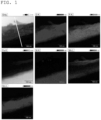
- FIG. 1 includes elemental mapping (EDS) images of O, P, Fe, Ni, Mo, and Sm.
- EDS elemental mapping
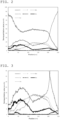
- the line scan results of metal elements, P, and O on the white line in the image labelled as "Grey" in FIG. 1 are shown in FIGS. 2 and 3.
- FIG. 3 is an enlarged view of the region from 0 to 40 atom% in FIG. 2 .
- the thickness of the coating on the surface of the magnetic material was about 200 nm.
- O was present in a larger amount than P throughout the coating.
- Mo is probably derived from the sodium molybdate added in the coating procedure
- Fe is probably derived from the magnetic material.
- FIGS. 4A and 4B show the results.
- FIG. 4A is a Mn distribution chart measured by STEM-EDX analysis using characteristic X-rays. The black colored areas indicate low Mn contents and the white colored areas indicate high Mn contents.
- the screen was divided into 512 ⁇ 512 pixels of 3 nm square, and the characteristic X-ray dose at the center of each pixel was measured by focusing the electron beam diameter to 1 nm.
- FIG. 4B is a histogram showing the distribution of Mn content.
- the distribution of Mn content is shown by dividing the Mn contents at all measurement points into the following five classes: at least 0 atom% but less than 0.05 atom% (indicated as 0-0.05 on the horizontal axis in FIG. 4B ); at least 0.05 atom% but less than 0.1 atom% (indicated as 0.05-0.1 on the horizontal axis in FIG. 4B ); at least 0.1 atom% but less than 0.15 atom% (indicated as 0.1-0.15 on the horizontal axis in FIG.
- FIG. 4B shows that the abundance ratio of pixels having a Mn concentration of at least 0 atom% but less than 0.05 atom%, which correspond to a first phase, is about 10% of the total pixels.
- the abundance ratio of pixels having a Mn content of at least 0.1 atom% is about 50% of the total pixels and is thus considered to be the abundance ratio of a second phase having a Mn content higher than the Mn content of the first phase.
- FIG. 4A and FIG. 4B show that the Fe-X alloy as a soft magnetic material used in the coated magnetic material of Example 16 was phase-separated into the first phase and the second phase.
Landscapes
- Engineering & Computer Science (AREA)
- Chemical & Material Sciences (AREA)
- Power Engineering (AREA)
- Manufacturing & Machinery (AREA)
- Mechanical Engineering (AREA)
- Chemical Kinetics & Catalysis (AREA)
- General Chemical & Material Sciences (AREA)
- Dispersion Chemistry (AREA)
- Materials Engineering (AREA)
- Metallurgy (AREA)
- Organic Chemistry (AREA)
- Electromagnetism (AREA)
- Physics & Mathematics (AREA)
- Soft Magnetic Materials (AREA)
- Powder Metallurgy (AREA)
Applications Claiming Priority (1)
| Application Number | Priority Date | Filing Date | Title |
|---|---|---|---|
| JP2023066601A JP2024152418A (ja) | 2023-04-14 | 2023-04-14 | 被覆磁性材料およびその製造方法 |
Publications (1)
| Publication Number | Publication Date |
|---|---|
| EP4447075A1 true EP4447075A1 (de) | 2024-10-16 |
Family
ID=90730332
Family Applications (1)
| Application Number | Title | Priority Date | Filing Date |
|---|---|---|---|
| EP24170047.5A Pending EP4447075A1 (de) | 2023-04-14 | 2024-04-12 | Beschichtetes magnetisches material und verfahren zur herstellung eines beschichteten magnetischen materials |
Country Status (4)
| Country | Link |
|---|---|
| US (1) | US20240344203A1 (de) |
| EP (1) | EP4447075A1 (de) |
| JP (1) | JP2024152418A (de) |
| CN (1) | CN118800581A (de) |
Citations (7)
| Publication number | Priority date | Publication date | Assignee | Title |
|---|---|---|---|---|
| WO2006006545A1 (ja) * | 2004-07-09 | 2006-01-19 | Toyota Jidosha Kabushiki Kaisha | 圧粉磁心およびその製造方法 |
| JP2011127201A (ja) | 2009-12-18 | 2011-06-30 | Hitachi Chem Co Ltd | 被覆金属粉、圧粉磁心及びこれらの製造方法 |
| US20130057371A1 (en) * | 2010-04-09 | 2013-03-07 | Takehiro Shimoyama | Coated metal powder, powder magnetic core and method for producing same |
| DE102013212866A1 (de) * | 2013-07-02 | 2015-01-08 | Robert Bosch Gmbh | Gesinterter weichmagnetischer Verbundwerkstoff und Verfahren zu dessen Herstellung |
| WO2017164376A1 (ja) | 2016-03-25 | 2017-09-28 | 国立研究開発法人産業技術総合研究所 | 磁性材料とその製造法 |
| WO2018155608A1 (ja) | 2017-02-24 | 2018-08-30 | 国立研究開発法人産業技術総合研究所 | 磁性材料とその製造法 |
| EP3376511B1 (de) * | 2015-11-10 | 2021-08-25 | Sumitomo Electric Industries, Ltd. | Herstellungsverfahren für formkörper aus kompaktpulver |
-
2023
- 2023-04-14 JP JP2023066601A patent/JP2024152418A/ja active Pending
-
2024
- 2024-04-11 CN CN202410433163.2A patent/CN118800581A/zh active Pending
- 2024-04-12 EP EP24170047.5A patent/EP4447075A1/de active Pending
- 2024-04-12 US US18/633,804 patent/US20240344203A1/en active Pending
Patent Citations (7)
| Publication number | Priority date | Publication date | Assignee | Title |
|---|---|---|---|---|
| WO2006006545A1 (ja) * | 2004-07-09 | 2006-01-19 | Toyota Jidosha Kabushiki Kaisha | 圧粉磁心およびその製造方法 |
| JP2011127201A (ja) | 2009-12-18 | 2011-06-30 | Hitachi Chem Co Ltd | 被覆金属粉、圧粉磁心及びこれらの製造方法 |
| US20130057371A1 (en) * | 2010-04-09 | 2013-03-07 | Takehiro Shimoyama | Coated metal powder, powder magnetic core and method for producing same |
| DE102013212866A1 (de) * | 2013-07-02 | 2015-01-08 | Robert Bosch Gmbh | Gesinterter weichmagnetischer Verbundwerkstoff und Verfahren zu dessen Herstellung |
| EP3376511B1 (de) * | 2015-11-10 | 2021-08-25 | Sumitomo Electric Industries, Ltd. | Herstellungsverfahren für formkörper aus kompaktpulver |
| WO2017164376A1 (ja) | 2016-03-25 | 2017-09-28 | 国立研究開発法人産業技術総合研究所 | 磁性材料とその製造法 |
| WO2018155608A1 (ja) | 2017-02-24 | 2018-08-30 | 国立研究開発法人産業技術総合研究所 | 磁性材料とその製造法 |
Also Published As
| Publication number | Publication date |
|---|---|
| JP2024152418A (ja) | 2024-10-25 |
| US20240344203A1 (en) | 2024-10-17 |
| CN118800581A (zh) | 2024-10-18 |
Similar Documents
| Publication | Publication Date | Title |
|---|---|---|
| CA3051184C (en) | Soft magnetic powder, fe-based nanocrystalline alloy powder, magnetic component and dust core | |
| KR101257248B1 (ko) | 비정질 합금 박대, 나노 결정 연자성 합금, 및 자심 | |
| KR102198781B1 (ko) | 자심, 코일 부품 및 자심의 제조 방법 | |
| EP2947670A1 (de) | Verfahren zur herstellung eines magnetpulverkerns, magnetpulverkern und spulenkomponente | |
| KR102195949B1 (ko) | 자심, 코일 부품 및 자심의 제조 방법 | |
| KR20160110372A (ko) | 자심 및 이를 이용한 코일 부품 | |
| US20090174512A1 (en) | IRON POWDER COATED WITH Mg-CONTAINING OXIDE FILM | |
| US20240347244A1 (en) | Coated soft magnetic material and method of producing coated soft magnetic material | |
| JP2020017690A (ja) | 圧粉磁心 | |
| EP3928892B1 (de) | Pulvermagnetkern und verfahren zur herstellung davon | |
| CN112309666A (zh) | 软磁性金属粉末和电子部件 | |
| EP4447075A1 (de) | Beschichtetes magnetisches material und verfahren zur herstellung eines beschichteten magnetischen materials | |
| US20240347243A1 (en) | Coated magnetic material and method of producing coated magnetic material | |
| JPS63115309A (ja) | 磁性合金粉末 | |
| JP2021086941A (ja) | Fe基軟磁性合金、薄帯、粉末、磁心、及びコイル部品 | |
| JP7783010B2 (ja) | 軟磁性合金粉末、圧粉磁心、および磁性部品 | |
| US20250329485A1 (en) | Soft magnetic material and method of producing soft magnetic material | |
| KR102837862B1 (ko) | 합금 입자, 압분 자심, 전자 소자, 전자 기기, 전동기 및 발전기 | |
| JP4586399B2 (ja) | 軟磁性材料、圧粉磁心、および軟磁性材料の製造方法 | |
| JP2008297622A (ja) | 軟磁性材料、圧粉磁心、軟磁性材料の製造方法および圧粉磁心の製造方法 | |
| KR102927257B1 (ko) | 압분 자심, 합금 입자, 전자 소자, 전자 기기, 전동기 및 발전기 | |
| KR102839350B1 (ko) | 철(Fe)-규소(Si) 합금분말을 포함하는 연자성 입자, 이를 포함하는 연자성 코어 및 그 제조 방법 | |
| KR102732530B1 (ko) | 연자성 입자, 이를 포함하는 연자성 코어 및 그 제조 방법 | |
| JP2021036577A (ja) | 圧粉磁芯 | |
| JP7783030B2 (ja) | 軟磁性金属粉末、圧粉磁心、磁性部品および電子機器 |
Legal Events
| Date | Code | Title | Description |
|---|---|---|---|
| PUAI | Public reference made under article 153(3) epc to a published international application that has entered the european phase |
Free format text: ORIGINAL CODE: 0009012 |
|
| STAA | Information on the status of an ep patent application or granted ep patent |
Free format text: STATUS: THE APPLICATION HAS BEEN PUBLISHED |
|
| AK | Designated contracting states |
Kind code of ref document: A1 Designated state(s): AL AT BE BG CH CY CZ DE DK EE ES FI FR GB GR HR HU IE IS IT LI LT LU LV MC ME MK MT NL NO PL PT RO RS SE SI SK SM TR |
|
| STAA | Information on the status of an ep patent application or granted ep patent |
Free format text: STATUS: REQUEST FOR EXAMINATION WAS MADE |
|
| 17P | Request for examination filed |
Effective date: 20250410 |