EP4450093A1 - Spaltbare immunzellen-engager - Google Patents
Spaltbare immunzellen-engager Download PDFInfo
- Publication number
- EP4450093A1 EP4450093A1 EP23168356.6A EP23168356A EP4450093A1 EP 4450093 A1 EP4450093 A1 EP 4450093A1 EP 23168356 A EP23168356 A EP 23168356A EP 4450093 A1 EP4450093 A1 EP 4450093A1
- Authority
- EP
- European Patent Office
- Prior art keywords
- groups
- antibody
- hetero
- group
- alkyl
- Prior art date
- Legal status (The legal status is an assumption and is not a legal conclusion. Google has not performed a legal analysis and makes no representation as to the accuracy of the status listed.)
- Ceased
Links
Images






Classifications
-
- A—HUMAN NECESSITIES
- A61—MEDICAL OR VETERINARY SCIENCE; HYGIENE
- A61K—PREPARATIONS FOR MEDICAL, DENTAL OR TOILETRY PURPOSES
- A61K47/00—Medicinal preparations characterised by the non-active ingredients used, e.g. carriers or inert additives; Targeting or modifying agents chemically bound to the active ingredient
- A61K47/50—Medicinal preparations characterised by the non-active ingredients used, e.g. carriers or inert additives; Targeting or modifying agents chemically bound to the active ingredient the non-active ingredient being chemically bound to the active ingredient, e.g. polymer-drug conjugates
- A61K47/51—Medicinal preparations characterised by the non-active ingredients used, e.g. carriers or inert additives; Targeting or modifying agents chemically bound to the active ingredient the non-active ingredient being chemically bound to the active ingredient, e.g. polymer-drug conjugates the non-active ingredient being a modifying agent
- A61K47/68—Medicinal preparations characterised by the non-active ingredients used, e.g. carriers or inert additives; Targeting or modifying agents chemically bound to the active ingredient the non-active ingredient being chemically bound to the active ingredient, e.g. polymer-drug conjugates the non-active ingredient being a modifying agent the modifying agent being an antibody, an immunoglobulin or a fragment thereof, e.g. an Fc-fragment
- A61K47/6801—Drug-antibody or immunoglobulin conjugates defined by the pharmacologically or therapeutically active agent
- A61K47/6803—Drugs conjugated to an antibody or immunoglobulin, e.g. cisplatin-antibody conjugates
- A61K47/6811—Drugs conjugated to an antibody or immunoglobulin, e.g. cisplatin-antibody conjugates the drug being a protein or peptide, e.g. transferrin or bleomycin
- A61K47/6813—Drugs conjugated to an antibody or immunoglobulin, e.g. cisplatin-antibody conjugates the drug being a protein or peptide, e.g. transferrin or bleomycin the drug being a peptidic cytokine, e.g. an interleukin or interferon
-
- A—HUMAN NECESSITIES
- A61—MEDICAL OR VETERINARY SCIENCE; HYGIENE
- A61K—PREPARATIONS FOR MEDICAL, DENTAL OR TOILETRY PURPOSES
- A61K47/00—Medicinal preparations characterised by the non-active ingredients used, e.g. carriers or inert additives; Targeting or modifying agents chemically bound to the active ingredient
- A61K47/50—Medicinal preparations characterised by the non-active ingredients used, e.g. carriers or inert additives; Targeting or modifying agents chemically bound to the active ingredient the non-active ingredient being chemically bound to the active ingredient, e.g. polymer-drug conjugates
- A61K47/51—Medicinal preparations characterised by the non-active ingredients used, e.g. carriers or inert additives; Targeting or modifying agents chemically bound to the active ingredient the non-active ingredient being chemically bound to the active ingredient, e.g. polymer-drug conjugates the non-active ingredient being a modifying agent
- A61K47/68—Medicinal preparations characterised by the non-active ingredients used, e.g. carriers or inert additives; Targeting or modifying agents chemically bound to the active ingredient the non-active ingredient being chemically bound to the active ingredient, e.g. polymer-drug conjugates the non-active ingredient being a modifying agent the modifying agent being an antibody, an immunoglobulin or a fragment thereof, e.g. an Fc-fragment
- A61K47/6835—Medicinal preparations characterised by the non-active ingredients used, e.g. carriers or inert additives; Targeting or modifying agents chemically bound to the active ingredient the non-active ingredient being chemically bound to the active ingredient, e.g. polymer-drug conjugates the non-active ingredient being a modifying agent the modifying agent being an antibody, an immunoglobulin or a fragment thereof, e.g. an Fc-fragment the modifying agent being an antibody or an immunoglobulin bearing at least one antigen-binding site
- A61K47/6849—Medicinal preparations characterised by the non-active ingredients used, e.g. carriers or inert additives; Targeting or modifying agents chemically bound to the active ingredient the non-active ingredient being chemically bound to the active ingredient, e.g. polymer-drug conjugates the non-active ingredient being a modifying agent the modifying agent being an antibody, an immunoglobulin or a fragment thereof, e.g. an Fc-fragment the modifying agent being an antibody or an immunoglobulin bearing at least one antigen-binding site the antibody targeting a receptor, a cell surface antigen or a cell surface determinant
-
- A—HUMAN NECESSITIES
- A61—MEDICAL OR VETERINARY SCIENCE; HYGIENE
- A61K—PREPARATIONS FOR MEDICAL, DENTAL OR TOILETRY PURPOSES
- A61K47/00—Medicinal preparations characterised by the non-active ingredients used, e.g. carriers or inert additives; Targeting or modifying agents chemically bound to the active ingredient
- A61K47/50—Medicinal preparations characterised by the non-active ingredients used, e.g. carriers or inert additives; Targeting or modifying agents chemically bound to the active ingredient the non-active ingredient being chemically bound to the active ingredient, e.g. polymer-drug conjugates
- A61K47/51—Medicinal preparations characterised by the non-active ingredients used, e.g. carriers or inert additives; Targeting or modifying agents chemically bound to the active ingredient the non-active ingredient being chemically bound to the active ingredient, e.g. polymer-drug conjugates the non-active ingredient being a modifying agent
- A61K47/68—Medicinal preparations characterised by the non-active ingredients used, e.g. carriers or inert additives; Targeting or modifying agents chemically bound to the active ingredient the non-active ingredient being chemically bound to the active ingredient, e.g. polymer-drug conjugates the non-active ingredient being a modifying agent the modifying agent being an antibody, an immunoglobulin or a fragment thereof, e.g. an Fc-fragment
- A61K47/6835—Medicinal preparations characterised by the non-active ingredients used, e.g. carriers or inert additives; Targeting or modifying agents chemically bound to the active ingredient the non-active ingredient being chemically bound to the active ingredient, e.g. polymer-drug conjugates the non-active ingredient being a modifying agent the modifying agent being an antibody, an immunoglobulin or a fragment thereof, e.g. an Fc-fragment the modifying agent being an antibody or an immunoglobulin bearing at least one antigen-binding site
- A61K47/6851—Medicinal preparations characterised by the non-active ingredients used, e.g. carriers or inert additives; Targeting or modifying agents chemically bound to the active ingredient the non-active ingredient being chemically bound to the active ingredient, e.g. polymer-drug conjugates the non-active ingredient being a modifying agent the modifying agent being an antibody, an immunoglobulin or a fragment thereof, e.g. an Fc-fragment the modifying agent being an antibody or an immunoglobulin bearing at least one antigen-binding site the antibody targeting a determinant of a tumour cell
- A61K47/6855—Medicinal preparations characterised by the non-active ingredients used, e.g. carriers or inert additives; Targeting or modifying agents chemically bound to the active ingredient the non-active ingredient being chemically bound to the active ingredient, e.g. polymer-drug conjugates the non-active ingredient being a modifying agent the modifying agent being an antibody, an immunoglobulin or a fragment thereof, e.g. an Fc-fragment the modifying agent being an antibody or an immunoglobulin bearing at least one antigen-binding site the antibody targeting a determinant of a tumour cell the tumour determinant being from breast cancer cell
-
- A—HUMAN NECESSITIES
- A61—MEDICAL OR VETERINARY SCIENCE; HYGIENE
- A61K—PREPARATIONS FOR MEDICAL, DENTAL OR TOILETRY PURPOSES
- A61K47/00—Medicinal preparations characterised by the non-active ingredients used, e.g. carriers or inert additives; Targeting or modifying agents chemically bound to the active ingredient
- A61K47/50—Medicinal preparations characterised by the non-active ingredients used, e.g. carriers or inert additives; Targeting or modifying agents chemically bound to the active ingredient the non-active ingredient being chemically bound to the active ingredient, e.g. polymer-drug conjugates
- A61K47/51—Medicinal preparations characterised by the non-active ingredients used, e.g. carriers or inert additives; Targeting or modifying agents chemically bound to the active ingredient the non-active ingredient being chemically bound to the active ingredient, e.g. polymer-drug conjugates the non-active ingredient being a modifying agent
- A61K47/68—Medicinal preparations characterised by the non-active ingredients used, e.g. carriers or inert additives; Targeting or modifying agents chemically bound to the active ingredient the non-active ingredient being chemically bound to the active ingredient, e.g. polymer-drug conjugates the non-active ingredient being a modifying agent the modifying agent being an antibody, an immunoglobulin or a fragment thereof, e.g. an Fc-fragment
- A61K47/6889—Conjugates wherein the antibody being the modifying agent and wherein the linker, binder or spacer confers particular properties to the conjugates, e.g. peptidic enzyme-labile linkers or acid-labile linkers, providing for an acid-labile immuno conjugate wherein the drug may be released from its antibody conjugated part in an acidic, e.g. tumoural or environment
-
- A—HUMAN NECESSITIES
- A61—MEDICAL OR VETERINARY SCIENCE; HYGIENE
- A61P—SPECIFIC THERAPEUTIC ACTIVITY OF CHEMICAL COMPOUNDS OR MEDICINAL PREPARATIONS
- A61P35/00—Antineoplastic agents
-
- A—HUMAN NECESSITIES
- A61—MEDICAL OR VETERINARY SCIENCE; HYGIENE
- A61P—SPECIFIC THERAPEUTIC ACTIVITY OF CHEMICAL COMPOUNDS OR MEDICINAL PREPARATIONS
- A61P37/00—Drugs for immunological or allergic disorders
-
- C—CHEMISTRY; METALLURGY
- C07—ORGANIC CHEMISTRY
- C07K—PEPTIDES
- C07K14/00—Peptides having more than 20 amino acids; Gastrins; Somatostatins; Melanotropins; Derivatives thereof
- C07K14/435—Peptides having more than 20 amino acids; Gastrins; Somatostatins; Melanotropins; Derivatives thereof from animals; from humans
- C07K14/52—Cytokines; Lymphokines; Interferons
- C07K14/54—Interleukins [IL]
-
- C—CHEMISTRY; METALLURGY
- C07—ORGANIC CHEMISTRY
- C07K—PEPTIDES
- C07K14/00—Peptides having more than 20 amino acids; Gastrins; Somatostatins; Melanotropins; Derivatives thereof
- C07K14/435—Peptides having more than 20 amino acids; Gastrins; Somatostatins; Melanotropins; Derivatives thereof from animals; from humans
- C07K14/52—Cytokines; Lymphokines; Interferons
- C07K14/54—Interleukins [IL]
- C07K14/5443—IL-15
-
- C—CHEMISTRY; METALLURGY
- C07—ORGANIC CHEMISTRY
- C07K—PEPTIDES
- C07K16/00—Immunoglobulins [IG], e.g. monoclonal or polyclonal antibodies
- C07K16/18—Immunoglobulins [IG], e.g. monoclonal or polyclonal antibodies against material from animals or humans
- C07K16/28—Immunoglobulins [IG], e.g. monoclonal or polyclonal antibodies against material from animals or humans against receptors, cell surface antigens or cell surface determinants
- C07K16/2803—Immunoglobulins [IG], e.g. monoclonal or polyclonal antibodies against material from animals or humans against receptors, cell surface antigens or cell surface determinants against the immunoglobulin superfamily
- C07K16/2827—Immunoglobulins [IG], e.g. monoclonal or polyclonal antibodies against material from animals or humans against receptors, cell surface antigens or cell surface determinants against the immunoglobulin superfamily against B7 molecules, e.g. CD80, CD86
-
- C—CHEMISTRY; METALLURGY
- C07—ORGANIC CHEMISTRY
- C07K—PEPTIDES
- C07K16/00—Immunoglobulins [IG], e.g. monoclonal or polyclonal antibodies
- C07K16/18—Immunoglobulins [IG], e.g. monoclonal or polyclonal antibodies against material from animals or humans
- C07K16/32—Immunoglobulins [IG], e.g. monoclonal or polyclonal antibodies against material from animals or humans against translation products of oncogenes
-
- A—HUMAN NECESSITIES
- A61—MEDICAL OR VETERINARY SCIENCE; HYGIENE
- A61K—PREPARATIONS FOR MEDICAL, DENTAL OR TOILETRY PURPOSES
- A61K39/00—Medicinal preparations containing antigens or antibodies
- A61K2039/505—Medicinal preparations containing antigens or antibodies comprising antibodies
-
- C—CHEMISTRY; METALLURGY
- C07—ORGANIC CHEMISTRY
- C07K—PEPTIDES
- C07K2317/00—Immunoglobulins specific features
- C07K2317/90—Immunoglobulins specific features characterized by (pharmaco)kinetic aspects or by stability of the immunoglobulin
- C07K2317/94—Stability, e.g. half-life, pH, temperature or enzyme-resistance
Definitions
- the present invention relates to immune cell engagers generated from antibodies and other polypeptides. More specifically the invention relates to conjugates, compositions and methods suitable for the attachment of an immune cell-binding polypeptide of interest to an antibody via a cleavable linker without requiring genetic engineering of the antibody before such attachment.
- the resulting antibody-immune cell engager conjugates as compounds, compositions, and methods can be useful, for example, in immunotherapy for cancer patients.
- Antibody-drug conjugates are comprised of an antibody to which is attached a pharmaceutical agent.
- the antibodies also known as ligands
- the antibodies can be small protein formats (scFv's, Fab fragments, DARPins, Affibodies, etc.) but are generally monoclonal antibodies (mAbs) which have been selected based on their high selectivity and affinity for a given antigen, their long circulating half-lives, and little to no immunogenicity.
- mAbs as protein ligands for a carefully selected biological receptor provide an ideal delivery platform for selective targeting of pharmaceutical drugs.
- a monoclonal antibody known to bind selectively with a specific cancer-associated antigen can be used for delivery of a chemically conjugated cytotoxic agent to the tumour, via binding, internalization, intracellular processing and finally release of active catabolite.
- the cytotoxic agent may be small molecule toxin, a protein toxin or other formats, like oligonucleotides.
- an antibacterial drug antibiotic
- conjugates of anti-inflammatory drugs are under investigation for the treatment of autoimmune diseases and for example attachment of an oligonucleotide to an antibody is a potential promising approach for the treatment of neuromuscular diseases.
- the concept of targeted delivery of an active pharmaceutical drug to a specific cellular location of choice is a powerful approach for the treatment of a wide range of diseases, with many beneficial aspects versus systemic delivery of the same drug.
- an alternative strategy to employ monoclonal antibodies for targeted delivery of a specific protein agent is by genetic fusion of the latter protein to one (or more) of the antibody's termini, which can be the N-terminus or the C-terminus on the light chain or the heavy chain (or both).
- the biologically active protein of interest e.g. a protein toxin like Pseudomonas exotoxin A (PE38) or an anti-CD3 single chain variable fragment (scFv)
- Pseudomonas exotoxin A (PE38) or an anti-CD3 single chain variable fragment (scFv) is genetically encoded as a fusion to the antibody, possibly but not necessarily via a peptide spacer, so the antibody is expressed as a fusion protein.
- the peptide spacer may contain a protease-sensitive cleavage site, or not.
- a monoclonal antibody may also be genetically modified in the protein sequence itself to modify its structure and thereby introduce (or remove) specific properties. For example, mutations can be made in the antibody Fc-fragment in order to nihilate binding to Fc-gamma receptors, binding to the FcRn receptor or binding to a specific cancer target may be modulated, or antibodies can be engineered to lower the pl and control the clearance rate from circulation.
- An emerging strategy in therapeutic treatment involves the use of an antibody that is able to bind simultaneously to multiple antigens or epitopes, a so-called bispecific antibody (simultaneously addressing two different antigens or epitopes), or a trispecific antibody (addressing three different antigens of epitopes), and so forth, as summarized in Kontermann and Brinkmann, Drug Discov. Today 2015, 20, 838-847 , incorporated by reference.
- a bispecific antibody with 'two-target' functionality can interfere with multiple surface receptors or ligands associated, for example with cancer, proliferation or inflammatory processes.
- Bispecific antibodies can also place targets into close proximity, either to support protein complex formation on one cell, or to trigger contacts between cells.
- bispecific antibodies that support protein complexation in the clotting cascade, or tumor-targeted immune cell recruiters and/or activators.
- bispecific antibodies vary in the number of antigen-binding sites, geometry, half-life in the blood serum, and effector function.
- bispecific antibodies are generated by one of three methods by somatic fusion of two hybridoma lines (quadroma), by genetic (protein/cell) engineering, or by chemical conjugation with cross-linkers, totalling more than 60 different technological platforms today.
- IgG-like formats based on full IgG molecular architectures include but are not limited to IgG with dual-variable domain (DVD-lg), Duobody technology, knob-in-hole (KIH) technology, common light chain technology and cross-mAb technology, while truncated IgG versions include ADAPTIR, XmAb and BEAT technologies.
- Non-IgG-like approaches include but are not limited BITE, DART, TandAb and ImmTAC technologies.
- Bispecific antibodies can also be generated by fusing different antigen-binding moieties (e.g., scFv or Fab) to other protein domains, which enables further functionalities to be included.
- two scFv fragments have been fused to albumin, which endows the antibody fragments with the long circulation time of serum albumin, as demonstrated by Müller et al., J. Biol. Chem. 2007, 282, 12650-12660 , incorporated by reference.
- Another example is the ⁇ dock-and-lock' approach based on heterodimerization of cAMP-dependent protein kinase A and protein A kinase-anchoring protein, as reported by Rossi et al., Proc. Nat. Acad. Sci. 2006, 103, 6841-6846 , incorporated by reference.
- bispecific antibodies that have been or are currently under clinic development are catumaxomab (EpCAM ⁇ CD3), blinatumomab (CD19 ⁇ CD3), GBR1302 (Her2 ⁇ CD3), MEDI-565 (CEA ⁇ CD3), BAY2010112 (PSMA ⁇ CD3), RG7221 (angiopoietin ⁇ VEGF), RG6013 (FIX ⁇ FX), RG7597 (Her1 ⁇ Her3), MCLA128 (Her2 ⁇ Her3), MM111 (Her2 ⁇ Her3), MM141 (IGF1R ⁇ Her3), ABT122 (TNFalpha ⁇ IL17), ABT981 (IL1a ⁇ II1b), ALX0761 (IL17A ⁇ IL17F), SAR156597 (IL4 ⁇ IL13), AFM13 (CD30 ⁇ CD16) and LY3164530 (Her1 ⁇ cMET).
- a popular strategy in the field of cancer therapy employs a bispecific antibody binding to an upregulated tumor-associated antigen (TAA or simply target) as well as to a receptor present on a cancer-destroying immune cell. e.g. a T cell or an NK cell.
- TAA tumor-associated antigen
- a receptor present on a cancer-destroying immune cell e.g. a T cell or an NK cell.
- Such bispecific antibodies are also known as T cell or NK cell-redirecting antibodies, respectively.
- blinatumomab The basis for the approval of blinatumomab (2014) resulted from a single-arm trial with a 32% complete remission rate and a minimal residual disease (MRD) response (31%) in all patients treated.
- MRD minimal residual disease
- 51 clinical trials of blinatumomab are being carried out for ALL (39 trials), NHL (10 trials), multiple myeloma (1 trial) and lymphoid cancer with Richter's transformation (1 trial).
- Blinatumomab suffers from a main drawback because of its short serum half-life (2.11 h, due to the relatively small molecule and simple structure), and patients require continuous intravenous infusion.
- therapeutic bispecific antibodies cause different side effects, the most common of which are nausea, vomiting, abdominal pain, fatigue, leukopenia, neutropenia, and thrombopenia.
- Abs against therapeutic bispecific antibodies appear in the blood during treatment.
- Most adverse events occur during the beginning of therapy, and in most cases side effects normalize under continued treatment.
- the majority of data on therapeutic BsAb adverse effects are available on blinatumomab and catumaxomab, since these drugs have undergone numerous clinical trials.
- a common side effect of blinatumomab and catumaxomab therapy is "cytokine storm", elevation of cytokine levels and some neurological events.
- Cytokine release-related symptoms are general side effects of many therapeutic mAbs and occur due to specific mechanisms of action: use of cytotoxic T cells as effectors. Minimizing cytokine-release syndrome is possible with a low initial dose of the drug in combination with subsequent high doses, as well as corticosteroid (dexamethasone) and antihistamine premedication.
- the resulting bispecific antibody is associated with a long half-life and high potency enabled by high-avidity bivalent binding to CD20 and head-to-tail orientation of B- and T cell-binding domains in a 2:1 molecular format.
- a heterodimeric human IgG1 Fc region carrying the "PG LALA" mutations was incorporated to abolish binding to Fcg receptors and to complement component C1q while maintaining neonatal Fc receptor (FcRn) binding, enabling a long circulatory half-life.
- the bispecific CD20-T cell engagers displays considerably higher potency than other CD20-TCB antibodies in clinical development and is efficacious on tumor cells expressing low levels of CD20.
- CD20-TCB also displays potent activity in primary tumor samples with low effector:target ratios.
- T cell-redirecting bispecific antibodies are amongst the most used approaches in cancer treatment and the first report in which bispecific antibodies specifically engaged CD3 on T cells on one side and the antigens of cancer cells independent of their T cell receptor (TCR) on the other side, was published 30 years ago. T cell-redirecting antibodies have made considerable progress in hematological malignancies and solid tumour treatments in the past 10 years.
- Catumaxomab is the first bispecific antibody of its kind targeting epithelial cell adhesion molecule (EpCAM) and CD3, which was approved in Europe (2009) for the treatment of malignant ascites (but withdrawn in 2017 for commercial reasons).
- blindatumomab Another successful bispecific targeting CD19 and CD3 (blinatumomab), which was given marketing permission by the FDA for relapsed or refractory precursor B-cell acute lymphoblastic leukemia (ALL) treatment in 2014.
- ALL B-cell acute lymphoblastic leukemia
- T cells to the tumor are currently expanded to other receptors, which are at the same time costimulatory, such as CD137 (4-1 BB), CD134 (OX40), CD27 or ICOS.
- CD137 In the field of CD137 targeting, agonistic monoclonal antibodies (so not bispecific) have shown much preclinical promise but their clinical development has been slow due to a poor therapeutic index, in particular liver toxicity.
- CD137 is expressed on T cells that are already primed to recognize tumor antigen through MHC/TCR interaction. It is a TNFRSF (tumor necrosis factor receptor super family) member which requires clustering to deliver an activating signal to T cells.
- TNFRSF tumor necrosis factor receptor super family
- Monospecific monoclonal antibodies that can agonise CD137 are in the clinic and known to be potent T cell activators but suffer from treatment-limiting hepatotoxicity due to Fc-receptor and multivalent format-driven clustering.
- Bispecific tumor-targeted antibodies that are monovalent for CD137, are unable to cause CD137 clustering in normal tissue. Only upon binding of the bispecific antibody to a tumor-associated antigen on tumor cells, clustering of co-engaged CD137 on tumor-associated T cells is induced. This drives a highly potent but tumor-specific T cell activation.
- the tumor-targeted cross-linking of Cd137/4-1 BB might provide a safe and effective way for co-stimulation of T cells for cancer immunotherapy and its combination with T cell bispecific antibodies may provide a convenient "off-the-shelf," systemic cancer immunotherapy approach for many tumor types.
- anti-CD137-based bispecific antibodies in clinical development include MP0310 (FAP ⁇ CD137), RG7827 (FAP ⁇ CD137), ALG.APV-527 (5T4 ⁇ CD137), MCLA145 (PD-1 ⁇ CD137), PRS342 (glypican-3 ⁇ CD137), PRS-343 (Her2 ⁇ CD137), CB307 (PSMA ⁇ CD137).
- MP0310 FAP ⁇ CD137
- RG7827 FAP ⁇ CD137
- ALG.APV-527 5T4 ⁇ CD137
- MCLA145 PD-1 ⁇ CD137
- PRS342 glypican-3 ⁇ CD137
- PRS-343 Her2 ⁇ CD137
- CB307 PSMA ⁇ CD137
- Antibodies known to bind T cells are known in the art, highlighted by Martin et al., Clin. Immunol. 2013, 148, 136-147 and Rossi et al., Int. Immunol. 2008, 20, 1247-1258 , both incorporated by reference, for example OKT3, UCHT3, BMA031 and humanized versions thereof.
- Antibodies known to bind to V ⁇ 9V ⁇ 2 T cells are also known, see for example de Bruin et al., J. Immunol. 2017, 198, 308-317 , incorporated by reference.
- NK cell recruitment to the tumor microenvironment is under broad investigation.
- NK cell engagement is typically based on binding CD16, CD56, NKp46, or other NK cell specific receptors, as summarized in Konjevic et al., 2017, http://dx.doi.org/10.5772/intechopen.69729, incorporated by reference.
- NK cell engagers can be generated by fusion or insertion of an NK-binding antibody (fragment) to a full IgG binding to a tumor-associated antigen.
- cytokines can also be employed, given that NK cell antitumor activity is regulated by numerous activating and inhibitory NK cell receptors, alterations in NK cell receptor expression and signaling underlie diminished cytotoxic NK cell function. Based on this and on predictive in vitro findings, cytokines including IFN ⁇ , IL-2, IL-12, IL-15, and IL-18 have been used systemically or for ex vivo activation and expansion of NK cells and have led to improved NK cells antitumor activity by increasing the expression of NK cell activating receptors and by inducing cytotoxic effector molecules.
- this cytokine-based therapy enhances NK cell proliferation and regulatory function, and it has been shown that it induces NK cells exhibiting cytokine induced memory-like properties that represent a newly defined NK cell subset with improved NK cell activity and longevity.
- cytokine payloads have been developed and tested in preclinical trials.
- Proinflammatory cytokines such as IL-2, TNF and IL-12 have been investigated for tumor therapy, as they have been found to increase and activate the local infiltrate of leukocytes at the tumor site.
- IL-2 monotherapy has been approved as aldesleukin (Proleukin ® ) and is in phase III clinical trials in combination with nivolumab (NKTR-214).
- various recombinant versions of IL-15 are under clinical evaluation (rhIL-15 or ALT-803).
- Specific mutants of IL-15 have been reported, for example by Behár et al., Prot. Engin. Des. Sel. 2011, 24, 283-290 and Silva et al., Nature 2019, 565, 186-191 , both incorporated by reference, and the complex of IL-15 with IL-15 receptor (IL-15R), as reported by Rubinstein et al., Proc. Nat. Acad. Sci.
- immunosuppressive cytokines such as IL-10 may be considered as payloads for the treatment of chronic inflammatory conditions or of other diseases (e.g., endometriosis).
- pro-inflammatory cytokines can lead to severe off-target-related adverse effects, which may limit the dose and prevent escalation to therapeutically active regimens.
- Certain cytokine products e.g., IL-2, TNF, IL-12
- IL-2, TNF, IL-12 have exhibited recommended doses in the single-digit milligram range (per person) or even below.
- Adverse effects associated with the intravenous administration of pro-inflammatory cytokines may include hypotension, fever, nausea or flu-like symptoms, and may occasionally also cause serious haematologic, endocrine, autoimmune or neurologic events.
- a common strategy in the field of immune cell engagement employs nihilation or removal of binding capacity of the antibody to Fc-gamma receptors, which has multiple pharmaceutical implications.
- the first consequence of removal of binding to Fc-gamma receptors is the reduction of Fc-gamma receptor-mediated uptake of antibodies by e.g. macrophages or megakaryocytes, which may lead to dose-limiting toxicity as for example reported for Kadcyla ® (trastuzumab-DM1) and LOP628.
- Selective deglycosylation of antibodies in vivo affords opportunities to treat patients with antibody-mediated autoimmunity.
- Roche is developing T cell-engagers based on asymmetric monoclonal antibodies that retain bivalent binding capacity to the TAA (for example CD20 or CEA) by both CDRs, but with an additional anti-CD3 fragment engineered into one of the two heavy chains only (2:1 ratio of target-binding:CD3-binding).
- Similar strategies can be employed for engagement/activation of T cells with anti-CD137 (4-1BB), anti-OX40, anti-CD27 or NK cell-engagement/activation with anti-CD16, CD56, NKp46, or other NK cell specific receptors.
- Abrogation of binding to Fc-gamma receptor can be achieved in various ways, for example by specific mutations in the antibody (specifically the Fc-fragment) or by removal of the glycan that is naturally present in the Fc-fragment (C H 2 domain, around N297).
- Glycan removal can be achieved by genetic modification in the Fc-domain, e.g. a N297Q mutation or T299A mutation, or by enzymatic removal of the glycan after recombinant expression of the antibody, using for example PNGase F or an endoglycosidase.
- endoglycosidase H is known to trim high-mannose and hybrid glycoforms
- endoglycosidase S is able to trim complex type glycans and to some extent hybrid glycan.
- Endoglycosidase S2 is able to trim both complex, hybrid and high-mannose glycoforms.
- Endoglycosidase F2 is able to trim complex glycans (but not hybrid), while endoglycosidase F3 can only trim complex glycans that are also 1 ,6-fucosylated.
- Another endoglycosidase, endoglycosidase D is able to hydrolyze Man5 (M5) glycan only.
- Inspiration may be taken from the field of ADC technologies to prepare antibody-protein conjugates for the generation of bispecific antibodies or antibody-cytokine fusions.
- Main chemistry for the alkylation of the thiol group in cysteine side-chain is based on the use of maleimide reagents, as is for example applied in the manufacuting of Adcetris ® .
- maleimide reagents as is for example applied in the manufacuting of Adcetris ® .
- a range of maleimide variants are also applied for more stable cysteine conjugation, as for example demonstrated by James Christie et al., J. Contr. Rel. 2015, 220, 660-670 and Lyon et al., Nat. Biotechnol. 2014, 32, 1059-1062 , both incorporated by reference.
- cysteine side-chain Another important technology for conjugation to cysteine side-chain is by means of disulfide bond, a bioactivatable connection that has been utilized for reversibly connecting protein toxins, chemotherapeutic drugs, and probes to carrier molecules (see for example Pillow et al., Chem. Sci. 2017, 8, 366-370 .
- Other approaches for cysteine alkylation involve for example nucleophilic substitution of haloacetamides (typically bromoacetamide or iodoacetamide), see for example Alley et al., Bioconj. Chem.
- reaction with acrylate reagents see for example Bernardim et al., Nat. Commun. 2016, 7, DOI: 10.1038/ncomms13128 and Ariyasu et al., Bioconj. Chem. 2017, 28, 897-902 , both incorporated by reference, reaction with phosphonamidates, see for example Kasper et al., Angew. Chem. Int. Ed. 2019, 58, 11625-11630 , incorporated by reference, reaction with allenamides, see for example Abbas et al., Angew. Chem. Int. Ed.
- reaction with cyanoethynyl reagents see for example Kolodych et al., Bioconj. Chem. 2015, 26, 197-200 , incorporated by reference, reaction with vinylsulfones, see for example Gil de Montes et al., Chem. Sci. 2019, 10, 4515-4522, incorporated by reference, or reaction with vinylpyridines, see for example https://iksuda.com/science/permalink/ (accessed Jan. 7th, 2020 ).
- Reaction with methylsulfonylphenyloxadiazole has also been reported for cysteine conjugation by Toda et al., Angew. Chem. Int. Ed. 2013, 52, 12592-12596 , incorporated by reference.
- a number of processes have been developed that enable the generation of an antibody-drug conjugate with defined drug-to-antibody ratio (DAR), by site-specific conjugation to a (or more) predetermined site(s) in the antibody.
- Site-specific conjugation is typically achieved by engineering of a specific amino acid (or sequence) into an antibody, serving as the anchor point for payload attachment, see for example Aggerwal and Bertozzi, Bioconj. Chem. 2014, 53, 176-192 , incorporated by reference, most typically engineering of cysteine.
- a range of other site-specific conjugation technologies has been explored in the past decade, most prominently genetic encoding of a non-natural amino acid, e.g.
- ADCs prepared by cross-linking of cysteines have a drug-to-antibody loading of ⁇ 4 (DAR4).
- DAR1 conjugates can be prepared from antibody Fab fragments (prepared by papain digestion of full antibody or recombinant expression) by selective reduction of the C H 1 and C L interchain disulfide chain, followed by rebridging the fragment by treatment with a symmetrical PDB dimer containing two maleimide units.
- the resulting DAR1-type Fab fragments were shown to be highly homogeneous, stable in serum and show excellent cytotoxicity.
- DAR1 conjugates can also be prepared from full IgG antibodies, after prior engineering of the antibody: either an antibody is used which has only one intrachain disulfide bridge in the hinge region (Flexmab technology, reported in Dimasi et al., J. Mol. Biol. 2009, 393, 672-692 , incorporated by reference) or an antibody is used which has an additional free cysteine, which may be obtained by mutation of a natural amino acid (e.g. HC-S239C) or by insertion into the sequence ( e.g .
- TCO trans-cyclooctene
- site-specific introduction of TCO (or tetrazine or cyclopropene other click moieties for tetrazine ligation) onto antibodies can be achieved by a multitude of methods based on prior genetic modification of the antibody as described above and for example reported by Lang et al., J. Am. Chem. Soc. 2012, 134, 10317-10320 , Seitchik et al., J. Am. Chem. Soc. 2012, 134, 2898-2901 and Oller-Salvia, Angew. Chem. Int. Ed. 2018, 57, 2831-2834 , all incorporated by reference.
- Sortase is a suitable enzyme for site-specific modification of proteins after prior introduction of a sortase recognition sequence, as first reported by Popp et al., Nat. Chem. Biol. 2007, 3, 707-708 ).
- Many other enzyme-enzyme recognition sequence combinations are also known for site-specific protein modification, as for example summarized by Milczek, Chem. Rev. 2018, 118, 119-141 , incorporated by reference, and specifically applied to antibodies as summarized by Falck and Müller, Antibodies 2018, 7, 4 (doi:10.3390/antib7010004 ) and van Berkel and van Delft, Drug Discov. Today: Technol. 2018, 30, 3-10 , both incorporated by reference.
- an immune cell engager can be readily generated while the stoichiometry of tumor-binding antibody to immune cell binder can be tailored by proper choice of technology.
- CCAP affinity peptide
- Fusion proteins comprising a cleavable linker have been described in for example WO2021198490 , WO2021188835 and WO2019/173832 .
- the cleavable linker may connect a masking agent with the rest of the fusion protein as described in WO2021188835 or WO2019/173832 .
- no methods have been reported for the preparation of a homogenous antibody-cytokine conjugate that is connected via a chemical linker, wherein the cytokine is released upon cleavage by a protease.
- the present invention concerns an antibody-cytokine conjugate in which a cytokine is connected to an antibody via a chemical linker, the antibody-cytokine conjugate enables for targeted delivery of the cytokine by release of the cytokine at the target.
- the antibody-cytokine conjugate can be produced without requiring genetic modification of the IgG.
- the current invention enables tailoring of the molecular format of the antibody-cytokine conjugate to be defined in 2:1 or 2:2 ratio, i.e. the ratio of complement-dependent regions in full IgG CDR (2) versus immune cell-engaging polypeptide (1 or 2).
- the conjugates according to the present invention have a higher efficacy and therapeutic window than a genetic fusion of an antibody and an immune cell engager.
- the inventors believe that the immune cell-engaging polypeptide of a fusion protein is glycosylated which results in a heterogeneous product having variable efficacy, the average efficacy of said heterogenous immune-cell engaging polypeptide is believed to be lower than that of a homogeneous aglycosylated product.
- a first aspect of the present invention relates to a cleavable antibody-cytokine conjugate.
- the present invention relates to the cleavable antibody immunocytokine conjugate for medical treatment.
- the present invention relates to a process for preparing the antibody-cytokine conjugate.
- the compounds disclosed in this description and in the claims may comprise one or more asymmetric centres, and different diastereomers and/or enantiomers may exist of the compounds.
- the description of any compound in this description and in the claims is meant to include all diastereomers, and mixtures thereof, unless stated otherwise.
- the description of any compound in this description and in the claims is meant to include both the individual enantiomers, as well as any mixture, racemic or otherwise, of the enantiomers, unless stated otherwise.
- the structure of a compound is depicted as a specific enantiomer, it is to be understood that the invention of the present application is not limited to that specific enantiomer.
- the compounds may occur in different tautomeric forms.
- the compounds according to the invention are meant to include all tautomeric forms, unless stated otherwise.
- the structure of a compound is depicted as a specific tautomer, it is to be understood that the invention of the present application is not limited to that specific tautomer.
- the compounds disclosed in this description and in the claims may exist as cis and trans isomers. Unless stated otherwise, the description of any compound in the description and in the claims is meant to include both the individual cis and the individual trans isomer of a compound, as well as mixtures thereof. As an example, when the structure of a compound is depicted as a cis isomer, it is to be understood that the corresponding trans isomer or mixtures of the cis and trans isomer are not excluded from the invention of the present application. When the structure of a compound is depicted as a specific cis or trans isomer, it is to be understood that the invention of the present application is not limited to that specific cis or trans isomer.
- the compounds according to the invention may exist in salt form, which are also covered by the present invention.
- the salt is typically a pharmaceutically acceptable salt, containing a pharmaceutically acceptable anion.
- the term "salt thereof' means a compound formed when an acidic proton, typically a proton of an acid, is replaced by a cation, such as a metal cation or an organic cation and the like.
- the salt is a pharmaceutically acceptable salt, although this is not required for salts that are not intended for administration to a patient.
- the compound may be protonated by an inorganic or organic acid to form a cation, with the conjugate base of the inorganic or organic acid as the anionic component of the salt.
- salt means a salt that is acceptable for administration to a patient, such as a mammal (salts with counter ions having acceptable mammalian safety for a given dosage regime). Such salts may be derived from pharmaceutically acceptable inorganic or organic bases and from pharmaceutically acceptable inorganic or organic acids.
- “Pharmaceutically acceptable salt” refers to pharmaceutically acceptable salts of a compound, which salts are derived from a variety of organic and inorganic counter ions known in the art and include, for example, sodium, potassium, calcium, magnesium, ammonium, tetraalkylammonium, etc., and when the molecule contains a basic functionality, salts of organic or inorganic acids, such as hydrochloride, hydrobromide, formate, tartrate, besylate, mesylate, acetate, maleate, oxalate, etc.
- protein is herein used in its normal scientific meaning.
- polypeptides comprising about 10 or more amino acids are considered proteins.
- a protein may comprise natural, but also unnatural amino acids.
- the term "monosaccharide” is herein used in its normal scientific meaning and refers to an oxygen-containing heterocycle resulting from intramolecular hemiacetal formation upon cyclisation of a chain of 5-9 (hydroxylated) carbon atoms, most commonly containing five carbon atoms (pentoses), six carbon atoms (hexose) or nine carbon atoms (sialic acid).
- Typical monosaccharides are ribose (Rib), xylose (Xyl), arabinose (Ara), glucose (Glu), galactose (Gal), mannose (Man), glucuronic acid (GlcA), N-acetylglucosamine (GIcNAc), N-acetylgalactosamine (GaINAc) and N-acetylneuraminic acid (NeuAc).
- cytokine is herein used in its normal scientific meaning and are small molecule proteins (5-20 kDa) that modulate the activity of immune cells by binding to their cognate receptors and by triggering subsequent cell signalling.
- Cytokines include chemokines, interferons (IFN), interleukins, monokines, lymphokines, colony-stimulating factors (CSF) and tumour necrosis factors (TNF).
- cytokines examples include IL-1 alpha (IL1a), IL-1 beta (IL1b), IL-2 (IL2), IL-4 (IL4), IL-5 (IL5), IL-6 (IL6) , IL8 (IL-8), IL-10 (IL10), IL-12 (IL12), IL-15 (IL15), IFN-alpha (IFNA), IFN-gamma (IFN-G), and TNF-alpha (TNFA).
- antibody is herein used in its normal scientific meaning.
- An antibody is a protein generated by the immune system that is capable of recognizing and binding to a specific antigen.
- An antibody is an example of a glycoprotein.
- the term antibody herein is used in its broadest sense and specifically includes monoclonal antibodies, polyclonal antibodies, dimers, multimers, multi-specific antibodies (e.g. bispecific antibodies), antibody fragments, and double and single chain antibodies.
- antibody is herein also meant to include human antibodies, humanized antibodies, chimeric antibodies and antibodies specifically binding cancer antigen.
- antibody is meant to include whole immunoglobulins, but also antigen-binding fragments of an antibody.
- the term includes genetically engineered antibodies and derivatives of an antibody.
- Antibodies, fragments of antibodies and genetically engineered antibodies may be obtained by methods that are known in the art.
- Typical examples of antibodies include, amongst others, abciximab, rituximab, basiliximab, palivizumab, infliximab, trastuzumab, efalizumab, alemtuzumab, adalimumab, tositumomab-1131, cetuximab, ibrituximab tiuxetan, omalizumab, bevacizumab, natalizumab, ranibizumab, panitumumab, eculizumab, certolizumab pegol, golimumab, canakinumab, catumaxomab, ustekinumab, tocilizumab, ofatumumab, denosumab, belimumab, ipilimumab and brentux
- antibody fragment is herein defined as a portion of an intact antibody, comprising the antigen-binding or variable region thereof.
- antibody fragments include Fab, Fab', F(ab') 2 , and Fv fragments, diabodies, minibodies, triabodies, tetrabodies, linear antibodies, single-chain antibody molecules, scFv, scFv-Fc, multispecific antibody fragments formed from antibody fragment(s), a fragment(s) produced by a Fab expression library, or an epitope-binding fragments of any of the above which immunospecifically bind to a target antigen (e.g., a cancer cell antigen, a viral antigen or a microbial antigen.
- a target antigen e.g., a cancer cell antigen, a viral antigen or a microbial antigen.
- an “antigen” is herein defined as an entity to which an antibody specifically binds.
- substantially is herein defined as a majority, i.e. >50% of a population, of a mixture or a sample, preferably more than 50%, 55%, 60%, 65%, 70%, 75%, 80%, 85%, 90%, 91%, 92%, 93%, 94%, 95%, 96%, 97%, 98%, or 99% of a population.
- a “linker” is herein defined as a moiety that connects two or more elements of a compound.
- an antibody and a payload are covalently connected to each other via a linker.
- a linker may comprise one or more linkers and spacer-moieties that connect various moieties within the linker.
- a “polar linker” is herein defined as a linker that contains structural elements with the specific aim to increase polarity of the linker, thereby improving aqueous solubility.
- a polar linker may for example comprise one or more units, or combinations thereof, selected from ethylene glycol, a carboxylic acid moiety, a sulfonate moiety, a sulfone moiety, an acylated sulfamide moiety, a phosphate moiety, a phosphinate moiety, an amino group or an ammonium group.
- spacer or spacer-moiety is herein defined as a moiety that spaces (i.e. provides distance between) and covalently links together two (or more) parts of a linker.
- the linker may be part of e.g. a linker-construct, the linker-conjugate or a bioconjugate, as defined below.
- click probe refers to a functional moiety that is capable of undergoing a click reaction, i.e. two compatible click probes mutually undergo a click reaction such that they are covalently linked in the product.
- Compatible probes for click reactions are known in the art, and preferably include (cyclic) alkynes and azides.
- click probe Q in the compound according to the invention is capable of reacting with click probe F on the (modified) protein, such that upon the occurrence of a click reaction, a conjugate is formed wherein the protein is conjugated to the compound according to the invention.
- F and Q are compatible click probes.
- heteroalkyl refers to alkyl groups and heteroalkyl groups.
- Heteroalkyl groups are alkyl groups wherein one or more carbon units in the alkyl chain (e.g. CH 2 , CH or C) are replaced by heteroatoms, such as O, S, S(O), S(O) 2 or NR 4 .
- the alkyl chain is interrupted with one ore more elements selected from O, S, S(O), S(O) 2 and NR 4 .
- interruptions are distinct from substituents, as they occur within the chain of an alkyl group, whereas substituents are pendant groups, monovalently attached to e.g. a carbon atom of an alkyl chain.
- the (hetero)alkyl group is an alkyl group, e.g. ethyl (Et), isopropyl (i-Pr), n-propyl (n-Pr), tert-butyl (t-Bu), isobutyl (i-Bu), n-butyl (n-Bu) or n-pentyl.
- heteroaryl refers to aryl groups and heteroaryl groups.
- Heteroaryl groups are aryl groups wherein one or more carbon units in the ring (e.g. CH) are replaced by heteroatoms, such as O, S, N or NR 4 .
- acylsulfamide moiety is herein defined as a sulfamide moiety (H 2 NSO 2 NH 2 ) that is N-acylated or N-carbamoylated on one end of the molecule and N-alkylated (mono or bis) at the other end of the molecule.
- this group is also referred to as "HS”.
- a “domain” may be any region of a protein, generally defined on the basis of sequence homologies and often related to a specific structural or functional entity.
- CEACAM family members are known to be composed of Ig-like domains.
- the term domain is used in this document to designate either individual Ig-like domains, such as "N-domain” or for groups of consecutive domains, such as "A3-B3 domain”.
- a "coding sequence” or a sequence “encoding” an expression product, such as a RNA, polypeptide, protein, or enzyme is a nucleotide sequence that, when expressed, results in the production of that RNA, polypeptide, protein, or enzyme, i.e., the nucleotide sequence encodes an amino acid sequence for that polypeptide, protein or enzyme.
- a coding sequence for a protein may include a start codon (usually ATG) and a stop codon.
- gene means a DNA sequence that codes for, or corresponds to, a particular sequence of amino acids which comprises all or part of one or more proteins or enzymes, and may or may not include regulatory DNA sequences, such as promoter sequences, which determine for example the conditions under which the gene is expressed. Some genes, which are not structural genes, may be transcribed from DNA to RNA, but are not translated into an amino acid sequence. Other genes may function as regulators of structural genes or as regulators of DNA transcription. In particular, the term gene may be intended for the genomic sequence encoding a protein, i.e. a sequence comprising regulator, promoter, intron and exon sequences.
- a "biomolecule” is herein defined as any molecule that can be isolated from nature or any molecule composed of smaller molecular building blocks that are the constituents of macromolecular structures derived from nature, in particular nucleic acids, proteins, glycans and lipids.
- a biomolecule include an enzyme, a (non-catalytic) protein, a polypeptide, a peptide, an amino acid, an oligonucleotide, a monosaccharide, an oligosaccharide, a polysaccharide, a glycan, a lipid and a hormone.
- payload refers to the moiety that is covalently attached to a targeting moiety such as an antibody. Payload thus refers to the monovalent moiety having one open end which is covalently attached to the targeting moiety via a linker.
- a payload may be small molecule or a biomolecule. In the present invention, the payload is an immune cell engager polymer.
- CDR complement-dependent region
- the present invention provides an antibody-cytokine conjugate with prolonged in vivo half-life and increased in vitro and in vivo activity, and capable of activating an immune response in the tumour microenvironment, thereby conferring protective anti-tumour immunity.
- the invention concerns antibody-cytokine conjugates of general structure (1) or (2):
- L 6 is present and ⁇ is 1.
- AB is an antibody.
- Antibodies are known in the art and include IgA, IgD, IgE, IgG, IgM, Fab, VHH, scFv, diabody, minibody, affibody, affylin, affimers, atrimers, fynomer, Cys-knot, DARPin, adnectin/centryin, knottin, anticalin, FN3, Kunitz domain, OBody, bicyclic peptides and tricyclic peptides.
- the antibody is a monoclonal antibody, more preferably selected from the group consisting of IgA, IgD, IgE, IgG and IgM antibodies.
- AB is an IgG antibody.
- the IgG antibody may be of any IgG isotype.
- the antibody may be any IgG isotype, e.g. IgG1, IgG2, IgI3 or IgG4.
- Preferably AB is a full-length antibody, but AB may also be a Fc fragment.
- the antibody Ab is typically specific for an extracellular receptor on a tumour cell, preferably wherein the extracellular receptor on the tumour cell is selected from the group consisting of 5T4 (TPBG), ADAM9, ALPP, ALPPL2, AMHRII, ASCT2 (SLC1A5), ASLG659, ASPHD1, av-integrin, avb3-integrin/ITGAV/CD51, Axl, B7-H3 (CD276), B7-H4 (VTCN1), BAFF-R, BCMA (CD269), BMPR1B, Brevican, c-KIT (CD117), c-Met, C4.4a (LYPD3), CA-IX (CA9)/MN, Cadherin-6, CanAg, CCR7, CD117 (c-KIT), CD123 (IL-3R ⁇ ), CD13, CD133, CD138/syndecan-1, CD166 (ALCAM), CD19, CD20, CD203C, CD205, Ly75, CD21, CD22,
- the antibody may also be specific to an extracellular protein resulting from a viral infection, e.g. human polio virus (HPV), human cytomegalovirus (HCMV) or human papillomavirus (HPV).
- the antibody may also be specific for a tumour-associated carbohydrate antigen (TACA) that is selected from the group of Tn, STn, T-antigen, LDN, Lewis c (Le c ), Sialyl-Lewis c (SLe c ), 6-Sialyl-Lewis c (6SLe c ), LN, alpha-Gal, 3SLN, 6SLN, H-antigen, A-antigen, B-antigen, Lewis a (Le a ), Sialyl-Lewis a (SLe a ), 6-Sialyl-Lewis a (6SLe a ), Lewis b (Le b ), Sialyl-Lewis b (SLe b ), 6-Sialy
- the number of payloads D attached to a single antibody is known in the art as the DAR (drug-to-antibody ratio).
- the drug is an immune cell engager polypeptide specific for an immune cell receptor.
- the DAR values are an integer in the range of 1-10, preferably DAR values are 1, 2 or 4, more preferably the DAR values are 1 or 2.
- Part of the antibody may be a linker L 6 that connects the reactive moiety F 1 or connecting group Z 1 to the peptide part of the cell-binding agent.
- the connecting group Z 1 is connected to the antibody via a glycan.
- Linker L 6 is preferably present, wherein reactive group F 1 may be introduced at a specific position of the antibody.
- reactive group F 1 may be introduced at a specific position of the antibody.
- This is for example the case for conjugation via an artificially introduced reactive group F 1 , such as for example using transglutaminase, using sortase or by enzymatic glycan modification (e.g. glycosyltransferase or a-1 ,3-mannosyl-glycoprotein-2-b-N-acetylglucosaminyl-transferase).
- a modified sugar residue S(F 1 ) 2 may be introduced at the glycan, extending the glycan with one monosaccharide residue S, which introduces two reactive groups F 1 on the glycan of an antibody.
- conjugation occurs via the glycan of the antibody.
- the site of conjugation is preferably at the heavy chain of the antibody.
- All recombinant antibodies generated in mammalian host systems, contain the conserved N-glycosylation site at the asparagine residue at or close to position 297 of the heavy chain (Kabat numbering), which is modified by a glycan of the complex type.
- This naturally occurring glycosylation site of antibodies is preferably used, but other glycosylation sites, including artificially introduced ones, may also be used for the connection of linker L 6 .
- L 6 is connected to an amino acid of the antibody which is located at a position in the range of 250 - 350 of the heavy chain, preferably in the range of 280 - 310 of the heavy chain, more preferably in the range of 295 - 300 of the heavy chain, most preferably at position 297 of the heavy chain.
- the obtained conjugates are formed as symmetrical dimers, wherein each half antibody contains one F 1 .
- Some antibodies may have a second glycosylation site per half antibody, which is preferably not used as conjugation site.
- the skilled person is able to perform the enzymatic conversions in such a way that only the main glycosylation site is utilized for conjugation.
- the skilled person is able to perform the enzymatic conversion in such a way that also the second glycosylation site is utilized for conjugation, thereby doubling the DAR of the antibody-drug conjugate.
- L 6 is a linker that connects AB to F 1 or Z 1 , and is represented by -(H) v -S-(L 7 ) w' -, wherein H is a monosaccharide, v is an integer in the range of 0 - 10, S is a sugar or a sugar derivative, w' is 0 or 1 and L 7 is -N(H)C(O)CH 2 -, -N(H)C(O)CF 2 - or -CH 2 -.
- (H) v may be linear or branched, S may be connected to any monosaccharide of (H) v .
- L 6 is at least partly formed by the glycan of an antibody.
- the -(H) v- part of L 6 is the glycan, or part thereof.
- the -(H), of the glycan thus typically originates from the original antibody.
- (H) v is preferably selected from structures (H1), (H2) and (H3).
- w is 0 or 1
- j is an integer in the range of 0 - 9
- GIcNAc is an N-acetylglucosamine moiety
- Fuc is a fucose moiety
- Gal is a galactose moiety
- the wavy bond to * represent the connection to the peptide of the antibody
- the wavy bond ** represents the connection to S.
- Fuc is typically bound to GIcNAc via an ⁇ -1 ,6-glycosidic bond.
- GIcNAc residue may also be referred to as the core-GIcNAc residue and is the monosaccharide that is directly attached to the peptide part of the antibody.
- trimming of glycans is well-known in the art and can be achieved by the action of an endoglycosidase. (H3) may be obtained by from a trimmed glycan by introducing a galactose with a galactosyltransferase and introducing S fucose with a fucosyltransferase as described in WO2022037665 .
- (G) j is an oligosaccharide fraction comprising j monosaccharide residues G, wherein j is an integer in the range of 2 - 5.
- (G) j is a monosaccharide fraction comprising j monosaccharide residues G, wherein j is 1.
- (G) j is connected to the GIcNAc moiety of GlcNAc(Fuc) w , typically via a ⁇ -1,4 bond.
- j is 0, 1, 3, 4 or 5, more preferably, j is 0 or 1, most preferably j is 0.
- (G) j may be linear or branched.
- Preferred examples of branched oligosaccharides (G) j are ( a ), ( b ), ( c ), ( d ), ( e ), ( f ) and (h) as shown below.
- the wavy lines represent the connection to the core GlcNac(Fuc) w .
- G j
- j 2
- the monosaccharide residue directly connected to S is preferably GIcNAc or Gal.
- the presence of a GIcNAc moiety facilitates the synthesis of the functionalized antibody, as monosaccharide derivative S can readily be introduced by glycosyltransfer onto a terminal GlcNAc residue.
- a Gal moiety facilitates the synthesis of the functionalized antibody, as monosaccharide derivative S sialic acid can readily be introduced by sialyltransferase onto a terminal Gal residue.
- the presence of a Gal moiety enables the introduction of monosaccharide derivative S fucose by fucosyltransferase onto the adjacent GIcNac as described in WO2022037665 .
- moiety S may be connected to any of the terminal GlcNAc residues, i.e. not the one with the wavy bond, which is connected to the core GlcNAc residue on the antibody.
- j 0, 1, 4, 5, 6, 7, 8, 9 or 10
- S is a sugar or sugar derivative.
- sugar derivative is herein used to indicate a derivative of a monosaccharide sugar, i.e. a monosaccharide sugar comprising substituents and/or functional groups.
- Suitable examples for S include glucose (Glc), galactose (Gal), mannose (Man), fucose (Fuc), amino sugars and sugar acids, e.g.
- glucosamine (GlcNH 2 ), galactosamine (GalNH 2 ) N-acetylglucosamine (GlcNAc), N-acetylgalactosamine (GalNAc), sialic acid (Sia) which is also referred to as N-acetylneuraminic acid (NeuNAc), and N-acetylmuramic acid (MurNAc), glucuronic acid (GlcA) and iduronic acid (IdoA).
- S is selected from Gal, GalNAc and NeuNAc.
- S is GaINAc.
- Connecting group Z 1 or reactive group F 1 may be attached directly to S, or there may be a linker L 7 present in between S and Z 1 or F 1 .
- L 7 is absent and each connecting moiety Z is directly attached to S.
- L 7 may be selected from -N(H)C(O)CH 2 -, -N(H)C(O)CF 2 - or -CH 2 -.
- the immune cell engager polypeptide D is The immune cell engager polypeptide D
- the payload of the conjugates of the invention is the immune cell engager polypeptide D, also referred to as a cytokine.
- Payload D is connected to the antibody via a cleavable linker.
- the polypeptide D or the precursor to polypeptide D is preferably produced by microbial recombinant expression. It is especially preferred that recombinant expression occurs in a prokaryote, in a cell-free protein expression system, by a synthetic method or by a combination of a synthetic method and a protein ligation approach. Proteins obtained by microbial expression of prokaryotes or by cell-free methods or by synthetic methods are not glycosylated, hence when D or the precursor to D is obtained by microbial expression of a prokaryote, by cell-free expression of a synthetic method it is more homogeneous than when obtained from an eukaryote. Most preferably, D is obtained by microbial recombinant expression by an E. coli bacteria. Alternatively worded, it is preferred that the peptide chain of D is not glycosylated, i.e. the D is an unglycosylated polypeptide.
- D is a polypeptide according to according to -(D 1 ) ⁇ -D 2 , wherein D 1 is a cleavable peptide linker; D 2 is an immune cell engager polypeptide specific for an immune cell receptor, and ⁇ is 0 or 1. D 1 is present if L is not cleavable. Preferably, ⁇ is 1 and D 1 is present, more preferably D is connected to Z 2 via the N-terminus or C-terminus of D 1 , most preferably the N-terminus.
- D 2 is specific for an immune cell receptor and by activating a receptor it triggers the subsequent cell signalling.
- the ability of D 2 bind to at least one of its associated receptors is decreased or reduced completely by its connection to the antibody. Therefore, D 2 becomes activated by cleavage of D 1 or linker L. Since the cleavable site has an enhanced probability of being cleaved at a particular target, the cell signalling occurs primarily at target. Since, the antibody sterically hinders the ability of D 2 to at least one of the associated receptor it is preferred that that the distance between D 2 and AB is as short as possible.
- the shortest chain of atoms between D 2 and AB is 10-100 atoms, more preferably the atoms are selected from B, C, O, N, S and P.
- the chain of atoms consists of 15 - 50 atoms selected from C, O, N, S and P, more preferably from C, O, N and S.
- D 1 is a cleavable peptide linker as known in the art.
- D 1 contains a cleavable site for a protease.
- the protease cleavage site can be cleaved by a protease that is overexpressed near or at the target cells, for example cancer cells, infected cells or pathogens.
- the overexpressed proteases may be extracellular enzymes produced by the target cells, or intracellular enzymes that are leaked outside of the target cells.
- the target is a cancer cell and the enzymes are overexpressed in the tumor microenvironment.
- D 1 contains a cleavable site that is recognized by one of a serine protease, a cysteine protease, an aspartate protease, a threonine protease, a glutamic acid protease, a metalloproteinase, a gelatinase, and a asparagine peptide lyase.
- D 1 contains a cleavable site that is recognized by one of a cathepsin B, a cathepsin C, a cathepsin D, a cathepsin E, a cathepsin G, a cathepsin K, a cathepsin L, a kallikrein, a hKI, a hKIO, a hKT5, a plasmin, a collagenase, a type IV collagenase, a stromelysin, a factor Xa, a chymotrypsin-like protease, a trypsin-like protease, a elastase-like protease, a subtilisin-like protease, an actinidain, a bromelain, a calpain, a caspase, a caspase-3, a mirl-CP, a papain, a catheps
- the immune cell-engaging polypeptide D 2 is specific for an immune cell receptor. It is understood that a reference to a cytokine includes mutated variants, cytokines with an attached cofactor.
- IL-15 refers to normal IL-15, but also to IL15 ⁇ , sushi-IL15, IL15 with point mutations etc, unless specifically indicated otherwise.
- the cytokine is without co-factor.
- D 2 is a mutant immune cell-engaging polypeptide, preferably the mutations enhance or decrease binding affinity to a receptor.
- the immune cell-engaging polypeptide is selected from the group consisting of IL-1, IL-2, IL-3, IL-4, IL-5, IL-6, IL-7, IL-8, IL-9, IL-10, IL-11, IL-12, IL-13, IL-15, IL-16, IL-17, IL-18, IL-19, IL-20, IL-21, IL-22, IL-23,, IL-24, IL-26, IL-28, IL-29, IL-33, IL-36, IL37, IL-38, IFN- ⁇ (including IFN- ⁇ 1/13, IFN- ⁇ 2, IFN- ⁇ 4, IFN- ⁇ 5, IFN- ⁇ 6, IFN- ⁇ 7, IFN- ⁇ 8, IFN- ⁇ 10, IFN- ⁇ 14, IFN- ⁇ 16, IFN- ⁇ 17, and IFN- ⁇ 21), IFN- ⁇ , IFN-Y, IFN-A, TFN- ⁇ , TNF- ⁇ , TGF- ⁇ 1, M
- D 2 is IL-15, preferably IL-15 is mutated to enhance or decrease the binding affinity to a receptor, more preferably IL-15 is mutated to decrease the binding affinity to IL15Ra.
- IL15Ra-binding results in a quick clearance, hence the mutant with decreased IL15Ra binding affinity results in a better PK and higher potency.
- IL15 according to sequence SEQ ID NO: 3 comprises an amino acid substitution on E46 and V49, even more preferably, the amino acid substitution is E46G,V49R, most preferably there are no other substitutions.
- the binding affinity to IL15R ⁇ and ⁇ c is decreased by the steric hindrance of the antibody. However, after cleavage the binding sites to IL15R ⁇ and ⁇ c become available and the immune response is activated.
- Z 1 and Z 2 are connecting groups, which covalently connect the antibody with the payloads of the conjugate according to the invention.
- the term "connecting group” herein refers to the structural element, resulting from a reaction, here between Q and F, connecting one part of the conjugate with another part of the same conjugate.
- Z 1 is formed by a cycloaddition or a nucleophilic substitution between Q 1 and F 1 .
- Z 1 is formed by a cycloaddition.
- Z 2 is preferably formed by a cycloaddition or a nucleophilic substitution between Q 2 and F 2 .
- Z 2 is formed by a cycloaddition.
- Z refers to Z 1 and Z 2
- Q refers to Q 1 and Q 2
- F refers to F 1 and F 2 .
- complementary groups Q include azido groups.
- complementary groups Q include alkynyl groups.
- complementary groups Q include tetrazinyl groups.
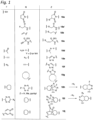
- Z is only an intermediate structure and will expel N 2 , thereby generating a dihydropyridazine (from the reaction with alkene) or pyridazine (from the reaction with alkyne) as shown in Figure 1 .
- connecting groups Z are obtained by a cycloaddition reaction, preferably wherein the cycloaddition is a [4+2] cycloaddition or a 1,3-dipolar cycloaddition.
- Conjugation reactions via cycloadditions are known to the skilled person, and the skilled person is capable of selecting appropriate reaction partners F and Q, and will understand the nature of the resulting connecting group Z.
- Preferred cycloadditions are a [4+2]-cycloaddition (e.g. a Diels-Alder reaction) or a [3+2]-cycloaddition (e.g. a 1,3-dipolar cycloaddition).
- the cycloaddition is the Diels-Alder reaction or the 1,3-dipolar cycloaddition.
- the preferred Diels-Alder reaction is the inverse electron-demand Diels-Alder cycloaddition.
- the 1,3-dipolar cycloaddition is used, more preferably the alkyne-azide cycloaddition. Cycloadditions, such as Diels-Alder reactions and 1 ,3-dipolar cycloadditions are known in the art, and the skilled person knows how to perform them.
- Z contains a moiety selected from the group consisting of a triazole, a cyclohexene, a cyclohexadiene, a [2.2.2]-bicyclooctadiene, a [2.2.2]-bicyclooctene, an isoxazoline, an isoxazolidine, a pyrazoline, a piperazine, a thioether, an amide or an imide group.
- Triazole moieties are especially preferred to be present in Z.
- Z comprises a (hetero)cycloalkene moiety, i.e. formed from Q comprising a (hetero)cycloalkyne moiety.
- Z comprises a (hetero)cycloalkane moiety, i.e. formed from Q comprising a (hetero)cycloalkene moiety.
- aromatic rings such as a triazole ring are considered a heterocycloalkane ring, since it is formed by reaction of an alkyne moiety and an azide moiety.
- Z has the structure (Z1):
- the bond depicted as --- is a single bond or a double bond.
- u + u' 0, 4, 5, 6, 7 or 8, more preferably 0, 4 or 5.
- u + u' 0 or 5.
- the wavy bond labelled with * is connected to AB, optionally via L 6
- the wavy bond labelled with ** is connected to L.
- Z comprises a (hetero)cycloalkene moiety, i.e. the bond depicted as - - - is a double bond.
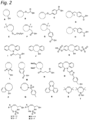
- Z is selected from the structures (Z2) - (Z20c), depicted here below:
- B (-) is an anion, preferably a pharmaceutically acceptable anion.
- B (+) is a cation, preferably a pharmaceutically acceptable cation.
- R 36 is an halogen selected from fluor, chlorine, bromine and iodine, preferably R 36 is fluor.
- Y 4 is a heteroatom, preferably Y 4 is O or NH.
- R 35 is selected from the group consisting of hydrogen, C 1 - C 24 alkyl groups, C 3 - C 24 cycloalkyl groups, C 2 - C 24 (hetero)aryl groups, C 3 - C 24 alkyl(hetero)aryl groups and C 3 - C 24 (hetero)arylalkyl groups, the C 1 - C 24 alkyl groups, C 3 - C 24 cycloalkyl groups, C 2 - C 24 (hetero)aryl groups, C 3 - C 24 alkyl(hetero)aryl groups and C 3 - C 24 (hetero)arylalkyl groups optionally substituted and optionally interrupted by one or more heteroatoms selected from O, Si, S and NR 14 wherein R 14 is independently selected from the group consisting of hydrogen and C 1 - C 4 alkyl groups, preferably R 35 is selected from H, C 5 H 11 , CH 3 , CH 2 CH 3 , CH 2 OH or CH 2 OTBS.
- Ring Z is formed by the cycloaddition reaction, and preferably is a triazole, a cyclohexene, a cyclohexadiene, a [2.2.2]-bicyclooctadiene, a [2.2.2]-bicyclooctene, an isoxazoline, an isoxazolidine, oxazolidine, a pyrazoline or a piperazine. Most preferably, ring Z is a triazole ring.
- Ring Z may have the structure selected from (Za) - (Zm) depicted below, wherein the carbon atoms labelled with ** correspond to the two carbon atoms of the (hetero)cycloalkane ring of (Z2) - (Z20), to which ring Z is fused. Since the connecting group Z is formed by reaction with a (hetero)cycloalkyne in the context of the present embodiment, the bond depicted above as --- is a double bond.
- R 29 is selected from hydrogen, C 1-6 alkyl, aryl, C(O)-C 1-6 alkyl, C(O)-aryl, C(O)-O-C 1-6 alkyl, C(O)-O-aryl, C(O)-NR 33 -C 1-6 alkyl and C(O)-NR 33 -aryl, wherein R 33 is H or C 1-4 alkyl.
- R 29 is selected from hydrogen, methyl, phenyl, pyridyl, pyridinyl and pyrimidinyl. It was found that R 29 is hydrogen gave optimal results in reactivity in the cycloaddition reaction, especially in case ring (Zl) is formed.
- ring Z is (Zl) wherein R 29 is selected from hydrogen, methyl, phenyl, pyridyl, pyridinyl and pyrimidinyl, more preferably R 29 is hydrogen.
- nitrone reactive group (F3a) below, which equally apply to isoxazoline (Zh) and rearrangement product (Zh').
- isoxazolines may rearrange according to the scheme below:
- the a 4-isoxazoline ring may suffer from disintegration via this rearrangement.
- Isoxazoline ring (a) is rearranged into the aziridine ring (b), from which ring strain is released in zwitterionic species (c).
- Addition of water gives hydroxylamine (e), from which aldehyde (f) is split off to give ketonamine (g).
- hydroxylamine (e) from which aldehyde (f) is split off to give ketonamine (g).
- This will not only destroy the isoxazoline ring, but also break the covalent linkage between the substituents at R* and the one at R**.
- the isoxazoline ring is part of a bioconjugate, the payload is removed from the biomolecule, therefore effectively eliminating its use and possibly creating severe side-effects.
- bioconjugates according to the present invention are a great improvement in terms of stability of the attachment of the payload to the biomolecule.
- ring Z is selected from (Za), (Zh), (Zj), (Zk) or (Zl), more preferably ring Z is according to structure (Za) or (Zl).
- Z is selected from the structures (Z21) - (Z38d), depicted here below:
- Structure (Z29) can be in endo or exo configuration, preferably it is in endo configuration.
- B (-) is an anion, preferably a pharmaceutically acceptable anion.
- B (+) is a cation, preferably a pharmaceutically acceptable cation.
- Ring Z is selected from structures (Za) - (Zm), as defined above.
- Z comprises a (hetero)cyclooctene moiety or a (hetero)cycloheptene moiety, preferably according to structure (Z8), (Z26), (Z27), (Z28), (Z37) or (Z38a), which are optionally substituted.
- Z8 a (hetero)cyclooctene moiety or a (hetero)cycloheptene moiety, preferably according to structure (Z8), (Z26), (Z27), (Z28), (Z37) or (Z38a), which are optionally substituted.
- Z comprises a heterocycloheptene moiety according to structure (Z37) or (Z38a), which is optionally substituted.
- the heterocycloheptene moiety according to structure (Z37) or (Z38a) is not substituted.
- Z comprises a (hetero)cyclooctene moiety according to structure (Z8), more preferably according to (Z29), which is optionally substituted.
- the cyclooctene moiety according to structure (Z8) or (Z29) is not substituted.
- Z preferably comprises a (hetero)cyclooctene moiety according to structure (Z39) as shown below, wherein V is (CH 2 ) l and I is an integer in the range of 0 to 10, preferably in the range of 0 to 6. More preferably, I is 0, 1, 2, 3 or 4, more preferably I is 0, 1 or 2 and most preferably I is 0 or 1. In the context of group (Z39), I is most preferably 1. Most preferably, Z is according to structure (Z42), defined further below.
- Z comprises a (hetero)cyclooctene moiety according to structure (Z26), (Z27) or (Z28), which is optionally substituted.
- Z preferably comprises a (hetero)cyclooctene moiety according to structure (Z40) or (Z41) as shown below, wherein Y 1 is O or NR 11 , wherein R 11 is independently selected from the group consisting of hydrogen, a linear or branched C 1 - C 12 alkyl group or a C 4 - C 12 (hetero)aryl group.
- the aromatic rings in (Z40) are optionally O-sulfated at one or more positions, whereas the rings of (Z41) may be halogenated at one or more positions.
- the (hetero)cyclooctene moiety according to structure (Z40) or (Z41) is not further substituted.
- Z is according to structure (Z43), defined further below.
- Z comprises a heterocycloheptenyl group and is according to structure (Z37).
- Z comprises a cyclooctenyl group and is according to structure (Z42):
- Z42 is according to structure (Z42):
- R 15 is independently selected from the group consisting of hydrogen, halogen, -OR 16 , C 1 - C 6 alkyl groups, C 5 - C 6 (hetero)aryl groups, wherein R 16 is hydrogen or C 1 - C 6 alkyl, more preferably R 15 is independently selected from the group consisting of hydrogen and C 1 - C 6 alkyl, most preferably all R 15 are H.
- R 18 is independently selected from the group consisting of hydrogen, C 1 - C 6 alkyl groups, most preferably both R 18 are H.
- R 19 is H.
- I is 0 or 1, more preferably I is 1
- Z comprises a (hetero)cyclooctenyl group and is according to structure (Z43):
- Z43 is according to structure (Z43):
- R 15 is independently selected from the group consisting of hydrogen, halogen, -OR 16 , -S(O) 3 (-) , C 1 - C 6 alkyl groups, C 5 - C 6 (hetero)aryl groups, wherein R 16 is hydrogen or C 1 - C 6 alkyl, more preferably R 15 is independently selected from the group consisting of hydrogen and -S(O) 3 (-) .
- Z comprises a heterocycloheptenyl group and is according to structure (Z37) or (Z38a), wherein ring Z is a triazole.
- connecting group Z comprises a (hetero)cycloalkane moiety, i.e. the bond depicted as --- is a single bond.
- the (hetero)cycloalkane group may also be referred to as a heterocycloalkyl group or a cycloalkyl group, preferably a cycloalkyl group, wherein the (hetero)cycloalkyl group is optionally substituted.
- the (hetero)cycloalkyl group is a (hetero)cyclopropyl group, a (hetero)cyclobutyl group, a norbornyl group, a norbornenyl group, a (hetero)cycloheptyl group, a (hetero)cyclooctyl group, which may all optionally be substituted.
- (hetero)cyclopropyl groups Especially preferred are (hetero)cyclopropyl groups, (hetero)cycloheptyl group or (hetero)cyclooctyl groups, wherein the (hetero)cyclopropyl group, the (hetero)cycloheptyl group or the (hetero)cyclooctyl group is optionally substituted.
- Z comprises a cyclopropyl moiety according to structure (Z44), a hetereocyclobutane moiety according to structure (Z45), a norbornane or norbornene group according to structure (Z46), a (hetero)cycloheptyl moiety according to structure (Z47) or a (hetero)cyclooctyl moiety according to structure (Z48).
- Y 3 is selected from C(R 23 ) 2 , NR 23 or O, wherein each R 23 is individually hydrogen, C 1 - C 6 alkyl or is connected to L, optionally via a spacer, and the bond labelled --- is a single or double bond.
- the cyclopropyl group is according to structure (Z49).
- the (hetero)cycloheptane group is according to structure (Z50) or (Z51).
- the (hetero)cyclooctane group is according to structure (Z52), (Z53), (Z54), (Z55) or (Z56).
- the R group(s) on Si in (Z50) and (Z51) are typically alkyl or aryl, preferably C 1 -C 6 alkyl.
- Ring Z is formed during the cycloaddition reaction and is typically selected from structures (Zn) - (Zu), wherein the carbon atoms labelled with ** correspond to the two carbon atoms of the (hetero)cycloalkane ring of (Z44) - (Z56) to which ring Z is fused, and the carbon a carbon labelled with * is connected to AB. Since the connecting group Z is formed by reaction with a (hetero)cycloalkene in the context of the present embodiment, the bound depicted above as --- is a single bond.
- R 29 is selected from hydrogen, C 1-6 alkyl, aryl, C(O)-C 1-6 alkyl, C(O)-aryl, C(O)-O-C 1-6 alkyl, C(O)-O-aryl, C(O)-NR 33 -C 1-6 alkyl and C(O)-NR 33 -aryl, wherein R 33 is H or C 1-4 alkyl.
- R 29 is selected from hydrogen, methyl, phenyl, pyridyl, pyridinyl and pyrimidinyl. It was found that R 29 is hydrogen gave optimal results in reactivity in the cycloaddition reaction, especially in case ring (Zu) is formed.
- ring Z is (Zu) wherein R 29 is selected from hydrogen, methyl, phenyl, pyridyl, pyridinyl and pyrimidinyl, more preferably R 29 is hydrogen.
- ring Z is selected from (Zn), (Zs), (Zt) or (Zu), most preferably ring Z is according to structure (Zu).
- connection group Z comprise a moiety selected from (Z1) - (Z56), wherein ring Z is selected from (Za) - (Zu).
- Z 1 and Z 2 typically differ, as Z 1 is formed by reaction of Q 1 and F 1 , whereas Z 2 is formed by reaction of Q 2 and F 2 .
- F 2 is reactive towards Q 2 but not towards Q 1 , such that Q 1 and Q 2 should differ.
- F 1 is azide and Q 1 is a benzoannulated or tetramethylated (hetero)cycloalkyne, while F 2 is tetrazine and Q 2 is bicyclononyne.
- the reaction of F 1 and Q 1 will preferably form a connecting group Z 1 according to structure (Z5), (Z6), (Z7), (Z11), (Z17), (Z18), (Z19) or (Z19a), wherein ring Z is according to structure (Za), preferably according to structure (Z26), (Z27), (Z28), (Z32), (Z37), (Z38) or (Z38a), more preferably according to structure (Z40), (Z41) or (Z43).
- the reaction of F 2 and Q 2 will preferably form a connecting group Z 2 according to structure (Z8), wherein ring Z is according to structure (Zl), preferably according to structure (Z29), more preferably according to structure (Z42).
- F 1 is azide and Q 1 is a cycloalkyne while Q 2 is a nitrone, ortho-quinone or tetrazine and F 2 is a cycloalkene, preferably trans-cyclooctene.
- the reaction of F 1 and Q 1 will preferably form a connecting group Z 1 according to structure (Z2) - (Z20), wherein ring Z is according to structure Za, preferably according to (Z8).
- reaction of F 2 and Q 2 will preferably form a connecting group Z 2 according to (Z44) - (Z56), wherein ring Z is according to structure (Zo), (Zp), (Zq), (Zr), (Zq) preferably according to structure (Zo) or (Zu), more preferably according to structure (Zo).
- Z 1 is obtainable by a click reaction between cycloalkyne and azide
- Z 2 is obtainable by a click reaction between cylcoalkyne and nitrone
- Z is formed by a nucleophilic reaction, preferably by a nucleophilic substitution or a Michael addition, preferably by a Michael addition.
- a preferred Michael reaction is the thiol-maleimide ligation, most preferably wherein Q is maleimide and F is a thiol group, wherein the thiol may be part of a disulphide bridge.
- the thiol is present in the sidechain of a cysteine residue.
- Such a conjugation reaction with a thiol may also be referred to as thiol alkylation or thiol arylation.
- connection group Z 1 comprises a succinimidyl ring or its ring-opened succinic acid amide derivative, which may be formed by hydrolysis of the succinimidyl ring]
- the structural moiety Q-(L 1 ) a -BM-(L 2 )b-Q is selected from bromomaleimide, bis-bromomaleimide, bis(phenylthiol)maleimide, bis-bromopyridazinedione, bis(halomethyl)benzene, bis(halomethyl)pyridazine, bis(halomethyl)pyridine or bis(halomethyl)triazole.
- Z 1 is formed by nucleophilic reaction at the amino group in the sidechain of a lysine residue (F), which may react with amino reactive groups Q.
- a conjugation reaction with a thiol may also be referred to as amide bond formation or carbamate bond formation.
- Typical amino reactive groups Q include N-hydroxysuccinimidyl (NHS) esters, p -nitrophenyl carbonates, pentafluorophenyl carbonates, isocyanates, isothiocyanates and benzoyl halides.
- connection group Z 1 comprises a moiety selected from (Z57) - (Z71) depicted here below.
- the wavy bond(s) labelled with an * in (Z57)-(Z66) is connected to AB, and the wavy bond without label to the payload via linker L.
- the nitrogen atom labelled with ** in (Z67)-(Z71) corresponds to the nitrogen atom of the side chain of a lysine residue of the antibody, and the wavy bond without label to the payload via linker L.
- the carbon atoms of the phenyl group of (Z69) and (Z70) are optionally substituted, preferably optionally fluorinated.
- Linker L connects payload D, via connecting group Z 2 , with connecting group Z 1 (in the conjugates according to the invention) or connects payload D with reactive group Q (in the linker-cytokine constructs) or connects antibody with reactive group (in the linker-antibody-constructs).
- Linkers are known in the art and may be cleavable or non-cleavable.
- linker L is represented by structure -(L 1 )-(L 2 ) o -(L 3 ) p -(L 4 ) q -wherein:
- L 1 may for example be selected from the group consisting of linear or branched C 1 -C 200 alkylene groups, C 2 -C 200 alkenylene groups, C 2 -C 200 alkynylene groups, C 3 -C 200 cycloalkylene groups, C 5 -C 200 cycloalkenylene groups, C 8 -C 200 cycloalkynylene groups, C 7 -C 200 alkylarylene groups, C 7 -C 200 arylalkylene groups, C 8 -C 200 arylalkenylene groups, C 9 -C 200 arylalkynylene groups.
- the optional substituents may be selected from polar groups, such as oxo groups, (poly)ethylene glycol diamines, (poly)ethylene glycol or (poly)ethylene oxide chains, (poly)propylene glycol or (poly)propylene oxide chains, carboxylic acid groups, carbonate groups, carbamate groups, cyclodextrins, crown ethers, saccharides (e.g. monosaccharides, oligosaccharides), phosphates or esters thereof, phosphonic acid or ester, phosphinic acid or ester, sulfoxides, sulfones, sulfonic acid or ester, sulfinic acid, or sulfenic acid.
- polar groups such as oxo groups, (poly)ethylene glycol diamines, (poly)ethylene glycol or (poly)ethylene oxide chains, (poly)propylene glycol or (poly)propylene oxide chains, carboxylic acid groups, carbonate groups
- linker L 1 contains a polar group, which may also be present in the chain of L 1 .
- the polar group may also contain an amino acid including an unnatural amino acid, preferably selected from Arg, Glu, Asp, Ser, Thr or cysteic acid.
- R 13 is further defined below for structure (23).
- Each R 30 is individually H, C 1-12 alkyl, C 1-12 aryl, C 1-12 alkaryl or C 1-12 aralkyl.
- Linker L 1 may contain more than one such polar group, such as at least two polar groups.
- the polar group may also be present in a branch of linker L 1 , which branches off a branching moiety as defined elsewhere. In the context of L 1 , a nitrogen or carbon atom is preferably used as branching moiety. It is especially preferred to have a -O(CH 2 CH 2 O) t - polar group present in a branch.
- Linker L 1 is or comprises a sulfamide group, preferably a sulfamide group according to structure ( 23 ):
- the wavy lines represent the connection to the remainder of the compound, typically to Q 2 or Z 2 and to L 2 , L 3 , L 4 or D.
- the (O) a C(O) moiety is connected to Q 2 or Z 2 and the NR 13 moiety to L 2 , L 3 , L 4 or D, preferably to L 2
- R 13 is selected from the group consisting of hydrogen, C 1 - C 24 alkyl groups, C 3 - C 24 cycloalkyl groups, C 2 - C 24 (hetero)aryl groups, C 3 - C 24 alkyl(hetero)aryl groups and C 3 - C 24 (hetero)arylalkyl groups, the C 1 - C 24 alkyl groups, C 3 - C 24 cycloalkyl groups, C 2 -C 24 (hetero)aryl groups, C 3 -C 24 alkyl(hetero)aryl groups and C 3 -C 24 (hetero)arylalkyl groups optionally substituted and optionally interrupted by one or more heteroatoms selected from O, S and NR 14 wherein R 14 is independently selected from the group consisting of hydrogen and C 1 - C 4 alkyl groups.
- R 13 is D connected to N optionally via a spacer moiety, preferably via Sp 2 as defined below, in one embodiment D is connected to N via -(B) e -(A) f -(B) g -C(O)-.
- R 13 is connected to elsewhere in the linker, optionally via a spacer moiety, to form a cyclic structure.
- R 13 may be connected to the linker via a CH 2 CH 2 spacer moiety to form a piperazinyl ring, where the connection to D is via the second nitrogen of the piperazinyl ring.
- R 13 is hydrogen, a C 1 - C 20 alkyl group, preferably a C 1 -- C 16 alkyl group, more preferably a C 1 - C 10 alkyl group, or connected to a further occurrence of D or to elsewhere in the linker optionally via a spacer moiety.
- the alkyl group is optionally substituted and optionally interrupted by one or more heteroatoms selected from O, S and NR 14 , preferably O, wherein R 14 is independently selected from the group consisting of hydrogen and C 1 -C 4 alkyl groups.
- R 13 is a C 1 - C 20 alkyl group, more preferably a C 1 -C 16 alkyl group, even more preferably a C 1 - C 10 alkyl group, wherein the alkyl group is optionally interrupted by one or more O-atoms, and wherein the alkyl group is optionally substituted with an -OH group, preferably a terminal -OH group.
- R 13 is a (poly)ethylene glycol chain comprising a terminal -OH group.
- R 13 is selected from the group consisting of hydrogen, methyl, ethyl, n-propyl, i-propyl, n-butyl, s-butyl and t-butyl or to elsewhere in the linker optionally via a spacer moiety, more preferably from the group consisting of hydrogen, methyl, ethyl, n-propyl and i-propyl, or connected to a further occurrence of D or to elsewhere in the linker optionally via a spacer moiety, and even more preferably from the group consisting of hydrogen, methyl and ethyl, or connected to a further occurrence of D or to elsewhere in the linker optionally via a spacer moiety. Yet even more preferably, R 13 is hydrogen or connected to a further occurrence of D or to elsewhere in the linker optionally via a spacer moiety, and most preferably R 13 is hydrogen.
- L 1 is according to structure ( 24 ):
- a and R 13 are as defined above, Sp 1 and Sp 2 are independently spacer moieties and b and c are independently 0 or 1.
- spacers Sp 1 and Sp 2 are independently selected from the group consisting of linear or branched C 1 -C 200 alkylene groups, C 2 -C 200 alkenylene groups, C 2 -C 200 alkynylene groups, C 3 -C 200 cycloalkylene groups, C 5 -C 200 cycloalkenylene groups, C 8 -C 200 cycloalkynylene groups, C 7 -C 200 alkylarylene groups, C 7 -C 200 arylalkylene groups, C 8 -C 200 arylalkenylene groups and C 9 -C 200 arylalkynylene groups, the alkylene groups, alkenylene groups, alkynylene groups, cycloalkylene groups, cycloalkenylene groups, cycloalkynylene groups, alkylarylene groups, arylalkylene groups, arylalkenylene groups and arylalkynylene groups being optionally substituted and optionally interrupted by one
- alkylene groups, alkenylene groups, alkynylene groups, cycloalkylene groups, cycloalkenylene groups, cycloalkynylene groups, alkylarylene groups, arylalkylene groups, arylalkenylene groups and arylalkynylene groups are interrupted by one or more heteroatoms as defined above, it is preferred that said groups are interrupted by one or more O-atoms, and/or by one or more S-S groups
- spacer moieties Sp 1 and Sp 2 are independently selected from the group consisting of linear or branched C 1 -C 100 alkylene groups, C 2 -C 100 alkenylene groups, C 2 -C 100 alkynylene groups, C 3 -C 100 cycloalkylene groups, C 5 -C 100 cycloalkenylene groups, C 8 -C 100 cycloalkynylene groups, C 7 -C 100 alkylarylene groups, C 7 -C 100 arylalkylene groups, C 8 -C 100 arylalkenylene groups and C 9 -C 100 arylalkynylene groups, the alkylene groups, alkenylene groups, alkynylene groups, cycloalkylene groups, cycloalkenylene groups, cycloalkynylene groups, alkylarylene groups, arylalkylene groups, arylalkenylene groups and arylalkynylene groups being optionally
- spacer moieties Sp 1 and Sp 2 are independently selected from the group consisting of linear or branched C 1 -C 50 alkylene groups, C 2 -C 50 alkenylene groups, C 2 -C 50 alkynylene groups, C 3 -C 50 cycloalkylene groups, C 5 -C 50 cycloalkenylene groups, C 8 -C 50 cycloalkynylene groups, C 7 -C 50 alkylarylene groups, C 7 -C 50 arylalkylene groups, C 8 -C 50 arylalkenylene groups and C 9 -C 50 arylalkynylene groups, the alkylene groups, alkenylene groups, alkynylene groups, cycloalkylene groups, cycloalkenylene groups, cycloalkynylene groups, alkylarylene groups, arylalkylene groups, arylalkenylene groups and arylalkynylene groups being optional
- spacer moieties Sp 1 and Sp 2 are independently selected from the group consisting of linear or branched C 1 -C 20 alkylene groups, C 2 -C 20 alkenylene groups, C 2 -C 20 alkynylene groups, C 3 -C 20 cycloalkylene groups, C 5 -C 20 cycloalkenylene groups, C 8 -C 20 cycloalkynylene groups, C 7 -C 20 alkylarylene groups, C 7 -C 20 arylalkylene groups, C 8 -C 20 arylalkenylene groups and C 9 -C 20 arylalkynylene groups, the alkylene groups, alkenylene groups, alkynylene groups, cycloalkylene groups, cycloalkenylene groups, cycloalkynylene groups, alkylarylene groups, arylalkylene groups, arylalkenylene groups and arylalkynylene groups being
- alkylene groups, alkenylene groups, alkynylene groups, cycloalkylene groups, cycloalkenylene groups, cycloalkynylene groups, alkylarylene groups, arylalkylene groups, arylalkenylene groups and arylalkynylene groups are unsubstituted and optionally interrupted by one or more heteroatoms selected from the group of O, S and NR 16 , preferably O, wherein R 16 is independently selected from the group consisting of hydrogen and C 1 - C 4 alkyl groups, preferably hydrogen or methyl.
- spacer moieties Sp 1 and Sp 2 are independently selected from the group consisting of linear or branched C 1 -C 20 alkylene groups, the alkylene groups being optionally substituted and optionally interrupted by one or more heteroatoms selected from the group of O, S and NR 16 , wherein R 16 is independently selected from the group consisting of hydrogen, C 1 - C 24 alkyl groups, C 2 - C 24 alkenyl groups, C 2 - C 24 alkynyl groups and C 3 - C 24 cycloalkyl groups, the alkyl groups, alkenyl groups, alkynyl groups and cycloalkyl groups being optionally substituted.
- the alkylene groups are unsubstituted and optionally interrupted by one or more heteroatoms selected from the group of O, S and NR 16 , preferably O and/or S-S, wherein R 16 is independently selected from the group consisting of hydrogen and C 1 - C 4 alkyl groups, preferably hydrogen or methyl.
- Preferred spacer moieties Sp 1 and Sp 2 thus include -(CH 2 ) r -, -(CH 2 CH 2 ) r -, -(CH 2 CH 2 O) r -, -(OCH 2 CH 2 ) r -, -(CH 2 CH 2 O) r CH 2 CH 2 -, -CH 2 CH 2 (OCH 2 CH 2 ) r -, -(CH 2 CH 2 CH 2 O) r -, -(OCH 2 CH 2 CH 2 ) r -, -(CH 2 CH 2 CH 2 O) r CH 2 CH 2 CH 2 - and -CH 2 CH 2 CH 2 (OCH 2 CH 2 CH 2 ) r -, wherein r is an integer in the range of 1 to 50, preferably in the range of 1 to 40, more preferably in the range of 1 to 30, even more preferably in the range of 1 to 20 and yet even more preferably in the range of 1 to 15. More preferably n is 1, 2, 3, 4, 5,
- preferred linkers L 1 may be represented by -(W) k -(A) d -(B) e (A) f -(C(O)) g - or [-(W) k -(A) d -(B) e -(A) f -] 2 BM-(C(O)) g - (A) d' -(B) e' -(A) f' -(C(O)) g' -, wherein
- Preferred linkers L 1 have structure -(W) k -(A) d -(B) e -(A) f -(C(O)) g -, wherein:
- linker is structure (a).
- linker L 1 comprises a branching nitrogen atom, which is located in the backbone between Q 1 or Z 1 and (L 2 ) o and which contains a further moiety Z 1 or Q 1 as substituent, which is preferably linked to the branching nitrogen atom via a linker.
- a branching nitrogen atom is the nitrogen atom NR 13 in structure ( 23 ), wherein R 13 is connected to a second occurrence of D via a spacer moiety.
- a branching nitrogen atoms may be located within L 1 according to structure -(W) k -(A) d -(B) e -(A) f- (C(O)) g -.
- L 1 is represented by [-(W) k -(A) d -(B) e -(A) f -(C(O)) g -] 2 BM-(A) d -(B) e -(A) f -(C(O)) g -, wherein A, B, W, d, e, f, g and k are as defined above and individually selected for each occurrence, and BM is a branching moiety, preferably a branching nitrogen atom, to which two instances of -(A) d -(B) e -(A) f -(C(O)) g - are connected.
- both (C(O)) g moieties are connected to - (L 2 ) o -(L 3 ) p -(L 4 ) q -D, wherein L 2 , L 3 , L 4 , o, p, q and D are as defined above and are each selected individually.
- each of L 2 , L 3 , L 4 , o, p, q and D are the same for both moieties connected to (C(O)) g .
- Preferred linkers L 1 comprising a branching moiety atom have structure [-(W) k -(A) d -(B) e -(A) f -(C(O)) g -] 2 N-(A') d -(B') e' -(A') f' -(C(O)) g' - wherein:
- the combination of a peptide spacer L 2 and a cleavable linker L 3 is well-known in the art.
- Linker L 2 functions as recognition and cleave site for cleaving-enzymes, more preferably the peptides are recognized by specific cleaving enzymes. This allows for cleavage at specific environments in which these cleaving enzymes are expressed such as specific tumors. Since different peptide sequences are cleaved by different enzymes, the L 2 group also allows customizing the conjugate for specific treatments.
- the peptide spacer may also be defined by (NH-CR 17 -CO) n , wherein R 17 represents an amino acid side chain as known in the art. Also covered within this definition is proline, which has R 17 joined with the nitrogen atom to form a cyclic moiety.
- the amino acid may be a natural or a synthetic amino acid.
- the amino acid(s) are all in their L-configuration.
- n is an integer in the range of 1 - 5, preferably in the range of 2 - 4.
- the peptide spacer contains 1 - 5 amino acids.
- R 17 represents the amino acid side chain, preferably selected from the side chains of alanine, cysteine, aspartic acid, glutamic acid, phenylalanine, glycine, histidine, isoleucine, lysine, acetyllysine, leucine, methionine, asparagine, pyrrolysine, proline, glutamine, arginine, serine, threonine, selenocysteine, valine, tryptophan, tyrosine and citrulline.
- Preferred amino acid side chains are those of Val, Cit, Ala, Lys, Arg, AcLys, Phe, Leu, Ile, Trp, Glu, Asp and Asn, more preferably from the side chains of Val, Cit, Ala, Glu and Lys.
- R 17 are CH 3 (Ala), CH 2 CH 2 CH 2 NHC(O)NH 2 (Cit), CH 2 CH 2 CH 2 CH 2 NH 2 (Lys), CH 2 CH 2 C(O)OH (Glu) and CH(CH 3 ) 2 (Val). Most preferably, R 17 is CH 3 (Ala), CH 2 CH 2 CH 2 NHC(O)NH 2 (Cit), CH 2 CH 2 CH 2 CH 2 NH 2 (Lys), or CH(CH 3 ) 2 (Val).
- the peptide spacer is selected from Val-Cit, Val-Ala, Val-Lys, Val-Arg, AcLys-Val-Cit, AcLys-Val-Ala, Glu-Val-Ala, Asp-Val-Ala, iGlu-Val-Ala, Glu-Val-Cit, Glu-Gly-Cit, Glu-Gly-Val, Asp-Val-Cit, iGlu-Val-Cit, Phe-Cit, Phe-Ala, Phe-Lys, Phe-Arg, Ala-Lys, Leu-Cit, Ile-Cit, Trp-Cit, Asn-Asn, Ala-Ala-Asn, Ala-Asn, Asn-Ala, Phe-Phe, Gly, Gly-Gly, Gly-Gly-Gly, Gly-Gly-Gly-Gly, Leu-Gly, Tyr-Gly,
- L 2 Val-Cit.
- L 2 Val-Ala.
- L 2 Asn-Ala.
- L 2 Glu-Gly-Cit.
- R 17 represents the amino acid side chain, preferably selected from the side chains of alanine, cysteine, aspartic acid, glutamic acid, phenylalanine, glycine, histidine, isoleucine, lysine, acetyllysine, leucine, methionine, asparagine, pyrrolysine, proline, glutamine, arginine, serine, threonine, selenocysteine, valine, tryptophan, tyrosine and citrulline.
- Preferred amino acid side chains are those of Val, Cit, Ala, Lys, Arg, AcLys, Phe, Leu, Ile, Trp, Glu, Asp and Asn, more preferably from the side chains of Val, Cit, Ala, Glu and Lys.
- R 17 are CH 3 (Ala), CH 2 CH 2 CH 2 NHC(O)NH 2 (Cit), CH 2 CH 2 CH 2 CH 2 NH 2 (Lys), CH 2 CH 2 C(O)OH (Glu) and CH(CH 3 ) 2 (Val). Most preferably, R 17 is CH 3 (Ala), CH 2 CH 2 CH 2 NHC(O)NH 2 (Cit), CH 2 CH 2 CH 2 CH 2 NH 2 (Lys), or CH(CH 3 ) 2 (Val).
- the amino acid side chain R 17 is substituted with a polar group, preferably selected from oxo groups, (poly)ethylene glycol diamines, (poly)ethylene glycol or (poly)ethylene oxide chains, (poly)propylene glycol or (poly)propylene oxide chains, carboxylic acid groups, carbonate groups, carbamate groups, cyclodextrins, crown ethers, saccharides (e.g.
- L 2 comprises the peptide spacer represented by general structure ( 25 ), preferably L 2 is represented by general structure ( 25 ):
- R 17 is as defined above, preferably R 17 is CH 3 (Ala) or CH 2 CH 2 CH 2 NHC(O)NH 2 (Cit).
- the wavy lines indicate the connection to (L 1 ) n and (L 3 ) p , preferably L 2 according to structure ( 25 ) is connected to (L 1 ) n via NH and to (L 3 ) p via C(O).
- L 2 may comprise a certain peptide sequence that is cleavable by specific enzymes. If those enzymes are exclusively expressed or overexpressed in the tumor microenvironment or in the endosomal/lysosomal compartment and leaked to the tumor microenvironment of cancer cells there is an increased probability of targeted release of the cytokine in the tumor and reduced release in healthy tissue.
- Linker L 3 is a self-cleavable spacer, also referred to as self-immolative spacer.
- Cleavage of L 2 results in 1,6- ⁇ elimination in linker L 3 , resulting in decarboxylation and the release of the payload, D.
- This advantageously allows for increased probability of release of the payload in regions wherein enzymes that are able to cleave L 2 are overexpressed.
- release of a payload can induce bystander killing which is advantageous for tumours in which not all cancer cells have overexpression of the targeted receptor.
- L 3 is para-aminobenzyloxycarbonyl (PABC) derivative, more preferably a PABC derivative according to structure (L3a):
- PABC para-aminobenzyloxycarbonyl
- the wavy lines indicate the connection to L 1 or L 2 , and to L 4 or D.
- the brackets indicate an optional carbonyl group.
- the PABC derivative is connected via NH to L 1 or L 2 , preferably to L 2 , and via OC(O) to L 4 or D.
- Ring A is a 5- or 6-membered aromatic or heteroaromatic ring, preferably a 6-membered aromatic or heteroaromatic ring.
- Suitable 5-membered rings are oxazole, thiazole and furan.
- Suitable 6-membered rings are phenyl and pyridyl.
- Ring A may be substituted with a substituent selected from halogen, X 2 R 4 , N(R 4 ) 2 , C 1-4 alkyl and NO 2 .
- X 2 and R 4 are as defined above, including preferred embodiments thereof.
- the optional substituent is selected from F, Cl, Br, OH, OR 4 , SH, NH 2 , Et, Me and NO 2 .
- ring A comprises 0 - 2 substituents, more preferably 0 or 1 substituent, most preferably ring A is not substituted.
- ring A is 1,4-phenyl, 1,2-phenyl, 2,5-pyridyl or 3,6-pyridyl. Most preferably, A is 1,4-phenyl.
- R 21 is selected from H, R 26 , C(O)OH and C(O)R 26 , wherein R 26 is C 1 - C 24 (hetero)alkyl groups, C 3 -C 10 (hetero)cycloalkyl groups, C 2 - C 10 (hetero)aryl groups, C 3 - C 10 alkyl(hetero)aryl groups and C 3 - C 10 (hetero)arylalkyl groups, which are optionally substituted and optionally interrupted by one or more heteroatoms selected from O, S and NR 28 wherein R 28 is independently selected from the group consisting of hydrogen and C 1 - C 4 alkyl groups.
- R 26 is C 3 - C 10 (hetero)cycloalkyl or polyalkylene glycol.
- the polyalkylene glycol is preferably a polyethylene glycol or a polypropylene glycol, more preferably - (CH 2 CH 2 O) S H or -(CH 2 CH 2 CH 2 O) s H.
- Ring A and R 21 are defined as for the PABC derivative according to structure (L3a).
- ring A a 6-membered aromatic or heteroaromatic ring, such as oxazole, thiazole, furan, phenyl and pyridyl.
- ring A is 1,3,4-phenyl, 2,4,5-pyridyl or 2,5,6-pyridyl.
- Linker L 3 according to structure (L3b) is cleavable by ⁇ -glucuronidase, similar to the mechanism in PABC, which results in self-immolation of the para-hydroxybenzyloxy group, decarboxylation and the release of the payload.
- An ADC comprising the glucuronide derivative according to structure (L3b) is especially useful for treating cancers having an overexpression of ⁇ -glucuronidase.
- ⁇ Glucuronidase concentrations in many solid tumours, including lung, breast, and gastrointestinal cancers, as well as in the tumour microenvironment, are reported to be higher than those in normal tissues, and the enzyme is not found in the general circulation.
- the conjugates according to the invention comprising the glucuronide derivative according to structure (L3b) are used to treat patients suffering from lung, breast, and gastrointestinal cancers
- Linker L 4 may be an aminoalkanoic acid spacer, i.e. -NR 22 -(C x -alkylene)-C(O)-, wherein x is an integer in the range 1 to 20, preferably 1 -10, most preferably 1 - 6.
- the aminoalkanoic acid spacer is typically connected to L 3 via the nitrogen atom and to D via the carbonyl moiety.
- L 4 6-aminohexanoic acid.
- L 4 glycine.
- R 22 is H or C 1 - C 4 alkyl, preferably R 22 is H or methyl, most preferably R 22 is H.
- linker L 4 may be an ethyleneglycol spacer according to the structure -NR 22 -(CH 2 -CH 2 -O) e6 -(CH 2 ) e7 -(C(O)-, wherein e6 is an integer in the range 1 -10, preferably e6 is in the range 2-6, and e7 is an integer in the range 1 - 3, preferably e7 is 2.
- R 22 is H or C 1 - C 4 alkyl, preferably R 22 is H or methyl, most preferably R 22 is H.
- linker L 4 may be a diamine spacer according to the structure - NR 22 -(C x -alkylene)-NR 22 -(C(O)) h -, wherein h is 0 or 1, x is an integer in the range 1 - 20, preferably an integer in the range 2
- linker L is selected from any one of the following structures:
- x is in the range of 0-100, preferably x is in the range of 0-50, more preferably x is in the range of 1-30, most preferably x is in the range of 1-18.
- ⁇ is preferably 0 and linker L is according to one of the structures below:
- L 2 is a peptide sequence that is a recognition site for a protease.
- the present invention relates a process for preparation of the conjugate according to the invention, the process comprising:
- x 2.
- the process according to this embodiment can be represented according schemes 1-4, preferably the process is according to scheme 2 or 4.
- the immune cell-engaging polypeptide is represented by D.
- the conjugation reaction between reactive moieties Q 1 and F 1 afford the connecting group Z 1 and the conjugation reaction between reactive moieties Q 2 and F 2 afford the connecting group Z 2
- Reactive moieties Q 1 and Q 2 are reactive to F 1 and F 2 respectively.
- Q refers to Q 1 and Q 2 .
- the term "reactive moiety" may refer to a chemical moiety that comprises a reactive group, but also to a reactive group itself.
- a cyclooctynyl group is a reactive group comprising a reactive group, namely a C-C triple bond.
- a reactive group for example an azido reactive group, may herein also be referred to as a reactive moiety
- Q is reactive towards and complementary to F.
- a reactive group is denoted as "complementary" to a reactive group when said reactive group reacts with said reactive group selectively, optionally in the presence of other functional groups.
- Complementary reactive moieties are known to a person skilled in the art, and are described in more detail below.
- the exact nature of Q, and F, depends on the type of reaction that is employed., the reaction is either a nucleophilic reaction, such as a Michael addition or nucleophilic substitution, or the reaction is a cycloaddition, such as a click reaction.
- the click probe is reactive in a cycloaddition (click reaction) and is preferably selected from an azide, a tetrazine, a triazine, a nitrone, a nitrile oxide, a nitrile imine, a diazo compound, an ortho-quinone, a dioxothiophene, a sydnone, an alkene moiety and an alkyne moiety.
- click probe Q comprises or is an alkene moiety or an alkyne moiety, more preferably wherein the alkene is a (hetero)cycloalkene and/or the alkyne is a terminal alkyne or a (hetero)cycloalkyne.
- Q comprises a cyclic (hetero)alkyne moiety.
- the alkynyl group may also be referred to as a (hetero)cycloalkynyl group, i.e. a heterocycloalkynyl group or a cycloalkynyl group, wherein the (hetero)cycloalkynyl group is optionally substituted.
- the (hetero)cycloalkynyl group is a (hetero)cycloheptynyl group, a (hetero)cyclooctynyl group, a (hetero)cyclononynyl group or a (hetero)cyclodecynyl group.
- the (hetero)cycloalkynes may optionally be substituted.
- the (hetero)cycloalkynyl group is an optionally substituted (hetero)cycloheptynyl group or an optionally substituted (hetero)cyclooctynyl group.
- the (hetero)cycloalkynyl group is a (hetero)cyclooctynyl group, wherein the (hetero)cyclooctynyl group is optionally substituted.
- Q comprises a (hetero)cycloalkynyl or (hetero)cycloalkenyl group and is according to structure (Q1):
- Q1 is a (hetero)cycloalkynyl or (hetero)cycloalkenyl group and is according to structure (Q1):
- v (u + u') x 2 (when the connection to L, depicted by the wavy bond, is via Y 2 ) or [(u + u') x 2] - 1 (when the connection to L, depicted by the wavy bond, is via one of the carbon atoms of u and u').
- reactive group Q comprises a (hetero)cycloalkynyl group and is according to structure (Q1 a):
- Q is a (hetero)cycloalkynyl group selected from the group consisting of (Q2) - (Q20c) depicted here below.
- connection to L may be to any available carbon or nitrogen atom of Q.
- the nitrogen atom of (Q10), (Q13), (Q14) and (Q15) may bear the connection to L, or may contain a hydrogen atom or be optionally functionalized.
- B (-) is an anion, which is preferably selected from (-) OTf, Cl (-) , Br (-) or I (-) , most preferably B (-) is (-) OTf.
- B (+) is a cation, preferably a pharmaceutically acceptable cation. In the conjugation reaction, B (-) does not need to be a pharmaceutically acceptable anion, since B (-) will exchange with the anions present in the reaction mixture anyway.
- the negatively charged counter-ion is preferably pharmaceutically acceptable upon isolation of the conjugate according to the invention, such that the conjugate is readily useable as medicament.
- R 36 is an halogen selected from fluor, chlorine, bromine and iodine, preferably R 36 is fluor.
- Y 4 is a heteroatom, preferably Y 4 is O or NH.
- R 35 is selected from the group consisting of hydrogen, C 1 - C 24 alkyl groups, C 3 - C 24 cycloalkyl groups, C 2 - C 24 (hetero)aryl groups, C 3 - C 24 alkyl(hetero)aryl groups and C 3 - C 24 (hetero)arylalkyl groups, the C 1 - C 24 alkyl groups, C 3 - C 24 cycloalkyl groups, C 2 - C 24 (hetero)aryl groups, C 3 - C 24 alkyl(hetero)aryl groups and C 3 - C 24 (hetero)arylalkyl groups optionally substituted and optionally interrupted by one or more heteroatoms selected from O, Si, S and NR 14 wherein R 14 is independently selected from the group consisting of hydrogen and C 1 - C 4 alkyl groups, preferably R 35 is selected from H, C 5 H 11 , CH 3 , CH 2 CH 3 , CH 2 OH or CH 2 OTBS.
- Q is a (hetero)cycloalkynyl group selected from the group consisting of (Q21) - (Q38a) depicted here below.
- B (-) is an anion, which is preferably selected from (-) OTf, Cl (-) , Br (-) or I (-) , most preferably B (-) is (-) OTf.
- B (+) is a cation, preferably a pharmaceutically acceptable cation.
- Groups R 35 and R 36 on (Q38b), (Q38c) and (Q38d) are defined elsewhere and equally apply to the present embodiment.
- Q comprises a (hetero)cyclooctyne moiety or a (hetero)cycloheptyne moiety, preferably according to structure (Q8), (Q26), (Q27), (Q28), (Q37) or (Q38a), which are optionally substituted.
- structure (Q8), (Q26), (Q27), (Q28), (Q37) or (Q38a) are optionally substituted.
- Q comprises a heterocycloheptyne moiety according to structure (Q37), also referred to as a TMTHSI, which is optionally substituted.
- Q37 a heterocycloheptyne moiety according to structure (Q37)
- TMTHSI TMTHSI
- the heterocycloheptyne moiety according to structure (Q37) is not substituted.
- Q comprises a cyclooctyne moiety according to structure (Q8), more preferably according to (Q29), also referred to as a bicyclo[6.1.0]non-4-yn-9-yl] group (BCN group), which is optionally substituted.
- the cyclooctyne moiety according to structure (Q8) or (Q29) is not substituted.
- Q preferably is a (hetero)cyclooctyne moiety according to structure (Q39) as shown below, wherein V is (CH 2 ) I and I is an integer in the range of 0 to 10, preferably in the range of 0 to 6. More preferably, I is 0, 1, 2, 3 or 4, more preferably I is 0, 1 or 2 and most preferably I is 0 or 1. In the context of group (Q39), I is most preferably 1. Most preferably, Q is according to structure (Q42), defined further below.
- Q comprises a (hetero)cyclooctyne moiety according to structure (Q26), (Q27) or (Q28), also referred to as a DIBO, DIBAC, DBCO or ADIBO group, which are optionally substituted.
- Q preferably is a (hetero)cyclooctyne moiety according to structure (Q40) or (Q41) as shown below, wherein Y 1 is O or NR 11 , wherein R 11 is independently selected from the group consisting of hydrogen, a linear or branched C 1 - C 12 alkyl group or a C 4 - C 12 (hetero)aryl group.
- the aromatic rings in (Q40) are optionally O-sulfonylated at one or more positions, whereas the rings of (Q41) may be halogenated at one or more positions.
- the (hetero)cyclooctyne moiety according to structure (Q40) or (Q41) is not further substituted.
- Q is according to structure (Q43), defined further below.
- Q comprises a heterocycloheptynylgroup and is according to structure (Q37).
- Q comprises a cyclooctynyl group and is according to structure (Q42):
- Q42 is according to structure (Q42):
- R 15 is independently selected from the group consisting of hydrogen, halogen, -OR 16 , C 1 - C 6 alkyl groups, C 5 - C 6 (hetero)aryl groups, wherein R 16 is hydrogen or C 1 - C 6 alkyl, more preferably R 15 is independently selected from the group consisting of hydrogen and C 1 - C 6 alkyl, most preferably all R 15 are H.
- R 18 is independently selected from the group consisting of hydrogen, C 1 - C 6 alkyl groups, most preferably both R 18 are H.
- R 19 is H.
- I is 0 or 1, more preferably I is 1.
- Q comprises a (hetero)cyclooctynyl group and is according to structure (Q43):
- Q43 structure (Q43):
- R 15 is independently selected from the group consisting of hydrogen, halogen, -OR 16 , -S(O) 3 (-) , C 1 - C 6 alkyl groups, C 5 - C 6 (hetero)aryl groups, wherein R 16 is hydrogen or C 1 - C 6 alkyl, more preferably R 15 is independently selected from the group consisting of hydrogen and -S(O) 3 (-) .
- Q comprises a cyclic alkene moiety.
- the alkenyl group Q may also be referred to as a (hetero)cycloalkenyl group, i.e. a heterocycloalkenyl group or a cycloalkenyl group, preferably a cycloalkenyl group, wherein the (hetero)cycloalkenyl group is optionally substituted.
- the (hetero)cycloalkenyl group is a (hetero)cyclopropenyl group, a (hetero)cyclobutenyl group, a norbornene group, a norbornadiene group, a trans -(hetero)cycloheptenyl group, a trans- (hetero)cyclooctenyl group, a trans -(hetero)cyclononenyl group or a trans -(hetero)cyclodecenyl group, which may all optionally be substituted.
- (hetero)cyclopropenyl groups trans- (hetero)cycloheptenyl group or trans -(hetero)cyclooctenyl groups, wherein the (hetero)cyclopropenyl group, the trans -(hetero)cycloheptenyl group or the trans -(hetero)cyclooctenyl group is optionally substituted.
- Q comprises a cyclopropenyl moiety according to structure (Q44), a hetereocyclobutene moiety according to structure (Q45), a norbornene or norbornadiene group according to structure (Q46), a trans -(hetero)cycloheptenyl moiety according to structure (Q47) or a trans- (hetero)cyclooctenyl moiety according to structure (Q48).
- Y 3 is selected from C(R 23 ) 2 , NR 23 or O, wherein each R 23 is individually hydrogen, C 1 - C 6 alkyl or is connected to L, optionally via a spacer, and the bond labelled - - - is a single or double bond.
- the cyclopropenyl group is according to structure (Q49).
- the trans -(hetero)cycloheptene group is according to structure (Q50) or (Q51).
- the trans- (hetero)cyclooctene group is according to structure (Q52), (Q53), (Q54), (Q55) or (Q56).
- the R group(s) on Si in (Q50) and (Q51) are typically alkyl or aryl, preferably C 1 -C 6 alkyl.
- Q is a thiol-reactive probe.
- Q is a reactive group compatible with cysteine conjugation.
- Such probes are known in the art and may be selected from the group consisting of a maleimide moiety, a haloacetamide moiety, an allenamide moiety, a phosphonamidite moiety, a cyanoethynyl moiety, a vinylsulfone, a vinylpyridine moiety or a methylsulfonylphenyloxadiazole moiety.
- Q comprises a maleimide moiety.
- Reagents may be monoalkylation type or may be a cross-linker for reaction with two cysteine side-chains.
- click probe QZ comprise a moiety selected from (Q1) - (Q56), more preferably is a moiety selected from (Q1) - (Q56).
- Reactive moieties F 1 and F 2 are reactive towards Q 1 and Q 2 resspectively.
- F refers to F 1 and F 2 .
- F is reactive towards and complementary to Q.
- a reactive group is denoted as "complementary" to a reactive group when said reactive group reacts with said reactive group selectively, optionally in the presence of other functional groups.
- Complementary reactive click probes are known to a person skilled in the art, and are described in more detail below. The exact nature of Q, and F, depends on the type of click reaction that is employed.
- the click probe is reactive in a cycloaddition (click reaction) and is preferably selected from an azide, a tetrazine, a triazine, a nitrone, a nitrile oxide, a nitrile imine, a diazo compound, an ortho -quinone, a dioxothiophene, a sydnone, an alkene moiety and an alkyne moiety.
- click probe F comprises or is an azide moiety or a tetrazine moiety.
- F is reactive towards Q in the conjugation reaction defined below, preferably wherein the conjugation reaction is a cycloaddition or a nucleophilic reaction.
- the options for F are the same as those for Q, provided that F and Q are reactive towards each other.
- F preferably comprises a click probe, a thiol, a thiol-reactive moiety, an amine or an amine-reactive moiety, more preferably F is a click probe, a thiol or an amine, most preferably F is a click probe.
- the click probe is reactive in a cycloaddition (click reaction) and is preferably selected from an azide, a tetrazine, a triazine, a nitrone, a nitrile oxide, a nitrile imine, a diazo compound, an ortho -quinone, a dioxothiophene, a sydnone, an alkene moiety and an alkyne moiety.
- the click probe comprises or is an azide, a tetrazine, a triazine, a nitrone, a nitrile oxide, a nitrile imine, a diazo compound, an ortho -quinone, a dioxothiophene or a sydnone, most preferably an azide.
- Typical thiol-reactive moieties are selected from maleimide moiety, a haloacetamide moiety, an allenamide moiety, a phosphonamidite moiety, a cyanoethynyl moiety, an ortho- quinone moiety, a vinylsulfone, a vinylpyridine moiety or a methylsulfonylphenyloxadiazole moiety.
- the thiol-reactive moiety comprises or is a maleimide moiety.
- Typical amine-reactive moieties are selected from N-hydroxysuccinimidyl esters, p-nitrophenyl carbonates, pentafluorophenyl carbonates, isocyanates, isothiocyanates and benzoyl halides.
- F is a click probe or a thiol, more preferably F is an azide or a thiol, most preferably F is an azide.
- the reactive group F on the antibody are typically introduced by a specific technique, for example a (bio)chemical or a genetic technique.
- the reactive group that is placed in the antibody is prepared by chemical synthesis, for example an azide or a terminal alkyne.
- Methods of preparing modified antibodies are known in the art, e.g. from WO 2014/065661 , WO 2016/170186 and WO 2016/053107 , which are incorporated herein by reference. From the same documents, the conjugation reaction between the modified antibody and a linker-toxin-construct is known to the skilled person.
- F is a click probe reactive towards a (hetero)cycloalkene and/or a (hetero)cycloalkyne, and is typically selected from the group consisting of azide, tetrazine, triazine, nitrone, nitrile oxide, nitrile imine, diazo compound, ortho-quinone, dioxothiophene and sydnone.
- Preferred structures for the reactive group are structures (F1) - (F10) depicted here below.
- the wavy bond represents the connection to AB or D.
- the payload can be connected to any one of the wavy bonds.
- the other wavy bond may then be connected to an R group selected from hydrogen, C 1 - C 24 alkyl groups, C 2 - C 24 acyl groups, C 3 - C 24 cycloalkyl groups, C 2 - C 24 (hetero)aryl groups, C 3 - C 24 alkyl(hetero)aryl groups, C 3 - C 24 (hetero)arylalkyl groups and C 1 - C 24 sulfonyl groups, each of which (except hydrogen) may optionally be substituted and optionally interrupted by one or more heteroatoms selected from O, S and NR 32 wherein R 32 is independently selected from the group consisting of hydrogen and C 1 - C 4 alkyl groups.
- R groups may be applied for each of the groups F.
- the R group connected to the nitrogen atom of (F3) may be selected from alkyl and aryl
- the R group connected to the carbon atom of (F3) may be selected from hydrogen, alkyl, aryl, acyl and sulfonyl.
- the reactive moiety F is selected from azides, nitrones or tetrazines.
- F is a tetrazine according to structure (F8a):
- R 29 is selected from hydrogen, C 1-6 alkyl, aryl, C(O)-C 1-6 alkyl, C(O)-aryl, C(O)-O-C 1-6 alkyl, C(O)-O-aryl, C(O)-NR 33 -C 1-6 alkyl and C(O)-NR 33 -aryl, wherein R 33 is H or C 1-4 alkyl.
- R 29 is selected from hydrogen, methyl, phenyl, pyridyl, pyridinyl and pyrimidinyl. It was found that R 29 is hydrogen gave optimal results in reactivity in the cycloaddition reaction.
- ring F in particular F 2 , is (F8a) wherein R 29 is selected from hydrogen, methyl, phenyl, pyridyl, pyridinyl and pyrimidinyl, more preferably R 29 is hydrogen.
- F is a nitrone according to structure (F3a).
- R 1 is L 10 XR 4 .
- X is a heteroatom having a lone pair which is capable of capturing the imine intermediate (d) by reacting with the imine carbon atom (see Scheme 3). In case this reaction forms a 5- or 6-membered ring, this capture of imine intermediate (d) is efficient and will stop the rearrangement reaction of Scheme 2.
- L 10 should be a linker of two or three carbon atoms.
- L 10 is a linker of structure (C(R 3 ) 2 ) z , wherein z is 2 or 3.
- Each R 3 is individually selected from H and C 1-4 alkyl.
- two occurrences of R 3 may be joined together to form an oxo group or a C 3-6 (hetero)cycloalkyl group.
- it is preferred that such a ring is a C 3 - C 6 ring, preferably a C 4 or C 5 ring.
- L 10 are (L 10 A) - (L 10 P):
- Ring (L) is spiro connected to the backbone atoms of L 10 .
- Ring (L) is preferably a cyclobutyl ring or a cyclopentyl ring, most preferably a cyclobutyl ring.
- (L 10 A), (L 10 B), (L 10 C) and (L 10 G) wherein ring L is a cyclobutyl ring.
- X is S, O or NH. Most preferably, X is O.
- R 4 is selected from H and C 1-4 alkyl. Typically, R 4 is H when X is O or NH, and R 4 is H or C 1-4 alkyl when X is S.
- XR 4 is typically selected from OH, NH 2 , SH and S-C 1-4 alkyl. In a preferred embodiment, XR 4 is SH, OH, NH 2 , most preferably XR 4 is OH.
- R 2a and R 2b are not crucial for the present invention, and any suitable substituent for a nitrone compound can be used.
- R 2a and R 2b may be the same or different, typically they are different.
- the configuration of the double bound between the nitrogen atom and carbon atom of the nitrone group may either be in E-configuration of in Z-configuration.
- the exact configuration has no influence on the working of the present invention.
- the connection to AB or D is typically via R 2a or R 2b .
- R 2a is selected from Hand C 1 - C 6 (cyclo)alkyl.
- R 2a is selected from H and C 1 - C 5 (cyclo)alkyl, more preferably R 2a is H, Me or Et, most preferably R 2a is H.
- R 2b is selected from the group consisting of C 1 - C 24 alkyl groups, C 3 - C 24 cycloalkyl groups, C 2 - C 24 (hetero)aryl groups, C 3 - C 24 alkyl(hetero)aryl groups and C 3 - C 24 (hetero)arylalkyl groups, the C 1 - C 24 alkyl groups, C 3 - C 24 cycloalkyl groups, C 2 - C 24 (hetero)aryl groups, C 3 - C 24 alkyl(hetero)aryl groups and C 3 - C 24 (hetero)arylalkyl groups, which may optionally be substituted and which may optionally be interrupted by one or more heteroatoms selected from O, S and NR 14 , wherein R 14 is independently selected from the group consisting of hydrogen and C 1 - C 4 alkyl groups.
- R 2a and R 2b are joined to form a (hetero)cyclic moiety.
- R 2b is L(D) r , wherein r is an integer in the range of 1 - 10, and L is a linker covalently connecting D with the nitrone group.
- R 2b is L 6 AB, wherein L 6 is a linker covalently connecting AB with the nitrone group.
- Preferred embodiments of antibody AB, payload D, linkers Land L 6 and integer r are defined elsewhere.
- R 2b is hydrogen, a C 1 - C 20 alkyl group, preferably a C 1 -- C 16 alkyl group, more preferably a C 1 - C 10 alkyl group, L(D) r or L 6 AB.
- the alkyl group is optionally substituted and optionally interrupted by one or more heteroatoms selected from O, S and NR 14 , preferably O, wherein R 14 is independently selected from the group consisting of hydrogen and C 1 - C 4 alkyl groups.
- R 2b is selected from the group consisting of hydrogen, methyl, ethyl, n-propyl, i-propyl, n-butyl, s-butyl, t-butyl, L(D) r or L 6 AB, more preferably from the group consisting of hydrogen, methyl, ethyl, n-propyl, i-propyl, L(D) r or L 6 AB, and even more preferably from the group consisting of hydrogen, methyl, ethyl, L(D) r or L 6 AB.
- the nitrone compound according to the invention is used in the preparation of a bioconjugate, wherein antibody AB is covalently connected to a payload D.
- R 2b is L(D) r or L 6 AB.
- R 2b is L(D) r and the nitrone compound is to be coupled with a (hetero)cycloalkyne compound comprising a antibody AB.
- R 2b is L 6 B and the nitrone compound is to be coupled with a (hetero)cycloalkyne compound comprising a payload D. It is especially preferred that the nitrone is coupled to the payload and thus that R 2b is L(D) r .
- click probes F 1 and F 2 are selected from the group consisting of azide, tetrazine, triazine, nitrone, nitrile oxide, nitrile imine, diazo compound, dioxothiophene, sydnone, iminosydnone and catechol.
- catechol in situ oxidized to an ortho -quinone group, which is reactive as click probe.
- tetrazine also encompasses "hydrotetrazine", a known precursor that forms tetrazine upon in situ oxidation.
- Such precursors of click probes, which in situ form reactive groups, are also covered in the present invention.
- Figure 12 gives some known examples of in situ formed click probes by oxidation.
- F 1 is an azide and F 2 is iminosydnone, catechol, which forms a ortho -quinone group in situ, ortetrazine. More preferably, F 2 is iminosydnone according to structure (F7), catechol, which forms structure (F10) in situ, or tetrazine according to structure (F8). Most preferably, F 1 is an azide according to structure (F1) and F 2 is a tetrazine according to structure (F8a).
- Q 1 and Q 2 differ, so that Q 1 is not reactive towards F 2 , whereas Q 2 is reactive towards F 2 .
- F 1 is azide and Q 1 is an benzoannulated or tetramethylated (hetero)cycloalkyne, while F 2 is tetrazine and Q 2 is bicyclononyne.
- Q 1 is preferably according to structure (Q5), (Q6), (Q7), (Q11), (Q17), (Q18), (Q19) or (Q19a), more preferably according to structure (Q26), (Q27), (Q28), (Q32), (Q37), (Q38) or (Q38a), most preferably according to structure (Q40), (Q41) or (Q43).
- Q 2 is preferably according to structure (Q8), more preferably according to structure (Q29), most preferably according to structure (Q42).
- F 1 is azide and Q 2 is a cycloalkyn, while Q 2 is trans-cyclooctene and F 2 is a nitrone or tetrazine.
- D-F 2 is obtained by a ligase-mediated step, preferably the ligase is selected from tubulin tyrosine ligase, transglutaminase, lipoic acid ligase, farnesyl transferase, glycosyl transferase, formyl-glycine generating enzyme (FGE), trypsiligase/subtiligase, more preferably the ligase is sortase.
- FGE formyl-glycine generating enzyme
- the sortase mediated step is as follows: *D-LPX 1 TG ⁇ X 2 n + (G) n' -F 2 ⁇ *D-LPX 2 T (G) n' -F 2 , or F 2 -LPX 1 TG ⁇ X 2 n + (G) n' -D* ⁇ F 2 -LPX 2 T (G) n' -D
- D* is the remaining part of D
- L is leucine
- P is proline
- T is threonine
- G is Glycine
- X 1 is any amino acid
- X 2 is any hydrophobic amino acid
- n is an integer in the range of 1 -20, preferably n is 3-15.
- F 2 may comprise a PEG chain. More preferably, LPX 1 TGX 2 n is a LPETGGH 10 and n' is 3.
- F 2 is an azide and the conjugation proceeds via a SPAAC reaction or F 2 is a tetrazine and the conjugation proceeds via an inverse-demand Diels-Alder reaction.
- F is a nitrone and D-F 2 is obtained by converting a terminal serine or threonine into a nitrone.
- the conversion into a nitrone can be realised by oxidizing the serine or threonine side chain and then converting into a nitrone as shown below:
- [ox] is an oxidizing agent, such as NalO 4 .
- R corresponds to R 1 as defined above for (F3a). Its exact nature is not relevant in the context of the present invention, although it is preferably defined as R 1 above.
- the thus obtained conjugates have improved stability, since they may rearrange into stable conjugates as explained above.
- the oxidation of the terminal amino acid, conversion into a nitrone and the conjugation to the linker are performed in one pot synthesis.
- the Q 2 is trans-cyclooctene, or Q 2 is a cyclo-alkyne and the conjugation reaction is a strain-promoted alkyne-nitrone cycloaddition (SPANC).
- SPANC strain-promoted alkyne-nitrone cycloaddition
- the conjugates of the present invention are suitable for medical treatment, the conjugates are especially suitable in the treatment of cancer or an autoimmune disease.
- the conjugates of the present invention are used for the treatment of blood disorders, such as neutropenia, anemia and thrombocytopenia.
- the invention further concerns a method for the treatment of cancer comprising administering to a subject in need thereof the conjugate according to the invention.
- the subject in need thereof is typically a cancer patient.
- conjugates, such as antibody-drug conjugates is well-known in the field of cancer treatment, and the conjugates according to the invention are especially suited in this respect.
- the method as described is typically suited for the treatment of cancer.
- the antibody-conjugate is typically administered in a therapeutically effective dose.
- a preferred dose for administration of the conjugates according to the invention is in the range of 3 - 20 mg per kg bodyweight, every three weeks, or every two weeks, or every week, preferably every three weeks.
- the present aspect of the invention can also be worded as a conjugate according to the invention for use in the treatment of cancer.
- this aspect concerns the use of a conjugate according to the invention for the preparation of a medicament or pharmaceutical composition for use in the treatment of cancer.
- treatment of cancer is envisioned to encompass treating, imaging, diagnosing, preventing the proliferation of, containing and reducing tumours.
- This aspect of the present invention may also be worded as a method for targeting a tumour cell expressing a specific extracellular receptor, comprising contacting the conjugate according to the invention with cells that may possibly express the extracellular receptor, and wherein the antibody specifically targets the extracellular receptor.
- These tumour cells expressing the extracellular receptor may be present in a subject, in which case the method comprises administering to a subject in need thereof the conjugate according to the invention. Alternatively, the method occurs ex vivo or in vitro.
- the cells that may possibly express the extracellular receptor are cells that express the extracellular receptor.
- the targeting of tumour cells preferably includes one or more of treating, preventing the proliferation of, containing and reducing the tumour cells.
- a conjugate containing an antibody that targets HER2, such as trastuzumab may be contacted with the cells.
- the conjugate will target the cells, while in case the tumour cells are not HER2-expressing, the conjugate will not target the cells.
- a cell-binding agent such as an antibody, is to be used that targets that specific extracellular receptor.
- the extracellular receptor is selected from the group consisting of 5T4 (TPBG), ADAM9, ALPP, ALPPL2, AMHRII, ASCT2 (SLC1A5), ASLG659, ASPHD1, av-integrin, avb3-integrin/ITGAV/CD51, Axl, B7-H3 (CD276), B7-H4 (VTCN1), BAFF-R, BCMA (CD269), BMPR1B, Brevican, c-KIT (CD117), c-Met, C4.4a (LYPD3), CA-IX (CA9)/MN, Cadherin-6, CanAg, CCR7, CD117 (c-KIT), CD123 (IL-3R ⁇ ), CD13, CD133, CD138/syndecan-1, CD166 (ALCAM), CD19, CD20, CD203C, CD205, Ly75, CD21, CD22, CD228 (P79, SEMF), CD25 (IL
- TPBG 5T4
- the conjugates of the present invention are also especially suitable as antibiotic, antiviral, antiinflammatory and anti-autoimmune agent.
- the invention concerns a method for the treatment of infection, inflammation of an autoimmune disorder, comprising administering to a subject in need thereof the conjugate according to the invention.
- the antibody-conjugate is typically administered in a therapeutically effective dose.
- the present aspect of the invention can also be worded as a conjugate according to the invention for use in the treatment of infection, inflammation of an autoimmune disorder.
- this aspect concerns the use of a conjugate according to the invention for the preparation of a medicament or pharmaceutical composition for use in the treatment of infection, inflammation of an autoimmune disorder.
- the infection may be bacterial or viral.
- the antibody is preferably specific to an extracellular protein resulting from a viral infection and/or tumour-associated carbohydrate antigen.
- the extracellular protein resulting from a viral infection may be human polio virus (HPV), human cytomegalovirus (HCMV) or human papillomavirus (HPV).
- the tumour-associated carbohydrate antigen may be selected from the group of Tn, STn, T-antigen, LDN, Lewis c (Le c ), Sialyl-Lewis c (SLe c ), 6-Sialyl-Lewis c (6SLe c ), LN, alpha-Gal, 3SLN, 6SLN, H-antigen, A-antigen, B-antigen, Lewis a (Le"), Sialyl-Lewis a (SLe a ), 6-Sialyl-Lewis a (6SLe a ), Lewis b (Le b ), Sialyl-Lewis b (SLe b ), 6-Sialyl-Lewis b (6SLe b ), Lewis x (Le x ), Sialyl-Lewis x (SLe x ), 6-Sialyl-Lewis x (6SLe x ), Lewis y (Le y ), Sia
- the present invention concerns a conjugate for use in the treatment of an autoimmune disorder.
- Cytokines may have inflammatory activities, such as IL-17 and interferon- ⁇ or have a regulatory effect in inflammation such as IL-10 and TGF- ⁇ .
- the conjugate of the present invention comprises a regulatory cytokine, more preferably the cytokine is selected from IL-4, IL-6, IL-9, IL-10, IL-11, and IL-13, IFN- ⁇ and TGF- ⁇ .
- the conjugate comprises an antibody that specifically targets the abnormal cells that cause the auto-immune disease, herein it is preferred that the cytokine promotes inflammation, herein the payload is preferably selected from IL-1, IL-2, IL-6, IL-12, IL-15 IL-17, IL-18, IFN-y, TNF- ⁇ and GM-CFS
- the invention also concerns a pharmaceutical composition
- a pharmaceutical composition comprising the conjugate according to the invention and a pharmaceutically acceptable carrier.
- the pharmaceutical composition typically contains the conjugate according to the invention in a pharmaceutically effective dose.
- IgG Prior to mass spectral analysis, IgG was treated with IdeS, which allows analysis of the Fc/2 fragment.
- IdeS For analysis of the Fc/2 fragment, a solution of 20 ⁇ g (modified) IgG was incubated for 1 hour at 37 °C with IdeS/Fabricator TM (1.25 U/ ⁇ L) in PBS Ph 7.4 in a total volume of 10 ⁇ L. Samples were diluted to 80 ⁇ L using PBS pH 7.4. For analysis of cytokines, a solution of 4 ⁇ g (modified) cytokine was diluted to 80 ⁇ L using PBS pH 7.4.
- MS analysis is performed on JEOL AccuTOF LC-plus JMS-T100LP system (ESI-TOF) combined with a HPLC system (Agilent 1100 series, Hewlett Packard). On the HPLC system a MassPREP TM On-line Desalting Cartridge (Waters PIN 186002785) is installed.
- a solution of 4 ⁇ g (modified) cytokine was diluted to 80 ⁇ L using PBS followed by analysis electrospray ionization time-of-flight (ESI-TOF) on a JEOL AccuTOF. Deconvoluted spectra were obtained using Magtran software.
- cytokines starts with transformation of the corresponding into BL21(DE3) cells (Novagen). Transformed cells were plated on LB-agar with ampicillin and incubated overnight at 37 °C. A single colony was picked and used to inoculate a small culture of TB medium + ampicillin followed by incubated overnight at 37 °C. Next, the overnight culture was used to inoculate a larger volume by performing a dilution of 20 fold in TB medium + ampicillin. The culture was incubated at 37 °C at 160 RPM and, when OD600 reached 2.5-4.0, induced with 1 mM IPTG (addition of 1 mL of 1 M stock solution).
- the culture was pelleted by centrifugation (5000 xg for 5 min).
- the culture cell pellet was lysed in BugBuster TM containing Benzonase and incubated on roller bank for 30 min at room temperature.
- the insoluble fraction was separated from the soluble fraction by centrifugation (15 minutes, 15000 x g).
- Half of the insoluble fraction was dissolved in BugBuster TM with lysozyme (final concentration of 200 pg/mL) and incubated on the roller bank for 10 min.
- the solution was diluted with 10 volumes of miliQ and centrifuged 15 min, 15000 x g .
- the pellet was washed in a solution of 1 :10 diluted BugBuster TM and centrifuged at 10 min, 12000 x g. This washing round was performed 1-3 times until a very white inclusion body pellet was obtained.
- the purified inclusion bodies were dissolved and denatured in 5 M guanidine with 40 mM Cysteamine and 20 mM Tris pH 8.0, to a final concentration of 1 mg/mL. Afterwards, the solution was incubated for 2 hours at RT on a rollerbank. Followingly, the 1 mg/mL solution is added dropwise to 10 volumes of refolding buffer (50 mM Tris, 10.53 mM NaCl, 0.44 mM KCI, 2.2 mM MgCl2 , 2.2 mM CaCl2, 0.055% PEG- 4000, 0.55 M L-arginine, 4 mM cysteamine, 4 mM cystamine, at pH 8.0) in a cold room at 4°C, stirring required.
- refolding buffer 50 mM Tris, 10.53 mM NaCl, 0.44 mM KCI, 2.2 mM MgCl2 , 2.2 mM CaCl2, 0.055% PEG- 4000, 0.
- Cleavable IL-15 variants were designed consisting of an N-terminal sequence suitable for chemical modification, consisting of either (M)SYR-, (M)ST- or (M)S-, fused to a protease-cleavable linker (amino acid sequence being identified by SEQ ID NO: 1 and SEQ ID NO: 2) and either wild-type or mutated human IL-15 (amino acid sequence of wild-type IL-15 being identified by SEQ ID NO: 3).
- the N-terminal methionine will be cleaved after expression leaving an N-terminal serine needed for chemical modification.
- cleavable linkers Both cleavable linkers have been designed for recognition by several tumor-specific proteases including matriptase (MT-SP1), legumain and urokinase (UpA).
- Non-cleavable variants have been designed by replacing the cleavable linker by either -(G 4 S) 8 -, -(G 4 S) 3 - or a -(G 4 S) 3 GGS- linker.
- the sushi domain of IL-15Ra is fused to IL-15 via a flexible linker (amino acid sequence of IL-15R ⁇ -linker-IL-15 being identified by SEQ ID NO: 4).
- Mutated IL-15 include the N72D mutation with enhanced IL-15R ⁇ -binding (amino acid sequence being identified by SEQ ID NO: 8), and the E46G,V49R mutation lacking IL-15R ⁇ -binding (amino acid sequence being identified by SEQ ID NO: 11).
- Codon-optimized DNA encoding PF18 (amino acid sequence being identified by SEQ ID NO: 5), PF50 (amino acid sequence being identified by SEQ ID NO: 6), PF51 (amino acid sequence being identified by SEQ ID NO: 7), PF52 (amino acid sequence being identified by SEQ ID NO: 8), PF53 (amino acid sequence being identified by SEQ ID NO: 9), PF54 (amino acid sequence being identified by SEQ ID NO: 10), PF55 (amino acid sequence being identified by SEQ ID NO: 11), PF56 (amino acid sequence being identified by SEQ ID NO: 12), PF57 (amino acid sequence being identified by SEQ ID NO: 13), PF58 (amino acid sequence being identified by SEQ ID NO: 14), PF59 (amino acid sequence being identified by SEQ ID NO: 15) were obtained from Genscript, Piscataway, USA. All codon-optimized DNA sequences were cloned into a pET
- Expression and inclusion body isolation for each cytokine mentioned in table 1. was performed according to General procedure for expression of cytokines and inclusion body isolation.
- the refolding of the cytokines was performed according to General procedure for refolding of cytokines with small adaptations.
- cytokine PF51, PF52, PF53, PF54 and PF56 the refolding was performed as normal.
- cytokine PF18, PF50 and PF55 the cytokine was dissolved and denatured in 5 M guanidine with 40 mM Cysteamine and 20 mM Tris pH 8.0, to a final concentration of 2 mg/mL instead of 1 mg/mL.
- cytokine PF57 and PF59 the cytokine was dissolved and denatured in 5 M guanidine with 40 mM Cysteamine and 20 mM Tris pH 8.0, to a final concentration of 3 mg/mL instead of 1 mg/mL.
- cytokine PF58 the cytokine was dissolved and denatured in 5 M guanidine with 40 mM Cysteamine and 20 mM Tris pH 8.0, to an unknown concentration instead of 1 mg/mL.
- Table 1 Expression and refolding conditions for the purified cytokines.
- reaction mixture was incubated overnight at RT. Mass spectral analysis showed one single peak (observed mass 14604 Da) corresponding to NHO1-PF51.
- the reaction mixture was dialyzed to PBS, 1x overnight and 2x 3 hours, using a Spectrum TM Spectra/Por TM 2 RC Dialysis Membrane Tubing 12-14 kDa MWCO.
- reaction mixture was incubated overnight at RT. Mass spectral analysis showed one single peak (observed mass 25720 Da) corresponding to NHO1-PF57.
- the reaction mixture was directly loaded onto a desalting column (Cytiva, HiPrep TM 26/10 desalting column) using PBS pH 7.5 as a mobile phase on an AKTA explorer (GE Healthcare).
- reaction mixture was incubated overnight at RT. Mass spectral analysis showed one single peak (observed mass 25401 Da) corresponding to NHO1-PF58.
- the reaction mixture was directly loaded on a Superdex TM 75 Increase (Cytiva) using PBS pH 7.5 as a mobile phase on an AKTA explorer (GE Healthcare).
- reaction mixture was incubated overnight at RT. Mass spectral analysis showed one single peak (observed mass 25503 Da) corresponding to NHO1-PF59.
- the reaction mixture was purified using Amicon Ultra-0.5 Centrifugal Filter Units (10 kDa MWCO) by performing 5 rounds of buffer exchange to PBS pH 7.5.
- the dialyzed product was directly loaded onto an AEX column (Cytiva 2x5 mL, HiTrap TM Q HP) on an AKTA explorer (GE Healthcare).
- the column was first washed with buffer A (20 mM Tris, 10 mM NaCl, pH 7.5).
- buffer A (20 mM Tris, 10 mM NaCl, pH 7.5).
- Retained protein was eluted with a linear gradient to buffer B (20 mM Tris buffer, 1 M NaCl, pH 7.5).
- the elute was directly loaded onto a desalting column (Cytiva, HiPrep TM 26/10 desalting column) using PBS pH 7.5 as a mobile phase on an AKTA explorer (GE Healthcare).
- the dialyzed product was directly loaded onto an AEX column (Cytiva 2x5 mL, HiTrap TM Q HP) on an AKTA explorer (GE Healthcare). After loading the product, the column was first washed with buffer A (20 mM Tris, 10 mM NaCl, pH 7.5).
- Retained protein was eluted with a linear gradient to buffer B (20 mM Tris buffer, 1 M NaCl, pH 7.5). The elute was directly loaded onto a desalting column (Cytiva, HiPrep TM 26/10 desalting column) using PBS pH 7.5 as a mobile phase on an AKTA explorer (GE Healthcare).
- the dialyzed product was directly loaded onto an AEX column (Cytiva 2x5 mL, HiTrap TM Q HP) on an AKTA explorer (GE Healthcare).
- the column was first washed with buffer A (20 mM Tris, 10 mM NaCl, pH 7.5).
- buffer A (20 mM Tris, 10 mM NaCl, pH 7.5).
- Retained protein was eluted with a linear gradient to buffer B (20 mM Tris buffer, 1 M NaCl, pH 7.5).
- the elute was directly loaded onto a desalting column (Cytiva, HiPrep TM 26/10 desalting column) using PBS pH 7.5 as a mobile phase on an AKTA explorer (GE Healthcare).
- reaction mixture was incubated overnight at RT. Mass spectral analysis showed one single peak (observed mass 25763 Da) corresponding to NHO2-PF57.
- the reaction mixture was purified using Amicon Ultra-0.5 Centrifugal Filter Units (10 kDa MWCO) by performing 5 rounds of buffer exchange to PBS pH 7.5.
- reaction mixture was incubated overnight at RT. Mass spectral analysis showed one single peak (observed mass 25749 Da) corresponding to NHO3-PF57.
- the reaction mixture was purified using Amicon Ultra-0.5 Centrifugal Filter Units (10 kDa MWCO) by performing 5 rounds of buffer exchange to PBS pH 7.5.
- reaction mixture was incubated overnight at RT. Mass spectral analysis showed one single peak (observed mass 25789 Da) corresponding to NHO4-PF57.
- the reaction mixture was purified using Amicon Ultra-0.5 Centrifugal Filter Units (10 kDa MWCO) by performing 5 rounds of buffer exchange to PBS pH 7.5.
- Example 28 N-terminal BCN functionalization of NHO1-PF51 by SPANC to obtain 218-NHO1-PF51
- the column was first washed with buffer A (20 mM Tris, 10 mM NaCl, pH 8.0). Retained protein was eluted with a linear gradient to buffer B (20 mM Tris buffer, 1 M NaCl, pH 8.0). The elute was dialyzed to PBS, 1x overnight and 2x 3 hours, using a Spectrum TM Spectra/Por TM 2 RC Dialysis Membrane Tubing 12-14 kDa MWCO. Mass spectrometry showed the correct product (observed mass 15105 Da) corresponding to 218-NHO1-PF51
- the column was first washed with buffer A (20 mM Tris, 100 mM NaCl, pH 7.5). Retained protein was eluted with a linear gradient to buffer B (20 mM Tris buffer, 1 M NaCl, pH 7.5). The elute was directly loaded onto a desalting column (Cytiva, HiPrep TM 26/10 desalting column) using PBS pH 7.5 as a mobile phase on an AKTA explorer (GE Healthcare). Mass spectrometry showed the correct product (observed mass 14929 Da) corresponding to 218-NHO2-PF52.
- buffer A (20 mM Tris, 100 mM NaCl, pH 7.5
- buffer B 20 mM Tris buffer, 1 M NaCl, pH 7.5
- the elute was directly loaded onto a desalting column (Cytiva, HiPrep TM 26/10 desalting column) using PBS pH 7.5 as a mobile phase on an AKTA explorer (GE Healthcare). Mass spectrometry showed the
- the column was first washed with buffer A (20 mM Tris, 100 mM NaCl, pH 7.5). Retained protein was eluted with a linear gradient to buffer B (20 mM Tris buffer, 1 M NaCl, pH 7.5). The elute was directly loaded onto a desalting column (Cytiva, HiPrep TM 26/10 desalting column) using PBS pH 7.5 as a mobile phase on an AKTA explorer (GE Healthcare). Mass spectrometry showed the correct product (observed mass 14930 Da) corresponding to 218-NHO2-PF53.
- buffer A (20 mM Tris, 100 mM NaCl, pH 7.5
- buffer B 20 mM Tris buffer, 1 M NaCl, pH 7.5
- the elute was directly loaded onto a desalting column (Cytiva, HiPrep TM 26/10 desalting column) using PBS pH 7.5 as a mobile phase on an AKTA explorer (GE Healthcare). Mass spectrometry showed the
- the column was first washed with buffer A (20 mM Tris, 100 mM NaCl, pH 7.5). Retained protein was eluted with a linear gradient to buffer B (20 mM Tris buffer, 1 M NaCl, pH 7.5). The elute was directly loaded onto a desalting column (Cytiva, HiPrep TM 26/10 desalting column) using PBS pH 7.5 as a mobile phase on an AKTA explorer (GE Healthcare). Mass spectrometry showed the correct product (observed mass 14646 Da) corresponding to 218-NHO2-PF54.
- buffer A (20 mM Tris, 100 mM NaCl, pH 7.5
- buffer B 20 mM Tris buffer, 1 M NaCl, pH 7.5
- the elute was directly loaded onto a desalting column (Cytiva, HiPrep TM 26/10 desalting column) using PBS pH 7.5 as a mobile phase on an AKTA explorer (GE Healthcare). Mass spectrometry showed the
- Example 32 N-terminal BCN functionalization of NHO1-PF55 by SPANC to obtain 218-NHO1-PF55
- NHO1-PF55 (22000 ⁇ L, 45 ⁇ M in PBS) was added 10 eq bisBCN-PEG 2 218 (2000 ⁇ L, 5 mM in DMF). The reaction was incubated overnight at room temperature. The reaction mixture was directly loaded onto a desalting column (Cytiva, HiPrep TM 26/10 desalting column) using PBS pH 7.5 as a mobile phase on an AKTA explorer (GE Healthcare). Mass spectrometry showed the correct product (observed mass 16196 Da) corresponding to 218-NHO1-PF55.
- Example 33 N-terminal BCN functionalization of NHO2-PF56 by SPANC to obtain 218-NHO2-PF56
- the column was first washed with buffer A (20 mM Tris, 100 mM NaCl, pH 7.5). Retained protein was eluted with a linear gradient to buffer B (20 mM Tris buffer, 1 M NaCl, pH 7.5). The elute was directly loaded onto a desalting column (Cytiva, HiPrep TM 26/10 desalting column) using PBS pH 7.5 as a mobile phase on an AKTA explorer (GE Healthcare). Mass spectrometry showed the correct product (observed mass 14914 Da) corresponding to 218-NHO2-PF56.
- buffer A (20 mM Tris, 100 mM NaCl, pH 7.5
- buffer B 20 mM Tris buffer, 1 M NaCl, pH 7.5
- the elute was directly loaded onto a desalting column (Cytiva, HiPrep TM 26/10 desalting column) using PBS pH 7.5 as a mobile phase on an AKTA explorer (GE Healthcare). Mass spectrometry showed the
- RP-UPLC analysis Prior to RP-UPLC analysis, protein samples were diluted to approximately 0.1 mg/mL using PBS pH 7.4. RP-UPLC analysis was performed on a Waters Acquity UPLC-SQD. The sample (5 ⁇ L) was injected with 0.4 mL/min onto Bioresolve RP mAb 2.1 ⁇ 150 mm 2.7 ⁇ m (Waters) with a column temperature of 70 °C. A linear gradient was applied in 9 minutes from 30 to 54% acetonitrile in 0.1% TFA and water.
- HPLC-SEC analysis was performed on an Agilent 1100 series (Hewlett Packard) using an Xbridge BEH200A (3.5 ⁇ M, 7.8x300 mm, PN 186007640 Waters) column. The sample was diluted to 1 mg/mL in PBS and measured with 0.86 mL/min isocratic method (0.1 M sodium phosphate buffer pH 6.9 (NaHPO4/Na2PO4) containing 10% isopropanol) for 16 minutes.
- Example 34 Transient expression of mPD-L1 in CHO
- the IgG was concentrated to 19.3 mg/mL using a Vivaspin Turbo 15 ultrafiltration unit (Sartorius) and obtained in a final yield of 87 mg.
- Trastuzumab (Herceptin), obtained from the pharmacy, was reconstituted and buffer exchanged to 20 mM Histidine-HCl, 150 mM NaCl, pH 7.5 using a HiPrep TM 26/10 Desalting Column (Cytiva) on an AKTA Purifier-10 (Cytiva).
- Trastuzumab (31.3 mL, 1128 mg, 36.0 mg/mL in 20 mM Histidine-HCl, 150 mM NaCl, pH 7.5) was incubated with EndoSH (1% w/w), as described in PCT/EP2017/052792 , His-TnGaINAcT, as described in PCT/EP2016/059194 (3% w/w), alkaline phosphatase (commercially available from Roche, 0.01% w/w) and UDP-6-N3-GalNAc (10 eq compared to IgG), prepared according to PCT/EP2016/059194 , in 20 mM Histidine-HCl pH 7.5 150 mM NaCl pH 7.5 and 6 mM MnCl 2 for 16 hours at 30 °C.
- Mass spectral analysis of a sample after IdeS treatment showed one major Fc/2 products (observed mass 24366 Da, approximately 90% of total Fc/2) corresponding to the 6-N 3 -GalNAc-GlcNAc(Fuc)-substituted Fc/2 fragment, and one minor Fc/2 products (observed mass 24220 Da, approximately 10% of total Fc/2) corresponding to the 6-N 3 -GalNAc-GlcNAc-substituted Fc/2 fragment.
- TBS pH 7.5 1802 ⁇ L
- propylene glycol 3427 ⁇ L
- trivalent linker 145 23.3 ⁇ L, 40 mM solution in DMF, 4 equiv. compared to IgG.
- the reaction was incubated overnight at RT followed by purification on a Superdex200 Increase 16/600 column (Cytiva) on an AKTA Purifier-10 (Cytiva) using PBS pH 7.4 as mobile phase.
- Mass spectral analysis of the IdeS-digested sample showed one major product (calculated mass 49799 Da, observed mass 49799Da), corresponding to intramolecularly cross-linked trastuzumab derivative trast-v1a-145 .
- Example 37 Enzymatic remodeling ofmPD-L1 to mPD-L1(6-N 3 -GalNAc) 2 ( mPD-L1-v1a )
- mPD-L1 (4528 ⁇ L, 87 mg, 19.3 mg/mL in 20 mM Histidine-HCl, 150 mM NaCl, pH 7.5) was incubated with EndoSH (1% w/w), as described in PCT/EP2017/052792 , His-TnGaINAcT, as described in PCT/EP2016/059194 (4% w/w), alkaline phosphatase (commercially available from Roche, 0.01% w/w) and UDP-6-N3-GalNAc (25 eq compared to IgG), prepared according to PCT/EP2016/059194 , in 20 mM Histidine-HCl pH 7.5 150 mM NaCl pH 7.5 and 6 mM MnCl 2 for 16 hours at 30 °C.
- the functionalized IgG was purified using two HiTrap MabSelect Sure 5 mL columns connected in series. After loading of the reaction mixture the column was washed with TBS + 0.2% Triton for 10 CV followed by TBS pH 7.5 for 10 CV. The IgG was eluted with 0.1 M sodium acetate pH 3.0 and neutralized with 2.5 M Tris-HCl pH 7.2. After three times dialysis to PBS pH 7.4, the IgG was concentrated to approximately 25 mg/mL using a Vivaspin Turbo 15 ultrafiltration unit (Sartorius).
- Mass spectral analysis of a sample after IdeS treatment showed one major Fc/2 products (observed mass 24368 Da, approximately 90% of total Fc/2) corresponding to the 6-N 3 -GalNAc-GlcNAc(Fuc)-substituted Fc/2 fragment.
- Example 38 Intramolecular cross-linking ofmPD-L1-v1a with trivalent linker 145 to give mPD-L1-v1a-145
- Mass spectral analysis of the IdeS-digested sample showed one major product (calculated mass 49799 Da, observed mass 49799Da), corresponding to intramolecularly cross-linked mPD-L1 derivative mPD-L1-v1a-145.
- Example 39 Conjugation of mPD-L1-v1a with bivalent linker XL14 to give mPD-L1-v1a-XL14
- Mass spectral analysis of the IdeS-digested sample showed one major product (observed mass 25063 Da, approximately 90% of total Fc/2), corresponding to desired product with XL14 conjugated to only a single Fc/2-fragment leaving the second reactive handle available for further conjugation.
- One minor product was observed (observed mass 49427 Da, approximately 10% of total Fc/2), corresponding to the undesired intramolecularly cross-linked derivative.
- antibody-cytokine conjugates were purified according to the following procedure.
- the reaction was diluted with 2 volumes of 20 mM Tris-HCl pH 8.0 to reduce the salt concentration to 50 mM NaCl.
- the sample was loaded onto a 5 mL HiTrap Q HP column (Cytiva) using 20 mM Tris-HCl pH 8.0, 50 mM NaCl as mobile phase.
- the column was washed with ⁇ 20 column volumes (CV) of 20 mM Tris-HCl pH 8.0, 50 mM NaCl, 0.2% Triton-X100 followed by ⁇ 20CV of 20 mM Tris-HCl pH 8.0, 50 mM NaCl.
- the product was eluted using a linear gradient of 20CV to 20 mM Tris-HCl pH 8.0, 500 mM NaCl. Fractions containing the desired product were collected, pooled and concentrated to ⁇ 5 mL using Vivaspin Turbo 15 ultrafiltration units (Sartorius). Next, the sample was purified on a Superdex200 Increase 16/600 column (Cytiva) using PBS pH 7.4 as mobile phase. The final antibody-cytokine conjugate was snap-frozen and stored at -80 °C until further use.
- Example 40 Transient expression of genetic fusion IC1 in CHO
- the genetic fusion IC1 consists of the identical mPD-L1 antibody targeting murine PD-L1, C-terminally fused to an identical cleavable linker and IL-15 sequence.
- the LC sequence being identified by SEQ ID NO: 16, and a HC sequence being identified by SEQ ID NO: 18.
- IC1 was transiently expressed in CHO KI cells by Evitria (Zurich, Switzerland) at 1100 mL scale.
- the antibody was purified using two HiTrap MabSelect Sure 5 mL columns connected in series. After loading of the supernatant the column was washed with TBS pH 7.5 for 10 CV.
- the genetic fusion protein was eluted with 0.1 M sodium acetate pH 3.0 and neutralized with 2.5 M Tris-HCl pH 7.2, yielding 22 mg IC1 with a monomer level of 77% according to SE-HPLC analysis.
- the sample was concentrated to 5 mL using a Vivaspin Turbo 15 ultrafiltration unit (Sartorius) followed by purification on a Superdex200 Increase 16/600 column (Cytiva) on an AKTA Purifier-10 (Cytiva) using PBS pH 7.4 as mobile phase.
- IC1 was obtained in a final yield of 12 mg and a monomer level of 95% according to SE-HPLC analysis. Isolation of IC1 was confirmed by reducing SDS-PAGE analysis ( Figure 18 ).
- the broad band observed for the heavy chain (HC) fused to IL-15 indicates heterogeneity, which may be due to glycosylation on the IL-15 portion.
- NHO1-PF50 150 ⁇ L, 3.7 mg/mL in PBS pH 7.4, 2.6 equiv. compared to IgG.
- the reaction was incubated overnight at room temperature.
- the reaction was diluted 20-fold using 20 mM Tris-HCl pH 8.0 and loaded onto a 1 mL HiTrap Q HP column (Cytiva) using 20 mM Tris-HCl pH 8.0, 10 mM NaCl as mobile phase.
- the product was eluted using a linear gradient of 50 CV to 20 mM Tris-HCl pH 8.0, 1 M NaCl.
- Example 42 Conjugation of mPD-L1-v1a to 218-NHO1-PF51 to obtain conjugate mPD-L1-v1a-218-NHO1-PF51 (2:2)
- Example 43 Conjugation of mPD-L1-v1a to 218-NHO2-PF52 to obtain conjugate mPD-L1-v1a-218-NHO2-PF52 (2:2)
- Example 44 Conjugation of mPD-L1-v1a to 218-NHO2-PF53 to obtain conjugate mPD-L1-v1a-218-NHO2-PF53 (2:2)
- Example 45 Conjugation of mPD-L1-v1a to 218-NHO2-PF54 to obtain conjugate mPD-L1-v1a-218-NHO2-PF54 (2:2)
- Example 46 Conjugation of mPD-L1-v1a to 218-NHO2-PF56 to obtain conjugate mPD-L1-v1a-218-NHO2-PF56 (2:2)
- Example 47 Conjugation of mPD-L1-v1a-145 to NHO2-PF52 to obtain conjugate mPD-L1-v1a-145-NHO2- PF52 (2:1)
- Example 48 Conjugation of mPD-L1-v1a-XL14 to NHO2-PF52 to obtain conjugate mPD-L1-v1a-XL14-NHO2-PF52 (2:2)
- Example 50 Conjugation of tras-v1a-145 to NHO1-PF58 to obtain conjugate tras-v1a-145-NHO1-PF58 (2:1)
- Example 51 Conjugation of tras-v1a-145 to NHO1-PF59 to obtain conjugate tras-v1a-145-NHO1-PF59 (2:1)
- Example 54 Conjugation of tras-v1a-145 to NHO4-PF57 to obtain conjugate tras-v1a-145-NHO4-PF57 (2:1)
- Antibody-cytokine conjugates mPD-L1-v1a-218-NHO1-PF51 (2:2), mPD-L1-v1a-218-NHO2-PF52 (2:2), mPD-L1-v1a-145-NHO2-PF52 (2:1) and IC1 were diluted to 1 mg/mL in PBS pH 7.4. Next, samples were snap-frozen using liquid nitrogen and thawed again. This step was performed 5 times. Aggregate levels were determined by SE-HPLC after 0, 1, 3 and 5 cycles ( Figure 21 ).
- Example 56 Stability study for antibody-cytokine conjugates prepared with IL-15 variants with variable N-terminal IL-15 sequence and using different hydroxylamines
- Antibody-cytokine conjugates were diluted to 1 mg/mL in PBS pH 7.4 and incubated at 37°C. At the indicated time points, samples were analyzed by RP-UPLC to determine the stability (Table 2). The variants prepared with hydroxylamines HO2, HO3 and HO4 showed improved stability over the variant prepared using HO1. Table 2. Stability of antibody-cytokine conjugates as determined by RP-UPLC. Stability is plotted as percentage of the cytokine-to-antibody ratio compared to T0.
- Example 57 Cleavage of antibody-cytokine conjugates by matriptase (MT-SP1)
- mPD-L1-v1a-218-NHO2-PF52 (2:2) was incubated at a final concentration of 1 mg/mL with 0.5, 1.0, 2.0 and 4.0 (w/w) % of recombinant human matriptase (commercially available from Bio-techne) for 2 hours at 37 °C followed by RP-UPLC analysis. Full cleavage was observed using 1.0% of matriptase ( Figure 22 ).
- Example 58 Treatment of antibody-cytokine conjugates with MT-SP1 prior to in vitro evaluation
- a set of antibody-cytokine conjugates (35 ⁇ g each) as indicated in figure 23 was incubated at a final concentration of 1 mg/mL with 2 (w/w) % of recombinant human matriptase (commercially available from Bio-techne) for 2 hours at 37 °C followed by RP-UPLC analysis. Full cleavage was observed in all cases ( Figure 23 ). The cleaved constructs were used for evaluation of IL-15 activity in the in vitro IL-15 bioassay.
- Example 59 Cleavage of antibody-cytokine conjugates by urokinase (uPA)
- Tras-v1a-145-NHO1-PF50 (2:1) was incubated at a final concentration of 1 mg/mL with 0.1, 1.0, and 10.0 (w/w) % of recombinant human urokinase (uPA, commercially available from Bio-techne) for 3 hours at room temperature. Intact samples were analyzed by MS. For the condition with 10% (w/w) of uPA, mass spectral analysis of the intact sample showed one major product (observed mass 149118 Da), corresponding to the cleaved antibody without IL-15, and one minor product (observed mass 13598 Da), corresponding to free IL-15.
- uPA recombinant human urokinase
- IL-15 activity was monitored using an IL-15 bioassay (Promega, cat.# JA2015). This is a bioluminescent cell-based assay designed to measure IL-15 stimulation or inhibition using the STAT-5 response element as a readout. When IL-15 binds to its receptor, receptor-mediated pathway signalling induces luminescence that can be detected upon addition of a substrate and quantified with a luminometer. The assay was performed according to the manufacturer's instructions.
- cleaved or intact antibody-cytokine conjugates or controls were added in duplo to IL-15 cells in a square root of 10-fold dilution series to obtain a final concentration ranging from 0.1 to 1000 pM unless stated otherwise (in case of cleaved constructs the concentration refers to the initial antibody-cytokine conjugate).
- IL-15 cells were incubated for 6 hours in a humidified atmosphere at 37°C and 5% CO 2 .
- Detection reagent Bio-Gio TM luciferase Assay reagent
- chemiluminescence intensity was recorded with a microplate reader (Envision, PerkinElmer). Data analysis was performed using Graphpad prism software.
- EC 50 values were calculated by non-linear regression and maximum fold induction was calculated by dividing the relative luminescence units (RLU) of treated cells by the RLU of untreated cells (both background substracted).
- Example 60 In vitro IL-15 activity assay of intact and cleavad antibody-cytokine conjugates
- the activity of 5 intact antibody-cytokine conjugates was measured via the in vitro IL-15 bioassay.
- mPD-L1-v1a-218-NHO2-PF52 (2:2) was included both with and without pretreatment with MT-SP1 for comparison.
- MT-SP1 treatment was performed according to example 58. All intact antibody-cytokine conjugates showed only minimal activation ranging from 1.0 to 2.5 fold induction, while the cleaved variant of mPD-L1-v1a-218-NHO2-PF52 (2:2) showed 7.2 fold induction Figure 24 and Table 3), demonstrating that IL-15 is inactivated or attenuated when linked to the antibody but becomes activated upon cleavage of the linker by MT-SP1.
- Table 3 Table 3.
- Example 61 In vitro IL-15 activity assay of cleaved antibody-cytokine conjugates
- Antibody-cytokine conjugates were pre-treated with MT-SP1 according to example 58 to obtain the free cytokines.
- the activity of 5 cleaved antibody-cytokine conjugates was measured via the in vitro IL-15 bioassay according to the general procedure.
- Both mPD-L1-v1a-218-NHO1-PF51 (2:2) and mPD-L1-v1a-218-NHO2-PF52 (2:2) showed higher potency in terms of EC 50 values and maximum fold induction compared to the genetic fusion IC1 comprising the same cleavable linker, IL-15 variant and stoichiometry ( Figure 25 and Table 4).
- Example 62 In vitro IL-15 activity assay of intact and cleaved antibody-cytokine conjugates
- mPD-L1-v1a-218-NHO2-PF52 (2:2) and mPD-L1-v1a-218-NHO2-PF56 (2:2) were pre-treated with MT-SP1 according to example 58 to obtain the free cytokines.
- the activity of both compounds was measured with and without pre-treated with MT-SP1 using the in vitro IL-15 bioassay.
- Non-modified cytokine PF52 was included as a reference.
- Cleaved and intact mPD-L1-v1a-218-NHO2-PF56 (2:2) was added in a higher final concentration ranging from 32 pM to 316 nM (square root of 10-fold dilution series).
- Example 63 In vitro IL-15 activity assay with alternative antibody and cleavable linker
- Tras-v1a-145-NHO1-PF50 (2:1) was pre-treated with urokinase (UpA) according to example 59 to obtain the free cytokines.
- the activity of tras-v1a-145-NHO1-PF50 (2:1) was measured with and without pre-treatment with UpA using the in vitro IL-15 bioassay.
- Non-modified cytokine PF50 and the non-modified antibody trastuzumab were included as controls.
- tras-v1a-145-NHO1-PF50 (2:1) showed only minimal activation (Table 6 and Figure 27 ), while cleaved tras-v1a-145-NHO1-PF50 (2:1) showed a similar response as the modified cytokine PF50.
- Table 6 EC 50 values and maximum fold induction of intact and cleaved antibody-cytokine conjugates as determined by the IL-15 bioassay. Non-modified cytokine P52 was included as a reference.
- mice Female BALB/c mice (groups of 3 mice, 6- to 8-week-old at study initiation, obtained from Vital River Laboratory Animal Technology Co., Ltd., China), were treated with vehicle (PBS pH 7.4) or the indicated antibody-cytokine conjugate (at 6 mg/kg), and compared to IC1 (at 6 mg/kg). In all cases a single dose was administered via s.c. injection. After dosing, all animals were measured daily for body weight ( Figures 28 and 29 , top graphs). Based on the read-out of this initial study, a second tolerability study was performed according to the same procedure but using dosing concentrations ranging from 3 to 12 mg/kg ( Figures 28 and 29 , middle graphs).
- variants mPD-L1-v1a-145-NHO2-PF52 (2:1) and mPD-L1-v1a-218-NHO2-PF53 (2:2) also showed a reduced tolerability with an estimated MTD of 9 and 15 mg/kg, respectively ( Figure 29 ).
- Example 65 In vivo efficacy in CT26 syngeneic colon cancer model
- mice Female BALB/c mice (5- to 8-week-old at study initiation, obtained from Vital River Laboratory Animal Technology Co., Ltd., China) were inoculated subcutaneously it the right rear flank region with 5 ⁇ 10 5 CT26 tumor cells in 0.1 ml of PBS for tumor development.
- the tumor volume was in the range of 70 to 120 mm 3
- groups of eight mice were injected s.c. with either vehicle (PBS pH 7.4) or the indicated antibody-cytokine conjugate (either 3 or 6 mg/kg as indicated). In all cases a dose was administered on day 0 and 7. Tumor volume and body weight was measured 2-3 times per week after randomization.
- mPD-L1-v1a-218-NHO2-PF52 (2:2) showed improved anti-tumor efficacy compared to the corresponding genetic fusion IC1 and the non-cleavable variant mPD-L1-v1a-218-NHO2-PF54 (2:2) ( Figure 30 ). Additionally, variants mPD-L1-v1a-145-NHO2-PF52 (2:1) and mPD-L1-v1a-218-NHO2-PF53 (2:2) and mPD-L1-v1a-218-NHO2-PF56 (2:2) showed anti-tumor efficacy compared to the vehicle group ( Figure 31 ).
Landscapes
- Health & Medical Sciences (AREA)
- Chemical & Material Sciences (AREA)
- Life Sciences & Earth Sciences (AREA)
- General Health & Medical Sciences (AREA)
- Engineering & Computer Science (AREA)
- Immunology (AREA)
- Medicinal Chemistry (AREA)
- Organic Chemistry (AREA)
- Bioinformatics & Cheminformatics (AREA)
- Veterinary Medicine (AREA)
- Public Health (AREA)
- Animal Behavior & Ethology (AREA)
- Pharmacology & Pharmacy (AREA)
- Molecular Biology (AREA)
- Genetics & Genomics (AREA)
- Proteomics, Peptides & Aminoacids (AREA)
- Epidemiology (AREA)
- Biochemistry (AREA)
- Biophysics (AREA)
- Cell Biology (AREA)
- Chemical Kinetics & Catalysis (AREA)
- Toxicology (AREA)
- Nuclear Medicine, Radiotherapy & Molecular Imaging (AREA)
- General Chemical & Material Sciences (AREA)
- Oncology (AREA)
- Zoology (AREA)
- Gastroenterology & Hepatology (AREA)
- Peptides Or Proteins (AREA)
- Medicines Containing Antibodies Or Antigens For Use As Internal Diagnostic Agents (AREA)
Priority Applications (7)
| Application Number | Priority Date | Filing Date | Title |
|---|---|---|---|
| EP23168356.6A EP4450093A1 (de) | 2023-04-17 | 2023-04-17 | Spaltbare immunzellen-engager |
| PCT/EP2024/060441 WO2024218162A1 (en) | 2023-04-17 | 2024-04-17 | Cleavable immune cell engagers |
| KR1020257038191A KR20250169628A (ko) | 2023-04-17 | 2024-04-17 | 절단 가능한 면역 세포 인게이저 |
| EP24718260.3A EP4698231A1 (de) | 2023-04-17 | 2024-04-17 | Spaltbare immunzellen-engager |
| PCT/EP2024/060444 WO2024218164A1 (en) | 2023-04-17 | 2024-04-17 | Stable 4-isoxazoline conjugates |
| CN202480033029.1A CN121219014A (zh) | 2023-04-17 | 2024-04-17 | 可切割的免疫细胞接合器 |
| EP24718261.1A EP4698280A1 (de) | 2023-04-17 | 2024-04-17 | Stabile 4-isoxazolinkonjugate |
Applications Claiming Priority (1)
| Application Number | Priority Date | Filing Date | Title |
|---|---|---|---|
| EP23168356.6A EP4450093A1 (de) | 2023-04-17 | 2023-04-17 | Spaltbare immunzellen-engager |
Publications (1)
| Publication Number | Publication Date |
|---|---|
| EP4450093A1 true EP4450093A1 (de) | 2024-10-23 |
Family
ID=86053753
Family Applications (1)
| Application Number | Title | Priority Date | Filing Date |
|---|---|---|---|
| EP23168356.6A Ceased EP4450093A1 (de) | 2023-04-17 | 2023-04-17 | Spaltbare immunzellen-engager |
Country Status (1)
| Country | Link |
|---|---|
| EP (1) | EP4450093A1 (de) |
Citations (14)
| Publication number | Priority date | Publication date | Assignee | Title |
|---|---|---|---|---|
| WO2013173391A1 (en) | 2012-05-15 | 2013-11-21 | Concortis Biosystems, Corp | Drug-conjugates, conjugation methods, and uses thereof |
| WO2014065661A1 (en) | 2012-10-23 | 2014-05-01 | Synaffix B.V. | Modified antibody, antibody-conjugate and process for the preparation thereof |
| WO2014114207A1 (zh) | 2013-01-23 | 2014-07-31 | 上海新理念生物医药科技有限公司 | 一种三齿型连接子及其应用 |
| WO2016053107A1 (en) | 2014-10-03 | 2016-04-07 | Synaffix B.V. | Sulfamide linker, conjugates thereof, and methods of preparation |
| WO2016170186A1 (en) | 2015-04-23 | 2016-10-27 | Synaffix B.V. | PROCESS FOR THE MODIFICATION OF A GLYCOPROTEIN USING A GLYCOSYLTRANSFERASE THAT IS OR IS DERIVED FROM A β(1,4)-N-ACETYLGALACTOSAMINYLTRANSFERASE |
| US20160340429A1 (en) | 2014-01-15 | 2016-11-24 | Kadmon Corporation, Llc | Immunomodulatory agents |
| WO2019034764A1 (en) | 2017-08-18 | 2019-02-21 | Medimmune Limited | CONJUGATES OF PYRROLOBENZODIAZEPINE |
| WO2019173832A2 (en) | 2018-03-09 | 2019-09-12 | AskGene Pharma, Inc. | Novel cytokine prodrugs |
| WO2021144314A1 (en) * | 2020-01-13 | 2021-07-22 | Synaffix B.V. | Via cycloaddition bilaterally functionalized antibodies |
| WO2021144315A1 (en) | 2020-01-13 | 2021-07-22 | Synaffix B.V. | Conjugates of antibodies an immune cell engagers |
| WO2021188835A1 (en) | 2020-03-18 | 2021-09-23 | City Of Hope | Multivalent chemokine receptor binding complexes |
| WO2021198490A1 (en) | 2020-04-01 | 2021-10-07 | Pierre Fabre Medicament | A protein complex comprising an immunocytokine |
| WO2022037665A1 (en) | 2020-08-21 | 2022-02-24 | Glyco-Therapy Biotechnology Co., Ltd. | Site-specific antibody conjugates and the methods for preparation of the same |
| WO2022108452A1 (en) * | 2020-11-20 | 2022-05-27 | Synaffix B.V. | Tyrosine-based antibody conjugates |
-
2023
- 2023-04-17 EP EP23168356.6A patent/EP4450093A1/de not_active Ceased
Patent Citations (14)
| Publication number | Priority date | Publication date | Assignee | Title |
|---|---|---|---|---|
| WO2013173391A1 (en) | 2012-05-15 | 2013-11-21 | Concortis Biosystems, Corp | Drug-conjugates, conjugation methods, and uses thereof |
| WO2014065661A1 (en) | 2012-10-23 | 2014-05-01 | Synaffix B.V. | Modified antibody, antibody-conjugate and process for the preparation thereof |
| WO2014114207A1 (zh) | 2013-01-23 | 2014-07-31 | 上海新理念生物医药科技有限公司 | 一种三齿型连接子及其应用 |
| US20160340429A1 (en) | 2014-01-15 | 2016-11-24 | Kadmon Corporation, Llc | Immunomodulatory agents |
| WO2016053107A1 (en) | 2014-10-03 | 2016-04-07 | Synaffix B.V. | Sulfamide linker, conjugates thereof, and methods of preparation |
| WO2016170186A1 (en) | 2015-04-23 | 2016-10-27 | Synaffix B.V. | PROCESS FOR THE MODIFICATION OF A GLYCOPROTEIN USING A GLYCOSYLTRANSFERASE THAT IS OR IS DERIVED FROM A β(1,4)-N-ACETYLGALACTOSAMINYLTRANSFERASE |
| WO2019034764A1 (en) | 2017-08-18 | 2019-02-21 | Medimmune Limited | CONJUGATES OF PYRROLOBENZODIAZEPINE |
| WO2019173832A2 (en) | 2018-03-09 | 2019-09-12 | AskGene Pharma, Inc. | Novel cytokine prodrugs |
| WO2021144314A1 (en) * | 2020-01-13 | 2021-07-22 | Synaffix B.V. | Via cycloaddition bilaterally functionalized antibodies |
| WO2021144315A1 (en) | 2020-01-13 | 2021-07-22 | Synaffix B.V. | Conjugates of antibodies an immune cell engagers |
| WO2021188835A1 (en) | 2020-03-18 | 2021-09-23 | City Of Hope | Multivalent chemokine receptor binding complexes |
| WO2021198490A1 (en) | 2020-04-01 | 2021-10-07 | Pierre Fabre Medicament | A protein complex comprising an immunocytokine |
| WO2022037665A1 (en) | 2020-08-21 | 2022-02-24 | Glyco-Therapy Biotechnology Co., Ltd. | Site-specific antibody conjugates and the methods for preparation of the same |
| WO2022108452A1 (en) * | 2020-11-20 | 2022-05-27 | Synaffix B.V. | Tyrosine-based antibody conjugates |
Non-Patent Citations (68)
| Title |
|---|
| ABBAS ET AL., ANGEW. CHEM. INT. ED., vol. 53, 2014, pages 7491 - 7494 |
| AGGERWALBERTOZZI, BIOCONJ. CHEM., vol. 53, 2014, pages 176 - 192 |
| ALLEY ET AL., BIOCONJ. CHEM., vol. 19, 2008, pages 759 - 765 |
| ARIYASU ET AL., BIOCONJ. CHEM., vol. 28, 2017, pages 897 - 902 |
| BACAC ET AL., CLIN. CANCER RES., vol. 24, 2018, pages 4785 - 4797 |
| BALAN ET AL., BIOCONJ. CHEM., vol. 18, 2007, pages 61 - 76 |
| BARTELS ET AL., METHODS, vol. 154, 2019, pages 93 - 101 |
| BEHAR ET AL., PROT. ENGIN. DES. SEL., vol. 24, 2011, pages 283 - 290 |
| BERNARDIM ET AL., NAT. COMMUN., vol. 7, 2016 |
| BESSARD ET AL., MOL. CANC. THER., vol. 8, 2009, pages 2736 - 2745 |
| BRENNAN ET AL., SCIENCE, vol. 229, 1985, pages 81 - 83 |
| BRUIN ET AL., J. IMMUNOL., vol. 198, 2017, pages 308 - 317 |
| BRYANT ET AL., MOL. PHARMACEUTICS, vol. 12, 2015, pages 1872 - 1879 |
| CHEN ET AL., ACC. CHEM. RES., vol. 44, 2011, pages 762 - 773 |
| CHENG ET AL., MOL. CANCER THERAP., vol. 17, 2018, pages 2665 - 2675 |
| DEVARAJ ET AL., ANGEW. CHEM. INT. ED., vol. 48, 2009, pages 7013 - 7016 |
| DIMASI ET AL., J. MOL. BIOL., vol. 393, 2009, pages 672 - 692 |
| DIMASI ET AL., MOL. PHARMACEUT., vol. 14, 2017, pages 1501 - 1516 |
| DOPPALAPUDI ET AL., BIOORG. MED. CHEM., vol. 17, 2007, pages 501 - 506 |
| DOPPALAPUDI ET AL., PROC. NAT. ACAD. SCI., vol. 107, 2010, pages 22611 - 22616 |
| FREEZE ET AL., CURR. PROT. MOL. BIOL, vol. 89, 2010 |
| GALL ET AL., EXP. HEMATOL., vol. 33, 2005, pages 452 - 459 |
| GILMONTES ET AL., CHEM. SCI., vol. 10, 2019, pages 4515 - 4522 |
| GOETZE ET AL., GLYCOBIOLOGY, vol. 21, 2011, pages 949 - 959 |
| GOROVITSKRINOS-FIOROTTI, CANCER IMMUNOL. IMMUNOTHER., vol. 62, 2013, pages 217 - 223 |
| HUTMACHERNERI, ADV. DRUG DELIV. REV., vol. 141, 2018, pages 67 - 91 |
| JAMES CHRISTIE ET AL., J. CONTR. REL., vol. 220, 2015, pages 660 - 670 |
| JOHN PUSKAS ET AL: "Development of an attenuated interleukin-2 fusion protein that can be activated by tumour-expressed proteases", CANCER RESEARCH, WILEY-BLACKWELL PUBLISHING LTD, GB, vol. 133, no. 2, 23 March 2011 (2011-03-23), pages 206 - 220, XP071276205, ISSN: 0019-2805, DOI: 10.1111/J.1365-2567.2011.03428.X * |
| JUNGKWON, POLYMER CHEM., vol. 7, 2016, pages 4585 - 4598 |
| KISHIMOTO ET AL., BIOCONJ. CHEM., 2019 |
| KONIEVWAGNER, CHEM. SOC. REV., vol. 44, 2015, pages 5495 - 5551 |
| KONTERMANNBRINKMANN, DRUG DISCOV. TODAY, vol. 20, 2015, pages 838 - 847 |
| LHOSPICE ET AL., MOL. PHARMACEUT., vol. 12, 2015, pages 1863 - 1871 |
| LYON ET AL., NAT. BIOTECHNOL., vol. 32, 2014, pages 1059 - 1062 |
| MARTIN ET AL., CLIN. IMMUNOL., vol. 148, 2013, pages 136 - 147 |
| MATSUDA ET AL., ACS OMEGA, vol. 4, 2019, pages 20564 - 20570 |
| MILCZEK, CHEM. REV., vol. 118, 2018, pages 119 - 141 |
| MULLER ET AL., J. BIOL. CHEM., vol. 282, 2007, pages 12650 - 12660 |
| MURERNERI, NEW BIOTECHNOL., vol. 52, 2019, pages 42 - 53 |
| OLLER-SALVIA, ANGEW. CHEM. INT. ED., vol. 57, 2018, pages 2831 - 2834 |
| PILLOW ET AL., CHEM. SCI., vol. 8, 2017, pages 27172722 - 370 |
| POPP ET AL., NAT. CHEM. BIOL., vol. 3, 2007, pages 707 - 708 |
| RAMOS-TOMILLERO ET AL., BIOCONJ. CHEM., vol. 29, 2018, pages 1199 - 1208 |
| REUSCHTEJADA, GLYCOBIOLOGY, vol. 25, 2015, pages 1325 - 1334 |
| ROBILLARD ET AL., ANGEW. CHEM. ED. ENGL., vol. 49, 2010, pages 3375 - 3378 |
| ROBINSON ET AL., RSC ADVANCES, vol. 7, 2017, pages 9073 - 9077 |
| ROSENFRANCIS, NAT. CHEM. BIOL., vol. 13, 2017, pages 697 - 705 |
| ROSSI ET AL., BIOCONJ. CHEM., vol. 23, 2012, pages 309 - 323 |
| ROSSI ET AL., INT. IMMUNOL., vol. 20, 2008, pages 1247 - 1258 |
| RUBINSTEIN ET AL., PROC. NAT. ACAD. SCI., vol. 103, 2006, pages 9166 - 9171 |
| RUDDLE ET AL., CHEMMEDCHEM, vol. 14, 2019, pages 1185 - 1195 |
| SCHUMACHER ET AL., ORG. BIOMOL. CHEM., vol. 37, 2014, pages 7261 - 7269 |
| SEITCHIK ET AL., J. AM. CHEM. SOC., vol. 134, 2012, pages 10317 - 10320 |
| SILVA ET AL., NATURE, vol. 565, 2019, pages 186 - 191 |
| SIMILARLY, YAMADA ET AL., ANGEW. CHEM. INT. ED., vol. 58, 2019, pages 11625 - 11630 |
| SMITH ET AL., J. AM. CHEM. SOC., vol. 132, 2010, pages 1960 - 1965 |
| TODA ET AL., ANGEW. CHEM. INT. ED., vol. 52, 2013, pages 12592 - 12596 |
| VAN BERKELVAN DELFT, DRUG DISCOV. TODAY: TECHNOL., vol. 30, 2018, pages 3 - 10 |
| VAN DE BOVENKAMP ET AL., J. IMMUNOL., vol. 196, 2016, pages 1435 - 1441 |
| VAN GEEL ET AL., BIOCONJ. CHEM., vol. 26, 2015, pages 2233 - 2242 |
| VAN GEEL REMON ET AL: "Chemoenzymatic Conjugation of Toxic Payloads to the Globally Conserved N-Glycan of Native mAbs Provides Homogeneous and Highly Efficacious Antibody-Drug Conjugates", BIOCONJUGATE CHEMISTRY, vol. 26, no. 11, 10 June 2015 (2015-06-10), US, pages 2233 - 2242, XP093001287, ISSN: 1043-1802, DOI: 10.1021/acs.bioconjchem.5b00224 * |
| VAN GEEL REMON ET AL: "GlycoConnect(TM) immune cell engagers (GC(TM)-ICEs). A non-genetic approach to targeted IL-15 immunotherapy | Cancer Research | American Association for Cancer Research", CANCER RESEARCH, 1 April 2023 (2023-04-01), pages Abstract 4425, XP093083430, Retrieved from the Internet <URL:https://aacrjournals.org/cancerres/article/83/7_Supplement/4425/721176/Abstract-4425-GlycoConnectT-immune-cell-engagers> [retrieved on 20230919] * |
| VERKADE ET AL., ANTIBODIES, vol. 7, 2018, pages 12 |
| WAGNER ET AL., PROC. NAT. ACAD. SCI., vol. 111, 2014, pages 16820 - 16825 |
| WHITE ET AL., MABS, vol. 11, 2019, pages 500 - 515 |
| WITTE ET AL., PROC. NAT. ACAD. SCI., vol. 109, 2012, pages 11993 - 11998 |
| YAMADAITO, CHEMBIOCHEM, vol. 20, 2019, pages 2729 - 2737 |
| YUWANG, J. CANCER RES. CLIN. ONCOL., vol. 145, 2019, pages 941 - 956 |
Similar Documents
| Publication | Publication Date | Title |
|---|---|---|
| US20230190951A1 (en) | Conjugates of antibodies an immune cell engagers | |
| US20250262314A1 (en) | Multifunctional antibodies | |
| US20230114866A1 (en) | Via cycloaddition bilaterally functionalized antibodies | |
| JP7807376B2 (ja) | 付加環化を介して両側官能化された抗体 | |
| US20240050583A1 (en) | Protein-drug conjugate and site-specific conjugating method | |
| JP7811217B2 (ja) | 抗her2抗体-免疫アゴニストコンジュゲート及びその使用 | |
| US20250090679A1 (en) | Antibody-conjugates for targeting of tumours expressing trop-2 | |
| WO2023180489A1 (en) | Antibody-conjugates for targeting of tumours expressing carcinoembyronic antigen | |
| EP4698231A1 (de) | Spaltbare immunzellen-engager | |
| EP4450093A1 (de) | Spaltbare immunzellen-engager | |
| EP4450489A1 (de) | Stabile 4-isoxazolinkonjugate | |
| US20250367315A1 (en) | Antibody-drug conjugates with masked pbd dimers | |
| KR20250162918A (ko) | 부위 특이적 직교 생체접합체 모달리티 및 이의 응용 |
Legal Events
| Date | Code | Title | Description |
|---|---|---|---|
| PUAI | Public reference made under article 153(3) epc to a published international application that has entered the european phase |
Free format text: ORIGINAL CODE: 0009012 |
|
| STAA | Information on the status of an ep patent application or granted ep patent |
Free format text: STATUS: THE APPLICATION HAS BEEN PUBLISHED |
|
| AK | Designated contracting states |
Kind code of ref document: A1 Designated state(s): AL AT BE BG CH CY CZ DE DK EE ES FI FR GB GR HR HU IE IS IT LI LT LU LV MC ME MK MT NL NO PL PT RO RS SE SI SK SM TR |
|
| STAA | Information on the status of an ep patent application or granted ep patent |
Free format text: STATUS: THE APPLICATION HAS BEEN REFUSED |
|
| 18R | Application refused |
Effective date: 20241108 |