EP4450186A1 - Verwaltung von stahlpulver frei von co, ti und al - Google Patents
Verwaltung von stahlpulver frei von co, ti und al Download PDFInfo
- Publication number
- EP4450186A1 EP4450186A1 EP23168701.3A EP23168701A EP4450186A1 EP 4450186 A1 EP4450186 A1 EP 4450186A1 EP 23168701 A EP23168701 A EP 23168701A EP 4450186 A1 EP4450186 A1 EP 4450186A1
- Authority
- EP
- European Patent Office
- Prior art keywords
- powder
- based powder
- particles
- vol
- powder according
- Prior art date
- Legal status (The legal status is an assumption and is not a legal conclusion. Google has not performed a legal analysis and makes no representation as to the accuracy of the status listed.)
- Withdrawn
Links
Images

Classifications
-
- B—PERFORMING OPERATIONS; TRANSPORTING
- B22—CASTING; POWDER METALLURGY
- B22F—WORKING METALLIC POWDER; MANUFACTURE OF ARTICLES FROM METALLIC POWDER; MAKING METALLIC POWDER; APPARATUS OR DEVICES SPECIALLY ADAPTED FOR METALLIC POWDER
- B22F1/00—Metallic powder; Treatment of metallic powder, e.g. to facilitate working or to improve properties
- B22F1/05—Metallic powder characterised by the size or surface area of the particles
- B22F1/052—Metallic powder characterised by the size or surface area of the particles characterised by a mixture of particles of different sizes or by the particle size distribution
-
- B—PERFORMING OPERATIONS; TRANSPORTING
- B22—CASTING; POWDER METALLURGY
- B22F—WORKING METALLIC POWDER; MANUFACTURE OF ARTICLES FROM METALLIC POWDER; MAKING METALLIC POWDER; APPARATUS OR DEVICES SPECIALLY ADAPTED FOR METALLIC POWDER
- B22F10/00—Additive manufacturing of workpieces or articles from metallic powder
- B22F10/10—Formation of a green body
- B22F10/14—Formation of a green body by jetting of binder onto a bed of metal powder
-
- B—PERFORMING OPERATIONS; TRANSPORTING
- B22—CASTING; POWDER METALLURGY
- B22F—WORKING METALLIC POWDER; MANUFACTURE OF ARTICLES FROM METALLIC POWDER; MAKING METALLIC POWDER; APPARATUS OR DEVICES SPECIALLY ADAPTED FOR METALLIC POWDER
- B22F10/00—Additive manufacturing of workpieces or articles from metallic powder
- B22F10/20—Direct sintering or melting
- B22F10/28—Powder bed fusion, e.g. selective laser melting [SLM] or electron beam melting [EBM]
-
- B—PERFORMING OPERATIONS; TRANSPORTING
- B33—ADDITIVE MANUFACTURING TECHNOLOGY
- B33Y—ADDITIVE MANUFACTURING, i.e. MANUFACTURING OF THREE-DIMENSIONAL [3D] OBJECTS BY ADDITIVE DEPOSITION, ADDITIVE AGGLOMERATION OR ADDITIVE LAYERING, e.g. BY 3D PRINTING, STEREOLITHOGRAPHY OR SELECTIVE LASER SINTERING
- B33Y10/00—Processes of additive manufacturing
-
- B—PERFORMING OPERATIONS; TRANSPORTING
- B33—ADDITIVE MANUFACTURING TECHNOLOGY
- B33Y—ADDITIVE MANUFACTURING, i.e. MANUFACTURING OF THREE-DIMENSIONAL [3D] OBJECTS BY ADDITIVE DEPOSITION, ADDITIVE AGGLOMERATION OR ADDITIVE LAYERING, e.g. BY 3D PRINTING, STEREOLITHOGRAPHY OR SELECTIVE LASER SINTERING
- B33Y70/00—Materials specially adapted for additive manufacturing
-
- C—CHEMISTRY; METALLURGY
- C22—METALLURGY; FERROUS OR NON-FERROUS ALLOYS; TREATMENT OF ALLOYS OR NON-FERROUS METALS
- C22C—ALLOYS
- C22C38/00—Ferrous alloys, e.g. steel alloys
- C22C38/02—Ferrous alloys, e.g. steel alloys containing silicon
-
- C—CHEMISTRY; METALLURGY
- C22—METALLURGY; FERROUS OR NON-FERROUS ALLOYS; TREATMENT OF ALLOYS OR NON-FERROUS METALS
- C22C—ALLOYS
- C22C38/00—Ferrous alloys, e.g. steel alloys
- C22C38/04—Ferrous alloys, e.g. steel alloys containing manganese
-
- C—CHEMISTRY; METALLURGY
- C22—METALLURGY; FERROUS OR NON-FERROUS ALLOYS; TREATMENT OF ALLOYS OR NON-FERROUS METALS
- C22C—ALLOYS
- C22C38/00—Ferrous alloys, e.g. steel alloys
- C22C38/08—Ferrous alloys, e.g. steel alloys containing nickel
-
- C—CHEMISTRY; METALLURGY
- C22—METALLURGY; FERROUS OR NON-FERROUS ALLOYS; TREATMENT OF ALLOYS OR NON-FERROUS METALS
- C22C—ALLOYS
- C22C38/00—Ferrous alloys, e.g. steel alloys
- C22C38/12—Ferrous alloys, e.g. steel alloys containing tungsten, tantalum, molybdenum, vanadium, or niobium
-
- B—PERFORMING OPERATIONS; TRANSPORTING
- B22—CASTING; POWDER METALLURGY
- B22F—WORKING METALLIC POWDER; MANUFACTURE OF ARTICLES FROM METALLIC POWDER; MAKING METALLIC POWDER; APPARATUS OR DEVICES SPECIALLY ADAPTED FOR METALLIC POWDER
- B22F3/00—Manufacture of workpieces or articles from metallic powder characterised by the manner of compacting or sintering; Apparatus specially adapted therefor ; Presses and furnaces
- B22F3/10—Sintering only
- B22F3/105—Sintering only by using electric current other than for infrared radiant energy, laser radiation or plasma ; by ultrasonic bonding
-
- B—PERFORMING OPERATIONS; TRANSPORTING
- B22—CASTING; POWDER METALLURGY
- B22F—WORKING METALLIC POWDER; MANUFACTURE OF ARTICLES FROM METALLIC POWDER; MAKING METALLIC POWDER; APPARATUS OR DEVICES SPECIALLY ADAPTED FOR METALLIC POWDER
- B22F3/00—Manufacture of workpieces or articles from metallic powder characterised by the manner of compacting or sintering; Apparatus specially adapted therefor ; Presses and furnaces
- B22F3/12—Both compacting and sintering
- B22F3/14—Both compacting and sintering simultaneously
- B22F3/15—Hot isostatic pressing
-
- B—PERFORMING OPERATIONS; TRANSPORTING
- B22—CASTING; POWDER METALLURGY
- B22F—WORKING METALLIC POWDER; MANUFACTURE OF ARTICLES FROM METALLIC POWDER; MAKING METALLIC POWDER; APPARATUS OR DEVICES SPECIALLY ADAPTED FOR METALLIC POWDER
- B22F3/00—Manufacture of workpieces or articles from metallic powder characterised by the manner of compacting or sintering; Apparatus specially adapted therefor ; Presses and furnaces
- B22F3/22—Manufacture of workpieces or articles from metallic powder characterised by the manner of compacting or sintering; Apparatus specially adapted therefor ; Presses and furnaces for producing castings from a slip
- B22F3/225—Manufacture of workpieces or articles from metallic powder characterised by the manner of compacting or sintering; Apparatus specially adapted therefor ; Presses and furnaces for producing castings from a slip by injection molding
-
- C—CHEMISTRY; METALLURGY
- C22—METALLURGY; FERROUS OR NON-FERROUS ALLOYS; TREATMENT OF ALLOYS OR NON-FERROUS METALS
- C22C—ALLOYS
- C22C33/00—Making ferrous alloys
- C22C33/02—Making ferrous alloys by powder metallurgy
-
- Y—GENERAL TAGGING OF NEW TECHNOLOGICAL DEVELOPMENTS; GENERAL TAGGING OF CROSS-SECTIONAL TECHNOLOGIES SPANNING OVER SEVERAL SECTIONS OF THE IPC; TECHNICAL SUBJECTS COVERED BY FORMER USPC CROSS-REFERENCE ART COLLECTIONS [XRACs] AND DIGESTS
- Y02—TECHNOLOGIES OR APPLICATIONS FOR MITIGATION OR ADAPTATION AGAINST CLIMATE CHANGE
- Y02P—CLIMATE CHANGE MITIGATION TECHNOLOGIES IN THE PRODUCTION OR PROCESSING OF GOODS
- Y02P10/00—Technologies related to metal processing
- Y02P10/25—Process efficiency
Definitions
- the present invention relates to a Fe-based powder for additive manufacturing, the use of the Fe-based powder, and a process for producing an object therefrom.
- additive manufacturing or three-dimensional (3D) printing
- additive manufacturing is a promising manufacturing technique that makes it possible to produce complex shapes and bodies that cannot be easily obtained by conventional manufacturing processes.
- L-PBF laser powder bed fusion
- a powder is subjected to rapid melting followed by rapid solidification (at a cooling rate of 10 4 -10 6 K/s).
- Maraging steels form part of a class of ultra-high strength martensitic steels which can be welded without preheating, either in annealed or heat-treated condition.
- AM maraging steels are therefore employed as tool steels in the mould and die making industry, as well as for high-performance parts, e.g. in the aerospace industry.
- Maraging steels are characterized by a low carbon content favouring dimensional stability, and the presence of substitutional alloying elements such as Mo, Ti, and Al which trigger age-hardening in Fe-Ni martensite by precipitation of nano-sized intermetallic particles (e.g. NisTi, NisMo, NiAl, and Fe 7 Mo 6 ).
- the martensitic microstructure of maraging steels is achieved through a high nickel content compared to most tool steels which instead are achieving their martensitic microstructure through a relatively high amount of carbon (up to 1.5 wt.%) in the alloy composition.
- Co increases the supersaturation of Mo in the matrix leading to enhanced precipitation kinetics. Co also reduces the stacking fault energy which retards dislocation movement in the matrix and increases the interaction energy between dislocations and interstitial atoms to reduce the brittleness at high strength levels. Co also raises the martensite start (Ms) temperature enabling addition of higher amounts of substitutional alloying elements (e.g. Mo and Ti) without running the risk of stabilizing residual austenite.
- Ms martensite start
- One of the challenges when producing martensitic steel objects using AM is to provide a body with comparable microstructure in view of porosity, a minimum of retained austenite etc. as conventionally produced steels in austenitized and quenched condition or in solution annealed condition.
- An object of the invention is to provide a powder free from Co, Al, and Ti imparting good hardness, ultimate tensile strength, yield strength and acceptable ductility properties as well as improved polish-ability to an object manufactured therefrom.
- a further object is to provide a powder with improved sinter-ability, i.e. a powder composition imparting a higher density to the sintered object.
- a further object of the invention is to reduce the amount of metal oxides remaining in the manufactured object obtained from the powder to reduce the negative impact on the polish-ability of an object manufactured thereof.
- the present invention relates to a Fe-based powder for additive manufacturing comprising the following elements in wt% based on the weight of all elements of the powder:
- Fe-based powder for additive manufacturing refers to a ready-to-print Fe-based powder for use in inter alia additive manufacturing processes.
- Ni is comprised in an amount ranging from 10.0 to 14.0.
- Mo is comprised in an amount ranging from 7.5 to 8.5.
- C is comprised in an amount ranging from 0.035 to 0.07.
- C is comprised in an amount ranging from 0.04 to 0.07.
- the Fe-based powder comprises the following elements in amounts, if present
- the Fe-based powder is free from or comprises impurities of the elements below in amounts in wt%, if present,
- the Fe-based powder is free from any additional impurities such as Cr, Nb, W, Hf, Ta, Pb, Sn, P, S and Cu or has a total amount thereof up to 0.5 wt% or up to 0.3 wt% or up to 0.1 wt% or up to 0.05 wt%.
- the density of the Fe-based powder ranges from about 7 to about 9 g/cm 3 , preferably from 7.5 to 8.5 g/cm 3 .
- the Fe-based powder has proved to be highly promising for a plurality of additive manufacturing processes such as Laser-Powder Bed Fusion (L-PBF), Electron Powder Bed Fusion (E-PBF), Direct Energy Deposition (DED) and Binder Jetting, particularly L-PBF.
- L-PBF Laser-Powder Bed Fusion
- E-PBF Electron Powder Bed Fusion
- DED Direct Energy Deposition
- Binder Jetting particularly L-PBF.
- the additively manufactured object shows negligible dimensional changes after the printing process and after subsequent solution annealing and cooling.
- the Fe-based powder of the invention has also been found to be suitable for consolidation processes such as HIP (Hot Isostatic Pressing), spark plasma sintering, pressing (such as uniaxial or multiaxial pressing), and metal injection moulding, the latter two needing a subsequent sintering stage.
- HIP Hot Isostatic Pressing
- spark plasma sintering spark plasma sintering
- pressing such as uniaxial or multiaxial pressing
- metal injection moulding the latter two needing a subsequent sintering stage.
- Such consolidation processes as well as additive manufacturing processes have proved to show reduced porosity (higher density) compared to powder comprising aluminum and/or titanium in amounts deteriorating these properties.
- Ni promotes formation of Fe-Ni martensite during cooling. At sufficiently high cooling rates, 5 to 10 wt% nickel is sufficient to achieve Fe-Ni martensite. By increasing the nickel content, the cooling rate necessary to form martensite reduces significantly. At about 10 wt% Ni, a fully martensitic matrix is formed even with slow cooling. A content of more than 25 wt% nickel lowers the martensite formation temperature below room temperature and thus promotes the formation of austenite which undesirably changes the morphology of martensite.
- Ni is below the claimed range, then the critical cooling rate to achieve martensite increases and the solubility of other elements in the matrix increases, leading to lower precipitation kinetics upon ageing.
- the claimed range of Ni also ensures adequate toughness. If Ni is above the claimed range, then the martensite start temperature will be lowered such that the martensitic steel will comprise an undesirable amount of retained (residual) austenite.
- Mo forms intermetallic compounds with both Ni and Fe.
- the intermetallic compounds of Ni and Mo formed during the aging process promote the hardness and/or strength of the Fe-based powder.
- Molybdenum also decreases the diffusion coefficients of certain alloying elements at the grain boundaries and thus slows down the grain boundary precipitation of second-phase particles during aging. This improves ductility and plasticity of the manufactured object.
- Mo also tends to segregate during fast solidification, which at high Mo amounts, promotes the formation of retained austenite at the micro-segregated regions. This, in combination with the Ni range, occurs if the Mo content is above 9.0 wt%. If Mo is below 7.0 wt%, then the amount of formed Mo-Ni precipitates results in insufficient hardness, yield strength, and ultimate tensile strength.
- the total content of Ni + Mo is below 23 wt% to achieve a near fully martensitic matrix of at least 95 volume% of martensite, the possible remaining portion being retained austenite, if present.
- the microstructure of Fe-based powder at room temperature (20 °C) is martensite (i.e. lath martensite).
- C increases the hardness of the Fe-based powder.
- C is kept within the claimed range to prevent eutectic carbide formation and stabilize possible retained austenite. If C is below the claimed range, fine Mo rich carbides to strengthen the matrix cannot form. If C is above the claimed range, the printing properties of the Fe-based powder will deteriorate and the martensite start temperature drops. Also, a C content above the claimed range results in increased residual stress.
- Mn may be added during the powder atomization processing in order to increase the processability. Amounts of Mn above the range specified herein deteriorate the ductility and decrease the tensile strength. Moreover, amounts of Mn above the specified range promotes delta ferrite formation which is undesirable for at least part of the objectives described herein, for example an increased loss of plasticity and ductility of the manufactured object.
- Si may be added to increase the processability during the powder atomization stage. If Si is added in amounts above the range specified herein, an increased and very undesirable loss of plasticity and ductility of the object manufactured from the powder occurs.
- Ti and Al may act as deoxidizers and can be comprised in a total amount of up to 0.1 wt%, preferably up to 0.05 wt% or up to 0.01 wt% or up to 0.005 wt%.
- the Fe-based powder is free from Ti and/or Al. It has been found Ti and Al, in particular above the amounts specified herein lead to oxide inclusion, and increased porosity and lower ductility after sintering.
- N may be present in the powder subsequent to the nitrogen gas atomization stage and/or because of the presence of nitrogen in the atmosphere.
- the content of N is preferably, if present, not above 0.05 wt% or not above 0.01 wt%.
- Each particle may be considered to comprise substantially the same ratio of the comprised elements in the Fe-based powder.
- the particles of the powder may be considered to have a substantially spherical shape.
- the particle diameter of a particle is thus assumed to be substantially uniform.
- At least 90 vol% of the particles of the Fe-based powder have a diameter lower than 500 ⁇ m, preferably lower than 200 ⁇ m, and most preferably lower than 45 ⁇ m such as lower than 38 ⁇ m or lower than 32 ⁇ m, and preferably at most 10 vol% of the particles of the Fe-based powder have a diameter lower than 10 ⁇ m or lower than 2 ⁇ m.
- This embodiment is suitable for binder jetting techniques.
- At most 10 vol% of the particles of the powder have a diameter lower than 15 ⁇ m and at least 90 vol% of the particles of the powder have a diameter lower than 53 ⁇ m or lower than 45 ⁇ m.
- This embodiment is particularly suitable for L-PBF techniques.
- at most 10 vol% of the particles of the powder have a diameter lower than 20 ⁇ m and 90 vol% of the particles of the powder have a diameter lower than 53 ⁇ m. This embodiment is particularly suitable for L-PBF techniques.
- At most 10 vol% of the particles of the powder have a diameter lower than 45 ⁇ m and at least 90 vol% of the particles of the powder have a diameter lower than 106 ⁇ m.
- This embodiment is particularly suitable for E-PBF techniques.
- At most 10 vol% of the particles of the powder have a diameter lower than 53 ⁇ m or lower than 45 ⁇ m and at least 90 vol% of the particles of the powder have a diameter lower than 150 ⁇ m or lower than 90 ⁇ m.
- This embodiment is particularly suitable for Direct Energy Deposition techniques.
- the particles of the powder have a mean particle diameter ranging from 10 to 60 ⁇ m, preferably from 25 to 50 ⁇ m. This range is particularly suitable for L-PBF techniques.
- the diameter of the particles of the Fe-based powder is determined by laser diffraction according to ASTM B822.
- the invention also relates to a method of producing a Fe-based powder as disclosed herein comprising the steps of
- the steel melt is transformed into a Fe-based powder using an atomization technique such as a gas atomization technique wherein a stream of a steel melt flowing through a nozzle is disintegrated into droplets by impingement of the steel melt with a high-pressure inert gas stream, such as nitrogen or argon, wherein the particles thus created are collected in a protective atmosphere.
- a gas atomization technique such as a gas atomization technique wherein a stream of a steel melt flowing through a nozzle is disintegrated into droplets by impingement of the steel melt with a high-pressure inert gas stream, such as nitrogen or argon, wherein the particles thus created are collected in a protective atmosphere.
- the pressure of the gas stream is preferably above 30 bar. Depending on the exact desired properties of the powder, a higher or lower pressure can be used.
- the droplets are subsequently cooled in a conventional atomization tower to form solid particles. The cooling rate will affect the properties of the powder but typically rates of between 10 2 to 10 7
- Particles in the desired fraction are subsequently preferably extracted using sieving operations comprising conventional steps of passing the powder through a mesh and/or suitable air classification equipment, such as an ATP Turboflex Air Classifier from Hosokawa Micron Ltd. Use of alternative air classification or powder separation equipment is also possible.
- suitable air classification equipment such as an ATP Turboflex Air Classifier from Hosokawa Micron Ltd.
- the particles of the powder may be sieved and blended during one or more gas atomization processes.
- the invention also relates to the use of a Fe-based powder as described herein for producing an object by
- the consolidation process is Hot Isostatic Pressing (HIP), spark plasma sintering, pressing or metal injection moulding.
- HIP Hot Isostatic Pressing
- spark plasma sintering pressing or metal injection moulding.
- the Fe-based powder is used to produce or repair an object such as tool holders, injection moulding tools and dies, extrusion dies, hot stamping dies, and forging dies.
- the additive manufacturing may be performed by binder jetting, directed energy deposition or powder bed fusion, such as laser beam powder bed fusion or electron beam powder bed fusion, preferably powder bed fusion, more preferably laser beam powder bed fusion.
- the invention also relates to the use of a Fe-based powder as described herein for consolidation processes such as HIP (hot isostatic pressing), spark plasma sintering, pressing, e.g. uniaxial or multiaxial pressing, and metal injection moulding, for example for manufacturing or repair of objects such as tool holders, injection moulding tools and dies, extrusion dies, hot stamping dies, and forging dies.
- HIP hot isostatic pressing
- spark plasma sintering pressing
- pressing e.g. uniaxial or multiaxial pressing
- metal injection moulding for example for manufacturing or repair of objects such as tool holders, injection moulding tools and dies, extrusion dies, hot stamping dies, and forging dies.
- the invention also relates to a process for producing an object comprising additively building an object by iteratively performing steps i) and ii)
- This process is preferably performed by means of L-PBF.
- the invention also relates to a process for producing an object comprising additively building an object by iteratively performing steps i) and ii)
- the additive manufacturing may be binder jetting.
- Aging is sometimes referred to as precipitation hardening, age hardening and particle hardening, which is a heat treatment technique used to increase the yield strength of the object. Aging produces fine particles of a second phase (precipitates) in the treated object because of temperature-dependent solid solubility as well as activity of the elements and thermodynamic driving forces for the second phase nucleation, and stability.
- aging of the built object is conducted without any preceding heat treatment, such as homogenization or solution annealing. A similar hardness level may still be obtained.
- a preceding heat treatment such as homogenization and/or solution annealing, is performed prior to aging of the built object.
- Homogenization is a heat treatment process generally conducted at, e.g. 950-1200 °C and commonly used during metal manufacturing. Homogenization is conducted to remove micro-segregation and dissolve precipitates. According to one embodiment, solution annealing is performed at 800-1100 °C. Solution annealing is a heat treatment process commonly conducted at a temperature higher than the ferrite to austenite transformation temperature. Solution annealing is commonly conducted to remove chemical inhomogeneities in heavy alloy steel by inducing diffusion of alloying materials and adjusting the grain size.
- the building process thus results in an as-built object having a substantially martensitic microstructure, preferably with a content of retained austenite below 5 vol% or below 1 vol%.
- the martensitic microstructure may thus, depending on process conditions, contain small amounts of retained austenite, i.e. substantially without unwanted precipitates.
- the aging process triggers the precipitation of intermetallic phases of NisMo, and possibly ⁇ phase and laves phases as well as Mo rich carbides when Mo and C are present in the powder. This advantageously increases the strength of the object produced by additive manufacturing.
- the aging is performed at a temperature in the range of 400-600 °C, for example 460-600 °C, preferably for a period of 0.5 to 8 hours such as 3 to 5 hours. Aging above this temperature range may lead to a reduced hardness of the aged material because of austenite reversion and/or precipitation coarsening.
- a metal melt was provided in an open furnace by induction melting. The melt was subsequently exposed to inert gas atomization in a nitrogen environment to provide a Fe-based powder. The elements were mixed in amounts so as to yield an elemental composition as set out in table 1.
- Table 1 Elemental composition of Fe-based powder, wt% C 0.04 N 0.0 O 0.1 Al ⁇ 0.01 Si 0.1 P 0.01 S 0.01 Ti ⁇ 0.01 Cr - Mn 0.1 Fe Balance Co 0.0 Ni 14.0 Mo 7.6
- the particles of the powder were sieved after atomization to obtain a particle size distribution, where 10 vol% of the particles of the powder had a diameter lower than 20 ⁇ m and 90 vol% of the particles of the powder had a diameter lower than 53 ⁇ m.
- E volumetric laser energy density
- E P ⁇ ⁇ h ⁇ t
- P laser power (W)
- v the scanning speed (mm/s)
- h the hatch spacing (mm)
- t the layer thickness (mm).
- the build plate was heated to 40°C and the building was conducted in nitrogen atmosphere ( ⁇ 1.6 vol.% Oxygen).
- the laser beam size was approximately 80 ⁇ m.
- Samples were produced using 40 ⁇ m layer thickness, ⁇ 1000 mm/s scanning speed, ⁇ 0.1 mm hatching spacing, and ⁇ 260-290 W laser power.
- a laser energy density of ⁇ 65-80 J/mm 3 resulted in a near fully dense material.
- the manufactured samples are referred to as as-built samples.
- the cylindrical as-built samples were then solution annealed at 1100°C for 2 h and cooled down to room temperature and subsequently aged at different temperatures and holding times as set out in table 2.
- the samples were then machined to produce small-sized 4C20 tensile test samples proportional to standard specimen. Tensile tests were performed conforming to the ASTM E8M standard.
- One as-built sample was aged in a chamber furnace at 490°C for 8 hours.
- a small-sized 4C20 tensile test sample proportional to the standard specimen was machined from the aged sample.
- Figure 1 shows tensile curves at 3 different ageing conditions.
- Table 3 shows the aged hardness of the as built samples at different ageing temperatures and soaking times, for example a hardness of up to 525 HV5 after printing and solution annealing at 1100°C during 2h and ageing at 525°C for 180 minutes.
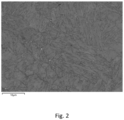
- Electron backscatter diffraction phase analysis (EBSD) in figure 2 further shows less than 1 vol% austenite (FCC structure) remained within the BCC(BCT) martensitic matrix.
- the austenite corresponds to the whitish fractions in the otherwise dark region in figure 2 (representing the martensitic matrix).
Landscapes
- Chemical & Material Sciences (AREA)
- Engineering & Computer Science (AREA)
- Materials Engineering (AREA)
- Mechanical Engineering (AREA)
- Metallurgy (AREA)
- Organic Chemistry (AREA)
- Manufacturing & Machinery (AREA)
- Physics & Mathematics (AREA)
- Plasma & Fusion (AREA)
- Powder Metallurgy (AREA)
Priority Applications (2)
| Application Number | Priority Date | Filing Date | Title |
|---|---|---|---|
| EP23168701.3A EP4450186A1 (de) | 2023-04-19 | 2023-04-19 | Verwaltung von stahlpulver frei von co, ti und al |
| PCT/EP2024/059531 WO2024217920A1 (en) | 2023-04-19 | 2024-04-09 | Maraging steel powder free from co, ti, and al |
Applications Claiming Priority (1)
| Application Number | Priority Date | Filing Date | Title |
|---|---|---|---|
| EP23168701.3A EP4450186A1 (de) | 2023-04-19 | 2023-04-19 | Verwaltung von stahlpulver frei von co, ti und al |
Publications (1)
| Publication Number | Publication Date |
|---|---|
| EP4450186A1 true EP4450186A1 (de) | 2024-10-23 |
Family
ID=86095688
Family Applications (1)
| Application Number | Title | Priority Date | Filing Date |
|---|---|---|---|
| EP23168701.3A Withdrawn EP4450186A1 (de) | 2023-04-19 | 2023-04-19 | Verwaltung von stahlpulver frei von co, ti und al |
Country Status (2)
| Country | Link |
|---|---|
| EP (1) | EP4450186A1 (de) |
| WO (1) | WO2024217920A1 (de) |
Citations (6)
| Publication number | Priority date | Publication date | Assignee | Title |
|---|---|---|---|---|
| US3392065A (en) * | 1965-10-15 | 1968-07-09 | Int Nickel Co | Age hardenable nickel-molybdenum ferrous alloys |
| EP0931844A1 (de) * | 1998-01-23 | 1999-07-28 | Imphy S.A. | Martensit-aushärtender Stahl ohne Kobalt |
| EP0935007A1 (de) * | 1998-02-04 | 1999-08-11 | Imphy S.A. | Martensitaushärtender Stahl ohne Kobalt und ohne Titan |
| DE102017131218A1 (de) * | 2017-12-22 | 2019-06-27 | Voestalpine Böhler Edelstahl Gmbh & Co Kg | Verfahren zum Herstellen eines Gegenstands aus einem Maraging-Stahl |
| EP3730236A1 (de) * | 2017-12-18 | 2020-10-28 | Hitachi Metals, Ltd. | Generativ gefertigter gegenstand, verfahren zu seiner herstellung und metallpulver zur generativen fertigung |
| EP3800276A1 (de) * | 2019-10-01 | 2021-04-07 | The Boeing Company | Maraging-stahllegierung und verfahren zu deren herstellung mittels generativer verfahren |
-
2023
- 2023-04-19 EP EP23168701.3A patent/EP4450186A1/de not_active Withdrawn
-
2024
- 2024-04-09 WO PCT/EP2024/059531 patent/WO2024217920A1/en not_active Ceased
Patent Citations (6)
| Publication number | Priority date | Publication date | Assignee | Title |
|---|---|---|---|---|
| US3392065A (en) * | 1965-10-15 | 1968-07-09 | Int Nickel Co | Age hardenable nickel-molybdenum ferrous alloys |
| EP0931844A1 (de) * | 1998-01-23 | 1999-07-28 | Imphy S.A. | Martensit-aushärtender Stahl ohne Kobalt |
| EP0935007A1 (de) * | 1998-02-04 | 1999-08-11 | Imphy S.A. | Martensitaushärtender Stahl ohne Kobalt und ohne Titan |
| EP3730236A1 (de) * | 2017-12-18 | 2020-10-28 | Hitachi Metals, Ltd. | Generativ gefertigter gegenstand, verfahren zu seiner herstellung und metallpulver zur generativen fertigung |
| DE102017131218A1 (de) * | 2017-12-22 | 2019-06-27 | Voestalpine Böhler Edelstahl Gmbh & Co Kg | Verfahren zum Herstellen eines Gegenstands aus einem Maraging-Stahl |
| EP3800276A1 (de) * | 2019-10-01 | 2021-04-07 | The Boeing Company | Maraging-stahllegierung und verfahren zu deren herstellung mittels generativer verfahren |
Non-Patent Citations (1)
| Title |
|---|
| YI HE ET AL: "Age hardening and mechanical properties of a 2400 MPa grade cobalt-free maraging steel", METALLURGICAL AND MATERIALS TRANSACTIONS A, SPRINGER-VERLAG, NEW YORK, vol. 37, no. 4, April 2006 (2006-04-01), pages 1107 - 1116, XP019695435, ISSN: 1543-1940 * |
Also Published As
| Publication number | Publication date |
|---|---|
| WO2024217920A1 (en) | 2024-10-24 |
Similar Documents
| Publication | Publication Date | Title |
|---|---|---|
| EP3795707A1 (de) | Generativ gefertigtes warmumformungswerkzeug, verfahren zu seiner herstellung und metallpulver für generativ gefertigtes warmumformungswerkzeug | |
| EP3472365B1 (de) | Stahl für kunststoffformwerkzeuge | |
| JP3689009B2 (ja) | 高耐食性高強度オーステナイト系ステンレス鋼とその製法 | |
| Shi et al. | Effect of hot isostatic pressing on the microstructure and mechanical properties of 17-4PH stainless steel parts fabricated by selective laser melting | |
| US12351894B2 (en) | Powder made of a cobalt-chromium alloy | |
| US20240068074A1 (en) | Titanium alloy and methods of manufacture | |
| EP3881954A1 (de) | Pulver zur generativen fertigung, dessen verwendung und verfahren zur generativen fertigung | |
| US20250230531A1 (en) | Metal powder for additive manufacturing | |
| KR20240116494A (ko) | 적층 조형물 및 그의 제조 방법 | |
| EP4450186A1 (de) | Verwaltung von stahlpulver frei von co, ti und al | |
| US20250188578A1 (en) | Maraging steel powder for additive manufacturing, maraging steel additive manufacturing product, and method for producing same | |
| US20250101559A1 (en) | Tool steel powder for additive manufacturing | |
| US20240300019A1 (en) | Powder for additive manufacturing, use thereof, and an additive manufacturing method | |
| JP4732694B2 (ja) | ナノカーバイド析出強化超高強度耐食性構造用鋼 | |
| EP4592006A1 (de) | Stahlpulver für warmarbeitswerkzeug zur generativen fertigung und generativ gefertigtes stahlobjekt für warmarbeitswerkzeug | |
| JP2013185249A (ja) | 鉄合金 | |
| Deirmina et al. | Effect of heat treatments on mechanical properties of ultra-high-strength maraging steels fabricated by additive manufacturing | |
| US20230332278A1 (en) | Alloy Material, Alloy Product Formed of Alloy Material, and Mechanical Device Including Alloy Product | |
| WO2025190983A1 (en) | Fe-based powder | |
| WO2025197624A1 (ja) | 積層造形用熱間工具鋼粉末および熱間工具鋼積層造形品 | |
| WO2025170066A1 (ja) | 積層造形用熱間工具鋼粉末および熱間工具鋼積層造形品 | |
| CN120752103A (zh) | 增材制造用Fe基粉末 | |
| WO2025070373A1 (ja) | 積層造形用マルエージング鋼粉末、マルエージング鋼積層造形品およびその製造方法 | |
| WO2025170067A1 (ja) | 積層造形用熱間工具鋼粉末および熱間工具鋼積層造形品 | |
| WO2025197625A1 (ja) | 積層造形用熱間工具鋼粉末および熱間工具鋼積層造形品 |
Legal Events
| Date | Code | Title | Description |
|---|---|---|---|
| PUAI | Public reference made under article 153(3) epc to a published international application that has entered the european phase |
Free format text: ORIGINAL CODE: 0009012 |
|
| STAA | Information on the status of an ep patent application or granted ep patent |
Free format text: STATUS: THE APPLICATION HAS BEEN PUBLISHED |
|
| AK | Designated contracting states |
Kind code of ref document: A1 Designated state(s): AL AT BE BG CH CY CZ DE DK EE ES FI FR GB GR HR HU IE IS IT LI LT LU LV MC ME MK MT NL NO PL PT RO RS SE SI SK SM TR |
|
| STAA | Information on the status of an ep patent application or granted ep patent |
Free format text: STATUS: REQUEST FOR EXAMINATION WAS MADE |
|
| 17P | Request for examination filed |
Effective date: 20250423 |
|
| STAA | Information on the status of an ep patent application or granted ep patent |
Free format text: STATUS: THE APPLICATION IS DEEMED TO BE WITHDRAWN |
|
| 18D | Application deemed to be withdrawn |
Effective date: 20250424 |