EP4450347A1 - Verbessertes verfahren und vorrichtung zur steuerung einer limp-heimfunktion einer arbeitsfahrzeug-anhänger-kombination - Google Patents
Verbessertes verfahren und vorrichtung zur steuerung einer limp-heimfunktion einer arbeitsfahrzeug-anhänger-kombination Download PDFInfo
- Publication number
- EP4450347A1 EP4450347A1 EP24170358.6A EP24170358A EP4450347A1 EP 4450347 A1 EP4450347 A1 EP 4450347A1 EP 24170358 A EP24170358 A EP 24170358A EP 4450347 A1 EP4450347 A1 EP 4450347A1
- Authority
- EP
- European Patent Office
- Prior art keywords
- work vehicle
- trailer
- limp home
- home functionality
- control system
- Prior art date
- Legal status (The legal status is an assumption and is not a legal conclusion. Google has not performed a legal analysis and makes no representation as to the accuracy of the status listed.)
- Pending
Links
Images


Classifications
-
- B—PERFORMING OPERATIONS; TRANSPORTING
- B60—VEHICLES IN GENERAL
- B60W—CONJOINT CONTROL OF VEHICLE SUB-UNITS OF DIFFERENT TYPE OR DIFFERENT FUNCTION; CONTROL SYSTEMS SPECIALLY ADAPTED FOR HYBRID VEHICLES; ROAD VEHICLE DRIVE CONTROL SYSTEMS FOR PURPOSES NOT RELATED TO THE CONTROL OF A PARTICULAR SUB-UNIT
- B60W10/00—Conjoint control of vehicle sub-units of different type or different function
- B60W10/04—Conjoint control of vehicle sub-units of different type or different function including control of propulsion units
- B60W10/06—Conjoint control of vehicle sub-units of different type or different function including control of propulsion units including control of combustion engines
-
- B—PERFORMING OPERATIONS; TRANSPORTING
- B60—VEHICLES IN GENERAL
- B60W—CONJOINT CONTROL OF VEHICLE SUB-UNITS OF DIFFERENT TYPE OR DIFFERENT FUNCTION; CONTROL SYSTEMS SPECIALLY ADAPTED FOR HYBRID VEHICLES; ROAD VEHICLE DRIVE CONTROL SYSTEMS FOR PURPOSES NOT RELATED TO THE CONTROL OF A PARTICULAR SUB-UNIT
- B60W10/00—Conjoint control of vehicle sub-units of different type or different function
- B60W10/18—Conjoint control of vehicle sub-units of different type or different function including control of braking systems
- B60W10/182—Conjoint control of vehicle sub-units of different type or different function including control of braking systems including control of parking brakes
-
- B—PERFORMING OPERATIONS; TRANSPORTING
- B60—VEHICLES IN GENERAL
- B60W—CONJOINT CONTROL OF VEHICLE SUB-UNITS OF DIFFERENT TYPE OR DIFFERENT FUNCTION; CONTROL SYSTEMS SPECIALLY ADAPTED FOR HYBRID VEHICLES; ROAD VEHICLE DRIVE CONTROL SYSTEMS FOR PURPOSES NOT RELATED TO THE CONTROL OF A PARTICULAR SUB-UNIT
- B60W10/00—Conjoint control of vehicle sub-units of different type or different function
- B60W10/18—Conjoint control of vehicle sub-units of different type or different function including control of braking systems
- B60W10/184—Conjoint control of vehicle sub-units of different type or different function including control of braking systems with wheel brakes
-
- B—PERFORMING OPERATIONS; TRANSPORTING
- B60—VEHICLES IN GENERAL
- B60W—CONJOINT CONTROL OF VEHICLE SUB-UNITS OF DIFFERENT TYPE OR DIFFERENT FUNCTION; CONTROL SYSTEMS SPECIALLY ADAPTED FOR HYBRID VEHICLES; ROAD VEHICLE DRIVE CONTROL SYSTEMS FOR PURPOSES NOT RELATED TO THE CONTROL OF A PARTICULAR SUB-UNIT
- B60W50/00—Details of control systems for road vehicle drive control not related to the control of a particular sub-unit, e.g. process diagnostic or vehicle driver interfaces
- B60W50/02—Ensuring safety in case of control system failures, e.g. by diagnosing, circumventing or fixing failures
- B60W50/029—Adapting to failures or work around with other constraints, e.g. circumvention by avoiding use of failed parts
-
- B—PERFORMING OPERATIONS; TRANSPORTING
- B60—VEHICLES IN GENERAL
- B60W—CONJOINT CONTROL OF VEHICLE SUB-UNITS OF DIFFERENT TYPE OR DIFFERENT FUNCTION; CONTROL SYSTEMS SPECIALLY ADAPTED FOR HYBRID VEHICLES; ROAD VEHICLE DRIVE CONTROL SYSTEMS FOR PURPOSES NOT RELATED TO THE CONTROL OF A PARTICULAR SUB-UNIT
- B60W50/00—Details of control systems for road vehicle drive control not related to the control of a particular sub-unit, e.g. process diagnostic or vehicle driver interfaces
- B60W50/02—Ensuring safety in case of control system failures, e.g. by diagnosing, circumventing or fixing failures
- B60W50/035—Bringing the control units into a predefined state, e.g. giving priority to particular actuators
-
- B—PERFORMING OPERATIONS; TRANSPORTING
- B60—VEHICLES IN GENERAL
- B60W—CONJOINT CONTROL OF VEHICLE SUB-UNITS OF DIFFERENT TYPE OR DIFFERENT FUNCTION; CONTROL SYSTEMS SPECIALLY ADAPTED FOR HYBRID VEHICLES; ROAD VEHICLE DRIVE CONTROL SYSTEMS FOR PURPOSES NOT RELATED TO THE CONTROL OF A PARTICULAR SUB-UNIT
- B60W50/00—Details of control systems for road vehicle drive control not related to the control of a particular sub-unit, e.g. process diagnostic or vehicle driver interfaces
- B60W50/02—Ensuring safety in case of control system failures, e.g. by diagnosing, circumventing or fixing failures
- B60W50/038—Limiting the input power, torque or speed
-
- B—PERFORMING OPERATIONS; TRANSPORTING
- B60—VEHICLES IN GENERAL
- B60W—CONJOINT CONTROL OF VEHICLE SUB-UNITS OF DIFFERENT TYPE OR DIFFERENT FUNCTION; CONTROL SYSTEMS SPECIALLY ADAPTED FOR HYBRID VEHICLES; ROAD VEHICLE DRIVE CONTROL SYSTEMS FOR PURPOSES NOT RELATED TO THE CONTROL OF A PARTICULAR SUB-UNIT
- B60W50/00—Details of control systems for road vehicle drive control not related to the control of a particular sub-unit, e.g. process diagnostic or vehicle driver interfaces
- B60W50/04—Monitoring the functioning of the control system
-
- B—PERFORMING OPERATIONS; TRANSPORTING
- B60—VEHICLES IN GENERAL
- B60W—CONJOINT CONTROL OF VEHICLE SUB-UNITS OF DIFFERENT TYPE OR DIFFERENT FUNCTION; CONTROL SYSTEMS SPECIALLY ADAPTED FOR HYBRID VEHICLES; ROAD VEHICLE DRIVE CONTROL SYSTEMS FOR PURPOSES NOT RELATED TO THE CONTROL OF A PARTICULAR SUB-UNIT
- B60W50/00—Details of control systems for road vehicle drive control not related to the control of a particular sub-unit, e.g. process diagnostic or vehicle driver interfaces
- B60W50/08—Interaction between the driver and the control system
- B60W50/10—Interpretation of driver requests or demands
-
- B—PERFORMING OPERATIONS; TRANSPORTING
- B60—VEHICLES IN GENERAL
- B60W—CONJOINT CONTROL OF VEHICLE SUB-UNITS OF DIFFERENT TYPE OR DIFFERENT FUNCTION; CONTROL SYSTEMS SPECIALLY ADAPTED FOR HYBRID VEHICLES; ROAD VEHICLE DRIVE CONTROL SYSTEMS FOR PURPOSES NOT RELATED TO THE CONTROL OF A PARTICULAR SUB-UNIT
- B60W50/00—Details of control systems for road vehicle drive control not related to the control of a particular sub-unit, e.g. process diagnostic or vehicle driver interfaces
- B60W50/02—Ensuring safety in case of control system failures, e.g. by diagnosing, circumventing or fixing failures
- B60W50/029—Adapting to failures or work around with other constraints, e.g. circumvention by avoiding use of failed parts
- B60W2050/0292—Fail-safe or redundant systems, e.g. limp-home or backup systems
-
- B—PERFORMING OPERATIONS; TRANSPORTING
- B60—VEHICLES IN GENERAL
- B60W—CONJOINT CONTROL OF VEHICLE SUB-UNITS OF DIFFERENT TYPE OR DIFFERENT FUNCTION; CONTROL SYSTEMS SPECIALLY ADAPTED FOR HYBRID VEHICLES; ROAD VEHICLE DRIVE CONTROL SYSTEMS FOR PURPOSES NOT RELATED TO THE CONTROL OF A PARTICULAR SUB-UNIT
- B60W50/00—Details of control systems for road vehicle drive control not related to the control of a particular sub-unit, e.g. process diagnostic or vehicle driver interfaces
- B60W50/08—Interaction between the driver and the control system
- B60W50/14—Means for informing the driver, warning the driver or prompting a driver intervention
- B60W2050/146—Display means
-
- B—PERFORMING OPERATIONS; TRANSPORTING
- B60—VEHICLES IN GENERAL
- B60W—CONJOINT CONTROL OF VEHICLE SUB-UNITS OF DIFFERENT TYPE OR DIFFERENT FUNCTION; CONTROL SYSTEMS SPECIALLY ADAPTED FOR HYBRID VEHICLES; ROAD VEHICLE DRIVE CONTROL SYSTEMS FOR PURPOSES NOT RELATED TO THE CONTROL OF A PARTICULAR SUB-UNIT
- B60W2300/00—Indexing codes relating to the type of vehicle
- B60W2300/14—Tractor-trailers, i.e. combinations of a towing vehicle and one or more towed vehicles, e.g. caravans; Road trains
-
- B—PERFORMING OPERATIONS; TRANSPORTING
- B60—VEHICLES IN GENERAL
- B60W—CONJOINT CONTROL OF VEHICLE SUB-UNITS OF DIFFERENT TYPE OR DIFFERENT FUNCTION; CONTROL SYSTEMS SPECIALLY ADAPTED FOR HYBRID VEHICLES; ROAD VEHICLE DRIVE CONTROL SYSTEMS FOR PURPOSES NOT RELATED TO THE CONTROL OF A PARTICULAR SUB-UNIT
- B60W2300/00—Indexing codes relating to the type of vehicle
- B60W2300/15—Agricultural vehicles
-
- B—PERFORMING OPERATIONS; TRANSPORTING
- B60—VEHICLES IN GENERAL
- B60W—CONJOINT CONTROL OF VEHICLE SUB-UNITS OF DIFFERENT TYPE OR DIFFERENT FUNCTION; CONTROL SYSTEMS SPECIALLY ADAPTED FOR HYBRID VEHICLES; ROAD VEHICLE DRIVE CONTROL SYSTEMS FOR PURPOSES NOT RELATED TO THE CONTROL OF A PARTICULAR SUB-UNIT
- B60W2300/00—Indexing codes relating to the type of vehicle
- B60W2300/17—Construction vehicles, e.g. graders, excavators
-
- B—PERFORMING OPERATIONS; TRANSPORTING
- B60—VEHICLES IN GENERAL
- B60W—CONJOINT CONTROL OF VEHICLE SUB-UNITS OF DIFFERENT TYPE OR DIFFERENT FUNCTION; CONTROL SYSTEMS SPECIALLY ADAPTED FOR HYBRID VEHICLES; ROAD VEHICLE DRIVE CONTROL SYSTEMS FOR PURPOSES NOT RELATED TO THE CONTROL OF A PARTICULAR SUB-UNIT
- B60W2520/00—Input parameters relating to overall vehicle dynamics
- B60W2520/04—Vehicle stop
Definitions
- the present invention relates to a method and to an apparatus for controlling a limp home functionality of a work vehicle and trailer combination, in particular of a tractor-trailer combination.
- the present invention finds its preferred, although not exclusive, application in the field of agricultural vehicles. Reference will be made to this application by way of example below, without however losing in generality.
- work vehicle and trailer combinations comprise a work vehicle carrying or towing a trailer, for instance a baler, a forage harvester, a manure spreader, or the like.
- Such work vehicles are provided with a trailer control system configured to control the operation of the trailer, in particular for controlling the operation of the brake system of the trailer. More in detail, the control system of the work vehicle is configured to control the parking brake system of the trailer.
- the work vehicle may be provided with a limp home functionality configured to limit the performances of the work vehicle, in particular its maximum traveling speed, when a failure is detected.
- failures that can trigger the limp home functionality may comprise transmission failures, engine failures, brake malfunctions, extremely low levels of oil or coolant fluid and/or the like.
- the limp home functionality may be triggered also when a failure in the trailer control system occurs.
- the limp home functionality is configured to allow the work vehicle and trailer combination to travel with a limited speed, in order to reduce the risks for the driver and to avoid making further damages, but still allowing this latter to reach the desired destination.
- the limp home functionality is further configured to allow the driver to safely slow down the work vehicle and trailer combination to a full stop.
- the activation of the limp home functionality is usually notified to the work vehicle driver by a warning light on the dashboard carried within the driver's cabin.
- the limp home functionality will be activated even if no trailer is attached to the work vehicle.
- the limp home functionality will be triggered and will remain activated even if the trailer is successively decoupled from the work vehicle.
- An aim of the present invention is to satisfy the above-mentioned needs in a cost effective and optimized manner.
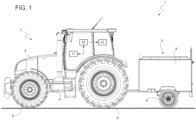
- number 1 denotes as a whole a work vehicle and trailed combination including a work vehicle 2 and a trailer 3 carried or towed by the work vehicle 2.
- work vehicle 2 may comprise an agricultural vehicle such as a tractor.
- the trailer 3 may be of any kind, for instance a baler, a forage harvester, a manure spreader or the like.
- work vehicle 2 is provided with a powertrain assembly (not illustrated), which is carried by a work vehicle body 4 and is adapted to provide torque to allow motion of the work vehicle body 4 with respect to the ground, e.g. thanks to at least one pair of ground engaging wheels or tracks 6.
- a powertrain assembly (not illustrated), which is carried by a work vehicle body 4 and is adapted to provide torque to allow motion of the work vehicle body 4 with respect to the ground, e.g. thanks to at least one pair of ground engaging wheels or tracks 6.
- the powertrain assembly preferably comprises an engine (not illustrated), such as an internal combustion engine, and a transmission assembly (not illustrated), which is carried by the engine and is adapted to be mechanically connected to an output shaft of the vehicle 2, such as a drive axle, to transmit this latter the torque provided at output by engine, in a manner per se known and therefore not further described.
- an engine such as an internal combustion engine
- a transmission assembly (not illustrated), which is carried by the engine and is adapted to be mechanically connected to an output shaft of the vehicle 2, such as a drive axle, to transmit this latter the torque provided at output by engine, in a manner per se known and therefore not further described.
- work vehicle 2 further comprises a brake system (not illustrated) configured to provide a braking torque to the ground engaging wheels or tracks 6 for braking the work vehicle 2.
- a brake system (not illustrated) configured to provide a braking torque to the ground engaging wheels or tracks 6 for braking the work vehicle 2.
- the trailer 3 preferably comprises a trailer body 8 configured to be attached to the work vehicle 2, in particular to the rear drawbar or to the rear hitch assembly of the work vehicle 2.
- trailer 3 preferably comprises at least a pair of ground engaging wheels 9 carried in a rotatable manner by the trailer body 8 and configured to allow motion of the trailer body 8 with respect to the ground.
- trailer 3 comprises a brake system coupled to the ground engaging wheels 9 and configured to provide a braking torque adapted to brake the same trailer 3.
- the brake system of trailer 3 may comprise a parking brake system.
- brake system of trailer 3 is preferably a pneumatically actuated brake system, in a manner per se known and therefore not further described.
- work vehicle 2 comprises an electronic control unit 10, which is electrically connected at least to powertrain assembly and/or braking assembly of the same work vehicle 2 and is provided with elaboration means configured to control their operation according to the limp home functionality described more in detail in the following.
- the limp home functionality in particular, foresees to control of the powertrain assembly of the same work vehicle 2 to reduce its maximum traveling speed.
- control logic mentioned above may be deployed into a specific software code, which can be downloaded into the electronic control unit 10 and is configured to execute the control method as described in the following.
- work vehicle comprises input means 11, such as a button, a knob, a joystick, an icon displayed on a touch sensitive screen carried within the driver's cabin and/or other similar HMIs, which is electrically connected to electronic control unit 10 and is configured to be manipulated/handled/operated by the user to provide control signals to control unit 10 adapted to control the operation of work vehicle 2.
- input means 11 such as a button, a knob, a joystick, an icon displayed on a touch sensitive screen carried within the driver's cabin and/or other similar HMIs, which is electrically connected to electronic control unit 10 and is configured to be manipulated/handled/operated by the user to provide control signals to control unit 10 adapted to control the operation of work vehicle 2.
- electronic control unit 10 may be configured to perform a limp home functionality when a fault or a failure in the work vehicle 2 is detected.
- electronic control unit may be configured to trigger such limp home functionality when a fault in the powertrain assembly and/or in the braking assembly of the work vehicle 2 is detected.
- electronic control unit 10 is configured to control powertrain assembly in order to limit the performances of work vehicle 2, in particular to reduce the maximum available traveling speed of work vehicle 2 to a safety value.
- Such limp home functionality may be notified to the work vehicle driver by means of a warning light on a dashboard carried in a driver's cabin of work vehicle 2, in a manner per se known and therefore not further described.
- work vehicle 2 further comprises a control system 13, in the following referred to as "trailer control system", which is adapted to be operatively connected to the trailer 3 to control its operation.
- trailer control system in the following referred to as "trailer control system”
- trailer control system 13 is preferably configured to be operatively connected to the brake system of trailer 3.
- Trailer control system 13 may comprise a further electronic control unit electrically connected to electronic control unit 10 and control valves, for instance pneumatic control valves, adapted to control the operation of the brake system of trailer 3, in a manner per se known and therefore non further described.
- Electronic control unit 10 is configured to provide the trailer control system 13 with control signals adapted to control the operation of the braking system of trailer 3.
- electronic control unit 10 is configured to detect if failures in the trailer control system 13 occur.
- electronic control unit 10 is preferably configured to allow the work vehicle driver to drive work vehicle 2 to stop.
- electronic control unit 10 may be configured to control the powertrain assembly and/or the braking assembly of work vehicle 2 in order to allow the work vehicle driver to drive this latter to a complete halt, if suitable control commands are provided by the driver to the electronic control unit 10.
- electronic control unit 10 is configured to provide control signal adapted to control an output unit of work vehicle 2 in order to notify the work vehicle driver of the fault occurred in the trailer control system 13.
- electronic control unit 10 may be configured to activate a warning light on a dashboard and/or to display an icon on a touch sensitive display carried within the driver's cabin of work vehicle 3.
- input means 11 are adapted to be operated /handled by the work vehicle driver in order to allow the same work vehicle driver to provide the electronic control unit 10 with control signals adapted to activate such limp home functionality.
- electronic control unit 10 is configured to provide a request to activate the limp home functionality too work vehicle driver. Then, electronic control unit 10 is configured to activate the limp home functionality only if a consent is provided by work vehicle driver via input means 11.
- electronic control unit 10 is configured to activate the limp home functionality accordingly, thus reducing the maximum traveling speed of work vehicle 2 to the safety value.
- electronic control unit 10 is configured to leave the limp home functionality of work vehicle 2 deactivated.
- work vehicle driver may detach the trailer 3 from work vehicle 2 and operate the work vehicle 2 without further limitations, i.e. with the limp home functionality deactivated.
- the parking brake system of trailer 3 may be engaged and the same trailer 3 can be simply detached from work vehicle 2 and left parked in a safe area.
- the limp mode functionality is not activated.
- work vehicle 2 may be controlled by work vehicle driver in order to safely drive work vehicle and trailer combination 1 to a full stop.
- a warning message is displayed to the work vehicle driver, for instance by displaying a message/ notification/ icon on a dashboard or on a touch sensitive display carried within the driver's cabin of work vehicle 2, and the activation of the limp home functionality is requested.
- the work vehicle driver may also engage the parking brake system of trailer 3.
- This for instance may allow the work vehicle driver to detach the trailer 3 from work vehicle 2 and to operate the work vehicle 2 without any limitations, while the trailer 3 can be simply detached from work vehicle 2 and left parked in a safe area.
- the present invention is directed to a method for controlling a limp home functionality of the work vehicle and trailer combination 1, the method comprising the following steps:
- the method may further comprise the step of engaging the parking brake system of trailer 3.
- the method may further comprise the step of detaching the trailer 3 from the work vehicle 2.
- the method may further comprise the step of allowing the work vehicle driver to control the work vehicle 2 in order to slow down work vehicle and trailer combination 1 (block 220), advantageously to a full stop.
- the work vehicle driver may decide whether to activate the limp home functionality and to safely but slowly drive the work vehicle and trailer combination 1 to the destination, or alternatively he can decide to not activate the limp home functionality on work vehicle 2 and to activate the parking brake system of the trailer 3.
- the work vehicle driver has either the possibility to insert the parking brake system of trailer 3, detach the same trailer 3 from the work vehicle 2, and operate the work vehicle 2 without any limitation, simply leaving the trailer 3 behind, or he can allow the activation of the limp home functionality and he can slowly but safely drive the work vehicle and trailer combination 1 to destination.
- the operation and the productivity of the work vehicle 2 is not limited by a fault which may occur on the trailer control system 13, without however affecting the safety of the work vehicle and trailer combination 1.
- the work vehicle 2 may be operated for different missions or agricultural jobs without undue limitations, while the trailer may be retrieved by a different work vehicle 2 with a properly operating trailer control system 13.
Landscapes
- Engineering & Computer Science (AREA)
- Automation & Control Theory (AREA)
- Transportation (AREA)
- Mechanical Engineering (AREA)
- Human Computer Interaction (AREA)
- Chemical & Material Sciences (AREA)
- Combustion & Propulsion (AREA)
- Regulating Braking Force (AREA)
Applications Claiming Priority (1)
| Application Number | Priority Date | Filing Date | Title |
|---|---|---|---|
| IT202300007866 | 2023-04-21 |
Publications (1)
| Publication Number | Publication Date |
|---|---|
| EP4450347A1 true EP4450347A1 (de) | 2024-10-23 |
Family
ID=87136996
Family Applications (1)
| Application Number | Title | Priority Date | Filing Date |
|---|---|---|---|
| EP24170358.6A Pending EP4450347A1 (de) | 2023-04-21 | 2024-04-15 | Verbessertes verfahren und vorrichtung zur steuerung einer limp-heimfunktion einer arbeitsfahrzeug-anhänger-kombination |
Country Status (1)
| Country | Link |
|---|---|
| EP (1) | EP4450347A1 (de) |
Citations (4)
| Publication number | Priority date | Publication date | Assignee | Title |
|---|---|---|---|---|
| US8560162B2 (en) * | 2008-06-20 | 2013-10-15 | Knorr-Bremse Systeme Fuer Nutzfahrzeuge Gmbh | Monitoring device for monitoring systems of a vehicle |
| US20200039487A1 (en) * | 2018-08-03 | 2020-02-06 | Toyota Motor Engineering & Manufacturing North America, Inc. | Trailer brake controller (tbc) failsafe using detection camera |
| US20200040956A1 (en) * | 2018-08-01 | 2020-02-06 | Bendix Commercial Vehicle Systems Llc | Method for using brake pad information in braking applications |
| US20200118361A1 (en) * | 2018-10-15 | 2020-04-16 | Bendix Commercial Vehicle Systems Llc | System and Method for Pre-Trip Inspection of a Tractor-Trailer |
-
2024
- 2024-04-15 EP EP24170358.6A patent/EP4450347A1/de active Pending
Patent Citations (4)
| Publication number | Priority date | Publication date | Assignee | Title |
|---|---|---|---|---|
| US8560162B2 (en) * | 2008-06-20 | 2013-10-15 | Knorr-Bremse Systeme Fuer Nutzfahrzeuge Gmbh | Monitoring device for monitoring systems of a vehicle |
| US20200040956A1 (en) * | 2018-08-01 | 2020-02-06 | Bendix Commercial Vehicle Systems Llc | Method for using brake pad information in braking applications |
| US20200039487A1 (en) * | 2018-08-03 | 2020-02-06 | Toyota Motor Engineering & Manufacturing North America, Inc. | Trailer brake controller (tbc) failsafe using detection camera |
| US20200118361A1 (en) * | 2018-10-15 | 2020-04-16 | Bendix Commercial Vehicle Systems Llc | System and Method for Pre-Trip Inspection of a Tractor-Trailer |
Similar Documents
| Publication | Publication Date | Title |
|---|---|---|
| JP7150928B2 (ja) | 作業機の制御装置、作業機の制御方法及び作業機 | |
| US5505267A (en) | Differential lock control system for agricultural vehicles | |
| AU687576B2 (en) | System for controlling a vehicle to selectively allow operation in either an autonomous mode or a manual mode | |
| EP3055173B1 (de) | Fahrzeugbremsverfahren und entsprechende vorrichtungen | |
| US8090514B2 (en) | Vehicle control system | |
| US10232859B2 (en) | Control system for a machine | |
| US5558163A (en) | Control system for utility vehicle | |
| EP3939843B1 (de) | Pneumatische anhängerbremsenschaltung mit losbrecherkennung und verfahren dafür | |
| US10710566B2 (en) | Powered vehicle including a SAHR brake | |
| EP4450347A1 (de) | Verbessertes verfahren und vorrichtung zur steuerung einer limp-heimfunktion einer arbeitsfahrzeug-anhänger-kombination | |
| JP6925882B2 (ja) | 作業機の制御装置、作業機の制御方法及び作業機 | |
| JP6893405B2 (ja) | 作業車両の停止システム | |
| US20240198984A1 (en) | Method for brake control of a vehicle combination and brake control system for operating this method | |
| JP3127925B2 (ja) | 前輪駆動クラッチ制御システム | |
| US10780887B2 (en) | Utility vehicle and method for operating a utility vehicle having a four-wheel drive and a differential lock | |
| US11268614B2 (en) | Working vehicle | |
| JP7782178B2 (ja) | 作業車両 | |
| EP3932765B1 (de) | Nutzfahrzeug | |
| JP2021107202A (ja) | 作業車両 | |
| JP7234827B2 (ja) | 作業車両 | |
| US20260054705A1 (en) | Work vehicle with sahr-actuated brake assembly and braking-related systems and methods | |
| EP4226753B1 (de) | Landwirtschaftliche maschine, die in kombinierter oder getrennter konfiguration betrieben werden kann | |
| JPH0411866Y2 (de) | ||
| JP2024092295A (ja) | 作業車両 | |
| CN119975363A (zh) | 一种集运机双向驾驶控制方法及系统 |
Legal Events
| Date | Code | Title | Description |
|---|---|---|---|
| PUAI | Public reference made under article 153(3) epc to a published international application that has entered the european phase |
Free format text: ORIGINAL CODE: 0009012 |
|
| STAA | Information on the status of an ep patent application or granted ep patent |
Free format text: STATUS: THE APPLICATION HAS BEEN PUBLISHED |
|
| AK | Designated contracting states |
Kind code of ref document: A1 Designated state(s): AL AT BE BG CH CY CZ DE DK EE ES FI FR GB GR HR HU IE IS IT LI LT LU LV MC ME MK MT NL NO PL PT RO RS SE SI SK SM TR |
|
| STAA | Information on the status of an ep patent application or granted ep patent |
Free format text: STATUS: REQUEST FOR EXAMINATION WAS MADE |
|
| 17P | Request for examination filed |
Effective date: 20250423 |