EP4451388A2 - Anodenaktivmaterial für lithiumsekundärbatterie und lithiumsekundärbatterie damit - Google Patents
Anodenaktivmaterial für lithiumsekundärbatterie und lithiumsekundärbatterie damit Download PDFInfo
- Publication number
- EP4451388A2 EP4451388A2 EP24196333.9A EP24196333A EP4451388A2 EP 4451388 A2 EP4451388 A2 EP 4451388A2 EP 24196333 A EP24196333 A EP 24196333A EP 4451388 A2 EP4451388 A2 EP 4451388A2
- Authority
- EP
- European Patent Office
- Prior art keywords
- active material
- anode active
- secondary battery
- lithium secondary
- anode
- Prior art date
- Legal status (The legal status is an assumption and is not a legal conclusion. Google has not performed a legal analysis and makes no representation as to the accuracy of the status listed.)
- Pending
Links
Images
Classifications
-
- H—ELECTRICITY
- H01—ELECTRIC ELEMENTS
- H01M—PROCESSES OR MEANS, e.g. BATTERIES, FOR THE DIRECT CONVERSION OF CHEMICAL ENERGY INTO ELECTRICAL ENERGY
- H01M4/00—Electrodes
- H01M4/02—Electrodes composed of, or comprising, active material
- H01M4/13—Electrodes for accumulators with non-aqueous electrolyte, e.g. for lithium-accumulators; Processes of manufacture thereof
- H01M4/133—Electrodes based on carbonaceous material, e.g. graphite-intercalation compounds or CFx
-
- H—ELECTRICITY
- H01—ELECTRIC ELEMENTS
- H01M—PROCESSES OR MEANS, e.g. BATTERIES, FOR THE DIRECT CONVERSION OF CHEMICAL ENERGY INTO ELECTRICAL ENERGY
- H01M4/00—Electrodes
- H01M4/02—Electrodes composed of, or comprising, active material
- H01M4/36—Selection of substances as active materials, active masses, active liquids
-
- H—ELECTRICITY
- H01—ELECTRIC ELEMENTS
- H01M—PROCESSES OR MEANS, e.g. BATTERIES, FOR THE DIRECT CONVERSION OF CHEMICAL ENERGY INTO ELECTRICAL ENERGY
- H01M4/00—Electrodes
- H01M4/02—Electrodes composed of, or comprising, active material
- H01M4/36—Selection of substances as active materials, active masses, active liquids
- H01M4/362—Composites
- H01M4/364—Composites as mixtures
-
- H—ELECTRICITY
- H01—ELECTRIC ELEMENTS
- H01M—PROCESSES OR MEANS, e.g. BATTERIES, FOR THE DIRECT CONVERSION OF CHEMICAL ENERGY INTO ELECTRICAL ENERGY
- H01M4/00—Electrodes
- H01M4/02—Electrodes composed of, or comprising, active material
- H01M4/36—Selection of substances as active materials, active masses, active liquids
- H01M4/58—Selection of substances as active materials, active masses, active liquids of inorganic compounds other than oxides or hydroxides, e.g. sulfides, selenides, tellurides, halogenides or LiCoFy; of polyanionic structures, e.g. phosphates, silicates or borates
- H01M4/583—Carbonaceous material, e.g. graphite-intercalation compounds or CFx
- H01M4/587—Carbonaceous material, e.g. graphite-intercalation compounds or CFx for inserting or intercalating light metals
-
- H—ELECTRICITY
- H01—ELECTRIC ELEMENTS
- H01M—PROCESSES OR MEANS, e.g. BATTERIES, FOR THE DIRECT CONVERSION OF CHEMICAL ENERGY INTO ELECTRICAL ENERGY
- H01M10/00—Secondary cells; Manufacture thereof
- H01M10/05—Accumulators with non-aqueous electrolyte
- H01M10/052—Li-accumulators
- H01M10/0525—Rocking-chair batteries, i.e. batteries with lithium insertion or intercalation in both electrodes; Lithium-ion batteries
-
- H—ELECTRICITY
- H01—ELECTRIC ELEMENTS
- H01M—PROCESSES OR MEANS, e.g. BATTERIES, FOR THE DIRECT CONVERSION OF CHEMICAL ENERGY INTO ELECTRICAL ENERGY
- H01M4/00—Electrodes
- H01M4/02—Electrodes composed of, or comprising, active material
- H01M2004/021—Physical characteristics, e.g. porosity, surface area
-
- H—ELECTRICITY
- H01—ELECTRIC ELEMENTS
- H01M—PROCESSES OR MEANS, e.g. BATTERIES, FOR THE DIRECT CONVERSION OF CHEMICAL ENERGY INTO ELECTRICAL ENERGY
- H01M4/00—Electrodes
- H01M4/02—Electrodes composed of, or comprising, active material
- H01M2004/026—Electrodes composed of, or comprising, active material characterised by the polarity
- H01M2004/027—Negative electrodes
-
- H—ELECTRICITY
- H01—ELECTRIC ELEMENTS
- H01M—PROCESSES OR MEANS, e.g. BATTERIES, FOR THE DIRECT CONVERSION OF CHEMICAL ENERGY INTO ELECTRICAL ENERGY
- H01M4/00—Electrodes
- H01M4/02—Electrodes composed of, or comprising, active material
- H01M4/36—Selection of substances as active materials, active masses, active liquids
- H01M4/48—Selection of substances as active materials, active masses, active liquids of inorganic oxides or hydroxides
- H01M4/50—Selection of substances as active materials, active masses, active liquids of inorganic oxides or hydroxides of manganese
- H01M4/505—Selection of substances as active materials, active masses, active liquids of inorganic oxides or hydroxides of manganese of mixed oxides or hydroxides containing manganese for inserting or intercalating light metals, e.g. LiMn2O4 or LiMn2OxFy
-
- H—ELECTRICITY
- H01—ELECTRIC ELEMENTS
- H01M—PROCESSES OR MEANS, e.g. BATTERIES, FOR THE DIRECT CONVERSION OF CHEMICAL ENERGY INTO ELECTRICAL ENERGY
- H01M4/00—Electrodes
- H01M4/02—Electrodes composed of, or comprising, active material
- H01M4/36—Selection of substances as active materials, active masses, active liquids
- H01M4/48—Selection of substances as active materials, active masses, active liquids of inorganic oxides or hydroxides
- H01M4/52—Selection of substances as active materials, active masses, active liquids of inorganic oxides or hydroxides of nickel, cobalt or iron
- H01M4/525—Selection of substances as active materials, active masses, active liquids of inorganic oxides or hydroxides of nickel, cobalt or iron of mixed oxides or hydroxides containing iron, cobalt or nickel for inserting or intercalating light metals, e.g. LiNiO2, LiCoO2 or LiCoOxFy
-
- Y—GENERAL TAGGING OF NEW TECHNOLOGICAL DEVELOPMENTS; GENERAL TAGGING OF CROSS-SECTIONAL TECHNOLOGIES SPANNING OVER SEVERAL SECTIONS OF THE IPC; TECHNICAL SUBJECTS COVERED BY FORMER USPC CROSS-REFERENCE ART COLLECTIONS [XRACs] AND DIGESTS
- Y02—TECHNOLOGIES OR APPLICATIONS FOR MITIGATION OR ADAPTATION AGAINST CLIMATE CHANGE
- Y02E—REDUCTION OF GREENHOUSE GAS [GHG] EMISSIONS, RELATED TO ENERGY GENERATION, TRANSMISSION OR DISTRIBUTION
- Y02E60/00—Enabling technologies; Technologies with a potential or indirect contribution to GHG emissions mitigation
- Y02E60/10—Energy storage using batteries
Definitions
- the present invention relates to an anode active material for a lithium secondary battery and a lithium secondary battery including the same. More particularly, the present invention relates to an anode active material that includes a graphite-based material for a lithium secondary battery and a lithium secondary battery including the same
- a secondary battery which can be charged and discharged repeatedly has been widely employed as a power source of a mobile electronic device such as a camcorder, a mobile phone, a laptop computer, etc., according to developments of information and display technologies. Recently, a battery pack including the secondary battery is being developed and applied as a power source of an eco-friendly vehicle such as a hybrid automobile.
- the secondary battery includes, e.g., a lithium secondary battery, a nickel-cadmium battery, a nickel-hydrogen battery, etc.
- the lithium secondary battery is highlighted due to high operational voltage and energy density per unit weight, a high charging rate, a compact dimension, etc.
- the lithium secondary battery may include an electrode assembly including a cathode, an anode and a separation layer (separator), and an electrolyte immersing the electrode assembly.
- the lithium secondary battery may further include an outer case having, e.g., a pouch shape.
- a carbon-based material is used as an anode active material of the lithium secondary battery which has preferably high capacity, high power and extended life-span.
- the anode active material is designed to have high power/ capacity composition, thermal and mechanical stability may be lowered, and life-span property and operational reliability of the lithium secondary battery may be deteriorated.
- Korean Registered Patent Publication No. 10-1764072 discloses a lithium iron phosphate electrode coated with carbon.
- an anode active material for a lithium secondary battery having improved capacity and operation reliability.
- a lithium secondary battery having an anode formed of the anode active material.
- An anode active material for a lithium secondary battery includes a first anode active material and a second anode active material, each of which includes a carbon-based active material and has a crystallite size defined as Equation 1 in a range from 50 nm to 60 nm.
- An XRD orientation ratio of the first anode active material is in a range from 0.9 to 1.2
- an XRD orientation ratio of the second anode active material is in a range from 1 to 5.
- the XRD orientation ratio is defined as I(004)/I(110) which is a ratio of a peak intensity at a (004) plane relative to a peak intensity at a (110) plane.
- L 1.84 ⁇ ⁇ cos ⁇
- Equation 1 L is the crystallite size, ⁇ is an X-ray wavelength (nm) used in an XRD analysis, ⁇ is a full width at half maximum (rad) of the (110) plane, and ⁇ is a diffraction angle (rad).
- the first anode active material may include natural graphite, and the second anode active material may include artificial graphite.
- the first anode active material may include natural graphite having a sphericity of 0.9 or more.
- the XRD orientation ratio of the second anode active material may be greater than the XRD orientation ratio of the first anode active material.
- the XRD orientation ratio of the first anode active material may be in a range from 0.99 to 1.2.
- the XRD orientation ratio of the second anode active material may be in a range from 2 to 4.
- a weight of the second anode active material may be equal to or greater than a weight of the first anode active material in the anode active material.
- a weight ratio of the first anode active material and the second anode active material may be in a range from 50:50 to 5:95.
- a lithium secondary battery includes an anode including the anode active material for a lithium secondary battery according to embodiments as described above, and a cathode facing the anode.
- the cathode may include a lithium-transition metal oxide containing nickel (Ni), cobalt (Co) and manganese (Mn) as a cathode active material.
- a molar ratio of Ni among Ni, Co and Mn in the lithium-transition metal oxide may be 0.6 or more.
- the anode active material for a lithium secondary battery may include a first anode active material and a second anode active material having crystallite sizes within a predetermined range and different XRD orientation properties. High capacity and life-span stability from the anode active material may be achieved using the combination of the first anode active material and the second anode active material,
- an improved capacity retention may be obtained by blending of the second anode active material even during repeated charging/discharging at high temperature.
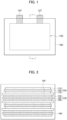
- FIGS. 1 and 2 are a schematic top planar view and a cross-sectional view, respectively, illustrating a lithium secondary battery in accordance with exemplary embodiments.
- an anode active material for a lithium secondary battery which includes different types of carbon-based materials and provides enhanced capacity and life-span properties.
- a lithium secondary battery including an anode formed of the anode active material is also provided.
- An anode active material for a lithium secondary battery (hereinafter, abbreviated as an anode active material) according to embodiments of the present invention may include different types of carbon-based active materials.
- the anode active material may include a graphite-based material.
- the anode active material may include a blend or mixture of natural graphite and artificial graphite.
- a crystallite size of the anode active material may be from 50 nm to 60 nm.
- the "crystallite size” may be a value measured through an X-ray diffraction (XRD) analysis of the anode active material in a powder state.
- the crystallite size may be calculated by Equation 1 below using a full width at half maximum (FWHM) obtained through the XRD analysis.
- L 1.84 ⁇ ⁇ cos ⁇
- L is the crystallite size (nm)
- ⁇ is an X-ray wavelength (nm)
- ⁇ is the full width at half maximum (rad) of a corresponding peak
- ⁇ is a diffraction angle (rad).
- the full width at half maximum in XRD analysis for the crystallite size measurement may be obtained from a peak of a (110) plane.
- the crystallite size of the anode active material exceeds 60 nm, capacity retention and life-span properties through the anode active material may be deteriorated. If the crystallite size of the anode active material is less than 50 nm, power and capacity from the anode active material may be excessively reduced.
- the anode active material includes a first anode active material and a second anode active material, and both the first anode active material and the second anode active material may have a crystallite size in a range from 50 nm to 60 nm.
- the first anode active material and the second anode active material may have different XRD orientation ratios (or orientation indexes).
- XRD orientation ratio or XRD orientation index used herein may be defined as a ratio of I(004) relative to I(110) (I(004)/I(110)) by the XRD analysis.
- I(110) and I(004) are peak intensities or maximum heights of a (110) plane and a (004) plane, respectively, by the XRD analysis of the first anode active material and the second anode active material in powder states.
- the XRD orientation index of the first anode active material may be from 0.9 to 1.2, and the XRD orientation index of the second anode active material may be from 1 to 5.
- the XRD orientation index may indicate a crystallinity of the anode active material. For example, when the XRD orientation index is excessively large, exposure of an active surface of the anode active material may become greater, thereby deteriorating life-span properties of the anode or lithium secondary battery. If the XRD orientation index is excessively small, the crystallinity may be degraded, and thus a capacity of the anode active material may also be degraded.
- the mixture of the first anode active material and the second anode active material having different XRD orientation indexes may be used, so that capacity retention and life-span properties may be improved while achieving or maintaining high-capacity properties of the secondary battery.
- the first anode active material may include natural graphite. Natural graphite may have improved power/capacity properties when compared to those from artificial graphite. Therefore, for example, high-capacity properties may be implemented from each of a cathode and the anode of the lithium secondary battery in combination with a high-nickel (High-Ni) cathode composition as will be described later,
- Natural graphite may have chemical and mechanical stability or durability less than those of artificial graphite. For example, contraction/expansion of natural graphite may occur during repeated charging/discharging, and damages to a particle structure or a crystal structure may be caused.
- natural graphite having the relatively small XRD orientation index may be employed as the first anode active material. Accordingly, the high-capacity properties in the anode may be enhanced by the utilization of natural graphite while compensating for instability of a crystal structure.
- natural graphite particles may be sphere-treated.
- a plate-like graphite may be pulverized through impact blending or milling. Thereafter, the pulverized graphite powder may be acid-treated using HF, HCl, HNO 3 , or the like, and then washed. The acid-treated and washed fine particles may be converted into spherical particles through a pressing process.
- a sphericity of the natural graphite particles may be 0.9 or more, preferably 0.94 or more, and more preferably 0.96 or more.
- the second anode active material may include artificial graphite.
- Artificial graphite has relatively improved life-span properties compared to those of natural graphite, but may not sufficiently provide high-capacity properties compared to those of natural graphite.
- artificial graphite having the relatively large XRD orientation index may be employed as the second anode active material. Accordingly, capacity stability and life-span properties at high temperature may be enhanced by utilizing artificial graphite, and effects from the combination with the above-described natural graphite may be improved.
- the XRD orientation index of the first anode active material may be from 0.99 to 1.2, more preferably from 0.99 to 1.1.
- the XRD orientation index of the second anode active material may be from 2 to 4, more preferably from 2.5 to 4.
- the second anode active material may include a heat-treated artificial graphite.
- a powder may be prepared by pulverizing a carbon-based material having an average particle diameter (D50) of 5 ⁇ m to 10 ⁇ m.
- the powder may be heat-treated at a temperature of 3000 °C or higher to prepare the second anode active material including artificial graphite.
- the carbon-based material may include coal-based heavy oil, petroleum-based heavy oil, tar, pitch, cokes, etc.
- the second anode active material may have a secondary particle structure.
- artificial graphite in the form of primary particles prepared as described above may be mixed with a binder and heat-treated again to obtain the second anode active material having the secondary particle structure.
- the XRD orientation index of the second anode active material may be changed according to a temperature and a time of the heat treatment for manufacturing artificial graphite.
- the first anode active material and the second anode active material having the different XRD orientation indexes may be used together. Accordingly, while maintaining/enhancing advantages and supplementing/suppressing disadvantageous properties of each anode active material, sufficient capacity and life-span properties may be achieved.
- a weight ratio of the first anode active material and the second anode active material in the anode active material may be adjusted in a range from 5:95 to 95:5.
- the weight of the second anode active material may be greater than or equal to the weight of the first anode active material to obtain high-temperature storage and capacity retention properties.
- the weight ratio of the first anode active material and the second anode active material (the weight of the first anode active material: the weight of the second anode active material) may be adjusted in a range from 50:50 to 5:95.
- the weight of the second anode active material may be greater than the weight of the first anode active material, and the weight ratio of the first anode active material and the second anode active material (the weight of the first anode active material : the weight of the second anode active material) may be adjusted in a range from 40:50 to 5:95.
- the crystallite size of the anode active material may be maintained within a range from 50 nm to 60 nm, so that a balance between high power/capacity and life-span properties may be more effectively implemented.
- FIGS. 1 and 2 are a schematic top planar view and a cross-sectional view, respectively, illustrating a lithium secondary battery in accordance with exemplary embodiments.
- the lithium secondary battery may include an electrode assembly including a cathode 100, an anode 130 and a separation layer 140 interposed between the cathode and the anode.
- the electrode assembly may be accommodated and impregnated with an electrolyte in a case 160 .
- the cathode 100 may include a cathode active material layer 110 formed by coating a cathode active material on a cathode current collector 105.
- the cathode active material may include a compound capable of reversibly intercalating and de-intercalating lithium ions.
- the lithium-transition metal oxide may be represented by Chemical Formula 1 below.
- Chemical Formula 1 Li 1+a Ni 1-(x+y) Co x M y O 2
- M includes at least one element selected from Mn, Mg, Sr, Ba, B, Al, Si, Ti, Zr and W.
- high capacity/power properties may be more effectively implemented through the high content Ni-cathode composition.
- the secondary battery capable of stably providing high capacity even in repeated charge/discharge operations may be implemented in combination with the anode active material capable of providing improved extended life-span properties.
- a slurry may be prepared by mixing and stirring the cathode active material with a binder, a conductive material and/or a dispersive agent in a solvent.
- the slurry may be coated on the cathode current collector 105, dried and pressed to form the cathode 100.
- the cathode current collector 105 may include, e.g., stainless steel, nickel, aluminum, titanium, copper, or an alloy thereof, preferably aluminum or an aluminum alloy.
- the binder may include an organic based binder such as a polyvinylidene fluoride-hexafluoropropylene copolymer (PVDF-co-HFP), polyvinylidenefluoride (PVDF), polyacrylonitrile, polymethylmethacrylate, etc., or an aqueous based binder such as styrene-butadiene rubber (SBR) that may be used with a thickener such as carboxymethyl cellulose (CMC).
- organic based binder such as a polyvinylidene fluoride-hexafluoropropylene copolymer (PVDF-co-HFP), polyvinylidenefluoride (PVDF), polyacrylonitrile, polymethylmethacrylate, etc.
- an aqueous based binder such as styrene-butadiene rubber (SBR) that may be used with a thickener such as carboxymethyl cellulose (CMC).
- SBR
- a PVDF-based binder may be used as a cathode binder.
- an amount of the binder for forming the cathode active material layer may be reduced, and an amount of the cathode active material may be relatively increased.
- capacity and power of the lithium secondary battery may be further improved.
- the conductive material may be added to facilitate electron mobility between active material particles.
- the conductive material may include a carbon-based material such as graphite, carbon black, graphene, carbon nanotube, etc., and/or a metal-based material such as tin, tin oxide, titanium oxide, a perovskite material such as LaSrCoO 3 or LaSrMnO 3 , etc.
- the anode 130 may include an anode active material layer 120 formed by coating a slurry containing the anode active material on an anode current collector 125 .
- the anode active material may include a mixture or blend of the first anode active material and the second anode active material having the above-described crystallite size and XRD orientation index.
- a slurry may be prepared by mixing and stirring a solvent, a binder, a conductive material, a dispersive agent, etc., with the anode active material according to exemplary embodiments as described above.
- the slurry may be coated on an anode current collector 125, dried and pressed to form the anode 130.
- the binder for forming the anode 130 may include, e.g., an aqueous binder such as styrene-butadiene rubber (SBR) for compatibility with the carbon-based active material, and carboxymethyl cellulose (CMC) may be used as a thickener.
- SBR styrene-butadiene rubber
- CMC carboxymethyl cellulose
- the separation layer 140 may be interposed between the cathode 100 and the anode 130.
- the separation layer 140 may include a porous polymer film prepared from, e.g., a polyolefin-based polymer such as an ethylene homopolymer, a propylene homopolymer, an ethylene/butene copolymer, an ethylene/hexene copolymer, an ethylene/methacrylate copolymer, or the like.
- the separation layer 140 may also include a non-woven fabric formed from a glass fiber with a high melting point, a polyethylene terephthalate fiber, or the like.
- an area and/or a volume of the anode 130 may be greater than that of the cathode 100.
- lithium ions generated from the cathode 100 may be easily transferred to the anode 130 without a loss by, e.g., precipitation or sedimentation.
- an electrode cell may be defined by the cathode 100, the anode 130 and the separation layer 140, and a plurality of the electrode cells may be stacked to form the electrode assembly 150 that may have e.g., a jelly roll shape.
- the electrode assembly 150 may be formed by winding, laminating or folding the separation layer 140.
- the electrode assembly may be accommodated together with the electrolyte in the case 160 to define the lithium secondary battery.
- a non-aqueous electrolyte may be used as the electrolyte.
- the non-aqueous electrolyte may include a lithium salt and an organic solvent.
- the lithium salt may be represented by Li + X - .
- An anion of the lithium salt X - may include, e.g., F - , Cl - , Br - , I - , NO 3 - , N(CN) 2 - , BF 4 - , ClO 4 - , PF 6 - , (CF 3 ) 2 PF 4 - , (CF 3 ) 3 PF 3 - , (CF 3 ) 4 PF 2 - , (CF 3 ) 5 PF - , (CF 3 ) 6 P - , CF 3 SO 3 - , CF 3 CF 2 SO 3 - , (CF 3 SO 2 ) 2 N - , (FSO 2 ) 2 N - , CF 3 CF 2 (CF 3 ) 2 CO - , (CF 3 SO 2 ) 2 CH - ,
- the organic solvent may include, e.g., propylene carbonate (PC), ethylene carbonate (EC), diethyl carbonate (DEC), dimethyl carbonate (DMC), ethylmethyl carbonate (EMC), methylpropyl carbonate, dipropyl carbonate, dimethyl sulfoxide, acetonitrile, dimethoxy ethane, diethoxy ethane, vinylene carbonate, sulfolane, gamma-butyrolactone, propylene sulfite, tetrahydrofuran, etc. These may be used alone or in a combination thereof.
- PC propylene carbonate
- EC ethylene carbonate
- DEC diethyl carbonate
- DMC dimethyl carbonate
- EMC ethylmethyl carbonate
- methylpropyl carbonate dipropyl carbonate
- dimethyl sulfoxide acetonitrile
- dimethoxy ethane diethoxy ethane
- an electrode tab (a cathode tab and an anode tab) may be formed from each of the cathode current collector 105 and the anode current collector 125 to extend to one end of the case 160.
- the electrode tabs may be welded together with the one end of the case 160 to form an electrode lead (a cathode lead 107 and an anode lead 127) exposed at an outside of the case 160.
- FIG. 1 illustrates that the cathode lead 107 and the anode lead 127 protrude from an upper side of the case 160 in a planar view, but locations of the electrode leads are not limited as illustrated in FIG. 1 .
- the electrode leads may protrude from at least one of both lateral sides of the case 160, or may protrude from a lower side of the case 160.
- the cathode lead 107 and the anode lead 127 may be formed to protrude from different sides of the case 160.
- the lithium secondary battery may be fabricated into a cylindrical shape using a can, a prismatic shape, a pouch shape, a coin shape, etc.
- Flake-type graphite was put in a continuous grinding classifier to obtain spherical natural graphite, acid treatment was performed at 80 °C for 12 hours using sulfuric acid/hydrochloric acid/nitric acid, and washing and drying were performed to obtain spherical natural graphite with a final purity of 99.8%.
- the obtained spherical natural graphite had a D50 of 10 ⁇ m and an average specific surface area of 10 m 2 /g.
- the spherical natural graphite and pitch were mixed in a weight ratio of 95:5, coating was performed using a blade mill for 30 minutes, and firing was performed using an RHK (roller hearth kiln) in a nitrogen atmosphere at 1200 °C for 12 hours. Thereafter, a first anode active material was obtained through classification and de-iron processes.
- Cokes was pulverized to a powder, and the powder was heat-treated at 3000 °C for 20 hours to prepare primary artificial graphite particles having an average particle diameter (D50) of 7.5 ⁇ m.
- the artificial graphite primary particles were mixed with pitch by a weight ratio of 95:5, and heat-treated at 800 °C for 10 hours to prepare secondary particles in which the primary particles were assembled.
- the average particle diameter (D50) of the secondary particles was 16 ⁇ m. Thereafter, a heat treatment was further performed at 3000 °C to prepare artificial graphite secondary particles.
- a natural graphite raw material, a sphere-treating condition, a heat treatment temperature and a heat treatment time when preparing the first anode active material were controlled to prepare natural graphite particles having different XRD orientation indexes and crystallite sizes.
- a type of cokes, pulverization conditions and heat treatment conditions used in manufacturing the second anode active material were controlled to prepare artificial graphite particles having different XRD orientation indexes and crystallite sizes.
- Table 1 Specific XRD analysis equipment/conditions are shown in Table 1 below.
- Table 1 XRD(X-Ray Diffractometer) EMPYREAN Maker PANalytical Anode material Cu K-Alpha1 wavelength 1.540598 ⁇ Generator voltage 45 kV Tube current 40 mA Scan Range 10 ⁇ 120° Scan Step Size 0.0065° Divergence slit 1/4° Antiscatter slit 1/2°
- anode active materials for Examples and Comparative Examples including natural graphite (the first anode active material) and/or artificial graphite (the second anode active material) were prepared.
- An anode slurry including 93 wt% of the anode active material, 5% by weight of KS6 as a flake type conductive material, 1 wt% of styrene-butadiene rubber (SBR) as a binder and 1 wt% of carboxymethyl cellulose (CMC) as a thickener was prepared.
- the anode slurry was coated on a copper substrate, dried and pressed to form an anode having an electrode density of 1.65 g/cc.
- a slurry was prepared by mixing Li[Ni 0.6 Co 0.2 Mn 0.2 ]O 2 as a cathode active material, carbon black as a conductive material and polyvinylidene fluoride (PVdF) as a binder in a weight ratio of 96.5:2:1.5.
- the slurry was uniformly coated on an aluminum foil having a thickness of 12 ⁇ m, and vacuum dried at 130 °C to prepare a cathode for a lithium secondary battery.
- the cathode and the anode prepared as described above were each notched with a predetermined size, and stacked with a separator (polyethylene, thickness: 25 ⁇ m) interposed between the cathode and the anode to form an electrode cell, and each tab portion of the cathode and the anode was welded.
- the welded cathode/separator/anode assembly was inserted in a pouch, and three sides of the pouch except for an electrolyte injection side were sealed. The tab portions were also included in sealed portions. An electrolyte was injected through the electrolyte injection side, and then the electrolyte injection side was also sealed. Subsequently, the above structure was impregnated for more than 12 hours.
- the electrolyte was prepared by forming 1M LiPF 6 solution in a mixed solvent of ethylene carbonate (EC)/ethyl methyl carbonate (EMC)/diethylene carbonate (DEC) (25/45/30; volume ratio), and then adding 1 wt% of vinylene carbonate, 0.5 wt% of 1,3-propensultone and 0.5 wt% of lithium bis(oxalato)borate (LiBOB).
- EC ethylene carbonate
- EMC ethyl methyl carbonate
- DEC diethylene carbonate
- LiBOB lithium bis(oxalato)borate
- the lithium secondary batteries of Examples and Comparative Examples having the anode compositions of Table 2 above were charged/discharged twice (SOC 100%) under conditions of 25 °C, 0.5C, CC-CV. Subsequently, the batteries were charged again under conditions of 0.5C CC-CV, and 0.5C discharged until a state of SOC 50%. Thereafter, a voltage (a first voltage) was measured after standing for 30 minutes.
- a voltage (a second voltage) was measured after i) 1C discharging for 10 seconds, and then leaving for 40 seconds, ii) 0.75C charging for 10 seconds and leaving for 40 seconds.
- DCIRs were measured using a difference between the first voltage and the second voltage.
- the lithium secondary batteries of Examples and Comparative Examples having the anode compositions of Table 2 above were charged (CC-CV 1.0 C 4.2V 0.05C CUT-OFF) and discharged (CC 1.0C 2.7V CUT-OFF) at room temperature, and set up as a state of SoC100. After standing in a chamber at 60 °C, the charging and discharging capacities were measured at an intervals of 4 weeks. After setting up the same state of SoC100 again and standing in the chamber, a capacity retention compared to an initial discharge capacity was calculated at an interval of 4 weeks.
- the lithium secondary batteries of Examples and Comparative Examples having the anode compositions of Table 2 above were charged (CC-CV 1.0 C 4.2V 0.05C CUT-OFF) and discharged (CC 1.0C 2.7V CUT-OFF) 500 times at a chamber of 45°C.
- a capacity retention was calculated as a percentage of a discharge capacity at a 500th cycle relative to a discharge capacity at a first cycle.
- the lithium secondary batteries of Examples and Comparative Examples having the anode compositions of Table 2 above were charged (CC-CV 2.0 C 4.2V 0.05C CUT-OFF) and discharged (CC 1.0C 2.7V CUT-OFF) 500 times at a chamber of 25 °C.
- a capacity retention was calculated as a percentage of a discharge capacity at a 500th cycle relative to a discharge capacity at a first cycle.
Landscapes
- Chemical & Material Sciences (AREA)
- Chemical Kinetics & Catalysis (AREA)
- Electrochemistry (AREA)
- General Chemical & Material Sciences (AREA)
- Composite Materials (AREA)
- Engineering & Computer Science (AREA)
- Inorganic Chemistry (AREA)
- Materials Engineering (AREA)
- Manufacturing & Machinery (AREA)
- Battery Electrode And Active Subsutance (AREA)
Applications Claiming Priority (2)
| Application Number | Priority Date | Filing Date | Title |
|---|---|---|---|
| KR1020210052386A KR102830133B1 (ko) | 2021-04-22 | 2021-04-22 | 리튬 이차 전지용 음극 활물질 및 이를 포함하는 리튬 이차 전지 |
| EP22167716.4A EP4080603B1 (de) | 2021-04-22 | 2022-04-11 | Anodenaktivmaterial für eine lithiumsekundärbatterie und lithiumsekundärbatterie damit |
Related Parent Applications (2)
| Application Number | Title | Priority Date | Filing Date |
|---|---|---|---|
| EP22167716.4A Division-Into EP4080603B1 (de) | 2021-04-22 | 2022-04-11 | Anodenaktivmaterial für eine lithiumsekundärbatterie und lithiumsekundärbatterie damit |
| EP22167716.4A Division EP4080603B1 (de) | 2021-04-22 | 2022-04-11 | Anodenaktivmaterial für eine lithiumsekundärbatterie und lithiumsekundärbatterie damit |
Publications (2)
| Publication Number | Publication Date |
|---|---|
| EP4451388A2 true EP4451388A2 (de) | 2024-10-23 |
| EP4451388A3 EP4451388A3 (de) | 2025-01-01 |
Family
ID=81307464
Family Applications (2)
| Application Number | Title | Priority Date | Filing Date |
|---|---|---|---|
| EP22167716.4A Active EP4080603B1 (de) | 2021-04-22 | 2022-04-11 | Anodenaktivmaterial für eine lithiumsekundärbatterie und lithiumsekundärbatterie damit |
| EP24196333.9A Pending EP4451388A3 (de) | 2021-04-22 | 2022-04-11 | Anodenaktivmaterial für lithiumsekundärbatterie und lithiumsekundärbatterie damit |
Family Applications Before (1)
| Application Number | Title | Priority Date | Filing Date |
|---|---|---|---|
| EP22167716.4A Active EP4080603B1 (de) | 2021-04-22 | 2022-04-11 | Anodenaktivmaterial für eine lithiumsekundärbatterie und lithiumsekundärbatterie damit |
Country Status (4)
| Country | Link |
|---|---|
| US (2) | US12506140B2 (de) |
| EP (2) | EP4080603B1 (de) |
| KR (1) | KR102830133B1 (de) |
| CN (1) | CN115241420A (de) |
Families Citing this family (2)
| Publication number | Priority date | Publication date | Assignee | Title |
|---|---|---|---|---|
| KR20250097200A (ko) * | 2023-12-21 | 2025-06-30 | 에스케이온 주식회사 | 이차전지용 음극 및 이를 포함하는 리튬 이차전지 |
| WO2026032328A1 (zh) * | 2024-08-06 | 2026-02-12 | 比亚迪股份有限公司 | 一种电极片及其制备方法、电池、电池组及用电设备 |
Citations (2)
| Publication number | Priority date | Publication date | Assignee | Title |
|---|---|---|---|---|
| KR101764072B1 (ko) | 2016-12-14 | 2017-08-01 | 한국과학기술원 | 높은 접착력을 가진 탄소가 코팅된 리튬인산철(c-LiFePO4) 전극용 바인더, 이를 포함하는 전극 및 이를 포함하는 리튬이차전지 |
| KR20210052386A (ko) | 2018-09-28 | 2021-05-10 | 인텔 코포레이션 | 집적 회로들에서의 슬립 트랜지스터의 캘리브레이션된 바이어싱 |
Family Cites Families (13)
| Publication number | Priority date | Publication date | Assignee | Title |
|---|---|---|---|---|
| US5340670A (en) * | 1992-06-01 | 1994-08-23 | Kabushiki Kaisha Toshiba | Lithium secondary battery and method of manufacturing carbonaceous material for negative electrode of the battery |
| KR101384216B1 (ko) | 2009-03-02 | 2014-04-14 | (주)포스코켐텍 | 복합 흑연 입자 및 이를 이용한 리튬 2차 전지 |
| KR101790392B1 (ko) * | 2014-05-23 | 2017-10-25 | 주식회사 엘지화학 | 음극 활물질, 이의 제조방법 및 이를 포함하는 리튬 이차전지 |
| WO2015190833A1 (ko) * | 2014-06-13 | 2015-12-17 | 주식회사 엘지화학 | 음극 활물질 및 이의 제조방법 |
| KR101685832B1 (ko) * | 2014-07-29 | 2016-12-12 | 주식회사 엘지화학 | 흑연 2차 입자 및 이를 포함하는 리튬 이차전지 |
| JP6605512B2 (ja) * | 2015-02-09 | 2019-11-13 | 昭和電工株式会社 | 炭素材料、その製造方法及びその用途 |
| US11031587B2 (en) | 2015-07-02 | 2021-06-08 | Showa Denko K. K. | Negative electrode material for lithium-ion batteries including non-flaky artificial graphite including silicon-containing particles, artificial graphite particles and carbonaceous material |
| KR102171094B1 (ko) | 2015-10-26 | 2020-10-28 | 주식회사 엘지화학 | 음극 활물질 및 이를 포함하는 리튬 이차전지 |
| US20190363348A1 (en) * | 2016-09-09 | 2019-11-28 | Showa Denko K.K. | Negative electrode material for lithium ion secondary cell |
| KR20180130182A (ko) * | 2017-05-29 | 2018-12-07 | 에스케이이노베이션 주식회사 | 리튬 이차 전지 |
| US20200227746A1 (en) * | 2017-08-08 | 2020-07-16 | Showa Denko K.K. | Negative electrode active material for secondary battery, and secondary battery |
| KR102684809B1 (ko) * | 2019-01-07 | 2024-07-11 | 주식회사 엘지에너지솔루션 | 음극 및 이를 포함하는 이차전지 |
| KR102218329B1 (ko) | 2020-05-29 | 2021-02-22 | 주식회사 포스코 | 리튬 이차전지용 음극 활물질, 이의 제조방법, 및 이를 포함하는 리튬 이차전지 |
-
2021
- 2021-04-22 KR KR1020210052386A patent/KR102830133B1/ko active Active
-
2022
- 2022-04-08 CN CN202210367300.8A patent/CN115241420A/zh active Pending
- 2022-04-11 US US17/718,251 patent/US12506140B2/en active Active
- 2022-04-11 EP EP22167716.4A patent/EP4080603B1/de active Active
- 2022-04-11 EP EP24196333.9A patent/EP4451388A3/de active Pending
-
2025
- 2025-11-19 US US19/393,575 patent/US20260074193A1/en active Pending
Patent Citations (2)
| Publication number | Priority date | Publication date | Assignee | Title |
|---|---|---|---|---|
| KR101764072B1 (ko) | 2016-12-14 | 2017-08-01 | 한국과학기술원 | 높은 접착력을 가진 탄소가 코팅된 리튬인산철(c-LiFePO4) 전극용 바인더, 이를 포함하는 전극 및 이를 포함하는 리튬이차전지 |
| KR20210052386A (ko) | 2018-09-28 | 2021-05-10 | 인텔 코포레이션 | 집적 회로들에서의 슬립 트랜지스터의 캘리브레이션된 바이어싱 |
Also Published As
| Publication number | Publication date |
|---|---|
| CN115241420A (zh) | 2022-10-25 |
| KR20220145610A (ko) | 2022-10-31 |
| EP4080603B1 (de) | 2024-10-16 |
| US20220344637A1 (en) | 2022-10-27 |
| EP4080603A3 (de) | 2022-11-02 |
| EP4080603A2 (de) | 2022-10-26 |
| EP4451388A3 (de) | 2025-01-01 |
| US20260074193A1 (en) | 2026-03-12 |
| KR102830133B1 (ko) | 2025-07-03 |
| US12506140B2 (en) | 2025-12-23 |
Similar Documents
| Publication | Publication Date | Title |
|---|---|---|
| EP3641024B1 (de) | Lithiumsekundärbatterie | |
| US12482813B2 (en) | Cathode for lithium secondary battery and lithium secondary battery including the same | |
| EP3919444A2 (de) | Kathodenaktivmaterial für lithiumsekundärbatterie | |
| US20220020984A1 (en) | Cathode for lithium secondary battery and lithium secondary battery including the same | |
| US20260074193A1 (en) | Anode active material for lithium secondary battery and lithium secondary battery including the same | |
| US20230216033A1 (en) | Anode for Lithium Secondary Battery and Lithium Secondary Battery Including the Same | |
| EP4102598A1 (de) | Kathodenzusammensetzung für lithium-sekundärbatterie und unter verwendung derselben hergestellte lithium-sekundärbatterie | |
| US10644306B2 (en) | Lithium secondary battery | |
| EP4343890A1 (de) | Kathodenaktivmaterial für lithiumsekundärbatterie und lithiumsekundärbatterie damit | |
| EP4064390A1 (de) | Kathode für lithiumsekundärbatterie und lithiumsekundärbatterie damit | |
| EP4386900A1 (de) | Kathodenaktivmaterial für lithiumsekundärbatterie und lithiumsekundärbatterie damit | |
| EP4194408A2 (de) | Kathodenaktivmaterial für lithiumsekundärbatterie und lithiumsekundärbatterie damit | |
| EP4411871A1 (de) | Anodenaktivmaterial für lithiumsekundärbatterie und lithiumsekundärbatterie damit | |
| EP4224563A1 (de) | Anodenaktivmaterial für lithiumsekundärbatterie und lithiumsekundärbatterie damit | |
| EP4063328A1 (de) | Kathodenaktivmaterial für eine lithiumsekundärbatterie und lithiumsekundärbatterie, die dieselbe einschliesst | |
| EP4250420A1 (de) | Kathodenzusammensetzung für lithiumsekundärbatterie und damit hergestellte lithiumsekundärbatterie | |
| EP4194407A1 (de) | Kathodenaktivmaterialvorläufer für eine lithiumsekundärbatterie, kathodenaktivmaterial für eine lithiumsekundärbatterie und lithiumsekundärbatterie | |
| EP4187630A1 (de) | Kathode für lithiumsekundärbatterie und lithiumsekundärbatterie damit | |
| US11962006B2 (en) | Cathode active material for lithium secondary battery and lithium secondary battery including the same | |
| EP4276074A1 (de) | Kathodenaktivmaterial für lithiumsekundärbatterie und lithiumsekundärbatterie damit | |
| US20260112617A1 (en) | Anode active material for lithium secondary battery, method of preparing the same and lithium secondary battery including the same | |
| EP4368570A1 (de) | Kathodenaktivmaterial für lithiumsekundärbatterie und lithiumsekundärbatterie damit | |
| US20240367985A1 (en) | Anode Active Material for Lithium Secondary Battery and Lithium Secondary Battery Including the Same | |
| EP4614600A1 (de) | Anodenaktivmaterial und lithiumsekundärbatterie | |
| EP4227270A1 (de) | Kathodenaktivmaterial für lithiumsekundärbatterie und lithiumsekundärbatterie damit |
Legal Events
| Date | Code | Title | Description |
|---|---|---|---|
| PUAI | Public reference made under article 153(3) epc to a published international application that has entered the european phase |
Free format text: ORIGINAL CODE: 0009012 |
|
| STAA | Information on the status of an ep patent application or granted ep patent |
Free format text: STATUS: REQUEST FOR EXAMINATION WAS MADE |
|
| 17P | Request for examination filed |
Effective date: 20240825 |
|
| AC | Divisional application: reference to earlier application |
Ref document number: 4080603 Country of ref document: EP Kind code of ref document: P |
|
| AK | Designated contracting states |
Kind code of ref document: A2 Designated state(s): AL AT BE BG CH CY CZ DE DK EE ES FI FR GB GR HR HU IE IS IT LI LT LU LV MC MK MT NL NO PL PT RO RS SE SI SK SM TR |
|
| REG | Reference to a national code |
Ref country code: DE Ref legal event code: R079 Free format text: PREVIOUS MAIN CLASS: H01M0004525000 Ipc: H01M0004133000 |
|
| PUAL | Search report despatched |
Free format text: ORIGINAL CODE: 0009013 |
|
| AK | Designated contracting states |
Kind code of ref document: A3 Designated state(s): AL AT BE BG CH CY CZ DE DK EE ES FI FR GB GR HR HU IE IS IT LI LT LU LV MC MK MT NL NO PL PT RO RS SE SI SK SM TR |
|
| RIC1 | Information provided on ipc code assigned before grant |
Ipc: H01M 4/525 20100101ALI20241125BHEP Ipc: H01M 4/587 20100101ALI20241125BHEP Ipc: H01M 4/36 20060101ALI20241125BHEP Ipc: H01M 4/133 20100101AFI20241125BHEP |