EP4451701A2 - Serre-tête et casque d'écoute - Google Patents
Serre-tête et casque d'écoute Download PDFInfo
- Publication number
- EP4451701A2 EP4451701A2 EP24170238.0A EP24170238A EP4451701A2 EP 4451701 A2 EP4451701 A2 EP 4451701A2 EP 24170238 A EP24170238 A EP 24170238A EP 4451701 A2 EP4451701 A2 EP 4451701A2
- Authority
- EP
- European Patent Office
- Prior art keywords
- frame
- headband
- spring clip
- joint structures
- plastic part
- Prior art date
- Legal status (The legal status is an assumption and is not a legal conclusion. Google has not performed a legal analysis and makes no representation as to the accuracy of the status listed.)
- Withdrawn
Links
Images



Classifications
-
- H—ELECTRICITY
- H04—ELECTRIC COMMUNICATION TECHNIQUE
- H04R—LOUDSPEAKERS, MICROPHONES, GRAMOPHONE PICK-UPS OR LIKE ACOUSTIC ELECTROMECHANICAL TRANSDUCERS; ELECTRIC HEARING AIDS; PUBLIC ADDRESS SYSTEMS
- H04R5/00—Stereophonic arrangements
- H04R5/033—Headphones for stereophonic communication
- H04R5/0335—Earpiece support, e.g. headbands or neckrests
-
- H—ELECTRICITY
- H04—ELECTRIC COMMUNICATION TECHNIQUE
- H04R—LOUDSPEAKERS, MICROPHONES, GRAMOPHONE PICK-UPS OR LIKE ACOUSTIC ELECTROMECHANICAL TRANSDUCERS; ELECTRIC HEARING AIDS; PUBLIC ADDRESS SYSTEMS
- H04R1/00—Details of transducers, loudspeakers or microphones
- H04R1/10—Earpieces; Attachments therefor ; Earphones; Monophonic headphones
- H04R1/105—Earpiece supports, e.g. ear hooks
-
- H—ELECTRICITY
- H04—ELECTRIC COMMUNICATION TECHNIQUE
- H04R—LOUDSPEAKERS, MICROPHONES, GRAMOPHONE PICK-UPS OR LIKE ACOUSTIC ELECTROMECHANICAL TRANSDUCERS; ELECTRIC HEARING AIDS; PUBLIC ADDRESS SYSTEMS
- H04R1/00—Details of transducers, loudspeakers or microphones
- H04R1/10—Earpieces; Attachments therefor ; Earphones; Monophonic headphones
- H04R1/1008—Earpieces of the supra-aural or circum-aural type
Definitions
- the present application relates to the field of headphone technology, particularly to a type of headband and headphones.
- Headband devices such as headphones are highly popular among users because of their easy-to-wear performance.
- the headband of headband devices is generally larger in size, and often has limited adjustability, which results in increased storage space when the headband is being stored, and inconvenience to carry it around.
- This application provides a headband and headphones that can reduce the storage space occupied by the headband when stored, increase its portability, and at the same time, improve the stability and reliability of the headband.
- a headband which includes an arc-shaped frame.
- the frame comprises: multiple joint structures, which are arranged along an extension direction of the frame; multiple pivot axles, where at least one pivot axle rotationally connects two adjacent joint structures, with an axial direction of the pivot axle being parallel to an axial direction of the frame, allowing the adjacent joint structures to rotate relative to each other around the axial direction of the pivot axle, and enabling the frame to switch between a folded state and an unfolded state; wherein the multiple joint structures include at least one joint structure such as a first joint structure, which consists of a plastic part and a spring piece, with the plastic part and the spring piece being integrally injection-molded.
- a pair of headphones which comprises a first earphone unit, a second earphone unit, and a headband.
- the first earphone unit is connected to one end of the frame, and the second earphone unit is connected to the other end of the frame.
- the frame when the headband is not in use, the frame can be folded by rotating each joint structure around the axis of the pivot axle, causing the frame to enter a folded state, thereby allowing the headband to enter a folded state.
- the spring clip has a certain degree of elasticity, and when the headband is worn on the head, the elasticity of the spring clip ensures that the headband maintains a good clamping force in the expanded state, making the connection between the headband and a person's head more secure and preventing the headband from falling or slipping off the head.
- a structural strength of the spring clip may be greater than a structural strength of the plastic part.
- the plastic part may have a hollow cavity.
- the spring clip may be located inside the hollow cavity.
- the spring clip may be stacked on an outer surface or an inner surface of the plastic part.
- the plastic part may be provided with a first positioning structure.
- a part of the spring clip may be located inside the first positioning structure.
- the spring clip may be provided with a second positioning structure, and a portion of the plastic part may preferably be located inside the second positioning structure.
- An end of the spring clip may be provided with a bending structure, which may preferably be integrally injection-molded with the spring clip, wherein more preferably the bending structure may be provided with an opening.
- the two adjacent joint structures may have a first connecting surface and a second connecting surface facing each other.
- the two adjacent joint structures may comprise a first joint structure and a second joint structure.
- the first joint structure with the first connecting surface may be provided with an accommodating slot. Additionally or alternatively, the second joint structure with the second connecting surface may be provided with a rotating piece.
- the accommodating slot may have a slot opening located at the first connecting surface.
- the rotating piece may be located at the second connecting surface and may preferably be inserted into the accommodating slot through the slot opening.
- the rotating piece may be provided with a mounting hole, which may preferably extend axially along the at least one pivot axle and/or penetrate the rotating piece.
- the at least one pivot axle may be inserted into the mounting hole.
- the two adjacent joint structures may be rotationally connected through the rotating piece and/or the at least one pivot axle.
- the accommodating slot may extend inwardly towards the frame, preferably to form a clearance notch for a rotation of the rotating piece.
- the frame may further comprise at least one of: a first clamping mechanism; a second clamping mechanism set opposite to the first clamping mechanism; and a connecting mechanism located between the first clamping mechanism and the second clamping mechanism.
- One end of the connecting mechanism may be rotatably connected to the first clamping mechanism through a first pivot axle and/or an (other) end of the connecting mechanism may be rotatably connected to the second clamping mechanism through a second pivot axle.
- the plurality of joint structures may further comprise a series of first joint structures.
- the connecting mechanism may be formed by the series of first joint structures connected in sequence.
- the plurality of joint structures may further comprise a series second joint structures, wherein preferably the first clamping mechanism may be formed by the series of second joint structures connected in sequence.
- the second clamping mechanism may be formed by the series of second joint structures connected in sequence.
- the series of second joint structures may be different in structure from the series of first joint structures.
- a pair of headphones may comprise: a first earphone unit, a second earphone unit, and a headband including first and second ends which are connected respectively to the first and second earphone units, the headband further including an arc-shaped frame having: a plurality of joint structures arranged along an extension direction of the frame, wherein at least one of the plurality of joint structures comprises a plastic part and a spring clip, with the plastic part being integrally injection-molded with the spring clip; and a plurality of pivot axels, wherein at least one pivot axle, of the plurality of pivot axles, rotationally connects two adjacent joint structures, an axial direction of the at least one pivot axle is parallel to an axial direction of the frame, and the two adjacent joint structures are configured to rotate relative to each other around the axial direction of the pivot axle, allowing the frame to switch between a folded state and an unfolded state.
- a structural strength of the spring clip may be greater than a structural strength of the plastic part; and/or the plastic part may have a hollow cavity, and/or the spring clip may be located inside the hollow cavity and/or stacked on an outer surface or an inner surface of the plastic part.
- the plastic part may be provided with a first positioning structure, wherein a part of the spring clip may preferably be located inside the first positioning structure; and/or the spring clip may be provided with a second positioning structure, and/or a portion of the plastic part may be located inside the second positioning structure.
- the two adjacent joint structures may have a first connecting surface and a second connecting surface facing each other, wherein the two adjacent joint structures may preferably comprise a first joint structure and a second joint structure.
- the first joint structure with the first connecting surface may be provided with an accommodating slot and/or the second joint structure with the second connecting surface may be provided with a rotating piece.
- the accommodating slot may have a slot opening located at the first connecting surface, and the rotating piece may preferably be located at the second connecting surface and be inserted into the accommodating slot through the slot opening.
- the rotating piece may be provided with a mounting hole, which may preferably extend axially along the at least one pivot axle and/or penetrate the rotating piece.
- the frame may further comprise a memory metal strip arranged on a side of the frame and extending along the extending direction of the frame.
- the memory metal strip may be configured to have an original shape (substantially) similar to a shape of the frame in the unfolded state.
- the memory metal strip may provide a restoring force returning the headband to the unfolded state.
- the frame may further comprise a memory metal strip arranged on a side of the frame and/or extending along the extending direction of the frame.
- the memory metal strip may be configured to have an original shape (substantially) similar to a shape of the frame in the folded state.
- the memory metal strip may provide a restoring force returning the headband to the folded state after it is unfolded.
- This application provides a headband and headphones designed to address the issue that headbands generally have a large spatial volume and has limited adjustability, resulting in the headbands occupying a significant amount of storage space and being inconvenient to carry it around when stored.
- this application provides a headband, as shown in Figure 1 , which comprises an arc-shaped frame 10.
- the frame 10 comprises multiple joint structures and multiple pivot axles 12 (as shown in Figure 6 ); the multiple joint structures are arranged along the extension direction (i.e., the length direction) of the frame 10, with adjacent joint structures connected by one or two pivot axles 12.
- the axial direction (i.e., the length direction) of the pivot axle 12 is parallel to the axial direction of the frame 10 (the OO direction in Figure 1 ).
- Adjacent joint structures can rotate relative to each other around the axial direction of one or the pair of oppositely arranged pivot axles 12, allowing the frame 10 to switch between a folded state and an unfolded state.
- the headband is used to connect with the earphone units and can secure the earphone units on the user's head.
- the frame 10 When the headband is in use, such as when it is worn on the head, the frame 10 is in an expanded state, meaning the headband is expanded and occupies a larger volume of space.
- the frame 10 serves as the main structural body of the headband.
- the frame 10 also provides mounting interfaces and support for other components.
- the frame 10 includes multiple joints that can rotate relative to each other. Therefore, when the headband is not in use, it can be folded by rotating each joint structure around the pivot axle 12, causing the frame 10 to enter a folded state. This folding action reduces the headband's volume significantly, making it more convenient to carry.
- the structures of the multiple joint structures can be the same or different; this application does not imposed specific limitations.
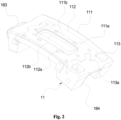
- the multiple joint structures include a first joint structure 11, which comprises a plastic part 111 and a spring clip 112.
- the plastic part 111 and the spring clip 112 are integrally molded by injection-molding.
- the spring clip 112 has a certain degree of elasticity, and when the headband is worn on the head, the spring force of the spring clip 112 maintains a good clamping force while the headband is in the expanded state, ensuring a firm connection between the headband and the head to prevent the headband from falling or slipping off the head.
- the plastic part 111 has the advantages of being lightweight, having a simple manufacturing process, and high processing precision. Integrating the plastic part 111 with the spring clip 112 through injection-molding to form the first joint structure 11 can reduce the overall weight and manufacturing difficulty of the first joint structure 11, and improve the processing precision of the first joint structure 11, making the assembly between each first joint structure 11 more precise. At the same time, the spring clip 112 and the plastic part 111 are not easily separated, making the overall performance of the first joint structure 11 more stable and less prone to disassembly or loosening.
- the structural strength of the spring clip 112 is greater than that of the plastic part 111.
- Structural strength refers to the ability of an object to resist breaking, which can enhance the overall structural strength of the first joint structure 11, making the overall performance of the first joint structure 11 more stable and less likely to break when the headband is bent.
- the material used to make the spring clip 112 can be an elastic metal, such as spring steel or spring copper, etc., which can increase the structural strength of the first joint structure 11 while enhancing its elasticity, ensuring a more secure connection between the headband and the head when the headband is worn.
- the material for the spring clip 112 can also be elastic plastic or other materials.
- the plastic part 111 has a hollow cavity, and the spring clip 112 is located inside the hollow cavity. It is understandable that when forming the first joint structure 11, the pre-prepared spring clip 112 can be placed inside the mold, then molten plastic is injected into the mold and used to wrap the spring clip 112. As the plastic wraps around the spring clip 112, a hollow cavity is formed inside the plastic part 111. This design can further enhance the connection strength between the spring clip 112 and the plastic part 111, preventing separation during the bending process of the headband.
- the spring clip 112 can also be stacked on the outer or inner surface of the plastic part 111.
- the outer surface of the plastic part 111 refers to the surface that is away from the head when the headband is worn, while the inner surface of the plastic part 111 refers to the surface that faces towards the head when the headband is worn.
- the pre-prepared spring clip 112 can also be placed inside the mold, followed by the injection of plastic into the mold. The plastic then forms on the surface of the spring clip 112, allowing the spring clip 112 to be stacked on the outer or inner surface of the plastic part 111. This design facilitates the user's observation of the spring clip 112, and in case of damage to the spring clip 112, it allows for timely repair or replacement of the first joint structure 11.
- the plastic part 111 is provided with a first positioning structure 111a, and a portion of the spring clip 112 is located within the first positioning structure 111a; and/or, the spring clip 112 is provided with a second positioning structure 112a, and a portion of the plastic part 111 is located within the second positioning structure 112a.
- the use of the first positioning structure 111a and the second positioning structure 112a can provide positioning for the spring clip 112, ensuring that the spring clip 112 is accurately installed at the designed location.
- the first positioning structure 111a and the second positioning structure 112a can also enhance the connection strength between the spring clip 112 and the plastic part 111, preventing relative movement between the spring clip 112 and the plastic part 111.
- the first positioning structure 111a may include structures such as positioning holes and/or slots located on the plastic part 111, with the spring clip 112 being provided with protruding structures, such as positioning posts.
- the molten plastic wraps around the protruding structures to form the positioning holes and/or slots.
- the second positioning structure 112a may also include structures such as positioning holes and/or slots located on the spring clip 112.
- the spring clip 112 and the plastic part 111 are integrally molded by injection, the molten plastic enters and solidifies within the positioning holes and/or slots.
- the end of the spring clip 112 is provided with a bending structure 113, which is integrally molded with the spring clip 112 by injection molding. It is understandable that when the spring clip 112 is integrally molded with the plastic part 111 by injection molding, the molten plastic will wrap around the bending structure 113, which can increase the contact area between the spring clip 112 and the plastic part 111, thereby further enhancing the connection strength between the spring clip 112 and the plastic part 111, and preventing separation during the bending process of the headband. Additionally, the plastic part 111 can limit the position of the spring clip 112 in various directions through the bending structure 113, preventing relative movement between the spring clip 112 and the plastic part 111.
- the bending structure 113 can be bent inward towards the plastic part 111, or it can be bent outward away from the plastic part 111.
- the bending structure 113 can be integrally formed with the spring clip 112 to enhance the connection strength between the spring clip 112 and the bending structure 113.
- the bending structure 113 can be formed by bending a portion of the end of the spring clip 112.
- both ends of the spring clip 112 can be provided with the bending structure 113 to further enhance the connection strength between the spring clip 112 and the plastic part 111.
- an opening 113a is provided on the bending structure 113. It can be understood that when the spring clip 112 is integrally injection-molded with the plastic part 111, the molten state fills in the opening 113a, thereby wrapping the bending structure 113 more tightly, which can further enhance the connection strength between the spring clip 112 and the plastic part 111, as well as strengthen the positional limitation of the plastic part 111 in all directions on the spring clip 112.
- the plastic part 111 is provided with a first hollow structure 111b, which penetrates the outer and inner surfaces of the plastic part 111, and the spring clip 112 is provided with a second hollow structure 112b corresponding to the first hollow structure 111b.
- the first hollow structure 111b and the second hollow structure 112b can reduce the contact area and weight between the first joint structure 11 and the top of the head, thereby reducing the pressure on the top of the head; in addition, the elasticity of the spring clip 112 can be adjusted through the design of the second hollow structure 112b; the elasticity of the spring clip 112 can also be adjusted based on certain aspects such as the thickness of the spring clip 112.
- the volume of the first hollow structure 111b and the second hollow structure 112b can be selected according to actual needs, and this application does not impose specific restrictions.
- the frame 10 comprises a first clamping mechanism 13, a second clamping mechanism 14, and a connecting mechanism 15; the second clamping mechanism 14 is set opposite to the first clamping mechanism 13; the connecting mechanism 15 is located between the first clamping mechanism 13 and the second clamping mechanism 14, with one end of the connecting mechanism 15 rotatably connected to the first clamping mechanism 13 through a pivot axle 12, and the other end rotatably connected to the second clamping mechanism 14 through another pivot axle 12.
- the connecting mechanism 15 is formed by sequentially connecting multiple first joint structures 11. It can be understood that when the headband is worn on the head, the connecting mechanism 15 is located at the top part of the head, with the first clamping mechanism 13 and the second clamping mechanism 14 located on either side of the head, respectively. The combined clamping force of the first clamping mechanism 13 and the second clamping mechanism 14 is used to secure the headband on the head; the connecting mechanism 15 is formed by sequentially connecting multiple first joint structures 11. The elasticity of the first joint structures 11 can provide greater clamping force for the first and second clamping mechanisms, ensuring a more secure connection between the headband and the head, and preventing the headband from falling off the head.
- multiple joint structures also comprise a second joint structure 16.
- the first clamping mechanism 13 is formed by connecting multiple second joint structures 16 in sequence
- the second clamping mechanism 14 is formed by connecting another set of multiple second joint structures 16 in sequence.
- the second joint structure 16 is different from the first joint structure 11 in configuration.
- the second joint structure 16 can include a joint piece 161, which can also be a part formed from plastic. It is understandable that, compared to the first joint structure 11, the second joint structure 16 has a simpler configuration, and it may include parts made from plastic without components such as a spring clip 112, which can reduce the weight of the second joint structure 16, thereby reducing the overall weight of the headband and enhancing the comfort of the user wearing the headband.
- first clamping mechanism 13 and the second clamping mechanism 14 can be symmetrically distributed at the two ends of the connecting mechanism 15.
- all the first joint structures 11 in the connecting mechanism 15 can have the same or different configurations
- all the second joint structures 16 in the first clamping mechanism 13 can have the same or different configurations
- all the second joint structures 16 in the second clamping mechanism 14 can have the same or different configurations.
- two adjacent joint structures have mutually facing first connecting surfaces 181 and second connecting surfaces 182.
- the one with the first connecting surface 181 is equipped with an accommodating slot 184
- the one with the second connecting surface 182 is equipped with a rotating piece 183.
- the accommodating slot 184 has a slot opening located on the first connecting surface 181, and the rotating piece 183 is positioned on the second connecting surface 182.
- the rotating piece 183 is inserted through the slot opening into accommodating slot 184.
- the rotating piece 183 is provided with a mounting hole 183a, which extends axially along the pivot axle 12 and penetrates through the rotating piece 183.
- the pivot axle 12 is threaded through the mounting hole 183a, and the adjacent joint structures are rotationally connected through the rotating member 183 and the pivot axle 12.
- the accommodating slot 184 extends inwardly towards the frame 10 to form a clearance notch that allows for the rotation of the rotating piece 183.
- the part of the first connection surface 181 that is far from the inside of the frame 10 and opposite the accommodating slot 184 abuts against the second connection surface 182. It can be understood that by inserting the rotating piece 183 into the accommodating slot 184, the connection between two adjacent joint structures is achieved, which can reduce the gap between them, thereby reducing the overall spatial volume of the headband. Moreover, the clearance notch provides rotational space for the rotating piece 183, allowing it to rotate towards the inside of the frame 10 around the axial direction of the pivot axle 12 when the frame 10 is in the expanded state, enabling the frame 10 to enter a folded state.
- the abutment of the first connection surface 181 against the second connection surface 182 ensures that the joint structures can only rotate towards the inside of the frame 10 (in the X direction as shown in Figure 5 ) to enter a folded state, and cannot rotate away from the inside of the frame 10, thus preventing reverse folding.
- the pivot axle 12 may be fixedly connected to one joint structure, and the rotating piece 183 may be fixedly connected to the other joint structure, with the rotating piece 183 being rotationally connected around the axial direction of the pivot axle 12, thereby achieving the rotational connection between the two adjacent joint structures.
- the pivot axle 12 may be rotationally connected around its axis to one joint structure, and the rotating piece 183 may be fixedly connected to the other joint structure, with the rotating piece 183 being fixedly connected to the pivot axle 12, which can also achieve the rotational connection between the two adjacent joint structures.
- the spacing of the rotational clearance 17 gradually increases in the direction closer to the inside of the frame 10. It can be understood that, instead of setting the width of the gaps at each part of the rotational clearance17 to be the same, for example, the overall shape of the rotational clearance 17 being rectangular, the examples of this application set the rotational clearance 17 to be generally in an inverted V-shape. This means that the spacing of the rotational clearance 17 gradually increases in the direction closer to the inside of the frame 10, which can reduce the spatial volume of the rotational clearance 17 between two adjacent joint structures without affecting the rotation of the joint structures. As a result, the overall spatial volume of the frame 10 in the expanded state is smaller. Moreover, after the joint structures rotate towards the inside of the frame 10 to enter a folded state, the rotational clearance 17 can be substantially eliminated, thereby further reducing the spatial volume of the headband in the folded state.
- a rotational clearance 17 is formed between the first connecting surface 181 and the second connecting surface 182. It can be understood that when the frame 10 is in an expanded state, at least a part of the first connecting surface 181 and the second connecting surface 182 are not in contact, forming a V-shaped rotational clearance 17.
- the angle formed between the first connecting surface 181 and the second connecting surface 182 is ⁇ , which can be 5 degrees to 10 degrees, preferably 8 degrees, to ensure that the joint structure has sufficient rotational space, while also avoiding an excessively large gap between adjacent joint structures that would lead to an overly large volume of the headband.
- a memory metal strip 191 is arranged on the side of the frame 10.
- the memory metal strip 191 extends along the extending direction of the frame 10 and is connected to the frame 10, and the frame 10 is maintained, for example, in an unfolded state under the action of the memory metal strip 191.
- the material for preparing the memory metal strip 191 can be, for example, a nickel-titanium alloy. Shape memory alloys have the property of being able to remember their original shape and return to that shape under certain conditions after being deformed.
- the original shape of the memory metal strip 191 can be designed to be the same or similar to the shape of the frame 10 when it is in an unfolded state. In this way, the memory metal strip 191 can provide a certain restoring force when returning the headband to the unfolded state.
- the original shape of the memory metal strip 191 can also be designed to be the same as the shape of the frame 10 when it is in a folded state, so that the memory metal strip 191 can provide a restoring force to return the headband to the folded state after it is unfolded, thereby giving the headband a greater clamping force when worn on the head.
- the specific working principle of the shape memory alloy has been disclosed in related technology, and this application will not elaborate further.
- the memory metal strip 191 can be arranged on only one side of the frame 10 along the axial direction of the pivot axle 12, or on both sides along the axial direction of the pivot axle 12.
- multiple mounting components 192 are arranged on the frame 10.
- the multiple mounting components 192 are spaced apart along the extending direction of the frame 10, and the mounting components 192 are provided with limiting holes 192a, through which the memory metal strip 191 is threaded.
- the limiting holes 192a are used to limit the position of the memory metal strip 191 to prevent it from separating from the frame 10.
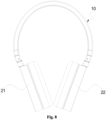
- the headphones include a first earphone unit 21, a second earphone unit 22, and a headband as described in any of the aforementioned examples.
- the first earphone unit 21 is connected to one end of the headband's frame 10
- the second earphone unit 22 is connected to the other end of the headband's frame 10.
- the headphones include the over-the-head type, which can be either wired or wireless.
- One of the first earphone unit 21 and the second earphone unit 22 can be the left earphone unit, and the other can be the right earphone unit.
- the headband disclosed herein can include sound isolating ear protecting units at its distal ends to enable use for what is commonly known as ear muffs.
- the headband disclosed herein can include ear covering material and structure at its distal ends to enable use for what is also commonly known as ear warmers.
Landscapes
- Physics & Mathematics (AREA)
- Engineering & Computer Science (AREA)
- Acoustics & Sound (AREA)
- Signal Processing (AREA)
- Health & Medical Sciences (AREA)
- Otolaryngology (AREA)
- Headphones And Earphones (AREA)
Applications Claiming Priority (1)
| Application Number | Priority Date | Filing Date | Title |
|---|---|---|---|
| CN202320855761.XU CN220528197U (zh) | 2023-04-17 | 2023-04-17 | 一种头带及耳机 |
Publications (2)
| Publication Number | Publication Date |
|---|---|
| EP4451701A2 true EP4451701A2 (fr) | 2024-10-23 |
| EP4451701A3 EP4451701A3 (fr) | 2024-10-30 |
Family
ID=89934878
Family Applications (1)
| Application Number | Title | Priority Date | Filing Date |
|---|---|---|---|
| EP24170238.0A Withdrawn EP4451701A3 (fr) | 2023-04-17 | 2024-04-15 | Serre-tête et casque d'écoute |
Country Status (4)
| Country | Link |
|---|---|
| US (1) | US20240348965A1 (fr) |
| EP (1) | EP4451701A3 (fr) |
| JP (1) | JP2024153607A (fr) |
| CN (1) | CN220528197U (fr) |
Families Citing this family (1)
| Publication number | Priority date | Publication date | Assignee | Title |
|---|---|---|---|---|
| USD1113084S1 (en) * | 2023-10-06 | 2026-02-17 | Vuzix Corporation | Headband support |
Family Cites Families (8)
| Publication number | Priority date | Publication date | Assignee | Title |
|---|---|---|---|---|
| JPS5883893U (ja) * | 1981-12-03 | 1983-06-07 | パイオニア株式会社 | ヘツドホ−ンのヘツドバンド構造 |
| JP2011015235A (ja) * | 2009-07-02 | 2011-01-20 | Sony Corp | ヘッドホン |
| US8976085B2 (en) * | 2012-01-19 | 2015-03-10 | Google Inc. | Wearable device with input and output structures |
| GB201215554D0 (en) * | 2012-08-31 | 2012-10-17 | Teca Technology Ltd | Headphones and headsets |
| US9918155B2 (en) * | 2016-01-04 | 2018-03-13 | Lg Electronics Inc. | Portable sound equipment |
| CN106817642B (zh) * | 2017-01-09 | 2023-09-08 | 深圳市冠旭电子股份有限公司 | 头带、耳机和该耳机的制造方法 |
| CN211791960U (zh) * | 2020-03-24 | 2020-10-27 | 湖南盈准科技有限公司 | 一种耳机头带和头戴式耳机 |
| CN218103458U (zh) * | 2022-08-04 | 2022-12-20 | 安克创新科技股份有限公司 | 一种头带及耳机 |
-
2023
- 2023-04-17 CN CN202320855761.XU patent/CN220528197U/zh active Active
-
2024
- 2024-04-12 US US18/634,095 patent/US20240348965A1/en active Pending
- 2024-04-15 EP EP24170238.0A patent/EP4451701A3/fr not_active Withdrawn
- 2024-04-17 JP JP2024066801A patent/JP2024153607A/ja active Pending
Also Published As
| Publication number | Publication date |
|---|---|
| EP4451701A3 (fr) | 2024-10-30 |
| US20240348965A1 (en) | 2024-10-17 |
| CN220528197U (zh) | 2024-02-23 |
| JP2024153607A (ja) | 2024-10-29 |
Similar Documents
| Publication | Publication Date | Title |
|---|---|---|
| US7184565B2 (en) | Headphone | |
| EP4451701A2 (fr) | Serre-tête et casque d'écoute | |
| EP1250025B1 (fr) | Ecouteurs | |
| JP4123600B2 (ja) | ヘッドホン装置 | |
| JP2001112081A (ja) | ヘッドホン | |
| US20050244027A1 (en) | Headphones | |
| CN114938483B (zh) | 一种人体工程学头戴式耳机 | |
| CN113473282A (zh) | 耳机 | |
| CN218103458U (zh) | 一种头带及耳机 | |
| CN117692841B (zh) | 耳夹式耳机及耳机组件 | |
| US20250168565A1 (en) | Headband and headphones | |
| CN223348763U (zh) | 一种弹性夹耳机构及夹耳式耳机 | |
| CN214799831U (zh) | 折叠结构及头戴耳机 | |
| CN208569187U (zh) | 可穿戴设备 | |
| CN218103459U (zh) | 一种头带及耳机 | |
| CN215861285U (zh) | 用于头戴式电子设备的转轴结构及头戴式电子设备 | |
| JPS6215790Y2 (fr) | ||
| JP3839768B2 (ja) | ヘッドホン | |
| CN224205205U (zh) | 一种头戴式耳机 | |
| CN223261633U (zh) | 一种多功能头戴式耳机 | |
| CN222674450U (zh) | 头带和头戴式耳机 | |
| JP2000294207A (ja) | 端子一体型保護装置及びその製造方法並びに電池パック | |
| CN223182259U (zh) | 头戴式耳机 | |
| CN224218488U (zh) | 耳机及耳机组件 | |
| CN219893355U (zh) | 一种折叠手机壳 |
Legal Events
| Date | Code | Title | Description |
|---|---|---|---|
| PUAI | Public reference made under article 153(3) epc to a published international application that has entered the european phase |
Free format text: ORIGINAL CODE: 0009012 |
|
| STAA | Information on the status of an ep patent application or granted ep patent |
Free format text: STATUS: THE APPLICATION HAS BEEN PUBLISHED |
|
| PUAL | Search report despatched |
Free format text: ORIGINAL CODE: 0009013 |
|
| AK | Designated contracting states |
Kind code of ref document: A2 Designated state(s): AL AT BE BG CH CY CZ DE DK EE ES FI FR GB GR HR HU IE IS IT LI LT LU LV MC ME MK MT NL NO PL PT RO RS SE SI SK SM TR |
|
| AK | Designated contracting states |
Kind code of ref document: A3 Designated state(s): AL AT BE BG CH CY CZ DE DK EE ES FI FR GB GR HR HU IE IS IT LI LT LU LV MC ME MK MT NL NO PL PT RO RS SE SI SK SM TR |
|
| RIC1 | Information provided on ipc code assigned before grant |
Ipc: H04R 5/033 20060101AFI20240920BHEP |
|
| STAA | Information on the status of an ep patent application or granted ep patent |
Free format text: STATUS: THE APPLICATION HAS BEEN WITHDRAWN |
|
| 18W | Application withdrawn |
Effective date: 20241106 |