EP4454607A2 - Support vasculaire - Google Patents
Support vasculaire Download PDFInfo
- Publication number
- EP4454607A2 EP4454607A2 EP24189545.7A EP24189545A EP4454607A2 EP 4454607 A2 EP4454607 A2 EP 4454607A2 EP 24189545 A EP24189545 A EP 24189545A EP 4454607 A2 EP4454607 A2 EP 4454607A2
- Authority
- EP
- European Patent Office
- Prior art keywords
- vascular support
- elements
- predetermined breaking
- support according
- membrane
- Prior art date
- Legal status (The legal status is an assumption and is not a legal conclusion. Google has not performed a legal analysis and makes no representation as to the accuracy of the status listed.)
- Pending
Links
Images





Classifications
-
- A—HUMAN NECESSITIES
- A61—MEDICAL OR VETERINARY SCIENCE; HYGIENE
- A61F—FILTERS IMPLANTABLE INTO BLOOD VESSELS; PROSTHESES; DEVICES PROVIDING PATENCY TO, OR PREVENTING COLLAPSING OF, TUBULAR STRUCTURES OF THE BODY, e.g. STENTS; ORTHOPAEDIC, NURSING OR CONTRACEPTIVE DEVICES; FOMENTATION; TREATMENT OR PROTECTION OF EYES OR EARS; BANDAGES, DRESSINGS OR ABSORBENT PADS; FIRST-AID KITS
- A61F2/00—Filters implantable into blood vessels; Prostheses, i.e. artificial substitutes or replacements for parts of the body; Appliances for connecting them with the body; Devices providing patency to, or preventing collapsing of, tubular structures of the body, e.g. stents
- A61F2/82—Devices providing patency to, or preventing collapsing of, tubular structures of the body, e.g. stents
- A61F2/86—Stents in a form characterised by the wire-like elements; Stents in the form characterised by a net-like or mesh-like structure
- A61F2/90—Stents in a form characterised by the wire-like elements; Stents in the form characterised by a net-like or mesh-like structure characterised by a net-like or mesh-like structure
- A61F2/91—Stents in a form characterised by the wire-like elements; Stents in the form characterised by a net-like or mesh-like structure characterised by a net-like or mesh-like structure made from perforated sheets or tubes, e.g. perforated by laser cuts or etched holes
- A61F2/915—Stents in a form characterised by the wire-like elements; Stents in the form characterised by a net-like or mesh-like structure characterised by a net-like or mesh-like structure made from perforated sheets or tubes, e.g. perforated by laser cuts or etched holes with bands having a meander structure, adjacent bands being connected to each other
-
- A—HUMAN NECESSITIES
- A61—MEDICAL OR VETERINARY SCIENCE; HYGIENE
- A61F—FILTERS IMPLANTABLE INTO BLOOD VESSELS; PROSTHESES; DEVICES PROVIDING PATENCY TO, OR PREVENTING COLLAPSING OF, TUBULAR STRUCTURES OF THE BODY, e.g. STENTS; ORTHOPAEDIC, NURSING OR CONTRACEPTIVE DEVICES; FOMENTATION; TREATMENT OR PROTECTION OF EYES OR EARS; BANDAGES, DRESSINGS OR ABSORBENT PADS; FIRST-AID KITS
- A61F2/00—Filters implantable into blood vessels; Prostheses, i.e. artificial substitutes or replacements for parts of the body; Appliances for connecting them with the body; Devices providing patency to, or preventing collapsing of, tubular structures of the body, e.g. stents
- A61F2/02—Prostheses implantable into the body
- A61F2/24—Heart valves ; Vascular valves, e.g. venous valves; Heart implants, e.g. passive devices for improving the function of the native valve or the heart muscle; Transmyocardial revascularisation [TMR] devices; Valves implantable in the body
- A61F2/2412—Heart valves ; Vascular valves, e.g. venous valves; Heart implants, e.g. passive devices for improving the function of the native valve or the heart muscle; Transmyocardial revascularisation [TMR] devices; Valves implantable in the body with soft flexible valve members, e.g. tissue valves shaped like natural valves
- A61F2/2418—Scaffolds therefor, e.g. support stents
-
- A—HUMAN NECESSITIES
- A61—MEDICAL OR VETERINARY SCIENCE; HYGIENE
- A61F—FILTERS IMPLANTABLE INTO BLOOD VESSELS; PROSTHESES; DEVICES PROVIDING PATENCY TO, OR PREVENTING COLLAPSING OF, TUBULAR STRUCTURES OF THE BODY, e.g. STENTS; ORTHOPAEDIC, NURSING OR CONTRACEPTIVE DEVICES; FOMENTATION; TREATMENT OR PROTECTION OF EYES OR EARS; BANDAGES, DRESSINGS OR ABSORBENT PADS; FIRST-AID KITS
- A61F2/00—Filters implantable into blood vessels; Prostheses, i.e. artificial substitutes or replacements for parts of the body; Appliances for connecting them with the body; Devices providing patency to, or preventing collapsing of, tubular structures of the body, e.g. stents
- A61F2/02—Prostheses implantable into the body
- A61F2/04—Hollow or tubular parts of organs, e.g. bladders, tracheae, bronchi or bile ducts
- A61F2/06—Blood vessels
- A61F2002/061—Blood vessels provided with means for allowing access to secondary lumens
-
- A—HUMAN NECESSITIES
- A61—MEDICAL OR VETERINARY SCIENCE; HYGIENE
- A61F—FILTERS IMPLANTABLE INTO BLOOD VESSELS; PROSTHESES; DEVICES PROVIDING PATENCY TO, OR PREVENTING COLLAPSING OF, TUBULAR STRUCTURES OF THE BODY, e.g. STENTS; ORTHOPAEDIC, NURSING OR CONTRACEPTIVE DEVICES; FOMENTATION; TREATMENT OR PROTECTION OF EYES OR EARS; BANDAGES, DRESSINGS OR ABSORBENT PADS; FIRST-AID KITS
- A61F2/00—Filters implantable into blood vessels; Prostheses, i.e. artificial substitutes or replacements for parts of the body; Appliances for connecting them with the body; Devices providing patency to, or preventing collapsing of, tubular structures of the body, e.g. stents
- A61F2/02—Prostheses implantable into the body
- A61F2/04—Hollow or tubular parts of organs, e.g. bladders, tracheae, bronchi or bile ducts
- A61F2/06—Blood vessels
- A61F2/07—Stent-grafts
- A61F2002/072—Encapsulated stents, e.g. wire or whole stent embedded in lining
-
- A—HUMAN NECESSITIES
- A61—MEDICAL OR VETERINARY SCIENCE; HYGIENE
- A61F—FILTERS IMPLANTABLE INTO BLOOD VESSELS; PROSTHESES; DEVICES PROVIDING PATENCY TO, OR PREVENTING COLLAPSING OF, TUBULAR STRUCTURES OF THE BODY, e.g. STENTS; ORTHOPAEDIC, NURSING OR CONTRACEPTIVE DEVICES; FOMENTATION; TREATMENT OR PROTECTION OF EYES OR EARS; BANDAGES, DRESSINGS OR ABSORBENT PADS; FIRST-AID KITS
- A61F2/00—Filters implantable into blood vessels; Prostheses, i.e. artificial substitutes or replacements for parts of the body; Appliances for connecting them with the body; Devices providing patency to, or preventing collapsing of, tubular structures of the body, e.g. stents
- A61F2/82—Devices providing patency to, or preventing collapsing of, tubular structures of the body, e.g. stents
- A61F2/86—Stents in a form characterised by the wire-like elements; Stents in the form characterised by a net-like or mesh-like structure
- A61F2/90—Stents in a form characterised by the wire-like elements; Stents in the form characterised by a net-like or mesh-like structure characterised by a net-like or mesh-like structure
- A61F2/91—Stents in a form characterised by the wire-like elements; Stents in the form characterised by a net-like or mesh-like structure characterised by a net-like or mesh-like structure made from perforated sheets or tubes, e.g. perforated by laser cuts or etched holes
- A61F2/915—Stents in a form characterised by the wire-like elements; Stents in the form characterised by a net-like or mesh-like structure characterised by a net-like or mesh-like structure made from perforated sheets or tubes, e.g. perforated by laser cuts or etched holes with bands having a meander structure, adjacent bands being connected to each other
- A61F2002/91533—Stents in a form characterised by the wire-like elements; Stents in the form characterised by a net-like or mesh-like structure characterised by a net-like or mesh-like structure made from perforated sheets or tubes, e.g. perforated by laser cuts or etched holes with bands having a meander structure, adjacent bands being connected to each other characterised by the phase between adjacent bands
- A61F2002/91541—Adjacent bands are arranged out of phase
-
- A—HUMAN NECESSITIES
- A61—MEDICAL OR VETERINARY SCIENCE; HYGIENE
- A61F—FILTERS IMPLANTABLE INTO BLOOD VESSELS; PROSTHESES; DEVICES PROVIDING PATENCY TO, OR PREVENTING COLLAPSING OF, TUBULAR STRUCTURES OF THE BODY, e.g. STENTS; ORTHOPAEDIC, NURSING OR CONTRACEPTIVE DEVICES; FOMENTATION; TREATMENT OR PROTECTION OF EYES OR EARS; BANDAGES, DRESSINGS OR ABSORBENT PADS; FIRST-AID KITS
- A61F2/00—Filters implantable into blood vessels; Prostheses, i.e. artificial substitutes or replacements for parts of the body; Appliances for connecting them with the body; Devices providing patency to, or preventing collapsing of, tubular structures of the body, e.g. stents
- A61F2/82—Devices providing patency to, or preventing collapsing of, tubular structures of the body, e.g. stents
- A61F2/86—Stents in a form characterised by the wire-like elements; Stents in the form characterised by a net-like or mesh-like structure
- A61F2/90—Stents in a form characterised by the wire-like elements; Stents in the form characterised by a net-like or mesh-like structure characterised by a net-like or mesh-like structure
- A61F2/91—Stents in a form characterised by the wire-like elements; Stents in the form characterised by a net-like or mesh-like structure characterised by a net-like or mesh-like structure made from perforated sheets or tubes, e.g. perforated by laser cuts or etched holes
- A61F2/915—Stents in a form characterised by the wire-like elements; Stents in the form characterised by a net-like or mesh-like structure characterised by a net-like or mesh-like structure made from perforated sheets or tubes, e.g. perforated by laser cuts or etched holes with bands having a meander structure, adjacent bands being connected to each other
- A61F2002/9155—Adjacent bands being connected to each other
- A61F2002/91575—Adjacent bands being connected to each other connected peak to trough
-
- A—HUMAN NECESSITIES
- A61—MEDICAL OR VETERINARY SCIENCE; HYGIENE
- A61F—FILTERS IMPLANTABLE INTO BLOOD VESSELS; PROSTHESES; DEVICES PROVIDING PATENCY TO, OR PREVENTING COLLAPSING OF, TUBULAR STRUCTURES OF THE BODY, e.g. STENTS; ORTHOPAEDIC, NURSING OR CONTRACEPTIVE DEVICES; FOMENTATION; TREATMENT OR PROTECTION OF EYES OR EARS; BANDAGES, DRESSINGS OR ABSORBENT PADS; FIRST-AID KITS
- A61F2250/00—Special features of prostheses classified in groups A61F2/00 - A61F2/26 or A61F2/82 or A61F9/00 or A61F11/00 or subgroups thereof
- A61F2250/0058—Additional features; Implant or prostheses properties not otherwise provided for
- A61F2250/0071—Additional features; Implant or prostheses properties not otherwise provided for breakable or frangible
-
- A—HUMAN NECESSITIES
- A61—MEDICAL OR VETERINARY SCIENCE; HYGIENE
- A61F—FILTERS IMPLANTABLE INTO BLOOD VESSELS; PROSTHESES; DEVICES PROVIDING PATENCY TO, OR PREVENTING COLLAPSING OF, TUBULAR STRUCTURES OF THE BODY, e.g. STENTS; ORTHOPAEDIC, NURSING OR CONTRACEPTIVE DEVICES; FOMENTATION; TREATMENT OR PROTECTION OF EYES OR EARS; BANDAGES, DRESSINGS OR ABSORBENT PADS; FIRST-AID KITS
- A61F2250/00—Special features of prostheses classified in groups A61F2/00 - A61F2/26 or A61F2/82 or A61F9/00 or A61F11/00 or subgroups thereof
- A61F2250/0058—Additional features; Implant or prostheses properties not otherwise provided for
- A61F2250/0082—Additional features; Implant or prostheses properties not otherwise provided for specially designed for children, e.g. having means for adjusting to their growth
-
- A—HUMAN NECESSITIES
- A61—MEDICAL OR VETERINARY SCIENCE; HYGIENE
- A61F—FILTERS IMPLANTABLE INTO BLOOD VESSELS; PROSTHESES; DEVICES PROVIDING PATENCY TO, OR PREVENTING COLLAPSING OF, TUBULAR STRUCTURES OF THE BODY, e.g. STENTS; ORTHOPAEDIC, NURSING OR CONTRACEPTIVE DEVICES; FOMENTATION; TREATMENT OR PROTECTION OF EYES OR EARS; BANDAGES, DRESSINGS OR ABSORBENT PADS; FIRST-AID KITS
- A61F2250/00—Special features of prostheses classified in groups A61F2/00 - A61F2/26 or A61F2/82 or A61F9/00 or A61F11/00 or subgroups thereof
- A61F2250/0058—Additional features; Implant or prostheses properties not otherwise provided for
- A61F2250/0096—Markers and sensors for detecting a position or changes of a position of an implant, e.g. RF sensors, ultrasound markers
-
- A—HUMAN NECESSITIES
- A61—MEDICAL OR VETERINARY SCIENCE; HYGIENE
- A61F—FILTERS IMPLANTABLE INTO BLOOD VESSELS; PROSTHESES; DEVICES PROVIDING PATENCY TO, OR PREVENTING COLLAPSING OF, TUBULAR STRUCTURES OF THE BODY, e.g. STENTS; ORTHOPAEDIC, NURSING OR CONTRACEPTIVE DEVICES; FOMENTATION; TREATMENT OR PROTECTION OF EYES OR EARS; BANDAGES, DRESSINGS OR ABSORBENT PADS; FIRST-AID KITS
- A61F2250/00—Special features of prostheses classified in groups A61F2/00 - A61F2/26 or A61F2/82 or A61F9/00 or A61F11/00 or subgroups thereof
- A61F2250/0058—Additional features; Implant or prostheses properties not otherwise provided for
- A61F2250/0096—Markers and sensors for detecting a position or changes of a position of an implant, e.g. RF sensors, ultrasound markers
- A61F2250/0098—Markers and sensors for detecting a position or changes of a position of an implant, e.g. RF sensors, ultrasound markers radio-opaque, e.g. radio-opaque markers
Definitions
- the invention relates to a radially expandable vascular support, which has a plurality of meandering ring elements which are flexibly connected to one another and which define a vascular support with a proximal and a distal end and a longitudinal axis, wherein the ring elements are arranged next to one another along the longitudinal axis of the vascular support and adjacent ring elements are connected to one another by connecting elements.
- vascular supports according to the invention are stents that can be expanded radially over their entire length or in partial areas for use in keeping blood vessels or other organ pathways in human or animal bodies open.
- Vascular stents are generally implanted to permanently support the vessel wall in the area of stenosis, as a support structure for membranes to keep vessels open or for minimally invasively implantable heart valves. They are pressed onto a folded balloon and expanded to a certain diameter in the vessel by balloon dilatation.
- a conventional stent can only be expanded to a maximum diameter of 6 to 8 mm.
- the diameter of a pulmonary artery in adulthood can be up to 30 mm
- conventional stents with a relatively small diameter would have to be expanded as the child grows. surgically removed with an operation on the heart-lung machine.
- the stents according to the invention with predetermined breaking points avoid this disadvantage, since they can be expanded as much as desired with another balloon after the predetermined breaking points have been broken. They then have hardly any radial strength, but this can be achieved if necessary by implanting another stent with a larger diameter.
- re-dilatable stents have suture connections between zigzag-shaped wire frames, such as DE 101 03 000 , which dissolve after a certain time and thus allow further vessel growth.
- the disadvantage is that the sewn-together segments shift when crimping onto a balloon and the radial force is low.
- a re-expandable endoprosthesis is formed from a stiff, tubular wire mesh with a longitudinal slit that is initially rolled up.
- the longitudinal slit is also held together by resorbable connecting threads. As these connecting threads dissolve over time, this prosthesis can only be expanded in the area of one slit.
- This endoprosthesis is not suitable for use in curved vessels, such as in children and in vessels close to the heart, due to its lack of flexibility.
- a re-expandable vascular support is produced that has a ring segment with a growth plate.
- the growth plate is bridged by connecting strips that can consist of absorbable wound suture and tear when a defined tensile force is applied.
- the connecting strips are attached to the ring segment by welding, soldering or gluing.
- the object of the present invention is to provide a radially expandable vascular support which experiences no or only a slight shortening during its expansion, bends less easily with better curve mobility, has sufficient radial strength and at the same time can be dilated again by expanding at least parts of it.
- the vascular supports according to the invention consist of ring elements arranged next to one another, which run in a meandering or zigzag shape, as well as connecting elements that connect ring elements lying next to one another. At least some connecting elements have predetermined breaking points, which run in particular parallel to the longitudinal axis of the vascular support, but can also run transversely to it.
- a connecting element can have both longitudinal and transverse predetermined breaking points. Diagonally running predetermined breaking points are also possible.
- longitudinal predetermined breaking points are suitable, which enable partial or complete opening of the stent during subsequent dilation.
- longitudinal predetermined breaking points also extend onto and over the webs of the ring elements, which are connected to one another by the respective connecting elements.
- the flexible radial re-expandable vascular support consists of a grid-shaped stent framework with a meandering ring structure of small width with several predetermined breaking points arranged in a circular, linear, transverse or spiral manner in the form of perforation lines or notches.
- these predetermined breaking points remain closed and firmly connected to one another, but can be broken open in any way at a later point in time by further balloon dilatation.
- an improved side branch access can be advantageously created by local expansion.
- the improved side branch access can be achieved both by breaking open predetermined breaking points in partial areas of the stent and by arranging extended stent struts or omitting stent struts.
- the stent is additionally covered with a biological or synthetic membrane, for example on the circumference, either completely or in part, then it can be attached to the stent by sewing, gluing or using special clamping and clip elements. These are also suitable for attaching biological or synthetic tissue, membranes or films and for laser-cut umbrella systems for closing heart wall defects. The same applies to implantable heart valves.
- the stent is covered with a membrane, it is particularly advantageous not to cover the two outer ring elements so that membrane prolapse does not occur when the stent is expanded at the ends.
- the vascular supports according to the invention have a plurality of connecting elements with a predetermined breaking function.
- These predetermined breaking functions can, for example, be limited to the connecting elements of only two adjacent ring elements in order to achieve, for example, a separation or opening of the vascular support, but they can also be arranged between a plurality of ring elements in order to define an area and in this way enable fenestrations.
- Another variant is the arrangement of the predetermined breaking points over the length of the vascular support, so that it can be completely or partially severed.
- the predetermined breaking points can be arranged parallel to the longitudinal axis of the stent, but can also follow a helical line that extends around the stent.
- predetermined breaking points that are arranged on all connecting elements in a partial area of the stent and thus enable the opening of a window, for example in the area of an outgoing blood vessel.
- vascular supports according to the invention are provided with a membrane that is sewn to the vascular support, threads made of resorbable material or pure iron or tungsten wire can be used.
- the membrane itself can consist of a biological or synthetic material. The latter can be applied by electrospinning.
- a plurality of ring segments can be connected to adjacent ring elements via spiral, S-shaped or curved connecting elements, which stretch during dilation.
- spiral, S-shaped or curved connecting elements webs can be present at regular or other intervals within the connecting element in such a way that they allow a gradual extension of the connecting element. This is made possible, for example, by the fact that in the case of a spiral connecting element, several webs are located at certain angular positions in the spiral, which break one after the other when overstretched, thus allowing the connecting element to be gradually extended from a spiral to a more stretched state.
- the predetermined breaking point of the connector which allows the connector to ultimately break apart completely, is then preferably in the middle of the spiral, although other positions are also conceivable and possible.
- the same principle can also be applied to curved or twisted connecting elements. Another advantage of this design is that the sometimes quite filigree structures of these The connecting bars provide additional stability to the twisted connecting elements, which also protects these structures and the balloon when the stent is crimped onto a balloon.
- arched connecting elements arranged in pairs in opposite directions, which together with the adjacent struts of the ring elements form a star-shaped element.
- this results in a high radial strength due to the multicellular structure, which is further increased by the spiral or alternating arrangement of one or more star-shaped segments.
- Such designs also have a positive effect on the overall bending behavior of the vascular support.
- the connecting elements can also be designed in such a way that the breaking of the predetermined breaking points is brought about by a lever in the connecting element.
- the web is then attached to the connector in the form of a two-dimensional joint ball and socket, for example, whereby both elements are connected by a connecting web - the predetermined breaking point - between the two-dimensional joint ball and socket.
- This has the advantage that the design of the predetermined breaking point can be more stable, since a lever force acts on this point in the event of overstretching. This area is therefore more stable in the non-overstretched stent. Overstretching also leads to a break in the predetermined breaking point, possibly even more easily and in any case in a defined manner.
- the webs of the connecting elements between the individual ring elements preferably have a slightly smaller cross-section than the webs of the meandering or zigzag-shaped ring elements.
- the web cross-section of the connecting webs is then about 60 to 80% of the cross-section of the webs of the ring elements. Any Combination possibilities with the different shapes of webs of the connecting elements are conceivable.
- the predetermined breaking points consist of notches, these usually have a depth of 30 to 50% of the web thickness of the connecting elements on which they are arranged.
- Perforations which are usually arranged linearly, have a diameter of approximately 20 to 60% of the web width of the corresponding connecting elements.
- the perforations can be round, triangular, rectangular or star-shaped.
- the material for the vascular support according to the invention in particular biocompatible metals such as iron, steel, tungsten, niobium, platinum, titanium, alloys of nickel and titanium and alloys with at least one of these metals, such as platinum-iridium. If the vascular support itself is to be expandable, a nickel-titanium alloy that has been temperature-optimized by heat treatment is preferably used.
- the stent can be coated with a biocompatible material to improve ingrowth into the vessel wall or with suitable medications to prevent hyperproliferation of the vessel wall or can release radiation through irradiation or radioactive decay.
- the stent or the covering can also be made of absorbable plastics, e.g. aliphatic polyesters such as polydioxanone.
- the vascular supports according to the invention are preferably made of seamlessly drawn tubes in order to avoid tension and cracks, as is often the case in the area of weld seams.
- the structures are preferably produced by laser or water jet cutting, electroerosion and electropolishing.
- the vascular supports have a lattice-like structure in the initial state, which can be compressed by crimping onto a dilatation balloon and, after implantation, can be expanded by dilatation beyond the original state after production.
- the predetermined breaking points are usually only activated and caused to tear open with a subsequent or redilation.
- stents with their various designs can also be designed without predetermined breaking points.
- connecting elements are designed purely as clamping devices for membranes, predetermined breaking points within the clamps can be dispensed with in these special cases.
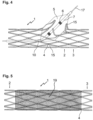
- Figure 1 shows a side view of an embodiment of the invention that has been crimped onto a dilatation balloon.
- the stent 1 consists of a plurality of ring elements 2 and 3 that are connected to one another by connecting elements 4. Ring elements 2 are located on the edge and each have only one neighbor, while ring elements 3 have either an edge or an inner ring element as a neighbor.
- the connecting elements 4 are connecting webs that start from the outer turning points of the ring elements and, in the case shown, run to the outer turning points of the neighboring ring element 3.
- the webs of the connecting elements 4 have perforations running in the direction of the longitudinal axis of the stent 1, which form a weakening zone that leads to a predetermined breaking point.
- the perforations continue through the adjacent parts of the webs of the ring segments 2, 3.
- the vascular support 1 is attached to a commercially available balloon 5, which can be transported to the site of use by means of a catheter and guide wire.
- Figure 2 shows the vascular support of Figure 1 in a first implanted state with slightly expanded ring segments 2, 3 and intact connecting elements 4. The dilatation balloon is removed from the vascular support 1.
- Figure 3 Finally, the vascular support of Figures 1 and 2 on a dilatation balloon 5.
- the dilatation balloon has a larger radius and can thus spread the stent 1 further until it ruptures or collapses. Breaking open the perforation line 8, which runs parallel to the longitudinal axis of the stent 1.
- markers 6 which are arranged proximally and distally to the vascular support 1.
- Figure 4 shows the stent 1 of Figure 2 and a dilatation balloon 5 inserted therein, which has been guided laterally through the wall of the vascular support 1 and dilated. Accordingly, the predetermined breaking points of the connecting webs of the affected ring elements 2 and 3 are broken open, so that a window is created through which a branching vessel can also be supplied with blood.
- the dilatation balloon 5 at the tip of the catheter 7 is advanced over a guide wire 17 and directed into the area already in the area of a Stent 1 implanted at the vascular branch is positioned so that it is broken open in the area of the branch.
- Figure 5 shows the stent of Figure 2 with a tubular membrane 19 stretched over it, which serves, for example, to shield a vascular anomaly, such as an aneurysm or a perforation.
- the membrane 19 can, for example, be made of Teflon or another biocompatible material and can optionally be equipped with a medication.
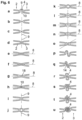
- the Figure 6 shows various variants of connecting elements 4 provided with predetermined breaking points between two ring elements 2, 3.
- the reference numbers 8 and 9 designate separation or perforation lines along which the corresponding connecting element 4 separates.
- the connecting elements 4 between two ring elements 2, 3 can be designed in almost any way and can be equipped with notches 10, constrictions 14, perforations 18, slot-shaped, circular, triangular, star-shaped or other designed openings or weakening zones of a different type to generate the predetermined breaking points, for example with webs 4 that are greatly weakened compared to the webs of the ring elements 2, 3, as they appear in the illustrations 6b, c and d.
- the connecting elements 4 are characterized by smooth transitions between two ring elements 2, 3.
- the connecting elements 4 can be curved (6a), S-shaped (6p, 6q), twisted as desired (6r to 6t) or spiral-shaped (6u). These curved connecting elements 4 can in turn be designed in such a way that they have predetermined breaking points in the form of notches or weakened zones.
- Figure 7 shows further variants of connecting elements 4 according to the invention between ring elements 2, 3.
- the reference numbers correspond to those of the Figure 6 .
- Illustration a is another variant of a connecting element 4 with a transverse predetermined breaking point 9.
- Illustrations b to d show variants with a longitudinal predetermined breaking point 8.
- Variants e to i show various possible Embodiments of the connecting elements 4 in which the separation of the stent struts takes place in stages, in that when overstretched, the connecting struts within the connecting element initially break, but a complete separation of the stent struts can only occur when the stent struts are expanded further, since only then can the spherical or T-shaped elements emerge from their respective counterparts.
- Illustrations j and k show embodiments in which the stent struts are arranged in the connecting element similar to a joint connection and are connected via a connecting strut. This arrangement enables the setting of defined leverage effects in the connecting element when the stent is expanded.
- Illustration j shows a simple embodiment
- illustration k the special arrangement specifies a bending point 27 on the two-dimensional joint ball 26.
- Illustration I shows a variant of a connecting element 4 which is arranged in a spiral and can be stretched in the longitudinal direction. The spiral struts are connected to one another via connecting struts, so that a gradual expansion of the connecting element is possible when overstretched.
- a further advantage of this embodiment is that the delicate spiral-shaped connector is given additional stability, which also protects this element from damage during stent processing and during crimping of the balloon.
- the illustrations n to p show embodiments in which several such elements, also in a twisted design, are arranged next to one another and can also act in the longitudinal direction.
- Illustration m shows a longitudinal arrangement of the spiral connectors without intermediate webs.
- a predetermined breaking point which leads to a final separation of the longitudinal and/or transverse elements, is preferably located in the middle of the spiral or halfway along the twisted connectors.
- any other sensible position is also conceivable and possible.
- Figure 8 shows an embodiment of a vascular support 1 according to the invention in the spread-out state with a partial surface within which the connecting elements 4 between ring elements 3 are provided with predetermined breaking points.
- the zone intended for fenestration is delimited by four markers 6. Between these markers 6, all connecting elements 4 with a predetermined breaking point are connected by perforation holes 15 arranged in a row in the longitudinal direction and equipped with notches for generating a predetermined breaking point in the circumferential direction. When a catheter balloon expands in the area of this fenestration zone, the connecting elements 4 tear along the predetermined breaking points and open the window, for example into a side vessel.
- Figure 9 shows a vascular support 1 according to the invention with webs 13 that are greatly extended in the central area in order to enable improved side branch access in the dilated state.
- the stent 1 can be split lengthwise along the dividing line 8, with the connecting elements 4 having two openings along this dividing line that bring about the weakening required for the splitting.
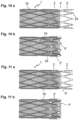
- Figure 10a /b shows a vascular support according to the invention with a covering 19 and predetermined breaking points in the connecting elements 4, which run both in the longitudinal direction and transversely thereto.
- the stent 1 has a ring element 2', which is connected to the peripheral ring element 2 of the stent 1 via connecting webs 4' and can be folded back onto the membrane 19.
- Fastening pins 24 serve to fix the membrane 19.
- Figure 11a /b shows a variant of the embodiment of Figure 10a /b, in which the terminal ring segment 2' is connected to the edge ring segments 2 via laterally offset connecting elements 4'.
- the diagonally extending connecting elements 4' facilitate the folding of the ring element 2' onto the membrane 19.
- inventions according to Figure 10 such as 11 have the predetermined breaking points according to the invention on the connecting elements 4 in the part of the stent 1 located under the membrane 19.
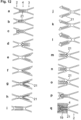
- Figure 12 shows in variants a to p a plurality of clamping elements 21 which serve to fix a membrane.
- the clamping elements 21 are webs which are notched out of a connecting element 4 or a ring element 2, 3 and which are resiliently movable against the connecting element or ring element. The membrane can thus be pushed under this resilient clamping element 21 and thereby fixed.
- the clamping elements 21 can advantageously be released from the connecting element 4 as well as from a ring element 2 or 3. These are freely movable webs of almost any shape. A widened end in the form of a star, hammer head or disk, a toothing or spikes serve to better secure a membrane.
- the clamping elements 21 can occur in pairs and run essentially in the longitudinal direction of the vascular support. In each case, a membrane is fixed by pushing it between the grid structure of the stent and the freely movable webs of the clamping elements 21, see Figure 12q .
- Figure 13 shows a vascular support 1 with a stent structure typical for heart valves with peripheral ring segments 2, adjacent ring segments 3 and connecting bars 4. Connecting bars are often designed as straight bars that run over the entire length of the stent 1 and thus define its length.
- connecting elements 34 are arranged in the area of the fracture lines 8 between the webs of the ring elements 2 and 3.
- the predetermined breaking points are formed by perforation lines, which tear open during subsequent dilation and thus allow the valve to adapt to the growing vessels.
- the in Figure 13 The stent 1 shown has resilient webs 21 which are suitable for fixing a heart valve-bearing stent in the surrounding vessel wall and thus prevent the stent from slipping. Furthermore, this stent can also have other clamping elements as shown in Figure 12 a to q shown are included so that the flap material can be clamped in. This eliminates the need for the usual gluing, wiring or sewing of the fixed or movable flap parts.
- a second cushion-like membrane can also be advantageously clamped inside and outside with suitable clamping elements 21 for sealing purposes at the lower edge of the stent 1.
- Figure 14 shows a further embodiment of a vascular support which has clamping devices for fixing a heart valve-bearing membrane.
- the clamping devices can be one of the Figure 12 illustrated variant or a combination of these or other clamping devices according to the invention.
- Figure 15 shows an example of how a heart valve-bearing membrane can be transformed into a vascular support, as in Figure 14 shown, is trapped.
- Figure 16 shows a further embodiment of a vascular support which, in addition to clamping devices for fixing a heart valve-supporting membrane, has further clamping devices for receiving a further membrane lying on the outside of the vascular support.
Landscapes
- Health & Medical Sciences (AREA)
- Biomedical Technology (AREA)
- Engineering & Computer Science (AREA)
- Cardiology (AREA)
- Heart & Thoracic Surgery (AREA)
- Veterinary Medicine (AREA)
- Oral & Maxillofacial Surgery (AREA)
- Transplantation (AREA)
- Public Health (AREA)
- Vascular Medicine (AREA)
- Life Sciences & Earth Sciences (AREA)
- Animal Behavior & Ethology (AREA)
- General Health & Medical Sciences (AREA)
- Physics & Mathematics (AREA)
- Optics & Photonics (AREA)
- Prostheses (AREA)
- Media Introduction/Drainage Providing Device (AREA)
- Surgical Instruments (AREA)
Applications Claiming Priority (3)
| Application Number | Priority Date | Filing Date | Title |
|---|---|---|---|
| DE102015108835.5A DE102015108835A1 (de) | 2015-06-03 | 2015-06-03 | Gefäßstütze |
| PCT/EP2016/062684 WO2016193449A1 (fr) | 2015-06-03 | 2016-06-03 | Support vasculaire |
| EP16732459.9A EP3302373B1 (fr) | 2015-06-03 | 2016-06-03 | Support vasculaire |
Related Parent Applications (1)
| Application Number | Title | Priority Date | Filing Date |
|---|---|---|---|
| EP16732459.9A Division EP3302373B1 (fr) | 2015-06-03 | 2016-06-03 | Support vasculaire |
Publications (2)
| Publication Number | Publication Date |
|---|---|
| EP4454607A2 true EP4454607A2 (fr) | 2024-10-30 |
| EP4454607A3 EP4454607A3 (fr) | 2024-12-04 |
Family
ID=56263655
Family Applications (2)
| Application Number | Title | Priority Date | Filing Date |
|---|---|---|---|
| EP16732459.9A Active EP3302373B1 (fr) | 2015-06-03 | 2016-06-03 | Support vasculaire |
| EP24189545.7A Pending EP4454607A3 (fr) | 2015-06-03 | 2016-06-03 | Support vasculaire |
Family Applications Before (1)
| Application Number | Title | Priority Date | Filing Date |
|---|---|---|---|
| EP16732459.9A Active EP3302373B1 (fr) | 2015-06-03 | 2016-06-03 | Support vasculaire |
Country Status (7)
| Country | Link |
|---|---|
| US (1) | US10905573B2 (fr) |
| EP (2) | EP3302373B1 (fr) |
| JP (1) | JP7075660B2 (fr) |
| CN (1) | CN107872968B (fr) |
| DE (1) | DE102015108835A1 (fr) |
| ES (1) | ES2988896T3 (fr) |
| WO (1) | WO2016193449A1 (fr) |
Families Citing this family (24)
| Publication number | Priority date | Publication date | Assignee | Title |
|---|---|---|---|---|
| US6878162B2 (en) | 2002-08-30 | 2005-04-12 | Edwards Lifesciences Ag | Helical stent having improved flexibility and expandability |
| US7780721B2 (en) | 2004-09-01 | 2010-08-24 | C. R. Bard, Inc. | Stent and method for manufacturing the stent |
| US9456911B2 (en) | 2006-02-14 | 2016-10-04 | Angiomed Gmbh & Co. Medizintechnik | Highly flexible stent and method of manufacture |
| DE102015115891A1 (de) * | 2015-09-21 | 2017-03-23 | Bentley Innomed Gmbh | Stent-Graft |
| US11622872B2 (en) | 2016-05-16 | 2023-04-11 | Elixir Medical Corporation | Uncaging stent |
| US12599490B2 (en) | 2017-05-25 | 2026-04-14 | Elixir Medical Corporation | Uncaging stent |
| CN112773583B (zh) * | 2017-08-11 | 2024-01-09 | 万能医药公司 | 撑开支架 |
| US11071626B2 (en) * | 2018-03-16 | 2021-07-27 | W. L. Gore & Associates, Inc. | Diametric expansion features for prosthetic valves |
| US10702407B1 (en) | 2019-02-28 | 2020-07-07 | Renata Medical, Inc. | Growth stent for congenital narrowings |
| CN121694847A (zh) | 2019-11-14 | 2026-03-20 | 爱德华兹生命科学公司 | 经导管的医疗植入物递送 |
| DE102019135453A1 (de) * | 2019-12-20 | 2021-06-24 | Malte Neuss | Mehrfachstent mit Membran |
| DE102020211175A1 (de) | 2020-09-04 | 2022-03-10 | Carl Zeiss Meditec Ag | Stent-Implantat zur Glaukom-Behandlung durch Kammerwasserdrainage aus der Vorderkammer |
| CN114469470B (zh) * | 2020-10-26 | 2023-06-02 | 元心科技(深圳)有限公司 | 支架 |
| CN113151980A (zh) * | 2021-03-19 | 2021-07-23 | 苏州大学 | Ptfe管状覆膜支架及其制备方法 |
| US12263104B2 (en) * | 2021-05-20 | 2025-04-01 | Cook Medical Technologies Llc | Self expanding stents and methods |
| WO2022245435A1 (fr) * | 2021-05-20 | 2022-11-24 | Cook Medical Technologies Llc | Stent auto-expansible et son procédé de chargement dans un cathéter |
| CN115363822A (zh) * | 2021-05-21 | 2022-11-22 | 爱德华兹生命科学公司 | 分流筒传感器植入物锚定 |
| CN116407335A (zh) * | 2021-12-31 | 2023-07-11 | 先健科技(深圳)有限公司 | 覆膜支架及覆膜支架输送系统 |
| ES2914516A1 (es) * | 2022-01-07 | 2022-06-13 | Conic Vascular Espana Sl | Stent pediatrico autoexpandible |
| US20230355381A1 (en) * | 2022-05-06 | 2023-11-09 | St. Jude Medical, Cardiology Division, Inc. | Detachable Cell Configuration for Valve in Valve |
| CN115192313B (zh) * | 2022-06-24 | 2024-03-26 | 柏为(武汉)医疗科技股份有限公司 | 一种可拼接外耳道支架 |
| CN115670740A (zh) * | 2022-10-10 | 2023-02-03 | 上海腾复医疗科技有限公司 | 一种血管网架结构 |
| AU2023390347A1 (en) | 2022-12-09 | 2025-06-19 | Renata Medical, Inc. | Transcatheter growth devices and methods for norwood, glenn and fontan therapy |
| CN116370168B (zh) * | 2023-05-31 | 2023-08-04 | 昆明理工大学 | 基于多圆弧星形胞元结构的血管支架结构、泊松比调节方法 |
Citations (3)
| Publication number | Priority date | Publication date | Assignee | Title |
|---|---|---|---|---|
| US5591223A (en) | 1992-11-23 | 1997-01-07 | Children's Medical Center Corporation | Re-expandable endoprosthesis |
| DE10103000A1 (de) | 2001-01-24 | 2002-08-01 | Qualimed Innovative Med Prod | Radial reexpandierbare Gefäßstütze |
| WO2011032526A1 (fr) | 2009-09-16 | 2011-03-24 | Bentley Surgical Gmbh | Stent pourvu d'éléments extenseurs |
Family Cites Families (28)
| Publication number | Priority date | Publication date | Assignee | Title |
|---|---|---|---|---|
| US7029492B1 (en) * | 1999-03-05 | 2006-04-18 | Terumo Kabushiki Kaisha | Implanting stent and dilating device |
| JP4799738B2 (ja) * | 1999-05-19 | 2011-10-26 | ノイス,マルテ | 放射状に拡大可能な管支持物 |
| US6458153B1 (en) * | 1999-12-31 | 2002-10-01 | Abps Venture One, Ltd. | Endoluminal cardiac and venous valve prostheses and methods of manufacture and delivery thereof |
| JP2003525691A (ja) * | 2000-03-09 | 2003-09-02 | ディセーニョ・イ・デサロリョ・メディコ・ソシエダッド・アノニマ・デ・カピタル・バリアブレ | カバーコネクタ付きステント |
| US8034097B2 (en) * | 2000-05-22 | 2011-10-11 | Malte Neuss | Radially expandable vessel support |
| US7550004B2 (en) * | 2002-08-20 | 2009-06-23 | Cook Biotech Incorporated | Endoluminal device with extracellular matrix material and methods |
| US7875068B2 (en) * | 2002-11-05 | 2011-01-25 | Merit Medical Systems, Inc. | Removable biliary stent |
| US20070219613A1 (en) * | 2003-10-06 | 2007-09-20 | Xtent, Inc. | Apparatus and methods for interlocking stent segments |
| US20050182479A1 (en) * | 2004-02-13 | 2005-08-18 | Craig Bonsignore | Connector members for stents |
| FR2881946B1 (fr) * | 2005-02-17 | 2008-01-04 | Jacques Seguin | Dispositif permettant le traitement de conduits corporels au niveau d'une bifurcation |
| US20060248698A1 (en) * | 2005-05-05 | 2006-11-09 | Hanson Brian J | Tubular stent and methods of making the same |
| US8652192B2 (en) * | 2006-03-31 | 2014-02-18 | St. Jude Medical, Cardiology Division, Inc. | Stent and system and method for deploying a stent |
| EP1958597A1 (fr) * | 2007-02-16 | 2008-08-20 | Universität Zürich | Prothèse d'appui tubulaire dotée d'une valvule, en particulier pour un remplacement d'une valvule de l'orifice aortique |
| US8617237B2 (en) * | 2007-02-16 | 2013-12-31 | Universität Zürich | Tubular supporting prosthesis with a heart valve, in particular for aortic valve replacement |
| EP1958598A1 (fr) * | 2007-02-16 | 2008-08-20 | Universität Zürich | Prothèse d'appui tubulaire et croissante |
| DE102007019703A1 (de) | 2007-04-26 | 2008-10-30 | Biotronik Vi Patent Ag | Stent |
| US20090099651A1 (en) * | 2007-10-10 | 2009-04-16 | Miv Therapeutics, Inc. | Lipid coatings for implantable medical devices |
| EP2355755B1 (fr) * | 2008-09-15 | 2017-10-18 | Abbott Laboratories Vascular Enterprises Limited | Stent avec anneaux de stent indépendants et fixations transitoires |
| US20130238086A1 (en) * | 2009-01-16 | 2013-09-12 | Zeus Industrial Products, Inc. | Electrospun PTFE Encapsulated Stent & Method of Manufature |
| US8221489B2 (en) * | 2009-08-20 | 2012-07-17 | Stentys | Device and method for treating a body lumen |
| DE202009012562U1 (de) * | 2009-09-16 | 2009-12-17 | Bentley Surgical Gmbh | Stent mit Dehnelementen |
| DE102011115902B4 (de) * | 2010-12-22 | 2021-07-01 | Bentley Innomed Gmbh | Stent-Graft und dessen Verwendung |
| US10166128B2 (en) * | 2011-01-14 | 2019-01-01 | W. L. Gore & Associates. Inc. | Lattice |
| US8974521B2 (en) * | 2011-02-24 | 2015-03-10 | Biotronik Ag | Implant and method for manufacturing same |
| DE102012001996A1 (de) * | 2012-02-03 | 2013-08-08 | Bentley Surgical Gmbh | Stent-Graft III |
| WO2014004746A2 (fr) * | 2012-06-26 | 2014-01-03 | Harvard Bioscience, Inc. | Procédés et compositions destinés à favoriser l'intégrité structurelle d'échafaudages pour ingénierie tissulaire |
| CN203029427U (zh) * | 2012-12-07 | 2013-07-03 | 佳木斯大学 | 一种冠脉支架 |
| US9345597B2 (en) * | 2013-07-09 | 2016-05-24 | Abbott Cardiovascular Systems Inc. | Polymeric stent with structural radiopaque marker |
-
2015
- 2015-06-03 DE DE102015108835.5A patent/DE102015108835A1/de active Pending
-
2016
- 2016-06-03 ES ES16732459T patent/ES2988896T3/es active Active
- 2016-06-03 WO PCT/EP2016/062684 patent/WO2016193449A1/fr not_active Ceased
- 2016-06-03 CN CN201680038131.6A patent/CN107872968B/zh active Active
- 2016-06-03 EP EP16732459.9A patent/EP3302373B1/fr active Active
- 2016-06-03 US US15/579,009 patent/US10905573B2/en active Active
- 2016-06-03 EP EP24189545.7A patent/EP4454607A3/fr active Pending
- 2016-06-03 JP JP2018515352A patent/JP7075660B2/ja active Active
Patent Citations (3)
| Publication number | Priority date | Publication date | Assignee | Title |
|---|---|---|---|---|
| US5591223A (en) | 1992-11-23 | 1997-01-07 | Children's Medical Center Corporation | Re-expandable endoprosthesis |
| DE10103000A1 (de) | 2001-01-24 | 2002-08-01 | Qualimed Innovative Med Prod | Radial reexpandierbare Gefäßstütze |
| WO2011032526A1 (fr) | 2009-09-16 | 2011-03-24 | Bentley Surgical Gmbh | Stent pourvu d'éléments extenseurs |
Also Published As
| Publication number | Publication date |
|---|---|
| CN107872968B (zh) | 2021-04-30 |
| WO2016193449A1 (fr) | 2016-12-08 |
| EP3302373C0 (fr) | 2024-08-07 |
| US20180140444A1 (en) | 2018-05-24 |
| EP4454607A3 (fr) | 2024-12-04 |
| EP3302373A1 (fr) | 2018-04-11 |
| US10905573B2 (en) | 2021-02-02 |
| ES2988896T3 (es) | 2024-11-22 |
| JP7075660B2 (ja) | 2022-05-26 |
| EP3302373B1 (fr) | 2024-08-07 |
| CN107872968A (zh) | 2018-04-03 |
| JP2018516735A (ja) | 2018-06-28 |
| DE102015108835A1 (de) | 2016-12-08 |
Similar Documents
| Publication | Publication Date | Title |
|---|---|---|
| EP3302373B1 (fr) | Support vasculaire | |
| DE102009060228B4 (de) | Medizinische Vorrichtungen | |
| DE10103000B4 (de) | Radial reexpandierbare Gefäßstütze | |
| DE602004012037T2 (de) | Abdeckvorrichtung für einen Aneurysemhals | |
| DE69633824T2 (de) | Vorrichtung zur implantierung in einem blutgefäss beziehungsweise in einem hohlen körperlumen | |
| EP2117476B1 (fr) | Prothèse de soutien tubulaire avec valvule cardiaque, notamment pour le remplacement de la valvule aortique | |
| EP2259728B1 (fr) | Dispositif d'obturation d'ouvertures défectueuses dans le système vasculaire | |
| DE602005004824T2 (de) | Stent mit Mehrpunktverschlussmechanismus | |
| DE10334868B4 (de) | Implantierbare Einrichtung als Organklappenersatz, dessen Herstellungsverfahren sowie Grundkörper und Membranelement dafür | |
| EP1648342B1 (fr) | Endoprothèse vasculaire tressée destinée à être implantée dans un vaisseau sanguin | |
| WO2001089414A1 (fr) | Tuteur vasculaire radialement extensible | |
| DE102012107175B4 (de) | Medizinische Verschlussvorrichtung und System mit einer derartigen Verschlussvorrichtung | |
| DE102004045994A1 (de) | Stent zur Implantation in oder um ein Hohlorgan mit Markerelementen aus einem röntgenopaken Material | |
| EP2822514B1 (fr) | Tuteur vasculaire à haute flexibilité présentant un point de rupture | |
| EP2846731B1 (fr) | Prothèse vasculaire intraluminale à fenestration in situ | |
| DE202004014789U1 (de) | Stent zur Implantation in oder um ein Hohlorgan mit Markerelementen aus einem röntgenopaken Material | |
| EP3412250B1 (fr) | Prothèse vasculaire intraluminale à fenestration in situ | |
| EP1958597A1 (fr) | Prothèse d'appui tubulaire dotée d'une valvule, en particulier pour un remplacement d'une valvule de l'orifice aortique | |
| EP3952798B1 (fr) | Stent | |
| DE19923133B4 (de) | Radial expandierbare Gefäßstütze | |
| EP1217968B9 (fr) | Tuteur intravasculaire s'elargissant radialement | |
| EP1292246B1 (fr) | Tuteur vasculaire radialement extensible | |
| DE20314392U1 (de) | Stent mit endständigen Verankerungselementen |
Legal Events
| Date | Code | Title | Description |
|---|---|---|---|
| PUAI | Public reference made under article 153(3) epc to a published international application that has entered the european phase |
Free format text: ORIGINAL CODE: 0009012 |
|
| STAA | Information on the status of an ep patent application or granted ep patent |
Free format text: STATUS: THE APPLICATION HAS BEEN PUBLISHED |
|
| REG | Reference to a national code |
Ref country code: DE Ref legal event code: R079 Free format text: PREVIOUS MAIN CLASS: A61F0002070000 Ipc: A61F0002915000 |
|
| AC | Divisional application: reference to earlier application |
Ref document number: 3302373 Country of ref document: EP Kind code of ref document: P |
|
| AK | Designated contracting states |
Kind code of ref document: A2 Designated state(s): AL AT BE BG CH CY CZ DE DK EE ES FI FR GB GR HR HU IE IS IT LI LT LU LV MC MK MT NL NO PL PT RO RS SE SI SK SM TR |
|
| PUAL | Search report despatched |
Free format text: ORIGINAL CODE: 0009013 |
|
| AK | Designated contracting states |
Kind code of ref document: A3 Designated state(s): AL AT BE BG CH CY CZ DE DK EE ES FI FR GB GR HR HU IE IS IT LI LT LU LV MC MK MT NL NO PL PT RO RS SE SI SK SM TR |
|
| RIC1 | Information provided on ipc code assigned before grant |
Ipc: A61F 2/07 20130101ALI20241028BHEP Ipc: A61F 2/06 20130101ALI20241028BHEP Ipc: A61F 2/24 20060101ALI20241028BHEP Ipc: A61F 2/915 20130101AFI20241028BHEP |
|
| STAA | Information on the status of an ep patent application or granted ep patent |
Free format text: STATUS: REQUEST FOR EXAMINATION WAS MADE |
|
| 17P | Request for examination filed |
Effective date: 20250604 |