EP4454635A1 - Composition cosmétique à conservation améliorée - Google Patents
Composition cosmétique à conservation améliorée Download PDFInfo
- Publication number
- EP4454635A1 EP4454635A1 EP24173061.3A EP24173061A EP4454635A1 EP 4454635 A1 EP4454635 A1 EP 4454635A1 EP 24173061 A EP24173061 A EP 24173061A EP 4454635 A1 EP4454635 A1 EP 4454635A1
- Authority
- EP
- European Patent Office
- Prior art keywords
- cosmetic preparation
- water
- aqueous phase
- concentration
- ultrapure water
- Prior art date
- Legal status (The legal status is an assumption and is not a legal conclusion. Google has not performed a legal analysis and makes no representation as to the accuracy of the status listed.)
- Pending
Links
Images

Classifications
-
- A—HUMAN NECESSITIES
- A61—MEDICAL OR VETERINARY SCIENCE; HYGIENE
- A61Q—SPECIFIC USE OF COSMETICS OR SIMILAR TOILETRY PREPARATIONS
- A61Q19/00—Preparations for care of the skin
-
- A—HUMAN NECESSITIES
- A61—MEDICAL OR VETERINARY SCIENCE; HYGIENE
- A61K—PREPARATIONS FOR MEDICAL, DENTAL OR TOILETRY PURPOSES
- A61K8/00—Cosmetics or similar toiletry preparations
- A61K8/02—Cosmetics or similar toiletry preparations characterised by special physical form
- A61K8/04—Dispersions; Emulsions
- A61K8/06—Emulsions
-
- A—HUMAN NECESSITIES
- A61—MEDICAL OR VETERINARY SCIENCE; HYGIENE
- A61K—PREPARATIONS FOR MEDICAL, DENTAL OR TOILETRY PURPOSES
- A61K8/00—Cosmetics or similar toiletry preparations
- A61K8/18—Cosmetics or similar toiletry preparations characterised by the composition
- A61K8/19—Cosmetics or similar toiletry preparations characterised by the composition containing inorganic ingredients
- A61K8/20—Halogens; Compounds thereof
-
- A—HUMAN NECESSITIES
- A61—MEDICAL OR VETERINARY SCIENCE; HYGIENE
- A61Q—SPECIFIC USE OF COSMETICS OR SIMILAR TOILETRY PREPARATIONS
- A61Q19/00—Preparations for care of the skin
- A61Q19/10—Washing or bathing preparations
-
- A—HUMAN NECESSITIES
- A61—MEDICAL OR VETERINARY SCIENCE; HYGIENE
- A61K—PREPARATIONS FOR MEDICAL, DENTAL OR TOILETRY PURPOSES
- A61K2800/00—Properties of cosmetic compositions or active ingredients thereof or formulation aids used therein and process related aspects
- A61K2800/40—Chemical, physico-chemical or functional or structural properties of particular ingredients
- A61K2800/52—Stabilizers
- A61K2800/524—Preservatives
-
- A—HUMAN NECESSITIES
- A61—MEDICAL OR VETERINARY SCIENCE; HYGIENE
- A61K—PREPARATIONS FOR MEDICAL, DENTAL OR TOILETRY PURPOSES
- A61K2800/00—Properties of cosmetic compositions or active ingredients thereof or formulation aids used therein and process related aspects
- A61K2800/70—Biological properties of the composition as a whole
Definitions
- the present invention relates to a cosmetic composition containing an aqueous phase.
- Cosmetic preparations are widespread and very popular. They are substances or mixtures of substances that come into contact with external parts of the human body (skin, hair system, nails, lips and external intimate areas) or with the teeth and mucous membranes of the oral cavity and are used exclusively or mainly to clean, care for or protect the skin and hair. They are also used to deodorize and perfume the body and to change the appearance. In this respect, many cosmetic preparations have an improving or refining effect on the skin's appearance and help to maintain good skin condition.
- the cosmetic preparations contain water and/or various oils as their main components.
- These two so-called phases, the water phase and the oil phase act as the product basis of the cosmetic preparation and, as carrier and base components, contain various caring, fragrant or coloring additives and ingredients as required.
- Products which, as purely oil-containing preparations, do not contain a water phase, such as ointments or lipo-gels.
- the preparations used predominantly have either an aqueous phase alone or are based on an aqueous and oily phase.
- the former would be, for example, solutions, skin or hair lotions, hydrogels.
- both basic components water and oil
- these two components are naturally immiscible with each other, which is why surface-active substances, so-called emulsifiers, are added to obtain stable preparations in which the water and oil phases do not separate from each other.
- emulsifiers so-called emulsifiers
- W/O water-in-oil emulsions
- O/W oil-in-water emulsions
- the oil phase forms the outer phase, in which the aqueous component is present as finely distributed droplets and is coated. Since the oil is present as the outer phase, the preparation has the appearance of a rich cream or fat cream. Such preparations are more suitable for the care or protection of dry skin.
- O/W emulsions are preparations whose outer phase is the aqueous phase in which fine oil droplets are distributed.
- This type of emulsion is characterized by user-friendly properties, particularly due to the aqueous outer phase.
- a cream, lotion, body milk or other cosmetic preparations with an aqueous outer phase and an oily inner phase are easy to spread on the skin. They are quickly absorbed into the skin and have a pleasant feel. Since they generally do not leave a greasy film, these preparations are suitable for a wide range of applications, especially for normal or oily skin.
- multiple emulsions are also available in which the different phases are present in (multiple) concentric droplets or emulsions that contain an inner solid phase
- the quality of the outer phase, aqueous or oily determines the resulting application properties
- the aqueous and oily components of the base contain different ingredients which give or support the cleansing, caring, (skin or hair) protective, deodorizing or coloring properties of the respective cosmetic preparations.
- Cosmetic preparations with an aqueous phase are susceptible to microbial contamination, attack and spoilage.
- O/W emulsions with water in the outer phase are particularly affected, as the water is contained in a form that is easily accessible to microorganisms from the outside. But even if the water is present in the inner phase, it is subject to the risk of contamination.
- preservatives are usually used for this purpose. They prevent certain chemical reactions, such as oxidation, or microbiological changes and thus ensure that a preparation in an unopened package does not spoil over a selected storage period.
- preservatives offer a certain degree of protection against contamination of the preparation in use in the opened packaging through the introduction of microorganisms when it is removed as intended.
- endocrine disruptors Some of the commonly used preservatives fall into the group of endocrine disruptors. These are endocrine-active substances that are also known as “environmental hormones”. Even in small quantities in the body, they can impair or damage health by changing the hormonal system.
- a composition of a preservative excipient with a preservative active ingredient is known, wherein the excipient is (i) isopentyldiol or (ii) isopentyldiol and 1,2-hexanediol, and the active ingredient is at least one substance selected from the group containing 2-phenoxyethanol, caprylyl glycol and ethylhexylglycerin.
- the composition contains ethyl lauroyl arginate and at least one monoglyceryl ether of the formula where one of the two residues R1 and R2 a branched or linear C3 to C12 alkyl group and the other represents a hydrogen atom.
- preservatives of plant origin are mentioned in the state of the art, for example in the CN 10 4738033 (A ), which discloses a composition of herbal preservatives comprising citral, vanillin, anisic acid and magnolol.
- KR 2008/0011546 (A ) is a cosmetic composition that is able to remove irritations caused by chemical preservatives by containing an extract of Lonicera flowers instead of a chemical preservative.
- plant-based ingredients can also trigger allergies and, on the other hand, the total concentration of preservatives when several substances are combined, each of which is contained in a small concentration, tends to be higher when added together.
- the present invention solves this problem of a cosmetic preparation containing an aqueous phase in that the aqueous phase contains water and a activated ultrapure water, wherein the water and the activated ultrapure water are added to the aqueous phase, and wherein the activated ultrapure water has a content of 60 to 1500 mg/l ClO - ions and a redox potential of + 700 to + 950 mV before addition to the aqueous phase, wherein the proportion of activated ultrapure water is at least 70 to 99.9% of the total water and activated ultrapure water added to the aqueous phase.
- the water of the aqueous phase can be water added during production.
- suitable waters include water for cosmetic purposes, aqua purificata or distilled water.
- This water can also be added to the cosmetic preparation in the form of other possible ingredients that are present as aqueous liquids and are added. This is the case, for example, when aqueous plant extracts or film formers, gelling agents such as cellulose or starch compositions, or stabilizers, buffers or pH regulators that are present in aqueous form as raw materials are part of a recipe.
- the activated ultrapure water is a water that has a content of 60 to 1500 mg/l ClO - ions and an oxidation potential of + 700 to + 950 mV and is produced in a multi-stage electrochemical process. It is available, for example, from POC Consulting GmbH, Schmelz. With regard to the activated ultrapure water and the process for its production, reference is made to the application EP 4019476 , the contents of which are hereby incorporated into this application.
- the activated ultrapure water in the sense of the present application has a content of 60 to 1500 mg/l ClO - ions. In particular, it has a content of, for example, 60 mg/l, 600 mg/l, 800 mg/l, 1200 mg/l or 1500 mg/l ClO - ions. A content of 800 mg/l or 1200 mg/l is preferred. For a cosmetic preparation with a high proportion of activated ultrapure water, such as 90 to 99.9%, a content of 60 mg/l is preferred.
- a solution of high-purity chloride salt such as NaCl
- conventional ultra-pure water which is characterized in particular by a low TOC limit value and low conductivity
- electrolysis can be controlled with regard to various process parameters, such as voltage or current flow, as well as the arrangement and geometry of the electrodes and also the residence time of the solution in the cyclic electrolysis cell, and thus the above-mentioned different contents of ClO - ions can be adjusted.
- a cell is used as the cyclic electrolysis cell that does not have a cathode and anode compartment separated by a membrane or diaphragm.
- the solution of the high-purity chloride salt is produced using ultra-pure electrochemically modified water as the starting material.
- This ultra-pure electrochemically modified water is obtained by degassing conventional ultra-pure water in several process steps (1), (2) applying a DC voltage in a flow-through electrolysis cell that does not have a separate cathode and anode compartment, i.e. without a membrane or diaphragm, (3) adding ambient air and/or O 2 and causing the water to react with the ambient air and/or the O 2 on a surface and finally degassing again (4).
- Process steps (2) and (3) can be repeated once or several times.
- the cosmetic preparation can comprise a preservative in the aqueous phase. It can also contain a preservative in the oily phase, but the aqueous phase is particularly susceptible to microbial contamination. All preservatives that are suitable in a cosmetic preparation for exclusively or predominantly inhibiting the development of microorganisms can be used here. In the context of the present invention, this term does not include substances that inhibit the growth of germs but are mainly added to the cosmetic preparation for another purpose, such as, for example, as an active ingredient for skin care, as a means of protecting against reactive oxygen species, as a stabilizer or as a buffer.
- Preservatives preferred for the present invention are, for example, benzoic acid and its sodium, calcium, potassium, magnesium or ammonium salt; also benzoic acid esters, such as ethyl, methyl, propyl, butyl, isopropyl, isobutyl or phenyl benzoate or benzoic acid monoethanolamine salt. Due to their low allergy potential, sorbic acid and its calcium, sodium or potassium salt, as well as 4-hydroxybenzoic acid and its esters are also suitable for the cosmetic preparation according to the invention.
- Dehydroacetic acid and sodium dehydroacetate, o-cymen-5-ol, 2-phenoxyethanol, benzyl alcohol, chlorphenesin, chlorhexidine and its diacetate, digluconate or dihydrochloride are also preferably used as preservatives in the sense of this invention.
- Particularly preferred preservatives are benzoic acid and benzoic acid esters, sorbic acid and its salts, chlorphenesin and phenoxyethanol because of their good tolerability.
- the maximum concentration can be specified in particular as a mass fraction in % by weight.
- the maximum concentrations permitted for preservatives can be specified by country-specific legal regulations, among other things. Different requirements are conceivable in different countries. For example, the FDA regulates the use of preservatives in the USA by issuing corresponding guidelines. One possible regulation that stipulates binding maximum concentrations for the EU is Regulation (EC) No. 1223/2009 of the European Parliament and of the Council in its current version. Annex V contains a complete list of the preservatives permitted in cosmetic preparations in the EU. For the preservatives listed, the names of which can be found in columns "b" and "c", the maximum permissible concentration for each preservative is specified in column "g" of Annex V, which relates to a type of product or specific use of the product that can be found in column "f".
- the concentration of a preservative is at most 35% of the maximum concentration permitted for it.
- the maximum concentration mentioned can also depend on the type of cosmetic preparation or on the intended use of the same.
- the concentrations of each substance in the mixture may only be up to 35% of its maximum permissible concentration.
- the concentration of the preservative in the cosmetic preparation is only up to 18% of the maximum permissible concentration.
- the cosmetic preparation in one embodiment has a concentration of the preservative which is 7.5 to 34% of the maximum permissible concentration.
- the cosmetic preparation may be designed in such a way that the concentration of the preservative is 7.5 to 18% of the maximum permissible concentration.
- the activated ultrapure water added to the aqueous phase of the cosmetic preparation can preferably have a pH value of 8.2 - 9.5 before addition. This can be adjusted by the above-mentioned process for producing the activated ultrapure water. Such a pH value is particularly suitable for ensuring the specified content of ClO - ions. After adding the activated ultrapure water to the cosmetic preparation, the pH value is usually around pH 5 to 6.5 or it is adjusted to values between pH 5.0 to 5.5 with pH regulators.
- the cosmetic preparation according to the invention can be purely water-based, i.e. it then only has an aqueous phase. However, according to a preferred embodiment, it is also conceivable that it also comprises an oily phase. In this case, it is again possible for the preparation to be in the form of a water-in-oil emulsion. However, it is preferred for this embodiment that the oily phase forms an oil-in-water emulsion with the aqueous phase.
- the aqueous phase of the cosmetic preparation additionally comprises, for example, a solvent.
- a solvent is selected from the group containing ethanol, isopropanol, glycerol, propylene glycol, butylene glycol Pentylene glycol and hexylene glycol are conceivable. 1,2-propanediol and 1,2-pentanediol are particularly preferred. These solvents have a skin-care effect and bind moisture in the preparation. Furthermore, the viscosity of the preparation can be brought to a desired range by adding these solvents.
- the cosmetic preparation preferably comprises a further auxiliary and/or additive selected from the group containing oil-in-water emulsifiers (O/W emulsifiers), antioxidants, gelling agents, thickeners, binders, film formers, humectants, fragrances.
- O/W emulsifiers oil-in-water emulsifiers
- antioxidants antioxidants
- gelling agents thickeners
- binders binders
- film formers humectants
- fragrances preferably comprises a further auxiliary and/or additive selected from the group containing oil-in-water emulsifiers (O/W emulsifiers), antioxidants, gelling agents, thickeners, binders, film formers, humectants, fragrances.
- Suitable O/W emulsifiers are, for example, sodium stearoyl glutamate, glyceryl stearate citrate, glyceryl stearate, polyglyceryl-4 caprate, glyceryl stearate, ceteareth-20, ceteareth-12, cetearyl alcohol, glycol distearate.
- Preferred antioxidants are tocopherol and tocopherol acetate, beta-carotene.
- Clay minerals, modified celluloses, especially bentonite, xanthan, maltooligosyl glucoside can be added as gelling agents.
- Preferred humectants are, for example, glycerin, ethylene glycol, 1,2-propanediol or 1,2-pentanediol.
- the cosmetic preparation can comprise various plant extracts, for example Rosa Damascena Flower Water, Cocos Nucifera Fruit Juice, Plantago Ovata Leaf Extract, Aloe Vera Leaf Juice.
- plant extracts for example Rosa Damascena Flower Water, Cocos Nucifera Fruit Juice, Plantago Ovata Leaf Extract, Aloe Vera Leaf Juice.
- the present invention also relates in particular to the use of activated ultrapure water having a content of 60 to 1500 mg/l ClO - ions and a redox potential of + 700 to + 950 mV for producing a cosmetic preparation according to the invention with an aqueous phase.
- the cosmetic preparation according to the invention has the particular advantage that, despite its water content, it does not require any preservatives or only requires preservatives in a significantly reduced concentration of only up to 35% of the maximum permissible concentration.
- Another advantage is that by omitting the preservative or reducing its concentration to up to 35% of the maximum permissible concentration, it is not necessary to use mixtures of several different preservatives in common concentrations. A so-called cocktail effect often observed with these mixtures, in which allergy and sensitization problems arise when using cosmetic preparations due to the number of different preservatives despite the low concentration, can be avoided by the preparations according to the invention.
- the cosmetic preparations according to the invention only contain mixtures of preservatives if the different preservatives are introduced into the preparation through the raw materials. This introduction cannot be prevented, but due to the minimal concentrations then present, an adverse effect, in particular a cocktail effect, is avoided.
- Example 1 To produce a shower gel according to Example 1, the activated ultrapure water is placed in a vessel at room temperature. It is stirred continuously. All ingredients are gradually added while stirring. The finished shower gel is filled into a suitable container.
- a shower gel according to comparative example 1a is produced analogously to example 1.
- the finished shower gel contains 0.28% chlorphenesin. It is filled into a suitable container.
- Example 2 The preparation of a lotion according to Example 2 is carried out analogously to Example 1.
- ingredients No. 1 to 6 of the aqueous phase are heated to 75 °C with slow stirring on level 1 of a Turbine V2 emulsifying machine.
- ingredients No. 7 to 9 of the oily phase are also heated to 75 °C with slow stirring.
- the two phases are combined and mixed with fast stirring on level 2 with approximately 3000 rpm in the emulsifying machine Turbine V2 and after 5 min the formed emulsion is cooled to room temperature.
- ingredient No. 10 is allowed to swell in ingredient No. 11 for 30 minutes. The swollen mixture is then added to the emulsion while stirring. As soon as the mixture is well incorporated and the emulsion has a homogeneous appearance, ingredient No. 12 is added little by little while stirring without interruption. After briefly stirring ingredient No. 13, this is also added to the emulsion. Finally, ingredient No. 14 is added. If necessary, the pH value is adjusted to a value between 5.0 and 5.5 using a pH regulator, e.g. citric acid. The finished emulsion is filled into a suitable container.
- a pH regulator e.g. citric acid
- an emulsion is prepared as described in example 3, with the only difference that instead of the activated ultra-pure water (ingredient no. 1), a purified water (aqua purificata) commonly used for cosmetic preparations is added in the appropriate amount, corresponding to ingredient no. 10.
- the finished emulsion is filled into a suitable container.
- an emulsion is prepared as described in example 3, with the difference that instead of the activated ultra-pure water (ingredient no. 1), a purified water (aqua purificata) that is customary for cosmetic preparations is added in the appropriate amount corresponding to ingredient no. 10. Furthermore, the preservative no. 6, chlorphenesin, is added in a concentration of 0.28%. This concentration is close to the maximum permissible concentration for chlorphenesin of 0.1%. The amount of water no. 1 is adjusted accordingly. The finished emulsion is filled into a suitable container.
- Example 4 Analogous to Example 3, for a skin cream according to Example 4, the ingredients No. 1 to 4 and No. 11 of the aqueous phase are heated to 75 °C with slow stirring on level 1. Separately, the ingredients No. 5 to 7 of the oily phase are also heated to 75 °C with slow stirring. The two phases are combined and emulsified with rapid stirring at approximately 3000 rpm in a Turbine V2 emulsifying machine and after 5 minutes the emulsion formed is cooled to room temperature.
- ingredient No. 8 is allowed to swell in ingredient No. 9 for 30 minutes. The swollen mixture is then added to the emulsion while stirring. As soon as the mixture is well incorporated and the emulsion has a homogeneous appearance, ingredient No. 10 is added little by little while stirring without interruption. After briefly stirring ingredient No. 12, this is also added to the emulsion. Finally, ingredient No. 13 is added. If necessary, the pH value is adjusted to a value between 5.0 and 5.5 using a pH regulator, e.g. citric acid. The finished emulsion is filled into a suitable container.
- a pH regulator e.g. citric acid
- an emulsion is prepared as described in example 4, with the only difference that instead of the activated ultrapure water (ingredient no. 1), a purified water (aqua purificata) commonly used for cosmetic preparations is added in the appropriate amount, corresponding to ingredient no. 9.
- the finished emulsion is filled into suitable containers.
- an emulsion is prepared as described in example 4, with the difference that instead of the activated ultra-pure water (ingredient no. 1), a purified water (aqua purificata) that is customary for cosmetic preparations is added in the appropriate amount, corresponding to ingredient no. 9. Furthermore, the preservatives no. 11 are added in a concentration of 1.0%. This concentration is close to the maximum permissible concentration for sodium benzoate of 0.5% and potassium sorbate of 0.6%. The amount of water no. 1 is adjusted accordingly. The finished emulsion is filled into a suitable container.
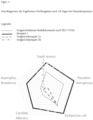
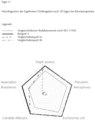
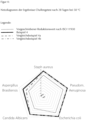
- the samples of the cosmetic preparation are deliberately inoculated with five different strains of microorganisms (Staphylococcus aureus, Pseudomonas aeruginosa, Escherichia coli, Candida albicans and Aspergillus Brasiliensis).
- the initial bacterial counts are determined and the inoculated samples are stored under defined conditions. After specified times (7 days, 14 days and 28 days), the bacterial counts of the inoculated samples are determined in order to track the development of the bacterial counts over the respective test period. This checks whether the bacterial counts are reduced accordingly. Since an introduction of microorganisms must be expected after opening a cosmetic preparation during use, the result of this test provides an indication of the microbial stability of the cosmetic preparation.
- criterion A the standard states that the product is protected against microbial proliferation. If only criterion B is met, further safety measures must be taken. such as protective packaging, must be taken to reduce the microbial risk during use and to meet the requirements of the standard.
- the cosmetic preparations according to the invention have the required reduction values according to criterion A. They are therefore sufficiently protected against microbial spoilage despite the preservatives contained only in small quantities and are safe for the consumer to use.
Landscapes
- Health & Medical Sciences (AREA)
- Life Sciences & Earth Sciences (AREA)
- Veterinary Medicine (AREA)
- Animal Behavior & Ethology (AREA)
- General Health & Medical Sciences (AREA)
- Public Health (AREA)
- Dermatology (AREA)
- Chemical & Material Sciences (AREA)
- Birds (AREA)
- Epidemiology (AREA)
- Inorganic Chemistry (AREA)
- Dispersion Chemistry (AREA)
- Cosmetics (AREA)
Applications Claiming Priority (1)
| Application Number | Priority Date | Filing Date | Title |
|---|---|---|---|
| DE102023111166.3A DE102023111166A1 (de) | 2023-04-29 | 2023-04-29 | Kosmetische Zubereitung mit verbesserter Konservierung |
Publications (1)
| Publication Number | Publication Date |
|---|---|
| EP4454635A1 true EP4454635A1 (fr) | 2024-10-30 |
Family
ID=90924151
Family Applications (1)
| Application Number | Title | Priority Date | Filing Date |
|---|---|---|---|
| EP24173061.3A Pending EP4454635A1 (fr) | 2023-04-29 | 2024-04-29 | Composition cosmétique à conservation améliorée |
Country Status (2)
| Country | Link |
|---|---|
| EP (1) | EP4454635A1 (fr) |
| DE (1) | DE102023111166A1 (fr) |
Citations (12)
| Publication number | Priority date | Publication date | Assignee | Title |
|---|---|---|---|---|
| US20020114851A1 (en) * | 2001-02-16 | 2002-08-22 | Camper Jurdon Wayne | Therapeutic mouthwash containing alkali metal hypohalite |
| KR20080011546A (ko) | 2006-07-31 | 2008-02-05 | (주)아모레퍼시픽 | 금은화 추출물을 함유하는 저자극성 피부 외용제 조성물 |
| CN101163492A (zh) * | 2005-03-23 | 2008-04-16 | 奥古露丝创新科学公司 | 利用氧化还原电位水溶液治疗2度和3度烧伤的方法 |
| WO2008070023A2 (fr) * | 2006-12-01 | 2008-06-12 | Pond Gary J | Agent d'irrigation dentaire amélioré |
| WO2013091978A2 (fr) | 2011-12-21 | 2013-06-27 | Henkel Ag & Co. Kgaa | Compositions d'agents de conservation et produits cosmétiques les contenant |
| CN104738033A (zh) | 2015-02-02 | 2015-07-01 | 广东工业大学 | 一种植物来源的防腐剂组方 |
| US20160045547A1 (en) * | 2003-12-30 | 2016-02-18 | Oculus Innovative Sciences, Inc. | Method of preventing or treating sinusitis with oxidative reductive potential water solution |
| US20170071980A1 (en) * | 2005-05-02 | 2017-03-16 | Oculus Innovative Sciences, Inc. | Method of using oxidative reductive potential water solution in dental applications |
| WO2019126560A1 (fr) * | 2017-12-22 | 2019-06-27 | Reoxcyn, Llc | Compositions redox stables et procédés d'utilisation |
| JP2019210250A (ja) | 2018-06-05 | 2019-12-12 | 株式会社クラレ | イソペンチルジオールを含有する防腐剤組成物 |
| WO2022017816A1 (fr) * | 2020-07-24 | 2022-01-27 | TULICHEM GmbH | Agent désinfectant, toléré par la peau, nourrissant et relipidant, destiné à être appliqué sur la peau |
| EP4019476A2 (fr) | 2020-12-23 | 2022-06-29 | Peter Ott Consulting | Procédé de production d'eau modifiée de manière électrochimique |
-
2023
- 2023-04-29 DE DE102023111166.3A patent/DE102023111166A1/de active Pending
-
2024
- 2024-04-29 EP EP24173061.3A patent/EP4454635A1/fr active Pending
Patent Citations (12)
| Publication number | Priority date | Publication date | Assignee | Title |
|---|---|---|---|---|
| US20020114851A1 (en) * | 2001-02-16 | 2002-08-22 | Camper Jurdon Wayne | Therapeutic mouthwash containing alkali metal hypohalite |
| US20160045547A1 (en) * | 2003-12-30 | 2016-02-18 | Oculus Innovative Sciences, Inc. | Method of preventing or treating sinusitis with oxidative reductive potential water solution |
| CN101163492A (zh) * | 2005-03-23 | 2008-04-16 | 奥古露丝创新科学公司 | 利用氧化还原电位水溶液治疗2度和3度烧伤的方法 |
| US20170071980A1 (en) * | 2005-05-02 | 2017-03-16 | Oculus Innovative Sciences, Inc. | Method of using oxidative reductive potential water solution in dental applications |
| KR20080011546A (ko) | 2006-07-31 | 2008-02-05 | (주)아모레퍼시픽 | 금은화 추출물을 함유하는 저자극성 피부 외용제 조성물 |
| WO2008070023A2 (fr) * | 2006-12-01 | 2008-06-12 | Pond Gary J | Agent d'irrigation dentaire amélioré |
| WO2013091978A2 (fr) | 2011-12-21 | 2013-06-27 | Henkel Ag & Co. Kgaa | Compositions d'agents de conservation et produits cosmétiques les contenant |
| CN104738033A (zh) | 2015-02-02 | 2015-07-01 | 广东工业大学 | 一种植物来源的防腐剂组方 |
| WO2019126560A1 (fr) * | 2017-12-22 | 2019-06-27 | Reoxcyn, Llc | Compositions redox stables et procédés d'utilisation |
| JP2019210250A (ja) | 2018-06-05 | 2019-12-12 | 株式会社クラレ | イソペンチルジオールを含有する防腐剤組成物 |
| WO2022017816A1 (fr) * | 2020-07-24 | 2022-01-27 | TULICHEM GmbH | Agent désinfectant, toléré par la peau, nourrissant et relipidant, destiné à être appliqué sur la peau |
| EP4019476A2 (fr) | 2020-12-23 | 2022-06-29 | Peter Ott Consulting | Procédé de production d'eau modifiée de manière électrochimique |
Also Published As
| Publication number | Publication date |
|---|---|
| DE102023111166A1 (de) | 2024-10-31 |
Similar Documents
| Publication | Publication Date | Title |
|---|---|---|
| DE68913239T2 (de) | Konservierungszusammensetzung für nasse Wischer. | |
| EP1478231B1 (fr) | Melanges synergiques de 1,2-alcane-diols | |
| EP0658097B1 (fr) | Agent cosmetique deodorant contenant des acides gras | |
| DE4429467C2 (de) | Desodorierende kosmetische Mittel | |
| EP3113846B1 (fr) | Ester de polyglycérine présentant une distribution particulière des oligomères de polyglycérine | |
| DE102010038952A1 (de) | Konservierungsmittel-Zusammensetzungen und Kosmetika enthaltend diese | |
| WO1993001714A1 (fr) | Melanges a effet antimicrobien | |
| DE102007017851A1 (de) | Zusammensetzung auf Basis von Glycerinether/Polyol-Gemischen | |
| DE3836241A1 (de) | Konservierte haar- und koerperbehandlungsmittel sowie verwendung einer konservierungsstoff-kombination | |
| DE202007002978U1 (de) | Wässrige, desinfizierende Gelzubereitung | |
| DE102010044785A1 (de) | Octenidindihydrochlorid als Co-Emulgator in Mikroemulsionen | |
| EP1068862A2 (fr) | Combinaison de principes actifs déodorants and utilisation | |
| DE102013222164A1 (de) | Stabilisierte multiple Emulsionen als Hautschutzprodukt | |
| WO2016102132A1 (fr) | Utilisation d'octénidine comme principe actif déodorant | |
| EP4454635A1 (fr) | Composition cosmétique à conservation améliorée | |
| EP3952822A1 (fr) | Composition destinée à une application topique sur la peau | |
| EP2717969B1 (fr) | Compositions cosmétiques ou dermatologiques ayant une stabilité microbiologique améliorée | |
| EP3280382B1 (fr) | Des solutions stables contenant des acides carboxyliques et des sels d'acides carboxylique et leur utilisation | |
| DE60007323T2 (de) | Antiseptisches/fungizides Mittel und endermatische Salbe, die es enthält | |
| EP3359120B1 (fr) | Solution stable des sels de hexamidine dans des melanges d'alcanediol et d'eau avec acitivité antimicrobielle et humidifié de la peau | |
| WO1998023245A2 (fr) | Agent de conservation contenant du 1,6-hexanediol | |
| DE102013226507B4 (de) | Konzentrat umfassend Ferulasäureethylester und Arylalkanol und dessen Verwendung | |
| DE102014205475A1 (de) | Polypropylenglykole mit antimikrobieller Wirkung in kosmetischen oder dermatologischen Zubereitungen | |
| EP2717838A2 (fr) | Combinaisons de principes actifs comprenant de l' e-polylysine (epsilon-polylysine) et un ou plusieurs terpènes | |
| EP2717837A2 (fr) | Associations de principes actifs contenant la -poly-lysine (epsilon-poly-lysine) et un ou plusieurs esters, aldéhydes et/ou alcools aromatiques |
Legal Events
| Date | Code | Title | Description |
|---|---|---|---|
| PUAI | Public reference made under article 153(3) epc to a published international application that has entered the european phase |
Free format text: ORIGINAL CODE: 0009012 |
|
| STAA | Information on the status of an ep patent application or granted ep patent |
Free format text: STATUS: THE APPLICATION HAS BEEN PUBLISHED |
|
| AK | Designated contracting states |
Kind code of ref document: A1 Designated state(s): AL AT BE BG CH CY CZ DE DK EE ES FI FR GB GR HR HU IE IS IT LI LT LU LV MC ME MK MT NL NO PL PT RO RS SE SI SK SM TR |
|
| STAA | Information on the status of an ep patent application or granted ep patent |
Free format text: STATUS: REQUEST FOR EXAMINATION WAS MADE |
|
| 17P | Request for examination filed |
Effective date: 20250430 |