EP4454745A1 - Procédé et installation pour la fabrication d'un produit de procédé - Google Patents
Procédé et installation pour la fabrication d'un produit de procédé Download PDFInfo
- Publication number
- EP4454745A1 EP4454745A1 EP23020200.4A EP23020200A EP4454745A1 EP 4454745 A1 EP4454745 A1 EP 4454745A1 EP 23020200 A EP23020200 A EP 23020200A EP 4454745 A1 EP4454745 A1 EP 4454745A1
- Authority
- EP
- European Patent Office
- Prior art keywords
- reactor
- carried out
- reactant mixture
- activation energy
- heater
- Prior art date
- Legal status (The legal status is an assumption and is not a legal conclusion. Google has not performed a legal analysis and makes no representation as to the accuracy of the status listed.)
- Withdrawn
Links
Images



Classifications
-
- B—PERFORMING OPERATIONS; TRANSPORTING
- B01—PHYSICAL OR CHEMICAL PROCESSES OR APPARATUS IN GENERAL
- B01J—CHEMICAL OR PHYSICAL PROCESSES, e.g. CATALYSIS OR COLLOID CHEMISTRY; THEIR RELEVANT APPARATUS
- B01J8/00—Chemical or physical processes in general, conducted in the presence of fluids and solid particles; Apparatus for such processes
- B01J8/001—Controlling catalytic processes
-
- B—PERFORMING OPERATIONS; TRANSPORTING
- B01—PHYSICAL OR CHEMICAL PROCESSES OR APPARATUS IN GENERAL
- B01J—CHEMICAL OR PHYSICAL PROCESSES, e.g. CATALYSIS OR COLLOID CHEMISTRY; THEIR RELEVANT APPARATUS
- B01J19/00—Chemical, physical or physico-chemical processes in general; Their relevant apparatus
- B01J19/0006—Controlling or regulating processes
- B01J19/0013—Controlling the temperature of the process
-
- B—PERFORMING OPERATIONS; TRANSPORTING
- B01—PHYSICAL OR CHEMICAL PROCESSES OR APPARATUS IN GENERAL
- B01J—CHEMICAL OR PHYSICAL PROCESSES, e.g. CATALYSIS OR COLLOID CHEMISTRY; THEIR RELEVANT APPARATUS
- B01J8/00—Chemical or physical processes in general, conducted in the presence of fluids and solid particles; Apparatus for such processes
- B01J8/02—Chemical or physical processes in general, conducted in the presence of fluids and solid particles; Apparatus for such processes with stationary particles, e.g. in fixed beds
- B01J8/04—Chemical or physical processes in general, conducted in the presence of fluids and solid particles; Apparatus for such processes with stationary particles, e.g. in fixed beds the fluid passing successively through two or more beds
- B01J8/0446—Chemical or physical processes in general, conducted in the presence of fluids and solid particles; Apparatus for such processes with stationary particles, e.g. in fixed beds the fluid passing successively through two or more beds the flow within the beds being predominantly vertical
- B01J8/0476—Chemical or physical processes in general, conducted in the presence of fluids and solid particles; Apparatus for such processes with stationary particles, e.g. in fixed beds the fluid passing successively through two or more beds the flow within the beds being predominantly vertical in two or more otherwise shaped beds
- B01J8/048—Chemical or physical processes in general, conducted in the presence of fluids and solid particles; Apparatus for such processes with stationary particles, e.g. in fixed beds the fluid passing successively through two or more beds the flow within the beds being predominantly vertical in two or more otherwise shaped beds the beds being superimposed one above the other
-
- B—PERFORMING OPERATIONS; TRANSPORTING
- B01—PHYSICAL OR CHEMICAL PROCESSES OR APPARATUS IN GENERAL
- B01J—CHEMICAL OR PHYSICAL PROCESSES, e.g. CATALYSIS OR COLLOID CHEMISTRY; THEIR RELEVANT APPARATUS
- B01J8/00—Chemical or physical processes in general, conducted in the presence of fluids and solid particles; Apparatus for such processes
- B01J8/02—Chemical or physical processes in general, conducted in the presence of fluids and solid particles; Apparatus for such processes with stationary particles, e.g. in fixed beds
- B01J8/04—Chemical or physical processes in general, conducted in the presence of fluids and solid particles; Apparatus for such processes with stationary particles, e.g. in fixed beds the fluid passing successively through two or more beds
- B01J8/0496—Heating or cooling the reactor
-
- C—CHEMISTRY; METALLURGY
- C01—INORGANIC CHEMISTRY
- C01C—AMMONIA; CYANOGEN; COMPOUNDS THEREOF
- C01C1/00—Ammonia; Compounds thereof
- C01C1/02—Preparation, purification or separation of ammonia
- C01C1/04—Preparation of ammonia by synthesis
- C01C1/0405—Preparation of ammonia by synthesis from N2 and H2 in presence of a catalyst
- C01C1/0482—Process control; Start-up or cooling-down procedures
-
- B—PERFORMING OPERATIONS; TRANSPORTING
- B01—PHYSICAL OR CHEMICAL PROCESSES OR APPARATUS IN GENERAL
- B01J—CHEMICAL OR PHYSICAL PROCESSES, e.g. CATALYSIS OR COLLOID CHEMISTRY; THEIR RELEVANT APPARATUS
- B01J2208/00—Processes carried out in the presence of solid particles; Reactors therefor
- B01J2208/00008—Controlling the process
- B01J2208/00017—Controlling the temperature
- B01J2208/00106—Controlling the temperature by indirect heat exchange
- B01J2208/00168—Controlling the temperature by indirect heat exchange with heat exchange elements outside the bed of solid particles
-
- B—PERFORMING OPERATIONS; TRANSPORTING
- B01—PHYSICAL OR CHEMICAL PROCESSES OR APPARATUS IN GENERAL
- B01J—CHEMICAL OR PHYSICAL PROCESSES, e.g. CATALYSIS OR COLLOID CHEMISTRY; THEIR RELEVANT APPARATUS
- B01J2208/00—Processes carried out in the presence of solid particles; Reactors therefor
- B01J2208/00008—Controlling the process
- B01J2208/00017—Controlling the temperature
- B01J2208/0053—Controlling multiple zones along the direction of flow, e.g. pre-heating and after-cooling
-
- B—PERFORMING OPERATIONS; TRANSPORTING
- B01—PHYSICAL OR CHEMICAL PROCESSES OR APPARATUS IN GENERAL
- B01J—CHEMICAL OR PHYSICAL PROCESSES, e.g. CATALYSIS OR COLLOID CHEMISTRY; THEIR RELEVANT APPARATUS
- B01J2208/00—Processes carried out in the presence of solid particles; Reactors therefor
- B01J2208/00008—Controlling the process
- B01J2208/00716—Means for reactor start-up
Definitions
- the present invention relates to a process and a plant for producing a process product, in particular ammonia, according to the preambles of the independent patent claims.
- renewable energy sources are advantageously used for the production of energy and various chemicals.
- the proposed method is used to produce a process product and comprises feeding a reactant mixture to a reactor and reacting it in the reactor in an exothermic reaction with an activation energy, wherein the method comprises a start-up operation in which at least part of the activation energy is provided using one or more start-up heaters (hereinafter, only for the sake of simplicity, "a" start-up heater is sometimes referred to in the singular), wherein the method comprises a production operation carried out after the start-up operation in which at least part of the activation energy is provided using thermal energy generated in the exothermic reaction, and wherein a load reduction, i.e. a reduction in the amount of process product produced per unit of time in the reactor, is carried out during the production operation. It is proposed that the start-up heater or at least one of the several start-up heaters is operated during the load reduction.
- the reduction in the amount of process product produced can be achieved, for example, by reducing the reactant mixture fed to the reactor.
- the same amount of reactant mixture can also be fed in, but less can be converted (e.g. by increasing the temperature). Unconverted reactants can then be returned to the reactor in a circuit. In this case, less reactant mixture is fed to the circuit, but not to the reactor itself.
- the process can be used in the production of ammonia, but is not limited to this.
- the following explanations are therefore for illustrative purposes only.
- reaction products downstream of a corresponding reactor are cooled and the ammonia is condensed and discharged from the circuit, while the gaseous, unreacted reactants are returned to the reactor together with fresh feedstock.
- corresponding processes can be operated with "green” hydrogen, i.e. with hydrogen produced by water electrolysis using renewable energy sources.
- conventional ammonia plants based on a corresponding Haber-Bosch cycle can only be operated to a limited extent in the partial load range and react only slowly to load changes, which, as mentioned at the beginning, are to be expected when using renewable energy sources.
- the solution proposed here involves using a start-up heater primarily provided for start-up operation during load reduction in order to increase the load change rate of the reactor and to avoid exceeding a minimum pressure in the reactor.
- start-up heater is used in the usual way.
- start-up heaters reference can be made to articles such as Rasmussen, CV, "Converter start-up heater: electric or fired?", Nitrogen 194: 30-35, 1991 , are referred to.
- start-up heaters For the sake of completeness, the task of start-up heaters will be briefly discussed below.
- the ammonia synthesis reaction in which nitrogen and hydrogen react in the presence of a catalyst, is exothermic and self-sustaining. However, the reaction can only start at higher temperatures.
- the ammonia reactor and its catalyst mass must therefore be preheated by appropriate start-up heaters.
- the heater is in continuous operation for a longer period of time. During normal operation, it is switched off in conventional processes.
- the most commonly used start-up heater is the directly fired type, but electric heaters are also used.
- the measures proposed here can include reducing a load from a first operating point to a second operating point during production mode.
- the flow temperature of at least the last catalyst bed is increased.
- it can also be provided to increase the flow temperatures of all catalyst beds downstream of a respective intercooler during the load change. This temperature increase is at least partially achieved by using the start-up heater.
- the reactor can therefore have several reaction beds arranged in series, with the heat transfer or a part of the heat transfer being carried out downstream of one or more of these reaction beds, and a change in the amount of heat transferred during the heat transfer can be carried out when the load is reduced. In this way, a dosed and targeted influence can be achieved.
- a temperature of the gas leaving the reactor can be increased by directing a larger portion of the feed to one or more intercoolers or feed-effluent heat exchangers, thereby reducing the intercooling or final cooling.
- reaction equilibrium is reached or nearly reached due to the reduced flow rate in the reactor.
- the higher the equilibrium temperature the less ammonia is present at equilibrium conditions.
- increasing the exit temperature of the last catalyst bed reduces the amount of ammonia in the reactor effluent. This in turn reduces the amount of material discharged from the loop, thus helping to maintain a higher loop pressure than would otherwise be possible.
- One way to increase the exit temperature of the last catalyst bed is to reduce the intercooling.
- intercooling is dispensed with altogether and the existing catalyst beds act as one.
- the load reduction can be carried out when the amount of electrical energy generated renewably decreases or falls below a predetermined threshold.
- island network refers to an electrical network that is not connected to a supra-regional, transnational or transcontinental power grid, so that only the electrical energy provided by the energy generation unit, for example comprising one or more photovoltaic or wind power plants, has to be made do.
- An island network does not necessarily have to have any other components in addition to the components mentioned.
- At least one component of the reactant mixture can be provided using electrical energy from a long-distance network, with the load reduction being carried out when the availability of electrical energy decreases and/or the price of electrical energy rises above a predetermined threshold.
- the "long-distance network" can in particular be a supra-regional, transnational or transcontinental power grid that includes a large number of energy generation facilities, in particular of different types, and a large number of consumers, e.g. industrial plants, residential buildings, office buildings, electromobility facilities, etc.
- the operation of the start-up heater or at least one of the several start-up heaters can be carried out in embodiments in particular on the basis of one or more variables recorded in the method. In this way, an adaptive adjustment of the output of the start-up heater(s) can take place.
- a corresponding variable recorded in the method or at least one of the several variables recorded in the method can comprise one or more pressure values in the reactor, so that a pressure drop can be directly counteracted.
- it can be provided and advantageous to record one or more temperature values, namely in the reactor beds, in the streams leaving the reactor beds and/or in the streams entering the reactor beds, with an exit stream of the last bed and an entry stream of the first bed in particular providing meaningful values.
- the provision of at least part of the activation energy in the production plant can comprise an adjustable heat transfer from one or more material streams formed using the reactor to the reactant mixture and/or to one or more partial streams of the reactant mixture.
- the start-up heater can be installed inside or outside a pressure jacket of the reactor.
- the heat can be generated electrically or by the combustion of a fuel, e.g. natural gas, ammonia or hydrogen.
- the heat can be taken from a heat storage facility, e.g. a molten salt storage facility, which has previously been charged with electricity, one of the above-mentioned fuels, the heat released in the ammonia reactor, or a combination thereof.
- the provision of at least part of the activation energy in the start-up operation and in the other operating phases of the start-up heater can comprise adjustable heating of the reactant mixture and/or one or more partial streams of the reactant mixture.
- the start-up heater can be fed with preheated or fresh feedstock.
- one or more further adjustable operating parameters of the method can be changed during the load reduction.
- the one or more operating parameters can be a speed of a cycle compressor and/or an operating parameter of a valve arranged parallel to the cycle compressor or another blocking device or can include such a parameter.
- the invention can therefore be combined with other advanced control methods that are not present in conventional Haber-Bosch cycles.
- the pressure can be controlled within limits by changing the speed of the cycle compressor in the Haber-Bosch cycle or by switching a valve in a line arranged parallel to the cycle compressor.
- this alone does not necessarily allow the pressure to be kept within the permissible range without violating other operational constraints.
- measures can be useful for fine-tuning the pressure near the desired operating point.
- Embodiments of the proposed process can be used to produce ammonia, methane or methanol as process product.
- the reactor system shown above is an example and the basic concept of the invention can be transferred to other types of reactors.
- the invention can also be used in other chemical processes in which an equilibrium-limited exothermic reaction takes place. These include, for example, methanol and methane synthesis.
- start-up heater In addition to using the start-up heater to reduce the load, it can also be used in further embodiments of the invention to expand the load range of the process. By continuously operating the start-up heater at low load, a lower partial load can be achieved due to the higher equilibrium, since a higher equilibrium temperature is reached at the reactor outlet.
- a heat buffer system that stores electrical energy in the form of heat can also be used.
- a heat buffer system that stores electrical energy in the form of heat
- systems with thermal oil or a molten salt can be used.
- the heat in these systems can be stored at times of low electricity costs and released during phases of low ammonia production when electrolysis is expensive or impossible.
- the advantages of using start-up heating during load changes in an ammonia plant include an increase in the achievable load change rate by reducing pressure fluctuations and the addition of a control variable for reactor control.
- the proposed plant for producing a process product comprises a reactor and a start-up heater and is designed to feed a reactant mixture to the reactor and to convert it in the reactor in an exothermic reaction with an activation energy, to carry out a start-up operation in which a Provision of at least part of the activation energy is carried out using one or more start-up heaters, and after the start-up operation, a production operation is carried out in which provision of at least part of the activation energy is carried out using thermal energy generated during the exothermic reaction, and during the production operation, a load reduction is carried out in which a reduction in the amount of the process product formed in the reactor per unit of time is carried out. It is provided that the plant is set up to operate the start-up heater or at least one of the several start-up heaters during the load reduction.
- Different embodiments of the invention may include, have, consist of, or consist essentially of other useful combinations of the described elements, components, features, parts, steps, means, etc., even if such combinations are not specifically described herein.
- the disclosure may include other inventions that are not currently claimed, but that may be claimed in the future, particularly if they are included within the scope of the independent claims.
- FIG. 1 a plant for the production of ammonia, which may form the basis of an embodiment of the invention, is shown and is designated overall by 100.
- the plant 100 comprises a reactor 10, which in the example shown has three catalytic beds 11, 12, 13, downstream of which intermediate or aftercoolers 14, 15, 16 are arranged. A start-up heater 17 is also present.
- the reactor 10 is suitable for operation with low partial load.
- a reactant mixture 1 is fed to the reactor 10, which is fed to the intermediate and aftercoolers 14, 15, 16 in partial flows 1a, 1b, 1c via a valve arrangement not specifically designated.
- Bypasses 1d, 1e can be present in any manner, and a remaining residue 1f of the reactant mixture 1 can be fed to the start-up heater 17.
- the example illustrated here does not restrict the invention and any connections can be present.
- the feed mixture is again designated with 1 at the point where it is combined and fed to the first catalyst bed 11. Its temperature at this point depends on the conditions in the intermediate or aftercoolers 14, 15, 16 and the corresponding distribution between these and the operation and supply of the start-up heater 17.
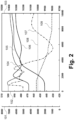
- FIG. 2 Aspects of a method not according to the invention are illustrated in the form of a diagram in which a time in seconds is indicated on the horizontal axis, a mass flow of hydrogen used in kg/h on a vertical axis 101, a temperature in °C on a second vertical axis 102, and a pressure in kPa on a third vertical axis 103.
- the corresponding values shown are obtained, for example, in the system 100 according to Figure 1 .
- 104 is a temperature downstream of the first catalyst bed 11
- 105 is a temperature downstream of the second catalyst bed 12
- 106 is a temperature downstream of the third catalyst bed 13.
- a pressure in the reactor 10 or a corresponding circuit is indicated by 107, a permissible minimum pressure by 108 and the mass flow of hydrogen by 109.
- Figure 2 This illustrates the relative trends of the bed temperatures of the three, for example, Figure 1 shown catalyst beds 11, 12, 13 for a selected load reduction process without using a start-up heater. As can be seen from the bed temperatures, it can be seen that the desired state of high outlet temperatures of the three beds is not reached within the period shown. As a result of the slow temperature change, the pressure 107 temporarily drops below the marked permissible minimum pressure 108.
- Figure 3 illustrates aspects of a method according to an embodiment of the invention, wherein the axes or courses 102 to 109 correspond to the already Figure 2 explained axes or curves 102 to 109.
- the first vertical axis 101a shown here also indicates a heating output of the start-up heater 17 in kW, the corresponding curve is indicated with 110.
- Figure 3 illustrates the same process of load reduction with the exact same ramp in the hydrogen supply as in Figure 2 .
- the load change is supported by the start-up heater 17. This enables a more favorable course of the bed temperatures and prevents the pressure 107 from falling below the specified minimum pressure 108.
- FIG. 4 illustrates a method according to an embodiment of the invention in a simplified block diagram, which is designated overall by 200. The corresponding method steps are now described again with reference to the Figure 1 and explains the elements presented there.
- the reactant mixture 1 is generally fed to the reactor 10 and reacted in the reactor 10 in an exothermic reaction with an activation energy.
- a first method step refers to a start-up operation 210 in which at least part of the activation energy is provided using the start-up heater 17.
- a production operation 220 can be carried out in a next step in which at least part of the activation energy is provided using thermal energy.
- a further step comprises a load reduction 222, wherein, as proposed here, a reduction in the amount of the respective process product, in this case ammonia, formed per unit of time in the reactor 10 is carried out until a second, lower load point is reached in a next step 223.
- a load reduction 222 as particularly with reference to Figure 3 shown, operation of the start-up heater 17 is carried out in order to prevent an excessive pressure drop.
Landscapes
- Chemical & Material Sciences (AREA)
- Organic Chemistry (AREA)
- Chemical Kinetics & Catalysis (AREA)
- Engineering & Computer Science (AREA)
- Automation & Control Theory (AREA)
- Analytical Chemistry (AREA)
- Inorganic Chemistry (AREA)
- Physical Or Chemical Processes And Apparatus (AREA)
Priority Applications (4)
| Application Number | Priority Date | Filing Date | Title |
|---|---|---|---|
| EP23020200.4A EP4454745A1 (fr) | 2023-04-28 | 2023-04-28 | Procédé et installation pour la fabrication d'un produit de procédé |
| AU2024260927A AU2024260927A1 (en) | 2023-04-28 | 2024-04-04 | Method and system for producing a process product |
| PCT/EP2024/025142 WO2024223081A1 (fr) | 2023-04-28 | 2024-04-04 | Méthode et système de production d'un produit de traitement |
| EP24718025.0A EP4701777A1 (fr) | 2023-04-28 | 2024-04-04 | Méthode et système de production d'un produit de traitement |
Applications Claiming Priority (1)
| Application Number | Priority Date | Filing Date | Title |
|---|---|---|---|
| EP23020200.4A EP4454745A1 (fr) | 2023-04-28 | 2023-04-28 | Procédé et installation pour la fabrication d'un produit de procédé |
Publications (1)
| Publication Number | Publication Date |
|---|---|
| EP4454745A1 true EP4454745A1 (fr) | 2024-10-30 |
Family
ID=86282532
Family Applications (2)
| Application Number | Title | Priority Date | Filing Date |
|---|---|---|---|
| EP23020200.4A Withdrawn EP4454745A1 (fr) | 2023-04-28 | 2023-04-28 | Procédé et installation pour la fabrication d'un produit de procédé |
| EP24718025.0A Pending EP4701777A1 (fr) | 2023-04-28 | 2024-04-04 | Méthode et système de production d'un produit de traitement |
Family Applications After (1)
| Application Number | Title | Priority Date | Filing Date |
|---|---|---|---|
| EP24718025.0A Pending EP4701777A1 (fr) | 2023-04-28 | 2024-04-04 | Méthode et système de production d'un produit de traitement |
Country Status (3)
| Country | Link |
|---|---|
| EP (2) | EP4454745A1 (fr) |
| AU (1) | AU2024260927A1 (fr) |
| WO (1) | WO2024223081A1 (fr) |
Citations (4)
| Publication number | Priority date | Publication date | Assignee | Title |
|---|---|---|---|---|
| US20110123404A1 (en) | 2008-04-30 | 2011-05-26 | Enrico Rizzi | Start-Up Heater for Ammonia Reactors |
| US20130108538A1 (en) * | 2011-11-02 | 2013-05-02 | Ammonia Casale Sa | Method for Load Regulation of an Ammonia Plant |
| US20160017800A1 (en) * | 2012-02-20 | 2016-01-21 | Thermogas Dynamics Limited | Methods and systems for energy conversion and generation |
| US20220119252A1 (en) * | 2019-01-15 | 2022-04-21 | Sabic Global Technologies B.V. | Use of intermittent energy in the production of chemicals |
-
2023
- 2023-04-28 EP EP23020200.4A patent/EP4454745A1/fr not_active Withdrawn
-
2024
- 2024-04-04 WO PCT/EP2024/025142 patent/WO2024223081A1/fr not_active Ceased
- 2024-04-04 AU AU2024260927A patent/AU2024260927A1/en active Pending
- 2024-04-04 EP EP24718025.0A patent/EP4701777A1/fr active Pending
Patent Citations (4)
| Publication number | Priority date | Publication date | Assignee | Title |
|---|---|---|---|---|
| US20110123404A1 (en) | 2008-04-30 | 2011-05-26 | Enrico Rizzi | Start-Up Heater for Ammonia Reactors |
| US20130108538A1 (en) * | 2011-11-02 | 2013-05-02 | Ammonia Casale Sa | Method for Load Regulation of an Ammonia Plant |
| US20160017800A1 (en) * | 2012-02-20 | 2016-01-21 | Thermogas Dynamics Limited | Methods and systems for energy conversion and generation |
| US20220119252A1 (en) * | 2019-01-15 | 2022-04-21 | Sabic Global Technologies B.V. | Use of intermittent energy in the production of chemicals |
Non-Patent Citations (2)
| Title |
|---|
| FAHR STEFFEN R. ET AL: "Design and Thermodynamic Analysis of a Large-Scale Power-to-Ammonia Reactor", 19 April 2023 (2023-04-19), pages 1 - 32, XP093075915, Retrieved from the Internet <URL:https://papers.ssrn.com/sol3/papers.cfm?abstract_id=4423036> [retrieved on 20230823], DOI: 10.2139/ssrn.4423036 * |
| RASMUSSEN, C.V.: "Converter start-up heater: electric or fired?", NITROGEN, vol. 194, 1991, pages 30 - 35, XP000237410 |
Also Published As
| Publication number | Publication date |
|---|---|
| AU2024260927A1 (en) | 2025-10-16 |
| EP4701777A1 (fr) | 2026-03-04 |
| WO2024223081A1 (fr) | 2024-10-31 |
Similar Documents
| Publication | Publication Date | Title |
|---|---|---|
| EP2751307B1 (fr) | Installation d'alimentation en énergie, destinée notamment au domaine des technologies domestiques | |
| EP2516358B1 (fr) | Procédé de production d'un gaz de produit riche en méthane, et système de réacteur utilisable à cet effet | |
| EP3426601A1 (fr) | Procédé et installation pour la production d'un produit gazeux sous des conditions de charge variables | |
| EP3383980B1 (fr) | Procédé et appareil pour la méthanisation des gaz | |
| DE102012103703A1 (de) | Solarthermie/Kombinationszyklus-Hybridkraftwerk und Solarreformer zur Verwendung darin | |
| WO1980001065A1 (fr) | Procede et dispositif pour la preparation d'hydrogene | |
| EP4466219A1 (fr) | Synthèse d'ammoniac et synthèse d'urée à empreinte carbone co2 réduite | |
| DE102011105934A1 (de) | Verfahren zum Betreiben eines Methanisierungsreaktors und Methanisierungsreaktor | |
| DE102021213799A1 (de) | Verfahren zum Betreiben einer Ammoniakanlage und Anlage zur Herstellung von Ammoniak | |
| WO2023094020A1 (fr) | Procédé et appareil de production d'ammoniac | |
| WO2020178045A1 (fr) | Procédé de préparation d'ammoniac | |
| EP0361612A2 (fr) | Méthode pour la production d'électricité | |
| EP4454745A1 (fr) | Procédé et installation pour la fabrication d'un produit de procédé | |
| EP4606769A1 (fr) | Procédé et installation de fabrication d'un produit de processus | |
| DE2807422A1 (de) | Verfahren und vorrichtung zum methanisieren von kohlenmonoxyd- und wasserstoffhaltigem einsatzgas | |
| BE1030483A1 (de) | Verfahren zum Betreiben einer Ammoniaksynthese mit schwankender Auslastung | |
| DE3881600T2 (de) | Chemische Verfahren mit exothermen Reaktionen. | |
| LU103015B1 (de) | Anlage und Verfahren zur Erzeugung von grünem Harnstoff | |
| LU103199B1 (de) | Synthese von grünem Ammoniak bei variablem Durchsatz | |
| WO2023057573A1 (fr) | Procédé et dispositif de production d'un produit gazeux contenant du méthane | |
| EP4700005A1 (fr) | Procédé et installation de production de méthanol | |
| BE1030201B1 (de) | Ammoniaksynthese und Harnstoffsynthese mit reduziertem CO2-Fußabdruck | |
| EP4685112A1 (fr) | Procédé et installation de production d'un produit d'ammoniac | |
| EP4368567B1 (fr) | Dispositif et procédé de conversion partielle d'ammoniac en un mélange gazeux contenant de l'hydrogène | |
| BE1030481B1 (de) | Ammoniakkonverter für schwankenden Teillastbetrieb |
Legal Events
| Date | Code | Title | Description |
|---|---|---|---|
| PUAI | Public reference made under article 153(3) epc to a published international application that has entered the european phase |
Free format text: ORIGINAL CODE: 0009012 |
|
| STAA | Information on the status of an ep patent application or granted ep patent |
Free format text: STATUS: THE APPLICATION HAS BEEN PUBLISHED |
|
| AK | Designated contracting states |
Kind code of ref document: A1 Designated state(s): AL AT BE BG CH CY CZ DE DK EE ES FI FR GB GR HR HU IE IS IT LI LT LU LV MC ME MK MT NL NO PL PT RO RS SE SI SK SM TR |
|
| STAA | Information on the status of an ep patent application or granted ep patent |
Free format text: STATUS: THE APPLICATION IS DEEMED TO BE WITHDRAWN |
|
| 18D | Application deemed to be withdrawn |
Effective date: 20250501 |