EP4455254A1 - Verfahren zur herstellung einer kerzenfüllung und verfahren zur herstellung und wiedergabe einer kerze mit füllung - Google Patents
Verfahren zur herstellung einer kerzenfüllung und verfahren zur herstellung und wiedergabe einer kerze mit füllung Download PDFInfo
- Publication number
- EP4455254A1 EP4455254A1 EP24172235.4A EP24172235A EP4455254A1 EP 4455254 A1 EP4455254 A1 EP 4455254A1 EP 24172235 A EP24172235 A EP 24172235A EP 4455254 A1 EP4455254 A1 EP 4455254A1
- Authority
- EP
- European Patent Office
- Prior art keywords
- filling
- candle
- mixture
- wick
- loose
- Prior art date
- Legal status (The legal status is an assumption and is not a legal conclusion. Google has not performed a legal analysis and makes no representation as to the accuracy of the status listed.)
- Withdrawn
Links
Images

Classifications
-
- C—CHEMISTRY; METALLURGY
- C11—ANIMAL OR VEGETABLE OILS, FATS, FATTY SUBSTANCES OR WAXES; FATTY ACIDS THEREFROM; DETERGENTS; CANDLES
- C11C—FATTY ACIDS FROM FATS, OILS OR WAXES; CANDLES; FATS, OILS OR FATTY ACIDS BY CHEMICAL MODIFICATION OF FATS, OILS, OR FATTY ACIDS OBTAINED THEREFROM
- C11C5/00—Candles
- C11C5/008—Candles characterised by their form; Composite candles, e.g. candles containing zones of different composition, inclusions, or the like
Definitions
- the subject of the invention is a method for making candle filling and a method for making and reproducing a candle with filling.
- the developed filling is used for the production of candles, grave lights, lanterns, and other illuminating decorative elements.
- the candles themselves are excellent for interior decoration and can serve as ambient lighting.
- the solution according to the invention will be suitable for the decorative industry, interior furnishings, grave lights, as well as in advertising and other industries where candles are used as a light source or decoration.
- the subject of the application also includes a candle with filling in a candle or grave light casing, as well as in other containers that can be used for this purpose (such as a favourite cup, vase, can, saucer, glass pane, or tile).
- Candle and grave light inserts vary in composition, size, quality, burning time, and price. The most important distinguishing features of these inserts are the materials used in their production, the type of wick, and the method of mounting the wick in the candle casing. The market predominantly offers oil-based and paraffin-based inserts for grave lights. The most commonly used materials for making decorative candles intended for home use include paraffin, stearin, paraffin gel, beeswax, palm wax, rapeseed wax, soy wax, other natural waxes, or their modifications or mixtures.
- oil-based inserts for grave lights contain a combination of oils, typically petroleum-derived (paraffins), with a butter-like consistency. They are made from a mixture of paraffin and oils, or waxes, which extends the burning process. In high temperatures, the oil-based insert literally melts owingto the addition of oil, usually palm oil. The oil-based insert also burns at a very low temperature.
- oils typically petroleum-derived (paraffins)
- paraffins oils
- waxes waxes
- Paraffin inserts are much more popular due to their low production costs. This factor promotes both, mass production and the diversity of these types of inserts. When lit, a paraffin insert exhibits a more liquid-like consistency and adapts well to various weather conditions.
- paraffin candle does not crumble during transport or storage, whereas an oil candle insert can melt at high temperatures, which adversely affects its storage,
- wicks there are various types of wicks and different known methods of securing them, such as wooden wicks or cotton wicks coated with an impregnant.
- Known wicks are encased in a stabilizing metal sheet, typically adhered to the bottom of the casing primarily to prevent the wick from shifting during the pouring of the liquefied filling. This allows for stabilizing the wick inside the vessel.
- microcrystalline paraffins have a high molecular weight and therefore high boiling points.
- residual mineral oil through vacuum distillation, primarily during the production of lubricating oil (residual waxes) and from sediments of mineral oil formed during its transportation, storage, and processing in a highly complex and expensive multi-stage process. This process typically involves deasphalting, solvent extraction, dewaxing, deoiling, and refinement steps.
- Deoiled microcrystalline paraffin contains impurities such as sulphur, nitrogen and oxygen compounds, which are odoriferous and range in colour from dark yellow to dark brown.
- impurities such as sulphur, nitrogen and oxygen compounds, which are odoriferous and range in colour from dark yellow to dark brown.
- the paraffin undergoes refining processes such as bleaching (for industrial use) or hydrotreatment (for use in food and pharmaceutical industries).
- Microcrystalline paraffins are primarily used as components in paraffin or wax mixtures. They are typically used in mixtures up to 5%. They increase the solidification and melting temperatures of these mixtures and improve their flexibility and oil-binding capacity. They are commonly used for producing waxes for impregnation, coating, and laminating in packaging and textile industries. Additionally, they are used in hot melt adhesives and sealants, pharmaceutical and cosmetic products, and chewing gum. Furthermore, they are applied in liquid compounds for casting, cables (especially in plastics), candles, rubber gum, and in the rubber tire industry. They are also used in protective, anti-slip, and anti-corrosive compositions.
- microcrystalline paraffin obtained through catalytic hydroisomerization at temperatures above 200°C from FT paraffin is characterized by having a carbon chain length ranging from 20 to 105. At 25°C, it exhibits at least a semi-solid consistency with a needle penetration of less than 100 x 10-1 mm, measured according to DIN 51579.
- the method for producing candles in containers involves filling rigid containers with a combustible mixture made from paraffin, animal fat, and additives such as dyes and fragrances, with a wick placed in the mixture.
- the method is characterized by gradually mixing melted animal fat (5-30% by weight of the product) with a deodorizing mixture based on plant aldehyde (0.05-1% by weight of the final product) until the undesired odour of the fat disappears.
- the refined fat is then mixed with paraffin (68-94.95% by weight of the final product) to achieve a homogeneous combustible mixture.
- the invention also covers a candle in a container.
- the subject of the invention is a mechanical method for securing the wick, which is tightened into a slot formed in the appropriately shaped bottom of the container.
- the wick is adhered by threading it through holes in the container's bottom, pouring adhesive into the recess of the bottom from the underside, and then cutting the wick.
- the subject of this invention is a flame-producing candle designed to produce a flame colour different from the natural yellow flame colour.
- the colours include green, red, blue, etc.
- the flame colourant in the candle can be a structural element of the candle, such as the wick, or an additional component made from elements or chemical compounds that colour the flame to the desired hue. It is possible to create a candle that produces a multi-coloured or changing flame.
- the candle is equipped with an appropriate colourant in the form of a wick saturated with the chosen element or chemical compound that colours the flame (preferably green, red, blue).
- the fuel is mixed with a solid, liquid, or gaseous colourant. Thermal excitation of the colourant atoms causes the flame to glow in the selected colour.
- Wax sold for candle or grave light production is often available in granular form (flakes and shavings). However, to create a proper insert, the wax needs to be melted and poured into a solid form that includes the embedded wick. During the use of the candle or grave light, the filling material melts again and evaporates into the surroundings. As the wick burns, a noticeable reduction in the amount of filling material can be observed.
- the aim of the developed solution is to create a filling that allows for easy refilling of candle, grave lights or lanterns casings, or of any other container, as well as to create a solution that enables easy shaping of candles, grave lights, lanterns, or any desired shape.
- the aim was also to develop a solution that is safe for humans, environmentally friendly, and allows for free arrangement of the indoor and outdoor space.
- the invention aims to develop a filling that is more economical.
- the essence of the developed method for producing candle filling made from a mixture of substances such as soy wax, beeswax, rapeseed wax, palm wax, paraffin, stearin, paraffin gel, or other natural waxes, their modifications, or mixtures, comprising 1% to 100% of the filling mass, involves heating this mixture to a temperature range of 35°C to 95°C until it liquefies.
- the heated, liquefied mixture is then gradually sprayed onto a metal surface cooled to a temperature at least 5°C lower than the liquefied mixture temperature.
- the liquefied mixture undergoes a phase change from liquid to solid.
- the resulting granules of varying sizes and shapes, constituting granular filling are then collected into collective packaging either gravitationally or mechanically, preferably using a feeder.
- fragrance substances or extracts are added to the liquefied mixture in an amount ranging from 0 ml to 270 ml or from 0 g to 200 g per 1000 ml of liquefied mixture.
- a dye or pigment is added to the liquefied mixture in an amount ranging from 0 to 270 ml or from 0 g to 200 g per 1000 ml of liquefied mixture.
- solid particulate substances such as sand, small pebbles, glass particles, glitter, etc.
- sand, small pebbles, glass particles, glitter, etc. are added to the liquefied mixture in an amount ranging from 0.01% to 5% relative to the total mass of the liquefied mixture.
- the surface onto which the cooling mixture is typically sprayed is naturally cooled, either by atmospheric conditions or by an additional cooling system.
- the surface onto which the cooling mixture is sprayed is inclined at an angle of at least 5° to 30°.
- the essence of the method for making and reproducing a candle with filling made from a mixture of substances such as soy wax, beeswax, rapeseed wax, palm wax, paraffin, stearin, paraffin gel, or other natural waxes, or their modifications or mixtures, comprising 1% to 100% of the filling mass involves filling the casing with loose filling. Subsequently, at least one wick is vertically inserted into the loose filling, designed so that after burning or overheating, the wick along with adhered melted loose filling particles can be removed from the loose filling. These loose filling particles adhere to the wick due to the flame and temperature, or reattach to the wick. Then, more loose filling is added into the casing, into which essentially at least one wick is inserted vertically.
- the loose filling is poured onto a casing that is flat or essentially flat, or essentially concave, or is an element with an outer edge slightly higher.
- the wick is saturated or coated with a substance that emits a coloured flame.
- the advantage of the solution according to the invention is the fact that when the wick burns, only a small amount of the surrounding loose filler, which is located directly around the wick, melts.
- the filling obtained by the method according to the invention is therefore calorific and efficient.
- the significant majority of the loose filling can be reused multiple times as a filling for a candle that can be easily reproduced (by replenishing with new loose filling to the initial volume).
- Loose filling that is further away from the wick does not absorb temperature because there is air between the granules, acting as an insulator. This characteristic prevents the loose filling, which is away from the wick, from heating up and isolates the flame temperature, thereby preventing the candle casing from heating up. Consequently, there is no need to place the candle on temperature-resistant surfaces.
- the solution obtained by the method according to the invention reduces the risk of burns when transporting candles, grave lights or lanterns.
- Another advantage of the solution according to the invention is that a significant part of the candle does not degrade during burning.
- Both the candle casing, the wick, and the loose filling can be used multiple times, making the proposed solution cheaper and more environmentally friendly (it does not contribute to the production of waste, such as disposable candle casings or grave lights).
- the wick can be shortened or turned over, while the candle casing (made of glass or synthetic material, for instance) can be refilled with loose filling.
- the loose filling itself due to its nature, can be used in various types of casings, adapting to their shape, similarly to how liquids conform to container shapes.
- the presented solution obtained by the method according to the invention does not require a container to make a candle, grave light, or lantern insert.
- Loose filling can also be placed on a flat surface, such as glass, a plate, or a base, allowing for the arrangement of a cone-shaped loose substance without the risk of it spilling or damaging the surface (as long as the flat surface on which the cone is placed remains in a horizontal position).
- a flat surface such as glass, a plate, or a base
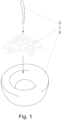
- the subject of the invention is a method for producing candle filling, specifically a loose filling 1 made from a mixture of substances such as soy wax, beeswax, rapeseed wax, palm wax, paraffin, stearin, paraffin gel, or other natural waxes, or their modifications or mixtures, which constitute from 1% to 100% of the mass of the loose filling 1.
- a loose filling 1 made from a mixture of substances such as soy wax, beeswax, rapeseed wax, palm wax, paraffin, stearin, paraffin gel, or other natural waxes, or their modifications or mixtures, which constitute from 1% to 100% of the mass of the loose filling 1.
- the mixture is heated to a temperature ranging from 35°C to 95°C to liquefy it.
- fragrant substances or extracts, or a dye or pigment are added to the liquefied mixture to obtain the desired colour, which is added in any proportion to obtain the planned aesthetic effect.
- Both the dye or the pigment are added in quantities corresponding to 0 to 270 ml or 0 to 200 g per 1000 ml (1 litre) of the liquefied mixture.
- the fragrant extracts are added later, at a strictly defined temperature, for example, between 30°C and 80°C (depending on the type of chosen fragrance).
- the extracts are added in quantities corresponding to 0 to 270 ml or 0 to 200 g per 1000 ml (1 litre) of the liquefied mixture.
- solid powdered substances such as sand, small pebbles, glass particles, or glitter are also added to the liquefied mixture in amounts from 0.01% to 5% of the total mass of the resulting mixture. These additions impart different physical and chemical properties to the obtained mixture.
- the heated, liquefied mixture (e.g., the heated wax mixture) is gradually sprayed onto a surface that is at least 5°C cooler than the liquefied mixture as a result of which (due to the temperature difference) the state of the liquefied mixture changes and returns from the liquid state to the solid state, which results in the formation of granules of various sizes and shapes constituting a loose filling 1.
- the selection of the temperature of the heated mixture and the temperature of the surface onto which the heated mixture is sprayed depends on the types of waxes used, their melting points, and their solidification points.
- the resulting granules of loose filling 1 then fall, for example, onto a conveyor, from where they are further transported (either by gravity or mechanically) to collective containers for packaging.
- the surface that is at least 5°C cooler than the liquefied mixture is made of metal and is cooled either naturally (by atmospheric factors) or with an additional cooling system.
- This surface is inclined at an angle of at least 5° to 30°, which allows easier, automatic (only under the influence of gravity forces) sliding of the loose filling 1 into a collective packaging enabling storage and further packaging of the loose filling 1.
- the subject of this application also includes a method for making and reproducing a candle with loose filling 1 (obtained by the method described above).
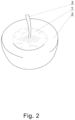
- the loose filling 1 being a mixture of base ingredients such as soy wax, beeswax, rapeseed wax, palm wax, paraffin, stearin, paraffin gel, or other natural waxes, or their modifications or mixtures, preferably also containing fragrant substances or extracts, dyes or pigments, or solid powdered substances such as sand, small pebbles, glass particles, or glitter, is poured into the casing 2 of a candle.
- the casing 2 can be transparent, made of any material, in any colour, and can have any shape.
- the casing 2 can also have decorative elements in the form of grooves, protrusions, or other elements embedded in its surface.
- the casing 2 of the candle can have the shape of any container with side walls, but it can also be a flat surface or an element with only a slightly raised outer edge.
- a wick 3 is vertically inserted into the loose filling 1.
- the wick 3 is not permanently attached to the casing 2 or embedded in the loose filling 1.
- the wick 3 can be woollen, cotton, or wooden.
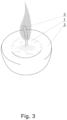
- the wick 3 can be saturated or coated with a substance that, during burning, allows for a different flame colour, such as green or purple.
- the casing 2 is not necessary for the proper functioning of the candle, grave light, or lantern, and the loose filling 1 along with wick 3 can serve as a light source.
- wicks 3 can be inserted into a casing 2 with a large radius.
- the wick 3 burns out or becomes charred, it is removed from the loose filling 1 along with a small amount of melted loose filling 1 particles, i.e. particles of the loose filling 1 which combine with each other under the influence of the flame and temperature, but also stuck to the wick 3. Subsequently, loose filling 1 is added to the casing 2 to replenish it, and a new wick 3 is inserted vertically (alternatively, the same wick 3, inverted, trimmed, or cleaned). The size of the surface area and dimensions of the melted loose filling depend on the thickness and other parameters of the wick 3 used.
- Loose filling 1 Example I Example II Example III Example IV Example V Soy wax - 50% 60% 90% - Beeswax 90% - - - - Rapeseed wax 10% 25% - 4% 45% Palm wax - 5% 28% - 45% Paraffin - - 2% - - Stearin - - - - 2% Paraffin gel - - - 3% - Fragrance substance/extract - - 5% 1,5% 3% Dye/pigment - - - 0,5% 5% Solid powdered substances, e.g., sand, small pebbles, glass particles, glitter - 20% (sand) 5% (glass particles) 1% (glitter) -
- Solid powdered substances e.g., sand, small pebbles, glass particles, glitter - 20% (sand) 5% (glass particles) 1% (glitter) -
Landscapes
- Chemical & Material Sciences (AREA)
- Composite Materials (AREA)
- General Chemical & Material Sciences (AREA)
- Life Sciences & Earth Sciences (AREA)
- Engineering & Computer Science (AREA)
- Chemical Kinetics & Catalysis (AREA)
- Oil, Petroleum & Natural Gas (AREA)
- Wood Science & Technology (AREA)
- Organic Chemistry (AREA)
- Fats And Perfumes (AREA)
Applications Claiming Priority (1)
| Application Number | Priority Date | Filing Date | Title |
|---|---|---|---|
| PL444572A PL444572A1 (pl) | 2023-04-24 | 2023-04-24 | Metoda otrzymywania wypełnienia do świec oraz metoda otrzymywania i odtwarzania świecy z wypełnieniem |
Publications (1)
| Publication Number | Publication Date |
|---|---|
| EP4455254A1 true EP4455254A1 (de) | 2024-10-30 |
Family
ID=91616729
Family Applications (1)
| Application Number | Title | Priority Date | Filing Date |
|---|---|---|---|
| EP24172235.4A Withdrawn EP4455254A1 (de) | 2023-04-24 | 2024-04-24 | Verfahren zur herstellung einer kerzenfüllung und verfahren zur herstellung und wiedergabe einer kerze mit füllung |
Country Status (2)
| Country | Link |
|---|---|
| EP (1) | EP4455254A1 (de) |
| PL (1) | PL444572A1 (de) |
Citations (4)
| Publication number | Priority date | Publication date | Assignee | Title |
|---|---|---|---|---|
| US4614625A (en) * | 1983-02-28 | 1986-09-30 | Lumi-Lite Candle Company, Inc. | Method of imparting color and/or fragrance to candle wax and candle formed therefrom |
| EP1034238B1 (de) * | 1997-11-25 | 2003-03-12 | S.C. Johnson & Son, Inc. | Formgepresste kerze |
| US8894409B1 (en) * | 2007-11-10 | 2014-11-25 | La Torre Innovation LLC | Colored flame candle |
| US20220259519A1 (en) * | 2021-02-16 | 2022-08-18 | Heidi STOJANOVIC | Ecologically Friendly Candle Kit |
Family Cites Families (2)
| Publication number | Priority date | Publication date | Assignee | Title |
|---|---|---|---|---|
| CN206768068U (zh) * | 2017-05-10 | 2017-12-19 | 山东亮卓新材料科技有限公司 | 一种用于制作颗粒蜡工艺中的新型防偏移钢带装置 |
| US20220228740A1 (en) * | 2021-01-19 | 2022-07-21 | Votivo, LLC | Sustainable candles and methods |
-
2023
- 2023-04-24 PL PL444572A patent/PL444572A1/pl unknown
-
2024
- 2024-04-24 EP EP24172235.4A patent/EP4455254A1/de not_active Withdrawn
Patent Citations (4)
| Publication number | Priority date | Publication date | Assignee | Title |
|---|---|---|---|---|
| US4614625A (en) * | 1983-02-28 | 1986-09-30 | Lumi-Lite Candle Company, Inc. | Method of imparting color and/or fragrance to candle wax and candle formed therefrom |
| EP1034238B1 (de) * | 1997-11-25 | 2003-03-12 | S.C. Johnson & Son, Inc. | Formgepresste kerze |
| US8894409B1 (en) * | 2007-11-10 | 2014-11-25 | La Torre Innovation LLC | Colored flame candle |
| US20220259519A1 (en) * | 2021-02-16 | 2022-08-18 | Heidi STOJANOVIC | Ecologically Friendly Candle Kit |
Also Published As
| Publication number | Publication date |
|---|---|
| PL444572A1 (pl) | 2024-10-28 |
Similar Documents
| Publication | Publication Date | Title |
|---|---|---|
| US6428753B2 (en) | Decorative candle and method of manufacturing the same | |
| US7217301B2 (en) | Triacylglycerol-based alternative to paraffin wax | |
| KR100377634B1 (ko) | 아이콘을 지니는 장식품 및 그 제조방법 | |
| CA2472636C (en) | Multilayered compressed candle and method for manufacture | |
| US6733548B2 (en) | Shimmering candle cream | |
| US10039851B2 (en) | Wax melt system | |
| US6019804A (en) | Compression-molded candle product | |
| KR20090043607A (ko) | 시각적으로 구별되는 영역들을 갖는 양초 | |
| AU2011296081B2 (en) | Decorative candle and method | |
| US7232550B1 (en) | Combination room freshener and oil candle and method for making the same | |
| US20030140551A1 (en) | Transparent candle | |
| US6638060B1 (en) | Everlasting candle | |
| Woodhead et al. | Lighting Devices | |
| JP2004502861A (ja) | ろうそく用組成物及びろうそく製品の製造方法 | |
| US9249375B2 (en) | Decorative candle and method | |
| RU2842393C1 (ru) | Состав для изготовления ароматических свечей | |
| US20040201123A1 (en) | Candle assembly and method of manufacture therefor | |
| FI12288U1 (fi) | Ulkotuli | |
| US20030226311A1 (en) | Creamy candle making compound | |
| US20060213785A1 (en) | Candle and match holder | |
| IL150372A (en) | Candle assembly and method of manufacturing it | |
| YUSUF | COMPARISON OF EFFECTS OF IMPORTED STEARIN (STEARICACID) AND LOCALLY MADE STEARIC ACID FROM COCONUT | |
| FR2790480A1 (fr) | Procede de confection de bougies et bougies ainsi obtenues |
Legal Events
| Date | Code | Title | Description |
|---|---|---|---|
| PUAI | Public reference made under article 153(3) epc to a published international application that has entered the european phase |
Free format text: ORIGINAL CODE: 0009012 |
|
| STAA | Information on the status of an ep patent application or granted ep patent |
Free format text: STATUS: THE APPLICATION HAS BEEN PUBLISHED |
|
| AK | Designated contracting states |
Kind code of ref document: A1 Designated state(s): AL AT BE BG CH CY CZ DE DK EE ES FI FR GB GR HR HU IE IS IT LI LT LU LV MC ME MK MT NL NO PL PT RO RS SE SI SK SM TR |
|
| STAA | Information on the status of an ep patent application or granted ep patent |
Free format text: STATUS: THE APPLICATION IS DEEMED TO BE WITHDRAWN |
|
| 18D | Application deemed to be withdrawn |
Effective date: 20250501 |