EP4455333A1 - Nichtorientiertes elektrostahlblech und verfahren zur herstellung davon - Google Patents
Nichtorientiertes elektrostahlblech und verfahren zur herstellung davon Download PDFInfo
- Publication number
- EP4455333A1 EP4455333A1 EP22911903.7A EP22911903A EP4455333A1 EP 4455333 A1 EP4455333 A1 EP 4455333A1 EP 22911903 A EP22911903 A EP 22911903A EP 4455333 A1 EP4455333 A1 EP 4455333A1
- Authority
- EP
- European Patent Office
- Prior art keywords
- steel sheet
- cold
- sheet
- oriented electrical
- rolled sheet
- Prior art date
- Legal status (The legal status is an assumption and is not a legal conclusion. Google has not performed a legal analysis and makes no representation as to the accuracy of the status listed.)
- Pending
Links
Images

Classifications
-
- C—CHEMISTRY; METALLURGY
- C21—METALLURGY OF IRON
- C21D—MODIFYING THE PHYSICAL STRUCTURE OF FERROUS METALS; GENERAL DEVICES FOR HEAT TREATMENT OF FERROUS OR NON-FERROUS METALS OR ALLOYS; MAKING METAL MALLEABLE, e.g. BY DECARBURISATION OR TEMPERING
- C21D9/00—Heat treatment, e.g. annealing, hardening, quenching or tempering, adapted for particular articles; Furnaces therefor
- C21D9/46—Heat treatment, e.g. annealing, hardening, quenching or tempering, adapted for particular articles; Furnaces therefor for sheet metals
-
- H—ELECTRICITY
- H01—ELECTRIC ELEMENTS
- H01F—MAGNETS; INDUCTANCES; TRANSFORMERS; SELECTION OF MATERIALS FOR THEIR MAGNETIC PROPERTIES
- H01F1/00—Magnets or magnetic bodies characterised by the magnetic materials therefor; Selection of materials for their magnetic properties
- H01F1/01—Magnets or magnetic bodies characterised by the magnetic materials therefor; Selection of materials for their magnetic properties of inorganic materials
- H01F1/03—Magnets or magnetic bodies characterised by the magnetic materials therefor; Selection of materials for their magnetic properties of inorganic materials characterised by their coercivity
- H01F1/12—Magnets or magnetic bodies characterised by the magnetic materials therefor; Selection of materials for their magnetic properties of inorganic materials characterised by their coercivity of soft-magnetic materials
- H01F1/14—Magnets or magnetic bodies characterised by the magnetic materials therefor; Selection of materials for their magnetic properties of inorganic materials characterised by their coercivity of soft-magnetic materials metals or alloys
- H01F1/147—Alloys characterised by their composition
-
- C—CHEMISTRY; METALLURGY
- C21—METALLURGY OF IRON
- C21D—MODIFYING THE PHYSICAL STRUCTURE OF FERROUS METALS; GENERAL DEVICES FOR HEAT TREATMENT OF FERROUS OR NON-FERROUS METALS OR ALLOYS; MAKING METAL MALLEABLE, e.g. BY DECARBURISATION OR TEMPERING
- C21D6/00—Heat treatment of ferrous alloys
- C21D6/002—Heat treatment of ferrous alloys containing Cr
-
- C—CHEMISTRY; METALLURGY
- C21—METALLURGY OF IRON
- C21D—MODIFYING THE PHYSICAL STRUCTURE OF FERROUS METALS; GENERAL DEVICES FOR HEAT TREATMENT OF FERROUS OR NON-FERROUS METALS OR ALLOYS; MAKING METAL MALLEABLE, e.g. BY DECARBURISATION OR TEMPERING
- C21D6/00—Heat treatment of ferrous alloys
- C21D6/005—Heat treatment of ferrous alloys containing Mn
-
- C—CHEMISTRY; METALLURGY
- C21—METALLURGY OF IRON
- C21D—MODIFYING THE PHYSICAL STRUCTURE OF FERROUS METALS; GENERAL DEVICES FOR HEAT TREATMENT OF FERROUS OR NON-FERROUS METALS OR ALLOYS; MAKING METAL MALLEABLE, e.g. BY DECARBURISATION OR TEMPERING
- C21D6/00—Heat treatment of ferrous alloys
- C21D6/008—Heat treatment of ferrous alloys containing Si
-
- C—CHEMISTRY; METALLURGY
- C21—METALLURGY OF IRON
- C21D—MODIFYING THE PHYSICAL STRUCTURE OF FERROUS METALS; GENERAL DEVICES FOR HEAT TREATMENT OF FERROUS OR NON-FERROUS METALS OR ALLOYS; MAKING METAL MALLEABLE, e.g. BY DECARBURISATION OR TEMPERING
- C21D8/00—Modifying the physical properties of ferrous metals or ferrous alloys by deformation combined with, or followed by, heat treatment
- C21D8/12—Modifying the physical properties of ferrous metals or ferrous alloys by deformation combined with, or followed by, heat treatment during manufacturing of articles with special electromagnetic properties
-
- C—CHEMISTRY; METALLURGY
- C21—METALLURGY OF IRON
- C21D—MODIFYING THE PHYSICAL STRUCTURE OF FERROUS METALS; GENERAL DEVICES FOR HEAT TREATMENT OF FERROUS OR NON-FERROUS METALS OR ALLOYS; MAKING METAL MALLEABLE, e.g. BY DECARBURISATION OR TEMPERING
- C21D8/00—Modifying the physical properties of ferrous metals or ferrous alloys by deformation combined with, or followed by, heat treatment
- C21D8/12—Modifying the physical properties of ferrous metals or ferrous alloys by deformation combined with, or followed by, heat treatment during manufacturing of articles with special electromagnetic properties
- C21D8/1216—Modifying the physical properties of ferrous metals or ferrous alloys by deformation combined with, or followed by, heat treatment during manufacturing of articles with special electromagnetic properties characterised by the working steps
- C21D8/1222—Hot rolling
-
- C—CHEMISTRY; METALLURGY
- C21—METALLURGY OF IRON
- C21D—MODIFYING THE PHYSICAL STRUCTURE OF FERROUS METALS; GENERAL DEVICES FOR HEAT TREATMENT OF FERROUS OR NON-FERROUS METALS OR ALLOYS; MAKING METAL MALLEABLE, e.g. BY DECARBURISATION OR TEMPERING
- C21D8/00—Modifying the physical properties of ferrous metals or ferrous alloys by deformation combined with, or followed by, heat treatment
- C21D8/12—Modifying the physical properties of ferrous metals or ferrous alloys by deformation combined with, or followed by, heat treatment during manufacturing of articles with special electromagnetic properties
- C21D8/1216—Modifying the physical properties of ferrous metals or ferrous alloys by deformation combined with, or followed by, heat treatment during manufacturing of articles with special electromagnetic properties characterised by the working steps
- C21D8/1233—Cold rolling
-
- C—CHEMISTRY; METALLURGY
- C21—METALLURGY OF IRON
- C21D—MODIFYING THE PHYSICAL STRUCTURE OF FERROUS METALS; GENERAL DEVICES FOR HEAT TREATMENT OF FERROUS OR NON-FERROUS METALS OR ALLOYS; MAKING METAL MALLEABLE, e.g. BY DECARBURISATION OR TEMPERING
- C21D8/00—Modifying the physical properties of ferrous metals or ferrous alloys by deformation combined with, or followed by, heat treatment
- C21D8/12—Modifying the physical properties of ferrous metals or ferrous alloys by deformation combined with, or followed by, heat treatment during manufacturing of articles with special electromagnetic properties
- C21D8/1244—Modifying the physical properties of ferrous metals or ferrous alloys by deformation combined with, or followed by, heat treatment during manufacturing of articles with special electromagnetic properties characterised by the heat treatment
- C21D8/1261—Modifying the physical properties of ferrous metals or ferrous alloys by deformation combined with, or followed by, heat treatment during manufacturing of articles with special electromagnetic properties characterised by the heat treatment following hot rolling
-
- C—CHEMISTRY; METALLURGY
- C21—METALLURGY OF IRON
- C21D—MODIFYING THE PHYSICAL STRUCTURE OF FERROUS METALS; GENERAL DEVICES FOR HEAT TREATMENT OF FERROUS OR NON-FERROUS METALS OR ALLOYS; MAKING METAL MALLEABLE, e.g. BY DECARBURISATION OR TEMPERING
- C21D8/00—Modifying the physical properties of ferrous metals or ferrous alloys by deformation combined with, or followed by, heat treatment
- C21D8/12—Modifying the physical properties of ferrous metals or ferrous alloys by deformation combined with, or followed by, heat treatment during manufacturing of articles with special electromagnetic properties
- C21D8/1244—Modifying the physical properties of ferrous metals or ferrous alloys by deformation combined with, or followed by, heat treatment during manufacturing of articles with special electromagnetic properties characterised by the heat treatment
- C21D8/1272—Final recrystallisation annealing
-
- C—CHEMISTRY; METALLURGY
- C21—METALLURGY OF IRON
- C21D—MODIFYING THE PHYSICAL STRUCTURE OF FERROUS METALS; GENERAL DEVICES FOR HEAT TREATMENT OF FERROUS OR NON-FERROUS METALS OR ALLOYS; MAKING METAL MALLEABLE, e.g. BY DECARBURISATION OR TEMPERING
- C21D8/00—Modifying the physical properties of ferrous metals or ferrous alloys by deformation combined with, or followed by, heat treatment
- C21D8/12—Modifying the physical properties of ferrous metals or ferrous alloys by deformation combined with, or followed by, heat treatment during manufacturing of articles with special electromagnetic properties
- C21D8/1277—Modifying the physical properties of ferrous metals or ferrous alloys by deformation combined with, or followed by, heat treatment during manufacturing of articles with special electromagnetic properties involving a particular surface treatment
- C21D8/1283—Application of a separating or insulating coating
-
- C—CHEMISTRY; METALLURGY
- C22—METALLURGY; FERROUS OR NON-FERROUS ALLOYS; TREATMENT OF ALLOYS OR NON-FERROUS METALS
- C22C—ALLOYS
- C22C38/00—Ferrous alloys, e.g. steel alloys
- C22C38/002—Ferrous alloys, e.g. steel alloys containing In, Mg, or other elements not provided for in one single group C22C38/001 - C22C38/60
-
- C—CHEMISTRY; METALLURGY
- C22—METALLURGY; FERROUS OR NON-FERROUS ALLOYS; TREATMENT OF ALLOYS OR NON-FERROUS METALS
- C22C—ALLOYS
- C22C38/00—Ferrous alloys, e.g. steel alloys
- C22C38/004—Very low carbon steels, i.e. having a carbon content of less than 0,01%
-
- C—CHEMISTRY; METALLURGY
- C22—METALLURGY; FERROUS OR NON-FERROUS ALLOYS; TREATMENT OF ALLOYS OR NON-FERROUS METALS
- C22C—ALLOYS
- C22C38/00—Ferrous alloys, e.g. steel alloys
- C22C38/008—Ferrous alloys, e.g. steel alloys containing tin
-
- C—CHEMISTRY; METALLURGY
- C22—METALLURGY; FERROUS OR NON-FERROUS ALLOYS; TREATMENT OF ALLOYS OR NON-FERROUS METALS
- C22C—ALLOYS
- C22C38/00—Ferrous alloys, e.g. steel alloys
- C22C38/02—Ferrous alloys, e.g. steel alloys containing silicon
-
- C—CHEMISTRY; METALLURGY
- C22—METALLURGY; FERROUS OR NON-FERROUS ALLOYS; TREATMENT OF ALLOYS OR NON-FERROUS METALS
- C22C—ALLOYS
- C22C38/00—Ferrous alloys, e.g. steel alloys
- C22C38/04—Ferrous alloys, e.g. steel alloys containing manganese
-
- C—CHEMISTRY; METALLURGY
- C22—METALLURGY; FERROUS OR NON-FERROUS ALLOYS; TREATMENT OF ALLOYS OR NON-FERROUS METALS
- C22C—ALLOYS
- C22C38/00—Ferrous alloys, e.g. steel alloys
- C22C38/06—Ferrous alloys, e.g. steel alloys containing aluminium
-
- C—CHEMISTRY; METALLURGY
- C22—METALLURGY; FERROUS OR NON-FERROUS ALLOYS; TREATMENT OF ALLOYS OR NON-FERROUS METALS
- C22C—ALLOYS
- C22C38/00—Ferrous alloys, e.g. steel alloys
- C22C38/12—Ferrous alloys, e.g. steel alloys containing tungsten, tantalum, molybdenum, vanadium, or niobium
-
- C—CHEMISTRY; METALLURGY
- C22—METALLURGY; FERROUS OR NON-FERROUS ALLOYS; TREATMENT OF ALLOYS OR NON-FERROUS METALS
- C22C—ALLOYS
- C22C38/00—Ferrous alloys, e.g. steel alloys
- C22C38/18—Ferrous alloys, e.g. steel alloys containing chromium
- C22C38/20—Ferrous alloys, e.g. steel alloys containing chromium with copper
-
- C—CHEMISTRY; METALLURGY
- C22—METALLURGY; FERROUS OR NON-FERROUS ALLOYS; TREATMENT OF ALLOYS OR NON-FERROUS METALS
- C22C—ALLOYS
- C22C38/00—Ferrous alloys, e.g. steel alloys
- C22C38/18—Ferrous alloys, e.g. steel alloys containing chromium
- C22C38/34—Ferrous alloys, e.g. steel alloys containing chromium with more than 1.5% by weight of silicon
-
- C—CHEMISTRY; METALLURGY
- C22—METALLURGY; FERROUS OR NON-FERROUS ALLOYS; TREATMENT OF ALLOYS OR NON-FERROUS METALS
- C22C—ALLOYS
- C22C38/00—Ferrous alloys, e.g. steel alloys
- C22C38/60—Ferrous alloys, e.g. steel alloys containing lead, selenium, tellurium, or antimony, or more than 0.04% by weight of sulfur
-
- H—ELECTRICITY
- H01—ELECTRIC ELEMENTS
- H01F—MAGNETS; INDUCTANCES; TRANSFORMERS; SELECTION OF MATERIALS FOR THEIR MAGNETIC PROPERTIES
- H01F1/00—Magnets or magnetic bodies characterised by the magnetic materials therefor; Selection of materials for their magnetic properties
- H01F1/01—Magnets or magnetic bodies characterised by the magnetic materials therefor; Selection of materials for their magnetic properties of inorganic materials
- H01F1/03—Magnets or magnetic bodies characterised by the magnetic materials therefor; Selection of materials for their magnetic properties of inorganic materials characterised by their coercivity
- H01F1/12—Magnets or magnetic bodies characterised by the magnetic materials therefor; Selection of materials for their magnetic properties of inorganic materials characterised by their coercivity of soft-magnetic materials
- H01F1/14—Magnets or magnetic bodies characterised by the magnetic materials therefor; Selection of materials for their magnetic properties of inorganic materials characterised by their coercivity of soft-magnetic materials metals or alloys
- H01F1/147—Alloys characterised by their composition
- H01F1/153—Amorphous metallic alloys, e.g. glassy metals
-
- H—ELECTRICITY
- H01—ELECTRIC ELEMENTS
- H01F—MAGNETS; INDUCTANCES; TRANSFORMERS; SELECTION OF MATERIALS FOR THEIR MAGNETIC PROPERTIES
- H01F1/00—Magnets or magnetic bodies characterised by the magnetic materials therefor; Selection of materials for their magnetic properties
- H01F1/01—Magnets or magnetic bodies characterised by the magnetic materials therefor; Selection of materials for their magnetic properties of inorganic materials
- H01F1/03—Magnets or magnetic bodies characterised by the magnetic materials therefor; Selection of materials for their magnetic properties of inorganic materials characterised by their coercivity
- H01F1/12—Magnets or magnetic bodies characterised by the magnetic materials therefor; Selection of materials for their magnetic properties of inorganic materials characterised by their coercivity of soft-magnetic materials
- H01F1/14—Magnets or magnetic bodies characterised by the magnetic materials therefor; Selection of materials for their magnetic properties of inorganic materials characterised by their coercivity of soft-magnetic materials metals or alloys
- H01F1/16—Magnets or magnetic bodies characterised by the magnetic materials therefor; Selection of materials for their magnetic properties of inorganic materials characterised by their coercivity of soft-magnetic materials metals or alloys in the form of sheets
-
- C—CHEMISTRY; METALLURGY
- C22—METALLURGY; FERROUS OR NON-FERROUS ALLOYS; TREATMENT OF ALLOYS OR NON-FERROUS METALS
- C22C—ALLOYS
- C22C2202/00—Physical properties
- C22C2202/02—Magnetic
Definitions
- An embodiment of the present invention relates to a non-oriented electrical steel sheet and a method for manufacturing the same. Specifically, an embodiment of the present invention relates to a non-oriented electrical steel sheet and a method for manufacturing the same capable of ensuring magnetic properties and extending the life of a mold in a high-alloy system by adjusting a dew point in an initial temperature raising treatment during cold-rolled sheet annealing depending on an alloy composition in a steel sheet and a surface roughness of a cold-rolled sheet, thereby forming an appropriate surface portion in the steel sheet.
- Efficient use of electrical energy is becoming a big issue for improving the global environment, such as energy saving, a reduction in fine dust generation, and a reduction in greenhouse gas. Since 50% or more of the entire electric energy that is currently being generated is consumed in electric motors, high efficiency of the electric motors is indispensable to achieve efficient use of electricity. Recently, along with rapid development of the field of eco-friendly vehicles (hybrid vehicle, plug-in hybrid vehicle, electric vehicle, and fuel cell vehicle), an interest in high-efficiency drive motor is rapidly increasing, and awareness and government regulations for high efficiency such as high-efficiency motors for home appliances and super-premium motors for heavy electric appliances have continued. Therefore, a demand for efficient use of electric energy is higher than ever.
- An embodiment of the present invention attempts to provide a non-oriented electrical steel sheet and a method for manufacturing the same. Specifically, an embodiment of the present invention attempts to provide a non-oriented electrical steel sheet and a method for manufacturing the same capable of ensuring magnetic properties and simultaneously extending the life of a mold in a high-alloy system by adjusting a dew point in an initial temperature raising treatment during cold-rolled sheet annealing depending on an alloy composition in a steel sheet and a surface roughness of a cold-rolled sheet, thereby forming an appropriate surface portion in the steel sheet.
- a non-oriented electrical steel sheet according to an embodiment of the present invention contains, by wt%: 3.1 to 3.8% of Si, 0.5 to 1.5% of Al, 0.3 to 1.5% of Mn, 0.01 to 0.15% of Cr, 0.003 to 0.08% of Sn, 0.003 to 0.06% of Sb, and a balance of Fe and inevitable impurities.
- the non-oriented electrical steel sheet according to an embodiment of the present invention may include a surface portion present from a surface of the steel sheet to 1/10 of a thickness of the steel sheet in a direction from the surface of the steel sheet toward an inside of the steel sheet, and a central portion, wherein when the non-oriented electrical steel sheet is punched, a length of a plastically deformed portion may be 100 ⁇ m or less.
- the plastically deformed portion refers to a length of a portion from a punched end portion where hardness of the surface portion exceeds 1.10 times that of the central portion.
- the non-oriented electrical steel sheet according to an embodiment of the present invention may satisfy Formula 1 below. 0.03 ⁇ Cr + Sn + Sb ⁇ 0.2 (in Formula 1, [Cr], [Sn], and [Sb] indicate contents (wt%) of Cr, Sn, and Sb, respectively.)
- the non-oriented electrical steel sheet according to an embodiment of the present invention may further contain@@@0.01 to 0.2 wt% of Cu.
- the non-oriented electrical steel sheet according to an embodiment of the present invention may further contain one or more of@@@0.08 wt% or less of P, 0.03 wt% or less of Mo, 0.0050 wt% or less of B, 0.0050 wt% or less of Ca, and 0.0050 wt% or less of Mg.
- the non-oriented electrical steel sheet according to an embodiment of the present invention may further contain 0.005 wt% or less of one or more of C, N, S, Ti, Nb, and V.
- a surface roughness of the steel sheet may be 0.15 to 0.35 ⁇ m.
- the hardness of the surface portion may be 1.05 to 1.10 times that of the central portion.
- a method for manufacturing a non-oriented electrical steel sheet according to an embodiment of the present invention includes: manufacturing a hot-rolled sheet by hot rolling a slab containing, by wt%: 3.1 to 3.8% of Si, 0.5 to 1.5% of Al, 0.3 to 1.5% of Mn, 0.01 to 0.15% of Cr, 0.003 to 0.08% of Sn, 0.003 to 0.06% of Sb, and a balance of Fe and inevitable impurities, and satisfying Formula 1 below; manufacturing a cold-rolled sheet by cold rolling the hot-rolled sheet; and subjecting the cold-rolled sheet to cold-rolled sheet annealing.
- the annealing the cold-rolled sheet includes a first temperature raising treatment of raising a temperature of the cold-rolled sheet from 200°C to 500°C, a second temperature raising treatment of raising the temperature of the cold-rolled sheet from higher than 500°C to lower than a soaking temperature, and a soaking treatment, and Formula 2 below is satisfied.
- [sheet thickness] indicates a sheet thickness ( ⁇ m) of the cold-rolled sheet after the manufacturing the cold-rolled sheet
- [sheet roughness] indicates a surface roughness ( ⁇ m) of the cold-rolled sheet after the manufacturing the cold-rolled sheet
- [DP] indicates a dew point (°C) in the first temperature raising treatment.
- the surface roughness of the cold-rolled sheet may be 0.15 to 0.35 ⁇ m.
- the dew point in the first temperature raising treatment may be 0 to 50°C.
- the dew point in the second temperature raising treatment and the soaking treatment may be -30°C to 10°C.
- the non-oriented electrical steel sheet according to an embodiment of the present invention can secure magnetic properties and simultaneously extend the life of a mold in a high-alloy system.
- the motor can be driven with a small current even during high-speed rotation, and thus the efficiency of the motor is excellent.
- the non-oriented electrical steel sheet according to an embodiment of the present invention contributes to the manufacture of motors for eco-friendly vehicles, high-efficiency motors for home appliances, and super-premium electric motors.
- first, second and third are used for describing, but are not limited to, various parts, components, regions, layers, and/or sections. These terms are used only to discriminate one part, component, region, layer or section from another part, component, region, layer or section. Therefore, a first part, component, region, layer or section described below may be referred to as a second part, component, region, layer or section without departing from the scope of the present invention.
- % means wt%, and 1 ppm is 0.0001 wt%.
- further including an additional element means that the additional element is included by replacing a balance of iron (Fe) by an amount of additional element added.
- an appropriate surface portion is formed in a steel sheet by adjusting a dew point in an initial temperature raising treatment during cold-rolled sheet annealing depending on an alloy composition in the steel sheet and a surface roughness of a cold-rolled sheet, resulting in ensuring magnetic properties and simultaneously extending the life of a mold in a high-alloy system.
- a non-oriented electrical steel sheet according to an embodiment of the present invention contains, by wt%: 3.1 to 3.8% of Si, 0.5 to 1.5% of Al, 0.3 to 1.5% of Mn, 0.01 to 0.15% of Cr, 0.003 to 0.08% of Sn, 0.003 to 0.06% of Sb, and a balance of Fe and inevitable impurities.
- Si serves to lower iron loss by increasing resistivity of a material and to increase strength. If Si is added too little, the effect of improving high-frequency iron loss and strength is insufficient. If Si is added excessively, the hardness of a material increases, so that the productivity and punching property become inferior. More specifically, Si may be included in an amount of 3.20 to 3.60 wt%.
- Aluminum (Al) serves to lower iron loss by increasing resistivity of a material and to improve strength. If Al is added too little, it is less effective in reducing high-frequency iron loss and improving strength, and fine nitrides may be formed to deteriorate the magnetic property. On the other hand, if Al is added excessively, it may cause problems in all processes such as steelmaking and continuous casting, resulting in a significant reduction in productivity. Therefore, Al may be added within the above-described range. More specifically, Al may be included in an amount of 0.50 to 1.30 wt%.
- Manganese (Mn) is an element that serves to improve iron loss by increasing resistivity of a material and to form sulfides. If Mn is added too little, MnS may precipitate finely and deteriorate the magnetic property. On the other hand, if Mn is added excessively, the magnetic flux density may be reduced by promoting formation of a ⁇ 111 ⁇ texture that is disadvantageous to the magnetic property. Therefore, Mn may be added within the above-described range. More specifically, Mn may be included in an amount of 0.5 to 1.4 wt%. More specifically, Mn may be included in an amount of 1.0 to 1.3 wt%.
- Resistivity 45 ⁇ cm or higher
- the resistivity is a value calculated from "13.25 + 11.3 ⁇ ([Si] + [Al] + [Mn]/2)".
- [Si], [Al], and [Mn] indicate contents (wt%) of Si, Al, and Mn, respectively.
- the segregation occurs properly only when Cr, Sn, and Sb are included within the above-described ranges. If the contents thereof are below the ranges, there is no surface segregation effect, and if they are added excessively, the brittleness of a material will be increased to cause problems. More specifically, Cr: 0.010 to 0.100 wt%, Sn: 0.005 to 0.050 wt%, and Sb: 0.005 to 0.030 wt% may be contained.
- the non-oriented electrical steel sheet according to an embodiment of the present invention may satisfy Formula 1. 0.030 ⁇ Cr + Sn + Sb ⁇ 0.200 (in Formula 1, [Cr], [Sn], and [Sb] indicate contents (wt%) of Cr, Sn, and Sb, respectively.)
- Formula 1 indicates a range in which the surface segregation occurs most efficiently. If the value is below the lower limit of Formula 1, the dew point should be further lowered for efficient segregation, which may reduce the productivity. If the value is above the upper limit of Formula 1, rolling may become impossible. More specifically, the value of Formula 1 may be 0.030 to 0.100.
- the non-oriented electrical steel sheet according to an embodiment of the present invention may further contain 0.01 to 0.2 wt% of Cu.
- Copper serves to form sulfides together with Mn. If Cu is added more or added too little, CuMnS may precipitate finely and deteriorate the magnetic property. If Cu is added excessively, high-temperature brittleness may occur and cracks may be formed during continuous casting or hot rolling. More specifically, Cu may be included in an amount of 0.01 to 0.10 wt%.
- the non-oriented electrical steel sheet according to an embodiment of the present invention may further contain one or more of 0.08 wt% or less of P, 0.03 wt% or less of Mo, 0.0050 wt% or less of B, 0.0050 wt% or less of V, 0.0050 wt% or less of Ca, 0.0050 wt% or less of Nb, and 0.0050 wt% or less of Mg.
- Phosphorus (P) is concentrated in the surface and serves to control the fraction of the internal oxidation layer. If the amount of P added is too small, it may be difficult to form a uniform internal oxidation layer. If the amount of P added is too large, the melting point of the Si-based oxide may vary and an internal oxidation layer may be rapidly formed. Therefore, the content of P may be controlled within the above-described range. More specifically, P may be included in an amount of 0.005 to 0.07 wt%.
- the non-oriented electrical steel sheet according to an embodiment of the present invention may further contain one or more of@@@0.03 wt% or less of Mo, 0.0050 wt% or less of B, 0.0050 wt% or less of Ca, and 0.0050 wt% or less of Mg.
- inevitable impurities such as carbon (C), sulfur (S), nitrogen (N), titanium (Ti), niobium (Nb), and vanadium (V) may be included.
- C, N, and Ti may be limited because they form carbonitrides to interfere with magnetic domain movement.
- S can form sulfides and deteriorate grain growth, so the upper limit may be limited.
- These elements may be included in an amount of 0.0040 wt% or less, respectively.
- N combines with Ti, Nb, and V to form nitride and serves to reduce grain growth.
- C reacts with N, Ti, Nb, V, and the like to form fine carbides and serves to interfere with grain growth and magnetic domain movement.
- one or more of C, S, N, Ti, Nb and V may be included in an amount of 0.005 wt% or less, respectively.
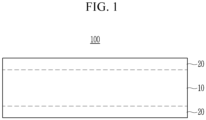
- FIG. 1 is schematic side cross-sectional view of a non-oriented electrical steel sheet according to an embodiment of the present invention.
- the non-oriented electrical steel sheet shown in FIG. 1 is only for illustrating the present invention, and the present invention is not limited thereto. Therefore, the structure of the non-oriented electrical steel sheet can be modified in various ways.
- a non-oriented electrical steel sheet 100 includes a surface portion 20 present from a surface of the steel sheet to 1/10 of a thickness of the steel sheet in a direction from the surface of the steel sheet toward an inside of the steel sheet and a central portion 10.
- a surface roughness of the steel sheet may be 0.15 to 0.35 ⁇ m. If the surface roughness of the steel sheet increases, residual oxygen increases on the surface of the steel sheet, making it difficult to control the dew point. If the surface roughness of the steel sheet is too low, the rolling productivity may decrease.
- the hardness of the surface portion 20 may be 1.05 to 1.10 times the hardness of the central portion 10.
- a large amount of alloy components such as Si, Al, and Mn are added, and these alloy components are concentrated in the surface portion 20 during the manufacturing process, resulting in an increase in the hardness of the surface portion 20 compared to that of the central portion 10.
- the hardness is Vickers hardness, and may be measured at a load of 10 g using a micro Vickers hardness tester. More specifically, the hardness of the surface portion 20 may be 1.06 to 1.09 times the hardness of the central portion 10.
- the hardness of the surface portion 20 may be 230 to 285, and the hardness of the central portion 10 may be 200 to 265. More specifically, the hardness of the surface portion 20 may be 245 to 275, and the hardness of the central portion 10 may be 220 to 255.
- the hardness may be constant on the entire surface of the steel sheet.
- the hardness of the punched end portion increases due to the punching.
- the hardness of the surface portion 20 increases significantly compared to the central portion 10, which causes a decrease in the life of a mold.
- the precipitation characteristics and oxidation characteristics of the surface portion 20 can be adjusted to suppress areas where the hardness of the surface portion 20 increases during punching. This minimizes the deterioration in iron loss due to punching.
- a length of a plastically deformed portion may be 100 ⁇ m or less.
- the plastically deformed portion refers to a length of a portion from the punched end portion where the hardness of the surface portion 20 exceeds 1.10 times that of the central portion 10.
- FIG. 2 shows a method of measuring the length of the plastically deformed portion.
- a punched end portion occurs as shown in the right end portion of FIG. 2 .
- sagging, shear surface, fractured surface and burr are formed.
- a length of the portion where the hardness of the surface portion 20 exceeds 1.10 times that of the central portion 10 is measured.
- the length of the plastically deformed portion More specifically, the length of the plastically deformed portion may be 90 ⁇ m or less. The lower limit is not particularly limited, but may be 50 ⁇ m or greater.
- the clearance is set to 8% of the thickness so that the length of the plastically deformed portion can be measured.
- the non-oriented electrical steel sheet according to an embodiment of the present also has excellent magnetic characteristics. Specifically, after punching, the iron loss (W 10/400 ) of the non-oriented electrical steel sheet may be 13.5 W/kg or less. Iron loss (W 10/400 ) is iron loss when a magnetic flux density of 1.0T is induced at a frequency of 400 HZ. More specifically, the iron loss (W 10/400 ) of the non-oriented electrical steel sheet may be 10.0 to 12.5 W/kg.
- a method for manufacturing a non-oriented electrical steel sheet includes the steps of: manufacturing a hot-rolled sheet by hot rolling a slab containing, by wt%: 3.1 to 3.8% of Si, 0.5 to 1.5% of Al, 0.3 to 1.5% of Mn, 0.01 to 0.15% of Cr, 0.003 to 0.08% of Sn, 0.003 to 0.06% of Sb, and a balance of Fe and inevitable impurities; manufacturing a cold-rolled sheet by cold rolling the hot-rolled sheet; and subjecting the cold-rolled sheet to cold-rolled sheet annealing.
- a slab is prepared.
- the reason for limiting the addition ratio of each composition in the slab is the same as the reason for limiting the composition of the non-oriented electrical steel sheet described above, so redundant descriptions will be omitted. Since the composition of the slab does not substantially change during manufacturing processes such as hot rolling, hot-rolled sheet annealing, cold rolling, and cold-rolled sheet annealing, which will be described below, the composition of the slab and the composition of the non-oriented electrical steel sheet are substantially the same.
- the slab may be heated before the step of manufacturing the hot-rolled sheet. Specifically, the slab is charged into a heating furnace and heated to 1100°C to 1250°C. When heated at a temperature exceeding 1250°C, the precipitates may be re-dissolved and finely precipitate after hot rolling.
- the heated slab is manufactured into a hot-rolled sheet by hot rolling to a thickness of 2 to 2.3 mm.
- the finishing rolling temperature may be 800°C to 1000°C.
- the step of subjecting the hot-rolled sheet to hot-rolled sheet annealing may be further included.
- the hot-rolled sheet annealing temperature may be 850°C to 1150°C. If the hot-rolled sheet annealing temperature is lower than 850°C, the structure does not grow or grows finely, so the effect of increasing a magnetic flux density is small. If the annealing temperature exceeds 1150°C, the magnetic properties rather deteriorate, and the shape of the plate may be deformed to deteriorate rolling workability. More specifically, the temperature range may be 950°C to 1125°C. More specifically, the annealing temperature of the hot-rolled sheet is 900°C to 1100°C. The hot-rolled sheet annealing is performed so as to increase the orientation advantageous to the magnetic property as needed, and may also be omitted.
- the hot-rolled sheet is pickled and cold rolled to a predetermined thickness.
- the hot-rolled plate may be cold rolled to a final thickness of 0.2 to 0.65 mm by applying a reduction ratio of 70 to 95% that may vary depending on the thickness of the hot-rolled sheet.
- the cold rolling may be performed once or may be performed two or more times with intermediate annealing therebetween.
- the surface roughness of the cold-rolled sheet may be 0.15 to 0.35 ⁇ m. If the surface roughness of the cold-rolled sheet increases, residual oxygen increases on the surface of the cold-rolled sheet, making it difficult to control the dew point. If the surface roughness of the cold-rolled sheet is too low, the rolling productivity may decrease.
- the cold-rolled sheet is subjected to cold-rolled sheet annealing.
- the annealing the cold-rolled sheet includes a first temperature raising treatment of raising a temperature of the cold-rolled sheet from 200°C to 500°C, a second temperature raising treatment of raising the temperature of the cold-rolled sheet from higher than 500°C to lower than a soaking temperature, and a soaking treatment, and Formula 2 below is satisfied.
- [sheet thickness] indicates a sheet thickness ( ⁇ m) of the cold-rolled sheet after the manufacturing the cold-rolled sheet
- [sheet roughness] indicates a surface roughness ( ⁇ m) of the cold-rolled sheet after the manufacturing the cold-rolled sheet
- [DP] indicates a dew point (°C) in the first temperature raising treatment.
- the dew point in the first temperature raising treatment does not satisfy Formula 2, that is, if the dew point is not sufficiently high, an amount of oxidation on the surface portion 10 becomes greater than an amount of segregation, making it difficult to properly adjust the hardness of the surface portion 10.
- the dew point in the first temperature raising treatment may be 0 to 30°C.
- the second temperature raising treatment raises the temperature of the cold-rolled sheet from higher than 500°C to lower than a soaking temperature.
- the dew point in the second temperature raising treatment may be -30°C to 10°C.
- the dew point may be adjusted to be lower than that in the first temperature raising treatment so as to prevent oxidation.
- the dew point in the second temperature raising treatment may be -30°C to 0°C. More specifically, the dew point in the second temperature raising treatment may be -30°C to -10°C. More specifically, the dew point in the second temperature raising treatment may be lower than that in the first temperature raising treatment by 10°C to 60°C.
- the soaking treatment is a process in which the temperature is maintained uniformly without variation after a soaking temperature is reached.
- the soaking treatment may be performed at a soaking temperature of 800°C to 1070°C. If the soaking temperature is too low, recrystallization cannot sufficiently occur, and if the soaking temperature is too high, the grain size may become too large, resulting in deterioration in high-frequency iron loss.
- the soaking treatment may be adjusted in the same manner as the dew point in the second temperature raising treatment.
- the soaking time may be 10 seconds to 5 minutes.
- a step of forming an insulating layer may be further included. Since the method of forming the insulating layer is widely known in the field of the non-oriented electrical steel sheet technology, detailed description is omitted.
- Slabs composed as shown in Table 1 below were prepared. The contents of C, S, N, Ti, Nb, V, and the like other than the components listed in Table 1 were all controlled to 0.003 wt% or less, and the balance was Fe.
- the slab was heated to 1150°C and hot-finish rolled at 850°C to produce a hot-rolled sheet with a thickness of 2.0 mm.
- the hot-rolled sheet was annealed at 1100°C for 4 minutes and then pickled. Then, cold rolling was performed to prepare the cold-rolled sheet with the sheet thickness and surface roughness as summarized in Table 2, and then cold-rolled sheet annealing was performed.
- the dew point in the first temperature raising treatment was adjusted as summarized in Table 2 below, and the dew points in the second temperature raising treatment and the soaking treatment were adjusted to about -10°C.
- the soaking temperature in the soaking treatment was set to 970°C and maintained for 3 minutes.
- the hardness of the surface portion was measured by grinding the surface to 1/20 of the total thickness of the steel sheet with soft sandpaper of #1000 or finer and then performing fine polishing and electropolishing to prevent surface stress from being induced due to polishing.
- the hardness of the central portion was measured by grinding the surface to 1/2 of the total thickness of the steel sheet with soft sandpaper of #1000 or finer and then performing fine polishing and electropolishing to prevent surface stress from being induced due to polishing.
- the plastically deformed portion was cut as above, and the tolerance was set to 8% of the thickness. While moving for each 5 ⁇ m from the punched end portion, the length of a portion where the ratio of the hardness of the surface portion and the hardness of the central portion exceeds 1.10 was measured.
Landscapes
- Chemical & Material Sciences (AREA)
- Engineering & Computer Science (AREA)
- Organic Chemistry (AREA)
- Materials Engineering (AREA)
- Mechanical Engineering (AREA)
- Metallurgy (AREA)
- Physics & Mathematics (AREA)
- Thermal Sciences (AREA)
- Crystallography & Structural Chemistry (AREA)
- Electromagnetism (AREA)
- Manufacturing & Machinery (AREA)
- Dispersion Chemistry (AREA)
- Power Engineering (AREA)
- Manufacturing Of Steel Electrode Plates (AREA)
- Soft Magnetic Materials (AREA)
Applications Claiming Priority (2)
| Application Number | Priority Date | Filing Date | Title |
|---|---|---|---|
| KR1020210184550A KR20230095257A (ko) | 2021-12-22 | 2021-12-22 | 무방향성 전기강판 및 그 제조방법 |
| PCT/KR2022/020907 WO2023121270A1 (ko) | 2021-12-22 | 2022-12-20 | 무방향성 전기강판 및 그 제조방법 |
Publications (2)
| Publication Number | Publication Date |
|---|---|
| EP4455333A1 true EP4455333A1 (de) | 2024-10-30 |
| EP4455333A4 EP4455333A4 (de) | 2025-04-23 |
Family
ID=86903019
Family Applications (1)
| Application Number | Title | Priority Date | Filing Date |
|---|---|---|---|
| EP22911903.7A Pending EP4455333A4 (de) | 2021-12-22 | 2022-12-20 | Nichtorientiertes elektrostahlblech und verfahren zur herstellung davon |
Country Status (7)
| Country | Link |
|---|---|
| US (1) | US20250109453A1 (de) |
| EP (1) | EP4455333A4 (de) |
| JP (1) | JP2025501608A (de) |
| KR (1) | KR20230095257A (de) |
| CN (1) | CN118647749A (de) |
| MX (1) | MX2024007758A (de) |
| WO (1) | WO2023121270A1 (de) |
Families Citing this family (2)
| Publication number | Priority date | Publication date | Assignee | Title |
|---|---|---|---|---|
| KR20250093778A (ko) * | 2023-12-15 | 2025-06-25 | 주식회사 포스코 | 무방향성 전기강판 및 그 제조방법 |
| KR20250093766A (ko) * | 2023-12-15 | 2025-06-25 | 주식회사 포스코 | 무방향성 전기강판 및 그 제조방법 |
Family Cites Families (13)
| Publication number | Priority date | Publication date | Assignee | Title |
|---|---|---|---|---|
| JP3852227B2 (ja) * | 1998-10-23 | 2006-11-29 | Jfeスチール株式会社 | 無方向性電磁鋼板およびその製造方法 |
| CN107002160A (zh) * | 2014-05-08 | 2017-08-01 | 材料开发中心股份公司 | 用于制备具有高冷轧压下度的晶粒非取向的电炉钢带材的方法 |
| JP5975076B2 (ja) * | 2014-08-27 | 2016-08-23 | Jfeスチール株式会社 | 無方向性電磁鋼板およびその製造方法 |
| KR101705235B1 (ko) * | 2015-12-11 | 2017-02-09 | 주식회사 포스코 | 무방향성 전기강판 및 그 제조방법 |
| KR102329385B1 (ko) * | 2017-05-12 | 2021-11-19 | 제이에프이 스틸 가부시키가이샤 | 방향성 전기 강판과 그 제조 방법 |
| KR102009393B1 (ko) * | 2017-12-26 | 2019-08-09 | 주식회사 포스코 | 무방향성 전기강판 및 그 제조방법 |
| KR102106409B1 (ko) * | 2018-07-18 | 2020-05-04 | 주식회사 포스코 | 무방향성 전기강판 및 그 제조방법 |
| KR102176351B1 (ko) * | 2018-11-30 | 2020-11-09 | 주식회사 포스코 | 무방향성 전기강판 및 그 제조방법 |
| KR102325005B1 (ko) * | 2019-12-20 | 2021-11-11 | 주식회사 포스코 | 무방향성 전기강판 및 그 제조방법 |
| CN114901850B (zh) * | 2020-02-20 | 2023-09-26 | 日本制铁株式会社 | 无取向电磁钢板用热轧钢板 |
| EP4353851A4 (de) * | 2021-07-05 | 2024-12-25 | JFE Steel Corporation | Nichtorientierte elektrostahlplatte und herstellungsverfahren dafür |
| US20250059618A1 (en) * | 2021-12-22 | 2025-02-20 | Posco Co., Ltd | Non-oriented electrical steel sheet, method for manufacturing same, and motor core comprising same |
| MX2024007788A (es) * | 2021-12-22 | 2024-09-02 | Posco Co Ltd | Chapa de acero eléctrico no orientada y método para fabricar la misma. |
-
2021
- 2021-12-22 KR KR1020210184550A patent/KR20230095257A/ko active Pending
-
2022
- 2022-12-20 WO PCT/KR2022/020907 patent/WO2023121270A1/ko not_active Ceased
- 2022-12-20 MX MX2024007758A patent/MX2024007758A/es unknown
- 2022-12-20 EP EP22911903.7A patent/EP4455333A4/de active Pending
- 2022-12-20 JP JP2024538232A patent/JP2025501608A/ja active Pending
- 2022-12-20 CN CN202280092048.2A patent/CN118647749A/zh active Pending
- 2022-12-20 US US18/723,234 patent/US20250109453A1/en active Pending
Also Published As
| Publication number | Publication date |
|---|---|
| EP4455333A4 (de) | 2025-04-23 |
| KR20230095257A (ko) | 2023-06-29 |
| JP2025501608A (ja) | 2025-01-22 |
| CN118647749A (zh) | 2024-09-13 |
| US20250109453A1 (en) | 2025-04-03 |
| MX2024007758A (es) | 2024-09-06 |
| WO2023121270A1 (ko) | 2023-06-29 |
Similar Documents
| Publication | Publication Date | Title |
|---|---|---|
| CN113166869B (zh) | 无方向性电磁钢板及其制造方法 | |
| JP7299893B2 (ja) | 無方向性電磁鋼板およびその製造方法 | |
| EP3556878B1 (de) | Nichtausgerichtetes elektrostahlblech und herstellungsverfahren eines nichtausgerichteten elektrostahlbleches | |
| TWI777498B (zh) | 無方向性電磁鋼板及其製造方法 | |
| EP4265745A1 (de) | Nichtorientiertes elektrostahlblech und verfahren zur herstellung davon | |
| EP3733907A1 (de) | Nichtorientiertes elektrostahlblech und verfahren zur herstellung davon | |
| EP3733916A1 (de) | Nichtorientiertes elektrostahlblech und verfahren zur herstellung davon | |
| EP4265746A1 (de) | Nichtorientiertes elektrostahlblech und verfahren zur herstellung davon | |
| US20250109453A1 (en) | Non-oriented electrical steel sheet and method for manufacturing same | |
| KR20240075044A (ko) | 무방향성 전기강판 및 그 제조방법 | |
| EP3825434A1 (de) | Nichtorientiertes elektrisches stahlblech und verfahren zur herstellung davon | |
| EP4640871A1 (de) | Nichtorientiertes elektrostahlblech und verfahren zur herstellung davon | |
| EP4640879A1 (de) | Nichtorientiertes elektrostahlblech und verfahren zur herstellung davon | |
| TW202202639A (zh) | 無方向性電磁鋼板及其製造方法 | |
| EP4317477A1 (de) | Nichtorientiertes elektromagnetisches stahlblech und verfahren zur herstellung davon | |
| CN113166878A (zh) | 无取向电工钢板及其制备方法 | |
| CN112930408A (zh) | 无取向性电磁钢板的制造方法 | |
| EP4640872A1 (de) | Nichtorientiertes elektrostahlblech, verfahren zur herstellung davon und motorkern damit | |
| EP3889290A2 (de) | Nichtorientiertes elektrostahlblech und verfahren zur herstellung davon | |
| EP4640867A1 (de) | Nichtorientiertes elektrostahlblech und verfahren zur herstellung davon | |
| KR20250093641A (ko) | 무방향성 전기강판 및 그 제조방법 | |
| KR20250093740A (ko) | 무방향성 전기강판 및 그 제조방법 | |
| KR20250093777A (ko) | 무방향성 전기강판 및 그 제조방법 | |
| KR20250093762A (ko) | 무방향성 전기강판 및 그 제조방법 | |
| KR20250092493A (ko) | 무방향성 전기강판 및 그 제조방법 |
Legal Events
| Date | Code | Title | Description |
|---|---|---|---|
| STAA | Information on the status of an ep patent application or granted ep patent |
Free format text: STATUS: THE INTERNATIONAL PUBLICATION HAS BEEN MADE |
|
| PUAI | Public reference made under article 153(3) epc to a published international application that has entered the european phase |
Free format text: ORIGINAL CODE: 0009012 |
|
| STAA | Information on the status of an ep patent application or granted ep patent |
Free format text: STATUS: REQUEST FOR EXAMINATION WAS MADE |
|
| 17P | Request for examination filed |
Effective date: 20240718 |
|
| AK | Designated contracting states |
Kind code of ref document: A1 Designated state(s): AL AT BE BG CH CY CZ DE DK EE ES FI FR GB GR HR HU IE IS IT LI LT LU LV MC ME MK MT NL NO PL PT RO RS SE SI SK SM TR |
|
| DAV | Request for validation of the european patent (deleted) | ||
| DAX | Request for extension of the european patent (deleted) | ||
| A4 | Supplementary search report drawn up and despatched |
Effective date: 20250325 |
|
| RIC1 | Information provided on ipc code assigned before grant |
Ipc: H01F 1/16 20060101ALI20250319BHEP Ipc: C22C 38/60 20060101ALI20250319BHEP Ipc: C22C 38/34 20060101ALI20250319BHEP Ipc: C22C 38/20 20060101ALI20250319BHEP Ipc: C22C 38/00 20060101ALI20250319BHEP Ipc: C21D 9/46 20060101ALI20250319BHEP Ipc: C21D 6/00 20060101ALI20250319BHEP Ipc: H01F 1/147 20060101ALI20250319BHEP Ipc: C21D 8/12 20060101ALI20250319BHEP Ipc: C22C 38/12 20060101ALI20250319BHEP Ipc: C22C 38/04 20060101ALI20250319BHEP Ipc: C22C 38/06 20060101ALI20250319BHEP Ipc: C22C 38/02 20060101AFI20250319BHEP |