EP4456068A1 - Interaktionsbewusste videosynopse - Google Patents
Interaktionsbewusste videosynopse Download PDFInfo
- Publication number
- EP4456068A1 EP4456068A1 EP24172301.4A EP24172301A EP4456068A1 EP 4456068 A1 EP4456068 A1 EP 4456068A1 EP 24172301 A EP24172301 A EP 24172301A EP 4456068 A1 EP4456068 A1 EP 4456068A1
- Authority
- EP
- European Patent Office
- Prior art keywords
- objects
- source
- video
- synopsis
- interaction
- Prior art date
- Legal status (The legal status is an assumption and is not a legal conclusion. Google has not performed a legal analysis and makes no representation as to the accuracy of the status listed.)
- Pending
Links
Images
Classifications
-
- G—PHYSICS
- G11—INFORMATION STORAGE
- G11B—INFORMATION STORAGE BASED ON RELATIVE MOVEMENT BETWEEN RECORD CARRIER AND TRANSDUCER
- G11B27/00—Editing; Indexing; Addressing; Timing or synchronising; Monitoring; Measuring tape travel
- G11B27/02—Editing, e.g. varying the order of information signals recorded on, or reproduced from, record carriers
- G11B27/031—Electronic editing of digitised analogue information signals, e.g. audio or video signals
-
- H—ELECTRICITY
- H04—ELECTRIC COMMUNICATION TECHNIQUE
- H04N—PICTORIAL COMMUNICATION, e.g. TELEVISION
- H04N21/00—Selective content distribution, e.g. interactive television or video on demand [VOD]
- H04N21/80—Generation or processing of content or additional data by content creator independently of the distribution process; Content per se
- H04N21/85—Assembly of content; Generation of multimedia applications
- H04N21/854—Content authoring
- H04N21/8549—Creating video summaries, e.g. movie trailer
-
- G—PHYSICS
- G06—COMPUTING OR CALCULATING; COUNTING
- G06N—COMPUTING ARRANGEMENTS BASED ON SPECIFIC COMPUTATIONAL MODELS
- G06N20/00—Machine learning
-
- G—PHYSICS
- G06—COMPUTING OR CALCULATING; COUNTING
- G06N—COMPUTING ARRANGEMENTS BASED ON SPECIFIC COMPUTATIONAL MODELS
- G06N3/00—Computing arrangements based on biological models
- G06N3/02—Neural networks
- G06N3/04—Architecture, e.g. interconnection topology
- G06N3/045—Combinations of networks
-
- G—PHYSICS
- G06—COMPUTING OR CALCULATING; COUNTING
- G06T—IMAGE DATA PROCESSING OR GENERATION, IN GENERAL
- G06T7/00—Image analysis
- G06T7/10—Segmentation; Edge detection
- G06T7/194—Segmentation; Edge detection involving foreground-background segmentation
-
- G—PHYSICS
- G06—COMPUTING OR CALCULATING; COUNTING
- G06V—IMAGE OR VIDEO RECOGNITION OR UNDERSTANDING
- G06V20/00—Scenes; Scene-specific elements
- G06V20/40—Scenes; Scene-specific elements in video content
- G06V20/41—Higher-level, semantic clustering, classification or understanding of video scenes, e.g. detection, labelling or Markovian modelling of sport events or news items
-
- G—PHYSICS
- G06—COMPUTING OR CALCULATING; COUNTING
- G06V—IMAGE OR VIDEO RECOGNITION OR UNDERSTANDING
- G06V20/00—Scenes; Scene-specific elements
- G06V20/40—Scenes; Scene-specific elements in video content
- G06V20/46—Extracting features or characteristics from the video content, e.g. video fingerprints, representative shots or key frames
-
- G—PHYSICS
- G06—COMPUTING OR CALCULATING; COUNTING
- G06V—IMAGE OR VIDEO RECOGNITION OR UNDERSTANDING
- G06V20/00—Scenes; Scene-specific elements
- G06V20/40—Scenes; Scene-specific elements in video content
- G06V20/46—Extracting features or characteristics from the video content, e.g. video fingerprints, representative shots or key frames
- G06V20/47—Detecting features for summarising video content
-
- G—PHYSICS
- G11—INFORMATION STORAGE
- G11B—INFORMATION STORAGE BASED ON RELATIVE MOVEMENT BETWEEN RECORD CARRIER AND TRANSDUCER
- G11B27/00—Editing; Indexing; Addressing; Timing or synchronising; Monitoring; Measuring tape travel
- G11B27/10—Indexing; Addressing; Timing or synchronising; Measuring tape travel
- G11B27/19—Indexing; Addressing; Timing or synchronising; Measuring tape travel by using information detectable on the record carrier
- G11B27/28—Indexing; Addressing; Timing or synchronising; Measuring tape travel by using information detectable on the record carrier by using information signals recorded by the same method as the main recording
-
- G—PHYSICS
- G06—COMPUTING OR CALCULATING; COUNTING
- G06T—IMAGE DATA PROCESSING OR GENERATION, IN GENERAL
- G06T2207/00—Indexing scheme for image analysis or image enhancement
- G06T2207/20—Special algorithmic details
- G06T2207/20081—Training; Learning
-
- G—PHYSICS
- G06—COMPUTING OR CALCULATING; COUNTING
- G06V—IMAGE OR VIDEO RECOGNITION OR UNDERSTANDING
- G06V10/00—Arrangements for image or video recognition or understanding
- G06V10/70—Arrangements for image or video recognition or understanding using pattern recognition or machine learning
- G06V10/82—Arrangements for image or video recognition or understanding using pattern recognition or machine learning using neural networks
-
- G—PHYSICS
- G06—COMPUTING OR CALCULATING; COUNTING
- G06V—IMAGE OR VIDEO RECOGNITION OR UNDERSTANDING
- G06V20/00—Scenes; Scene-specific elements
- G06V20/40—Scenes; Scene-specific elements in video content
- G06V20/44—Event detection
Definitions
- the present invention relates generally to the field of video processing and, more particularly, to producing a variant of video synopsis.
- video synopsis as used herein is the name given to the technology which aims to minimize hours of video footage to a few minutes.
- the technology does so by tracking and analyzing moving objects (called events) and converting the incoming video streams into a database of events and activities.
- the information is then presented as a time-compressed video with links, for each event, to the actual video stream.
- the process begins by detecting and tracking objects of interest. Each object is represented as a "tube” in the "space-time" of the video stream (a sequence of video frames). Objects are detected and stored in a database in near-real time. Following a user request to summarize a time period, all objects from the desired time are extracted from the database and are shifted in time to create a much shorter summary video containing maximum activity (tube-packing).
- VCA video content analysis or video content analytics
- VA video analysis or video analytics
- Video Synopsis provides an efficient video summary. This is done by segmenting the moving objects in the video, and changing the appearance time of each object such that the duration of the newly created synopsis video is reduced. Some information can be lost in this process, such as the interactions between objects. Interactions may be lost as in video synopsis each object is treated separately. Given two interacting objects in the original video - each will likely be assigned a new appearance time in the synopsis video, and the interaction will not be visible.
- some of the interactions visible in the synopsis video may be generated by objects from different original times that are just shifted to play simultaneously, creating new interactions that were not included in the original video.
- the present invention addresses the aforementioned drawbacks of the so-called classic video synopsis.
- the inventors offer herein a way to render an interaction-aware synopsis. It is similar to the original synopsis with two important changes: First it has the option to keep the original relative time between interacting objects also in the synopsis video. Second, it has the option to visually distinguish in the generated synopsis video between real interactions which occurred in the original video to interactions that were created as a side effect of the video synopsis process.
- a method of generating an interaction-aware video synopsis may include the following stages: obtaining, using a computer processor, a source video containing a plurality of source objects; extracting, using the computer processor, the source objects from the source video; detecting, using the computer processor, at least one object-interaction between at least two source objects; generating, using the computer processor, synopsis objects by sampling respective source objects; and generating, using the computer processor, a synopsis video having an overall play time shorter than the overall play time of the source video, by determining a play time for each one of the synopsis objects, wherein at least two synopsis objects which are played at least partially simultaneously in the synopsis video, are generated from source objects that are captured at different times in the source video, and wherein a relative display time in the synopsis video of the at least two synopsis objects created from the at least two source objects, detected as having an object-interaction therebetween, is the same as the relative
- a system for generating an interaction-aware video synopsis comprising: a server comprising: a processing device; a memory device; and an interface for communicating with a video camera, wherein the memory device comprising a set of instructions that, when executed, cause at the processing device to: obtain from the video camera a source video containing a plurality of source objects; extract the source objects from the source video; detect at least one object-interaction between at least two source objects; generate synopsis objects by sampling respective source objects; and generate a synopsis video having an overall play time shorter than the overall play time of the source video, by determining a play time for each one of the synopsis objects, wherein at least two synopsis objects which are played at least partially simultaneously in the synopsis video, are generated from source objects that are captured at different times in the source video, and wherein a relative display time in the synopsis video of the at least two synopsis objects created from the at least two source objects, detected as having an object
- the process of producing an interaction aware video synopsis may involve the following stages:
- the task of rendering an interaction-aware video synopsis can use a preliminary stage in which objects are detected and tracked in the original video.
- the scene background model may be learned and moving objects re-extracted by their difference from the background model. Such background subtraction methods are applicable as long as the recording camera is static.
- object detection methods such as Faster-RCNN or SSD
- pose detection methods such as PifPaf, or CPN
- PifPaf, or CPN can be applied to extract pose information from objects.
- Such methods can work also when the camera is moving, as in the case of handheld cameras, vehicle mounted cameras, or wearable cameras.
- Pixel level object masks can be computed using instance segmentation methods such as Mask-RCNN. These methods are applicable also for video frames recorded by a moving camera.
- Multiple object tracking methods exist, associating objects between multiple frames of a video, such as reviewed in. These methods can connect the detections of each individual object in different video frames, based on appearance and motion similarity.
- Each trajectory can be composed from detections of an object in a sequence of frames.
- the object can be designated by some point on the object (e.g. UTS center), or by a bounding box of the object, or by a pixel map forming a mask having the shape of the object in this frame.
- Detecting object interactions is a broad term used for many different computer vision tasks. Possible, non-inclusive, examples of interaction are described below:
- one possibility to achieve this goal is to represent multiple interacting object tubes as if they are a single combined tube. In this way, whenever a new appearance time is determined for the combined tube, all interacting tubes in it will maintain their original relative time.
- another way to achieve this effect is to mark interacting objects and constrain the video synopsis process to keep the relative time of iterating objects also in the generated video synopsis.
- a tube is a collection of regions in frames. Initially, the frames are consecutive, and every object may appear in different tubes: assume a person is walking behind a tree - we have a tube until the person disappears, and another one after he reappears. Once we determine that the tube before the tree and the tube after the tree are the same person, we combine them into a single tube. This means that when we move the object by two seconds for the synopsis, all regions in the tube move the same. It happened to us that when people walked behind a fence we would detect the legs as one tube and the torso as another, and only later connected them to a single tube.
- a video synopsis is generated by sorting objects in respect to some selected features. Assume an object is pre-selected, a possible feature can include the interaction with the pre-selected object. So, the generated synopsis will show objects interacting with the pre-selected object. However, the synopsis video will most likely fail to show the interactions themselves, as each object is given an independent play time in the generated video synopsis, while showing the interactions requires keeping the original relative time between the obj ects.
- sample selections can be, for example:
- interactions can be specified by identity of the objects involved, or by the exact type of activity. For example:
- a video synopsis is generated from an input of multiple cameras.
- a common background image is rendered, and a synopsis of objects from different cameras is rendered on that background image.
- source objects is defined as physical objects that are imaged by the cameras , which then create “video objects” or , more simply , "objects” .It is explained there in detail how all the objects of a "source object” which was viewed in multiple cameras, can be assigned with a unique id, and rendered accordingly. This process is known in the art of Computer Vision as Cross-Camera-Tracking. As in [11], this synopsis can include pre-selected sets of objects, which are clustered by a common attribute or feature.
- sample selections can be, for example:
- Interaction aware video synopsis can also be done in the case of video synopsis from multiple sources. Interactions between objects can be performed for objects appearing in the same video source (for example, same camera or same video clip). Once the desired interaction is detected as described in earlier sections, we could perform the multi-camera video synopsis while keeping the original temporal relations between interacting objects also in the resulting synopsis video.
- interactions can also be detected for objects appearing in different video sources.
- an example of the detection of such interactions can be as follows: When the relative geometry of two cameras is known, the distance in the scene between two objects can be determined even when the two objects appear in different cameras. In this case of interactions involving scene proximity and temporal proximity - they can be computed even for objects appearing in different cameras.
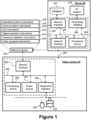
- FIG. 1 shows a block diagram of the configuration of a video camera 20 and a server 80 configured to produce interaction-aware video synopsis based on video analytics.
- the video camera 20 directly or indirectly, may access a bus 200 (or another data transfer mechanism) that interconnects subsystems and components for transferring information within the video camera 20.
- bus 200 may interconnect a processing device 202, a memory interface 204, and a peripherals interface 208 connected to an I/O system 210.
- Power source 209 provides the power to the video camera 20 and it may include a primary or a rechargeable battery (not shown), DC-DC converters (not shown) and other components required for the proper operation of the video camera 20.
- processing device 202 may use a memory interface 204 to access data and a software product stored on a memory device 234 or a non-transitory computer-readable medium device 234.
- memory device 234 may be part of the server whereas in other embodiments memory device 234 may be part of video camera 20.
- the peripherals interface 208 may also be connected to sensors, devices, and subsystems to facilitate multiple functionalities.
- the peripherals interface 208 may be connected to an I/O system 210 configured to receive signals or input from devices and to provide signals or output to one or more devices that allow data to be received and/or transmitted by the video camera 20.
- the I/O system 210 may include a touch screen controller 212, audio controller 214, and/or other types of input controller(s) 216.
- the touch screen controller 212 may be coupled to a touch screen 218.
- the touch screen 218 and the touch screen controller 212 may, for example, detect contact, and movement, using any of a plurality of touch sensitivity technologies, including but not limited to capacitive, resistive, infrared, and surface acoustic wave technologies as well as other proximity sensor arrays or other elements for determining one or more points of contact with the touch screen 218.
- the touch screen 218 may also, for example, be used to implement virtual or soft buttons and/or a keyboard. While a touch screen 218 is shown in Figure 1 , I/O system 210 may include a display screen (e.g., LCD or LED) in place of a touch screen 218.
- the peripherals interface 208 may also be connected to an image sensor 226, a motion sensor 228, a light sensor 230, and/or a proximity sensor 232 to facilitate image capturing, orientation, lighting, and proximity functions.
- a GPS receiver may also be integrated with, or connected to, the video camera 20, such as GPS receivers typically integrated into mobile communications devices.
- GPS software may permit the video camera 20 to access an external GPS receiver (e.g., connecting via a serial port or Bluetooth).
- video camera 20 may use a memory interface 204 to access a memory device 234.
- the memory device 234 may store an operating system 236, such as Android, iOS, MS Windows, Linux, or any other embedded operating system.
- Operating system 236 may include instructions for handling basic system services and for performing hardware-dependent tasks.
- the operating system 236 may be a kernel (e.g., Linux kernel).
- the memory device 234 may also store communication instructions 238 to facilitate communicating with one or more additional devices, one or more computers, and/or one or more servers.
- the memory device 234 may include: graphical user interface instructions 240 to facilitate graphic user interface processing; object extraction instructions 242 to facilitate object extraction from the source video and functions; interaction detection instructions 244 to facilitate detection of interaction between objects in the source video and functions; and video synopsis instructions 246 to facilitate generating of interaction-aware video synopsis and functions.
- Each of the above-identified instructions and applications may correspond to a set of instructions for performing one or more functions described above. These instructions do not necessarily need to be implemented as separate software programs, procedures, or modules.
- the memory device 234 may include additional instructions or fewer instructions.
- various functions of the video camera 20 may be implemented in hardware and/or software, including in one or more signal processing and/or application-specific integrated circuits.
- a server 80 for production on interaction-aware video synopsis of a video captured by at least one video camera 20 is provided.
- Processing device 282 may include at least one processor configured to execute computer programs, applications, methods, processes, or other software to perform embodiments described in the present disclosure.
- processing device 282 may use a memory interface 284 to access data and a software product stored on a memory device or a non-transitory computer-readable medium or to access a data structure 186.
- memory device 234 may include a set of instructions that, when executed, cause at the processing device 282 to: obtain from the video camera 20 a source video containing a plurality of source objects; extract the source objects from the source video; detect at least one object-interaction between at least two source objects; generate synopsis objects by sampling respective source objects; and generate a synopsis video having an overall play time shorter than the overall play time of the source video, by determining a play time for each one of the synopsis objects, wherein at least two synopsis objects which are played at least partially simultaneously in the synopsis video, are generated from source objects that are captured at different times in the source video, and wherein a relative display time in the synopsis video of the at least two synopsis objects created from the at least two source objects, detected as having an object-interaction therebetween, is the same as the relative display time of the at least two source objects in the source video.
- the extracting of the source objects from the source video is carried out by training a machine learning model to distinguish between foreground objects and a background object.
- the detection of the at least one object-interaction between at least two source objects is carried out by training a machine learning model to detect object interaction.
- each one of the source objects is represented by a respective tube and wherein the memory device 234 further comprising a set of instructions that, when executed, cause the processing device 282 to merge the respective tubes for the at least two source objects, detected as having an object-interaction therebetween into a single tube.
- the memory device 234 further comprising a set of instructions that, when executed, cause the processing device 282 to use the single tube to guarantee that the relative display time in the synopsis video of the at least two synopsis objects created from the at least two source objects, detected as having an object-interaction therebetween is the same as the relative display time of the at least two source objects in the source video.
- each one of the source objects is represented by a respective tube and wherein the memory device 234 further comprising a set of instructions that, when executed, cause the processing device 282 to tag the respective tubes with a tag for the at least two source objects, detected as having an object-interaction therebetween, as associated with a same object interaction.
- the memory device 234 further comprising a set of instructions that, when executed, cause the processing device 282 to use the tag to guarantee that the relative display time in the synopsis video of the at least two synopsis objects created from the at least two source objects, detected as having an object-interaction therebetween is the same as the relative display time of the at least two source objects in the source video.
- the network interface 286 may provide two-way data communication to a network.
- communication 290 between the video camera 20 and server 80 is represented by a dashed arrow.
- the network interface 286 may include an integrated services digital network (ISDN) card, cellular modem, satellite modem, or a modem to provide a data communication connection over the Internet.
- the network interface 286 may include a wireless local area network (WLAN) card.
- the network interface 286 may include an Ethernet port connected to radio frequency receivers and transmitters. The specific design and implementation of the network interface 286 may depend on the communications network(s) over which the video camera 20 and the server 80 may communicate.
- the server 80 may also include a peripherals interface 288 coupled to the bus 280.
- the peripherals interface 288 may also be connected to devices, and subsystems to facilitate multiple functionalities as performed by the server 80.
- those devices and subsystems may comprise a display screen (e.g., CRT or LCD) a USB port, and the like.
- server 80 and the video camera 20 are not intended to limit the disclosed embodiments.
- numerous variations and/or modifications may be made to the depicted configuration of server 80 and the video camera 20.
- not all the depicted components may be essential for the operation of server 80 or the video camera 20 in all cases.
- Any component may be located in any appropriate part of server 80, and the components may be rearranged into a variety of configurations while providing the functionality of the disclosed embodiments.
- some types of video cameras 20 may include only part of the depicted sensors and include sensors which are not depicted.
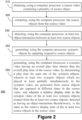
- FIG. 2 is a high-level flowchart illustrating a method in accordance with some embodiments of the present invention.
- Method 300 of generating an interaction-aware video synopsis is provided herein and may include the following steps: obtaining, using a computer processor, a source video containing a plurality of source objects 310; extracting, using the computer processor, the source objects from the source video 320; detecting, using the computer processor, at least one object-interaction between at least two source objects 330; generating, using the computer processor, synopsis objects by sampling respective source objects 340; and generating, using the computer processor, a synopsis video having an overall play time shorter than the overall play time of the source video, by determining a play time for each one of the synopsis objects 350, wherein at least two synopsis objects which are played at least partially simultaneously in the synopsis video, are generated from source objects that are captured at different times in the source video, and wherein a relative display time in the synopsis video of the at least two synopsis objects
- each one of the source objects may represented by a respective tube and method 300 may further include a step of merging the respective tubes for the at least two source objects, detected as having an object-interaction therebetween into a single tube.
- method 300 may further include a step of using the single tube to guarantee that the relative display time in the synopsis video of the at least two synopsis objects created from the at least two source objects, detected as having an object-interaction therebetween is the same as the relative display time of the at least two source objects in the source video.
- each one of the source objects may represented by a respective tube and method 300 may further include a step of tagging the respective tubes for the at least two source objects, detected as having an object-interaction therebetween, as associated with a same object interaction.
- method 300 may further include the step of using the tagging to guarantee that the relative display time in the synopsis video of the at least two synopsis objects created from the at least two source objects, detected as having an object-interaction therebetween is the same as the relative display time of the at least two source objects in the source video.
- Some embodiments of the invention may be carried out by a computing system.
- a processor operatively connected to a memory holding data and software, code, or instructions, may be configured or programmed by the software, code or instructions to carry out embodiments of the present invention. More than one such processor or computing system may be used.
- all methods according to some embodiments of the present invention may be stored as instructions in a computer readable medium to cause processors, such as central processing units (CPU) to perform the method.
- processors such as central processing units (CPU)
- the method described in the present disclosure can be stored as instructions in a non-transitory computer readable medium, such as storage devices which may include hard disk drives, solid state drives, flash memories, and the like.
- non-transitory computer readable medium can be memory units.
- a computer processor may receive instructions and data from a read-only memory or a random-access memory or both. At least one of aforementioned steps is performed by at least one processor associated with a computer.
- the essential elements of a computer are a processor for executing instructions and one or more memories for storing instructions and data.
- a computer will also include, or be operatively coupled to communicate with, one or more mass storage devices for storing data files.
- Storage modules suitable for tangibly embodying computer program instructions and data include all forms of non-volatile memory, including by way of example semiconductor memory devices, such as EPROM, EEPROM, and flash memory devices and also magneto-optic storage devices.
- aspects of the present invention may be embodied as a system, method or computer program product. Accordingly, aspects of the present invention may take the form of an entirely hardware embodiment, an entirely software embodiment (including firmware, resident software, micro-code, etc.) or an embodiment combining software and hardware aspects that may all generally be referred to herein as a "circuit,” “module” or “system.” Furthermore, some aspects of the present invention may take the form of a computer program product embodied in one or more computer readable medium(s) having computer readable program code embodied thereon.
- the computer readable medium may be a computer readable signal medium or a computer readable storage medium.
- a computer readable storage medium may be, for example, but not limited to, an electronic, magnetic, optical, electromagnetic, infrared, or semiconductor system, apparatus, or device, or any suitable combination of the foregoing.
- a computer readable storage medium may be any tangible medium that can contain or store a program for use by or in connection with an instruction execution system, apparatus, or device.
- Program code embodied on a computer readable medium may be transmitted using any appropriate medium, including but not limited to wireless, wireline, optical fiber cable, RF, etc., or any suitable combination of the foregoing.
- Computer program code for carrying out operations for aspects of the present invention may be written in any combination of one or more programming languages, including an object-oriented programming language such as Java, Smalltalk, JavaScript Object Notation (JSON), C++ or the like and conventional procedural programming languages, such as the "C" programming language or similar programming languages.
- the program code may execute entirely on the user's computer, partly on the user's computer, as a stand-alone software package, partly on the user's computer and partly on a remote computer or entirely on the remote computer or server.
- the remote computer may be connected to the user's computer through any type of network, including a local area network (LAN) or a wide area network (WAN), or the connection may be made to an external computer (for example, through the Internet using an Internet Service Provider).
- LAN local area network
- WAN wide area network
- Internet Service Provider an Internet Service Provider
- These computer program instructions may also be stored in a computer readable medium that can direct a computer, other programmable data processing apparatus, or other devices to function in a particular manner, such that the instructions stored in the computer readable medium produce an article of manufacture including instructions which implement the function/act specified in the flowchart and/or portion diagram portion or portions.
- the computer program instructions may also be loaded onto a computer, other programmable data processing apparatus, or other devices to cause a series of operational steps to be performed on the computer, other programmable apparatus or other devices to produce a computer implemented process such that the instructions which execute on the computer or other programmable apparatus provide processes for implementing the functions/acts specified in the flowchart and/or portion diagram portion or portions.
- each portion in the flowchart or portion diagrams may represent a module, segment, or portion of code, which comprises one or more executable instructions for implementing the specified logical function(s).
- the functions noted in the portion may occur out of the order noted in the figures. For example, two portions shown in succession may, in fact, be executed substantially concurrently, or the portions may sometimes be executed in the reverse order, depending upon the functionality involved.
- each portion of the portion diagrams and/or flowchart illustration, and combinations of portions in the portion diagrams and/or flowchart illustration can be implemented by special purpose hardware-based systems that perform the specified functions or acts, or combinations of special purpose hardware and computer instructions.
- Methods of the present invention may be implemented by performing or completing manually, automatically, or a combination thereof, selected steps or tasks.
- method may refer to manners, means, techniques and procedures for accomplishing a given task including, but not limited to, those manners, means, techniques and procedures either known to, or readily developed from known manners, means, techniques and procedures by practitioners of the art to which the invention belongs.
- the present invention may be implemented in the testing or practice with methods and materials equivalent or similar to those described herein.
Landscapes
- Engineering & Computer Science (AREA)
- Theoretical Computer Science (AREA)
- Physics & Mathematics (AREA)
- General Physics & Mathematics (AREA)
- Multimedia (AREA)
- Software Systems (AREA)
- Computer Vision & Pattern Recognition (AREA)
- Evolutionary Computation (AREA)
- General Engineering & Computer Science (AREA)
- Mathematical Physics (AREA)
- Computational Linguistics (AREA)
- Data Mining & Analysis (AREA)
- Artificial Intelligence (AREA)
- Computing Systems (AREA)
- Databases & Information Systems (AREA)
- Computer Security & Cryptography (AREA)
- Signal Processing (AREA)
- Molecular Biology (AREA)
- General Health & Medical Sciences (AREA)
- Biomedical Technology (AREA)
- Biophysics (AREA)
- Life Sciences & Earth Sciences (AREA)
- Medical Informatics (AREA)
- Health & Medical Sciences (AREA)
- Processing Or Creating Images (AREA)
- Image Analysis (AREA)
Applications Claiming Priority (1)
| Application Number | Priority Date | Filing Date | Title |
|---|---|---|---|
| US202363497773P | 2023-04-24 | 2023-04-24 |
Publications (1)
| Publication Number | Publication Date |
|---|---|
| EP4456068A1 true EP4456068A1 (de) | 2024-10-30 |
Family
ID=90904765
Family Applications (1)
| Application Number | Title | Priority Date | Filing Date |
|---|---|---|---|
| EP24172301.4A Pending EP4456068A1 (de) | 2023-04-24 | 2024-04-24 | Interaktionsbewusste videosynopse |
Country Status (2)
| Country | Link |
|---|---|
| US (1) | US12432428B2 (de) |
| EP (1) | EP4456068A1 (de) |
Family Cites Families (11)
| Publication number | Priority date | Publication date | Assignee | Title |
|---|---|---|---|---|
| US5768447A (en) * | 1996-06-14 | 1998-06-16 | David Sarnoff Research Center, Inc. | Method for indexing image information using a reference model |
| US20050138674A1 (en) * | 2003-12-17 | 2005-06-23 | Quadrock Communications, Inc | System and method for integration and synchronization of interactive content with television content |
| US20050229227A1 (en) * | 2004-04-13 | 2005-10-13 | Evenhere, Inc. | Aggregation of retailers for televised media programming product placement |
| US8949235B2 (en) * | 2005-11-15 | 2015-02-03 | Yissum Research Development Company Of The Hebrew University Of Jerusalem Ltd. | Methods and systems for producing a video synopsis using clustering |
| CA2640834C (en) * | 2005-11-15 | 2014-08-19 | Yissum Research Development Company Of The Hebrew University Of Jerusalem | Method and system for producing a video synopsis |
| EP3297272A1 (de) * | 2007-02-01 | 2018-03-21 | Yissum Research Development Company of the Hebrew University of Jerusalem Ltd. | Verfahren und system zur videoindizierung und videosynopse |
| US9877086B2 (en) * | 2014-01-26 | 2018-01-23 | BriefCam Ltd. | Method and system for producing relevance sorted video summary |
| US10958854B2 (en) * | 2018-11-02 | 2021-03-23 | BriefCam Ltd. | Computer-implemented method for generating an output video from multiple video sources |
| KR102271929B1 (ko) * | 2019-09-17 | 2021-07-02 | 한국과학기술연구원 | 장면 이해를 통해 비디오 요약을 생성하는 방법 및 이를 위한 시스템 |
| US11262985B2 (en) * | 2020-03-10 | 2022-03-01 | International Business Machines Corporation | Pretraining utilizing software dependencies |
| US11328160B2 (en) * | 2020-06-10 | 2022-05-10 | Ionetworks Inc. | Video condensation and recognition method and system thereof |
-
2024
- 2024-04-24 EP EP24172301.4A patent/EP4456068A1/de active Pending
- 2024-04-24 US US18/644,707 patent/US12432428B2/en active Active
Non-Patent Citations (5)
| Title |
|---|
| LI XUELONG ET AL: "Video Synopsis in Complex Situations", IEEE TRANSACTIONS ON IMAGE PROCESSING, IEEE, USA, vol. 27, no. 8, 1 August 2018 (2018-08-01), pages 3798 - 3812, XP011681934, ISSN: 1057-7149, [retrieved on 20180425], DOI: 10.1109/TIP.2018.2823420 * |
| QI SIYUAN ET AL: "Learning Human-Object Interactions by Graph Parsing Neural Networks", 5 October 2018, SAT 2015 18TH INTERNATIONAL CONFERENCE, AUSTIN, TX, USA, SEPTEMBER 24-27, 2015; [LECTURE NOTES IN COMPUTER SCIENCE; LECT.NOTES COMPUTER], SPRINGER, BERLIN, HEIDELBERG, PAGE(S) 407 - 423, ISBN: 978-3-540-74549-5, XP047489016 * |
| SANTOS DANIEL F S ET AL: "Video Segmentation Learning Using Cascade Residual Convolutional Neural Network", 2019 32ND SIBGRAPI CONFERENCE ON GRAPHICS, PATTERNS AND IMAGES (SIBGRAPI), IEEE, 28 October 2019 (2019-10-28), pages 1 - 7, XP033643020, DOI: 10.1109/SIBGRAPI.2019.00009 * |
| YANG YOONSIK ET AL: "Scene Adaptive Online Surveillance Video Synopsis via Dynamic Tube Rearrangement Using Octree", IEEE TRANSACTIONS ON IMAGE PROCESSING, IEEE, USA, vol. 30, 29 September 2021 (2021-09-29), pages 8318 - 8331, XP011881100, ISSN: 1057-7149, [retrieved on 20211004], DOI: 10.1109/TIP.2021.3114986 * |
| YUNZUO ZHANG ET AL: "Object interaction-based surveillance video synopsis", APPLIED INTELLIGENCE., vol. 53, no. 4, 1 February 2023 (2023-02-01), NL, pages 4648 - 4664, XP093201333, ISSN: 0924-669X, Retrieved from the Internet <URL:https://link.springer.com/content/pdf/10.1007/s10489-022-03477-5.pdf> DOI: 10.1007/s10489-022-03477-5 * |
Also Published As
| Publication number | Publication date |
|---|---|
| US12432428B2 (en) | 2025-09-30 |
| US20240357218A1 (en) | 2024-10-24 |
Similar Documents
| Publication | Publication Date | Title |
|---|---|---|
| US10614310B2 (en) | Behavior recognition | |
| CN112100438B (zh) | 一种标签抽取方法、设备及计算机可读存储介质 | |
| CN114140832A (zh) | 井下行人越界风险检测方法、装置、电子设备及存储介质 | |
| CN113111838A (zh) | 行为识别方法及装置、设备和存储介质 | |
| Elharrouss et al. | FSC-set: counting, localization of football supporters crowd in the stadiums | |
| CN111160243A (zh) | 客流量统计方法及相关产品 | |
| Ghadi et al. | Syntactic model-based human body 3D reconstruction and event classification via association based features mining and deep learning | |
| Aljuaid et al. | Postures anomaly tracking and prediction learning model over crowd data analytics | |
| CN110929619A (zh) | 一种基于图像处理的目标对象追踪方法、系统、设备及可读介质 | |
| CN111709382A (zh) | 人体轨迹处理方法、装置、计算机存储介质以及电子设备 | |
| CN113705417A (zh) | 图像处理方法及装置、电子设备及计算机可读存储介质 | |
| KR20230086457A (ko) | 화재 감지 시스템의 구축을 위한 전차 장치 및 그 방법 | |
| Mishra et al. | Recent trends in pedestrian detection for robotic vision using deep learning techniques | |
| CN115346157A (zh) | 入侵检测方法、系统、设备及介质 | |
| CN114241379A (zh) | 一种乘客异常行为识别方法、装置、设备及乘客监控系统 | |
| KR20170006356A (ko) | 이차원 영상 기반 고객 분석 방법 및 장치 | |
| CN117998039A (zh) | 视频数据处理方法、装置、设备及存储介质 | |
| CN114677627A (zh) | 目标线索寻找方法、装置、设备及介质 | |
| CN113837066A (zh) | 行为识别方法、装置、电子设备及计算机存储介质 | |
| Harish et al. | Intruder detection by extracting semantic content from surveillance videos | |
| CN110363193A (zh) | 车辆重识别方法、装置、设备和计算机存储介质 | |
| CN113329260B (zh) | 一种直播处理方法、装置、存储介质及电子设备 | |
| US12432428B2 (en) | Method and system for producing interaction-aware video synopsis | |
| CN113012223B (zh) | 目标流动监测方法、装置、计算机设备和存储介质 | |
| CN114387547A (zh) | 一种确定行为视频片段的方法、设备、介质及程序产品 |
Legal Events
| Date | Code | Title | Description |
|---|---|---|---|
| PUAI | Public reference made under article 153(3) epc to a published international application that has entered the european phase |
Free format text: ORIGINAL CODE: 0009012 |
|
| STAA | Information on the status of an ep patent application or granted ep patent |
Free format text: STATUS: THE APPLICATION HAS BEEN PUBLISHED |
|
| AK | Designated contracting states |
Kind code of ref document: A1 Designated state(s): AL AT BE BG CH CY CZ DE DK EE ES FI FR GB GR HR HU IE IS IT LI LT LU LV MC ME MK MT NL NO PL PT RO RS SE SI SK SM TR |
|
| STAA | Information on the status of an ep patent application or granted ep patent |
Free format text: STATUS: REQUEST FOR EXAMINATION WAS MADE |
|
| 17P | Request for examination filed |
Effective date: 20250429 |