EP4456105A1 - Elektrowerkzeug - Google Patents
Elektrowerkzeug Download PDFInfo
- Publication number
- EP4456105A1 EP4456105A1 EP24171829.5A EP24171829A EP4456105A1 EP 4456105 A1 EP4456105 A1 EP 4456105A1 EP 24171829 A EP24171829 A EP 24171829A EP 4456105 A1 EP4456105 A1 EP 4456105A1
- Authority
- EP
- European Patent Office
- Prior art keywords
- normal
- state
- snap
- switch assembly
- trigger
- Prior art date
- Legal status (The legal status is an assumption and is not a legal conclusion. Google has not performed a legal analysis and makes no representation as to the accuracy of the status listed.)
- Pending
Links
- 230000007246 mechanism Effects 0.000 description 12
- 230000004913 activation Effects 0.000 description 5
- 238000010586 diagram Methods 0.000 description 4
- 239000004519 grease Substances 0.000 description 4
- 230000003993 interaction Effects 0.000 description 4
- 230000005540 biological transmission Effects 0.000 description 3
- 230000003213 activating effect Effects 0.000 description 2
- 230000008901 benefit Effects 0.000 description 2
- 230000009849 deactivation Effects 0.000 description 2
- 230000006866 deterioration Effects 0.000 description 2
- 238000005516 engineering process Methods 0.000 description 2
- 230000002708 enhancing effect Effects 0.000 description 2
- 230000009471 action Effects 0.000 description 1
- 238000004519 manufacturing process Methods 0.000 description 1
- 230000004048 modification Effects 0.000 description 1
- 238000012986 modification Methods 0.000 description 1
- 230000000704 physical effect Effects 0.000 description 1
Images




Classifications
-
- H—ELECTRICITY
- H01—ELECTRIC ELEMENTS
- H01H—ELECTRIC SWITCHES; RELAYS; SELECTORS; EMERGENCY PROTECTIVE DEVICES
- H01H9/00—Details of switching devices, not covered by groups H01H1/00 - H01H7/00
- H01H9/02—Bases, casings, or covers
- H01H9/06—Casing of switch constituted by a handle serving a purpose other than the actuation of the switch, e.g. by the handle of a vacuum cleaner
-
- B—PERFORMING OPERATIONS; TRANSPORTING
- B25—HAND TOOLS; PORTABLE POWER-DRIVEN TOOLS; MANIPULATORS
- B25F—COMBINATION OR MULTI-PURPOSE TOOLS NOT OTHERWISE PROVIDED FOR; DETAILS OR COMPONENTS OF PORTABLE POWER-DRIVEN TOOLS NOT PARTICULARLY RELATED TO THE OPERATIONS PERFORMED AND NOT OTHERWISE PROVIDED FOR
- B25F5/00—Details or components of portable power-driven tools not particularly related to the operations performed and not otherwise provided for
- B25F5/02—Construction of casings, bodies or handles
-
- H—ELECTRICITY
- H01—ELECTRIC ELEMENTS
- H01H—ELECTRIC SWITCHES; RELAYS; SELECTORS; EMERGENCY PROTECTIVE DEVICES
- H01H13/00—Switches having rectilinearly-movable operating part or parts adapted for pushing or pulling in one direction only, e.g. push-button switch
- H01H13/02—Details
- H01H13/04—Cases; Covers
- H01H13/08—Casing of switch constituted by a handle serving a purpose other than the actuation of the switch
-
- H—ELECTRICITY
- H01—ELECTRIC ELEMENTS
- H01H—ELECTRIC SWITCHES; RELAYS; SELECTORS; EMERGENCY PROTECTIVE DEVICES
- H01H3/00—Mechanisms for operating contacts
- H01H3/02—Operating parts, i.e. for operating driving mechanism by a mechanical force external to the switch
- H01H3/20—Operating parts, i.e. for operating driving mechanism by a mechanical force external to the switch wherein an auxiliary movement thereof, or of an attachment thereto, is necessary before the main movement is possible or effective, e.g. for unlatching, for coupling
-
- H—ELECTRICITY
- H01—ELECTRIC ELEMENTS
- H01H—ELECTRIC SWITCHES; RELAYS; SELECTORS; EMERGENCY PROTECTIVE DEVICES
- H01H3/00—Mechanisms for operating contacts
- H01H3/32—Driving mechanisms, i.e. for transmitting driving force to the contacts
- H01H3/50—Driving mechanisms, i.e. for transmitting driving force to the contacts with indexing or locating means, e.g. indexing by ball and spring
Definitions
- the subject matter described herein relates to a power tool, and more particularly relates to a power tool with an improved switch assembly.
- a power tool is usually provided with a trigger for activating/deactivating the power tool; when the trigger is pressed, a switch is closed to energize the power tool, while when the trigger is released, the switch is open to deenergize the power tool.
- Lock Position at which position the power tool cannot be activated
- Operation Position at which position the power tool may be activated/deactivated at any time
- ON-Hold Position at which position the power tool maintains continuously active.
- a power tool is disclosed herein to overcome at least one of the drawbacks in conventional technologies.
- a power tool comprises: a housing and a switch assembly, the switch assembly comprising a position shifter, the position shifter being movable relative to the housing to shift between a plurality of positions, the switch assembly being disposed in one of a normal-OFF state, a selective ON/OFF state, and a normal-ON state when the position shifter is shifted to one of the plurality of positions, wherein a snap-in convex rib is arranged on the housing; a snap groove is formed on the position shifter; when the snap-in convex rib is snapped into the snap groove, the switch assembly is disposed in the selective ON/OFF state.
- two stop convex ribs are arranged on the position shifter, the snap groove is formed between the two stop convex ribs, a snap-in arm is arranged on the housing, the snap-in convex rib is arranged on the snap-in arm, and when the snap-in convex rib abuts against an external side of a corresponding one of the two stop convex ribs, the switch assembly is disposed in the normal-OFF state or in the normal-ON state.
- the position shifter is further provided with a first reset unit, the first reset unit being operable to provide a reset force for resetting the switch assembly to the selective ON/OFF state.
- the switch assembly comprises a switch and a trigger, the trigger being operable for controlling closing or opening of the switch; a first limit column and a second limit column are provided on the position shifter, a guide passage being formed between the first limit column and the second limit column, a guide portion being provided on the trigger; wherein the plurality of positions include:
- a guide wall is arranged at a side of the first limit column proximal to the second limit column, the guide passage being formed between the second limit column and the guide wall.
- the guide wall comprises a first stop rib extending in a direction towards the trigger; in the normal-OFF state with the trigger being pressed, the first stop rib and the guide portion interact to limit the position shifter from being disengaged from the normal-OFF position.
- the second limit column comprises a second stop rib extending towards the trigger; in the selective ON/OFF state with the switch being open, the second stop rib and the guide portion interact to limit the position shifter from moving towards the normal-ON position.
- the second limit column comprises a limit wall; the limit wall limits the position shifter from being disengaged from the normal-ON position in a direction opposite the selective ON/OFF position.
- the trigger and the switch are movably connected via a connector, a second reset unit being sleeved on the connector, the second reset unit being operable to reset the trigger.
- orientational or positional relationships indicated by the terms “center,” “longitudinal,” “transverse,” “length,” “width,” “thickness,” “upper,” “lower,” “front,” “rear,” “left,” “right,” “vertical,” “horizontal,” “top,” “bottom,” “inner,” “clockwise,” and “counterclockwise” refer to those orientational and positional relationships illustrated in the drawings, which are intended only for facilitating description of the disclosure and simplifying relevant depictions, but not for indicating or implying that the devices or elements compulsorily possess such specific orientations or are compulsorily configured and operated with these specific orientations; therefore, such terms should not be construed as limitations to the disclosure.
- first and second are only used for descriptive purposes, which shall not be construed as indicating or implying relative importance or implicitly indicating the number of a referred to technical feature. Therefore, the features limited by “first” and “second” may explicitly or implicitly include one or more of such features.
- plural indicates two or above.
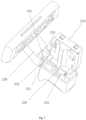
- Figs. 1 to 3 illustrate a power tool according to an embodiment of the disclosure, comprising a housing 100, an operating mechanism, and a switch assembly 200, the operating mechanism being electrically connected to the switch assembly 200, the switch assembly comprising a switch 210, a trigger 220, and a position shifter 230, the trigger 220 controlling closing or opening of the switch 210, where when the switch 210 is closed, the operating mechanism is activated, while when the switch 210 is opened, the operating mechanism is deactivated.
- a grease gun With a grease gun as an example, its operating mechanism comprises an electric motor, a transmission mechanism, and a plunger pump, the plunger pump being connected to the electric motor via the transmission mechanism;
- a power source of the grease gun may be a battery or a mains supply;
- the switch assembly 200 which is connected to the power source and the operating mechanism, is operable to control activation or deactivation of the electric motor, thereby controlling operation of the grease gun.
- the power tool may also be a power drill, a power hammer, an electric screw driver, or a heat gun, etc.
- a first hole site for mounting the trigger 220 and a second hole site for mounting the position shifter 230 are provided on the housing 100, the trigger 220 being movable in the first hole site, the position shifter 230 being movable in the second hole site.
- the position shifter 230 is movable left and right relative to the housing 100 to shift between a plurality of positions; when the position shifter 230 is shifted to one of the positions, the switch assembly 200 may be sequentially disposed in one of the following states: normal-OFF, selective ON/OFF, and normal-ON.
- the position shifter 230 may be disposed at three positions relative to the housing 100: left, middle, right, where the middle position is the selective ON/OFF position, and the left and right positions correspond to the normal-OFF and normal-ON positions, respectively; when the position shifter 230 is disposed at one of the left, middle, and right positions, the switch assembly 200 may be correspondingly in the normal-OFF state, the selective ON/OFF state, or the normal-ON state.
- the operating mechanism When the switch assembly 200 is in the normal-OFF state, the operating mechanism cannot be activated; when the switch assembly 200 is in the selective ON/OFF state, a user may control activation or deactivation of the operating mechanism by pressing or releasing the trigger; when the switch assembly 200 is in the normal-ON state, the operating mechanism maintains active.
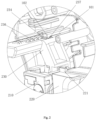
- a first limit column 231 and a second limit column 232 protruding towards the trigger 220 are arranged on the position shifter 230, a guide passage 233 being formed between the first limit column 231 and the second limit column 232, a guide portion 221 being provided on the trigger 220.
- the position shifter 230 moves to the normal-OFF position, the guide portion 221 is blocked by the first limit column 231 so that the trigger 220 cannot approach the switch 210, and the switch 210 is open and cannot be closed, whereby the switch assembly 200 is in the normal-OFF state.
- the guide portion 221 is movable within the guide passage 233; now, the user may press or release the trigger 220 to close or open the switch 210, in which case the switch assembly 200 is in the selective ON/OFF state.
- the position shifter 230 at the selective ON/OFF position shifts to the normal-ON position; now, the trigger 220, if released, is blocked by the second limit column 232 from moving further away from the switch 210, so that the switch 210 maintains closed and the switch assembly is in the normal-ON state.
- the switch assembly 200 is contributed with three different operational states via interaction between the position shifter 230 and the guide portion 221, i.e., the normal-OFF state, the selective ON/OFF state, and the normal-ON state.
- the normal-OFF state unintentional touch of the trigger 220 may be prevented from activating the power tool, which reduces the odds of accidents when operating the power tool.
- the power tool In the normal-ON state, the power tool can still operate without pressing the trigger 220, which reduces fatigue when the user operates the power tool.
- the selective ON/OFF state the user may operate the power tool as he or she usually does, i.e., the user may freely select an operational state of the switch assembly 200 as needed, whereby user experience is enhanced.
- a snap-in arm 101 is arranged on the housing 100, a snap-in convex rib 102 is arranged on the snap-in arm 101, and a snap groove 237 is formed on the position shifter 230.
- the snap-in convex rib 102 is snapped into the snap groove 237.
- the snap-in convex rib 102 is disengaged from the snap groove 237.
- snap-in-place feedback may be provided to the user, so that the user may know whether the switch assembly 200 has been shifted to the selective ON/OFF state; in this case, the snap-in convex rib 102 does not easily escape from the snap groove 237; as such, the switch assembly 200 in the selective ON/OFF state is touch-rejection enabled.
- interaction between the snap-in convex rib 102 and the snap groove 237 provides shift feedback when the switch assembly 200 is shifted to the selective ON/OFF state; in this case, the switch assembly 200 is also contributed with a touch-rejection feature, whereby user experience is enhanced.
- two stop convex ribs 234 are arranged on the position shifter, and the snap groove 237 is formed between the two stop convex ribs.
- the switch assembly 200 is disposed in the normal-OFF state or the normal-ON state.
- the position shifter 230 can provide shifted-in-place feedback to the user irrespective of whether the switch assembly 200 is switched to the normal-OFF state, the selective ON/OFF state, or the normal-ON state, whereby user experience is enhanced. Moreover, when the switch assembly 200 is in the normal-OFF state or the normal-ON state, an external force is needed to drive the snap-in convex rib 102 to cross the stop convex rib 234 so that the switch assembly 200 can be switched to the selective ON/OFF state.
- the switch assembly 200 is touch-rejection enabled irrespective of being in the normal-OFF state, the selective ON/OFF state, or the normal-ON state, whereby user experience is further enhanced.
- the position shifter 230 is further provided with a first reset unit 236, a mounting site 235 is provided on the position shifter 230, and the first reset unit 236 is mounted at the mounting site 235.
- the first reset unit 236 at least partially extends beyond the position shifter 230 but not beyond the second hole site, so that the first reset unit 236 is limited within the housing 100.
- the first reset unit 236 When the user urges the position shifter 230 to move left or right within the housing 100, the first reset unit 236 is pressed against by the housing 100 to accumulate energy in the course of the position shifter 230 shifting from the selective ON/OFF position to the normal-OFF position or normal-ON position, so that the first reset unit 236 interacts with the snap-in convex rib 102 and the stop convex ribs 234 to hold the snap-in convex rib 102 against a corresponding one of the stop convex rib 234.
- the position shifter 230 is limited to the normal-OFF position or normal-ON position due to the reset force applied by the first reset unit 236, so that the position shifter 230 does not shake when the power tool is operating normally.
- the small reset force provided by the first reset unit 236 does not suffice for the snap-in convex rib 102 to cross the stop convex rib 234 into the snap groove 237; now, the switch assembly 200 is still touch-rejection enabled.
- the first reset unit 236 which interacts with the snap-in convex rib 102 and the stop convex rib 234, the snap-in convex rib 102 is stressed to abut against the stop convex rib 234 so that shaking does not easily occur, and the position shifter 230 can always be limited irrespective of whether the switch assembly 200 is in the normal-OFF state, the selective ON/OFF state, or the normal-ON state.
- the first reset unit 236 provides a reset force for facilitating the position shifter 230 to shift back to the selective ON/OFF position, which eases the user's shifting effort.
- a connector 222 is secured on the trigger 220, the trigger 220 and the switch 210 are movably connected via the connector 222, the connector 222 is slidable relative to the switch 210, and a second reset unit (not shown) is provided between the trigger 220 and the switch 210, the second reset unit being sleeved on the connector 222, the second reset unit being operable to reset the trigger 220 to move away from the switch 210.
- the trigger 220 moves closer to the switch 210 so that the second reset unit is stressed to accumulate energy; when the user releases the trigger 220, the second reset unit resets to push the trigger 200 to reset and move away from the switch 210, whereby the switch 210 is opened.
- the second reset unit is a spring. It may be understood that, the second reset unit may also adopt another element or structure with equivalent physical properties.
- the switch 210 By movably connecting the trigger 220 and the switch 210 via the connector 222 and providing the second reset unit between the trigger 220 and the switch 210, when the user presses the trigger 220, the switch 210 may be closed; and when the trigger 220 is released, the second reset unit automatically resets to push the trigger 220 away to thereby open the switch 210.
- a different transmission mechanism may also be adopted to drive the trigger away from the switch to thereby close the switch, or to drive the trigger closer to the switch to thereby open the switch.
- Figs. 3 to 8 illustrate a power tool according to an embodiment of the disclosure.
- a guide wall 2311 is arranged at a side of the first limit column 231 proximal to the second limit column 232, and the guide passage 233 is formed between the second limit column 232 and the guide wall 2311.
- the guide portion 221 of the trigger 220 may move within the guide passage 233 to thereby close or open the switch 210.
- the guide wall 2311 plays a role of guiding, as well as limiting the movable extent of the guide portion 221, so that the position shifter 230 at the selective ON/OFF position cannot move to the normal-OFF position, whereby the normal-OFF position and the normal-ON position are noticeably distinguished.
- the noticeable distinguishing between modes of shifting to the normal-ON position and shifting to the normal-OFF position helps the user cultivate a good habit, preventing faulty operation due to indiscrimination between the modes of shifting.
- the guide wall 2311 comprises a first stop rib 2312 extending in a direction towards the trigger 220; when the position shifter 230 is at the normal-OFF position and the user presses the trigger 220, the trigger 220 abuts against the first limit column 231; now, the first stop rib 2312 interferes with the guide portion 221 when the position shifter 230 moves in the direction towards the selective ON/OFF position, so that the position shifter 230 cannot leave the normal-OFF position, whereby the switch assembly 200 is disposed in the normal-OFF state.
- the position shifter 230 at the normal-OFF position is limited from unexpectedly shifting to the selective ON/OFF position after the user presses the trigger 220, thereby preventing unexpected activation of the power tool and reducing occurrence of accidents.
- Figs. 3 to 8 illustrate a power tool according to an embodiment of the disclosure.
- the second limit column 232 comprises a second stop rib 2321 extending towards the trigger 220; when the position shifter 230 is at the selective ON/OFF position with the switch 210 being open, the second stop rib 2321 interacts with the guide portion 221 to limit the position shifter 230 from moving towards the normal-ON position.
- the switch 210 To shift the position shifter 230 to the normal-ON position, the switch 210 needs to be activated before moving the position shifter 230; to prevent the position shifter 230 from shifting to the normal-ON position while the switch 210 is open so that the normal-ON state of the switch assembly 200 cannot be activated, the second stop rib 2321 is provided; as such, the guide portion 221 and the second stop rib 2321 form an interference when the position shifter 230, which is at the normal-ON position with the switch 210 being open, moves towards the normal-ON position, thereby limiting the position shifter 230 from moving towards the normal-ON position, preventing occurrence of a circumstance where the corresponding function cannot be activated when the position shifter 230 is at a wrong position and thusly preventing deterioration of the product's user experience.
- Fig. 4 illustrates a power tool according to an embodiment of the disclosure.
- the second limit column 232 comprises a third stop rib 2322 extending in a direction towards the switch 210; when the position shifter 230 is at the normal-ON position and the guide portion 221 contacts with the third stop rib 2322, the third stop rib 2322 interacts with the guide portion 221 to limit the position shifter 230 from leaving the normal-ON position in the direction towards the selective ON/OFF position.
- the third stop rib 2322 interferes with the guide portion 221 when the position shifter 230 moves in the direction towards the selective ON/OFF position, limiting the position shifter 230 from moving towards the selective ON/OFF position, thereby preventing unintentional touch-induced functional failure when the user uses the normal-ON function of the power tool, which enhances user experience.
- the second limit column 232 further comprises a limit wall 2323, the limit wall 2323 limiting the position shifter 230 from being disengaged from the normal-ON position in a direction opposite the selective ON/OFF position.
- the limit wall 2323 is arranged on the second limit column 232, so that the limit wall 2323 interferes with the guide portion 221 in the direction opposite the selective ON/OFF position to prevent the position shifter 230 from being disengaged from the normal-ON position, which further prevents unintentional touch-induced functional failure when the user uses the normal-ON function of the power tool, whereby user experience is further enhanced.
Landscapes
- Engineering & Computer Science (AREA)
- Mechanical Engineering (AREA)
- Push-Button Switches (AREA)
- Switch Cases, Indication, And Locking (AREA)
Applications Claiming Priority (1)
| Application Number | Priority Date | Filing Date | Title |
|---|---|---|---|
| CN202320985955.1U CN220179248U (zh) | 2023-04-23 | 2023-04-23 | 一种电动工具 |
Publications (1)
| Publication Number | Publication Date |
|---|---|
| EP4456105A1 true EP4456105A1 (de) | 2024-10-30 |
Family
ID=89111124
Family Applications (1)
| Application Number | Title | Priority Date | Filing Date |
|---|---|---|---|
| EP24171829.5A Pending EP4456105A1 (de) | 2023-04-23 | 2024-04-23 | Elektrowerkzeug |
Country Status (2)
| Country | Link |
|---|---|
| EP (1) | EP4456105A1 (de) |
| CN (1) | CN220179248U (de) |
Citations (4)
| Publication number | Priority date | Publication date | Assignee | Title |
|---|---|---|---|---|
| US3461556A (en) * | 1967-07-10 | 1969-08-19 | Sunbeam Corp | Trigger switch for electric appliance |
| DE10034670A1 (de) * | 2000-07-17 | 2002-01-31 | Kopp Heinrich Ag | Vorrichtung zur mechanischen Sicherung der EIN- und AUS-Schaltstellung eines elektrischen Druckschalters |
| DE69630097T2 (de) * | 1995-11-28 | 2004-07-08 | Black & Decker Inc., Newark | Ein Schalter mit Ein- und Ausverriegelung |
| US20220230818A1 (en) * | 2019-05-28 | 2022-07-21 | Festool Gmbh | Switch for a hand-held power tool |
-
2023
- 2023-04-23 CN CN202320985955.1U patent/CN220179248U/zh active Active
-
2024
- 2024-04-23 EP EP24171829.5A patent/EP4456105A1/de active Pending
Patent Citations (4)
| Publication number | Priority date | Publication date | Assignee | Title |
|---|---|---|---|---|
| US3461556A (en) * | 1967-07-10 | 1969-08-19 | Sunbeam Corp | Trigger switch for electric appliance |
| DE69630097T2 (de) * | 1995-11-28 | 2004-07-08 | Black & Decker Inc., Newark | Ein Schalter mit Ein- und Ausverriegelung |
| DE10034670A1 (de) * | 2000-07-17 | 2002-01-31 | Kopp Heinrich Ag | Vorrichtung zur mechanischen Sicherung der EIN- und AUS-Schaltstellung eines elektrischen Druckschalters |
| US20220230818A1 (en) * | 2019-05-28 | 2022-07-21 | Festool Gmbh | Switch for a hand-held power tool |
Also Published As
| Publication number | Publication date |
|---|---|
| CN220179248U (zh) | 2023-12-15 |
Similar Documents
| Publication | Publication Date | Title |
|---|---|---|
| JP4181640B2 (ja) | 押ボタンスイッチ及びこれを用いた操作装置並びに教示ペンダント | |
| EP1422733B1 (de) | Drucktastenanordnung | |
| US6355892B1 (en) | One piece power tool trigger with lock and return spring | |
| US6627830B2 (en) | Push button and teaching pendant with the push button | |
| JPWO1998049701A1 (ja) | 押ボタンスイッチ及びこれを用いた操作装置並びに教示ペンダント | |
| JP4545802B2 (ja) | 押ボタンスイッチ及びこれを用いた操作装置並びに教示ペンダント | |
| US9965046B2 (en) | Keyboard and notebook computer with same | |
| CN212365786U (zh) | 开关组件及电动工具 | |
| EP4456105A1 (de) | Elektrowerkzeug | |
| JP4487790B2 (ja) | 電源スイッチの誤操作防止装置 | |
| US9799467B1 (en) | Key structure | |
| US9847188B2 (en) | Key structure | |
| US7746322B2 (en) | Mouse device with keys | |
| US12517486B2 (en) | Control device having a monitoring unit | |
| WO2025081668A1 (zh) | 按压开关、车门和汽车 | |
| US11906038B2 (en) | Shifter mechanism with manual shift function | |
| JP6604642B1 (ja) | ロッカースイッチのスライド操作変換用アダプタ。 | |
| JP4122697B2 (ja) | スイッチ装置 | |
| CN220362532U (zh) | 电动工具 | |
| US12265318B2 (en) | Multi-directional control device applied to waterproof case of camera | |
| JP3828451B2 (ja) | リバーシブルキーボード及び情報処理装置 | |
| CN218601740U (zh) | 带弹出式摇杆组件的笔记本电脑 | |
| CN222826248U (zh) | 开关装置及电动工具 | |
| CN211484335U (zh) | 吸尘器 | |
| JP4170551B2 (ja) | プッシュスライドスイッチ |
Legal Events
| Date | Code | Title | Description |
|---|---|---|---|
| PUAI | Public reference made under article 153(3) epc to a published international application that has entered the european phase |
Free format text: ORIGINAL CODE: 0009012 |
|
| STAA | Information on the status of an ep patent application or granted ep patent |
Free format text: STATUS: THE APPLICATION HAS BEEN PUBLISHED |
|
| AK | Designated contracting states |
Kind code of ref document: A1 Designated state(s): AL AT BE BG CH CY CZ DE DK EE ES FI FR GB GR HR HU IE IS IT LI LT LU LV MC ME MK MT NL NO PL PT RO RS SE SI SK SM TR |
|
| STAA | Information on the status of an ep patent application or granted ep patent |
Free format text: STATUS: REQUEST FOR EXAMINATION WAS MADE |
|
| 17P | Request for examination filed |
Effective date: 20250318 |