EP4458169A2 - Produits de tabac sans fumée gainés de polymères - Google Patents
Produits de tabac sans fumée gainés de polymères Download PDFInfo
- Publication number
- EP4458169A2 EP4458169A2 EP24195267.0A EP24195267A EP4458169A2 EP 4458169 A2 EP4458169 A2 EP 4458169A2 EP 24195267 A EP24195267 A EP 24195267A EP 4458169 A2 EP4458169 A2 EP 4458169A2
- Authority
- EP
- European Patent Office
- Prior art keywords
- tobacco
- smokeless tobacco
- encased
- compressed
- microfibers
- Prior art date
- Legal status (The legal status is an assumption and is not a legal conclusion. Google has not performed a legal analysis and makes no representation as to the accuracy of the status listed.)
- Pending
Links
Images


Classifications
-
- B—PERFORMING OPERATIONS; TRANSPORTING
- B05—SPRAYING OR ATOMISING IN GENERAL; APPLYING FLUENT MATERIALS TO SURFACES, IN GENERAL
- B05D—PROCESSES FOR APPLYING FLUENT MATERIALS TO SURFACES, IN GENERAL
- B05D3/00—Pretreatment of surfaces to which liquids or other fluent materials are to be applied; After-treatment of applied coatings, e.g. intermediate treating of an applied coating preparatory to subsequent applications of liquids or other fluent materials
- B05D3/10—Pretreatment of surfaces to which liquids or other fluent materials are to be applied; After-treatment of applied coatings, e.g. intermediate treating of an applied coating preparatory to subsequent applications of liquids or other fluent materials by other chemical means
- B05D3/107—Post-treatment of applied coatings
- B05D3/108—Curing
-
- A—HUMAN NECESSITIES
- A24—TOBACCO; CIGARS; CIGARETTES; SIMULATED SMOKING DEVICES; SMOKERS' REQUISITES
- A24B—MANUFACTURE OR PREPARATION OF TOBACCO FOR SMOKING OR CHEWING; TOBACCO; SNUFF
- A24B13/00—Tobacco for pipes, for cigars, e.g. cigar inserts, or for cigarettes; Chewing tobacco; Snuff
-
- A—HUMAN NECESSITIES
- A24—TOBACCO; CIGARS; CIGARETTES; SIMULATED SMOKING DEVICES; SMOKERS' REQUISITES
- A24B—MANUFACTURE OR PREPARATION OF TOBACCO FOR SMOKING OR CHEWING; TOBACCO; SNUFF
- A24B15/00—Chemical features or treatment of tobacco; Tobacco substitutes, e.g. in liquid form
- A24B15/18—Treatment of tobacco products or tobacco substitutes
- A24B15/186—Treatment of tobacco products or tobacco substitutes by coating with a coating composition, encapsulation of tobacco particles
-
- A—HUMAN NECESSITIES
- A24—TOBACCO; CIGARS; CIGARETTES; SIMULATED SMOKING DEVICES; SMOKERS' REQUISITES
- A24B—MANUFACTURE OR PREPARATION OF TOBACCO FOR SMOKING OR CHEWING; TOBACCO; SNUFF
- A24B15/00—Chemical features or treatment of tobacco; Tobacco substitutes, e.g. in liquid form
- A24B15/18—Treatment of tobacco products or tobacco substitutes
- A24B15/28—Treatment of tobacco products or tobacco substitutes by chemical substances
-
- A—HUMAN NECESSITIES
- A24—TOBACCO; CIGARS; CIGARETTES; SIMULATED SMOKING DEVICES; SMOKERS' REQUISITES
- A24F—SMOKERS' REQUISITES; MATCH BOXES; SIMULATED SMOKING DEVICES
- A24F23/00—Cases for tobacco, snuff, or chewing tobacco
-
- B—PERFORMING OPERATIONS; TRANSPORTING
- B05—SPRAYING OR ATOMISING IN GENERAL; APPLYING FLUENT MATERIALS TO SURFACES, IN GENERAL
- B05D—PROCESSES FOR APPLYING FLUENT MATERIALS TO SURFACES, IN GENERAL
- B05D1/00—Processes for applying liquids or other fluent materials
- B05D1/007—Processes for applying liquids or other fluent materials using an electrostatic field
-
- B—PERFORMING OPERATIONS; TRANSPORTING
- B05—SPRAYING OR ATOMISING IN GENERAL; APPLYING FLUENT MATERIALS TO SURFACES, IN GENERAL
- B05D—PROCESSES FOR APPLYING FLUENT MATERIALS TO SURFACES, IN GENERAL
- B05D3/00—Pretreatment of surfaces to which liquids or other fluent materials are to be applied; After-treatment of applied coatings, e.g. intermediate treating of an applied coating preparatory to subsequent applications of liquids or other fluent materials
- B05D3/06—Pretreatment of surfaces to which liquids or other fluent materials are to be applied; After-treatment of applied coatings, e.g. intermediate treating of an applied coating preparatory to subsequent applications of liquids or other fluent materials by exposure to radiation
- B05D3/061—Pretreatment of surfaces to which liquids or other fluent materials are to be applied; After-treatment of applied coatings, e.g. intermediate treating of an applied coating preparatory to subsequent applications of liquids or other fluent materials by exposure to radiation using U.V.
- B05D3/065—After-treatment
- B05D3/067—Curing or cross-linking the coating
-
- B—PERFORMING OPERATIONS; TRANSPORTING
- B65—CONVEYING; PACKING; STORING; HANDLING THIN OR FILAMENTARY MATERIAL
- B65B—MACHINES, APPARATUS OR DEVICES FOR, OR METHODS OF, PACKAGING ARTICLES OR MATERIALS; UNPACKING
- B65B29/00—Packaging of materials presenting special problems
- B65B29/02—Packaging of substances, e.g. tea, which are intended to be infused in the package
-
- B—PERFORMING OPERATIONS; TRANSPORTING
- B65—CONVEYING; PACKING; STORING; HANDLING THIN OR FILAMENTARY MATERIAL
- B65B—MACHINES, APPARATUS OR DEVICES FOR, OR METHODS OF, PACKAGING ARTICLES OR MATERIALS; UNPACKING
- B65B53/00—Shrinking wrappers, containers, or container covers during or after packaging
- B65B53/02—Shrinking wrappers, containers, or container covers during or after packaging by heat
-
- B—PERFORMING OPERATIONS; TRANSPORTING
- B65—CONVEYING; PACKING; STORING; HANDLING THIN OR FILAMENTARY MATERIAL
- B65B—MACHINES, APPARATUS OR DEVICES FOR, OR METHODS OF, PACKAGING ARTICLES OR MATERIALS; UNPACKING
- B65B63/00—Auxiliary devices, not otherwise provided for, for operating on articles or materials to be packaged
- B65B63/02—Auxiliary devices, not otherwise provided for, for operating on articles or materials to be packaged for compressing or compacting articles or materials prior to wrapping or insertion in containers or receptacles
-
- B—PERFORMING OPERATIONS; TRANSPORTING
- B65—CONVEYING; PACKING; STORING; HANDLING THIN OR FILAMENTARY MATERIAL
- B65B—MACHINES, APPARATUS OR DEVICES FOR, OR METHODS OF, PACKAGING ARTICLES OR MATERIALS; UNPACKING
- B65B9/00—Enclosing successive articles, or quantities of material, e.g. liquids or semiliquids, in flat, folded, or tubular webs of flexible sheet material; Subdividing filled flexible tubes to form packages
- B65B9/10—Enclosing successive articles, or quantities of material, in preformed tubular webs, or in webs formed into tubes around filling nozzles, e.g. extruded tubular webs
-
- B—PERFORMING OPERATIONS; TRANSPORTING
- B33—ADDITIVE MANUFACTURING TECHNOLOGY
- B33Y—ADDITIVE MANUFACTURING, i.e. MANUFACTURING OF THREE-DIMENSIONAL [3D] OBJECTS BY ADDITIVE DEPOSITION, ADDITIVE AGGLOMERATION OR ADDITIVE LAYERING, e.g. BY 3D PRINTING, STEREOLITHOGRAPHY OR SELECTIVE LASER SINTERING
- B33Y10/00—Processes of additive manufacturing
Definitions
- This disclosure generally relates to polymer encased smokeless tobacco products, polymer encases tobacco substitute products, methods for forming polymeric casings around smokeless tobacco products and tobacco substitute products, and machines for encasing bodies including smokeless tobacco or a tobacco substitute.
- Smokeless tobacco is tobacco that is placed in the mouth and not combusted.
- smokeless tobacco includes: chewing tobacco, moist smokeless tobacco, snus, and dry snuff.
- Chewing tobacco is coarsely divided tobacco leaf that is typically packaged in a large pouch- like package and used in a plug or twist.
- Moist smokeless tobacco is a moist, more finely divided tobacco that is provided in loose form or in pouch form and is typically packaged in round cans and used as a pinch or in a pouch placed between a cheek and gum of an adult tobacco consumer.
- Snus is a heat treated smokeless tobacco.
- Dry snuff is finely ground tobacco that is placed in the mouth or used nasally.
- Smokeless tobacco can be pouched in a fabric using a pouching machine.
- a method for pouching smokeless tobacco includes flavoring the smokeless tobacco, pouching the flavored smokeless tobacco into a paper or fabric, and then packaging the pouches for delivery to consumers.
- a conventional pouching machine may form a supply of pouching material around tube, seal the edges of the pouching material to form a tube of pouching material, form a cross-seal to form a bottom of the pouch, deliver an amount of smokeless tobacco through the tube and into the bottom-sealed pouch, move the bottom- sealed pouch off the tube, and form a second cross-seal above the smokeless tobacco to close the pouch.
- the second-cross-seal can also be used as the bottom seal for a subsequent pouch as the process continues. Individual pouches can be cut at the cross-seals.
- Methods for encasing bodies including smokeless tobacco or a tobacco substitute with a polymeric casing can include coating a compressed body with microfibers, applying tubular casings to compressed bodies, printing netting and webs on compressed bodies, injection molding around compressed bodies, applying a webbing to compressed bodies, placing compressed bodies into a skin forming bath, and including thermoplastic polymers in a compressed body.
- Methods and machines provided herein can form polymeric casings around smokeless tobacco, tobacco substitutes, and/or similar materials (e.g., tea). Methods and machines provided herein are adapted to provide encased smokeless tobacco products that can retain the smokeless tobacco material, but provide an adult tobacco consumer with desirable flavor and tactile experience.
- methods and machines provided herein can encase compressed bodies of smokeless tobacco, a tobacco substitute, or similar material in an elastomeric polymer (e.g., polyurethane).
- an elastomeric polymer e.g., polyurethane
- other suitable elastomeric polymers suitable for methods and machines provided herein include styrenes (including styrene block copolymers), EVA (ethyl vinyl acetate), and/or polyether block amides.
- non-elastomeric polymers can be used in methods and machines provided herein. Suitable non-elastomeric polymers include rayon, polypropylene, polyethylene, polyethylene terephthalate, and cellulose.
- blends and/or composites of multiple polymers can provide suitable elastomeric or non-elastomeric polymeric fiber webs.
- a blend of polyurethane, polypropylene, and styrene can be compounded and used in casings provided herein.
- cellulose mouth dissolvable fibers can be included in the body and/or casing.
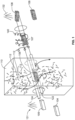
- a casing of polymeric material can be produced by coating a compressed body 104 with micro fibers 112 and curing and/or melt bonding the micro fibers with a heat source 140 to form a web encased body 108.
- a sticky coating or electrostatic charge 131 can be applied to make compressed body 104 a sticky body 105.
- Sticky body 105 can be introduced into a chamber 110 filled with circulating micro fibers 112. While in chamber 110, sticky body 105 can become coated with micro fibers to become a covered body 106.
- Rods 122 and 124 can support bodies passed through chamber 110. Rods 122 and 124 can rotate to cause body 106 to rotate and thus become fully covered in microfibers.
- rods 122 and 124 can be heated. Upon exiting the chamber, covered body 106 can be heated to melt bond and/or cure the microfibers into a continuous network or webbing to form a web encased body 108.
- the heat source 140 can supply IR, UV, and/or convection heat.
- the compressed body can have a reduced oven volatiles content during the process of applying the microfibers.
- the body can have an oven volatiles of less than 60 weight percent prior to applying the microfibers, less than 50 weight percent prior to applying the microfibers, less than 40 weight percent prior to applying the microfibers, less than 30 weight percent prior to applying the microfibers, less than 20 weight percent prior to applying the microfibers, or less than 10 weight percent prior to applying the microfibers.
- a rewetting spray 132 can be applied to raise the oven volatiles to at least 10 weight percent, at least 20 weight percent, at least 30 weight percent, at least 40 weight percent, at least 50 weight percent, or at least 60 weight percent.
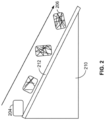
- Figure 2 depicts an alternative way of coating a body 202 with microfibers 212 to form a covered body 206.
- body 204 can roll/tumble down a sloping surface 210 covered with sticky microfibers 212.
- sloping surface 210 can be adapted to vibrate, which can help convey body 204 down the slope and/or provide random orientation of fibers.
- Body 204 will accumulate sticky microfibers 212 on its path down the slope. An amount of microfibers accumulated can be based on an amount of sticky microfibers on the surface and the length of the slope.
- Covered body can be cured and/or melt bonded to form a web encased body as discussed above in reference to Figure 1 .
- a casing of polymeric material be produced by placing a compressed body 104 within polymeric tubes, reducing the diameter of the tubes, and melt bonding and/or curing the tubes to form a mesh encased body.
- a compressed body 304 can be placed in first mesh tube 312a.
- First mesh tube 312a can define a plurality of fenestrations. Once positioned in first mesh tube 312a, the diameter of first mesh tube 312a can be reduced.
- heat 342 can be applied to reduce the diameter of first mesh tube 312a to produce partially covered body 306 having non-covered ends 307.
- Partially covered body 306 can be placed in a second mesh tube 312b such that non-covered ends 307 are positioned adjacent to walls of second mesh tube 312b.
- Heat 344 can again be applied to reduce the diameter of second mesh tube 312b, and optionally to melt-bond the first and second mesh tubes 312a and 312b together, to form mesh encased body 108.
- Exemplary suitable materials for first and second mesh tubes 312a and 312b include PTFE, FEP, nylon, polyolefins, neoprene, EVA (ethyl vinyl acetate), and PVC.
- mesh tubes can also be expanded and reduced by mechanical means.
- first mesh tube 411a can be mechanically expanded using force 450 that increases the diameter to form first expanded mesh tube 412a.
- expanding the diameter can reduce the length of the tube.
- first mesh tube 411a can include bands and connectors that are curved such that they can be reversibly plastically or elastically deformed to expand mesh tube. Bands and connectors in mesh tube 411a can define fenestrations there between.
- Compressed body 404 can be placed in first expanded mesh tube 412a. Once positioned in first expanded mesh tube 412a, the diameter of first expanded mesh tube 412a can be reduced using force 452.
- first expanded mesh tube 412b stretching the length of first expanded mesh tube 412b will reduce the diameter to form partially covered body 406 having uncovered ends 407.
- first expanded mesh tube can be plastically deformed by crimping the first expanded mesh tube 412b.
- first expanded mesh tube 412b is expanded elastically and held in an expanded state until compressed body 304 is in position.
- Partially covered body 406 can be placed in second expanded mesh tube 412b such that non-covered ends 407 are positioned adjacent to walls of second expanded mesh tube 412b.
- Force and/or shape memory 454 can be used to reduce the diameter of second expanded mesh tube 412b to create covered body 408.
- heat can be applied to melt-bond the first and second mesh tubes 412a and 412b together.
- Exemplary suitable materials for first and second mesh tubes 411a and 412b include PE and PP, which can be foamed.
- a mesh or web casing can be printed on a compressed body.
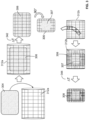
- Figures 5 and 6 depict an example of how 3D printers can be used to cover each side of a compressed body 504 with a mesh casing.
- 3D printer heads 510a, 510b, and 510c can deposit rows of polymer 512a, 512b, and 512c across a top surface of a body to form a partially covered body 505.
- Partially covered body 505 can be rotated 90 degrees in step 520 and 3D printer head 530 can print rows of polymer 532 across to the previously deposited rows of polymer to produce partially covered body 506.
- Partially covered body 506 can be cured (e.g., using UV energy) in step 540 to create cured partially covered body 507.
- Cured partially covered body 507 can be flipped in step 550 and 3D printer head 560 can print rows of polymer 562 to form partially covered body 508.
- Partially covered body 508 can be rotated 90 degrees in step 570 and 3D printer head 580 can print rows of polymer 582 across previously deposited rows of polymer 562 to create covered body 509.
- Covered body 509 can be cured (e.g., using UV energy) in step 590 to mesh cased body 501.
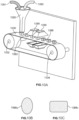
- Figure 6 depicts how the steps of Figure 5 can be conducted on an assembly line.
- a molding device 620 can produce compressed bodies of material (e.g., smokeless tobacco) and deposit them on a conveyor 630 that travels through each process shown in Figure 5 .
- a first section of the conveyor 632 deposits a mesh on five of the six sides before partially covered body 506 enters a UV curing zone 634.
- a second section of the conveyor 636 applies a mesh on a last side of cured partially covered body 507 before covered body 509 enters a second UV curing zone 638 for a final cure.
- Second curing zone 638 can provide a longer cure than first curing zone 634.
- first curing zone 634 can provide a cure time that lasts about 10 second and second curing zone 638 can provide a cure time that lasts about 40 seconds.
- mesh cased bodies can be packaged in packaging section 640.
- spray heads can spray an elastomer (e.g., polyurethane) through hot melt nozzles onto a body.
- elastomer e.g., polyurethane
- the elastomer fibers produced by a hot melt nozzle can air cool on the body to create a fiber encased body.
- compressed bodies can be inserted into a mold with an inscribed webbing pattern, and material injected around the bodies.
- recesses 710 can be formed in a mold cavity adapted to receive compressed body 704.
- injection molded webbing 712 can remain on the body to form encased bodies 708.
- the injected material can be a foamed material. After the pieces are ejected from the mold with the injection molded webbing, each piece can be air and/or heat cured.
- a non- woven net 812 of sticky fibers can be formed and a body 804 projected 820 at a high speed through the web to form an encased body 808.
- Net 812 can be formed between two pistons 810a and 810b by placing a sticky fiber material between pistons 810a and 810b and retracting the pistons to form the net 812.
- Net 812 can have a cob web type appearance.
- encased body 808 is cured.
- a foamed skin casing can be applied to compressed bodies by placing bodies 904 into a bath 960 on a conveyor 930.
- Bath 960 can include a foaming mixture that coats bodies 904 and creates a foam skin.
- Possible materials include polyurethane foam, PVC foam, Styrofoam, and combinations thereof.
- polyurethane foam can be formed using carbon dioxide or another food grade liquid gas as a solvent.
- Figure 9B depicts a porous surface of a foamed skin applied by the bath 960.
- Figures 9C and 9D depict possible product forms 908c and 908d that can be formed using this process.
- a mesh casing can be formed around a compressed body by including a mesh forming material in the body and selectively treating a surface of the body to create the mesh.
- a molding device 1020 can receive a mixture of thermoplastic polymer 1081 and smokeless tobacco 1082 (or similar material) and compress the mixture into a body 1001, which can be deposited on a conveyor 1030. Conveyor, moving between rollers 1032 and 1034, can move body 1001 under curing lamps 1090a, 1090b, 1090c, and 1090d to selectively melt bond and/or cure thermoplastic polymer along exterior surfaces of the compressed body and thus form encased body 1008.
- Figures 10B and IOC depict possible product forms 1008b and 1008c that can be formed using this process.
- Casings provided herein can include any suitable polymer.
- Exemplary polymers include polypropylene, polyurethane, styrene, and/or combinations thereof.
- polypropylene, polyurethane, and styrene can also be compounded together in different ratios.
- polymers can be colored to provide a moist appearance and/or have hydrophilic properties that allow for wicking performance.
- casings provided herein include elastomeric polymers (e.g., polyurethane). Elastomeric polymers can provide mesh and web casings with improved elongation and toughness. In some cases, casings provided herein can provide the unique property of allowing an adult tobacco consumer to reduce or increase a packing density of an encased smokeless tobacco product, which can impact a rate of flavor release. A higher packing density can reduce a rate of flavor release.
- Suitable elastomeric polymers include EPAMOULD (Epaflex), EPALINE (Epafiex), TEXIN (Bayer), DESMOPAN (Bayer), HYDROPHAN (AdvanceSourse Biomaterials), ESTANE (Lubrizol), PELLETHANE (Lubrizol), PEARLTHANE (Merquinsa), IROGRAN (Huntsman), ISOTHANE (Greco), ZYTHANE (Alliance Polymers and Services), VISTAMAX (ExxonMobil), and MD-6717 (Kraton).
- elastomers can be combined with polyolefms at ratios ranging from 1 :9 to 9: 1.
- elastomeric polymers can be combined with polypropylene.
- a blend of polyurethane, polypropylene, and styrene can be compounded and used in methods and machines provided herein.
- Smokeless tobacco is tobacco suitable for use in an orally used tobacco product.
- smokeless tobacco it is meant a part, e.g., leaves, and stems, of a member of the genus Nicotiana that has been processed.
- Exemplary species of tobacco include N. rustica, N. tabacum, N. tomentosiformis, and N. sylvestris.
- Suitable tobaccos include fermented and unfermented tobaccos.
- the tobacco can also be processed using other techniques.
- tobacco can be processed by heat treatment (e.g., cooking, toasting), flavoring, enzyme treatment, expansion and/or curing. Both fermented and non-fermented tobaccos can be processed using these techniques.
- the tobacco can be unprocessed tobacco.
- suitable processed tobaccos include, dark air-cured, dark fire-cured, burley, flue cured, and cigar filler or wrapper, as well as the products from the whole leaf stemming operation.
- smokeless tobacco includes up to 70% dark tobacco on a fresh weight basis.
- Tobacco can be conditioned by heating, sweating and/or pasteurizing steps as described in U.S. Publication Nos. 2004/0118422 or 2005/0178398 .
- fermentation can change the color, texture, and other sensorial attributes (taste) of a leaf.
- evolution gases can be produced, oxygen can be taken up, the pH can change, and the amount of water retained can change. See, for example, U.S. Publication No. 2005/0178398 and Tso (1999, Chapter 1 in Tobacco, Production, Chemistry and Technology, Davis & Nielsen, eds., Blackwell Publishing, Oxford ).
- Cured, or cured and fermented tobacco can be further processed (e.g., cut, expanded, blended, milled or comminuted) prior to incorporation into the smokeless tobacco product.
- the tobacco in some cases, is long cut fermented cured moist tobacco having an oven volatiles content of between 30 and 61 weight percent prior to mixing with the polymeric material and optionally flavorants and other additives.
- the tobacco can, in some cases, be prepared from plants having less than 20 ⁇ g of DVT per cm 2 of green leaf tissue.
- the tobacco particles can be selected from the tobaccos described in U.S. Patent Publication No. 2008/0209586 , which is hereby incorporated by reference.
- Tobacco compositions containing tobacco from such low-DVT varieties exhibits improved flavor characteristics in sensory panel evaluations when compared to tobacco or tobacco compositions that do not have reduced levels of DVTs.
- Green leaf tobacco can be cured using conventional means, e.g., flue-cured, barn- cured, fire-cured, air-cured or sun-cured. See, for example, Tso (1999, Chapter 1 in Tobacco, Production, Chemistry and Technology, Davis & Nielsen, eds., Blackwell Publishing, Oxford ) for a description of different types of curing methods.
- Cured tobacco is usually aged in a wooden drum (i.e., a hogshead) or cardboard cartons in compressed conditions for several years (e.g., two to five years), at a moisture content ranging from 10% to about 25%. See, U.S. Patent Nos. 4,516,590 and 5,372,149 . Cured and aged tobacco then can be further processed.
- Further processing includes conditioning the tobacco under vacuum with or without the introduction of steam at various temperatures, pasteurization, and fermentation. Cure, aged, and fermented smokeless tobacco can be further processed (e.g., cut, shredded, expanded, or blended). See, for example, U.S. Patent Nos. 4,528,993 ; 4,660,577 ; and 4,987,907 .
- the smokeless tobacco can be processed to a desired size.
- long cut smokeless tobacco typically is cut or shredded into widths of about 10 cuts/inch up to about 110 cuts/inch and lengths of about 0.1 inches up to about 1 inch.
- Double cut smokeless tobacco can have a range of particle sizes such that about 70%> of the double cut smokeless tobacco falls between the mesh sizes of -20 mesh and 80 mesh. Other lengths and size distributions are also contemplated.
- the smokeless tobacco can have a total oven volatiles content of about 10% by weight or greater; about 20%> by weight or greater; about 40%> by weight or greater; about 15%o by weight to about 25% by weight; about 20%> by weight to about 30%> by weight; about 30%o by weight to about 50%> by weight; about 45% by weight to about 65 % by weight; or about 50% by weight to about 60% by weight.
- "moist" smokeless tobacco typically refers to tobacco that has an oven volatiles content of between about 30%> by weight and about 61%> by weight (e.g., about 45% by weight to about 55%o by weight, or about 50% by weight).
- oven volatiles are determined by calculating the percentage of weight loss for a sample after drying the sample in a pre- warmed forced draft oven at 110°C for 3.25 hours.
- the encased smokeless tobacco product can have a different overall oven volatiles content than the oven volatiles content of the smokeless tobacco used to make the encased smokeless tobacco product.
- the processing steps described herein can reduce or increase the oven volatiles content.
- the overall oven volatiles content of the encased smokeless tobacco product is discussed below.
- the encased smokeless tobacco product can include between 15 weight percent and 85 weight percent smokeless tobacco on a dry weight basis.
- the amount of smokeless tobacco in encased smokeless tobacco product on a dry weight basis is calculated after drying the product in a pre-warmed forced draft oven at 110°C for 3.25 hours. The remaining nonvolatile material is then separated into tobacco material and polymeric material.
- the percent smokeless tobacco in the encased smokeless tobacco product is calculated as the weight smokeless tobacco divided by the total weight of the non- volatile materials.
- the encased smokeless tobacco product includes between 20 and 60 weight percent tobacco on a dry weight basis.
- the encased smokeless tobacco product includes at least 28 weight percent tobacco on a dry weight basis.
- enrobed product portions produced in methods and/or machines provided herein can be rewet with water and/or a solution of flavorants, sweeteners, and/or other additives discussed herein to wick the coating of polymeric fibers, provide a moist appearance, prove a flavor immediately, and/or to increase a flavor intensity.
- a plant material other than tobacco is used as a tobacco substitute in the pouched products made using machines and methods provided herein.
- the tobacco substitute can be an herbal composition.
- Herbs and other edible plants can be categorized generally as culinary herbs (e.g., thyme, lavender, rosemary, coriander, dill, mint, peppermint) and medicinal herbs (e.g., Dahlias, Cinchona, Foxglove, Meadowsweet, Echinacea, Elderberry, Willow bark).
- culinary herbs e.g., thyme, lavender, rosemary, coriander, dill, mint, peppermint
- medicinal herbs e.g., Dahlias, Cinchona, Foxglove, Meadowsweet, Echinacea, Elderberry, Willow bark.
- the tobacco is replaced with a mixture of non-tobacco plant material.
- Such non-tobacco compositions may have a number of different primary ingredients, including but not limited to, tea leaves, red clover, coconut flakes, mint leaves, ginseng, apple, corn silk, grape leaf, and basil leaf.
- the plant material typically has a total oven volatiles content of about 10% by weight or greater; e.g., about 20%) by weight or greater; about 40%> by weight or greater; about 15% by weight to about 25%) by weight; about 20%> by weight to about 30%> by weight; about 30%> by weight to about 50%) by weight; about 45% by weight to about 65 % by weight; or about 50%> by weight to about 60%) by weight.
- Flavors and other additives can be included in the compositions and arrangements described herein and can be added to the encased smokeless tobacco product at any point in the process.
- any of the initial components, including the polymeric material can be provided in a flavored form.
- flavorants and/or other additives are included in the smokeless tobacco.
- flavorants and/or other additives are absorbed into to the encased smokeless tobacco product after pouching.
- flavorants and/or other additives are mixed with the polymeric material (e.g., with structural fibers) prior to melt-blowing the fibers and/or as the fibers exit the spinnerets.
- Suitable flavorants include wintergreen, cherry and berry type flavorants, various liqueurs and liquors such as Drambuie, bourbon, scotch, whiskey, spearmint, peppermint, lavender, cinnamon, cardamom, apium graveolents, clove, cascarilla, nutmeg, sandalwood, bergamot, geranium, honey essence, rose oil, vanilla, lemon oil, orange oil, Japanese mint, cassia, caraway, cognac, jasmine, chamomile, menthol, ilangilang, sage, fennel, piment, ginger, anise, coriander, coffee, liquorish, and mint oils from a species of the genus Mentha.
- Mint oils useful in particular embodiments of the encased smokeless tobacco products include spearmint and peppermint.
- Flavorants can also be included in the form of flavor beads, which can be dispersed within the encased smokeless tobacco product (e.g., in a nonwoven network of polymeric structural fibers).
- the encased smokeless tobacco product could include the beads described in U.S. Patent Application Publication 2010/0170522 , which is hereby incorporated by reference.
- the amount of flavorants in the encased smokeless tobacco product is limited to less than 30 weight percent in sum. In some cases, the amount of flavorants in the encased smokeless tobacco product can be limited to be less than 5 weight percent in sum. For example, certain flavorants can be included in the encased smokeless tobacco product in amounts of about 3 weight percent.
- additives can include but are not limited to fillers (e.g., starch, di- calcium phosphate, lactose, sorbitol, mannitol, and microcrystalline cellulose), soluble fiber (e.g., Fibersol from Matsushita), calcium carbonate, dicalcium phosphate, calcium sulfate, and clays), sodium chloride, lubricants (e.g., lecithin, stearic acid, hydrogenated vegetable oil, mineral oil, polyethylene glycol 4000-6000 (PEG), sodium lauryl sulfate (SLS), glyceryl palmitostearate, sodium benzoate, sodium stearyl fumarate, talc, and stearates (e.g., Mg or K), and waxes (e.g., glycerol monostearate, propylene glycol monostearate, and acetylated monoglycerides)), plasticizers (e.g., glycerine, propy
- Oven volatiles such as water
- flavorants and other additives are included in a hydrating liquid.
- the encased smokeless tobacco product can have a total oven volatiles content of between 10 and 61 weight percent. In some cases, the total oven volatiles content is at least 40 weight percent.
- the oven volatiles include water and other volatile compounds, which can be a part of the tobacco, the polymeric material, the flavorants, and/or other additives.
- the "oven volatiles" are determined by calculating the percentage of weight loss for a sample after drying the sample in a pre-warmed forced draft oven at 110 °C for 3.25 hours. Some of the processes may reduce the oven volatiles content (e.g., heating the composite or contacting the smokeless tobacco with a heated polymeric material), but the processes can be controlled to have an overall oven volatiles content in a desired range.
- the oven volatiles content of the composite encased smokeless tobacco product is between 50 and 61 weight percent.
- the oven volatiles content of smokeless tobacco used in the various processed described herein can be about 57 weight percent. In other embodiments, the oven volatiles content can be between 10 and 30 weight percent.
Landscapes
- Engineering & Computer Science (AREA)
- Chemical & Material Sciences (AREA)
- Chemical Kinetics & Catalysis (AREA)
- General Chemical & Material Sciences (AREA)
- Mechanical Engineering (AREA)
- Health & Medical Sciences (AREA)
- General Health & Medical Sciences (AREA)
- Toxicology (AREA)
- Physics & Mathematics (AREA)
- Plasma & Fusion (AREA)
- Manufacture Of Tobacco Products (AREA)
- Laminated Bodies (AREA)
Applications Claiming Priority (4)
| Application Number | Priority Date | Filing Date | Title |
|---|---|---|---|
| US201461953387P | 2014-03-14 | 2014-03-14 | |
| EP21187074.6A EP3957190B1 (fr) | 2014-03-14 | 2015-03-13 | Produits de tabac sans fumée gainés de polymères |
| EP15712499.1A EP3116330B1 (fr) | 2014-03-14 | 2015-03-13 | Produits de tabac sans fumée gainés de polymères |
| PCT/US2015/020449 WO2015138899A2 (fr) | 2014-03-14 | 2015-03-13 | Produits de tabac sans fumée gainés de polymères |
Related Parent Applications (2)
| Application Number | Title | Priority Date | Filing Date |
|---|---|---|---|
| EP21187074.6A Division EP3957190B1 (fr) | 2014-03-14 | 2015-03-13 | Produits de tabac sans fumée gainés de polymères |
| EP15712499.1A Division EP3116330B1 (fr) | 2014-03-14 | 2015-03-13 | Produits de tabac sans fumée gainés de polymères |
Publications (2)
| Publication Number | Publication Date |
|---|---|
| EP4458169A2 true EP4458169A2 (fr) | 2024-11-06 |
| EP4458169A3 EP4458169A3 (fr) | 2025-01-15 |
Family
ID=52823787
Family Applications (3)
| Application Number | Title | Priority Date | Filing Date |
|---|---|---|---|
| EP24195267.0A Pending EP4458169A3 (fr) | 2014-03-14 | 2015-03-13 | Produits de tabac sans fumée gainés de polymères |
| EP21187074.6A Active EP3957190B1 (fr) | 2014-03-14 | 2015-03-13 | Produits de tabac sans fumée gainés de polymères |
| EP15712499.1A Active EP3116330B1 (fr) | 2014-03-14 | 2015-03-13 | Produits de tabac sans fumée gainés de polymères |
Family Applications After (2)
| Application Number | Title | Priority Date | Filing Date |
|---|---|---|---|
| EP21187074.6A Active EP3957190B1 (fr) | 2014-03-14 | 2015-03-13 | Produits de tabac sans fumée gainés de polymères |
| EP15712499.1A Active EP3116330B1 (fr) | 2014-03-14 | 2015-03-13 | Produits de tabac sans fumée gainés de polymères |
Country Status (4)
| Country | Link |
|---|---|
| US (6) | US9896228B2 (fr) |
| EP (3) | EP4458169A3 (fr) |
| CA (2) | CA3181428A1 (fr) |
| WO (1) | WO2015138899A2 (fr) |
Families Citing this family (2)
| Publication number | Priority date | Publication date | Assignee | Title |
|---|---|---|---|---|
| WO2017113106A1 (fr) * | 2015-12-29 | 2017-07-06 | 深圳瀚星翔科技有限公司 | Cigarette électronique et ensemble d'atomisation s'y rapportant |
| EP4230684A1 (fr) * | 2022-02-18 | 2023-08-23 | Salamander SPS GmbH & Co. KG | Matériau composite avec vecteur aromatique |
Citations (10)
| Publication number | Priority date | Publication date | Assignee | Title |
|---|---|---|---|---|
| US4516590A (en) | 1982-11-26 | 1985-05-14 | Philip Morris Incorporated | Air-cured bright tobacco filler, blends and smoking articles |
| US4528993A (en) | 1982-08-20 | 1985-07-16 | R. J. Reynolds Tobacco Company | Process for producing moist snuff |
| US4660577A (en) | 1982-08-20 | 1987-04-28 | R.J. Reynolds Tobacco Company | Dry pre-mix for moist snuff |
| US4987907A (en) | 1988-06-29 | 1991-01-29 | Helme Tobacco Company | Chewing tobacco composition and process for producing same |
| US5372149A (en) | 1992-03-25 | 1994-12-13 | Roth; David S. | Sterilization process in the manufacturing of snuff |
| US20040118422A1 (en) | 2002-12-19 | 2004-06-24 | Swedish Match North Europe Ab | Tobacco dough and a method for its manufacture |
| US20050178398A1 (en) | 2003-12-22 | 2005-08-18 | U.S. Smokeless Tobacco Company | Conditioning process for tobacco and/or snuff compositions |
| US20080209586A1 (en) | 2007-02-23 | 2008-08-28 | U.S. Smokeless Tobacco Company | Novel tobacco compositions and methods of making |
| EP2033895A1 (fr) * | 2007-09-04 | 2009-03-11 | Amotek S.r.l. | Procédé et appareil d'emballage, en particulier pour des éléments substantiellement cylindriques |
| US20100170522A1 (en) | 2008-12-19 | 2010-07-08 | U.S. Smokeless Tobacco Company | Tobacco Granules and Method of Producing Tobacco Granules |
Family Cites Families (96)
| Publication number | Priority date | Publication date | Assignee | Title |
|---|---|---|---|---|
| US2734509A (en) | 1956-02-14 | Wetting | ||
| US2580609A (en) | 1950-08-02 | 1952-01-01 | Ecusta Paper Corp | Cigarette paper |
| US3354863A (en) | 1963-10-28 | 1967-11-28 | Dow Chemical Co | Apparatus for coating particulate materials |
| US3354013A (en) * | 1963-11-26 | 1967-11-21 | Eastman Kodak Co | Method and apparatus for applying particulate additives to continuous filament tow |
| GB1472286A (en) | 1973-05-05 | 1977-05-04 | Focke Pfuhl Verpack Automat | Dispensing of portions of fibrous material |
| DE2557313C2 (de) | 1975-12-19 | 1983-12-08 | Hauni-Werke Körber & Co KG, 2050 Hamburg | Tabakschneider |
| US4205750A (en) * | 1978-11-09 | 1980-06-03 | The Dews Co., Inc. | Double-seal container and method |
| US4380570A (en) | 1980-04-08 | 1983-04-19 | Schwarz Eckhard C A | Apparatus and process for melt-blowing a fiberforming thermoplastic polymer and product produced thereby |
| US4405688A (en) | 1982-02-18 | 1983-09-20 | Celanese Corporation | Microporous hollow fiber and process and apparatus for preparing such fiber |
| US4526733A (en) | 1982-11-17 | 1985-07-02 | Kimberly-Clark Corporation | Meltblown die and method |
| US4606357A (en) * | 1984-11-19 | 1986-08-19 | Dusek Russell L | Tobacco composition |
| US4848373A (en) | 1987-04-13 | 1989-07-18 | Helme Tobacco Company | Nicotine removal process and product produced thereby |
| GB8723447D0 (en) | 1987-10-06 | 1987-11-11 | Johnson & Johnson Ltd | Wound dressing |
| US4940464A (en) | 1987-12-16 | 1990-07-10 | Kimberly-Clark Corporation | Disposable incontinence garment or training pant |
| JP2848684B2 (ja) | 1989-11-16 | 1999-01-20 | ゲブリユーダー ズルツアー アクチエンゲゼルシヤフト | よこ糸分配機構 |
| US5063104A (en) | 1990-01-03 | 1991-11-05 | The Dexter Corporation | Fibrous base web bonding system and method |
| JP3016434B2 (ja) | 1990-08-02 | 2000-03-06 | 味の素株式会社 | 立体型食品の製造方法 |
| CA2120549C (fr) | 1993-08-18 | 1996-07-02 | Richard Frank Vincelli | Table de balcon pliante |
| JP2886342B2 (ja) | 1994-01-27 | 1999-04-26 | アエロマティック−フィールダー・アクチェンゲゼルシャフト | 固体粒子コーティング装置 |
| US5476616A (en) | 1994-12-12 | 1995-12-19 | Schwarz; Eckhard C. A. | Apparatus and process for uniformly melt-blowing a fiberforming thermoplastic polymer in a spinnerette assembly of multiple rows of spinning orifices |
| US5645790A (en) | 1996-02-20 | 1997-07-08 | Biax-Fiberfilm Corporation | Apparatus and process for polygonal melt-blowing die assemblies for making high-loft, low-density webs |
| DE19609143C1 (de) | 1996-03-08 | 1997-11-13 | Rhodia Ag Rhone Poulenc | Melt-blown-Vlies, Verfahren zu dessen Herstellung und dessen Verwendungen |
| US6013223A (en) | 1998-05-28 | 2000-01-11 | Biax-Fiberfilm Corporation | Process and apparatus for producing non-woven webs of strong filaments |
| TWI248820B (en) | 1999-03-03 | 2006-02-11 | Nitto Denko Corp | Oral adhesive sheet and oral adhesive preparation |
| EP1035239B1 (fr) | 1999-03-08 | 2005-05-11 | The Procter & Gamble Company | Structure absorbente et flexible comprenant des fibres d' amidon |
| US6607598B2 (en) | 1999-04-19 | 2003-08-19 | Scimed Life Systems, Inc. | Device for protecting medical devices during a coating process |
| WO2000074503A1 (fr) | 1999-06-04 | 2000-12-14 | Japan Tobacco Inc. | Tabac en feuille et procede et systeme de production |
| US6716498B2 (en) | 1999-12-21 | 2004-04-06 | The Procter & Gamble Company | Applications for substance encapsulating laminate web |
| US6524442B2 (en) | 1999-12-29 | 2003-02-25 | Kimberly-Clark Worldwide, Inc. | Apparatus for forming and metering fluff pulp |
| KR20020086716A (ko) | 2000-03-27 | 2002-11-18 | 다우 글로벌 테크놀로지스 인크. | 고변형률 신장률을 갖는 폴리프로필렌 직물을 제조하는방법 및 이를 사용하는 방법 |
| JP2002176964A (ja) | 2000-12-13 | 2002-06-25 | Japan Tobacco Inc | シートたばこ、その製造方法及び製造装置 |
| NL1020185C2 (nl) | 2001-03-16 | 2003-01-28 | Farm Frites Nederland B V | Draaiend trommelsysteem voor met beslag bedekken van patatrepen. |
| US20030194939A1 (en) | 2002-04-16 | 2003-10-16 | Schwarz Eckhard C.A. | Fibrous webs of bi-component melt-blown fibers of thermoplastic polymers from a bi-component spinnerette assembly of multiple rows of spinning orifices |
| ATE377361T1 (de) | 2002-08-16 | 2007-11-15 | Hauni Maschinenbau Ag | Verfahren und einrichtung zum zuführen eines, vorzugsweise flüssigen, zusatzstoffes auf eine bewegte, ausgebreitete bahn aus filtermaterial |
| US20050217092A1 (en) | 2002-12-03 | 2005-10-06 | Barker James R | Anchoring loops of fibers needled into a carrier sheet |
| US20050196580A1 (en) | 2002-12-03 | 2005-09-08 | Provost George A. | Loop materials |
| US7465366B2 (en) | 2002-12-03 | 2008-12-16 | Velero Industries B.V. | Needling loops into carrier sheets |
| US20050196583A1 (en) | 2002-12-03 | 2005-09-08 | Provost George A. | Embossing loop materials |
| US7547469B2 (en) | 2002-12-03 | 2009-06-16 | Velcro Industries B.V. | Forming loop materials |
| ES2302974T3 (es) | 2002-12-03 | 2008-08-01 | Velcro Industries B.V. | Perforacion con aguja a traves de laminas de soporte para formar bucles. |
| US8753459B2 (en) | 2002-12-03 | 2014-06-17 | Velcro Industries B.V. | Needling loops into carrier sheets |
| KR100803798B1 (ko) | 2002-12-16 | 2008-02-14 | 군제 가부시키가이샤 | 의료용 필름 |
| US20040118421A1 (en) | 2002-12-19 | 2004-06-24 | Swedish Match North Europe Ab | New product and a method for its manufacture |
| US20050056956A1 (en) | 2003-09-16 | 2005-03-17 | Biax Fiberfilm Corporation | Process for forming micro-fiber cellulosic nonwoven webs from a cellulose solution by melt blown technology and the products made thereby |
| DE10346649A1 (de) | 2003-10-08 | 2005-05-12 | Reemtsma H F & Ph | Tabakportion sowie Verfahren zum Herstellen von Tabakportionen |
| US8469036B2 (en) | 2003-11-07 | 2013-06-25 | U.S. Smokeless Tobacco Company Llc | Tobacco compositions |
| US8627828B2 (en) | 2003-11-07 | 2014-01-14 | U.S. Smokeless Tobacco Company Llc | Tobacco compositions |
| WO2005073442A1 (fr) | 2004-02-02 | 2005-08-11 | Raisio Chemicals Korea Inc. | Processus de preparation de filament continu compose de nanofibres |
| KR100578764B1 (ko) | 2004-03-23 | 2006-05-11 | 김학용 | 상향식 전기방사장치 및 이를 이용하여 제조된 나노섬유 |
| SE0402258D0 (sv) | 2004-05-07 | 2004-09-17 | Katarina Saend | Portionssnus |
| US7856989B2 (en) | 2004-12-30 | 2010-12-28 | Philip Morris Usa Inc. | Electrostatically produced fast dissolving fibers |
| FR2880330B1 (fr) * | 2004-12-30 | 2009-09-18 | Sleever Internat Company Sa | Procede d'emballage d'objet(s) au moyen de manchons thermo-retractables, et enveloppe d'emballage associee |
| US7562426B2 (en) | 2005-04-08 | 2009-07-21 | Velcro Industries B.V. | Needling loops into carrier sheets |
| US9044049B2 (en) | 2005-04-29 | 2015-06-02 | Philip Morris Usa Inc. | Tobacco pouch product |
| US20060292271A1 (en) | 2005-06-27 | 2006-12-28 | Peter King | Spray coating method and apparatus |
| US20070062549A1 (en) | 2005-09-22 | 2007-03-22 | Holton Darrell E Jr | Smokeless tobacco composition |
| EP1926401B1 (fr) | 2005-09-22 | 2014-01-15 | R. J. Reynolds Tobacco Company | Composition de tabac qui ne se fume pas |
| US7810507B2 (en) | 2006-02-10 | 2010-10-12 | R. J. Reynolds Tobacco Company | Smokeless tobacco composition |
| US20080029116A1 (en) | 2006-08-01 | 2008-02-07 | John Howard Robinson | Smokeless tobacco |
| US8602036B2 (en) | 2006-08-03 | 2013-12-10 | Philip Morris Usa Inc. | Smoking articles enhanced to deliver additives incorporated within electrospun microfibers and nonofibers, and related methods |
| KR100857523B1 (ko) | 2007-07-03 | 2008-09-08 | 파인텍스테크놀로지글로벌리미티드 | 전기방사장치의 방사 조건의 조절 방법 |
| WO2008136581A1 (fr) | 2007-05-07 | 2008-11-13 | Finetex Technology Global Limited | Procédé de fabrication d'une nanofibre uniforme |
| US8673097B2 (en) | 2007-06-07 | 2014-03-18 | Velcro Industries B.V. | Anchoring loops of fibers needled into a carrier sheet |
| US20080308115A1 (en) | 2007-06-08 | 2008-12-18 | Philip Morris Usa Inc. | Oral pouched products including tobacco beads |
| US9888712B2 (en) | 2007-06-08 | 2018-02-13 | Philip Morris Usa Inc. | Oral pouch products including a liner and tobacco beads |
| US20080302682A1 (en) | 2007-06-11 | 2008-12-11 | Radi Medical Biodegradable Ab | Pouch for tobacco or tobacco substitute |
| US8119173B2 (en) | 2007-07-16 | 2012-02-21 | Philip Morris Usa Inc. | Method of flavor encapsulation through the use of a drum coater |
| CN101873809B (zh) | 2007-07-23 | 2014-11-12 | R.J.雷诺兹烟草公司 | 无烟烟草组合物 |
| WO2009048522A1 (fr) | 2007-10-11 | 2009-04-16 | Richard Fuisz | Produit à base de tabac n'émettant pas de fumée |
| MX2010004871A (es) | 2007-11-16 | 2010-06-02 | Nestec Sa | Cobertura de chocolate reducida en grasa formada por aspersion. |
| PL2062484T3 (pl) | 2007-11-23 | 2011-07-29 | Reemtsma Cigarettenfabriken Gmbh | Sposób wytwarzania wyrobów tytoniowych nieprzeznaczonych do palenia i wyrób tytoniowy nieprzeznaczony do palenia do spożycia doustnego |
| JP2009203412A (ja) | 2008-02-29 | 2009-09-10 | Inoac Corp | 吸水性ポリウレタン発泡体 |
| CN101548797B (zh) | 2008-03-31 | 2011-12-07 | 湖北中烟工业有限责任公司 | 一种含烟及其制作方法 |
| US8029260B2 (en) | 2008-04-11 | 2011-10-04 | Reifenhauser Gmbh & Co. Kg Maschinenfabrik | Apparatus for extruding cellulose fibers |
| US8029259B2 (en) | 2008-04-11 | 2011-10-04 | Reifenhauser Gmbh & Co. Kg Maschinenfabrik | Array of nozzles for extruding multiple cellulose fibers |
| US8303888B2 (en) | 2008-04-11 | 2012-11-06 | Reifenhauser Gmbh & Co. Kg | Process of forming a non-woven cellulose web and a web produced by said process |
| US20100018539A1 (en) | 2008-07-28 | 2010-01-28 | Paul Andrew Brinkley | Smokeless tobacco products and processes |
| US20100018882A1 (en) | 2008-07-28 | 2010-01-28 | St Charles Frank K | Smokeless tobacco products and processes |
| US20100018883A1 (en) | 2008-07-28 | 2010-01-28 | Pankaj Patel | Smokeless tobacco products and processes |
| DK2389079T3 (da) * | 2008-12-31 | 2013-10-21 | Us Smokeless Tobacco Co | Røgfrie tobaksartikler |
| CN102300883B (zh) | 2009-01-29 | 2014-08-20 | 埃克森美孚化学专利公司 | 聚丙烯非织造纤维和织物及其制造方法 |
| US9687023B2 (en) * | 2009-10-09 | 2017-06-27 | Philip Morris Usa Inc. | Moist smokeless tobacco product for oral usage having on a portion of the outer surface at least one friction reducing strip that provides texture during use |
| US8539958B2 (en) * | 2009-10-13 | 2013-09-24 | Philip Morris Usa Inc. | Oral moist smokeless tobacco products with net-structured gel coating and methods of making |
| US20110220130A1 (en) | 2009-12-15 | 2011-09-15 | John-Paul Mua | Tobacco Product And Method For Manufacture |
| US9623988B2 (en) | 2010-03-26 | 2017-04-18 | Philip Morris Usa Inc. | High speed poucher |
| CA2796346C (fr) * | 2010-04-14 | 2018-10-02 | Altria Client Services Inc. | Produit de tabac sans fumee preforme |
| CN103458715B (zh) | 2010-08-05 | 2017-11-03 | 奥驰亚客户服务公司 | 一种无烟烟草产品以及其使用和制作方法 |
| BR112013002843A2 (pt) * | 2010-08-05 | 2016-06-07 | Altria Client Services Inc | produtos, sistemas e métodos compostos à base de tabaco não fumígeno |
| US8931493B2 (en) | 2010-11-01 | 2015-01-13 | R.J. Reynolds Tobacco Co. | Smokeless tobacco products |
| JP5860603B2 (ja) | 2011-03-18 | 2016-02-16 | 国立大学法人信州大学 | セパレーター製造装置 |
| JP5798346B2 (ja) | 2011-03-20 | 2015-10-21 | 国立大学法人信州大学 | セパレーターの製造方法 |
| US9854831B2 (en) * | 2012-01-20 | 2018-01-02 | Altria Client Services Llc | Oral product |
| US12285025B2 (en) * | 2012-02-10 | 2025-04-29 | R.J. Reynolds Tobacco Company | Multi-layer smokeless tobacco composition |
| US9386800B2 (en) * | 2012-09-21 | 2016-07-12 | R.J. Reynolds Tobacco Company | Fibrous composite tobacco-containing materials |
| WO2014159403A1 (fr) | 2013-03-14 | 2014-10-02 | Altria Client Services Inc. | Article à tabac sans fumée |
| CN103551046B (zh) | 2013-11-11 | 2016-03-23 | 天津风云水资源科技有限公司 | 一种疏水性氨氮脱除膜的制备方法 |
-
2015
- 2015-03-13 EP EP24195267.0A patent/EP4458169A3/fr active Pending
- 2015-03-13 US US14/657,018 patent/US9896228B2/en active Active
- 2015-03-13 CA CA3181428A patent/CA3181428A1/fr active Pending
- 2015-03-13 EP EP21187074.6A patent/EP3957190B1/fr active Active
- 2015-03-13 EP EP15712499.1A patent/EP3116330B1/fr active Active
- 2015-03-13 CA CA2942870A patent/CA2942870C/fr active Active
- 2015-03-13 WO PCT/US2015/020449 patent/WO2015138899A2/fr not_active Ceased
-
2018
- 2018-02-20 US US15/899,889 patent/US10384816B2/en active Active
-
2019
- 2019-07-10 US US16/507,680 patent/US11198151B2/en active Active
-
2021
- 2021-10-25 US US17/509,613 patent/US11731162B2/en active Active
-
2023
- 2023-07-31 US US18/362,032 patent/US12151260B2/en active Active
-
2024
- 2024-11-19 US US18/951,846 patent/US20250073747A1/en active Pending
Patent Citations (10)
| Publication number | Priority date | Publication date | Assignee | Title |
|---|---|---|---|---|
| US4528993A (en) | 1982-08-20 | 1985-07-16 | R. J. Reynolds Tobacco Company | Process for producing moist snuff |
| US4660577A (en) | 1982-08-20 | 1987-04-28 | R.J. Reynolds Tobacco Company | Dry pre-mix for moist snuff |
| US4516590A (en) | 1982-11-26 | 1985-05-14 | Philip Morris Incorporated | Air-cured bright tobacco filler, blends and smoking articles |
| US4987907A (en) | 1988-06-29 | 1991-01-29 | Helme Tobacco Company | Chewing tobacco composition and process for producing same |
| US5372149A (en) | 1992-03-25 | 1994-12-13 | Roth; David S. | Sterilization process in the manufacturing of snuff |
| US20040118422A1 (en) | 2002-12-19 | 2004-06-24 | Swedish Match North Europe Ab | Tobacco dough and a method for its manufacture |
| US20050178398A1 (en) | 2003-12-22 | 2005-08-18 | U.S. Smokeless Tobacco Company | Conditioning process for tobacco and/or snuff compositions |
| US20080209586A1 (en) | 2007-02-23 | 2008-08-28 | U.S. Smokeless Tobacco Company | Novel tobacco compositions and methods of making |
| EP2033895A1 (fr) * | 2007-09-04 | 2009-03-11 | Amotek S.r.l. | Procédé et appareil d'emballage, en particulier pour des éléments substantiellement cylindriques |
| US20100170522A1 (en) | 2008-12-19 | 2010-07-08 | U.S. Smokeless Tobacco Company | Tobacco Granules and Method of Producing Tobacco Granules |
Non-Patent Citations (1)
| Title |
|---|
| TSO: "Tobacco, Production, Chemistry and Technology", 1999, BLACKWELL PUBLISHING |
Also Published As
| Publication number | Publication date |
|---|---|
| EP3957190A3 (fr) | 2022-05-04 |
| CA2942870C (fr) | 2023-01-31 |
| EP3957190B1 (fr) | 2024-08-21 |
| WO2015138899A2 (fr) | 2015-09-17 |
| CA3181428A1 (fr) | 2015-09-17 |
| EP3116330B1 (fr) | 2021-08-11 |
| EP4458169A3 (fr) | 2025-01-15 |
| US20230372967A1 (en) | 2023-11-23 |
| US20250073747A1 (en) | 2025-03-06 |
| WO2015138899A3 (fr) | 2015-11-05 |
| US20190329916A1 (en) | 2019-10-31 |
| US20180170593A1 (en) | 2018-06-21 |
| EP3957190A2 (fr) | 2022-02-23 |
| EP3116330A2 (fr) | 2017-01-18 |
| US11731162B2 (en) | 2023-08-22 |
| CA2942870A1 (fr) | 2015-09-17 |
| US9896228B2 (en) | 2018-02-20 |
| US20150257442A1 (en) | 2015-09-17 |
| US10384816B2 (en) | 2019-08-20 |
| US20220040729A1 (en) | 2022-02-10 |
| US11198151B2 (en) | 2021-12-14 |
| US12151260B2 (en) | 2024-11-26 |
Similar Documents
| Publication | Publication Date | Title |
|---|---|---|
| US12193473B2 (en) | Product portion enrobing machines and methods | |
| US11812776B2 (en) | Methods and machines for pouching smokeless tobacco and tobacco substitute products | |
| US20250073747A1 (en) | Polymer encased smokeless tobacco products |
Legal Events
| Date | Code | Title | Description |
|---|---|---|---|
| PUAI | Public reference made under article 153(3) epc to a published international application that has entered the european phase |
Free format text: ORIGINAL CODE: 0009012 |
|
| STAA | Information on the status of an ep patent application or granted ep patent |
Free format text: STATUS: THE APPLICATION HAS BEEN PUBLISHED |
|
| AC | Divisional application: reference to earlier application |
Ref document number: 3116330 Country of ref document: EP Kind code of ref document: P Ref document number: 3957190 Country of ref document: EP Kind code of ref document: P |
|
| AK | Designated contracting states |
Kind code of ref document: A2 Designated state(s): AL AT BE BG CH CY CZ DE DK EE ES FI FR GB GR HR HU IE IS IT LI LT LU LV MC MK MT NL NO PL PT RO RS SE SI SK SM TR |
|
| REG | Reference to a national code |
Ref country code: DE Ref legal event code: R079 Free format text: PREVIOUS MAIN CLASS: A24B0015280000 Ipc: A24B0013000000 |
|
| PUAL | Search report despatched |
Free format text: ORIGINAL CODE: 0009013 |
|
| AK | Designated contracting states |
Kind code of ref document: A3 Designated state(s): AL AT BE BG CH CY CZ DE DK EE ES FI FR GB GR HR HU IE IS IT LI LT LU LV MC MK MT NL NO PL PT RO RS SE SI SK SM TR |
|
| RIC1 | Information provided on ipc code assigned before grant |
Ipc: A24B 15/28 20060101ALI20241209BHEP Ipc: A24B 15/18 20060101ALI20241209BHEP Ipc: A24B 13/00 20060101AFI20241209BHEP |
|
| STAA | Information on the status of an ep patent application or granted ep patent |
Free format text: STATUS: REQUEST FOR EXAMINATION WAS MADE |
|
| 17P | Request for examination filed |
Effective date: 20250715 |
|
| STAA | Information on the status of an ep patent application or granted ep patent |
Free format text: STATUS: EXAMINATION IS IN PROGRESS |
|
| 17Q | First examination report despatched |
Effective date: 20251222 |