EP4458231A1 - Bac de douche - Google Patents
Bac de douche Download PDFInfo
- Publication number
- EP4458231A1 EP4458231A1 EP24169196.3A EP24169196A EP4458231A1 EP 4458231 A1 EP4458231 A1 EP 4458231A1 EP 24169196 A EP24169196 A EP 24169196A EP 4458231 A1 EP4458231 A1 EP 4458231A1
- Authority
- EP
- European Patent Office
- Prior art keywords
- shower
- recess
- shower tray
- drain opening
- tray
- Prior art date
- Legal status (The legal status is an assumption and is not a legal conclusion. Google has not performed a legal analysis and makes no representation as to the accuracy of the status listed.)
- Pending
Links
Images

Classifications
-
- A—HUMAN NECESSITIES
- A47—FURNITURE; DOMESTIC ARTICLES OR APPLIANCES; COFFEE MILLS; SPICE MILLS; SUCTION CLEANERS IN GENERAL
- A47K—SANITARY EQUIPMENT; ACCESSORIES THEREFOR, e.g. TOILET ACCESSORIES
- A47K3/00—Baths; Showers; Appurtenances therefor
- A47K3/28—Showers or bathing douches
- A47K3/40—Pans or trays
-
- A—HUMAN NECESSITIES
- A47—FURNITURE; DOMESTIC ARTICLES OR APPLIANCES; COFFEE MILLS; SPICE MILLS; SUCTION CLEANERS IN GENERAL
- A47K—SANITARY EQUIPMENT; ACCESSORIES THEREFOR, e.g. TOILET ACCESSORIES
- A47K3/00—Baths; Showers; Appurtenances therefor
- A47K3/28—Showers or bathing douches
- A47K3/40—Pans or trays
- A47K3/405—Pans or trays flush with the surrounding floor, e.g. for easy access
Definitions
- the present invention relates to a shower tray, with a drain opening and a shower surface that can be supplied with shower water and is inclined to the horizontal in the direction of the drain opening, wherein the shower surface has a recess that runs from the drain opening to an opposite edge section and two standing surfaces, wherein the recess runs between the two standing surfaces, which have a gradient perpendicular to and in the direction of the recess, so that the shower water is at least partially directed into the recess.
- DE 10 2020 119 260 A1 discloses, for example, a shower tray having a shower surface which is inclined all the way around in the direction of a centrally arranged drain opening.
- CH 705 943 B1 shows a shower tray which is designed in such a way that the formation of a drain opening in the shower tray can be avoided.
- the shower tray has a shower surface with a gradient in the direction of a side edge of the shower tray, whereby the shower surface is limited by side walls which are vertical or slanted in the direction of the shower surface.
- a shower tray is shown that has a gradient that runs from the standing surfaces of the shower tray into a centrally located recess from which the water can drain from the shower surface of the shower tray. This avoids DE 10 2021 103 470 A1 both the use of an incline of the shower surface in the direction of the drain, as well as the creation of a drain opening.
- shower trays according to the state of the art is that shower water can only drain out of the shower tray slowly and that after the shower water has drained away, puddles of water residue can remain that evaporate only slowly, which can lead to dirt, difficult-to-remove traces of limescale, rust and/or the formation of mould.
- its gradient can be increased. This increases the height of the shower tray, especially its installation height. This can cause space problems.
- the present invention solves this problem with a shower tray having the features of claim 1.
- the shower tray comprises a drain opening and a shower surface that can be exposed to shower water and is inclined to the horizontal in the direction of the drain opening, the shower surface having a recess that runs from the drain opening to an opposite edge section that is remote from the drain opening, and two standing surfaces.
- the recess runs between the two standing surfaces, which have a gradient that is perpendicular and in the direction of the recess, so that the shower water is at least partially directed into the recess. This enables the shower water to drain quickly from the standing surfaces.
- the recess is inclined in the direction of the drain opening so that the shower water drains from the standing surfaces via the recess through the drain opening.
- the volume flow and/or the drainage speed, the time that the shower water needs to drain from the shower tray; also called the drainage capacity, of the shower water from the shower tray is increased.
- the shower water can surprisingly drain particularly quickly and completely out of the shower tray, which, for example, accelerates the drying of the shower tray and reduces the formation of limescale or dirt residues, particularly on the standing surfaces.
- the depression runs between the two standing surfaces, which shortens the distance that the shower water has to travel to drain from the standing surfaces into the depression, compared to the distance to the drain opening, and leads to a particularly rapid drainage of the shower water from both standing surfaces.
- the surface of the depression preferably runs essentially in one plane, so that it can be advantageously designed.
- the shower tray particularly preferably comprises or consists of enamelled sheet steel. This means that the shower tray can be particularly robust and have a particularly high-quality appearance.
- the shower tray is preferably a molded body made from sheet steel and then enamelled.
- the recess is arranged perpendicular to its longitudinal direction, preferably in the middle, in particular in a section between 30% and 70%, preferably from 40% to 60% and particularly preferably from 45% to 55% of the shower surface. This enables the arrangement of the recess to be optimized, in particular between the standing areas, for example to its space requirements depending on the amount of shower water and/or the size of the standing areas.
- the recess is linear or strip-shaped and/or the recess can in particular have a width of about 0 cm to 50 cm and preferably about 5 cm to 40 cm and even more preferably about 10 cm to 35 cm and particularly preferably about 15 cm to 25 cm, so that the dimensions of the recess and/or the shower tray can be selected, for example, to suit the space available for installing the shower tray and/or the amount (volume) of shower water to be absorbed.
- the depression is arranged in its deepest region in the direction perpendicular to its longitudinal extension in the vertical direction, in particular at least 0.5 cm to 5 cm and preferably between 1 cm and 3 cm and particularly preferably between 1.5 cm and 2.5 cm below the highest point of the shower surface in the vertical direction and/or the closest edge section. This allows the design of the depression and/or its capacity for receiving shower water to be advantageously selected.
- the drain opening is arranged on an edge section of the shower surface, i.e. in a plan view of the shower surface on the edge but within the shower surface, so that the recess is preferably only inclined in one direction.
- the distance between the edge of the drain opening and the nearest edge of the shower surface can be, for example, between 10 mm and 200 mm, in particular 20 mm and 100 mm.
- the recess is formed in a cross-section perpendicular to its inclination in the direction of the drain opening, or a transition from the standing areas to the recess is formed in a curved or stepless manner.
- the shower area has no corners or edges.
- the recess is preferably inclined in the direction of the drain opening, in particular by 0.5% to 2.5% and preferably by 1% to 2% and particularly preferably by 1.5% to the horizontal. This allows the drainage speed of the shower water from the shower tray to be optimized.
- the gradient of the standing surfaces in the direction of the depression is inclined in particular by 0.1% to 5% and preferably by 1% to 4% and particularly preferably by 2% to 3.5% to the horizontal. This allows the drainage speed of the shower water from the standing surfaces to be optimized.
- more than half of the standing surfaces can be designed to be more inclined towards the depression than the depression is inclined towards the drain opening, with the standing surfaces preferably having a gradient of 0% or insignificantly more than 0% at an edge section in the direction of the depression and this gradient preferably increasing in the direction of the drain opening.
- This edge section can in particular be designed to be essentially flat in order to further improve the accessibility of the shower area.
- the shower tray is preferably designed such that the recess makes up about 5% to 25% and preferably about 10% to 20% of the shower surface. This enables an advantageous design of the shower surface, whereby the space required by the recess can be adapted to the space required by the standing areas (and thus a user of the shower tray).
- the standing areas each make up approximately 75% to 95% and preferably approximately 80% to 90% of the shower area. This enables an advantageous design of the shower area, whereby the space required by the standing areas can be adapted to the space required by a user of the shower tray and/or the recess and whereby the shower tray can have a visually appealing appearance.
- the shower tray can have a lower edge along its edge sections, which can in particular be C-shaped and/or flat, so that it can be easily mounted on and/or on a support device.
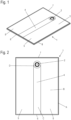
- FIG. 1 an isometric view of a shower tray 1 according to the invention is shown.
- the shower tray 1 has a drain opening 2, which is arranged adjacent to an edge section 7 of the shower tray 1, and a shower surface 3.
- the shower surface 3 is inclined to the horizontal in the direction of the drain opening 2, so that shower water that hits the shower surface 3 is at least partially directed to the drain opening 2.
- a recess 4 of the shower surface 3 runs from the drain opening 2 to an opposite Edge section 6 of the shower tray 1, wherein the shower surface 3 has two standing surfaces 5, between which the recess 4 runs.
- the recess 4 is arranged along the width of the shower tray 1 centrally between the standing surfaces 5, in particular in a section between 30% and 70%, preferably from 40% to 60% and particularly preferably from 45% to 55% of the shower surface 3.
- the standing surfaces 5 have a gradient vertically and in the direction of the depression 4. They are inclined in a gradient area B in particular by 0.1% to 5% and preferably from 1% to 4% and particularly preferably from 2% to 3.5% to the horizontal. As a result, the shower water is at least partially directed into the depression 4.
- the depression 4 is inclined in the direction of the drain opening 2 in a gradient area C in particular by 0.5% to 2.5% and preferably from 1% to 2% and particularly preferably by 1.5% to the horizontal, so that the shower water runs off via the depression 4 through the drain opening 2.
- the shower tray 1 optionally has a gradient area D around the drain opening 2.
- the shower tray 1 optionally has a gradient area A around the shower surface 3 in a particularly horizontally formed edge area.
- the shower tray 1 optionally has a lower edge 8 along its edge sections.
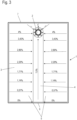
- Figure 2 shows a top view of the shower tray 1 from Figure 1 .
- the recess 4 has a width of approximately 0 cm to 50 cm and preferably approximately 5 cm to 40 cm and even more preferably from 10 cm to 35 cm and particularly preferably approximately 15 cm to 25 cm.
- the recess 4 is also linear.
- the recess 4 preferably makes up approximately 5% to 25% and preferably approximately 10% to 20% of the shower surface 3, with the standing areas 5 each making up approximately 75% to 95% and preferably approximately 80% to 90% of the shower surface 3.
- the shower tray 1 is rectangular, with the recess running parallel to the longest side edge of the shower tray 1 between the two edge sections 6 and 7.
- Figure 3 includes the same representation of the shower tray 1 as Figure 2 , whereby the main gradients of the shower surface 3 are shown with arrows indicating their direction. More than half of the standing surfaces 5 are inclined more towards the depression 4 than the depression 5 is inclined towards the drain opening 2. The standing surfaces 5 point towards the edge section 6 in the direction of the depression 4 has a gradient of 0% or slightly more than 0%, and this gradient increases in the direction of the drain opening 2.
- Figure 4 shows a cross-sectional view of the shower tray 1 from Fig. 1 to 3 along the recess 4.
- the gradient area A runs horizontally and the gradient area C, the gradient of the recess 4, and the gradient area D run in the direction of the drain opening 2.
- the lower edge 8 of the shower tray 1 is C-shaped and/or flat in its edge sections.
- the surface of the recess 4 runs essentially in one plane.
- FIG 5 is another cross-sectional view of the shower tray 1 from Fig. 1 to 4
- the shower surface 3 is arranged at the top and the shower tray 1 has the lower edge 8.
- the shower water can drain from the shower surface 3 out of the shower tray 1 through the drain opening 2.
- Figure 6 shows a cross-sectional view of the shower tray 1 from Fig. 5 in a section along the longitudinal extension of the recess.
- the shower surface 3 is arranged at the top and the recess 4 of the shower surface 3 is arranged between the standing surfaces 5.
- the shower tray 1 has the lower edge 8.
- the shower water can run off the standing surfaces 5 via the recess 4 through the drain opening 2 from the shower tray 1.
- the recess 4 is in a perpendicular direction to its longitudinal extension, i.e.
- in the vertical direction in each case at least in particular from 0.5 cm to 5 cm and preferably between 1 cm and 3 cm and particularly preferably between 1.5 cm and 2.5 cm below the highest point of the shower surface 3 in the vertical direction and/or the nearest edge section.
Landscapes
- Health & Medical Sciences (AREA)
- Public Health (AREA)
- Epidemiology (AREA)
- General Health & Medical Sciences (AREA)
- Containers Having Bodies Formed In One Piece (AREA)
Applications Claiming Priority (1)
| Application Number | Priority Date | Filing Date | Title |
|---|---|---|---|
| DE102023110748.8A DE102023110748A1 (de) | 2023-04-26 | 2023-04-26 | Duschwanne |
Publications (1)
| Publication Number | Publication Date |
|---|---|
| EP4458231A1 true EP4458231A1 (fr) | 2024-11-06 |
Family
ID=90719844
Family Applications (1)
| Application Number | Title | Priority Date | Filing Date |
|---|---|---|---|
| EP24169196.3A Pending EP4458231A1 (fr) | 2023-04-26 | 2024-04-09 | Bac de douche |
Country Status (2)
| Country | Link |
|---|---|
| EP (1) | EP4458231A1 (fr) |
| DE (1) | DE102023110748A1 (fr) |
Citations (7)
| Publication number | Priority date | Publication date | Assignee | Title |
|---|---|---|---|---|
| GB2402059A (en) * | 2003-05-29 | 2004-12-01 | Anthony Keith Webb | Shower tray |
| DE102013107797A1 (de) | 2013-07-22 | 2015-01-22 | Kunststofftechnik Schedel Gmbh | Duschplatzanordnung |
| CH705943B1 (de) | 2011-12-22 | 2015-09-15 | Schmidlin Wilhelm Ag | Duschwanne mit einer geneigten Bodenfläche. |
| FR3003151B3 (fr) * | 2013-03-14 | 2015-12-25 | Yannick Peron | Receveur de douche a "l'italienne" |
| US20200000290A1 (en) * | 2017-01-20 | 2020-01-02 | Seranit Granit Seramik Sanayi Ve Ticaret Anonim Sirketi | Inclined ceramic shower tile |
| DE102020119260A1 (de) | 2020-07-21 | 2022-01-27 | Bette Gesellschaft mit beschränkter Haftung & Co. KG | Wanneninstallation |
| DE102021103470A1 (de) | 2020-12-10 | 2022-06-15 | Villeroy & Boch Aktiengesellschaft | Sanitärbodenelement und Kombination eines Sanitärbodenelements mit einer Wandablaufvorrichtung |
-
2023
- 2023-04-26 DE DE102023110748.8A patent/DE102023110748A1/de active Pending
-
2024
- 2024-04-09 EP EP24169196.3A patent/EP4458231A1/fr active Pending
Patent Citations (7)
| Publication number | Priority date | Publication date | Assignee | Title |
|---|---|---|---|---|
| GB2402059A (en) * | 2003-05-29 | 2004-12-01 | Anthony Keith Webb | Shower tray |
| CH705943B1 (de) | 2011-12-22 | 2015-09-15 | Schmidlin Wilhelm Ag | Duschwanne mit einer geneigten Bodenfläche. |
| FR3003151B3 (fr) * | 2013-03-14 | 2015-12-25 | Yannick Peron | Receveur de douche a "l'italienne" |
| DE102013107797A1 (de) | 2013-07-22 | 2015-01-22 | Kunststofftechnik Schedel Gmbh | Duschplatzanordnung |
| US20200000290A1 (en) * | 2017-01-20 | 2020-01-02 | Seranit Granit Seramik Sanayi Ve Ticaret Anonim Sirketi | Inclined ceramic shower tile |
| DE102020119260A1 (de) | 2020-07-21 | 2022-01-27 | Bette Gesellschaft mit beschränkter Haftung & Co. KG | Wanneninstallation |
| DE102021103470A1 (de) | 2020-12-10 | 2022-06-15 | Villeroy & Boch Aktiengesellschaft | Sanitärbodenelement und Kombination eines Sanitärbodenelements mit einer Wandablaufvorrichtung |
Also Published As
| Publication number | Publication date |
|---|---|
| DE102023110748A1 (de) | 2024-10-31 |
Similar Documents
| Publication | Publication Date | Title |
|---|---|---|
| DE2657131A1 (de) | Oberflaechenkondensator | |
| EP2902556A1 (fr) | Revêtement de drainage | |
| EP3366852A1 (fr) | Dispositif pour un écoulement au sol disposé au sol d'une pièce | |
| EP3789550A1 (fr) | Dispositif d'encliquetage | |
| DE19511206C2 (de) | Hochbauentwässerungsrinne | |
| EP4458231A1 (fr) | Bac de douche | |
| DE102014111784B4 (de) | Vorrichtung für einen beabstandet zu einer Wand im Boden eines Raumes angeordneten Bodenablauf | |
| AT524845B1 (de) | Leitvorrichtung zum Umlenken von Wasser in einer Wasserablaufrinne eines Schwimmbeckens sowie entsprechende Wasserablaufrinne | |
| EP2990549B1 (fr) | Fente de drainage dotée d'une tige longitudinale amovible | |
| DE20302195U1 (de) | Entwässerungsvorrichtung | |
| EP0297258A2 (fr) | Coquille pour la coulée continue de profiles d'entrées pour laminage de poutrelles | |
| EP2048292A2 (fr) | Caniveau de drainage | |
| DE29602588U1 (de) | Entwässerungsrinne | |
| DE9215887U1 (de) | Abflußrinne für Flüssigkeiten | |
| DE102013001234B4 (de) | Anordnung einer Vorrichtung für einen in der Nähe einer Wand angeordneten Bodenablauf | |
| DE102020113909A1 (de) | Abflusssystem mit einer Abflussrinne sowie einem Rost | |
| EP1170428B1 (fr) | Canal d'écoulement configuré comme profil de gouttière | |
| DE102017103785A1 (de) | Vorrichtung für einen im Boden eines Raumes angeordneten Bodenablauf | |
| DE102007047064A1 (de) | Ablaufrinne mit Abdeckung | |
| EP1022390A1 (fr) | Caniveau | |
| AT404044B (de) | Bodenablauf mit einem ablaufkörper | |
| DE202011104877U1 (de) | Entwässerungs-Rinnensystem | |
| EP3502367B1 (fr) | Goutièrre d'écoulement | |
| DE102019106003B3 (de) | Waschtisch | |
| EP0959203A2 (fr) | Goulotte de piscine, en particulier en céramique |
Legal Events
| Date | Code | Title | Description |
|---|---|---|---|
| PUAI | Public reference made under article 153(3) epc to a published international application that has entered the european phase |
Free format text: ORIGINAL CODE: 0009012 |
|
| STAA | Information on the status of an ep patent application or granted ep patent |
Free format text: STATUS: THE APPLICATION HAS BEEN PUBLISHED |
|
| AK | Designated contracting states |
Kind code of ref document: A1 Designated state(s): AL AT BE BG CH CY CZ DE DK EE ES FI FR GB GR HR HU IE IS IT LI LT LU LV MC ME MK MT NL NO PL PT RO RS SE SI SK SM TR |
|
| STAA | Information on the status of an ep patent application or granted ep patent |
Free format text: STATUS: REQUEST FOR EXAMINATION WAS MADE |
|
| 17P | Request for examination filed |
Effective date: 20250505 |