EP4458633A1 - Datenverarbeitungsverfahren und -vorrichtung, vorrichtung und speichermedium - Google Patents
Datenverarbeitungsverfahren und -vorrichtung, vorrichtung und speichermedium Download PDFInfo
- Publication number
- EP4458633A1 EP4458633A1 EP23737130.7A EP23737130A EP4458633A1 EP 4458633 A1 EP4458633 A1 EP 4458633A1 EP 23737130 A EP23737130 A EP 23737130A EP 4458633 A1 EP4458633 A1 EP 4458633A1
- Authority
- EP
- European Patent Office
- Prior art keywords
- vehicle
- target vehicle
- lane
- target
- area
- Prior art date
- Legal status (The legal status is an assumption and is not a legal conclusion. Google has not performed a legal analysis and makes no representation as to the accuracy of the status listed.)
- Pending
Links
- 238000003672 processing method Methods 0.000 title claims abstract description 18
- 238000000034 method Methods 0.000 claims abstract description 61
- 230000001133 acceleration Effects 0.000 claims description 90
- 238000004590 computer program Methods 0.000 claims description 28
- 230000008859 change Effects 0.000 claims description 25
- 238000012545 processing Methods 0.000 claims description 19
- 238000005516 engineering process Methods 0.000 description 31
- 230000008569 process Effects 0.000 description 13
- 238000013473 artificial intelligence Methods 0.000 description 12
- 230000006870 function Effects 0.000 description 12
- 238000010586 diagram Methods 0.000 description 6
- 206010039203 Road traffic accident Diseases 0.000 description 3
- 230000006399 behavior Effects 0.000 description 3
- 238000011161 development Methods 0.000 description 3
- 238000004891 communication Methods 0.000 description 2
- 238000013461 design Methods 0.000 description 2
- 238000013500 data storage Methods 0.000 description 1
- 238000013135 deep learning Methods 0.000 description 1
- 230000000694 effects Effects 0.000 description 1
- 230000005611 electricity Effects 0.000 description 1
- 230000010354 integration Effects 0.000 description 1
- 230000003993 interaction Effects 0.000 description 1
- 238000010801 machine learning Methods 0.000 description 1
- 238000012544 monitoring process Methods 0.000 description 1
- 238000003058 natural language processing Methods 0.000 description 1
- 230000006855 networking Effects 0.000 description 1
- 239000013307 optical fiber Substances 0.000 description 1
- 230000008447 perception Effects 0.000 description 1
- 238000011160 research Methods 0.000 description 1
- 230000003068 static effect Effects 0.000 description 1
- 230000001360 synchronised effect Effects 0.000 description 1
Images


Classifications
-
- B—PERFORMING OPERATIONS; TRANSPORTING
- B60—VEHICLES IN GENERAL
- B60W—CONJOINT CONTROL OF VEHICLE SUB-UNITS OF DIFFERENT TYPE OR DIFFERENT FUNCTION; CONTROL SYSTEMS SPECIALLY ADAPTED FOR HYBRID VEHICLES; ROAD VEHICLE DRIVE CONTROL SYSTEMS FOR PURPOSES NOT RELATED TO THE CONTROL OF A PARTICULAR SUB-UNIT
- B60W30/00—Purposes of road vehicle drive control systems not related to the control of a particular sub-unit, e.g. of systems using conjoint control of vehicle sub-units
- B60W30/14—Adaptive cruise control
- B60W30/16—Control of distance between vehicles, e.g. keeping a distance to preceding vehicle
-
- B—PERFORMING OPERATIONS; TRANSPORTING
- B60—VEHICLES IN GENERAL
- B60W—CONJOINT CONTROL OF VEHICLE SUB-UNITS OF DIFFERENT TYPE OR DIFFERENT FUNCTION; CONTROL SYSTEMS SPECIALLY ADAPTED FOR HYBRID VEHICLES; ROAD VEHICLE DRIVE CONTROL SYSTEMS FOR PURPOSES NOT RELATED TO THE CONTROL OF A PARTICULAR SUB-UNIT
- B60W30/00—Purposes of road vehicle drive control systems not related to the control of a particular sub-unit, e.g. of systems using conjoint control of vehicle sub-units
- B60W30/18—Propelling the vehicle
- B60W30/18009—Propelling the vehicle related to particular drive situations
- B60W30/18163—Lane change; Overtaking manoeuvres
-
- B—PERFORMING OPERATIONS; TRANSPORTING
- B60—VEHICLES IN GENERAL
- B60W—CONJOINT CONTROL OF VEHICLE SUB-UNITS OF DIFFERENT TYPE OR DIFFERENT FUNCTION; CONTROL SYSTEMS SPECIALLY ADAPTED FOR HYBRID VEHICLES; ROAD VEHICLE DRIVE CONTROL SYSTEMS FOR PURPOSES NOT RELATED TO THE CONTROL OF A PARTICULAR SUB-UNIT
- B60W50/00—Details of control systems for road vehicle drive control not related to the control of a particular sub-unit, e.g. process diagnostic or vehicle driver interfaces
- B60W50/08—Interaction between the driver and the control system
- B60W50/14—Means for informing the driver, warning the driver or prompting a driver intervention
-
- G—PHYSICS
- G08—SIGNALLING
- G08G—TRAFFIC CONTROL SYSTEMS
- G08G1/00—Traffic control systems for road vehicles
- G08G1/16—Anti-collision systems
- G08G1/167—Driving aids for lane monitoring, lane changing, e.g. blind spot detection
-
- B—PERFORMING OPERATIONS; TRANSPORTING
- B60—VEHICLES IN GENERAL
- B60W—CONJOINT CONTROL OF VEHICLE SUB-UNITS OF DIFFERENT TYPE OR DIFFERENT FUNCTION; CONTROL SYSTEMS SPECIALLY ADAPTED FOR HYBRID VEHICLES; ROAD VEHICLE DRIVE CONTROL SYSTEMS FOR PURPOSES NOT RELATED TO THE CONTROL OF A PARTICULAR SUB-UNIT
- B60W50/00—Details of control systems for road vehicle drive control not related to the control of a particular sub-unit, e.g. process diagnostic or vehicle driver interfaces
- B60W50/08—Interaction between the driver and the control system
- B60W50/14—Means for informing the driver, warning the driver or prompting a driver intervention
- B60W2050/146—Display means
-
- B—PERFORMING OPERATIONS; TRANSPORTING
- B60—VEHICLES IN GENERAL
- B60W—CONJOINT CONTROL OF VEHICLE SUB-UNITS OF DIFFERENT TYPE OR DIFFERENT FUNCTION; CONTROL SYSTEMS SPECIALLY ADAPTED FOR HYBRID VEHICLES; ROAD VEHICLE DRIVE CONTROL SYSTEMS FOR PURPOSES NOT RELATED TO THE CONTROL OF A PARTICULAR SUB-UNIT
- B60W2552/00—Input parameters relating to infrastructure
- B60W2552/53—Road markings, e.g. lane marker or crosswalk
-
- B—PERFORMING OPERATIONS; TRANSPORTING
- B60—VEHICLES IN GENERAL
- B60W—CONJOINT CONTROL OF VEHICLE SUB-UNITS OF DIFFERENT TYPE OR DIFFERENT FUNCTION; CONTROL SYSTEMS SPECIALLY ADAPTED FOR HYBRID VEHICLES; ROAD VEHICLE DRIVE CONTROL SYSTEMS FOR PURPOSES NOT RELATED TO THE CONTROL OF A PARTICULAR SUB-UNIT
- B60W2554/00—Input parameters relating to objects
- B60W2554/40—Dynamic objects, e.g. animals, windblown objects
- B60W2554/404—Characteristics
- B60W2554/4045—Intention, e.g. lane change or imminent movement
-
- B—PERFORMING OPERATIONS; TRANSPORTING
- B60—VEHICLES IN GENERAL
- B60W—CONJOINT CONTROL OF VEHICLE SUB-UNITS OF DIFFERENT TYPE OR DIFFERENT FUNCTION; CONTROL SYSTEMS SPECIALLY ADAPTED FOR HYBRID VEHICLES; ROAD VEHICLE DRIVE CONTROL SYSTEMS FOR PURPOSES NOT RELATED TO THE CONTROL OF A PARTICULAR SUB-UNIT
- B60W2554/00—Input parameters relating to objects
- B60W2554/80—Spatial relation or speed relative to objects
- B60W2554/801—Lateral distance
-
- B—PERFORMING OPERATIONS; TRANSPORTING
- B60—VEHICLES IN GENERAL
- B60W—CONJOINT CONTROL OF VEHICLE SUB-UNITS OF DIFFERENT TYPE OR DIFFERENT FUNCTION; CONTROL SYSTEMS SPECIALLY ADAPTED FOR HYBRID VEHICLES; ROAD VEHICLE DRIVE CONTROL SYSTEMS FOR PURPOSES NOT RELATED TO THE CONTROL OF A PARTICULAR SUB-UNIT
- B60W2554/00—Input parameters relating to objects
- B60W2554/80—Spatial relation or speed relative to objects
- B60W2554/802—Longitudinal distance
-
- B—PERFORMING OPERATIONS; TRANSPORTING
- B60—VEHICLES IN GENERAL
- B60W—CONJOINT CONTROL OF VEHICLE SUB-UNITS OF DIFFERENT TYPE OR DIFFERENT FUNCTION; CONTROL SYSTEMS SPECIALLY ADAPTED FOR HYBRID VEHICLES; ROAD VEHICLE DRIVE CONTROL SYSTEMS FOR PURPOSES NOT RELATED TO THE CONTROL OF A PARTICULAR SUB-UNIT
- B60W2556/00—Input parameters relating to data
- B60W2556/45—External transmission of data to or from the vehicle
-
- B—PERFORMING OPERATIONS; TRANSPORTING
- B60—VEHICLES IN GENERAL
- B60W—CONJOINT CONTROL OF VEHICLE SUB-UNITS OF DIFFERENT TYPE OR DIFFERENT FUNCTION; CONTROL SYSTEMS SPECIALLY ADAPTED FOR HYBRID VEHICLES; ROAD VEHICLE DRIVE CONTROL SYSTEMS FOR PURPOSES NOT RELATED TO THE CONTROL OF A PARTICULAR SUB-UNIT
- B60W2556/00—Input parameters relating to data
- B60W2556/45—External transmission of data to or from the vehicle
- B60W2556/50—External transmission of data to or from the vehicle of positioning data, e.g. GPS [Global Positioning System] data
-
- B—PERFORMING OPERATIONS; TRANSPORTING
- B60—VEHICLES IN GENERAL
- B60W—CONJOINT CONTROL OF VEHICLE SUB-UNITS OF DIFFERENT TYPE OR DIFFERENT FUNCTION; CONTROL SYSTEMS SPECIALLY ADAPTED FOR HYBRID VEHICLES; ROAD VEHICLE DRIVE CONTROL SYSTEMS FOR PURPOSES NOT RELATED TO THE CONTROL OF A PARTICULAR SUB-UNIT
- B60W2720/00—Output or target parameters relating to overall vehicle dynamics
- B60W2720/10—Longitudinal speed
- B60W2720/106—Longitudinal acceleration
Definitions
- Embodiments of this application relate to the fields of intelligent transportation and automatic driving, and more specifically, relate to a data processing method, apparatus, and device, and a storage medium.
- an intelligent control system of a vehicle is increasingly required.
- a driving route is directly changed only according to an operation of a driver, only a road congestion condition of a road ahead can be provided for the driver, more road information of the current scenario cannot be provided for the driver, more prompt information cannot be provided for the driver in the driving process, and relatively less information is provided for the driver. Therefore, user experience is relatively poor.
- This application provides a data processing method, apparatus, and device, and a storage medium, which can provide more information for a driver with reference to a current driving environment, thereby improving user experience and driving safety.
- a first aspect provides a data processing method, including: determining, based on a position of a first vehicle around a target vehicle, multiple areas around the first vehicle, a longitudinal center line of the first vehicle not coinciding with a center line of a first lane in which the first vehicle travels; determining, based on a relative position of the target vehicle to the first vehicle, a target area from the multiple areas, in which the target vehicle is located; and providing a prompt indicating a driving operation for the target vehicle based on the target area.
- a second aspect provides a data processing apparatus, including: a first determining unit, configured to determine, based on a position of a first vehicle around a target vehicle, multiple areas around the first vehicle, a longitudinal center line of the first vehicle not coinciding with a center line of a first lane in which the first vehicle travels; a second determining unit, configured to determine, based on a relative position of the target vehicle to the first vehicle, a target area from the multiple areas, in which the target vehicle is located; and a third determining unit, configured to provide a prompt indicating a driving operation for the target vehicle based on the target area.
- a third aspect provides an electronic device, including: a processor, adapted to execute a computer program; and a computer readable storage medium, the computer readable storage medium storing a computer program, and when the computer program is executed by the processor, the method according to the first aspect being implemented.
- a fourth aspect provides a computer readable storage medium, configured to store a computer program, where the computer program causes a computer to perform the method in the first aspect.
- a fifth aspect provides a computer program product, including a computer program/instruction, where the computer program/instruction is executed by a processor to implement the method in the first aspect.
- a target area in which the target vehicle is located is determined from the multiple areas; and based on the target area, a prompt is displayed.
- This solution may provide more information for a driver with reference to a current driving environment, thereby improving user experience and driving safety.
- AI artificial intelligence
- AI is a theory, method, technology, and application system that uses a digital computer or a machine controlled by the digital computer to simulate, extend, and expand human intelligence, perceive an environment, obtain knowledge, and use knowledge to obtain an optimal result.
- AI is a comprehensive technology in computer science and attempts to understand the essence of intelligence and produce a new intelligent machine that can react in a manner similar to human intelligence.
- AI is to study the design principles and implementation methods of various intelligent machines, to enable the machines to have the functions of perception, reasoning, and decision-making.
- AI technology is a comprehensive discipline, and relates to a wide range of fields including both hardware-level technologies and software-level technologies.
- the basic AI technologies generally include technologies such as a sensor, a dedicated AI chip, cloud computing, distributed storage, a big data processing technology, an operating/interaction system, and electromechanical integration.
- AI software technologies mainly include several major directions such as a computer vision (CV) technology, a speech processing technology, a natural language processing technology, and machine learning/deep learning.
- CV computer vision
- artificial intelligence technologies With research and progress of artificial intelligence technologies, the artificial intelligence technologies are studied and applied in multiple fields, such as common smart home, intelligent wearable devices, virtual assistants, intelligent sound boxes, intelligent marketing, unmanned driving, autonomous driving, unmanned aerial vehicles, robots, intelligent medical treatment, and intelligent customer service. It is believed that with development of technologies, artificial intelligence technologies will be applied in more fields and play an increasingly important role.
- the solutions provided in this application may be applied to technologies such as an automatic driving technology or an auxiliary driving technology of artificial intelligence.
- the data processing method in this application may be applied to the automatic driving technology.
- corresponding prompt information may be displayed in real time according to a traffic status in a scenario, so that a driver or an automatic driving control center confirms a traveling track of a vehicle in real time, thereby reducing a probability of a traffic accident of the vehicle, thereby improving safety.
- the automatic driving technology may include technologies such as a high-precision map, environment awareness, behavior decision, path planning, and motion control.
- the automatic driving technology has a wide application prospect.
- the data processing method in this application may be applied to the auxiliary driving technology. Based on this, the method provided in this application may be used for assisting a driver in driving a vehicle, so as to reduce a probability that a traffic accident occurs on the vehicle, thereby improving safety.
- the solutions provided in this application may further relate to various network frameworks, such as the Internet of Things (IoT) or cloud IoT related to the transportation industry.
- IoT Internet of Things
- cloud IoT related to the transportation industry.
- the Internet of Things in the transportation industry may also be referred to as vehicle-to-everything.
- the Internet of Things means that by using various apparatuses and technologies such as information sensors, radio frequency recognition technologies, global positioning systems, infrared sensors, and laser scanners, any object or process that needs to be monitored, connected, or interacted with is collected in real time, and various required information such as sound, light, heat, electricity, mechanics, chemistry, biology, and position is collected, so as to implement universal connections between objects and between objects and people by using various possible network access, so as to intelligently perceive, recognize, and manage the objects and the processes.
- Internet of Things is an information carrier according to the Internet, traditional telecommunication network, etc. It enables all ordinary physical objects that can be independently addressed to form an interconnected network.
- the cloud Internet of Things is designed to access, to the Internet, information sensed by a sensing device and an instruction received by the sensor device in traditional Internet of Things, truly implement networking, and implement massive data storage and computing by using a cloud computing technology. Because a feature of the Internet of Things is that things are connected to things, and a current running status of each "object" is perceived in real time, a large amount of data information is generated in this process. How to summarize the information, and how to select useful information from the massive information to make decision support for subsequent development have become key problems that affect the development of the Internet of Things, and therefore, the cloud of the Internet of Things based on the cloud computing and the cloud storage technology becomes powerful support for the Internet of Things technology and the application.
- FIG. 1 is a schematic block diagram of a system framework 100 according to an embodiment of this application.
- the system framework 100 includes a terminal device 110 and a server 120.
- the terminal device 110 may communicate with the server 120 based on the Internet protocol in a wireless or wired manner.
- a quantity of terminal devices 110 and a quantity of servers 120 in FIG. 1 are merely an example. According to an implementation requirement, there may be any quantity of terminal devices 110 and any quantity of servers 120.
- the terminal device 110 includes but is not limited to an intelligent mobile phone, a tablet computer, an in-vehicle terminal, a palm game console, and another small personal portable device, such as a personal digital assistant (PDA) or an electronic book (E-book).
- the server 120 may be an independent physical server, or may be a server cluster or a distributed system formed by multiple physical servers, or may be a cloud server that provides a basic cloud computing service such as a cloud service, a cloud database, cloud computing, a cloud function, cloud storage, a network service, cloud communication, a middleware service, a domain name service, a security service, big data, and an artificial intelligence platform.
- the server may be directly or indirectly connected in a wired or wireless communication manner, which is not limited herein.
- the terminal device 110 may be located in a current vehicle, and obtains positioning information of a first vehicle from the server; and positioning information of another vehicle around the current vehicle, so that the terminal device 110 determines, based on a position of a first vehicle around a target vehicle, multiple areas around the first vehicle, a longitudinal center line of the first vehicle not coinciding with a center line of a first lane in which the first vehicle travels; determines, based on a relative position of the target vehicle to the first vehicle, a target area from the multiple areas, in which the target vehicle is located; and provides a prompt based on the target area.
- the terminal device 110 may further store a traffic network parameter of a target road section and traveling data of a vehicle on the target road section.
- the traffic network parameter of the target road section may include parameters such as a quantity of roads of a real target road section, relative angle information between roads, and a pedestrian of the target road section, and may further include parameters such as a traffic light identifier and a speed limit identifier that are set in the target road section.
- the traveling data of the vehicle on the target road section may include a traveling speed interval, a steering angle, a lateral distance and a longitudinal distance between vehicles on the real target road section, and the like.
- the traffic network parameter of the target road section and the traveling data of the vehicle on the target road section may further be obtained from the server.
- the server may also obtain the traffic network parameter of the target road section and the traveling data of the vehicle on the target road section from another road monitoring server, which is not specifically limited in this application.
- This application provides a solution, which is applicable to a case in which a longitudinal center line of a vehicle body does not coincide with a center line of a lane.
- FIG. 2 is an example of a scenario 200 to which a data processing method is applicable according to an embodiment of this application.
- the data processing method is executable by a current vehicle in traveling, that is, a target vehicle, or is executable by a terminal device disposed in the current vehicle, or is further executable by a server.
- the scenario 200 includes a lane 1, a lane 2, a lane 3, a vehicle A, a vehicle B1, a vehicle B2, a vehicle B3, a vehicle B4, a vehicle B5, and a vehicle B6.
- a vehicle traveling direction on the lane 1, the lane 2, and the lane 3 is the same.
- a specific traveling direction is shown by a traveling direction arrow in FIG. 2 .
- a vehicle body longitudinal center line of the vehicle A does not coincide with a center line of the lane 2.
- the vehicle B 1, the vehicle B2, the vehicle B3, the vehicle B4, the vehicle B5, and the vehicle B6 are surrounding vehicles of the vehicle A.
- the current vehicle may be any vehicle of the vehicle B1, the vehicle B2, the vehicle B3, the vehicle B4, the vehicle B5, or the vehicle B6, and a first vehicle may be the vehicle A.
- This application provides a solution, which may be applicable to a case in which the vehicle body longitudinal center line of the vehicle A does not coincide with the center line of the lane 2.
- FIG. 3 is a schematic flowchart of a data processing method 300 according to an embodiment of this application.
- the method may be applied to a device, for example a vehicle terminal, or a server of an integrated data processing system.
- the server may be the server 120 shown in FIG. 1 .
- the method may be applicable to a current vehicle in traveling, that is, a target vehicle, or is applicable to a terminal device disposed in the current vehicle.
- the method 300 may include some or all of the following content:
- the first vehicle may be a vehicle selected by a user, such as a driver, or may be a vehicle determined according to surrounding driving environment information, where the driving environment information may be received from the server or a roadside device.
- the longitudinal center line of the first vehicle does not coincide with the center line of the first lane in which the first vehicle travels in this application may mean that the longitudinal center line of the first vehicle and the center line of the first lane in which the first vehicle travels are parallel in a Frenet coordinate system; or may mean that the longitudinal center line of the first vehicle and the center line of the first lane in which the first vehicle travels are at any angle, provided that the longitudinal center line of the first vehicle does not coincide with the center line of the first lane in which the first vehicle travels.
- This application sets no specific limitation on an angle relationship between the longitudinal center line of the first vehicle and the center line of the first lane.
- the longitudinal center line of the first vehicle and the center line of the first lane may be parallel in the Frenet coordinate system. Certainly, they may also be at any angle, provided that the longitudinal center line of the first vehicle does not coincide with the center line of the first lane in which the first vehicle travels. This application sets no specific limitation on an angle relationship between the longitudinal center line of the first vehicle and the center line of the first lane.
- the first vehicle is in the first lane and does not cross the first lane.
- the first vehicle may also travel on a lane boundary line in the first lane.
- D offset is between 0 and H/2 (H is a width of the lane 2).
- the target area in which the target vehicle is located may be determined according to positioning information of the target vehicle.
- the positioning information of the target vehicle may be positioning information of a geometric center or a centroid of a rectangular outer contour of a projection of the target vehicle on a two-dimensional plane(e.g., road surface). The positioning information only considers a position on a two-dimensional plane without considering an elevation.
- the target area in which the target vehicle is located is determined from the multiple areas, and vehicles in different areas around the first vehicle are differently affected by the first vehicle.
- a corresponding prompt is provided automatically, so that a driver or an automatic driving control center can confirm a traveling track of the vehicle in real time, thereby reducing a probability that a traffic accident occurs on the vehicle, thereby improving safety.
- the driver can be provided with more information with reference to a current driving environment, thereby improving user experience and driving safety.
- providing a prompt may include: displaying a prompt.
- providing a prompt may include: generating a prompt; and sending the prompt to a server, so that the server forwards the prompt to an automatic driving control center, so that a related person confirms a vehicle traveling track.
- S301 may include:
- the first preset distance may be a distance calculated according to historical traffic data, or may be a distance obtained according to expert experience, or may be a longitudinal distance between the front contour line of the first vehicle and a center position of the driver seat of the first vehicle.
- a specific value of the first preset distance is not specifically limited in this application.
- the front contour line of the first vehicle is a first side of an obtained outer contour rectangle after the first vehicle is mapped to a two-dimensional plane, and the first side is a side corresponding to a head contour of the first vehicle.
- the first area comprises the front area of the first boundary line in the traveling direction and the lane 3.
- S303 may include: displaying, in a case that the target area is the first area, a prompt indicating that the target vehicle is capable of being controlled to keep current traveling status.
- S301 may include:
- the second preset distance may be a distance calculated according to historical traffic data, or may be a distance obtained according to expert experience.
- the second area is an area between the first boundary line and the second boundary line in the lane 1.
- the second boundary line may further be related to a size of the first vehicle.
- a boundary line that is located in a direction opposite to the traveling direction of the first vehicle, that is parallel to the normal direction of the first lane, and that is at the second preset distance longitudinally from the driver seat center position of the first vehicle may be determined as the second boundary line.
- S303 may include:
- the adjacent lane on the first side of the first lane is a right adjacent lane of the first lane.
- the adjacent lane on the first side of the first lane may also be a left adjacent lane of a lane in which the target vehicle currently travels, that is, provided that the adjacent lane on the first side of the first lane is different from the first lane and the adjacent lane on the first side of the first lane is a changeable lane specified in a traffic rule.
- This application specifically sets no specific limitation on the adjacent lane on the first side of the first lane. It is to be understood that the adjacent lane on the first side of the first lane is not only related to the position of the target vehicle, but also related to a total quantity of lanes.
- the third preset distance may be a preset distance obtained according to experience, or may be a preset distance obtained according to a current speed of the target vehicle. For example, if the current vehicle speed of the target vehicle is 100 km/h, the third preset distance may be 100 meters. If the current vehicle speed of the target vehicle is 60 km/h, the third preset distance may be 80 meters. A specific value of the third preset distance is not specifically limited in this application.
- the vehicle B2 is located in the second area between the first boundary line and the second boundary line on the lane 1.
- the first lane changing instruction used for instructing the B2 to change to the adjacent lane(e.g., lane 3) on the first side of the first lane it indicates that the vehicle B2 has a lane changing intention, and then it is determined whether the vehicle B2 meets a lane changing condition, that is, it is determined whether a longitudinal distance between the vehicle B2 and the vehicle B5 in the the adjacent lane(lane 3) on the first side of the first lane, and whether a longitudinal distance between the vehicle B2 and the vehicle B6 in the the adjacent lane(lane 3) on the first side of the first lane is greater than the third preset distance. If both are greater than the third preset distance, prompt information used for prompting that the vehicle B2 is capable of being controlled to change to the the adjacent lane(e.g., lane 3) on the first side of the first lane is greater than the third preset distance. If both are greater than the third
- S303 may further include:
- the target vehicle is prompted, in a case that the target vehicle has traveled out of the second area after the target vehicle accelerates at a first acceleration for first duration, that the target vehicle is capable of being controlled to follow a vehicle ahead in a traveling lane of the target vehicle.
- specific values of the first acceleration and the first duration are not specifically limited, provided that an average speed of the target vehicle does not exceed a maximum speed limit of a traveling road, and after the target vehicle accelerates at the first acceleration for the first duration, a distance between a vehicle before the target vehicle and the target vehicle is greater than 0.
- S303 may further include: prompting, in a case that the target area is the second area and an offset instruction used for instructing the target vehicle to deviate laterally towards a second side of a current lane in which the target vehicle is traveling is obtained, that the target vehicle is capable of being controlled to deviate laterally towards the second side of the current lane, and continue to travel until travel out of the second area.
- This application sets no specific limitation on an offset angle of the target vehicle, provided that an outer contour line of the target vehicle in the current traveling direction of the target vehicle does not exceed the current traveling lane of the target vehicle.
- S301 may include:
- the rear area on the lane 1 and of the second boundary line in the traveling direction of the vehicle A is determined as the third area, that is, an area in which the vehicle B3 is located.
- S303 may include:
- the adjacent lane on the first side of the first lane is a right adjacent lane of the first lane in which the first vehicle currently travels.
- the adjacent lane on the first side of the first lane may also be a left adjacent lane of a lane in which the target vehicle currently travels, that is, provided that the adjacent lane on the first side of the first lane is different from the first lane and the adjacent lane on the first side of the first lane is a changeable lane specified in a traffic rule.
- This application specifically sets no specific limitation on the adjacent lane on the first side of the first lane. It is to be understood that the adjacent lane on the first side of the first lane is not only related to the position of the target vehicle, but also related to a total quantity of lanes.
- the fourth preset distance may be a preset fixed distance, or may be a preset distance calculated according to the current speed of the target vehicle. For example, if the current vehicle speed of the target vehicle is 100 km/h, the fourth preset distance may be 100 meters. If the current vehicle speed of the target vehicle is 60 km/h, the fourth preset distance may be 80 meters. A specific value of the fourth preset distance is not specifically limited in this application.
- the safe lane changing condition may further be that the longitudinal distance between the target vehicle and the fourth vehicle in the adjacent lane on the first side of the first lane is greater than the fourth preset distance, that is, the longitudinal distance between the target vehicle and the fifth vehicle in the adjacent lane on the first side of the first lane is greater than a seventh preset distance, and the fourth preset distance is different from the seventh preset distance, but a minimum safe vehicle distance between vehicles needs to be met.
- the vehicle B3 is located in the rear area of the second boundary line in the traveling direction of the vehicle A on the lane 1, that is, the third area, and when a second lane changing instruction used for instructing the vehicle B3 to change a lane is obtained, it is determined whether the vehicle B3 meets the lane changing condition, that is, it is determined whether the longitudinal distance between the vehicle B3 and the vehicle B5 and whether the longitudinal distance between the vehicle B3 and the vehicle B6 are both greater than the fourth preset distance, and if both are greater than the fourth preset distance, prompt information used for prompting that the vehicle B3 is capable of being controlled to change to the lane 3 is displayed.
- S303 may further include:
- the target vehicle is prompted, in a case that the target vehicle has traveled out of the third area after the target vehicle accelerates at a second acceleration for second duration, that the target vehicle is capable of being controlled to follow a vehicle ahead in a traveling lane of the target vehicle.
- an acceleration instruction used for instructing the target vehicle to accelerate it is determined that the target vehicle has an acceleration intention.
- specific values of the second acceleration and the second duration are not specifically limited, provided that an average speed of the target vehicle does not exceed a maximum speed limit of a traveling road, and after the target vehicle accelerates at the second acceleration for the second duration, a distance between a vehicle before the target vehicle and the target vehicle is greater than 0.
- S303 may further include:
- the fifth preset distance may be a preset distance obtained according to experience, or may be a preset distance obtained according to a current speed of the target vehicle. For example, if the current vehicle speed of the target vehicle is 100 km/h, the fifth preset distance may be 100 meters. If the current vehicle speed of the target vehicle is 60 km/h, the fifth preset distance may be 80 meters, that is, the fifth preset distance is the minimum safe vehicle distance between the target vehicle and the first projected vehicle. A specific value of the fifth preset distance is not specifically limited in this application.
- a maximum traveling speed of the target vehicle does not exceed a maximum speed limit of a traveling road section.
- S301 may include:
- the rear area on the lane 2 and of the first boundary line in the traveling direction of the vehicle A is determined as the fourth area, that is, an area in which the vehicle B4 is located.
- S303 may include: prompting, in a case that the target area is the fourth area, that the target vehicle is capable of being controlled to follow the first vehicle, where that the target vehicle follows the first vehicle represents that a distance between the target vehicle and the first vehicle is greater than or equal to a sixth preset distance in the driving process.
- the sixth preset distance may be a preset distance obtained according to experience, or may be a preset distance obtained according to a current speed of the target vehicle. For example, if the current vehicle speed of the target vehicle is 100 km/h, the sixth preset distance may be 100 meters. If the current vehicle speed of the target vehicle is 60 km/h, the sixth preset distance may be 80 meters, that is, the sixth preset distance is the minimum safe vehicle distance between the target vehicle and the first vehicle. A specific value of the sixth preset distance is not specifically limited in this application.
- a maximum traveling speed of the target vehicle does not exceed a maximum speed limit of a traveling road section.
- the multiple target areas include at least two of the following areas: the first area, the second area, the third area, and the fourth area.
- FIG. 5 is another schematic flowchart of a data processing method 500 according to an embodiment of this application.
- the method 500 may include some or all of the following content:
- third ⁇ fourth ⁇ fifth ⁇ sixth is merely for distinguishing between similar objects, and does not represent a specific sorting for the objects. It is to be understood that a specific sequence or order for "third ⁇ fourth ⁇ fifth ⁇ sixth” may be interchanged if allowed, which shall not be a limitation on this application.
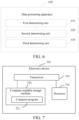
- FIG. 6 is a schematic block diagram of a data processing apparatus 600 according to an embodiment of this application.
- the data processing apparatus 600 may include some or all of the following content:
- the first determining unit 610 may be specifically configured to: determine, based on the position of the first vehicle, a reference line that is in a lateral direction of the first lane and at a first preset distance along a direction opposite to a traveling direction of the first vehicle from a front contour line of the first vehicle, as a first boundary line; and determine a first front area of the first boundary line in the traveling direction of the first vehicle and located in an adjacent lane on a first side of the first lane, the first side of the first lane being opposite to a second side of the first lane towards which the first vehicle deviates laterally; determine a second front area of the first boundary line in the traveling direction of the first vehicle and located in the first lane; obtain a first area in the multiple areas, the first area comprising the first front area, the second front area, and an adjacent lane on the second side of the first lane
- the third determining unit 630 may be specifically configured to: display, in a case that the target area is the first area, a prompt indicating that the target vehicle is capable of being controlled to keep current traveling status.
- the first determining unit 610 may be further specifically configured to: determine, based on the position of the first vehicle, a reference line that is in a lateral direction of the first lane and at a first preset distance along a direction opposite to a traveling direction of the first vehicle from a front contour line of the first vehicle, as a first boundary line; determine, based on the position of the first vehicle, a reference line that is in a lateral direction of the first lane, and at a second preset distance along a direction opposite to a traveling direction of the first vehicle from a front contour line of the first vehicle as a second boundary line; and determine an area between the first boundary line and the second boundary line and located in an adjacent lane on a second side of the first lane towards which the first vehicle deviates laterally, as a second area in the multiple areas.
- the third determining unit 630 may be further specifically configured to: determine, in a case that the target area is the second area and a first lane changing instruction used for instructing the target vehicle to change to an adjacent lane on a first side of the first lane is obtained, whether the target vehicle meets a safe lane changing condition, the safe lane changing condition representing that both a longitudinal distance between the target vehicle and a second vehicle in the adjacent lane on the first side of the first lane and a longitudinal distance between the target vehicle and a third vehicle in the adjacent lane on the first side of the first lane are greater than a third preset distance, the second vehicle being a vehicle in front of the target vehicle in the traveling direction, and the third vehicle being a vehicle behind the target vehicle in the traveling direction; display, in a case that the target vehicle meets the safe lane changing condition, a prompt indicating that the target vehicle is capable of being controlled to change to the adjacent lane on the first side of the first lane; and display, in a case that the target vehicle does not
- the third determining unit 630 may be further specifically configured to: determine, in a case that the target area is the second area and an acceleration instruction used for instructing the target vehicle to accelerate is obtained, whether the target vehicle meets a safe acceleration condition, the safe acceleration condition representing that after the target vehicle accelerates at a first acceleration for first duration, a distance between a vehicle in front of the target vehicle and the target vehicle is greater than 0; display, in a case that the target vehicle meets the safe acceleration condition, prompt information used for prompting that the target vehicle is capable of being controlled to perform an acceleration operation; and display, in a case that the target vehicle does not meet the safe acceleration condition, prompt information used for prompting that the target vehicle is incapable of being controlled to perform an acceleration operation.
- the third determining unit 630 may be further specifically configured to: determine, in a case that the target vehicle meets the safe acceleration condition, whether the target vehicle is to travel out of the second area after traveling for the first duration; and redetermine, in a case that the target vehicle does not travel out of the second area, whether the target vehicle meets the safe acceleration condition.
- the apparatus is further configured to: prompt, in a case that the target vehicle has traveled out of the second area, that the target vehicle is capable of being controlled to follow a vehicle ahead in a traveling lane of the target vehicle.
- the third determining unit 630 may be further specifically configured to: prompt, in a case that the target area is the second area and an offset instruction used for instructing the target vehicle to deviate laterally towards a second side of a current lane in which the target vehicle is traveling is obtained, that the target vehicle is capable of being controlled to deviate laterally towards the second side of the current lane.
- the first determining unit 610 may be further specifically configured to: determine, based on the position of the first vehicle, a reference line that is in a lateral direction of the first lane and at a second preset distance along a direction opposite to a traveling direction of the first vehicle from a front contour line of the first vehicle, as a second boundary line; and determine a rear area in an adjacent lane on a second side of the first lane towards which the first vehicle deviates laterally and behind the second boundary line as a third area in the multiple areas.
- the third determining unit 630 may be further specifically configured to: determine, in a case that the target area is the third area and a second lane changing instruction used for instructing the target vehicle to change to an adjacent lane on a first side of the first lane is obtained, whether the target vehicle meets a safe lane changing condition, the safe lane changing condition representing that both a longitudinal distance between the target vehicle and a fourth vehicle in the adjacent lane on the first side of the first lane and a longitudinal distance between the target vehicle and a fifth vehicle in the adjacent lane on a first side of the first lane are greater than a fourth preset distance, the fourth vehicle being a vehicle in front of the target vehicle in the traveling direction of the target vehicle, and the fifth vehicle being a vehicle behind the target vehicle in the traveling direction of the target vehicle; display, in a case that the target vehicle meets the safe lane changing condition, a prompt indicating that the target vehicle is capable of being controlled to change to the adjacent lane on the first side of the first lane; and display, in
- the third determining unit 630 may be further specifically configured to: determine, in a case that the target area is the third area and an acceleration instruction used for instructing the target vehicle to accelerate is obtained, whether the target vehicle meets a safe acceleration condition, the safe acceleration condition being used for representing that after the target vehicle accelerates at a second acceleration for second duration, a distance between a vehicle in front of the target vehicle and the target vehicle is greater than 0; display, in a case that the target vehicle meets the safe acceleration condition, prompt information used for prompting that the target vehicle is capable of being controlled to perform an acceleration operation; and display, in a case that the target vehicle does not meet the safe acceleration condition, prompt information used for prompting that the target vehicle is incapable of being controlled to perform an acceleration operation.
- the third determining unit 630 may be further specifically configured to: determine, in a case that the target vehicle meets the safe acceleration condition, whether the target vehicle travels out of the third area after the second duration; and redetermine, in a case that the target vehicle does not travel out of the third area, whether the target vehicle meets the safe acceleration condition.
- the third determining unit 630 may be further specifically configured to: project, in a case that the target area is the third area, the first vehicle to the lane in which the target vehicle is located, to obtain a first projected vehicle; and prompt that the target vehicle is capable of being controlled to follow the first projected vehicle, where that the target vehicle follows the first projected vehicle represents that a distance between the target vehicle and the first projected vehicle is greater than or equal to the fifth preset distance in the driving process.
- the apparatus is further configured to: prompt, in a case that the target vehicle has traveled out of the third area, that the target vehicle is capable of being controlled to follow a vehicle ahead in a traveling lane of the target vehicle.
- the first determining unit 610 may be further specifically configured to: determine, based on the position of the first vehicle, a reference line that is in a lateral direction of the first lane and at a first preset distance along a direction opposite to a traveling direction of the first vehicle from a front contour line of the first vehicle, as a first boundary line; and determine a rear area of the first boundary line in the first lane in which the first vehicle is currently traveling as a fourth area in the multiple areas;.
- the third determining unit 630 may be further specifically configured to: display, in a case that the target area is the fourth area, prompt information used for prompting that the target vehicle is capable of being controlled to follow the first vehicle.
- the data processing apparatus embodiment and the method embodiment may be corresponding to each other.
- references may be made to the method embodiment.
- details are not described herein again.
- the data processing apparatus 600 may be corresponding to a corresponding body in the method 300 and the method 500 in the embodiments of this application, and each unit in the data processing apparatus 600 is separately used for implementing a corresponding procedure in the method 300 and the method 500.
- details are not described herein again.
- the units in the data processing apparatus 600 in this embodiment of this application may be separately combined or all combined into one or several other units, or one (or more) of the units herein may further be divided into multiple units of smaller functions. In this way, the same operations can be implemented, and implementation of the technical effects of the embodiments of this application is not affected.
- the foregoing units are divided based on logical functions. In an actual application, a function of one unit may be implemented by multiple units, or functions of multiple units are implemented by one unit. In another embodiment of this application, the data processing apparatus 600 may alternatively include other units. In actual application, these functions may be implemented with the assistance of other units, and may be cooperatively implemented by multiple units.
- a computer program (including program code) that can execute steps involved in a corresponding method may be run on a general-purpose computing device that includes a processing element such as a central processing unit (CPU), a random access storage medium (RAM), a read-only storage medium (ROM), and a storage element, so as to construct the data processing apparatus 600 in the embodiment of this application and implement the data processing method in the embodiment of this application.
- the computer program may be recorded in, for example, a computer readable storage medium, and is installed in an electronic device by using the computer readable storage medium, so as to implement a corresponding method in the embodiment of this application.
- the foregoing units may be implemented in a hardware form, may be implemented in an instruction in a software form, or may be implemented in a combination of software and hardware.
- the steps of the method embodiments in this application may be completed by using an integrated logic circuit of hardware in a processor and/or an instruction in a form of software.
- the steps of the method disclosed with reference to the embodiments of this application may be directly performed by a hardware decoding processor, or may be performed by using a combination of hardware and software in a decoding processor.
- the software may be located in a storage medium that is mature in the art, such as a random access memory, a flash memory, a read-only memory, a programmable read-only memory, an electrically erasable programmable memory, or a register.
- the storage medium is located in the memory.
- the processor reads information in the memory and completes the steps of the method embodiments in combination with hardware thereof.
- FIG. 7 is a schematic structural diagram of an electronic device 700 according to an embodiment of this application.
- the electronic device 700 includes at least a processor 710 and a computer readable storage medium 720.
- the processor 710 and the computer readable storage medium 720 may be connected by using a bus or in another manner.
- the computer readable storage medium 720 is configured to store a computer program 721.
- the computer program 721 includes a computer instruction.
- the processor 710 is configured to execute the computer instruction stored in the computer readable storage medium 720.
- the processor 710 is a computing core and a control core of the electronic device 700, and is adapted to implement one or more computer instructions, and is specifically adapted to load and execute one or more computer instructions, so as to implement a corresponding method procedure or a corresponding function.
- the processor 710 may also be referred to as a central processing unit (CPU).
- the processor 710 may include but is not limited to: a general purpose processor, a digital signal processor (DSP), an application-specific integrated circuit (ASIC), a field programmable gate array (FPGA) or another programmable logic device, a discrete gate or a transistor logic device, a discrete hardware component, or the like.
- DSP digital signal processor
- ASIC application-specific integrated circuit
- FPGA field programmable gate array
- the computer readable storage medium 720 herein may be a high-speed RAM memory, or may be a non-volatile memory, for example, at least one disk memory. In all embodiments of the present disclosure, the computer readable storage medium may be at least one computer readable storage medium located far away from the foregoing processor 710. Specifically, the computer readable storage medium 720 includes but is not limited to: a volatile memory and/or a non-volatile memory.
- the non-volatile memory may be a read-only memory (ROM), a programmable ROM (PROM), an erasable PROM (EPROM), an electrically EPROM (EEPROM), or a flash memory.
- the volatile memory may be a random access memory (RAM) serving as an external cache.
- RAMs in many forms, for example, a static RAM (SRAM), a dynamic RAM (DRAM), a synchronous DRAM (SDRAM), a double data rate SDRAM (DDR SDRAM), an enhanced SDRAM (ESDRAM), a synch link DRAM (SLDRAM), and a direct rambus RAM (DRRAM), are available.
- SRAM static RAM
- DRAM dynamic RAM
- SDRAM synchronous DRAM
- DDR SDRAM double data rate SDRAM
- ESDRAM enhanced SDRAM
- SLDRAM synch link DRAM
- DRRAM direct rambus RAM
- the electronic device 700 may be the data processing apparatus 600 shown in FIG. 6 .
- the computer readable storage medium 720 stores a computer instruction.
- the processor 710 loads and executes the computer instruction stored in the computer readable storage medium 720, so as to implement corresponding steps in the method embodiments shown in FIG. 3 and FIG. 5 .
- the computer instruction in the computer readable storage medium 720 is loaded by the processor 710 to perform a corresponding step. To avoid repetition, details are not described herein again.
- an embodiment of this application further provides a computer readable storage medium (Memory), where the computer readable storage medium is a memory device in the electronic device 700, and is configured to store a program and data, for example, the computer readable storage medium 720.
- the computer readable storage medium 720 herein may include a built-in storage medium in the electronic device 700, and certainly may also include an extended storage medium supported by the electronic device 700.
- the computer readable storage medium provides storage space, and the storage space stores an operating system of the electronic device 700.
- one or more computer instructions suitable for being loaded and executed by the processor 710 are further stored in the storage space. These computer instructions may be one or more computer programs 721 (including program code).
- the electronic device 700 may further include: a transceiver 730, where the transceiver 730 may be connected to the processor 710 or the computer readable storage medium 720.
- the computer readable storage medium 720 may control the transceiver 730 to communicate with another device, specifically, may send information or data to another device, or receive information or data sent by another device.
- the transceiver 730 may include a transmitter and a receiver.
- the transceiver 730 may further include an antenna, and a quantity of antennas may be one or more.
- a computer program product or a computer program is provided, the computer program product or the computer program including computer instructions, the computer instructions being stored in a computer readable storage medium, for example, the computer program 721.
- the electronic device 700 may be a computer.
- the processor 710 reads the computer instruction from the computer readable storage medium 720, and the processor 710 executes the computer instruction, so that the computer performs the data processing method provided in the foregoing optional manners.
- implementation may be entirely or partially performed in the form of a computer program product.
- the computer program product includes one or more computer instructions.
- the computer may be a general-purpose computer, a special-purpose computer, a computer network, or another programmable apparatus.
- the computer instruction may be stored in a computer readable storage medium or transmitted from one computer readable storage medium to another computer readable storage medium.
- the computer instruction may be transmitted from one website, computer, server or data center to another website, computer, server or data center in a wired (for example, a coaxial cable, an optical fiber or a digital subscriber line (DSL)) or wireless (for example, infrared, wireless or microwave) manner.
- a wired for example, a coaxial cable, an optical fiber or a digital subscriber line (DSL)
- wireless for example, infrared, wireless or microwave
Landscapes
- Engineering & Computer Science (AREA)
- Automation & Control Theory (AREA)
- Transportation (AREA)
- Mechanical Engineering (AREA)
- Physics & Mathematics (AREA)
- General Physics & Mathematics (AREA)
- Human Computer Interaction (AREA)
- Traffic Control Systems (AREA)
Applications Claiming Priority (2)
| Application Number | Priority Date | Filing Date | Title |
|---|---|---|---|
| CN202210011355.5A CN114348001B (zh) | 2022-01-06 | 2022-01-06 | 一种交通仿真方法、装置、设备以及存储介质 |
| PCT/CN2023/070887 WO2023131268A1 (zh) | 2022-01-06 | 2023-01-06 | 一种数据处理方法、装置、设备以及存储介质 |
Publications (2)
| Publication Number | Publication Date |
|---|---|
| EP4458633A1 true EP4458633A1 (de) | 2024-11-06 |
| EP4458633A4 EP4458633A4 (de) | 2025-04-30 |
Family
ID=81108178
Family Applications (1)
| Application Number | Title | Priority Date | Filing Date |
|---|---|---|---|
| EP23737130.7A Pending EP4458633A4 (de) | 2022-01-06 | 2023-01-06 | Datenverarbeitungsverfahren und -vorrichtung, vorrichtung und speichermedium |
Country Status (4)
| Country | Link |
|---|---|
| US (1) | US12485895B2 (de) |
| EP (1) | EP4458633A4 (de) |
| CN (1) | CN114348001B (de) |
| WO (1) | WO2023131268A1 (de) |
Cited By (1)
| Publication number | Priority date | Publication date | Assignee | Title |
|---|---|---|---|---|
| US20240182031A1 (en) * | 2022-01-06 | 2024-06-06 | Tencent Technology (Shenzhen) Company Limited | Data processing method, apparatus, and device, and storage medium |
Families Citing this family (1)
| Publication number | Priority date | Publication date | Assignee | Title |
|---|---|---|---|---|
| CN115056790B (zh) * | 2022-07-13 | 2025-07-18 | 腾讯科技(深圳)有限公司 | 车辆处理方法、装置、设备及存储介质 |
Family Cites Families (59)
| Publication number | Priority date | Publication date | Assignee | Title |
|---|---|---|---|---|
| JPH0995194A (ja) * | 1995-09-29 | 1997-04-08 | Aisin Seiki Co Ltd | 車両前方の物体検出装置 |
| US9523984B1 (en) * | 2013-07-12 | 2016-12-20 | Google Inc. | Methods and systems for determining instructions for pulling over an autonomous vehicle |
| EP3007150A1 (de) * | 2014-10-07 | 2016-04-13 | Autoliv Development AB | Spurwechselerkennung |
| CN107836018A (zh) * | 2015-07-15 | 2018-03-23 | 本田技研工业株式会社 | 车辆控制装置、车辆控制方法及车辆控制程序 |
| JP6344695B2 (ja) * | 2015-10-28 | 2018-06-20 | 本田技研工業株式会社 | 車両制御装置、車両制御方法、および車両制御プログラム |
| JP6380766B2 (ja) * | 2016-03-14 | 2018-08-29 | 本田技研工業株式会社 | 車両制御装置、車両制御方法、および車両制御プログラム |
| US11072331B2 (en) * | 2016-03-14 | 2021-07-27 | Honda Motor Co., Ltd. | Vehicle control device, vehicle control method and vehicle control program |
| WO2017199965A1 (ja) * | 2016-05-16 | 2017-11-23 | 株式会社デンソー | 支援装置、支援方法 |
| JP6550016B2 (ja) * | 2016-06-27 | 2019-07-24 | 株式会社デンソー | 車両制御装置及び車両制御方法 |
| DE102016009762A1 (de) * | 2016-08-11 | 2018-02-15 | Trw Automotive Gmbh | Steuerungssystem und Steuerungsverfahren zum Ermitteln einer Wahrscheinlichkeit für einen Fahrspurwechsel eines vorausfahrenden Kraftfahrzeugs |
| US10093315B2 (en) * | 2016-09-19 | 2018-10-09 | Ford Global Technologies, Llc | Target vehicle deselection |
| JPWO2018096644A1 (ja) * | 2016-11-25 | 2019-10-17 | 本田技研工業株式会社 | 車両用表示制御装置、車両用表示制御方法、および車両用表示制御プログラム |
| DE102016223579A1 (de) * | 2016-11-28 | 2018-05-30 | Robert Bosch Gmbh | Verfahren zum Ermitteln von Daten einer Verkehrssituation |
| KR102383427B1 (ko) * | 2016-12-16 | 2022-04-07 | 현대자동차주식회사 | 자율주행 제어 장치 및 방법 |
| KR102368604B1 (ko) * | 2017-07-03 | 2022-03-02 | 현대자동차주식회사 | Ecu, 상기 ecu를 포함하는 무인 자율 주행 차량, 및 이의 차선 변경 제어 방법 |
| US10185322B1 (en) * | 2017-07-20 | 2019-01-22 | Ford Global Technologies, Llc | Vehicle landmark identification |
| JP6822365B2 (ja) * | 2017-09-28 | 2021-01-27 | トヨタ自動車株式会社 | 車両運転支援装置 |
| DE102017223486A1 (de) * | 2017-12-21 | 2019-06-27 | Continental Teves Ag & Co. Ohg | Verfahren und System zum Vermeiden von lateralen Kollisionen |
| JP2019121040A (ja) * | 2017-12-28 | 2019-07-22 | 株式会社デンソーテン | 駐車制御装置、車両制御装置および駐車制御方法 |
| JP6643370B2 (ja) * | 2018-01-23 | 2020-02-12 | 本田技研工業株式会社 | 走行基準ライン決定装置及び自動運転装置 |
| KR102507115B1 (ko) * | 2018-02-27 | 2023-03-07 | 삼성전자주식회사 | 차량의 주행 경로를 계획하는 방법 및 이를 위한 장치 |
| CN112154088B (zh) * | 2018-04-05 | 2024-05-24 | 图森有限公司 | 用于自主车辆的自动车道变更控制的系统和方法 |
| JP6628843B1 (ja) * | 2018-09-05 | 2020-01-15 | 三菱電機株式会社 | 障害物回避装置および障害物回避経路生成装置 |
| US11046321B2 (en) * | 2019-03-13 | 2021-06-29 | GM Global Technology Operations LLC | Adaptive control of automated lane change in vehicle |
| US11541892B2 (en) * | 2019-03-29 | 2023-01-03 | Nissan Motor Co., Ltd. | Vehicle control method and vehicle control device |
| WO2020221420A1 (en) * | 2019-04-29 | 2020-11-05 | Volvo Truck Corporation | A method for a lane change of a plurality of vehicles |
| JP7123867B2 (ja) * | 2019-06-28 | 2022-08-23 | 本田技研工業株式会社 | 車両制御装置、車両制御装方法、およびプログラム |
| US11634142B2 (en) * | 2019-08-09 | 2023-04-25 | Intel Corporation | Blind spot detection |
| CN110550029B (zh) * | 2019-08-12 | 2021-02-09 | 华为技术有限公司 | 障碍物避让方法及装置 |
| CN110588510B (zh) * | 2019-08-26 | 2021-09-07 | 华为技术有限公司 | 一种对本车的预警方法及装置 |
| CN110796007B (zh) * | 2019-09-27 | 2023-03-03 | 华为技术有限公司 | 场景识别的方法与计算设备 |
| CN111739342B (zh) * | 2020-03-26 | 2022-03-01 | 腾讯科技(深圳)有限公司 | 用于避让侧前方车辆的方法、装置、介质以及车辆 |
| JP7431081B2 (ja) * | 2020-03-27 | 2024-02-14 | 本田技研工業株式会社 | 車両制御装置、車両制御方法、およびプログラム |
| JP7464425B2 (ja) * | 2020-03-31 | 2024-04-09 | 本田技研工業株式会社 | 車両制御装置、車両制御方法、及びプログラム |
| KR20210126442A (ko) * | 2020-04-10 | 2021-10-20 | 현대모비스 주식회사 | 차량의 후측방 경고 시스템 및 방법 |
| EP3905106A1 (de) * | 2020-04-27 | 2021-11-03 | Aptiv Technologies Limited | Verfahren zur bestimmung einer befahrbaren fläche |
| CN111717198B (zh) * | 2020-06-24 | 2021-07-30 | 中国第一汽车股份有限公司 | 面向l2级自动驾驶的控制方法、装置、设备及介质 |
| CN111986514B (zh) * | 2020-09-17 | 2021-12-14 | 腾讯科技(深圳)有限公司 | 基于交通工具的数据处理方法、装置、设备以及介质 |
| JP7560989B2 (ja) * | 2020-10-13 | 2024-10-03 | 株式会社Subaru | 車両の走行環境表示装置 |
| CN112416004B (zh) * | 2020-11-19 | 2021-12-14 | 腾讯科技(深圳)有限公司 | 一种基于自动驾驶的控制方法、装置、车辆以及相关设备 |
| CN113158349B (zh) * | 2021-05-24 | 2025-06-13 | 腾讯科技(深圳)有限公司 | 车辆换道仿真方法、装置、电子设备及存储介质 |
| CN115451982B (zh) * | 2021-06-09 | 2025-05-06 | 腾讯科技(深圳)有限公司 | 一种定位方法和相关装置 |
| US12071127B2 (en) * | 2021-07-16 | 2024-08-27 | Nissan North America, Inc. | Proactive risk mitigation |
| WO2023015505A1 (zh) * | 2021-08-11 | 2023-02-16 | 华为技术有限公司 | 一种车辆驾驶方法、装置及系统 |
| CN113793533A (zh) * | 2021-08-30 | 2021-12-14 | 武汉理工大学 | 一种基于车辆前方障碍物识别的碰撞预警方法及其装置 |
| WO2023073773A1 (ja) * | 2021-10-25 | 2023-05-04 | 株式会社Subaru | 走行制御装置 |
| CN114103957B (zh) * | 2021-12-22 | 2024-02-06 | 阿波罗智联(北京)科技有限公司 | 变道控制方法、装置、电子设备和存储介质 |
| CN114348001B (zh) * | 2022-01-06 | 2024-04-26 | 腾讯科技(深圳)有限公司 | 一种交通仿真方法、装置、设备以及存储介质 |
| JP2025503576A (ja) * | 2022-01-06 | 2025-02-04 | インディアン・モーターサイクル・インターナショナル・エルエルシー | 自動二輪車のための動的に適応可能な近接領域 |
| CN115123303B (zh) * | 2022-07-18 | 2025-02-25 | 腾讯科技(深圳)有限公司 | 车辆驾驶状态展示方法、装置、电子设备和存储介质 |
| CN115158319A (zh) * | 2022-07-22 | 2022-10-11 | 阿波罗智能技术(北京)有限公司 | 车辆变道方法、装置、电子设备和存储介质 |
| JP7666448B2 (ja) * | 2022-08-09 | 2025-04-22 | トヨタ自動車株式会社 | 車両制御装置、車両制御方法及び車両制御用コンピュータプログラム |
| EP4357807A1 (de) * | 2022-10-19 | 2024-04-24 | Continental Autonomous Mobility Germany GmbH | Fahrzeugerkennungssystem und verfahren zum erkennen eines zielfahrzeugs in einem hinter einem subjektfahrzeug befindlichen erfassungsbereich |
| JP7831265B2 (ja) * | 2022-12-13 | 2026-03-17 | トヨタ自動車株式会社 | 車両の走行支援方法及び走行支援装置 |
| US12330652B2 (en) * | 2022-12-19 | 2025-06-17 | Ford Global Technologies, Llc | Lane-based vehicle control |
| JP7771141B2 (ja) * | 2023-08-31 | 2025-11-17 | 本田技研工業株式会社 | 運転支援システム |
| KR20250032466A (ko) * | 2023-08-31 | 2025-03-07 | 현대자동차주식회사 | 자율 주행 차량 및 그의 제어 방법 |
| JP7845336B2 (ja) * | 2023-11-15 | 2026-04-14 | トヨタ自動車株式会社 | 車両の制御装置及び、制御方法 |
| CN117842004B (zh) * | 2024-02-01 | 2025-01-21 | 重庆赛力斯凤凰智创科技有限公司 | 控制车辆行驶的方法、装置、电子设备及可读存储介质 |
-
2022
- 2022-01-06 CN CN202210011355.5A patent/CN114348001B/zh active Active
-
2023
- 2023-01-06 EP EP23737130.7A patent/EP4458633A4/de active Pending
- 2023-01-06 WO PCT/CN2023/070887 patent/WO2023131268A1/zh not_active Ceased
- 2023-12-04 US US18/528,202 patent/US12485895B2/en active Active
Cited By (2)
| Publication number | Priority date | Publication date | Assignee | Title |
|---|---|---|---|---|
| US20240182031A1 (en) * | 2022-01-06 | 2024-06-06 | Tencent Technology (Shenzhen) Company Limited | Data processing method, apparatus, and device, and storage medium |
| US12485895B2 (en) * | 2022-01-06 | 2025-12-02 | Tencent Technology (Shenzhen) Company Limited | Data processing method, apparatus, and device, and storage medium |
Also Published As
| Publication number | Publication date |
|---|---|
| EP4458633A4 (de) | 2025-04-30 |
| US12485895B2 (en) | 2025-12-02 |
| US20240182031A1 (en) | 2024-06-06 |
| WO2023131268A1 (zh) | 2023-07-13 |
| CN114348001B (zh) | 2024-04-26 |
| CN114348001A (zh) | 2022-04-15 |
Similar Documents
| Publication | Publication Date | Title |
|---|---|---|
| US12337876B2 (en) | Collision detection method, electronic device, and medium | |
| DE112019000065B4 (de) | Sicherheitsprozeduranalyse zur hindernisvermeidung in einem autonomen fahrzeug | |
| CN111653113B (zh) | 车辆的局部路径确定方法、装置、终端和存储介质 | |
| EP4209853A1 (de) | Steuerungsverfahren und -vorrichtung auf basis von autonomem fahren sowie fahrzeug und zugehörige vorrichtung | |
| EP4138059A2 (de) | Verfahren, vorrichtung und system zur verarbeitung von informationen über fahrzeug-strassen-kollaboration | |
| CN112477878B (zh) | 自动驾驶车辆的驾驶决策共享方法、装置、设备和介质 | |
| EP3001272B1 (de) | Verfahren zur Bahnplanung bei Fließmanövern | |
| EP3696785B1 (de) | Verfahren zur verkehrsflusssteuerung in einem internet der fahrzeuge und vorrichtung dafür | |
| EP4098975B1 (de) | Fahrzeugfahrsteuerungsverfahren und -gerät | |
| US12485895B2 (en) | Data processing method, apparatus, and device, and storage medium | |
| JP2017019421A (ja) | 周辺環境認識装置、及び周辺環境認識プログラム | |
| EP4074569A1 (de) | Verfahren zum bestimmen eines automatischen fahrmerkmals, gerät, vorrichtung, medium und programmprodukt | |
| US12361831B2 (en) | Platooning processing method and apparatus, computer-readable medium, and electronic device | |
| US12240503B2 (en) | Method for controlling vehicle, electronic device, storage medium and vehicle | |
| JPWO2018066133A1 (ja) | 車両判定方法、走行経路補正方法、車両判定装置、及び走行経路補正装置 | |
| US20230202518A1 (en) | Method for planning route, electronic device and storage medium | |
| EP4345790A1 (de) | Informationsverarbeitungsverfahren und -vorrichtung | |
| CN113610059A (zh) | 基于区域评估的车辆控制方法、装置和智能交管系统 | |
| CN115294764B (zh) | 人行横道区域确定方法、装置、设备及自动驾驶车辆 | |
| EP4607480A2 (de) | Verfahren und vorrichtung zur wahrnehmung einer strassenumgebung, trainingsverfahren und -vorrichtung, elektronische vorrichtung, autonom fahrendes fahrzeug, speichermedium und programmprodukt | |
| CN114360289A (zh) | 用于车辆的辅助系统、相应的方法、车辆和存储介质 | |
| US12071172B2 (en) | Method for visualizing a steering angle and lateral boundaries for driver assist and safer driving | |
| JP2020053069A (ja) | 車載用電子制御装置 | |
| EP3965017B1 (de) | Wissensdestillation für autonome fahrzeuge | |
| HK40069965A (en) | Traffic simulation method, device, equipment and storage medium |
Legal Events
| Date | Code | Title | Description |
|---|---|---|---|
| STAA | Information on the status of an ep patent application or granted ep patent |
Free format text: STATUS: THE INTERNATIONAL PUBLICATION HAS BEEN MADE |
|
| PUAI | Public reference made under article 153(3) epc to a published international application that has entered the european phase |
Free format text: ORIGINAL CODE: 0009012 |
|
| STAA | Information on the status of an ep patent application or granted ep patent |
Free format text: STATUS: REQUEST FOR EXAMINATION WAS MADE |
|
| 17P | Request for examination filed |
Effective date: 20240730 |
|
| AK | Designated contracting states |
Kind code of ref document: A1 Designated state(s): AL AT BE BG CH CY CZ DE DK EE ES FI FR GB GR HR HU IE IS IT LI LT LU LV MC ME MK MT NL NO PL PT RO RS SE SI SK SM TR |
|
| REG | Reference to a national code |
Ref country code: DE Ref legal event code: R079 Free format text: PREVIOUS MAIN CLASS: B60W0040090000 Ipc: B60W0030160000 |
|
| DAV | Request for validation of the european patent (deleted) | ||
| DAX | Request for extension of the european patent (deleted) | ||
| A4 | Supplementary search report drawn up and despatched |
Effective date: 20250331 |
|
| RIC1 | Information provided on ipc code assigned before grant |
Ipc: B60W 30/095 20120101ALN20250325BHEP Ipc: B60W 30/16 20200101AFI20250325BHEP |