EP4459533A1 - Verfahren und system zur steuerung der bereitstellung eines digitalen persönlichen assistenten - Google Patents
Verfahren und system zur steuerung der bereitstellung eines digitalen persönlichen assistenten Download PDFInfo
- Publication number
- EP4459533A1 EP4459533A1 EP23171809.9A EP23171809A EP4459533A1 EP 4459533 A1 EP4459533 A1 EP 4459533A1 EP 23171809 A EP23171809 A EP 23171809A EP 4459533 A1 EP4459533 A1 EP 4459533A1
- Authority
- EP
- European Patent Office
- Prior art keywords
- user
- dpa
- instance
- satisfaction
- knowledge base
- Prior art date
- Legal status (The legal status is an assumption and is not a legal conclusion. Google has not performed a legal analysis and makes no representation as to the accuracy of the status listed.)
- Withdrawn
Links
Images



Classifications
-
- G—PHYSICS
- G06—COMPUTING OR CALCULATING; COUNTING
- G06Q—INFORMATION AND COMMUNICATION TECHNOLOGY [ICT] SPECIALLY ADAPTED FOR ADMINISTRATIVE, COMMERCIAL, FINANCIAL, MANAGERIAL OR SUPERVISORY PURPOSES; SYSTEMS OR METHODS SPECIALLY ADAPTED FOR ADMINISTRATIVE, COMMERCIAL, FINANCIAL, MANAGERIAL OR SUPERVISORY PURPOSES, NOT OTHERWISE PROVIDED FOR
- G06Q30/00—Commerce
- G06Q30/01—Customer relationship services
- G06Q30/015—Providing customer assistance, e.g. assisting a customer within a business location or via helpdesk
-
- G—PHYSICS
- G06—COMPUTING OR CALCULATING; COUNTING
- G06F—ELECTRIC DIGITAL DATA PROCESSING
- G06F40/00—Handling natural language data
- G06F40/20—Natural language analysis
- G06F40/279—Recognition of textual entities
-
- G—PHYSICS
- G06—COMPUTING OR CALCULATING; COUNTING
- G06F—ELECTRIC DIGITAL DATA PROCESSING
- G06F40/00—Handling natural language data
- G06F40/30—Semantic analysis
-
- G—PHYSICS
- G06—COMPUTING OR CALCULATING; COUNTING
- G06N—COMPUTING ARRANGEMENTS BASED ON SPECIFIC COMPUTATIONAL MODELS
- G06N5/00—Computing arrangements using knowledge-based models
- G06N5/02—Knowledge representation; Symbolic representation
- G06N5/022—Knowledge engineering; Knowledge acquisition
Definitions
- the invention relates to the field of digital personal assistants.
- Digital personal assistants also known as virtual assistants or intelligent personal assistants
- a user may stop using a digital personal assistant if the digital assistant makes a mistake or if the user finds interactions with the digital personal assistant frustrating. In such situations, the user will often turn to a new, different assistant. Replacement of a digital personal assistant can cause issues, as it will take some time for the new digital personal assistant to build up the knowledge required for their role.
- a computer-implemented method for controlling the provision of a digital personal assistant to a user comprises: determining the user's satisfaction with a first instance of the digital personal assistant, DPA, wherein the first instance of the DPA is configured to employ a first knowledge base associated with the user; responsive to the user's satisfaction failing to meet a predetermined requirement, generating a second instance of the DPA, wherein the second instance of the DPA is devoid of one or more characteristics that contributed to the user's satisfaction failing to meet a predetermined requirement; and generating, for employment by the second instance of the DPA, a second knowledge base associated with the user, said generating of the second knowledge base being based on information from the first knowledge base.
- DPA digital personal assistant
- determining the user's satisfaction with the first instance of the DPA comprises: analyzing an interaction of the user with the first instance of the DPA, wherein said analyzing comprises processing the interaction with at least one of: a natural language processing algorithm; a stress detection algorithm; a tone-of-voice detection algorithm; and a response timing algorithm.
- These algorithms may be used to detect an emotional response of the user to the first instance of the DPA. For example, if a natural language processing algorithm identifies negative or abusive language by the user towards the DPA, this may indicate that the user is upset, angry or frustrated with the DPA.
- a user's satisfaction with the first instance of the DPA may be determined during normal use of the DPA.
- determining the user's satisfaction with the first instance of the DPA comprises: communicating a request to the user, the request prompting the user to provide an indication of satisfaction with the first instance of the DPA; detecting an indication provided by user in response to the request; and determining, based on the detected indication, the user's satisfaction with the first instance of the DPA.
- An indication of satisfaction provided by the user in response to a request may provide a more reliable determination of the user's satisfaction.
- a request for an indication of satisfaction may be communicated to the user in response to determining poor user satisfaction based on analyzing an interaction of the user with the first instance of the DPA. The user's response may then be used to confirm that the user is no longer satisfied with the first instance.
- a request for an indication of satisfaction may be communicated to the user at predetermined intervals (e.g., every day, weekly, monthly etc.).
- a frequency of requests for an indication of satisfaction may vary over the period of use of the first instance of the DPA.
- determining the user's satisfaction with the first instance of the DPA comprises: determining a satisfaction value representing a level of satisfaction with the first instance of the DPA, and wherein the predetermined requirement is that the satisfaction value exceeds a minimum threshold value.
- a second instance of the DPA may be generated responsive to the satisfaction value failing to exceed the minimum threshold value.
- the satisfaction value may, for example, be based on analyzing a user's interaction with the first instance of the DPA and/or on an indication of user satisfaction provided by the user.
- the method further comprises: communicating, to the user, a request for an indication as to whether a new assistant is desired; and detecting an indication as to whether a new assistant is desired provided by user in response to the request, wherein: the user's satisfaction is determined to meet the predetermined requirement responsive to detecting an indication that a new assistant is not desired; and the user's satisfaction is determined to fail to meet the predetermined requirement responsive to detecting an indication that a new assistant is desired.
- a second instance of the DPA may be generated only when the user explicitly desires a new assistant. This reduces a likelihood of a second instance of the DPA being generated unnecessarily by a user that is quick to express dissatisfaction but is not so dissatisfied as to want a different assistant.
- the second instance of the DPA differs from the first instance of the DPA in at least one of: visual appearance; audible sound; conversational style; tone of communication; communication modality; role title; and name.
- a more personalized DPA may need to differ more significantly between the first instance and the second instance in order to appear as a different assistant to the user. For example, a more personalized DPA may need to change more features and/or make a larger change in each feature that is changed.
- generating a second instance of the DPA comprises: determining one or more personality characteristics that contributed to the user's satisfaction failing to meet a predetermined requirement; and generating the second instance of the DPA such that the second instance of the DPA is devoid of the determined one or more personality characteristics.
- the second instance of the DPA may be devoid of one or more personality characteristics that contributed to the user's satisfaction failing to meet a predetermined requirement by generating the second instance not to have those personality characteristics.
- the one or more personality characteristics comprise at least one of: a tone of voice; a conversational style; and/or a visual response to a user interaction. These are personality characteristics that a user may have a negative reaction to.
- the method further comprises: responsive to the user's satisfaction failing to meet a predetermined requirement, determining one or more behavioral characteristics associated with the user's satisfaction failing to meet the predetermined requirement; and storing information about the determined one or more behavioral characteristics in the first knowledge base.
- the second instance of the DPA may access this information in order to avoid repeating the first instance's mistakes. This ensures that the second instance of the DPA is devoid of the one or more characteristics that contributed to the user's satisfaction failing to meet a predetermined requirement when one or more of these characteristics relate to a behavior of the DPA.
- the one or more behavioral characteristics comprise at least one of: a use of a trigger word; a use of a trigger topic; a repetition of questioning on a trigger topic; a depth of questioning on a trigger topic; a time between uses of a trigger word or topic; and/or a context of a use of a trigger word or topic.
- a "trigger" word or topic is a word or topic that the user reacted negatively to in their interactions with the first instance of the DPA.
- a user may react negatively to some trigger topics whenever they are brought up, while other topics may be tolerated if asked about occasionally or only touched upon but cause a negative reaction in the user if questions on the topic are repeated or if asked about in detail. Further, some topics may be acceptable to a user in certain contexts (e.g. place, time of day etc.) but not others.
- generating a second knowledge base comprises: generating a question based on information from the first knowledge base; communication the question to user; obtaining information about the user's response to the question; and storing information in the second knowledge base based on the obtained information about the user's response.
- the second instance of the DPA can build up knowledge more efficiently while also avoiding mistakes made by the first instance.
- a system for controlling the provision of a DPA to a user comprising: an analysis unit configured to determine the user's satisfaction with a first instance of the DPA, wherein the first instance of the DPA is configured to employ a first knowledge base associated with the user; and a processor arrangement configured to, responsive to the user's satisfaction failing to meet a predetermined requirement, generate a second instance of the DPA, wherein the second instance of the DPA is devoid of one or more characteristics that contributed to the user's satisfaction failing to meet a predetermined requirement, and to generate, for employment by the second instance of the DPA, a second knowledge base associated with the user, said second knowledge base being based on information from the first knowledge base.
- the analysis unit comprises a data processor configured to analyze an interaction of the user with the first instance of the DPA, wherein said analyzing comprising processing the interaction with at least one of: a natural language processing algorithm; a stress detection algorithm; a tone-of-voice detection algorithm; and a response timing algorithm.
- DPA system configured to provide a DPA for interaction with a user, wherein the DPA system comprises a system for controlling the provision of the DPA described above.
- the invention provides a method and system for controlling the provision of a digital personal assistant (DPA) to a user.
- the method comprises determining a satisfaction of a user with a first instance of the DPA, and generating a second instance of the DPA in response to the satisfaction failing to meet a predetermined requirement.
- the second instance of the DPA does not have at least one characteristic associated with the user's satisfaction failing to meet the predetermined requirement.
- the first and second instances of the DPA respectively employ first and second knowledge bases associated with the user, wherein the second knowledge base is generated based on information from the first knowledge base.
- Embodiments are at least partly based on the realization that a digital personal assistant has the capability to change its manifestation and social interaction, such that it appears to be a new digital personal assistant, while still retaining the information obtained in previous user interactions.
- This allows the DPA to reset its relationship with the user, starting a new relationship in which it can exploit previously-obtained knowledge in order to create an improved user experience and/or an improved result as defined by the goal of the DPA (e.g. a clinical result, a well-being improvement, a learning objective, etc.).
- Illustrative embodiments may, for example, be employed in consumer digital personal assistants (e.g. that provide lifestyle coaching, mental health support, chronic disease support, home appliance control etc.) and/or professional digital personal assistants (e.g. that provide clinical decision support, device maintenance support, agenda management etc.).
- consumer digital personal assistants e.g. that provide lifestyle coaching, mental health support, chronic disease support, home appliance control etc.
- professional digital personal assistants e.g. that provide clinical decision support, device maintenance support, agenda management etc.
- Fig. 1 illustrates a computer-implemented method 100 for controlling the provision of a digital personal assistant (DPA) to a user, according to an embodiment of the invention.
- the DPA may be any application that interacts with a user to provide assistance to the user, such as chatbots and voice-based virtual assistants.
- the DPA may be an application on a phone, a tablet, a computer, a home conversational pod (e.g. a smart speaker) or an augmented reality (AR) or virtual reality (VR) headset.
- a home conversational pod e.g. a smart speaker
- AR augmented reality
- VR virtual reality
- the method begins at step 110, in which the user's satisfaction with a first instance of the DPA is determined.
- the first instance of the DPA is a first persona or identity of the DPA.
- the DPA employs a first knowledge base associated with the user, in which knowledge obtained by the first instance of the DPA during interactions with the user is stored in the first knowledge base and used by the first instance of the DPA in subsequent interactions.
- the step of determining the user's satisfaction with the first instance of the DPA comprises analyzing an interaction of the user with the first instance of the DPA.
- An interaction of the user with the first instance of the DPA may be analyzed by processing the interaction with at least one of a natural language processing (NLP) algorithm, a stress detection algorithm, a tone-of-voice detection algorithm and a response timing algorithm.
- NLP natural language processing
- a natural language processing algorithm may be used to identify whether the content of the user's responses to the DPA include positive wording that indicates user satisfaction or negative wording indicative of anger, frustration etc.
- a stress detection algorithm e.g. that processes physiological measurements of the user during interactions with the DPA, may determine whether the user experiences increased stress levels when interacting with the DPA.
- a tone-of-voice detection algorithm may be used to distinguish between user responses given in a happy or neutral tone from those in which the user sounds upset, angry or irritated.
- a response timing algorithm may be used to detect whether a user is interacting with the DPA less frequently, or has stopped interacting with the DPA, which may indicate poor satisfaction with the DPA.
- the outcome of the analysis of an interaction with a user with the first instance of the DPA may be a binary determination (satisfied/not satisfied), a quantitative measure of user satisfaction (e.g. a satisfaction score, a physiological measurement indicative of stress, a time since last response), or a qualitative measure of user satisfaction (e.g. "highly satisfied”, “quite satisfied”, “quite dissatisfied”, “highly dissatisfied”).
- the step of determining the user's satisfaction with the first instance of the DPA additionally or alternatively comprises communicating a request to the user, the request prompting the user to provide an indication of satisfaction with the first instance, detecting an indication provided by the user in response to the request, and determining, based on the detected indication, the user's satisfaction with the first instance of the DPA.
- the user's satisfaction with the first instance of the DPA may be determined by direct feedback from the user, rather than (or in addition to) inferring the user's satisfaction from the user's interactions with the DPA during normal use.
- a request for an indication of satisfaction with the first instance may, for example, be communicated to the user at predetermined intervals (e.g. daily, weekly, monthly, etc.) during use of the first instance of the DPA.
- the length of the predetermined intervals may vary over the period of use of the first instance of the DPA; for instance, the DPA may request an indication of satisfaction more frequently at the beginning of its use, and then reduce a frequency of requests once the DPA has been used satisfactorily for a predetermined period.
- a request for an indication of satisfaction with the first instance may be communicated to the user in response to a determination of user satisfaction based on analyzing the user's interactions (e.g. as described above) indicating that the user is not satisfied with the first instance of the DPA, with the user's response to the request confirming or contradicting the determination that user satisfaction with the first instance is low.
- the first instance of the DPA may ask the user, "I can sense that you are not satisfied with my answer/how I have dealt with [topic]. Am I right?"
- the DPA may request an indication of satisfaction from the user in response to each determination that the user exhibited dissatisfaction in an interaction with the DPA, or in response to a determination that a frequency of interactions in which the user exhibits dissatisfaction (or a low level of satisfaction) exceeds a predetermined frequency threshold (e.g. a request may be communicated if a user exhibits dissatisfaction in more than one in four interactions).
- the step of determining the user's satisfaction with the first instance of the DPA comprises determining a satisfaction value representing a level of satisfaction with the first instance of the DPA.
- a type of a satisfaction value may depend on how the user's satisfaction is determined. For instance if a binary determination of satisfied/not satisfied is made, based on an analysis of a user interaction and/or on an indication of satisfaction from the user in response to a request, the satisfaction value may be 0 for "not satisfied” and 1 for "satisfied”. If an analysis of a user interaction results in a quantitative measure of user satisfaction, this quantitative measure may be the satisfaction value (or the satisfaction value may be a combination of multiple quantitative measures obtained by separate analyses, e.g. using different algorithms). If an analysis of a user interaction results in a qualitative measure of user satisfaction, this may be converted into a satisfaction value according to predetermined rules (e.g. 4 for "highly satisfied", 3 for "quite satisfied”, etc.).
- step 120 a determination as to whether the user's satisfaction meets a predetermined requirement is made.
- the predetermined requirement may be that the satisfaction value exceeds a minimum threshold value.
- the minimum threshold value will, of course, depend on the type of satisfaction value (e.g. for a binary satisfaction value, the minimum threshold value would be zero - i.e. the value must be 1 in order to meet the predetermined requirement).
- the step of determining whether the user's satisfaction meets a predetermined requirement may comprise communicating to the user a request for an indication as to whether a new assistant is desired. For instance, following a user having indicated that they were not satisfied, the first instance of the DPA may say, "I am sorry I made a mistake. If you like, I can bring in one of my fellow assistants, I believe it is more skilled than I am in helping you.” In response to the user providing an indication that a new assistant is not desired, a determination may be made that the user's satisfaction meets the predetermined requirement. Conversely, in response to the user providing an indication that a new assistant is desired, a determination may be made that the user's satisfaction does not meet the predetermined requirement.
- the user's satisfaction with the first instance of the DPA may continue to be monitored (e.g. continuously, by analyzing each interaction with the user, or at intervals, by periodically communicating a request for an indication of satisfaction). Steps 110 and 120 may continue to be repeated until it is determined that the user's satisfaction does not meet the predetermined requirement.
- step 130 in which a second instance of the DPA is generated.
- the second instance is a different identity or persona of the DPA to the first instance and is devoid of one or more characteristics that contributed to the user's satisfaction failing to meet the predetermined requirement.
- the second instance of the DPA may, for example, differ from the first instance of the DPA in at least one of visual appearance, audible sound, conversational style, tone of communication, communication modality, role title and name, in order to appear to the user as a different assistant.
- the feature(s) by which the second instance of the DPA differs from the first instance may depend on a type and capability of the DPA.
- a change in name is a simple way for the second instance of the DPA to appear to be a different assistant from the first instance.
- greater modifications may be required.
- the second instance of the DPA may use a different avatar to the first instance.
- Voice-based DPAs may use a different voice (e.g., different pitch, accent etc.) for the second instance of the DPA.
- the second instance of the DPA may have a different conversational style to the first instance (e.g., formal/informal, cheerful/neutral).
- the second instance of the DPA may employ a different modality (in some cases, via a different device) to the first instance (e.g., a voice-based conversation rather than a type-based chatbot or vice versa).
- the second instance of the DPA may also present themselves as having a different role/positioning to the first instance; for example, the second instance of the DPA may call themselves a stress-managing assistant or virtual friend instead of a health coach.
- the second instance of the DPA is devoid of one or more characteristics that contributed to the user's satisfaction failing to meet a predetermined requirement.
- the one or more characteristics may comprise behavioral and/or personality characteristics.
- the one or more characteristics comprises at least one behavioral characteristic. Depending on the nature of the one or more characteristics, this may be achieved at the point of generating the second instance of the DPA (e.g. for personality characteristics) and/or on an ongoing basis throughout the lifetime of the second instance, by using knowledge of the user's preferences when generating questions and/or responses in user interactions (e.g. for behavioral characteristics).
- one or more behavioral characteristics associated with the user's satisfaction failing to meet the predetermined requirement is determined.
- Information about the determined one or more behavioral characteristics is stored in the first knowledge base.
- a behavioral characteristic associated with the user's satisfaction failing to meet the predetermined requirement is a behavior of the first instance of the DPA that the user reacted negatively to (i.e. a cause of the failure to meet the predetermined requirement).
- the one or more behavioral characteristics may, for example, comprise a use of a particular word (a "trigger" word) and/or bringing up a particular ("trigger") topic.
- the one or more behavioral characteristics may additionally or alternatively comprise a behavior associated with the use of a trigger word or topic, such as a repetition of questioning on a trigger topic (e.g. the user may be ok with one question about the topic but find several questions irritating), a depth of questioning on a trigger topic (e.g. the user may dislike being asked about a particular topic in too much detail), a time between uses of a trigger word or topic (e.g.
- a user may not be upset by a single question about a topic, and may not become upset if another question on the topic is asked several hours or days later, but is upset if questions on the topic are asked within seconds or minutes of each other), and a context of a user of a trigger word or topic (e.g. the user may be happy to talk about the topic at some times of day and/or in some places but not others - for example, the user may dislike discussing personal matters during work).
- the second instance of the DPA may draw on this information to shape their interactions with the user, as described below. This allows the second instance of the DPA to avoid behavioral characteristics that contributed to the user's satisfaction failing to meet a predetermined requirement.
- the one or more characteristics that contributed to the user's satisfaction failing to meet a predetermined requirement may comprise one or more personality characteristics, such as one or more features of a tone of voice, conversational style and/or visual response employed by the first instance, and/or one or more specific causes of failure (i.e. behaviors) associated with the user's satisfaction failing to meet the predetermined requirement.
- the step of generating a second instance of the DPA may comprise determining one or more personality characteristics that contributed to the user's satisfaction failing to meet a predetermined requirement, and generating the second instance of the DPA such that the second instance of the DPA differs from the first instance of the DPA in at least the determined one or more characteristics.
- analysis of user interactions with the first instance of the DPA may indicate that the user is irritated by or otherwise reacts negatively to one or more features of a tone of voice, conversational style and/or visual response employed by the first instance.
- the DPA may identify a set of features to which the user reacted negatively (i.e. the set of features of a tone of voice, conversational style etc. used in a particular interaction in which the user was/became irritated or upset), and correlate the reaction to different sets of features to infer the feature(s) that caused the negative reaction. If the DPA does not have sufficient information to infer which feature(s) caused the negative reaction, the DPA may generate new sets of features for use in future interactions in order to obtain sufficient information.
- a tone of voice include an emotional tone (e.g. empathetic, dry, etc.), a tempo of speech (e.g. slow or rapid) and a use of pauses.
- a conversational style may include a complexity (e.g. simple or elaborate wording), a conversational tone (e.g. casual, professional, etc.) and other conversational features such as whether the DPA reformulates the user's words in their responses.
- a visual response to a user interaction may include the display of a certain facial expression or a visual modification such as a change of color or shape.
- a second knowledge base associated with the user, for employment by the second instance of the DPA is generated based on information from the first knowledge base. Some or all of the information stored in the first knowledge base may be copied or transferred to the second knowledge base. In particular, information about a determined cause of failure may be copied or transferred to the second knowledge base.
- the second instance of the DPA uses information in the second knowledge base in their interactions with the user (e.g. to generate questions). Information obtained directly from the user by the second instance of the DPA may also be stored in the second knowledge base, to be used by the second instance of the DPA in later interactions with the user.
- the second instance of the DPA is able to distinguish between information in the second knowledge base that is based on information from the first knowledge base and information that was obtained directly from the user by the second instance of the DPA. This allows the second instance of the DPA to make use of knowledge obtained by the first instance in a way that does not alert the user to the fact that the second instance of the DPA has information that they have not been given directly.
- the second knowledge base may store information based on information from the first knowledge base as implicit knowledge, and information obtained directly by the second instance of the DPA in interactions with the user as explicit knowledge.
- the second instance of the DPA may then exploit the implicit knowledge in interactions with the user without explicitly referring to this knowledge, for example, to determine which questions to ask in order to build up explicit knowledge in the second knowledge base without annoying or upsetting the user.
- Fig. 2 illustrates an example process 200 for the storage and use of knowledge by the DPA.
- the first instance of the DPA employs explicit knowledge stored in the first knowledge base, and information about the user obtained during the interaction is stored as explicit knowledge in the first knowledge base.
- the explicit knowledge may be referred to directly by the first instance of the DPA at any point in an interaction with the user.
- causes of failure associated with the user's satisfaction failing to meet the predetermined requirement are determined, and a second knowledge base is generated.
- the determined causes of failure are sensitive (or "trigger") topics.
- Explicit knowledge from the first knowledge base is stored as implicit knowledge in the second knowledge base.
- Fig. 3 illustrates an example of a semantic representation 300 of knowledge at a time of a reset of a DPA.
- the first instance of the DPA had determined that the user is concerned about work and private issues, and that the private issues concern the user's child.
- sensitive topics for the user are "son" and "problem”.
- the second instance of the DPA starts with no explicit knowledge that it can refer to when interacting with the user, but is able to employ the identified sensitive topics and the implicit knowledge to determine a question to ask that will rebuild the explicit knowledge base efficiently and without using trigger words or directly referring to trigger topics, by exploiting sematic relations.
- knowledge obtained during this interaction may be stored in the second knowledge base as explicit knowledge and referred to directly by the second instance of the DPA in future interactions.
- the second instance of the DPA may avoid the use of triggers by referring to trigger words or topics more obliquely, for example, by substituting a trigger word or a name of a trigger topic with a more general term that includes, but is not limited to, the trigger word or topic. For instance, if the user's son is a trigger topic for the user, the second instance of the DPA may avoid using the word "son” and instead use the more general "child” or "family".
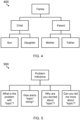
- the second instance of the DPA may use "subsumes" relation trees in order to identify a more general term to use as a substitute for a trigger word or name of a trigger topic.
- Fig. 4 illustrates a semantic representation 400 of an example subsumes relation tree for the topic "son".
- the second instance of the DPA identifies a more general term by moving up the subsumes relation tree (e.g. from “son” to "child”).
- a yet more general term may be identified by moving further up the subsumes relation tree (e.g. from "child” to "family”).
- the second instance of the DPA may determine how far to move up the subsumes relation tree according to how many of the terms that fall under a higher-level term are trigger words. For instance, if a term one level up from a trigger word covers several trigger words (or if all the words it covers are trigger terms), the second instance of the DPA may select a yet more general term by moving a further level up the subsumes relation tree. In the example subsumes relation tree 400 of Fig. 4 , the second instance of the DPA may substitute "child” for "son” if "son” is the only trigger word falling under "child”, but use "family” in the case that both "son” and “daughter” are trigger words.
- Fig. 5 illustrates a semantic representation 500 of example alternative methods of problem inference.
- the second instance of DPA By asking the user a question generated based on information from the first knowledge base, the second instance of DPA obtains information about the user directly from the user's response to the question more efficiently and with a reduced likelihood of upsetting or annoying the user compared to a DPA that generates questions with no prior knowledge of the user. This directly-obtained information is then stored in the second knowledge base as explicit knowledge.
- a first instance of the DPA may have the following discussion with the user:
- the second instance of the DPA may have the following conversation with the user:
- the second instance of the DPA employs the implicit knowledge stored in the second knowledge base that had been obtained by the first instance (that there were issues with the user's son) to generate targeted questions, while using semantic relations to avoid referring directly to the identified sensitive topics.
- This allows the second instance of the DPA to reach the same point as the previous conversation with the first instance in fewer steps, without the user noticing that the DPA knows about the situation with the son and without upsetting the user by using negative wording (e.g. "problem") with respect to the son.
- the tone of the conversation is also different to the conversation the first instance of the DPA had, so the user is unlikely to make a link between the second instance of the DPA and the first instance: the second instance will appear to them to be an entirely new assistant.
- FIGs 3 to 5 relate to an example involving a DPA that provides personal wellbeing support/lifestyle coaching, the skilled person will appreciate that the same techniques may be applied to other types of DPA.
- a camera-based DPA may be used to help a physician with a general visual examination of a patient's body.
- a physician will generally ascertain a large amount of information about a patient from an initial impression (e.g. from inspecting the patient's gait, stature, posture, facial features and expression, hands and nails aspect, skin color, handshake, clothing, quality of voice, and smell), and from an initial interaction with the patient (e.g. from the ease of speech, state of the mouth, and breathing pattern).
- the physician will form an initial opinion on a diagnosis based on this information, and the DPA may complement this with further relevant data and suggestions that enable the physician to perform an enhanced diagnosis.
- the DPA may irritate the physician by providing the physician with information that they already have (and may already have in more detail, due to their expertise), or information that is irrelevant for their purposes.
- the physician may be an expert in diagnosing a condition based on a patient's speech, and may have decided to pay less attention to a patient's face because the patient is wearing make-up which would affect the accuracy of facial observations.
- the physician may in this case become irritated by a DPA providing observations relating to the patient's speech and face.
- the DPA may learn which types of information the physician does not want advice on based on the physician's interactions with the first instance of the DPA.
- the second instance of the DPA may then avoid providing the physician with these types of information.
- a physician using a DPA to help with treatment options may have preferences for/disinclinations towards certain treatments based on experience, intuition and/or a drive for personal research (i.e. intangible criteria for a DPA).
- Such a physician may, for example, become irritated by a DPA suggesting conventional options when they would prefer to consider alternative/more advanced options.
- the second instance of the DPA may avoid making these suggestions.
- An AI-based DPA (e.g. for image analysis to support a radiologist) may therefore learn how to present help in a way that the clinician will accept, by learning which aspects of the DPA the clinician is particularly irritated by, and avoiding these in the second instance of the DPA.
- Fig. 6 illustrates a DPA system 600 configured to provide a DPA for interaction with a user, according to an embodiment of the invention.
- the system 600 comprises a system 650 for controlling the provision of a DPA to a user, which comprises an analysis unit 651 and a processor arrangement 652.
- the system 650 controlling the provision of a DPA to a user is, itself, an embodiment of the invention.
- the analysis unit 651 is configured to determine the user's satisfaction with a first instance of the DPA.
- the first instance of the DPA is configured to employ a first knowledge base associated with the user.
- the analysis unit 651 may determine the user's satisfaction with the first instance of the DPA using any of the methods described above.
- the analysis unit may comprise a data processor configured to analyze an interaction of the user with the first instance of the DPA, by processing the interaction with at least one of: a natural language processing algorithm; a stress detection algorithm; a tone-of-voice detection algorithm; and a response timing algorithm.
- the processor arrangement 652 is configured to, responsive to the user's satisfaction failing to meet a predetermined requirement, generate a second instance of the DPA, wherein the second instance of the DPA is devoid of one or more characteristics that contributed to the user's satisfaction failing to meet a predetermined requirement, and to generate, for employment by the second instance of the DPA, a second knowledge base associated with the user, said second knowledge base being based on information from the first knowledge base.
- Fig. 7 illustrates an example of a computer 700 within which one or more parts of an embodiment may be employed.
- Various operations discussed above may utilize the capabilities of the computer 700.
- one or more parts of a system for processing an image with a CNN may be incorporated in any element, module, application, and/or component discussed herein.
- system functional blocks can run on a single computer or may be distributed over several computers and locations (e.g. connected via internet).
- the computer 700 includes, but is not limited to, PCs, workstations, laptops, PDAs, palm devices, servers, storages, and the like.
- the computer 700 may include one or more processors 710, memory 720, and one or more I/O devices 770 that are communicatively coupled via a local interface (not shown).
- the local interface can be, for example but not limited to, one or more buses or other wired or wireless connections, as is known in the art.
- the local interface may have additional elements, such as controllers, buffers (caches), drivers, repeaters, and receivers, to enable communications. Further, the local interface may include address, control, and/or data connections to enable appropriate communications among the aforementioned components.
- the processor 710 is a hardware device for executing software that can be stored in the memory 720.
- the processor 710 can be virtually any custom made or commercially available processor, a central processing unit (CPU), a digital signal processor (DSP), or an auxiliary processor among several processors associated with the computer 700, and the processor 710 may be a semiconductor based microprocessor (in the form of a microchip) or a microprocessor.
- the memory 720 can include any one or combination of volatile memory elements (e.g., random access memory (RAM), such as dynamic random access memory (DRAM), static random access memory (SRAM), etc.) and non-volatile memory elements (e.g., ROM, erasable programmable read only memory (EPROM), electronically erasable programmable read only memory (EEPROM), programmable read only memory (PROM), tape, compact disc read only memory (CD-ROM), disk, diskette, cartridge, cassette or the like, etc.).
- RAM random access memory
- DRAM dynamic random access memory
- SRAM static random access memory
- non-volatile memory elements e.g., ROM, erasable programmable read only memory (EPROM), electronically erasable programmable read only memory (EEPROM), programmable read only memory (PROM), tape, compact disc read only memory (CD-ROM), disk, diskette, cartridge, cassette or the like, etc.
- the memory 720 may incorporate electronic, magnetic, optical, and/or other types
- the software in the memory 720 may include one or more separate programs, each of which comprises an ordered listing of executable instructions for implementing logical functions.
- the software in the memory 720 includes a suitable operating system (O/S) 750, compiler 740 source code 730, and one or more applications 760 in accordance with exemplary embodiments.
- the application 760 comprises numerous functional components for implementing the features and operations of the exemplary embodiments.
- the application 760 of the computer 700 may represent various applications, computational units, logic, functional units, processes, operations, virtual entities, and/or modules in accordance with exemplary embodiments, but the application 760 is not meant to be a limitation.
- the operating system 750 controls the execution of other computer programs, and provides scheduling, input-output control, file and data management, memory management, and communication control and related services. It is contemplated by the inventors that the application 760 for implementing exemplary embodiments may be applicable on all commercially available operating systems.
- Application 760 may be a source program, executable program (object code), script, or any other entity comprising a set of instructions to be performed.
- a source program then the program is usually translated via a compiler (such as the compiler 740), assembler, interpreter, or the like, which may or may not be included within the memory 720, so as to operate properly in connection with the O/S 750.
- the application 760 can be written as an object oriented programming language, which has classes of data and methods, or a procedure programming language, which has routines, subroutines, and/or functions, for example but not limited to, C, C++, C#, Pascal, BASIC, API calls, HTML, XHTML, XML, ASP scripts, JavaScript, FORTRAN, COBOL, Perl, Java, ADA, NET, and the like.
- the I/O devices 770 may include input devices such as, for example but not limited to, a mouse, keyboard, scanner, microphone, camera, etc. Furthermore, the I/O devices 770 may also include output devices, for example but not limited to a printer, display, etc. Finally, the I/O devices 770 may further include devices that communicate both inputs and outputs, for instance but not limited to, a NIC or modulator/demodulator (for accessing remote devices, other files, devices, systems, or a network), a radio frequency (RF) or other transceiver, a telephonic interface, a bridge, a router, etc. The I/O devices 770 also include components for communicating over various networks, such as the Internet or intranet.
- a NIC or modulator/demodulator for accessing remote devices, other files, devices, systems, or a network
- RF radio frequency
- the I/O devices 770 also include components for communicating over various networks, such as the Internet or intranet.
- the software in the memory 720 may further include a basic input output system (BIOS) (omitted for simplicity).
- BIOS is a set of essential software routines that initialize and test hardware at startup, start the O/S 750, and support the transfer of data among the hardware devices.
- the BIOS is stored in some type of read-only-memory, such as ROM, PROM, EPROM, EEPROM or the like, so that the BIOS can be executed when the computer 700 is activated.
- the processor 710 When the computer 700 is in operation, the processor 710 is configured to execute software stored within the memory 720, to communicate data to and from the memory 720, and to generally control operations of the computer 700 pursuant to the software.
- the application 760 and the O/S 750 are read, in whole or in part, by the processor 710, perhaps buffered within the processor 710, and then executed.
- a computer readable medium may be an electronic, magnetic, optical, or other physical device or means that can contain or store a computer program for use by or in connection with a computer related system or method.
- the application 760 can be embodied in any computer-readable medium for use by or in connection with an instruction execution system, apparatus, or device, such as a computer-based system, processor-containing system, or other system that can fetch the instructions from the instruction execution system, apparatus, or device and execute the instructions.
- a "computer-readable medium" can be any means that can store, communicate, propagate, or transport the program for use by or in connection with the instruction execution system, apparatus, or device.
- the computer readable medium can be, for example but not limited to, an electronic, magnetic, optical, electromagnetic, infrared, or semiconductor system, apparatus, device, or propagation medium.
- each step of a flow chart may represent a different action performed by a processing system, and may be performed by a respective module of the processing system.
- the system makes use of a processing system to perform the data processing.
- the processing system can be implemented in numerous ways, with software and/or hardware, to perform the various functions required.
- the processing system typically employs one or more microprocessors that may be programmed using software (e.g. microcode) to perform the required functions.
- the processing system may be implemented as a combination of dedicated hardware to perform some functions and one or more programmed microprocessors and associated circuitry to perform other functions.
- circuitry examples include, but are not limited to, conventional microprocessors, application specific integrated circuits (ASICs), and field-programmable gate arrays (FPGAs).
- ASICs application specific integrated circuits
- FPGAs field-programmable gate arrays
- the processing system may be associated with one or more storage media such as volatile and non-volatile computer memory such as RAM, PROM, EPROM, and EEPROM.
- the storage media may be encoded with one or more programs that, when executed on one or more processing systems and/or controllers, perform the required functions.
- Various storage media may be fixed within a processing system or controller may be transportable, such that the one or more programs stored thereon can be loaded into a processing system.
- processors may be implemented by a single processor or by multiple separate processing units which may together be considered to constitute a "processor". Such processing units may in some cases be remote from each other and communicate with each other in a wired or wireless manner.
- a computer program may be stored/distributed on a suitable medium, such as an optical storage medium or a solid-state medium supplied together with or as part of other hardware, but may also be distributed in other forms, such as via the Internet or other wired or wireless telecommunication systems.
- a suitable medium such as an optical storage medium or a solid-state medium supplied together with or as part of other hardware, but may also be distributed in other forms, such as via the Internet or other wired or wireless telecommunication systems.
Landscapes
- Engineering & Computer Science (AREA)
- Theoretical Computer Science (AREA)
- Physics & Mathematics (AREA)
- General Engineering & Computer Science (AREA)
- General Physics & Mathematics (AREA)
- Artificial Intelligence (AREA)
- Computational Linguistics (AREA)
- Health & Medical Sciences (AREA)
- Audiology, Speech & Language Pathology (AREA)
- General Health & Medical Sciences (AREA)
- Business, Economics & Management (AREA)
- Computing Systems (AREA)
- Economics (AREA)
- Mathematical Physics (AREA)
- Software Systems (AREA)
- Data Mining & Analysis (AREA)
- Accounting & Taxation (AREA)
- Development Economics (AREA)
- Evolutionary Computation (AREA)
- Finance (AREA)
- Marketing (AREA)
- Strategic Management (AREA)
- General Business, Economics & Management (AREA)
- Machine Translation (AREA)
- Information Retrieval, Db Structures And Fs Structures Therefor (AREA)
Priority Applications (2)
| Application Number | Priority Date | Filing Date | Title |
|---|---|---|---|
| EP23171809.9A EP4459533A1 (de) | 2023-05-05 | 2023-05-05 | Verfahren und system zur steuerung der bereitstellung eines digitalen persönlichen assistenten |
| PCT/EP2024/061714 WO2024231144A1 (en) | 2023-05-05 | 2024-04-29 | Method and system for controlling provision of a digital personal assistant |
Applications Claiming Priority (1)
| Application Number | Priority Date | Filing Date | Title |
|---|---|---|---|
| EP23171809.9A EP4459533A1 (de) | 2023-05-05 | 2023-05-05 | Verfahren und system zur steuerung der bereitstellung eines digitalen persönlichen assistenten |
Publications (1)
| Publication Number | Publication Date |
|---|---|
| EP4459533A1 true EP4459533A1 (de) | 2024-11-06 |
Family
ID=86330401
Family Applications (1)
| Application Number | Title | Priority Date | Filing Date |
|---|---|---|---|
| EP23171809.9A Withdrawn EP4459533A1 (de) | 2023-05-05 | 2023-05-05 | Verfahren und system zur steuerung der bereitstellung eines digitalen persönlichen assistenten |
Country Status (2)
| Country | Link |
|---|---|
| EP (1) | EP4459533A1 (de) |
| WO (1) | WO2024231144A1 (de) |
Citations (3)
| Publication number | Priority date | Publication date | Assignee | Title |
|---|---|---|---|---|
| US20170125008A1 (en) * | 2014-04-17 | 2017-05-04 | Softbank Robotics Europe | Methods and systems of handling a dialog with a robot |
| WO2017112813A1 (en) * | 2015-12-22 | 2017-06-29 | Sri International | Multi-lingual virtual personal assistant |
| KR102420564B1 (ko) * | 2015-02-16 | 2022-07-14 | 삼성전자주식회사 | 정보 제공 방법 및 디바이스 |
-
2023
- 2023-05-05 EP EP23171809.9A patent/EP4459533A1/de not_active Withdrawn
-
2024
- 2024-04-29 WO PCT/EP2024/061714 patent/WO2024231144A1/en not_active Ceased
Patent Citations (3)
| Publication number | Priority date | Publication date | Assignee | Title |
|---|---|---|---|---|
| US20170125008A1 (en) * | 2014-04-17 | 2017-05-04 | Softbank Robotics Europe | Methods and systems of handling a dialog with a robot |
| KR102420564B1 (ko) * | 2015-02-16 | 2022-07-14 | 삼성전자주식회사 | 정보 제공 방법 및 디바이스 |
| WO2017112813A1 (en) * | 2015-12-22 | 2017-06-29 | Sri International | Multi-lingual virtual personal assistant |
Non-Patent Citations (1)
| Title |
|---|
| ANA PAULA CHAVES ET AL: "How should my chatbot interact? A survey on human-chatbot interaction design", ARXIV.ORG, CORNELL UNIVERSITY LIBRARY, 201 OLIN LIBRARY CORNELL UNIVERSITY ITHACA, NY 14853, 4 April 2019 (2019-04-04), XP081165176 * |
Also Published As
| Publication number | Publication date |
|---|---|
| WO2024231144A1 (en) | 2024-11-14 |
Similar Documents
| Publication | Publication Date | Title |
|---|---|---|
| JP7386878B2 (ja) | アシスタントの応答を動的に適応させること | |
| US11942194B2 (en) | Systems and methods for mental health assessment | |
| US11120895B2 (en) | Systems and methods for mental health assessment | |
| US10592503B2 (en) | Empathy injection for question-answering systems | |
| US10515631B2 (en) | System and method for assessing the cognitive style of a person | |
| US9724824B1 (en) | Sensor use and analysis for dynamic update of interaction in a social robot | |
| US20180174055A1 (en) | Intelligent conversation system | |
| US20180268821A1 (en) | Virtual assistant for generating personal suggestions to a user based on intonation analysis of the user | |
| US20170344713A1 (en) | Device, system and method for assessing information needs of a person | |
| Valtolina et al. | Design of a chatbot to assist the elderly | |
| US11501879B2 (en) | Voice control for remote monitoring | |
| CN110587621A (zh) | 机器人、基于机器人的病人看护方法和可读存储介质 | |
| US20210233524A1 (en) | Placing a voice response system into a forced sleep state | |
| KR20220065746A (ko) | 치매 환자의 기록 데이터 가공 서비스를 지원하는 시스템 | |
| Keller et al. | Receptivity to mobile health interventions | |
| EP4459533A1 (de) | Verfahren und system zur steuerung der bereitstellung eines digitalen persönlichen assistenten | |
| US20230290482A1 (en) | Digital Apparatus and Application for Treating Social Communication Disorder | |
| KR20250054958A (ko) | 인공지능 기반 자폐 스펙트럼 장애 진단 보조 방법 및 장치 | |
| KR102764067B1 (ko) | 멀티모달 인공지능을 이용한 돌봄 서비스 제공 로봇장치 및 방법 | |
| JP2026051255A (ja) | システム | |
| JP2026025303A (ja) | システム | |
| JP2026033790A (ja) | システム | |
| JP2026018510A (ja) | システム | |
| JP2026024302A (ja) | システム | |
| JP2026029478A (ja) | システム |
Legal Events
| Date | Code | Title | Description |
|---|---|---|---|
| PUAI | Public reference made under article 153(3) epc to a published international application that has entered the european phase |
Free format text: ORIGINAL CODE: 0009012 |
|
| STAA | Information on the status of an ep patent application or granted ep patent |
Free format text: STATUS: THE APPLICATION HAS BEEN PUBLISHED |
|
| AK | Designated contracting states |
Kind code of ref document: A1 Designated state(s): AL AT BE BG CH CY CZ DE DK EE ES FI FR GB GR HR HU IE IS IT LI LT LU LV MC ME MK MT NL NO PL PT RO RS SE SI SK SM TR |
|
| STAA | Information on the status of an ep patent application or granted ep patent |
Free format text: STATUS: THE APPLICATION IS DEEMED TO BE WITHDRAWN |
|
| 18D | Application deemed to be withdrawn |
Effective date: 20250507 |