EP4459637A1 - Festelektrolytfolie und verfahren zur herstellung davon - Google Patents
Festelektrolytfolie und verfahren zur herstellung davon Download PDFInfo
- Publication number
- EP4459637A1 EP4459637A1 EP22915770.6A EP22915770A EP4459637A1 EP 4459637 A1 EP4459637 A1 EP 4459637A1 EP 22915770 A EP22915770 A EP 22915770A EP 4459637 A1 EP4459637 A1 EP 4459637A1
- Authority
- EP
- European Patent Office
- Prior art keywords
- solid electrolyte
- alumina
- electrolyte sheet
- sheet
- powder
- Prior art date
- Legal status (The legal status is an assumption and is not a legal conclusion. Google has not performed a legal analysis and makes no representation as to the accuracy of the status listed.)
- Pending
Links
Images
Classifications
-
- H—ELECTRICITY
- H01—ELECTRIC ELEMENTS
- H01M—PROCESSES OR MEANS, e.g. BATTERIES, FOR THE DIRECT CONVERSION OF CHEMICAL ENERGY INTO ELECTRICAL ENERGY
- H01M10/00—Secondary cells; Manufacture thereof
- H01M10/05—Accumulators with non-aqueous electrolyte
- H01M10/056—Accumulators with non-aqueous electrolyte characterised by the materials used as electrolytes, e.g. mixed inorganic/organic electrolytes
- H01M10/0561—Accumulators with non-aqueous electrolyte characterised by the materials used as electrolytes, e.g. mixed inorganic/organic electrolytes the electrolyte being constituted of inorganic materials only
- H01M10/0562—Solid materials
-
- C—CHEMISTRY; METALLURGY
- C01—INORGANIC CHEMISTRY
- C01F—COMPOUNDS OF THE METALS BERYLLIUM, MAGNESIUM, ALUMINIUM, CALCIUM, STRONTIUM, BARIUM, RADIUM, THORIUM, OR OF THE RARE-EARTH METALS
- C01F7/00—Compounds of aluminium
- C01F7/02—Aluminium oxide; Aluminium hydroxide; Aluminates
- C01F7/028—Beta-aluminas
-
- H—ELECTRICITY
- H01—ELECTRIC ELEMENTS
- H01B—CABLES; CONDUCTORS; INSULATORS; SELECTION OF MATERIALS FOR THEIR CONDUCTIVE, INSULATING OR DIELECTRIC PROPERTIES
- H01B1/00—Conductors or conductive bodies characterised by the conductive materials; Selection of materials as conductors
- H01B1/06—Conductors or conductive bodies characterised by the conductive materials; Selection of materials as conductors mainly consisting of other non-metallic substances
-
- H—ELECTRICITY
- H01—ELECTRIC ELEMENTS
- H01B—CABLES; CONDUCTORS; INSULATORS; SELECTION OF MATERIALS FOR THEIR CONDUCTIVE, INSULATING OR DIELECTRIC PROPERTIES
- H01B1/00—Conductors or conductive bodies characterised by the conductive materials; Selection of materials as conductors
- H01B1/06—Conductors or conductive bodies characterised by the conductive materials; Selection of materials as conductors mainly consisting of other non-metallic substances
- H01B1/08—Conductors or conductive bodies characterised by the conductive materials; Selection of materials as conductors mainly consisting of other non-metallic substances oxides
-
- H—ELECTRICITY
- H01—ELECTRIC ELEMENTS
- H01M—PROCESSES OR MEANS, e.g. BATTERIES, FOR THE DIRECT CONVERSION OF CHEMICAL ENERGY INTO ELECTRICAL ENERGY
- H01M10/00—Secondary cells; Manufacture thereof
- H01M10/05—Accumulators with non-aqueous electrolyte
- H01M10/054—Accumulators with insertion or intercalation of metals other than lithium, e.g. with magnesium or aluminium
-
- H—ELECTRICITY
- H01—ELECTRIC ELEMENTS
- H01M—PROCESSES OR MEANS, e.g. BATTERIES, FOR THE DIRECT CONVERSION OF CHEMICAL ENERGY INTO ELECTRICAL ENERGY
- H01M4/00—Electrodes
- H01M4/02—Electrodes composed of, or comprising, active material
- H01M4/04—Processes of manufacture in general
- H01M4/0471—Processes of manufacture in general involving thermal treatment, e.g. firing, sintering, backing particulate active material, thermal decomposition, pyrolysis
-
- H—ELECTRICITY
- H01—ELECTRIC ELEMENTS
- H01M—PROCESSES OR MEANS, e.g. BATTERIES, FOR THE DIRECT CONVERSION OF CHEMICAL ENERGY INTO ELECTRICAL ENERGY
- H01M2300/00—Electrolytes
- H01M2300/0017—Non-aqueous electrolytes
- H01M2300/0065—Solid electrolytes
- H01M2300/0068—Solid electrolytes inorganic
- H01M2300/0071—Oxides
-
- Y—GENERAL TAGGING OF NEW TECHNOLOGICAL DEVELOPMENTS; GENERAL TAGGING OF CROSS-SECTIONAL TECHNOLOGIES SPANNING OVER SEVERAL SECTIONS OF THE IPC; TECHNICAL SUBJECTS COVERED BY FORMER USPC CROSS-REFERENCE ART COLLECTIONS [XRACs] AND DIGESTS
- Y02—TECHNOLOGIES OR APPLICATIONS FOR MITIGATION OR ADAPTATION AGAINST CLIMATE CHANGE
- Y02E—REDUCTION OF GREENHOUSE GAS [GHG] EMISSIONS, RELATED TO ENERGY GENERATION, TRANSMISSION OR DISTRIBUTION
- Y02E60/00—Enabling technologies; Technologies with a potential or indirect contribution to GHG emissions mitigation
- Y02E60/10—Energy storage using batteries
Definitions
- the present invention relates to beta-alumina-based solid electrolyte sheets for use in power storage devices, such as sodium-ion secondary batteries, and methods for producing the same.
- Lithium-ion secondary batteries have secured their place as high-capacity and light-weight power sources essential for mobile devices, electric vehicles, and so on.
- current lithium-ion secondary batteries employ as their electrolytes, mainly, combustible organic electrolytic solutions, which raises concerns about the risk of burning or explosion.
- all-solid-state lithium-ion batteries using a solid electrolyte instead of an organic electrolytic solution have been under development (see, for example, Patent Literature 1).
- the energy density per unit volume can be increased. Furthermore, by doing so, the resistance to sodium ion migration in the battery is reduced and, therefore, improvement in rate characteristics can be expected.
- the present invention has an object of providing a beta-alumina-based solid electrolyte sheet capable of increasing the first charge and discharge capacities and rapid charge and discharge characteristics of an all-solid-state sodium secondary battery.
- a solid electrolyte sheet according to the present invention is a solid electrolyte sheet containing ⁇ -alumina and/or ⁇ "-alumina and satisfies C 1 > C 2 where C 1 represents a concentration of Na 2 O in a surface of the solid electrolyte sheet and C 2 represents a concentration of Na 2 O in a middle of a thickness direction of the solid electrolyte sheet.
- an irreversible capacity in the negative electrode of the all-solid-state sodium secondary battery caused by a first charge-discharge reaction can be cancelled and, therefore, the first charge-discharge efficiency can be increased.
- sodium ions conducted from the positive electrode to the negative electrode by the first charge-discharge reaction are taken up in the negative electrode and held unreleased therefrom (in the case of occurrence of an irreversible capacity)
- sodium ions are released, instead of those in the negative electrode, from Na 2 O contained in the surface of the solid electrolyte sheet and, therefore, the irreversible capacity can be cancelled.
- a sodium ion-conducting path can be easily formed at the interface between the electrode layer and the solid electrolyte sheet, which improves the rate characteristics and makes it possible to increase the rapid charge and discharge characteristics.
- the solid electrolyte sheet according to the present invention preferably satisfies C 1 -C 2 ⁇ 0.1% by mole.
- the solid electrolyte sheet according to the present invention preferably has a thickness of 500 ⁇ m or less.
- the solid electrolyte sheet according to the present invention preferably contains, in terms of % by mole, 65 to 98% Al 2 O 3 , 2 to 20% Na 2 O, 0.3 to 15% MgO+Li 2 O, 0 to 20% ZrO 2 , and 0 to 5% Y 2 O 3 .
- the solid electrolyte sheet according to the present invention is preferably used in an all-solid-state sodium-ion secondary battery.
- An all-solid-state sodium secondary battery according to the present invention includes the above-described solid electrolyte sheet.
- a method for producing a solid electrolyte sheet according to the present invention is a method for producing any one of the above-described solid electrolyte sheets and includes the steps of: preparing a precursor sheet containing ⁇ -alumina; and coating a surface of the precursor sheet with an Na-containing material and then firing the precursor sheet. By doing so, a solid electrolyte sheet having a higher concentration of Na 2 O in the sheet surface than that in the middle of the thickness direction of the sheet can be obtained.
- beta-alumina-based solid electrolyte sheet it is difficult to produce a thin beta-alumina-based solid electrolyte sheet.
- polishing is conceivable as another means for reducing the thickness, but, as for the beta-alumina-based solid electrolyte, dry polishing need to be performed because the beta-alumina-based solid electrolyte is decreased in ionic conductivity by moisture absorption.
- dry polishing is likely to apply great stress on the solid electrolyte sheet and the thinner the thickness, the more likely cracks are to be generated.
- Na component tends to vaporize to precipitate heterogeneous crystals containing no Na, such as MgAl 2 O 4 .
- rate characteristics tend to decrease due to decrease in ionic conductivity and lack of Na.
- a precursor sheet containing ⁇ -alumina is first prepared and then allowed to react with an Na-containing material to turn the ⁇ -alumina into beta-alumina, thus producing a beta-alumina-based solid electrolyte sheet.
- the ⁇ -alumina-containing sheet is free from the problem of deterioration in characteristics due to moisture absorption, can be therefore wet-polished, and can be easily reduced in thickness .
- polishing the ⁇ -alumina-containing sheet to reach a desired thickness and then turning the ⁇ -alumina into beta-alumina, a thin beta-alumina-based solid electrolyte sheet can be easily produced.
- the Na-containing material preferably contains Na 2 CO 3 .
- the present invention enables provision of a beta-alumina-based solid electrolyte sheet capable of increasing the first charge and discharge capacities and rapid charge and discharge characteristics of an all-solid-state sodium secondary battery.
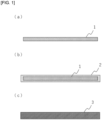
- FIG. 1 is a schematic cross-sectional view showing an embodiment of a method for producing a solid electrolyte sheet according to the present invention.
- a solid electrolyte sheet according to the present invention is a solid electrolyte sheet containing ⁇ -alumina and/or ⁇ "-alumina and satisfies C 1 > C 2 where C 1 represents the concentration of Na 2 O in a surface of the solid electrolyte sheet and C 2 represents the concentration of Na 2 O in the middle of the thickness direction of the solid electrolyte sheet.
- C 1 -C 2 is preferably 0.1% by mole or more, more preferably 0.2% by mole or more, even more preferably 0.3% by mole or more, and particularly preferably 0.4% by mole or more.
- the upper limit of the C 1 -C 2 is not particularly limited, but is, actually, preferably not more than 3% by mole, more preferably not more than 2% by mole, and particularly preferably not more than 1% by mole.
- the solid electrolyte sheet according to the present invention contains ⁇ -alumina and/or ⁇ "-alumina and a specific example of the composition is a composition containing, in terms of % by mole, 65 to 98% Al 2 O 3 , 2 to 20% Na 2 O, 0.3 to 15% MgO+Li 2 O, 0 to 20% ZrO 2 , and 0 to 5% Y 2 O 3 .
- a specific example of the composition is a composition containing, in terms of % by mole, 65 to 98% Al 2 O 3 , 2 to 20% Na 2 O, 0.3 to 15% MgO+Li 2 O, 0 to 20% ZrO 2 , and 0 to 5% Y 2 O 3 .
- Al 2 O 3 is a main constituent of ⁇ -alumina and/or ⁇ "-alumina.
- the content of Al 2 O 3 is preferably 65 to 98% and particularly preferably 70 to 95%. If Al 2 O 3 is too little, the ionic conductivity of the solid electrolyte sheet is likely to decrease. On the other hand, if Al 2 O 3 is too much, ⁇ -alumina having no sodium-ion conductivity remains in the solid electrolyte sheet and, therefore, the ionic conductivity of the solid electrolyte sheet is likely to decrease.
- Na 2 O is a component that gives sodium-ion conductivity to the solid electrolyte sheet.
- the content of Na 2 O is preferably 2 to 20%, more preferably 3 to 18%, and particularly preferably 4 to 16%. If Na 2 O is too little, the above effect is difficult to achieve. On the other hand, if Na 2 O is too much, surplus Na 2 O forms a compound not contributing to ionic conductivity, such as NaAlO 2 , and, therefore, the ionic conductivity of the solid electrolyte sheet is likely to decrease.
- MgO and Li 2 O are components (stabilizers) that stabilize the structures of ⁇ -alumina and/or ⁇ "-alumina.
- the content of MgO+Li 2 O (the total content of MgO and Li 2 O) is preferably 0.3 to 15%, more preferably 0.5 to 10%, and particularly preferably 0.8 to 8%. If MgO+Li 2 O is too little, ⁇ -alumina remains in the solid electrolyte sheet and, therefore, the ionic conductivity is likely to decrease. On the other hand, if MgO+Li 2 O is too much, MgO or Li 2 O having not functioned as a stabilizer remains in the solid electrolyte sheet and, therefore, the ionic conductivity is likely to decrease.
- the content of each of MgO and Li 2 O is preferably 0 to 15%, more preferably 0.3 to 15%, even more preferably 0.5 to 10%, and particularly preferably 0.8 to 8%.
- ZrO 2 and Y 2 O 3 have the effect of suppressing abnormal grain growth of ⁇ -alumina particles and/or ⁇ "-alumina particles during firing in a production method to be described hereinafter and thus increasing the adhesion between ⁇ -alumina particles and/or ⁇ "-alumina particles. As a result, the ionic conductivity of the solid electrolyte sheet can be easily increased.
- the content of ZrO 2 is preferably 0 to 15%, more preferably 1 to 13%, and particularly preferably 2 to 10%.
- the content of Y 2 O 3 is preferably 0 to 5%, more preferably 0.01 to 4%, and particularly preferably 0.02 to 3%. If ZrO 2 or Y 2 O 3 is too much, the amount of formation of ⁇ -alumina and/or ⁇ "-alumina decreases and, therefore, the ionic conductivity of the solid electrolyte sheet is likely to decrease.
- Examples of ⁇ -alumina include (Al 10.35 Mg 0.65 O 16 ) (Na 1.65 O), (Al 10.37 Mg 0.63 O 16 ) (Na 1.63 O), NaAl 11 O 17 , and (Al 10.32 Mg 0.68 O 16 ) (Na 1.68 O), all of which are hexagonal crystals.
- Examples of ⁇ "-alumina include (Al 10.35 Mg 0.65 O 16 ) (Na 1.65 O), (Al 8.87 Mg 2.13 O 16 ) (Na 3.13 O), Na 1.67 Mg 0.67 Al 10.33 O 17 , Na 1.49 Li 0.25 Al 10.75 O 17 , Na 1.72 Li 0.3 Al 10.66 O 17 , and Na 1.6 Li 0.34 Al 10.66 O 17 , all of which are trigonal crystals.
- the thickness of the solid electrolyte sheet according to the present invention is preferably 500 ⁇ m or less, 300 ⁇ m or less, 100 ⁇ m or less, 50 ⁇ m or less, 20 ⁇ m or less, 15 ⁇ m or less, 7 ⁇ m or less, or 5 ⁇ m or less.
- the thickness is preferably not less than 0.5 ⁇ m, not less than 1 ⁇ m or not less than 3 ⁇ m.
- the surface of the solid electrolyte sheet is preferably formed of a porous solid electrolyte layer having three-dimensionally continuous voids.
- a constituent material of the electrode layer can easily enter the voids in the porous solid electrolyte layer, which facilitates strong adhesion between the electrode layer and the solid electrolyte sheet. Therefore, the contact area between the electrode layer and the solid electrolyte sheet increases and, thus, the interfacial resistance between the electrode layer and the solid electrolyte layer can be reduced.
- the anchoring effect works to make it harder for the electrode layer to peel off from the solid electrolyte layer.
- both the surfaces of the solid electrolyte sheet are preferably formed of respective porous solid electrolyte layers.
- the thickness of the porous solid electrolyte layer is preferably 499.5 ⁇ m or less, 499 ⁇ m or less, 497 ⁇ m or less, 490 ⁇ m or less, 450 ⁇ m or less, 400 ⁇ m or less, or 300 ⁇ m or less, and particularly preferably 150 ⁇ m or less. If the thickness of the porous solid electrolyte layer is too large, it is difficult to fully fill the voids in the porous solid electrolyte layer with the electrode layer material and, therefore, the energy density per unit volume tends to be low. In addition, the amount of contraction during formation of the porous solid electrolyte layer becomes large, which makes a portion of the porous solid electrolyte layer easily peeled off.
- the thickness of the porous solid electrolyte layer is preferably not less than 10 ⁇ m, more preferably not less than 30 ⁇ , and particularly preferably not less than 50 ⁇ m.
- Fig. 1 is a schematic cross-sectional view showing an embodiment of a method for producing a solid electrolyte sheet according to the present invention.
- a precursor sheet 1 containing ⁇ -alumina is prepared ( Fig. 1(a) ).
- the surface of the precursor sheet 1 is coated with an Na-containing material 2 ( Fig. 1(b) ).
- the precursor sheet 1 coated with the Na-containing material 2 is fired and, thus, a beta-alumina-based solid electrolyte sheet 3 can be obtained ( Fig. 1 (c) ).
- the precursor sheet containing ⁇ -alumina can be produced, for example, by the green sheet method.
- a specific method thereof is as follows.
- a binder, a plasticizer, a solvent, and so on are added to a raw material powder containing ⁇ -alumina and the mixture is kneaded to form a slurry.
- the raw material powder may contain, other than ⁇ -alumina, components of beta-alumina, such as Na, Mg or Li.
- the solvent may be water or any organic solvent, such as ethanol or acetone.
- the sodium component may be dissolved out of the raw material powder to increase the pH of the slurry and agglomerate the raw material powder. Therefore, an organic solvent is preferably used.
- the obtained slurry is applied to a base material made of PET (polyethylene terephthalate) or so on and then dried, thus obtaining a green sheet.
- the application of the slurry can be done with a doctor blade, a die coater or so on.
- the thickness of the green sheet is preferably 0.01 to 1 mm and particularly preferably 0.02 to 0.9 mm. If the thickness of the green sheet is too small, the mechanical strength of the solid electrolyte sheet may decrease and a short-circuit may occur between the positive electrode and the negative electrode. On the other hand, if the thickness of the green sheet is too large, the solid electrolyte sheet becomes thick, which increases the distance taken for ionic conduction and, therefore, is likely to decrease the energy density per unit cell.
- the firing temperature is not particularly limited so long as it is a temperature that enables provision of a dense sintered body, but the firing temperature is, for example, preferably 1400 to 1800°C and particularly preferably 1600 to 1750°C.
- the firing time is appropriately adjusted to sufficiently sinter ⁇ -alumina. Specifically, the firing time is preferably 10 to 120 minutes and particularly preferably 20 to 80 minutes.
- the denseness of the ⁇ -alumina-containing precursor sheet after being fired can be increased and, as a result, the denseness of a beta-alumina-based solid electrolyte sheet as a final product can be increased later.
- the obtained precursor sheet may be subjected to polishing or so on to reduce the thickness.
- the precursor sheet containing ⁇ -alumina is, unlike a sheet made of beta-alumina, free from the problem of deterioration in characteristics due to moisture absorption, can be therefore wet-polished, and can be easily reduced in thickness.
- a beta-alumina-based solid electrolyte sheet as a final product can also be reduced in thickness.
- a green sheet for a porous layer may be obtained by adding an organic vehicle containing a binder to a mixed powder containing an ⁇ -alumina-containing raw material powder and a polymer powder to make a slurry, applying the slurry to a base material, and then drying the slurry.
- the production process of the green sheet for a porous layer is different from the production process of the aforementioned green sheet for the ⁇ -alumina precursor only in that the polymer powder is added as a solid content, and the rest can be performed employing the same materials and manners.
- the polymer powder is a material used for the purpose of forming voids in a porous layer by being burned off in the later firing process.
- examples of the polymer powder include acrylic resin, polyacrylonitrile, polymethacrylonitrile, and polystyrene.
- the average particle diameter (D 50 ) of the polymer powder is preferably 0.1 to 100 ⁇ m, more preferably 1 to 80 ⁇ m, even more preferably 5 to 70 ⁇ m, and particularly preferably 10 to 50 ⁇ m. If the average particle diameter of the polymer powder is too small, three-dimensionally continuous voids are difficult to form in the porous layer. On the other hand, if the average particle diameter of the polymer powder is too large, the sintering of the porous layer becomes insufficient, which tends to decrease the ionic conductivity and, as a result, decrease the rate characteristics.
- the content ratio between the ⁇ -alumina-containing raw material powder and the polymer powder is, in terms of volume ratio, preferably 75:25 to 3:97, more preferably 60:40 to 6:94, and even more preferably 40:60 to 9:91. If the content of the polymer powder is too small, three-dimensionally continuous voids are difficult to form in the porous layer. On the other hand, if the content of the polymer powder is too large, the sintering of the porous layer becomes insufficient, which tends to decrease the ionic conductivity and, as a result, decrease the rate characteristics.
- the content ratio between the ⁇ -alumina-containing raw material powder and the polymer powder is, in terms of mass ratio, preferably 95:5 to 20:80, more preferably 90:10 to 30:70, and even more preferably 80:20 to 40:60.
- the reason why the content ratio is limited like this is as described above.
- the green sheet for a porous layer may be layered on one or both sides of the previously obtained green sheet made of ⁇ -alumina-containing raw material powder to obtain a laminate.
- the laminate is subjected to pressing (preferably hot pressing). By doing so, the adhesion between adjacent green sheets can be increased.
- an ⁇ -alumina-containing precursor sheet can be produced the surface of which is formed of a porous solid electrolyte layer having three-dimensionally continuous voids.
- the firing temperature is not particularly limited, but is, for example, preferably 1400 to 1800°C and particularly preferably 1600 to 1750°C.
- the firing time is appropriately adjusted to sufficiently sinter ⁇ -alumina. Specifically, the firing time is preferably 10 to 120 minutes and particularly preferably 20 to 80 minutes.
- the thickness of the ⁇ -alumina-containing precursor sheet is preferably 500 ⁇ m or less, 300 ⁇ m or less, or 100 ⁇ m or less, and particularly preferably 50 ⁇ m or less, 20 ⁇ m or less, 15 ⁇ m or less, 7 ⁇ m or less, or 5 ⁇ m or less.
- the thickness of the ⁇ -alumina-containing precursor sheet is preferably not less than 0.5 ⁇ m and particularly preferably not less than 1 ⁇ m or not less than 3 ⁇ m.
- the thickness of the porous layer is preferably not less than 5 ⁇ m, more preferably not less than 10 ⁇ m, particularly preferably not less than 30 ⁇ m, preferably not more than 499.5 ⁇ m, not more than 499 ⁇ m, not more than 497 ⁇ m, not more than 490 ⁇ m, not more than 450 ⁇ m, not more than 400 ⁇ m, not more than 300 ⁇ m, or not more than 150 ⁇ m.
- a porous solid electrolyte layer having a desired thickness can be formed.
- the Na-containing material contains, for example, Na 2 CO 3 .
- the Na-containing material may further contain a Mg component (for example, MgO) or a Li component (for example, Li 2 O) each of which functions as a stabilizer for beta-alumina.
- Mg component for example, MgO
- Li component for example, Li 2 O
- the preferred composition of the Na-containing material is, in terms of % by mole of oxides, 35 to 100% (preferably 40 to 95% and more preferably 50 to 90%) Na 2 O, and 0 to 65% (preferably 5 to 60% and more preferably 10 to 50%) MgO+Li 2 O. If the content of Na 2 O is too small, ⁇ -alumina is difficult to sufficiently turn into beta-alumina and, thus, a desired beta-alumina-based solid electrolyte sheet is difficult to obtain.
- the content of each of MgO and Li 2 O is preferably 0 to 65%, more preferably 5 to 60%, and particularly preferably 10 to 50%.
- the Na-containing material may contain, in addition to the above components, ZrO 2 or Y 2 O 2 that suppress abnormal grain growth of ⁇ -alumina and/or ⁇ "-alumina.
- the form of the Na-containing material is not particularly limited and examples include a paste form and a powdered form.
- the paste form is preferred because the surface of the ⁇ -alumina-containing precursor sheet can be uniformly coated with it. Both the principal surfaces of the ⁇ -alumina-containing precursor sheet are preferably entirely coated with the Na-containing material. By doing so, throughout the entire ⁇ -alumina-containing precursor sheet, ⁇ -alumina can be easily turned into beta-alumina and, therefore, a desired beta-alumina-based solid electrolyte sheet can be easily obtained. However, only a portion of the surface of the ⁇ -alumina-containing precursor sheet (for example, only one principal surface thereof or only a portion of the principal surface) may be coated with the Na-containing material.
- the thickness of the coating layer may be appropriately selected to provide a desired beta-alumina-based solid electrolyte sheet and is, for example, preferably 5 to 200 ⁇ m, more preferably 10 to 100 ⁇ m, and particularly preferably 15 to 50 ⁇ m.
- a polymer powder may be added to the Na-containing material. By doing so, a porous layer can be formed on the surface of the ⁇ -alumina-containing precursor sheet.
- the content ratio between the Na-containing material powder and the polymer powder is, in terms of volume ratio, preferably 75:25 to 3:97, more preferably 60:40 to 6:94, and even more preferably 40:60 to 9:91.
- the firing temperature is preferably 1400°C or higher, more preferably 1450°C or higher, and particularly preferably 1500°C or higher. If the firing temperature is too low, the ⁇ -alumina-containing precursor sheet is difficult to sufficiently turn into beta-alumina.
- the upper limit of the firing temperature is preferably not higher than 1750°C and particularly preferably not higher than 1700°C. If the firing temperature is too high, the amount of sodium component or the like vaporized from the Na-containing material becomes large, which tends to precipitate heterogeneous crystals and decrease the denseness of the sheet. As a result, the ionic conductivity of the obtained solid electrolyte sheet is likely to decrease.
- the firing time is appropriately adjusted to sufficiently turn the ⁇ -alumina-containing precursor sheet into beta-alumina. Specifically, the firing time is preferably 10 to 120 minutes and particularly preferably 20 to 80 minutes.
- an ⁇ -alumina-containing precursor sheet obtained by previous firing is used. Therefore, the ⁇ -alumina-containing precursor sheet during later firing after being coated with the Na-containing material is less likely to initiate contraction. Therefore, a beta-alumina-based solid electrolyte having excellent planarity can be easily obtained.
- the solid electrolyte sheet according to the present invention is suitable for use in an all-solid-state sodium-ion secondary battery.
- the all-solid-state sodium-ion secondary battery is made up by including a positive electrode layer formed on one of the surfaces of the solid electrolyte sheet according to the present invention and a negative electrode layer formed on the other surface of the solid electrolyte sheet.
- the positive electrode layer and the negative electrode layer contain respective active materials. These active materials act as a positive-electrode active material and a negative-electrode active material, respectively, and can absorb and release sodium ions during charge and discharge.
- the preferred positive-electrode active materials are triclinic crystals belonging to space group P1 or P-1 and, particularly, crystals represented by a general formula Na x M y P 2 O 7 (where 1.2 ⁇ x ⁇ 2.8 and 0.95 ⁇ y ⁇ 1.6), because these crystals have high capacity, excellent chemical stability, and excellent cycle characteristics.
- a specific example of the crystals represented by the above general formula is Na 2 FeP 2 O 7 .
- Examples other than the above include: layered sodium transition metal oxide crystals, such as NaCrO 2 , Na 0.7 MnO 2 , and NaFe 0.2 Mn 0.4 Ni 0.4 O 2 ; and Na 3 V 2 (PO 4 ) 3 .
- the type of the negative-electrode active material is not particularly limited and examples include: crystals containing at least one selected from Nb and Ti, and O; metallic crystals of at least one selected from Sn, Bi, and Sb; and other active material crystals.
- Graphite or hard carbon may be used as the negative-electrode active material.
- metallic sodium may be used.
- the positive electrode layer and the negative electrode layer may be electrode mixture layers made of a composite of an active material and a solid electrolyte.
- the solid electrolyte acts as a sodium ion-conducting path in the electrode mixture and can therefore increase the discharge capacity and voltage of the battery.
- Each of the positive electrode layer and the negative electrode layer preferably further contain a conductive agent.
- the conductive agent is a component to be added to the electrode layer for the purpose of achieving a capacity increase and high-rate charge and discharge of the electrode.
- Specific examples of the conductive agent include highly electrically conductive carbon blacks, such as acetylene black and Ketjen black, graphite, coke, and metal powders, such as Ni powder, Cu powder, and Ag powder. Among them, any of highly electrically conductive carbon blacks, Ni powder, and Cu powder is preferably used, which exhibit excellent electrical conductivity even when added in very small amount.
- Tables 1 and 2 show Examples 1 to 4 of the present invention and Comparative Examples 1 and 2.
- the obtained green sheet was fired at 1650°C for 30 minutes and both the surfaces thereof were wet-polished, thus obtaining a 53 ⁇ m thick ⁇ -alumina-containing precursor sheet.
- Na 2 CO 3 powder and MgO powder were mixed to give a composition of 77.5% Na 2 O and 22.5% MgO in terms of % by mole of oxides, thus obtaining a Na-containing material.
- An amount of 20 parts by mass of polyvinyl butyral resin was added to the obtained Na-containing material and N-methyl-2-pyrrolidone was added as a solvent to the mixture to give a concentration of mixed powder of 50% by mass.
- These materials were mixed with a planetary centrifugal mixer, thus making a Na-containing material paste.
- the obtained Na-containing material paste was applied to both the surfaces of the ⁇ -alumina-containing precursor sheet obtained above and dried, thus forming a 21 ⁇ m thick Na-containing material layer on each of the surfaces.
- the ⁇ -alumina-containing precursor sheet with Na-containing material layers formed on both the surfaces was placed on a magnesia setter and fired at 1550°C for 30 minutes to react the ⁇ -alumina-containing precursor sheet with the Na-containing material.
- an 89 ⁇ m thick solid electrolyte sheet was obtained.
- the obtained solid electrolyte sheet was analyzed by an XRD (powder X-ray diffractometer), diffraction lines originating from ⁇ "-alumina were confirmed.
- the obtained solid electrolyte sheet was measured in terms of concentrations of Na 2 O in the surface and the middle of the thickness direction and ionic conductivity by the following methods. The results are shown in Table 1.
- the concentrations of Na 2 O in the surface and the middle of the thickness direction of the solid electrolyte sheet were measured with an EDX (energy dispersive X-ray analyzer).
- the ionic conductivity of the solid electrolyte sheet was measured in the following manner .
- a gold electrode was formed as an ion blocking electrode on a surface of the solid electrolyte sheet and, then, the electrode was measured within a frequency range of 1 to 10 7 Hz by the AC impedance method to obtain a resistance value from a Cole-Cole plot. An ionic conductivity was calculated from the obtained resistance value. The measurement was conducted at 25°C.
- ⁇ "-alumina manufactured by Ionotec Ltd. was ground in a ball mill and a planetary ball mill, thus obtaining a solid electrolyte powder having an average particle diameter of 0.3 ⁇ m.
- powders of these raw materials were formulated to give a composition of, in terms of % by mole, 40% Na 2 O, 20% Fe 2 O 3 , and 40% P 2 O 5 .
- the powders of raw materials were melted in an air atmosphere at 1250°C for 45 minutes. Thereafter, the resultant melt was poured between a pair of rotating rollers and formed into a shape with rapid cooling, thus obtaining a film-like glass.
- the obtained film-like glass was ground in a ball mill and a planetary ball mill, thus obtaining a glass powder (a positive-electrode active material precursor powder) having an average particle diameter of 0.2 ⁇ m.
- the positive-electrode active material precursor powder obtained above, the solid electrolyte powder obtained above, and acetylene black (SUPER C65 manufactured by TIMCAL) as a conductive agent were weighed to reach 83% by mass, 13% by mass, and 4% by mass, respectively, and mixed with an agate pestle in an agate mortar.
- An amount of 20 parts by mass of polypropylene carbonate was added to 100 parts by mass of the obtained mixed powder and 110 parts by mass of N-methyl-pyrrolidinone was further added to the mixture, followed by well stirring with a planetary centrifugal mixer, thus obtaining an electrode paste.
- the obtained electrode paste was applied, with an area of 1 cm 2 and a thickness of 300 ⁇ m, to one surface of the solid electrolyte sheet obtained above and then dried at 70°C for four hours, thus forming a positive-electrode material layer.
- the positive-electrode material layer was fired at 500°C for 30 minutes in a mixed gas of 4% by volume H 2 and 96% by volume N 2 , thus forming a 150 ⁇ m thick positive electrode layer on the one surface of the solid electrolyte layer. All the above operations were performed in an environment with a dew point of -40°C or lower.
- a current collector formed of a 300-nm thick gold electrode was formed on the surface of the obtained positive electrode layer, using a sputtering device (stock number "SC-701AT” manufactured by Sanyu Electron Co., Ltd.). Thereafter, in an argon atmosphere with a dew point of -60°C or lower, metallic sodium serving as a counter electrode was pressure-bonded to the other surface of the solid electrolyte layer, and the obtained laminate was placed on a lower lid of a coin cell and then covered with an upper lid, thus producing a CR2032-type test cell.
- a sputtering device stock number "SC-701AT” manufactured by Sanyu Electron Co., Ltd.
- the produced test cell underwent a charge and discharge test at 60°C to evaluate its first charge-discharge efficiency and rapid charge and discharge characteristics.
- the first charge-discharge efficiency was evaluated as a ratio of the first discharge capacity to the first charge capacity when charge and discharge were conducted at a C rate of 0.05 C.
- the rapid charge and discharge characteristics were evaluated as a ratio of the first discharge capacity when charge and discharge were conducted at a C rate of 0.1 C to the first discharge capacity when charge and discharge were conducted at a C rate of 0.05 C.
- Table 1 The results are shown in Table 1.
- a solid electrolyte sheet was produced in the same manner as in Example 1 except that, in the composition of the Na-containing material, Na 2 CO 3 powder and MgO powder were mixed to give a composition of 55.5% Na 2 O and 44.5% MgO in terms of % by mole of oxides, and the solid electrolyte sheet was evaluated in terms of each of the characteristics described previously. Furthermore, a test cell was produced in the same manner as in Example 1 using the produced solid electrolyte sheet and evaluated in terms of the battery characteristics. The results are shown in Table 1.
- a solid electrolyte sheet was produced in the same manner as in Example 1 except that, in the composition of the Na-containing material, Na 2 CO 3 powder and Li 2 O powder were mixed to give a composition of 85% Na 2 O and 15% Li 2 O in terms of % by mole of oxides, and the solid electrolyte sheet was evaluated in terms of each of the characteristics described previously. Furthermore, a test cell was produced in the same manner as in Example 1 using the produced solid electrolyte sheet and evaluated in terms of the battery characteristics. The results are shown in Table 1.
- a solid electrolyte sheet was produced in the same manner as in Example 1 except that after the green sheet was fired, both the surfaces of the green sheet were wet-polished to obtain a 21 ⁇ m thick ⁇ -alumina-containing precursor sheet, and the solid electrolyte sheet was evaluated in terms of each of the characteristics described previously. Furthermore, a test cell was produced in the same manner as in Example 1 using the produced solid electrolyte sheet and evaluated in terms of the battery characteristics. The results are shown in Table 1.
- a raw material powder was prepared to have a composition of, in terms of % by mole, 14.2% Na 2 O, 75.4% Al 2 O 3 , 5.4% MgO, 4.9% ZrO 2 , and 0.1% Y 2 O 3 .
- these powdered raw materials were wet-mixed for four hours using ethanol as a medium.
- the slurry obtained above was applied onto a PET film using a doctor blade and dried at 70°C, thus obtaining a 113 ⁇ m thick green sheet.
- the obtained green sheet was placed on a magnesia setter and fired at 1550°C for 30 minutes, thus obtaining a 92 ⁇ m thick solid electrolyte sheet.
- the obtained solid electrolyte sheet was analyzed by an XRD (powder X-ray diffractometer), diffraction lines originating from ⁇ "-alumina were confirmed.
- the obtained solid electrolyte sheet was evaluated in terms of each of the characteristics in the same manners as in Example 1. Furthermore, a test cell was produced in the same manner as in Example 1 using the produced solid electrolyte sheet and evaluated in terms of the battery characteristics. The results are shown in Table 1.
- the solid electrolyte sheet according to the present invention is suitable for sodium-ion secondary batteries for use in portable electronic devices, electric vehicles, electric power tools, backup emergency power supplies, and so on.
Landscapes
- Chemical & Material Sciences (AREA)
- Engineering & Computer Science (AREA)
- Manufacturing & Machinery (AREA)
- General Chemical & Material Sciences (AREA)
- Electrochemistry (AREA)
- Chemical Kinetics & Catalysis (AREA)
- Inorganic Chemistry (AREA)
- Condensed Matter Physics & Semiconductors (AREA)
- Materials Engineering (AREA)
- Physics & Mathematics (AREA)
- General Physics & Mathematics (AREA)
- Organic Chemistry (AREA)
- Geology (AREA)
- Life Sciences & Earth Sciences (AREA)
- Secondary Cells (AREA)
- Conductive Materials (AREA)
- Compositions Of Oxide Ceramics (AREA)
Applications Claiming Priority (2)
| Application Number | Priority Date | Filing Date | Title |
|---|---|---|---|
| JP2021211976A JP2023096320A (ja) | 2021-12-27 | 2021-12-27 | 固体電解質シート及びその製造方法 |
| PCT/JP2022/046396 WO2023127546A1 (ja) | 2021-12-27 | 2022-12-16 | 固体電解質シート及びその製造方法 |
Publications (2)
| Publication Number | Publication Date |
|---|---|
| EP4459637A1 true EP4459637A1 (de) | 2024-11-06 |
| EP4459637A4 EP4459637A4 (de) | 2025-12-31 |
Family
ID=86998793
Family Applications (1)
| Application Number | Title | Priority Date | Filing Date |
|---|---|---|---|
| EP22915770.6A Pending EP4459637A4 (de) | 2021-12-27 | 2022-12-16 | Festelektrolytfolie und verfahren zur herstellung davon |
Country Status (5)
| Country | Link |
|---|---|
| US (1) | US20250070232A1 (de) |
| EP (1) | EP4459637A4 (de) |
| JP (1) | JP2023096320A (de) |
| CN (1) | CN118451516A (de) |
| WO (1) | WO2023127546A1 (de) |
Family Cites Families (2)
| Publication number | Priority date | Publication date | Assignee | Title |
|---|---|---|---|---|
| JPS50436B1 (de) * | 1970-04-10 | 1975-01-09 | ||
| JP7172245B2 (ja) * | 2017-09-20 | 2022-11-16 | 日本電気硝子株式会社 | 固体電解質シート及びその製造方法、並びに全固体二次電池 |
-
2021
- 2021-12-27 JP JP2021211976A patent/JP2023096320A/ja active Pending
-
2022
- 2022-12-16 EP EP22915770.6A patent/EP4459637A4/de active Pending
- 2022-12-16 US US18/722,692 patent/US20250070232A1/en active Pending
- 2022-12-16 WO PCT/JP2022/046396 patent/WO2023127546A1/ja not_active Ceased
- 2022-12-16 CN CN202280086393.5A patent/CN118451516A/zh active Pending
Also Published As
| Publication number | Publication date |
|---|---|
| WO2023127546A1 (ja) | 2023-07-06 |
| EP4459637A4 (de) | 2025-12-31 |
| US20250070232A1 (en) | 2025-02-27 |
| JP2023096320A (ja) | 2023-07-07 |
| CN118451516A (zh) | 2024-08-06 |
Similar Documents
| Publication | Publication Date | Title |
|---|---|---|
| US12438183B2 (en) | Solid electrolyte sheet, method for manufacturing same, and sodium ion all-solid-state secondary cell | |
| KR102410194B1 (ko) | 나트륨 이온 전지용 전극합재, 그 제조 방법 및 나트륨 전고체 전지 | |
| JP2023011777A (ja) | 固体電解質物質を含むイオン伝導性バッテリー | |
| JP5069403B2 (ja) | 高エネルギー密度高出力密度電気化学電池 | |
| US12224398B2 (en) | All-solid-state sodium ion secondary battery | |
| US11552329B2 (en) | Solid electrolyte sheet, method for producing same and all-solid-state secondary battery | |
| US20260066266A1 (en) | Member for power storage device, all-solid-state battery, and method for manufacturing member for power storage device | |
| JP7820709B2 (ja) | 全固体ナトリウムイオン二次電池用固体電解質シート、全固体二次電池及び全固体ナトリウムイオン二次電池用固体電解質シートの製造方法 | |
| US20220393232A1 (en) | Member for electricity storage devices, and electricity storage device | |
| JP2019057495A (ja) | 固体電解質シート及びその製造方法、並びに全固体二次電池 | |
| US20230299285A1 (en) | Positive electrode active material and lithium-ion secondary battery | |
| EP4459637A1 (de) | Festelektrolytfolie und verfahren zur herstellung davon | |
| WO2024135655A1 (ja) | 全固体ナトリウムイオン二次電池 | |
| US11721836B2 (en) | Solid electrolyte sheet, method for producing same and all-solid-state secondary battery | |
| EP4641739A1 (de) | Energiespeicherelement und festkörpersekundärbatterie | |
| EP4641740A1 (de) | Energiespeicherelement und festkörpersekundärbatterie | |
| EP4456233A1 (de) | Festkörpernatriumionensekundärbatterie | |
| EP4597614A1 (de) | Festkörperbatterie mit vorlithiierter siliciumnegativelektrode | |
| EP4459706A1 (de) | Elektrodenmaterial für eine festkörperbatterie, elektrode für eine festkörperbatterie und verfahren zur herstellung davon sowie festkörperbatterie und verfahren zur herstellung davon | |
| JP2026043181A (ja) | 全固体二次電池及び全固体二次電池の充電方法 | |
| WO2026079051A1 (ja) | ナトリウムイオン二次電池用電極合材、ナトリウムイオン二次電池用電極、及び全固体ナトリウムイオン二次電池 | |
| KR20250022638A (ko) | 전리튬화된 실리콘 음극을 포함하는 전고체 전지 | |
| WO2024135616A1 (ja) | 固体電解質シート及び全固体二次電池 |
Legal Events
| Date | Code | Title | Description |
|---|---|---|---|
| STAA | Information on the status of an ep patent application or granted ep patent |
Free format text: STATUS: THE INTERNATIONAL PUBLICATION HAS BEEN MADE |
|
| PUAI | Public reference made under article 153(3) epc to a published international application that has entered the european phase |
Free format text: ORIGINAL CODE: 0009012 |
|
| STAA | Information on the status of an ep patent application or granted ep patent |
Free format text: STATUS: REQUEST FOR EXAMINATION WAS MADE |
|
| 17P | Request for examination filed |
Effective date: 20240605 |
|
| AK | Designated contracting states |
Kind code of ref document: A1 Designated state(s): AL AT BE BG CH CY CZ DE DK EE ES FI FR GB GR HR HU IE IS IT LI LT LU LV MC ME MK MT NL NO PL PT RO RS SE SI SK SM TR |
|
| DAV | Request for validation of the european patent (deleted) | ||
| DAX | Request for extension of the european patent (deleted) | ||
| A4 | Supplementary search report drawn up and despatched |
Effective date: 20251127 |
|
| RIC1 | Information provided on ipc code assigned before grant |
Ipc: H01B 1/06 20060101AFI20251121BHEP Ipc: H01B 1/08 20060101ALI20251121BHEP Ipc: H01B 13/00 20060101ALI20251121BHEP Ipc: H01M 10/054 20100101ALI20251121BHEP Ipc: H01M 10/0562 20100101ALI20251121BHEP Ipc: C01F 7/028 20220101ALI20251121BHEP |