EP4459708A1 - Matériau actif composite - Google Patents
Matériau actif composite Download PDFInfo
- Publication number
- EP4459708A1 EP4459708A1 EP22916053.6A EP22916053A EP4459708A1 EP 4459708 A1 EP4459708 A1 EP 4459708A1 EP 22916053 A EP22916053 A EP 22916053A EP 4459708 A1 EP4459708 A1 EP 4459708A1
- Authority
- EP
- European Patent Office
- Prior art keywords
- active material
- composite active
- sulfur
- surface portion
- solid electrolyte
- Prior art date
- Legal status (The legal status is an assumption and is not a legal conclusion. Google has not performed a legal analysis and makes no representation as to the accuracy of the status listed.)
- Pending
Links
Images

Classifications
-
- H—ELECTRICITY
- H01—ELECTRIC ELEMENTS
- H01M—PROCESSES OR MEANS, e.g. BATTERIES, FOR THE DIRECT CONVERSION OF CHEMICAL ENERGY INTO ELECTRICAL ENERGY
- H01M4/00—Electrodes
- H01M4/02—Electrodes composed of, or comprising, active material
- H01M4/36—Selection of substances as active materials, active masses, active liquids
- H01M4/362—Composites
- H01M4/366—Composites as layered products
-
- H—ELECTRICITY
- H01—ELECTRIC ELEMENTS
- H01M—PROCESSES OR MEANS, e.g. BATTERIES, FOR THE DIRECT CONVERSION OF CHEMICAL ENERGY INTO ELECTRICAL ENERGY
- H01M4/00—Electrodes
- H01M4/02—Electrodes composed of, or comprising, active material
- H01M4/13—Electrodes for accumulators with non-aqueous electrolyte, e.g. for lithium-accumulators; Processes of manufacture thereof
- H01M4/131—Electrodes based on mixed oxides or hydroxides, or on mixtures of oxides or hydroxides, e.g. LiCoOx
-
- C—CHEMISTRY; METALLURGY
- C01—INORGANIC CHEMISTRY
- C01B—NON-METALLIC ELEMENTS; COMPOUNDS THEREOF; METALLOIDS OR COMPOUNDS THEREOF NOT COVERED BY SUBCLASS C01C
- C01B25/00—Phosphorus; Compounds thereof
- C01B25/14—Sulfur, selenium, or tellurium compounds of phosphorus
-
- C—CHEMISTRY; METALLURGY
- C01—INORGANIC CHEMISTRY
- C01G—COMPOUNDS CONTAINING METALS NOT COVERED BY SUBCLASSES C01D OR C01F
- C01G33/00—Compounds of niobium
-
- H—ELECTRICITY
- H01—ELECTRIC ELEMENTS
- H01M—PROCESSES OR MEANS, e.g. BATTERIES, FOR THE DIRECT CONVERSION OF CHEMICAL ENERGY INTO ELECTRICAL ENERGY
- H01M10/00—Secondary cells; Manufacture thereof
- H01M10/05—Accumulators with non-aqueous electrolyte
- H01M10/052—Li-accumulators
-
- H—ELECTRICITY
- H01—ELECTRIC ELEMENTS
- H01M—PROCESSES OR MEANS, e.g. BATTERIES, FOR THE DIRECT CONVERSION OF CHEMICAL ENERGY INTO ELECTRICAL ENERGY
- H01M10/00—Secondary cells; Manufacture thereof
- H01M10/05—Accumulators with non-aqueous electrolyte
- H01M10/056—Accumulators with non-aqueous electrolyte characterised by the materials used as electrolytes, e.g. mixed inorganic/organic electrolytes
- H01M10/0561—Accumulators with non-aqueous electrolyte characterised by the materials used as electrolytes, e.g. mixed inorganic/organic electrolytes the electrolyte being constituted of inorganic materials only
- H01M10/0562—Solid materials
-
- H—ELECTRICITY
- H01—ELECTRIC ELEMENTS
- H01M—PROCESSES OR MEANS, e.g. BATTERIES, FOR THE DIRECT CONVERSION OF CHEMICAL ENERGY INTO ELECTRICAL ENERGY
- H01M10/00—Secondary cells; Manufacture thereof
- H01M10/05—Accumulators with non-aqueous electrolyte
- H01M10/058—Construction or manufacture
- H01M10/0585—Construction or manufacture of accumulators having only flat construction elements, i.e. flat positive electrodes, flat negative electrodes and flat separators
-
- H—ELECTRICITY
- H01—ELECTRIC ELEMENTS
- H01M—PROCESSES OR MEANS, e.g. BATTERIES, FOR THE DIRECT CONVERSION OF CHEMICAL ENERGY INTO ELECTRICAL ENERGY
- H01M4/00—Electrodes
- H01M4/02—Electrodes composed of, or comprising, active material
- H01M4/13—Electrodes for accumulators with non-aqueous electrolyte, e.g. for lithium-accumulators; Processes of manufacture thereof
- H01M4/139—Processes of manufacture
-
- H—ELECTRICITY
- H01—ELECTRIC ELEMENTS
- H01M—PROCESSES OR MEANS, e.g. BATTERIES, FOR THE DIRECT CONVERSION OF CHEMICAL ENERGY INTO ELECTRICAL ENERGY
- H01M4/00—Electrodes
- H01M4/02—Electrodes composed of, or comprising, active material
- H01M4/13—Electrodes for accumulators with non-aqueous electrolyte, e.g. for lithium-accumulators; Processes of manufacture thereof
- H01M4/139—Processes of manufacture
- H01M4/1391—Processes of manufacture of electrodes based on mixed oxides or hydroxides, or on mixtures of oxides or hydroxides, e.g. LiCoOx
-
- H—ELECTRICITY
- H01—ELECTRIC ELEMENTS
- H01M—PROCESSES OR MEANS, e.g. BATTERIES, FOR THE DIRECT CONVERSION OF CHEMICAL ENERGY INTO ELECTRICAL ENERGY
- H01M4/00—Electrodes
- H01M4/02—Electrodes composed of, or comprising, active material
- H01M4/36—Selection of substances as active materials, active masses, active liquids
- H01M4/48—Selection of substances as active materials, active masses, active liquids of inorganic oxides or hydroxides
- H01M4/50—Selection of substances as active materials, active masses, active liquids of inorganic oxides or hydroxides of manganese
- H01M4/505—Selection of substances as active materials, active masses, active liquids of inorganic oxides or hydroxides of manganese of mixed oxides or hydroxides containing manganese for inserting or intercalating light metals, e.g. LiMn2O4 or LiMn2OxFy
-
- H—ELECTRICITY
- H01—ELECTRIC ELEMENTS
- H01M—PROCESSES OR MEANS, e.g. BATTERIES, FOR THE DIRECT CONVERSION OF CHEMICAL ENERGY INTO ELECTRICAL ENERGY
- H01M4/00—Electrodes
- H01M4/02—Electrodes composed of, or comprising, active material
- H01M4/36—Selection of substances as active materials, active masses, active liquids
- H01M4/48—Selection of substances as active materials, active masses, active liquids of inorganic oxides or hydroxides
- H01M4/52—Selection of substances as active materials, active masses, active liquids of inorganic oxides or hydroxides of nickel, cobalt or iron
- H01M4/525—Selection of substances as active materials, active masses, active liquids of inorganic oxides or hydroxides of nickel, cobalt or iron of mixed oxides or hydroxides containing iron, cobalt or nickel for inserting or intercalating light metals, e.g. LiNiO2, LiCoO2 or LiCoOxFy
-
- H—ELECTRICITY
- H01—ELECTRIC ELEMENTS
- H01M—PROCESSES OR MEANS, e.g. BATTERIES, FOR THE DIRECT CONVERSION OF CHEMICAL ENERGY INTO ELECTRICAL ENERGY
- H01M4/00—Electrodes
- H01M4/02—Electrodes composed of, or comprising, active material
- H01M4/62—Selection of inactive substances as ingredients for active masses, e.g. binders, fillers
- H01M4/621—Binders
-
- H—ELECTRICITY
- H01—ELECTRIC ELEMENTS
- H01M—PROCESSES OR MEANS, e.g. BATTERIES, FOR THE DIRECT CONVERSION OF CHEMICAL ENERGY INTO ELECTRICAL ENERGY
- H01M4/00—Electrodes
- H01M4/02—Electrodes composed of, or comprising, active material
- H01M4/62—Selection of inactive substances as ingredients for active masses, e.g. binders, fillers
- H01M4/624—Electric conductive fillers
-
- H—ELECTRICITY
- H01—ELECTRIC ELEMENTS
- H01M—PROCESSES OR MEANS, e.g. BATTERIES, FOR THE DIRECT CONVERSION OF CHEMICAL ENERGY INTO ELECTRICAL ENERGY
- H01M4/00—Electrodes
- H01M4/02—Electrodes composed of, or comprising, active material
- H01M4/62—Selection of inactive substances as ingredients for active masses, e.g. binders, fillers
- H01M4/624—Electric conductive fillers
- H01M4/625—Carbon or graphite
-
- C—CHEMISTRY; METALLURGY
- C01—INORGANIC CHEMISTRY
- C01P—INDEXING SCHEME RELATING TO STRUCTURAL AND PHYSICAL ASPECTS OF SOLID INORGANIC COMPOUNDS
- C01P2002/00—Crystal-structural characteristics
- C01P2002/50—Solid solutions
-
- C—CHEMISTRY; METALLURGY
- C01—INORGANIC CHEMISTRY
- C01P—INDEXING SCHEME RELATING TO STRUCTURAL AND PHYSICAL ASPECTS OF SOLID INORGANIC COMPOUNDS
- C01P2002/00—Crystal-structural characteristics
- C01P2002/70—Crystal-structural characteristics defined by measured X-ray, neutron or electron diffraction data
- C01P2002/72—Crystal-structural characteristics defined by measured X-ray, neutron or electron diffraction data by d-values or two theta-values, e.g. as X-ray diagram
-
- C—CHEMISTRY; METALLURGY
- C01—INORGANIC CHEMISTRY
- C01P—INDEXING SCHEME RELATING TO STRUCTURAL AND PHYSICAL ASPECTS OF SOLID INORGANIC COMPOUNDS
- C01P2004/00—Particle morphology
- C01P2004/01—Particle morphology depicted by an image
- C01P2004/03—Particle morphology depicted by an image obtained by SEM
-
- C—CHEMISTRY; METALLURGY
- C01—INORGANIC CHEMISTRY
- C01P—INDEXING SCHEME RELATING TO STRUCTURAL AND PHYSICAL ASPECTS OF SOLID INORGANIC COMPOUNDS
- C01P2004/00—Particle morphology
- C01P2004/80—Particles consisting of a mixture of two or more inorganic phases
-
- C—CHEMISTRY; METALLURGY
- C01—INORGANIC CHEMISTRY
- C01P—INDEXING SCHEME RELATING TO STRUCTURAL AND PHYSICAL ASPECTS OF SOLID INORGANIC COMPOUNDS
- C01P2006/00—Physical properties of inorganic compounds
- C01P2006/12—Surface area
-
- C—CHEMISTRY; METALLURGY
- C01—INORGANIC CHEMISTRY
- C01P—INDEXING SCHEME RELATING TO STRUCTURAL AND PHYSICAL ASPECTS OF SOLID INORGANIC COMPOUNDS
- C01P2006/00—Physical properties of inorganic compounds
- C01P2006/40—Electric properties
-
- H—ELECTRICITY
- H01—ELECTRIC ELEMENTS
- H01M—PROCESSES OR MEANS, e.g. BATTERIES, FOR THE DIRECT CONVERSION OF CHEMICAL ENERGY INTO ELECTRICAL ENERGY
- H01M4/00—Electrodes
- H01M4/02—Electrodes composed of, or comprising, active material
- H01M2004/021—Physical characteristics, e.g. porosity, surface area
-
- H—ELECTRICITY
- H01—ELECTRIC ELEMENTS
- H01M—PROCESSES OR MEANS, e.g. BATTERIES, FOR THE DIRECT CONVERSION OF CHEMICAL ENERGY INTO ELECTRICAL ENERGY
- H01M4/00—Electrodes
- H01M4/02—Electrodes composed of, or comprising, active material
- H01M2004/026—Electrodes composed of, or comprising, active material characterised by the polarity
- H01M2004/028—Positive electrodes
-
- H—ELECTRICITY
- H01—ELECTRIC ELEMENTS
- H01M—PROCESSES OR MEANS, e.g. BATTERIES, FOR THE DIRECT CONVERSION OF CHEMICAL ENERGY INTO ELECTRICAL ENERGY
- H01M2300/00—Electrolytes
- H01M2300/0017—Non-aqueous electrolytes
- H01M2300/0065—Solid electrolytes
-
- H—ELECTRICITY
- H01—ELECTRIC ELEMENTS
- H01M—PROCESSES OR MEANS, e.g. BATTERIES, FOR THE DIRECT CONVERSION OF CHEMICAL ENERGY INTO ELECTRICAL ENERGY
- H01M2300/00—Electrolytes
- H01M2300/0017—Non-aqueous electrolytes
- H01M2300/0065—Solid electrolytes
- H01M2300/0068—Solid electrolytes inorganic
-
- H—ELECTRICITY
- H01—ELECTRIC ELEMENTS
- H01M—PROCESSES OR MEANS, e.g. BATTERIES, FOR THE DIRECT CONVERSION OF CHEMICAL ENERGY INTO ELECTRICAL ENERGY
- H01M2300/00—Electrolytes
- H01M2300/0017—Non-aqueous electrolytes
- H01M2300/0065—Solid electrolytes
- H01M2300/0068—Solid electrolytes inorganic
- H01M2300/008—Halides
-
- Y—GENERAL TAGGING OF NEW TECHNOLOGICAL DEVELOPMENTS; GENERAL TAGGING OF CROSS-SECTIONAL TECHNOLOGIES SPANNING OVER SEVERAL SECTIONS OF THE IPC; TECHNICAL SUBJECTS COVERED BY FORMER USPC CROSS-REFERENCE ART COLLECTIONS [XRACs] AND DIGESTS
- Y02—TECHNOLOGIES OR APPLICATIONS FOR MITIGATION OR ADAPTATION AGAINST CLIMATE CHANGE
- Y02E—REDUCTION OF GREENHOUSE GAS [GHG] EMISSIONS, RELATED TO ENERGY GENERATION, TRANSMISSION OR DISTRIBUTION
- Y02E60/00—Enabling technologies; Technologies with a potential or indirect contribution to GHG emissions mitigation
- Y02E60/10—Energy storage using batteries
Definitions
- the present invention relates to a composite active material and an electrode material mixture, a coating composition, an electrode, and a solid-state battery including the same.
- Solid-state batteries use a solid electrolyte as an electrolyte and are therefore safer than batteries using an electrolyte solution. For this reason, solid-state batteries are expected to be used in various applications, including electric automobiles.
- Patent Literature 2 a solid electrolyte that is a sulfur-based compound made of a glass ceramic is known (Patent Literature 2).
- Patent Literature 2 it is proposed to coat the surface of an active material with a sulfur-based compound made of a glass ceramic in order to improve the battery output.
- an object of the present invention is to provide a composite active material with which good battery performance can be obtained.
- the present invention provides a composite active material having an active material and a surface portion that is disposed on the surface of the active material and that contains a sulfur-containing compound, wherein the sulfur-containing compound contains a crystalline phase having an argyrodite-type crystal structure.
- the present invention relates to a composite active material having an active material and a surface portion disposed on the surface of the active material.
- the active material and the surface portion of the composite active material of the present invention will be individually described below.
- the active material is a part of the composite active material of the present invention that mainly contributes to an electrode reaction.
- the active material may be either a positive electrode active material or a negative electrode active material.
- the active material is typically in particle form, and the entire particle may be composed of a single substance or may have a core particle and a coating portion disposed on the surface of the core particle.
- the composite active material of the present invention has a structure having a core particle, a coating portion disposed on the surface of the core particle, and a surface portion disposed on the surface of the coating portion.
- a positive electrode active material or a negative electrode active material can be used as the core particle. Whether the positive electrode active material is used or the negative electrode active material is used can be determined according to the specific application of the composite active material of the present invention.
- a positive electrode active material When a positive electrode active material is used as the core particle, a conventionally known positive electrode active material can be used as the positive electrode active material without any particular limitation.
- a material capable of absorbing and releasing lithium ions can be used as the positive electrode active material.
- examples of such a positive electrode active material include, but are not limited to, a compound having a layered rock salt-type crystal structure, a compound having a spinel-type crystal structure, a compound having an olivine-type crystal structure, and the like.
- Examples of the layered rock salt-type crystal structure include lithium-transition metal complex oxides such as lithium cobalt oxide and lithium nickel oxide.
- Examples of the compound having a spinel-type crystal structure include lithium-transition metal complex oxides such as lithium manganese oxide and lithium nickel manganese oxide.
- Examples of the compound having an olivine-type crystal structure include phosphates such as lithium iron phosphate.
- a negative electrode active material When a negative electrode active material is used as the core particle, a conventionally known negative electrode active material can be used as the negative electrode active material without any particular limitation.
- a carbon material such as graphite, silicon, a silicon oxide, and the like, which are materials capable of absorbing and releasing lithium ions, can be used as the negative electrode active material.
- the core particle is made of, as the positive electrode active material, a lithium metal complex oxide containing a lithium (Li) element and an element M. Details of the element M are as described below.
- the above-described lithium metal complex oxide is particles made of a lithium metal complex oxide having a layered rock salt-type crystal structure represented by a general formula (1): Li 1+x M 1-x O 2 , because this improves the performance of a battery including the composite active material of the present invention even further.
- M represents either (i) or (ii) below:
- Li 1+x M 1-x O 2 is preferably 0.95 or more and 1.09 or less, more preferably 0.97 or more and 1.07 or less, and even more preferably 0.98 or more and 1.05 or less.
- M in the general formula (1) represents one element, or a combination of two or more elements, selected from the group consisting of Ni, Co, Mn, and Al, or "M” represents one element, or a combination of two or more elements, selected from the group consisting of Ni, Co, Mn, and Al as well as one element, or two or more elements, selected from the group consisting of transition metal elements that are present between Group 3 elements and Group 11 elements on the periodic table and typical metal elements in Periods 2 to 4 on the periodic table.
- transition metal elements that are present between Group 3 elements and Group 11 elements on the periodic table and the typical metal elements in Periods 2 to 4 on the periodic table include Al, P, V, Fe, Ti, Mg, Cr, Ga, Cu, Zn, Nb, Zr, Mo, W, Ta, Re, and the like.
- one element, or a combination of two or more elements, selected from the group consisting of Ni, Co, Mn, and Al, or alternatively, elements including one element, or a combination of two or more elements, selected from the group consisting of Ni, Co, Mn, and Al as well as one element, or two or more elements, selected from the group consisting of P, V, Fe, Ti, Mg, Cr, Ga, Cu, Zn, Nb, Zr, Mo, W, Ta, and Re can be used as the constituent element M.
- M in the general formula (1) includes three elements Mn, Co, and Ni.
- M may consist only of the three elements Mn, Co, and Ni, or may include one or more of the aforementioned other elements in addition to these three elements.
- Mn:Co:Ni 0.01 to 0.45:0.01 to 0.40:0.30 to 0.95
- Mn:Co:Ni 0.05 to 0.40:0.03 to 0.40:0.30 to 0.85
- Mn:Co:Ni 0.05 to 0.40:0.03 to 0.40:0.30 to 0.75.
- the atomic ratio of the oxygen content in the general formula (1) is specified as "2" for the sake of convenience, the compound may be somewhat non-stoichiometric. That is to say, the atomic ratio of the oxygen content may be "2- ⁇ ". "-6" indicates oxygen deficiency, and ⁇ is preferably 0 or more or 0.2 or less, and in particular is more preferably 0.1 or less, and even more preferably 0.05 or less.
- the lithium metal complex oxide may contain impurities.
- the impurity content is not particularly limited as long as the active material can exhibit desired functions, but, for example, is preferably 0.20 mass% or less, and more preferably 0.17 mass% or less. When the impurity content is within this range, the lithium metal complex oxide can exhibit excellent properties as an active material.
- the lithium metal complex oxide has a layered rock salt-type crystal structure can be determined by performing fitting to a crystal structure model of a hexagonal crystal with the space group R-3m, for example, and if the ranges of Rwp and S, which indicate the degree of agreement between the observed intensity and the calculated intensity, satisfy Rwp ⁇ 10 or S ⁇ 2.5, the crystal structure of the lithium metal complex oxide can be determined as being a layered rock salt-type crystal structure.
- Primary particles of the lithium metal complex oxide may be monocrystalline or polycrystalline, but are particularly preferably polycrystalline. "Monocrystalline” means that the primary particles are each composed of a single crystallite, while “polycrystalline” means that a plurality of crystallites are present within each of the primary particles. Whether or not the lithium metal complex oxide is polycrystalline can be checked by observing a primary particle cross section through electron backscatter diffraction (EBSD), for example. If the lithium metal complex oxide is polycrystalline, it can be confirmed that crystalline bodies with a plurality of orientations are present within a primary particle.
- EBSD electron backscatter diffraction
- the active material constituting the composite active material of the present invention preferably has a core particle and a coating portion.
- the active material having the coating portion the contact between the core particle and the surface portion can be suppressed in the composite active material.
- the core particle, the coating portion, and the surface portion are disposed in this order. With this configuration, it is possible to suppress problems such as the formation of a resistive layer at the interface between the core particle and the surface portion and therefore suppress problems such as the resistive layer inhibiting the transfer of lithium ions.
- the coating portion contains a lithium (Li) element, an element A, where A is at least one of a titanium (Ti) element, a zirconium (Zr) element, a tantalum (Ta) element, a niobium (Nb) element, and an aluminum (Al) element, and an oxygen (O) element, because this improves the performance of a battery including the composite active material of the present invention.
- the element A is at least one of Ta and Nb.
- the element A is at least Nb, and in particular it is preferable that the element A is Nb.
- the composition of the coating portion can be represented by Li x AO y , for example.
- x and y in the formula can take any values within ranges based on the valences of the elements.
- the coating portion has a composition (1 ⁇ x) in which more than 1 mole of Li is contained per mole of the element A, because this improves the performance of a battery including the composite active material of the present invention.
- a method for satisfying 1 ⁇ x may be to blend the raw materials such that the lithium raw material is added in such an amount relative to that of the element A raw material that the amount of Li is in excess of the amount in the stoichiometric composition ratio of a composition that is expected to be produced, for example, LiAO 3 .
- simply adding Li in an excess amount results in the formation of lithium carbonate on the surface of the active material due to the excess lithium, and the formed lithium carbonate causes resistance and may actually degrade the rate characteristics and the cycle characteristics.
- the coating portion On the surface of the core particle, the coating portion may be present as particles, may be present as aggregate particles formed through aggregation of particles, or may be present while forming a layer.
- the wording "be present while forming a layer” means a state in which the material constituting the coating portion is present with a certain thickness.
- the thickness of the coating portion coating the surface of the core particle may be uniform or nonuniform. It is possible to confirm that the surface of the core particle is coated with the coating portion by, for example, observing the surface of the core particle using an electron microscope.
- the coverage by the coating portion is not particularly limited as long as the coating portion is present at least on the surface of the core particle. In the present invention, the coverage of the core particle by the coating portion is, for example, preferably 50% or more, more preferably 70% or more, even more preferably 80% or more, yet even more preferably 90% or more, and yet even more preferably 95% or more.
- the coating portion may be crystalline or amorphous, but is preferably amorphous.
- the coating portion is present as a buffer layer between the core particle and the surface portion of the present invention and can reduce the reaction resistance.
- Whether the coating portion is crystalline or amorphous can be determined by, for example, checking whether a halo pattern is obtained through selected area electron diffraction.
- a halo pattern refers to a broad diffraction pattern at lower angles with no distinct diffraction peak.
- the coating portion can be formed using the following method, for example. That is, the coating portion can be formed by adding core particles to a mixed solution in which a lithium raw material and an element A raw material are dissolved in a solvent, and then drying and firing the mixture under predetermined conditions.
- this method is merely a preferred example, and the method for forming the coating portion is not limited to this method.
- the amount of the coating portion coating the surface of the core particle can be expressed as the proportion of the element A in the composite active material of the present invention.
- the proportion of the element A in the composite active material is, for example, preferably 0.2 mass% or more, more preferably 0.5 mass% or more, and even more preferably 1.0 mass% or more.
- the proportion is, for example, preferably 5.0 mass% or less, more preferably 3.0 mass% or less, and even more preferably 2.0 mass% or less.
- the surface portion coats the surface of the above-described active material.
- the surface portion contains a sulfur-containing compound.
- This sulfur-containing compound contains a crystalline phase having an argyrodite-type crystal structure.
- the battery including the composite active material of the present invention has a reduced internal resistance and therefore improved battery output performance.
- Patent Literature 2 discloses a technology of coating the surface of an active material with a glass ceramic made of a sulfur-containing compound.
- the sulfur-containing compound contains a crystalline phase having an argyrodite-type crystal structure.
- Sulfur-containing compounds containing a crystalline phase having an argyrodite-type crystal structure have superior ion conductivity compared with glass ceramics.
- sulfur-containing compounds containing a crystalline phase having an argyrodite-type crystal structure tend to be harder and more resistant to deform compared with glass ceramics. Therefore, it is natural to consider that glass ceramics are suitable for a sulfur-containing compound for use in the surface portion of the composite active material.
- the interfacial contact area between the active material 2 and the surface portion 3 is increased, and the transport of lithium ions is made smoother.
- the high lithium ion conductivity of the sulfur-containing compound contained in the surface portion 3 contributes to an improvement in battery performance.
- the surface portion 3 deforms and suppresses the formation of voids between the particles of the composite active material 1, thereby making the transport of lithium ions between the composite active material 1 and the solid electrolyte (not shown) even smoother.
- the coverage of the active material by the surface portion is, for example, preferably 50% or more, more preferably 80% or more, and even more preferably 90% or more.
- the surface portion may coat the entire surface of the active material. In other words, the coverage of the active material by the surface portion may be 100%. It is preferable that the surface portion coats the active material with this coverage, because this increases the interfacial contact area between the active material and the surface portion and makes the transport of lithium ions even smoother. A method for measuring the coverage of the active material by the surface portion will be described in Examples later.
- the thickness of the surface portion is, for example, more than 0 nm, preferably 50 nm or more, more preferably 70 nm or more, and even more preferably 100 nm or more.
- the thickness of the surface portion is, for example, preferably 500 nm or less, more preferably 300 nm or less, and even more preferably 200 nm or less.
- the wording "the surface portion coating the active material” means that the amount of exposed portions of the surface of core particles is small, and is defined by the above-described coverage.
- the surface portion contains a sulfur-containing compound as described above.
- This sulfur-containing compound contains a crystalline phase having an argyrodite-type crystal structure.
- An argyrodite-type crystal structure refers to a crystal structure possessed by a group of compounds derived from a mineral represented by the chemical formula Ag 8 GeS 6 . Whether or not the above-described surface portion has a crystalline phase with an argyrodite-type crystal structure can be determined by performing XRD measurement or the like.
- data of PDF No. 00-034-0688 for example, is used.
- the sulfur-containing compound contains a lithium (Li) element, a phosphorus (P) element, a sulfur (S) element, and a halogen (X) element.
- the sulfur-containing compound has a composition formula (I): Li a PS b X c , where X is at least one of a fluorine (F) element, a chlorine (Cl) element, a bromine (Br) element, and an iodine (I) element.
- a which represents the mole ratio of the Li element, is preferably 3.0 or more and 6.5 or less, more preferably 4.0 or more and 5.9 or less, and even more preferably 5.0 or more and 5.6 or less.
- a is within this range, the cubic argyrodite-type crystal structure is stable near room temperature (25°C), sufficient lithium ion vacancies can be introduced into the structure, and thus lithium ion conductivity can be enhanced.
- b is preferably 3.5 or more and 5.5 or less, more preferably 4.0 or more and 4.9 or less, and even more preferably 4.2 or more and 4.7 or less, because this stabilizes the argyrodite-type crystal structure near room temperature (25 °C) and enhances the lithium ion conductivity.
- c is preferably 0.1 or more and 2.5 or less, more preferably 1.1 or more and 2.0 or less, and even more preferably 1.4 or more and 1.8 or less.
- the sulfur-containing compound may also be represented by a composition formula (II): Li 7-d PS 6-d X d .
- a composition represented by the composition formula (II) is the stoichiometric composition of an argyrodite-type crystalline phase.
- X is as defined in the composition formula (I).
- d is preferably 0.4 or more and 2.2 or less, more preferably 0.8 or more and 2.0 or less, and even more preferably 1.2 or more and 1.8 or less.
- the sulfur-containing compound may also be represented by a composition formula (III): Li 7-d-2e PS 6-d-e X d .
- An argyrodite-type crystalline phase having a composition represented by the composition formula (III) is generated by, for example, a reaction between an argyrodite-type crystalline phase having a composition represented by the composition formula (II) and P 2 S 5 (phosphorus pentasulfide).
- e is a value indicating the deviation of the Li 2 S component from the stoichiometric composition represented by the composition formula (II).
- e is preferably -0.9 or more and (-d+2) or less, more preferably -0.6 or more and (-d+1.6) or less, and even more preferably -0.3 or more and (-d+1.0) or less.
- composition formula (I), (II), or (III) some of the P sites may be replaced with at least one or two or more elements of Si, Ge, Sn, Pb, B, Al, Ga, As, Sb, and Bi.
- the composition formula (I) is Li a (P 1-y M y )S b X c
- the composition formula (II) is Li 7-d (P 1-y M y )S 6-d X d
- the composition formula (III) is Li 7-d-2e (P 1-y M y )S 6-d-e X d
- M represents one or two or more elements selected from Si, Ge, Sn, Pb, B, Al, Ga, As, Sb and Bi.
- y is preferably 0.01 or more and 0.7 or less, more preferably 0.02 or more and 0.4 or less, and even more preferably 0.05 or more and 0.2 or less.
- the atomic ratio X/P of the halogen (X) element to the phosphorus (P) element in the sulfur-containing compound is, for example, preferably more than 1.0, more preferably 1.1 or more, even more preferably 1.2 or more, and yet even more preferably 1.4 or more.
- the atomic ratio X/P is, for example, preferably 2.5 or less, more preferably 2.3 or less, and even more preferably 2.2 or less.
- the atomic ratio X/P is within the above-described range, lithium ion conductivity of the composite active material is further improved.
- the atomic ratio can be measured by high-frequency inductively coupled plasma optical emission spectroscopy (ICP emission spectroscopy) or SEM-EDS analysis.
- the atomic ratio (Cl+Br)/P of the total of the chlorine (Cl) element and the bromine (Br) element to the phosphorus (P) element is, for example, preferably more than 1.0, more preferably 1.1 or more, even more preferably 1.2 or more, and yet even more preferably 1.4 or more.
- the atomic ratio (Cl+Br)/P is, for example, preferably 2.5 or less, more preferably 2.3 or less, and even more preferably 2.0 or less.
- the atomic ratio (Cl+Br)/P is within the above-described range, lithium ion conductivity of the composite active material is advantageously improved even further.
- the atomic ratio can be measured by high-frequency inductively coupled plasma optical emission spectroscopy (ICP emission spectroscopy) or elemental analysis using a scanning electron microscope with EDS (SEM-EDS).
- composition formula (IV) Li 7-d PS 6-d Cl d1 Br d2 .
- d in the composition formula (IV) is preferably more than 1.0 and 1.9 or less, more preferably 1.2 or more or 1.8 or less, and even more preferably 1.4 or more or 1.7 or less.
- the ratio (d2/d1) of the mole ratio of Br to the mole ratio of Cl is, for example, preferably 0.1 or more and 10 or less, more preferably 0.3 or more and 5 or less, and even more preferably 0.5 or more and 3 or less.
- d2/d1 is within the above-described range, lithium ion conductivity can be enhanced even further.
- d1 which indicates the mole ratio of Cl, preferably satisfies, for example, 0.3 or more and 1.5 or less, is more preferably 0.4 or more and 1.2 or less, and is even more preferably 0.6 or more and 1.0 or less.
- d1 is not less than the aforementioned lower limit value, lithium ion conductivity can be enhanced even further.
- d1 is not more than the aforementioned upper limit value, it is easy to obtain the sulfur-containing compound.
- d2 which indicates the mole ratio of Br, preferably satisfies, for example, 0.3 or more and 1.5 or less, is more preferably 0.4 or more and 1.2 or less, and is even more preferably 0.6 or more and 1.0 or less.
- d2 is not less than the aforementioned lower limit value, it is easy to obtain the sulfur-containing compound.
- d2 is not more than the aforementioned upper limit value, lithium ion conductivity can be enhanced even further.
- the proportion of the surface portion in the composite active material of the present invention is not particularly limited as long as the effects of the present invention can be obtained, but is, for example, preferably 0.1 mass% or more, more preferably 1.0 mass% or more, and even more preferably 2.0 mass% or more.
- this proportion is, for example, preferably 30 mass% or less, more preferably 15 mass% or less, and even more preferably 8 mass% or less.
- the proportion of the surface portion in the composite active material of the present invention can be measured by, for example, high-frequency inductively coupled plasma optical emission spectroscopy (ICP emission spectroscopy).
- the method for forming the surface portion of the composite active material of the present invention for example, a method in which particles of the active material and particles of a substance constituting the surface portion containing the sulfur-containing compound are dry-mixed or wet-mixed may be used.
- An argyrodite-type solid electrolyte dissolves in a solvent such as ethanol and may be re-precipitated by desolvation treatment. In that case, there is a problem in that a heterogeneous phase such as a lithium halide is generated, resulting in a reduction in lithium ion conductivity.
- dry mixing without using a solvent is adopted, and in this manner, generation of a lithium halide or the like in the surface portion can be suppressed during the formation of the surface portion, and as a result, good lithium ion conductivity can be obtained.
- the atomic ratio X/P of the halogen (X) element to the phosphorus (P) element in the sulfur-containing compound becomes larger than 1.0, the above-described effects become more prominent. Therefore, when using a sulfur-containing compound with a large atomic ratio X/P, it is particularly preferable to adopt dry mixing. Dry mixing is preferably performed under a shearing force, a compressive force, and/or an impact force.
- the surface portion can be firmly formed on the surface of the active material.
- a dry particle composing machine Nobilta (registered trademark) manufactured by Hosokawa Micron Corporation
- Nobilta registered trademark manufactured by Hosokawa Micron Corporation
- the amount of lithium halide in the surface portion is, for example, preferably 10 mass% or less, more preferably 5 mass% or less, and even more preferably 1 mass% or less, with respect to the compound exhibiting a crystalline phase having an argyrodite-type crystal structure.
- the amount of lithium halide is within the above-described range, good lithium ion conductivity can be obtained.
- the lithium halide include LiCl, LiBr, LiCl 1-x Br x (0 ⁇ x ⁇ 1), LiI, LiF, and the like.
- the presence or absence of a lithium halide can be determined through XRD measurement, for example.
- the peaks due to the (111) and (200) planes are observed at 30.0 ⁇ 0.5° and 34.8 ⁇ 0.5° for LiCl, 28.0 ⁇ 0.5° and 32.5 ⁇ 0.5° for LiBr, and 29.0 ⁇ 0.5° and 33.8 ⁇ 0.5° for LiCl 0.5 Br 0.5 , when CuK ⁇ 1 radiation is used as the X-ray source.
- the amount of lithium halide present can also be determined based on peak intensity ratios obtained through XRD diffraction measurement.
- XRD diffraction measurement using CuK ⁇ 1 radiation as the X-ray source when the counts at the position of 27.0° is taken as the background counts A, the highest counts at 30.0° ⁇ 1.0° due to the argyrodite-type crystal structure is represented by B, and the highest counts at a peak position due to the (200) plane of the lithium halide is represented by C, the formula (C-A)/(B-A) that represents the abundance ratio of the lithium halide to the argyrodite-type crystal structure is preferably 0.5 or less, more preferably 0.2 or less, and even more preferably 0.1 or less.
- the lithium ion conductivity of the composite active material is further improved. If (C-A)/(B-A) is 0.1 or less, it can be determined that there is no lithium halide peak.
- the particle size of the composite active material of the present invention is, for example, preferably 0.1 ⁇ m or more, more preferably 0.5 ⁇ m or more, and even more preferably 1.0 ⁇ m or greater, in terms of the cumulative volume particle size D 50 at 50 vol% cumulative volume as measured using a laser diffraction scattering particle size distribution measurement method.
- the cumulative volume particle size D 50 is, for example, preferably 20 ⁇ m or less, more preferably 15 ⁇ m or less, and even more preferably 10 ⁇ m or less.
- the BET specific surface area of the composite active material of the present invention is, for example, preferably 0.1 m 2 /g or more, more preferably 0.2 m 2 /g or more, and even more preferably 0.3 m 2 /g or more.
- the BET specific surface area of the composite active material of the present invention is within this range, contact points between the particles of the composite active material increase, and the lithium ion transport between the particles of the composite active material is further improved.
- the BET specific surface area is, for example, preferably 10 m 2 /g or less, more preferably 5.0 m 2 /g or less, and even more preferably 4.0 m 2 /g or less.
- the BET specific surface area of the composite active material of the present invention is within this range, because this makes it easy to uniformly disperse the composite active material during the production of an all-solid-state battery.
- the BET specific surface area can be set within this range by, for example, controlling the particle size of the active material constituting the composite active material of the present invention, or controlling the coating amount and the coating state of the surface portion coating the active material.
- the ratio of the BET specific surface area of the composite active material to the BET specific surface area of the active material is, for example, preferably 0.01 or more, more preferably 0.1 or more, and even more preferably 0.2 or more.
- the ratio of the BET specific surface area of the composite active material to the BET specific surface area of the active material is, for example, preferably 1.2 or less, more preferably 1.0 or less, and even more preferably 0.8 or less.
- the ratio of the BET specific surface area of the composite active material to the BET specific surface area of the active material according to the present invention is within this range, because this means that the active material is homogeneously coated with the surface portion, and therefore the interfacial contact area between the composite active material and the solid electrolyte of the surface portion increases, making the transport of lithium ions even smoother.
- the specific surface area of the active material can be calculated by, for example, dissolving the argyrodite-type solid electrolyte of the coating portion in ethanol or the like, and measuring the specific surface area of the particles after washing.
- the composite active material of the present invention can be formed into an electrode material mixture by mixing the composite active material with a solid electrolyte and a conductive material.
- This electrode material mixture is useful for forming an electrode (positive or negative electrode) of a battery.
- the solid electrolyte contained in this electrode material mixture may be the same as or different from the sulfur-containing compound used in the surface portion constituting the composite active material.
- the solid electrolyte may or may not contain a crystalline phase having an argyrodite-type crystal structure.
- a material conventionally used in solid-state batteries can be appropriately selected.
- the solid electrolyte contains a crystalline phase having an argyrodite-type crystal structure
- the description regarding the sulfur-containing compound above appropriately applies to the solid electrolyte, and therefore a description thereof is omitted here.
- the solid electrolyte may be, for example, a sulfur-containing compound made of a glass ceramic, an oxide-based or nitride-based solid electrolyte having lithium ion conductivity, or the like.
- a conductive substance made of a carbon material can be used as the conductive material.
- a coating composition can be obtained by mixing the above-described electrode material mixture with a binder and a solvent.
- This coating composition is useful from the viewpoint of, for example, forming an electrode (positive or negative electrode) by applying this coating composition to the surface of a current collector.
- An electrode can be formed on the surface of the current collector by, for example, applying the coating composition to the surface of the current collector and drying the resulting coating film to remove the solvent.
- the thus formed electrode contains the above-described electrode material mixture and the binder. Any binders and solvents that are conventionally used in the art can be used without particular limitation as the binder and the solvent contained in the coating composition.
- a battery including the composite active material of the present invention may be a battery with a structure having, for example, a positive electrode layer, a negative electrode layer, and a solid electrolyte layer located between the positive electrode layer and the negative electrode layer, that is to say, a solid-state battery.
- the composite active material of the present invention is a positive electrode active material
- the positive electrode layer contains the composite active material of the present invention.
- the composite active material of the present invention is a negative electrode active material
- the negative electrode layer contains the composite active material of the present invention.
- the solid electrolyte contained in the solid electrolyte layer of the battery may be the same as or different from the sulfur-containing compound used in the surface portion constituting the composite active material.
- the solid electrolyte may be the same as that described in the section of the electrode material mixture, and a description thereof is therefore omitted here.
- the present invention further discloses the following composite active materials, electrode material mixtures, electrodes, batteries, and coating compositions.
- NCM lithium-transition metal complex oxide
- a mixed aqueous solution was obtained by dissolving 4.5 g of niobium hydroxide and 10.7 mL of 30% hydrogen peroxide solution in 450 mL of an aqueous lithium hydroxide solution adjusted to a lithium ion concentration of 11.1 g/L. 100 g of the core particles was added to this mixed aqueous solution to prepare a slurry. The slurry was heated to 90°C or higher and kept for 20 minutes. As a result of heating at 90°C or higher, a Li-Nb-O-based compound, which has the property of being easily adsorbed on the surface of core particles, was generated on the surface of the core particles.
- the resulting liquid was decanted, and then washed three times with 600 mL of a 0.14 mol/L lithium sulfate solution. Then, after drying at 120°C, heat treatment was performed at 200°C for 2 hours in the atmosphere, and a target active material was thus obtained.
- the cumulative volume particle size D 50 of the obtained active material was 4.9 ⁇ m.
- the Nb content in the active material as measured by ICP emission spectroscopy was 1.2 mass%.
- a Li 2 S powder, a P 2 S 5 powder, a LiCl powder, and a LiBr powder were weighed so as to obtain a composition Li 5.4 PS 4.4 Cl 0.8 Br 0.8 , and the powders were pulverized and mixed in a ball mill for 6 hours to prepare a mixed powder.
- the mixed powder was filled into a carbon container, heated in a tubular electric furnace at a temperature increase and decrease rate of 200°C/h while flowing H 2 S gas (100% purity) at 1.0 L/min, and fired at 500°C for 4 hours to obtain a fired body.
- the fired body was pulverized, and then sized through a sieve with an opening size 53 ⁇ m to obtain a raw material powder for molding a surface portion.
- the cumulative volume particle size D 50 of the obtained raw material powder was 0.7 ⁇ m.
- the ionic conductivity at room temperature was confirmed to be 4.4 mS/cm.
- X-ray diffraction measurement of the obtained composite active material confirmed the presence of an argyrodite-type crystal structure as shown in Fig. 2 . No peak from a lithium halide was observed.
- the obtained composite active material was subjected to elemental analysis by SEM-EDS and confirmed to have a (Cl+Br)/P atomic ratio of more than 1.0.
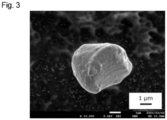
- Fig. 3 shows a scanning electron microscope image of the composite active material.
- Example 1 The feed amount of the raw material powder of the surface portion relative to the particles of the active material in Example 1 was changed as shown in Table 1 below. Otherwise, a similar procedure to that of Example 1 was performed, and particles of a composite active material were thus obtained. X-ray diffraction measurement of the obtained composite active material confirmed the presence of an argyrodite-type crystal structure. No peak from a lithium halide was observed. In addition, the obtained composite active material was subjected to elemental analysis by SEM-EDS and confirmed to have a (Cl+Br)/P atomic ratio of more than 1.0.
- Example 1 During the formation of the surface portion in Example 1, the raw material powder was adjusted so that the composition of the surface portion was Li 5.8 PS 4.8 Cl 1.2 . Otherwise, a similar procedure to that of Example 1 was performed, and particles of a composite active material were thus obtained.
- Example 2 a similar procedure to that of Example 1 was performed, and particles of a composite active material were thus obtained. X-ray diffraction measurement of the obtained composite active material was performed, and no argyrodite-type crystal structure was confirmed. Elemental analysis by SEM-EDS confirmed that the (Cl+Br)/P atomic ratio was less than 1.0.
- Example 1 During the formation of the surface portion in Example 1, the raw material powder of the surface portion and the particles of the active material were mixed using a mortar. Otherwise, a similar procedure to that of Example 1 was performed, and particles of a composite active material were thus obtained.
- the particle size D 50 and the BET specific surface area were measured.
- the BET specific surface area of the active material obtained by removing the surface portion from the composite active material using the method described above was also measured.
- the maximum measurement depth was set to be greater than or equal to the depth at which a reduced saturation region (plateau region) was reached in an S2p semi-quantitative profile measured in the inward direction from the surface. Specifically, the depth at which the slope of a line obtained by linear approximation with respect to two or more consecutive measurement points in a range of 100 nm or deeper in the S2p semi-quantitative profile first became -0.002 or more from the surface toward the inside was used as the depth at which the reduced saturation region was reached.
- a powder sample was pelletized using a press in an Ar atmosphere with a dew point of -60°C or lower, then fixed to a sample stand dedicated to XPS using a metal jig, and conveyed to the XPS apparatus using a non-atmospheric-exposure vessel manufactured by ULVAC-PHI, Inc.
- the XPS data was analyzed using data analysis software ("MultiPak Ver 9.9" manufactured by ULVAC-PHI, Inc.), and semi-quantitative values in the depth direction was calculated for each element. Shirley was used for background mode. For example, charge correction was performed at the Nb3d5/2 peak (206.7 eV).
- the Br3d peak interferes with the Ni3p peak
- the Br semi-quantitative values were calculated using the peak area from which the interference component of Ni3p was removed by waveform separation analysis.
- Specific waveform separation parameters vary depending on a coating compound and a core compound, and therefore, it is desirable to measure the Br3d and Ni3p spectra for each of the coating compound and the uncoated core compound, and determine and use peak parameters that reproduce each spectrum.
- the value of the depth at which an intermediate value between the maximum value and the minimum value was obtained was calculated as the thickness of the coating layer.
- the value of the depth corresponding to the intermediate value was calculated with the two measurement points located before and after the intermediate value using a linear approximation formula.
- Solid-state batteries were produced by performing the following procedure using the composite active materials obtained in the examples and the comparative examples. With respect to Examples 1 and 3 and Comparative Examples 1 and 2, the obtained composite active material was mixed with a conductive material (VGCF) in a mortar to obtain a positive electrode material mixture so that the mass ratio between the active material, the solid electrolyte, and the conductive material was 85.4:10.3:4.3. No solid electrolyte was added except for the solid electrolyte contained in the composite active material.
- VGCF conductive material
- Example 2 With respect to Example 2, the obtained composite active material was mixed with the solid electrolyte prepared for the formation of the coating portion and the conductive material (VGCF) in a mortar to obtain a positive electrode material mixture so that the active material:the solid electrolyte
- the conductive material 85.4:10.3:4.3.
- a negative electrode material mixture was obtained by mixing a graphite powder and the solid electrolyte prepared for the formation of the coating portion in a mortar at a mass ratio of 50:50.
- 0.05 g of solid electrolyte was poured into a ceramic cylinder with openings at the upper and lower ends, the ceramic cylinder having an opening diameter of 10.5 mm and a height of 18 mm, in a state in which the lower opening was closed with an electrode made of SUS.
- An electrode was attached to the upper opening, and uniaxial pressing was performed at about 0.8 tf/cm 2 to form a solid electrolyte layer.
- the upper electrode was temporarily removed, the positive electrode material mixture was poured onto the solid electrolyte layer, the positive electrode material mixture was smoothed flat, and then the upper electrode was attached again. Subsequently, the lower electrode was temporarily removed, and the negative electrode material mixture was poured onto the solid electrolyte layer.
- the lower electrode was attached again, and uniaxial pressing was performed at about 4.6 tf/cm 2 . After that, the resulting stack was clamped from both the upper electrode side and the lower electrode side, and bound together under a torque pressure of 4 N•m. Thus, an all-solid-state battery having a capacity equivalent to 1.5 mAh was produced.
- the production steps of the all-solid-state battery were performed in a glove box purged with dry air with an average dew point of -70°C.
- the thus obtained battery was placed in an environmental testing machine kept at 25°C, connected to a charge/discharge measuring apparatus, and evaluated. Charging was performed using a CC-CV method with an upper limit voltage set to 4.4 V, and discharging was performed using a CC method with a lower limit voltage set to 3.0 V.
- the discharge capacity retention rate was calculated by dividing the discharge capacity when discharging was performed at a current density of 8 C by the discharge capacity at 0.1 C in the third cycle.
- CC charging was performed at 0.1 C to a charge capacity of 0.75 mAh.
- the charged battery was subjected to impedance measurement using SOLARTRON 1255B SOLARTRON 1255B FREQUENCY RESPONSE ANALYZER available from TOYO Corporation.
- the AC amplitude was set to 10 mV, and the frequency range was set to 1.0 ⁇ 10 -6 to 1.0 ⁇ 10 -1 Hz.
- the reaction resistance ( ⁇ ) was calculated from the intersection with the horizontal axis in a Cole-Cole plot that was a complex impedance plane plot obtained through the measurement.
- the crystalline phase was confirmed through X-ray diffraction measurement.
- the measurement was performed using an X-ray diffractometer "Smart Lab SE” manufactured by Rigaku Corporation.
- the measurement conditions were as follows: non-atmospheric-exposure; scan axis: 2 ⁇ / ⁇ ; scan range: from 20° to 40°; step width: 0.01°; and scan speed: 0.1°/min.
- CuK ⁇ 1 radiation was used as the X-ray source.
- the tube voltage was set to 40 kV, and the tube current was set to 80 mA.
- the solid-state batteries including the composite active materials obtained in the examples have a lower reaction resistance and a higher discharge capacity retention rate than the solid-state batteries of the comparative examples.
Landscapes
- Chemical & Material Sciences (AREA)
- Chemical Kinetics & Catalysis (AREA)
- Electrochemistry (AREA)
- General Chemical & Material Sciences (AREA)
- Engineering & Computer Science (AREA)
- Inorganic Chemistry (AREA)
- Manufacturing & Machinery (AREA)
- Composite Materials (AREA)
- Organic Chemistry (AREA)
- Materials Engineering (AREA)
- Condensed Matter Physics & Semiconductors (AREA)
- General Physics & Mathematics (AREA)
- Physics & Mathematics (AREA)
- Battery Electrode And Active Subsutance (AREA)
- Secondary Cells (AREA)
- Inorganic Compounds Of Heavy Metals (AREA)
Applications Claiming Priority (2)
| Application Number | Priority Date | Filing Date | Title |
|---|---|---|---|
| JP2021212238 | 2021-12-27 | ||
| PCT/JP2022/048024 WO2023127830A1 (fr) | 2021-12-27 | 2022-12-26 | Matériau actif composite |
Publications (2)
| Publication Number | Publication Date |
|---|---|
| EP4459708A1 true EP4459708A1 (fr) | 2024-11-06 |
| EP4459708A4 EP4459708A4 (fr) | 2025-09-03 |
Family
ID=86999267
Family Applications (1)
| Application Number | Title | Priority Date | Filing Date |
|---|---|---|---|
| EP22916053.6A Pending EP4459708A4 (fr) | 2021-12-27 | 2022-12-26 | Matériau actif composite |
Country Status (7)
| Country | Link |
|---|---|
| US (1) | US20250015270A1 (fr) |
| EP (1) | EP4459708A4 (fr) |
| JP (1) | JPWO2023127830A1 (fr) |
| KR (1) | KR20240128667A (fr) |
| CN (1) | CN118339676A (fr) |
| TW (1) | TW202335960A (fr) |
| WO (1) | WO2023127830A1 (fr) |
Families Citing this family (1)
| Publication number | Priority date | Publication date | Assignee | Title |
|---|---|---|---|---|
| WO2025205723A1 (fr) * | 2024-03-29 | 2025-10-02 | 三井金属鉱業株式会社 | Matériau actif et mélange d'électrode, couche d'électrode et batterie à semi-conducteurs le contenant |
Family Cites Families (5)
| Publication number | Priority date | Publication date | Assignee | Title |
|---|---|---|---|---|
| JP6323475B2 (ja) | 2016-02-26 | 2018-05-16 | トヨタ自動車株式会社 | 複合活物質、固体電池および複合活物質の製造方法 |
| CN110800149B (zh) | 2017-07-07 | 2021-04-20 | 三井金属矿业株式会社 | 锂二次电池的固体电解质及该固体电解质用硫化物系化合物 |
| KR102151511B1 (ko) * | 2018-03-12 | 2020-09-03 | 미쓰이금속광업주식회사 | 황화물계 고체 전해질 입자 |
| JP7374664B2 (ja) * | 2019-08-29 | 2023-11-07 | マクセル株式会社 | 固体電解質シートおよび全固体リチウム二次電池 |
| KR20230022158A (ko) * | 2020-06-10 | 2023-02-14 | 미쓰이금속광업주식회사 | 고체 전해질, 전극 합제 및 전지 |
-
2022
- 2022-12-26 US US18/712,496 patent/US20250015270A1/en active Pending
- 2022-12-26 KR KR1020247016832A patent/KR20240128667A/ko active Pending
- 2022-12-26 WO PCT/JP2022/048024 patent/WO2023127830A1/fr not_active Ceased
- 2022-12-26 CN CN202280079883.2A patent/CN118339676A/zh active Pending
- 2022-12-26 JP JP2023571033A patent/JPWO2023127830A1/ja active Pending
- 2022-12-26 EP EP22916053.6A patent/EP4459708A4/fr active Pending
- 2022-12-27 TW TW111150114A patent/TW202335960A/zh unknown
Also Published As
| Publication number | Publication date |
|---|---|
| TW202335960A (zh) | 2023-09-16 |
| KR20240128667A (ko) | 2024-08-26 |
| JPWO2023127830A1 (fr) | 2023-07-06 |
| WO2023127830A1 (fr) | 2023-07-06 |
| EP4459708A4 (fr) | 2025-09-03 |
| US20250015270A1 (en) | 2025-01-09 |
| CN118339676A (zh) | 2024-07-12 |
Similar Documents
| Publication | Publication Date | Title |
|---|---|---|
| KR102425325B1 (ko) | 충전식 리튬 이온 배터리용 양극 재료 | |
| US20230253554A1 (en) | Ni based cathode material for rechargeable lithium-ion batteries | |
| EP4459712A1 (fr) | Matériau actif composite | |
| CN103080010B (zh) | 钛酸锂颗粒粉末及其制造方法、含Mg钛酸锂颗粒粉末及其制造方法、非水电解质二次电池用负极活性物质颗粒粉末以及非水电解质二次电池 | |
| CN114946047A (zh) | Li/Na离子电池阳极材料 | |
| Nisar et al. | Impact of surface coating on electrochemical and thermal behaviors of a Li-rich Li 1.2 Ni 0.16 Mn 0.56 Co 0.08 O 2 cathode | |
| KR102449815B1 (ko) | 전고체 전지용 양극 활물질, 이의 제조방법 및 이를 포함하는 전고체 전지 | |
| AU2013377013B2 (en) | Improved lithium manganese oxide compositions | |
| WO2017204428A1 (fr) | Matière active de cathode, son procédé de préparation, et batterie rechargeable au lithium la comprenant | |
| EP4033565B1 (fr) | Matériau actif d'électrode positive pour batterie secondaire au lithium-ion et batterie secondaire au lithium-ion | |
| US8563174B2 (en) | Secondary battery material and synthesis method | |
| JP7348728B2 (ja) | 活物質、それを用いた正極合剤及び固体電池 | |
| JPWO2019103037A1 (ja) | 非水系電解質二次電池用正極活物質、非水系電解質二次電池用正極活物質の製造方法 | |
| EP3992150A1 (fr) | Matériau actif d'électrode positive pour batteries secondaires au lithium-ion, sa méthode de production et batterie secondaire au lithium-ion | |
| EP4459708A1 (fr) | Matériau actif composite | |
| JP7238783B2 (ja) | 三酸化タングステン | |
| Jayasree et al. | Nanoscale-engineered LiCoO2 as a high energy cathode for wide temperature lithium-ion battery applications–role of coating chemistry and thickness | |
| JP6849124B1 (ja) | リチウムイオン二次電池用正極材料、リチウムイオン二次電池用正極、リチウムイオン二次電池 | |
| EP4184639A1 (fr) | Matériau actif de cathode pour batterie tout solide à base de sulfure | |
| Xu et al. | Structural and electrochemical performance of F-doped SnO2 coated LiCoO2 as cathode materials | |
| JP2023121067A (ja) | 電極合剤、及びそれを用いた電極スラリー並びに電池 | |
| JP2022122296A (ja) | リチウム金属複合酸化物、リチウム二次電池用正極活物質、リチウム二次電池用正極及びリチウム二次電池 | |
| EP4481849A1 (fr) | Mélange d'électrodes et suspension d'électrodes et batterie utilisant ledit mélange d'électrodes | |
| Ha et al. | The Effect of Si Doping or/and Ti Coating on the Electrochemical Properties of Ni-Rich NCA (LiNi0. 8Co0. 15Al0. 05O2) Cathode Material for Lithium-Ion Batteries | |
| US20230335716A1 (en) | Active material and method for producing same, electrode mixture, and battery |
Legal Events
| Date | Code | Title | Description |
|---|---|---|---|
| STAA | Information on the status of an ep patent application or granted ep patent |
Free format text: STATUS: THE INTERNATIONAL PUBLICATION HAS BEEN MADE |
|
| PUAI | Public reference made under article 153(3) epc to a published international application that has entered the european phase |
Free format text: ORIGINAL CODE: 0009012 |
|
| STAA | Information on the status of an ep patent application or granted ep patent |
Free format text: STATUS: REQUEST FOR EXAMINATION WAS MADE |
|
| 17P | Request for examination filed |
Effective date: 20240524 |
|
| AK | Designated contracting states |
Kind code of ref document: A1 Designated state(s): AL AT BE BG CH CY CZ DE DK EE ES FI FR GB GR HR HU IE IS IT LI LT LU LV MC ME MK MT NL NO PL PT RO RS SE SI SK SM TR |
|
| DAV | Request for validation of the european patent (deleted) | ||
| DAX | Request for extension of the european patent (deleted) | ||
| A4 | Supplementary search report drawn up and despatched |
Effective date: 20250804 |
|
| RIC1 | Information provided on ipc code assigned before grant |
Ipc: H01M 4/36 20060101AFI20250729BHEP Ipc: H01M 4/131 20100101ALI20250729BHEP Ipc: H01M 10/0562 20100101ALI20250729BHEP Ipc: H01M 10/0585 20100101ALI20250729BHEP Ipc: H01M 4/139 20100101ALI20250729BHEP Ipc: H01M 4/505 20100101ALI20250729BHEP Ipc: H01M 4/525 20100101ALI20250729BHEP Ipc: H01M 4/62 20060101ALI20250729BHEP Ipc: H01M 4/1391 20100101ALI20250729BHEP Ipc: H01M 10/052 20100101ALI20250729BHEP Ipc: H01M 4/02 20060101ALN20250729BHEP |
|
| RAP3 | Party data changed (applicant data changed or rights of an application transferred) |
Owner name: MITSUI KINZOKU COMPANY, LIMITED |