EP4459923A1 - Vorrichtung zur erzeugung eines optischen signals zur verteilung von quantenschlüsseln - Google Patents
Vorrichtung zur erzeugung eines optischen signals zur verteilung von quantenschlüsseln Download PDFInfo
- Publication number
- EP4459923A1 EP4459923A1 EP24173928.3A EP24173928A EP4459923A1 EP 4459923 A1 EP4459923 A1 EP 4459923A1 EP 24173928 A EP24173928 A EP 24173928A EP 4459923 A1 EP4459923 A1 EP 4459923A1
- Authority
- EP
- European Patent Office
- Prior art keywords
- optical signal
- generating
- random
- quantum
- optical
- Prior art date
- Legal status (The legal status is an assumption and is not a legal conclusion. Google has not performed a legal analysis and makes no representation as to the accuracy of the status listed.)
- Pending
Links
Images


Classifications
-
- H—ELECTRICITY
- H04—ELECTRIC COMMUNICATION TECHNIQUE
- H04L—TRANSMISSION OF DIGITAL INFORMATION, e.g. TELEGRAPHIC COMMUNICATION
- H04L9/00—Cryptographic mechanisms or cryptographic arrangements for secret or secure communications; Network security protocols
- H04L9/08—Key distribution or management, e.g. generation, sharing or updating, of cryptographic keys or passwords
- H04L9/0816—Key establishment, i.e. cryptographic processes or cryptographic protocols whereby a shared secret becomes available to two or more parties, for subsequent use
- H04L9/0852—Quantum cryptography
-
- H—ELECTRICITY
- H04—ELECTRIC COMMUNICATION TECHNIQUE
- H04B—TRANSMISSION
- H04B10/00—Transmission systems employing electromagnetic waves other than radio-waves, e.g. infrared, visible or ultraviolet light, or employing corpuscular radiation, e.g. quantum communication
- H04B10/70—Photonic quantum communication
-
- H—ELECTRICITY
- H04—ELECTRIC COMMUNICATION TECHNIQUE
- H04B—TRANSMISSION
- H04B10/00—Transmission systems employing electromagnetic waves other than radio-waves, e.g. infrared, visible or ultraviolet light, or employing corpuscular radiation, e.g. quantum communication
- H04B10/11—Arrangements specific to free-space transmission, i.e. transmission through air or vacuum
- H04B10/118—Arrangements specific to free-space transmission, i.e. transmission through air or vacuum specially adapted for satellite communication
-
- H—ELECTRICITY
- H04—ELECTRIC COMMUNICATION TECHNIQUE
- H04B—TRANSMISSION
- H04B7/00—Radio transmission systems, i.e. using radiation field
- H04B7/14—Relay systems
- H04B7/15—Active relay systems
- H04B7/185—Space-based or airborne stations; Stations for satellite systems
- H04B7/1851—Systems using a satellite or space-based relay
- H04B7/18513—Transmission in a satellite or space-based system
Definitions
- the invention is in the technical field of devices enabling the exchange or quantum distribution of keys (in English QKD for Quantum Key Distribution ), and more particularly when the exchange of keys is implemented by a protocol of the Prepare & Measure type (in English Prepare and Measure ) with discrete variable (in English DV for Discrete Variable ) .
- the invention relates to a high-performance and compact optical signal transmission device, exhibiting high resistance to the risks of attacks by measuring electromagnetic radiation.
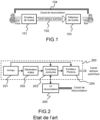
- FIG 1 schematically represents the operation of an exchange/distribution of secret keys by quantum optical link (QKD).
- QKD quantum optical link
- transmitter 101 emits a random sequence of qubits (sequence of 0s and 1s) in randomly chosen bases.
- Receiver 103 measures the qubits of this sequence on its own bases and reconstructs an incomplete and fragmentary sequence of bits, following the signal degradations linked to the transmission on the optical link 102 (photons lost on the path, parasitic photons, measurement errors, etc.).
- a process called reconciliation carried out on a reconciliation channel 104, makes it possible to generate a secret key known only by the transmitter 101 (Alice) and the receiver 103 (Bob) from the two random sequences: the random sequence emitted by Alice and the sequence received and reconstructed by Bob.
- the emitter 101 In discrete variable Prepare and Measure protocols, such as the BB84 protocol, the emitter 101 (Alice) emits a random sequence of qubits encoded on several possible bases and two possible values (0 and 1). Ideally, the qubits are made of single photons.
- the optical source is an attenuated laser, and not a single photon source, it generates coherent states that can contain a finite number of photons per pulse with a Poisson probability. Decoys can be introduced to prevent attacks by a hostile third party (called Eve) based on the measurement of additional photons in the case of multi-photon pulses. This is called the BB84 decoy protocol.
- the protocol controller 203 of the qubit transmitter 200 is functionally connected to the reconciliation channel by a device denoted Reconciliation Interface (I/F) 205 for the example.
- the functions of controlling and managing the reconciliation channel, of controlling and running the reconciliation process are distributed between the two devices of the example: the protocol controller 203 of the qubit transmitter and the reconciliation interface 205.
- Clock 201 clocks the device and sets the rate at which the random sequence of qubits is transmitted per pulse train.
- the protocol controller 203 is a digital device (for example a computer, an FPGA ( Field Programmable Gate Array ), an ASIC ( Application-Specific Integrated Circuit ) or a DSP ( Digital Signal Processor ) which controls the photonic source in accordance with the chosen protocol. From the sequence of random numbers provided by the QRNG 202, the protocol controller 203 creates a sequence of instructions or control words intended for the photon emitter 204.
- a digital device for example a computer, an FPGA ( Field Programmable Gate Array ), an ASIC ( Application-Specific Integrated Circuit ) or a DSP ( Digital Signal Processor ) which controls the photonic source in accordance with the chosen protocol. From the sequence of random numbers provided by the QRNG 202, the protocol controller 203 creates a sequence of instructions or control words intended for the photon emitter 204.
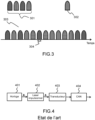
- FIG 3 illustrates the constitution of an optical signal used for a quantum key exchange.
- the optical signal consists of a succession of 304 time pulses, these pulses are either qubit pulses or decoy pulses.
- the number of bits required to encode the instruction or command word of the protocol controller 203 for the photon source 204 is at least 4 bits per pulse. For example, 1 bit or more to define the type of the pulse (qubit or decoy), 1 bit to define the value of the qubit (0 or 1), 1 bit or more to define the encoding base (rectilinear or diagonal polarization, phase, ...), 1 bit or more to define the amplitude (or intensity) of the decoy pulse (number of photons per pulse), etc.
- These instructions intended for the photon emitter 204 are developed and encoded by the protocol controller 203 from the random sequence from the random number generator 202 and in accordance with the chosen prepare and measure protocol.
- quantum key exchange protocols such as the B92 protocol, which is a simplified version of the BB84 protocol using two polarization states (the horizontal polarization state (-) of the rectilinear basis and +45° (/) of the diagonal basis), or the SSP protocol ( Six-State Protocol ), which is also a modified version of BB84 using six polarization states.
- B92 protocol which is a simplified version of the BB84 protocol using two polarization states (the horizontal polarization state (-) of the rectilinear basis and +45° (/) of the diagonal basis)
- SSP protocol Six-State Protocol
- the content of the temporal pulses 304 corresponding to the qubits and the decoys, their polarization states and the amplitude (or intensity) of the decoys must be completely random, with probability densities defined as a function of the quantum key exchange protocol implemented.
- the quality of the exchanged encryption key depends on the entropy of the random sequence.
- the encoding of the qubits and decoys (typically their polarization and amplitude) is achieved by various techniques involving mostly attenuated lasers.
- the piloting of this photon "modulator" is done by the protocol controller 203.
- An object of the invention is therefore to define a device for generating a compact and competitive optical signal whose architecture makes it possible to overcome the defects of the prior art stated above.
- the device according to the invention achieves this by integrating, where appropriate in a single piece of equipment, the generator and quantum state modulator of photons, protocol controller, randomness generation and extraction, and adaptation to the transmission medium (optical fiber or free space).
- the device for generating an optical signal further comprises a device for adapting the optical signal delivered by the quantum state modulator to the optical signal transmission medium.
- the optical signal transmission medium is chosen from an optical fiber and free space.
- the CAN transducer is configured to exploit a random quantum phenomenon of the photons of one of the pulse streams generated by the photonic source to determine the random binary sequence.
- the random sequence(s) generated by the calculation means are obtained by applying one-way mathematical functions to the random binary sequence produced by the CAN transducer.
- the digital calculation means are further configured to implement a process of reconciling the data transmitted to the receiver.
- figure 4 represents such a quantum random number generator. It comprises a pulsed laser 402 configured to generate a pulse stream clocked by a clock 401. The pulse stream is converted into a random binary sequence by a transducer 403 and an analog-to-digital converter (ADC) 404 using the quantum random properties of the pulses, for example the initial phase of the pulses, their amplitude or intensity, their time of occurrence (position in the pulse), the speckle patterns, etc.
- ADC analog-to-digital converter
- the transducer 403 converts the chosen random quantum physical property into an electrical signal, amplifies it and formats it.
- the analog-to-digital converter (ADC) 404 converts the electrical signal generated and amplified by the transducer into a digital value (an 8-bit binary word for example). Due to the eminently random nature of the physical properties of quantum phenomena, the sequence of digital values generated is random with very good entropy.
- FIG. 5 represents a device for generating an optical signal according to an embodiment of the invention. It comprises a photonic source 501, here a pulsed laser emitting a series of pulses. This series of pulses is transmitted on the one hand to a quantum state modulator 502, and on the other hand to a CAN transducer 503.
- the division of the pulse flow can be done for example using an optical divider, such as a semi-reflecting mirror, which will collect and redirect part of the main optical flow.
- the CAN transducer 503 consists of a transducer that converts a quantum property of the optical pulse into an electrical signal, and an analog/digital converter CAN that converts the electrical signal into a digital value (binary word).
- the CAN transducer 503 is configured to convert each optical pulse of one of the pulse streams generated by said photonic source into a random binary word, exploiting for this the quantum properties of the pulses, in a manner comparable to what is done in quantum random number generators according to the state of the art such as that shown in FIG. figure 4 .
- the succession of random binary words constitutes a random binary sequence which feeds a random sequence generation function 505.
- the device for generating an optical signal also comprises digital calculation means 504, such as for example an ASIC, an FPGA, a DSP, or a microprocessor, configured to perform the function 505 of generating random sequences, and a protocol controller function 506.
- digital calculation means 504 such as for example an ASIC, an FPGA, a DSP, or a microprocessor, configured to perform the function 505 of generating random sequences, and a protocol controller function 506.
- random sequences When random sequences have equal probability densities, such as those for the encoding base and the value of the qubits, they can be grouped into a single random sequence whose rate is increased relative to the binary rate of the random binary sequence used as input.
- the generation, from a first random sequence (mother sequence), of a new random sequence (daughter sequence) whose properties (rhythm and probability density) are adjusted with respect to a given need is an operation known to those skilled in the art, and can be done by applying mathematical functions, such as for example a one-way function such as hashing , on the daughter random sequences.
- mathematical functions such as for example a one-way function such as hashing , on the daughter random sequences.
- These mathematical functions ensure that it is impossible for an observer (Eve) to find the other random sequences from one of the random sequences (daughter) that would have been reconstituted.
- Other mathematical functions, such as mixing (random permutation) of the sequences are also possible.
- the quantum state modulator 502 has two actions on the optical pulses delivered by the pulsed laser 501: it attenuates the intensity of the optical pulse to fix the average number of photons per pulse and it fixes the quantum state of the photons of the pulse.
- the intensity of the pulse (average number of photons) and the quantum state of the photons are defined for each pulse by a control word provided by the protocol controller 506.
- the quantum state modulator 502 modifies the flow of optical pulses generated by the pulsed laser 501 into a succession of qubits and decoys, by fixing the average number and the quantum state of the photons of each optical pulse in accordance with the control word given by digital calculation means 504.
- the protocol controller 506 encodes the qubits and the decoys by adjusting the amplitude of the pulses (average number of photons per pulse) and the state (for example the polarization) of the photons in accordance with the control word transmitted by the protocol controller 506.
- the device for generating an optical signal comprises a clock 507 used to clock the emissions from the photonic source 501, and to synchronize the protocol controller function 506 with the pulse flow.
- the device for generating an optical signal according to the invention comprises a device for adaptation to the transmission medium 508.
- the transmission medium optical channel
- the device for adaptation to the medium 508 controls for example the polarization axes of the optical signal emitted according to the medium, by defining in an absolute manner the polarization axis, which can differ according to the medium.
- This adaptation is done in collaboration with the receiver to measure the distortions of quantum states (e.g. polarization) caused by propagation on the transmission medium.
- This measurement of distortions can be done for example via the optical channel before transmission of the qubits in the case of fiber transmission or via a reference optical channel dedicated to this function in the case of free space transmission.
- the photonic source 601 is a source of single photons known to those skilled in the art.
- the device then comprises a photon separation device 601, such as for example a splitter plate. A portion of the photons is taken to power the quantum state modulator 502, and the other portion is transmitted to the CAN transducer 503.
- the operation of the device is identical to that described in FIG. figure 5 .
- FIG. 7 represents a device for generating an optical signal according to another embodiment of the invention, in which the photon source 701 is configured to generate two photon streams, a first stream towards the quantum state modulator 502 and a second stream towards the CAN transducer 503.
- Two pulsed lasers connected in parallel or two single photon sources constitute examples of a photon source with two outputs.
- the invention includes a random sequence generator 505, which allows an increase in the performance in terms of throughput (transmission frequency) and entropy (quality of the randomness) of the random binary sequence generated by the CAN transducer 503.
- a quantum key exchange (QKD) link using the invention as a qubit transmitter (Alice) will be more efficient than those of the prior art, and will allow more keys to be exchanged.
- the random sequence generator makes it possible to offer very good entropy of the transmitted data, and therefore contributes to good quality of the quantum keys exchanged.
- the integration of the random sequence generator and the protocol in a single device also makes it possible to eliminate the connection between these two units, and therefore to further increase the randomness generation rate.
- the payload 900 comprises a device for generating an optical signal according to the invention 901, an optical modem 902 for transmitting the reconciliation data exchanged between the device 901 and the receiver, both connected to an optical terminal 903, or telescope.
- the payload also comprises a synchronization and polarization measurement device 905 ensuring the synchronization of the qubit receiver of the earth station with the device of the invention and the measurement of the distortions of the polarization of the optical channel.
- the payload is completed by a mission controller 904, configured to ensure the establishment, maintenance and closure of links (quantum and classical), the sequencing of operations, and the management of the payload, including the command and control of the signal generation device 901.
- the 902 modem is an RF modem, connected to an antenna.
- Quantum key exchange via satellite can be implemented equivalently using the optical ground station as the transmitter and the satellite as the receiver.
Landscapes
- Physics & Mathematics (AREA)
- Engineering & Computer Science (AREA)
- Signal Processing (AREA)
- Computer Networks & Wireless Communication (AREA)
- Electromagnetism (AREA)
- General Physics & Mathematics (AREA)
- Astronomy & Astrophysics (AREA)
- Optics & Photonics (AREA)
- Aviation & Aerospace Engineering (AREA)
- Theoretical Computer Science (AREA)
- Computer Security & Cryptography (AREA)
- Optical Modulation, Optical Deflection, Nonlinear Optics, Optical Demodulation, Optical Logic Elements (AREA)
- Optical Communication System (AREA)
Applications Claiming Priority (1)
| Application Number | Priority Date | Filing Date | Title |
|---|---|---|---|
| FR2304460A FR3148507B1 (fr) | 2023-05-04 | 2023-05-04 | Dispositif de génération d'un signal optique pour la distribution de clés quantiques |
Publications (1)
| Publication Number | Publication Date |
|---|---|
| EP4459923A1 true EP4459923A1 (de) | 2024-11-06 |
Family
ID=88413203
Family Applications (1)
| Application Number | Title | Priority Date | Filing Date |
|---|---|---|---|
| EP24173928.3A Pending EP4459923A1 (de) | 2023-05-04 | 2024-05-02 | Vorrichtung zur erzeugung eines optischen signals zur verteilung von quantenschlüsseln |
Country Status (3)
| Country | Link |
|---|---|
| US (1) | US20240372628A1 (de) |
| EP (1) | EP4459923A1 (de) |
| FR (1) | FR3148507B1 (de) |
Citations (3)
| Publication number | Priority date | Publication date | Assignee | Title |
|---|---|---|---|---|
| EP2940923A1 (de) * | 2014-04-28 | 2015-11-04 | Université de Genève | Verfahren und Vorrichtung für einen optischen Quantumzufallszahlengenerator |
| WO2019115984A1 (en) * | 2017-12-13 | 2019-06-20 | Arqit Limited | Quantum protection of telemetry tracking and command links |
| EP3993312A1 (de) * | 2020-10-29 | 2022-05-04 | Thales | Verfahren zur sicherung der übertragung von satellitendaten und entsprechendes übertragungssystem |
Family Cites Families (3)
| Publication number | Priority date | Publication date | Assignee | Title |
|---|---|---|---|---|
| FR3012274B1 (fr) * | 2013-10-18 | 2019-04-19 | Thales | Procede d'emission et procede de reception d'un flux de donnees binaires, emetteur et recepteur pour la mise en oeuvre du procede |
| WO2019149383A1 (en) * | 2018-02-05 | 2019-08-08 | Telefonaktiebolaget Lm Ericsson (Publ) | Quantum key distribution apparatus, system and method |
| US11695551B2 (en) * | 2019-02-26 | 2023-07-04 | Ut-Battelle, Llc | Quantum frequency processor for provable cybersecurity |
-
2023
- 2023-05-04 FR FR2304460A patent/FR3148507B1/fr active Active
-
2024
- 2024-05-02 EP EP24173928.3A patent/EP4459923A1/de active Pending
- 2024-05-03 US US18/654,540 patent/US20240372628A1/en active Pending
Patent Citations (3)
| Publication number | Priority date | Publication date | Assignee | Title |
|---|---|---|---|---|
| EP2940923A1 (de) * | 2014-04-28 | 2015-11-04 | Université de Genève | Verfahren und Vorrichtung für einen optischen Quantumzufallszahlengenerator |
| WO2019115984A1 (en) * | 2017-12-13 | 2019-06-20 | Arqit Limited | Quantum protection of telemetry tracking and command links |
| EP3993312A1 (de) * | 2020-10-29 | 2022-05-04 | Thales | Verfahren zur sicherung der übertragung von satellitendaten und entsprechendes übertragungssystem |
Non-Patent Citations (2)
| Title |
|---|
| HUANG DONGHAI ET AL: "Quantum Key Distribution Over Double-Layer Quantum Satellite Networks", IEEE ACCESS, IEEE, USA, vol. 8, 13 January 2020 (2020-01-13), pages 16087 - 16098, XP011768438, DOI: 10.1109/ACCESS.2020.2966683 * |
| SHENG-KAI LIAO ET AL: "Satellite-to-ground quantum key distribution", ARXIV.ORG, CORNELL UNIVERSITY LIBRARY, 201 OLIN LIBRARY CORNELL UNIVERSITY ITHACA, NY 14853, 3 July 2017 (2017-07-03), XP081279476, DOI: 10.1038/NATURE23655 * |
Also Published As
| Publication number | Publication date |
|---|---|
| FR3148507A1 (fr) | 2024-11-08 |
| US20240372628A1 (en) | 2024-11-07 |
| FR3148507B1 (fr) | 2025-10-03 |
Similar Documents
| Publication | Publication Date | Title |
|---|---|---|
| Yin et al. | Entanglement-based secure quantum cryptography over 1,120 kilometres | |
| EP0877508B1 (de) | Verfahren und Vorrichtung zur Schlüsselverteilung mittels Quanten-Kryptographie | |
| EP1825633B1 (de) | Kontinuierlich variables system zur verschlüsselungsschlüssel-quantendistribution | |
| Hiskett et al. | Long-distance quantum key distribution in optical fibre | |
| EP1342337B1 (de) | Vorrichtung zur gesicherten optischen übertragung eines binären kodes | |
| FR2920550A1 (fr) | Emetteur optique et son procede de commande. | |
| JP4822811B2 (ja) | 光通信装置 | |
| Roberts et al. | Modulator‐Free Coherent‐One‐Way Quantum Key Distribution | |
| Zhao et al. | Synchronized random bit sequences generation based on analog-digital hybrid electro-optic chaotic sources | |
| Bannik et al. | Plug&Play subcarrier wave quantum key distribution with deep modulation | |
| EP2067298B1 (de) | System und verfahren zur sicheren übertragung eines binären codes durch phasen- und intensitätskodierung | |
| EP4459923A1 (de) | Vorrichtung zur erzeugung eines optischen signals zur verteilung von quantenschlüsseln | |
| EP4305559A1 (de) | Vereinfachter client und zugehörige architekturen zur delegierung von quantenberechnungen an einen quantenserver | |
| EP1348277A1 (de) | Quantenkryptographieverfahren und system | |
| Woo et al. | Plug-and-play QKD architecture with a self-optical pulse train generator | |
| WO2023232937A1 (fr) | Systeme et procede de determination de cles de cryptage utilisant l'encodage de phase d'un signal | |
| EP4144039B1 (de) | Verfahren zur sicheren berechnung einer logischen und zwischen zwei bits mit quantenkommunikation | |
| US20250317281A1 (en) | System for implementing quantum key distribution (qkd) in a data center environment | |
| Rusca | Security of quantum cryptography: from quantum random key generation to quantum key distribution | |
| De Toni | Advances in real-world applications of Quantum Key Distribution | |
| Guarda et al. | Decoy-state quantum key distribution over long-distance optical fiber | |
| Alshaer et al. | Feasibility Analysis of Uplink Quantum Communication with HAP Considering Beam Wandering and Weather Dependence | |
| EP4576613A1 (de) | Quantenschlüsselverteilungssystem mit photonenpolarisationskorrektur | |
| Crişan | Contributions for quantum communication networks with frequency encoded entangled photons from Silicon resonators | |
| Agnesi et al. | Simple and robust QKD system with Qubit4Sync temporal synchronization and the POGNAC polarization encoder |
Legal Events
| Date | Code | Title | Description |
|---|---|---|---|
| PUAI | Public reference made under article 153(3) epc to a published international application that has entered the european phase |
Free format text: ORIGINAL CODE: 0009012 |
|
| STAA | Information on the status of an ep patent application or granted ep patent |
Free format text: STATUS: THE APPLICATION HAS BEEN PUBLISHED |
|
| AK | Designated contracting states |
Kind code of ref document: A1 Designated state(s): AL AT BE BG CH CY CZ DE DK EE ES FI FR GB GR HR HU IE IS IT LI LT LU LV MC ME MK MT NL NO PL PT RO RS SE SI SK SM TR |
|
| STAA | Information on the status of an ep patent application or granted ep patent |
Free format text: STATUS: REQUEST FOR EXAMINATION WAS MADE |
|
| 17P | Request for examination filed |
Effective date: 20250430 |