EP4461641B1 - Verfahren und vorrichtung zum ein- und ausfahren eines wirtschaftlichen betriebsmodus für ein zweimotoriges luftfahrzeug - Google Patents
Verfahren und vorrichtung zum ein- und ausfahren eines wirtschaftlichen betriebsmodus für ein zweimotoriges luftfahrzeug Download PDFInfo
- Publication number
- EP4461641B1 EP4461641B1 EP24154895.7A EP24154895A EP4461641B1 EP 4461641 B1 EP4461641 B1 EP 4461641B1 EP 24154895 A EP24154895 A EP 24154895A EP 4461641 B1 EP4461641 B1 EP 4461641B1
- Authority
- EP
- European Patent Office
- Prior art keywords
- operating mode
- aircraft
- limitations
- engine
- rotor
- Prior art date
- Legal status (The legal status is an assumption and is not a legal conclusion. Google has not performed a legal analysis and makes no representation as to the accuracy of the status listed.)
- Active
Links
Images
Classifications
-
- F—MECHANICAL ENGINEERING; LIGHTING; HEATING; WEAPONS; BLASTING
- F02—COMBUSTION ENGINES; HOT-GAS OR COMBUSTION-PRODUCT ENGINE PLANTS
- F02C—GAS-TURBINE PLANTS; AIR INTAKES FOR JET-PROPULSION PLANTS; CONTROLLING FUEL SUPPLY IN AIR-BREATHING JET-PROPULSION PLANTS
- F02C6/00—Plural gas-turbine plants; Combinations of gas-turbine plants with other apparatus; Adaptations of gas-turbine plants for special use
- F02C6/20—Adaptations of gas-turbine plants for driving vehicles
- F02C6/206—Adaptations of gas-turbine plants for driving vehicles the vehicles being airscrew driven
-
- B—PERFORMING OPERATIONS; TRANSPORTING
- B64—AIRCRAFT; AVIATION; COSMONAUTICS
- B64C—AEROPLANES; HELICOPTERS
- B64C27/00—Rotorcraft; Rotors peculiar thereto
- B64C27/04—Helicopters
- B64C27/12—Rotor drives
-
- G—PHYSICS
- G05—CONTROLLING; REGULATING
- G05D—SYSTEMS FOR CONTROLLING OR REGULATING NON-ELECTRIC VARIABLES
- G05D1/00—Control of position, course, altitude or attitude of land, water, air or space vehicles, e.g. using automatic pilots
- G05D1/60—Intended control result
- G05D1/644—Optimisation of travel parameters, e.g. of energy consumption, journey time or distance
-
- B—PERFORMING OPERATIONS; TRANSPORTING
- B64—AIRCRAFT; AVIATION; COSMONAUTICS
- B64D—EQUIPMENT FOR FITTING IN OR TO AIRCRAFT; FLIGHT SUITS; PARACHUTES; ARRANGEMENT OR MOUNTING OF POWER PLANTS OR PROPULSION TRANSMISSIONS IN AIRCRAFT
- B64D31/00—Power plant control systems; Arrangement of power plant control systems in aircraft
-
- B—PERFORMING OPERATIONS; TRANSPORTING
- B64—AIRCRAFT; AVIATION; COSMONAUTICS
- B64D—EQUIPMENT FOR FITTING IN OR TO AIRCRAFT; FLIGHT SUITS; PARACHUTES; ARRANGEMENT OR MOUNTING OF POWER PLANTS OR PROPULSION TRANSMISSIONS IN AIRCRAFT
- B64D31/00—Power plant control systems; Arrangement of power plant control systems in aircraft
- B64D31/02—Initiating means
- B64D31/06—Initiating means actuated automatically
-
- F—MECHANICAL ENGINEERING; LIGHTING; HEATING; WEAPONS; BLASTING
- F02—COMBUSTION ENGINES; HOT-GAS OR COMBUSTION-PRODUCT ENGINE PLANTS
- F02C—GAS-TURBINE PLANTS; AIR INTAKES FOR JET-PROPULSION PLANTS; CONTROLLING FUEL SUPPLY IN AIR-BREATHING JET-PROPULSION PLANTS
- F02C6/00—Plural gas-turbine plants; Combinations of gas-turbine plants with other apparatus; Adaptations of gas-turbine plants for special use
- F02C6/02—Plural gas-turbine plants having a common power output
-
- F—MECHANICAL ENGINEERING; LIGHTING; HEATING; WEAPONS; BLASTING
- F02—COMBUSTION ENGINES; HOT-GAS OR COMBUSTION-PRODUCT ENGINE PLANTS
- F02C—GAS-TURBINE PLANTS; AIR INTAKES FOR JET-PROPULSION PLANTS; CONTROLLING FUEL SUPPLY IN AIR-BREATHING JET-PROPULSION PLANTS
- F02C7/00—Features, components parts, details or accessories, not provided for in, or of interest apart form groups F02C1/00 - F02C6/00; Air intakes for jet-propulsion plants
- F02C7/26—Starting; Ignition
-
- F—MECHANICAL ENGINEERING; LIGHTING; HEATING; WEAPONS; BLASTING
- F02—COMBUSTION ENGINES; HOT-GAS OR COMBUSTION-PRODUCT ENGINE PLANTS
- F02C—GAS-TURBINE PLANTS; AIR INTAKES FOR JET-PROPULSION PLANTS; CONTROLLING FUEL SUPPLY IN AIR-BREATHING JET-PROPULSION PLANTS
- F02C9/00—Controlling gas-turbine plants; Controlling fuel supply in air- breathing jet-propulsion plants
-
- F—MECHANICAL ENGINEERING; LIGHTING; HEATING; WEAPONS; BLASTING
- F02—COMBUSTION ENGINES; HOT-GAS OR COMBUSTION-PRODUCT ENGINE PLANTS
- F02C—GAS-TURBINE PLANTS; AIR INTAKES FOR JET-PROPULSION PLANTS; CONTROLLING FUEL SUPPLY IN AIR-BREATHING JET-PROPULSION PLANTS
- F02C9/00—Controlling gas-turbine plants; Controlling fuel supply in air- breathing jet-propulsion plants
- F02C9/26—Control of fuel supply
- F02C9/42—Control of fuel supply specially adapted for the control of two or more plants simultaneously
-
- F—MECHANICAL ENGINEERING; LIGHTING; HEATING; WEAPONS; BLASTING
- F05—INDEXING SCHEMES RELATING TO ENGINES OR PUMPS IN VARIOUS SUBCLASSES OF CLASSES F01-F04
- F05D—INDEXING SCHEME FOR ASPECTS RELATING TO NON-POSITIVE-DISPLACEMENT MACHINES OR ENGINES, GAS-TURBINES OR JET-PROPULSION PLANTS
- F05D2220/00—Application
- F05D2220/30—Application in turbines
- F05D2220/32—Application in turbines in gas turbines
- F05D2220/329—Application in turbines in gas turbines in helicopters
-
- G—PHYSICS
- G05—CONTROLLING; REGULATING
- G05D—SYSTEMS FOR CONTROLLING OR REGULATING NON-ELECTRIC VARIABLES
- G05D2109/00—Types of controlled vehicles
- G05D2109/20—Aircraft, e.g. drones
- G05D2109/25—Rotorcrafts
Definitions
- the present invention lies in the field of aircraft pilot assistance systems.
- the present invention relates to a method and device for entering and exiting an economical operating mode for a twin-engine aircraft.
- the present invention is intended for rotary wing aircraft equipped with at least two heat engines and at least one rotor, the heat engines driving the respective rotor(s) of these aircraft in rotation.
- Such a rotary-wing aircraft comprises at least one rotor that can be driven in rotation by at least two thermal engines.
- the thermal engines are further oversized to allow the rotor to be driven with a single engine, in the event of failure of another engine.
- Such an aircraft comprises a so-called “total” or “AEO” operating mode for the English designation “All Engines Operative” in which each thermal engine provides non-zero mechanical power to said at least one rotor, the thermal engines then jointly and substantially symmetrically providing the required mechanical power to said at least one rotor.
- a so-called "economical" operating mode can be used, mainly during a cruising flight phase.
- this economical operating mode a single thermal engine is active and provides the power necessary to rotate the aircraft's rotor.
- the other thermal engine(s) are passive, and do not provide significant mechanical power, or even provide no power at all.
- This economical operating mode is therefore an operation asymmetrical thermal engines, thermal engines not operating in the same way.
- Such an economical operating mode is interesting but must be used judiciously. Indeed, the economical operating mode can make it possible to obtain a gain in fuel consumption to directly reduce the cost of the flight, its environmental footprint, or to improve the performance of the aircraft by increasing the range that can be covered by the aircraft or its transportable mass.
- the economical operating mode can be limited to a certain flight envelope, on the one hand so that flight safety is always ensured, and on the other hand so that the powerplant provides the power required for the current flight phase.
- the economic operating mode must be engaged with a minimum safety height above the ground flown over in order to allow, in the event of failure of the motor driving the rotor, the reactivation of another motor.
- the aircraft requires significant engine power that cannot be provided by the economical operating mode without the risk of specific damage to the thermal engine and/or the mechanical transmission chain, this damage then being likely to generate additional maintenance costs.
- the economical operating mode results in a reduction in the aircraft speed, consequently increasing the flight time and, consequently, the operational cost of this flight.
- the costs induced by increased flight time and/or additional maintenance costs may prove greater than the gain obtained by the reduction in fuel consumption or the improvement in aircraft performance.
- the performance of a thermal engine fluctuates depending on the aircraft's operational conditions, such as wind, outside temperature or altitude. These conditions can have an influence on the power developed by the thermal engine and/or its fuel consumption. In fact, using the economical operating mode may prove less economical under these conditions than a traditional operating mode for thermal engines in flight, or even impossible.
- the standby engine may optionally be at idle, or even at a rotational speed below idle.
- various operating parameters of the rotorcraft engines and/or rotor must be either within predetermined ranges or below or above predetermined thresholds.
- the standby engine can provide additional power, or even its full power.
- the document WO 2022/029581 describes the conditions for transitioning between an AEO operating mode and the economic operating mode.
- the economic operating mode can be used within a limited flight envelope of the aircraft, in particular when it is in an area free of obstacles or flight restrictions.
- the forward speed of the aircraft and the rotation speed of its rotor must be within specific intervals.
- the altitude and height of the aircraft above the ground as well as the torque delivered by the engines are also influential in authorizing the economic operating mode.
- the operational state and/or the presence of a failure of the aircraft systems and equipment are also taken into account to authorize the economic operating mode.
- entry into asymmetric operation may be performed following an operator request or automatically.
- the second engine may be required to provide more power compared to standby mode, and possibly immediately return to high power.
- Various aircraft operating information can be displayed to a pilot, such as engine power output and a target range indicator.
- an availability message is sent to a cockpit of the aircraft. Then upon receipt of a request initiated by the pilot to use this asymmetric operation, the engines are commanded to operate in the asymmetric operation. When one or more of these parameters no longer meet the asymmetric operating conditions, the asymmetric operation is deactivated.
- a detection of parameters associated with the operating conditions of the aircraft is carried out, these parameters including significant parameters of the behavior of the engines as well as the positions of the controls imposed by the pilot on the rotors. Then, the transition of the aircraft from the first configuration to the second configuration is carried out when the parameters take predetermined values.
- the second engine In standby mode, the second engine is not stopped, but drives a rotating output shaft without providing engine power to this output shaft. Series of messages are displayed to the crew to indicate whether the required conditions are met or, on the contrary, not met.
- the present invention therefore aims to propose an alternative method and system for controlling the implementation of such an economical operating mode in order to optimize and secure the use of this economical operating mode.
- the present invention thus aims at a method and a system for controlling the economical operating mode for an aircraft. comprising at least two thermal engines to manage the entry and exit from this economical operating mode during a flight.
- the method according to the invention thus makes it possible to manage exits from the economic operating mode during the flight of the aircraft, in order to secure the flight of the aircraft and the use of this economic operating mode.
- the method according to the invention thus advantageously makes it possible to assist the pilot of the aircraft in managing the use of this economical operating mode during the flight.
- this economical mode of operation is to be used in a limited flight domain, specific to this economical mode of operation, likely to make its use complex, or even counter-productive from an economic point of view.
- this method makes it possible to compare operating parameters of the aircraft with the safety and functional limitations characterizing the limited flight envelope of the aircraft in the economical operating mode. At least one operating parameter is compared with a functional limitation and at least one operating parameter is compared with a safety limitation.
- Aircraft operating parameters include, among other things, defining the current operating status of the aircraft and its equipment, such as its powerplant and rotors, as well as the current characteristics of its flight. Aircraft operating parameters may also include meteorological parameters.
- the limitations of the economic operating mode are two-tiered and include functional limitations and safety limitations.
- Safety limitations have a direct effect on the aircraft's flight safety. Compliance with these safety limitations is therefore essential to avoid putting the aircraft in a position of risk.
- Functional limitations have an effect on the operation of the aircraft or on the efficiency of the economical operating mode. Failure to comply with one or more functional limitations results, for example, in the loss of an unsafe function of the aircraft and/or may result in the absence of a gain, possibly in terms of fuel consumption and/or financial costs.
- This alert of exceeding functional limitations may be issued in the form of a display of a message on a display device of the aircraft.
- the displayed message includes information relating to said at least one flight and operating parameter not respecting the associated functional limitation in order to inform the pilot of the aircraft.
- Failure to comply with a functional limitation may indicate that the use of the economic operating mode is not optimized and/or that the margin of the parameter concerned with respect to a safety limitation is reduced. The pilot can then act on controls, immediately or following the completion of the current maneuver, to comply with the functional limitations again.
- activation of a passive motor allows it to provide non-zero mechanical power to drive the at least one rotor into rotation.
- the method according to the invention advantageously makes it possible, during a flight phase implementing the economic operating mode, on the one hand to warn the pilot in the event of non-compliance with at least one functional limitation in order to give him the possibility of optimizing the operation of the aircraft, and on the other hand to automatically exit this economic operating mode in the event of non-compliance with at least one safety limitation in order to continue the flight safely.
- the method can comprise a normal start and an accelerated start of the passive motor(s) in the economic operating mode in order to disengage this economic operating mode and exit it, this or these thermal motor(s) then being capable of supplying non-zero mechanical power to the rotor.
- Normal start and accelerated start can be applied both to a passive engine that is stopped and not fueled, and to a passive engine that is started, for example at idle speed.
- Normal start-up may, for example, include a first so-called "normal” acceleration applied to a passive engine, the first acceleration being carried out for a first duration until this or these thermal engines provide non-zero mechanical power to the rotor, or even the power required for this thermal engine.
- the accelerated start may, for example, include a second so-called “short” acceleration applied to a passive motor, the second acceleration being carried out for a second duration until this or these thermal motors provide non-zero mechanical power to the rotor, or even the power required for this thermal motor.
- the second duration is less than the first duration.
- Normal start-up may be performed following the issuance of an alert that the functional limitations of the economic operating mode have been exceeded, if an aircraft pilot commands an exit from the economic operating mode using a human-machine interface.
- Accelerated start-up can be performed following non-compliance with at least one safety limitation, when disengaging from the economic operating mode, and more specifically for the activation of each passive motor.
- Usage data relating to a heat engine can be used to characterize the use and/or damage to this heat engine.
- An engine counter can, for example, record the hours of operation of the heat engine, the endocreep it has undergone, as well as the number of cycles of a gas generator and a free turbine of a turboshaft engine.
- usage data relating to an input shaft of the mechanical transmission chain makes it possible to characterize the use and/or damage to this input shaft.
- a transmission counter can, for example, count the number of cycles or the number of hours of operation of an input shaft or even a duration of use of this input shaft in the economic operating mode.
- the safety and functional limitations may include at least one propulsion limitation relating to at least one propulsion parameter, at least one flight limitation relating to at least one flight parameter, at least one limitation operational relating to at least one operational parameter and at least one environmental limitation relating to at least one environmental parameter.
- a safety and functional limitation may include an upper threshold, an operating parameter respecting this limitation if the value of this parameter is lower than this upper threshold.
- a safety and functional limitation may include a lower threshold, an operating parameter respecting this limitation if the value of this parameter is greater than this lower threshold.
- a safety and functional limitation may include a range within which the value of the flight and operating parameter must fall to comply with this limitation.
- a safety and functional limitation may also be associated with an operating parameter known as a "state" parameter.
- a state parameter may take at least two distinct values.
- Such a limitation is, for example, respected when the state parameter is in a first state and not respected when the parameter is in a second state.
- a state parameter may, for example, characterize an operating state of a piece of equipment and include a "normal operating" state, a "stopped” state or a "presence of a malfunction” state relating to this equipment.
- some of these limitations may include hysteresis thresholds in order to to avoid successive and untimely commitments and disengagements from the economic mode of operation.
- a safety or functional limitation may include a lower hysteresis threshold with a first threshold and a second threshold, the second threshold being higher than the first threshold.
- This limitation is thus considered to be respected as long as the value of the operating parameter is higher than the second threshold.
- the value of the parameter is also higher than the first threshold in this case.
- This limitation is also considered to be respected when the value of the operating parameter becomes lower than the second threshold while remaining higher than the first threshold.
- the limitation is considered to be violated and remains considered to be violated as long as the parameter value is lower than the second threshold, therefore including once the parameter value is higher than the first threshold.
- the limitation is again considered to be respected as soon as the parameter value is higher than the second threshold, and therefore also higher than the first threshold.
- the method can comprise a transmission of information relating to the availability of the economic operating mode. This information makes it possible to inform the pilot of the aircraft that the functional and safety limitations relating to the economic operating mode are respected and that the aircraft can therefore use this economic operating mode without risk and in an efficient manner to reduce fuel consumption, and consequently the operational cost of the flight.
- the pilot can then decide, via a human-machine interface, to order the engagement of the automatic operating mode.
- This transmission of information relating to the availability of the economic operating mode may include the display of a message on a display device of the aircraft, the transmission of a sound using a loudspeaker or the transmission of a vibration using a haptic device.
- the method may include an engagement of the economic operating mode.
- This engagement of the economic operating mode is for example carried out automatically if the pilot has previously selected such a possibility via a suitable human-machine interface.
- the step of engaging the economical operating mode may comprise a first regulation of at least one of the heat engines using the regulator so that it is an active engine and provides the required mechanical power to said at least one rotor, and a second regulation of at least one other of the heat engines using the regulator so that it is a passive engine, providing no mechanical power to said at least one rotor.
- the second regulation comprises, for example, stopping or idling one or more of the other heat engines using the regulator.
- the computer can determine which heat engine can or must be an active engine and which heat engine can or must be a passive engine among the heat engines for the economical operating mode. The computer then transmits to the regulator of information relating to the active motor for the first regulation and to the passive motor for the second regulation.
- This information can, for example, make it possible to alternate several active engines on several successive flights, or even on the same flight, in order to balance the duration of use and damage to the thermal engines as well as the associated input shafts of a mechanical power transmission box to which each thermal engine is connected.
- This information can be determined based on the propulsion parameters relating to the entire aircraft, and in particular the usage data relating to the thermal engines and the mechanical transmission chain provided respectively by the engine counters and by the transmission counters.
- the maintenance of the thermal engines and the mechanical transmission chain can be optimized, the maintenance of the two engines being able, for example, to be carried out simultaneously.
- This information can in particular be used during the stage of engaging the economic operating mode in order to define to which thermal engines the first regulation and the second regulation must respectively be applied.
- the method may comprise a display step using a visualization device, such as a screen, in order to display one or more operating parameters and the associated functional and safety limitations.
- a visualization device such as a screen
- the pilot of the aircraft can permanently display information relating to the position of these parameters in relation to their respective limitations, and decide whether or not he can use the economic operating mode.
- the regulator can include as many motor controllers as The aircraft has thermal engines, each engine controller being dedicated to a single thermal engine in order to manage, regulate and monitor its operation.
- Each engine controller allows, for example, to store the engine counters of a thermal engine in a memory and to increment them when the thermal engines are operating.
- Such an engine controller is, for example, of the EECU type for the English designation "Electronic Engine Control Unit” or can even be part of a FADEC type system for the English designation "Full Authority Digital Engine Control”.
- the economical operating mode can comprise a first operating mode, for which the passive engine is stopped and not supplied with fuel, and a second operating mode, for which the passive engine is started and supplied with fuel, without providing mechanical power to said at least one rotor.
- An aircraft may have both economic operating modes or only one of these two economic operating modes.
- At least one of the functional limitations may comprise a first functional limitation relating to the first mode of operation and a second functional limitation relating to the second mode of operation, the first functional limitation and the second functional limitation then being associated with the same operating parameter.
- at least one of the safety limitations may include a first safety limitation relating to the first mode of operation and a second safety limitation relating to the second mode of operation, the first safety limitation and the second safety limitation then being associated with the same operating parameter.
- a step of issuing an alert of exceeding the first functional limitations can be carried out.
- This alert can be visual, with the display of a message informing the pilot of the operating parameter not respecting the first functional limitation, audible, or haptic.
- a step of engaging the second operating mode can be carried out automatically if a human-machine interface is actuated or has been previously actuated by a pilot of the aircraft.
- This engagement step can include starting the passive engine(s) stopped in this first operating mode, without it supplying mechanical power to said at least one rotor. This starting step is carried out using the regulator.
- a step of engaging the second operating mode can be carried out automatically.
- This engagement step can include a start of the passive engine(s) stopped in this first operating mode, without it providing power. mechanically audits at least one rotor. This starting step is carried out using the regulator.
- the first duration relating to the aforementioned normal start may be different for the first operating mode and for the second operating mode. This first duration is, for example, longer for the first operating mode than for the second operating mode. The first duration may be equal to 30 seconds for the first operating mode and 20 seconds for the second operating mode.
- the second duration relating to the aforementioned accelerated start may be different for the first operating mode and for the second operating mode.
- This second duration is, for example, greater for the first operating mode than for the second operating mode.
- the second duration may be equal to 10 seconds for the first operating mode and 5 seconds for the second operating mode.
- the present invention also relates to a computer program comprising instructions which, when the program is executed, lead to implementing the method according to the invention described above.
- the program is for example executed by a computer or a calculator on board the aircraft, comprising at least one processor, at least one integrated circuit, at least one programmable system, at least one logic circuit, and a memory, these examples not limiting the scope given to the expression "computer” or "calculator”.
- the memory is used to store the computer program as well as various information used by the computer program, namely safety and functional limitations, as well as operating parameters of the aircraft, for example weather parameters.
- the present invention also relates to a system for controlling an economical operating mode for an aircraft equipped with at least one rotor, and at least two thermal engines rotating said at least one rotor, the aircraft having a regulator configured to regulate the thermal engines according to an economical operating mode in which at least one active engine among the thermal engines provides mechanical power to said at least one rotor and at least one passive engine among the other thermal engines does not provide mechanical power to said at least one rotor.
- This control system comprises at least one computer, and at least one memory storing instructions.
- the system for controlling an economical operating mode is connected to the regulator of the thermal engines and is configured to implement the method previously described using these instructions.
- the control system is mounted on the aircraft and is connected to the thermal engine regulator, by a wireless link or a wired link.
- the control system may include a display device, such as a screen, in order to display, in particular, an alert message.
- the present invention finally aims at an aircraft comprising such a control system.
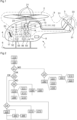
- the aircraft 1 shown is a rotary wing aircraft comprising a fuselage 4, landing gear 6, a power plant 10 and at least one rotor 2, 3 driven in rotation by the power plant 10.
- the aircraft 1 comprises two rotors 2, 3, namely a main rotor 2 arranged above the fuselage 4 and a rear rotor 3 arranged on a tail boom of the aircraft 1.
- the power plant 10 and the rotors 2, 3 form an assembly 9 making it possible to cause the movements of the aircraft 1.
- the power plant 10 comprises at least two heat engines 11, a regulator 14 regulating the operation of the heat engines 11 and a mechanical transmission chain arranged between the heat engines 11 and the rotors 2, 3.
- This mechanical transmission chain is provided in particular with a mechanical power transmission box 12.
- the mechanical power transmission box 12 comprises input shafts 13 each mechanically connected and distinctively to one of the heat engines 11, for example by means of a freewheel.
- the example of power plant 10 shown in the Figure 1 comprises two heat engines 11 although such a power plant 10 may comprise at least three heat engines 11.
- the regulator 14 may, for example, comprise as many motor controllers 15 as the power plant 10 comprises heat engines 11.
- Each motor controller 15 is connected to a respective heat engine 11, and can control and monitor the operation of this heat engine 11.
- Each motor controller 15 makes it possible, by means of sensors arranged on the heat engine 11, to measure propulsion parameters relating to the heat engine 11, such as torques and rotation speeds at the level of rotating parts of this heat engine 11, internal temperatures of this heat engine 11, for example of a combustion chamber or outlet of a compressor, as well as margins in relation to the performance of the heat engine 11, and in particular in relation to the power actually available for the heat engine 11.
- the propulsion parameters also include usage data of these heat engines 11.
- the usage data of each heat engine 11, for example its operating time or the number of cycles performed, are counted by an engine counter.
- the propulsion parameters can be stored in a memory of the engine controller 15.
- the assembly 9 may include other sensors, not shown in the Figure 1 for the sake of clarity, in order to measure propulsion parameters relating to the rotors 2, 3, and to the mechanical transmission chain, in particular to the mechanical power transmission box 12.
- These propulsion parameters then comprise torques and rotational speeds at the level of respective masts 23, 33 of the rotors 2, 3, measured for example using torque meters and tachometers, torques and rotational speeds of rotating members of the mechanical transmission chain, for example at the level of the input shafts 13, measured for example using torque meters and tachometers, as well as usage data of the input shafts 13.
- the usage data of each input shaft 13, for example its operating time or the number of cycles performed, are counted by a transmission counter.
- These propulsion parameters relating to the rotors 2, 3, and to the mechanical transmission chain can be stored in a memory 19 of the power plant 10.
- the propulsion parameters may be stored in a dedicated memory or in a memory of an avionics system 8 of the aircraft 1.
- This avionics system 8 may comprise or be connected to several sensors in order to measure operating parameters of the aircraft 1. These operating parameters comprise flight parameters relating to the aircraft 1, such as its forward speed, its climb speed, its altitude, its attitude and/or its height relative to the ground flown over, for example. These flight parameters of the aircraft 1 may for example be measured using tachometers, accelerometers, an inertial unit, a barometric altimeter or a radiosonde.
- These operating parameters may also include operational parameters of the aircraft 1. These operational parameters may include commanded pitch values of the blades 21, 31 of the rotors 2, 3, or an acceptable forward speed for the aircraft 1 in the economical operating mode. Such an acceptable forward speed is determined as a function of the power actually available for each heat engine 11. This acceptable forward speed may therefore be different depending on the heat engine 11 used.
- These operational parameters may also include a state of equipment of the aircraft 1.
- a state of equipment of the aircraft 1 characterizes whether each piece of equipment is in a normal or nominal operating state or not, for example in a normal or nominal mode, namely without breakdown or malfunction and with nominal performance, in a degraded mode, namely with limited performance, or in a fault.
- Such equipment of the aircraft 1 may include, for example, an electric motor, a starter or a starter-generator connected to a thermal engine 11, or even an electric battery.
- these operating parameters may include environmental parameters including traffic conditions around the aircraft and weather conditions.
- the traffic conditions include, for example, a traffic status to define whether it is significant or not, for example, if the number of aircraft flying around the aircraft 1 is greater than a predetermined number.
- the weather conditions include, for example, measured values of an outside temperature and an outside atmospheric pressure in an environment located outside the aircraft 1.
- the weather conditions may include a wind speed value, a status characterizing the presence of rain or snow, or a status characterizing visibility conditions, for example good or degraded.
- the power plant 10 can implement several operating modes in order to drive the rotors 2, 3.
- the regulator 14 regulates the operation of the heat engines 11 so that all the heat engines 11 are used and each provide non-zero mechanical power to the rotors 2, 3 so that they jointly and substantially symmetrically provide the mechanical power necessary for the proper operation of the rotors 2, 3 and the aircraft 1.
- the regulator 14 can regulate the operation of the heat engines 11 so that at least one of the heat engines 11 is an active engine 111 providing non-zero mechanical power to the rotors 2, 3 in an economical operating mode.
- Each of the other heat engines 11 of the power plant 10 is a passive engine 112, then not providing mechanical power to the rotors 2, 3 and not contributing to their rotations.
- This economical mode of operation aims to reduce the fuel consumption of the power plant 10, and consequently to reduce the cost of a flight of the aircraft 1.
- the economical mode of operation is particularly intended for cruise flight.
- the economical operating mode can generate financial or fuel savings, increase the range of the aircraft 1 for a given quantity of fuel, increase the mass of the additional payload carried by the aircraft 1.
- the flight envelope in which the economic mode of operation can be used is limited by several limitations.
- a limitation may include an upper threshold, a lower threshold, or a range to be respected, possibly using hysteresis thresholds.
- Such a limitation may also be relative to a particular state.
- These limitations of the economic mode of operation include functional limitations and safety limitations.
- safety and functional limitations may include at least one propulsion limitation relating to at least one propulsion parameter, at least one flight limitation relating to at least one flight parameter, at least one operational limitation relating to at least one operational parameter, and at least one environmental limitation relating to at least one environmental parameter.
- the economy mode of operation may comprise a single mode of operation.
- the economy mode of operation may comprise at least two distinct modes of operation.
- economic operating mode comprises at least two distinct operating modes
- specific and distinct safety and functional limitations may be associated with each of these operating modes for the same operating parameter.
- flight limitations may include a safety height, which may be different for each economic operating mode, below which aircraft 1 must not fly in economic operating mode, or a minimum forward speed, usually designated Vy, which may be the same for each economic operating mode, below which aircraft 1 must not fly in economic operating mode.
- Vy minimum forward speed
- Hysteresis thresholds may be used for these flight limitations, for example with a 5% gap between the two thresholds. Both of these flight limitations are safety limitations.
- Flight limitations may also include a maximum attitude of aircraft 1, for example a maximum pitch angle and a maximum roll angle equal to +/-10° respectively. This flight limitation is functional. Indeed, the roll angle of aircraft 1 may, for example, be temporarily increased during a turn, without compromising flight safety.
- Propulsion limitations may include minimum margins relative to the actual power that a heat engine 11 can provide or that the mechanical power transmission box 12 can transmit, below which associated propulsion parameters must not be located. Such a minimum margin is, for example, equal to 1%. These two propulsion limitations are safety limitations. Propulsion limitations are generally limitations safe, because they have a direct effect on the maintenance of the aircraft in flight 1.
- Environmental limitations may include a maximum wind speed, which is a functional limitation. Environmental limitations may also include the presence of rain or snow, or the presence of heavy traffic in the flight area. These environmental limitations are safety limitations.
- Environmental limitations may also include lack of visibility, the prioritization of which may be left to the pilot's discretion. Indeed, if the flight takes place outside a traffic zone and far from any relief or obstacle, this limitation may be a functional limitation. Otherwise, it may become a safety limitation.
- the environmental parameter relating to visibility may, for example, have two states, namely good visibility and degraded visibility, the associated environmental limitation being respected in the "good” state and not respected in the "degraded” state.
- Operational limitations may include the condition of aircraft equipment 1, whether hydraulic or electrical, for example.
- Such an operational limitation is, for example, respected when equipment is in a normal or nominal operating state and not respected when it is damaged or faulty.
- a limitation may be functional and safety-related. For example, if it concerns a redundant navigation device, and at least two are still functional, the limitation may be functional. But when only one device remains functional, the limitation becomes safety-related.
- Operational limitations may also include an upper limit on the increase in the commanded rotor blade pitch values 2,3, the power available in the economic operation not being compatible with an increase greater than this limit.
- This upper limit is for example equal to 3 degrees per second.
- Hysteresis thresholds can be applied, a difference of for example 10% being able to separate the two thresholds.
- Operational limitations may also include a range relative to the acceptable forward speed in the economic operating mode, the forward speed having to be within this range for this limitation to be respected.
- Hysteresis thresholds may be applied, for example a difference of 2% may separate the two thresholds.
- the aircraft 1 comprises a system 50 for controlling an economical operating mode of the aircraft 1.
- This control system 50 comprises a computer 55, a memory 56 and a display device 52, such as a screen, for example arranged on a dashboard 17 of the aircraft 1.
- the control system 50 may also comprise a loudspeaker 53 and a human-machine interface 54.
- the human-machine interface 54 may comprise any system that can be used by an individual, such as a touch screen of a screen or a button with several positions for example.
- the computer 55 of the control system 50 is connected to the regulator 14, by a wired connection or by a wireless connection.
- the computer 55 is also connected, by a wired connection or by a wireless connection, to the avionics system 8 and/or to various sensors of the aircraft 1 in order to receive operating parameters of the aircraft 1.
- the control system 50 makes it possible to assist the pilot of the aircraft 1 in managing the operating modes and the economic operating mode in particular.
- the control system 50 is in fact configured to implement a method control of an economical operating mode for the aircraft 1.
- the memory 56 can store instructions and/or a computer program making it possible in particular to execute the control method, a block diagram of which is shown in the Figure 2 .
- the computer 55 of the control system 50 allows the execution of this process.
- the ordering process involves the following steps.
- the operating parameters are measured using the various sensors.
- the measured values of these operating parameters can be transmitted, via a wired or wireless connection, in the form of an electrical or optical, digital or analog signal, to the computer 55.
- the measured values of these operating parameters can also be transmitted to a memory to be stored there.
- a comparison step 120 the measured values of these operating parameters are compared by the computer 55 respectively with the safety and functional limitations relating to the economic operating mode and associated with these parameters in order to verify whether each operating parameter complies with the associated safety or functional limitation.
- a condition C1 relating to the use of the economic operating mode is verified and if a condition C2 relating to compliance with the limitations concludes, following the comparison 120, that at least one functional limitation is not respected while the safety limitations are respected, a transmission 210 of an alert of exceeding the functional limitations of the economic operating mode is transmitted to the pilot of the aircraft 1.
- the computer 55 sends a digital or analog, optical or electrical signal to the device transmitting this alert.
- This transmission 210 of such an overshoot alert may include a step 211 of displaying a message on the display device 52.
- This message includes information relating to said at least one operating parameter not respecting the associated functional limitation.
- This transmission 210 of such an overshoot alert may also include a step 213 of transmitting a sound using the loudspeaker 53 or a transmission 215 of a vibration using a haptic device, arranged for example on a collective pitch control lever.
- the pilot is thus informed of the non-compliance with this functional limitation and can act on the aircraft controls in order to return to the flight envelope of the economic operating mode.
- the pilot can also, for example using the human-machine interface 54, command a manual exit from the economic operating mode.
- the human-machine interface 54 then sends a digital or analog, optical or electrical signal, carrying such a command to the regulator 14.
- a normal start 256 of the passive motor(s) 112 can then be controlled by the regulator 14 in order to disengage the economical operating mode.
- This normal start 256 is carried out with a first acceleration of this or these passive motor(s) 112 carried out for a first duration until this or these thermal engines 11 provide non-zero mechanical power to the rotors 2, 3, the power plant 10 then providing the non-zero mechanical power to the rotors 2, 3.
- the aircraft 1 is then, for example, in the AEO operating mode.
- the operating parameter(s) not respecting the functional limitations are not modified, but the aircraft 1 then operates with several thermal engines 11 providing mechanical power to the rotors 2, 3.
- the flight envelope is then expanded and compatible with the values of these parameters.
- a semi-automatic operation of the control system 50 may have to be previously configured by the pilot.
- a normal start 256 of the passive motor(s) 112 is automatically controlled and carried out by the regulator 14.
- condition C1 relating to the use of the economic operating mode is verified and if condition C2 relating to compliance with the limitations concludes, following comparison 120, that at least one safety limitation is not respected, independently of compliance with the functional limitations, a disengagement 250 of the economic operating mode is carried out, the computer 55 then sending a digital or analog, optical or electrical signal carrying such a command to the regulator 14. During this disengagement 250, an activation 258 of the passive motor(s) 118 is carried out automatically using the regulator 14.
- This disengagement 250 may include an accelerated start 255 of the passive motor(s) 112 in order to disengage the economical operating mode.
- the accelerated start 255 is carried out using the regulator 14 with a second acceleration of this or these passive engines 112, the second acceleration being carried out for a second duration until this or these thermal engines 11 provide non-zero mechanical power to the rotors 2, 3, the second duration being less than the first duration.
- the accelerated start 255 thus advantageously makes it possible to quickly start the passive engine(s) 112 in order to place the aircraft 1 as quickly as possible in a safe flight envelope.
- the economical operating mode may, for example, comprise two distinct operating modes.
- a first operating mode the passive engine(s) 112 are stopped and are not supplied with fuel.
- a second operating mode the passive engine(s) 112 are started and operate in an idle state.
- specific flight domains may be associated with the first and second operating modes respectively.
- the flight domain associated with the first operating mode is more restrictive than the flight domain associated with the second operating mode.
- the limitations, whether functional or safety-related, may then comprise first limitations relating to the first operating mode and second limitations relating to the second operating mode respectively.
- the method according to the invention may then comprise steps specific to these two economic operating modes. For example, when a condition C3 relating to the use of the first operating mode is verified and if a condition C4 relating to compliance with the limitations concludes, following the comparison 120, that at least one first functional limitation is not respected while the first safety limitations are respected, a transmission 220 of an alert for exceeding the first limitations functional is issued to the pilot of the aircraft 1. For this purpose, the computer 55 sends a digital or analog, optical or electrical signal to the device issuing this alert.
- the pilot is informed of the non-compliance with this first functional limitation and can act on the controls of the aircraft 1 to return to the flight envelope relating to the first operating mode.
- the pilot can also act, for example using the human-machine interface 54 to command an engagement 260 of the second operating mode.
- the stopped passive engine(s) 112 are then started by the regulator 14, while remaining passive, namely without providing mechanical power to the rotors 2, 3.
- the human-machine interface 54 then sends a digital or analog, optical or electrical signal, carrying such a command to the regulator 14.
- the operating parameter(s) not complying with the first functional limitations are not modified, but the aircraft 1 then operates in the second operating mode and in a wider flight envelope compatible with the values of these parameters.
- a semi-automatic operation of the control system 50 may have been previously configured by the pilot.
- this semi-automatic operating mode upon transmission 220 of the alert of exceeding the first functional limitations, the engagement 260 of the second operating mode is controlled and carried out by the regulator 14.
- condition C3 relating to the use of the first operating mode is verified and if condition C4 relating to compliance with the limitations concludes, following comparison 120, that at least one first safety limitation is not complied with, and that the second safety limitations are complied with, independently of the first and second functional limitations, an engagement 270 of the second operating mode is carried out by the regulator 14.
- the stopped passive motor(s) 11 are then started by the regulator 14, while remaining passive, namely without providing mechanical power to the rotors 2, 3.
- the operating parameter(s) not complying with the first safety limitations are not modified, but aircraft 1 then operates in the second operating mode and in an extended flight envelope compatible with the values of these parameters.
- the method also includes other steps in the case where condition C1 is not verified, namely that aircraft 1 is not operating in an economical mode.
- condition C1 is not verified and a condition C5 relating to compliance with the limitations, whether functional or safety-related, is verified following comparison 120, a transmission 230 of information relating to the availability of the economic operating mode is carried out by the computer 15.
- This transmission 230 of information relating to availability of the economic operating mode may include a step 231 of displaying a message on the display device 52.
- This message includes information signaling that the economic operating mode is operational.
- This transmission 230 of information relating to availability of the economic operating mode may also include a step 233 of transmission of a sound using the loudspeaker 53 or a transmission 235 of a vibration using a haptic device, arranged for example on a collective pitch control lever.
- the pilot is informed that the economic operating mode is usable and can act, for example on the human-machine interface 54, to engage this economic operating mode.
- the human-machine interface 54 then transmits a digital or analog, optical or electrical signal, carrying information on engagement of the economic operating mode to the regulator 14.
- This engagement 300 comprises a first regulation 310 of at least one of the thermal engines 11 using the regulator 14 so that it is an active engine 111 and provides the required mechanical power to the rotors 2, 3, and a second regulation 320 of at least one other of the thermal engines 11 using said regulator 14 so that it is a passive engine 112 and does not provide mechanical power to the rotors 2, 3.
- This second regulation 320 may comprise a stopping or idling of this at least one other passive engine 112.
- a semi-automatic operation of the control system 50 may have to be previously configured by the pilot.
- this semi-automatic operating mode upon transmission 230 of the information relating to the availability of the economic operating mode, an engagement 300 of the economic operating mode is then carried out automatically by the regulator 14.
- the computer 55 can determine using the propulsion parameters, and in particular the usage data relating to the thermal engines 11 and to the mechanical transmission chain provided respectively by the engine counters and by the transmission counters, which thermal engine or engines 11 can be an active engine 111, and consequently the thermal engine or engines 11 which must be a passive engine 112.
- the computer 55 can transmit to the regulator 14 information relating on the one hand to this or these thermal engines 11 likely to be an active engine 111 providing non-zero mechanical power to the rotors 2, 3 to carry out the first regulation 310, and on the other hand to this or these thermal engines 11 likely to be a passive engine 112, providing no mechanical power to the rotors 2, 3 to carry out the second regulation 320.
Landscapes
- Engineering & Computer Science (AREA)
- Chemical & Material Sciences (AREA)
- Combustion & Propulsion (AREA)
- Mechanical Engineering (AREA)
- General Engineering & Computer Science (AREA)
- Aviation & Aerospace Engineering (AREA)
- Radar, Positioning & Navigation (AREA)
- Remote Sensing (AREA)
- Physics & Mathematics (AREA)
- General Physics & Mathematics (AREA)
- Automation & Control Theory (AREA)
- Control Of Vehicle Engines Or Engines For Specific Uses (AREA)
- Combined Controls Of Internal Combustion Engines (AREA)
Claims (14)
- Verfahren zum Steuern eines wirtschaftlichen Betriebsmodus für ein Luftfahrzeug (1), wobei das Luftfahrzeug (1) mit mindestens einem Rotor (2, 3) und mindestens zwei den mindestens einen Rotor (2, 3) drehantreibenden Verbrennungsmotoren (11) ausgestattet ist, wobei das Luftfahrzeug (1) einen Regler (14) aufweist, der konfiguriert ist, um die Verbrennungsmotoren (11) in mindestens dem wirtschaftlichen Betriebsmodus zu regeln, in dem mindestens ein aktiver Motor (111) unter den Verbrennungsmotoren (11) eine von Null verschiedene mechanische Leistung an den mindestens einen Rotor (2, 3) liefert und mindestens ein passiver Motor (112) unter den übrigen Verbrennungsmotoren (11) keine mechanische Leistung an den mindestens einen Rotor (2, 3) liefert,wobei das Verfahren die folgenden Schritte umfasst:- Messen (110) von Betriebsparametern des Luftfahrzeugs (1) mit Hilfe von Sensoren,- Vergleichen (120) der Betriebsparameter des Luftfahrzeugs (1) mit den wirtschaftlichen Betriebsmodus betreffenden Sicherheitsbeschränkungen und Funktionsbeschränkungen mit Hilfe eines Rechners (55), wobei die Sicherheitsbeschränkungen einen direkten Einfluss auf die Flugsicherheit des Luftfahrzeugs (1) haben und die Funktionsbeschränkungen einen Einfluss auf den Betrieb des Luftfahrzeugs (1) und/oder auf die Effizienz des wirtschaftlichen Betriebsmodus haben,- wenn sich das Luftfahrzeug (1) in dem wirtschaftlichen Betriebsmodus befindet und mindestens eine der Funktionsbeschränkungen nicht eingehalten wird und die Sicherheitsbeschränkungen eingehalten werden, Ausgeben (210) einer Warnung, dass die Funktionsbeschränkungen des wirtschaftlichen Betriebsmodus überschritten sind, und- wenn sich das Luftfahrzeug (1) in dem wirtschaftlichen Betriebsmodus befindet und mindestens eine der Sicherheitsbeschränkungen nicht eingehalten wird, automatisches Deaktivieren (250) des wirtschaftlichen Betriebsmodus, wobei das automatische Deaktivieren (250) ein Aktivieren (258) des mindestens einen passiven Motors (112) mit Hilfe des Reglers (14) umfasst,dadurch gekennzeichnet, dassdas Verfahren einen normalen Start (256) und einen beschleunigten Start (255) des mindestens einen im wirtschaftlichen Betriebsmodus passiven Motors (112) umfasst,wobei der normale Start (256) eine erste Beschleunigung des mindestens einen passiven Motors (112) während einer ersten Zeitspanne umfasst, bis dieser eine von Null verschiedene mechanische Leistung an den mindestens einen Rotor (2, 3) liefert,wobei der beschleunigte Start (255) eine zweite Beschleunigung des mindestens einen passiven Motors (112) während einer zweiten Zeitspanne umfasst, bis dieser eine von Null verschiedene mechanische Leistung an den mindestens einen Rotor (2, 3) liefert, wobei die zweite Zeitspanne kürzer ist als die erste Zeitspanne,wobei der normale Start (256) nach dem Ausgeben (210) einer Warnung über das Überschreiten der Funktionsbeschränkungen des wirtschaftlichen Betriebsmodus erfolgt und wenn ein Pilot des Flugzeugs (1) über eine Schnittstelle (54) das Verlassen des wirtschaftlichen Betriebsmodus genehmigt,wobei der beschleunigte Start (255) beim Aktivieren (258) durchgeführt wird.
- Verfahren nach Anspruch 1,
bei dem, wenn sich das Luftfahrzeug (1) nicht im wirtschaftlichen Betriebsmodus befindet und die Sicherheits- und Funktionsbeschränkungen durch die Betriebsparameter eingehalten werden, das Verfahren ein Ausgeben (230) einer Information über eine Verfügbarkeit des wirtschaftlichen Betriebsmodus umfasst. - Verfahren nach Anspruch 1,
bei dem, wenn sich das Luftfahrzeug (1) nicht in dem wirtschaftlichen Betriebsmodus befindet und die Sicherheits- und Funktionsbeschränkungen durch die Betriebsparameter eingehalten werden, das Verfahren ein Aktivieren (300) des wirtschaftlichen Betriebsmodus umfasst, wobei das Aktivieren (300) ein erstes Regeln (310) mindestens eines der Verbrennungsmotoren (11) mit Hilfe des Reglers (14), so dass er ein aktiver Motor (111) ist, und ein zweites Regeln (320) mindestens eines weiteren der Verbrennungsmotoren (11) mit Hilfe des Reglers (14), so dass er ein passiver Motor (112) ist, umfasst, wobei das zweite Regeln (320) ein Abschalten oder einen Leerlauf des mindestens einen weiteren der Verbrennungsmotoren (11) umfasst. - Verfahren nach Anspruch 3,
bei dem der Rechner (55) den mindestens einen aktiven Motor (111) und den mindestens einen passiven Motor (112) unter den Verbrennungsmotoren (11) in dem wirtschaftlichen Betriebsmodus bestimmt, wobei der Rechner (55) Informationen über den mindestens einen aktiven Motor (111) für das erste Regeln (310) und über den mindestens einen passiven Motor (111) für das zweite Regeln (320) an den Regler (14) übermittelt. - Verfahren nach einem der Ansprüche 1 bis 4,
bei dem das Ausgeben (210) einer Warnung über das Überschreiten der Funktionsbeschränkungen des wirtschaftlichen Betriebsmodus einen Schritt des Anzeigens (211) einer Meldung auf einer Anzeigevorrichtung (52) des Luftfahrzeugs (1) umfasst, wobei die Meldung eine Information über den mindestens einen Betriebsparameter umfasst, der die zugeordnete Funktionsbeschränkung nicht einhält. - Verfahren nach einem der Ansprüche 1 bis 5,
bei dem die Betriebsparameter des Luftfahrzeugs (1) mindestens zwei Parameter umfassen, darunter:- Antriebsparameter, die eine Baugruppe (9) des Luftfahrzeugs (1) betreffen, wobei die Baugruppe (9) die Verbrennungsmotoren (11), den mindestens einen Rotor (2, 3) und einen mechanischen Antriebsstrang (45) umfasst, der die Verbrennungsmotoren (11) und den mindestens einen Rotor (2, 3) mechanisch verbindet, wobei die Antriebsparameter aus Drehmomenten und Drehzahlen an rotierenden Teilen der Verbrennungsmotoren (11), einem Drehmoment und einer Drehzahl eines Mastes des mindestens einen Rotors (2,3), Drehmomenten und Drehzahlen von rotierenden Elementen des mechanischen Antriebsstrangs (45), Innentemperaturen der Verbrennungsmotoren (11), Toleranzen in Bezug auf die Leistung der Verbrennungsmotoren (11), den Verbrennungsmotoren (11) zugeordneten Motorzählern, wobei jeder Motorzähler einen Betriebswert eines der besagten Verbrennungsmotoren (11) erfasst, und Getriebezähler umfasst, die jeweils Wellen (13) des mechanischen Antriebsstrangs (45) zugeordnet sind, die mechanisch mit den Verbrennungsmotoren (11) verbunden sind, wobei jeder Getriebezähler einen Betriebswert einer der Wellen (13) erfasst,- Flugparameter des Flugzeugs (1), ausgewählt aus einer Vorwärtsgeschwindigkeit, einer Steiggeschwindigkeit, einer Höhe, einer Fluglage, einer Höhe über dem überflogenen Boden (1),- Betriebsparameter des Flugzeugs (1), wobei die Betriebsparameter ausgewählt sind aus Sollwerten für die Blattstellung des mindestens einen Rotors (2, 3), einer akzeptablen Vorwärtsgeschwindigkeit des Luftfahrzeugs (1) im wirtschaftlichen Betriebsmodus, einem Zustand von Einrichtungen des Luftfahrzeugs (1), wobei der Zustand in Bezug auf die Einrichtung mindestens zwei Zustände aus einem Betriebszustand "normal", einem Zustand "stillstehend" und einem Zustand "Vorliegen einer Störung" umfasst, und- Umgebungsparameter, die sich auf die Verkehrsbedingungen um das Luftfahrzeug (1) und auf die Wetterbedingungen außerhalb des Luftfahrzeugs (1) beziehen. - Verfahren nach Anspruch 6,
bei dem die Sicherheitsbeschränkungen und die Funktionsbeschränkungen zusammen umfassen:- mindestens eine Antriebsbeschränkung in Bezug auf mindestens einen der Antriebsparameter,- mindestens eine Flugbeschränkung in Bezug auf mindestens einen der Flugparameter,- mindestens eine Betriebsbeschränkung in Bezug auf mindestens einen der Betriebsparameter und- mindestens eine Umgebungsbeschränkung in Bezug auf mindestens einen der Umgebungsparameter. - Verfahren nach einem der Ansprüche 1 bis 7,
bei dem der wirtschaftliche Betriebsmodus einen ersten Betriebsmodus, bei dem der mindestens eine passive Motor (112) abgeschaltet und nicht mit Kraftstoff versorgt ist, und einen zweiten Betriebsmodus umfasst, bei dem der mindestens eine passive Motor (112) gestartet und mit Kraftstoff versorgt ist. - Verfahren nach Anspruch 8,
bei dem mindestens eine der Funktionsbeschränkungen eine den ersten Betriebsmodus betreffende erste Funktionsbeschränkung und eine den zweiten Betriebsmodus betreffende zweite Funktionsbeschränkung umfasst, wobei die erste Funktionsbeschränkung und die zweite Funktionsbeschränkung einem gleichen Betriebsparameter zugeordnet sind, und, wenn sich das Flugzeug (1) im ersten Betriebsmodus befindet und mindestens eine der ersten Funktionsbeschränkungen nicht eingehalten wird und die zweiten Funktionsbeschränkungen eingehalten werden, das Verfahren umfasst:- Ausgeben (220) einer Warnung, dass die ersten Funktionsbeschränkungen des ersten Betriebsmodus überschritten wurden, oder- Aktivieren (260) des zweiten Betriebsmodus, wenn eine Schnittstelle (54) von einem Piloten des Luftfahrzeugs (1) betätigt wurde, wobei das Aktivieren (260) einen Start (265) des mindestens einen passiven Triebwerks (112) mit Hilfe des Reglers (14) umfasst, ohne dass dieser dem mindestens einen Rotor (2, 3) mechanische Leistung zuführt, oder- Ausgeben (220) einer Warnung über das Überschreiten der ersten Funktionsbeschränkungen des wirtschaftlichen Betriebsmodus und Aktivieren (260) des zweiten Betriebsmodus, wenn die Schnittstelle (54) vom Piloten betätigt wird. - Verfahren nach einem der Ansprüche 8 bis 9,
bei dem mindestens eine der Sicherheitsbegrenzungen eine den ersten Betriebsmodus betreffende erste Sicherheitsbegrenzung und eine den zweiten Betriebsmodus betreffende zweite Sicherheitsbegrenzung umfasst, wobei die erste Sicherheitsbegrenzung und die zweite Sicherheitsbegrenzung einem gleichen Betriebsparameter zugeordnet sind, und das Verfahren den folgenden zusätzlichen Schritt umfasst:- wenn sich das Flugzeug (1) im ersten Betriebsmodus befindet und mindestens eine der ersten Sicherheitsbeschränkungen nicht eingehalten wird und die zweiten Sicherheitsbeschränkungen eingehalten werden, Aktivieren (270) des zweiten Betriebsmodus, wobei das Aktivieren (270) ein Starten (275) des mindestens einen passiven Motors (11) mit Hilfe des Reglers (14) umfasst, ohne dass dieser mechanische Leistung an den mindestens einen Rotor (2, 3) liefert. - Verfahren nach einem der Ansprüche 1 bis 10,
bei dem der Regler (14) so viele Motorsteuerungen (15) umfasst, wie das Luftfahrzeug (1) Verbrennungsmotoren (11) umfasst. - Computerprogramm mit Befehlen, die bei Ausführung des Programms zur Durchführung des Verfahrens nach einem der Ansprüche 1 bis 11 führen.
- System (50) zur Steuerung eines wirtschaftlichen Betriebsmodus für ein Luftfahrzeug (1), das mit mindestens einem Rotor (2, 3) und mindestens zwei den mindestens einen Rotor (2, 3) drehantreibenden Verbrennungsmotoren (11) ausgestattet ist, wobei das Luftfahrzeug (1) einen Regler (14) aufweist, der konfiguriert ist, um die Verbrennungsmotoren (11) in mindestens dem wirtschaftlichen Betriebsmodus zu regeln, in dem mindestens ein aktiver Motor (111) unter den Verbrennungsmotoren (11) mechanische Leistung an den mindestens einen Rotor (2, 3) liefert und mindestens ein passiver Motor (112) unter den übrigen Verbrennungsmotoren (11) keine mechanische Leistung an den mindestens einen Rotor (2, 3) liefert, wobei das System (50) umfasst:- mindestens einen Rechner (55) und- mindestens einen Speicher (56), der mindestens eine Datenbank speichert,dadurch gekennzeichnet, dass das System (50) zur Steuerung eines wirtschaftlichen Betriebsmodus konfiguriert ist, um das Verfahren nach einem der Ansprüche 1 bis 11 durchzuführen.
- Luftfahrzeug (1),
dadurch gekennzeichnet, dass das Luftfahrzeug (1) ein System (50) zur Steuerung eines wirtschaftlichen Betriebsmodus gemäß Anspruch 13 umfasst.
Applications Claiming Priority (1)
| Application Number | Priority Date | Filing Date | Title |
|---|---|---|---|
| FR2304589A FR3148580A1 (fr) | 2023-05-09 | 2023-05-09 | Procédé et dispositif d’entrée et de sortie d’un mode de fonctionnement économique pour un aéronef bimoteur |
Publications (2)
| Publication Number | Publication Date |
|---|---|
| EP4461641A1 EP4461641A1 (de) | 2024-11-13 |
| EP4461641B1 true EP4461641B1 (de) | 2025-06-25 |
Family
ID=87555085
Family Applications (1)
| Application Number | Title | Priority Date | Filing Date |
|---|---|---|---|
| EP24154895.7A Active EP4461641B1 (de) | 2023-05-09 | 2024-01-31 | Verfahren und vorrichtung zum ein- und ausfahren eines wirtschaftlichen betriebsmodus für ein zweimotoriges luftfahrzeug |
Country Status (4)
| Country | Link |
|---|---|
| US (1) | US20240377838A1 (de) |
| EP (1) | EP4461641B1 (de) |
| CN (1) | CN118934251A (de) |
| FR (1) | FR3148580A1 (de) |
Families Citing this family (1)
| Publication number | Priority date | Publication date | Assignee | Title |
|---|---|---|---|---|
| JP7838755B2 (ja) * | 2022-03-29 | 2026-04-01 | 株式会社石川エナジーリサーチ | 飛行装置 |
Family Cites Families (13)
| Publication number | Priority date | Publication date | Assignee | Title |
|---|---|---|---|---|
| US9267438B2 (en) * | 2011-10-11 | 2016-02-23 | Pratt & Whitney Canada Corp. | Starting of aircraft engine |
| US10577118B2 (en) * | 2016-04-27 | 2020-03-03 | Pratt & Whitney Canada Corp. | Power plant management system for dual engine helicopter in single engine operation mode |
| US11987375B2 (en) * | 2019-02-08 | 2024-05-21 | Pratt & Whitney Canada Corp. | System and method for operating engines of an aircraft in an asymmetric operating regime |
| US11725597B2 (en) * | 2019-02-08 | 2023-08-15 | Pratt & Whitney Canada Corp. | System and method for exiting an asymmetric engine operating regime |
| US11391214B2 (en) * | 2019-05-15 | 2022-07-19 | Pratt & Whitney Canada Corp. | System and method for purging a fuel manifold of a gas turbine engine using a flow divider assembly |
| US11299286B2 (en) | 2019-05-15 | 2022-04-12 | Pratt & Whitney Canada Corp. | System and method for operating a multi-engine aircraft |
| US20200362754A1 (en) | 2019-05-15 | 2020-11-19 | Pratt & Whitney Canada Corp. | System and method for operating a rotorcraft |
| US11486303B2 (en) * | 2019-05-15 | 2022-11-01 | Pratt & Whitney Canada Corp. | System and method for purging a fuel manifold of a gas turbine engine using a pump |
| US11663863B2 (en) * | 2019-06-07 | 2023-05-30 | Pratt & Whitney Canada Corp. | Methods and systems for operating a rotorcraft |
| US11668250B2 (en) * | 2019-11-11 | 2023-06-06 | Pratt & Whitney Canada Corp. | System and method for engine operation in a multi-engine aircraft |
| EP3951150B1 (de) | 2020-08-04 | 2023-04-19 | LEONARDO S.p.A. | Verfahren zur steuerung eines schwebefähigen flugzeugs und entsprechendes flugzeug |
| US12054274B2 (en) * | 2021-03-19 | 2024-08-06 | Pratt & Whitney Canada Corp. | Hybrid electric systems for rotorcraft |
| US11668249B2 (en) * | 2021-09-14 | 2023-06-06 | Pratt & Whitney Canada Corp. | System and method for operating a multi-engine aircraft |
-
2023
- 2023-05-09 FR FR2304589A patent/FR3148580A1/fr active Pending
-
2024
- 2024-01-31 EP EP24154895.7A patent/EP4461641B1/de active Active
- 2024-02-15 US US18/442,395 patent/US20240377838A1/en active Pending
- 2024-02-19 CN CN202410182523.6A patent/CN118934251A/zh active Pending
Also Published As
| Publication number | Publication date |
|---|---|
| CN118934251A (zh) | 2024-11-12 |
| EP4461641A1 (de) | 2024-11-13 |
| FR3148580A1 (fr) | 2024-11-15 |
| US20240377838A1 (en) | 2024-11-14 |
Similar Documents
| Publication | Publication Date | Title |
|---|---|---|
| EP3670339B1 (de) | Verfahren zur unterstützung eines einmotorigen drehflügelflugzeuges im falle eines motorausfalls | |
| EP2724939B1 (de) | Verfahren zur Steuerung eines Triebwerkausfalls in einem Luftfahrzeug mit mehreren Triebwerken, das mit einer Hybrid-Triebwerksanlage ausgestattet ist | |
| EP2735512B1 (de) | Verfahren und hubschrauber mit drei triebwerken | |
| EP3715260B1 (de) | Optimierungsverfahren des von einem drehflügelflugzeug im flug erzeugten lärms | |
| EP2301844B1 (de) | Verfahren und Vorrichtung zur Steuerungshilfe eines Flugzeuges im Störungsfall eines Instruments für die erste Begrenzung | |
| EP3912909B1 (de) | Verfahren zur optimierung des von einem drehflügelflugzeug am boden erzeugten lärms | |
| EP3339182B1 (de) | Vorrichtung zur regulierung der drehgeschwindigkeit einer gasgenerator-welle eines turbomotors eines drehflügelflugzeugs, drehflügelflugzeug, das mit einer solchen vorrichtung ausgestattet ist, und entsprechende regulierungsmethode | |
| EP3109156B1 (de) | Regulierverfahren für eine dreimotorige antriebsanlage für ein drehflügelflugzeug | |
| CA2824418A1 (fr) | Procede d'assistance d'un pilote d'un aeronef monomoteur a voilure tournante lors d'une phase de vol en autorotation | |
| CA2590991A1 (fr) | Equilibrage en puissance de deux turbomoteurs d'un aeronef | |
| EP4099128B1 (de) | Verfahren zur unterstützung der steuerung eines drehflügelflugzeugs in hohen höhen dank einer mechanischen leistung, die aus einer elektrischen motoranlage stammt | |
| EP4461641B1 (de) | Verfahren und vorrichtung zum ein- und ausfahren eines wirtschaftlichen betriebsmodus für ein zweimotoriges luftfahrzeug | |
| WO1996026472A1 (fr) | Dispositif d'aide au pilotage | |
| EP3893173A1 (de) | Verfahren und vorrichtung zum gefahren- und alarmmanagement | |
| EP3583032A1 (de) | Verfahren und system zur steuerung einer notvorrichtung | |
| EP3868659B1 (de) | Vorrichtung zur überwachung eines schubkraftspielraums für drehflügelflugzeug, entsprechendes drehflügelflugzeug und verfahren | |
| EP4582344A1 (de) | Verfahren zur überwachung der funktion einer drehflügler-antriebsanlage und zugehöriger drehflügler | |
| EP4545406B1 (de) | Verfahren zur steuerung eines drehflüglers, entsprechendes drehflügelflugzeug und entsprechendes computerprogramm | |
| EP4495009B1 (de) | Verfahren zur unterstützung der steuerung eines drehflüglers und drehflügler damit | |
| CA2986771A1 (fr) | Dispositif de regulation de la vitesse de rotation d'un arbre d'un generateur de gaz de turbomoteur de giravion, giravion equipe d'un tel dispositif et methode de regulation associee |
Legal Events
| Date | Code | Title | Description |
|---|---|---|---|
| PUAI | Public reference made under article 153(3) epc to a published international application that has entered the european phase |
Free format text: ORIGINAL CODE: 0009012 |
|
| STAA | Information on the status of an ep patent application or granted ep patent |
Free format text: STATUS: THE APPLICATION HAS BEEN PUBLISHED |
|
| AK | Designated contracting states |
Kind code of ref document: A1 Designated state(s): AL AT BE BG CH CY CZ DE DK EE ES FI FR GB GR HR HU IE IS IT LI LT LU LV MC ME MK MT NL NO PL PT RO RS SE SI SK SM TR |
|
| STAA | Information on the status of an ep patent application or granted ep patent |
Free format text: STATUS: REQUEST FOR EXAMINATION WAS MADE |
|
| 17P | Request for examination filed |
Effective date: 20241118 |
|
| P01 | Opt-out of the competence of the unified patent court (upc) registered |
Free format text: CASE NUMBER: APP_61817/2024 Effective date: 20241119 |
|
| RBV | Designated contracting states (corrected) |
Designated state(s): AL AT BE BG CH CY CZ DE DK EE ES FI FR GB GR HR HU IE IS IT LI LT LU LV MC ME MK MT NL NO PL PT RO RS SE SI SK SM TR |
|
| GRAP | Despatch of communication of intention to grant a patent |
Free format text: ORIGINAL CODE: EPIDOSNIGR1 |
|
| STAA | Information on the status of an ep patent application or granted ep patent |
Free format text: STATUS: GRANT OF PATENT IS INTENDED |
|
| RIC1 | Information provided on ipc code assigned before grant |
Ipc: B64C 27/12 20060101ALI20250304BHEP Ipc: F02C 9/42 20060101ALI20250304BHEP Ipc: B64D 31/06 20240101ALI20250304BHEP Ipc: B64C 27/04 20060101AFI20250304BHEP |
|
| INTG | Intention to grant announced |
Effective date: 20250328 |
|
| GRAS | Grant fee paid |
Free format text: ORIGINAL CODE: EPIDOSNIGR3 |
|
| GRAA | (expected) grant |
Free format text: ORIGINAL CODE: 0009210 |
|
| STAA | Information on the status of an ep patent application or granted ep patent |
Free format text: STATUS: THE PATENT HAS BEEN GRANTED |
|
| AK | Designated contracting states |
Kind code of ref document: B1 Designated state(s): AL AT BE BG CH CY CZ DE DK EE ES FI FR GB GR HR HU IE IS IT LI LT LU LV MC ME MK MT NL NO PL PT RO RS SE SI SK SM TR |
|
| REG | Reference to a national code |
Ref country code: GB Ref legal event code: FG4D Free format text: NOT ENGLISH |
|
| REG | Reference to a national code |
Ref country code: CH Ref legal event code: EP |
|
| REG | Reference to a national code |
Ref country code: CH Ref legal event code: EP |
|
| REG | Reference to a national code |
Ref country code: IE Ref legal event code: FG4D Free format text: LANGUAGE OF EP DOCUMENT: FRENCH |
|
| REG | Reference to a national code |
Ref country code: DE Ref legal event code: R096 Ref document number: 602024000224 Country of ref document: DE |
|
| PG25 | Lapsed in a contracting state [announced via postgrant information from national office to epo] |
Ref country code: FI Free format text: LAPSE BECAUSE OF FAILURE TO SUBMIT A TRANSLATION OF THE DESCRIPTION OR TO PAY THE FEE WITHIN THE PRESCRIBED TIME-LIMIT Effective date: 20250625 |
|
| REG | Reference to a national code |
Ref country code: LT Ref legal event code: MG9D |
|
| PG25 | Lapsed in a contracting state [announced via postgrant information from national office to epo] |
Ref country code: GR Free format text: LAPSE BECAUSE OF FAILURE TO SUBMIT A TRANSLATION OF THE DESCRIPTION OR TO PAY THE FEE WITHIN THE PRESCRIBED TIME-LIMIT Effective date: 20250926 Ref country code: NO Free format text: LAPSE BECAUSE OF FAILURE TO SUBMIT A TRANSLATION OF THE DESCRIPTION OR TO PAY THE FEE WITHIN THE PRESCRIBED TIME-LIMIT Effective date: 20250925 |
|
| PG25 | Lapsed in a contracting state [announced via postgrant information from national office to epo] |
Ref country code: BG Free format text: LAPSE BECAUSE OF FAILURE TO SUBMIT A TRANSLATION OF THE DESCRIPTION OR TO PAY THE FEE WITHIN THE PRESCRIBED TIME-LIMIT Effective date: 20250625 |
|
| PG25 | Lapsed in a contracting state [announced via postgrant information from national office to epo] |
Ref country code: HR Free format text: LAPSE BECAUSE OF FAILURE TO SUBMIT A TRANSLATION OF THE DESCRIPTION OR TO PAY THE FEE WITHIN THE PRESCRIBED TIME-LIMIT Effective date: 20250625 |
|
| PG25 | Lapsed in a contracting state [announced via postgrant information from national office to epo] |
Ref country code: RS Free format text: LAPSE BECAUSE OF FAILURE TO SUBMIT A TRANSLATION OF THE DESCRIPTION OR TO PAY THE FEE WITHIN THE PRESCRIBED TIME-LIMIT Effective date: 20250925 |
|
| PG25 | Lapsed in a contracting state [announced via postgrant information from national office to epo] |
Ref country code: LV Free format text: LAPSE BECAUSE OF FAILURE TO SUBMIT A TRANSLATION OF THE DESCRIPTION OR TO PAY THE FEE WITHIN THE PRESCRIBED TIME-LIMIT Effective date: 20250625 |
|
| REG | Reference to a national code |
Ref country code: NL Ref legal event code: MP Effective date: 20250625 |
|
| PG25 | Lapsed in a contracting state [announced via postgrant information from national office to epo] |
Ref country code: NL Free format text: LAPSE BECAUSE OF FAILURE TO SUBMIT A TRANSLATION OF THE DESCRIPTION OR TO PAY THE FEE WITHIN THE PRESCRIBED TIME-LIMIT Effective date: 20250625 |
|
| PG25 | Lapsed in a contracting state [announced via postgrant information from national office to epo] |
Ref country code: PT Free format text: LAPSE BECAUSE OF FAILURE TO SUBMIT A TRANSLATION OF THE DESCRIPTION OR TO PAY THE FEE WITHIN THE PRESCRIBED TIME-LIMIT Effective date: 20251027 |
|
| REG | Reference to a national code |
Ref country code: AT Ref legal event code: MK05 Ref document number: 1806241 Country of ref document: AT Kind code of ref document: T Effective date: 20250625 |
|
| PG25 | Lapsed in a contracting state [announced via postgrant information from national office to epo] |
Ref country code: IS Free format text: LAPSE BECAUSE OF FAILURE TO SUBMIT A TRANSLATION OF THE DESCRIPTION OR TO PAY THE FEE WITHIN THE PRESCRIBED TIME-LIMIT Effective date: 20251025 |
|
| PG25 | Lapsed in a contracting state [announced via postgrant information from national office to epo] |
Ref country code: AT Free format text: LAPSE BECAUSE OF FAILURE TO SUBMIT A TRANSLATION OF THE DESCRIPTION OR TO PAY THE FEE WITHIN THE PRESCRIBED TIME-LIMIT Effective date: 20250625 Ref country code: SM Free format text: LAPSE BECAUSE OF FAILURE TO SUBMIT A TRANSLATION OF THE DESCRIPTION OR TO PAY THE FEE WITHIN THE PRESCRIBED TIME-LIMIT Effective date: 20250625 |
|
| PG25 | Lapsed in a contracting state [announced via postgrant information from national office to epo] |
Ref country code: CZ Free format text: LAPSE BECAUSE OF FAILURE TO SUBMIT A TRANSLATION OF THE DESCRIPTION OR TO PAY THE FEE WITHIN THE PRESCRIBED TIME-LIMIT Effective date: 20250625 |
|
| PG25 | Lapsed in a contracting state [announced via postgrant information from national office to epo] |
Ref country code: PL Free format text: LAPSE BECAUSE OF FAILURE TO SUBMIT A TRANSLATION OF THE DESCRIPTION OR TO PAY THE FEE WITHIN THE PRESCRIBED TIME-LIMIT Effective date: 20250625 |
|
| PG25 | Lapsed in a contracting state [announced via postgrant information from national office to epo] |
Ref country code: EE Free format text: LAPSE BECAUSE OF FAILURE TO SUBMIT A TRANSLATION OF THE DESCRIPTION OR TO PAY THE FEE WITHIN THE PRESCRIBED TIME-LIMIT Effective date: 20250625 |
|
| PG25 | Lapsed in a contracting state [announced via postgrant information from national office to epo] |
Ref country code: SK Free format text: LAPSE BECAUSE OF FAILURE TO SUBMIT A TRANSLATION OF THE DESCRIPTION OR TO PAY THE FEE WITHIN THE PRESCRIBED TIME-LIMIT Effective date: 20250625 |
|
| PG25 | Lapsed in a contracting state [announced via postgrant information from national office to epo] |
Ref country code: ES Free format text: LAPSE BECAUSE OF FAILURE TO SUBMIT A TRANSLATION OF THE DESCRIPTION OR TO PAY THE FEE WITHIN THE PRESCRIBED TIME-LIMIT Effective date: 20250625 |
|
| PG25 | Lapsed in a contracting state [announced via postgrant information from national office to epo] |
Ref country code: DK Free format text: LAPSE BECAUSE OF FAILURE TO SUBMIT A TRANSLATION OF THE DESCRIPTION OR TO PAY THE FEE WITHIN THE PRESCRIBED TIME-LIMIT Effective date: 20250625 |
|
| PGFP | Annual fee paid to national office [announced via postgrant information from national office to epo] |
Ref country code: DE Payment date: 20260121 Year of fee payment: 3 |
|
| PGFP | Annual fee paid to national office [announced via postgrant information from national office to epo] |
Ref country code: IT Payment date: 20260131 Year of fee payment: 3 |
|
| PGFP | Annual fee paid to national office [announced via postgrant information from national office to epo] |
Ref country code: FR Payment date: 20260123 Year of fee payment: 3 |
|
| PLBE | No opposition filed within time limit |
Free format text: ORIGINAL CODE: 0009261 |
|
| STAA | Information on the status of an ep patent application or granted ep patent |
Free format text: STATUS: NO OPPOSITION FILED WITHIN TIME LIMIT |