EP4461868A2 - Manchette d'étanchéité pour un appareil ménager destiné à l'entretien du linge, dotée d'une zone en forme de s de forme spécifique, ainsi que procédé et appareil ménager - Google Patents
Manchette d'étanchéité pour un appareil ménager destiné à l'entretien du linge, dotée d'une zone en forme de s de forme spécifique, ainsi que procédé et appareil ménager Download PDFInfo
- Publication number
- EP4461868A2 EP4461868A2 EP24170804.9A EP24170804A EP4461868A2 EP 4461868 A2 EP4461868 A2 EP 4461868A2 EP 24170804 A EP24170804 A EP 24170804A EP 4461868 A2 EP4461868 A2 EP 4461868A2
- Authority
- EP
- European Patent Office
- Prior art keywords
- sealing sleeve
- shape
- shaped
- care
- household appliance
- Prior art date
- Legal status (The legal status is an assumption and is not a legal conclusion. Google has not performed a legal analysis and makes no representation as to the accuracy of the status listed.)
- Granted
Links
Images

Classifications
-
- D—TEXTILES; PAPER
- D06—TREATMENT OF TEXTILES OR THE LIKE; LAUNDERING; FLEXIBLE MATERIALS NOT OTHERWISE PROVIDED FOR
- D06F—LAUNDERING, DRYING, IRONING, PRESSING OR FOLDING TEXTILE ARTICLES
- D06F37/00—Details specific to washing machines covered by groups D06F21/00 - D06F25/00
- D06F37/26—Casings; Tubs
- D06F37/266—Gaskets mounted between tub and casing around the loading opening
-
- D—TEXTILES; PAPER
- D06—TREATMENT OF TEXTILES OR THE LIKE; LAUNDERING; FLEXIBLE MATERIALS NOT OTHERWISE PROVIDED FOR
- D06F—LAUNDERING, DRYING, IRONING, PRESSING OR FOLDING TEXTILE ARTICLES
- D06F39/00—Details of washing machines not specific to a single type of machines covered by groups D06F9/00 - D06F27/00
-
- B—PERFORMING OPERATIONS; TRANSPORTING
- B29—WORKING OF PLASTICS; WORKING OF SUBSTANCES IN A PLASTIC STATE IN GENERAL
- B29D—PRODUCING PARTICULAR ARTICLES FROM PLASTICS OR FROM SUBSTANCES IN A PLASTIC STATE
- B29D99/00—Subject matter not provided for in other groups of this subclass
- B29D99/0053—Producing sealings
-
- D—TEXTILES; PAPER
- D06—TREATMENT OF TEXTILES OR THE LIKE; LAUNDERING; FLEXIBLE MATERIALS NOT OTHERWISE PROVIDED FOR
- D06F—LAUNDERING, DRYING, IRONING, PRESSING OR FOLDING TEXTILE ARTICLES
- D06F35/00—Washing machines, apparatus, or methods not otherwise provided for
-
- D—TEXTILES; PAPER
- D06—TREATMENT OF TEXTILES OR THE LIKE; LAUNDERING; FLEXIBLE MATERIALS NOT OTHERWISE PROVIDED FOR
- D06F—LAUNDERING, DRYING, IRONING, PRESSING OR FOLDING TEXTILE ARTICLES
- D06F58/00—Domestic laundry dryers
- D06F58/20—General details of domestic laundry dryers
-
- F—MECHANICAL ENGINEERING; LIGHTING; HEATING; WEAPONS; BLASTING
- F16—ENGINEERING ELEMENTS AND UNITS; GENERAL MEASURES FOR PRODUCING AND MAINTAINING EFFECTIVE FUNCTIONING OF MACHINES OR INSTALLATIONS; THERMAL INSULATION IN GENERAL
- F16J—PISTONS; CYLINDERS; SEALINGS
- F16J15/00—Sealings
- F16J15/50—Sealings between relatively-movable members, by means of a sealing without relatively-moving surfaces, e.g. fluid-tight sealings for transmitting motion through a wall
- F16J15/52—Sealings between relatively-movable members, by means of a sealing without relatively-moving surfaces, e.g. fluid-tight sealings for transmitting motion through a wall by means of sealing bellows or diaphragms
-
- G—PHYSICS
- G06—COMPUTING OR CALCULATING; COUNTING
- G06F—ELECTRIC DIGITAL DATA PROCESSING
- G06F30/00—Computer-aided design [CAD]
- G06F30/10—Geometric CAD
- G06F30/17—Mechanical parametric or variational design
Definitions
- One aspect of the invention relates to a sealing sleeve for a household appliance for the care of laundry items. Further aspects of the invention relate to design methods, manufacturing methods and a household appliance.
- Such a sealing sleeve is known to have an S-shaped area, which is viewed in cross-section.
- Such a household appliance and such a sealing sleeve are known, for example, from DE 10 2015 204 331 B4 known.
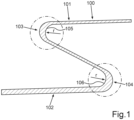
- a cross-sectionally known S-shaped region 100 is shown in the illustration according to Fig. 1 shown.
- This S-shaped region 100 has two S-part regions or two U-shaped or V-shaped parts 101 and 102.
- a deflection zone 103 and 104 of these regions 101 and 102 are constructed as circular arcs 105 and 106. These have the radius r.
- vibrations occur which are also transmitted to this sealing sleeve, in particular the S-shaped region 100. Since this sealing sleeve is elastically deformable, corresponding deformations also occur in this S-shaped region 100.
- the sealing sleeve has an S-shaped area when viewed in cross-section. At least one channel-shaped part of the S-shape has a parabolic shape or is designed in a parabolic shape.
- Such an annular sealing sleeve significantly reduces the deformation behavior when vibrations act on the sealing sleeve. It is particularly advantageous to avoid the legs of the S-shape coming into contact with each other when the vibrations act on the sealing sleeve. This significantly stabilizes this S-shaped area, but on the other hand does not lose its functionality, which is maintained without restriction.
- a deflection zone of at least one S-section of this S-shaped region has a parabolic shape.
- an inner side and/or an outer side of this deflection zone have this parabolic shape.
- at least one specific zone of this S-shaped region, in particular of an S-shaped partial region is no longer designed as a circular arc, but has a parabolic shape.
- This shape is not only flexible, but also robust enough to withstand unwanted deformations, in particular, and retains this S-shape even during system movement and thus vibration and its effects.
- This new shape can also reduce the number and spacing of diagonal folds.
- This specific shape is also particularly advantageous in that the occurrence of self-contact between adjacent legs of this S-shaped region and fatigue within the folds of the S-shaped region can be significantly reduced.
- the parabolic shape is constructed using a tension triangle method.
- a parabolic shape can be designed very individually and with precise shape.
- the tension triangle method enables a shape to be created that offers particularly high stability with regard to a wide range of forces, but does not lose a very advantageous elasticity, particularly in this S-shaped area.
- the basic shape of an inner contour of the channel-shaped sub-area constructed using the tension triangle method is smoothed with a parabola.
- both channel-shaped sub-areas of the S-shape have a parabolic shape.
- the channel-shaped sub-areas of the S-shape are in particular the sub-areas of the S-shape.
- the deflection zones of these two channel-shaped sub-areas are of the same design. They then have the same parabolic shape.
- these two sub-areas, in particular their deflection zones have different parabolic shapes.
- an S-shaped area of such a sealing sleeve which can then also be designed the same in the remaining area in one embodiment, can be individually designed. This means that requirements for the sealing sleeve can be adapted very easily, particularly with regard to use with different device types.
- the sealing sleeve is formed in one piece. It can preferably be made of elastomer.
- This provides a particularly advantageous design method with which the desired parabolic shape can be produced particularly precisely.
- a computer-implemented method can also be used to generate a data set in a particularly advantageous manner, on the basis of which either a specific mold, with which the annular sealing sleeve can then be produced, can be produced with great precision with regard to the parabolic shape to be produced.
- this data set which can be provided to a control unit, to control the manufacturing process of the annular sealing sleeve very precisely, in particular with regard to the production, in particular casting, of the S-shaped region formed as an elastomer. It is therefore particularly advantageous to generate such a data set in order to be able to carry out the actual production very precisely and with precise shape even with advantageous and modern production facilities on the basis of this data set.
- the parabolic shape is constructed on the basis of a tension triangle method. It is particularly advantageous if the production is carried out on the basis of design data such as those obtained by the method explained above for the particularly computer-implemented construction of a channel-shaped region of a sealing sleeve.
- the production of the S-shaped region is controlled on the basis of the design data by a control unit of a production system.
- the production of the S-shaped region takes place on the basis of the design data in such a way that a production tool is first produced and provided as a negative mask, the shape of which was generated at least in part on the basis of these design data.
- a further aspect of the invention relates to a sealing cuff for a household appliance for the care of laundry items, obtainable by a method for producing a sealing cuff for a household appliance according to the above-mentioned aspect or an advantageous embodiment thereof.
- a further aspect of the invention relates to a household appliance for the care of laundry items, with a housing and a tub arranged therein.
- the household appliance also has an annular sealing sleeve according to an above-mentioned aspect or an advantageous embodiment thereof.
- this sealing sleeve is arranged on the one hand on the housing, in particular directly on the housing, and on the other hand on the suds container, in particular directly on the suds container.
- the household appliance can also have a laundry drum. This is accommodated in the suds container.
- a loading opening of the laundry drum can be closed by a door of the household appliance, which is pivotably arranged on the housing.
- the door is arranged overlapping the sealing sleeve when viewed in the depth direction of the household appliance.
- the sealing sleeve can rest against the door with a sealing lip.
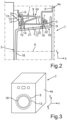
- a household appliance I which is designed for the care of laundry items and can be, for example, a washing machine or a washer-dryer.
- the household appliance I comprises a substantially hollow-cylindrical and annular sealing sleeve 1 which radially encloses a loading and unloading opening 2.
- the loading and unloading opening 2 thus represents an annular hole through which laundry items can be passed.
- the sealing sleeve 1 is fixed at a first end 3 to a front housing wall 4 of a housing 4a of the household appliance I and at a second end 5 to a suds container 6.
- the front housing wall 4 has a flange 7 which is surrounded by a first circumferential bead 8.
- the sealing sleeve 1 has a cylindrical shape and finally merges into a bellows 9.
- this is only to be understood as an example, and the sealing sleeve 1 can also be designed differently in this respect. It is essential that the sealing sleeve 1 has this bellows 9.
- the sealing sleeve 1 is designed to be so flexible that it can compensate for the movements of the tub 6 relative to the front housing wall 4 that occur during the washing process or during the spinning process with large quantities of laundry.
- a second bead 11 is provided on the second end 5 of the sealing sleeve 1, with which the sealing sleeve 1 is fixed to the peripheral edges 10 and 12 of the tub 6.
- a laundry drum 13 is arranged inside the tub 6, which rotates during a washing or spinning process, takes on the function of a spinning drum during a spinning process and is fed from one end through the ring hole.
- a sealing lamella 14 extends from the second bead 11 in the longitudinal direction and thus in the direction of the axis A of the arrangement and reaches up to a flanged edge 15 of the laundry drum 13.
- the illustrated household appliance I also has a porthole-shaped door 16 which, as not shown in detail, is pivotably connected to the front housing wall 4 on one side via a hinge and can be locked on its opposite side against the front housing wall 4.
- the door 16 is preferably made of transparent glass in some areas.
- the door 16 has a frustoconical casing 17 and a circular base 18.
- a sealing lip 19 is formed at the first end of the sealing sleeve 1, as shown in Fig. 2 can be seen.
- This sealing lip 19 extends essentially from the first bead 8 in a radial direction inwards and, when the door 16 is closed, lies sealingly against an outer circumferential surface 21 of the door 16 with a particularly flat annular contact 20.
- This sealing lip 19 is arranged in one piece on a base body 23 of the sealing sleeve 1 and opens into it with a part 22.
- Fig. 3 is a perspective view of the household appliance I, as it is Fig. 2 explained in the sectional view.
- FIG. 4 is a perspective view of an embodiment of an annular sealing sleeve 1 with an S-shaped region 24.
- Fig. 5 In this regard, a perspective sectional view of the sealing sleeve 1 is shown. The specifically shaped S-shaped area 24 can be seen.
- Both the partial area 25 and the partial area 26 have deflection zones 25a and 26a.
- These deflection zones 25a and 26a each have a parabolic shape. This preferably applies to an inner side 25b and/or an inner side 26b. Furthermore, this can also apply to an outer side 25c and/or 26c.
- These deflection zones 25a and 26a can be designed in the same way in terms of their shape as a parabola. The parabolas of these two deflection zones 25a and 26a can be completely different in another embodiment.
- the sealing sleeve 1 is formed in one piece, in particular from elastomer.
- the tension triangle method is preferably used in one embodiment.
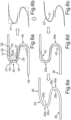
- a step of the construction as shown in Fig. 6a
- two mutually perpendicular legs 27 and 28 are created.
- the method for constructing the channel-shaped partial area 25 explained here and below preferably also applies in a corresponding manner to the further channel area or partial area 26.
- a further base leg 29 is created.
- the base legs 27 and 28 are perpendicular to one another and join together.
- the base legs 27 and 29 also join together perpendicularly.
- the base legs 28 and 29 are preferably oriented parallel to one another.
- a strictly S-shaped basic form 38 can be used as a template for the construction, the transition zones or deflection zones 39 and 40 of which are circular arcs.
- the legs that flow into these circular arcs are straight and oriented parallel to one another.
- the Fig. 6e shown shape of the S-shaped area 24 is present as a data set in the computer-implemented design. This data set can be made available to a manufacturing plant in order to produce the sealing sleeve 1 according to Fig. 4 and 5 , to produce.
Landscapes
- Engineering & Computer Science (AREA)
- Physics & Mathematics (AREA)
- Textile Engineering (AREA)
- General Engineering & Computer Science (AREA)
- Geometry (AREA)
- Mechanical Engineering (AREA)
- General Physics & Mathematics (AREA)
- Theoretical Computer Science (AREA)
- Computational Mathematics (AREA)
- Computer Hardware Design (AREA)
- Evolutionary Computation (AREA)
- Pure & Applied Mathematics (AREA)
- Mathematical Optimization (AREA)
- Mathematical Analysis (AREA)
- Main Body Construction Of Washing Machines And Laundry Dryers (AREA)
- Outer Garments And Coats (AREA)
- Gasket Seals (AREA)
- Details Of Garments (AREA)
Applications Claiming Priority (1)
| Application Number | Priority Date | Filing Date | Title |
|---|---|---|---|
| DE102023204229.0A DE102023204229A1 (de) | 2023-05-08 | 2023-05-08 | Dichtungsmanschette für ein Haushaltsgerät zur Pflege von Wäschestücken mit spezifisch geformtem S-förmigen Bereich, sowie Verfahren und Haushaltsgerät |
Publications (3)
| Publication Number | Publication Date |
|---|---|
| EP4461868A2 true EP4461868A2 (fr) | 2024-11-13 |
| EP4461868A3 EP4461868A3 (fr) | 2025-01-22 |
| EP4461868B1 EP4461868B1 (fr) | 2026-08-19 |
Family
ID=90789641
Family Applications (1)
| Application Number | Title | Priority Date | Filing Date |
|---|---|---|---|
| EP24170804.9A Active EP4461868B1 (fr) | 2023-05-08 | 2024-04-17 | Manchette d'étanchéité pour un appareil ménager destiné à l'entretien du linge, dotée d'une zone en forme de s de forme spécifique, ainsi que procédé et appareil ménager |
Country Status (3)
| Country | Link |
|---|---|
| EP (1) | EP4461868B1 (fr) |
| CN (1) | CN118912210A (fr) |
| DE (1) | DE102023204229A1 (fr) |
Families Citing this family (2)
| Publication number | Priority date | Publication date | Assignee | Title |
|---|---|---|---|---|
| DE202024106857U1 (de) | 2024-11-26 | 2026-04-23 | BSH Hausgeräte GmbH | Profilanordnung für Wäschebehandlungsmaschinen |
| DE202024106858U1 (de) | 2024-11-26 | 2026-04-23 | BSH Hausgeräte GmbH | Wäschebehandlungsmaschine mit einer Profilanordnung |
Citations (1)
| Publication number | Priority date | Publication date | Assignee | Title |
|---|---|---|---|---|
| DE102015204331B4 (de) | 2015-03-11 | 2019-06-19 | BSH Hausgeräte GmbH | Haushaltsgerät zur Pflege von Wäschestücken mit einer Messvorrichtung an einer Dichtungsmanschette |
Family Cites Families (6)
| Publication number | Priority date | Publication date | Assignee | Title |
|---|---|---|---|---|
| KR20050081458A (ko) * | 2004-02-13 | 2005-08-19 | 엘지전자 주식회사 | 드럼 세탁기의 개스킷 |
| DE102006043922B4 (de) * | 2006-09-14 | 2009-12-10 | Miele & Cie. Kg | Faltenbalg für eine Wäschebehandlungsmaschine wie Waschmaschine oder Waschtrockner |
| EP2078777B1 (fr) * | 2008-01-14 | 2016-04-13 | Electrolux Home Products Corporation N.V. | Machine à laver le linge avec soufflets améliorés |
| DE102013110935B4 (de) * | 2013-10-02 | 2016-11-17 | Miele & Cie. Kg | Beutel zur Filterung von Flusen und Wäschetrockner mit einem solchen Beutel |
| AT518347A1 (de) * | 2016-03-14 | 2017-09-15 | Lkr Leichtmetallkompetenzzentrum Ranshofen Gmbh | Stranggepresstes Profil |
| DE102018204716A1 (de) * | 2018-03-28 | 2019-10-02 | BSH Hausgeräte GmbH | Manschette und Wäschebehandlungsgerät |
-
2023
- 2023-05-08 DE DE102023204229.0A patent/DE102023204229A1/de active Pending
-
2024
- 2024-04-15 CN CN202410447380.7A patent/CN118912210A/zh active Pending
- 2024-04-17 EP EP24170804.9A patent/EP4461868B1/fr active Active
Patent Citations (1)
| Publication number | Priority date | Publication date | Assignee | Title |
|---|---|---|---|---|
| DE102015204331B4 (de) | 2015-03-11 | 2019-06-19 | BSH Hausgeräte GmbH | Haushaltsgerät zur Pflege von Wäschestücken mit einer Messvorrichtung an einer Dichtungsmanschette |
Also Published As
| Publication number | Publication date |
|---|---|
| EP4461868A3 (fr) | 2025-01-22 |
| DE102023204229A1 (de) | 2024-11-14 |
| EP4461868B1 (fr) | 2026-08-19 |
| CN118912210A (zh) | 2024-11-08 |
Similar Documents
| Publication | Publication Date | Title |
|---|---|---|
| EP2054648B1 (fr) | Manchon d'étanchéité ou soufflet | |
| DE19615940B4 (de) | Harz-Gleichlaufgelenkmanschette | |
| DE102023204229A1 (de) | Dichtungsmanschette für ein Haushaltsgerät zur Pflege von Wäschestücken mit spezifisch geformtem S-förmigen Bereich, sowie Verfahren und Haushaltsgerät | |
| EP0582543B1 (fr) | Dispositif de raccordement de tuyaux | |
| CH666145A5 (de) | Verfahren zur herstellung von kontaktfederbuchsen. | |
| DE2501774C2 (de) | Verstärkungselement für einen flexiblen Dichtungsstreifen | |
| DE112008004188T5 (de) | Grommet | |
| DE69711377T2 (de) | Schachtoberteil | |
| EP0921328B1 (fr) | Douille avec une collerette médiane, son utilisation et son procédé de fabrication | |
| EP1835199A2 (fr) | Tuyau de jambe de force en tôle laminée flexible | |
| DE10131302A1 (de) | Achsmanschette und Verfahren zu ihrer Herstellung | |
| DE10149335B4 (de) | Strahlreger für eine sanitäre Auslaufarmatur | |
| WO2022003065A1 (fr) | Joint métallique pour une soupape à clapet | |
| DE2047631A1 (de) | Wellendichtung | |
| AT14987U1 (de) | Verfahren zum Verbinden von Möbelbeschlagsteilen und Möbelbeschlag | |
| DE10247070A1 (de) | Waschmaschinentrommel mit Schöpfrippen und Verfahren zur Herstellung einer solchen Waschmaschinentrommel | |
| EP3283681B1 (fr) | Ensemble comprenant un tambour de lavage et un dispositif de compensation de balourd, appareil ménager pour l'entretien d'articles de linge et procédé de fixation d'un dispositif de compensation de balourd | |
| EP3129171A1 (fr) | Procédé de fabrication d'un fond de tambour pour le tambour de lavage d'un appareil électroménager, tambour de lavage et appareil électroménager | |
| DE102022211750A1 (de) | Dichtvorrichtung für Waschmaschinenhülsen | |
| DE102019123295B4 (de) | Intraokularlinse mit spezifischer, dreidimensional gekrümmter Haptik | |
| DE102007012136B4 (de) | Faltenbalgdichtung für eine Waschmaschine | |
| DE10231075A1 (de) | Verfahren zum Herstellen eines Rollbalges | |
| DE102011011150A1 (de) | Medizinische Vorrichtung mit einem expandierbaren Gittergeflecht | |
| DE102005017746A1 (de) | Einbauanordnung für Antriebswellen in Kreuzgelenkgabeln | |
| DE20216045U1 (de) | Abdichtung für ein Kugelgelenk |
Legal Events
| Date | Code | Title | Description |
|---|---|---|---|
| PUAI | Public reference made under article 153(3) epc to a published international application that has entered the european phase |
Free format text: ORIGINAL CODE: 0009012 |
|
| STAA | Information on the status of an ep patent application or granted ep patent |
Free format text: STATUS: THE APPLICATION HAS BEEN PUBLISHED |
|
| AK | Designated contracting states |
Kind code of ref document: A2 Designated state(s): AL AT BE BG CH CY CZ DE DK EE ES FI FR GB GR HR HU IE IS IT LI LT LU LV MC ME MK MT NL NO PL PT RO RS SE SI SK SM TR |
|
| PUAL | Search report despatched |
Free format text: ORIGINAL CODE: 0009013 |
|
| AK | Designated contracting states |
Kind code of ref document: A3 Designated state(s): AL AT BE BG CH CY CZ DE DK EE ES FI FR GB GR HR HU IE IS IT LI LT LU LV MC ME MK MT NL NO PL PT RO RS SE SI SK SM TR |
|
| RIC1 | Information provided on ipc code assigned before grant |
Ipc: D06F 35/00 20060101ALI20241217BHEP Ipc: D06F 37/26 20060101AFI20241217BHEP |
|
| STAA | Information on the status of an ep patent application or granted ep patent |
Free format text: STATUS: REQUEST FOR EXAMINATION WAS MADE |
|
| 17P | Request for examination filed |
Effective date: 20250722 |
|
| GRAP | Despatch of communication of intention to grant a patent |
Free format text: ORIGINAL CODE: EPIDOSNIGR1 |
|
| STAA | Information on the status of an ep patent application or granted ep patent |
Free format text: STATUS: GRANT OF PATENT IS INTENDED |
|
| INTG | Intention to grant announced |
Effective date: 20260415 |
|
| GRAS | Grant fee paid |
Free format text: ORIGINAL CODE: EPIDOSNIGR3 |
|
| GRAA | (expected) grant |
Free format text: ORIGINAL CODE: 0009210 |
|
| STAA | Information on the status of an ep patent application or granted ep patent |
Free format text: STATUS: THE PATENT HAS BEEN GRANTED |