EP4461996A1 - Modulares schaltsystem - Google Patents
Modulares schaltsystem Download PDFInfo
- Publication number
- EP4461996A1 EP4461996A1 EP23172174.7A EP23172174A EP4461996A1 EP 4461996 A1 EP4461996 A1 EP 4461996A1 EP 23172174 A EP23172174 A EP 23172174A EP 4461996 A1 EP4461996 A1 EP 4461996A1
- Authority
- EP
- European Patent Office
- Prior art keywords
- shift
- shift device
- shifting
- housing
- transmission
- Prior art date
- Legal status (The legal status is an assumption and is not a legal conclusion. Google has not performed a legal analysis and makes no representation as to the accuracy of the status listed.)
- Pending
Links
Images


Classifications
-
- F—MECHANICAL ENGINEERING; LIGHTING; HEATING; WEAPONS; BLASTING
- F16—ENGINEERING ELEMENTS AND UNITS; GENERAL MEASURES FOR PRODUCING AND MAINTAINING EFFECTIVE FUNCTIONING OF MACHINES OR INSTALLATIONS; THERMAL INSULATION IN GENERAL
- F16H—GEARING
- F16H61/00—Control functions within control units of change-speed- or reversing-gearings for conveying rotary motion ; Control of exclusively fluid gearing, friction gearing, gearings with endless flexible members or other particular types of gearing
- F16H61/26—Generation or transmission of movements for final actuating mechanisms
- F16H61/28—Generation or transmission of movements for final actuating mechanisms with at least one movement of the final actuating mechanism being caused by a non-mechanical force, e.g. power-assisted
- F16H61/30—Hydraulic or pneumatic motors or related fluid control means therefor
-
- F—MECHANICAL ENGINEERING; LIGHTING; HEATING; WEAPONS; BLASTING
- F16—ENGINEERING ELEMENTS AND UNITS; GENERAL MEASURES FOR PRODUCING AND MAINTAINING EFFECTIVE FUNCTIONING OF MACHINES OR INSTALLATIONS; THERMAL INSULATION IN GENERAL
- F16H—GEARING
- F16H61/00—Control functions within control units of change-speed- or reversing-gearings for conveying rotary motion ; Control of exclusively fluid gearing, friction gearing, gearings with endless flexible members or other particular types of gearing
- F16H61/02—Control functions within control units of change-speed- or reversing-gearings for conveying rotary motion ; Control of exclusively fluid gearing, friction gearing, gearings with endless flexible members or other particular types of gearing characterised by the signals used
- F16H61/0202—Control functions within control units of change-speed- or reversing-gearings for conveying rotary motion ; Control of exclusively fluid gearing, friction gearing, gearings with endless flexible members or other particular types of gearing characterised by the signals used the signals being electric
- F16H61/0204—Control functions within control units of change-speed- or reversing-gearings for conveying rotary motion ; Control of exclusively fluid gearing, friction gearing, gearings with endless flexible members or other particular types of gearing characterised by the signals used the signals being electric for gearshift control, e.g. control functions for performing shifting or generation of shift signal
-
- F—MECHANICAL ENGINEERING; LIGHTING; HEATING; WEAPONS; BLASTING
- F16—ENGINEERING ELEMENTS AND UNITS; GENERAL MEASURES FOR PRODUCING AND MAINTAINING EFFECTIVE FUNCTIONING OF MACHINES OR INSTALLATIONS; THERMAL INSULATION IN GENERAL
- F16H—GEARING
- F16H61/00—Control functions within control units of change-speed- or reversing-gearings for conveying rotary motion ; Control of exclusively fluid gearing, friction gearing, gearings with endless flexible members or other particular types of gearing
- F16H61/26—Generation or transmission of movements for final actuating mechanisms
- F16H61/28—Generation or transmission of movements for final actuating mechanisms with at least one movement of the final actuating mechanism being caused by a non-mechanical force, e.g. power-assisted
- F16H61/32—Electric motors , actuators or related electrical control means therefor
-
- F—MECHANICAL ENGINEERING; LIGHTING; HEATING; WEAPONS; BLASTING
- F16—ENGINEERING ELEMENTS AND UNITS; GENERAL MEASURES FOR PRODUCING AND MAINTAINING EFFECTIVE FUNCTIONING OF MACHINES OR INSTALLATIONS; THERMAL INSULATION IN GENERAL
- F16H—GEARING
- F16H63/00—Control outputs from the control unit to change-speed- or reversing-gearings for conveying rotary motion or to other devices than the final output mechanism
- F16H63/02—Final output mechanisms therefor; Actuating means for the final output mechanisms
- F16H63/04—Final output mechanisms therefor; Actuating means for the final output mechanisms a single final output mechanism being moved by a single final actuating mechanism
- F16H63/06—Final output mechanisms therefor; Actuating means for the final output mechanisms a single final output mechanism being moved by a single final actuating mechanism the final output mechanism having an indefinite number of positions
- F16H63/065—Final output mechanisms therefor; Actuating means for the final output mechanisms a single final output mechanism being moved by a single final actuating mechanism the final output mechanism having an indefinite number of positions hydraulic actuating means
-
- F—MECHANICAL ENGINEERING; LIGHTING; HEATING; WEAPONS; BLASTING
- F16—ENGINEERING ELEMENTS AND UNITS; GENERAL MEASURES FOR PRODUCING AND MAINTAINING EFFECTIVE FUNCTIONING OF MACHINES OR INSTALLATIONS; THERMAL INSULATION IN GENERAL
- F16H—GEARING
- F16H63/00—Control outputs from the control unit to change-speed- or reversing-gearings for conveying rotary motion or to other devices than the final output mechanism
- F16H63/02—Final output mechanisms therefor; Actuating means for the final output mechanisms
- F16H63/08—Multiple final output mechanisms being moved by a single common final actuating mechanism
- F16H63/16—Multiple final output mechanisms being moved by a single common final actuating mechanism the final output mechanisms being successively actuated by progressive movement of the final actuating mechanism
- F16H63/18—Multiple final output mechanisms being moved by a single common final actuating mechanism the final output mechanisms being successively actuated by progressive movement of the final actuating mechanism the final actuating mechanism comprising cams
-
- F—MECHANICAL ENGINEERING; LIGHTING; HEATING; WEAPONS; BLASTING
- F16—ENGINEERING ELEMENTS AND UNITS; GENERAL MEASURES FOR PRODUCING AND MAINTAINING EFFECTIVE FUNCTIONING OF MACHINES OR INSTALLATIONS; THERMAL INSULATION IN GENERAL
- F16H—GEARING
- F16H63/00—Control outputs from the control unit to change-speed- or reversing-gearings for conveying rotary motion or to other devices than the final output mechanism
- F16H63/02—Final output mechanisms therefor; Actuating means for the final output mechanisms
- F16H63/30—Constructional features of the final output mechanisms
- F16H63/3023—Constructional features of the final output mechanisms the final output mechanisms comprising elements moved by fluid pressure
-
- F—MECHANICAL ENGINEERING; LIGHTING; HEATING; WEAPONS; BLASTING
- F16—ENGINEERING ELEMENTS AND UNITS; GENERAL MEASURES FOR PRODUCING AND MAINTAINING EFFECTIVE FUNCTIONING OF MACHINES OR INSTALLATIONS; THERMAL INSULATION IN GENERAL
- F16H—GEARING
- F16H63/00—Control outputs from the control unit to change-speed- or reversing-gearings for conveying rotary motion or to other devices than the final output mechanism
- F16H63/02—Final output mechanisms therefor; Actuating means for the final output mechanisms
- F16H63/30—Constructional features of the final output mechanisms
- F16H63/304—Constructional features of the final output mechanisms the final output mechanisms comprising elements moved by electrical or magnetic force
-
- F—MECHANICAL ENGINEERING; LIGHTING; HEATING; WEAPONS; BLASTING
- F16—ENGINEERING ELEMENTS AND UNITS; GENERAL MEASURES FOR PRODUCING AND MAINTAINING EFFECTIVE FUNCTIONING OF MACHINES OR INSTALLATIONS; THERMAL INSULATION IN GENERAL
- F16H—GEARING
- F16H63/00—Control outputs from the control unit to change-speed- or reversing-gearings for conveying rotary motion or to other devices than the final output mechanism
- F16H63/02—Final output mechanisms therefor; Actuating means for the final output mechanisms
- F16H63/30—Constructional features of the final output mechanisms
- F16H63/32—Gear shift yokes, e.g. shift forks
-
- F—MECHANICAL ENGINEERING; LIGHTING; HEATING; WEAPONS; BLASTING
- F16—ENGINEERING ELEMENTS AND UNITS; GENERAL MEASURES FOR PRODUCING AND MAINTAINING EFFECTIVE FUNCTIONING OF MACHINES OR INSTALLATIONS; THERMAL INSULATION IN GENERAL
- F16H—GEARING
- F16H61/00—Control functions within control units of change-speed- or reversing-gearings for conveying rotary motion ; Control of exclusively fluid gearing, friction gearing, gearings with endless flexible members or other particular types of gearing
- F16H61/26—Generation or transmission of movements for final actuating mechanisms
- F16H61/28—Generation or transmission of movements for final actuating mechanisms with at least one movement of the final actuating mechanism being caused by a non-mechanical force, e.g. power-assisted
- F16H61/30—Hydraulic or pneumatic motors or related fluid control means therefor
- F16H2061/307—Actuators with three or more defined positions, e.g. three position servos
-
- F—MECHANICAL ENGINEERING; LIGHTING; HEATING; WEAPONS; BLASTING
- F16—ENGINEERING ELEMENTS AND UNITS; GENERAL MEASURES FOR PRODUCING AND MAINTAINING EFFECTIVE FUNCTIONING OF MACHINES OR INSTALLATIONS; THERMAL INSULATION IN GENERAL
- F16H—GEARING
- F16H61/00—Control functions within control units of change-speed- or reversing-gearings for conveying rotary motion ; Control of exclusively fluid gearing, friction gearing, gearings with endless flexible members or other particular types of gearing
- F16H61/26—Generation or transmission of movements for final actuating mechanisms
- F16H61/28—Generation or transmission of movements for final actuating mechanisms with at least one movement of the final actuating mechanism being caused by a non-mechanical force, e.g. power-assisted
- F16H61/30—Hydraulic or pneumatic motors or related fluid control means therefor
- F16H2061/308—Modular hydraulic shift units, i.e. preassembled actuator units for select and shift movements adapted for being mounted on transmission casing
-
- F—MECHANICAL ENGINEERING; LIGHTING; HEATING; WEAPONS; BLASTING
- F16—ENGINEERING ELEMENTS AND UNITS; GENERAL MEASURES FOR PRODUCING AND MAINTAINING EFFECTIVE FUNCTIONING OF MACHINES OR INSTALLATIONS; THERMAL INSULATION IN GENERAL
- F16H—GEARING
- F16H63/00—Control outputs from the control unit to change-speed- or reversing-gearings for conveying rotary motion or to other devices than the final output mechanism
- F16H2063/005—Preassembled gear shift units for mounting on gear case
-
- F—MECHANICAL ENGINEERING; LIGHTING; HEATING; WEAPONS; BLASTING
- F16—ENGINEERING ELEMENTS AND UNITS; GENERAL MEASURES FOR PRODUCING AND MAINTAINING EFFECTIVE FUNCTIONING OF MACHINES OR INSTALLATIONS; THERMAL INSULATION IN GENERAL
- F16H—GEARING
- F16H63/00—Control outputs from the control unit to change-speed- or reversing-gearings for conveying rotary motion or to other devices than the final output mechanism
- F16H63/02—Final output mechanisms therefor; Actuating means for the final output mechanisms
- F16H63/30—Constructional features of the final output mechanisms
- F16H63/304—Constructional features of the final output mechanisms the final output mechanisms comprising elements moved by electrical or magnetic force
- F16H2063/3056—Constructional features of the final output mechanisms the final output mechanisms comprising elements moved by electrical or magnetic force using cam or crank gearing
-
- F—MECHANICAL ENGINEERING; LIGHTING; HEATING; WEAPONS; BLASTING
- F16—ENGINEERING ELEMENTS AND UNITS; GENERAL MEASURES FOR PRODUCING AND MAINTAINING EFFECTIVE FUNCTIONING OF MACHINES OR INSTALLATIONS; THERMAL INSULATION IN GENERAL
- F16H—GEARING
- F16H2200/00—Transmissions for multiple ratios
- F16H2200/003—Transmissions for multiple ratios characterised by the number of forward speeds
- F16H2200/0039—Transmissions for multiple ratios characterised by the number of forward speeds the gear ratios comprising three forward speeds
Definitions
- the present invention relates to a modular shifting system.
- the present invention relates to a pneumatically actuated shift device for the modular shifting system.
- a shifting system includes a transmission providing different gear ratios between an output shaft and an input shaft and a shift device for shifting between the different gear ratios of the transmission.
- a transmission providing different gear ratios between an output shaft and an input shaft and a shift device for shifting between the different gear ratios of the transmission.
- an electrically actuated shift device and a pneumatically actuated shift device for the shifting system is known.
- the selection of either the electrically actuated shift device or the pneumatically actuated shift device depends on various factors such as the intended use of the shifting system, customer requirements, etc. Due to the different designs and dimensions of the differently actuated shift devices, the selection of the shift device influences the design of the transmission (and/or the transmission housing), the required installation space of the transmission, and the arrangement of surrounding components, e.g., in a vehicle chassis or a vehicle body.
- the selection of the shift device must therefore be made early in the manufacturing process, which reduces the flexibility. Moreover, the selection of the shift device affects the design and arrangement of adjacent components, which increases the number of different components required and conflicts with the need to achieve the most efficient manufacturing process. In order to make the manufacturing process cost-effective, it is desirable to reduce the number of different components required.
- a pneumatically actuated shift device for the modular shifting system according to the invention is the subject-matter of claim 5. Further advantageous developments are set out in the dependent claims.
- a modular shifting system includes a shift device for shifting between at least two gear ratios, which is detachably attached to a transmission housing.
- the shift device is one of an electrically actuated shift device and a pneumatically actuated shift device and the modular shifting system is configured such that the electrically actuated shift device is interchangeable with the pneumatically actuated shift device and vice versa.
- the electrically and the pneumatically actuated shift devices can be detachably attached to the transmission housing and are interchangeable with each other, the selection of the shift device does not affect the design of the transmission and/or the transmission housing of the shifting system. As a result, the number of different components required can be reduced, which makes the manufacturing process more cost-effective. Moreover, the selection of the shift device can be made later in the manufacturing process facilitating the adaption of the shifting system to customer and market requirements. Consequently, the manufacturing process can be made more flexible.
- the dimensions of a housing of the electrically actuated shift device may substantially be equal to the dimensions of a housing of the pneumatically actuated shift device.
- an installation space required for the modular shifting system is independent of the shift device selection.
- the selection of the shift device does not affect the installation space of the modular shifting system and the influence on the arrangement of surrounding components, e.g., in a vehicle chassis or a vehicle body, can be reduced. This allows the selection of the shift device to be made later in the manufacturing process, making the manufacturing process more flexible.
- the transmission may include a first shift fork axially shiftable by axially shifting a first follower and a second shift fork axially shiftable by axially shifting a second follower.
- the first follower and the second follower may be exposed to the outside of the transmission housing.
- Both the electrically actuated shift device and the pneumatically actuated shift device may include shifting means positioned so as to be able to axially shift the first follower and the second follower.
- the selection of the shift device does not affect the design of the transmission of the shifting system, in particular, the design and the arrangement of the followers intended for the communication with the shift device.
- the number of different components required can be reduced, which makes the manufacturing process more cost-effective.
- the manufacturing of the transmission is not affected by the selection of the shift device.
- the manufacturing process can be made more flexible.
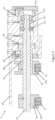
- Figure 1 illustrates a schematic sectional view of the modular shifting system having an electrically actuated shift device 2 attached to a transmission housing 16.
- Figure 2 illustrates a schematic sectional view of the modular shifting system having a pneumatically actuated shift device 3 attached to a transmission housing 16.
- the modular shifting system comprises a transmission 1.
- the transmission 1 includes an input shaft (not shown in the figures) configured to be connected to a drive source, such as an engine or motor, and an output shaft (not shown in the figures) configured to be connected to driven components, such as wheels of a vehicle.
- the input shaft and the output shaft are accommodated in and rotatably supported by the transmission housing 16.
- the transmission 1 further includes multiple (three in the present embodiment shown in the figures) gear trains accommodated in the transmission housing 16 and selectively transmitting torque from the input shaft to the output shaft.
- the gear trains provide different gear ratios for establishing a transmission ratio between the output shaft and the input shaft.
- Each of the gear train is constituted, for example, by a gear provided on the input shaft and a gear provided on the output shaft meshing with the gear provided on the input shaft.
- the gear provided on the input shaft is axially fixed and rotatably supported on the input shaft.
- the gear can be rotationally locked to the input shaft by an engagement with a dog clutch provided on the input shaft.
- the dog clutch is rotationally locked to the input shaft but axially movable relative to the input shaft.
- the dog clutch is allowed to engage and disengage with the gear by axially reciprocating on the input shaft relative to the gear.
- An axial movement of the dog clutch is caused by a shift fork linked to the dog clutch.
- the shift fork is axially movably supported on a sliding rod 15.
- the shift fork is coupled to a follower via a spring mechanism (so called "blocker spring").
- blocker spring By axially shifting the follower, the shift fork is axially shifted, and the dog clutch coupled to the shift fork is engaged with or disengaged from the gear.
- the spring mechanism is capable to temporarily compensate the shifting movement of the follower when the dog clutch is prevented from shifting during the engagement process with the gear, for example, due to a tooth-to-tooth position with the gear, or during the disengagement process with the gear, for example, due to torque still acting on the engagement between the dog clutch and the gear. In this way, the spring mechanism serves to prevent overloading of an actuator that drives the axial movement of the follower.
- the transmission 1 includes a first gear 111, a second gear 112, and a third gear 113.
- the first gear 111 and the second gear 112 can be rotationally locked to the input shaft by means of a first dog clutch 110.
- the third gear 113 can be rotationally locked to the input shaft by means of a second dog clutch 120.
- the first dog clutch 110 is linked to a first shift fork 11, and the second dog clutch 120 is linked to a second shift fork 12 axially movably supported on the sliding rod 15.
- the first shift fork 11 is axially shiftable by a first follower 13 supported on the sliding rod 15.
- the second shift fork 12 is axially shiftable by a second follower 14 supported on the sliding rod 15.
- the first follower 13 and the second follower 14 are provided in the transmission housing 16 so as to be exposed to the outside of the transmission housing 16.
- the first and the second followers 13, 14 are axially shiftable by corresponding shifting means 23, 24, 33, 34 provided in the respective shift device 2, 3 attached to the transmission housing 16.
- the first shift fork 11 is shifted towards the first axial direction thereby moving the first dog clutch 110 from a neutral position, in which the first dog clutch 110 is disengaged with the first and second gears 111, 112, to a first engaged position, in which the first dog clutch 110 is engaged with the first gear 111.
- the first shift fork 11 is shifted towards the second axial direction thereby moving the first dog clutch 110 from a neutral position, in which the first dog clutch 110 is disengaged with the first and second gears 111, 112, to a second engaged position, in which the first dog clutch 110 is engaged with the second gear 112.
- the second shift fork 12 is shifted towards the first axial direction thereby moving the second dog clutch 120 from a neutral position, in which the second dog clutch 120 is disengaged with the third gear 113, to an engaged position, in which the second dog clutch 120 is engaged with the third gear 113.
- an electrically actuated shift device 2 can be attached to the transmission housing 16.
- the electrically actuated shift device 2 comprises an actuator, such as a stepper motor, which is capable of rotating a shifting shaft 21 of the shift device 2 by a specific rotation angle.
- the shifting shaft 21 is accommodated in and rotatably supported by a housing 26 of the shift device 2.
- the shifting shaft 21 is provided with a first shifting means 23 and a second shifting means 24.
- the first and second shifting means 23, 24 are formed in a disk-shaped manner protruding radially outwardly from the shifting shaft 21 and extending in a circumferential direction.
- Each of the shifting means 23, 24 comprises a circumferential recess 231, 241 radially recessed from a peripheral surface of the shifting means 23, 24 towards an axial center and extending in the circumferential direction.
- the circumferential recesses 231, 241 are formed to include inclined portions (not shown in the figures) that are inclined with respect to a plane perpendicular to the axial direction of the shifting shaft 21.
- the circumferential recesses 231, 241 of the first and the second shifting means 23, 24 are at least partially exposed to the outside through a correspondingly arranged opening in the housing 26 of the shift device 2.
- the housing 26 of the electrically actuated shift device 2 can be fixed to the transmission housing 16 by fixing means such as screws.
- the first follower 13 engages with the circumferential recess 231 of the first shifting means 23 and the second follower 14 engages with the circumferential recess 241 of the second shifting means 24. Therefore, when the first and second shifting means 23, 24 are rotated by actuation of the stepper motor, the first and second followers 13, 14 can be axially shifted by the inclined portions of the circumferential recesses 231, 241 engaged with the first and second followers 13, 14.
- Figure 1 shows the electrically actuated shift device 2 in a neutral position. That is, the first and second shifting means 23, 24 engaged with the first and second followers 13, 14, are positioned such that the first dog clutch 110 is not engaged with the first and second gears 111, 112 and the second dog clutch 120 is not engaged with the third gear 113.
- the stepper motor When a shifting command is issued, for example, by a driver of a vehicle provided with the modular shifting system, the stepper motor is actuated and rotates by a specific rotation angle in a specific rotation direction.
- the rotation of the stepper motor causes the shifting shaft 21 and the first and second shifting means 23, 24 to rotate by the specific rotation angle in the specific rotation direction.
- the first and second shifting means 23, 24 rotate, the first and second followers 13, 14 slide within the respective recess of the first and second shifting means 23, 24.
- the first follower 13 sliding within the recess of the first shifting means 23 reaches one of the inclined portions of the recess, the first follower 13 is axially shifted by the rotating first shifting means 23.
- the first shift fork 11 is axially shifted, thereby moving the first dog clutch 110, e.g., from the neutral position to the first engaged position in which the dog clutch engages with the first gear 111.
- the first dog clutch 110 can be engaged with either the first gear 111 or the second gear 112, and the second dog clutch 120 can be engaged with the third gear 113.
- a pneumatically actuated shift device 3 can be attached to the transmission housing 16. Similar to the electrically actuated shift device 2, the pneumatically actuated shift device 2 also comprises a first shifting means 33 engaging with the first follower 13 of the transmission 1 and a second shifting means 34 engaging with the second follower 14 of the transmission 1. However, the shifting of the first and second followers 13, 14 is not caused by rotation but by axial translation of the first and second shifting means 33, 34 in the axial direction. In particular, the first and second shifting means 33, 34 of the pneumatically actuated shift device 3 are reciprocated in the axial direction.
- the pneumatically actuated shift device 3 includes a first shift rod 31 and a second shift rod 32.
- the first shift rod 31 is radially supported by a housing 36 of the pneumatically actuated shift device 3 so as to be slidably movable in an axial direction with respect to the housing 36. That is, the first shift rod 31 is shiftable in a first axial direction (e.g., to the left in figures 2 and 3 ) and in a second axial direction (e.g., to the right in figures 2 and 3 ) opposite to the first axial direction.
- the first shifting means 33 is fixed to the first shift rod 31 so as to move integrally with the first shift rod 31.
- the first shifting means 33 comprises a recessed portion 331 for engaging with the first follower 13.
- the second shift rod 32 is radially supported by the first shift rod 31 so as to be slidably movable in the axial direction with respect to the housing 36 and the first shift rod 31. That is, the second shift rod 32 is shiftable in the first axial direction and in the second axial direction.
- the second shift rod 32 includes a central hollow portion penetrating the second shift rod 32 in the axial direction.
- the first shift rod 31 is inserted into the central hollow portion so as to axially penetrate the second shift rod 32.
- the second shifting means 34 is fixed to the second shift rod 32 so as to move integrally with the second shift rod 32.
- the second shifting means 34 comprises a recessed portion 341 for engaging with the second follower 14.
- the recessed portions 331, 341 of the first and the second shifting means 33, 34 are at least partially exposed to the outside through a correspondingly arranged opening in the housing 36 of the shift device 3.
- the housing 36 of the pneumatically actuated shift device 3 can be fixed to the transmission housing 16 by fixing means such as screws.
- the housing 36 of the pneumatically actuated shift device 3 includes at an axial end portion in the second axial direction a first chamber 37 and a second chamber 38.
- the first chamber 37 is substantially formed as a blind hole opened in the second axial direction.
- the opening of the first chamber 37 is covered by a first cover 371 in an airtight manner.
- the second chamber 38 is substantially formed as a blind hole opened in the first axial direction.
- the opening of the second chamber 38 is covered by a second cover 381 in an airtight manner.
- a through hole extending in the axial direction is provided between the first chamber 37 and the second chamber 38.
- the first shift rod 31 is inserted into the through hole such that an axial end portion of the first shift rod 31 in the second axial direction is accommodated in the first chamber 37 and the first shift rod 31 passes through the second chamber 38 and a corresponding hole in the second cover 381.
- the first shift rod 31 comprises a first piston member 311 and a second piston member 312, 313 arranged on the axial end portion of the first piston member 311 in the second axial direction.
- the first piston member 311 divides the first chamber 37 of the housing 36 into a first space S1 and a second space S2.
- the second piston member 312, 313 divides the first chamber 37 into the second space S2 and a third space S3. Pressurized air can be supplied to and discharged from the first space S1 by a first supply path, the second space S2 by a second supply path, and the third space S3 by a third supply path.
- An axial end side of the first piston member 311 in the first axial direction abuts on a step provided on the first shift rod 31.
- An outer peripheral surface of the first piston member 311 slidably contacts an inner peripheral surface of the first chamber 37 so as to separate the first space S1 and the second space S2 in an airtight manner.
- the second piston member 312, 313 comprises an inner piston element 312 and an outer piston element 313 positioned on a radially outer side of the inner piston element 312.
- the inner piston element 312 is substantially formed by a sleeve having a flange on the axial end side in the second axial direction projecting radially outward.
- the inner piston element 312 (in particular, an axially end surface of the inner piston element 312 in the first axial direction) abuts the first piston member 311.
- the first piston member 311 and the inner piston element 312 are axially fixed to the first shift rod 31 by, for example, a retaining ring. That is, the inner piston element 312 is sandwiched between the first piston member 311 and the retaining ring.
- the outer piston element 313 is substantially formed by a sleeve having a flange on the axial end side in the second axial direction projecting radially outward and a ring-shaped hook portion on the axial end side in the first axial direction projecting radially inward.
- the inner piston element 312 is inserted into the outer piston element 313 such that an inner peripheral surface of the outer piston element 313 slides on an outer peripheral surface of the flange of the inner piston element 312 and an inner peripheral surface of the hook portion slides on an outer peripheral surface of the inner piston element 312.
- the axial movement of the outer piston element 313 in the second axial direction relative to the inner piston element 312 is restricted by the hook portion abutting the flange of the inner piston element 312.
- the axial movement of the outer piston element 313 in the first axial direction relative to the inner piston element 312 is restricted by the hook portion abutting the first piston member 311 (the axial end side of the first piston member 311 in the second axial direction).
- An outer peripheral surface of the flange of the outer piston element 313 slidably contacts an inner peripheral surface of the first chamber 37 so as to separate the second space S2 and the third space S3 in an airtight manner.
- the second shift rod 32 is substantially formed by a sleeve having a flange on the axial end side in the second axial direction projecting radially outward. An axial end portion of the second shift rod 32 in the second axial direction including the flange is inserted into the second chamber 38. The second shift rod 32 passes through the second cover 381 so that the axial end portion of the second shift rod 32 in the first axial direction projects from the second chamber 38.
- the second shifting means 34 is fixed to the axial end portion of the second shift rod 32 in the first axial direction projecting from the second chamber 38.
- An outer peripheral surface of the flange of the second shift rod 32 slidably contacts an inner peripheral surface of the second chamber 38 so as to divide the second chamber 38 into a fourth space S4 and a fifth space S5 and to separate the fourth space S4 and the fifth space S5 in an airtight manner. Pressurized air can be supplied to and discharged from the fourth space S4 by a fourth supply path and the fifth space S5 by a fifth supply path.
- Figures 2 and 3 show the pneumatically actuated shift device 3 in a neutral position. That is, the first and second shifting means 33, 34 engaged with the corresponding one of the first and second followers 13, 14, are positioned such that the first dog clutch 110 is not engaged with the first and second gears 111, 113 and the second dog clutch 120 is not engaged with the third gear 113.
- the flange of the second shift rod 32 When the second shift rod 32 is in a position corresponding to the neutral position of the shift device 3, the flange of the second shift rod 32, in particular, an axial end surface of the flange in the second axial direction, abuts an axial end surface of the second chamber 38.
- pressurized air is supplied to one or more of the first to fifth spaces S1 to S5 via the supply paths, to shift the first and second shift rod 31, 32 in the axial direction.
- the supply of pressurized air is controlled, for example, by corresponding solenoid valves.
- the solenoid valves can be directly integrated on the housing 36 of the pneumatically actuated shift device 3.
- the outer piston element 313 is shifted relative to the inner piston element 312 until the hook portion of the outer piston element 313 abuts the flange of the inner piston element 312.
- the axial force exerted on the outer piston element 313 of the second piston member 312, 313 urges the first shift rod 31 in the second axial direction. Since the surface of the outer piston element 313 exposed to the pressure within the space S2 is larger than the surface of the first piston member 311 exposed to the pressure within the space S2, the axial force urging the first shift rod 31 to the second axial direction is larger than the axial force urging the first shift rod 31 to the first axial direction. As a result, the first shift rod 31 is returned to the position corresponding to the neutral position of the shift device 3 and the first dog clutch 110 is disengaged with the first gear 111 or the second gear 112.
- the pneumatically actuated shift device 3 can be made very compact in size.
- a size of the housing 36 of the pneumatically actuated shift device 3 can be achieved which substantially corresponds to a size of the housing 26 of the electrically actuated shift device 2.
- the first and second shifting means 33, 34 can be positioned corresponding to the first and second shifting means 23, 24 of the electrically actuated shift device 2, i.e., along an axial direction.
- first and second followers 13, 14 of the transmission 1 can be moved axially both by the rotation of the shifting shaft 21 of the electrically actuated shift device 2 with only one actuator (e.g., the stepper motor) and by the pneumatically actuated first and second shift rods 31, 32. Therefore, it is not necessary to adapt the transmission 1, in particular the first and second followers 13, 14 of the transmission 1, to the respective shift device 2, 3.
- one actuator e.g., the stepper motor
Landscapes
- Engineering & Computer Science (AREA)
- General Engineering & Computer Science (AREA)
- Mechanical Engineering (AREA)
- Physics & Mathematics (AREA)
- Fluid Mechanics (AREA)
- Gear-Shifting Mechanisms (AREA)
Priority Applications (3)
| Application Number | Priority Date | Filing Date | Title |
|---|---|---|---|
| EP23172174.7A EP4461996A1 (de) | 2023-05-09 | 2023-05-09 | Modulares schaltsystem |
| US18/630,668 US12590632B2 (en) | 2023-05-09 | 2024-04-09 | Modular shifting system |
| CN202410564020.5A CN118934957A (zh) | 2023-05-09 | 2024-05-08 | 模块化换挡系统 |
Applications Claiming Priority (1)
| Application Number | Priority Date | Filing Date | Title |
|---|---|---|---|
| EP23172174.7A EP4461996A1 (de) | 2023-05-09 | 2023-05-09 | Modulares schaltsystem |
Publications (1)
| Publication Number | Publication Date |
|---|---|
| EP4461996A1 true EP4461996A1 (de) | 2024-11-13 |
Family
ID=86330750
Family Applications (1)
| Application Number | Title | Priority Date | Filing Date |
|---|---|---|---|
| EP23172174.7A Pending EP4461996A1 (de) | 2023-05-09 | 2023-05-09 | Modulares schaltsystem |
Country Status (3)
| Country | Link |
|---|---|
| US (1) | US12590632B2 (de) |
| EP (1) | EP4461996A1 (de) |
| CN (1) | CN118934957A (de) |
Citations (5)
| Publication number | Priority date | Publication date | Assignee | Title |
|---|---|---|---|---|
| US5842947A (en) * | 1996-12-31 | 1998-12-01 | Borg-Warner Automotive, Inc. | Planetary gear carrier having a band brake on an axial extension of the carrier for transfer cases |
| WO2005085683A1 (en) * | 2004-03-05 | 2005-09-15 | Ricardo Uk Ltd., | Gear selector and transmission |
| WO2015144147A1 (de) * | 2014-03-26 | 2015-10-01 | Schaeffler Technologies AG & Co. KG | Getriebeaktor für ein kraftfahrzeuggetriebe |
| DE102016006751A1 (de) * | 2016-06-06 | 2017-12-07 | Knorr-Bremse Systeme für Nutzfahrzeuge GmbH | Betätigungseinheit für ein Schaltgetriebe eines schaltbaren Antriebsstranges |
| US20230075508A1 (en) * | 2016-12-22 | 2023-03-09 | Eaton Cummins Automated Transmission Technologies Llc | High efficiency, high ouput transmission having ease of integration features |
Family Cites Families (2)
| Publication number | Priority date | Publication date | Assignee | Title |
|---|---|---|---|---|
| US5517876A (en) * | 1994-08-04 | 1996-05-21 | Eaton Corporation | Transmission spring loaded shift device |
| JP2019533605A (ja) * | 2016-11-01 | 2019-11-21 | デーナ、オータモウティヴ、システィムズ、グループ、エルエルシー | リニアアクチュエータ機構および車両の車軸連結解除/連結システムにおける使用 |
-
2023
- 2023-05-09 EP EP23172174.7A patent/EP4461996A1/de active Pending
-
2024
- 2024-04-09 US US18/630,668 patent/US12590632B2/en active Active
- 2024-05-08 CN CN202410564020.5A patent/CN118934957A/zh active Pending
Patent Citations (5)
| Publication number | Priority date | Publication date | Assignee | Title |
|---|---|---|---|---|
| US5842947A (en) * | 1996-12-31 | 1998-12-01 | Borg-Warner Automotive, Inc. | Planetary gear carrier having a band brake on an axial extension of the carrier for transfer cases |
| WO2005085683A1 (en) * | 2004-03-05 | 2005-09-15 | Ricardo Uk Ltd., | Gear selector and transmission |
| WO2015144147A1 (de) * | 2014-03-26 | 2015-10-01 | Schaeffler Technologies AG & Co. KG | Getriebeaktor für ein kraftfahrzeuggetriebe |
| DE102016006751A1 (de) * | 2016-06-06 | 2017-12-07 | Knorr-Bremse Systeme für Nutzfahrzeuge GmbH | Betätigungseinheit für ein Schaltgetriebe eines schaltbaren Antriebsstranges |
| US20230075508A1 (en) * | 2016-12-22 | 2023-03-09 | Eaton Cummins Automated Transmission Technologies Llc | High efficiency, high ouput transmission having ease of integration features |
Also Published As
| Publication number | Publication date |
|---|---|
| US20240376980A1 (en) | 2024-11-14 |
| US12590632B2 (en) | 2026-03-31 |
| CN118934957A (zh) | 2024-11-12 |
Similar Documents
| Publication | Publication Date | Title |
|---|---|---|
| US8733200B2 (en) | Shifting device of a motor vehicle manual transmission | |
| EP1245863B1 (de) | Fahrzeuggetriebe | |
| US6607060B2 (en) | Clutch operating system and a hydraulic mechanism used in the same | |
| US8079283B2 (en) | Device for activating gearshift forks | |
| KR101689910B1 (ko) | 하나 이상의 도그 클러치를 구비한 장치 | |
| US11174927B2 (en) | Electric drive assembly | |
| US6886672B2 (en) | Power transmitting apparatus for a working vehicle | |
| US11971073B2 (en) | Rotary shifter assembly | |
| EP3324081B1 (de) | Stellglied für ein shift-by-wire-automatikgetriebe | |
| US5239897A (en) | Automatic selector device for a multi-gear change-speed gearbox | |
| EP4461996A1 (de) | Modulares schaltsystem | |
| US11746856B2 (en) | Shiftable planetary gear train | |
| US6427548B1 (en) | Automatic transmission | |
| US5249476A (en) | Automatic selector device for multi-gear change-speed gearbox | |
| US20080047797A1 (en) | Clutch | |
| US5067362A (en) | Control device | |
| US6854353B2 (en) | Gear shift mechanism | |
| GB2256243A (en) | An automatic selector device including a multi-way selection valve with stop means for a multi-gear change-speed gearbox | |
| CN109210189B (zh) | 变速器致动器、系统包和由系统包与变速器罩组成的系统 | |
| EP4261438A1 (de) | Betätigungssystem zur betätigung von bewegungselementen eines getriebes und anordnung für ein getriebe mit dem betätigungssystem | |
| GB2108602A (en) | Control device for the auxiliary gear reducing unit of a motor vehicle having four driving wheels | |
| US5476164A (en) | Solenoid actuated mechanical clutch | |
| EP2083199B1 (de) | Getriebeschaltsystem | |
| JPH0221645Y2 (de) | ||
| JPH021572Y2 (de) |
Legal Events
| Date | Code | Title | Description |
|---|---|---|---|
| PUAI | Public reference made under article 153(3) epc to a published international application that has entered the european phase |
Free format text: ORIGINAL CODE: 0009012 |
|
| STAA | Information on the status of an ep patent application or granted ep patent |
Free format text: STATUS: THE APPLICATION HAS BEEN PUBLISHED |
|
| AK | Designated contracting states |
Kind code of ref document: A1 Designated state(s): AL AT BE BG CH CY CZ DE DK EE ES FI FR GB GR HR HU IE IS IT LI LT LU LV MC ME MK MT NL NO PL PT RO RS SE SI SK SM TR |
|
| STAA | Information on the status of an ep patent application or granted ep patent |
Free format text: STATUS: REQUEST FOR EXAMINATION WAS MADE |
|
| 17P | Request for examination filed |
Effective date: 20250513 |