EP4462169A2 - Compartiment de comptage et procédé d'analyse d'échantillon - Google Patents
Compartiment de comptage et procédé d'analyse d'échantillon Download PDFInfo
- Publication number
- EP4462169A2 EP4462169A2 EP24190363.2A EP24190363A EP4462169A2 EP 4462169 A2 EP4462169 A2 EP 4462169A2 EP 24190363 A EP24190363 A EP 24190363A EP 4462169 A2 EP4462169 A2 EP 4462169A2
- Authority
- EP
- European Patent Office
- Prior art keywords
- counting
- sample
- compartment
- counting compartment
- sensor
- Prior art date
- Legal status (The legal status is an assumption and is not a legal conclusion. Google has not performed a legal analysis and makes no representation as to the accuracy of the status listed.)
- Pending
Links
Images




Classifications
-
- G—PHYSICS
- G01—MEASURING; TESTING
- G01N—INVESTIGATING OR ANALYSING MATERIALS BY DETERMINING THEIR CHEMICAL OR PHYSICAL PROPERTIES
- G01N15/00—Investigating characteristics of particles; Investigating permeability, pore-volume or surface-area of porous materials
- G01N15/06—Investigating concentration of particle suspensions
-
- B—PERFORMING OPERATIONS; TRANSPORTING
- B01—PHYSICAL OR CHEMICAL PROCESSES OR APPARATUS IN GENERAL
- B01L—CHEMICAL OR PHYSICAL LABORATORY APPARATUS FOR GENERAL USE
- B01L3/00—Containers or dishes for laboratory use, e.g. laboratory glassware; Droppers
- B01L3/50—Containers for the purpose of retaining a material to be analysed, e.g. test tubes
- B01L3/508—Rigid containers without fluid transport within
-
- G—PHYSICS
- G01—MEASURING; TESTING
- G01N—INVESTIGATING OR ANALYSING MATERIALS BY DETERMINING THEIR CHEMICAL OR PHYSICAL PROPERTIES
- G01N15/00—Investigating characteristics of particles; Investigating permeability, pore-volume or surface-area of porous materials
- G01N15/10—Investigating individual particles
- G01N15/14—Optical investigation techniques, e.g. flow cytometry
- G01N15/1425—Optical investigation techniques, e.g. flow cytometry using an analyser being characterised by its control arrangement
-
- G—PHYSICS
- G01—MEASURING; TESTING
- G01N—INVESTIGATING OR ANALYSING MATERIALS BY DETERMINING THEIR CHEMICAL OR PHYSICAL PROPERTIES
- G01N15/00—Investigating characteristics of particles; Investigating permeability, pore-volume or surface-area of porous materials
- G01N15/10—Investigating individual particles
- G01N15/14—Optical investigation techniques, e.g. flow cytometry
- G01N15/1434—Optical arrangements
-
- G—PHYSICS
- G01—MEASURING; TESTING
- G01N—INVESTIGATING OR ANALYSING MATERIALS BY DETERMINING THEIR CHEMICAL OR PHYSICAL PROPERTIES
- G01N21/00—Investigating or analysing materials by the use of optical means, i.e. using sub-millimetre waves, infrared, visible or ultraviolet light
- G01N21/01—Arrangements or apparatus for facilitating the optical investigation
- G01N21/03—Cuvette constructions
- G01N21/0303—Optical path conditioning in cuvettes, e.g. windows; adapted optical elements or systems; path modifying or adjustment
-
- G—PHYSICS
- G01—MEASURING; TESTING
- G01N—INVESTIGATING OR ANALYSING MATERIALS BY DETERMINING THEIR CHEMICAL OR PHYSICAL PROPERTIES
- G01N33/00—Investigating or analysing materials by specific methods not covered by groups G01N1/00 - G01N31/00
- G01N33/48—Biological material, e.g. blood, urine; Haemocytometers
- G01N33/483—Physical analysis of biological material
- G01N33/487—Physical analysis of biological material of liquid biological material
-
- G—PHYSICS
- G02—OPTICS
- G02B—OPTICAL ELEMENTS, SYSTEMS OR APPARATUS
- G02B21/00—Microscopes
- G02B21/06—Means for illuminating specimens
- G02B21/08—Condensers
- G02B21/14—Condensers affording illumination for phase-contrast observation
-
- B—PERFORMING OPERATIONS; TRANSPORTING
- B01—PHYSICAL OR CHEMICAL PROCESSES OR APPARATUS IN GENERAL
- B01L—CHEMICAL OR PHYSICAL LABORATORY APPARATUS FOR GENERAL USE
- B01L2200/00—Solutions for specific problems relating to chemical or physical laboratory apparatus
- B01L2200/02—Adapting objects or devices to another
- B01L2200/025—Align devices or objects to ensure defined positions relative to each other
-
- B—PERFORMING OPERATIONS; TRANSPORTING
- B01—PHYSICAL OR CHEMICAL PROCESSES OR APPARATUS IN GENERAL
- B01L—CHEMICAL OR PHYSICAL LABORATORY APPARATUS FOR GENERAL USE
- B01L2200/00—Solutions for specific problems relating to chemical or physical laboratory apparatus
- B01L2200/06—Fluid handling related problems
- B01L2200/0647—Handling flowable solids, e.g. microscopic beads, cells, particles
-
- B—PERFORMING OPERATIONS; TRANSPORTING
- B01—PHYSICAL OR CHEMICAL PROCESSES OR APPARATUS IN GENERAL
- B01L—CHEMICAL OR PHYSICAL LABORATORY APPARATUS FOR GENERAL USE
- B01L2300/00—Additional constructional details
- B01L2300/04—Closures and closing means
- B01L2300/041—Connecting closures to device or container
-
- B—PERFORMING OPERATIONS; TRANSPORTING
- B01—PHYSICAL OR CHEMICAL PROCESSES OR APPARATUS IN GENERAL
- B01L—CHEMICAL OR PHYSICAL LABORATORY APPARATUS FOR GENERAL USE
- B01L2300/00—Additional constructional details
- B01L2300/08—Geometry, shape and general structure
- B01L2300/0809—Geometry, shape and general structure rectangular shaped
- B01L2300/0816—Cards, e.g. flat sample carriers usually with flow in two horizontal directions
-
- B—PERFORMING OPERATIONS; TRANSPORTING
- B01—PHYSICAL OR CHEMICAL PROCESSES OR APPARATUS IN GENERAL
- B01L—CHEMICAL OR PHYSICAL LABORATORY APPARATUS FOR GENERAL USE
- B01L2300/00—Additional constructional details
- B01L2300/08—Geometry, shape and general structure
- B01L2300/0848—Specific forms of parts of containers
- B01L2300/0851—Bottom walls
-
- B—PERFORMING OPERATIONS; TRANSPORTING
- B01—PHYSICAL OR CHEMICAL PROCESSES OR APPARATUS IN GENERAL
- B01L—CHEMICAL OR PHYSICAL LABORATORY APPARATUS FOR GENERAL USE
- B01L2300/00—Additional constructional details
- B01L2300/08—Geometry, shape and general structure
- B01L2300/0848—Specific forms of parts of containers
- B01L2300/0854—Double walls
-
- B—PERFORMING OPERATIONS; TRANSPORTING
- B01—PHYSICAL OR CHEMICAL PROCESSES OR APPARATUS IN GENERAL
- B01L—CHEMICAL OR PHYSICAL LABORATORY APPARATUS FOR GENERAL USE
- B01L2300/00—Additional constructional details
- B01L2300/08—Geometry, shape and general structure
- B01L2300/0861—Configuration of multiple channels and/or chambers in a single devices
- B01L2300/0877—Flow chambers
-
- B—PERFORMING OPERATIONS; TRANSPORTING
- B01—PHYSICAL OR CHEMICAL PROCESSES OR APPARATUS IN GENERAL
- B01L—CHEMICAL OR PHYSICAL LABORATORY APPARATUS FOR GENERAL USE
- B01L3/00—Containers or dishes for laboratory use, e.g. laboratory glassware; Droppers
- B01L3/50—Containers for the purpose of retaining a material to be analysed, e.g. test tubes
- B01L3/502—Containers for the purpose of retaining a material to be analysed, e.g. test tubes with fluid transport, e.g. in multi-compartment structures
- B01L3/5027—Containers for the purpose of retaining a material to be analysed, e.g. test tubes with fluid transport, e.g. in multi-compartment structures by integrated microfluidic structures, i.e. dimensions of channels and chambers are such that surface tension forces are important, e.g. lab-on-a-chip
- B01L3/502715—Containers for the purpose of retaining a material to be analysed, e.g. test tubes with fluid transport, e.g. in multi-compartment structures by integrated microfluidic structures, i.e. dimensions of channels and chambers are such that surface tension forces are important, e.g. lab-on-a-chip characterised by interfacing components, e.g. fluidic, electrical, optical or mechanical interfaces
-
- G—PHYSICS
- G01—MEASURING; TESTING
- G01N—INVESTIGATING OR ANALYSING MATERIALS BY DETERMINING THEIR CHEMICAL OR PHYSICAL PROPERTIES
- G01N15/00—Investigating characteristics of particles; Investigating permeability, pore-volume or surface-area of porous materials
- G01N15/06—Investigating concentration of particle suspensions
- G01N15/075—Investigating concentration of particle suspensions by optical means
-
- G—PHYSICS
- G01—MEASURING; TESTING
- G01N—INVESTIGATING OR ANALYSING MATERIALS BY DETERMINING THEIR CHEMICAL OR PHYSICAL PROPERTIES
- G01N15/00—Investigating characteristics of particles; Investigating permeability, pore-volume or surface-area of porous materials
- G01N15/10—Investigating individual particles
- G01N15/14—Optical investigation techniques, e.g. flow cytometry
- G01N15/1434—Optical arrangements
- G01N2015/144—Imaging characterised by its optical setup
-
- G—PHYSICS
- G01—MEASURING; TESTING
- G01N—INVESTIGATING OR ANALYSING MATERIALS BY DETERMINING THEIR CHEMICAL OR PHYSICAL PROPERTIES
- G01N15/00—Investigating characteristics of particles; Investigating permeability, pore-volume or surface-area of porous materials
- G01N15/10—Investigating individual particles
- G01N15/14—Optical investigation techniques, e.g. flow cytometry
- G01N2015/1486—Counting the particles
-
- G—PHYSICS
- G01—MEASURING; TESTING
- G01N—INVESTIGATING OR ANALYSING MATERIALS BY DETERMINING THEIR CHEMICAL OR PHYSICAL PROPERTIES
- G01N21/00—Investigating or analysing materials by the use of optical means, i.e. using sub-millimetre waves, infrared, visible or ultraviolet light
- G01N21/01—Arrangements or apparatus for facilitating the optical investigation
- G01N21/03—Cuvette constructions
- G01N2021/0321—One time use cells, e.g. integrally moulded
-
- G—PHYSICS
- G01—MEASURING; TESTING
- G01N—INVESTIGATING OR ANALYSING MATERIALS BY DETERMINING THEIR CHEMICAL OR PHYSICAL PROPERTIES
- G01N21/00—Investigating or analysing materials by the use of optical means, i.e. using sub-millimetre waves, infrared, visible or ultraviolet light
- G01N21/01—Arrangements or apparatus for facilitating the optical investigation
- G01N21/03—Cuvette constructions
- G01N2021/0378—Shapes
- G01N2021/0382—Frustoconical, tapered cell
-
- G—PHYSICS
- G01—MEASURING; TESTING
- G01N—INVESTIGATING OR ANALYSING MATERIALS BY DETERMINING THEIR CHEMICAL OR PHYSICAL PROPERTIES
- G01N21/00—Investigating or analysing materials by the use of optical means, i.e. using sub-millimetre waves, infrared, visible or ultraviolet light
- G01N21/01—Arrangements or apparatus for facilitating the optical investigation
- G01N21/03—Cuvette constructions
- G01N2021/0389—Windows
-
- G—PHYSICS
- G01—MEASURING; TESTING
- G01N—INVESTIGATING OR ANALYSING MATERIALS BY DETERMINING THEIR CHEMICAL OR PHYSICAL PROPERTIES
- G01N2201/00—Features of devices classified in G01N21/00
- G01N2201/06—Illumination; Optics
- G01N2201/066—Modifiable path; multiple paths in one sample
-
- G—PHYSICS
- G01—MEASURING; TESTING
- G01N—INVESTIGATING OR ANALYSING MATERIALS BY DETERMINING THEIR CHEMICAL OR PHYSICAL PROPERTIES
- G01N2201/00—Features of devices classified in G01N21/00
- G01N2201/06—Illumination; Optics
- G01N2201/066—Modifiable path; multiple paths in one sample
- G01N2201/0662—Comparing measurements on two or more paths in one sample
-
- G—PHYSICS
- G02—OPTICS
- G02B—OPTICAL ELEMENTS, SYSTEMS OR APPARATUS
- G02B21/00—Microscopes
- G02B21/24—Base structure
- G02B21/26—Stages; Adjusting means therefor
Definitions
- the present invention relates to a counting compartment or counting chamber for analyzing samples comprising cells or particles, said counting compartment or chamber comprising at least two different depths provided by the bottom and top measurement window.
- the present invention further relates to a counting device comprising the counting compartment or counting chamber of the present invention.
- the present invention further relates to a method for analyzing samples comprising cells or particles, comprising the step of determining the difference between the value measured at the at least two different depths of a counting compartment or counting chamber.
- the present invention further relates to a method for analyzing samples comprising cells or particles, comprising the step of controlling the depth of a counting compartment.
- the aim is to establish how many spermatozoa are present in the sample and also how motile they are and how their morphology is.
- the aim is to establish how many red and/or white blood cells are present in the sample and also how their morphology is.
- a sample of a certain thickness is to be subjected to microscopic examination in a counting compartment, using a grid built into the eyelens of the microscope.
- a grid may be divided into a hundred squares, and the number of cells (such as spermatozoa or blood cells) in each of a representative number of squares can be counted by the investigator in order to determine the total number of cells in the whole grid area.
- Such a grid may also be provided in the counting compartment.
- a counting device which comprises two transparent plates which are held at a fixed distance from each other and joined together by a connecting layer, and at least one counting compartment which is situated between the plates, bounded by the connecting layer and fitted with an inlet and an outlet.
- the connecting layer contains material particles which are separate from one another and have a size that determines the depth of the counting compartment, which material particles are substantially in contact with the two plates.
- this counting device is a one-way device and requires a new counting area for each sample thus raising high requirements for uniformity of the devices. The way of loading the device as well as the quality of the sample can influence the result of such an evaluation. As the two glass plates are firmly attached to each other, the sample must pass through a very small gap into the counting area (typically between 10 and 100 ⁇ m), being thus exposed to any kind of blocking or sieving effects developing at such a small gap.
- this object is solved by a counting compartment for analyzing samples comprising cells or particles, said counting compartment comprising
- this object is solved by a counting device for analyzing samples comprising cells or particles comprising
- this object is solved by a method for analyzing samples comprising cells or particles,
- this object is solved by a method for analyzing samples comprising cells or particles, comprising the step of controlling the depth of a counting compartment, preferably by z axis-calibration or by sensor measurement.
- the present invention provides a counting compartment or counting chamber for analyzing samples comprising cells or particles.
- Said counting compartment or counting chamber comprises:
- the at least two different depths of the counting compartment are provided by the bottom and top measurement window and can preferably be achieved by the following embodiments:
- the bottom and/or top measurement window comprise step(s).
- One or both of the measurement windows comprise a step.
- the counting compartment can be configured such that when the lid/top part closes on the bottom part the step of each of both measurement windows is on top of each other (i.e. super-imposed), thereby forming two different depths; or they are not on top of each other, thereby forming more than two different depths.
- the measurement windows can also comprise more than one such step.
- one of the bottom or top measurement window is placed with inclination.
- one of the bottom or top measurement window is placed parallel to the other measurement window and is provided with a inclined plane on the side facing the sample liquid.
- the at least two different depths of the counting compartment can also be provided by movement, namely by moving the lid or top part and/or the bottom part of the counting compartment, such as with a spindle with motor.
- the bottom and/or top measurement window is made of a transparent material, such as glass or plastic.
- the at least two different depths provided by the bottom and top measurement window are in the range of about 5 to about 100 ⁇ m, preferably about 10 ⁇ m to 40 ⁇ m, for example 10 ⁇ m and 20 ⁇ m.
- the difference between the two different depths provided by the bottom and top measurement window is at least the size or height of a monolayer of the cells or particles of the sample to be analyzed.
- the counting compartment of the present invention can further comprise (4) means for moving the lid or top part.
- the counting compartment of the present invention can further comprise (5) an inlet and outlet.
- the means for moving the lid or top part comprise magnetic means and optionally spacer.
- Examples for magnetic means are permanent electro magnet(s).
- the magnetic means can be comprised in the lid or top part and/or the bottom part.
- spacer examples are spring-loaded spacers.
- the spacer(s) can be comprised in the lid or top part and/or the bottom part.
- screws or gauges can be comprised in the lid or top part and/or the bottom part.
- the lid or top part and the bottom part of the counting department/chamber of the invention are manufactured by high precision manufacturing. In such embodiment, no (micrometer) screws or gauges are necessary.
- the lid or top part is moved by mechanic means, such as a spindle with an attached motor.
- the lid or top part and the bottom part are preferably configured such that they form the bottom, lid and side walls of the counting compartment or counting chamber.
- the lid or top part and the bottom part are made of steel, such as stainless steel.
- the lid or top part and the bottom part are made of ceramics or plastic or using a coating of yet another material to provide certain properties to the device or a combination of materials and manufacturing technologies.
- the inlet and/or outlet can be part of the lid or top part and/or the bottom part.
- the counting compartment or counting chamber of the present invention is a flow-through counting compartment or counting chamber.
- the counting compartment or counting chamber of the present invention is provided/configured such that it can be connected with pumps, control units etc.
- the counting compartment further comprises
- a heating unit is suitable for controlling the temperature of the sample to be analyzed, such as in case of a semen sample.
- a positioning unit is suitable for moving the counting compartment. The positioning and heating unit can be separate but also jointed into one system.
- the counting compartment of the present invention further comprises a grid in in one of the measurement windows.
- Said grid allows a manual count.
- the samples comprising cells or particles are identical to the samples comprising cells or particles.
- the counting compartment is configured to be used for determining the number of cells or particles.
- such cells are spermatozoa or blood cells, e. g. red blood cells.
- the cells are spermatozoa.
- Counting device comprising the counting compartment or chamber
- the present invention provides a counting device for analyzing samples comprising cells or particles.
- Said counting device comprises:
- Said sensor(s) of the counting device are for determining and obtaining the depth(s) of the counting compartment.
- the counting device of the present invention further comprises processing, analyzing and/or evaluating system and software, such as AndroVision ® CASA Software (of Minitüb GmbH, Germany).
- the counting device of the present invention further comprises further sensor(s), such as current sensor, inductive sensor, capacitive sensor, optical sensor(s).
- sensor(s) such as current sensor, inductive sensor, capacitive sensor, optical sensor(s).
- the counting device of the present invention further comprises a grid in the ocular of the light microscope or in one of the measurement windows of the counting compartment or chamber.
- Said grid allows a manual count.
- the samples comprising cells or particles are identical to the samples comprising cells or particles.
- the counting device of the present invention can be designed for the manual or automated use.
- the counting device of the present invention is (fully) automatized.
- the counting device is configured to be used for determining the number of cells or particles.
- such cells are spermatozoa or blood cells, e. g. red blood cells.
- the cells are spermatozoa.
- the present invention provides a first method for analyzing samples comprising cells or particles.
- Said first method comprises the step of determining the difference between the value measured at the at least two different depths of a counting compartment.
- Determining said difference can be used in the following ways:
- Said method of the present invention preferably uses the counting compartment or counting chamber of the present invention and/or the counting device of the present invention.
- the samples comprising cells or particles are provided.
- the method of the present invention comprises the steps of
- the next sample can be analyzed.
- the sample value to be measured is the number of cells or particles in the sample, such as the number of spermatozoa / concentration of spermatozoa.
- the number of cells or particles is measured by identifying and counting each cell in the sample individually and, optionally, by determining, for each cell individually, based on defined parameters, such as cell motility, cell morphology, cell viability etc., whether or not such cell is to be added towards the number of cells to be measured.
- the method according to the present invention is particularly suitable to count the number of spermatozoa in a sample, such spermatozoa being characterized by a set of defined characteristics, as determined by a user/operator of the counting device according to the present invention. The characteristics may be chosen depending on the intended use of the cells.
- the method according to the present invention neither involves the lysis of cells nor the numerical determination of an absorbance value caused by an analyte/biomolecule dissolved in the (liquid) sample. In one embodiment, the method according to the present invention does not involve the numerical determination of a light scattering value caused by an analyte or cell or particle in the (liquid) sample. In embodiments, where the number of cells or particles is determined, such number of cells preferably is an integer value.
- the method of the present invention comprises further analysis of the sample, such as the analysis / evaluation of
- the present invention provides a further method for analyzing samples comprising cells or particles.
- Said further method comprises the step of controlling the depth of a counting compartment, preferably by
- the samples comprising cells or particles are provided.
- the method of the present invention comprises the steps of
- the next sample can be analyzed.
- the sample value to be measured is the number of cells or particles in the sample, such as the number of spermatozoa / concentration of spermatozoa.
- step (4) can follow step (3) or step (3) can follow step (4).
- the number of cells or particles is measured by identifying and counting each cell in the sample individually and, optionally, by determining, for each cell individually, based on defined parameters, such as cell motility, cell morphology, cell viability etc., whether or not such cell is to be added towards the number of cells to be measured.
- the method according to the present invention is particularly suitable to count the number of spermatozoa in a sample, such spermatozoa being characterized by a set of defined characteristics, as determined by a user/operator of the counting device according to the present invention. The characteristics may be chosen depending on the intended use of the cells.
- the method according to the present invention neither involves the lysis of cells nor the numerical determination of an absorbance value caused by an analyte/biomolecule dissolved in the (liquid) sample. In one embodiment, the method according to the present invention does not involve the numerical determination of a light scattering value caused by an analyte or cell or particle in the (liquid) sample. In embodiments, where the number of cells or particles is determined, such number of cells preferably is an integer value.
- the method of the present invention comprises further analysis of the sample, such as the analysis / evaluation of
- the counting compartment of the present invention was developed due to the following critical features of single-use or one-way devices, which are for example:
- the present invention provides a counting compartment or chamber and respective counting device which
- the counting compartment or chamber and respective counting device of the present invention can be used manually and in an automated manner. In the following an automated embodiment is further explained:
- the counting compartment or chamber includes a bottom and lid part.
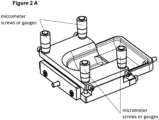
- the lid part includes micrometer screws or gauges and a measurement window.
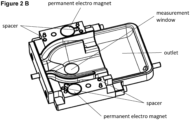
- the bottom part includes a similar configured measurement window. Furthermore, magnetic means and spacer are integrated in the bottom part.
- the bottom part furthermore includes an outlet area.
- the measurement windows are configured such that in the middle there is a step (for example, in the range of 5 to 10 ⁇ m, such as a 5 ⁇ m, 6 ⁇ m or 7 ⁇ m high step).
- a step for example, in the range of 5 to 10 ⁇ m, such as a 5 ⁇ m, 6 ⁇ m or 7 ⁇ m high step.
- the measurement windows are aligned/oriented that both steps are congruent (i.e. super-imposed) and in the directed of the sample flow.
- the steps are super-imposed, thereby forming two different heights/depths of the counting compartment, which differ in height by the sum of the steps in the measurement windows (for example, the sum can be in the range of 10 to 20 ⁇ m, such as 10 ⁇ m, 12 ⁇ m or 14 ⁇ m) (see Figure 1A ).
- the counting compartment is positioned on a heatable motorized positioning unit underneath a light microscope with negative phase contrast (see Figure 3 ). Furthermore, the counting compartment is connected to a draw-off pump, a control unit, an injection pump (with e.g. sample syringe connected thereto).
- the functional core of the counting compartment is the volume which is formed by the overlapping measurement windows of lid and bottom part.
- the distance of both measurement windows to each other is adjusted, namely plan-parallel to each other, by the micrometer screws/gauges integrated in the lid. This is carried out by a continuous white-light interferometry measurement. Generally, depths between about 5 ⁇ m to 100 ⁇ m, preferably 10 to 40 ⁇ m are set (adjusted).
- Opening and closing of the counting compartment is carried out by magnetic means, such as permanent electro magnets located in the bottom part.
- the magnetic means can function in the following way: If no electric current is applied, the lid is pulled towards the bottom, such that the counting compartment is closed. If electric current is applied, the magnetic means lose their holding force, such that the lid part is lifted, and the counting compartment is open. In case the electric power is turned off, the counting compartment closes.
- Liquids are only loaded when the counting compartment is open.
- the loading usually is carried out via silicone tubing, wherein a y-angle, which is located upstream of the counting compartment, unites/brings together sample liquid and washing liquid (such as diluent in case of semen samples) into the inlet of the counting compartment.
- a y-angle which is located upstream of the counting compartment, unites/brings together sample liquid and washing liquid (such as diluent in case of semen samples) into the inlet of the counting compartment.
- Injection of the sample is carried out using an injection pump, in which a milliliter syringe filled with sample liquid is placed.
- the washing or rinsing liquid is pumped into the counting compartment when needed via a flexible-tube pump located e.g. in the housing of the control unit.
- Said pump uses washing liquid (such as diluent in case of semen samples).
- a draw-off pump Downstream of the counting compartment is a draw-off pump, which is connected to the outlet via silicone tubing and which draws off waste or superfluous liquid from the counting compartment.
- the whole process is controlled by a (central) control unit.
- Said central control unit can be connected to and communicate with a processing, analyzing and/or evaluating system and software, such as Androvision ® , for further automation. Then, only one start signal could be required.
- a processing, analyzing and/or evaluating system and software such as Androvision ®
- a specific amount of measurement fields with the bigger depth and the same amount of measurement fields with the smaller depth are analyzed, such as with regard to the cell number/count (e.g. sperm number). See e.g. Figure 4 .
- the respective average is determined (one average value for the bigger and one for the smaller height/depth).
- two different values are obtained.
- two different spermatozoa concentrations since spermatozoa concentration is linearly dependent on the measurement volume.
- the total number of cells or particles such as sperm cells
- an average cell/particle count for the bigger depth and an average cell/particle count for the smaller depth are obtained.
- the advantages of such difference measurement are that the measurement depth does not need to be adjusted for each measurement and that possible errors in the measurement depth, which can e.g. be caused by foreign particles/impurities in the sample, are recognized or "masked", since the difference between the smaller and the bigger height/depth is constant.
- the third value i.e. the difference between the (averaged) value of the smaller and the bigger measurement depth
- the desired value such as the sperm concentration
- the desired value can serve as control of the other two values, since all values should provide the same number of sperm per volume unit. See e.g. Figure 5 .
- a morphological analysis is possible, such as morphological analysis of (sperm) cells.
- the counting compartment can be used for sample analyses after cleaning and rinsing.
- the compartment has to warm up on a certain temperature which can generally be achieved by using a heating unit integrated into the microscope.
- the temperature should simulate physiological conditions (e.g. between 35°C and 39°C).
- Cleaning can be conducted by using alcoholic derivatives and rinsing by using a washing liquid such as BTS semen extender in case of semen samples.
- the amount of washing liquid should be sufficiently chosen in order to remove the amount of sample material in the counting compartment.
- the counting compartment has to be opened for rinsing i.e. the lid or top part is in open position.
- the counting compartment has to be open during sample injection. Analyses can follow.
- the procedure starts from the beginning but without the cleaning step which is only necessary before using the compartment for the first time.
- the raw ejaculate is appropriately diluted with extenders, such as Androhep ® Plus (Minitüb GmbH, Germany), Androstar ® Plus (Minitüb GmbH, Germany), M III ® (Minitüb GmbH, Germany) or BTS (Minitüb GmbH, Germany), shortly after collecting the ejaculate.
- extenders such as Androhep ® Plus (Minitüb GmbH, Germany), Androstar ® Plus (Minitüb GmbH, Germany), M III ® (Minitüb GmbH, Germany) or BTS (Minitüb GmbH, Germany
- Homogenization of such a diluted sample, especially before using the counting compartment, can be conducted manually or mechanically.
- Manual homogenization includes shaking the sample and/or turning the sample in a container.
- Mechanical homogenization includes the usage of a vortex mechanical mixer or a magnetic stirrer.
Landscapes
- Health & Medical Sciences (AREA)
- Chemical & Material Sciences (AREA)
- Life Sciences & Earth Sciences (AREA)
- Physics & Mathematics (AREA)
- Analytical Chemistry (AREA)
- General Physics & Mathematics (AREA)
- General Health & Medical Sciences (AREA)
- Immunology (AREA)
- Pathology (AREA)
- Biochemistry (AREA)
- Engineering & Computer Science (AREA)
- Biomedical Technology (AREA)
- Dispersion Chemistry (AREA)
- Hematology (AREA)
- Urology & Nephrology (AREA)
- Biophysics (AREA)
- Molecular Biology (AREA)
- Food Science & Technology (AREA)
- Medicinal Chemistry (AREA)
- Optics & Photonics (AREA)
- Clinical Laboratory Science (AREA)
- Chemical Kinetics & Catalysis (AREA)
- Investigating Or Analysing Biological Materials (AREA)
- Apparatus Associated With Microorganisms And Enzymes (AREA)
- Analysing Materials By The Use Of Radiation (AREA)
Applications Claiming Priority (3)
| Application Number | Priority Date | Filing Date | Title |
|---|---|---|---|
| EP16153189.2A EP3199937A1 (fr) | 2016-01-28 | 2016-01-28 | Compartiment de comptage et un procédé pour l'analyse d'échantillons |
| EP17702843.8A EP3408644A1 (fr) | 2016-01-28 | 2017-01-30 | Compartiment de comptage et procédé d'analyse d'échantillons |
| PCT/EP2017/051933 WO2017129819A1 (fr) | 2016-01-28 | 2017-01-30 | Compartiment de comptage et procédé d'analyse d'échantillons |
Related Parent Applications (1)
| Application Number | Title | Priority Date | Filing Date |
|---|---|---|---|
| EP17702843.8A Division EP3408644A1 (fr) | 2016-01-28 | 2017-01-30 | Compartiment de comptage et procédé d'analyse d'échantillons |
Publications (2)
| Publication Number | Publication Date |
|---|---|
| EP4462169A2 true EP4462169A2 (fr) | 2024-11-13 |
| EP4462169A3 EP4462169A3 (fr) | 2025-06-25 |
Family
ID=55273138
Family Applications (3)
| Application Number | Title | Priority Date | Filing Date |
|---|---|---|---|
| EP16153189.2A Withdrawn EP3199937A1 (fr) | 2016-01-28 | 2016-01-28 | Compartiment de comptage et un procédé pour l'analyse d'échantillons |
| EP24190363.2A Pending EP4462169A3 (fr) | 2016-01-28 | 2017-01-30 | Compartiment de comptage et procédé d'analyse d'échantillon |
| EP17702843.8A Ceased EP3408644A1 (fr) | 2016-01-28 | 2017-01-30 | Compartiment de comptage et procédé d'analyse d'échantillons |
Family Applications Before (1)
| Application Number | Title | Priority Date | Filing Date |
|---|---|---|---|
| EP16153189.2A Withdrawn EP3199937A1 (fr) | 2016-01-28 | 2016-01-28 | Compartiment de comptage et un procédé pour l'analyse d'échantillons |
Family Applications After (1)
| Application Number | Title | Priority Date | Filing Date |
|---|---|---|---|
| EP17702843.8A Ceased EP3408644A1 (fr) | 2016-01-28 | 2017-01-30 | Compartiment de comptage et procédé d'analyse d'échantillons |
Country Status (3)
| Country | Link |
|---|---|
| US (1) | US10768087B2 (fr) |
| EP (3) | EP3199937A1 (fr) |
| WO (1) | WO2017129819A1 (fr) |
Families Citing this family (2)
| Publication number | Priority date | Publication date | Assignee | Title |
|---|---|---|---|---|
| ES2863800T3 (es) | 2017-12-22 | 2021-10-11 | Minitueb Gmbh | Procedimiento y dispositivos para analizar muestras de esperma |
| CN118294358B (zh) * | 2022-12-30 | 2025-10-21 | 深圳赛桥生物创新技术有限公司 | 微流控芯片的细胞计数方法及细胞计数装置 |
Citations (3)
| Publication number | Priority date | Publication date | Assignee | Title |
|---|---|---|---|---|
| US4911782A (en) | 1988-03-28 | 1990-03-27 | Cyto-Fluidics, Inc. | Method for forming a miniaturized biological assembly |
| US5200152A (en) | 1988-03-28 | 1993-04-06 | Cytonix Corporation | Miniaturized biological assembly |
| EP0809815B1 (fr) | 1995-02-15 | 2002-05-15 | De Kock, Alfons Petrus Antonius Gerrit | Compartiment de comptage pour analyses biologiques, et son procede de fabrication |
Family Cites Families (6)
| Publication number | Priority date | Publication date | Assignee | Title |
|---|---|---|---|---|
| US5214593A (en) * | 1990-11-07 | 1993-05-25 | Rainin Instrument Co., Inc. | Method and apparatus for extending the linear dynamic range of absorbance detectors including multi-lightpath flow cells |
| US5371020A (en) * | 1991-09-19 | 1994-12-06 | Radiometer A/S | Method of photometric in vitro determination of the content of an analyte in a sample |
| AU3530799A (en) * | 1998-05-13 | 1999-11-29 | Bayer Corporation | Optical spectroscopy sample cell |
| JP2015215164A (ja) * | 2012-09-07 | 2015-12-03 | シャープ株式会社 | 測定用器具および測定装置 |
| CA2917889C (fr) * | 2013-07-12 | 2023-10-03 | President And Fellows Of Harvard College | Systemes et procedes pour interconnexion de dispositifs de culture de cellules et interconnexion de dispositifs fluidiques |
| WO2015066006A2 (fr) * | 2013-10-29 | 2015-05-07 | Idexx Laboratories, Inc. | Procédé et dispositif pour détecter des bactéries et déterminer leur concentration dans un échantillon liquide |
-
2016
- 2016-01-28 EP EP16153189.2A patent/EP3199937A1/fr not_active Withdrawn
-
2017
- 2017-01-30 US US16/071,674 patent/US10768087B2/en active Active
- 2017-01-30 WO PCT/EP2017/051933 patent/WO2017129819A1/fr not_active Ceased
- 2017-01-30 EP EP24190363.2A patent/EP4462169A3/fr active Pending
- 2017-01-30 EP EP17702843.8A patent/EP3408644A1/fr not_active Ceased
Patent Citations (4)
| Publication number | Priority date | Publication date | Assignee | Title |
|---|---|---|---|---|
| US4911782A (en) | 1988-03-28 | 1990-03-27 | Cyto-Fluidics, Inc. | Method for forming a miniaturized biological assembly |
| US5200152A (en) | 1988-03-28 | 1993-04-06 | Cytonix Corporation | Miniaturized biological assembly |
| EP0809815B1 (fr) | 1995-02-15 | 2002-05-15 | De Kock, Alfons Petrus Antonius Gerrit | Compartiment de comptage pour analyses biologiques, et son procede de fabrication |
| US6551554B1 (en) | 1995-02-15 | 2003-04-22 | Leja Products B.V. | Counting compartment for biological investigations and a method for manufacturing such a counting compartment |
Also Published As
| Publication number | Publication date |
|---|---|
| US10768087B2 (en) | 2020-09-08 |
| EP3408644A1 (fr) | 2018-12-05 |
| EP4462169A3 (fr) | 2025-06-25 |
| EP3199937A1 (fr) | 2017-08-02 |
| US20190025179A1 (en) | 2019-01-24 |
| WO2017129819A1 (fr) | 2017-08-03 |
Similar Documents
| Publication | Publication Date | Title |
|---|---|---|
| EP1701150B1 (fr) | Comptage de leucocytes | |
| AU2007275926B2 (en) | Enumeration of thrombocytes | |
| JP2023126872A (ja) | 自動顕微鏡血球分析 | |
| US9535059B2 (en) | Microfluidic device | |
| CN112424329B (zh) | 用于细胞成像、分析和测量的系统和方法 | |
| US20050220668A1 (en) | Disposable test device with sample volume measurement and mixing methods | |
| US6852527B2 (en) | Apparatus and method for the measurement of cells in biological samples | |
| Moon et al. | Application of a new portable microscopic somatic cell counter with disposable plastic chip for milk analysis | |
| US11971341B2 (en) | Method and devices for analyzing sperm samples | |
| US10768087B2 (en) | Counting compartment and method for sample analysis | |
| Zheng et al. | Fluorescent labeling, sensing, and differentiation of leukocytes from undiluted whole blood samples | |
| CN112213172A (zh) | 一种稳定的阴道分泌物有形成分染色液及其制备方法 | |
| CN108982337B (zh) | 尿分析装置及尿分析方法 | |
| JP2021530690A (ja) | 自動化試料堆積および染色システムならびに関連方法 | |
| US20080182290A1 (en) | Apparatus and methods for determining viability of cell-based products | |
| WO2013010999A9 (fr) | Procédé et système d'analyse d'un échantillon de cellules liquide par microscopie holographique numérique | |
| WO2025131829A1 (fr) | Procédé et système d'application d'un échantillon liquide sur un substrat pour analyse d'image | |
| US20230173482A1 (en) | Urine analysis systems and methods | |
| WO2008065529A2 (fr) | Appareil et méthodes d'évaluation de produits à base de cellules | |
| Hochsprung et al. | Upgrading urinalysis to support the goals of healthcare reform. | |
| HK1200754B (en) | Microfluidic device |
Legal Events
| Date | Code | Title | Description |
|---|---|---|---|
| PUAI | Public reference made under article 153(3) epc to a published international application that has entered the european phase |
Free format text: ORIGINAL CODE: 0009012 |
|
| STAA | Information on the status of an ep patent application or granted ep patent |
Free format text: STATUS: THE APPLICATION HAS BEEN PUBLISHED |
|
| AC | Divisional application: reference to earlier application |
Ref document number: 3408644 Country of ref document: EP Kind code of ref document: P |
|
| AK | Designated contracting states |
Kind code of ref document: A2 Designated state(s): AL AT BE BG CH CY CZ DE DK EE ES FI FR GB GR HR HU IE IS IT LI LT LU LV MC MK MT NL NO PL PT RO RS SE SI SK SM TR |
|
| REG | Reference to a national code |
Ref country code: DE Ref legal event code: R079 Free format text: PREVIOUS MAIN CLASS: G02B0021260000 Ipc: G01N0015060000 |
|
| RIC1 | Information provided on ipc code assigned before grant |
Ipc: G02B 21/26 20060101ALN20241231BHEP Ipc: B01L 3/00 20060101ALN20241231BHEP Ipc: G01N 21/03 20060101ALN20241231BHEP Ipc: G01N 15/06 20240101AFI20241231BHEP |
|
| PUAL | Search report despatched |
Free format text: ORIGINAL CODE: 0009013 |
|
| AK | Designated contracting states |
Kind code of ref document: A3 Designated state(s): AL AT BE BG CH CY CZ DE DK EE ES FI FR GB GR HR HU IE IS IT LI LT LU LV MC MK MT NL NO PL PT RO RS SE SI SK SM TR |
|
| RIC1 | Information provided on ipc code assigned before grant |
Ipc: G02B 21/26 20060101ALN20250520BHEP Ipc: B01L 3/00 20060101ALN20250520BHEP Ipc: G01N 21/03 20060101ALN20250520BHEP Ipc: G01N 15/06 20240101AFI20250520BHEP |
|
| STAA | Information on the status of an ep patent application or granted ep patent |
Free format text: STATUS: REQUEST FOR EXAMINATION WAS MADE |
|
| STAA | Information on the status of an ep patent application or granted ep patent |
Free format text: STATUS: EXAMINATION IS IN PROGRESS |
|
| 17P | Request for examination filed |
Effective date: 20251202 |
|
| 17Q | First examination report despatched |
Effective date: 20251212 |