EP4464228A1 - Automatische reinigungsvorrichtung und system - Google Patents
Automatische reinigungsvorrichtung und system Download PDFInfo
- Publication number
- EP4464228A1 EP4464228A1 EP22919735.5A EP22919735A EP4464228A1 EP 4464228 A1 EP4464228 A1 EP 4464228A1 EP 22919735 A EP22919735 A EP 22919735A EP 4464228 A1 EP4464228 A1 EP 4464228A1
- Authority
- EP
- European Patent Office
- Prior art keywords
- automatic cleaning
- cleaning device
- button
- bracket
- assembled
- Prior art date
- Legal status (The legal status is an assumption and is not a legal conclusion. Google has not performed a legal analysis and makes no representation as to the accuracy of the status listed.)
- Pending
Links
Images


Classifications
-
- A—HUMAN NECESSITIES
- A47—FURNITURE; DOMESTIC ARTICLES OR APPLIANCES; COFFEE MILLS; SPICE MILLS; SUCTION CLEANERS IN GENERAL
- A47L—DOMESTIC WASHING OR CLEANING; SUCTION CLEANERS IN GENERAL
- A47L11/00—Machines for cleaning floors, carpets, furniture, walls, or wall coverings
- A47L11/40—Parts or details of machines not provided for in groups A47L11/02 - A47L11/38, or not restricted to one of these groups, e.g. handles, arrangements of switches, skirts, buffers, levers
- A47L11/4002—Installations of electric equipment
- A47L11/4008—Arrangements of switches, indicators or the like
-
- A—HUMAN NECESSITIES
- A47—FURNITURE; DOMESTIC ARTICLES OR APPLIANCES; COFFEE MILLS; SPICE MILLS; SUCTION CLEANERS IN GENERAL
- A47L—DOMESTIC WASHING OR CLEANING; SUCTION CLEANERS IN GENERAL
- A47L9/00—Details or accessories of suction cleaners, e.g. mechanical means for controlling the suction or for effecting pulsating action; Storing devices specially adapted to suction cleaners or parts thereof; Carrying-vehicles specially adapted for suction cleaners
- A47L9/28—Installation of the electric equipment, e.g. adaptation or attachment to the suction cleaner; Controlling suction cleaners by electric means
- A47L9/2857—User input or output elements for control, e.g. buttons, switches or displays
-
- H—ELECTRICITY
- H01—ELECTRIC ELEMENTS
- H01H—ELECTRIC SWITCHES; RELAYS; SELECTORS; EMERGENCY PROTECTIVE DEVICES
- H01H23/00—Tumbler or rocker switches, i.e. switches characterised by being operated by rocking an operating member in the form of a rocker button
- H01H23/02—Details
- H01H23/12—Movable parts; Contacts mounted thereon
- H01H23/14—Tumblers
- H01H23/143—Tumblers having a generally flat elongated shape
-
- A—HUMAN NECESSITIES
- A47—FURNITURE; DOMESTIC ARTICLES OR APPLIANCES; COFFEE MILLS; SPICE MILLS; SUCTION CLEANERS IN GENERAL
- A47L—DOMESTIC WASHING OR CLEANING; SUCTION CLEANERS IN GENERAL
- A47L2201/00—Robotic cleaning machines, i.e. with automatic control of the travelling movement or the cleaning operation
-
- H—ELECTRICITY
- H01—ELECTRIC ELEMENTS
- H01H—ELECTRIC SWITCHES; RELAYS; SELECTORS; EMERGENCY PROTECTIVE DEVICES
- H01H2221/00—Actuators
- H01H2221/008—Actuators other then push button
- H01H2221/018—Tumbler
-
- H—ELECTRICITY
- H01—ELECTRIC ELEMENTS
- H01H—ELECTRIC SWITCHES; RELAYS; SELECTORS; EMERGENCY PROTECTIVE DEVICES
- H01H2221/00—Actuators
- H01H2221/036—Return force
- H01H2221/044—Elastic part on actuator or casing
-
- H—ELECTRICITY
- H01—ELECTRIC ELEMENTS
- H01H—ELECTRIC SWITCHES; RELAYS; SELECTORS; EMERGENCY PROTECTIVE DEVICES
- H01H2221/00—Actuators
- H01H2221/054—Actuators connected by flexible webs
-
- H—ELECTRICITY
- H01—ELECTRIC ELEMENTS
- H01H—ELECTRIC SWITCHES; RELAYS; SELECTORS; EMERGENCY PROTECTIVE DEVICES
- H01H2223/00—Casings
- H01H2223/002—Casings sealed
-
- H—ELECTRICITY
- H01—ELECTRIC ELEMENTS
- H01H—ELECTRIC SWITCHES; RELAYS; SELECTORS; EMERGENCY PROTECTIVE DEVICES
- H01H23/00—Tumbler or rocker switches, i.e. switches characterised by being operated by rocking an operating member in the form of a rocker button
- H01H23/02—Details
- H01H23/04—Cases; Covers
- H01H23/06—Dustproof, splashproof, drip-proof, waterproof, or flameproof casings
Definitions
- the present application relates to the field of cleaning robot technologies, and in particular to an automatic cleaning device and an automatic cleaning system.
- Cleaning robots become more and more popular in modem life, and bring convenience to family lives.
- Cleaning robots include sweeping robots, mopping robots, sweeping and mopping integrated robots, or the like. With the popularity of the cleaning robots, the functions and structures of the cleaning robots become more and more complex, and accordingly, their production cost is getting higher and higher.
- some cleaning robots are additionally provided with structures or functions such as automatic charging, automatic dust removal, lifting and vibration.
- structures or functions such as automatic charging, automatic dust removal, lifting and vibration.
- an automatic cleaning device including:
- the step structure in an assembled state, is a step continuously ascending from outside to inside.
- the bracket includes at least one side wall, and an assembly portion is formed on an inner side of the at least one side wall.
- the bracket includes a first side wall extending circumferentially and continuously along an outer edge of the bracket and a second side wall extending circumferentially and continuously along an interior of the bracket, where a first assembly portion is formed between the first side wall and the second side wall, and a second assembly portion is formed inside the second side wall.
- At least a part of the step structure is located on the first assembly portion, and another part of the step structure is located on the second assembly portion.
- each of two ends of the bracket includes a positioning hole
- a lower surface of the cover plate is provided with a positioning column corresponding to the positioning hole, and the positioning column passes through the positioning hole to realize fixation of the bracket.
- the bracket further includes a button plate connected by at least one elastic arm, the button plate is configured to move downwards under an external force to implement a pressing function, and the elastic arm is configured to restore the button plate.
- the button cap includes a pressing body portion and at least one protruding portion extending downwards around the pressing body portion, where when the button cap is assembled on the bracket, the at least one protruding portion is adapted to the assembly portion formed on the inner side of the at least one side wall.
- the button cap includes a first protruding portion and a second protruding portion extending downwards around the pressing body portion, where when the button cap is assembled on the bracket, the first protruding portion and the second protruding portion are adapted to the first assembly portion and the second assembly portion respectively.
- the button cap includes a third protruding portion connecting the first protruding portion to the second protruding portion, and the third protruding portion extends upwards around the pressing body portion.
- FIGS. 1 and 2 are schematic structural diagrams of an automatic cleaning device according to an exemplary embodiment.
- the automatic cleaning device may be a vacuum cleaning robot, a mopping/brushing robot, a window climbing robot, or the like.
- the automatic cleaning device may include a moving platform 100, a sensing system 120, a control system 130, a driving system 140, a cleaning module 150, an energy system 160, and a human-machine interaction system 170.
- the moving platform 100 may be configured to automatically move on an operation surface in a target direction.
- the operation surface may be a surface to be cleaned by the automatic cleaning device.
- the automatic cleaning device may be a mopping robot, in which case the automatic cleaning device works on a floor, and the floor is the operation surface; the automatic cleaning device may also be a window cleaning robot, in which case the automatic cleaning device works on the exterior surface of a glass of a building, and the glass is the operation surface; and the automatic cleaning device may also be a pipeline cleaning robot, in which case the automatic cleaning device works on the interior surface of a pipeline, and the interior surface of the pipeline is the operation surface.
- a mopping robot in which case the automatic cleaning device works on a floor, and the floor is the operation surface
- the automatic cleaning device may also be a window cleaning robot, in which case the automatic cleaning device works on the exterior surface of a glass of a building, and the glass is the operation surface
- the automatic cleaning device may also be a pipeline cleaning robot, in which case the automatic cleaning device works on the interior surface of a pipeline, and the interior surface of the pipeline is the operation surface.
- the cliff sensors 123 are provided at the bottom of the moving platform 100 and in the front and rear of the driving wheel assembly 141.
- the cliff sensors are configured to prevent the automatic cleaning device from falling off when the automatic cleaning device moves back, so as to protect the automatic cleaning device against damage.
- the aforementioned "front” refers to the side in the same direction as the traveling direction of the automatic cleaning device, and the aforementioned “rear” refers to the side in a direction opposite to the traveling direction of the automatic cleaning device.
- a specific type of the position determination apparatus 121 includes, but is not limited to, a camera and a laser distance sensor (LDS).
- LDS laser distance sensor
- the various components in the sensing system 120 may work independently or jointly to achieve intended functions more accurately.
- the surface to be cleaned is identified by the cliff sensor 123 and the ultrasonic sensor to determine the physical properties of the surface to be cleaned, including surface materials, the degree of cleanliness, etc., and more accurate determinations may be performed in combination with the camera, and the laser distance sensor, etc.
- the control system 130 controls the automatic cleaning device to conduct carpet-mode cleaning.
- the buffer 122 is provided on the forward portion 111 of the moving platform 100.
- the buffer 122 detects one or more events (or objects) in a traveling path of the automatic cleaning device via the sensing system (for example, an infrared sensor) when the driving wheel assembly 141 propels the automatic cleaning device to travel on the floor in the process of cleaning.
- the automatic cleaning device may control, according to the events (or objects), such as an obstacle and a wall, detected by the buffer 122, the driving wheel assembly 141 to enable the automatic cleaning device to respond to the events (or objects), for example, moving away from the obstacle.
- the driving system 140 may execute a driving command based on a specific distance and angle information, such as components of x, y and ⁇ , to control the automatic cleaning device to travel across the floor.
- the driving system 140 includes a driving wheel assembly 141, and may control a left wheel and a right wheel simultaneously.
- the driving system 140 preferably includes a left driving wheel assembly and a right driving wheel assembly that are symmetrically provided along a transverse axis defined by the moving platform 100.
- the automatic cleaning device may include one or more steering components 142.
- the steering component 142 may be driven wheels or driving wheels, the structure form of which may include, but is not limited to, universal wheels.
- the steering component 142 may be located in front of the driving wheel assembly 141.
- the energy system 160 includes a rechargeable battery, such as a nickel-hydrogen battery or a lithium battery.
- the rechargeable battery may be connected to a charging control circuit, a battery pack charging temperature detecting circuit, and a battery undervoltage monitoring circuit, which are then connected to a single-chip microcomputer control circuit.
- a host of the automatic cleaning device is connected to a charging pile by a charging electrode provided on a side of or below the body of the automatic cleaning device for charging. If the exposed charging electrode is covered with dust, due to the accumulative effect of charges in the process of charging, a plastic body around the electrode will be melted and deformed, even resulting in that the electrode itself is deformed and the normal charging cannot be continued.
- the human-machine interaction system 170 includes buttons on a panel of the host for a user to select functions, and may further include a display screen and/or an indicator light and/or a speaker, as well as a mobile phone client program.
- the display screen, the indicator light and the speaker show the current state or function options of the automatic cleaning device to the user.
- a mobile phone client may show a map of the environment where the device is located, as well as the location of the device to the user, thus providing the user with richer and more user-friendly function items.
- the cleaning module 150 may include a dry cleaning module 151.
- the dry cleaning module 151 includes a roller brush, a dust box, a fan, and an air outlet.
- the roller brush in a certain interference with the floor sweeps up debris on the floor and rolls it to the front of a dust suction inlet between the roller brush and the dust box, and then the debris is sucked into the dust box by a gas with a suction force, which is generated by the fan and passes through the dust box.
- the dust removal capacity of the sweeping robot can be characterized by the dust pickup (DPU) efficiency of the debris, which is affected by the structure and the material of the roller brush, affected by the utilization rate of air in an air passage formed by the dust suction inlet, the dust box, the fan, the air outlet and connecting components among the dust suction inlet, the dust box, the fan and the air outlet, and affected by the type and the power of the fan; and thus, it is a complex problem of system design.
- the improvement of dust removal capacity is of greater significance to the energy-limited automatic cleaning device compared to an ordinary plug-in vacuum cleaner.
- the dry cleaning module may further include a side brush 152 provided with a rotating shaft at a certain angle relative to the floor, for moving the debris into a roller brush area of the cleaning module 150.
- the automatic cleaning device may further include a wet cleaning module configured to clean at least a part of the operation surface in a wet cleaning manner.
- the wet cleaning module includes a water tank, a cleaning head, a driving unit, or the like, where water from the water tank flows along a waterway to the cleaning head, and the cleaning head cleans at least a part of the operation surface under the driving of the driving unit.
- Pressing structures on cover plates of existing automatic cleaning devices are complex; for example, for most of the button structures of the existing cleaning devices, a soft plastic bracket is provided on a hard plastic bracket, a hard plastic button cap and the soft plastic bracket are bonded together, then the soft plastic bracket and a decorative cover of an upper shell of the automatic cleaning device are bonded together with a double-sided adhesive, and the hard plastic bracket is fixed to the upper shell through a hook at the lower side.
- a button assembly the structure is complex, there is a large number of parts, the assembling time is long, the production process is complex, and the cost is high.
- embodiments of the present application provide an automatic cleaning device without a flip cover, in which the space between the lower side of a button assembly and the upside of a circuit board is increased, while unnecessary components of the button assembly of the automatic cleaning device are omitted, so that more electronic components can be arranged in the space. Meanwhile, the resilience of the button assembly is increased, making it easier to implement pressings.
- the present application provides an automatic cleaning device. As shown in FIG.
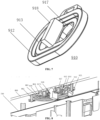
- the present application provides an automatic cleaning device, including: a moving platform 100 configured to automatically move on an operation surface, where the moving platform 100 includes a cover plate 800, and the cover plate 800 constitutes at least a part of the top surface of the moving platform; and a button assembly 900, configured to be manually operated and pressed to control operations of the automatic cleaning device.
- the button assembly 900 includes a button cap 910 and a bracket 920, which are assembled on the cover plate 800, where the cover plate 800 includes a button mounting hole 802, the button assembly 900 includes a pressing body portion 911, and the pressing body portion 911 is assembled in the button mounting hole 802, so that a top surface of the pressing body portion is approximately flush with a top surface of the cover plate.
- the button assembly 900 may be applied to any device housing that requires mechanical buttons, including but not limited to a sweeping robot, a mopping robot, a sweeping and mopping robot, a hand-held robot, and a sprinkling robot.
- the button assembly is usually provided on an upper surface of the housing of a mechanical device, and may also be provided on a side surface of the housing of the mechanical device, which is not limited herein.
- the housing of the mechanical device is usually made of hard plastic, resin, metal or alloy materials, which is not limited herein.
- the button assembly 900 includes a button cap 910 and a bracket 920.
- the button cap 910 is usually made of a soft plastic light-tight material to provide the leakproofness, waterproofness and lightproofness during interference assembly.
- the bracket 920 is usually made of a hard plastic material to provide support during assembly of the button cap, and to fix the button cap in cooperation with the hard cover plate. As shown in FIG.
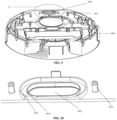
- the soft plastic button cap is first assembled with the cover plate from bottom to top, so that at least the pressing body portion 911 is assembled in the corresponding button mounting hole 802; and then, the hard plastic bracket is assembled under the soft plastic button cap and fixed by a positioning column 801 on the cover plate 800 and a positioning hole 925 in the bracket 920, so as to form the button assembly.
- the two circular positioning holes 925 in the button bracket and the positioning column 801 of a snap-on structure on the cover plate simultaneously serve the function of positioning, so that the button cap 910 is assembled between the bracket 920 and the cover plate.
- the bracket 920 includes a step structure 930 extending in a circumferential direction.
- the step structure is a step continuously ascending from outside to inside or from inside to outside.
- an elevated portion in the step structure can provide a layout space and a design freedom for other components, so that the space at the upper portion of the bracket is effectively utilized.
- the direction of the step can be designed according to space requirements of other components.
- the step structure is a step continuously ascending from outside to inside, and the step continuously ascending from outside to inside not only increases an extra space, but also the increased extra space is in the middle, which is conductive to providing a sufficient space correspondingly below the pressing body portion, which is required for implementing a pressing action.
- the pressing stroke is reasonably set and the elasticity is restored, so as to enhance the user experience.
- Each step of the step structure 930 extends circumferentially parallel to an overall peripheral contour shape of the bracket 920 in a surrounding manner to form a closed structure, such as a surrounding closed ellipse, circle, square, rectangle, etc., which is not limited herein.
- the step structure 930 is a substantially tapered step structure formed by steps continuously ascending from outside to inside, and extends upwards from outer-ring steps to inner-ring steps.
- the specific number of steps is not limited; for example, there are 2-5 steps. As an example, there are 2-3 steps.
- each step is not limited in width and height, and the steps may be of equal width and equal height, or unequal widths and unequal heights.
- the bracket 920 extends in the circumferential direction, there is a larger overhanging space under the bracket.
- a butted circuit board 700 is located under the bracket, as shown in FIG.
- the overhanging space can improve the convenience of designing components for the circuit board relative to a confined space, so that the space originally occupied by the lower portion of the bracket can be used to provide more electronic components.
- the bracket 920 extends in the circumferential direction, there is a larger overhanging space under the bracket, which improves the resilience of the hard bracket. After a pressing force applied to the button assembly is transmitted to the hard bracket, the bracket is more prone to elastic deformation and is easier to restore after being subject to the elastic deformation, which brings a better touch feeling for the button assembly and improves the convenience of pressing contact of the device.
- the bracket 920 includes a first side wall 921 extending circumferentially and continuously along an outer edge of the bracket 920 and a second side wall 922 extending circumferentially and continuously along an interior of the bracket 920, where a first assembly portion 923 is formed between the first side wall 921 and the second side wall 922, and a second assembly portion 924 is formed inside the second side wall 922.
- the first side wall 921 and the second side wall 922 extend circumferentially parallel to an overall peripheral contour shape of the bracket 920 in a surrounding manner to form a closed structure, such as a surrounding closed ellipse, circle, square, rectangle, etc., which is not limited herein.
- the first side wall 921 and the second side wall 922 which extend in a closed manner, form the first assembly portion 923 and the second assembly portion 924 for accommodating a first protruding portion 912 and a second protruding portion 913 of the button cap, thus playing a role in fixing and supporting the button cap as a whole.
- the step structure is located on the first assembly portion 923, and another part of the step structure is located on the second assembly portion 924.
- the first assembly portion 923 includes at least one step structure
- the second assembly portion 924 includes the highest step surface of the step structure.
- the first side wall 921 and the second side wall 922 substantially form a high-low structure as the step structure 930 ascends.
- the second side wall 922 is higher than the first side wall 921, allowing for more stable supporting for the button cap and more complete sealing.
Landscapes
- Engineering & Computer Science (AREA)
- Mechanical Engineering (AREA)
- Cleaning Implements For Floors, Carpets, Furniture, Walls, And The Like (AREA)
- Electric Vacuum Cleaner (AREA)
- Push-Button Switches (AREA)
Applications Claiming Priority (2)
| Application Number | Priority Date | Filing Date | Title |
|---|---|---|---|
| CN202220066057.1U CN216932997U (zh) | 2022-01-11 | 2022-01-11 | 自动清洁设备及系统 |
| PCT/CN2022/093608 WO2023134096A1 (zh) | 2022-01-11 | 2022-05-18 | 自动清洁设备及系统 |
Publications (2)
| Publication Number | Publication Date |
|---|---|
| EP4464228A1 true EP4464228A1 (de) | 2024-11-20 |
| EP4464228A4 EP4464228A4 (de) | 2026-01-28 |
Family
ID=82315153
Family Applications (1)
| Application Number | Title | Priority Date | Filing Date |
|---|---|---|---|
| EP22919735.5A Pending EP4464228A4 (de) | 2022-01-11 | 2022-05-18 | Automatische reinigungsvorrichtung und system |
Country Status (7)
| Country | Link |
|---|---|
| US (1) | US20250089965A1 (de) |
| EP (1) | EP4464228A4 (de) |
| JP (1) | JP7817411B2 (de) |
| KR (1) | KR20240134003A (de) |
| CN (1) | CN216932997U (de) |
| AU (1) | AU2022434150B2 (de) |
| WO (1) | WO2023134096A1 (de) |
Families Citing this family (4)
| Publication number | Priority date | Publication date | Assignee | Title |
|---|---|---|---|---|
| JP1766127S (ja) * | 2022-12-06 | 2024-03-21 | 掃除ロボット | |
| USD1097398S1 (en) * | 2022-12-16 | 2025-10-07 | Alfred Kaercher Se & Co. Kg | Floor cleaning robot |
| USD1082190S1 (en) * | 2023-06-12 | 2025-07-01 | Samsung Electronics Co., Ltd. | Robot vacuum cleaner |
| CA234408S (en) * | 2024-03-25 | 2025-10-22 | Beijing Roborock Technology Co Ltd | Self-cleaning part of docking station for cleaning appliance |
Family Cites Families (8)
| Publication number | Priority date | Publication date | Assignee | Title |
|---|---|---|---|---|
| JP2016219347A (ja) | 2015-05-25 | 2016-12-22 | フォスター電機株式会社 | コントロールユニット及びその製造方法 |
| WO2017073582A1 (ja) * | 2015-10-28 | 2017-05-04 | ホーチキ株式会社 | 機器取付構造及びその取付板、警報器、火災警報器、警報装置及びその製造方法 |
| JP2018061539A (ja) * | 2016-10-11 | 2018-04-19 | 日立アプライアンス株式会社 | 電気掃除機 |
| CN111768996B (zh) * | 2019-12-17 | 2024-01-12 | 北京沃东天骏信息技术有限公司 | 按键组件和音箱 |
| CN211016862U (zh) * | 2020-01-22 | 2020-07-14 | 佛山市云米电器科技有限公司 | 一种榨汁机的防水按键结构 |
| CN213958834U (zh) * | 2020-12-22 | 2021-08-13 | 佛山市顺德区美的洗涤电器制造有限公司 | 一种按键防水结构和洗碗机 |
| CN213845098U (zh) * | 2021-01-05 | 2021-07-30 | 深圳市冠杰工业制造有限公司 | 一种记录仪的超薄防水按键结构 |
| CN113331745B (zh) * | 2021-06-29 | 2025-04-04 | 深圳银星智能集团股份有限公司 | 清洁设备 |
-
2022
- 2022-01-11 CN CN202220066057.1U patent/CN216932997U/zh active Active
- 2022-05-18 US US18/728,056 patent/US20250089965A1/en active Pending
- 2022-05-18 EP EP22919735.5A patent/EP4464228A4/de active Pending
- 2022-05-18 WO PCT/CN2022/093608 patent/WO2023134096A1/zh not_active Ceased
- 2022-05-18 JP JP2024541630A patent/JP7817411B2/ja active Active
- 2022-05-18 KR KR1020247026370A patent/KR20240134003A/ko active Pending
- 2022-05-18 AU AU2022434150A patent/AU2022434150B2/en active Active
Also Published As
| Publication number | Publication date |
|---|---|
| WO2023134096A1 (zh) | 2023-07-20 |
| EP4464228A4 (de) | 2026-01-28 |
| AU2022434150B2 (en) | 2026-02-12 |
| AU2022434150A1 (en) | 2024-08-22 |
| CN216932997U (zh) | 2022-07-12 |
| JP2025501386A (ja) | 2025-01-17 |
| KR20240134003A (ko) | 2024-09-05 |
| JP7817411B2 (ja) | 2026-02-18 |
| US20250089965A1 (en) | 2025-03-20 |
Similar Documents
| Publication | Publication Date | Title |
|---|---|---|
| AU2022434150B2 (en) | Automatic cleaning device and system | |
| EP3690591B1 (de) | Autonomer mobiler roboter und ladestationsuchverfahren dafür, steuerungsvorrichtung und intelligentes reinigungssystem | |
| EP4461186A1 (de) | Automatische reinigungsvorrichtung und system | |
| EP3684238B1 (de) | Feuchtigkeitsdichte matte und intelligentes reinigungssystem | |
| AU2022434156B2 (en) | Automatic cleaning device | |
| US20220313051A1 (en) | Blocking plug and intelligent cleaning device | |
| AU2022433747B2 (en) | Automatic cleaning apparatus. | |
| AU2022434162B2 (en) | Automatic cleaning device | |
| EP4464225A1 (de) | Automatische reinigungsvorrichtung | |
| CN218451585U (zh) | 自动清洁设备 | |
| EP4578358A1 (de) | Automatische reinigungsvorrichtung und system | |
| CN218500627U (zh) | 清洁设备及系统 | |
| CN216495111U (zh) | 自动清洁设备 |
Legal Events
| Date | Code | Title | Description |
|---|---|---|---|
| STAA | Information on the status of an ep patent application or granted ep patent |
Free format text: STATUS: THE INTERNATIONAL PUBLICATION HAS BEEN MADE |
|
| PUAI | Public reference made under article 153(3) epc to a published international application that has entered the european phase |
Free format text: ORIGINAL CODE: 0009012 |
|
| STAA | Information on the status of an ep patent application or granted ep patent |
Free format text: STATUS: REQUEST FOR EXAMINATION WAS MADE |
|
| 17P | Request for examination filed |
Effective date: 20240807 |
|
| AK | Designated contracting states |
Kind code of ref document: A1 Designated state(s): AL AT BE BG CH CY CZ DE DK EE ES FI FR GB GR HR HU IE IS IT LI LT LU LV MC MK MT NL NO PL PT RO RS SE SI SK SM TR |
|
| DAV | Request for validation of the european patent (deleted) | ||
| DAX | Request for extension of the european patent (deleted) | ||
| A4 | Supplementary search report drawn up and despatched |
Effective date: 20260108 |
|
| RIC1 | Information provided on ipc code assigned before grant |
Ipc: A47L 11/40 20060101AFI20251223BHEP Ipc: A47L 11/24 20060101ALI20251223BHEP |